Showing posts with label lauren bacall. Show all posts
Friday, November 14, 2014
Cameraman: The Life and Work of Jack Cardiff
Directed by Craig McCall, Cameraman: The Life and Work of Jack Cardiff is a documentary about the cinematographer who helped innovate the use of Technicolor as well as providing the cinema some of its greatest images. Especially as he was revered by the filmmakers he worked with as well as actors and actresses. The result is one of the most fascinating documentaries about one of cinema’s great photographers.
Famous for his beautiful work with Technicolor film stock for films like The Red Shoes, Black Narcissus, The African Queen, Barefoot Contessa, and Under Capricorn among many others. Jack Cardiff was a cinematographer who was considered one of the best as he would push the film stock to great heights as he went from being a cameraman to a top cinematographer. Shot partially in 2008 (a year before his death) as well as footage from his trip to the 1998 Cannes Film Festival where he was a guest of honor. Cardiff talks about many of the films he shot as well as the filmmakers, actors, actresses, and technicians he worked with in his illustrious career.
Some of which involves his process into the art of photography where Cardiff revealed that he was inspired more by painters rather than what was happening film. When Technicolor arrived in Britain in the late 1930s, Cardiff was the first who would understand the process as he would serve as a cameraman for a few documentaries that led to him working with Michael Powell and Emeric Pressburger as a second unit cameraman in The Life and Death of Colonel Blimp. This would get him a job to work as a cinematographer in their great works such as A Matter of Life and Death, Black Narcissus, and The Red Shoes. Cardiff also talks about some his early experiences as a cameraman in the 1930s where he talked about Marlene Dietrich’s fondness for lighting which he was impressed by.
With interviews from actors like Kirk Douglas and Lauren Bacall as well as filmmakers Martin Scorsese and Richard Fleischer plus Scorsese’s editor Thelma Schoonmaker, many of them discuss Cardiff’s methods in the art of photography. Even as Bacall, who would often visit’s the sets where her husband Humphrey Bogart was starring in, talked about how good he shot the actors which made actresses like Sophia Loren, Marilyn Monroe, Katherine Hepburn, Ava Gardner, and Marilyn Monroe look great as they would do photos for him for fun. There’s also discussions about Cardiff’s brief period as a filmmaker where despite getting accolades for films like Sons and Lovers and My Geisha in the 1960s, he would eventually return to cinematography in the late 1970s.
With some unique editing from Dan Roberts and Chris Dickens along with some terrific sound design from Sandra Portman, the film definitely takes a unique look into Cardiff’s career as he also talks about some of the drawbacks he had upon his return when it came to photographic special effects as Scorsese, who is an admirer of Cardiff’s work, expresses the sense of loss in the transition between film and digital where Scorsese favors the former. With some wonderfully low-key yet whimsical music from Mark Sayer-Wade, the film has this appreciation for Cardiff‘s contributions which begins and ends with the honorary Oscar he would receive at the 2001 Academy Awards.
Cameraman: The Life and Work with Jack Cardiff is an extraordinary film from Craig McCall. The film isn’t just a mesmerizing piece on one of cinema’s great photographers but also a man who brought a lot of new things to cinematography when film was getting a sense of how to present color. In the end, Cameraman: The Life and Work of Jack Cardiff is a sensationally rich film from Craig McCall.
© thevoid99 2014
Wednesday, June 25, 2014
Written on the Wind
Based on the novel by Robert Wilder, Written on the Wind is the story of a woman who marries into an oil family as she would fall for her husband’s best friend. Directed by Douglas Sirk and screenplay by George Zuckerman, the film is an exploration of a woman who becomes part of a very dysfunctional and decadent family as she tries to make sense of the family she‘s married to while dealing with her feelings for husband‘s best friend. Starring Rock Hudson, Lauren Bacall, Robert Stack, and Dorothy Malone. Written on the Wind is a sensational yet wild film from Douglas Sirk.
Based on a real life incident involving the tobacco heir Zachary Smith Reynolds and torch singer Libby Holman, the film is an exploration into the chaotic world of a Texan oil family whose adult children are spoiled and troubled as they besmirch the reputation of the family as an heir’s wife and his best friend are caught in the middle. Much of which play into an heir trying to find happiness in his life as he meets an executive secretary in New York City as he woos her into marrying him. Though it seems to be a major change and a step into maturity for Kyle Hadley (Robert Stack) as he would introduce his new wife Lucy Moore (Lauren Bacall) to his father Jasper (Robert Keith). Trouble would brew due to the presence of Kyle’s younger sister Marylee (Dorothy Malone) who has gained a reputation for being a nymphomaniac as she also wants longtime childhood friend Mitch Wayne (Rock Hudson) who secretly has feelings for Lucy.
George Zuckerman’s screenplay doesn’t just explore the desires of what Kyle and Marylee Hadley want in their very lavish but often empty lives. The script also explores Lucy and Mitch being in the middle of this chaotic world where Lucy was reluctant to be wooed by Kyle yet finds him fascinating as he was very honest about his alcoholism and such. While Mitch would watch Kyle be with Lucy as he would suck it up and accept it, he becomes overwhelmed by Kyle and Marylee as he wants to leave the entire world of the Hadleys though he still has some loyalty to Japser. While he knows about Kyle’s alcoholism and does pity him, Lucy has no clue on how severe it is as she and Kyle try to start a family only for things to not go as quickly as Kyle wanted. Adding to Kyle’s already fragile state is Marylee whose desire to want Mitch would have her be manipulative to Kyle over the idea that Mitch and Lucy are having an affair which isn’t true. It would add to the heightened sense of drama that would play out as it would be very sensational but also lurid considering the kind of behavior that Marylee has.
Douglas Sirk’s direction is very stylish as well as being a bit over-the-top of times since it does play into his sensibilities on melodrama. While he keeps much of it restrained and somber early on though the film begins with Kyle driving very fast to his home as a gunshot is then heard. It then flashes back to something less dramatic when Kyle meets Lucy for the first time where he’s about to have lunch with Mitch as it starts off as this very straightforward romance with some very lovely compositions in its use of medium shots and close-ups along with a few low angle shots. The film becomes more stylized in its compositions once the film is set in Texas where Sirk adds something that is very dark once Marylee comes into the picture as she is this firecracker that likes to push buttons. While she may have some air of innocence over what she wants to have with Mitch, there is that layer of darkness about her that does drive the film. Especially where it would have this soaring and sensational idea of drama where it is very strange at times but also offbeat considering how over-the-top it can be. Overall, Sirk crafts a very mesmerizing yet visceral film about two people caught up in the world of a very dysfunctional family.
Cinematographer Russell Metty does phenomenal work with the film‘s very rich and colorful Technicolor-based cinematography with its stylish approach to lighting for some of its nighttime interior scenes as well as the way some of the locations in Texas plus the old river that Kyle, Mitch, and Marylee used to play at. Editor Russell J. Schoengarth does excellent work with the editing as it‘s straightforward in terms of its cutting strategies while playing to the film‘s unique rhythm for its melodramatic moments. Art directors Alexander Golitzen and Robert Clatworthy, with set decorators Russell A. Gausman and Julia Heron, do fantastic work with the design of Hadley mansion as well as the bar that Kyle likes to go as well as the posh hotel suites in Miami where Kyle hoped to woo Lucy at.
Costume designer Bill Thomas does amazing work with the design of the gowns that Marylee and Lucy wears as the former is very lavish and provocative while the latter is more classy as it both plays to their personalities. The sound work of Leslie I. Carey and Robert Pritchard is terrific for the way the Hadleys‘ cars sound when they‘re speeding to the atmosphere of the parties they old. The film’s music by Frank Skinner is brilliant for its soaring and lush orchestral-based music as it plays to the melodrama while there‘s some jazz-based themes that play into the world of Marylee while music supervisor Joseph Gershenson brings in some jazz-based pieces into the music soundtrack plus a ballad written by Victor Young and Sammy Cahn that opens the film.
The film’s superb cast includes some notable small roles from Robert J. Wilkes as the bartender at the bar that Kyle likes to drink at, Harry Shannon as Mitch’s father, John Larch as one of Marylee’s lovers, Roy Glenn and Maidie Norman as the house servants of the Hadley home, and Edward Platt as the longtime family doctor who examines Lucy as he becomes concerned if Kyle is the real problem. Robert Keith is excellent as Marylee and Kyle’s father Jasper as an oil man who treats Mitch like a son as he watches the behavior of his children with great despair as he questions about his failings as a father. Dorothy Malone is amazing as the very lurid and slimy Marylee Hadley as this nymphomaniac who likes to cause trouble while wanting to pursue Mitch in every way she can.
Robert Stack is brilliant as the troubled Kyle Hadley as a playboy who wants to have the good things in life when he meets Lucy only to succumb to his own insecurities and alcoholism as he loses sight of everything as well as his friendship to Mitch. Lauren Bacall is incredible as Lucy Moore as this woman who is wooed by Kyle as she is baffled yet charmed by his personality only to deal with his alcoholism and insecurities as she wonders if she made the right decision as she starts to have feelings for Mitch. Finally, there’s Rock Hudson in a glorious performance as Mitch Wayne as this simple yet kind man who devotes his loyalty to Jasper Hadley while trying to deal with Kyle’s alcoholism as well as his own feelings for Lucy as it’s a role that has Hudson be tough but also be grounded as someone who had seen a lot and knows what is important as it’s one of Hudson’s finest performances.
Written on the Wind is a spectacular film from Douglas Sirk that is highlighted by the performances of Rock Hudson, Lauren Bacall, Robert Stack, and Dorothy Malone. Along with the beautiful cinematography of Russell Metty and Frank Skinner’s lush score, it’s a film that is quite touching but also very intense in terms of its melodrama while not being afraid of being dark and be critical about rich American families. In the end, Written on the Wind is a remarkable film from Douglas Sirk.
Douglas Sirk Films: (t Was een April) - (The Court Concert) - (To New Shores) - (La Habanera) - (Boefje) - (Hitler’s Madman) - (Summer Storm) - (A Scandal in Paris) - (Lured) - (Sleep My Love) - Shockproof - (Thunder on the Hill) - (No Room for the Groom) - (Has Anybody Seen My Gal?) - (Meet Me at the Fair) - (Take Me to Town) - (All I Desire) - (Taza, Son of Cochise) - Magnificent Obsession (1954 film) - (Sign of the Pagan) - (Captain Lightfoot) - All That Heaven Allows - There's Always Tomorrow (1956 film) - (Never Say Goodbye) - (Battle Hymn) - (Interlude) - (The Tarnished Angels) - (A Time to Love and A Time to Die) - Imitation of Life
© thevoid99 2014
Friday, February 08, 2013
Pret-a-Porter
Directed by Robert Altman and written by Altman and Barbara Shulgasser, PrĂȘt-a-Porter is the story about a group of very different people who attend Fashion Week in Paris as some are reporting the events while some are just attending to see what is out there. The film is an exploration into the world of fashion that involves many people in the course of a week. Starring Marcello Mastroianni, Sophia Loren, Julia Roberts, Tim Robbins, Kim Basinger, Lili Taylor, Jean-Pierre Cassel, Chiara Mastroianni, Linda Hunt, Sally Kellerman, Stephen Rea, Anouk Aimee, Tracey Ullman, Rossy de Palma, Forest Whitaker, Rupert Everett, Lyle Lovett, and Lauren Bacall. Pret-a-Porter is a witty yet chaotic comedy from Robert Altman.
The film is about many different groups of people attending Fashion Week in Paris where a lot is happening while a prestigious fashion president had died believing that he had been murder. In the course of the film, a lot happens as a fashion TV reporter covers the events that is happening while lots of affairs between fashion designers are happening. Two American journalists are forced to share the same hotel room while covering what is happening and a fashion designer is dealing with possible bankruptcy. Fashion magazine editors spar with each other to go get a prestigious photographer while a woman goes on a shopping spree around the city. All in the course of an entire week as it leads to a climatic fashion show where a designer presents the ultimate show in grand style.
The screenplay by Robert Altman and Barbara Shulgasser doesn’t really have any kind of singular plot as it’s all about the chaos of Fashion Week. Notably as there’s journalists trying to cover the event and make sense of it as it involves a New York Times photographer (Lili Taylor) and a fashion TV reporter named Kitty Porter (Kim Basinger). Yet, there’s also this story about this French fashion president in Olivier de la Fontaine (Jean-Pierre Cassel) who meets a mysterious man named Sergei (Marcello Mastroianni) where something happens leading to de la Fontaine’s death as his wife Isabella (Sophia Loren) seems relieved though is lover in fashion designer Simone Lowenthal (Anouk Aimee) is saddened as she is dealing with losing her business where her son Jack (Rupert Everett) does something that will save her business but with some reservations. Things get crazier as two different American journalists in Anne Eisenhower (Julia Roberts) and Joe Flynn (Tim Robbins) are forced to share a hotel to cover what’s been happening.
Altman’s direction is definitely engaging for the way he explores the world of fashion and what goes on in Fashion Week. Taking on a style similar to cinema verite, Altman captures all of the craziness that occurs while going inside into what goes in the world of fashion as shows are being prepared and such. Notably as the film features cameos from celebrities, models, and fashion designers as they’re part of this crazy yet fascinating world. The direction is also intimate and straightforward for scenes inside the hotel rooms and offices where many people work out as well as some moments in the fashion runway. It is still about the show and the world that is happening which also includes Sergei trying to contact Isabella as they’re revealed to be former lovers. Their scenes together is essentially an ode to their appearance in Vittorio de Sica’s 1963 film Yesterday, Today, and Tomorrow. While it’s a film that can be described as a rambling mess due to the many storylines that happens. It is still a very enjoyable and very exhilarating film from Robert Altman.
Cinematographers Jean Lepine and Pierre Mignot do excellent work with the look of Paris during Fashion Week with its many landmarks as well as the scenes inside the fashion shows and some of the film‘s interior settings. Editors Geraldine Peroni and Suzy Elmiger do wonderful work with the editing to capture the sense of chaos that occurs in the world of fashion as well as more straightforward moments in the intimate scenes. Production Stephen Altman, with set decorator Francoise Dupertuis and art director William Abello, does nice work with the looks of the hotels and the runway shows that occur including the very street-based show one of the designers at a metro.
Costume designer Catherine Leterrier does terrific work with the non-designer clothes some of the characters wear to maintain their lack of style while most of the characters wear clothes that display their unique personalities. Sound editor Skip Lievsay does superb work with the sound to capture the atmosphere of the runway shows to the chaos in some of the parties. The film’s music by Michel Legrand is delightful for its playful piano pieces and other cuts to play out the humor. Music supervisor Allan F. Nichols creates a fantastic soundtrack that features music from Massive Attack, Bjork, U2, Ini Kamoze, Salt-N-Pepa, the Rolling Stones, M People, Janet Jackson, the Cranberries, Pizzicato Five, Robert Palmer, Grace Jones, and many others to capture the spirit of the fashion world.
Finally, there’s the film’s amazing ensemble cast as it features cameo appearances from Bjork, Harry Belafonte, Cher, and David Copperfield along with supermodels like Claudia Schiffer, Helena Christensen, Naomi Campbell, Linda Evangelista, Carla Bruni, and Christy Turlington, and fashion designers like Jean-Paul Gaultier, Sonia Rykiel, Issey Miyake, Christian Lacroix, and Gianfranco Ferre for Christian Dior as themselves. In small but notable roles, there’s Alexandra Vandernoot as a TV reporter, Jean Rochefort and Michel Blanc as police investigators, Teri Garr as an obsessed shopper, Danny Aiello as the shopper’s husband, Rossy de Palma as Simone’s assistant Pilar, Chiara Mastroianni as Kitty Porter’s aide Sophie Choiset, Ute Lemper as the pregnant model Albertine, Kasia Figura as the dim-witted assistant of magazine editor Sissy, and Jean-Pierre Cassel as the Fashion Week president Olivier de la Fontaine.
Sally Kellerman, Linda Hunt, and Tracey Ullman are great in their respective rules as the dueling magazine editors Sissy Wannamaker, Regina Krumm, and Nina Scant who all try to nab Stephen Rea’s very devious photographer Milo O’Brannigan who would provide a prank of his own all three where Rea is very funny. Lauren Bacall is wonderful as the colorblind fashionista Slim Chrysler while Lyle Lovett is terrific as the cowboy boots designer Clint Lammereaux. Julia Roberts and Tim Robbins are excellent as the dueling journalists Anne Eisenhower and Joe Flynn where they eventually fall for each other as they share a hotel room together. Lili Taylor is superb as the NY Times photojournalist Fiona Ulrich while Kim Basinger is hilarious as the somewhat dim fashion TV reporter Kitty Porter. Forest Whitaker and Richard E. Grant are fantastic in their respective roles as fashion designers in the street-wise Cy Bianco and the snobbish Cort Romney.
Rupert Everett is pretty good as the slimy Jack Lowenthal who does something without his mother’s consent while Anouk Aimee is phenomenal as the respected fashion designer Simone Lowenthal who deals with Olivier’s death as well as the prospect of losing her business. Finally, there’s Marcello Mastroianni and Sophia Loren in marvelous performances in their respective roles as Sergio/Sergei and Isabella where they play former lovers who finally meet after many years where Mastroianni brings a lot of humor with Loren bringing an element of class to her role as well as a sexiness that is still captivating.
Pret-a-Porter is an excellent film from Robert Altman. Featuring a wild ensemble cast full of actors, models, fashion designers, and all sorts of people. It’s a film that captures the craziness that is Fashion Week while taking time to inject humor into that world. While the film is a bit of a mess, it is still enjoyable for the way Altman explores a world that is fascinating. In the end, Pret-a-Porter is a remarkable film from Robert Altman.
Robert Altman Films: (The Delinquents) - (The James Dean Story) - Countdown (1968 film) - (That Cold Day in the Park) - M.A.S.H. - Brewster McCloud - McCabe & Mrs. Miller - (Images) - The Long Goodbye - Thieves Like Us - California Split - Nashville - Buffalo Bill and the Indians, or Sitting Bull’s History Lesson - 3 Women - (A Wedding) - (Quintet) - (A Perfect Couple (HealtH) - Popeye - (Come Back to the Five and Dime, Jimmy Dean, Jimmy Dean) - (Streamers) - (Secret Honor) - (O.C. and Stiggs) - Fool for Love - (Beyond Therapy) - (Aria-Les Boreades) - (Tanner ‘88) - (Vincent & Theo) - The Player - Short Cuts - (Kansas City) - (The Gingerbread Man) - Cookie’s Fortune - Dr. T & the Women - Gosford Park - The Company (2003 film) - (Tanner on Tanner) - A Prairie Home Companion
© thevoid99 2013
Monday, January 16, 2012
Dogville
Originally Written and Posted at Epinions.com on 3/21/04 w/ Additional Edits & Revisions.
Written and directed by Lars von Trier, Dogville is about a young woman named Grace in 1930s Great Depression running away from the mob as she hides in a quiet town in the Rocky Mountains where she befriends a man who helps her. Seeking refuge in the town where the locals give her labor work, things start out fine until it escalates where Grace becomes mistreated by the locals. Playing the role of Grace is Nicole Kidman who leads a rich ensemble cast that includes von Trier veterans Sioban Fallon-Hogan, Stellan Skarsgard, Jean-Marc Barr, Udo Kier, and Zeljko Ivanek, as well as film veterans Phillip Baker Hall, James Caan, Lauren Bacall, and Ben Gazzara plus Paul Bettany, Jeremy Davies, Chloe Sevigny, Patricia Clarkson, Blair Brown, and narration by John Hurt. Dogville is a haunting yet provocative film from Lars von Trier.
In the small mining town of Dogville in the Rocky Mountains, a philosopher named Tom Edison (Paul Bettany) hears a gunshots nearby as a woman named Grace arrives into town seeking refuge. With Grace hiding in the mines, Tom learns that Grace is hiding from a mob led by its leader (James Caan) as they want to know about her whereabouts. While Tom told him that she's not here, he is given a card in case she does arrive as they leave. Tom holds a town meeting with the locals to introduce Grace as she is given a two-week trial run to see if she can fit by doing usual labor work. While she manages to befriend the blind Jack McKay (Ben Gazzara) and help out various locals including the grouchy apple farmer Chuck (Stellan Skarsgard) during the trial-run. Grace is accepted where things seem to go fine as she continued to help out and such.
After a 4th of July picnic when a cop posted posters of Grace being wanted for robbery, things become tense as Grace chooses to work for less wages. Yet, Grace finds herself dealing with all sorts of trouble as she gained the ire of the local women led by Chuck's wife Vera whose young son Jason (Miles Purton) was spanked when he was trying to provoke Grace. After Grace claimed that Chuck had raped her during a visit from the cops, Vera refuses to believe by smashing the little figurines Grace had bought some time ago. Grace decides to leave Dogville with the help of Tom and garage worker Ben (Zeljko Ivanek) that doesn't go well at all when Ben returns to Dogville as Grace had been accused of stealing money from Tom's father (Philip Baker Hall).
Grace is forced into doing slave labor while being a sexual tool for the men in the town as Tom feels that things have gone too far. After some truths were unveiled, Tom decides to call up the mob leader where a bigger shock is revealed about Grace's identity in relation to the mob.
The film presentation of Dogville is clearly one of the most original ideas as the entire movie feels like a play with minimal settings, cars driving in and out of the soundstage while doors are being opened by mimic since there's no doors built, and a fake mountain near the edge of the set. In many respects, Lars von Trier has once again made his mark as a groundbreaking filmmaker by just stripping everything down to the essentials. With help from production designer Peter Grant and set decorator Simone Grau, the film's set plays up to Great Depression-era America as well as the costumes by Manon Rasmussen. The film has this strange look where in the day scenes, there's a white background surrounding and a black for night.
Even when there's weather, leaves, snow, and all sorts of things fall down just to give the film a strange, cinematic feel. Even the film's score from the compositions of Antonio Vivaldi plays up to the innocence of the town as well as its suspense and drama as the film's mood changes. One notable musical piece that is set to the film's disturbing final credits of America in ruins is presented with the musical accompaniment of David Bowie's Young Americans.
With a dizzying, video look from cinematographer Anthony Dod Mantle, the film has this strange, avant-garde tone to the film as von Trier also plays the role of camera operator as the film has not just a hand held feel. Also a TV-like production feels as if a play is being filmed. The real genius of the film is easily von Trier as he brings in a fluent, storytelling direction that is masterful as he doesn't even let the pacing of the film slow things down or make things fast, especially since the film is 3-hours long.
Even the film's screenplay is filled with brilliance as the story and characters starts off innocently and then evolves into something very ugly. Now for those who found the ending to Dancer in the Dark to be quite sadistic will find the ending in Dogville much more disturbing and ugly. At times, the characters can be sympathetic but as the story evolves, it becomes blurry as the actions of the people of Dogville become more sadistic.
What makes Dogville such a compelling film isn’t just how American society is back then but in relation to today's society. What von Trier does is provide all sorts of ambiguities and symbolism, particularly in the little things in the set like the China figurines that Grace cherishes and Ma Ginger's Gooseberry bushes. There's a fine line in the story at what goes on and when it comes to the ending, it comes with this sense of realization at not just what the people in Dogville are but to America as well. In many aspects, von Trier isn't trying to knock down American society but the politically incorrectness and restriction on what this country has become.
If von Trier has had a great cast before in his previous films, he certainly topped them all with everyone in this film. You can never put a better ensemble cast as better as this. While the roles of Cleo King, Harriet Andersson, Shauna Shims, Jean-Marc Barr, and Udo Kier are small, they were all well-performed and fun to watch as Cleo King plays up to the mood of the African-American housemaid while overcoming the stereotype just as the film evolves since she ends up being treated like a equal. The roles of Chuck and Vera's children are well-performed, particularly Miles Purinton as Jason who probably gets his first S&M lesson from Nicole Kidman in one of the film's most hilarious scenes. While Blair Brown and Bill Raymond are well used as the Henson parents as well as Jeremy Davies as the dimwitted Bill is used, Chloe Sevigny stood out the most among the family as she tries to play up as a rival to Kidman's Grace for the affections of Tom Edison.
Siobhan Fallon Hogan and Zeljko Ivanek also does standout performances in their roles as well as the enigmatic Lauren Bacall as the wise Ma Ginger who ends up becoming a real mean lady to Grace. Stellan Skarsgard is excellent as the grouchy Chuck as he plays up in a very vulnerable role in earlier scenes with Grace as he shines in the rape scene where he reveals his huevos grandes. Phillip Baker Hall is also excellent in his role as Tom Sr. while Ben Gazzara is amazing as the blind Jack McKay, who too becomes a dirty old man.
Of the entire supporting cast, no one stood out better than Patricia Clarkson (who replaces the late Breaking the Waves actress Katrin Cartlidge, who the film was dedicated to) as Vera, who starts out very nice but once she gets mean, she is really mean as the current indie queen gives Kidman a lesson in indie meanness. James Caan, of course is brilliant in the film's final act as he meets with great with a surprise revelation as he doesn's come off as the classic mob criminal by just playing the role charismatically and with subtlety that is very surprising from the film legend.
Of the male cast, no one shines more than Paul Bettany. Bettany brings in an anguished, sympathetic performance as Grace's love interest while he comes up with all of these mindless theories. As the film develops, Bettany's Tom Edison might seem to be the most innocent of all characters but as the film ends, he's not what he seems as well. The narration of John Hurt of course is spoken very elegant as if he plays the lost citizen of Dogville as he watches everything through his own words and it's easily one of the best narrations ever heard in cinema. Finally, there's Nicole Kidman in one of her great performances of her career in the role of Grace. Kidman brings a real vulnerability to a woman just wants to do good though there is also something not right about her as the film progresses giving Kidman a bigger edge to her character.
Dogville is a dark yet extraordinary film from Lars von Trier featuring a brilliant performance from Nicole Kidman. The film is one of von Trier's essential projects as well as one of his most daring in terms of presentation and what von Trier had to say about American intolerance. While it's not an easy film to watch due to its theme and a three-hour length. It is still a film that dares to ask big questions while being powerful enough to be provoking. In the end, Dogville is a magnificent film from Lars von Trier.
Lars von Trier Films: The Element of Crime - Epidemic - Medea - Europa - The Kingdom I - Breaking the Waves - The Kingdom II - Dogme #2-Idioterne - Dancer in the Dark - The Five Obstructions - Manderlay - The Boss of It All - Antichrist - Dimension (2010 short) - Melancholia - Nymphomaniac - The House That Jack Built - The Kingdom: Exodus - (Etudes)
Related: The Auteurs #7: Lars von Trier
© thevoid99 2012
Saturday, June 11, 2011
Manderlay
Originally Written and Posted at Epinions.com on 10/17/06 w/ Additional Edits.
When Lars von Trier released Dogville at the 2003 Cannes Film Festival, some loved the film for its experimental approach to filmmaking but others found the film to be very anti-American in which, the plane-phobic von Trier has never been to. Dogville was the first of a three-part trilogy the Danish enfant terrible has planned in this exploration of America during the Great Depression. Whereas Dogville explored the elements of American politics and its foreign policy, some American critics were upset over von Trier's point-of-view. The result of the controversy only troubled von Trier's plan financially over the trilogy as his Dogville star Nicole Kidman decided back out due to scheduling conflicts. In 2005, von Trier returned to the Cannes Film Festival with the second part of USA-Land of Opportunities trilogy entitled Manderlay.
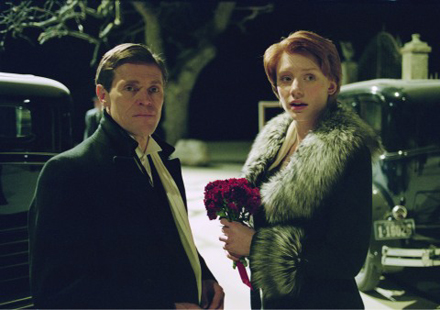
Written & directed by von Trier, Manderlay continues the story of Grace's exploration to America where she and her mob-boss father leave Dogville behind and stumble upon a Southern plantation called Manderlay where to the shock of the outsiders, slavery is still around. In an attempt to take control and free the slaves, Grace tries to impose her own ideals in order to make the slaves think freely only to cause more trouble after swaying her father's warning. Taking over the role of Grace for Nicole Kidman is Bryce Dallas Howard and taking over the role of her father for James Caan is Willem Dafoe. Also starring von Trier regulars Udo Kier, Jean-Marc Barr, Zeljko Ivanek, and from Dogville, Jeremy Davies, Chloe Sevigny, Lauren Bacall, and as narrator, John Hurt. Joining the cast for Manderlay along with Howard and Dafoe are Issach de Bankole and Danny Glover. Manderlay is a fierce, uncompromising study of race in America from the controversial Lars von Trier.
After the events at the town of Dogville, Grace and her father drive through the American South where they stop at a plantation called Manderlay. Grace sees a young black woman running away claiming she's about to be whipped. Grace realizes that the plantation still has slavery around as she meets the plantation's owner Mam (Lauren Bacall) who is falling ill. With an aging slave named Wilhelm (Danny Glover), Mam gives Grace a book of her laws as she lays on her deathbed. After telling Wilhelm that slavery has been abolished 70 years ago, Wilhelm reveals that none of the slaves know what to do with this new freedom as Grace decides to help them get in touch with modern America. Grace's father is convinced that Grace is only bringing trouble as he reluctantly lends Grace a few of her men including Niels (Jeremy Davies), Mr. Robinson (Jean-Marc Barr), Mr. Kirspe (Udo Kier), and business consultant Joseph (Teddy Kempner).
With the slave suspicious over Grace's plans including an African-born slave named Timothy (Issach de Bankole), they reluctantly welcome her as Grace also keeps Mam's family to help with things. Grace looks into the book of Mam's law realizing the complexity of the laws as well as the categorization of slaves. Meeting slaves such as Jack (Javone Prince), Old Wilma (Mona Hammond), and Elizabeth (Ginny Holder), Grace is intrigued by Timothy's presence as they get to work on giving new life to Manderlay. During this slow period of reconstruction, Grace meets a doctor named Hector (Zeljko Ivanek) who makes some suggestions that Grace refuses to comply to as she takes trees from a garden to rebuild houses. Yet, it doesn't go well as Grace hoped to be as she blames Mam's family by making them slaves as a dust storm happen as Grace learns about why the trees were placed in the garden.
Following the dust storm, Grace tries to get things started as her personal interests start to conflict with the things that Manderlay needed as Joseph decides to leave along with the gangsters. Despite the progress of cotton growing in large amounts, Grace's attempts to make profit for herself and the former slaves are dashed. Even as her feelings for Timothy would bring trouble, Grace learns some unexpected revelations about Mam's law that would force her to admit failure.
Ever since the day Africans were shipped into America as slaves, African-Americans definitely went through a struggle of oppression that's been going on for so long that it's unimaginable. Yet, the idea of slavery continuing in a tiny little plantation in Alabama 70 years after it was abolished is an astonishing idea. Then, the plot kicks in when a young woman imposes on her idealism on democracy in hoping to give them an idea of what freedom is. That plot idea is something that von Trier seems to comment on as an idea of how America is trying to bring democracy to Iraq. Yet, what von Trier brings is a different point of view of how things work. Whereas Grace had hopes to make things better her way, she begins to ignore and overlook everything else of what the former slaves wanted as well as what Mam's law was trying to do for its slaves.
Using an eight-chapter structure for his script, von Trier takes the same epic approach of Dogville but what it lacks in comparison to its predecessor is that Manderlay lacks a bit of its ambition and unpredictable commentary. Still, Manderlay remains unpredictable in its subject matter while taking several point of views on everything including its characters. For the African-American characters, they start off as stereotypes in terms of what some Americans think they are and everything only to reveal something far more complex. Even objects such as the Old Lady's Garden and the book of Mam's law which reveals to be more than simple objects. The dust storm is indeed a foreshadowing of what was to come with Hurricane Katrina in some ways while the book of Mam's law is far more complex than Grace had thought it would be. In many ways, von Trier comments on Grace's naivete and ignorance on these things that would end up making ways for her own doom. Therefore, what makes Grace end up leaving Manderlay is the result of what her point-of-view is on how things work when she doesn't realize of how things worked in Manderlay before.
The way von Trier sets things up and reveal the sense of how racism works reveals more about Mam's law and how its author sees things. There, it requires a lot of thinking of not just how America was post-slavery but America now when dealing with racism. Since von Trier chooses the same theatrical approach of Dogville, his vision is far bigger since the film starts off with an overhead shot of Grace, her father, and the gangsters driving from Dogville to Manderlay and the overhead shots of Manderlay itself reveal a much bigger land filled with a huge garden, little houses, a big plantation mansion, a well, and everything else a plantation needed. The approach is an observant of behaviors and politics in von Trier's fluid direction while his approach to narrative that is narrated by John Hurt reveals the idea of what the characters are thinking and how Grace’s point-of-view and emotions deal with the situation. Overall, it's a very strong film from Lars von Trier.
Helping von Trier with his vision is longtime cinematographer Anthony Dod Mantle. With him and von Trier serving as camera operators, many of the camera work is handheld to reveal an intimacy of where the characters are from the perspective shots to give hit a human feel while the only stillness is overhead shot to reveal the landscape of Manderlay and its plantation. Mantle's work is brilliant for using bright lights for the day with wonderful bluish nights for the night scenes and full-on sepia for the dust storm sequence. Art director Peter Grant and set decorator Simone Grau created an amazing set inside the sound stage that included a two-floor idea of Mam's plantation mansion that only shows a fireplace, a stair, and a bed. The rest of the production features the same kind of sparse, minimalist design of Dogville with small things like a window, door, and a broken roof. Costume designer Manon Rasmussen also created stark, poor-like clothing for most of the cast while giving a tattered suit for Wilhelm, a bunch of clean suits for the gangsters, and a fashionable dress for Grace in the look of the depression.
For the dust storm sequence, Peter Horjth created a realistic, harrowing look of the dust in its sepia color that is made in a minimalist style of visual effects. Editors Bodil Kjaerhauge and Molly Marlene Stensgard use the film's 140-minute running time to create a tight, leisurely paced film with elements of jump cuts to give the film some rhythm on many of the film's more intimate sequences. Sound designers Kristian Eidnes Andersen and Per Streit do excellent work in the sound to create the atmosphere of theatricality to the film with sounds of objects to represent the times. Music composer Joachim Holbek creates an ominous orchestral score to accompany the narration where it adds dramatic intensity in the situations where Grace and the characters are.
The film's cast includes several actors of African descent where most of them are British with the exception of a few American actors like Danny Glover and French actor Issach de Bankole. The small performances from the likes of Wendy Juel, Nina Sosanya, Ginny Holder, Javone Prince, Emmanuel Idowu, Joseph Mydell, Mona Hammond, Llewella Gideon, Suzette Llewellyn and Geoffrey Bateman are excellent as the slaves of the film. Other small performances from Chloe Sevigny, Rik Launspach, and Michael Abiteboul are excellent as Mam's family who have a moment when they're forced to wear black face that really is degrading in some way. Lauren Bacall is great in her brief appearance as Mam while Zeljko Ivanek, who replaced John C. Reilly, is funny as the sleazy entertainment doctor Hector. Other small performances from Jeremy Davies, Udo Kier, Jean-Marc Barr, and Teddy Kempner as the gangsters all each have memorable, individual moments.
Willem Dafoe gives a more subdued yet charismatic performance in the role of Grace's father. While he is more subtle than James Caan, Dafoe brings a sense of realism and cynicism to his character as a man who understands power yet doesn't want to get involved in anything else other than his own affairs. Dafoe is brilliant in his role as he doesn't overshadow Caan or out-act him. Danny Glover is great in a very complex role as a wise slave who isn't sure about the idea of freedom while letting Grace know about how Manderlay worked. When the film is about to end, Glover's performance is very subdued in how complex his character is in the way it counterpoints Grace's point of view as Glover is amazing in his performance.
Issach de Bankole is excellent in his performance as the prideful Timothy who refuses to give in to any kind of change until he's open to it only to reveal a darker side. The performance de Bankole gives is complex in his intentions as a character who is a lot smarter than he appears while he has some fine chemistry and tension with Bryce Dallas Howard.
Taking over for Nicole Kidman in a role and character that is strong and complex, Bryce Dallas Howard definitely managed to fulfill the character's expectations by bringing a newfound sense of naivete and youthful understanding to her character. Howard brings an energy and aggressiveness to her character as a young woman who imposes on ideas that she thinks will work only to be forced into understanding about how things worked before. Howard manages to reveal her range in many ways, including an emotional full-frontal nude scene that leads to a graphic sex scene with de Bankole that suggests something more. Howard really gives a fantastic performance while proving that she's more than just Ron Howard's daughter.
When Manderlay premiered at Cannes in 2005, reviews like Dogville were mixed and when it was officially released in the U.S. in early 2006, it divided everyone. Still, the film did manage to raise issues in which von Trier wanted to talk about. More importantly, the film will make anyone who has seen Dogville to go back and revisit the film on how it came to Manderlay. What both films share aside from its Brechtian staging and questions on American morality and politics is irony, notably the ending.
The title of von Trier's trilogy, USA-Land of Opportunities is a very ironic title considering that both films have grim endings that are very ironic to the situations. Whereas Dogville was about an outsider coming into town to be protected only to be humiliated by the rules and everything that led to the town's doom. Manderlay is really about how one plantation's old ways is being changed only to have things go really wrong in the end. It's in that film's ending where race is again that's the main issue in what Wilhelm says was relevant to what was happening in mid-2000s America.
Manderlay is a compelling yet haunting film from Lars von Trier that features superb performances from Bryce Dallas Howard, Danny Glover, Willem Dafoe, and Issach de Bankole. While it doesn't have the big ambitions of its predecessor Dogville, it still a wonderful yet daring film from von Trier that has him commenting on the state of American idealism circa-2005. It's not an easy film to watch that features themes that not everyone will want to discuss. Yet, it's the kind of film that will provoke and challenge ideas as Manderlay, despite its flaws, is an intriguing film from Lars von Trier.
Lars von Trier Films: The Element of Crime - Epidemic - Medea - Europa - The Kingdom I - Breaking the Waves - The Kingdom II - Dogme #2-Idioterne - Dancer in the Dark - Dogville - The Five Obstructions - The Boss of It All - Antichrist - Dimension (2010 short) - Melancholia - Nymphomaniac - The House That Jack Built - The Kingdom: Exodus - (Etudes)
Related: The Auteurs #7: Lars von Trier
© thevoid99 2011
Sunday, December 19, 2010
Eve
Written and directed by Natalie Portman, Eve is a twenty-minute short film about a teenage girl who visits her grandmother unaware that her grandmother is about to go on a date. The girl reluctantly joins her grandmother on the date as she watches her grandmother act around a man near her age while the girl wants to talk to her grandmother about something. The short is about not just aging but also the connection between an elderly woman and her granddaughter. Starring Lauren Bacall, Olivia Thirlby, and Ben Gazzara. Eve is a remarkable short film from Natalie Portman.
Lola (Lauren Bacall) is getting ready for her date as she gets a surprise visit from her granddaughter Kate (Olivia Thirlby). Kate decides to spend the night unaware that her grandmother has a date with a man named Joe (Ben Gazzara). Kate wants to talk to Lola about her mother as they wait for Joe to arrive. Joe arrives in time for cocktail hour as he meets Kate where the three go to dinner for what would be a nice evening.
While the film’s plot is simply about a girl visiting her grandmother and being the third wheel on a date. It’s really more than that though there isn’t a lot of dialogue nor any big plot devices. Really, it’s about the relationship between a teenage girl and her grandmother with the girl’s desire to talk about her mother. Though not much is revealed about the mother, who is the title character. It seems like it’s something the grandmother isn’t really keen on wanting to discuss as she’s about to embark on the date. The date is merely a chance for the young girl to observe the behaviors of an elderly couple that is as joyful and a bit reckless like many. Still, she is able to find something to relate to.
Portman’s approach to the story definitely seems very personal which has something that anyone can relate to in relationship between someone and its grandparent. Even when it can be a bit hectic at times. The screenplay is definitely well structured with some excellent dialogue. Portman’s direction is marvelous to watch though she rarely moves the camera to present her scenes. Yet, she starts the film with shots of makeup being used as Lola is putting on the makeup. The way Portman presents these shots is to convey the world of Lola with Kate looking around while often reminding her grandmother that she will always be here. Despite Lola’s insistence of letting Kate to get whatever jewelry she has after she passes.
Many of the scenes Portman creates are done with an intimacy as if the audience is watching this crazy yet fun night between two elderly people. She makes sure the camera is inches away from the action with very little close-ups. Even as she gets a chance for both Lola and Kate to look in the mirrors. One is a scene of innocent curiosity while the other is about facing aging and other harsh truths. What Portman creates isn’t just a wonderful short film but also a somber piece about the indescribable relationship between a girl and her grandmother.
Cinematographer Adam Kimmel brings an elegant yet dream-like look to the film for many of the scenes with the mirror and restaurant as it‘s mostly straightforward. Editor Tricia Cooke does an excellent job with the film‘s methodical pacing and rhythmic cutting. Production designer Anne Ross and art director Jennifer Dehghan do a fantastic job with the look of Lola‘s apartment and the restaurant. Costume designer Leah Katznelson creates a great look for Lauren Bacall with her costumes while going for mostly casual clothes for Olivia Thirlby. Music composer Sufjan Stevens creates a somber yet melancholic piano piece that plays throughout the film as it also features a piano piece by Nicholas Britell for the restaurant scene.
Ben Gazzara is wonderful as Joe, an old man who is full of life as he offers to move in with Lola as he wants to do the things to please her. Olivia Thirlby is superb as Kate, Lola’s granddaughter as she plays a third wheel and observer to the date while pondering about the idea of being old. Even as she tries to reach out to her grandmother while wanting to spend all the time that is left with her. Lauren Bacall is radiant as Lola, an old woman who wants to live life to the fullest while being treated like a young lady during her date. Though Bacall spends a lot of time trying to put on makeup and look great, her greatest scene is in the final one where she stares at herself in the mirror showing the kind of majestic persona that she has as a cinematic legend.
Eve is an amazing debut short film from Natalie Portman. Armed with a great crew and a superb cast led by Lauren Bacall. It’s clear that if Portman ever has a future in the world of directing films. This is definitely a great way to start a directing career. Even as she has a story that people can relate to about the way the young is interested with the elderly. Eve is a short that is worth checking out.
© thevoid99 2010
Subscribe to:
Posts (Atom)