Originally Written and Posted at Epinions.com on 10/26/07 w/ Additional Edits & New Content.
Known for his quirky, heartfelt, and melancholic films, Wes Anderson is among one of the modern auteurs of the 21st Century. Along with fellow American directors like Sofia Coppola and David Gordon Green, Anderson is among those as part of the new American auteurs to make a mark in the late 90s and 21st Century. Early films like 1995's caper film Bottle Rocket and 1998's coming-of-age high school film Rushmore were delighted for its humor and heartfelt themes of disappointments and life-changing experiments. Along with co-writer and actor Owen Wilson, Anderson would score another critical hit with 2001's The Royal Tenenbaums that gave the duo an Oscar nomination for Best Original Screenplay. It seemed Anderson and his team, that included the Wilson brothers, Owen, Andrew, and Luke along with Bill Murray, Anjelica Huston, Jason Schwartzman, set designer Eric Anderson, and cinematographer Robert Yeomen, could do no wrong.
Then came 2004's The Life Aquatic with Steve Zissou that Anderson co-wrote with Noah Baumbach and things didn't go well as planned. The film received mixed reviews from both fans and critics as Anderson's tale of a washed-up documentary filmmaker with a man who he believes is his long-lost son was a film that didn't connect with general audiences. Despite another winning performance from Bill Murray along with a unique ensemble that included Owen Wilson, Cate Blanchett, Willem Dafoe, Anjelica Huston, Michael Gambon, and Jeff Goldblum, it was lost with some audiences. After a break that included producing Baumbach's award-winning The Squid & the Whale and developing an adaptation of Roald Dahl's The Fantastic Mr. Fox, Anderson returns with a new project that reveled in his themes of families, disappointments, and heartbreak. This new film is entitled The Darjeeling Limited.
Written by Anderson, Roman Coppola, and Jason Schwartzman, The Darjeeling Limited tells the story of three estranged brothers trying to reunite following the death of their father on a spiritual journey in India. Along the way, they try to find their lost mother while dealing with brotherly issues and such. A film that seems to recall not just the family dysfunctions of The Royal Tenenbaums but also the ambitions of Life Aquatic in terms of its location rather than its production. Anderson also seeks inspiration from the films of late Indian film director Satyajit Ray along with his music and the early films & music of the Merchant-Ivory team. Starring Anderson regulars Owen Wilson, Jason Schwartzman, Anjelica Huston, Kumar Pallana, Waris Ahluwalia, and a cameo from Bill Murray along with Adrien Brody, Camilla Rutherford, Amara Karan, and Irfan Khan. The Darjeeling Limited is Wes Anderson's most mature and poignant effort to date.
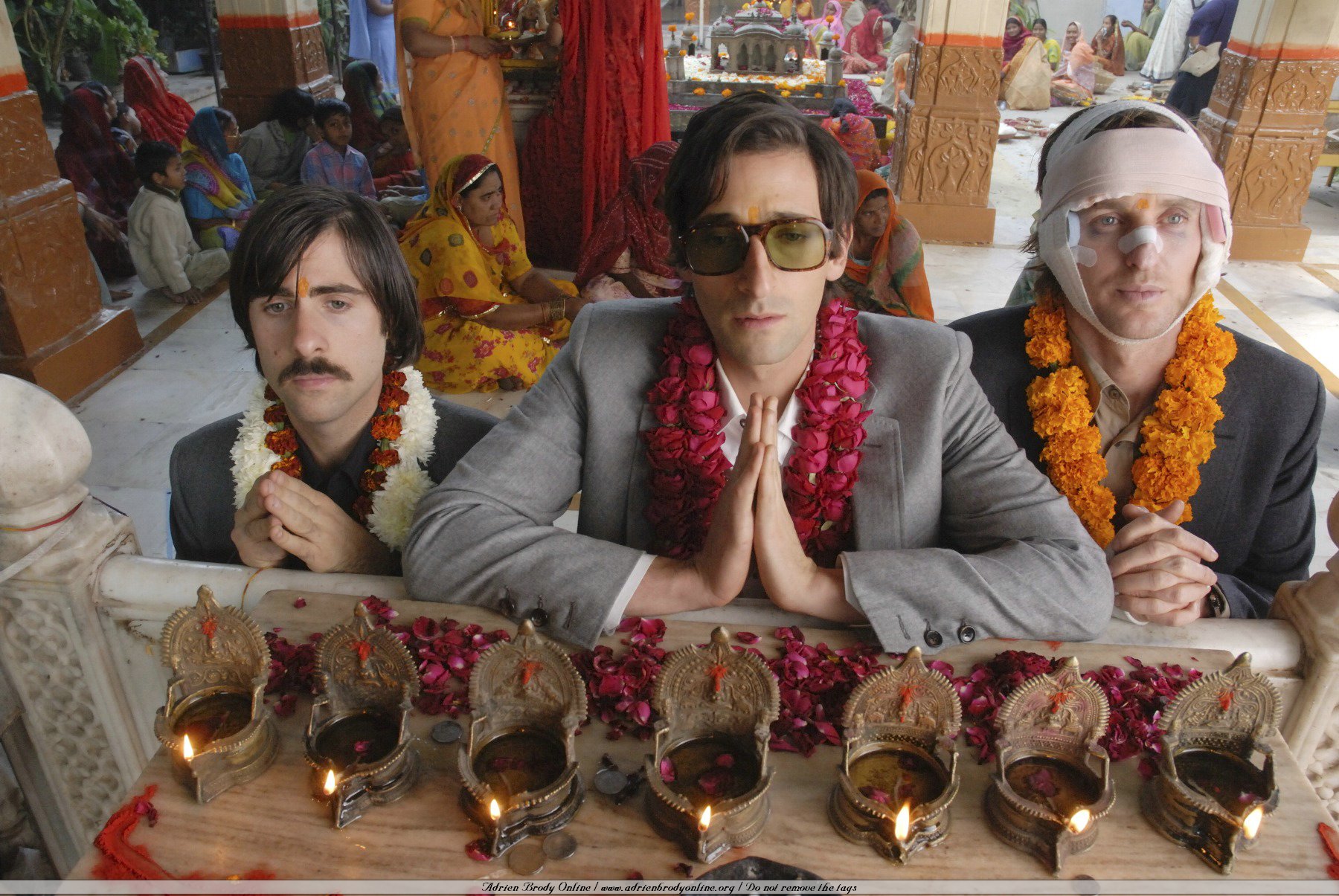
After racing a businessman (Bill Murray) to catch the Darjeeling Limited train, Peter Whitman (Adrien Brody) beats him as he enters the train to meet up with younger brother Jack (Jason Schwartzman). They’re later joined by the eldest brother Francis (Owen Wilson), who is sporting bandages on his face following a motorcycle injury. After not being together for a year since the funeral of their father, Francis hopes to reconcile his feelings with their brother. With help from his bald-headed assistant Brendan (Wallace Wolodarsky), Francis sets up an itinerary for a spiritual journey to many spiritual sites in India. While both Peter and Jack aren't enthused about the trip, they reluctantly join as Peter is still in mourning over their father's death. Even worse, Peter is also dealing with the upcoming birth of his first child with wife Alice (Camilla Rutherford) who is back home in London. Jack meanwhile, copes with the relationship of an ex-girlfriend by falling for a train stewardess named Rita (Amara Karan).
With Jack making out with Rita, he also plans to leave for Italy to meet up with his ex-girlfriend while Peter also plans to leave. Francis refuses for both to leave while they take on the spiritual journey. Yet, the trio start to get into crazy situations when Peter is often carrying their late father's things including his keys, razor, and sunglasses while borrowing Francis' belt. After purchasing a cobra, Peter takes it to the train but it only causes trouble when they're confronted by the train's chief steward (Waris Ahluwalia). After another stop during their journey, Francis is still trying to find information about the whereabouts of their mother Patricia (Anjelica Huston) whom was the real motive for Francis' plans for a spiritual journey. When the train is suddenly off course, things get tense when finally, the brothers are forced to leave the train. After confronting everything they've been through, it's clear that the spiritual journey has failed.
Upon their plans to return to the airport, the Whitman brothers suddenly encounter and later, get involved in an accident that eventually becomes tragic. Taken to a village where they meet a man (Irfan Khan), the brothers are suddenly forced to reflect that last time they were together at the day of their father's funeral. There, they recall the moments where they find the key into why they fell apart. After their period at the village and with gratitude towards the people that took them in, Francis finally found the whereabouts of their mother. The brothers find out their mother had become a nun as they all confront the death of the boys' father and Patricia's husband.
While The Darjeeling Limited and The Life Aquatic with Steve Zissou both had ambitious narratives and storylines that took Wes Anderson and his characters to different worlds. What the Life Aquatic had seemed to fail in terms of its ambitions is suddenly made up for with great maturity and care in The Darjeeling Limited. It's largely because Anderson scaled back his ambitions for something more personal in a film that isn't just about loss but fear. Fear is the main theme as the Whitman brothers and their mother all seem to run away from something. Jack is running away from a failed relationship, Peter from impending fatherhood, and Francis and Patricia both running away from death in their own ways. While Francis' brush with death would serve as a plot device to the film's story, it's also a film about brothers and how dysfunctional they are in their relationship.
With help from Roman Coppola and Jason Schwartzman, who are both cousins in real life, Anderson brings a script that is filled with not just Anderson's unique take on humor but also his sense of melancholia. Where his previous film, The Life Aquatic had been overwhelmed by its ambitions where both the humor and drama seems forced. The Darjeeling Limited goes for something natural where there's a line in which Jack asks if his relationship with Francis and Peter would've been better if they had been friends in real life instead of brothers. That's definitely the key plot-point of the entire film as the script isn't just Anderson as his most mature but also a step into a new direction for the director.
Anderson's direction, that's been known for its use of tracking shots, slow-motion sequences, and moments of spontaneous hijinks. All of that is there but this time around, he takes a new step by adding more emotions to what he's doing. The compositions Anderson goes for in some of the sequences on train are definitely wonderful while he and 2nd unit director Roman Coppola capture the beauty and mystique that is India. The film also has Anderson confronting many new themes while adding some humor to the situations. It doesn't come off as awkward but rather emphasizes the dysfunctional behavior of the Whitman brothers. Another new element Anderson adds to the film is mystique. There's two characters who make brief appearances in the feature film, the businessman and Jack’s ex-girlfriend (Natalie Portman), who appears in The Darjeeling Limited for a minute. There are no answers to their appearances except for Jack's ex-girlfriend who appears in the prequel short Hotel Chevalier.
Again, this is Anderson opening up more where audiences can give an idea of interpretation while there's some clues in the dialogue into who they might be or what actions they have done. The overall work in what Anderson does visually is definitely miles away from the things he's done in previous films. He's managed to get not too much into his style but also try new things like a car chase in the opening scene of the film. It's one of the most amazing and frantic car chase scenes ever done. The result isn't just Anderson starting to get better at his craft but also growing in the process.
Longtime cinematographer Robert Yeomen's cinematography is very potent with its wonderful exterior shots of India that includes some wonderful nighttime and evening shots of the area in the exteriors. Many of the interior scenes are awash with a mix of blue, yellow, green, and exotic colors that gives Yeomen's camera amazing coverage of some of exterior shots of the train and what's going on. Yeomen's work is just stunning in every frame. Production designer Mark Friedberg along with art directors Aradhana Seth (who is also a set decorator) and Adam Stockhausen with additional help from set decorator Suzanne Caplan Merwanji bring a great look to train that is the Darjeeling Limited. The small rooms, hallways, and rooms have an exotic look to the film. With additional help from Wes Anderson’s brother Eric on the luggage design, the film's look works to its visual.
Legendary costume designer Milena Canonero brings a wonderful look to the film's colorful atmosphere with the lovely use of silk for Rita's stewardess clothing along with the chief steward, and the suits that the Whitman brothers wear. Editor Andrew Weisblum brings some solid editing to the film and its irreverent tone with the use of slo-mo edits, jump-cuts, and action cuts to convey some of the film's humor as well as its drama. Sound recordist Pawel Wdowczak along with additional help from Coppola sound designer Richard Beggs do great work in conveying the atmosphere of India including some of the recorded traditional material that's added to the film’s soundtrack.
The film soundtrack marks the first in being that it's first of Anderson's films to not feature a written score from longtime collaborator Mark Mothersbaugh of Devo. Instead, Anderson goes to the music of the late, legendary Indian auteur Satjayit Ray for his intense, folky compositions to convey the film's road-like feel, romance, and drama with additional cuts from Ray collaborators Ustad Vilayat Khan and Jyotitindra Moitra. The Indian music works not just for the atmosphere that is India but is used for accompaniment or background of where the characters are in whatever situation they're in. Along with classical cuts by Ludwig Van Beethoven and Alexis Weissenberg, the film also includes pop songs by Peter Sarstedt (notably in Hotel Chevalier), Joe Dassin, and a bouncy Indian-pop cut from Shankar Jaikishan from the Merchant-Ivory film Bombay Talkie.
While the score and music adds a new flavor to Anderson's knack of musical taste, he still uses his beloved collection of British rock music. A cut from the Rolling Stones appear in one of the film's most emotional key sequences while three cuts from the Kinks from their 1970 album Lola Versus Powerman and the Moneygoround Part One. Two of those songs, This Time Tomorrow and Strangers, both of which appear on the film's trailer, emphasize the film's melancholic tone while Powerman appears near the film's end. Once again, Anderson and music supervisor Randall Poster create an amazing soundtrack.
The film's cast is wonderfully assembled as it features cameos from Anderson regulars Wallace Wolodarsky as Francis' bald-headed assistant Brendan, Waris Ahluwalia as the Chief Steward (and also a security chief in Hotel Chevalier), and Kumar Pallana as a traveler on the train. Whereas the previous film didn't have cameos from Anderson's buddies, this one made up for it, especially Kumar Pallana's cameo which is a joy to see. While some may feel that beloved Indian actor Irfan Khan's appearance is merely a cameo and is wasted, his performance as a grieving man is a sight to see for those who have never seen any of the actor's work. While it's a cameo of sorts, it works in every way as his appearance is wonderful to watch. Amara Karan is great as the stewardess Rita whom Jack falls for while she is dealing with the breakup of her boyfriend as her presence is wonderful to watch. Camilla Rutherford is excellent in her brief scenes as Peter's wife Alice, notably in the flashback scene, and an appearance on the train as a wife worried about Peter and his grief over his father.
While Bill Murray's role as a businessman is a cameo, he manages to make everything of his brief appearance as a businessman running to catch a train as he's just great to watch while he also appears briefly in another scene with the train. Even Natalie Portman's brief five-second appearance as Jack's ex-girlfriend from Hotel Chevalier makes a wonderful impression.
Anderson regular Anjelica Huston, who has a brief appearance, is great as Patricia Whitman. A mother turned nun who seems very weary over what had happened in the year since. While Huston is great in her performance, her character is the strangest where despite being this maternal figure, she seems to wander off as if she had been traumatized while talking to people who might not have existed. It's a great performance from the actress who's amazing to watch in any of Anderson's films. New to the Anderson film family is Adrien Brody in what is definitely his funniest performance yet. Taking a break from more dramatic, darker film roles, Brody is at ease in playing the middle brother Peter (after Peter Bogdonavich) who seems very possessive and also cries a lot whenever he's dealing with his father's death. Brody's chemistry with Wilson and Schwartzman is full of energy and delight as he's definitely a natural for the role as his performance is great to watch.
Jason Schwartzman delivers a brilliant performance as the emotionally battered Jack (after his late father and bits of Jack Nicholson) who seems to try to find ways in coping over the relationship with his ex-girlfriend by making out with Rita or calling his ex's answering machines. Schwartzman is definitely the peacekeeper and conscience of the brothers while adding lots of comedy to his role. Owen Wilson is great in his role as the bossy older brother Francis (after Schwartzman's uncle and Roman Coppola's father Francis Ford Coppola) who is desperate to try and reconcile with his younger brothers. While Owen's appearance with bandages is very disturbing (considering the recent events of his own personal life), it's probably Owen at his best while not playing the often laid-back persona in most of his comedies. Owen shows more range as an actor in this film as he acts like a leader while trying to act in a fraternal role that shows that Owen Wilson is a better actor when he's not acting like an idiot or some sentimental figure in more mainstream fare.
***DVD Content Written from 12/14/10 to 12/16/10***
When The Darjeeling Limited was released on DVD in 2008 by Fox Searchlight. The DVD only contained the short Hotel Chevalier along with a Behind-the-Scenes featurette and a trailer. While it was a good DVD for casual audiences, it wasn’t enough for fans of Wes Anderson who had been used to having his film released through the Criterion Collection company for its DVD releases. In 2010, The Darjeeling Limited finally gets a release through the Criterion Collection with total approval and involvement from its director, Wes Anderson.
The Region 1, 2-disc Criterion DVD for The Darjeeling Limited presents the film with a new, high-definition digital transfer that is approved and supervised by Wes Anderson. Presented with Surround Sound and the film’s original theatrical widescreen aspect ratio of 2:40:1. The film along with the short Hotel Chevalier are given a wonderful, colorful transfer that is a trademark of Anderson’s films. It’s fuller in color and has a more lush setting as it’s shot on location in India as the film is given the treatment it needed to live up to what fans wanted in his DVDs.
The first disc of the DVD has both Hotel Chevalier and The Darjeeling Limited that can be played separately or together since Hotel Chevalier is a prequel of sorts to The Darjeeling Limited. The special features on the first disc includes the film’s theatrical trailer and a feature-length audio commentary track from Wes Anderson and the film’s co-writers in Roman Coppola and Jason Schwartzman while Anderson does a sole commentary track for Hotel Chevalier.
Anderson’s commentary for Hotel Chevalier revealed that it was made for two days in 2005 as an experiment of sorts while he was working on the script for The Darjeeling Limited with Roman Coppola and Jason Schwartzman. Anderson hadn’t worked with Schwartzman since Rushmore but have been very close friends. Anderson revealed his interest in creating more shorts either as a stand-alone piece or as part of an omnibus type of film. He also revealed that Natalie Portman came in when she had a break from making Milos Forman’s Goya’s Ghost. It’s a wonderful commentary track that would lead to The Darjeeling Limited.
The commentary for The Darjeeling Limited features Anderson, Coppola, and Schwartzman all commenting on different locations through Skype. The three men talk about the writing process of the film as well as recounting their own experiences in India. The film was shot in late 2006 as Schwartzman, Owen Wilson, and Adrien Brody all rehearsed their dialogue and scenes before the movie started. While all of the dialogue was spoken from the script, everything else was improvised because of the chaotic atmosphere of the locations.
Anderson, Coppola, and Schwartzman that with the exception of the train that was partially a set that was built for the film. Everything else was shot on location in India except for the scenes in New York City which were shot last. The men also mention a lot of film references that inspired the film. Notably the works of Satyajit Ray and Robert Altman along with Jean Renoir’s The River. They also talked about a lot of the Indian actors they hired while some just walked on set not knowing they were being filmed but it worked because it felt so natural. Anderson and Schwartzman had a lot of praise towards Amara Karan as Rita, who they really liked a lot. Schwartzman also talked about how nervous he was acting with Owen Wilson and Adrien Brody but once the film went into production, they were all equal.
Anderson also had praise for Brody who was new to the world of Wes Anderson as Brody invited his mother on the set to shoot pictures along with Owen Wilson’s mother. Anderson admitted that if it wasn’t for Roman Coppola, the shooting of The Darjeeling Limited would’ve been extremely hard since he didn’t want to relive some of the headaches he had in making The Life Aquatic with Steve Zissou. The commentary is an enjoyable one while it ended with a lot of humor as someone made a call to Anderson about an idea for his production company.
The second disc of the DVD is filled with loads of special features. Leading the supplement material is a 41-minute behind-the-scenes documentary by Barry Braverman. The documentary is shot on location in India where Wes Anderson, cast, and crew are making the film. Notably with six specific sequences as the first with Bill Murray as the businessman was shot during a chaotic morning with crazy traffic around. For the scenes at the spiritual temples, they had to shoot in the mornings and early day even though the ceremonies were actually happening throughout. Even as the actors got to interact with the locals.
For the scenes in the train, the documentary shown how the look of the train was made where it doubled not just as a real train but also a soundstage where they shot everything while it’s moving. Even as the train was used for transportation for the actors and crew to live in. Even where they stopped for some scenes as everyone had a good time. For the funeral scene, it was shot on a real village while the actors got to interact with three young brothers that were in the film and helped during the big stunt in that film. It’s an enjoyable documentary that often has shots of the people, animals, and beautiful locations where it was a more relaxed making of than the overwhelming production that was Anderson’s previous film in The Life Aquatic with Steve Zissou.
The 21-minute discussion between Wes Anderson and filmmaker James Ivory is about the music used in the film. Shot at a restaurant in Paris, Anderson and Ivory talked about the music that was used with footage of where the music of those movies originated from. Ivory revealed that when he did The Guru with 20th Century Fox providing the money, it was at the time when all things related to India became popular as he said it was partially inspired by George Harrison. They also discussed Satyajit Ray and the music he made as Ivory always have pieces that he will love. He also likes the way Anderson used the music for those scenes in The Darjeeling Limited as the discussion ended with Anderson thanking Ivory for inspiring him. Ivory thanked him for giving the music a chance to be heard to a new audience.
The 12-minute video essay by film critic Matt Zoller Seitz. Seitz uses images of both Hotel Chevalier and The Darjeeling Limited to talk about the film and why they’re important in Wes Anderson’s film career. Seitz claims that The Darjeeling Limited is Anderson’s 2001 in the way he uses all of his film tricks and refines them into something that is distinctive. Seitz also talks about the characters and why Hotel Chevalier is important to the story. It’s a wonderful video essay that not only explains some of the secrets of the film but reveals why spiritual journeys should never have itineraries.
The only deleted scene is where the Peter tries to play cricket with a tennis ball as Francis and Jack watch. Two alternate scenes include a shot of the Whitman brothers going down the hill and the other is a scene of the brothers about to board a plane where the dialogue is finally revealed. The audition of the young actor Sriharsh Sharma, who plays the boy with the handkerchief in the village/funeral scenes, is an impressive audition clip. Though he was not able to play one of the young brothers, his audition showed some natural quality while he sang Green Day’s Boulevard of Broken Dreams. Other small video features includes the American Express commercial Wes Anderson made that features Jason Schwartzman, Waris Ahluwalia, and cinematographer Robert Yeomen.
Waris Ahluwalia also has a video diary filled with several photos and video clips. Among the clips are life on the train where everyone seems relaxed and enjoying themselves while Kumar Pallana does a magic trick. Shots of animals including a dancing elephant on a truck and a flock of sheep not going in the right direction. Jason Schwartzman at a kitchen cooking while cooks are making lunch for the other actors. Everyone doing some fitness and kite-flying with special guest, Kiki Smith. A shot of what Anderson’s idea of special effects are for the film. Waris trying on his costume with help from famed costume designer Milena Canonero. A crew member talking about Indian luck while Adrien Brody signs autograph to fans. Wes Anderson and Roman Coppola talking about a scene with the theme of Bombay Talkie playing in the car and what Waris is feeling when he’s shot all alone in a desert. The photos are in Polaroid pictures from the cast and crew of the film plus Hotel Chevalier and the American Express commercial.
The Oakley Friedberg/Packer speech short video is where Mark Friedberg’s son talked about his trip to India where he talked his experience and how he and many of the people working on the film managed to raise money for bikes so that kids can go to school miles away from where they lived. It’s a wonderful clip that features a great photo gallery of locations and the modern schools the kids learn at. A forty-seven video clip reveals the two major awards The Darjeeling Limited won, one at the Venice Film Festival and the other from a U.S. comedy film festival. The last short video featurette is from Roman Coppola which is a two-and-a-half minute clip of Coppola, Schwartzman, and Anderson writing the film during their trip to India with pictures and all sorts of footage which is just dazzling to watch.
The stills gallery features three sets of on-set photos. One from the on-set photographer James Hamilton that features a wide array of photos on location in both India and New York City. The other two comes from the mothers of Owen Wilson and Adrien Brody. Laura Wilson’s photos are shown in color while the renowned Sylvia Plachy are shown in black-and-white. The DVD includes a booklet that features original illustrations by Eric Chase Anderson and an essay by film critic Richard Brody. Entitled Voyage to India, Brody discusses a lot of the personal attributes Wes Anderson made for The Darjeeling Limited. He even revealed that the film was meant to be the anti-Life Aquatic which was an expensive and overwhelming film to make for Anderson. For that, Anderson had to improvise shots while retaining some of his visual styles while not having trailers around for the actors.
Brody also talks about Hotel Chevalier where it would be a crux for Jack’s writing as he is tormented by his ex-girlfriend’s visit. Jack would often try to find the approval of his brothers for his writing as he would finally get it towards the end while making some acceptance about his own work. Originally, it was going to be a piece by itself but became part of The Darjeeling Limited when Anderson was writing the film with Roman Coppola and Jason Schwartzman. When The Darjeeling Limited finally came into production and the train was made, it was a place where everyone felt like equals whether they were shooting or not. Brody recalls his meetings with Anderson as he revealed that part of the film’s inspiration aside from Satyajit Ray and Jean Renoir’s The River was the John Cassavetes film Husbands.
The essay is a truly remarkable for its analytical take on the film as well as the characters and objects that the Whitman brothers carry. It also reveals why the film was a hit with his fans because there was something they could relate to as well as how they’re connected to the characters in Anderson’s other films. In many ways, it’s a stepping stone for Anderson to move into newer territory while refining his own tricks. The Criterion DVD for The Darjeeling Limited is a must-have for fans of Wes Anderson while the special features are truly top-notch.
***End of DVD Tidbits***
While it's not as brilliant as Rushmore, or in some cases to the hardcore fans, Bottle Rocket, The Darjeeling Limited is a funny, dramatic, complex, and serious film from Wes Anderson and company. Fans of Anderson's work will no doubt enjoy his directing style, themes, and characters in this film while those new to him might have a hard time in understanding his themes and humor. Yet, the film does remain entertaining and its laughs are well-earned. The Darjeeling Limited is an overall joyful, uplifting film from Wes Anderson who has now managed to grow up with grace and style.
© thevoid99 2010


