Showing posts with label irfan khan. Show all posts
Sunday, May 15, 2016
2016 Cannes Marathon: Salaam Bombay!
(Winner of the Camera d’Or and Audience Prize at the 1988 Cannes Film Festival)
Directed by Mira Nair and screenplay by Sooni Taraporevala from a story by Nair and Taraporevala, Salaam Bombay! (Greetings Bombay!) is the story of the day-to-day life of children living in streets of Mumbai as they struggle to survive. The film explores the world of Mumbai in the 1980s which was filled with the seedy world of crime where children try to live with a sense of goodness in a very dark world. Starring Shafiq Syed, Hansa Vithal, Chanda Sharma, Raghuvir Yadav, Anita Kanwar, Nana Patekar, and Irrfan Khan. Salaam Bombay is a majestic yet gripping film from Mira Nair.
Set almost entirely in the city of Mumbai (then called Bombay), the film revolves around a young boy who had been left behind by a traveling circus where he stays in the city trying to raise money so he can return to his home village and pay back his older brother for a bicycle he burned. There, he struggles to work by giving tea to people in his crowded neighborhood in the streets while befriending a drug dealer and a young girl who is forced to become a prostitute. It all plays into that sense of survival in a world that is quite unforgiving yet Krishna/Chaipau (Shafiq Syed) does whatever he can no matter how hard things are. Even as he is eager to reach his goal and do what is right, despite the fact that his older brother is abusive to him, in a world that is very troubled.
Sooni Taraporevala’s screenplay isn’t just about Chaipau’s own attempt to struggle but also his friendship with the dealer Chillum (Raghuvir Yadav), who works for a local drug lord/pimp in Baba (Nana Patekar), as he struggles with his addiction to drugs. Another character Chaipau meets, who is also working for Baba against her will, is a young girl named Sola Saal (Chanda Sharma) who would be sold to a brothel as a virginal prostitute. Chaipau would also do things with other young boys such as steel and do whatever work to make money where it is about the need to survive. Though there is a structure, much of it is very loose to play into the day-to-day struggle of these characters where Chaipau would also have to take care of a young girl named Manju (Hansa Vithal) whose mother (Anita Kanwar) is a prostitute that is married to Baba. The script would also show these children trying to do whatever they can to have good lives where there’s a moment in the third act where they work for a wedding for 20 rupees and how bad they’re treated by the people in the party including children their own age.
Mira Nair’s direction definitely has an air of realism to the film as it was shot around 52 different locations in and around Mumbai in the span of 52 days. Going for a cinema verite style of sorts, Nair captures that sense of energy and chaos that surrounds the streets of Mumbai where it does feel cramped and claustrophobic in its narrow streets. Nair’s usage of medium shots and some close-ups add to that sense of claustrophobia into the frame as it include some dramatic moments between Baba and his wife arguing about the state of the things. There are also these discomforting moments when a touring journalist (Sanjana Kapoor) is thinking about interviewing Baba until she sees his abuse towards Chillum. Nair’s direction would have some wide shots to have a look into Mumbai as this world that is very vibrant world as it’s also got a grimy look yet has a tone that feels very exotic in the way it smells and feels. Nair also has this air of a world that is trying to catch up with the modern world but there is so much that is holding it back as people are struggling to live day-by-day.
Even as Chaipau and other kids are doing the best they can only for so much to go wrong where he and Manju would be sent somewhere else in its third act. It play into that reality of India trying to reinvent itself but also the reality of these children who might not have a future no matter how hard they struggle. Overall, Nair crafts a mesmerizing yet provocative film about children struggling to survive in the streets of Mumbai.
Cinematographer Sandi Sissel does excellent work with the film‘s cinematography in the way it has this mixture of beauty and grit that play into the look of many of the daytime exteriors and interiors in Mumbai along with straightforward lighting for some of the nighttime interior scenes. Editor Barry Alexander Brown does amazing work with the stylish usage of jump-cuts and dissolves to play into some of the action and dramatic moments as it also captures that sense of energy of the city. Production designer Mitch Epstein, with art directors Nitin Chandrakant Desai and Nitish Roy, does fantastic work with the look of some of the places inside where the characters live as well as a few prop creations. Sound editor Margaret Crimmins does nice work with the sound as it has an air of realism in the way it captures a lot in what is recorded on location. The film’s music by L. Subramaniam does incredible work with the music in its mixture traditional Indian music with elements of jazz to play into a world that is modern but also raucous.
The casting by Hassan Kutty is brilliant as it features some notable small roles from Sanjana Kapoor as a foreign reporter, Anita Kanwar as Baba’s neglected and frustrated wife, and Irrfan Khan in a small role as a letter writer. Nana Patekar is fantastic as the very devious Baba as a man who claims to be a lot of things but is really evil as he is abusive towards his wife and abusive towards their daughter Manju. Hansa Vithal is wonderful as Manju as a little girl who helps Chaipau with some chores as well as wanting to play with someone as she embodies that air of innocence. Chanda Sharma is excellent in a largely silent role as Sola Saal as a young teenager who is forced to become a virginal prostitute as he copes with her role only to find solace through Chaipau’s generosity.
Raghuvir Yadav is amazing as Chillum as a small-time drug dealer who struggles with his addiction as he takes in Chaipau and help him while dealing with Baba’s own disdain towards him. Finally, there’s Shafiq Syed in a phenomenal performance as Krishna/Chaipau as this young boy struggling to work and make money to return home where he also deals with the horror of his surroundings and the people he would encounter where he would see good in the few he meet as it is this very realistic yet evocative performance.
Salaam Bombay! is an outstanding film from Mira Nair. Featuring an incredible cast, sumptuous images, and a mesmerizing score, the film is truly one of a kind in terms of capturing a world on the fringes of society as it is largely told from the perspective of a young boy and those trying to survive in the streets of Mumbai. In the end, Salaam Bombay! is a magnificent film from Mira Nair.
Mira Nair Films: (Mississippi Masala) - (The Perez Family) - (Kama Sutra: A Tale of Love) - Monsoon Wedding - (Hysterical Blindness) - (Vanity Fair) - The Namesake - (Amelia) - (The Reluctant Fundamentalist) - (Words with God) - (Queen of Katwe)
© thevoid99 2016
Sunday, May 08, 2016
Jurassic World
Directed by Colin Trevorrow and screenplay by Trevorrow, Derek Connolly, Rick Jafa, and Amanda Silver from a story by Jafa and Silver from characters created by Michael Crichton, Jurassic World is the story of theme park that displays dinosaurs to public is suddenly thrown into chaos when a genetically-modified dinosaur breaks loose and all hell breaks loose. Set twenty-two years after the events that was presented in the 1993 film Jurassic Park, the film plays into humanity’s encounter with dinosaurs where a park operations manager and a researcher try to save everyone with the aid of a few dangerous dinosaurs. Starring Chris Pratt, Bryce Dallas Howard, Vincent D’Onofrio, Ty Simpkins, Nick Robinson, Jake Johnson, Lauren Lapkus, Omar Sy, Judy Greer, Andy Buckley, B.D. Wong, and Irrfan Khan. Jurassic World is a thrilling and intense film from Colin Trevorrow.
Two boys are sent to the fictional island of Isla Nublar where their aunt is managing a theme park that displays dinosaurs where a newly-created dinosaur has broken loose and creating havoc forcing the aunt and a researcher to stop things. That is pretty much what the film is about as it is film with a simple story yet it also has a lot to offer as it relates what happens when those who play God create something that can’t be stopped. Even as there are those that want to create dinosaurs for means that go beyond what they’re mean to do while there are those who see things differently and actually want to gain the trust of the dinosaurs without disrupting the natural order of things. It’s a film that does say a lot about the ideas of nature but it’s also a film that manages to balance the ideas of sci-fi intelligence with a sense of fun in its approach to action and adventure.
The film’s screenplay, which was largely written by Colin Trevorrow and Derek Connolly, doesn’t just explore the dangers of re-creating dinosaurs but also what would happen when dinosaurs are created with genetic DNA strains that would allow them to be not just intelligent but also adapt to any kind of environment for their own gain. It’s an experiment that has made the park’s owner in this billionaire, in Simon Masrani (Irrfan Khan), uneasy but he is forced to take responsibilities because of the sponsors he had to get to help sell the park who want these geneticists such as Dr. Henry Wu (B.D. Wong) to make the dinosaurs bigger and scarier. The park’s manager in Claire Dearing (Bryce Dallas Howard) is a workaholic that is asked to accompany her nephews in Gray and Zach Mitchell (Ty Simpkins and Nick Robinson) as the former is a dinosaur buff.
Yet, she lets her assistant Zara (Katie McGrath) do the work as Claire is trying to deal with sponsors and making the park more successful but is unaware of what Dr. Wu as well as the park’s security head in Vic Hoskins (Vincent D’Onofrio) have created. The creation is this hybrid dinosaur known as the Indominus Rex that can do a lot as it’s made one of the park’s experts in Owen Grady (Chris Pratt) extremely uneasy as he’s managed to gain the trust of the velociraptors whom he had been studying. Once the Rex is loose and is killing other dinosaurs, Claire realizes she must team up with Grady to keep her nephews safe as he has a better understanding of the dinosaurs than nearly everyone working at the park. Especially as the more naturally-created dinosaurs are also unsafe from this new creation forcing Grady to have his velociraptors to stop this dinosaur but knows it might not be enough as it relates to the laws of nature.
Trevorrow’s direction is definitely grand in terms of the world that is created where dinosaurs are roaming the Earth but in an environment that they can adjust to with humanity being able to help them as well as be seen by the public as an attraction. Shot largely in Louisiana with a few shots in Hawaii, Trevorrow knows how to maintain something that is large in its scenery as well as the scope of these dinosaurs including one that emerges from the water to eat its food. There are some medium shots and close-ups to play into some of the intimacy as well as moments of terror where Claire, Masrani, and others are watching things unfold in a control room as well as scenes where Gray and Zach find themselves dealing with the Indominous Rex that led them to find the old Jurassic Park. Trevorrow’s approach to suspense is slow-building as it relates to exactly what these people are facing where it’s not just this dinosaur but also in the fact that it is much smarter than they seem to believe and can release other hostile dinosaurs.
Trevorrow also creates that sense of excitement during the second act where some pterosaurs were released where Grady would be the one to regain some control. There are moments of comedy as it includes a few lines as well as some tension between Claire and Grady who had previously dated while there is a moment where one of control room people tried to make out with another. It does play with much of the conventions where Trevorrow knows how to inject moments that aren’t meant to be serious. The film’s climax is quite thrilling where it’s not just about Claire, Grady, Gray, and Zach trying to evade the Indominous Rex but also trying to see if the velociraptors will fight for them despite the fact that they’re outmatched against the Rex. Yet, it would lead to not just a homage of sorts to the original film but also a moment that proves to be exciting and fun. Overall, Trevorrow creates an exhilarating and entertaining film about a dinosaur theme park being under siege by a dangerous dinosaur.
Cinematographer John Schwartzman does excellent work with the cinematography from the way the jungles and woods look with its air of grain in the colors for some of the daytime scenes to the low-key set of lights for the scenes in the control room as well as the eerie look for the scenes set at night. Editor Kevin Stitt does brilliant work with the editing as it is quite straightforward while it does feature some fast-cutting for some of the action though doesn‘t deviate too much in that style so that the audience can see what is going on. Production designer Ed Verreaux, with set decorator Ronald R. Reiss and senior art director Aaron McBride, does amazing work with the look of the park in its entirety and its attractions along with the control room and relics of the old park. Costume designers April Ferry and Daniel Orlandi do nice work with the costumes from the casual look of most of the cast with the exception of the clothes that Claire and Masrani wear as it’s more business-like.
Creature designer Stan Winston does phenomenal work with the look of the dinosaurs in every way and form to create something that looks and feel real. The visual effects work of Tim Alexander, Glen McIntosh, Michael Meinardus, and Tony Plett do superb work with not just some of the set dressing but also in the movements of the dinosaurs including the way the Indominous Rex can shield itself from its enemies. Sound designers Pete Horner and Al Nelson, along with sound editor Gwendolyn Yates Whittle, do terrific work with the sound in the way the dinosaurs sound as well as capturing the chaos in the park in some of its intense moments. The film’s music by Michael Giacchino does a fantastic job with the score by not just creating variations of John Williams’ theme but also create some new pieces for its suspense and moments of intense action.
The casting by John Papsidera is wonderful as it features cameo appearances from Jimmy Buffett as a man running from the pterosaur, Jimmy Fallon as himself in the gyro sphere ride video, director Colin Trevorrow as the voice of Mr. DNA, and Brad Bird as the voice of a monorail conductor. Other notable small roles include Colby Boothman as a new handler at the raptor cage, Eric Edelstein as the Indominous Rex control room supervisor, Katie McGrath as Claire’s assistant who is tasked to watch over the nephews, and Brian Tee as a security leader who tries to stop the Indominous Rex. Judy Greer and Andy Buckley are terrific as Gray and Zach’s parents with the former being concerned about her sister’s workaholic tendencies knowing that she and her husband are going through a divorce. Lauren Lapkus and Jake Johnson are superb in their respective roles as Vivian and Lowery as two control room employees who try to watch over everything with the latter being more of a geek in his work and towards dinosaurs.
Irrfan Khan is excellent as billionaire Simon Misrani who is the park’s owner who tries to deal with the demands for the park to do well where he is concerned about the creation of the Indominous Rex. B.D. Wong is brilliant as Dr. Henry Wu as a geneticist, who appeared in the first film, who would create the Indominous Rex to play up the demands as he would do things that are against the laws of nature. Omar Sy is amazing as Owen’s friend Barry who also has an understanding with the velociraptors where he treats them humanely like Owen. Ty Simpkins and Nick Robinson are incredible in their respective roles as Gray and Zach as Claire’s nephews who deal with the dangers of the park with the former knowing a lot about dinosaurs and the latter being a typical but resourceful teenager.
Vincent D’Onofrio is great as security head Vic Hoskins who sees the potential in using dinosaurs as weapons as he believes the Indominous Rex can be helpful. Bryce Dallas Howard is remarkable as Claire Dearing as the park’s operations manager who answers to what the sponsors want as she realizes that the creation of the Indominous Rex is a bad idea where she helps Grady in trying to stop it as well as help her nephews. Finally, there’s Chris Pratt in a phenomenal role as Owen Grady as a former Navy officer who has made a connection with the velociraptors where he sees what the Indominous Rex can do where he tries to save everyone as it’s a role that has a lot of the everyman in being a badass but also being very funny.
Jurassic World is a sensational film from Colin Trevorrow. Featuring a great cast, amazing action sequences, Michael Giacchino’s soaring score, top-notch visual effects, and engaging themes about the laws of nature. It’s a film that manages to not only be scary and fun but also provide that great balance of being an entertaining film with brains. In the end, Jurassic World is an incredible film from Colin Trevorrow.
Colin Trevorrow Films: (Home Base) - (Reality Show) - (Safety Not Guaranteed) - (The Book of Henry) - (Star Wars Episode IX)
Related: (Jurassic Park) - (The Lost World: Jurassic Park) - (Jurassic Park III) - (Jurassic World 2)
© thevoid99 2016
Monday, September 01, 2014
The Namesake
Originally Written and Posted at Epinions.com on 1/9/08 w/ Additional Edits & Revisions.
Based on the novel by Jhumpa Lahiri, The Namesake is the story of the life of a young Indian-American who deals with his identity as he struggles with his own culture clash while learning about the root of his name and his family. Directed by Mira Nair and screenplay by Sooni Taraporevala, the film is a multi-layered story that explores the experience of immigrants as it's told from multiple perspectives from the young man and his parents. Starring Kal Penn, Tabu, Jacinda Barrett, Zuleikha Robinson, and Irfan Khan. The Namesake is a powerful and compassionate film from Mira Nair.
Ashoke Ganguli (Irfan Khan) is riding on a train in India reading a book by Nikolai Gogol when he talks to an old man named Ghosh (Jangannath Guha) about the world when a crash occurred. Three years later in 1977, Ashoke is with his family as he is about to meet his bride Ashami (Tabu) in an arranged marriage as they're set to depart for New York City. Though Ashoke manages to find work through a college and be accustomed to American lifestyle, Ashami feels lonely and confused. Yet, she finds comfort in Ashoke as they eventually gain a son the following year whom they name Gogol as the pet name when they're still waiting for her grandmother to give the baby boy his official name. With a baby girl named Sonia to follow, things started to feel blissful despite Ashami's cultural confusion as she and the family return to India following her father's (Sabayasachi Chakravarthy) death.
It's the mid-1990s as Gogol (Kal Penn) has become a typical American teenager who listens to grunge rock, smoke pot, and is about to graduate. Yet, he still struggles with his name Nihil Gogol Ganguli after learning from a teacher (Linus Roache) that he was named after a Russian novelist who had a bleak outlook on life. Though Ashoke and Ashami are struggling with Gogol and Sonia's (Sahira Nair) American outlook, they decide to take the family to India for the summer. Before leaving, Ashoke gives Gogol a present which is a book by Nikolai Gogol that Gogol doesn't seem enthused about yet Ashoke says it will bring him something. Around that same time, plans for a possible arranged marriage is made between Gogol and a young girl named Moushimi (Zuleikha Robinson). During their trip to India, the family visit relatives and other places as the big moment is the trip to the Taj Mahal where Gogol learns what he wants to do with his life. Returning home, Gogol also decides to change his name back to Nihil for a business identity.
Years later as he becomes an architect, Gogol finds happiness in an American girlfriend named Maxine (Jacinda Barrett) while his parents find themselves becoming disconnected with their children as Sonia now lives in California. With Ashoke set to work at a Cleveland university for a semester, he becomes worried for Ashima who never lived alone all her life. Though an awkward visit from Gogol and Maxine arrive for lunch on their way to a vacation, Ashima struggles to deal with Gogol's life while Gogol is trying to think more about himself. It is there that Ashoke has a private moment with Gogol about his name. Then, an event forces Gogol to rethink his entire life as he returns to India and learn about his identity. After seeing Moushimi again, he starts to find himself in touch with his Indian heritage while starting to accept who he is. Still, his acceptance also forces him to learn the true meaning of his name and what he wants with his life.
Films about cultural clash, isolation, family, and acceptance often tend to be overdramatized or sometimes done with humor. Yet, from the vison of Mira Nair whose roots remain in India while splitting her time also in New York City. With a wonderful script by Sooni Taraporevala, the film definitely pays true to Jhumpa Lahiri's novel in this story of change and culture. Nair’s ethereal and evocative direction is amazing from the film's opening scenes in India that is filled with color to the grayish look of winter that reveals the sense of change and isolation from the viewpoint of Ashima. Isolation is the theme of Ashima whose fears to be alone as she deals with not just loss but also her children departing for their own worlds.
Then there's the character of Gogol who like his mother go through a change in character development. While she deals with her own isolation and cultural clashes, Gogol deals with a cultural clash in a similar way yet also his own identity as he becomes confused about himself and his name. Then there's the theme of acceptance where both Gogol and Ashima start to get into in the third act. Yet, for both of them, it becomes a fulfillment of their characters as they're each guided by Ashoke who acts like a guide for everyone as his bravery is really the glue that holds the story together. Nair's direction is truly superb in the way she places her camera, the framing, and presentation is great. Even in the film's final moments has an emotional payoff that is extremely moving without being manipulative or overly sentimental. It's Nair at her finest.
Cinematographer Frederick Elmes does great work in capturing the beauty of India with his fluid camera while adding bits of grainy distortion for flashback sequences including Ashoke's train crash. Elmes work in his photography is brilliant to show the contrasting look of India and New York City in all of its splendor as its exteriors are great while the interiors, notably in India are just exquisite. Editor Allyson C. Johnson does excellent work with the film's editing in the use of transitions and perspective cutting to convey the sense of emotion in the film's scene along with the structuring of the story and flashbacks. Even the film's pacing is solid without being too slow or too fast with credit also going to Nair in her direction.
Production designer Stephanie Carroll and art director Suttirat Anne Larlarb do great work in the differing look of the times from the colorful yet street look of India to the clean, American suburban homes that Ashoke and Ashima live in along with the homes Gogol visits. Costume designer Arjun Bhasin does exquisite work with the traditional Indian clothing that Ashima wears throughout the film along with the contemporary clothing other characters wear in the American sequences. Sound mixers Dave Paterson and Joe White do excellent work in conveying the different cultural atmospheres of India and America in all of their glory. Music composer Nitin Sawhney does excellent work in creating a subtle, traditional Indian score that is filled with layers of vocals and sitars while the soundtrack is a mix of traditional Indian music, Indian pop, hip-hop, and rock music including Pearl Jam.
The casting by Cindy Tolan is great in employing a wonderful mix of Indian and American actors. Small appearances from American actors Glenne Headly and Daniel Gerroll as Maxine’s parents, Brooke Smith as Ashima's library co-worker Sally, and Maximilano Hernandez as Sonia's boyfriend Ben are nice to see along with a cameo from British actor Linus Roache as Gogol's literature teacher. Indian actors Tanusree Shankar and Sabayasachi Chakravarthy as Ashima's parents, Ruma Guha Thakurta and Tamal Sengupta as Ashoke's parents, and Jangannath Guha as Mr. Ghosh are great in their brief scenes. Soham Chatterjee is wonderful as the four-year old Gogol with Noor Lahiri Vourvoulias as the baby Sonia.
Mira Nair's niece Sahira is great as the teenage/adult Sonia who starts off as a typical Indian-American teenager who couldn't relate to India while dealing with cultural changes and then as a woman who takes care of her mother. Jacinda Barrett is excellent as Maxine, Gogol's American girlfriend who loves Gogol and wants to understand his Indian heritage despite a few awkward moments involving his parents that shows her naivete and innocence. Zuleikha Robinson is wonderful as Moushimi, an arty young woman who starts off as a nerd and is then seen as this beautiful, cultured woman who like Gogol, struggles with her own heritage. Robinson's performance is filled with charm and depth as she is a wonder onscreen that includes a great dance sequence of sorts with her and Kal Penn.
Known to American audiences for his comedic film roles including Van Wilder, Malibu's Most Wanted, and the stoner cult-classic Harold & Kumar Go to White Castle, Kal Penn delivers an impressive performance as Nikhil Gogol Ganguli. Penn does a great job in selling the American teenager that he is struggling with his name and identity while he is then seen as an adult. Then when his character changes and deals with this conflict of identity, Penn shows his strength as a dramatic actor as he is a huge revelation in the film. It's also noted he got the part as he was suggested by Nair's son and a friend of his for the role. Irfan Khan delivers an amazing, subtle performance as Ashoke Ganguli, a man whose wisdom on life is just a joy to watch. Khan's performance is really the centerpiece of the film as his character guides both his wife and son into their own path to self-discovery. Khan's performance is definitely one of the year best and must certainly not be overlooked.
The film's best performance easily goes to Tabu, a famous Bollywood actress in her first major American production. Though she's in her 30s, Tabu definitely brings a performance that starts out youthful as she brought a sense of innocence to the film in her scenes in India. Then in America, she shows depth in her dealing with isolation and cultural change while she has amazing chemistry with Khan. In the role of parent, Tabu has an older look yet remains radiant and spellbinding as this woman who is dealing with her children's Americanized personalities and changing times. Tabu is really the heart of the film and her performance is truly unforgettable.
The Namesake is a phenomenal film from Mira Nair that features great performances from Irfan Khan, Tabu, and Kal Penn. The film is truly one of the most engaging and moving tales about the immigrant experience as well as how a young man comes to term with his identity. Especially as it has very common ideas about family and tradition without the need to embellish as it allows audience to find something extraordinary to connect with these characters and their stories. In the end, The Namesake is a sensational film from Mira Nair.
Mira Nair Films: Salaam Bombay! - (Mississippi Masala) - (The Perez Family) - (Kama Sutra: A Tale of Love) - Monsoon Wedding - (Hysterical Blindness) - (Vanity Fair) - (Amelia) - (The Reluctant Fundamentalist) - (Words with God) - (Queen of Katwe)
© thevoid99 2014
Wednesday, April 17, 2013
The Amazing Spider-Man
Based on the comic by Stan Lee and Steve Ditko, The Amazing Spider-Man is an origin story of how a teenage Peter Parker became Spider-Man as he searches for what happened to his parents while meeting a scientist who knew his father. Directed by Marc Webb and screenplay by James Vanderbilt, Alvin Sargent, and Steve Kloves from a screen story by Vanderbilt. The film is new interpretation into the Spider-Man saga by interpreting a new take on Spider-Man’s origin story as he is played by Andrew Garfield. Also starring Emma Stone, Rhys Ifans, Denis Leary, Campbell Scott, Irrfan Khan, Campbell Scott, Sally Field, and Martin Sheen. The Amazing Spider-Man is an enjoyable blockbuster from Marc Webb.
The film is essentially a re-telling of the origin story of how Peter Parker became Spider-Man as it relates to the disappearance of his parents and why he had to live with his uncle Ben (Martin Sheen) and aunt May (Sally Field). The film also explores his relationship with his high school classmate Gwen Stacy (Emma Stone) whose father is the police captain George Stacy (Denis Leary) who is suspicious about Spider-Man’s vigilante antics. Yet, the story follows Parker trying to find answers into why his parents disappeared which leads him to meet Oscorps scientist Dr. Curt Connors (Rhys Ifans) who had been trying to create a regeneration formula that can help restore limbs for humans where Parker helped out giving him an algorithm. Instead, things go wrong when Dr. Connors becomes the Lizard forcing Spider-Man to stop him unleash the formula all over New York City.
The screenplay by James Vanderbilt, Alvin Sargent, and Steve Kloves does allow the film to be both a superhero origin story as well as a bit of mystery where it relates to Peter Parker’s search for answers on not just about his parents but also some of the secrets his father had been hiding. Notably the algorithm in a folder that he had been hiding as he showed to Dr. Connors where Parker would unfortunately set off some things that he shouldn’t have. Along with other incidents that Peter Parker would have to endure, he realized the role he has to play along with the responsibility he would have to carry for all of his life. Still, the film is more about how Parker became Spider-Man and how he would have to bear the responsibility of his role though there are several things in the script like what really happened to Peter’s parents that remain unresolved.
While characters like Uncle Ben, Aunt May, Gwen, and Captain Stacy do get provide some key aspects to the story. It’s Dr. Connors who is the most interesting as he is a man who has good intentions for regeneration as he’s a man that had lost his right arm. Yet, there’s an ambiguity to Dr. Connors as he might know about what happened to Peter Parker’s parents or he doesn’t know what really happened as his superior Dr. Ratha (Irrfan Khan) makes a threat about revealing something that relates to Parker’s parents. Yet, Dr. Connors attempt to test his regeneration formula would have some dire consequences as he becomes this giant lizard that is wreaking havoc on New York City.
Marc Webb’s direction is pretty good as he does a lot of what is expected in a superhero blockbuster story while he also finds the time to make it standout a bit from the previous Spider-Man films that were helmed by Sam Raimi. Notably as he creates some engaging moments in the drama as well as some of the humor of the film that includes a hilarious scene of Spider-Man and the Lizard fighting in a library. While it is shot on location in New York City, there are some scenes where it’s a mix of real-life action and CGI where Webb creates moments that are engaging though there are some shortcomings which relates to the story. Overall, Webb creates a solid and entertaining blockbuster film that does what is needed to do though it doesn’t do enough to make it standout more against its predecessors.
Cinematographer John Schwartzman does nice work with the film‘s cinematography from the look of the day and nighttime exterior scenes to some stylish moments for some of the film‘s nighttime interiors with its lighting schemes. Editors Alan Edward Ball, Michael McCusker and Pierto Scalia do terrific work with the editing as it‘s stylized in a few montages as well as some rhythmic cuts for the film‘s action sequences. Production designer J. Michael Riva, with set decorator Leslie A. Pope and supervising art director David F. Klassen, does excellent work with the look of the Oscorp building and some of its labs inside the building.
Costume designer Kym Barrett does good work with the costumes as it is mostly casual. Visual effects supervisors Jerome Chen, Kevin Kolodinsky, and Jim Rygiel superb work with some of the visual effects of Spider-Man flinging his web from place to place as well as the look of the Lizard. Sound editor Shannon Mills and Addison Teague do wonderful work with the sound to create some nice sound effects as well as some moments in the film‘s action scenes. The film’s music by James Horner is brilliant as it is a mix of orchestral bombast as well as some somber piano pieces to play out some of the growing pains Peter Parker goes through. The soundtrack is decent as it features a few rock cuts by the Shins and Phantom Planet as well as a piece from Coldplay that is just terrible.
The casting by Francine Maisler is remarkable for the ensemble that is used for the film as it features some memorable small appearances from C. Thomas Howell as a father whose son was saved by Spider-Man as he would return the favor, Chris Zylka as school bully Flash Thompson, Hannah Marks as a classmate of Parker, Campbell Scott and Embeth Davidtz as Peter’s parents who appear early in the film, and a hilarious cameo from Stan Lee as a librarian who is oblivious to the fight Spider-Man and the Lizard. Irrfan Khan is OK as Dr. Connors’ superior Dr. Ratha where Khan doesn‘t really get much to do except be used as someone who would drive Dr. Connors into drastic situations. Sally Field is great as Aunt May who worries about Peter’s activities as she also has to remind him that she will always worry about him. Martin Sheen is superb as Uncle Ben Parker as a man who is concerned about Peter while instilling him the role that Peter would have to use as a person.
Denis Leary is excellent as Captain George Stacy as a man is trying to maintain his role as a man of law and order as he sees Spider-Man as a vigilante while trying to deal with the Lizard. Rhys Ifans is brilliant as Dr. Curt Connors as a man whose experiments on regeneration wants him to do good but has him becoming maniacal and ambitious as he nearly loses sight on himself. Emma Stone is very good as Gwen Stacy as a classmate of Peter who knows a lot about science as she also tries to deal with his role as Spider-Man as she would help him fight the Lizard. Finally, there’s Andrew Garfield in a marvelous performance as Peter Parker/Spider-Man as Garfield infuses all of the anxiety of a teenage boy as well as someone who is troubled by what he’s dealing with as Garfield adds a lot of dramatic weight to his performance that makes him a major highlight of the film.
The Amazing Spider-Man is a very stellar film from Marc Webb that features an amazing performance from Andrew Garfield. Along with a strong supporting cast and a unique take on the origin story, it’s a film that is definitely enjoyable and engaging to watch though it does have a few flaws in the shortcomings to the screenplay. In the end, The Amazing Spider-Man is a pretty good film from Marc Webb.
Spider-Man Films: Spider-Man - Spider-Man 2 - Spider-Man 3 - The Amazing Spider-Man 2 - Spider-Man: Homecoming - Spider-Man: Into the Spider-Verse - Spider-Man: Far from Home - Spider-Man: No Way Home - Spider-Man: Across the Spider-Verse - (Spider-Man: Beyond the Spider-Verse)
© thevoid99 2013
Sunday, December 02, 2012
Life of Pi
Based on the novel by Yann Martel, Life of Pi is the story of a 16-year old boy who survives a freighter sinking as he’s on a lifeboat with a Bengal tiger as they trek on a journey in the sea. Directed by Ang Lee and screenplay by David Magee, the film explores the world of a young man’s survival and the bond he makes with his surroundings and with God. Starring Suraj Sharma, Tabu, Adil Hussain, Gerard Depardieu, Rafe Spall, and Irrfan Khan. Life of Pi is a lavish yet extraordinary film from Ang Lee.
The film is essentially the story of how a young 16-year old boy from India named Pi (Suraj Sharma) who survives 227 days in the Pacific Ocean after a freighter has been sunk where he’s on a lifeboat with a Bengal tiger named Richard Parker. Throughout the journey, Pi ponders about the spiritual world as he and Richard Parker try to live with each other on this lifeboat and survive as it is all told by the adult Pi (Irrfan Khan) to a writer (Rafe Spall). During the course of the film, Pi talks about his fascination with spirituality as a child and how it would impact the way he dealt with the situation of being stranded all alone in sea with a Bengal tiger.
David Magee’s screenplay does play into traditional narrative conventions as the first act is about Pi’s childhood and how he named himself Pi since he was originally named Piscine after a pool his father’s friend had been to in France. In this first act told by the adult Pi, Pi reveals a lot about his own fascination with different religions and the belief that things like animals have a soul. Of course, his father would show him a lesson about the way animals are as it would confuse the teenage Pi where he would fall for a beautiful young girl until his family decides to move to Canada on a freighter ship. The second act is about the time on the ship and the accident that leads to Pi being stranded on sea with a Bengal tiger.
Then the story starts to deviate a bit in terms of structure as there is thing long section about Pi’s time in the sea where there’s no voice-over narration or any kind of narrative device. It’s just about Pi and a tiger on a boat trying to survive and become companions in this adventure where they would encounter many mystical moments. The third act is about Pi and the tiger encountering more miracles that would test Pi’s faith and eventually his return to the real world. Still, it is told from this man’s perspective to a writer where he reveals what he gained from the experience but also what was lost.
Ang Lee’s direction is truly stylish in the way he presents the film as he goes for very different framing devices and aspect ratios as well as keeping things simple in the dramatic portions of the film. Largely in the scenes set in India and Montreal where Lee doesn’t go for a lot of visual tricks except for a few scenes that carries a lot of exposition into the origins of Pi’s name in scenes set in Paris though it’s shot at a soundstage in Taiwan. The rest of the film is shot in a soundstage with a water tank to explore Pi’s journey as it does feature a lot of computer-based visual effects to help tell the story. Yet, it manages to work in order for Pi to interact with this unique world in the sea filled with flying fishes and all sorts of creatures.
Some of the approach Lee uses in these visual-effects driven scenes allow Lee to play with different aspect ratios in order to create something that is stylish as well as playing around with the 3D technology. Though at times, it seems like Lee wants to unveil the advantages of 3D. It doesn’t really seem necessary as it still looks very good in the two-dimensional format. Notably in scenes such as Pi’s encounter with a mysterious island that he stops at where it would become a turning point on what he should do with the journey he’s taking in. Even as it would reveal a lot of ambiguities into the story that Pi is telling where it does end on a fitting note, despite being a bit over-drawn at times, about what Pi went through as well as how he was able to maintain his idea of spirituality. Overall, Lee creates a very fascinating and visually-marvelous film about survival and faith.
Cinematographer Claudio Miranda does brilliant work with the film‘s colorful photography from the beautiful scenes set in India to some of the more entrancing and colorful shots at the sea. Editor Tim Squyres does excellent work with the editing to play around with the film‘s structure and include a few montages as well as jump-cuts to play with the film‘s rhythm. Production designer David Gropman, along with supervising art director Dan Webster and set decorators Terry Lewis and Anna Pinnock, does amazing work with the set pieces from the French pool that Pi was named after to the scenes in India and Montreal as well as the island that Pi encounters.
Costume designer Arjun Bhasin does wonderful work with the costumes for the clothes that are worn in the scenes set in India and Paris. Visual effects supervisor Bill Westenhofer does some spectacular work with the visual effects from the look of some of the animals including the Richard Parker character in some parts of the film to the scenes in the sea including the fishes and whales. Sound editor Philip Stockton does superb work with the sound work from the way the freighter sinks in that big sequence to the more intimate scenes in the sea. The film’s music by Mychael Danna is terrific for its mixture of low-key orchestral and piano driven scores with exotic Indian music arrangements to play out the drama and mysticism of the film.
The casting by Avy Kaufman is fantastic for the ensemble that is created for the film. Among these notable small performances include Adil Hussain and Tabu as Pi’s parents, Shravanthi Sainath as Pi’s teenage girlfriend Anandi, Mohamed Abbas Khaleeli and Ayan Khan as Pi’s older brother Ravi in different ages, Andrea di Stefano as a priest that the young Pi meets, and Gerard Depardieu in a funny cameo as meat-loving cook. Rafe Spall is wonderful in a small but crucial role as the writer who listens to Pi’s story as he has to figure out what is the best story to tell. For the role of Pi, there’s four actors playing the role such as Gautam Belur as the five-year old Pi and Ayush Tandon as the 11/12 year old Pi where both of them give excellent performances. Irrfan Khan is great as the adult Pi who tells his life story with such sincerity as well as a bit of humor into a man who knows he went through a lot. Finally, there’s Suraj Sharma as 16-year old Pi as Sharma gives a remarkable performance as a young man dealing with his situation and the journey he encounters as well as the Bengal tiger that he grows to love in this journey.
Life of Pi is a spectacular and enchanting film from Ang Lee. Featuring a captivating breakthrough performance from Suraj Sharma and an engaging story about faith and humanity. The film is definitely a film that features amazing visuals as well as themes that is very universal to a wide audience. In the end, Life of Pi is a tremendous film from Ang Lee.
Ang Lee Films: Pushing Hands - The Wedding Banquet - Eat Drink Man Woman - Sense & Sensibility (1995 film) - The Ice Storm - Ride with the Devil - Crouching Tiger, Hidden Dragon - The Hire: Chosen - Hulk - Brokeback Mountain - Lust, Caution - Taking Woodstock - Billy Lynn's Long Halftime Walk - The Auteurs #19: Ang Lee
© thevoid99 2012
Monday, April 02, 2012
A Mighty Heart
Originally Written and Posted at Epinions.com on 6/24/07 w/ Additional Edits.
Following the attacks of 9/11/01 and the uproar over terrorism that included Al-Qaeda and other terrorists affiliates in Afghanistan and parts of Pakistan. There was a frenzy in the world of journalism on information into what was going on. The motives, who were people working for, and such. One of those journalists who was in Pakistan covering the world of terrorism was American journalist Daniel Pearl. In late January 2002, Pearl was kidnapped by a terrorist group on his way to interview a terrorist leader. Pearl was later killed on February 1, 2002 just days after photos of him handcuffed and with a gun to his head were shown. His body cut into pieces, and the horror of his death sent shockwaves around the world. Around this time, his wife Mariane was pregnant with their son Adam who would be born later in May 2002. A year later, Mariane Pearl released a memoir about her husband's life and death in the book entitled A Mighty Heart where years later, it's become a film of the same name.
Directed by British auteur Michael Winterbottom with an adapted script by John Orloff with screen story credit by Sarah Crichton. A Mighty Heart tells the story of Daniel and Mariane Pearl's time in Pakistan following the attacks of 9/11 that would eventually led to Daniel Pearl's death. The film is a detailed account based on Mariane Pearl's memoirs and the time of her husband's death. Playing the roles of the couple are Capote screenwriter Dan Futterman and Angelina Jolie in their respective roles of Daniel and Mariane Pearl. Also starring Archie Panjabi, Jillian Armenante, Irfan Khan, and Will Patton. A Mighty Heart is a powerful yet harrowing drama from Michael Winterbottom.
Following the attacks of 9/11 and the war against Al-Qaeda and the Taliban in parts of Pakistan, journalists all over the world are covering the war on terror as well as terrorism itself. Among them are the Pearls, Wall Street journalist Daniel Pearl and his French-born, multiracial wife Mariane, who is pregnant with their child. Living with another Wall Street journalist in Asra Nomani (Archie Panjabi) in Karachi, Pakistan, Daniel Pearl uncovers a possible link between a terrorist organization in Pakistan to the shoe-bomber Richard Reid, who tried to blow up a plane. On January 23, 2002, Daniel Pearl leaves for another typical assignment as he hopes to meet contacts to a man named Sheikh Gilani (Ikram Bhatti). He would never be seen again where on that day, Mariane went shopping for dinner waiting for her husband.
The next day, he doesn't come home as Mariane, Asra, and others wonder where is he as they call the police to report him missing. A police captain (Ifran Khan) is called upon to supervise the investigation with help from FBI agents Maureen Platt (Jillian Armenante) and Randall Bennett (Will Patton) who met Daniel on the day he disappeared during Daniel's meeting on whether or not he should meet the contact. The suspicions arises when everyone tries to find out where is Daniel and if he's alive. Finally, photos of him had surfaced through suspicious emails claiming to have Daniel Pearl in custody. The captain goes further into the city of Karachi as he tries to find the locations of computers and such. Wall Street journalist Steve LeVine (Gary Wilmes) and editor John Skelton (Demetri Goritsas) join in to help Mariane.
With Mariane often contacts Daniel's parents Judea (Jeffry Kaplow) and Ruth Pearl (Perrine Moran) for news, she helps along in the investigation since she too, is a journalist. When Sheikh Gilani is caught, the captain and Bennett learn that Gilani is not the man but bait. Another contact Daniel was supposed to meet for Gilani was a man named Bashir whose real name is Ahmed Omar Saeed Sheikh (Aly Khan). After capturing several associates, the captain learns that Omar has been caught already as he is interrogated to see if he knows where Daniel is. Time goes by when finally, a video tape was surfaced through a Pakistan journalist giving it to an American when the truth is uncovered breaking the hearts of everyone including Mariane.
A film like this based on a real-life tragedy could've been handled with a heavy-handed approach into melodrama. Fortunately, in the hands of the very prolific Michael Winterbottom. The film doesn't stray into traditional or conventional, Hollywood territory of huge dramatic moments and endings that aren't realistic. With John Orloff's adapted script based on Mariane Pearl's novel, the film is less plot-driven but rather plays itself as an unconventional thriller filled with suspense of what happens. While the audience knows what happens in the end, Michael Winterbottom goes for the same documentary-like style to tell the story. While the cinema verite style might not be everyone's cup of tea, the immediacy and intensity of Winterbottom's direction makes it feel like the audience is watching everything unfold.
The direction of Winterbottom with the film shot in India, rather than Pakistan for security reasons, is wonderfully handled. While not much is revealed on the film's politics though the film opens with reports of the world following the events of Pakistan. The film is not about politics but rather about this woman trying to cling on to some kind of hope that her husband is alive only to be wrecked by tragedy. Yet, the aftermath of Daniel's death shows it strength in the character of Mariane who gives a fascinating speech about terror that isn't preachy at all. Even the use of flashbacks about Daniel and Mariane's life shows the strength of that character. While the film has shots of Karachi, the locations as well as the hand-held camera style really gives the film a unique style that wouldn't work by Hollywood standards or in the hands of lesser director. In the end, it's Winterbottom's strength as a director and his unique style that brings a lot of attention to the film's story and drama.
Cinematographer Marcel Zyskind and his digital-camera photography really adds nuance to many of the film's locations with its natural, documentary-like photography on many of the film's exterior sequences. For the interior scenes, notably in the home base of the Pearls, the film looks very intimate while doesn't go into too many close-ups to capture the drama. Editor Peter Christelis does excellent work on using jump-cuts to bring an unconventional rhythm to the film's pacing while using stock footage to convey what was going on in early 2002. Production designer Mark Digby and art director Christopher Sull create a wonderful look to the home of the Pearls that include a marker board that creates a puzzle for the investigation. Charlotte Walter goes for realism in the film's look of clothes that shows the personality of Mariane and her connection to Daniel.
Makeup artist Toni G and hair stylist Adruitha Lee do wonderful work in recreating Angelina Jolie into the character of Mariane Pearl with her perm hair, dark eyes, and her unique look. Sound editor Joakim Sundstrom definitely captures the atmosphere of Karachi that includes the morning prayer blasted through the city as well as some of the film's highly, emotional moments. The film's score is by Harry Escott and Molly Nyman. Mostly using acoustic guitars to convey the suspense as well as a low-key orchestral score, the film also includes a wonderful piano piece by Nyman that reveals the film's emotions and Mariane's love for Daniel.
The film's cast is wonderfully assembled that features small performances from Denis O'Hare as John Bussey, Zachary Coffin as Matt McDowell, Jillian Armenante, Perrine Moran, Jeffry Kaplow, Demetri Goritsas, Gary Wilkes, Amy Shindler as Daniel's sister Michelle, and Chad Chenouga as Mariane's brother Satchi. In the roles of the suspects, Aly Khan and Ikram Bhatti are wonderfully performed, especially for not being portrayed as villains but real-life human beings. Will Patton gives an excellent performance as Randall Bennett, the FBI agent who is part of the investigation who tries to help things out while having a funny one-liner about the investigation. Archie Panjabi gives an amazing performance as Asra Nomani, the Wall Street journalist and friend who tries to use her connections to help the investigation while being the sympathetic friend for Mariane.
Ifran Khan is also great as the captain who leads the investigation while not being afraid to be rough in order to interrogate. Khan brings a presence that is very alarming to the film as a man who wants to do what is right for not just Mariane but his country who is starting to look real bad in front of the world. Dan Futterman is wonderful as Daniel Pearl where he's often seen mostly in flashbacks as a man who seems like a professional journalist and a good husband. Futterman definitely sells the wonderful human being that is Daniel Pearl to the way he adores Mariane and how he is with his fellow journalists.
In what has to be her best film role since her Oscar-winning performance in James Mangold's 1999 film Girl, Interrupted, Angelina Jolie definitely disappears into the character of Mariane Pearl. While some parts of Pearl's French accent may not be perfect nor does she look like Mariane. Jolie still manages to portray this woman like anyone who would go through a tragedy like this. What is more striking about her performance is how restrained she is through most of the film as she strips down all layers of her public persona and goes into character. When the moment of tragedy occurs, it's Jolie's strength in that character that is really shocking and powerful. Overall, it's a fantastic performance from Angelina Jolie.
While not up to par with films like Wonderland, 24 Hour Party People, or In This World, A Mighty Heart is still a powerful movie by Michael Winterbottom. Fans of Angelina Jolie will no doubt find her performance to be one of her best. Fans of Winterbottom will be amazed that the director didn't change his style, even to a film that is involved by the likes of Jolie and producer Brad Pitt. Yet, the film isn't about Jolie, Pitt, or Winterbottom but rather the Pearls. Daniel, Mariane, and Adam Pearl as their life may be marred by tragedy but its outcome proves that all you need is love. In the end, A Mighty Heart is a film that is mighty in itself.
Michael Winterbottom Films: (Rosie the Great) - (Forget About Me) - (Under the Sun) - (Love Lies Bleeding) - (Family (1993 TV film)) - (Butterfly Kiss) - (Go Now) - (Jude) - Welcome to Sarajevo - I Want You - (With or Without You (1998 film)) - Wonderland (1999 film) - The Claim - 24 Hour Party People - In This World - Code 46 - 9 Songs - Tristram Shandy: A Cock & Bull Story - The Road to Guantanamo - Genova - The Shock Doctrine (2009 film) - The Killer Inside Me - The Trip (2010 film) - (Trishna) - (Everyday) - The Look of Love - (The Trip to Italy) - (The Face of an Angel)
© thevoid99 2012
Thursday, December 16, 2010
The Darjeeling Limited
Originally Written and Posted at Epinions.com on 10/26/07 w/ Additional Edits & New Content.
Known for his quirky, heartfelt, and melancholic films, Wes Anderson is among one of the modern auteurs of the 21st Century. Along with fellow American directors like Sofia Coppola and David Gordon Green, Anderson is among those as part of the new American auteurs to make a mark in the late 90s and 21st Century. Early films like 1995's caper film Bottle Rocket and 1998's coming-of-age high school film Rushmore were delighted for its humor and heartfelt themes of disappointments and life-changing experiments. Along with co-writer and actor Owen Wilson, Anderson would score another critical hit with 2001's The Royal Tenenbaums that gave the duo an Oscar nomination for Best Original Screenplay. It seemed Anderson and his team, that included the Wilson brothers, Owen, Andrew, and Luke along with Bill Murray, Anjelica Huston, Jason Schwartzman, set designer Eric Anderson, and cinematographer Robert Yeomen, could do no wrong.
Then came 2004's The Life Aquatic with Steve Zissou that Anderson co-wrote with Noah Baumbach and things didn't go well as planned. The film received mixed reviews from both fans and critics as Anderson's tale of a washed-up documentary filmmaker with a man who he believes is his long-lost son was a film that didn't connect with general audiences. Despite another winning performance from Bill Murray along with a unique ensemble that included Owen Wilson, Cate Blanchett, Willem Dafoe, Anjelica Huston, Michael Gambon, and Jeff Goldblum, it was lost with some audiences. After a break that included producing Baumbach's award-winning The Squid & the Whale and developing an adaptation of Roald Dahl's The Fantastic Mr. Fox, Anderson returns with a new project that reveled in his themes of families, disappointments, and heartbreak. This new film is entitled The Darjeeling Limited.
Written by Anderson, Roman Coppola, and Jason Schwartzman, The Darjeeling Limited tells the story of three estranged brothers trying to reunite following the death of their father on a spiritual journey in India. Along the way, they try to find their lost mother while dealing with brotherly issues and such. A film that seems to recall not just the family dysfunctions of The Royal Tenenbaums but also the ambitions of Life Aquatic in terms of its location rather than its production. Anderson also seeks inspiration from the films of late Indian film director Satyajit Ray along with his music and the early films & music of the Merchant-Ivory team. Starring Anderson regulars Owen Wilson, Jason Schwartzman, Anjelica Huston, Kumar Pallana, Waris Ahluwalia, and a cameo from Bill Murray along with Adrien Brody, Camilla Rutherford, Amara Karan, and Irfan Khan. The Darjeeling Limited is Wes Anderson's most mature and poignant effort to date.
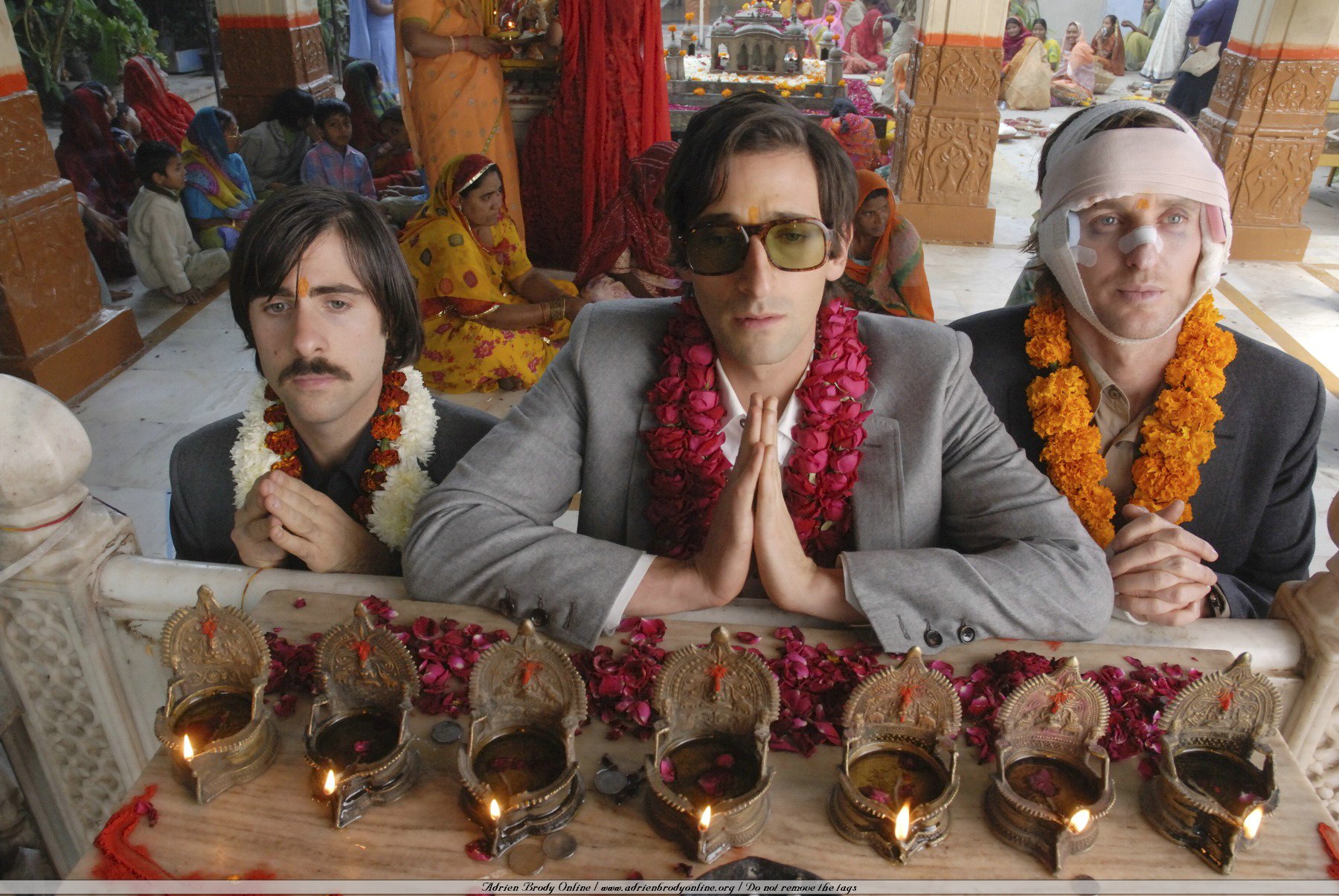
After racing a businessman (Bill Murray) to catch the Darjeeling Limited train, Peter Whitman (Adrien Brody) beats him as he enters the train to meet up with younger brother Jack (Jason Schwartzman). They’re later joined by the eldest brother Francis (Owen Wilson), who is sporting bandages on his face following a motorcycle injury. After not being together for a year since the funeral of their father, Francis hopes to reconcile his feelings with their brother. With help from his bald-headed assistant Brendan (Wallace Wolodarsky), Francis sets up an itinerary for a spiritual journey to many spiritual sites in India. While both Peter and Jack aren't enthused about the trip, they reluctantly join as Peter is still in mourning over their father's death. Even worse, Peter is also dealing with the upcoming birth of his first child with wife Alice (Camilla Rutherford) who is back home in London. Jack meanwhile, copes with the relationship of an ex-girlfriend by falling for a train stewardess named Rita (Amara Karan).
With Jack making out with Rita, he also plans to leave for Italy to meet up with his ex-girlfriend while Peter also plans to leave. Francis refuses for both to leave while they take on the spiritual journey. Yet, the trio start to get into crazy situations when Peter is often carrying their late father's things including his keys, razor, and sunglasses while borrowing Francis' belt. After purchasing a cobra, Peter takes it to the train but it only causes trouble when they're confronted by the train's chief steward (Waris Ahluwalia). After another stop during their journey, Francis is still trying to find information about the whereabouts of their mother Patricia (Anjelica Huston) whom was the real motive for Francis' plans for a spiritual journey. When the train is suddenly off course, things get tense when finally, the brothers are forced to leave the train. After confronting everything they've been through, it's clear that the spiritual journey has failed.
Upon their plans to return to the airport, the Whitman brothers suddenly encounter and later, get involved in an accident that eventually becomes tragic. Taken to a village where they meet a man (Irfan Khan), the brothers are suddenly forced to reflect that last time they were together at the day of their father's funeral. There, they recall the moments where they find the key into why they fell apart. After their period at the village and with gratitude towards the people that took them in, Francis finally found the whereabouts of their mother. The brothers find out their mother had become a nun as they all confront the death of the boys' father and Patricia's husband.
While The Darjeeling Limited and The Life Aquatic with Steve Zissou both had ambitious narratives and storylines that took Wes Anderson and his characters to different worlds. What the Life Aquatic had seemed to fail in terms of its ambitions is suddenly made up for with great maturity and care in The Darjeeling Limited. It's largely because Anderson scaled back his ambitions for something more personal in a film that isn't just about loss but fear. Fear is the main theme as the Whitman brothers and their mother all seem to run away from something. Jack is running away from a failed relationship, Peter from impending fatherhood, and Francis and Patricia both running away from death in their own ways. While Francis' brush with death would serve as a plot device to the film's story, it's also a film about brothers and how dysfunctional they are in their relationship.
With help from Roman Coppola and Jason Schwartzman, who are both cousins in real life, Anderson brings a script that is filled with not just Anderson's unique take on humor but also his sense of melancholia. Where his previous film, The Life Aquatic had been overwhelmed by its ambitions where both the humor and drama seems forced. The Darjeeling Limited goes for something natural where there's a line in which Jack asks if his relationship with Francis and Peter would've been better if they had been friends in real life instead of brothers. That's definitely the key plot-point of the entire film as the script isn't just Anderson as his most mature but also a step into a new direction for the director.
Anderson's direction, that's been known for its use of tracking shots, slow-motion sequences, and moments of spontaneous hijinks. All of that is there but this time around, he takes a new step by adding more emotions to what he's doing. The compositions Anderson goes for in some of the sequences on train are definitely wonderful while he and 2nd unit director Roman Coppola capture the beauty and mystique that is India. The film also has Anderson confronting many new themes while adding some humor to the situations. It doesn't come off as awkward but rather emphasizes the dysfunctional behavior of the Whitman brothers. Another new element Anderson adds to the film is mystique. There's two characters who make brief appearances in the feature film, the businessman and Jack’s ex-girlfriend (Natalie Portman), who appears in The Darjeeling Limited for a minute. There are no answers to their appearances except for Jack's ex-girlfriend who appears in the prequel short Hotel Chevalier.
Again, this is Anderson opening up more where audiences can give an idea of interpretation while there's some clues in the dialogue into who they might be or what actions they have done. The overall work in what Anderson does visually is definitely miles away from the things he's done in previous films. He's managed to get not too much into his style but also try new things like a car chase in the opening scene of the film. It's one of the most amazing and frantic car chase scenes ever done. The result isn't just Anderson starting to get better at his craft but also growing in the process.
Longtime cinematographer Robert Yeomen's cinematography is very potent with its wonderful exterior shots of India that includes some wonderful nighttime and evening shots of the area in the exteriors. Many of the interior scenes are awash with a mix of blue, yellow, green, and exotic colors that gives Yeomen's camera amazing coverage of some of exterior shots of the train and what's going on. Yeomen's work is just stunning in every frame. Production designer Mark Friedberg along with art directors Aradhana Seth (who is also a set decorator) and Adam Stockhausen with additional help from set decorator Suzanne Caplan Merwanji bring a great look to train that is the Darjeeling Limited. The small rooms, hallways, and rooms have an exotic look to the film. With additional help from Wes Anderson’s brother Eric on the luggage design, the film's look works to its visual.
Legendary costume designer Milena Canonero brings a wonderful look to the film's colorful atmosphere with the lovely use of silk for Rita's stewardess clothing along with the chief steward, and the suits that the Whitman brothers wear. Editor Andrew Weisblum brings some solid editing to the film and its irreverent tone with the use of slo-mo edits, jump-cuts, and action cuts to convey some of the film's humor as well as its drama. Sound recordist Pawel Wdowczak along with additional help from Coppola sound designer Richard Beggs do great work in conveying the atmosphere of India including some of the recorded traditional material that's added to the film’s soundtrack.
The film soundtrack marks the first in being that it's first of Anderson's films to not feature a written score from longtime collaborator Mark Mothersbaugh of Devo. Instead, Anderson goes to the music of the late, legendary Indian auteur Satjayit Ray for his intense, folky compositions to convey the film's road-like feel, romance, and drama with additional cuts from Ray collaborators Ustad Vilayat Khan and Jyotitindra Moitra. The Indian music works not just for the atmosphere that is India but is used for accompaniment or background of where the characters are in whatever situation they're in. Along with classical cuts by Ludwig Van Beethoven and Alexis Weissenberg, the film also includes pop songs by Peter Sarstedt (notably in Hotel Chevalier), Joe Dassin, and a bouncy Indian-pop cut from Shankar Jaikishan from the Merchant-Ivory film Bombay Talkie.
While the score and music adds a new flavor to Anderson's knack of musical taste, he still uses his beloved collection of British rock music. A cut from the Rolling Stones appear in one of the film's most emotional key sequences while three cuts from the Kinks from their 1970 album Lola Versus Powerman and the Moneygoround Part One. Two of those songs, This Time Tomorrow and Strangers, both of which appear on the film's trailer, emphasize the film's melancholic tone while Powerman appears near the film's end. Once again, Anderson and music supervisor Randall Poster create an amazing soundtrack.
The film's cast is wonderfully assembled as it features cameos from Anderson regulars Wallace Wolodarsky as Francis' bald-headed assistant Brendan, Waris Ahluwalia as the Chief Steward (and also a security chief in Hotel Chevalier), and Kumar Pallana as a traveler on the train. Whereas the previous film didn't have cameos from Anderson's buddies, this one made up for it, especially Kumar Pallana's cameo which is a joy to see. While some may feel that beloved Indian actor Irfan Khan's appearance is merely a cameo and is wasted, his performance as a grieving man is a sight to see for those who have never seen any of the actor's work. While it's a cameo of sorts, it works in every way as his appearance is wonderful to watch. Amara Karan is great as the stewardess Rita whom Jack falls for while she is dealing with the breakup of her boyfriend as her presence is wonderful to watch. Camilla Rutherford is excellent in her brief scenes as Peter's wife Alice, notably in the flashback scene, and an appearance on the train as a wife worried about Peter and his grief over his father.
While Bill Murray's role as a businessman is a cameo, he manages to make everything of his brief appearance as a businessman running to catch a train as he's just great to watch while he also appears briefly in another scene with the train. Even Natalie Portman's brief five-second appearance as Jack's ex-girlfriend from Hotel Chevalier makes a wonderful impression.
Anderson regular Anjelica Huston, who has a brief appearance, is great as Patricia Whitman. A mother turned nun who seems very weary over what had happened in the year since. While Huston is great in her performance, her character is the strangest where despite being this maternal figure, she seems to wander off as if she had been traumatized while talking to people who might not have existed. It's a great performance from the actress who's amazing to watch in any of Anderson's films. New to the Anderson film family is Adrien Brody in what is definitely his funniest performance yet. Taking a break from more dramatic, darker film roles, Brody is at ease in playing the middle brother Peter (after Peter Bogdonavich) who seems very possessive and also cries a lot whenever he's dealing with his father's death. Brody's chemistry with Wilson and Schwartzman is full of energy and delight as he's definitely a natural for the role as his performance is great to watch.
Jason Schwartzman delivers a brilliant performance as the emotionally battered Jack (after his late father and bits of Jack Nicholson) who seems to try to find ways in coping over the relationship with his ex-girlfriend by making out with Rita or calling his ex's answering machines. Schwartzman is definitely the peacekeeper and conscience of the brothers while adding lots of comedy to his role. Owen Wilson is great in his role as the bossy older brother Francis (after Schwartzman's uncle and Roman Coppola's father Francis Ford Coppola) who is desperate to try and reconcile with his younger brothers. While Owen's appearance with bandages is very disturbing (considering the recent events of his own personal life), it's probably Owen at his best while not playing the often laid-back persona in most of his comedies. Owen shows more range as an actor in this film as he acts like a leader while trying to act in a fraternal role that shows that Owen Wilson is a better actor when he's not acting like an idiot or some sentimental figure in more mainstream fare.
When The Darjeeling Limited was released on DVD in 2008 by Fox Searchlight. The DVD only contained the short Hotel Chevalier along with a Behind-the-Scenes featurette and a trailer. While it was a good DVD for casual audiences, it wasn’t enough for fans of Wes Anderson who had been used to having his film released through the Criterion Collection company for its DVD releases. In 2010, The Darjeeling Limited finally gets a release through the Criterion Collection with total approval and involvement from its director, Wes Anderson.
The Region 1, 2-disc Criterion DVD for The Darjeeling Limited presents the film with a new, high-definition digital transfer that is approved and supervised by Wes Anderson. Presented with Surround Sound and the film’s original theatrical widescreen aspect ratio of 2:40:1. The film along with the short Hotel Chevalier are given a wonderful, colorful transfer that is a trademark of Anderson’s films. It’s fuller in color and has a more lush setting as it’s shot on location in India as the film is given the treatment it needed to live up to what fans wanted in his DVDs.
The first disc of the DVD has both Hotel Chevalier and The Darjeeling Limited that can be played separately or together since Hotel Chevalier is a prequel of sorts to The Darjeeling Limited. The special features on the first disc includes the film’s theatrical trailer and a feature-length audio commentary track from Wes Anderson and the film’s co-writers in Roman Coppola and Jason Schwartzman while Anderson does a sole commentary track for Hotel Chevalier.
Anderson’s commentary for Hotel Chevalier revealed that it was made for two days in 2005 as an experiment of sorts while he was working on the script for The Darjeeling Limited with Roman Coppola and Jason Schwartzman. Anderson hadn’t worked with Schwartzman since Rushmore but have been very close friends. Anderson revealed his interest in creating more shorts either as a stand-alone piece or as part of an omnibus type of film. He also revealed that Natalie Portman came in when she had a break from making Milos Forman’s Goya’s Ghost. It’s a wonderful commentary track that would lead to The Darjeeling Limited.
The commentary for The Darjeeling Limited features Anderson, Coppola, and Schwartzman all commenting on different locations through Skype. The three men talk about the writing process of the film as well as recounting their own experiences in India. The film was shot in late 2006 as Schwartzman, Owen Wilson, and Adrien Brody all rehearsed their dialogue and scenes before the movie started. While all of the dialogue was spoken from the script, everything else was improvised because of the chaotic atmosphere of the locations.
Anderson, Coppola, and Schwartzman that with the exception of the train that was partially a set that was built for the film. Everything else was shot on location in India except for the scenes in New York City which were shot last. The men also mention a lot of film references that inspired the film. Notably the works of Satyajit Ray and Robert Altman along with Jean Renoir’s The River. They also talked about a lot of the Indian actors they hired while some just walked on set not knowing they were being filmed but it worked because it felt so natural. Anderson and Schwartzman had a lot of praise towards Amara Karan as Rita, who they really liked a lot. Schwartzman also talked about how nervous he was acting with Owen Wilson and Adrien Brody but once the film went into production, they were all equal.
Anderson also had praise for Brody who was new to the world of Wes Anderson as Brody invited his mother on the set to shoot pictures along with Owen Wilson’s mother. Anderson admitted that if it wasn’t for Roman Coppola, the shooting of The Darjeeling Limited would’ve been extremely hard since he didn’t want to relive some of the headaches he had in making The Life Aquatic with Steve Zissou. The commentary is an enjoyable one while it ended with a lot of humor as someone made a call to Anderson about an idea for his production company.
The second disc of the DVD is filled with loads of special features. Leading the supplement material is a 41-minute behind-the-scenes documentary by Barry Braverman. The documentary is shot on location in India where Wes Anderson, cast, and crew are making the film. Notably with six specific sequences as the first with Bill Murray as the businessman was shot during a chaotic morning with crazy traffic around. For the scenes at the spiritual temples, they had to shoot in the mornings and early day even though the ceremonies were actually happening throughout. Even as the actors got to interact with the locals.
For the scenes in the train, the documentary shown how the look of the train was made where it doubled not just as a real train but also a soundstage where they shot everything while it’s moving. Even as the train was used for transportation for the actors and crew to live in. Even where they stopped for some scenes as everyone had a good time. For the funeral scene, it was shot on a real village while the actors got to interact with three young brothers that were in the film and helped during the big stunt in that film. It’s an enjoyable documentary that often has shots of the people, animals, and beautiful locations where it was a more relaxed making of than the overwhelming production that was Anderson’s previous film in The Life Aquatic with Steve Zissou.
The 21-minute discussion between Wes Anderson and filmmaker James Ivory is about the music used in the film. Shot at a restaurant in Paris, Anderson and Ivory talked about the music that was used with footage of where the music of those movies originated from. Ivory revealed that when he did The Guru with 20th Century Fox providing the money, it was at the time when all things related to India became popular as he said it was partially inspired by George Harrison. They also discussed Satyajit Ray and the music he made as Ivory always have pieces that he will love. He also likes the way Anderson used the music for those scenes in The Darjeeling Limited as the discussion ended with Anderson thanking Ivory for inspiring him. Ivory thanked him for giving the music a chance to be heard to a new audience.
The 12-minute video essay by film critic Matt Zoller Seitz. Seitz uses images of both Hotel Chevalier and The Darjeeling Limited to talk about the film and why they’re important in Wes Anderson’s film career. Seitz claims that The Darjeeling Limited is Anderson’s 2001 in the way he uses all of his film tricks and refines them into something that is distinctive. Seitz also talks about the characters and why Hotel Chevalier is important to the story. It’s a wonderful video essay that not only explains some of the secrets of the film but reveals why spiritual journeys should never have itineraries.
The only deleted scene is where the Peter tries to play cricket with a tennis ball as Francis and Jack watch. Two alternate scenes include a shot of the Whitman brothers going down the hill and the other is a scene of the brothers about to board a plane where the dialogue is finally revealed. The audition of the young actor Sriharsh Sharma, who plays the boy with the handkerchief in the village/funeral scenes, is an impressive audition clip. Though he was not able to play one of the young brothers, his audition showed some natural quality while he sang Green Day’s Boulevard of Broken Dreams. Other small video features includes the American Express commercial Wes Anderson made that features Jason Schwartzman, Waris Ahluwalia, and cinematographer Robert Yeomen.
Waris Ahluwalia also has a video diary filled with several photos and video clips. Among the clips are life on the train where everyone seems relaxed and enjoying themselves while Kumar Pallana does a magic trick. Shots of animals including a dancing elephant on a truck and a flock of sheep not going in the right direction. Jason Schwartzman at a kitchen cooking while cooks are making lunch for the other actors. Everyone doing some fitness and kite-flying with special guest, Kiki Smith. A shot of what Anderson’s idea of special effects are for the film. Waris trying on his costume with help from famed costume designer Milena Canonero. A crew member talking about Indian luck while Adrien Brody signs autograph to fans. Wes Anderson and Roman Coppola talking about a scene with the theme of Bombay Talkie playing in the car and what Waris is feeling when he’s shot all alone in a desert. The photos are in Polaroid pictures from the cast and crew of the film plus Hotel Chevalier and the American Express commercial.
The Oakley Friedberg/Packer speech short video is where Mark Friedberg’s son talked about his trip to India where he talked his experience and how he and many of the people working on the film managed to raise money for bikes so that kids can go to school miles away from where they lived. It’s a wonderful clip that features a great photo gallery of locations and the modern schools the kids learn at. A forty-seven video clip reveals the two major awards The Darjeeling Limited won, one at the Venice Film Festival and the other from a U.S. comedy film festival. The last short video featurette is from Roman Coppola which is a two-and-a-half minute clip of Coppola, Schwartzman, and Anderson writing the film during their trip to India with pictures and all sorts of footage which is just dazzling to watch.
The stills gallery features three sets of on-set photos. One from the on-set photographer James Hamilton that features a wide array of photos on location in both India and New York City. The other two comes from the mothers of Owen Wilson and Adrien Brody. Laura Wilson’s photos are shown in color while the renowned Sylvia Plachy are shown in black-and-white. The DVD includes a booklet that features original illustrations by Eric Chase Anderson and an essay by film critic Richard Brody. Entitled Voyage to India, Brody discusses a lot of the personal attributes Wes Anderson made for The Darjeeling Limited. He even revealed that the film was meant to be the anti-Life Aquatic which was an expensive and overwhelming film to make for Anderson. For that, Anderson had to improvise shots while retaining some of his visual styles while not having trailers around for the actors.
Brody also talks about Hotel Chevalier where it would be a crux for Jack’s writing as he is tormented by his ex-girlfriend’s visit. Jack would often try to find the approval of his brothers for his writing as he would finally get it towards the end while making some acceptance about his own work. Originally, it was going to be a piece by itself but became part of The Darjeeling Limited when Anderson was writing the film with Roman Coppola and Jason Schwartzman. When The Darjeeling Limited finally came into production and the train was made, it was a place where everyone felt like equals whether they were shooting or not. Brody recalls his meetings with Anderson as he revealed that part of the film’s inspiration aside from Satyajit Ray and Jean Renoir’s The River was the John Cassavetes film Husbands.
The essay is a truly remarkable for its analytical take on the film as well as the characters and objects that the Whitman brothers carry. It also reveals why the film was a hit with his fans because there was something they could relate to as well as how they’re connected to the characters in Anderson’s other films. In many ways, it’s a stepping stone for Anderson to move into newer territory while refining his own tricks. The Criterion DVD for The Darjeeling Limited is a must-have for fans of Wes Anderson while the special features are truly top-notch.
***End of DVD Tidbits***
While it's not as brilliant as Rushmore, or in some cases to the hardcore fans, Bottle Rocket, The Darjeeling Limited is a funny, dramatic, complex, and serious film from Wes Anderson and company. Fans of Anderson's work will no doubt enjoy his directing style, themes, and characters in this film while those new to him might have a hard time in understanding his themes and humor. Yet, the film does remain entertaining and its laughs are well-earned. The Darjeeling Limited is an overall joyful, uplifting film from Wes Anderson who has now managed to grow up with grace and style.
Wes Anderson Films: Bottle Rocket - Rushmore - The Royal Tenenbaums - The Life Aquatic with Steve Zissou - Hotel Chevalier - Fantastic Mr. Fox - Moonrise Kingdom - Castello Cavalcanti - The Grand Budapest Hotel - Isle of Dogs - The French Dispatch - Asteroid City - The Wonderful Story of Henry Sugar - The Swan - The Rat Catcher - Poison - The Phoenician Scheme - The Auteurs #8: Wes Anderson
Wes Anderson Soundtracks: Bottle Rocket - Rushmore - The Royal Tenenbaums - The Life Aquatic with Steve Zissou - Seu Jorge-The Life Aquatic Studio Sessions - The Darjeeling Limited - Fantastic Mr. Fox - (Moonrise Kingdom)
© thevoid99 2010
Subscribe to:
Posts (Atom)


