Based on the comic book The Secret Service by Dave Gibbons and Mark Millar, Kingsman: The Secret Service is the story of a young man who is recruited to be part of a secret spy organization where they try to save the world from a megalomaniacal man of great wealth. Directed by Matthew Vaughn and screenplay by Vaughn and Jane Goldman, the film is a take on the world of spies and what it takes to become a badass spy with a sense of style. Starring Colin Firth, Taron Egerton, Mark Strong, Sophie Cookson, Sofia Boutella, Mark Hamill, Samuel L. Jackson, and Michael Caine. Kingsman: The Secret Service is an exhilarating and fun film from Matthew Vaughn.
The film revolves around a young man, whose father had died when he was young, as he is recruited to be part of a secret organization from a man who feels he owes a debt to that young man’s father for saving his life. There, the two deal with a wealthy Internet mogul who has plans to wipe out most of the population in favor of saving the world as it forces the secret organization of the Kingsman to save the world. It’s a film with a simple plot that plays into a lot of the tropes that is expected in spy films such as world domination, chaos, and doing what is right. Yet, Matthew Vaughn and co-screenwriter Jane Goldman become aware of these clichés and play with those while investing their time in developing a young man who was going through an aimless life into finding something that has meaning.
The protagonist Eggsy (Taron Egerton) is a young kid who lost his father at a young age where he’s been living with his mother, an abusive stepfather, and infant half-sister where he had all of the grades and potential to be something more than a criminal but has a chip on his shoulder. When he meets Harry Hart aka Galahad (Colin Firth) who knew Eggsy’s father, he would bail him out and show him what he could be as Galahad is a spy that looks like a tailor but proves to be a formidable badass. Yet, Galahad is also dealing with the loss of one of his colleagues and needs a replacement where he and the Kingsman are dealing with this billionaire named Richmond Valentine (Samuel L. Jackson) who is an odd villain of sorts. A billionaire with a lisp and can’t stand the sight of blood despite what he is doing to the world with his new free software that he gives to the world which really serves as what he is planning to do. Once Galahad and the Kingsman senior agent Merlin (Mark Strong) realize what they’re dealing with, they knew something had to be done which also prompts Eggsy to fulfill his own potential.
Matthew Vaughn’s direction is definitely stylish from some of the tracking shots and long takes he creates for some of the scenes to the mixture of violence and humor that is injected in the film. While it starts off with comical moments of violence, Vaughn does play into some of the impact that occurs such as an opening sequence where Eggsy’s father sacrifices himself to save three men from a suicide bomber which plays into Galahad making an oath to be there for Eggsy. While some of the action and suspenseful moments are quite gripping, Vaughn does find a way to inject some humor but also play into what is at stake where Eggsy learns what he has to do to become a Kingsman. Even in a tense moment where he meets with Kingsman leader Arthur (Michael Caine) that would serve as a major test to see if he can really become one. Vaughn’s usage of close-ups and medium shots do play into the drama as well as Eggsy coming to term with who he is but also someone that has a lot of attachments which is often the reason for why he never able to live up to his promises as a young man.
When the film reaches its third act where the Kingsman have to confront Valentine, it is presented in a grand scale in terms of its set pieces and what is at stake where Eggsy not only fulfills that potential. He also becomes aware of what is at stake where Vaughn does play with the conventions of these climaxes as some of it is very violent but also has this air of dark comedy that manages to be a whole lot of fun to watch. Especially in what Valentine unleashes into the world through his app which gave the world free internet and free cellphone usages which plays into the drawbacks of the modern world. Overall, Vaughn creates a very thrilling yet witty film about a young man who realizes his potential to be something more as well as saving the world.
Cinematographer George Richmond does excellent work with the film‘s cinematography with its usage of lights for many of the nighttime interior settings including the film‘s climax as well as some of the exteriors in the day to play off its natural look for scenes set in London. Editors Eddie Hamilton and Jon Harris do nice work with the editing as it does have some fast-paced rhythmic cuts for some of the action and conversations while knowing when not to cut such as some of the tracking shots. Production designer Paul Kirby, with supervising art director Andy Thomson and set decorators Naomi Moore, David Morison, and Jennifer Williams, does fantastic work with the set design from the look of the Kingsman base and its training facilities to the secret hideout where Valentine holds his party. Costume designer Arianne Phillips does terrific work with the costumes from the tailored suits the Kingsman wear as well as the stylish clothes of Valentine.
Hair/makeup designer Christine Blundell does wonderful work with the hairstyles of the characters including the one Galahad would wear during his brief comatose state. Visual effects supervisors Steven Begg, Huseyin Caner, and Matt Kasmir do fine work with some of the visual effects though some of the background stuff don‘t look finished at times. Sound designer Matthew Collinge and sound editor Danny Sheehan do superb work with the sound in creating some sound effects for some of the gadgets the Kingsman use along with some of the sound that occurs in the locations and places the characters go to. The film’s music by Henry Jackman and Matthew Margeson is amazing for its mixture of orchestral bombast and some pulsating electronic music as the latter plays more into Eggsy‘s personality while music supervisor Ian Neill creates a fun soundtrack that features a plethora of music ranging from rock, pop, and hip-hop from acts like Lynyrd Skynyrd, KC and the Sunshine Band, Dire Straits, Take That, Dizzee Rascal, Iggy Azalea and Ellie Goulding, and Bryan Ferry.
The casting by Reg Poerscout-Edgerton is brilliant as it features notable small roles from Jack Cutmore-Scott, Tom Prior, and Fiona Hampton as a few Kingsman candidates, Hanna Alstrom as the Swedish princess who refuses to make a deal with Valentine, Bjorn Floberg as the Swedish prime minister, Richard Brake as an interrogator for the candidates, Jack Davenport as the original Lancelot who tried to save a professor, Geoff Bell as Eggsy’s abusive stepfather Dean, Samantha Womack as Eggsy’s mother whom he cares about, and Mark Hamill in a terrific role as Professor James Arnold as this man who would be a pawn into what Valentine is creating. Edward Holcroft is superb as the Kingsman candidate Charlie Hesketh who bears all of the attributes to be a Kingsman as he is the total opposite of what Eggsy brings to the organization.
Sofia Boutella is fantastic as Valentine’s amputated henchwoman Gazelle as this woman who is beautiful but dangerous as her sword-like legs are very dangerous. Sophie Cookson is amazing as Kingsman candidate Roxanne as a young woman who befriends Eggsy as she is one of the few who doesn’t dismiss his working-class background while being someone who can be a Kingsman and do what is right. Michael Caine is excellent as Arthur as the Kingsman leader who tries to sort out everything that is happening as well as deal with a world that is changing very rapidly. Mark Strong is awesome as Merlin as a senior Kingsman officer who is also the candidates’ trainer as a man that had seen so much as he is also the film’s conscious of sorts.
Samuel L. Jackson is phenomenal as Richmond Valentine as this megalomaniacal man of wealth who believes he has the answers for all of the problems of the world while doing it in a very evil way where Jackson brings charm but also some humor in his lisps and aversion to blood and violence. Colin Firth is remarkable as Galahad/Harry Hart as a Kingsman agent who personifies all of the things to be a spy that is full of control and style while also being the one person who can show Eggsy what he can be as it’s one of Firth’s finest performances. Finally there’s Taron Egerton in a real breakthrough as Eggsy as young man with a chip on his shoulder as someone that is lost and destined for trouble as he tries to find ways to better himself as well as bring meaning where Egerton manages to have some charm and dramatic weight to his role.
Kingsman: The Secret Service is a sensational film from Matthew Vaughn. Featuring a great cast and an inventive premise that manages to be fun and engaging, the film is truly not just a play on spy movies but also showcases the idea of what a gentleman can be when he’s facing the world in danger. In the end, Kingsman: The Secret Service is a rapturous film from Matthew Vaughn.
Matthew Vaughn Films: (Layer Cake) - (Stardust) - Kick-Ass - X-Men: First Class
© thevoid99 2015

Directed by J.J. Abrams and screenplay by Abrams, Michael Arndt, and Lawrence Kasdan from characters written by George Lucas, The Force Awakens (Star Wars: Episode VII) is the story of a conflict between two factions that re-emerges to disrupt order in the galaxy as three people find themselves in the middle of this conflict. Set thirty years after the events in Return of the Jedi, the film focuses on new characters who encounter those from the past as they deal with this conflict in a new war. Starring Daisy Ridley, John Boyega, Oscar Isaac, Adam Driver, Domhnall Gleeson, Lupita Nyong’o, Andy Serkis, Gwendoline Christie, Max von Sydow, Anthony Daniels, Peter Mayhew, Mark Hamill, Carrie Fisher, and Harrison Ford. The Force Awakens is a sensational and riveting film from J.J. Abrams.
Set 30 years after the events that saw the fall of the Galactic Empire and the resurrection of the Galactic Republic, the film revolves around a new conflict between a new order known as the First Order and a group opposing the First Order in the Resistance led by General Leia Organa (Carrie Fisher). Realizing that the First Order is trying to find Luke Skywalker (Mark Hamill) who had disappeared many years ago, General Organa asks Resistance pilot Poe Dameron (Oscar Isaac) to find a map that could lead to Skywalker before the First Order finds and eliminates him. While it is a film that is derivative of plot elements that relates to Episode IV, it does however manage to find ways to create new storylines and characters to be engaging as it bears elements that made those first three films so special.
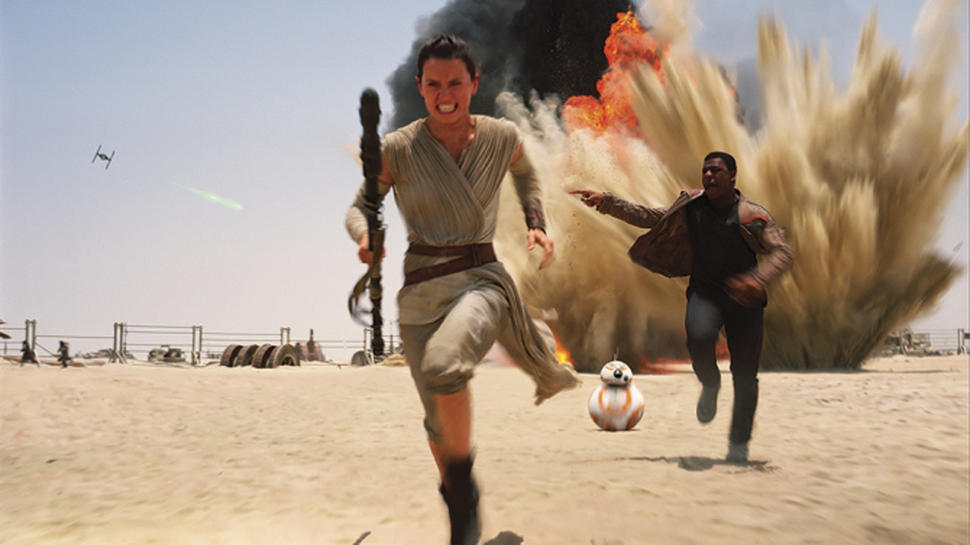
The film’s screenplay by J.J. Abrams, Michael Arndt, and Lawrence Kasdan doesn’t just introduce these new characters into the story and how they would interact with characters from the past. It also has an air of innocence that was definitely missing from the prequels as it relates to a character named Rey (Daisy Ridley) as she is this young scavenger from a desert planet called Jakku as she steals and sells scraps from war remnants to survive. Yet, she is in the planets as she awaits for people to comeback until she meets this droid named BB-8 where her adventure begins that includes an encounter with a Stormtrooper named Finn (John Boyega) who defects from the First Order after seeing what they have done. Finn is an interesting character as he is someone that was born and raised to be part of the First Order but when he sees first-hand in what they do. He starts to question what they do where he would later help Poe escape from the clutches of the First Order as well as go into his own journey.
Rey, Poe, and Finn aren’t just this new trio of protagonists who all have something to offer as they’re allowed to be characters audiences can root for. While Poe may not have as much development as Rey or Finn, he is someone that is willing to do the right thing and stand up to the First Order no matter what they can do to him. Then there’s the antagonists in the members of the First Order such as Kylo Ren (Adam Driver) as he is someone that is strong with the Force as well as someone that is kind of an emotional time bomb whenever things don’t go his way. While he would also have to contend with First Order leader General Hux (Domhnall Gleeson) over what should be done, Ren is someone that is also very complex as it relates to his own background and why he’s obsessed with finding Skywalker. By the time Han Solo (Harrison Ford) and Chewbacca (Peter Mayhew) come into the story, they would not only help Finn and Rey but also reveal the many myths about the Jedi, the Sith, and the Force which would allow Solo to reunite with Leia and find Luke. It’s not just in the characterizations and storylines that help make the story successful but also the dialogue where it does reveal aspects to the story but also has some funny moments.
Abrams’ direction is definitely grand not just in the way the galaxy is presented but also in establishing a world of peace and prosperity is about to be undone by this new galactic world order. Just after the opening crawl, the film opens with this large Star Destroyer covering a planet as it plays into how much the galaxy has changed where things are about to become very chaotic. With the planet of Jakku shot in Abu Dhabi as well as some locations that are shot in Ireland and parts of Iceland, Abrams does give the film a more worldly feel while also harkening back to visual ideas and such that isn’t just a homage to the original trilogy. It’s also to play into moments that made that original trilogy so special where Abrams doesn’t just bring back that air of innocence but also keeping things simple in its story while not doing too much to make everything bigger than it already is. Abrams usage of the 2:35:1 aspect ratio allowed him to capture every moment with the wide shots with such beauty as well as in the medium shots that establishes some of the moments between the characters.
Abrams also create these moments in the action where it does have this energy and element of suspense that is needed such as Finn and Rey trying to run from the TIE Fighters. Even the battles in the air are thrilling where Abrams knows what is happening and what needs to be shown while he also finds a way to have the story break away from the action for drama and humor. Even in the way he uses close-ups and camera angles to help play into the drama and suspense. Abrams’ usage of practical visual and special effects doesn’t just add to a sense of realism to the look of the film but also add something that isn’t overwhelmed by computerized-digital effects that often takes some of the visual elements away from the story. The film’s climax may bear similarities to other climaxes from past films but the stakes are definitely high as it play into what is happening as well as the kind of weapon the Resistance has to take down in this mega-version of the Death Star that is called the Starbase Killer. Overall, Abrams creates an exhilarating and majestic film about a group of people trying to save the galaxy from a new world order.
Cinematographer Dan Mindel does brilliant work with the film‘s cinematography from the sunny look of the planet of Jakku to the usage of green and naturalistic colors for the planet of Takodana as well as some of the interior lights for the scenes inside the Star Destroyer and the Starbase Killer. Editors Mary Jo Markey and Maryann Brandon do amazing work with the editing with its usage of jump-cuts and stylish transition wipes to not go overboard as well as allowing shots and scenes to play out longer rather than delve into conventional fast-cutting techniques. Production designers Rick Carter and Darren Gilford, with set decorator Lee Sandales and supervising art director Neil Lamont, do incredible work with the set designs from the look of the Resistance base as well as many of the interiors in the Star Destroyers and Starbase Killer as well as the junkyard at Jakku.
Costume designer Michael Kaplan does excellent work with the costumes from the newer look of the Stormtrooper outfits as well as the look of the Resistance and the jacket that Finn wears that belonged to Poe. Hair designer Lisa Tomblin and makeup artist Amy Byrne do fantastic work with the look of some of the characters including Leia‘s hair and some of the minor characters including some pirates that have issues with Solo. Special effects supervisor Chris Corbould and creatures conceptual designer Neal Scanlan do phenomenal work with the practical effects from the look of the X-Wing and TIE Fighters as well as some of the starships and creatures in the planets that look and feel real which adds to how worldly the galaxy is. Visual effects supervisors Roger Guyett and Michael Mulholland do splendid work with the visual effects from the look of some of the characters as well as some of the exteriors in space as well as the look of the Starbase Killer in its exterior setting.
Sound designers David Acord and Ben Burtt, with sound editors Gary Rydstrom and Matthew Wood, do superb work with the sound from the sound effects of the droids including BB-8 and R2-D2 as well as the sound work of the some of the starships and other moments that play into the sound. The film’s music by John Williams is remarkable for its bombastic orchestral score that features themes from past films but also some newer themes from some very low-key yet somber pieces as well as some heavy moments as it is one of Williams’ finest work.
The casting by Nina Gold, April Webster, and Alyssa Weisberg is marvelous for the people that are assembled for the film as it features small appearances from Billie Lourd as Resistance officer Lt. Connix, Tim Rose and the voice of Erik Bauersfeld as Admiral Ackbar, Mike Quinn and the voice of Kipsang Roitch as Resistance fighter Nien Nunb, Ken Leung as Resistance Admiral Statura, Simon Pegg as Jakku junkyard dealer Unkar Plutt, Greg Gunberg and Jessica Henwick as a couple of X-wing pilots, Thomas Brodie-Sangster as First Order Petty Officer Thanisson, Dave Chapman and Brian Herring as the puppeteers for BB-8 with vocal work from Bill Hader and Ben Schwartz, and Kenny Baker as the voice work of the droid R2-D2. Other notable small roles include Anthony Daniels as the protocol droid C-3P0, a trio of pirates played Yayan Ruhian, Iko Uwais, and Cecep Arif, Gwendoline Christie as the Stormtroopers leader/First Order officer Captain Phasma, and Max von Sydow in a brief yet superb performance as Lor San Tekka as a village elder who would give Poe a portion of a map that carries information into where Skywalker is.
Peter Mayhew is terrific as Chewbacca as Han Solo’s first-mate and friend who aids him in dealing with pirates and members of the First Order as additional credit goes to Joonas Suatamo who appears as Chewbacca for some of the film’s action scenes. Andy Serkis is excellent as the mysterious First Order leader Supreme Leader Snoke as this figure who is Ren’s master as he is hoping to end the Resistance and bring order to the galaxy. Domhnall Gleeson is fantastic as General Hux as a First Order leader who watches over the Starbase Killer as he often contends with Ren for power as well as provide a more ruthless idea of what the First Order should be. Lupita Nyong’o is brilliant as the pirate Maz Kanata as this offbeat yet wise alien who is an old friend of Solo and Chewbacca who can look through people as she provides some key moments for both Rey and Finn.
Mark Hamill is wonderful as Luke Skywalker where despite the fact that Hamill doesn’t appear in the film, he maintains a presence that is of great importance as the legendary Jedi knight that looms over the conflict in the galaxy. Carrie Fisher is amazing as General Leia Organa as the leader of the Resistance who is trying to deal with the First Order as she also copes with her brother’s disappearance and the hope to find good in the galaxy. Harrison Ford is great as Han Solo as the legendary smuggler who finds himself back in the conflict as he too carries a burden of what had been lost where he becomes this reluctant figure of wisdom for both Finn and Rey. Adam Driver is phenomenal as Kylo Ren as this commander of the First Order who displays the power of the Force as someone who is eager to fulfill the legacy of Darth Vader but is also unpredictable and dangerous as it plays into who he really is under the mask that he wears.
Oscar Isaac is incredible as Poe Dameron as Resistance fighter who is considered the best pilot in the galaxy as he is tasked to do a mission for General Organa in finding out where Luke Skywalker is as he also deals with the severity of the First Order. John Boyega is tremendous as Finn as a Stormtrooper who defects to the Resistance as he tries to find redemption and meaning to his life as he helps Rey and take down the First Order despite being targeted as a traitor. Finally, there’s Daisy Ridley in an astonishing performance as Rey as this young scavenger who finds herself in an adventure that has her doing so much from fixing starships to fighting Stormtroopers as she is also someone that is very vulnerable as it relates to being alone for much of her life as Ridley is the film’s real discovery.
The Force Awakens is a magnificent film from J.J. Abrams. Featuring a great cast of people from past films as well as a collection of newcomers along with great technical work and a thrilling score. The film isn’t just a great mixture of nostalgia and homage to the original trilogy but also a film that manages to bring in a lot of adventure and heart that the series that hadn’t been seen in years. Notably as it’s the kind of film that manages to be escapist cinema but also cinema that is very intelligent and full of warmth and innocence that is often lacking in today’s high-octane mainstream cinema. In the end, The Force Awakens is an outstanding film from J.J. Abrams.
Star Wars Films: Star Wars - The Empire Strikes Back - Return of the Jedi - The Phantom Menace - Attack of the Clones - Revenge of the Sith - The Last Jedi - The Rise of Skywalker
Related: The Star Wars Holiday Special - Caravan of Courage - The Battle for Endor - The Clone Wars - Fanboys - The People vs. George Lucas
Star Wars Anthology Films: Rogue One - Solo: A Star Wars Story - (Untitled Star Wars Anthology Film)
George Lucas Films: THX 1138 - (American Graffiti)
J.J. Abrams Films: (Mission: Impossible III) - (Star Trek (2009 film)) - Super 8 - (Star Trek: Into Darkness)
© thevoid99 2015
Directed and shot by Herve Martin-Delpierre and written by Martin-Depierre and Marina Rozenman, Daft Punk Unchained is a documentary about the seminal French electronic duo who are considered the forefathers of the modern wave of electronic dance music. From the band’s early years as part of the alternative band Darlin’ to becoming icons in electronic music, the film doesn’t just play into their work as artists but also maintain a sense of mystique about them as they rarely do interviews as well as not make any kind of public appearances unless they’re wearing costumes as robots. The result is a fascinating film about one of the finest groups to ever come out in the world of electronic music.
From their formation in 1993 after being part of the French alternative rock group Darlin’ with future Phoenix-cofounder Laurent Brancowitz, Thomas Bangalter and Guy-Manuel de Homem-Christo would form the duo known as Daft Punk based on a review for their band as well as going to raves which were hot in those times. The film plays into not just their early beginnings but also the sense of mystique that has loomed over the band ever since the late 1990s where they started wearing masks and such to avoid what is typical of promotion in those days. On the first day of the new Millennium, the two would wear masks and such claiming they have become robots as it only increased their mystique even more as well as being more inaccessible to the press where they’re rarely seen unmasked.
Featuring interviews with collaborators such as Kanye West, Giorgio Moroder, Paul Williams, Nile Rodgers, Pharrell Williams, and filmmaker Michel Gondry. The film plays into not just their influence but also the albums they made and why they didn’t want to play by the rules with the industry. While they would use videos to promote their music, it would be their legendary performance at the 2006 Coachella Music Festival in Indio, California that would make them a very popular live act. The film also features rare audio interviews with Daft Punk that only adds more to their mystique. Director Herve Martin-Delpierre would also compile many rare archival interviews with the group before their decision to mask themselves as well as play into many of the stunts and such that played into their music and how they presented it.
Especially as prominent EDM figures such as Pete Tong and current EDM star Skrillex reveal exactly what Daft Punk has done for the genre. Through some stylish editing and the usage of music that had influenced Daft Punk including film footage from Brian de Palma’s Phantom of the Paradise. While many who talk about Daft Punk revel into their importance, it all plays into what the group is really about which is making good music and making it matter no matter if it’s retro or innovative.
Daft Punk Unchained is an excellent film from Herve Martin-Delpierre. Not only is it a film that fans of the group will enjoy but also will introduce those unfamiliar with electronic music the group’s importance for the genre. In the end, Daft Punk Unchained is a superb film from Herve Martin-Delpierre.
© thevoid99 2015

Based on the play by William Shakespeare, Macbeth is the story of a Highland lord who becomes the king of Scotland through deceit, plotting, and other things where he succumbs to his own paranoia and guilt. Directed by Roman Polanski and screenplay by Polanski and Kenneth Tynan, the film is an interpretation of the Shakespearean tragedy that explores a man’s decent for ambition in a stylized yet atmospheric take on the play with Jon Finch as the titular role. Also starring Francesca Annis, Martin Shaw, Terence Bayler, John Stride, Nicholas Selby, Stephan Chase, Paul Shelley, Maisie MacFarquhar, Elsie Taylor, Noelle Rimmington, Keith Chegwin, and Diane Fletcher. Macbeth is a riveting yet eerie film from Roman Polanski.
Set in medieval Scotland, the film revolves around a young lord who encounters three witches as he believes in a prophecy that would allow him to become King of Scotland where he and his wife would conspire to kill the king only to be driven by guilt and paranoia. It’s a story that has been told many times yet what Roman Polanski and co-screenwriter Kenneth Tynan do is create something that plays into a man believing into something that isn’t real and may not be about him. Yet, Macbeth (Jon Finch) and his wife (Francesca Annis) take these words very seriously as they believe that killing King Duncan (Nicholas Selby) would bring them good fortune. Instead, questions arise about Duncan’s death as those such as Macduff (Terence Bayler) and Prince Malcolm (Stephan Chase) suspect something isn’t right.
Even as one of the play’s more minor characters in Ross (John Stride) would be given more to do as a man who aids those who are in power for his own gain where he would align with whoever can be powerful. All of which plays into not just the concept about ambition but also its fallacies where guilt would come into play for both Macbeth and his wife through events and visions that would trouble them. For Macbeth, paranoia would ensue where he would kill those close to him and drive those around him mad. Notably in the climatic battle in the third act where Macbeth tries to make sense of all that is happening to him as he faces those he had hurt and such on his ascent to the throne.
Polanski’s direction is definitely intoxicating in terms of the images he creates as well as maintaining an atmosphere into the locations he uses which are set in Wales and England. Polanski’s approach to wide and medium shots not only capture the beauty of those locations with its hills, woods, and all sorts of scenery in these places but also in how it creates this world that quite vast but also unsettling. Notably in scenes where rain is an important part to the landscape which adds an atmosphere that is morose as well as have this stench of death which sets the tone for what Macbeth will deal with. Especially with some of the violence that happens in the film as it is quite gruesome as it play into Macbeth’s own thirst for power and his mistrust towards nearly everyone around him.
The direction also has this air of theatricality in some of the intimate moments that occur yet it is done with a sense of grit in the way the actors are presented into the frame. Most notably a scene where Lady Macbeth is walking in her room naked as she is coping with her own guilt and the trauma in her actions as if she is hallucinating about what is in her body. The film’s climatic battle doesn’t just display these eerie moments of violence but also a sense of terror that plays into the guilt that looms over Macbeth as if all of the misdeeds he had committed into his ascent to the throne is coming back to haunt him as it’s told through such potent imagery through what Polanski unveils in the film. Overall, Polanski creates a spectacular yet haunting film about a man’s desire for power and the fallacy of ambition.
Cinematographer Gil Taylor does brilliant work with the film‘s very colorful cinematography with its emphasis on naturalistic colors for some of the skyline scenes along with unique lighting and fog for the scenes set in the rain as well as some low-key lights for some of the interiors set at night. Editor Alistair McIntyre does amazing work with the editing as it is quite stylish with its usage of jump-cuts but also in creating rhythmic cuts to play up the suspense and drama. Production designer Wilfred Shingleton, with set decorator Bryan Graves and art director Fred Carter, does fantastic work with the look of the castles from the home of Macbeth as well as the look of the home of the three witches and the other castles that the other characters live in.
Costume designer Anthony Mendleson does nice work with the look of the clothes from the robes of the women to the armor and clothes that the men wear. The special effects work of Ted Samuels is terrific for some of the hallucinations that Macbeth would see as it plays into the paranoia that looms over him. Sound mixer Simon Kaye does superb work with the sound in creating some sound effects in some of the battles and fights as well as in some of the sound effects that play into the eerie tone of the film. The film’s music by the Third Ear Band is incredible as it’s one of the film’s highlights for its mixture of traditional folk music of the times mixed in with haunting music pieces that play into the sense of dread that looms in the film.
The film’s remarkable cast features some notable small roles from Keith Chegwin as Banquo’s son Fleance, Mark Dightam as Macduff’s son, Richard Pearson as a doctor who expresses concern for Lady Macbeth’s well-being, Diane Fletcher as Lady Macduff, and as the three witches, Maisie MacFarquhar, Elsie Taylor, and Noelle Rimmington. Paul Shelley and Stephan Chase are terrific in their respective roles as Donalbain and Malcolm as King Duncan’s sons who both flee to England as they both suspect that something wasn’t right in the death of their father. Nicholas Selby is excellent as King Duncan as this man who gives Macbeth so much as he just wants to rule Scotland in peace while deciding to give Malcolm the chance to be the next in line for the throne. John Stride is fantastic as Ross as a knight who aids Macbeth in killing those while aligning himself with whoever has a shift in power so he can be safe and be conniving as it’s a very complex performance.
Terence Bayler is brilliant as Macduff as a general who suspects that Macbeth might be involved with King Duncan’s death as he later copes with events and such that forces him to confront Macbeth in the film’s climax. Martin Shaw is amazing as Banquo as Macbeth’s best friend who too saw the prophecy as he starts to become alienated by Macbeth’s sudden change in behavior. Francesca Annis is phenomenal as Lady Macbeth as this woman who would goad her husband and scheme with him as she would succumb to madness as Annis brings a more low-key approach to the character. Finally, there’s Jon Finch in a riveting performance as the titular character as a lord who would scheme and kill his way to become king only to be driven by guilt and paranoia as it’s a performance that is larger than life and full of intensity as it is one of Finch’s best works.
Macbeth is a sensational film from Roman Polanski that features great performances from Jon Finch, Francesca Annis, Terence Bayler, Martin Shaw, and John Stride. It’s a film that takes the Shakespearean tragedy and put into a darker setting that plays true to what Shakespeare might’ve conveyed as well as has a sense of danger that is typical of what Polanski does. In the end, Macbeth is a tremendous film from Roman Polanski.
Related: Macbeth (1948 film) - Throne of Blood - (Macbeth (2015 film)) - (The Tragedy of Macbeth (2021 film))
Roman Polanski Films: Knife in the Water - Repulsion - Cul-de-Sac - The Fearless Vampire Killers - Rosemary's Baby - (What?) - Chinatown - The Tenant - Tess - (Pirates) - Frantic - Bitter Moon - Death and the Maiden - The Ninth Gate - The Pianist - Oliver Twist - The Ghost Writer - Carnage - (Venus in Fur) - (Based on a True Story) - (An Officer and a Spy) - (The Palace)
© thevoid99 2015
Written, co-edited, and directed by Jon Schnepp, The Death of “Superman Lives”: What Happened? is a documentary that revolves around the making and un-making of Tim Burton’s attempt to make Superman Lives in the late 1990s with Nicolas Cage in the role of Superman. Featuring interviews with Burton as well as several collaborators including filmmakers Kevin Smith and Dan Gilroy who both were involved in writing the script in different stages. The documentary plays into what happens when a group of people including producers, designers, and writers all band together to get a film made only to see their work not see the light of day. The result is one of the most fascinating and exciting films about a film that could’ve been one of the greatest superhero films ever made.
In the mid-1990s, producer Jon Peters had just returned to Warner Brothers where he had just acquired the rights to make film versions about Superman as he wanted to revive the franchise following the critical and commercial failure of 1987’s Superman IV: The Quest for Peace. Yet, Peters wanted to do something different as an update of sorts of the Superman story where he had filmmaker Kevin Smith, a noted comic book fan boy, pitch some ideas as he would turn in a draft that was based largely on the 1992 comic book storyline The Death of Superman. Smith would be out of the project once Tim Burton came on board to direct the film as he brought in Wesley Strick to write a new draft as the cast would feature Cage as Superman/Clark Kent, Sandra Bullock as Lois Lane, Kevin Spacey as Lex Luthor, Christopher Walken as Brainiac, and Chris Rock as Jimmy Olsen.
With many of Burton’s collaborators such as production designer Rick Heinrichs and costume designer Colleen Atwood as well as a team of effects designers and such. The project to develop the film began in 1996 and ended in 1998 as a lot is revealed into what is made where director Jon Schnepp interviews many including Burton, Smith, Strick, Atwood, Heinrichs, Peters, producer Lorenzo de Bonaventura, and filmmaker Dan Gilroy who became the third screenwriter to write a new draft after the studio forced Burton to fire Strick. With the aid of co-editor Marie Jamora and the sound work of Stephen Chesney, Schnepp doesn’t uncover some rare footage including footage of Cage in the Superman suit which Atwood revealed was an evolution into what could’ve been. Even as Schnepp also create some animated sequences and mock-footage with the aid of cinematographer Carl Millard King about ideas of what Burton wanted visually as it features some unique background music from Frederick William Scott that ranged from orchestral bombast to somber ambient music pieces.
There are also many questions into why the film never made it pass the developmental stage as de Bonaventura, Burton, and Peters reveals a lot about what happened. Some of it isn’t surprising with what usually happens when studios find themselves dealing with projects that goes beyond the parameters of mainstream filmmaking. Yet, there is a lot of things that are revealed about why the film fell apart as it relates to behind-the-scenes issues within the studios as well as what was happening to Warner Brothers in the late 1990s due to the some of the films they had released which were some major flops. It plays into not just these great opportunities being wasted but also the fact that projects like this film could’ve been a game-changer or something that people will talk about. The fact that it still exists and people are interested in what this film would’ve done goes to show exactly why some of the most daring and off-the-wall projects should be made at times when people need something new.
The Death of “Superman Lives”: What Happened? is an extraordinary film from Jon Schnepp. Not only is it an interesting look into a film that had so much promise and potential to be something more but also a look into the process of what it took to make something that was daring from the people who were there. Especially from those who are fans of Superman and were interested in seeing something that was new and great. In the end, The Death of “Superman Lives”: What Happened? is a marvelous film from Jon Schnepp.
Superman Films: (Superman) - (Superman II) - (Superman III) - (Superman IV: The Quest for Peace) - (Superman Returns) - (Superman II: The Richard Donner Cut) - Man of Steel - (Batman v Superman: Dawn of Justice)
© thevoid99 2015

Based on the novel by Armitage Trail, Scarface is the story of a young hood who rises from working for a gang leader into becoming a mob leader in Chicago. Directed by Howard Hawks and screenplay by W.R. Burnett, John Lee Mahan, and Seton I. Miller from a story by Ben Hecht, the film revolves into the world of gang warfare and police intervention for the control of Chicago where a young hood wants it all. Starring Paul Muni, Ann Dvorak, Karen Morley, Osgood Perkins, and Boris Karloff. Scarface is a phenomenal and thrilling film from Howard Hawks.
The film revolves around a mob boss’ bodyguard who decides to work for the second-in-command in the hopes to rise and become the biggest crime boss in Chicago during a conflict between different factions as he would succeed through terror and killing everyone involved while antagonizing the police. For Tony Camonte (Pal Muni), he hopes to do more than own Chicago as he wants to be the big shot where he knows he has to be second-in-command for Johnny Lovo (Osgood Perkins) as they deal with the boss from Chicago’s north side area in O’Hara where Camonte has his own ideas but Lovo doesn’t want to cause trouble. Instead, Camonte would do things his way where he wins over Lovo’s girlfriend Poppy (Karen Morley) and score lots of money but alienates Lovo and raises the suspicion of the police.
The film’s screenplay isn’t just a rise-and-fall tale but also a study of ambition and cruelty in the hands of a young hood who would kill the man he’s been hired to protect just so he can get him out of the way. Especially as the boss was someone has more old values and doesn’t feel the need to expand when he already has everything he needs. Yet, Camonte and Lovo are part of a new world order where they want more but Lovo still carries some old values about being cautious and knowing when not to cause trouble. Camonte is someone that wants more and more but he’s also quite sadistic as it relates to his sister Cesca (Ann Dvorak) whom he’s protective of. Once he gets rid of all of the rivals and becomes the big man, it is clear that the only way for Camonte to go is down. Especially in the third act as it plays into Camonte’s eventual downfall.
Howard Hawks’ direction is very mesmerizing from the way he opens the film with this long take of a party celebration winding down that includes a unique tracking shot where the camera captures everything in a wide shot. Notably as it sets up the things that Camonte would do as some of Hawks’ compositions are stylish in terms of the wide and medium shots he would create and how he would put his actors in a frame. Some of the violence in the film is quite graphic as well as moments of violence that is captured off-camera as it does create a sense of impact of what is going on. Even in a scene where Hawks, with the aid of co-director Richard Rosson, would recreate the St. Valentine Day’s Massacre of 1929 in a stylish manner where it is the aftermath that shows how intense things were in those times. Hawks’ usage of close-ups are also evident as it plays into the complex personalities of Camonte where he can be charming but also quite scary. Even in moments where he tries to maintain some control but also have this feeling that he’s invincible until its third act where he’s eventually going to fall and fall hard. Overall, Hawks creates an enthralling yet entertaining film about a gangster’s rise and fall in the city of Chicago.
Cinematographers Lee Garmes and L.W. O’Connell do amazing work with the film‘s black-and-white photography in setting some unique moods with the usage of shadows and lights for many of the exterior scenes set at night along with more lavish lighting for its climax. Editor Edward Curtiss does excellent work with the editing in knowing when to cut for some rhythmic moments in the drama and action as well as some stylish fade-outs to help set-up the next scene in the film. Set decorator Harry Oliver does nice work with the sets from the look of the city exteriors to the rooms and places where Camonte works and celebrates at. The sound work of William Snyder does terrific work with the sound to capture the layers of sound with the machine gun noises and other things to play up the world of violence. The film’s music by Shelton Brooks is superb for its orchestral score that plays into the sense of chaos that occurs with its bombastic string arrangements and percussions as well as some jazz pieces that play into the period of the times.
The film’s brilliant cast include some notable small roles from Harry J. Vejar as Tony and Johnny’s old boss, Edwin Maxwell as a chief of detectives, Tully Marshall as a newspaper editor, Vince Barnett as Tony’s dim-witted assistant Angelo, and Inez Palange as Tony and Cesca’s mother who disapproves of their lifestyle choices. C. Henry Gordon is terrific as Inspector Guarino who despises Camonte as he hopes to take him down while Boris Karloff is superb as crime boss Gaffney who tries to figure out how to combat Camonte and not create too much trouble. George Raft is excellent as Tony’s right-hand man Guino Rinaldo as a guy who helps take care of business for Tony while having some feelings for Cesca.
Karen Morley is wonderful as Poppy as this beautiful blonde who is Lovo’s girlfriend until she is charmed by Camonte as she ends up being his woman and showing him how to look like a boss. Ann Dvorak is amazing as Tony’s sister Cesca as a woman that wants to have fun and be with men as she has some feelings for Guino. Osgood Perkins is fantastic as Johnny Lovo as this crime boss who is part of a new school of bosses but wants to be cautious as he’s alienated by Camonte’s ambitions prompting him to try and regain control. Finally, there’s Paul Muni in a phenomenal performance as Tony Camonte as this young hood who worked his way to become the top boss while being ruthless in his drive for success as it’s really a fun performance to watch.
Scarface is a remarkable film from Howard Hawks that features Paul Muni in an exhilarating performance. Not only is it one of the definitive films of the gangster film genre but also a unique study of ambition and violence set in one of the most turbulent periods in American history. In the end, Scarface is a spectacular film from Howard Hawks.
Related: Scarface (1983 film)
Howard Hawks Films: (The Road to Glory) - (Fig Leaves) - (Cradle Snatchers) - (Paid to Love) - (A Girl in Every Port (1928 film)) - (Fazil) - (The Air Circus) - (Trent’s Last Case (1929 film)) - (The Dawn Patrol (1930)) - (The Criminal Code) - (The Crowd Roars (1932 film)) - (Tiger Shark) - (Today We Live) - (The Prizefighter and the Lady) - (Viva Villa!) - (Twentieth Century) - (Barbary Coast) - (Ceiling Zero) - (The Road to Glory) - (Come and Get It) - Bringing Up Baby - (Only Angels Have Wings) - (His Girl Friday) - (Sergeant York) - (Ball of Fire) - (Air Force) - (To Have and Have Not) - (The Big Sleep (1946 film)) - (The Outlaw) - Red River (1948 film) - (A Song is Born) - (I Was a Male War Bride) - (The Big Sky) - (Monkey Business) - (O Henry’s Full House) - Gentlemen Prefer Blondes - (Land of the Pharaohs) - Rio Bravo - (Hatari!) - (Man’s Favorite Sport?) - (Red Line 7000) - (El Dorado) - (Rio Lobo)
© thevoid99 2015
Directed by Caleb Deschanel and written by Scott Frost, the eighth episode of the second season of Twin Peaks entitled Drive with a Dead Girl revels in the aftermath of not just Benjamin Horne’s arrest but also in the revelation into who really killed Laura Palmer. With Jerry Horne arriving to represent his brother where it is clear that the two are in trouble over their connection with One Eyed Jack’s, it is clear that Horne is in big trouble while Leland Palmer is in total disbelief over the fact that Horne is a suspect as he starts to act very odd during a following meeting with Special Agent Cooper and Sheriff Truman on the way to the country club.
It’s an episode where there are many revelations about the identity of Laura Palmer’s killers but also into the things about Benjamin Horne as he is major suspect but isn’t the man that killed her. When Pete Martell arrived at the station to talk about Truman about Josie’s recent departure, he would also meet Horne with a message that proved to be just as shocking. What happens would be a bad day for Horne as he is then examined by the possessed Philip Gerard who believes that killer is close. While Truman thinks Horne did it, Cooper doesn’t think so as he thinks there is more that is happening.
It’s an episode where the audiences know who is the killer but also into the strange events that is happening in the town following the return of one of its residents. Still, there are a few subplots that occur as it relates to a few residents such as Norma Jennings who receives a visit from her mother (Jane Greer) who reveals she is married as she introduces her husband (James Booth) to Norma as Hank knows the man from prison which Norma doesn’t know. Another subplot involves Lucy as she returns home with her sister Gwen (Kathleen Wilhoite) as it causes more baffling questions about who could’ve impregnated Lucy along with a quick-rich scheme from Bobby Briggs who discovers the content from Leo's tape recorder. It’s among some of the humorous moments of the episode yet it is largely about the mystery involving the killer.
Especially in the final minutes where a body is found as it becomes clear the killer is loose where Cooper just as he was talking to Audrey Horne who asks him about her father. It’s an episode that is more simplistic and less plot-driven where Caleb Deschanel maintains certain visuals that is hallmarks of the series as well as a quirky flashback sequence with offbeat edits as it relate to Ben and Jerry Horne’s childhood past.
Drive with a Dead Girl is a spectacular episode of Twin Peaks from Caleb Deschanel. Not only does it create a lot of intrigue into the mystery of Laura Palmer’s death but also play into the person who killed her and those who are suspected into her death. Even as it becomes clear that just as everyone thinks they’re closer to solving the mystery, there’s more bumps ahead. In the end, Drive with a Dead Girl is an exhilarating episode of Twin Peaks from Caleb Deschanel.
Twin Peaks: Season 1: Pilot - Episode 1 - Episode 2 - Episode 3 - Episode 4 - Episode 5 - Episode 6 - Episode 7
Season 2: Episode 8 - Episode 9 - Episode 10 - Episode 11 - Episode 12 - Episode 13 - Episode 14 - (Episode 16) - (Episode 17) - (Episode 18) - (Episode 19) - (Episode 20) - (Episode 21) - (Episode 22) - (Episode 23) - (Episode 24) - (Episode 25) - (Episode 26) - (Episode 27) - (Episode 28) - (Episode 29)
Fire Walk with Me - (The Missing Pieces)
Season 3: (Coming Soon)
© thevoid99 2015
Directed by Alex Gibney, Sinatra: All or Nothing at All is a two-part, four-plus hour documentary film about the life and career of Frank Sinatra through various archival footage and interviews from the man himself as well as those who knew him and biographers that wrote about Sinatra. Inter-cut with footage from Sinatra’s first retirement concert in 1971 in Los Angeles where he sings a selection of his iconic songs which serves as chapters to each part of his life. The film revels into the many highs and lows Sinatra endured as an entertainer and as a man. The result is a fascinating yet elegant film from Alex Gibney.
If there was one vocalist who was pretty much the standard bearer of the 20th Century, it was Frank Sinatra whose voice captured a generation where he was a heartthrob in late 1930s and 1940s into becoming the master crooner who would rule the charts from the 1950s and 1960s defying trends as well as cultivate a successful career in films where he would win an Oscar for Best Supporting Actor for the 1953 film From Here to Eternity. The documentary doesn’t just tell the story of Sinatra’s life but it is told through the songs that made him a legend as he performs them in his first retirement concert in 1971 that is shown through rare footage that hadn’t been seen for many years.
The film is split into two parts that intertwine with footage from the 1971 concert as the first half is about Sinatra’s early life as a child with Italian immigrant parents as well as his early triumphs as a singer where he was a teen heartthrob. The second half revolves around Sinatra in the 1950s after he won an Oscar and recovered from his late 1940s career decline where he would become very popular as well as having involvements with the Mafia and John F. Kennedy as well as his relationships with other women. Much of it isn’t just told through Sinatra’s own words but also from the view of friends and colleagues as it is collected through many archives and such that played into Sinatra’s life. Though there aren’t any real narrators in the film other than a few biographers, it does allow Sinatra’s life to be presented by many as well as display a man who was all sort of things yet remain a man that is from Hoboken, New Jersey.
Alex Gibney’s direction is quite simple where he and his editors Samuel D. Pollard, Ben Sozanski, and Anoosh Tertzakian, along with sound editor Alexa Zimmerman, Gibney compiles many archival interviews including a famous one in the 1960s with Walter Kronkite along with interviews from the late 70s and early 80s. With the aid of cinematographers Antonio Rossi and Samuel Painter along with visual effects supervisor Raul Ortega, they would recreate pictures and old stock footage to play into the impact Sinatra had not just in popular culture but also in American society. Even where he would have a reputation where it is flawed as it played into a man full of contradictions and such that makes him far more compelling.
Then there’s the music as the songs that are chosen to represent each part of his life play into who he is as a performer and why he’s never caught on into any trends where Mia Farrow reveal that singing something that is popular doesn’t mean anything to him if he can’t connect with it. It says a lot to the man as there’s clips of him performing with other acts including Elvis Presley where it represents the old guard passing the torch to the new generation where the two definitely show common ground when singing together. Even in moments that showcase that he is willing to sing at any place including a prison in Washington D.C. where it proves that despite the fact that he’s a womanizer and can be a dick sometimes. The man cares for the people and is willing to give them their times worth for a performance.
Sinatra: All or Nothing at All is a phenomenal documentary from Alex Gibney. The film is definitely not just a captivating portrait about one of the greatest entertainers that ever lived but also managed to show more of the man as just a man rather than the legend he’s known for. In the end, Sinatra: All or Nothing at All is a sensational film from Alex Gibney.
© thevoid99 2015

Directed by Sofia Coppola and written by Coppola, Bill Murray, and Mitch Glazer, A Very Murray Christmas is a musical comedy where Bill Murray hosts a Christmas special at the Carlyle Hotel in New York City as a deadly snowstorm arrives where he wonders if anyone will show up. With Murray as himself, the special is an offbeat yet lively take on the world of variety specials that is about the holidays and Murray himself. Also starring George Clooney, Miley Cyrus, Paul Shaffer, Maya Rudolph, Michael Cera, David Johansen, Chris Rock, Jason Schwartzman, Jenny Lewis, Rashida Jones, Dmitri Dmitrov, Julie White, and the band Phoenix. The result is a fun and heartwarming TV special from Sofia Coppola.
It’s Christmas Eve at New York City’s Carlyle Hotel where Bill Murray is hosting a live Christmas special as the city has been hit by a snowstorm where none of the guests he wanted to have including George Clooney have arrived. Thus, the day becomes a nightmare where Murray goes into a full meltdown where he desperately tries to save his TV special while drowning his sorrows at the bar with friend and music director Paul Shaffer. Along the way, a lot of hilarity and singing ensue with those working at the bar and a few guests saddened by the snowstorm. It’s a simple story where Murray just tries to get into the Xmas spirit while dealing with talent agents, producers, and all sorts of people trying to kiss his ass. Still, there is a lot that happens where Murray and whoever is around him play songs whether it’s traditional or contemporary Xmas songs and songs that don’t fit into that mold.
Sofia Coppola’s direction is quite intimate but also gorgeous for the way she presents the rooms and bar at the Carlyle Hotel which is a character in the special. With the aid of cinematographer John Tanzer and production designer Anne Ross, Coppola ensures the low-key look of the hotel as well as provide a sense of whimsical comedy in Murray’s attempt to stage this TV special. Coppola’s usage of close-ups and medium shots maintain that sense of intimacy while many of the musical moments are either improvised or planned. With the aid of music director Paul Shaffer, the songs that are sung range from traditional songs and holiday standards along with contemporary songs that are either for the holidays or a song like Todd Rundgren’s I Saw the Light. With the aid of sound editor Max Green, the sound of noises in the kitchen and bar helps with the atmosphere as well as Sarah Flack’s editing where it is straightforward to play into what is happening.
The musical numbers that are improvisational do give the special a very lively feel where it has this sense of not knowing what is going to happen while it does have an air of fantasy where the look of it is brighter and colorful thanks to Tanzer’s stylish lighting, Flack’s upbeat editing, the art direction, and Stacey Battat’s playful costume design. It adds to what Murray would’ve wanted in his Xmas special as it sort of mocks the idea of the variety show but also have some fun with it. Even as it is all about celebrating Christmas with friends and colleagues despite all of the chaos that occurs.
The special’s cast include appearances from Dimitri Dimitrov as Murray’s assistant, Jenny Lewis as a singing waitress, the French-indie band Phoenix as chefs, David Johansen as the bartender, Maya Rudolph as the lounge singer, Amy Poehler and Julie White as Murray’s producers of the special, Jason Schwartzman and Rashida Jones as an engaged couple that were supposed to be married at the hotel, and Michael Cera as a talent agent who is desperate to have Murray as his client.
As themselves, George Clooney, Chris Rock, Miley Cyrus, and Paul Shaffer all bring their own sense of charm to their appearances with Clooney providing some nice vocals on Santa Claus Want Some Lovin’ while Rock plays a reluctant player in Murray’s attempt to revive his TV special. Finally, there’s Bill Murray who brings a very diva-esque approach to himself as someone that is just losing it over the failure of his show where he tries to get himself in the Xmas spirit where it’s Murray sort of making fun of himself and his persona while being so fun to watch.
A Very Murray Christmas is a phenomenal TV special from Sofia Coppola that is about the brilliance that is Bill Murray. Fans of the actor will no doubt get a chance to see the man making fun of himself while trying to put on a fun Xmas special that manages to be entertaining and more. In the end, A Very Murray Christmas is a sensational TV special from Sofia Coppola.
Sofia Coppola Films: Lick the Star - The Virgin Suicides - Lost in Translation - Marie Antoinette - Somewhere - The Bling Ring - The Beguiled (2017 film) - On the Rocks - Priscilla (2023 film)
Sofia Coppola Soundtracks: Air-The Virgin Suicides OST - The Virgin Suicides OST - Lost in Translation OST - Marie Antoinette OST - (The Bling Ring OST) - (Priscilla OST)
Related: The Ads & Videos 1993-2008 - The Auteurs #1: Sofia Coppola - Favorite Films #1: Lost in Translation - Favorite Films #4: Somewhere - 10 Reasons Why Lost in Translation is the Best Film Ever...
© thevoid99 2015
Based on the play by William Shakespeare, Macbeth is the story of a general who learns of a prophecy that he will become king of Scotland as he’s pushed by his wife to kill where he is consumed by guilt and paranoia. Written for the screen, directed, and starring Orson Welles in the titular role, the film is a straightforward yet intricate take on the Shakespeare tragedy that explores the fallacy of ambition and greed. Also starring Jeanette Nolan, Dan O’Herlihy, Roddy McDowall, Edgar Barrier, and Alan Napier. Macbeth is a chilling yet visually-entrancing film from Orson Welles.
Following a victory in battle, the film revolves a general who encounters three witches who tells him of a prophecy that would make him the king of Scotland where he and his wife conspire to kill the king and claim the throne. It’s a film that explores a man who would do the deed to kill the king where he not only becomes consumed with guilt but also paranoia where he is unable to trust anyone including those who are his friends. The paranoia would eventually cause alienation as allies such as Macduff (Dan O’Herlihy) and the king’s son Malcolm (Roddy McDowall) who would team up to plan an assault on Macbeth. The film’s screenplay doesn’t just play into the guilt that Macbeth would face but also the fallacy of his actions where he copes with the decisions he makes as well as trying to kill his own best friend Banquo (Edgar Barrier). Even as Lady Macbeth (Jeanette Nolan) would goad him only to fall apart as well where Macbeth deals with the consequences of his actions.
Orson Welles’ direction is definitely entrancing on a visual scales with not just the sets that are built but also the mood he creates with its Expressionistic lighting. While it was shot largely on soundstages due to budget constraints, Welles was able to create something that is very eerie from the way the castles are made as well as some of the exterior settings. While there are a few wide shots and some intricate close-ups, it’s in the medium shots where Welles would put more than one actor in a frame that is entrancing as well as creating scenes shot in long takes. The long takes would play into the drama that occurs as well as the sense of paranoia and guilt that occurs including moments of tragedy where Welles would let the actors recite Shakespeare’s dialogue to convey the drama that is unfolding. Especially in the film’s climax as it is one of the most chilling moments in the film which showcases the fallacy of ambition. Overall, Welles creates a gripping yet evocative film about a general’s scheme to become king.
Cinematographer John L. Russell does brilliant work with the film‘s black-and-white photography with its intricate usage of lighting schemes and moods to play up the sense of dread and paranoia that looms throughout the film. Editor Louis Lindsay does amazing work with the editing with its straightforward approach to cutting with some rhythmic cuts for some of the dramatic reactions that play out in the film. Art director/costume designer Fred Ritter, with set decorators John McCarthy Jr. and James Redd, does fantastic work with the look of the castle and some of the exterior sets to make it look like it was set in that medieval period as well as the costumes that were co-designed by Welles to play into that period.
The sound work of Garry A. Harris and John Stransky Jr. is terrific as it is mostly post-production sound that create some sound effects as well as correctly dubbing the actors who were lip-syncing to what they were saying. The film’s music by Jacques Ibert is superb for its mixture of orchestral bombast with eerie string pieces to play into the drama and suspense.
The film’s incredible cast include some notable small roles from Christopher Welles as Macduff’s son, Brainerd Duffield in a dual role as a murderer and a witch, Lurene Tuttle in a dual role as a witch and a gentlewoman, George Chirello as one of Macbeth’s servants in Seyton, Jerry Farber as Banquo’s son Fleance, and Peggy Webber in a dual role as Lady Macduff and a witch. Erskine Sanford is superb as King Duncan as the ruler of Scotland who would become the victim of Macbeth’s plot. Edgar Barrier is excellent as Macbeth’s friend Banquo who too saw the prophecy from the witches as he becomes concerned for Macbeth’s state of mind where he learns that something isn’t right. Alan Napier is terrific as the Holy Father who is the throne’s spiritual advisor who notices that things aren’t going well where he eventually turns to Macduff.
Dan O’Herlihy is fantastic as Macduff as an ally of Macbeth who realizes that something isn’t right as he is seen as a traitor while being the one person that can restore order. Roddy McDowall is wonderful as Malcolm as the king’s son who suspects that something isn’t right as he joins Macduff in plotting against Macbeth. Jeanette Nolan is brilliant as Lady Macbeth as the architect of the scheme as she is a woman of ambition as she goads her husband into killing King Duncan where she later copes with her husband’s paranoia and guilt where she would eventually succumb to her own actions. Finally, there’s Orson Welles in an amazing performance as the titular character where he embodies the larger-than-life persona of the character as he display all of the conflicts and anguish into his performance as it’s one of Welles’ best performances.
Macbeth is a sensational film from Orson Welles that features brilliant performances from Welles, Jeanette Nolan, Roddy McDowall, and Dan O’Herlihy. It’s a film that isn’t just a unique take on the William Shakespeare tragedy but it is a film that is told with such style that manages to do a lot to the play itself. In the end, Macbeth is a remarkable film from Orson Welles.
Related: Throne of Blood - Macbeth (1971 film) - (Macbeth (2015 film))- The Eyes of Orson Welles - Orson Welles: The One-Man Band - They’ll Love Me When I’m Dead - The Auteurs #69: Orson Welles: Part 1 - Part 2
Orson Welles Films: Citizen Kane - The Magnificent Ambersons - The Stranger (1946 film) - The Lady from Shanghai - Othello (1952 film) - Mr. Arkadin - Touch of Evil - The Trial - Chimes at Midnight - The Immortal Story - F for Fake - Filming Othello – The Other Side of the Wind
© thevoid99 2015
Directed by Sam Peckinpah and screenplay by Peckinpah and Gordon Dawson from a story by Peckinpah and Frank Kowalski, Bring Me the Head of Alfredo Garcia is the story of an ex-army officer who joins in a quest to find the head of a dead man for a bounty where he encounters all sorts of trouble. Though it is set in a contemporary setting, the film is a Western of sorts where a man deals with many others to collect the bounty for a crime lord who wants the head of this dead man. Starring Warren Oates, Isela Vega, Robert Webber, Gig Young, Helmut Dantine, Kris Kristofferson, and Emilio Fernandez. Bring Me the Head of Alfredo Garcia is an absolutely violent and rapturous film from Sam Peckinpah.
When a crime lord learns about his daughter has been impregnated by a man named Alfredo Garcia, he puts a bounty on the man’s head where a group of criminals get a former American army officer to do the job unaware that the reward is a million dollars. It’s a film where a man knows who Garcia is as he’s been tasked to do a deed where he’ll be paid handsomely as he brings along his prostitute girlfriend who also knows Garcia where the two go on a road trip through Mexico. Yet, they would also encounter bounty hunters and all sorts of people who either know about the bounty or those that just want to cause trouble.
The film’s screenplay isn’t about this trip that Bennie (Warren Oates) has to make with Elita (Isela Vega) but also the chance for a good life with the money he’s to be given. Still, Bennie has to endure all sorts of things as he’s seen a lot of good and bad things in his life where he wants something new and different which is among the reasons why he took the job. While trekking through Mexico where he would encounter bikers, strange men, and all sorts of people. He wonders why is people interested in Garcia who is already dead and why the need for his head? Especially in the film’s second half where he would retrieve the head despite many complications but also a trail of bodies that include some innocent people. It plays into a man being caught in the middle of a quest where he eventually finds out why the need for the head of a dead man.
Sam Peckinpah’s direction is definitely intense in terms of the level of violence and suspense that plays out into the film. Especially as it opens very serenely where a young pregnant woman looks out at the river of her family villa until her father known as El Jefe (Emilio Fernandez) demands to know who the father of the child is. It plays into this air of suspense where many men from different parts of Mexico along with some American and European criminals who all go around Mexico to find anyone who knows Alfredo Garcia. All of this happens in the first 10-15 minutes of the film as it establishes what is going on where a couple of Americans meet Bennie at a bar he runs where he’s playing piano as they ask him about Garcia. Peckinpah’s approach to close-ups and medium shot help play into the intimacy that occurs including Bennie’s relationship with Elita where it’s playful at times but also a bit one-sided considering that Elita sleeps with other men much to Bennie’s chagrin. By the time the film moves into the Mexican countryside where Peckinpah takes great advantage of the desert locations with its wide and medium shots. He also knows how to build up moments of suspense such as an encounter that Bennie and Elita would have with a couple of bikers that would end violently.
It would set the tone for things to come where Peckinpah does infuse elements of style into the way he approaches the violence where some of it is quite gruesome. Especially in the third act as it involves shootouts and such where Bennie is forced to come to terms with what he’s doing as well as why Garcia’s head means so much to this crime lord in the middle of Latin America. It all plays into Bennie being someone of the old ways where it’s the new world that is coming into play where the new world order doesn’t care how many lives are worth for the head of one man but for Bennie. These lives actually matter as it shows that money can’t buy everything. Overall, Peckinpah creates a riveting yet wild film about a man going on a trip to retrieve a dead man’s head.
Cinematographer Alex Phillips Jr. does excellent work with the film’s cinematography with its usage of grainy film stock to play up the brooding tone of the film as well as the griminess of the locations in Mexico with its approach to natural lights for its daytime/nighttime exterior scenes. Editors Dennis Dolan, Sergio Ortega, and Robbe Roberts do brilliant work with the editing with its stylish usage of jump-cuts, slow-motion cuts, and other rhythmic cuts to play into the action as well as some of the dark and violent moments of the film. Art director Agustin Ituarte does nice work with the set design from the look of a hotel suite where Bennie is given the job to the home of El Jefe.
Sound editor Michael Colgan does superb work with the sound from the usage of sound effects in the shootouts to the raucous atmosphere in the bars and places the characters go to. The film’s music by Jerry Fielding is amazing for its mixture of traditional Mexican folk music with bits of orchestral flourishes that play into the world of Mexico and the aspects that is the West.
The casting by Claudia Becker is fantastic as it features some notable small appearances from Janine Maldonado as El Jefe’s pregnant daughter and Kris Kristofferson as a biker who harasses Elita. Emilio Fernandez is superb as El Jefe as this crime lord who puts a bounty for whoever gets the head of Alfredo Garcia while Helmut Dantine is terrific as a European businessman who orders Bennie to find Garcia’s head where he will pay him a good sum as he wants to deliver the head to collect the bounty. Robert Webber and Gig Young are excellent in their respective roles as the American hitmen Sappensly and Johnny Quill who meet with Bennie early in the film in finding Garcia as they later track him down to collect the bounty.
Isela Vega is brilliant as Elita as this prostitute who knew Garcia as she reluctantly joins Bennie on the trip where she copes with the encounter with the bikers as well as what Bennie is going to do though she too craves for a better life. Finally, there’s Warren Oates in a phenomenal performance as Bennie as this former Army officer who likes to play piano and get drunk where he is given a chance to make money by retrieving a dead man’s head where he gets more than he bargains for where Oates is quite tough but also shows a vulnerability that is rarely displayed as it is Oates in his greatest performance.
Bring Me the Head of Alfredo Garcia is a spectacular film from Sam Peckinpah that features an incredible performance from Warren Oates. It’s a film that is absolutely uncompromising in terms of violence and the inhumanity a man faces in his quest to retrieve a man’s head. Even as it is presented with a sense of grittiness and excessive violence that isn’t afraid to be out there and to the fucking point as it is a pure example of “fuck you” cinema. In the end, Bring Me the Head of Alfredo Garcia is an astonishing film from Sam Peckinpah.
Sam Peckinpah Films: The Deadly Companions - Ride the High Country - Major Dundee - Noon Wine - The Wild Bunch - The Ballad of Cable Hogue - Straw Dogs - Junior Bonner - The Getaway - Pat Garrett and Billy the Kid - The Killer Elite - Cross of Iron - Convoy - The Osterman Weekend - The Auteurs #62: Sam Peckinpah
© thevoid99 2015