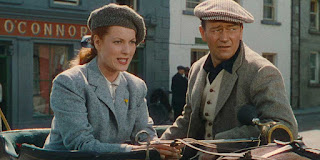
The film follows a former boxer who has returned from Pittsburgh to a small Irish village to purchase his old family cottage as he gets the ire of his neighbor who wanted the land as the tension worsens when the boxer falls for his neighbor’s sister. It is a film that plays into this man who has chosen to leave behind the world of boxing but also wanting to return home to his old family cottage in order to restore the family’s legacy while falling for this woman whose brother has immense hatred for. Frank S. Nugent’s screenplay, with un-credited contributions by John Ford, is largely straightforward as it is told mainly from the perspective of Father Lonergan (Ward Bond) who narrates the story as it opens with the arrival of Sean Thornton (John Wayne) who goes to the village of Inisfree with a lot of money in wanting to buy the cottage that his family used to live in when he was a child. Upon his arrival, Thornton gets a glimpse of a fiery redhead in Mary Kate Danaher (Maureen O’Hara) whom he tries to court only to realize her older brother is Squire “Red” Will Danaher (Victor McLaglen) who is upset that Thornton purchased the cottage and land from the rich widow Sarah Tillane (Mildred Natwick) who accepted Thornton’s offer.
Though Red refuses to have his sister wanting to do with Thornton despite the town’s embracement of him due to his family history. Mary Kate does fall for Thornton as many of its locals including Father Lonergan, the matchmaker/bookmaker Michaeleen `Oge Flynn (Barry Fitzgerald), the Protestant Reverend Cyril Playfair (Arthur Shields) and his wife Elizabeth (Eileen Crowe) decide to create a little lie that would get Red to allow his sister to marry Thornton. Yet, things eventually get complicated making things for Thornton and Mary Kate troubling with the former also carrying the guilt into why he ended his boxing career as he is unwilling to get physical with Red. Even as the latter has a dowry that she had worked for and wants as Thornton is unsure in how to get it without getting physical as he is afraid of what he might do.
John Ford’s direction is definitely full of richness in its imagery as many of its exterior locations were shot on location in the Ireland counties of Mayo and Galway with the interior locations shot at the Republic Studios backlot. Ford’s usage of the wide shots definitely add to the beauty of the locations with so much attention to detail of the hills and mountains in the background as well as the fields and grass in the foreground. It plays into the vastness of the village while Ford also employs a lot of close-ups and medium shots for the scenes at the cottage and at the pub where the characters go to. Even as it play into the drama such as the scene where Red meets Thornton for the first time at Tillane’s home where Ford definitely showcases the tension that looms throughout the film while also infusing bits of comedy when Flynn is asked to watch over Thornton and Mary Kate as their courtship begins.
Ford’s direction also plays into the difference between American and Irish customs as it is something Thornton has trouble with when it concerns the latter as well as his own confusion about Mary Kate’s dowry. It is a moment where Ford definitely shifts from the male perspective of things to Mary Kate’s own perspective of pride as she is someone who has to tend to her brother and his mates yet has worked hard to make something for herself. While Thornton has everything he can get her, the dowry isn’t something that Mary Kate needs as Thornton would eventually understand as Ford does create some unique shots as it plays into Thornton’s own fear about his past and what he’s afraid he might do. Yet, it all comes down to this climatic moment that is all about Thornton needing to prove how much he loves Mary Kate and what he must do for her. Overall, Ford crafts a riveting and evocative film about an Irish-born American ex-boxer trying to get the approval of his neighbor so he can marry that man’s sister.
Cinematographer Winton C. Hoch does brilliant work with the film’s Technicolor cinematography as it captures the lushness of the locations along with some low-key lighting for some of the interior/exterior scenes at night as it is a highlight of the film. Editor Jack Murray does excellent work with the editing as it has some unique rhythmic cuts to play into the drama and action along with a few transitional dissolves. Art director Frank Hotaling, with set decorators John McCarthy Jr. and Charles S. Thompson, does amazing work with the look of the interiors of the cottage that Thornton used to live in as a child as well as the home of Danaher. Costume designer Adele Palmer does fantastic work with the costumes from the look of the dresses that Mary Kate wears as well as some of the fine suits and casual clothing that Thornton wears.
The special effects by Howard and Theodore Lydecker are terrific for its usage of a few of the film’s minimal effects such as some of the medium shots of the characters on a carriage with rear projection footage in the background. The sound work of Daniel J. Bloomberg, T.A. Carman, David H. Moriarty, W.O. Watson, and Howard Wilson is superb for capturing the sounds of the crowd during some big events including the film’s climax along with the sound of music that is played on location. The film’s music by Victor Young is incredible for its luscious score that mixes orchestral string arrangements with traditional Irish folk as it is a major highlight of the film that include traditional songs that play into the atmosphere of the film.
The film’s wonderful ensemble cast as it feature some notable small roles from Jack MacGowran as Red’s assistant Ignatius Feeney, May Craig as a woman with a fish basket at the train station, Paddy O’Donnell as a railway porter, Eric Gorman as a train engine driver, Kevin Lawless as a train engineer fireman, Joseph O’Dea as a train guard, Sean McClory and Charles FitzSimons in their respective roles as the locals Owen Glynn and Hugh Forbes who are skeptical towards Thornton at first only to accept him due to his family heritage, and James Fitzsimons as a young pastor in Father Paul who would inform Father Lonergan about the events in the film’s climax. Arthur Shields and Eileen Crowe are superb in their respective roles as the Reverend Cyril and Elizabeth Playfair as a couple who help in creating a courtship for Thornton and Mary Kate with the former knowing Thornton under another name as a boxer. Francis Ford is terrific as an elderly villager in Dan Tobin who knows about the Thornton family as well as being supportive of him.
Mildred Natwick is fantastic as the widow Sarah Tillane as a rich woman who owned the land and cottage that used to be Thornton’s home as she accept Thornton’s offer against Red’s offer believing he will do more for the community. Ward Bond is excellent as Father Peter Lonergan as the film’s narrator who is among those who immediately accepts Thornton while also giving Mary Kate some guidance as he brings some humor including his quest to catch a large salmon. Barry Fitzgerald is brilliant as Michaeleen `Oge Flynn as a matchmaker/bookmaker who is the first to befriend Thornton as he is aware of Thornton’s family as he does what he can to guide Thornton about the Irish customs as well as courting Thornton to Mary Kate. Victor McLaglen is amazing as Squire “Red” Will Danaher as Mary Kate’s older brother who is upset at Thornton in buying the land and cottage that he hoped to get while also doing what he can to not approve the courtship between Thornton and his sister in an act of pride and arrogance.
Finally, there’s the duo of John Wayne and Maureen O’Hara in tremendous leading performance in their respective roles as Sean Thornton and Mary Kate Danaher. O’Hara’s performance is full of radiance and energy as a woman who is independent and prefers to do things her way despite having to care for her brother while also trying to save up money for her own dowry. Wayne’s performance is surprisingly tender as well as witty as a man who just wants to return to his roots as well as wanting something simple as a way to hide from the guilt he is carrying from his time in Pittsburgh. Wayne and O’Hara together just have immense chemistry in the way they deal with each other but also try to be respectful towards another as they are a major highlight of the film.
The Quiet Man is a sensational film from John Ford that features great leading performances from John Wayne and Maureen O’Hara. Along with its incredible ensemble supporting cast, gorgeous cinematography, beautiful locations, its exploration of pride and guilt, and Victor Young’s enchanting music score. It is a film that isn’t just this exhilarating and intoxicating romantic film but also an exploration of two people wanting to create a life for themselves despite the ire of a man who is full of pride because he couldn’t get what he wants. In the end, The Quiet Man is a phenomenal film from John Ford.
© thevoid99 2023
Based on the novel by Richard Llewellyn, How Green Was My Valley is the story of a Welsh family dealing with hardship in the 19th Century where a mining town in Wales is going through hard times. Directed by John Ford and screenplay by Philip Dunne, the film is a look into the life of a family from the perspective of a young boy as he sees a family deal with changes and a way of life becoming obsolete. Starring Walter Pidgeon, Maureen O’Hara, Anna Lee, Donald Crisp, Roddy McDowall, Sara Allgood, Barry Fitzgerald, Patric Knowles, John Loder, and narration by Irving Pichel. How Green Was My Valley is an evocatively rich and touching film from John Ford.
Told from the perspective of an old man recalling his time as a child in mid-19th Century Wales, the film revolves around a family in a small mining town where they deal with hardships and changing times that would affect their community. It’s a film that plays into a world that had a system and ideal that has worked with them for many years but little things would make some changes for this family and those they know as it would mark the end of innocence for a young boy. Philip Dunne’s screenplay follows the life of the young boy in Huw Morgan (Roddy McDowall) who sees the work that his father Gwilym (Donald Crisp) and his older brothers do as miners with his mother Beth (Sara Allgood) and older sister Angharad (Maureen O’Hara) do every day in making sure there’s soap and hot water available. It’s a system that’s worked as one of them in Ivor (Patric Knowles) would marry a young woman in Bronwyn (Anna Lee), whom Huw is fond of, who would do the same for Ivor. Yet when changes made over wages occur, the Morgan siblings hold a strike with Gwilym stepping back as he doesn’t want to cause trouble where he, Beth, Angharad, and Huw watch to see its outcome.
It would be in the town’s new pastor Mr. Gruffydd (Walter Pidgeon) who would make sense of everything as it would create an uneasy compromise that would start the beginning of a sense of decline in the town. Even as certain things occur where Mr. Gruffydd’s time with the ailing Huw, following an accident that left him temporarily paralyzed, has him being around Angharad who is falling for him. Yet, Mr. Gruffydd is aware that being seen with Angharad is forbidden as he would also see some of the trouble among some of the town elders over some of the immorality where Angharad would end up marrying the mine owner’s son Iestyn Evans (Marten Lamont). It would add to this sense of change where there’s tragedy but also this reality that Gwilym is forced to accept while he realizes that Huw should look for a future away from the mines though Huw does want to follow in the footsteps of his father and brothers.
John Ford’s direction is quite vast in terms of the setting that he creates as well as showing a world that was very simple only to be changed by modernism and this growing sense of morality. Shot on location at the Santa Monica Mountains near Malibu, California, Ford would use the landscape to recreate the world of 19th Century Wales at a time when the actual location was unavailable due the events of World War II. Nevertheless, Ford’s usage of the Santa Monica Mountains would allow him to capture life in a mining town where miners would sing traditional Welsh songs after work or for a ceremony as Ford would capture the vastness of this town and valleys with some gorgeous wide shots. Even in the moments of tragedy of how a town would react toward an emergency whistle to emphasize something has gone wrong while Ford would also capture a few wide shots to play into the moments such as the tense meetings at the church and Huw’s first day attending a national public school miles away from home.
Ford would also use close-ups and medium shots to get a look inside the Morgan family home as well as the way some of the characters interact. Notably the moments between Mr. Gruffydd and Angharad as they know their feelings for each other is forbidden with the former making a choice that he knows would protect him from some of the troubles he would endure from the elders. The film’s third act isn’t about Gwilyn facing reality as he becomes concerned for Huw’s future but also Huw making a decision to help the family where he learns about hypocrisy from some of the community as it relates to Angharad and Mr. Gruffydd. It would culminate with another moment of tragedy that would force the older Huw, via narration, to see what had been lost with Ford gazing into a moment in time where it was peaceful only to become corrupted by greed, deceit, and ideals that never did anything good. Overall, Ford crafts a somber yet rapturous film a boy coming of age in a small Welsh mining town in the 19th Century.
Cinematographer Arthur C. Miller does brilliant work with the film’s black-and-white photography to capture the gorgeous beauty of the exteriors in the day along with some naturalistic lighting for some of the interior scenes set at night. Editor James B. Clark does excellent work as it is straightforward with a few dissolves and rhythmic cuts to play into the drama. Art directors Richard Day and Nathan Juran, along with set decorator Thomas Little, do amazing work with the look of the town including the mining tower and the chapel where many in the community meet on Sundays. Costume designer Gwen Wakeling does fantastic work with the costumes that is true to the period including the dresses that the women wear. The sound work of Eugene Grossman and Roger Heman Sr. do superb work in capturing the atmosphere of the mines as well as how they’re heard from the outside. The film’s music by Alfred Newman is wonderful for its sweeping orchestral score that is a mixture of soaring string arrangements as well as vocal choirs with some traditional Welsh music.
The film’s incredible cast feature some notable small roles from Clifford Severn as a school bully who goads Huw into fighting him, Lionel Pape as the mine owner Mr. Evans, Marten Lamont as Mr. Evans’ son Iestyn who would marry Angharad, Ethel Griffies as Angharad’s housekeeper at the Evans estate, Frederick Worlock as the town doctor, Arthur Shields as the local deacon Mr. Parry who is an ultra-conservative figure in the town, the trio of, Richard Fraser, Evan S. Evans, and James Monk in their respective roles as three of Huw’s older brothers in Davy, Gwilym Jr., and Owen, and Morton Lowry as Huw’s cruel schoolteacher Mr. Jonas who looks down at Huw for being Welsh and working class. Rhys Williams is terrific as the boxer Dai Bando who teaches Huw the art of boxing while confronting Mr. Jonas over his cruelty. Barry Fitzgerald is superb as Bando’s friend Cyfartha as a man who is often drunk but is always friendly to everyone.
John Loder and Patric Knowles are fantastic in their respective roles as the eldest Morgan brothers in Ianto and Ivor as two men who become aware of the changes in the mine as they try to fight for what is right. Anne Lee is wonderful as Ianto’s wife Bronwyn whom Huw has a crush on as she deals with life as a miner’s wife as well as dealing with some of the chaos as she is able to get help from Ianto’s family. Sara Allgood is excellent as Beth Morgan as the family matriarch who is a very old-school woman with old-school values as she is baffled by the idea of mathematics and geography though she eventually realizes about the bleak future that is to come. Donald Crisp is brilliant as Gwilym Morgan as the family patriarch who is a miner that is dealing with changing times as well as sensing the decline in the world of mining as he urges Huw to focus on a life outside of mining.
Roddy McDowall is marvelous as Huw as the youngest child of the Morgan family who looks up to his brother as well as he cope with the changes around him as well as new environments in his life. Maureen O’Hara is amazing as Angharad as the sole Morgan daughter who helps her mother run the house as she is in love with Mr. Gruffydd as she is torn in being with him but also not cause any sense of immorality. Finally, there’s Walter Pidgeon in a remarkable performance as Mr. Gruffydd as the town’s new pastor who arrives to the town with a sense of morality yet is torn in his devotion to God and his feelings for Angharad where he helps out the Morgan family and sees the growing hypocrisy in the town toward things they don’t understand.
How Green Was My Valley is a spectacular film from John Ford. Featuring a great cast, a compelling premise, gorgeous visuals, and a sumptuous music score. It’s a film that explores a boy seeing a way of life go into decline as well as coping with changes that would destroy everything that made a community he grew up on become obsolete. In the end, How Green Was My Valley is a sensational film from John Ford.
© thevoid99 2017


