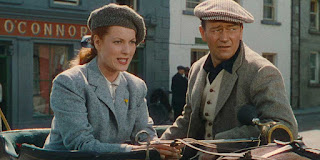
The film follows a former boxer who has returned from Pittsburgh to a small Irish village to purchase his old family cottage as he gets the ire of his neighbor who wanted the land as the tension worsens when the boxer falls for his neighbor’s sister. It is a film that plays into this man who has chosen to leave behind the world of boxing but also wanting to return home to his old family cottage in order to restore the family’s legacy while falling for this woman whose brother has immense hatred for. Frank S. Nugent’s screenplay, with un-credited contributions by John Ford, is largely straightforward as it is told mainly from the perspective of Father Lonergan (Ward Bond) who narrates the story as it opens with the arrival of Sean Thornton (John Wayne) who goes to the village of Inisfree with a lot of money in wanting to buy the cottage that his family used to live in when he was a child. Upon his arrival, Thornton gets a glimpse of a fiery redhead in Mary Kate Danaher (Maureen O’Hara) whom he tries to court only to realize her older brother is Squire “Red” Will Danaher (Victor McLaglen) who is upset that Thornton purchased the cottage and land from the rich widow Sarah Tillane (Mildred Natwick) who accepted Thornton’s offer.
Though Red refuses to have his sister wanting to do with Thornton despite the town’s embracement of him due to his family history. Mary Kate does fall for Thornton as many of its locals including Father Lonergan, the matchmaker/bookmaker Michaeleen `Oge Flynn (Barry Fitzgerald), the Protestant Reverend Cyril Playfair (Arthur Shields) and his wife Elizabeth (Eileen Crowe) decide to create a little lie that would get Red to allow his sister to marry Thornton. Yet, things eventually get complicated making things for Thornton and Mary Kate troubling with the former also carrying the guilt into why he ended his boxing career as he is unwilling to get physical with Red. Even as the latter has a dowry that she had worked for and wants as Thornton is unsure in how to get it without getting physical as he is afraid of what he might do.
John Ford’s direction is definitely full of richness in its imagery as many of its exterior locations were shot on location in the Ireland counties of Mayo and Galway with the interior locations shot at the Republic Studios backlot. Ford’s usage of the wide shots definitely add to the beauty of the locations with so much attention to detail of the hills and mountains in the background as well as the fields and grass in the foreground. It plays into the vastness of the village while Ford also employs a lot of close-ups and medium shots for the scenes at the cottage and at the pub where the characters go to. Even as it play into the drama such as the scene where Red meets Thornton for the first time at Tillane’s home where Ford definitely showcases the tension that looms throughout the film while also infusing bits of comedy when Flynn is asked to watch over Thornton and Mary Kate as their courtship begins.
Ford’s direction also plays into the difference between American and Irish customs as it is something Thornton has trouble with when it concerns the latter as well as his own confusion about Mary Kate’s dowry. It is a moment where Ford definitely shifts from the male perspective of things to Mary Kate’s own perspective of pride as she is someone who has to tend to her brother and his mates yet has worked hard to make something for herself. While Thornton has everything he can get her, the dowry isn’t something that Mary Kate needs as Thornton would eventually understand as Ford does create some unique shots as it plays into Thornton’s own fear about his past and what he’s afraid he might do. Yet, it all comes down to this climatic moment that is all about Thornton needing to prove how much he loves Mary Kate and what he must do for her. Overall, Ford crafts a riveting and evocative film about an Irish-born American ex-boxer trying to get the approval of his neighbor so he can marry that man’s sister.
Cinematographer Winton C. Hoch does brilliant work with the film’s Technicolor cinematography as it captures the lushness of the locations along with some low-key lighting for some of the interior/exterior scenes at night as it is a highlight of the film. Editor Jack Murray does excellent work with the editing as it has some unique rhythmic cuts to play into the drama and action along with a few transitional dissolves. Art director Frank Hotaling, with set decorators John McCarthy Jr. and Charles S. Thompson, does amazing work with the look of the interiors of the cottage that Thornton used to live in as a child as well as the home of Danaher. Costume designer Adele Palmer does fantastic work with the costumes from the look of the dresses that Mary Kate wears as well as some of the fine suits and casual clothing that Thornton wears.
The special effects by Howard and Theodore Lydecker are terrific for its usage of a few of the film’s minimal effects such as some of the medium shots of the characters on a carriage with rear projection footage in the background. The sound work of Daniel J. Bloomberg, T.A. Carman, David H. Moriarty, W.O. Watson, and Howard Wilson is superb for capturing the sounds of the crowd during some big events including the film’s climax along with the sound of music that is played on location. The film’s music by Victor Young is incredible for its luscious score that mixes orchestral string arrangements with traditional Irish folk as it is a major highlight of the film that include traditional songs that play into the atmosphere of the film.
The film’s wonderful ensemble cast as it feature some notable small roles from Jack MacGowran as Red’s assistant Ignatius Feeney, May Craig as a woman with a fish basket at the train station, Paddy O’Donnell as a railway porter, Eric Gorman as a train engine driver, Kevin Lawless as a train engineer fireman, Joseph O’Dea as a train guard, Sean McClory and Charles FitzSimons in their respective roles as the locals Owen Glynn and Hugh Forbes who are skeptical towards Thornton at first only to accept him due to his family heritage, and James Fitzsimons as a young pastor in Father Paul who would inform Father Lonergan about the events in the film’s climax. Arthur Shields and Eileen Crowe are superb in their respective roles as the Reverend Cyril and Elizabeth Playfair as a couple who help in creating a courtship for Thornton and Mary Kate with the former knowing Thornton under another name as a boxer. Francis Ford is terrific as an elderly villager in Dan Tobin who knows about the Thornton family as well as being supportive of him.
Mildred Natwick is fantastic as the widow Sarah Tillane as a rich woman who owned the land and cottage that used to be Thornton’s home as she accept Thornton’s offer against Red’s offer believing he will do more for the community. Ward Bond is excellent as Father Peter Lonergan as the film’s narrator who is among those who immediately accepts Thornton while also giving Mary Kate some guidance as he brings some humor including his quest to catch a large salmon. Barry Fitzgerald is brilliant as Michaeleen `Oge Flynn as a matchmaker/bookmaker who is the first to befriend Thornton as he is aware of Thornton’s family as he does what he can to guide Thornton about the Irish customs as well as courting Thornton to Mary Kate. Victor McLaglen is amazing as Squire “Red” Will Danaher as Mary Kate’s older brother who is upset at Thornton in buying the land and cottage that he hoped to get while also doing what he can to not approve the courtship between Thornton and his sister in an act of pride and arrogance.
Finally, there’s the duo of John Wayne and Maureen O’Hara in tremendous leading performance in their respective roles as Sean Thornton and Mary Kate Danaher. O’Hara’s performance is full of radiance and energy as a woman who is independent and prefers to do things her way despite having to care for her brother while also trying to save up money for her own dowry. Wayne’s performance is surprisingly tender as well as witty as a man who just wants to return to his roots as well as wanting something simple as a way to hide from the guilt he is carrying from his time in Pittsburgh. Wayne and O’Hara together just have immense chemistry in the way they deal with each other but also try to be respectful towards another as they are a major highlight of the film.
The Quiet Man is a sensational film from John Ford that features great leading performances from John Wayne and Maureen O’Hara. Along with its incredible ensemble supporting cast, gorgeous cinematography, beautiful locations, its exploration of pride and guilt, and Victor Young’s enchanting music score. It is a film that isn’t just this exhilarating and intoxicating romantic film but also an exploration of two people wanting to create a life for themselves despite the ire of a man who is full of pride because he couldn’t get what he wants. In the end, The Quiet Man is a phenomenal film from John Ford.
© thevoid99 2023

Set in a remote island castle in Britain, the film revolves around an American gangster who is on the run with his ailing Irish partner as he hides in the castle home of a British man and his young French wife where things become chaotic in the course of a few days. It is a film that is sort of a home invasion film yet it is an exploration of three people in isolation as they deal with bad weather, sexual tension, visitors, and other things that makes these few days chaotic. The film’s screenplay by Roman Polanski and Gerard Bach is largely straightforward in its narrative yet it is their approach to the three main characters is what makes it unique as the American gangster Dickie (Lionel Stander) is trying to escape with his partner Albie (Jack MacGowran) who is injured following a botched robbery as they drive towards a causeway that is being submerged by the rising tide. Dickie walks through the tide to get help as he finds a castle that is owned by the middle-aged George (Donald Pleasance) and his young French wife Teresa (Francoise Dorleac) who spends her time messing around with a young neighbor.
Upon discovering Dickie at their home, George and Teresa are frightened by his presence though Dickie is someone that just needs help as he’s trying to contact his boss over what happened as George and Teresa do help him retrieve the ailing Albie. Yet, things however don’t go well as it leads to chaos but also moments of the couple getting to know Dickie with him and George hitting it off on their views on life despite the former’s rudeness and the latter’s own lack of masculine rage. Things get complicated when the three learn some friends of George are about to visit to see the castle as Dickie plays along as a servant though he gets annoyed by a child who ends up being more trouble for everyone making both George and Teresa upset as well.
Polanski’s direction is stylish as it is shot on location at Lindisfarne with the island’s actual castle being the home where George and Teresa live in with the exception of a few rooms in the castle that are used. The film opens with this wide shot of a car coming into a causeway and then crashing onto a marker and then to a medium shot of Dickie and Albie talking with the former leaving to get help. Polanski’s compositions and direction are filled with dazzling imagery as well as long shots that goes on for minutes including a beachside conversation between George and Dickie as they’re both drunk and lament over things in their lives while Teresa is in the background swimming naked on the beach. It is among some of the images that Polanski uses to play into this sense of isolation in this island with these rising tides but also this sense of uncertainty as it relates to Dickie’s boss whom he is waiting for. It is among the things that play into the dramatic tension with Teresa not being comfortable with Dickie’s presence though she is sympathetic to his situation as well as his sense of loyalty towards Albie.
Polanski also brings in bits of humor from a scene early in the film where George puts on some makeup as a way to express his lack of masculinity while wearing one of his wife’s nightgowns as it only brings trouble upon meeting Dickie for the first time. Even as the humor would play into the sequence where George’s friends arrive to see the castle and have lunch as they expect to have a big feast. Yet, things don’t go well as a child is wreaking havoc angering Dickie and Teresa as things would intensify due to the fact that a guest brought a double-barrel rifle as it would ultimately push George to the edge. Even as Teresa starts to act out as she feels suffocated by the presence of these two middle-aged men where the tension ultimately boils over as it also play into Dickie’s desire to leave but is unsure about the fates of George and Teresa and whether he has to kill them so that they don’t know anything only for things to go wrong as it relates to other desires and such. Overall, Polanski crafts a chilling yet offbeat film about an American criminal hiding and taking control at the castle home of a middle-aged Englishmen and his young French wife.
Cinematographer Gilbert Taylor does brilliant work with the film’s black-and-white photography as it help set a mood for some of the scenes at night as well as some of the daytime interior scenes as well as some of the scenes during the morning. Editor Alastair McIntyre does excellent work with the editing as it is largely straightforward with some rhythmic cuts to play into the suspense and drama. Production designer Voytek and art director George Lack do fantastic work with the interiors for the scenes in the castle including Teresa’s chicken house where she houses all of her chickens until it becomes a makeshift garage.
The special effects work of Les Bowie is terrific for a scene on the causeway where the tide is rising where Albie is being trapped in the car along with a few bits in the film’s climax. The sound work of Stephen Dalby is superb for the natural elements of the sound that is captured on location as well as how music is sound from a record player from another room. The film’s music by Krzysztof Komeda is incredible for its jazzy score with elements of piano and trumpets to play into the film’s offbeat tone as well as some of its suspenseful moments with a music soundtrack that is also filled with jazz music.
The film’s wonderful ensemble cast feature some notable small roles as Jacqueline Bisset as a young guest that is part of George’s circle of friends, Trevor Delaney as a young boy named Horace who is the son of one of the guests who causes a lot of trouble and panic, William Franklyn as another guest in Cecil whom Teresa takes a liking to, Iain Quarrier as a young man named Christopher whom Teresa was with as they try to find shrimp and their own naked bodies, Geoffrey Sumner and Renee` Houston as Christopher’s parents who live nearby, and the duo of Robert Dorning and Marie Kean in their respective roles in Philip and Marion Mayweather as two of George’s friends who are also Horace’s parents as they often say unkind things to the point that they push George to the edge.
Jack MacGowran is excellent as Albie as an ailing gangster who is dealing with his wounds while he is waiting in a car as he deals with a rising tide and later the severity of his wounds. Francoise Dorleac is brilliant as Teresa as a young Frenchwoman who is married to the middle-aged George as she deals with his lack of masculinity as she often gets sexual satisfaction from other men while she also finds herself disgusted by Dickie despite his own views on the world. Lionel Stander is amazing as Dickie as an American gangster dealing with an ailing partner, a botched robbery, and other things as he tries to get some news from his boss but also deal with his injury and his own fate while trying to do his own thing while befriending George. Finally, there’s Donald Pleasence in a fantastic performance as George as a middle-aged man who is just trying to enjoy retirement as he endures the presence of Dickie whom he would befriend while dealing with all sorts of things including his own lack of masculinity and the pain he’s carrying as it relates to loss.
Cul-de-Sac is a phenomenal film from Roman Polanski. Featuring great performances from Donald Pleasence, Francoise Dorleac, and Lionel Stander as well as gorgeous visuals, chilling suspense, a minimalist premise, and Krzysztof Komeda’s sumptuous score. It is a film that explore a couple dealing with a criminal in a castle on an isolated island as they deal with their surroundings and all sorts of things that would eventually bring chaos. In the end, Cul-de-Sac is a sensational film from Roman Polanski.
Roman Polanski Films: Knife in the Water - Repulsion - The Fearless Vampire Killers - Rosemary's Baby - Macbeth (1971 film) - (What?) – Chinatown - The Tenant – Tess (1979 film) - (Pirates) – Frantic - Bitter Moon - Death and the Maiden - The Ninth Gate - The Pianist - Oliver Twist (2005 film) - The Ghost Writer - Carnage (2011 film) - (Venus in Fur) – (Based on a True Story) – (An Officer and a Spy) – (The Palace)
© thevoid99 2022

Directed by Roman Polanski and written by Polanski and Gerard Brach, The Fearless Vampire Killers is a comedy about a bumbling professor and his apprentice who go on the search for vampires in Eastern Europe as all things lead to trouble. The film is an exploration into the horror genre by adding humor to the story as it pokes fun all of its clichés and such as Polanski plays the role of the professor’s apprentice. Also starring Jack MacGowran, Sharon Tate, and Ferdy Mayne. The Fearless Vampire Killers is a witty yet stylish comedy from Roman Polanski.
Professor Abronius (Jack MacGowran) arrives to a village nearby Transylvania with his assistant Alfred (Roman Polanski) in the search for vampires. Staying at an inn, Abronius is hoping to rid the world of vampires before it spreads as Alfred falls for the innkeeper’s daughter Sarah (Sharon Tate) where some strange things happen when Sarah is kidnapped. Alfred follows a strange hunchback named Koukal as he realizes there’s a castle as he and Abronius enter the castle to confront the local vampire lord Count von Krolock (Ferdy Mayne). Count von Krolock lets them in as guests as Alfred hears a strange, siren voice believing to be Sarah as he hopes to rescue as he also has to deal with the count’s son Herbert (Iain Quarrier).
Abronius decides to go after the count and his son at their castle but the scared Alfred is unsure of killing the vampires will save Sarah as things go wrong when he realizes that she is there and still alive. When the count learns what Abronius and Alfred are up to just as he deals with them just as he’s to hold a ball for Sarah to become the vampires’ next victim. Abronius and Alfred however, decide to do something to crash the ball and save Sarah from the vampires.
The film is essentially a comedy about a bumbling professor and his cowardice apprentice who go to Transylvania to find and kill vampires in during the 19th Century. Yet, they ensue all sorts of trouble along the way as they learn more about the world of the vampires and their surroundings as they do whatever it takes to save an innkeeper’s daughter from becoming a vampire. The screenplay by Roman Polanski and Gerard Brach definitely plays to the schematics of vampires and its clichés such as crosses and garlic to stop them while creating characters like Professor Abronius and Alfred who are incompetent in their mission yet are interesting enough to root for them when the film reaches the climatic ball scene.
Polanski’s direction is definitely stylish as it’s the first film of his to not just use colored photography but also to embrace the anamorphic widescreen format in order to create a wide depth of field for the scenes he shoots. Shot in locations in Austria and Italy for exterior settings not set in the castle, Polanski is able to present something that is quite artificial since it’s not meant to be a realistic idea of the vampire world. For the scenes in the castle, Polanski creates some very unique compositions to maintain that artificiality along with some intimate close-ups and medium shots to showcase this very strange world. While it’s a film that isn’t meant to be taken seriously, Polanski does manage to make enjoyable as a quirky vampire comedy that plays with its mythology.
Cinematographer Douglas Slocombe does brilliant work with the film‘s colorful photography from the nighttime exterior shots to the gorgeous colors of the film‘s daytime exterior and interior settings to play up the world of artificiality. Editor Alastair McIntyre does nice work with the editing to play up the rhythm of the film‘s humor and suspense. Production designer Wilfrid Shingleton and art director Fred Carter do amazing work with the set pieces such as the look of the inn as well as the lavishness of the castle that the count lives in.
Costume designer Sophie Devine does wonderful work with the costumes that plays up to the 19th Century period as it includes the lovely red dress that Sarah wears in the ball. Makeup work by Tom Smith and hair by Biddy Chrystal are terrific to play up the extravagant look of the vampire as it plays up to that period. Sound editor Lionel Selwyn is superb for the atmosphere that creates in the castle with the sound of Sarah‘s siren voice as it adds to the suspense. The music of Krzystof Komeda is excellent for its diverse score filled with classical-like pieces for the ball scene along with playful themes and more suspenseful-driven cuts to maintain that world of the vampire.
The film’s stellar ensemble cast includes some notable performances from Fiona Lewis as the inn’s maid Magda, Jessie Robins as Sarah’s mother, Terry Downes as the count’s hunchback servant Koukol, Alfie Bass as the innkeeper, Ronald Lacey as the hilarious village idiot who becomes a vampire, and Iain Quarrier as the count’s flamboyant son Herbert. Ferdy Mayne is terrific as Count von Krolock with his eerie presence and lavish persona as it plays to the prestige of most vampires. Sharon Tate is very good as Sarah as this woman who is intrigued by Alfred as she is later kidnapped by the vampires. Roman Polanski is superb as the cowardice Alfred as Polanski brings a unique innocence to the character as Polanski also adds a lot of nice humor the role. Finally there’s Jack MacGowran is a splendid performance as Professor Abronius as he creates a very lively and witty performance as a man who is clever but also dim-witted in his pursuits.
The Fearless Vampire Killers is a silly yet fun film from Roman Polanski. While it is definitely among his weaker works in comparison to his darker, more suspenseful-driven films. It is certainly one that is engaging for the fact that it doesn’t take itself so seriously while just wanting to be something that is a funny take on the vampire films. In the end, The Fearless Vampire Killers is an entertaining yet solid comedy from Roman Polanski.
Roman Polanski Films: Knife in the Water - Repulsion - Cul-de-Sac - Rosemary’s Baby - Macbeth (1971 film) - (What?) - Chinatown - The Tenant - Tess - (Pirates (1986 film)) - Frantic - Bitter Moon - Death and the Maiden - The Ninth Gate - The Pianist - Oliver Twist (2005 film) - The Ghost Writer - Carnage - (Venus in Fur) - (Based on a True Story) - (An Officer and a Spy) - (The Palace)
© thevoid99 2012


