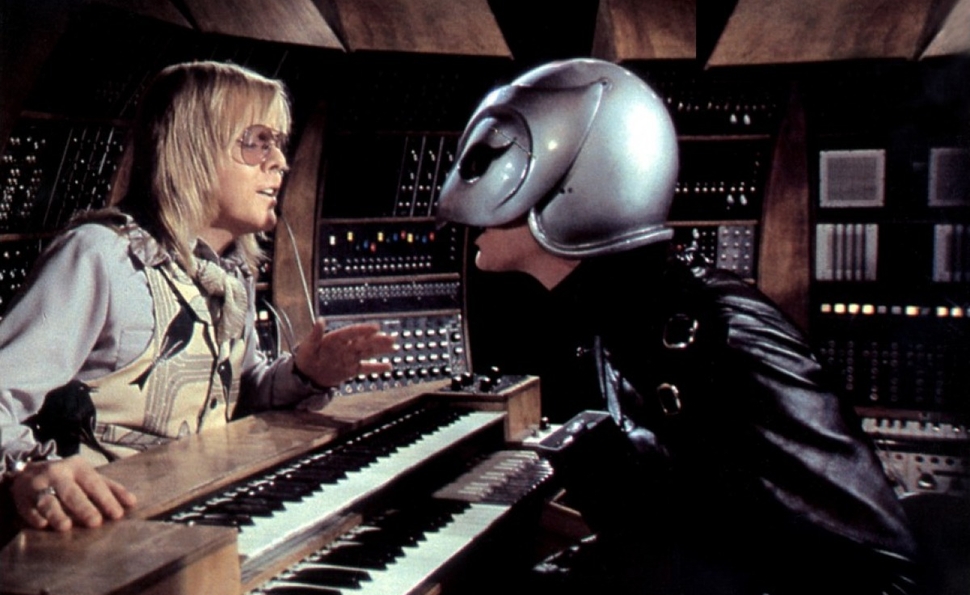
The film revolves around a music composer whose music he wrote was stolen by a producer as an incident left the composer’s face disfigured where he creates a new identity but also makes an uneasy deal with the producer to get his music made while they fight over a woman who wants to become a singing star. It’s a film that is inspired by all sorts material such as Phantom of the Opera, Faust, and The Picture of Dorian Grey but set in a world where a music is eager to latch on to anything and create his rock n’ roll palace where he would get all the talent of the world and make money off of them. The film’s screenplay by Brian de Palma, that features uncredited contributions from Louisa Rose, is largely straightforward as it play into this musician named Winslow Leach (William Finley) who plays at this club during an intermission as he catches the attention of the music producer known as Swan (Paul Williams).
Swan believes that Leach has the right music for his new music palace as he gets his right-hand man Arnold Philbin (George Memmoli) to steal Leach’s music while Leach’s attempts to reach Swan fail as he is sent to prison for a false drug possession charge where Leach breaks out of prison after a rendition of one of his songs being played. During the chase, he becomes disfigured where he adopts a new identity as he’s discovered by Swan who offers him a deal that would become troubling. It all play into these elements of deals with the devil but also the stakes as Leach is someone who just wants to create music but Swan is the one who can bring it to everyone while there is also something mysterious about who Swan is.
The film’s direction by de Palma definitely evokes a lot of style as a lot of it is shot largely on location in New York City while it plays into this world of music and clubs where people go out and see what is considered cool. The film has de Palma create this world that is outlandish as it represents a world of nostalgia, decadence, and wondrous as if it’s a fantasy for anyone that wants to be a star in the world of music. The usage of wide shots add to the scope of this world that Swan has created yet much of de Palma’s compositions emphasizes on close-ups and medium shots as it play into the conversations between Leach and Swan as well as in some of the film’s musical performances. With the help of choreographer Peter Elbling, the performances has this air of camp as it play into Swan’s vision and his take on Leach’s music as it is presented in different styles ranging from 1950s doo-wop rock, 1960s surf music, and the glam rock of the 1970s. It also play into this world that allows Swan to thrive as it adds intrigue into what kind of deal Leach made with him. Even as a young singer named Phoenix (Jessica Harper) comes in as Leach has feelings for her but Swan wants something else for her leading to this lavish climax that relates to ambition and identity. Overall, de Palma crafts a majestic yet chilling film about a songwriter’s uneasy deal with a producer as he would later seek revenge on him.
Cinematographer Larry Pizer does excellent work with its usage of stylish lights for the performances as well as in the usage of low-key lights for some of the exterior/interior scenes at night. Editor Paul Hirsch does brilliant work with the editing as it has some stylish jump-cuts that help play into the humor and musical performances as well as montages that play into Leach and Swan at work. Production designer Jack Fisk does amazing work with the look of the sets including the sets for the stage performances that are lavish and over-the-top as it include some additional set dressing from Fisk’s wife in actress Sissy Spacek. Costume designer Rosanna Norton does fantastic work with the costumes from the look of Leach’s clothes when he becomes the Phantom as well as the lavish clothes of the musical performers including Phoenix and the clothes of Swan.
Makeup designers John Chambers and Thomas R. Burman do terrific work with the look of the disfigured Leach as well as some of the glam makeup for some of the musical performers. The special effects work of Greg Auer is wonderful for a few of the effects that play into some of the musical performances and presentation. The sound work of James M. Tanenbaum is superb for some of the sound effects as well as how instruments sound in a live setting as well as the sounds of crowds. The film’s music by Paul Williams is phenomenal as it is a major highlight of the film for its mixture of piano ballads, stylish rock songs, pop, and all sorts of songs as it help tells the story as Williams also does a lot of Leach’s own singing while music supervisors Michael Arciaga and Jules Chaikin help provide various people to sing those songs that include Raymond Louis Kennedy as the voice for the glam vocalist Beef.
The casting by Sylvia Fay, Geno Havens, and Peggy Taylor is marvelous as it feature some notable small roles from Rod Serling as the film’s unseen narrator in its opening minutes, Janus Blythe as a groupie, the trio of Archie Hahn, Jeffrey Comanor, and Peter Elbling as a trio of vocalists who moonlight as a trio of acts in the 50s nostalgia act the Juicy Fruits, the surf-rock tribute band the Beach Bums, and a modern band in the Undead, Gerrit Graham as the glam-rock singer Beef who is Swan’s original choice until he is confronted by Leach, and George Memmoli as Swan’s right-hand man Arnold Philbin as a handler who looks like a 1950s greaser as he also manages some of Swan’s businesses. Jessica Harper is brilliant as Phoenix as a woman wanting to sing as she meets Leach at an audition as he believes she is the right singer where she would succeed but used as a tool for Swan to get what he wants.
Paul Williams is incredible as Swan as this mysterious producer who wants to create the ultimate music palace while maintaining this ambiguity about his importance as Williams brings this devilish charm to his role that is a joy to watch. Finally, there’s William Finley in an amazing performance as Winslow Leach and the titular character as a singer-songwriter wanting to create music that he believes has something to say only to go through obstacles and later become a disfigured artist who watches from afar as his music is played but also copes with the troubling deal he made with Swan.
Phantom of the Paradise is a spectacular film from Brian de Palma. Featuring a great cast, gorgeous set designs, dazzling visuals, and a rapturous music soundtrack from Paul Williams. The film is an outlandish yet whirlwind genre-bender that doesn’t play by the rules nor hide its influences to create a story set to the world of rock n’ roll. In the end, Phantom of the Paradise is a sensational film from Brian de Palma.
Brian de Palma Films: (Murder a la Mod) – (Greetings) – (The Wedding Party) – (Dionysus in ’69) – (Hi, Mom!) – (Get to Know Your Rabbit) – Sisters (1973 film) - Obsession – Carrie - The Fury - (Home Movies) – Dressed to Kill - Blow Out - Scarface - Body Double – (Wise Guys) – The Untouchables - Casualties of War - The Bonfire of the Vanities - Raising Cain - Carlito's Way - Mission: Impossible - Snake Eys - Mission to Mars - Femme Fatale - The Black Dahlia - (Redacted) – Passion (2012 film) - (Domino (2019 film))
© thevoid99 2020

