Showing posts with label martin sheen. Show all posts

Sunday, December 21, 2014

Catch Me If You Can


Based on the book by Frank Abagnale and Stan Redding, Catch Me If You Can is the story about a young Abagnale who manages to concoct several successful cons before the age of 19 as he’s often in pursuit by a FBI agent. Directed by Steven Spielberg and screenplay by Jeff Nathanson, the film is a quirky comedy of sorts where a young man forges checks to create elaborate cons as he deals with being pursued by a FBI agent who refuses to give up as Leonardo diCaprio plays Frank Abagnale and Tom Hanks in the role of FBI agent Carl Hanratty. Also starring Nathalie Baye, Martin Sheen, Amy Adams, Jennifer Garner, James Brolin, and Christopher Walken. Catch Me If You Can is a witty yet adventurous film from Steven Spielberg.

The film revolves around the life of a young man who decides to forge checks in order to con banks out of their money as his actions get the attention of a FBI agent who would chase him for several years. It’s a film that plays into two men involved in this cat-and-mouse game where there is a bit of mutual respect between the two even though Frank Abagnale is a criminal and Carl Hanratty is a FBI agent. Though Hanratty’s motivations is to capture Abagnale and retrieve all of the money that was stolen, it is Abagnale’s motivation that is clearly far more interesting. Especially as he is doing these schemes on banks as an act of revenge when his father Frank Sr. (Christopher Walken) was turned down by banks for a loan due to various things involving the IRS. By pretending to be a Pan Am pilot, a doctor, and a lawyer, Abagnale does whatever it takes to survive but things eventually get out of control which forces Abagnale to get more desperate in order to evade the FBI.

Jeff Nathanson’s screenplay does have a unique narrative as it’s told in a reflective style where Abagnale is returning to the U.S. from France as he’s accompanied by Hanratty. While the film does have a traditional structure, it is more about Abagnale’s motivations as he once lived a good life with his parents until money issues and his French mother Paula (Nathalie Baye) having an affair with a friend of his father in Jack Barnes (James Brolin) which lead to the end of the life that Abagnale had. The divorce of his parents would lead Abagnale to run away and use his mastery to con people would provide him as a means of survival where he would live well and woo women. All of this gets the attention of authorities where Carl Hanratty would be the one chasing him throughout the years as it’s all set during the 1960s while the scenes of Abagnale and Hanratty coming home to the U.S. is set in the 1970s.

While the presentation of the story is comical as the chases does have Hanratty in a series of humiliating moments. It is still a drama at heart where there’s these conversations from a pay phone that Abagnale would have with Hanratty on Christmas Day where it is about these two men getting to know each other as an act of respect between two opponents. Even as Abagnale would have thoughts of giving up his criminal schemes where an encounter with a young pregnant nurse named Brenda (Amy Adams) would raise those thoughts. While it’s third act plays more into what Abagnale would endure as a captured criminal and what he would have to do to avoid spending more time in prison where the roles of Abagnale and Hanratty would sort of change in terms of who gets humiliated. Still, it is about a sense of one-upmanship as well as how Abagnale would use his skills into this new life and find some fulfillment in his life.

Steven Spielberg’s direction is very stylish as it plays up this vibrant world of the 1960s as well as creating something that feels upbeat and lively. Especially in the way he definitely mimics films of those time while creating something that feels intimate with the compositions he creates. Some that intimacy with its use of close-ups and medium shots play into the life that the young Abagnale had with his family including the scenes between Abagnale and his father which expresses Abagnale’s desire and loyalty to his father. It’s among these smaller moments that Spielberg creates that is quite magical while having airs of sentimentality since it showcases Abagnale’s willingness to make his father proud. The direction also has Spielberg use some unique compositions to play into the phone conversations between Abagnale and Hanratty where Spielberg uses a few wide shots to play into the loneliness that looms in Hanratty as he is never seen not working.

The scenes where Spielberg plays into the chase scenes have these intricate steadicam shots play into the frenzy of Hanratty’s desperation to capture Abagnale. Even as Spielberg infuses some style with some tracking shots as well as scenes that play into some of the chases along with an extravagant scene where Abagnale hires women to pretend to be stewardesses. There is a sense of extravagance in these moments but it plays to how elaborate Abagnale’s schemes are as things do slow down in the third act. Yet, Spielberg does manage infuse some style in his compositions as well as in creating the conflicts in Abagnale in what he has to do in the third act. Overall, Spielberg creates a very compelling yet whimsical film about a cat-and-mouse game between a FBI agent and a young con artist.

Cinematographer Janusz Kaminski does brilliant work with the film‘s photography with its array of stylish approach to interior lightings for the scenes set in the bars and restaurants as well as some of its nighttime exteriors in the U.S. and parts of France. Editor Michael Kahn does fantastic work with the editing with its rhythmic approach to humor that includes the chase scenes along with some straightforward cuts to play into the drama. Production designer Jeannine Oppewall, with art director Sarah Knowles and set decorators Claudette Didul and Leslie A. Pope, does amazing work with the set design from the look of the hotel rooms and places that Abagnale stayed in to the FBI office building where Hanratty is at in his job.

Costume designer Mary Zophres does excellent work with the design of the Pan Am pilot uniforms and stewardess costumes as well as some of the clothes Abagnale wears to play into the sunny world of the 1960s. Visual effects supervisors Nathan McGuinness and Patrice Mugnier do nice work with some of the minimal visual effects which plays more as set-dressing in some sequences in the film. Sound editors Charles L. Campbell and John A. Larsen do terrific work with the sound to play into some of the machines that Abagnale would use later in his cons as well as the planes and location scenes to play into the world that the characters are in. The film’s music by John Williams is incredible as it is this nice mix of jazz textures and lush orchestral music to play into the humor and drama as the soundtrack features music from Frank Sinatra, Judy Garland, Nat King Cole, Dusty Springfield, and the trio of Antonio Carlos Jobim, Stan Getz, and Joao Gilberto.

The casting by Debra Zane is phenomenal as it features some notable small roles from Elizabeth Banks and Ellen Pompeo as women that Abagnale would woo in his adventures, Brian Howe, Chris Ellis, and Frank John Hughes as a trio of FBI agents who work with Hanratty as they’re often seen as bumbling fools, the real Frank Abagnale as a French policeman who would arrest Abagnale in France, Jennifer Garner as a call girl Abagnale would woo during one of his schemes, and Nancy Lenehan as Brenda’s mother who definitely takes a liking to Frank as she is excited that Brenda found a good man. James Brolin is terrific as Jack Barnes as a man who was a friend of Abagnale’s father who would betray him by sleeping with Abagnale’s mother and later marry her. Martin Sheen is excellent as Brenda’s father Roger Strong who is a bit suspicious of Abagnale yet takes him under his wing when Abagnale thinks about becoming a lawyer.

Amy Adams is fantastic as Brenda Strong as this young nurse who falls for Frank as she comes to him thinking he’s a doctor about having an abortion as the two fall in love where Adams exudes a sense of innocence to her role. Nathalie Baye is superb as Abagnale’s French mother who met Abagnale’s father when she was 18 and would marry him as she is really an interesting character as a woman that wanted a different life as she has no clue into how bad she hurt her son. Christopher Walken is brilliant as Frank Abagnale Sr. as the man that the young Frank idolizes as Walken has this sense of charm and warmth into his role as a man who wants to do what is best for his family while he would learn exactly what his son has been doing.

Tom Hanks is amazing as Carl Hanratty as the FBI agent who would be chasing Abagnale for several years as he tries to figure out how he does his schemes and such where there’s a bit of admiration in the character as well as some humor as Hanks manages to create a character that is fun to watch despite some shaky moments in his New English accent. Finally, there’s Leonardo diCaprio in a remarkable performance as Frank Abagnale as this young man who would start his cons at the age of 16 in an act of rebellion against the banks that cheated his father as diCaprio brings a lot of charm and wit to his role as well an energy and anguish into someone that wants to make his father proud as it’s one of diCaprio’s finest performances.

Catch Me If You Can is a sensational and fun film from Steven Spielberg. Armed with a great cast led by Leonardo diCaprio and Tom Hanks as well as very exciting premise that is told with such style. The film is definitely one of Spielberg’s most entertaining films as well as one of his funniest. In the end, Catch Me If You Can is a marvelous film from Steven Spielberg.

Steven Spielberg Films: (Duel (1971 film)) - (The Sugarland Express) - (Jaws) - (Close Encounters of the Third Kind) - (1941) - (Raiders of the Lost Ark) - (E.T. the Extraterrestrial) - (Twilight Zone: the Movie-Kick the Can) - (Indiana Jones and the Temple of Doom) - (The Color Purple) - (Empire of the Sun) - (Always) - (Indiana Jones and the Last Crusade) - (Hook) - (Jurassic Park) - Schindler’s List - (The Lost World: Jurassic Park) - (Amistad) - Saving Private Ryan - (A.I. Artificial Intelligence) - (Minority Report) - (The Terminal) - (War of the Worlds (2005 film)) - (Munich) - (Indiana Jones and the Kingdom of the Crystal Skull) - (The Adventures of Tintin: The Secret of the Unicorn) - (War Horse) - (Lincoln) - (Bridge of Spies) - (The BFG)

© thevoid99 2014

Wednesday, October 01, 2014

Hearts of Darkness: A Filmmaker's Apocalypse


Directed by Fax Bahr, Eleanor Coppola, and George Hickenlooper, Hearts of Darkness: A Filmmaker’s Apocalypse is about the making of Francis Ford Coppola’s 1979 film Apocalypse Now and its notorious production as it was captured by his wife Eleanor. The film showcases many of the aspects that nearly troubled the production from weather to all sorts of illness as the film also features new interviews with the film’s cast and crew. The result is a fascinating yet evocative documentary film about the making of Apocalypse Now.

In early 1976, production for what would be Francis Ford Coppola’s re-imagining of Joseph Conrad’s Heart of Darkness into a film set during the Vietnam War begins but what happens would be one of the most troubled productions ever in the history of cinema. Coppola’s wife Eleanor arrived to the Philippines with their three children in Gian-Carlo and future filmmakers Roman and Sofia where Eleanor was supposed to make some promotional footage for United Artists on the making of the film. What happened instead is that she would capture is the unthinkable as well as record private conversations with her husband unbeknownst to him at the time of the film’s production. Much of it would involve delays due to a typhoon that destroyed a film set, military personnel forced to take their helicopters to fight rebels in the south of the country, and Francis trying to figure out an ending and be faithful to John Milius’ original script.

The film would feature new interviews with the Coppolas plus actors Martin Sheen, Laurence Fishburne, Frederic Forrest, Albert Hall, Sam Bottoms, Robert Duvall, and Dennis Hopper plus cinematographer Vittorio Storaro, producer Fred Roos, and production designer Dean Tavoularis as they talk about a lot that went on in the production. A lot of it is revealed to be true as it showed a lot of things that went wrong where a week into shooting, Francis decided to replace Harvey Keitel with Martin Sheen as it was just the first of many things. The film begins with a rare footage of Francis at the 1979 Cannes Film Festival where he premiered a work-in-progress version of the film where Francis declared that the film isn’t about Vietnam. It is Vietnam.

Through Eleanor’s footage with a few of her camera operators, she showcases a lot of the things that went wrong as well as some of the things that really made the production one of the most maddening where her husband would have meltdowns during the production. There’s also moments where Eleanor would capture some of the things that happened in the Philippines where some of it would be surprising such as its ceremonies and such to showcase some of the light-hearted moments in the production. With the new interviews shot by cinematographers Larry Carney, Shana Hagan, Igor Meglic, and Steven Wacks, the actors, crew, and the Coppolas reflect on the craziness that went on as Francis often wondered how the hell he managed to continue.

With the help of editors Michael Greer and Jay Miracle along with sound editor Brian Risner, the film compiles many of the footage that occurs in the making of the film plus some of the film‘s deleted footage that would later be restored for its 2001 Redux version of the film. Even as Risner would use some of Francis own conversations that Eleanor had recorded to play into his own madness and his difficulty with the production as he would deal with the press who were already calling the film a disaster before it even finished. Especially as some of the audio features recordings by Orson Welles reciting the Joseph Conrad novel which he had hoped to adapt for many years. With some original music by Todd Boekelheide that is mostly low-key in its ambient score, much of the music in the documentary is from the original film to play into much of its madness and setbacks.

Hearts of Darkness: A Filmmaker’s Apocalypse is a phenomenal film from Fax Bahr, Eleanor Coppola, and George Hickenlooper. The film is something that anyone who loves Apocalypse Now must see over its troubled production as well as what happens when things can go wrong only for a director to persevere despite all of the obstacles he goes through. In the end, Hearts of Darkness: A Filmmaker's Apocalypse is a tremendous film from Fax Bahr, Eleanor Coppola, and George Hickenlooper.

Apocalypse Now/Apocalypse Now Redux

© thevoid99 2014

Wednesday, April 17, 2013

The Amazing Spider-Man


Based on the comic by Stan Lee and Steve Ditko, The Amazing Spider-Man is an origin story of how a teenage Peter Parker became Spider-Man as he searches for what happened to his parents while meeting a scientist who knew his father. Directed by Marc Webb and screenplay by James Vanderbilt, Alvin Sargent, and Steve Kloves from a screen story by Vanderbilt. The film is new interpretation into the Spider-Man saga by interpreting a new take on Spider-Man’s origin story as he is played by Andrew Garfield. Also starring Emma Stone, Rhys Ifans, Denis Leary, Campbell Scott, Irrfan Khan, Campbell Scott, Sally Field, and Martin Sheen. The Amazing Spider-Man is an enjoyable blockbuster from Marc Webb.

The film is essentially a re-telling of the origin story of how Peter Parker became Spider-Man as it relates to the disappearance of his parents and why he had to live with his uncle Ben (Martin Sheen) and aunt May (Sally Field). The film also explores his relationship with his high school classmate Gwen Stacy (Emma Stone) whose father is the police captain George Stacy (Denis Leary) who is suspicious about Spider-Man’s vigilante antics. Yet, the story follows Parker trying to find answers into why his parents disappeared which leads him to meet Oscorps scientist Dr. Curt Connors (Rhys Ifans) who had been trying to create a regeneration formula that can help restore limbs for humans where Parker helped out giving him an algorithm. Instead, things go wrong when Dr. Connors becomes the Lizard forcing Spider-Man to stop him unleash the formula all over New York City.

The screenplay by James Vanderbilt, Alvin Sargent, and Steve Kloves does allow the film to be both a superhero origin story as well as a bit of mystery where it relates to Peter Parker’s search for answers on not just about his parents but also some of the secrets his father had been hiding. Notably the algorithm in a folder that he had been hiding as he showed to Dr. Connors where Parker would unfortunately set off some things that he shouldn’t have. Along with other incidents that Peter Parker would have to endure, he realized the role he has to play along with the responsibility he would have to carry for all of his life. Still, the film is more about how Parker became Spider-Man and how he would have to bear the responsibility of his role though there are several things in the script like what really happened to Peter’s parents that remain unresolved.

While characters like Uncle Ben, Aunt May, Gwen, and Captain Stacy do get provide some key aspects to the story. It’s Dr. Connors who is the most interesting as he is a man who has good intentions for regeneration as he’s a man that had lost his right arm. Yet, there’s an ambiguity to Dr. Connors as he might know about what happened to Peter Parker’s parents or he doesn’t know what really happened as his superior Dr. Ratha (Irrfan Khan) makes a threat about revealing something that relates to Parker’s parents. Yet, Dr. Connors attempt to test his regeneration formula would have some dire consequences as he becomes this giant lizard that is wreaking havoc on New York City.

Marc Webb’s direction is pretty good as he does a lot of what is expected in a superhero blockbuster story while he also finds the time to make it standout a bit from the previous Spider-Man films that were helmed by Sam Raimi. Notably as he creates some engaging moments in the drama as well as some of the humor of the film that includes a hilarious scene of Spider-Man and the Lizard fighting in a library. While it is shot on location in New York City, there are some scenes where it’s a mix of real-life action and CGI where Webb creates moments that are engaging though there are some shortcomings which relates to the story. Overall, Webb creates a solid and entertaining blockbuster film that does what is needed to do though it doesn’t do enough to make it standout more against its predecessors.

Cinematographer John Schwartzman does nice work with the film‘s cinematography from the look of the day and nighttime exterior scenes to some stylish moments for some of the film‘s nighttime interiors with its lighting schemes. Editors Alan Edward Ball, Michael McCusker and Pierto Scalia do terrific work with the editing as it‘s stylized in a few montages as well as some rhythmic cuts for the film‘s action sequences. Production designer J. Michael Riva, with set decorator Leslie A. Pope and supervising art director David F. Klassen, does excellent work with the look of the Oscorp building and some of its labs inside the building.

Costume designer Kym Barrett does good work with the costumes as it is mostly casual. Visual effects supervisors Jerome Chen, Kevin Kolodinsky, and Jim Rygiel superb work with some of the visual effects of Spider-Man flinging his web from place to place as well as the look of the Lizard. Sound editor Shannon Mills and Addison Teague do wonderful work with the sound to create some nice sound effects as well as some moments in the film‘s action scenes. The film’s music by James Horner is brilliant as it is a mix of orchestral bombast as well as some somber piano pieces to play out some of the growing pains Peter Parker goes through. The soundtrack is decent as it features a few rock cuts by the Shins and Phantom Planet as well as a piece from Coldplay that is just terrible.

The casting by Francine Maisler is remarkable for the ensemble that is used for the film as it features some memorable small appearances from C. Thomas Howell as a father whose son was saved by Spider-Man as he would return the favor, Chris Zylka as school bully Flash Thompson, Hannah Marks as a classmate of Parker, Campbell Scott and Embeth Davidtz as Peter’s parents who appear early in the film, and a hilarious cameo from Stan Lee as a librarian who is oblivious to the fight Spider-Man and the Lizard. Irrfan Khan is OK as Dr. Connors’ superior Dr. Ratha where Khan doesn‘t really get much to do except be used as someone who would drive Dr. Connors into drastic situations. Sally Field is great as Aunt May who worries about Peter’s activities as she also has to remind him that she will always worry about him. Martin Sheen is superb as Uncle Ben Parker as a man who is concerned about Peter while instilling him the role that Peter would have to use as a person.

Denis Leary is excellent as Captain George Stacy as a man is trying to maintain his role as a man of law and order as he sees Spider-Man as a vigilante while trying to deal with the Lizard. Rhys Ifans is brilliant as Dr. Curt Connors as a man whose experiments on regeneration wants him to do good but has him becoming maniacal and ambitious as he nearly loses sight on himself. Emma Stone is very good as Gwen Stacy as a classmate of Peter who knows a lot about science as she also tries to deal with his role as Spider-Man as she would help him fight the Lizard. Finally, there’s Andrew Garfield in a marvelous performance as Peter Parker/Spider-Man as Garfield infuses all of the anxiety of a teenage boy as well as someone who is troubled by what he’s dealing with as Garfield adds a lot of dramatic weight to his performance that makes him a major highlight of the film.

The Amazing Spider-Man is a very stellar film from Marc Webb that features an amazing performance from Andrew Garfield. Along with a strong supporting cast and a unique take on the origin story, it’s a film that is definitely enjoyable and engaging to watch though it does have a few flaws in the shortcomings to the screenplay. In the end, The Amazing Spider-Man is a pretty good film from Marc Webb.

Spider-Man Films: Spider-Man - Spider-Man 2 - Spider-Man 3 - The Amazing Spider-Man 2 - Spider-Man: Homecoming - Spider-Man: Into the Spider-Verse - Spider-Man: Far from Home - Spider-Man: No Way Home - Spider-Man: Across the Spider-Verse - (Spider-Man: Beyond the Spider-Verse)

© thevoid99 2013

Wednesday, November 09, 2011

Talk to Me


Originally Written and Posted at Epinions.com on 12/18/07 w/ Additional Edits & Revisions.


In the turmoil of race riots and the Civil Right Movement in the mid and late 1960s, one of the best voices heard on radio is Petey Greene. Claiming he was "telling it like it is", Green's honest yet humorous take on politics and everyday life made him an unlikely voice for the African-American community from the late 60s to the 1970s. Though he died in 1984, Green's influence and life proved to be inspirational as his voice and saying what he got to say attitude remains relevant to this day. In 2007, a film based on life was released as it explored not just the impact of Greene's life but also his own personal life including his friendship with manager Dewey Hughes entitled Talk to Me.

Directed by Kasi Lemmons and written by Michael Genet and Rick Famuyiwa, Talk to Me is about Petey Greene's life as a reformed convict who gets paroled as he becomes a radio DJ telling the African-American community about what he has to say and winning fans along the way. Playing the role of the legendary radio personality is Don Cheadle, who also serves as one of the film's executive producer. Also starring Chiwetel Ejiofor, Taraji P. Henson, Cedric the Entertainer, Mike Epps, Vondie Curtis-Hall, and Martin Sheen. Talk to Me is an inspiring, entertaining film from Kasi Lemmons and company.

Dewey Hughes (Chiwetel Ejiofor) is a radio program director from Washington D.C. who goes to visit his brother Milo (Mike Epps) at a state prison in 1966. During this visit, Hughes hears the voice of a raucous DJ named Ralph Waldo "Petey" Greene as Hughes meets him and his girlfriend Vernell (Taraji P. Henson). Though Hughes isn't sure about hiring a convict who is still serving time, Hughes is desperate as he needs someone to boost ratings against another local station as its worrying his boss E.G. Sonderling (Martin Sheen). Greene eventually gets out after helping a suicidal prisoner as he and Vernell make their way to the station to Hughes' shock. Though Hughes rejects him that is followed by Greene making some protests to be on the radio, Hughes makes a deal with Greene who gets to do the morning slot as he takes over the much-beloved Sunny Jim (Vondie Curtis-Hall).

Greene's first broadcast gains controversy as Sonderling fires Greene though Hughes realizes that the feedback he's getting is what he needs. Sneaking Greene back into the radio station and locking up everyone, Greene and Hughes take over the morning show where Greene is a star. Success arrives very fast until Greene gets himself in trouble with Vernell who decides to sleep with another DJ in the Nighthawk (Cedric the Entertainer). When Sonderling reveals that Dr. Martin Luther King Jr. had been assassinated, Greene talks to the people on air where he manages to calm things down as he also hosts a free James Brown concert the next night. With Greene being the voice of D.C., Hughes believes he can make Greene a bigger star as they did a local talk show with Greene hosting.

When an offer to appear on The Tonight Show with Johnny Carson is happening, Hughes' dreams come true as he wants to see Greene on the show. Unfortunately, the night of Greene's appearance becomes a disaster leading to a fallout with him and Hughes. After Hughes becomes a successful DJ and the new head of the radio station, he realizes how much Greene has done so much for him while Greene becomes a recluse as the two ponder about their friendship.

While most stories about certain figures tend to be serious and dramatic but from the viewpoint of director Kasi Lemmons and the film's writers, they didn't go for that approach for the most part. Instead, they chose to portray an individual like Petey Greene as a man of excitement, charisma, and humor as the overall result is an entertaining bio-pic about the late DJ. While the film is filled with lots of humor and such, the core story of the film is about the relationship between Greene and Dewey Hughes. Here's two different men, one is brash, charismatic, and wild while the other is more clean-cut, eloquent, and ambitious. Yet, how they co-existed is the real revelation as they go into this journey from the streets of Washington D.C. to the Tonight Show and beyond.

While the film isn't perfect due to a minor shift in tone in the third act where the film is more about Dewey Hughes than Petey Greene, Lemmons' direction is still in line with the film's story of Greene. Particularly in Hughes' ambitions and what he wanted for Greene. It is there that Lemmons show the men for who they really are and not just some stereotypical caricatures that they seemed to appear. While Hughes may look like a clean-cut man who is trying to be white, there's a reason for his look and behavior while proving to his community that he is no sell-out. Greene meanwhile, may seem like a wild, tell-it-like-is kind of man, he is someone who prefers the simple pleasures of life and doesn't want to become some caricature. Lemmons' stylish direction filled with stock footage of the times of the late 60s to the early 80s is very solid as the result is a film that never gets dull and doesn't make it feel extremely nostalgic.

Cinematographer Stephane Fontaine does great work in capturing the film's distinctive look of the time periods from the bright colors of the radio station and Washington D.C. exteriors to the smoky, intimate lighting in the film's interior sequences in the homes of Hughes, Greene, and the pool halls. Fontaine's colorful, stylish photography is exquisite to capturing the look of the film's different periods. Editor Terilyn A. Shropshire does great work in the film's cutting style with the use of jump cuts, dissolves, side-split screens to capture the tone of the film's scenes including the riots and Greene speaking about the riots as he calm things down. Shropshire's editing is superb for its emphasis of style while maintaining its leisurely pace.

Production designer Warren Alan Young and art director Patrick Banister do a great job in capturing the look of the times with its furniture, cars, and appliances to give the film not just a feel of nostalgia of sorts but also a look as if the viewer is back in time. Costume designer Gersha Phillips does an amazing job with the film's clothing from the wild dresses of Vernell, the colorful suits and clothes of Petey, to the clean-cut look of Dewey that is very distinctive and stylish as if the 70s were alive again. Makeup artists Janice Tunnell and Geralyn Wraith do great work with the film's look of 70s from the mustaches of Petey and later, Dewey to the huge Afros that Vernell sports. Sound editor Jay Nierenberg and designer Stuart Provine do amazing work in capturing the spirit of the films' time while doing great work in the riot scenes and radio deejay scenes to convey that sense of the times.

The music score by Terence Blanchard is wonderfully diverse with its mix of 70s funk and jazz music helmed by Blanchard's trumpet to convey the sense of drama as well as excitement in those times. The soundtrack is filled with loads of soul classics from James Brown, Sly & the Family Stone, and others that isn't just amazing to hear but also capture the spirit of the times.

The film's cast is overall brilliant with notable small performances from Richard Chevolleau as a prisoner whom Petey talks to early in the film, Peter MacNeill as the prison warden, Herbert Rawlins as soul legend James Brown, and Alison Sealy-Smith as the radio station's secretary. Mike Epps is excellent in the few scenes he's in as Dewey's incarcerated brother Milo who introduces Petey to Dewey. Vondie Curtis-Hall is excellent as the old-school DJ Sunny Jim who is upset at his demotion only to be one of Petey's supporters. Cedric the Entertainer is great and stylish as the sexy-voiced Nighthawk who always has a fine presence while being a voice of sexiness. Martin Sheen is in great form as the fearful E.G. Sonderling who is the comic relief of sorts as a man upset over Petey's comments as Sheen is a scene-stealer.

The film's biggest scene-stealer is Taraji P. Henson as Petey's girlfriend Vernell. Henson's wild, energetic performance is the perfect complement to Cheadle's charismatic performance as the woman who supports Petey while doing her own thing and such as Henson's performance is just phenomenal in every scene she's in. Chiwetel Ejiofor is perfect as the clean-cut Dewey Hughes. Ejiofor's performance is filled with some charm as well as subtlety as a man whose ambitions to be like Johnny Carson conflicts with Greene's more urban, intimate world. Ejiofor is the perfect counterpart to Cheadle while proving he’s a good nine-ball player. Then there's Don Cheadle in what has to be one of his best performances. Cheadle's brash, charismatic, no-nonsense performance is filled with energy and excitement in every scene he's in while proving he can be subtle as Cheadle again proves that he is one of American cinema's finest actors.

The Region 1 DVD from Focus Features presents the film in 2:35:1 aspect ratio for anamorphic widescreen along with 5.1 Dolby Digital Surround Sound for English along with subtitles in English, Spanish, & French. In the DVD are 30-minutes worth of special features including six deleted scenes. The first is a scene where Dewey talks to an associate about a slump with a reference to the Celtics. The second is an extended scene following Petey's talk on the riots that involved Sonderling talking an encounter he had with Dr. King a few years ago. The third scene is about an interview for Greene’s TV talk show where an executive is angry over comments Greene made for one of his guests as Greene says, he's just who he is. The fourth scene involves a dress rehearsal at the Tonight Show where Greene talked about a story of how he got himself out of prison, that's already been told before. The fifth scene is about Greene's love of booze and his call to Vernell trying to talk to her after being sober for six months. The sixth and final scene involves Greene making a speech at a high school about his lack of comfort towards success and change as his colleagues including Dewey, from afar, watch.

The 11-minute featurette Who is Petey Greene? is a mini-doc about the making of the film, Greene's life, and interviews with the film's cast and crew including director Kasi Lemmons. Lemmons and the cast discuss Greene's impact as well as the friendship between him and Dewey Hughes. A lot of the film's themes are discussed yet the cast are relaxed with clips of the film being made showing everyone having a good time. The 10-minute Recreating P-Town is about the film's look with profiles on production designer Warren Alan Young and costume designer Gersha Phillips. Phillips talks about the men's look for the clothes where for Dewey Hughes, the look came from Sydney Poitier while Greene is meant to be the opposite. Young talks about a lot of the film's production designs, notably the riot scene that took 2 days to shoot but 6 days to set up. The overall special features are great for the DVD and such.

Talk to Me is an inspiring yet entertaining bio-pic from Kasi Lemmons and company helmed by Don Cheadle's winning performance and a great supporting cast led by Chiwetel Ejiofor and Taraji P. Henson. While it's more entertaining than Lemmons' own 1997 directorial debut Eve's Bayou, though the latter is a superior film. This is a film that proves to powerful yet funny at the same time as the life of Petey Greene is finally told. Talk to Me is a wonderful gem of a film that keeps making people laugh while reliving the days of the late 60s and early 70s.

(C) thevoid99 2011

Thursday, August 18, 2011

The Dead Zone


Originally Written and Posted at Epinions.com on 9/13/07 w/ Extensive Revisions.


Known for his novels that helped transcend the genre of horror, Stephen King remains one of the most beloved writers in literature as his own work would often turn into films. In 1983, one of his famed novels entitled The Dead Zone was made into a feature film by Canadian film auteur David Cronenberg. Known for his unique, dark take on sex and violence, Cronenberg proved to be the right man to handle a material as dramatic and horrifying as it would eventually become a cult hit in its own right.

Directed by David Cronenberg with adaptation by Jeffrey Boam, The Dead Zone tells the story of Maine schoolteacher who survives a car accident after being in a coma for 5 years. During his recovery, the man begins to have visions of the future and past relating to someone he touches. After using his new powers to help prevent tragedies, he is then linked to a presidential hopeful who he believes will bring a horrible future. Starring Christopher Walken, Brooke Adams, Tom Skerritt, Colleen Dewhurst, Herbert Lom, and Martin Sheen. The Dead Zone is a fascinating, chilling suspense-drama from David Cronenberg.

The life of Maine schoolteacher Johnny Smith (Christopher Walken) is going great as he has a steady girlfriend named Sarah (Brooke Adams) and a great career. After a date at an amusement park where Johnny receives a headache, he is suddenly in a car accident during a rain-soaked night where he would be comatose for five years. After waking up and under the car of Dr. Sam Weizak, Johnny learns from his parents (Sean Sullivan and Jackie Burroughs) that he lost five years of his life as Sarah is now married with boy named Denny. During a checkup, Johnny grabs the arm of a nurse (Chapelle Jaffe) where he sees a strange vision about her daughter Amy (Julie-Ann Heathwood) is trapped at burning house. When Sam learns what Johnny did as Sam realizes some stuff about himself, it is clear that Johnny has gotten a strange gift that Sam feels shouldn't be exploited.

Returning home to his parents, a sheriff named Bannerman (Tom Skerritt) asks Johnny to help him investigate a series of murders that's been going on for three-and-a-half years. Johnny politely declines as he later receives a visit from Sarah which only drives him to despair. Finally helping Bannerman and his partner Frank Dodd (Nicholas Campbell), Johnny realizes who the killer is as he asks the man's mother (Colleen Dewhurst). Deciding to move to a new town in Maine as a private tutor, Johnny becomes a recluse refusing to use his powers. When a businessman named Roger Stuart (Anthony Zerbe) asks Johnny to tutor his shy son Chris (Simon Craig), Johnny agrees as they become friends. During a session, Johnny learns that a politician named Greg Stillson (Martin Sheen) is running for the Senate with Stuart providing the funds.

With his focus on tutoring Chris, Sarah re-appears again as campaign volunteer with her husband Walt (Barry Flatman) which only furthered Johnny's despair until he sees a vision involving Chris. Realizing he can see the future in which Stuart realizes what happened, Johnny also comes across Stillson where he sees something much darker. With advice from Sam, Johnny realizes what he must do to save the world from what Stillson would do.

Given the knowledge and description of Stephen King's world of horror and suspense, it's very clear if there was going to be a director that was to be faithful to his vision, it's David Cronenberg. While like most adaptations, there's a few stories, details, and such that are cut. The concept that Cronenberg and screenwriter Jeffrey Boam has made is very true to King's vision of psychic powers and man's struggle with that power. The plot and concept is told very wisely in a film that builds up its momentum while studying a character who is likeable yet flawed.

Credit goes to Cronenberg for using King's idyllic, small town atmosphere as a setting point. While the film is shot in Cronenberg's native Ontario, the small-town feel is there as well as the comfort zone that is a small town rather than something larger. When it comes to suspense, Cronenberg doesn't make the audience aware of when it's going to happen. Instead, he goes for something quick and unexpected while building up momentum the outcome of what Johnny sees. Cronenberg's strength in his directing isn't how he plays up to the genres of horror and suspense but what he gives his actors into their performances. Instead of having them be one-dimensional and such, there's more personalities to them as well as complexities and flaws that makes them more human. Overall, the film shows why Cronenberg remains one of cinema's most enduring visionaries.

Cinematographer Mark Irwin creates a wonderful look with white snow for some of the film's wonderful, daytime exterior sequences to set the mood of the film. When it's night and dark, the film emphasizes its suspense and tone as well as the troubled state of mind of Johnny Smith. Production designer Carol Spier and art director Barbara Dunphy help create the film's small town look with intimate sets and decoration to give the idea of a working-class small town that is idyllic. Costume designer Olga Dimitrov helps with that look for the clothing with more posh business suits for the characters of Stillson and Stuart that includes contribution from Cronenberg's sister Denise.

Editor Ronald Sanders brings a nice approach to the film's pacing that plays to its suspense and horror while not making it too slow or stylistically in the time when fast-cut edits were becoming trendy. Sound editor David Lewis Yewdall helps with the film's sound to convey the suspense in the small town environment that works in presenting the horror. Composer Michael Kamen, who was chosen over Cronenberg regular Howard Shore, brings a unique score that is both dramatic and suspenseful with his heavy, orchestral arrangements. It is a great score though it doesn't have some of the intensity that Shore brings to Cronenberg's films.

The film's cast is wonderfully assembled with memorable performances from Sean Sullivan and Jackie Burroughs as Johnny's loving parents, Nicholas Campbell as the shady Frank Dodd, Barry Flatman as Sarah's husband Walt, Roberta Weiss as one of the Castle Rock victims Johnny sees, Chapelle Jaffe as a nurse, Julie-Ann Heathwood as the nurse's daughter, Geza Kovacs as Stillson's bodyguard Sonny, Martin Sheen's real-life son Ramon Estevez as a photographer in the film's ending, and in the roles of the baby Denny, Raffi Tchalikian and Seirge LeBlanc. Colleen Dewhurst gives a small yet memorable performance as the Castle Rock killer's mother who sees Johnny as the devil in the flesh. Tom Skerritt is excellent as Sheriff Bannerman who asks Johnny for help while being sympathetic to his own reluctance.

Simon Craig gives a memorable performance as Chris Stuart, a shy kid who finds a friend in Johnny while proving to see through some of his own father’s faults. Anthony Zerbe is great as Roger Stuart, a businessman who tries to help his son while trying to deal with Stillson whom he confesses to Johnny that would lead to a huge plot point. Herbert Lom gives the film's best supporting performance as Johnny's sympathetic, protective doctor Sam Weizak who also becomes the one true friend to Johnny. Lom's performance is also great in one scene concerning the future that also shows a bit of humor.

Brooke Adams is excellent as Sam's ex-girlfriend who loves the man but is also dealing with the life she has now since his coma as she brings more depth than the typical girlfriend role. Martin Sheen is brilliant as this brash, corruptive politician who has a lot of charm and wit to shadow his own desire for power.

Christopher Walken gives a phenomenal performance as Johnny Smith with a restraint, subtlety, and creepiness that is pure Walken. Walken's ability to play it straight and normal in the film's early scenes only to show the depth and despair of his character as he deals with his new changes. While Walken shows some of the creepiness and shouts that fans come to know and love. Walken is proof that he's a real actor in this role as the complexity in how he deals with newfound powers and how they're used shows emphasizes that he can do a lot. In the end, it's one of the greatest film roles he's ever played.

When it was released in 1983, the film proved to be a hit with critics and filmgoers, especially fans of Stephen Kings' novels. The film helped Cronenberg get mainstream attention despite his desire to work on his own projects. The film, like many of King and Cronenberg's work, would attract attention through pop culture and a cult following. Most notably, Christopher Walken's portrayal of the character would be spoofed by the actor himself in his many appearances on Saturday Night Live. In 2002, the film turned into a hit TV show starring Anthony Michael Hall as Johnny Smith that's continuing to do well.

The film version of The Dead Zone might not live up what King purists might want in comparison to the novel. David Cronenberg's adaptation of Stephen King's novel is still one of the best King film adaptations ever made. New to Cronenberg will no doubt enjoy this as it's among one of his finest films. With a great cast led by THE GREAT CHRISTOPHER WALKEN, it's a film that has something both fans of horror and suspense will enjoy. In the end, The Dead Zone is a fascinating feature from both Stephen King and David Cronenberg.


© thevoid99 2011

Thursday, April 14, 2011

Badlands


Originally Written and Posted at Epinions.com on 12/17/05 w/ Additional Edits.


1970s American cinema had their share of heroes in the directors. Francis Ford Coppola, Robert Altman, Peter Bogonovich, Martin Scorsese, Sidney Lumet, and many more. Then there was one director whose visual style filled with poetry of doom, love, and irony who stood out among them all. Though he would only make two films in that decade before disappearing for 20 years, his work remained to be highly influential in the years to come and since. His name was Terrence Malick, a Texas-born, Harvard-grad student in philosophy.

After attending and exiting Oxford, Malick became a freelance journalist and taught philosophy at another college before finally getting a chance to become a screenwriter after doing re-writes for such films as Deadhead Miles, Drive, He Said, and an uncredited re-write for Dirty Harry (none of the material he wrote was used). After helming a short called Lanton Hills for his American Film Institute studies, he got his first official writing credit for co-writing Pocket Money that starred Paul Newman & Lee Marvin. Then, through independent investors and a non-union crew, Malick unleashed his talents in 1973 with his debut feature Badlands.

Written and directed by Malick, Badlands is a story inspired by the Starkweather-Fugate murder spree of the 1950s about a couple who go on a killing spree across the U.S. Using a voice-over narrative style from the perspective of a young teenage girl running away with a 20-something garbage man inspired by James Dean. Malick brings an elliptical, visual-poetic style to his story while shooting the film with a trio of cameraman and a small crew on a budget that was less than $350,000. Starring Martin Sheen, Sissy Spacek, Warren Oates, Alan Vint, and Ramon Bieri. Badlands is a brilliant, seminal crime debut from one of American cinema's most enduring yet mysterious directors.

It's 1959 in South Texas as a garbage man named Kit (Martin Sheen) wanders around town where he meets a young teenage girl named Holly (Sissy Spacek) who both seem out of place with the rest of the world around them. After quitting his job and working in a cattle ranch, Kit and Holly immediately become a couple much to the chagrin of her father (Warren Oates). Disapproving the relationship, Holly’s father tries to end it by several means, which included a conversation with Kit. Then one day, Kit breaks into their house and get her things when he is caught by her father. Carrying a gun, Kit kills Holly's father as tries to figure out what to do while confessing something on record as he burns the home and goes on the run with Holly.

Deciding to hide out near a river in the woods, the two decide to make homes while living off fish and live animals while making traps for intruders. When intruders finally came as Kit kills three hunters and he and Holly go on the run where they decided to stay at a friend of Kit named Cato (Ramon Bieri). Things go fine only that Kit's paranoia gets the best of him as Cato lays dying. Now knowing that he is in big trouble, Kit plans to make headway to Canada with Holly in tow. After putting a couple in a cellar near Cato's home, he and Holly leave where they've now become a big threat in Middle America.

After hiding out briefly in the home of a rich man (John N. Carter) with his deaf maid (Dona Baldwin), Holly ponders what would've happened if she never met Kit as the two leave the house and make their way towards North. Often turning to her collection of media magazines and dreaming of a better world, Holly wonders if Kit does have it all planned out. Even through the plains of the mid-west through South Dakota, Holly wonders if Kit's got the brains to hold a job down. After attempts to try other means of transportation, they continue on the road where after a gas stop, a helicopter catches them. Holly has had enough as Kit makes a run for it only to wonder if he has any time left till a deputy (Alan Vint) finally captures him.

Though it's only an interpretive view on Starkweather-Fugate murders, Malick's view on making the central characters more human while being indifferent to their actions is truly remarkable for its originality. They’re definitely alienated by some form of society whereas Kit has a desire to be some kind of icon and couldn't relate to the trappings of holding down a job or doing something that isn't adventurous. Holly meanwhile, is also bored in her own existence where she only lives at home with her father and escapes through her world of celebrity. Still, it's not a film about killers but dreamers who have no way of fitting into the world only to find themselves doing bad things and realize their own flaws right to the end.

One of the unique ideas of Malick's approach to storytelling is his approach to voice-over narration where it's in the perspective of Holly. Her narration is very reminiscing about how she remembered things while not displaying any kind of moral judgment though she's aware of the bad things Kit is doing. Still, there's a nice humanity and innocence to that narrative approach where in the ending for their downfall, there's an acceptance from those two characters about their own fates. Even though their actions will damn them, it's the acceptance that kind of redeems them. Even in one scene where they hide out in the rich man's house where Kit does something that becomes a development of his character. The development of characters is something that makes the audience seem to like Kit and Holly. It's also something that is part of Malick's genius as a writer along with his unique approach to structure.

On the directing front, Malick takes advantage of the low budget funding he uses by shooting entirely on location. From the quaint, idyllic towns in South Texas and South Dakota to the more broad, plain fields of the deserts and rivers. While his approach in telling the story might be elliptical only to build up momentum, it works since he goes for landscapes and whatever houses Kit and Holly to create whatever situation they're in. The camera movements and shooting is very observant to some scenes where Malick is shooting from feet away while giving the characters time to have fun and be themselves. The use of camera that Malick brings is very poetic in terms of capturing the true look of the American Heartland right, smack in the middle of it. It's truly a down-home American film.

Helping Malick is his poetic, stark vision of the American Heartland is a trio of cinematographers in Tak Fujimoto, Steve Larner, and Brian Probyn. Many of the film's photography has many of what visual elements Malick would have where all the lighting is real with its enormous backdrop of sunlight, moons, and headlights bringing many of the film's exterior scenes to come away with its evocative imagery. The film's interior scenes are also shot with natural lighting with either the sun or lamps to provide the lighting. In many ways, the film's look is truly American where its almost reminiscent of the paintings of those times as it provides one of the greatest technical moments of the film. Helping out in the visual department is art director Jack Fisk, who would become Malick's longtime collaborator, who does a great job in designing many of the film's down-home antiques for the houses, especially Cato's home along with the house that Kit and Holly built near the river.

With its 95-minute running time, the film could've felt or been longer but it's tightly edited by Robert L. Estrin while using a lot of wonderful fade-out cuts for the film's unique approach to storytelling. Sound designer James Nelson also does great work in the sound in terms of capturing the natural sounds of helicopters, guns, and everything around the film. Finally, there is the music of the film that features a couple of songs where they're both used for memorable dance scenes. One song is the very upbeat Love Is Strange by Mickey & Sylvia that provides a very happy moment with that cowbell in tow. Another great music moment is another dance scene at night in front of a car where Kit & Holly slow dance to Nat King Cole's A Blossom Fell. With other score cuts from Erik Satie, James Taylor, and composers Carl Orff and Gunild Keetman, the most memorable score piece that's been used relentlessly is a xylophone-like score cut by George Aliceson Tipton that opens and closes the movie while being played in the middle somewhere. It's one of the best pieces of music ever heard.

Then we have the film's cast that includes some small, memorable appearances from John N. Carter as the rich man who is taken hostage and Dona Baldwin as the deaf maid. Other small roles including Bryan Montgomery and Gail Threlkeld as the couple who gets put into a cellar; Charles Fitzpatrick as a employment clerk for Kit in the film's early scenes; Alan Vint as a deputy who captures Kit and the elusive Terrence Malick in a cameo as a salesman in the scene when Kit is at the rich man's home. Ramon Bieri is excellent in a small, memorable role as Kit's friend Cato who has some great lines in an early scene while his motives later on after what Kit has done becomes questionable as he gives a great performance in his final moments. Warren Oates is also great in his role as Holly's protective, strict father who isn't really a bad guy although he is the reason for her own alienation as Oates brings a memorable performance.

The best performances easily goes to the leading actors in Martin Sheen and Sissy Spacek. The two together brings a natural, innocent kind of chemistry where despite their bad deeds are entirely likeable and human. There's never a dull moment when those two are together while separately they have great individual moments. Martin Sheen brings a performance that if described in one word, it would be... cool. While his actions as a killer brings an edge to him, Sheen becomes totally laid back after killing someone or morally upset while in the film's final moments, he accepts his role and just acts cool throughout the entire film. Sissy Spacek brings a dreamy innocence to her role while adding a calmness to everything around her, especially Kit while being the more mature person of sorts in the relationship. It's truly a remarkable performance from one of American cinema's finest actresses, who would later marry the film's art director Jack Fisk.

***Additional DVD Content Written from 12/17/12-7/23/13***

When Badlands was first released on the then-new DVD format in 1999 by Warner Brothers, the film was presented with a remastered 5.1 Dolby Digital Surround Sound in English as well as being presented in both full-screen and the widescreen format. It was a decent release for its time but in the years since, the bare-bones edition felt pale in comparison to the subsequent DVD/Blu-Ray releases the Criterion Collection had done for Terrence Malick’s two subsequent features in Days of Heaven and The Thin Red Line. After years of waiting, Badlands finally arrives in the presentation the film deserves.

The 2013 Region 1 DVD/Region A Blu-Ray presents the film in a new 4k digital transfer by its auteur Terrence Malick with additional help from cinematographer Emmanuel Lubezki who has been Malick’s regular collaborator since The New World. The DVD is presented in 1:85:1 theatrical aspect ratio in the widescreen format with Dolby Digital Mono. The DVD set includes various features relating to the film.

The first is a 41-and-a-half minute interview with actors Martin Sheen and Sissy Spacek as well as longtime Malick collaborator/Spacek’s husband in art director Jack Fisk. Sheen and Spacek talk about Malick’s approach to acting where he lets them find the characters in the performance as both of them also reveal their hesitations in playing the role. Sheen for the fact that he was 31 when the film was made while Spacek wasn’t sure about using her Texan accent as she had been told for years to drop the accent. Jack Fisk talks about his collaboration with Malick and how Fisk was very helpful to Malick’s vision as Malick was very new to the world of filmmaking. Spacek talks about Fisk’s contributions as she felt helped her be more in tune with her character as they also talk about Malick’s approach to voice-over narration as it’s a very engrossing piece about the film and how it was made as well as Malick’s approach to filmmaking.

The 22-minute interview with longtime Malick collaborator Billy Weber has the editor talking about not just Malick’s approach to editing but also in the way he uses voice-overs and music in film. Weber who was an associate editor in the film talked Malick’s unique style as well as how Francois Truffaut’s 1970 film The Wild Child would be influential in Malick’s approach to voice-over narration. Weber also talks about how this film is different from the films Malick would do later on as this film had more dialogue and more written voice-over as opposed to the looseness that would be prevalent in later films.

The 12-and-a-half minute interview with producer Edward Pressman has him talking about not just the making of the film but also the difficulties of working on a low-budget film. Pressman reveals how he and Malick had met as they were both fans of the French New Wave as well as auteur-driven films as Pressman was in total support of Malick despite the fact that he was a first-time filmmaker. Pressman also talked about the film’s official theatrical release where it didn’t do well as it was first presented in a double feature with Mel Brooks’ comedy classic Blazing Saddles where it got a poor reception. After its theatrical run, Pressman revealed that it took subsequent TV airings and such for the film to find its footing.

The 21-minute excerpt of the TV program American Justice on a 1993 episode about Charles Starkweather discusses the murder spree that would inspire Badlands. The 1958 murder spree that Starkweather and Caril Ann Fugate would take part in where eleven people including Fugate’s family were killed in the span of eight days until their capture. The special plays into the infamy of the murders as well as Starkweather’s peculiar behavior as he had confessed to the killings. The special also shows excerpts of Fugate’s interviews in the 1970s and 1990s as she expressed remorse for her actions.

The DVD also includes the film’s trailer and a booklet that features an essay by filmmaker Michael Almereyda entitled Misfits. The essay discusses the film and why it stood out from a lot of the crime-dramas that was coming out of the late 60s and early 70s while reflecting a moment in time that seemed to have this warped idea of innocence as the film was released during a tumultuous period in America. Almereyda uses a lot of text from Flannery O’Connor’s A Good Man is Hard to Find as well as other quotes of O’Connor to convey the world that the film’s characters live in and why they’re misfits in some ways. Almereyda also noted the contrast the film had with Martin Scorsese’s 1973 breakthrough film Mean Streets where both films premiered at the New York Film Festival that year as both filmmakers made very different cameos in their respective films. It’s a wonderful essay that accompanies a truly amazing DVD/Blu-Ray release.

***End of DVD Tidbits***

Badlands is truly one of the greatest directorial debuts ever created from one of cinema's most enduring visionaries in Terrence Malick.  Featuring phenomenal performances from Martin Sheen and Sissy Spacek, it is a film that takes the crime genre and adding a sense of Romanticism through its story and visual images.  In comparison to the films he would do later on, this is Malick's most accessible as it's a film driven by characters going on the run.  It's also his most entertaining in terms of what is expected in a crime, road-film genre like this.  In the end, Badlands is a superb debut film from Terrence Malick and company.

Terrence Malick Films: Days of Heaven - The Thin Red Line - The New World - The Tree of Life - To the Wonder - Knight of Cups - Voyage of Time: The IMAX Experience - (Voyage of Time: Life's Journey) - Song to Song - A Hidden Life - (The Way of the Wind)

© thevoid99 2011

Thursday, January 06, 2011

Apocaplyse Now/Apocalypse Now Redux


Apocalypse Now

From 1972 to 1974, Francis Ford Coppola was clearly the hottest director in American cinema. He had released three films in that period. Two of which were The Godfather movies that both won Best Picture while in between was The Conversation that won the Palme D’or at the 1974 Cannes Film Festival. Then Coppola chose to produce a film based on an idea by John Milius which was a Vietnam film that is also an adaptation of Joseph Conrad’s Heart of Darkness. The project was called Apocalypse Now as Coppola and Milius worked on the project that included ideas from Michael Herr based on his article The Battle of Khe Sanh.

The project was originally going to be directed by George Lucas who turned it down to make Star Wars. Coppola ended up taking on the project as the director as he decided to make it into an ambitious film about Vietnam with a budget ranging from $12-14 million. Yet, finding the location proved to be tough as he found it in the Philippines despite the warning from his mentor Roger Corman to not shoot there. From March of 1976 to May of 1977, the production of Apocalypse Now was a chaotic experience as Harvey Keitel was replaced by Martin Sheen after a few days. What was to be a five-month shoot became longer.

When Marlon Brando arrived three months into production, he arrived overweight and not having read the material Coppola wanted him to read. Things got worse due to typhoons and in early 1977, Martin Sheen suffered a heart attack. After shooting wrapped, Coppola and company returned to California for what would be a two-year work on the film not just for editing but also for its sound. Even as Coppola and his longtime editor Walter Murch brought together a team of sound mixers and editors to create a new quadraphonic sound mix that would eventually become 5.1 Dolby Stereo Surround Sound.

The editing and sound work took a long two years as the film was screened in rough sketches including a showing at the 1979 Cannes Film Festival where it would co-win the Palme D’or with Volker Schlondorff’s The Tin Drum. In August of 1979 after extensive post-production and with a final budget of $31.5 million, which was massive at the time. Apocalypse Now was finally released.

Directed by Francis Ford Coppola with the screenplay written by Coppola, John Milius, and narration by Michael Herr as its told by Martin Sheen’s brother Joe Estevez. Apocalypse Now is the story of an army captain going upriver through Cambodia to assassinate a colonel who had supposedly gone insane. A classified mission as he’s accompanied by a Navy patrol boat crew where they would encounter strange things including a surf-crazed Lt. Col as they go deep into a dark jungle. Starring Marlon Brando, Martin Sheen, Robert Duvall, Laurence Fishburne, Sam Bottoms, Frederic Forrest, Albert Hall, Harrison Ford, G.D. Spradlin, and Dennis Hopper. Apocalypse Now is an eerie yet hypnotic masterpiece from Francis Ford Coppola.

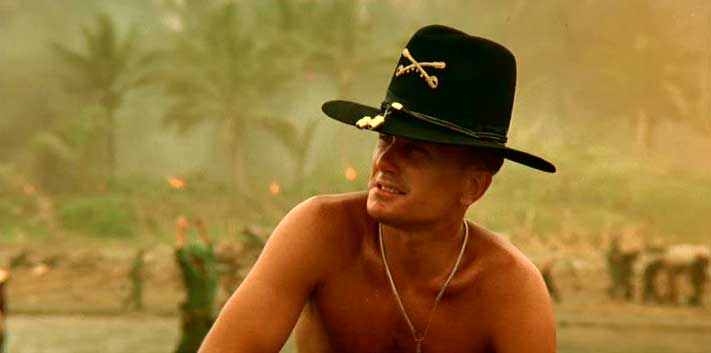
It’s 1970 in Saigon as a burned-out and troubled special forces soldier by the name of Captain Benjamin L. Willard (Martin Sheen) is awaiting for his next assignment. He then gets a call for his next assignment as he’s briefed by Lt. General Corman (G.D. Spradlin), Col. Lucas (Harrison Ford), and a government official (Jerry Ziesmer) about his mission, which is also classified. The mission is to upriver to Nung River where he must find and kill Colonel Walter E. Kurtz. Kurtz is a special forces soldier who has feared to have gone rogue while forming an army of his own somewhere in Cambodia. Another captain (Scott Glenn) was supposed to kill Kurtz but has since disappeared.

Willard takes the mission as he joins the crew of a Navy patrol boat headed by Chief Phillips (Albert Hall) that also includes a surfer named Lance B. Johnson (Sam Bottoms), a guy named Chef (Frederic Forrest), and a young kid named Clean (Laurence Fishburne). Willard doesn’t tell anyone about his mission as he tells Phillips to go to a rendezvous point to meet Lt. Col. Kilgore (Robert Duvall) for transport to Nung River. Kilgore leads an air cavalry of helicopters as he decides to transport the team after learning that Lance is part of the patrol. He takes the team to a day of an attack where Willard and crew saw the chaos that Kilgore has created.

During the journey upriver, Willard begins to read about Kurtz’s background as they would make at a stop at a USO show with Playboy Bunnies. Later on during the journey, they stop to investigate a boat against Willard’s orders which leads to dire consequences. The journey darkens when they stop at a U.S. outpost at a bridge where a fight with the North Vietnamese is occurring where Willard receives more information about Kurtz and the captain who was supposed to assassinate him. With Lance on LSD and causing trouble, more chaos ensues as they’re getting closer where an encounter with villagers lead to dire consequences. After telling the crew what he’s doing as they reluctantly take him upriver.

Upon arriving into Kurtz’s outpost as Willard gives orders to call an air strike if he doesn’t return. He meets a freelance photographer (Dennis Hopper) who explains to Willard about Kurtz’s brilliance. Willard then meets Kurtz as he tells Kurtz why he is here. Even as Kurtz knows why as it’s clear that Willard is going to have a much harder time to complete his mission.

While the film is simply about an assassin going on a journey to find his target. It’s a much more complex film than what the plot suggests. Since Francis Ford Coppola and his co-screenwriters were basing their ideas from Joseph Conrad’s Heart of Darkness. Conrad’s novel explored the psychology of one of its protagonists as he goes into this journey in the Congo rivers. Along the way, he finds a world filled with chaos and despair as he gets closer to the man he’s trying to find. That idea is what probably attracted Coppola and John Milius to create Apocalypse Now by setting it in the Vietnam War.

Unlike the war films about Vietnam that were being made in the late 1970s, there is no political context since Coppola isn’t interested in going into ideas of anti-war or pro-war. Instead, he’s interested in this journey that Captain Willard is taking on. Willard is definitely a man that has seem to be in too many battles and is unable to return home as the same man he used to be. He is someone addicted to war and being of use for his country. When he’s finally given a mission, he goes head-on as he also decides to dwell into the psychology of Col. Kurtz.

The narration by Michael Herr, that is told by Joe Estevez (who filled in due to his brother’s health problems at the time), recalls Willard’s thoughts as he is going into his surroundings while reading about Kurtz. The voice-over narration of Willard also serves as a development for his character as it becomes clear that the closer he’s getting to Kurtz. The more troubled he becomes as he tries to keep his sanity together.

While the film is in some ways about Willard, it’s also about the journey with the patrol crew that Willard surrounds himself with. The characters of Chief, Chef, Clean, and Lance are just as interesting with all of their different personalities. Though Willard doesn’t try to interact or bond with them very much, they do effect his thoughts as at one point during the journey. Chief realizes that something bad is happening as he tells Willard that he has no idea where he is going. Even as Willard doesn’t tell them anything until the third act.

Another character Willard encounters in the journey is Lt. Col. Kilgore. Kilgore is an eccentric character who likes to create chaos and has a love for surfing. He is also someone who is very much into war and victory but also has a certain respect for the enemy. At one point, he says that anyone who had the guts to fight against him deserves a drink of water where a wounded Vietcong soldier is lying on the ground though he is waving a canteen around.

Then there’s Colonel Kurtz. A man with an amazing background in military and humanitarian services. Yet, the mystery of why he turned rogue and gave up all of these accomplishments to lead an army of his own. Though not everything is answered, it is clear that war had done a lot to damage the man as there’s a great monologue about the horrors he had seen in battle. Even as he has done a lot to protect himself where he’s become feared by those he opposed and those he had done his duties for.

The screenplay is definitely a complex story that involves a lot into the ideas of war as well as humanity in general. Capturing all of that terror is the direction of Francis Ford Coppola. Coppola’s broad, hypnotic direction is really the highlight of the film as he opens the film with an eerie scene of a jungle being bombed as it dissolves with burned-out face of Willard. The film has a dream-like yet eerie look where once the journey upriver takes place. It plays up as this eerie journey to Hell as Coppola mostly uses eerie camera shots for the movements on the boat. Many of the scenes in the river were obviously inspired by Werner Herzog’s 1972 film Aguirre, the Wrath of God. Even in using hand-held shots for the film’s battle scene along with aerial shots from helicopters.

It’s not just Coppola’s stylized shots that are the highlight of his direction. It’s also the way he creates the tension in the drama. Even as it leads to the climatic meeting between Willard and Kurtz where he just lets the camera roll as a keen observer wondering what kind of man Kurtz is. The way Coppola underplays the drama and maintain the tension between Willard and Kurtz is astounding as they’re surrounded by this world of chaos. Overall, this is Francis Ford Coppola at his finest.

Helping Coppola wield his surreal yet lush vision is cinematographer Vittorio Storaro. Storaro’s dream-like yet hypnotic photography is filled with arrays orange-like colors mixed in with dark green and elements of blue for a few nighttime scenes. For many of the daytime scenes including the famed air-cavalry which is mostly straightforward while adding a mostly dark, sepia-like tone for many of the scenes of the river. Not only is this Storaro’s best work as a cinematographer but it’s also the film’s real technical highlight.

The editing of Walter Murch, Richard Marks, Lisa Fruchtman, and Gerald G. Greenberg is phenomenal for the way the film moves in its leisured though chaotic approaching to pacing. Even in the more intense action scenes, the film moves with a kinetic rhythm that plays up to the excitement of war. For the scenes in the jungle and the journey, it moves slow but in a more methodical way as helps create the dramatic tension of the film. It’s definitely an idea of what great editing is.

Production designer Dean Tavoularis, along with set decorator George R. Nelson and art director Angelo P. Graham do a spectacular job with the look of the villages that Kilgore attacks as well as the apartment of Willard. Even the temple has a look that is truly mystical with its feeling of death as the art direction for the film is superb. The sound work by sound designer Walter Murch and sound editor Richard P. Cirincione is truly masterful for the way it invented the kind of sound that audiences hear in today’s film world. With additional help mixer Richard Beggs, the sound work is brilliant for the film’s spectacular air-cavalry attack as it’s another of the film’s technical achievements.

The music by Carmine Coppola and Francis Ford Coppola is another of the film‘s highlights for its calm but brooding tone of the film. With its use of soothing string arrangements mixed with electronics and percussions performed by Mickey Hart of the Grateful Dead. The score is truly mesmerizing for the way it captures the horrors of war. The film’s soundtrack includes a cover of Creedence Clearwater Revival’s Suzie Q in the Playboy USO show scene, the Rolling Stones’ Satisfaction during a water-skiing scene on the patrol boat, and Richard Wagner’s Ride of the Valkyries for the air cavalry attack. Another song that is used for the opening scenes of the film as well as the climatic ending is the Doors’ The End.

The casting by Terry Liebing and Vic Ramos is definitely inspiring for the use of memorable appearances of actors big and small. Among those who make an appearance in the film are famed music promoter Bill Graham as the USO Playboy promoter, Jerry Ziesmer as a government agent who tells Willard what to do about the mission, R. Lee Emrey as a helicopter pilot, Scott Glenn as the original assassin who becomes a part of Kurtz’s soldiers, and as Playboy Bunnies, Colleen Camp, Linda Carpenter, and Cynthia Wood. Also in the film making cameos as a film crew are Francis Ford Coppola and cinematographer Vittorio Storaro in the battle scene following the air-cavalry attack.

Other notable small but memorable appearances include Harrison Ford and G.D Spradlin as army officers debriefing Willard about his mission and Dennis Hopper as a crazed photographer who praises Kurtz and his ideologies. In the roles of the patrol boat crew, a then 14-year old Laurence Fishburne as wonderful as the young soldier Clean who has issues with Willard’s presence. Frederic Forrest is very good as Chef, a man obsessed with Playboy Bunnies while fearing over his own surroundings. Sam Bottoms is excellent as Lance, a surfer who gets himself into drugs as he tries to find a way to escape from the horrors of war. Albert Hall is great as Chief, the patrol boat leader who questions Willard’s authority while realizing that something bad is about to happen.

Robert Duvall is superb as Lt. Col. Kilgore, a man who cares for his soldiers while being someone that is completely eccentric. Even when he cares about making great waves for good surfs. It’s one of Duvall’s finest performances as he spouts one of the film’s most memorable lines. Martin Sheen is phenomenal as the film’s protagonist Captain Willard. A troubled man who is a product of the war as he goes deep into the dark jungles of Cambodia to find his target. He’s someone with little remorse as he often alienates himself from the patrol boat crew that is taking to his journey. It’s definitely Sheen at his best as he brings a lot to a character that is losing his humanity.

Finally, there’s Marlon Brando in what is definitely his last great performance as Col. Kurtz. While he would do more films over the years until his death in 2004, this would be one of Brando’s most iconic roles of his career. Playing a man troubled by war as well as the horrors of what he sees as inhuman. It’s a role that not only has Brando bald and overweight but also someone who is burned out as if he’s one the brink of insanity. It’s definitely a great role from the legendary actor.

When the film did premiere in August of 1979, it initially received mixed reviews as it did do well in the box office. At the Oscars, it would win two for Best Cinematography to Vittorio Storaro and Best Sound as well as several awards. The film would become Coppola’s last great hit as he spent the 80s in debt following the release of his 1982 film One from the Heart. Though he would be able to recover from his financial troubles in the 1990s, it would be many years before he decided to revisit his 1979 film.

Apocalypse Now Redux

In 1998, Francis Ford Coppola along with new American Zoetrope chief Kim Aubry decided to work on a new version of Apocalypse Now with additional footage that was cut from the film. With help from editor Walter Murch and cinematographer Vittorio Storaro to help with the new transfer of the film. Coppola also brought in some of the film’s cast to do new dubbing for the film while some new music was made with help from Mickey Hart. The result would be an expanded version of Apocalypse Now called Apocalypse Now Redux.

The 202-minute version is a different film of sorts in comparison to the original 153-minute cut of the film. A few scenes get altered like a water-skiing scene that was shown early in the film before Willard and crew meets Kilgore. In the Redux version, it’s shown much later with Willard reading the dossier on Kurtz. There’s also a new introduction to Kilgore as he arrives on a helicopter. Also altered in the Redux version is the ending that Coppola for years had issues with because he felt that audiences were confused about it. The new ending isn’t much of an alteration as it would clarify things about what Willard has done in the end.

The Redux version also includes some more humor in the film like a scene of Willard stealing Kilgore’s surfboard as well as a scene where Willard and crew try to hide the surfboard and their boat from Kilgore’s crew. Other new scenes in the longer cut include a rainy scene where Willard finds the Playboy Bunnies helicopter has landed on an abandoned army medical camp where Chef and Lance spend their time with a couple of Bunnies while Clean is waiting to score with one. Other new scenes have more interplay with Willard and crew as well as a scene where Kurtz reads some articles from Time magazine to Willard as he’s surrounded by children.

One significant scene that is restored for the Redux scene is the French Plantation scene. It’s where following the tragic death one of the patrol crew members, they stop at a foggy area as they encounter a group of French soldiers protecting a plantation in Cambodia. It is in this sequence where Chief’s duty of honor occurs during the funeral as they bury a fallen one while Willard and the remaining crew eat. The scene includes a child (Roman Coppola) reading a poem while the plantation head (Christian Marquand) talks about why the French shouldn’t give up as it features a cameo from Henri Martin Affair who argues with the plantation head. The scene also includes Willard’s encounter with Roxanne (Aurore Clement) who is a member of the family as she gets Willard in touch with his humanity as they smoke opium.

The scenes in the film definitely adds more to the story as they also fill in gaps that were probably unexplained in the original cut of the film. At the same time, it allows the film to move a bit faster while maintaining a leisured pace for the film. The new scenes have the same look and feel that Vittorio Storaro’s photography have as the French Plantation scene is the best looking scene in the Redux version. The score, which features additional material that wasn’t in the original film by Carmine Coppola, definitely brings more tension thanks in part to Mickey Hart’s percussion work and arrangements.

The performances from the cast who were in the original cut are given more nuance. Particularly Brando, Sheen, and Duvall as they show more humanity while Sheen gets to be funnier in a few scenes. More importantly, minor characters such as a couple of Playmates in Colleen Camp and Cynthia Wood are given more to do. For the French plantation scene, cameos by Francis’ sons Roman and Gian-Carlo as children of the plantation are good as is Henri Martin Affair as an old man commenting about the plantation’s history. Christian Marquand is great as the owner who talks about the French’s war record as he says they will not lose in Vietnam. Finally there’s Aurore Clement as Roxanne, a widow in the plantation who befriends Willard as she briefly gets him in touch with the humanity he seems to be losing.

Apocalypse Now Redux premiered at the 2001 Cannes Film Festival to a very positive reaction as the film was given a limited release in theaters where it did modestly successful. While audiences and critics were divided over the new scenes with the French Plantation receiving the brunt of the criticism. Still, it was successful enough for Coppola to help his revived American Zoetrope studio to keep going. In 2010, Coppola released both versions of the film along with the 1992 making-of documentary Heart of Darkness for a special Blu-Ray release as the legacy of Apocalypse Now remains intact.

Apocalypse Now is definitely one of the greatest war films ever from the dazzling yet eerie mind of Francis Ford Coppola. Featuring a great ensemble led by Marlon Brando, Martin Sheen, and Robert Duvall. It’s a film that is definitely hypnotic with grand visuals and intense moments that are truly unforgettable. Whether it’s the original cut or the extended Redux edition. It’s definitely a film that everyone must see whether they’re into war films or not. In the end, Apocalypse Now is a haunting yet mesmerizing film from Francis Ford Coppola.

Francis Ford Coppola Films: Dementia 13 - (You’re a Big Boy Now) - (Finian’s Rainbow) - (The Rain People) - The Godfather - The Conversation - The Godfather Pt. II - One from the Heart - The Outsiders - Rumble Fish - (The Cotton Club) - (Peggy Sue Got Married) - (Garden of Stone) - (Tucker: The Man and His Dream) - New York Stories - The Godfather Pt. III - Bram Stoker’s Dracula - (Jack) - (The Rainmaker) - (Youth Without Youth) - Tetro - (Twixt)

Related: Hearts of Darkness: A Filmmaker's Apocalypse

© thevoid99 2011