Written, scored, directed, and edited by John Carpenter, Assault on Precinct 13 is the story of a cop trying to defend his precinct from a gang as he is helped by convicted murderer. The film is a simple showdown movie where a cop and his colleagues go into a war against a brutish gang of thugs. Starring Austin Stoker, Darwin Joster, Laurie Zimmer, Nancy Kyes, and Tony Burton. Assault on Precinct 13 is a chilling yet intense film from John Carpenter.
Set in a precinct that is about to close near the ghettos of Los Angeles, the film is about a police lieutenant whose job is to watch over the precinct on its final night where it is being under siege from a gang where he is helped by a secretary and two convicts including an infamous murderer as they fight off the gang. It’s a film that manages to take a simple premise about a precinct under siege yet it is more about a lieutenant trying to maintain some order and stay alive while having to trust someone who is very likely to kill him. John Carpenter’s screenplay has this very unique structure where it takes place entirely in the span of a day.
The first half of the story takes place following a gang shooting by police as a group of warlords plan to retaliate while Lieutenant Ethan Bishop (Austin Stoker) is getting ready to run precinct 13 near the ghetto as a last-minute assignment. Yet, the actions of a gang would cause trouble nearby as a bus carrying a trio of convicts, including the murderer Napoleon Wilson (Darwin Joster) during a transfer where a stop at the precinct would later be fatal. The film’s second half would begin when a man (Martin West) comes into the precinct exhausted and in need of help after a confrontation with one of the warlords where all hell breaks loose. The film’s second half sets almost entirely in this precinct where Wilson, Bishop, a secretary named Leigh (Laurie Zimmer), and a convict named Wells (Tony Burton) are forced to take a stand for their own survival with limited amount of ammo while realizing that they’re going up against a gang that refuses to quit.
John Carpenter’s direction is truly riveting not just for the way he builds up the suspense but in how he uses this timeframe of 24 hours to play into the sense of dread that is emerging. The direction starts off in the late-night mornings at a ghetto in Los Angeles where a gang is being gunned down by the police as it would set off a chain of events. Much of Carpenter’s direction involves some close-ups and medium shots as there’s a simplicity to the camera angles but its approach to violence and suspense is quite graphic and confrontational. Most notably an infamous sequence often referred to as “the ice cream scene” which involves an ice cream man and a gun-toting warlord as it is a scene of unexpected violence at its most visceral.
Once the story is set at night at the precinct where sounds of gun silencers come into play, it becomes clear that it becomes a film where anything can happen. Even as the violence is very unpredictable outside of the precinct while the suspense is happening inside where Bishop and Wilson have to trust each other. Under the John T. Chance alias, Carpenter’s approach to editing is quite straightforward but once the battle begins. There is a fluidity to his rhythmic cutting as it plays to the intensity of the violence as Carpenter knows when to cut to showcase the sense of violence that is happening. Also serving as the film’s composer, Carpenter’s electronic-based score is truly hypnotic with its very dark and eerie synthesizer riffs as it plays into the suspense and terror in the film. Especially in the final showdown between the remaining survivors and the gang in a climax that is violent as well as terrifying. Overall, Carpenter creates a very thrilling and mesmerizing film about a group of people under siege by a ruthless gang.
Cinematographer Douglas Knapp does excellent work with the film‘s cinematography to create some unique lighting schemes and textures for the scenes set at night in order to convey the mood of terror during the siege. Art director/sound effects editor Tommy Lee Wallace does amazing work with the look of the precinct that is almost in ruins as it‘s about to be abandoned while the sound effects he creates with sound recorder William Cooper are fantastic to convey the sense of terror as well as the impact of the silencer bullets.
The film’s brilliant cast include some notable small roles from Frank Doubleday as a gun-toting warlord, Peter Bruni as the ice cream man, John J. Fox as a warden who doesn’t like Wilson, Charles Cypher as the prison authority figure Starker who watches over Wilson, Henry Brandon as the precinct’s original top figure Chaney, Nancy Kyes as the very scared secretary Julie, Martin West as the shocked man who confronts a warlord in Lawson, and Kim Richards in a small yet terrific role as Lawson’s daughter. Tony Burton is excellent as the cautious convict Wells who realizes the gang that they’re going up against as he is also the film‘s comic relief.
Laurie Zimmer is fantastic as Leigh as a secretary who had seen a lot at the precinct as she proves to be very handy with a gun while wondering what kind of man Wilson is. Darwin Joston is great as Napoleon Wilson as this convicted murderer who is a charmer as he often asks for cigarettes as he proves to be a formidable ally who is willing to help anyone as he knows he’s an asshole but a reliable one. Finally, there’s Austin Stoker in an incredible performance as Lieutenant Ethan Bishop as this straight-laced cop that used to live in the ghetto as he tries to keep everyone alive from the siege as well as trusting someone like Wilson which he knows is a major risk.
Assault on Precinct 13 is a phenomenal film from John Carpenter. Armed with a great cast, a suspenseful premise, and a fucking cool score, it’s definitely one of Carpenter’s great early triumphs. Even in moments that are just shocking in terms of the presentation of the violence. In the end, Assault on Precinct 13 is a remarkable film from John Carpenter.
John Carpenter Films: Dark Star - Halloween - Someone’s Watching Me! - Elvis - The Fog - Escape from New York - The Thing - Christine - Starman - Big Trouble in Little China - Prince of Darkness - They Live - Memoirs of an Invisible Man - Body Bags - In the Mouth of Madness - Village of the Damned - Escape from L.A. - Vampires - Ghosts of Mars - The Ward
The Auteurs #60: John Carpenter Pt. 1 - Pt. 2
© thevoid99 2014
Directed by John G. Avildsen and written and starring Sylvester Stallone, Rocky is the story of a club fighter who is down on his luck as he is given a shot to fight the heavyweight champion of the world. The film is the first of a series of films that explores the trials and tribulations of Rocky Balboa as he is a kind-hearted man that is trying to make it in the only thing he knows how to do. Also starring Talia Shire, Burgess Meredith, Burt Young, Tony Burton, and Carl Weathers as Apollo Creed. Rocky is a heartwarming and sensational film from John G. Avildsen.
The film is a simple story about a club fighter named Rocky Balboa who is a good, kind-hearted man with little prospects as he is given a shot to fight the World Heavyweight Champion Apollo Creed. Yet, the film follows the life of this guy who knows how to fight while he spends part of his time collecting money for a loan shark just to make a living. Still, it’s not enough as he’s considered a bum by most people living in the urban neighborhood in Philadelphia while a gym owner named Mickey Goldmill (Burgess Meredith) is convinced that Rocky is wasting his potential by working for a loan shark. When opportunity arises to fight Apollo Creed all because of his nickname in The Italian Stallion, it becomes one of many things that help Rocky’s life as he also falls for a shy pet store clerk named Adrian (Talia Shire). While he is considered a long-shot to win the fight, Rocky would do something to surprise everyone in his climatic fight with Creed.
Sylvester Stallone’s screenplay reveals a lot of the struggles of a man just trying to get a break in life as he wants to do good yet he isn’t given many opportunities to do so. Particularly as he is someone who is street-smart but had to give up school as a teenager making life much tougher for him. The only friend he has is an alcoholic meat-packing plant worker named Paulie (Burt Young) who is also Adrian’s older brother. Adrian becomes the one person in Rocky’s life that shows him a world with love as he would help her come out of her shell more as she eventually stands up to the abusive tirades of her brother. The opportunity to fight Creed isn’t just something that Rocky needed to help his life but also prove to the people that he’s not a bum. Even as he turns to Mickey for help as Mickey had been reluctant in the past but knows Rocky needs someone who can help him.
The Apollo Creed character is based on some of the more outrageous fighters of the 1960s and 1970s as he’s a man that needed to fight a fighter as his original fight fell through. By giving an unknown a shot at the title on New Year’s Day in 1976, it would give Creed the publicity that he craves for as a man who is generous with the people. What he doesn’t know is that his opponent is training for the fight a little more seriously as it does lead to this fight. There’s a moment in the third act before the fight where an admittedly-scared Rocky knows that he couldn’t beat the undefeated Creed. Yet, he doesn’t want to go out there and lose like a bum where the fight would have Rocky do the unthinkable in that fight.
John G. Avildsen’s direction is quite understated for much of the film in terms of creating the sense of drama as it has this sense of looseness in the way things play out. Even as it features scenes of Rocky walking around place in Philadelphia where the place itself is a character in the film. While a lot of the dramatic moments are shot with some simplicity, the scenes involving the fights are more stylish. Notably in the way it shows Rocky’s training methods like hitting meat in a meat locker or running around the streets of Philadelphia. Avildsen also creates some amazing training montages where the shots of Rocky running in training featured one of the most early uses of the Steadicam that would also include the shot of Rocky reaching the top of the steps of Philadelphia Museum of Arts.
The climatic fight scene is presented with such degree of style where Avildsen does use some stock footage for the crowd scenes as while having the camera be in and outside the ring to capture the intensity. Even as it reveals what the crowd is seeing as there’s a lot of drama in the fight including some moments where both Rocky and Creed put their bodies at great risk. Overall, Avildsen creates a very gripping yet powerful film about a fighter getting the opportunity to do good and fight the champ.
Cinematographer James Crabe does excellent work with the film‘s cinematography by using very simple lighting schemes for some of the film‘s interiors and exteriors while creating a sense of style for the film‘s fights with some unique uses of lighting. Editors Scott Conrad and Richard Halsey do great work with the editing to use more simple but effective cuts in the dramatic portions while creating some amazing montages in the training sequence as well as some rhythmic cuts in the climatic fight. Production designer William J. Cassidy, with set decorator Ray Molyneaux and art director James H. Spencer, does nice work with some of the set pieces along with the lavish look of the climatic fight.
Makeup designer Michael Westmore does terrific work with the makeup for the film‘s climatic fight to showcase the brutality the two men put upon each other. The sound work of Bud Alper, Lyle J. Burbridge, William McCaughey, and Harry Warren Tetrick is wonderful for the atmosphere that occurs in the gym and in the fights along with the intimate scene of Rocky and Adrian at the ice skating rink. The film’s music by Bill Conti is brilliant as it features some soaring orchestral music including the theme Gonna Fly Now along with some plaintive piano pieces to express Rocky’s melancholia.
The casting by Caro Jones is fantastic as it features some notable appearances from famed fighter Joe Frazier as well as performances from Joe Spinnell as the loan shark Tony Gazzo, Thayer David as the promoter George Jergens, and Tony Burton as Creed’s trainer Tony “Duke” Evers. Carl Weathers is great as the flamboyant fighter Apollo Creed as a man who is full of charisma and skill only to realize that the opponent he picked isn’t some bum. Burt Young is excellent as Rocky’s friend Paulie who tries to help Rocky out while being very cruel towards his sister claiming she’s making his life difficult. Burgess Meredith is superb as Mickey as a former boxer who is aware of Rocky’s potential as he helps trains for the fight. Talia Shire is wonderful as Adrian as a shy pet store clerk who falls for Rocky as she helps him deal with the doubts he has. Finally, there’s Sylvester Stallone in a magnificent performance as Rocky Balboa by displaying a man who is very good to people though doesn’t get appreciated while being a tough guy with heart as it’s definitely a true breakthrough for Sly.
Rocky is a tremendous film from John G. Avildsen and its star/writer Sylvester Stallone. The film isn’t just one of the great sport movies but also an inspirational story of how an underdog can overcome the odds. Even as it’s a film that started one of the great franchises in films while finding a character in Rocky Balboa for the people to root for. In the end, Rocky is an outstanding film from John G. Avildsen.
Rocky Films: (Rocky II) - (Rocky III) - (Rocky IV) - (Rocky V) - (Rocky Balboa) - Creed (2015 film) - (Creed II)
John G. Avildsen Films: (Turn on to Love) - (Guess What We Learned in School Today?) - (Joe) - (Cry Uncle!) - (Okay Bill) - (Save the Tiger) - (The Stoolie) - (Fore Play) - (W.W. and the Dixie Dancekings) - (Slow Dancing in the Big City) - (The Formula) - (Neighbors) - (Traveling Hopefully) - (A Night in Heaven) - The Karate Kid - The Karate Kid Part II - (Happy New Year) - (For Keeps) - (Lean on Me) - The Karate Kid Part III - (The Power of One) - (8 Seconds) - (Inferno)
© thevoid99 2013
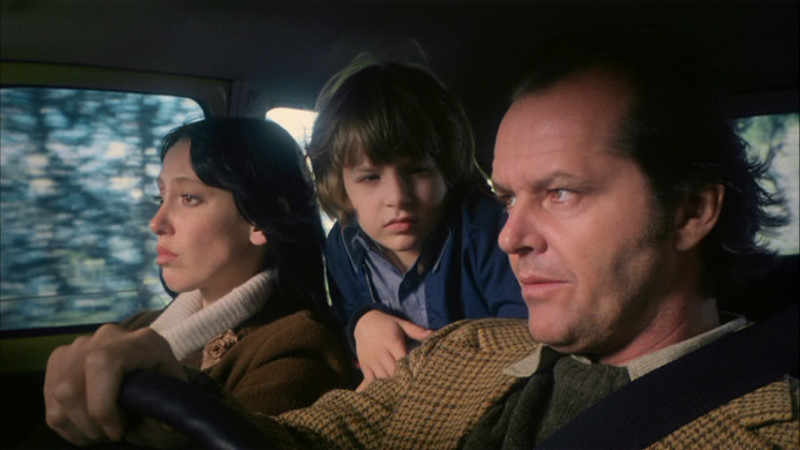
Based on the novel by Stephen King, The Shining is the story of a writer who is asked to become a caretaker for an isolated hotel as he brings his family along where things go wrong as he starts to become insane and terrorize his family. Directed by Stanley Kubrick and screenplay by Kubrick and Diane Johnson, the film is an exploration into madness as well as the world of the supernatural in a strange hotel. Starring Jack Nicholson, Shelley Duvall, Scatman Crothers, and Danny Lloyd. The Shining is a terrifying yet visually-entrancing film from Stanley Kubrick.
After taking a job to be a caretaker for the Overlook Hotel in the middle of Colorado, writer Jack Torrance (Jack Nicholson) brings his wife Wendy (Shelley Duvall) and their son Danny (Danny Lloyd) to the place where they’ll stay for five months during the winter time where the hotel is closed for the time being. Jack hopes to use the time to write a novel as he and Wendy meet up with the people running the hotel as it includes a chef named Dick Hallorann (Scatman Crothers). Dick notices that Danny as telepathic powers that communicate with other people with their minds as they briefly talk as Dick asks Danny not to go to the mysterious room 237. A month goes by as Jack’s novel is going nowhere while Wendy and Danny spend most of their time looking around the hotel and its many sites including a maze outside of the hotel.
When winter arrives with a terrible snowstorm, things start to get strange after Danny runs into a couple of twins (Lisa and Louise Burns) while noticing that someone left room 237 open. After Jack wakes up from a nightmare and Wendy notices bruises on Danny’s neck believing that Jack did it, Jack goes into the Gold Room where he talks to its ghostly bartender Lloyd (Joe Turkel) where Jack gets to vent. When Wendy talks to Jack claiming it was a woman at room 237 who attacked Danny, Jack goes to room 237 where he encounters some strange moments as he decides to stay at the hotel to live up to work. After attending a party at the Gold Room where he meets a waiter whose name is Grady (Philip Stone), Jack realizes he was the previous caretaker who had rumored to have killed his wife and two daughters. Yet, Grady says that Jack had always been the caretaker and what he did to his family was correct them.
After getting a psychic connection with Danny who has been seeing things that are becoming true, Dick decides to fly from Florida to Colorado to see what is going on at the hotel. Wendy meanwhile, notices that Jack’s behavior has gone out of control after she suggests that she should take Danny away from the hotel as Jack starts to go insane. After knocking Jack out and locking him inside the pantry, Wendy realizes that she and Danny could not escape as the snowstorm is getting worse. When Jack manages to get out of the pantry, all hell breaks loose as he goes after his wife and child in an insane quest to get rid of them.
What happens when a man decides to be a caretaker at a hotel in middle of nowhere as he starts to go insane in this mysterious hotel? That is simply the premise of the film as it is an exploration into the supernatural and madness. Yet, it’s a film that shows a man completely losing touch with reality as he starts to see things around him where he starts to vent his frustrations on his wife for disrupting his work. Notably as his wife is becoming concerned about their son who has these strange visions along with an imaginary friend called Tony. When the boy starts to realizes that the images he saw prior to going to the hotel are coming true, he goes into a trance as Tony starts to take over leaving the boy’s mother to finally worry as she starts to realize what is going on.
The film’s screenplay by Stanley Kubrick and Diane Johnson is quite eerie in the way it explores a man’s descent into insanity. Yet, it is a script that takes its time to let the mystery unravel though there’s a lot that is revealed early in the film that Jack Torrance seems to ignore such as the fact that the previous caretaker killed his family and later himself in a strange incident similar to what Jack went through. Another noted fact is that the hotel was built on an old Indian burial ground which definitely explains a lot of supernatural elements that occurs in the story. Then there’s Jack Torrance himself as he’s a man with a dark past as he once an alcoholic who had accidentally broken his son’s arm as he’s unaware that he’s a danger to himself and everyone. For his wife Wendy, she becomes more unsure about Jack just as she was starting to regain his trust as it leads to all sorts of trouble.
Danny is another key element to the film as he’s this boy with telepathic powers where he communicate people with their minds as he meets this very kind chef named Dick Hallorann who also has telepathic powers. Dick realizes that Danny has these visions as he gives Danny a warning about not entering this very strange room yet thing suddenly go wrong when the room’s door opens. It becomes a major plot point that leads to all sorts of moments where Jack starts to descend further into madness after meeting a ghost as they would tell Jack to deal with the situation about his family. This leads to a third act where it becomes this very chilling-suspense thriller as Jack goes insane and terrorizes his family.
Kubrick’s direction is very entrancing for the way he presents the film such as the opening sequence of Jack’s car driving around the Rocky Mountains in Colorado through these sprawling wide shots from a helicopter. Kubrick’s direction is also very stylized such as the way he shoots wide shots of conversations where the camera is far away from the actors. It’s part of the style that Kubrick wants to convey where it’s not just him capturing the conversation but the locations themselves as it establishes the world that Jack and his family are about to enter. Immediately, the audience will think that this nice hotel is a nice place to stay but once it’s just Jack, Wendy, and Danny all alone in this hotel. That’s where things start to go wrong. It’s not just the sense of isolation that eventually starts to take a toll on Jack but also his writer’s block.
Once the Torrance family stays in the hotel for a month where Kubrick utilizes these stylish steadicam shots to capture Danny’s movements on the big wheel tricycle along with the scenes in the maze. It shows that Danny and Wendy are having fun but Jack is troubled as it features that famous Kubrick stare of Jack who is slowly descending. This definitely leads to an element of suspense that Kubrick builds in a very slow, meticulous to have things unravel bit by bit. Through these montages that includes a pool of blood coming out of an elevator and all of these strange images, it is to reveal what is to come. Along with some amazing tracking shots and camera movements to maintain that air of suspense, Kubrick plays up the stakes that Wendy and Danny had to go through.
It’s not just Jack and the supernatural they have to face but also nature itself as they do whatever they can to survive Jack’s terror. This would eventually play out to the horror that occurs as Kubrick maintains this very unsettling atmosphere that occurs not just in the hotel but outside. Even as Kubrick would intensify the camera movements and scenery to play up the horror up to the fullest. Overall, Kubrick creates a mesmerizing yet unsettling horror film that does more than its premise offers.
Cinematographer John Alcott does fantastic work with the film‘s evocative photography from the lush look of the film‘s daytime exterior scenes including the gorgeous ones during the snow to the more stylized yet entrancing look of the scenes at night in the interior scenes as well as the exteriors during the maze sequence at night as Alcott‘s work is a major highlight. Editor Ray Lovejoy does brilliant work with the editing to create some unique rhythmic cuts to play out the film‘s structure and suspense along with some stylized jump-cuts and dissolves for the transitions including some very eerie montages for Danny‘s visions. Production designer Roy Walker and art director Leslie Tomkins do amazing work with many of the film’s interiors for the scenes in the hotel from the carpets that Danny plays at to the Gold Room and its stylish bathroom along with the other hotel rooms the characters encounter.
Costume designer Milena Canonero does wonderful work with the costumes from the dresses that Wendy wears to costumes worn by the ghosts at the Gold Room party. The makeup work of Barbara Daly and Tom Smith, along with the hair by Leonard, is terrific for the scenes at the Gold Room party that plays up to the period that Jack is entranced by. Sound editor Dino Di Campo, Jack T. Knight, and Winston Ryder do excellent work on the sound from the way the Big Wheel sounds on the floors to the atmosphere it creates in some of the film‘s most chilling moments as the sound work is another major highlight of the film. The film’s superb music soundtrack consists of a variety of pieces from the opening electronic score by Wendy Carlos and Rachel Elkind to set a dark mood to the film to an array of eerie orchestral pieces from Gyorgi Ligeti, Bela Bartok, and Krzysztof Penderecki as well as old standard pop music from Henry Hall, Ray Noble, Al Bowlly, Jimmy Campbell, Reginald Connelly, and Harry Woods.
The casting by James Liggat is great for the ensemble that is created as it features notable small roles from Lisa and Louise Burns as the Grady twins, Anne Jackson as a doctor who visits Danny early in the film, Tony Burton as Dick’s friend Larry, Barry Nelson as the hotel manager Stuart Ullman, Joe Turkel as the friendly ghost bartender Lloyd, and Philip Stone as the brooding waiter Delbert Grady. Scatman Crothers is excellent as Dick Hallorann who shares his telepathic gift with Danny while noticing something is wrong as he tries to see what is going on. Danny Lloyd is brilliant as Danny as he displays a performance of a kid troubled by these premonitions while making strange voices whenever he acts as Tony as it’s a truly incredible performance for the young kid.
Shelley Duvall is amazing as Wendy as she starts out as this very kind and fun woman excited about staying in a hotel for months only to deal with the terror of her husband as Duvall displays an eerie intensity to her role in the way she deals with everything. Finally, there’s Jack Nicholson in one of his most iconic performance as Jack Torrance. Nicholson’s performance is riveting for the way he explores a man’s descent into madness as Nicholson brings a lot of dark humor to the role as well as a determination to man hell-bent on maintaining his job as caretaker where it’s a performance that has Nicholson go all out and more making it one of the great performances in film.
The Shining is a harrowing yet intriguing horror film from Stanley Kubrick that features outstanding performances from Jack Nicholson and Shelley Duvall. The film is definitely an interesting yet thrilling take on madness and isolation as it also explores horror at its most extreme. It’s also a film that strays from the conventions of typical horror films in order to have the audience be engaged by the visuals and the events that occur. In the end, The Shining is a magnificent film from Stanley Kubrick.
Stanley Kubrick Films: Fear & Desire - Killer's Kiss - The Killing - Paths of Glory - Spartacus - Lolita - Dr. Strangelove or How I Learned to Stop Worrying and Love the Bomb - 2001: A Space Odyssey - A Clockwork Orange - Barry Lyndon - Full Metal Jacket - Eyes Wide Shut
Related: Stanley Kubrick: A Life in Pictures - The Auteurs #18: Stanley Kubrick
© thevoid99 2012