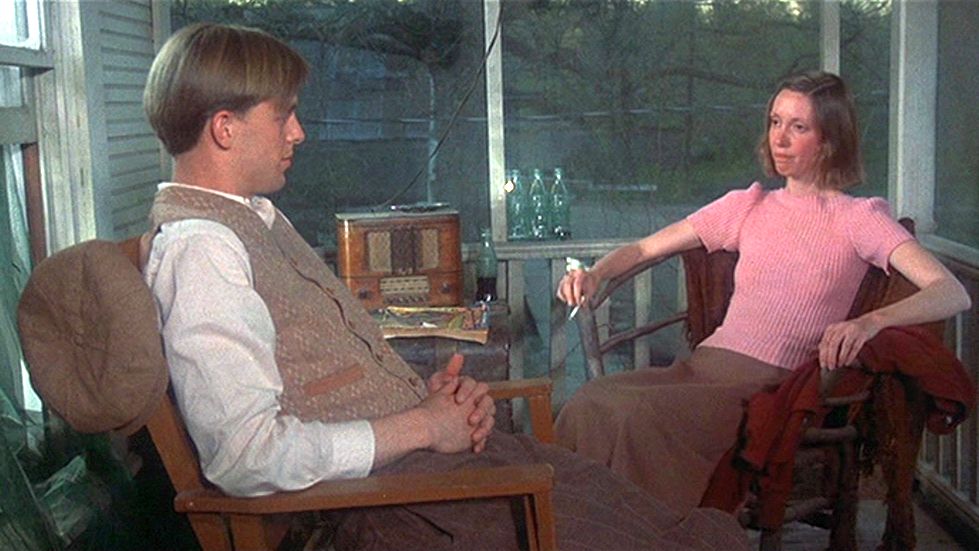
Based on the novel by Edward Anderson, Thieves Like Us is the story of three men who escaped prison as they go on a crime spree throughout the American South during the 1930s. Directed by Robert Altman and screenplay by Altman, Joan Tewkesbury, and Calder Willingham, the film is a loose remake of Nicholas Ray’s 1949 film They Live by Night which was also an adaptation of Anderson’s novel as it blends elements of humor and crime. Starring Keith Carradine, Shelley Duvall, John Schuck, Tom Skerritt, Bert Remsen, and Louise Fletcher. Thieves Like Us is a riveting and mesmerizing film from Robert Altman.
Set during the Great Depression in the American South, the film revolves around a trio of escaped convicts who become bank robbers as they would become successful and notorious only to go way over their head when they are later pursued by the authorities. It’s a film with a simple premise as it play into three men that want to live the good life during the Depression as well as endure some of the trappings of success in their work as bank robbers. The film’s screenplay by Robert Altman, Joan Tewkesbury, and Calder Willingham does follow a straightforward narrative but it’s really more about three guys trying to plan robberies and such as one of them is a young man named Bowie (Keith Carradine) is someone that is learning the ropes of robbing but is eager to wanting to have a good life with a young woman in Keechie (Shelley Duvall). Yet, Bowie is pressured to continue robbing by his partners T-Dub (Bert Remsen) and Chicamaw (John Schuck) as the latter becomes more violent and troubling to the point that he would cause a lot of trouble.
Altman’s direction has elements of style in terms of the compositions and scenes he creates but he also does things that doesn’t play into conventions such as the robberies where he never reveals what happens during the robbery. Instead, it’s about the action outside where Bowie is the getaway driver as he waits for T-Dub and Chicamaw leaving the bank and getting into the car. It’s among these moments in the film that has Altman deviate from what is expected in caper films as he’s more concerned about the characters and how they plan a robbery. Even if it means laying low between robberies where they can get a chance to enjoy themselves as T-Dub would live at a house with Chicamaw and a woman whose young adult daughter is someone he is in love with. Shot largely on location in the state of Mississippi, Altman does maintain that air of realism into the locations such as the swamps and dirt roads along with showing this period of the American South during the Depression that was grimy but also kind of exciting.
Altman’s direction also emphasizes on the usage of radio reports as well as diegetic music to capture the idea of the times where it is either used as a form of entertainment or to intensify the drama during the film’s second act where Bowie, T-Dub, and Chicamaw become fugitives. Altman’s usage of long takes in the drama add to an energetic tone as well as the events that would occur in the third act with Chicamaw becoming violent as Bowie finds himself being a reluctant participant in these violent acts. Even as Bowie wants to take part in a simple life with Keechie but is pulled into wanting to participate in more robberies as it would eventually get more troubling. All of which has Altman showcase these haunting moments of violence that would haunt Bowie whose life is in greater danger just as he’s trying to make changes for himself. Overall, Altman crafts a witty yet compelling film about three convicts making a name for themselves as bank robbers during the Great Depression.
Cinematographer Jean Boffety does brilliant work with the film’s cinematography as it has a low-key approach to the way many of the daytime exteriors look with ideas of grainy photography as well as the way some of the scenes at night are lit. Editor Lou Lombardo does amazing work with the editing as it has an air of style for its usage of jump-cuts as well as a key scene towards the end with its usage of slow-motion as it is a highlight of the film. Costume designer Polly Platt does excellent work with the costumes from the look of the dresses the women wear as well as the clothes the men wear during those times. Sound mixer Don Matthews does fantastic work with the sound in the way music and radio programs sound like inside a car or at a house as well as the atmosphere of the locations including the scenes involving overlapping dialogue.
The film’s superb cast include some notable small roles from Arch Hall Sr. as a young man who picks up Bowie, T-Dub, and Chicamaw early in the film, Al Scott as a prison warden, Ann Latham as T-Dub’s young lover Lula, and Tom Skerritt in a terrific small role as the general store owner Dee Mobley who also runs a small-time criminal operation that he eventually abandoned. Louise Fletcher is fantastic as Lula’s mother Mattie as a woman who lets T-Dub, Bowie, and Chicamaw stay at her home where it eventually becomes chaotic to the point that she would later play a part in their downfall. Bert Remsen is excellent as T-Dub as eldest of the three thieves who walks with a cane and is always trying to ensure that things go well while not wanting to be violent as he enjoys the fruit of success.
John Schuck is brilliant as Chicamaw as the most brutal of the three thieves as well as someone who isn’t satisfied with robbing banks where he becomes more violent and unruly where he would get everyone into trouble. Shelley Duvall is amazing as Keechie as Mobley’s younger sister who falls for Bowie as they embark on a relationship where she knows what he does but also keeps it a secret while dealing with the idea that Bowie would abandon the good life in favor of the thrill of danger. Finally, there’s Keith Carradine in an incredible performance as Bowie as a young thief who contemplates his role as someone who is a robber where he relishes in having money and wanting a good life but becomes disturbed by some of the violence he encounters as it’s a role that has Carradine display humor but also someone who comes to term with the trouble he’s created and the need to make things right.
Thieves Like Us is a sensational film from Robert Altman that features great performances from Keith Carradine and Shelley Duvall. Along with its ensemble cast, evocative cinematography, loose take on theft and notoriety, and an unconventional take on the caper genre. It’s a film that play into the idea of three men wanting to succeed through crime only to go way over their heads once they become notorious. In the end, Thieves Like Us is a phenomenal film from Robert Altman.
Robert Altman Films: (The Delinquents) – (The James Dean Story) – Countdown (1968 film) - (That Cold Day in the Park) – M.A.S.H. - Brewster McCloud - McCabe & Mrs. Miller - (Images) – The Long Goodbye - California Split - Nashville - Buffalo Bill and the Indians or, Sitting Bull's History Lesson - 3 Women - (A Wedding) – (Quintet) – (A Perfect Couple) – (HealtH) – Popeye - (Come Back to the Five and Dime, Jimmy Dean, Jimmy Dean) – (Streamers) – (Secret Honor) – (O.C. and Stiggs) – Fool for Love - (Beyond Therapy) – (Aria-Les Boreades) – (Tanner ’88) – (Vincent & Theo) – The Player - Short Cuts - Pret-a-Porter - (Kansas City) – (The Gingerbread Man) – Cookie's Fortune - Dr. T and the Women - Gosford Park - The Company - (Tanner on Tanner) – A Prairie Home Companion
© thevoid99 2018
Directed by Robert Altman and written by Doran William Cannon, Brewster McCloud is the story of a recluse who lives in a shelter at the Houston Astrodome as he dreams of wanting to fly where he would create a flying machine. The film is an offbeat comedy that plays into a young man wanting to do the impossible as it mixes fantasy and reality into this man’s desire to fly. Starring Bud Cort, Sally Kellerman, Michael Murphy, Rene Auberjonois, Stacy Keach, Margaret Hamilton, Jennifer Salt, and introducing Shelley Duvall. Brewster McCloud is a witty and whimsical film from Robert Altman.
The film is about a young recluse who yearns to fly as he creates a flying machine that would give him the chance to fly as he would deal with others who threaten him leading to a murder investigation led a detective from San Francisco. Set entirely in the city of Houston with the Astrodome in the center of the story, the film follows this titular character (Bud Cort) as he is trying to get an idea of how to fly with these wings he created. The film’s screenplay by Doran William Cannon sets up the main premise yet much of the film is improvised by director Robert Altman who would include small subplots into the film as it relates to Brewster McCloud.
Popping up every now and then is a lecturer (Rene Auberjonois) talking about birds and their wings while another subplot involves this detective in Frank Shaft (Michael Murphy) who arrives from San Francisco to investigate these mysterious murders as the one key evidence in these killings are bird shit. McCloud would try to mind his own business despite being aided by a mysterious woman in a trench coat named Louise (Sally Kellerman) and getting the attention of a tour guide in Suzanne (Shelley Duvall). Still, he is determined to prove that man can fly no matter what obstacles he faces.
Altman’s direction is offbeat as it opens with a band rehearsing the American national anthem until its singer (Margaret Williams) stops it because the band was off-key prompting to start all over again with the opening credits appearing once again. Shot on location in Houston, Texas and in and out of the Astrodome, the film does play into this strange mixture of fantasy and reality as it relates to what Brewster is trying to do in being able to fly. Yet, he also has to make a living as he would be first seen being a chauffeur to a miserly old man (Stacy Keach) while he also deals with an off-duty narcotics officer who tries to plant drugs on him at the zoo. Both men would meet their fate in bizarre ways as it adds to the film’s offbeat tone. Much of Altman’s direction is loose as he does use wide shots to get a look of the locations as well as shots inside the Astrodome. There are also some medium shots and close-ups that play into the characters and their interaction with a location including a scene of Brewster hiding from a security guard where he finds himself party of a touring group.
The film also play into these offbeat moments that happen as if something else is happening during a key scene which adds to Altman’s approach to the story as it play into so much that is happening including overlapping dialogue that would become a trademark of Altman’s style. Even as there is this car chase during the third act where it’s a riff of the car chase in some respects but also play into this confrontation with reality for some of the characters. The film’s climax is about Brewster’s flight and everything he thought about into his attempt to fly and what he would do to make this dream happen just as discoveries are made about these bizarre murders. Overall, Altman crafts an odd yet rapturous film about a young recluse wanting to fly inside the Astrodome.
Cinematographers Lamar Boden and Jordan Cronenweth do excellent work with the film’s cinematography to capture the sunny look of the daytime exterior scenes in Houston as well as the interiors for some scenes at night as well as the interiors of the Astrodome. Editor Lou Lombardo does brilliant work with the editing with some stylish jump-cuts to play into the humor and parts of the suspense as well as some playful montages that play into the bits of fantasy colliding with reality. Art directors E. Preston Ames and George W. Davis, with set decorators Robert R. Benton and Hugh Hunt, do fantastic work with the look of the shelter that Brewster lives in as well as the home of some of the victims along with the place that Suzanne lives in that she takes Brewster too.
Special makeup effects artist/wing designer Leon Ericksen does amazing work with the look of the old man that Brewster works for early in the film as well as the design of the wings. The sound work of William L. McCaughey and Harry W. Tetrick do superb work with the sound as it help capture the sound of the crowd as well as the atmosphere of the stadium when it isn’t full as well as some of the film’s natural elements. The film’s music by Gene Page is terrific for its playful orchestral score with elements of folk and country that include some original songs by John Phillips that play into the sense of adventure.
The casting by Gary Chason is wonderful that include some notable small roles from G. Wood as a skeptical police captain in Crandall who isn’t fond of Shaft, Bert Remsen as the corrupt narcotics officer Breen, John Schuck as the officer Johnson who helps out Shaft, William Baldwin as Suzanne’s boyfriend Bernard who works for the top police official Weeks, Stacy Keach as a stingy and cruel old man who collects money from old folks home in Abraham, Corey Fischer as an officer who helps Crandall, Margaret Hamilton as a singer in Daphne Heap that is cruel to the band playing for her, and Jennifer Salt as a young woman named Hope who helps out Brewster while also being sexually attracted to him. Rene Auberjonois is fantastic as the lecturer as this mad professor who talks about birds and their power in a comical way while William Windom is terrific as the top police official Haskell Weeks who hires Shaft to investigate while trying to smooth things over within the city.
In her film debut, Shelley Duvall is excellent as Suzanne as a tour guide for the Astrodome that meets Brewster when he’s trying to steal her car as they evade the police while learning about what Brewster is doing. Michael Murphy is brilliant as detective Frank Shaft as a man with piercing blue eyes who lead the investigation over these bizarre murders as he’s an offbeat man that is trying to investigate the case where he is the closest to anyone getting any answers of what is going on. Sally Kellerman is amazing as Louise as this mysterious woman who helps Brewster in his quest as she is this caretaker of sorts while also giving him advice on what to do to achieve his dream. Finally, there’s Bud Cort in a marvelous performance as the titular character as this young man that is wanting to fly as it’s an odd performance of a kid who is shy and reclusive yet is so determined to wanting to fly.
Brewster McCloud is an incredible film from Robert Altman. Featuring a great cast, an offbeat premise, dazzling visuals, and humorous moments that play into the film’s mix of reality and fantasy. It’s a film that definitely displays Altman’s unique vision in telling a story in an unconventional manner while playing up the ideas of fantasy and reality. In the end, Brewster McCloud is a sensational film from Robert Altman.
Robert Altman Films: (The Delinquents) – (The James Dean Story) – Countdown (1968 film) - (That Cold Day in the Park) – M.A.S.H. - McCabe & Mrs. Miller - (Images) – Thieves Like Us - The Long Goodbye - California Split - Nashville - Buffalo Bill and the Indians, or Sitting Bull's History Lesson - 3 Women - (A Wedding) – (Quintet) – (A Perfect Couple) – (HealtH) – Popeye - (Come Back to the Five and Dime, Jimmy Dean, Jimmy Dean) – (Streamers) – (Secret Honor) – (O.C. and Stiggs) – Fool for Love - (Beyond Therapy) – (Aria-Les Boreades) – (Tanner ’88) – (Vincent & Theo) – The Player - Short Cuts - Pret-a-Porter - (Kansas City) – (The Gingerbread Man) – Cookie's Fortune - Dr. T and the Women - Gosford Park - The Company (2003 film) - (Tanner on Tanner) – A Prairie Home Companion
© thevoid99 2018
Based on the play Indians by Arthur Kopit, Buffalo Bill and the Indians, or Sitting Bull’s History Lesson is the story of Buffalo Bill trying to stage a Wild West show where he gets the services of a deposed chief in hoping to present a show for the American president. Directed by Robert Altman and screenplay by Altman and Alan Rudolph, the film is an unconventional western that explores a man’s desire to uphold his own mythological persona while dealing with the realities around him including his own conflicts with Native Americans. Starring Paul Newman, Geraldine Chaplin, Joel Grey, Shelley Duvall, Harvey Keitel, Will Sampson, and Burt Lancaster. Buffalo Bill and the Indians, or Sitting Bull’s History Lesson is a whimsical yet engrossing film from Robert Altman.
Set in 1885 during the last years of a conflict involving Native Americans, the film revolves around a legend of the West who learns he’s gotten the services of the famed Chief Sitting Bull (Frank Kaquitts) for his show celebrating the West as it would prove to be more troubling as he would have to stage it in front of President Grover Cleveland (Pat McCormick). It’s a film that explores some of the behind-the-scenes moments of Buffalo Bill Cody (Paul Newman) trying to stage this show as he wants to present the ideas of the West as something wild and with its own sense of mythology. The film’s screenplay by Robert Altman and Alan Rudolph doesn’t just explore Cody trying to present his stage show as this façade of what the Wild West was but is forced to cope with the realities of what really happened. Especially when he meets Sitting Bull who he thought was this savage that enjoys killing people but it’s revealed to be this very calm, quiet, and morally pure which complicate everything that Cody wants to stage to the people.
The script also showcase Cody’s attempt to play up this persona he’s created as he becomes upset over not just Sitting Bull’s presence but also the fact that Sitting Bull doesn’t want to compromise very much as his interpreter Halsey (Will Sampson) has to speak up for him. Cody would also get into some tension with some of the players including Annie Oakley (Geraldine Chaplin) who is more sympathetic towards Sitting Bull. After a stage show with Sitting Bull where Cody expected him to be booed, it goes the other way around as it destroys everything Cody wanted to present in his idea of the American West. Adding to this turmoil is the fact that Cody isn’t just getting older but he’s having a hard time living up to the persona he’s created as his loyal nephew Ed Goodman (Harvey Keitel) is forced to realize this while his biographer Ned Buntline (Burt Lancaster) is trying to tell many about the many myths of Cody and romanticize to the people working at the show.
Altman’s direction is definitely stylish for not just creating a film that is quite chaotic and loose but also play up into this conflict of reality vs. myth with the West as its backdrop. Shot on location at the Stoney Indian Reservation in Alberta, Canada, the film does play into this idea of a man trying to recreate the Wild West in the middle of a forest near the Rocky Mountains as Altman would use some wide shots to establish the beauty of the location. Yet, he would go for more intimate shots in the usage of close-ups and medium shots as it play into the events happening behind the scenes as everyone is trying to stage the show. The presentation of the shows are quite lavish including the recreation of the Battle of Little Big Horn which shows Cody trying to show the battle from his view but the reality turns out to be more troubling.
The conflict of reality vs. myth is what is at stake in the film as Altman showcases these scenes where Cody is surrounded by things that aren’t real as he has opera singers as lovers, a biographer trying to embellish his legend, and people working with Cody trying to create the greatest show possible. Yet, there are things in the second half that showcase Cody’s struggle to create this myth in a moment where Sitting Bull and some of his people from his tribe have left as Cody and his men try to find them. What happens is that unveiling of the reality that Cody couldn’t face as he has to maintain his persona as this mythological figure of the West to President Grover. Though there are times the sense of looseness in the film does meander a bit for the film’s pacing, Altman does try to maintain a sense of liveliness to capture a moment in time with its protagonist being unaware of what is ahead. Overall, Altman creates a very intoxicating yet offbeat film about a legend of the Wild West trying to stage the ultimate show to present his vision of that world.
Cinematographer Paul Lohmann does brilliant work with the film’s cinematography in using some gorgeous natural lighting to capture the beauty of the locations in the day along with some lights for some of the scenes set at night. Editors Peter Appleton and Dennis M. Hill do terrific work with the editing as it’s mostly straightforward with a few jump-cuts to play into some of the humor and moments of the show. Production designer Anthony Masters, with set decorator Dennis J. Parrish and art director Jack Maxsted, does amazing work with the look of the sets for the stage show as well as the room where Cody sleeps in as well as the bar and a few other places at the circus area.
Costume designer Anthony Powell does excellent work with the costumes from the clothes that Cody wears as well as some of the actors to the simpler look of Sitting Bull and his tribe. Makeup artist Monty Westmore does nice work with the look of Cody as well as some of the makeup the characters wear during a performance. Sound editors Richard Oswald and William A. Sawyer do superb work with the sound as it play into the raucous sounds such as the overlapping dialogue and other things in and around the field for the stage show and circus. The film’s music by Richard Baskin is wonderful as it’s mainly an orchestral score filled with woodwinds and brass instruments that is often played on location to create this sense of pageantry into Cody’s own legend.
The film’s incredible ensemble cast include some Jerri and Joy Duce as cowboy trick riders, Bert Remsen as the bartender Crutch, Robert DoQui as an African-American actor who would often play the Indian chiefs in the stage performances, Bonnie Leaders and Evelyn Lear as a couple of opera singers who try to entertain Cody with the latter being the one who would sing in front of the president, Patrick Reynolds as the president’s aide, Patrick McCormick as President Grover Cleveland, and Shelley Duvall as the First Lady. Will Sampson is terrific as Sitting Bull’s right-hand man and interpreter Halsey as a man that is just trying to keep the peace and explain Sitting Bull’s view of things while Frank Kaquitts is superb as Sitting Bull as the revered Indian chief who rarely says anything as he maintains this presence of purity throughout the film.
John Considine is fantastic as Frank E. Butler as the husband of Annie Oakley who would often be the person holding her targets as well as deal with the chaos of the show. Kevin McCarthy is excellent as Major Burke as a military official who would be the one to get Sitting Bull to be involved as he’s this boisterous individual that likes to have fun and make sure everyone have fun. Joel Grey is brilliant as the producer Nate Salisbury as a man trying to keep everything in control while being announcer for the stage shows while Harvey Keitel is amazing as Cody’s nephew Ed Goodman as an assistant for Cody who is trying to keep him calm and deal with Halsey and Sitting Bull.
Burt Lancaster is marvelous as Ned Buntline as a journalist who is writing Cody’s biography as he tries to maintain that air of mystique for Cody though he is aware that the idea of myth won’t last. Geraldine Chaplin is remarkable as Annie Oakley as the famed sharpshooter who is seen with her right arm in a sling as she copes with not just her injury but the treatment of Sitting Bull as she becomes frustrated with Cody and his desire to present his idea of what the Wild West is. Finally, there’s Paul Newman in a phenomenal performance as Buffalo Bill Cody as a man that is trying to live up to the mythical persona he’s created as he copes with not just the reality of the West but also himself as it’s a performance with charm but also humility as it’s one of his finest performances of his career.
Buffalo Bill and the Indians, or Sitting Bull’s History Lesson is a vivacious film from Robert Altman that features an incredible leading performance from Paul Newman. Along with its great supporting cast, gorgeous visuals, and themes on mythology vs. reality, it’s a film that doesn’t play by the rules into the ideas of the Wild West though it does have a few flaws in its pacing. In the end, Buffalo Bill and the Indians, or Sitting Bull’s History Lesson is a sensational film from Robert Altman.
Robert Altman Films: (The Delinquents) – (The James Dean Story) – Countdown - (That Cold Day in the Park) – M.A.S.H. - Brewster McCloud – McCabe & Mrs. Miller - (Images) – Thieves Like Us - The Long Goodbye - California Split - Nashville - 3 Women - (A Wedding) – (Quintet) – (A Perfect Couple) – (HealtH) – Popeye - (Come Back to the Five and Dime, Jimmy Dean, Jimmy Dean) – (Streamers) – (Secret Honor) – (O.C. and Stiggs) – Fool for Love - (Beyond Therapy) – (Aria-Les Boreades) – (Tanner ’88) – (Vincent & Theo) – The Player - Short Cuts - Pret-a-Porter - (Kansas City) – (The Gingerbread Man) – Cookie's Fortune - Dr. T & the Women - Gosford Park - The Company (2003 film) - (Tanner on Tanner) – A Prairie Home Companion
© thevoid99 2017

Based on the novel by Henry James, The Portrait of a Lady is the story of an American woman who travels to Europe with her inheritance to confront her destiny while meeting two American expatriates who would change her fortunes for the worse. Directed by Jane Campion and screenplay by Laura Jones, the film is an exploration of an independent woman who seeks to make something of herself only to be trapped by the world that she‘s chosen. Starring Nicole Kidman, Barbara Hershey, John Malkovich, Mary-Louise Parker, Martin Donovan, Viggo Mortensen, Christian Bale, Valentina Cervi, Richard E. Grant, Shelley Winters, Shelley Duvall, and John Gielgud. The Portrait of a Lady is an enchanting yet intoxicating film from Jane Campion.
The film is an exploration into the life of an American woman in the 1870s who craves independence and wants to explore the world as she’s been given an inheritance by her uncle. With her inheritance, Isabel Archer (Nicole Kidman) travels through Europe where she meets Madame Serena Merle (Barbara Hershey) whom she met in England some time earlier as Merle would introduce her to another American expatriate in Gilbert Osmond (John Malkovich). After rejecting several proposals from many suitors including her cousin Ralph (Martin Donovan), Isabel marries Gilbert only for the marriage to be not what it seemed as Isabel becomes concerned for the well-being of her stepdaughter Pansy (Valentina Cervi). Isabel is forced to face the destiny she’s chosen as she finds herself lost while coming to the conclusion that she’s driven away those she was close to but also couldn’t help those who really need her.
Laura Jones’ screenplay creates this very complex story as it plays into the world of Isabel Archer as the first act is about her in England as she’s approached by suitors including Lord Warburton (Richard E. Grant), Boston mill heir Casper Goodwood (Viggo Mortensen), and her cousin Ralph Touchett. They all mean well but Archer wants more as she knows that the world is changing as her friend Henrietta (Mary-Louise Parker) is already acting like a modern woman. Upon meeting Madame Merle and gaining her inheritance, Isabel is convinced that she will get the chance to live a life of great wonderment and independence where she meets Gilbert Osmond who shares her ideas about the world. Much of the first half is about Isabel’s search for herself and meeting Madame Merle and Osmond as they have plans about what to do with Isabel’s inheritance which brings a lot of suspicion from Ralph.
The film’s second half in the story is much darker where Isabel has to deal with not just the decision she made but also the people she unknowingly drove away like Ralph, Henrietta, and the suitors who still wanted her. The men would question about her happiness which Isabel chooses to dismiss them as she finds herself constrained by Gilbert’s world and what he wants as it takes a toll on her and his daughter Pansy who has fallen for a nice young man in Edward Rosier (Christian Bale) whom Gilbert dislikes. With Ralph becoming ill and Isabel realizing what she’s done, she finds herself in conflict about what to do and who to help. Even as she learns some truths about who is Pansy’s mother as well as into why Madame Merle would introduce her to Gilbert.
Jane Campion’s direction is really filled with exotic imagery and ravishing compositions in not just the way she creates the world of late 19th Century Europe but also a world that is changing where a woman like Isabel Archer seems to be part of these changes. It plays into this interesting conflict between the ideas of the Old World and New World where Campion creates a lot of scenes where it feels like the New World is emerging into the Old World and with new ideas. Even as she brings in some unique images in the way she puts the actors into a frame or how she captures a certain location like Italy and Britain where it’s starting to come in to the modern world. Even as Campion would use mirrors and glass to play into Isabel’s emotions as the world is changing where she’s oblivious to how bad things can become.
There’s also some unique visual effects sequences that Campion does that includes a montage of Archer traveling with Merle in different places of the world in surreal black-and-white images. All of which would play into the de-evolution of Archer as Campion’s presentation would become darker. Even as Campion would create slanted camera angles to play into a world that is returning to the old ways where things are becoming more complicated and constrained. Largely as the framing becomes tighter to play out the drama that is unfolding. Even as it would play into an ending where it’s not just about loss but uncertainty. Overall, Campion creates a very ethereal yet haunting film about a woman’s search for her identity in an ever-changing world.
Cinematographer Stuart Dryburgh does fantastic work with the film‘s very colorful cinematography from the use of colors for many of the film‘s first half to play out something natural in some of its exterior and interior settings to more usage of filters in a few scenes set in the winter along with some lighting schemes for the interiors including Pansy‘s cotillion party. Editor Veronika Jenet does brilliant work in the editing as she incorporates a lot of stylistic cuts from the use of dissolves and jump-cuts along with transitional fade-outs to play with its structure. Production/costume designer Janet Patterson and supervising art director Martin Childs do amazing work with the set pieces and costumes from the look of the homes the characters live in to the dresses that Isabel and other female characters wear.
Hair/makeup designer Peter King does terrific work with the hair styles that the women wear in the film along with some of facial hair that some of the men sport. Visual effects supervisor Kent Houston does nice work with some of the film‘s minimal visual effects to play up into Isabel‘s fantasies as well as her trip around the world. Sound designer Lee Smith does superb work with the sound to play into the intimacy of some of the locations and scenes as well as the parties that occur in the film. The film’s music by Wojciech Kilar is excellent for its flourishing and broad orchestral score that features sweeping string arrangements to play out the drama while its soundtrack also includes lots of classical pieces by Johann Strauss, Franz Schubert, and Johann Sebastian Bach.
The casting by Johanna Ray is incredible for the ensemble that is created as it features small yet notable appearances from Shelley Winters as Isabel’s aunt, Shelley Duvall as Gilbert’s flighty yet sympathetic sister Countess Gemini, and John Gielgud as Isabel’s uncle who would be the one to give her the inheritance. Viggo Mortensen and Richard E. Grant are terrific in their respective roles as Isabel’s suitors Caspar Goodwood and Lord Warburton where the latter is offered the chance to marry Pansy while Christian Bale is superb in a small but memorable role as Pansy’s young suitor Edward Rosier. Valentina Cervi is wonderful as Pansy whom Isabel cherishes as she’s a young woman who is confused by what she wants but to also please her father. Mary Louise-Parker is excellent as Isabel’s friend Henrietta who encourages Isabel to be independent only to realize where she ended up as she tries to help the ailing Ralph.
Martin Donovan is amazing as Isabel’s cousin Ralph who is devoted to her as he watches her be wooed by Gilbert from afar while dealing with his illness and what is happening to her. Barbara Hershey is fantastic as Madame Serena Merle as a woman who charms Isabel into confronting her destiny only to have things go too far as she realizes the damage that she caused. John Malkovich is marvelous as Gilbert Osmond as a man who marries Isabel in the hopes to become rich and powerful as he becomes controlling into ensuring what he wants and such. Finally, there’s Nicole Kidman in a tremendous performance as Isabel Archer as she goes from this independent yet ambitious woman wanting to seek new adventures in an ever-changing world only to fall prey by a couple of American expatriates who would trap her into something very dark as she tries to comprehend the decisions she’s made and who to help as Kidman brings a lot of grace and melancholia to her role.
The Portrait of a Lady is an exhilarating yet brooding film from Jane Campion that features an amazing leading performance from Nicole Kidman. Along with a great supporting cast as well as very strong themes on identity, destiny, and modernism. The film isn’t just this fascinating portrait of a woman trying to keep up and embrace the new world but also deal with the ideas of an older world that prove that some things don’t change. In the end, The Portrait of a Lady is a remarkable film from Jane Campion.
Jane Campion Films: Sweetie - An Angel at My Table - The Piano - Holy Smoke! - In the Cut - Bright Star - Top of the Lake (TV miniseries) - (Top of the Lake-China Girl) - The Power of the Dog - The Auteurs #25: Jane Campion
© thevoid99 2013
Based on E.C. Segar’s comic strip, Popeye is the story about a sailor with big forearms who fights off against foes while helping a skinny woman known as Olive Oyl. Directed by Robert Altman and screenplay by Jules Feiffer from a screen story by Altman, the film is a live-action take on the famed comic strip character that was later popularized as a cartoon as Robin Williams plays the titular role. Also starring Shelley Duvall, Ray Walston, Paul L. Smith, Paul Dooley, and Richard Libertini. Popeye is a funny yet whimsical comedy-musical from Robert Altman.
The film is the story about a sailor named Popeye with big forearms who arrives to the port city of Sweethaven looking for his father. There, he befriends a young skinny woman known as Olive Oyl (Shelley Duvall) who was supposed to be engaged to a bullish captain named Bluto (Paul L. Smith) who runs the town in the name of the mysterious commodore. When he and Olive find an abandoned baby they name Swee’Pea (Wesley Ivan Hurt), their love for another starts to grow much to Bluto’s dismay until he learns that Swee’Pea can predict the future in the hopes to get a mysterious treasure and rule the town. It’s a premise that is simple yet the presentation in its screenplay by Jules Feiffer is anything but due to the fact that a lot happens in the story.
The screenplay is an origin story of sorts of how Popeye meets Olive Oyl and becomes a local hero in Sweethaven as he arrives as an outsider. Popeye becomes the one guy who can not only stand up for the people but also Bluto who has taken control of the town. Bluto is a brutish individual who is very mean and destructive as he feels like he can do whatever he wants while he watches the whole town from his boat. In Popeye, Bluto realizes there is someone who can be a challenge as they also fight for the heart of Olive Oyl. Olive is someone who wants to have a good life as she thinks marrying Bluto would do that. Once Popeye arrives, she realizes here is someone who can offer her something more and with a child in tow. Even as Popeye hopes to do right for this baby as he is still looking for his father that he hadn’t seen since the age of 2.
Robert Altman’s direction is definitely full of amazing imagery from the way he presents the port town of Sweethaven with wide camera shots to some of the intimate moments that occurs throughout the film. Yet, it is filled with lots of improvisation that he is known for as it is a huge ensemble piece with lots of overlapping dialogue. The sense of improvisation does create a looseness in the film in terms of the comedy that happens where there is a lot going on in the background. Even as it involves some of the film’s minor characters who often look around or are part of the scene.
Since the film is also a musical, it’s an element where Altman seems to have a bit of difficulty in finding that looseness in the musical performances. Though there are a few moments where Altman can get something special there, it does put the film into some silly places. Notably in the film’s climax in the final confrontation between Popeye and Bluto that would involve an octopus that looks very fake. Despite the flaws that it has, the film is still an engaging and entertaining film from Robert Altman.
Cinematographer Giuseppe Rotunno does excellent work with the film‘s very colorful cinematography to capture the beauty of Sweethaven for many of its day and nighttime exterior scenes. Editors John W. Holmes and David A. Simmons do nice work with the editing as it‘s mostly straightforward in its presentation to play out the humor and musical numbers. Production designer Wolf Kroeger and set decorator Jack Stephens do amazing work with the set pieces from the look of the Sweethaven town to the floating boxing ring and boats in the film.
Costume designer Scott Bushnell does terrific work with the costumes from the sailor uniform of Popeye to the clothes that Olive Oyl wears. Sound editor Sam Gemette does wonderful work with the sound to capture the overlapping dialogue and raucous atmosphere of the big crowd scenes. The film’s music by Harry Nilsson, with additional work by Tom Pierson, is a major highlight of the film for the songs that are used to convey the sense of adventure and atmosphere of the film that includes a major highlight in the upbeat ballad He Needs Me that Olive Oyl sings.
The film’s ensemble cast is incredible as it features some notable small appearances from Klaus Voorman as a band leader, Van Dykes Park as the band pianist, Bill Irwin as the eccentric Ham Gravy, Dennis Franz as a bully Popeye beats up, Peter Bray as the boxer Oxblood Oxheart, Linda Hunt as Oxblood’s mother, and Donald Moffat as the taxman who annoys the town by making them pay taxes every minute. Other memorable small roles include Wesley Ivan Hurt as the baby Swee’Pea, Richard Libertini as the Oyl family friend George W. Geezil, MacIntyre Dixon and Roberta Maxwell as Olive’s parents, and Donovan Scott as Olive Oyl’s brother Castor. Paul Dooley is very funny as the burger-loving Wimpy who is willing to do anything to get a burger. Ray Walston is excellent as the mysterious Poopdeck Pappy who shares the same characteristics as Popeye.
Paul L. Smith is terrific as Bluto who is the big bully of Sweethaven who hopes to strike it rich and gain total control while being threatened by Popeye. Shelley Duvall is great as Olive Oyl as she not only captures her strange physicality but also her unique personality as she also has wonderful chemistry with the lead in Robin Williams. Williams is wonderful in his first leading role as Popeye the Sailor Man where Williams get to display a lot of charisma into the role in which he is funny but also energetic though it doesn’t reach the heights of his other great performances in the years to come.
While it is kind of a mess of a film, Popeye is still a fun film to watch from Robert Altman thanks to the leading performances of Robin Williams and Shelley Duvall as well as Harry Nilsson’s music. While it’s a film that is considered to be minor Altman, it still has some of the elements that he’s known for that does make the film a bit above most ensemble-based pieces. Fans of the Popeye cartoons and comic strip will see this film as a faithful piece to the story despite flaws it has. In the end, Popeye is a very good film from Robert Altman.
Robert Altman Films: (The Delinquents) - (The James Dean Story) - Countdown (1968 film) - (That Cold Day in the Park) - M.A.S.H. - Brewster McCloud - McCabe & Mrs. Miller - (Images) - The Long Goodbye - Thieves Like Us - California Split - Nashville - Buffalo Bill and the Indians, or Sitting Bull’s History Lesson - 3 Women - (A Wedding) - (Quintet) - (A Perfect Couple (HealtH) - (Come Back to the Five and Dime, Jimmy Dean, Jimmy Dean) - (Streamers) - (Secret Honor) - (O.C. and Stiggs) - Fool for Love - (Beyond Therapy) - (Aria-Les Boreades) - (Tanner ‘88) - (Vincent & Theo) - The Player - Short Cuts - Pret-a-Porter - (Kansas City) - (The Gingerbread Man) - Cookie’s Fortune - Dr. T & the Women - Gosford Park - The Company (2003 film) - (Tanner on Tanner) - A Prairie Home Companion
© thevoid99 2013
Originally Written and Posted at Epinions.com on 3/13/07 w/ Additional Edits & Revisions.
Directed by Robert Altman and written by Joan Tewkesbury, Nashville is a multi-layered story about different groups of people coming together for a country music convention where the world of politics and celebrity collide in the course of five day that leads to a climatic concert. The film explores the world of celebrity culture through a variety of stories that features more than 20 characters. With an all-star cast that includes Keith Carradine, Lily Tomlin, Shelley Duvall, Michael Murphy, Geraldine Chaplin, Henry Gibson, Ronee Blakley, Gwen Welles, Barbara Baxley, Ned Beatty, Jeff Goldblum, Allen Garfield, Scott Glenn, Elliott Gould, Julie Christie, and many more. Nashville is a superb, sprawling, yet eerie film from Robert Altman.
Replacement party candidate Hal Phillip Walker is set to appear in Nashville, Tennessee in the hopes to win another primary for the U.S. Presidency as a BBC news reporter named Opal (Geraldine Chaplin) is making a documentary about the city. Opal accidentally interrupts a recording session for country legend Haven Hamilton (Henry Gibson) as she meets his son Bud (Dave Peel) while she attends another session featuring gospel singers led by a local housewife in Linnea Reese (Lily Tomlin). Linnea's husband Delbert (Ned Beatty) has a meeting with Californian businessman John Triplette (Michael Murphy) while a mysterious man (Jeff Goldbum) arrives on a motor-tricycle where a cook named Wade Cooley (Robert DoQui) and waitress/aspiring singer Sueleen Gray (Gwen Welles watch). Another aspiring singer in Winifred Albuquerque leaves her husband Star (Bert Ramsen) at a traffic jam as Nashville is waiting for the arrival of famed country singer Barbara Jean (Ronee Blakley).
Delbert, Triplette, Haven, Bud, and Haven's mistress Lady Pearl (Barbara Baxley) are at the airport to meet Barbara Jean and her husband Barnett (Allen Garfield) while a soldier named Pfc. Glenn Kelly (Scott Glenn) watches while a folk trio named Bill (Allan F. Nichols), Mary (Cristina Raines), and Tom Frank (Keith Carradine) arrive to the city as does a woman known as L.A. Joan (Shelley Duvall) who meets her uncle Mr. Green (Keenan Wynn). Jean is sent to the hospital as many await to give interviews or to meet her as Mr. Green later gets a visit from musician Kenny Fraiser (David Hayward) asking to rent a room. Jean's appearance is canceled as everyone in town including African-American country singer Tommy Brown (Timothy Brown) play gigs all over the city while Linnea gets some strange calls from Tom Frank who sleeps around with some of the women in the city. Sueleen auditions for a man named Trout at a club where she passes the audition despite her poor vocal quality. At a show at the Grand Old Opry, Connie White (Karen Black) fills in for Jean who steals the show much to the dismay of Barbara Jean who is still at the hospital. With a big concert at the Parthenon still set, Bill and Mary's relationship is deteriorating as Triplette asks them to play.
Barbara Jean finally plays a show but the performance was shambolic making Triplette and Barnett worried if she will be involved for the big show. At a club later that night, Tom Frank reveals his vulnerability in a song called I'm Easy as Linnea watches while Sueleen attends the gig she received where it's revealed to be not what she expected. On the day Hal Phillip Walker arrives for the show, all of the people big and small in the past four day come together for the big moment where reality and tragedy collide.
Given upon the film's attitude towards idol-worship and politics, the timing couldn't have been any better for a film like Nashville. Even in today's view where whatever cynicism that had been growing in the mid-70s has only served as a reminder to today's harsh times. While a lot of credit should go to Altman for his improvisation, chaotic style in collaboration with his actors. Much of the credit should also go to screenwriter Joan Tewkesbury for telling this story of ordinary people including celebrities and political officers coming together in a place as American as Nashville.
A lot of the film reveals the kind of cynicism and disillusionment that came out of the 1960s. The character of Lady Pearl reveals these feelings when reflecting on her love for the Kennedys and her anger towards her own state for letting Richard Nixon win that state because they didn't want to vote for someone who is Catholic. A lot of the film's political overtones from the voice of P.A. guy talking about the candidate Hal Phillip Walker, who is never seen throughout the entire film.
It's not just politics that drives the course of this story, but also celebrity in which, you have some major celebrity figures in characters like Haven Hamilton, Barbara Jean, Connie White, and Tommy Brown. There's a scene in which the African-American Brown, based on the country singer Charley Pride, is called a racial slur, not by a white man but from one of his own. There's also a scene in where Barbara Jean starts to ramble where it shows the folly and downside of celebrity where it becomes a disappointment to somebody in the audience.
Largely because they're forced to see this iconic figure be something they don't want to see, human. Jean is an interesting character who starts to fall apart from the pressures of celebrity as well as the competition against rival Connie White. There's even a couple of walk-on cameo appearances from Altman regulars Elliot Gould and Julie Christie playing themselves intrigued by this event going on in Nashville.
The city itself is a major character since it's the melting pot of not just where country music is but also the place where Hal Phillip Walker hopes to win. There's a moment where John Triplette uses Nashville hoping to get more votes though he has no care for them. Right before the film's climatic concert, there's a scene of Triplette and Barnett arguing about political motives that revels in how a country has become unsure of their own future concerning the government. After this argument comes this tragedy that would foreshadow an event in the years to come. Plus, in this tragedy comes this wave of disillusionment, loss, and confusion. It is there that someone takes this tragic moment and tries to create something to get people together. This is where the genius of Robert Altman occurs.
Altman isn't concerned about politics, lifestyles, or the cult of celebrity but people, real people even if they're celebrities or political lackeys. Altman's observant yet improvisational direction proves that there's a lot of life in any part of a place like Nashville. Even in a scene where Opal goes to a car dump to prepare narration for her documentary as she is trying to figure out what to say. Altman shows the folly of humanity and how events can lead to surrealism. The character of Linnea Reese is a woman who is a loving mother and wife who cares for her deaf children while her husband is more distracted by this political event rather than paying attention to what his son is trying to say. Altman reveals the folly of people trying to follow something as confusing in politics and celebrity. The moments in the film are often filled with overlapping dialogue to convey the atmosphere of what is going on and where these people are. What are they reacting to or what are they thinking. Altman isn't trying to reveal any kind of answers rather than letting the audience themselves involved in what they think is happening. The result is a truly superb, sprawling direction from the late, great Robert Altman.
Cinematographer Paul Lohmann does excellent work in capturing the wonders that is Nashville from the Parthenon, the Grand Old Opry, and the clubs that make this place unique with its colorful, documentary-like camera work. Set decorator Robert M. Anderson also plays to the film's authentic look of the city with its intimate look for the clubs to the colorful, spacious home of the Reese family. Costume designer Jules Melillo does great work in creating the lavish costumes of the country singers as well as the laid-back clothes of the folk trio Bill, Mary, & Tom to the look of regular people. Editors Dennis M. Hill and Sidney Levin do great work in putting together the stories and characters together with some wonderful editing to move one story to another and see how they all relate to another. Sound editor William A. Sawyer along with Chris McLaughlin and James E. Webb also do amazing work with the sound to convey the sense of tension and atmosphere in the scenes that's happening, notably the way the music is captured.
With many of the actors including Altman contributing music to the film, the soundtrack is wonderfully memorable from the songs Ronee Blakley sings that is pure traditional country to the other songs by Karen Black, Henry Gibson, and Timothy Brown that shows the wonders of country in the 1970s. The musical performances are memorable with Gwen Welles doing a hilariously bad rendition of the songs she sings. Lily Tomlin also does some wonderful music while the real standout is Keith Carradine and his Oscar-winning song I'm Easy. The performance of It Don't Worry Me by Barbara Harris truly memorable while other songs features contributions from Richard Baskin and Gary Busey. It's one of the finest soundtracks ever assembled.
Then, we have the film's large, ensemble cast and it's truly filled with some of the most memorable characters assembled on film. From notable small performances from Gailard Sartain as a diner patron, screenwriter Joan Tewkesbury as the voice of Tom's lover and Kenny's mother, Howard K. Smith as a TV reporter, Merle Kilgore as Trout, composer Richard Baskin as a piano player named Frog, James Dan Calvert and Donna Denton as the Reese's deaf children, and cameos from Altman regulars Elliott Gould and Julie Christie as themselves. Notable small performances from Bert Remsen as Star, Jeff Goldblum as the tricycle man, and David Arkin as Norman are exceptionally memorable for their individual moments. Allan F. Nichols and Cristina Raines are also excellent as the bickering couple of Bill and Mary who are stuck in a tempting love triangle with band mate Tom. Gwen Welles is great as the naive dreamer Sueleen whose belief that she can sing is undermined by the fact that she can't until this moment of humiliation. Robert DoQui is also great as Gwen's friend who reminds her of her lack of talent despite his cynical attitude.
Karen Black is excellent as the bitchy, vain Connie White who has a nicer personality onstage but offstage, she's a mean, egotistical singer with little respect for Barbara Jean. Timothy Brown is also excellent in his brief role as the Charley Pride-inspired Tommy Brown while Scott Glenn is also good in his small role as a soldier who had a nice story about Barbara Jean. Barbara Harris gives a comical, memorable performance as a struggling singer named Albuquerque who is hoping for her own break where she has an amazing scene in the film's finale. David Hayward is also great as the mysterious Kenny who seems lost in the world he is surrounded by as a musician trying to find a place to fit in. Dave Peel is wonderful as the sweet, intelligent Bud Hamilton who enjoys the role of helping his father's business matters while aspires for something more. Allen Garfield is great as Barbara Jean's frustrated, caring manager who is trying to take care of his wife but couldn't deal with the way she's being used.
Keenan Wynn is wonderful as Mr. Green, L.A. Joan's uncle who is dealing with his wife's illness and his niece's single-minded personality. Shelly Duvall is wonderful as the loopy, icon-obsessed L.A. Joan who is more concerned about public events and icons rather than her own aunt. Barbara Baxley gives a wonderfully touching performance as the sweet yet cynical Lady Pearl whose loss of hope for politics reveal a dark anger to the way she reacts towards her own background. Henry Gibson is great as country legend Haven Hamilton who is trying to organize things while dealing with his own celebrity and his city's reputation. Ned Beatty is excellent as the neglectful Delbert Reese while Altman regular Michael Murphy is also great as the political lackey John Triplette, who makes an insulting comment on Nashville. Ronee Blakley gives a wonderful performance as the fragile yet enchanting Barbara Jean whose presence as a singer is wonderful to watch only to see her fall apart with her rambling.
Geraldine Chaplin is wonderful as the eccentric, loopy Opal who tries to create a story but isn't sure what to do while being selfish for her own gain. Altman regular Keith Carradine is great as the burned out, womanizing Tom Frank who has a great moment with his performance of I'm Easy. In her feature-film debut and first of many films for Altman, Lily Tomlin gives a phenomenal performance as Linnea Reese with her caring, conflicted woman who loves her children but tries to deal with her husband's neglect and her own role as a wife.
Nashville is a magnificent film from Robert Altman that features an outstanding ensemble cast and a captivating screenplay from Joan Tewkesbury. The film is definitely one of the great examples of what a multi-layered ensemble film should be as it doesn't lose sight on the big themes while allowing small moments to play out. It's also a film that is also not afraid to tackle big subjects that are more relevant than ever since its original release. In the end, Nashville is a tremendous film from Robert Altman.
Robert Altman Films: (The Delinquents) - (The James Dean Story) - Countdown (1968 film) - (That Cold Day in the Park) - M.A.S.H. - Brewster McCloud - McCabe & Mrs. Miller - (Images) - The Long Goodbye - Thieves Like Us - California Split - Buffalo Bill and the Indians, or Sitting Bull’s History Lesson - 3 Women - (A Wedding) - (Quintet) - (A Perfect Couple) - (HealtH) - Popeye - (Come Back to the Five and Dime, Jimmy Dean, Jimmy Dean) - (Streamers) - (Secret Honor) - (O.C. and Stiggs) - Fool for Love - (Beyond Therapy) - (Aria-Les Boreades) - (Tanner ‘88) - (Vincent & Theo) - The Player - Short Cuts - Pret-a-Porter - (Kansas City) - (The Gingerbread Man) - Cookie’s Fortune - Dr. T & the Women - Gosford Park - The Company (2003 film) - (Tanner on Tanner) - A Prairie Home Companion
© thevoid99 2013
Originally Written and Posted at Epinions.com on 11/26/04 w/ Additional Edits & Revisions.
Based on the novel McCabe by Edward Naughton, McCabe & Mrs. Miller is the story about an entrepreneurial gambler who teams up with a brothel madam to become business partners for ventures in a town that is just developing in the late 1800s. Directed by Robert Altman and screenplay by Altman and Brian McKay, the film is a revisionist western set in the Pacific Northwest during the late 1800s where it explores ambition and the people that would come in to ruin the dreams of these two individuals. Starring Warren Beatty, Julie Christie, Shelley Duvall, Keith Carradine, Rene Auberjonois, William Devane, John Schuck, and Hugh Millais. McCabe & Mrs. Miller is an evocative yet entrancing film from Robert Altman.
John McCabe (Warren Beatty) arrives on a horse to a small town where he stops at a saloon to gamble where he meets its own Sheehan (Rene Auberjonois) and a patron named Smalley (John Schuck). McCabe stays at the saloon where he reveals in wanting to build a new saloon and a gambling casino as well as a bathhouse. With Smalley and other men helping out, McCabe also bring in three homely women as prostitutes until a brothel madam named Constance Miller (Julie Christie) looks on as she meets with McCabe. Miller is aware that McCabe wants to create a brothel but felt the women he brought in aren't good enough as she can get more classier girls from Seattle where they make a deal for Miller to run the brothel while Miller also helps McCabe become successful. With the town being built as a group of people arrive including a barber named Washington (Rodney Gage) and a young woman named Ida Coyle (Shelley Duvall), the small town is finally completed where McCabe and Mrs. Miller's business ventures become successful.
With Ida becoming a prostitute for Mrs. Miller after the death of her husband and the arrival of a young cowboy (Keith Carradine), a local mining business is interested in buying out McCabe as two men in Sears (Michael Murphy) and Hollander (Anthony Holland) offer McCabe a substantial deal. McCabe's decision upsets Miller who thinks that McCabe should've taken the deal but McCabe wants to stick to his dream of running a small independent business. After some discussions with Miller, McCabe starts to consider the offer as he turns to a lawyer (William Devane) who tells McCabe what he should do. Meanwhile, a gunman named Butler (Hugh Millais) arrives with two men whom McCabe believe are from the mining company. After an incident that leaves both McCabe and Mrs. Miller shaken, McCabe realizes what he must do to save his dream.
While Miller & Mrs. McCabe, like many Westerns, have a shootout scene. Altman presents the scene in a more unconventional way, especially done in a hazy, snowy way where McCabe is battling Butler but at the same time, something else is going on in the town. Altman's directing style done in widescreen camera angles is very succinct and elegant in its look, notably for the fact that it doesn't look like any other Western. Thanks to a strong, ambiguous script by him and Brian McKay, the film is filled with many ideas and comparisons to the time of the late 1800s and the Vietnam-era of 1971. The film's business ideals and sense shows the idealism of the 1960s with many of the dialogue done in a more contemporary way with a lot of profanity. Yet, when the third act begins with death, it's not just McCabe's dream that falls but also something that many film critics had suggest that the death of an even bigger dream. This is why Altman's directing is so dead-on in its presentation, especially since he knew that big business would take over the little business soon, one way or another.
Whereas most Westerns had a desert, sunny look, Altman chose for a bleak, rainy, snowy look in McCabe & Mrs. Miller where he shot the film, entirely in Canada. Helping Altman with his hazy vision is the grainy, desaturated cinematography of Vilmos Zsigmond, who brings a colorless look of muddy grounds, leaves, and everything else that isn't bright except for the sunlight in one scene. For the lighting, Zsigmond goes for candlelights in a lot of the interior scenes while in the exteriors, goes for graininess in its look. With production designer Leon Erickson and art directors Phillip E. Thomas and Albert J. Locatelli, the film has a very detailed look of the late 1800s Western saloons, bathhouses, and brothels, especially the bridges that connect in some of the lake areas. The film also has a strange, atmospheric sound with its wind and music box chimes that is captured wonderfully while Lou Lombardo's editing really helps give the film a nice pacing while in the shootout scene, help plays to the film's unconventional style.
Then, there's the film's soundtrack which features three songs by Leonard Cohen, The Stranger Song, Sisters Of Mercy, and Winter Song which all came from Cohen's debut album. The use of Cohen's songs helps bring a dark, bleak atmosphere where everything is amiss and a sense of doom is set to emerge. Winter Song serves a nice accompaniment to the opium-induced mind of Mrs. Miller while The Stranger Song is perfect for the brooding McCabe. Sisters Of Mercy is also wonderfully used for the three homely prostitutes McCabe brings. Even in their extended instrumental sections that Cohen added to the film, it's melancholic folk-driven tone really gives the film a different feel in comparison to many Westerns.
Then, there's the film's amazingly sprawling cast of actors. Hugh Millais is wonderfully sadistic and charismatic as Butler with his British, roguish tone where he seems like a likeable villain while Michael Murphy and Anthony Holland are sleazily brilliant in the respective roles of Sears and Hollander. Shelley Duvall is lovely as the aloof mail-order bride Ida who doesn't know much but her scenes with Christie are wonderfully executed. William Devane is exquisitely charismatic as McCabe's attorney who shares his dreams in a way that seems very off but with some humor. Rene Auberjonois is also wonderful in his small role of Sheehan as is John Schuck as McCabe's business associate, Smalley. Rodney Gage, Bert Remsen, and many other small characters are wonderfully acted but biggest standout in the smallest of roles is Keith Carradine as a doomed, young cowboy who gets killed for no reason since all he wanted was to get new socks inside the saloon.
Warren Beatty, often seen as an iconic, handsomely old man, brings in an amazing performance as John McCabe. In his bearded look, Beatty brings a mix of humor, romanticism, idealistic, and charm to his role as the somewhat simpleton, chauvinistic McCabe. The scenes where Beatty talks to himself are funny sometimes but also sad since there's a sense of doom laying for him. Beatty really shines in this performance where he plays against type as a man who is just a bumbling, two-bit gambler who achieves something more than his simple, foolhardy dream. Julie Christie is the film's best performance, not to mention that she received an Oscar nod for Best Actress for this film, thanks to her Cockney British accent and smart, business tactics as Mrs. Constance Miller. Though the character was more interested in her opium pipe rather than the world around her, Christie brings grace and sympathy to her role, as a woman who is trying to ignore the world around her yet couldn't escape it. Christie also brings a sexiness that is a wonderful presence despite not showing a lot of skin as she transcends her beauty with grit and intelligence.
Beatty and Christie are wonderful together in their scenes and thankfully, Altman chose for them to go more into a sense of business rather than into a full-on romance. Though, there's hint of it, Beatty and Christie chose to act like business partners rather than reluctant lovers. Though the two care about each other, they know what's important first. It's one of the best pairings in cinema.
McCabe & Mrs. Miller is a magnificent film from Robert Altman that features incredible leading performances from Warren Beatty and Julie Christie in the title roles. Armed with a great supporting cast, Vilmos Zsigmond's lush cinematography, strong themes, and Leonard Cohen's seductive soundtrack. It's a film that is definitely among one of Altman's best films as well as one of the most unconventional westerns of that genre. In the end, McCabe & Mrs. Miller is a brilliant film from Robert Altman.
Robert Altman Films: (The Delinquents) - (The James Dean Story) - Countdown (1968 film) - (That Cold Day in the Park) - M.A.S.H. - Brewster McCloud - (Images) - The Long Goodbye - Thieves Like Us - California Split - Nashville - Buffalo Bill and the Indians, or Sitting Bull’s History Lesson - 3 Women - (A Wedding) - (Quintet) - (A Perfect Couple) - (HealtH) - Popeye - (Come Back to the Five and Dime, Jimmy Dean, Jimmy Dean) - (Streamers) - (Secret Honor) - (O.C. and Stiggs) - Fool for Love - (Beyond Therapy) - (Aria-Les Boreades) - (Tanner ‘88) - (Vincent & Theo) - The Player - Short Cuts - Pret-a-Porter - (Kansas City) - (The Gingerbread Man) - Cookie’s Fortune - Dr. T & the Women - Gosford Park - The Company (2003 film) - (Tanner on Tanner) - A Prairie Home Companion
© thevoid99 2013
Directed by Terry Gilliam and written by Gilliam and Michael Palin, Time Bandits is the story of a boy who goes on an adventure with a group of time-traveling dwarves where he travels to different periods in time. The film is an exploration into the world of fantasy and man trying to fight the impossible as it is the first part of a trilogy of films about dreamers. Starring John Cleese, Sean Connery, Michael Palin, Shelley Duvall, Ralph Richardson, Ian Holm, Katherine Helmond, Peter Vaughn, and David Warner. Time Bandits is a funny yet enjoyable fantasy film from Terry Gilliam.
A young boy named Kevin (Craig Warnock) enjoys reading adventures about all sorts of things while his parents (David Daker and Sheila Fearn) are more obsessed with household appliances and TV shows. One day, a gang of time traveling dwarf bandits come out of his closet looking for a time hole as they carry a map that get them through each time hole in order to steal riches from different periods of time. Leading the pack is Randall (David Rappaport) as he admits to stealing the map from the Supreme Being (Ralph Richardson and the voice of Tony Jay) as Kevin finds himself being part of the adventure. There, Kevin and the bandits land in the Napoleonic wars where the bandits find themselves having to entertain Napoleon Bonaparte (Ian Holm) where they successfully steal some treasure.
After finding themselves in the Middle Ages where they meet Robin Hood (John Cleese) where they end up having their take being given to the poor, Randall and the bandits ponder where to go next. Unaware that a sorcerer known as Evil (David Warner) is watching them, the bandits continue their journey where they’re being chased by the Supreme Being as Kevin finds himself in Mycenaean Greece where he saved the life of King Agamemnon (Sean Connery). Being happy around King Agamemnon, Kevin hopes to stay there until the bandits finally appear to steal more riches and take Kevin where they find themselves in the 20th Century on a ship. Randall believes that through the map that there’s a place into the unknown that can lead them to something that is considered to be the most fantastic object of the world. Kevin reluctantly joins them where they encounter more trouble where Kevin realizes what is going on forcing he and the bandits to fight Evil.
The film is essentially the story about a young boy who joins a group of time-traveling dwarves into an adventure into different periods of time where they steal riches while going after something that is to be even better than riches unaware that they’re watched by an evil sorcerer. That’s pretty much what the story is about though it is a film that is about a boy trying to find a place where he belongs as he feels out of place with the modern world as his parents are just obsessed with the technologies of the times. Throughout this adventure with this gang of dwarves that likes to steal and do things, this young boy would encounter worlds that are very different from the modern world as he feels like he belongs there.
The screenplay by Terry Gilliam and his Monty Python cohort Michael Palin does have a traditional structure into the motivations of how young Kevin sees things throughout his journey. Notably as the journeys he takes would play into his development and understanding of the world itself. He enjoys going back in time but he doesn’t like what the dwarves do as things get more complicated in the third act when the dwarves begin to doubt Randall over his obsession with going into this mysterious world. Particularly as they’re all unaware that they’re being watched by this evil sorcerer who wants the map they can carry to spread evil into the world. While the script is essentially a fantasy story, it’s also very comical since a lot of the situations are absurd and things do very silly such as the fact that the characters often drop in on a couple (Michael Palin and Shelley Duvall) and ruining their moment.
Terry Gilliam’s direction is definitely big in terms of its presentation where it is all about these elaborate set pieces, different locations, and all sorts of hi-jinks the characters encounter. Through some amazing compositions where Gilliam puts a lot into the frame in order to establish the world the characters encounter. He also makes sure that it’s about this group of dwarves and this young boy while he does take his time to establish what the evil sorcerer wants to do. The direction also includes some vast wide shots of some of these elaborate set pieces where things often feel offbeat such as the climatic world in the third act. Still, Gilliam manages to find a way to keep things offbeat in its humor and intentions while creating something that can appeal to a young audience. Overall, Gilliam creates a fantastic film that plays up to world of imagination and the yearn to escape from the doldrums of the modern world.
Cinematographer Peter Bizou does excellent work with the film’s cinematography from the very sunny and vast look of the King Agamemnon sequence to the more dreary look of the dark world that the sorcerer lives in. Editor Julian Doyle does wonderful work with the editing by creating some unique rhythms for the film’s action scenes along with some stylish slow-motion cuts for some of its intense moments. Production designer Milly Burns and art director Norman Garwood do amazing work with the vast set design that is created from the look of King Agamemnon’s palace, the castle where Napoleon is being entertained, and the dark underworld where the sorcerer lives in.
Costume designer James Acheson, with additional work from Hazel Cote, does terrific work with the costumes to capture the many different periods from the robes of King Agamemnon, the look of Robin Hood, and uniform worn by Napoleon. Hair and makeup work by Maggie Weston and Elaine Carew is superb for the look of some of the characters including the evil sorcerer that is over the top. The sound work of Allen Hurd is very good for the atmosphere that is created in parts of the films including the party scene at King Agamemnon’s hall. The music by Mike Moran is a delight to hear not just for its bombastic orchestral score but also for its playfulness as it serves as a great accompaniment to the film’s humorous moments. The music also includes a song by one of the film’s executives producers in George Harrison that plays up to the film’s whimsical charm.
The film’s cast is incredible for the ensemble that is created as it features some noteworthy small roles from Jim Broadbent as a game show host, Peter Vaughn as an ogre named Winston, Katherine Helmond as the ogre’s wife, David Daker and Sheila Fearn as Kevin’s parents, and Michael Palin and Shelley Duvall as a loving couple often interrupted by the appearances of the dwarves. Other appearances that are definitely played for laughs include Ian Holm as Napoleon Bonaparte and John Cleese as a somewhat dim-witted Robin Hood. Sean Connery is superb as King Agamemnon where he displays a great sense of prestige in his role. David Warner is terrific as the sorcerer Evil who is very over-the-top while Ralph Richardson is wonderful as the very witty Supreme Being.
The performances by the dwarves in Tiny Ross, Mike Edmonds, Jack Purvis, Malcolm Dixon, and Kenny Baker are definitely amazing to watch as well as Jack Rappaport as the conniving leader of the gang in Randall. Finally, there’s Craig Warnock in a marvelous performance as Kevin who is intrigued by the world of adventure and imagination as he deals with his journey as well as the evil forces that he later has to fight.
Time Bandits is an extraordinary yet witty film from Terry Gilliam. Armed with a great ensemble cast and amazing set pieces, the film is definitely among one of Gilliam’s best films. Notably as it’s also a very accessible film that offers something more to a wide audience including children. In the end, Time Bandits is a whimsical yet adventurous film from Terry Gilliam.
Terry Gilliam Films: Jabberwocky - Brazil - The Adventures of Baron Munchausen - The Fisher King - 12 Monkeys - Fear and Loathing in Las Vegas - The Brothers Grimm - Tideland - The Imaginarium of Dr. Parnassus - The Zero Theorem - The Auteurs #38: Terry Gilliam
© thevoid99 2013