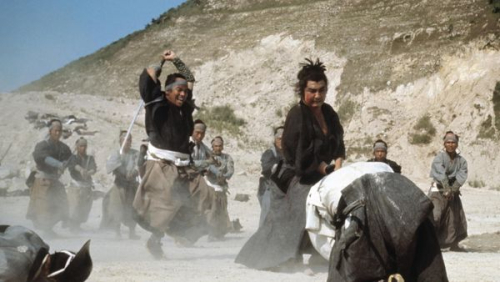
Based on the manga series by Kazuo Koike and Goseki Kojima, Lone Wolf and Cub: Baby Cart to Hades is the third film of the series in which the father/son duo who continue their journey through Japan as the former saves a prostitute from humiliation after killing her client as he would do a job for the yakuza to kill a governor. Directed by Kenji Misumi and screenplay by Kazuo Koike, the film explore the father/son duo as they deal with an unruly world as well as a growing sense of corruption that would involve the Yakuza and other factions as Itto Ogami/Lone Wolf and Daigoro/Cub are reprised respectively by Tomisaburo Wakayama and Akihiro Tomikawa. Also starring Go Kato, Yuko Hama, Isao Yamagata, and Michitaro Mizushima. Lone Wolf and Cub: Baby Cart to Hades is a ravishing and evocative film from Kenji Misumi.
The film follows a father-son duo as they continue their journey through Edo-era Japan as they remain in pursuit of the clan who had disgraced him as he would encounter a lowly group of samurai warriors and later a yakuza who was about to punish a prostitute for killing a client as he is later asked by the yakuza leader to kill a power-hungry governor. It’s a film that play into Itto Ogami and his son Daigoro as they encounter a sense of unruliness around them as the lowly group of samurai warriors would rape a couple of women only to be taken care of by their leader Kanbei (Go Kato) who is revealed to be a man with a sense of honor. This idea of code and honor would continue after Ogami chooses to protect a prostitute he and Daigoro met on a boat early in the film as the yakuza leader in Torizo (Yuko Hama) is amazed by taking all sorts of physical and mental torture for this prostitute as she learns about his true identity. Kazuo Koike’s script is largely straightforward while it does feature some flashbacks as it relates to the governor Sawatari Genba (Isao Yamagata) who is eager to win the favor of Ogami’s enemies.
Kenji Misumi’s direction does maintain a sense of style from its previous films while he also restrains some of the violence though images of dismembered body parts, blood sprays, and such still are shown in the film. Yet, Misumi does showcase this air of chaos and discontent in the way a young woman and her mother are raped by a gang of lowly samurai warriors or how the prostitute is mistreated by her client. Shot in various rural locations in Japan, Misumi does use the locations as characters in the film from the bamboo forest early in the film where Ogami disposes a trio of ninjas while the scene in the desert hill serves as the climax between Ogami and the governor’s army. The usage of the wide shots don’t just play into the scope of the locations but also in how Daigoro would place himself on a spot to get someone’s attention or just to get a view of what he’s seeing whenever his father is about to attack.
With the aid of fight choreographer Eiichi Kusumoto, Misumi’s approach to the fighting is more restrained as it’s more about who makes the first move as well as a sense of respect during duels as it’s something both Torizo and Kanbei have believing there’s still some semblance of honor despite the former’s lack of belief towards codes with her yakuza. Misumi’s close-ups and medium shots help play into the drama and air of suspense as well as these stylish flashbacks as it relates to the governor that Ogami is hired to kill. Its climax doesn’t just play into this growing disconnect over thirst of power and honor but also the idea of what a samurai really is as it’s something both Ogami and Kanbei are asking. Overall, Misumi crafts a rapturous yet chilling film about a father-son duo who trek through Japan as they encounter unruliness in their path.
Cinematographer Chikashi Makiura does incredible work with the film’s cinematography with its gorgeous usage of natural lights for many of the daytime exteriors while the nighttime scenes feature lighting by Hiroshi Mima who help provide a low-key look to the film along with the flashbacks which were shot in black-and-white. Editor Toshio Taniguchi does excellent work with the editing as its emphasis on style in the jump-cuts, dissolves, and other stylish cuts help play into the action as well as the suspense and drama where things do slow down to play more into emotional reactions than action. Production designer Yoshinobu Nishioka does amazing work with the look of the yakuza’s main base including an inn that they run as well as the lavish home of the governor. The makeup work of Hideo Yumoto and Toshio Tanaka do terrific work with the look of a few characters from the one-armed man hiding in Torizo’s closet to the ragged look of Kanbei’s gang.
The special stunt effects by Daizen Shishido is amazing for some of the action that occurs including scenes that involve aerial attacks from ninjas and samurais as it help play into the action. The sound work of Tsuchitaro Hayashi, with sound effects by Toru Kurashima, is superb for the atmosphere of the locations as well as sounds of gunfire, swords, and arrows that occur during battle. The film’s music by Hideaki Sakurai is phenomenal for its array of themes from a Western-like theme for the main characters with its guitars and strings as well as percussive-based music for its suspense and sounds of strings and warbling synthesizers for the film’s climatic battle.
The film’s wonderful ensemble cast feature some notable small roles from Jun Hamamura as the one-armed retainer that Torizo had been hiding that Ogami knew, Sayoko Kato as the prostitute that Ogami and Daigoro protects, Michitaro Mizushima as a former aide of Governor Genba from the film’s flashbacks, and Isao Yamagata as the power-hungry Sawatari Genba who is hoping to gain the favor of the shogunate and his clan upon learning about Ogami whom he realizes is a threat. Yuko Hamada is excellent as the yakuza leader Torizo as a woman who learns about Ogami’s true identity as she sees someone that she respects as well as asking for help as it relates to the governor whom she despises. Go Kato is amazing as Kanbei as a leader of a ragged group of lowly samurai warriors who encounters Ogami early in the film as he is aware of who he is as they would later meet where Kanbei is a man of respect and honor as he is trying to answer the question of identity and being a true samurai.
Finally, there’s the duo of Akihiro Tomikawa and Tomisaburo Wakayama in their respective roles as Diagoro and Ogami Itto with the former as the young boy who observes everything around him while often luring warriors into traps as well as be the one to bring kindness to the prostitute. The latter showcases more restraint as a man still haunted by loss yet is still keen on his path towards Hell where he deals with a sense of unruliness around him while surprised to find that there are those who do have some kind of honor as it is a rapturous performance from Wakayama.
Lone Wolf and Cub: Baby Cart to Hades is a sensational film from Kenji Misumi. Featuring a great ensemble cast, dazzling visuals, stylish action sequences, and a chilling music score, the film is definitely an exhilarating samurai-adventure film that isn’t just filled with lots of action but also drama and suspense. In the end, Lone Wolf and Cub: Baby Cart to Hades is a phenomenal film from Kenji Misumi.
Lone Wolf and Cub: Sword of Vengeance - Baby Cart at the River Styx - Baby Cart in Peril – Baby Cart in the Land of Demons – White Heaven in Hell
© thevoid99 2020
Based on the manga series by Kazuo Koike and Goseki Kojima, Lone Wolf and Cub: Baby Cart at the River Styx is the second film of the series in which an assassin-for-hire continues his journey through Edo-period Japan where he battle a group of female assassins hired by the clan who killed his wife and disgraced his name. Directed Kenji Misumi and screenplay by Kazuo Koike, the film explores a man continuing his path to find redemption as he well as seeking justice for the loss of his wife while accompanying his young son his path as the role of Itto Ogami and his son Daigoro are reprised by Tomisaburo Wakayama and Akihiro Tomikawa. Also starring Kayo Matsuko, Akji Kobayashi, Minoru Ohki, and Shin Kishida. Lone Wolf and Cub: Baby Cart at the River Styx is a majestic yet exhilarating film from Kenji Misumi.
The film follows the duo of Lone Wolf and Cub as they trek through Japan seeking whatever work Itto Ogami can do as an assassin as they’re eventually hired by a clan to kill a clan leader for disrupting their business while Ogami is being pursued by samurai warriors including a group of female assassins working for the man who disgraced Ogami. It’s a film with a simple premise that manga co-writer Kazuo Koike creates as it play into Ogami and Daigoro going on this journey as they’re eventually hired by a clan who is known for making indigo dye and have a monopoly on it but someone had betrayed them and is willing to share their secret method to a shogun whom Ogami is in conflict with. Ogami agrees to do the job yet the shogun’s own ninja clan team up with a clan of female assassins to try and eliminate Ogami for good. There isn’t much of a plot yet it is more about Ogami and Daigoro continuing on their path and the forces he face as they’re forced to deal with Ogami. Among them are a trio of brothers known as the Hidaris who are fierce warriors with iron-like weapons as they’re hoping to protect the man who had stolen the indigo dye methods.
Kenji Misumi’s direction is stylish not just in its compositions and settings but also its emphasis on suspense and drama. Most notably as Daigoro is given more to do and actually take part in a bit of the action including a scene where he tends to his ailing father after a scuffle that left him wounded for a bit. Shot on various locations in Japan, Misumi does use some wide shots for not just a scope of the locations including a gorgeous scene shot in a greenish forest. It’s also in the compositions he creates in some extreme close-ups and medium shots with the latter used for meetings between Ogami and the indigo dye clan or the group of people conspiring to kill Ogami. Misumi also creates images that do play into the beauty of Ogami’s journey despite the claims that Ogami and Daigoro are walking towards the River Styx on their way to Hell.
With the aid of fight choreographer Eiichi Kusumoto, Misumi’s approach to the sword fights, battles, and duels do play into this air of urgency of whenever Ogami has to attack. Even in a scene on a boat where he meets the Hidari brothers and sees what they’re able to do while he stays in the room with them as it showcases an act of respect between warriors. Ogami’s first confrontation with Akari Yagyu clan leader Sayaka (Kayo Matsuo) does have an air of style as well as some strange moments that occur after their first confrontation ends. The film’s third act that takes place in sand dunes do showcase this air of style in its setting where the Hidari brothers are confronted by members of the indigo dye clan as the violence remains stylized with limbs cut off and blood being sprayed as it is just a taste of what is to come upon meeting Ogami. Overall, Misumi crafts a ravishing and enchanting film about an assassin-for-hire and his young son trekking through Japan while dealing with a horde of new enemies.
Cinematographer Chikashi Makiura does brilliant work with the film’s cinematography as it features some gorgeous natural lighting and colors for some of the daytime exterior scenes including shots in the forest while the scenes at night with lighting by Hiroshi Mima add to the low-key yet somber beauty of the film as it is a major highlight of the film. Editor Toshio Taniguchi does excellent work with the editing as it has elements of style in its jump-cuts, stylish dissolves, and other cuts that help play into the action, drama, and suspense. Production designer Akira Naito does fantastic work with the look of the hut that Ogami and Daigoro stay at for a bit, some of the homes of the clans, and the boat where Ogami meets the Hidari brothers. Costume designer Yoshio Ueno does nice work with the costumes in the robes that Sayaka wears as well as the clothes that the Hidari brothers wear.
Special stunt effects by Daizen Shishido is amazing for some of the action including characters jumping in the air with mechanical effects by Shin-Ei Art Workshop adding to the film’s visual effects. The sound work of Tsuchitaro Hayashi, along with sound effects by Toru Kurashima, do superb work with the sound in the creation of some of the sound effects as well as . The film’s music by Hideaki Sakurai is incredible for its array of dissonant and eerie music score filled with offbeat percussive music that help build up the suspense as well as traditional Japanese string instruments that play into the drama as it is a major highlight of the film.
The film’s wonderful cast feature some notable small roles from Akiji Kobayashi as the leader of the Kurokuwa group in Ozuno who conspires with Sayaka to kill Ogami, the quartet of Izumi Ayukawa, Reiko Kasahara, Yukiji Ikeda, and Yuriko Mishima as four of Sayaka’s assassins, the trio of Minoru Ohki, Shin Kishida, and Shogen Nitta as the Hidari brothers, and Kayo Matsuo in a fantastic performance as Sayaka as a clan leader loyal to the lead shogun as she hopes to kill Ogami for her master only for her confrontations with Ogami leading to many revelations for her. Finally, there’s the duo of Akihiro Tomikawa and Tomisaburo Wakayama in their respective roles as Ogami Daigoro and Ogami Itto as the son-father duo with the former being a three-year old boy who is aware of what is happening around him yet proves to be formidable whenever danger is around. Wakayama’s performance as the latter is more restrained in terms of someone who is in total control but is also aware that he has a big target on his back and is always ready while he ponders if the path he’s chosen for himself and his son is the right one.
Lone Wolf and Cub: Baby Cart at the River Styx is a spectacular film from Kenji Misumi. Featuring a great ensemble cast, intoxicating visuals, evocative music, and a simple yet thrilling premise, the film is an exhilarating samurai film with lots of action, suspense, and drama as it plays into a father-and-son duo trekking through Japan as they encounter enemies and such during their path. In the end, Lone Wolf and Cub: Baby Cart at the River Styx is a tremendous film from Kenji Misumi.
Lone Wolf and Cub: Sword of Vengeance - Baby Cart to Hades – Baby Cart in Peril – Baby Cart in the Land of Demons – White Heaven in Hell
© thevoid99 2020
In the 17th week of 2020 for Wandering Through the Shelves' Thursday Movie Picks. We venture into the subject of verbal altercations where two people go at each other verbally as they argue and sometimes lead to really intense moments. Here are my three picks as they’re all from documentary films:
1. Year of the Horse
Jim Jarmusch’s documentary about Neil Young and his band Crazy Horse during their 1996 tour with footage of their past shows and tours in the 1970s, 1980s, and early 1990s. It’s a film that showcases the highs and lows of touring and collaboration where they can have fun at times but there are also times when things aren’t fun as Jarmusch uses archival footage to show the band in some bad moments. Notably a scene in the 1980s where Young and bassist Billy Talbot have an argument over an arrangement that wasn’t played as it’s intense but shows that brotherhood among band members can get shaky as Young’s backing band do stand their ground as they continue to play on-and-off since.
2. My Best Fiend
VIDEO Considered among one of the greatest collaborations in the history of film, the relationship between filmmaker Werner Herzog and actor Klaus Kinski is also one of the most intense as there’s a love-hate relationship between the two in the five films they’ve made from 1972’s Aguirre, the Wrath of God to 1987’s Cobra Verde . Herzog’s 1999 documentary film about this collaboration showcases the relationship that at times can be fruitful but most of the time is often intense and chaotic. Most notably during an infamous scene during the making of the 1982 film Fitzcarraldo where Kinski is having an argument with one of the production figures on the film as it’s shot by documentary filmmaker Les Blank for his own documentary on the making of the film entitled Burden of Dreams . For anyone who had seen various meltdowns and arguments that occur during film shoots will realize that no one holds a candle to the ferocity and terror that is Klaus Kinski.
3. Metallica: Some Kind of Monster
Joe Berlinger and Bruce Sinofsky’s 2004 documentary film about the making of Metallica’s eighth full-length studio album St. Anger is a sobering documentary about a band trying to make a comeback after a period of immense commercial success but also fan backlash over claims that they’ve sold out as well as their fight against the music file-sharing program Napster that made them lose favor with a lot of fans. Also adding to the turmoil was the departure of longtime bassist Jason Newstead as the band tried to make the album with longtime producer Bob Rock who fills in on bass as the film features moments where its two co-founders in vocalist/guitarist James Hetfield and drummers Lars Ulrich argue constantly. Most notably a scene early in the film where Hetfield is in a bad mood as he doesn’t like what’s been recorded and he gets into a serious argument with Ulrich as he would walk out of the band for nearly a year to undergo treatment for alcoholism. Yet, the fighting didn’t stop as there’s another famous argument during a therapy session where Ulrich is upset over Hetfield as it looks like he wants to kill him.
© thevoid99 2020
Based on the memoir by Molly Bloom, Molly’s Game is the story about a mogul skier who decides to run an underground poker empire that makes her rich until she gets the attention of the FBI. Written for the screen and directed by Aaron Sorkin, the film is a dramatic telling of Molly Bloom’s life story as she is a woman struggling to re-define herself after her dreams of being an Olympic skier fell apart while hoping to retain the new life that she created for herself as Bloom is portrayed by Jessica Chastain. Also starring Idris Elba, Jeremy Strong, Michael Cera, Chris O’Dowd, Joe Keery, Bill Camp, Brian D’Arcy James, and Kevin Costner. Molly’s Game is an intoxicating and chilling film from Aaron Sorkin.
Following a failed attempt to qualify for the 2002 Winter Olympics as a mogul skier due to an unfortunate accident, Molly Bloom would reinvent herself in running an underground poker empire after working for an unsuccessful real estate dealer in planning his underground poker games and making something of herself until she gets the attention of the FBI. It’s a film with a simple premise as it play into a woman trying to create a new life for herself as she is driven to become successful on her own terms yet would put herself in dangerous when her gambling business include Russian mobsters that would attract unwanted attention as she turns to an attorney who tries to understand her as well as read her just-released memoir. Aaron Sorkin’s screenplay doesn’t exactly follow a traditional narrative as sort of moves back-and-forth into the life of Molly Bloom from when she’s running her poker enterprise as well as awaiting trial for the crimes she’s being accused of.
Notably as Bloom is someone who had wanted to become an Olympic skier as she was trained and motivated by her psychiatrist father Larry Bloom (Kevin Costner) whom she has a tense relationship with as she would rarely speak with him after her Olympic career ended. Though she was meant to go to law school, she instead moved to Los Angeles and took a year off where she was a bottle service waitress and then working for a real estate dealer who often had underground poker games that would feature various people including top poker players, major athletes, and a movie star in Player X (Michael Cera). Though she is successful in Los Angeles as she would forge her own career, things do get complicated where Sorkin’s script reveal what forced Bloom to move to New York City as well as exploring her own downfall as it relates to the people she would meet and their connection to the Russian mafia. Sorkin also reveal some of Bloom’s own motivations and her own growing sense of disdain towards men of power while turning to high-priced attorney Charlie Jaffey (Idris Elba) for counsel as he’s to defend her in court yet he is someone that would get to know her and wonder what she is all about.
Sorkin’s direction is largely straightforward in terms of the compositions as it is shot on various locations in New York City, Los Angeles, and parts of Canada including Toronto with the last of the three locations playing into Bloom’s early life and her time trying to become an Olympic skier. While Sorkin does create some unique wide shots to establish some of the locations, much of his direction is intimate in its usage of medium shots and close-ups to get an interaction into the characters as well as in the framing where the poker players are in the foreground playing while Bloom is in the background looking at her laptop and observing the game. Sorkin’s direction also play into the world of underground poker and how it’s a game of wit and control as Bloom is someone who likes to be in control of everything. Notably in the film’s first half that is set in Los Angeles where Bloom has gained control and lots of money until she sees a player completely lose it as well as learn about Player X’s activities when it comes to recruiting players.
The second half set in New York City that moves back-and-forth into Bloom’s meetings with Jaffey as well as her activities in the city as she had games in expensive hotel suites and a richer clientele but would also take some money from the games that would end up being illegal. Even as it involves a drunken Irish-American businessman in Douglas Downey (Chris O’Dowd) who would introduce Bloom to the Russians as Sorkin’s direction showcases this craziness that would occur. Notably in the third act as it relates to a client in Los Angeles who played at her games as well as many other things where Sorkin shows a woman who has been trying to do things her way in a man’s world yet finds herself going into this air of uncertainty about what to do next as she faces serious trouble despite Jaffey’s help. Overall, Sorkin crafts an evocative and compelling film about a woman running an underground poker empire that would eventually fall apart.
Cinematographer Charlotte Bruus Christensen does excellent work with the film’s cinematography as it is largely straightforward with some stylish lighting for the nighttime interiors to help set the mood of the poker games as well as some of the exterior scenes at night. Editors Alan Baumgarten, Josh Schaeffer, and Elliot Graham do fantastic work with the editing as it has some elements of style in its usage of montages, jump-cuts, and stylish fade-outs to play into the drama in the film. Production designer David Wasco, with set decorator Patricia Larman and art director Brandt Gordon, does brilliant work with the look of the hotel suites, bars, and such where some of the poker games occur as well as the New York apartment Bloom lived in and Jaffey’s office. Costume designer Susan Lyall does nice work with the costumes that include a lot of the stylish and cleavage-revealing dresses that Bloom wears when she’s at work as well as the casual clothes she would wear off-work.
Hair stylist Carol Hartwick and makeup artist Alastair Muir do amazing work with the look that Bloom would take in the years of making herself look presentable for her empire. Visual effects supervisor Aaron Weintraub does terrific work with the film’s minimal visual effects that include a few bits of set dressing including scenes during Bloom’s time as a skier. Sound editors Michael J. Benavente and David McCallum, along with sound designer Todd Toon, do superb work with the film’s sound in the atmosphere of intimate card games as well as some of the sounds that occur in poker houses and some of the quieter moments in Bloom’s home and Jaffey’s office. The film’s music by Daniel Pemberton is wonderful for its low-key electronic score that play into the drama as well as some of the darker moments in the film while music supervisors Carlton Kaller and Sean Mulligan provide a soundtrack of music that is diverse ranging from artists/bands such as Thenewno2, Temple of the Dogs, Thunderpussy, the Raveonettes, Sly and the Family Stone, Alexander McCabe, Sammy Davis Jr., and Tommy James.
The casting by Francine Maisler is incredible as it feature some notable small roles from Piper Howell and Samantha Isler in their respective roles as the adolescent and teenage Bloom, Jon Bass as famous guy who tries to sell a Bloom a famous painting as collateral for a game, Claire Rankin as Bloom’s mother, Natalie Krill, Stephanie Herfield, Madison McKinley as a trio of former Playboy Playmates who work for Bloom in recruiting the players in New York City, Joe Keery as a trust fund guy named Cole, Angela Gots as a poker dealer named B who would give Bloom the idea to take a percentage of large pots, Justin Kirk as a NYC player named Jay, Whitney Peak as Jaffey’s teenage daughter Stella that Bloom befriends, J.C. MacKenzie as a federal prosecutor in Harrison Wellman who deals with Jaffey over Bloom’s case, and Graham Greene in a small yet effective performance as the judge in Bloom’s trial.
Bill Camp is terrific as a card shark in Harlan Eustice who is a skilled player that collapses after losing a game while Brian d’Arcy James is superb as a hedge fund manager in Brad who is one of the game’s worst players. Chris O’Dowd is fantastic as Douglas Downey as an Irish-American businessman that introduces Bloom to the Russians while Jeremy Strong is excellent as Bloom’s real estate developer boss who would introduce her to the world of underground poker and have her plan it only to realize that she does a better job than he does. Michael Cera is brilliant as Player X as a famous movie star who would help Bloom recruit players while doing things that make Bloom uncomfortable in Los Angeles. Kevin Costner is amazing as Bloom’s father Larry who was also her coach and a psychiatrist who had become estranged with Bloom due to their tumultuous relationship as he would appear in the third act not just to make amends with her but also understand why she is in such trouble.
Idris Elba is sensational as Charlie Jaffey as an attorney who takes Bloom’s case as he would also read her memoir where he asks some questions while trying to figure out as it is one of Elba’s finest performances including a scene where he defends Bloom as he realizes that she is really a good person despite the crimes she committed. Finally, there’s Jessica Chastain in a phenomenal performance as Molly Bloom as a woman who is driven to succeed though her hopes to be an Olympic skier is dashed forcing her to find other means yet becomes cunning in her pursuit. Chastain has this ferocity in her performance as someone that doesn’t quit but it’s also a flaw when she doesn’t know when it’s time to quit as it’s a role that has Chastain be part of some bad things but try to find an understanding of why she is driven to run an underground gambling empire that is often dominated by men.
Molly’s Game is an incredible film from Aaron Sorkin that features a great leading performance from Jessica Chastain. Along with a superb ensemble cast led by an amazing supporting performance from Idris Elba as well as Sorkin’s inventive and intriguing script that is filled with unique aspects of character study. The film is definitely a fascinating drama that explore a woman trying to succeed on her own terms in the world of underground poker that is often dominated by men. In the end, Molly’s Game is a sensational film from Aaron Sorkin.
(The Trial of the Chicago 7)
© thevoid99 2020
In the 16th week of 2020 for Wandering Through the Shelves' Thursday Movie Picks. We go into the subject of numbers in titles but not part of any franchise. Movies that have a certain number in these title that says something but could also mean other things. Here are my three picks:
1. The Seven Samurai
Akira Kurosawa’s sprawling epic about seven samurai warriors hired to protect a village from a group of bandits remains one of the touchstones of 20th Century cinema. A film that would inspire countless remakes takes a simple premise of poor farmers trying to hire warriors to protect them play into these seven samurai warriors finding a reason to help people and fight against these bandits. When it comes to Akira Kurosawa, there is no film that is the best place to start with than this one as it showcases Kurosawa’s approach to action and drama but also in setting as Kurosawa knows where to put the camera as well as place importance in parts of those locations.
2. 12 Monkeys
Terry Gilliam’s dystopian remake of Chris Marker’s short film La Jetee is a strange sci-fi film that revolves around a man dreaming about an image of what he saw as a child. He is sent into a world and then tries to figure out what is going on as well as meet an assortment of odd characters including Brad Pitt as the son of a revered scientist who also leads an underground movement. It’s a film that is quite timely considering that Bruce Willis’ character is trying to find the source of a virus that wipes out the human race with only 1% of humanity actually surviving.
3. 8 Women
An adaptation of Robert Thomas’ play is this strange mystery that is Agatha Christie meets Douglas Sirk with French pop songs. Francois Ozon’s film is definitely a murder mystery where a family patriarch is murdered and the eight women in the house that includes the wife, his two daughters, his sister, his sister-in-law, his mother-in-law, and two maids all try to figure out what is going on while they all get the chance to sing a song.
© thevoid99 2020
Based on the manga series by Kazuo Koike and Goseki Kojima, Lone Wolf and Cub: Sword of Vengeance is the story of an assassin who wanders from town to town for whatever job he’s asked to do while he’s accompanying his infant son as he seeks vengeance for the death of his wife. Directed by Kenji Misumi and screenplay by Kazuo Koike, the film is a samurai film where a man tries to protect his child while getting revenge on those who tried to destroy his life and disgrace his name. Starring Tomisaburo Wakayama, Akihiro Tomikawa, Fumio Watanabe, and Shigeru Tsuyuguchi. Lone Wolf and Cub: Sword of Vengeance is a gripping and exhilarating film from Kenji Misumi.
Set during the Edo era of Japan, the film revolves around an assassin-for-hire who was once a revered executioner until his wife was murdered and was then accused of a crime by a clan leader and an investigator leading him to become a ronin. It’s a film that play into a man as he treks through parts of rural Japan as he is willing to work as an assassin as long as he gets paid while raising his young son. The film’s screenplay by Kazuo Koike is straightforward with some flashbacks about the life of Ogami Itto (Tomisaburo Wakayama) and his infant son Daigoro (Akihiro Tomikawa) as he would have him on a cart during their trips as they trek through small towns and castles as they would be hired by a chamberlain to kill a clan leader and his gang of thieves and bandits in a remote village near a hot spring spa pool. There he deals with these bandits but doesn’t attack them in order to be their hostage until things eventually become complicated as he also thinks about the past
Kenji Misumi’s direction does have a lot of unique style in terms of the presentation as well as creating something that stray from the conventions of a revenge film. Shot in these rural locations in Japan in the woods and in nearby locations of old castles, Misumi presents this world of a man living during the Edo period of Japan as it play into a moment in time when everyone worked for some clan or has a role relating to top clans in Japan. The role that Itto has is an executioner as the first scene of the film has him preparing the execution of a child who is the lord of a clan as it’s a role that Itto takes seriously and with pride though it has made him an enemy among other clans. Especially for one who has his wife killed but also puts a tablet in his small temple that makes him a criminal leading to a showdown with the investigator and his army.
Misumi’s usage of wide and medium shots aren’t just about capturing the locations but also the scope of some of the battles and how Itto handles those who try to kill him with the aid of fight choreographer Eiichi Kusumoto in showing how samurai warriors take careful steps into attacking someone as Misumi would use tracking shots and wide angles to capture where Itto is at as well as what he does to slay an attacker. Misumi also creates some stylish imagery as it play into the path Itto and his son are on including a flashback as its usage of close-ups and medium shot shows the path that Daigoro has chosen as it would relate to a scene of Itto watching two boys playing with a ball. There is also this air of intrigue that occur in the third act as it relates to Itto’s growing reputation as this mysterious ronin with others not knowing his true identity. The violence of the film is stylized with blood squirting out and body parts dismembered as it play into the brutality of samurai sword-fighting as well as Itto’s resolve to do what is necessary to survive and live for his son. Overall, Misumi crafts a riveting and evocative film about a ronin samurai warrior trekking through Edo-period Japan as an assassin-for-hire with his infant son.
Cinematographer Chikashi Makiura does brilliant work with the film’s cinematography in capturing some of gorgeous colors of the daytime exterior scenes as well as use low-key available light for scenes in the right and low-key lighting from Hiroshi Mima for some of the scenes set at night. Editor Toshio Taniguchi does excellent work with the editing as it has elements of style in its usage of jump-cuts, slow-motion shots, and other stylish cuts that help play into the action and suspense. Production designer Akira Naito does amazing work with the look of the places that Itto goes to including his old home and the house near the hot spring water pool and the design of the cart itself.
The sound work of Tsuchitaro Hayashi, with sound effects by Toru Kurashima, is fantastic for its sound work that include some creative sound effects for some of the sword swings and how body parts sound when they get dismembered. The film’s music by Hideaki Sakurai is incredible for its mixture of traditional Japanese percussive, woodwind, and string instrument flourishes with some grimy electric guitars to help set a mood for the scene as well as maintain that eerie air of discomfort throughout the film.
The film’s superb ensemble cast features some notable small roles from Keiko Fujita as Itto’s wife Azami, Reiko Kasahara as a madwoman who believes Daigoro is her son, Shigeru Tsuyuguchi and Yunosuke Ito as members of the Yagyu clan that has brought trouble to Itto, Fumio Watanabe as the aging Yagyu clan leader Bizen-no-kami who wants to destroy Itto’s life, Tomoko Mayama as the prostitute Osen who is treated with kindness by Itto, and Akihiro Tomikawa as Itto’s young son Daigoro who observes everything his father does while joining him on this journey of uncertainty. Finally, there’s Tomisaburo Wakayama in a phenomenal performance as Ogami Itto as a once-revered executioner who goes into a path of uncertainty as an assassin for hire as he copes with the death of his wife and being disgraced by rival clans as it is a performance of restraint but also terror whenever he’s being confronted as it is a fierce and chilling performance from Wakayama.
Lone Wolf and Cub: Sword of Vengeance is a sensational film from Kenji Misumi that features an incredible leading performance from Tomisaburo Wakayama. Along with its ensemble cast, gorgeous visuals, eerie music score, and story of vengeance and ideals. It’s a samurai film that doesn’t play by convention in order to study a man’s path of loss and disgrace as he tries to find redemption and justice for what he’s lost. In the end, Lone Wolf and Cub: Sword of Vengeance is a spectacular film from Kenji Misumi.
Lone Wolf and Cub: Baby Cart at the River Styx – Baby Cart to Hades – Baby Cart in Peril – Baby Cart in the Land of Demons – White Heaven in Hell
© thevoid99 2020
Based on the novel by Emily M. Danforth, The Miseducation of Cameron Post is about a teenager who is sent to a gay conversion therapy center after her religious aunt learns about an incident where she is caught having sex with another girl. Directed by Desiree Akhavan and screenplay by Akhavan and Cecilia Frugiuele, the film is an exploration of the world of gay conversion therapy centers as it is set in the early 1990s at a time when the LGBT movement was becoming more open. Starring Chloe Grace Moretz, John Gallagher Jr., Sasha Lane, Forrest Goodluck, Marin Ireland, Owen Campbell, Kerry Butler, Quinn Shephard, Emily Skeggs, Melanie Ehrlich, and Jennifer Ehle. The Miseducation of Cameron Post is an evocative and riveting film from Desiree Akhavan.
Set in 1993, the film revolves around a teenage girl who is caught by her prom date for having sex with another girl in a car prompting her aunt to send to a gay conversion therapy center where she is trying to cope with her situations and others who are struggling with their own identity and sexuality. It’s a film that explore the world of gay conversion therapy as the titular character (Chloe Grace Moretz) is sent to the center as she tries to find out what she might be gay but also others at this center. The film’s screenplay by Desiree Akhavan and Cecilia Frugiuele is largely straightforward with bits of flashbacks but also moments that are dream-like as it play into Cameron Post’s own journey as she meets other teens who are living in this camp with some just trying to become straight with a couple of teens who don’t want to play by the rules but act out in secret.
Running the camp is Dr. Lydia Marsh (Jennifer Ehle) who is trying to get the kids in line with the help of her brother Reverend Rick (John Gallagher Jr.) who used to be gay until his sister saved him. The script does showcase some depth in both Reverend Rick and Dr. Marsh as well-meaning people who believe they’re doing God’s work yet they’re unable to understand everything as Post begins to ask questions though she doesn’t think they’re bad people. The script also play into this air of temptation but also a struggle with identity as two of the teens in the hippie-raised Jane Fonda (Sasha Lane) and the Lakota two-spirit Adam Red Eagle (Forrest Goodluck) are both aware of who they are as they start to become unhappy with their time at the center.
Akhavan’s direction is largely straightforward in terms of its compositions yet it does a lot in exploring this period in time when gays and lesbians start to have their voices heard and people starting to come out. Yet, it is set in a world where not everyone is embracing this growing sense of change as Akhavan would shoot the film in various parts of Upstate New York. The location adds to the tone of the film where it does play into something where these young people are living somewhere that is almost in the middle of nowhere and sort of cut off from civilization. Akhavan’s direction doesn’t have a lot of wide shots except to establish the locations as she aims for something more intimate in her approach to close-ups and medium shots. Notably the latter as she focuses on what happens during group meetings as well as intimate moments involving Post, Fonda, and Eagle as well as exercises with her roommate Erin (Emily Skeggs). Akhavan also uses long takes to play into the conversations and group meetings in order to maintain the building friendship for Post and others at the center including a scene late in the film with Reverend Rick as it is clear that with all of these questions that Post has.
It is obvious that even someone like Reverend Rick doesn’t have all the answers but is at least trying to help these kids no matter how wrong he and his sister are. It all play into Post not just struggling with the world she’s in that is oppressive not just to herself but also to other teens as well as the people running it as they’re also struggling to connect with what is happening in modern civilization away. Akhavan also showcases Post’s own personal struggles as she’s trying to contact the girl she got caught with but also questions about whether she can come home as it raises her questions about her place in the world at a time when gays and lesbians are coming out yet acceptance is becoming hard to gain. Overall, Akhavan crafts a somber yet mesmerizing film about a teenage girl coping with her sexuality at a gay conversion therapy center.
Cinematographer Ashley Connor does excellent work with the film’s low-key cinematography as it emphasizes on naturalistic yet dark colors in some of the daytime interior/exterior scenes as well as low-key lights for the scenes set at night. Editor Sara Shaw does terrific work with the editing as it is largely straightforward with some jump-cuts to play into a few bits of Post jogging on a track field as well as some rhythmic cuts to play into the drama. Production designer Markus Kirschner, with set decorators John Arnos and Erin Blake plus art director Tori Lancaster, does amazing work with the look of the center and its buildings as well as the rooms that include decorations that teens put in the wall to motivate them getting straight.
Costume designer Stacey Berman does fantastic work with the costumes as it features some uniforms that the teens wear as well as a few casual pieces they would wear in the weekends or time to get out of the camp for a bit. Sound editor Ryan Billa does superb work with the sound as it is largely straightforward to play into the natural atmosphere of the locations as well as how music is heard on a radio or at a live Christian rock show. The film’s music by Julian Wass is wonderful for its mixture of low-key ambient music with elements of folk to play into the air of uncertainty that occur throughout the film while music supervisors Maggie Phillips and Christine Greene Roe create a soundtrack that does play into the period of the early 90s from the alternative music of the Feelies and 4 Non Blondes as well as music from Clarice Jensen, Melanie Ehrlich, Fredda Manzo, Irma Thomas, Wild Yawp with Justin Denis and Jack Reilly, and Timothy Blixseth.
The casting by Jessica Daniels is incredible as it feature some notable small roles from Dale Soules as Post’s grandmother, Christopher Dylan White as a teen named Dane who has a lot of attitude and puts people down over their problems, Melanie Ehrlich as a teen in Helen who is really into Christian rock, Quinn Shephard as the girl Post got caught with before she is sent to the center in Coley, Kerry Butler as Post’s aunt/guardian, Marin Ireland as a math teacher/Reverend Rick’s girlfriend Bethany whom Post dreams about making out with, and Owen Campbell as a troubled teen in Mark who is Adam’s roommate as he offers to help Post out while dealing with the idea that he might not be masculine enough for his father. Emily Skeggs is terrific as Erin as teenage girl who loves the Minnesota Vikings as she believes she’s a lesbian due to spending a lot of time with her dad as she finds herself becoming attracted towards Post. Jennifer Ehle is fantastic as Dr. Lydia Marsh as the center’s head as someone who is trying to help these teens though she is at times strict yet is willing to give people a chance to explain themselves while thinking she might have the answer to help them.
John Gallagher Jr. is excellent as Reverend Rick as Dr. Marsh’s brother who used to be gay as he is someone trying to help these kids as well as be a guide to them but eventually finds himself having a hard time when he is unable to give them easy or hard answers. Forrest Goodluck is brilliant as Adam Red Eagle as a two-spirit Lakota teen whose father has converted to Christianity as he has trouble trying to understand what the people at the center are doing while often likes to wear his hair down in a small act of rebellion. Sasha Lane is amazing as Jane Fonda as a hippie-raised teenage girl who sports a prosthetic leg as she is also rebellious but in secrecy as she also grows marijuana outside of the plant as a way to cope with her surroundings. Finally, there’s Chloe Grace Moretz in a phenomenal performance as the titular character as this young woman who is sent to this gay-conversion therapy center as she struggles with the idea of why she’s gay while trying to cope with the therapy itself though she doesn’t think the people running the place aren’t bad but misguided as she also deals with herself and other things at the center as it is one of Moretz’s finest performances to date.
The Miseducation of Cameron Post is an incredible film from Desiree Akhavan featuring a mesmerizing leading performance from Chloe Grace Moretz. Along with its brilliant ensemble cast and exploration of sexual identity during a time when not everyone is embracing the idea of coming out. It is also a film that explore a woman dealing with her situation as well as being in a world that is strict and religious yet with people who have good intentions but don’t have all the answers. In the end, The Miseducation of Cameron Post is a sensational film from Desiree Akhavan.
© thevoid99 2020
In the 15th week of 2020 for Wandering Through the Shelves' Thursday Movie Picks. We discuss the subject of films about animals suggested by Birgit. Films where the animals drive the stories and such as some are fun while others are scary. Here are my three picks all based on the one animal that I hate more than anything and is really scared of. The spider:
1. Charlotte’s Web
The 1973 animated film revolves around a pig who is sent to live at a farm owned by a girl’s uncle as the pig is afraid to be slaughtered only to then befriend a spider named Charlotte who is voiced by the legendary Debbie Reynolds. Charlotte would find ways to keep the pig Wilbur happy as well as be kept away from becoming food as they’re aided by the rat Templeton who is voiced by the always-underrated Paul Lynde. It’s a charming animated film that shows the good side of what spiders can do.
2. Arachnophobia
A film that I never want to see ever again and all of the reasons why I’m so fucking scared of spiders. It’s about a rare spider from Venezuela that travels to California where he meets a domestic house spider and mates with it where a shitload of scary little poisonous spiders emerge with mysterious deaths. It has some funny moments in the film largely due to John Goodman’s role as an exterminator that no creature should fuck with. Still, the idea of a venomous spider killing people and breeding house spiders that kill people is just too fucking scary for me.
3. Eight Legged Freaks
A horror comedy where an exotic spider farmer feeds crickets to his spiders unaware that the crickets were found at a toxic waste as the spiders become big and wreak havoc in a small town in Arizona. It’s an OK b-movie of sorts as it never takes it seriously. Featuring an ensemble cast that include David Arquette, Kari Wuhrer, Scarlett Johansson, Doug E. Doug, Rick Overton, Leon Rippy, and Tom Noonan in an un-credited role as the spider farmer. It’s just cheesy as fuck but it is still an entertaining film.
© thevoid99 2020
One of the unsung pioneers of cinema, Alice Guy-Blache made more than hundreds of films from 1896 to 1922 as several of them are lost with others being rediscovered thanks in some part to Pamela B. Green’s documentary film Be Natural: The Untold Story of Alice Guy-Blache . With that film, Guy-Blache’s contributions to cinema is now discussed as she left behind a massive catalog of films. Here are seven of the films that she made in her lifetime.
The Birth, the Life, and the Death of Christ An ambitious yet multi-part 33-minute short film about the life of Jesus Christ is definitely Guy-Blache’s most ambitious work. Thanks in part to the attention to detail in the set design courtesy of art directors Henri Menessier and Robert-Jules Garnier as well as costume designer/assistant director Victorin-Hippolyte Jasset. Guy-Blache’s direction is largely straightforward in the composition as she doesn’t move the camera as she just puts the camera in a medium-wide shot to capture what is going on in the events of Christ’s life with the aid of cinematographer Anatole Thiberville. It goes from his birth and his time when he was this savior to then being crucified only to then be resurrected. It is a tremendous short that features a lush and bombastic orchestral score by Patrick Laviosa from its 2008 restored edition.
Algie the Miner Starring Billy Quirk and Mary Foy, the 10-minute short film is a western-comedy about a man who is hoping to get the approval of his girlfriend’s father in order to marry her by going to the West. It’s a film that explores the idea of masculinity as a man goes to the West in hoping to become a man due to his quirks and such yet it is funny in some of the antics that occur. The film’s music by Marcus Sjowall, from its 2007 restoration, is playful in its approach to humor as well as its study of masculinity by Guy-Blache.
Falling Leaves A young woman is ill with consumption as a doctor and believes she will not make it. However, the young woman’s adolescent younger sister believes it has to do with leaves as she finds a way in the hope that it would keep her sister alive and well. It’s a touching short film that explore what a young girl would do and inspire a doctor to help find a cure for consumption as it features a somber piano score by Tamar Muskal in its 2009/2010 restored edition.
Canned Harmony Featuring music by Robert Israel from its 2009/2010 restored edition, the film is a whimsical comedy about a music teacher who refuses to have his daughter be with a young man whom he feels is unsuitable for her. In response, the young man pretends to be a revered musician to impress him. It’s a film that would feature the early usage of the Gaumont Chronophone as it has actors miming to music that is being played on set and then be re-used in post-production as an early idea of sound in silent film that showcases Guy-Blache’s approach to using music in film.
Matrimony’s Speed Limit Starring Fraunie Fraunholz and Marian Swayne in their respective roles as a poor businessman and his rich girlfriend is a film that really diverts the idea of gender roles. The poor man breaks up with his girlfriend believing he isn’t worthy of her yet she would scheme to get him to marry her by creating a telegram claiming that an aunt of his had just died and is leaving him a fortune but he would only acquire it if he can find someone to marry by noon. It’s a funny short yet it is Guy-Blache’s approach to playing up gender roles and some of the visual gags despite a moment where the guy approaches a woman only to see what she is where it is an insensitive moment that doesn’t date well. It’s got a playful music score as it is one of Guy-Blache’s finest shorts.
A House Divided Another short starring Fraunie Fraunholz and Marian Swayne respectively as Gerald and Diana Hutton, the 13-minute short revolves around a bickering couple who want to divorce but has to agree to live with each other for a certain amount of time while they run a perfume business. It’s a delightful comedy that showcases Guy-Blache’s usage of humor that is more about people reacting to another as well as try to live with each other as it is filled with gags that would become prevalent in comedies to come. The film features music by Christina Hunsack from its 2018 restored edition as its mixture of piano and strings help play into the humor.
The Ocean Waif A young woman runs away from her cruel stepfather as she hides in an abandoned estate which was then purchased for rent by a young writer working on a novel as they meet and fall in love despite the fact that he’s engaged to someone else. It’s a short that showcases Guy-Blache’s approach to suspense and drama as well as humor while also featuring some incredible performances from Doris Kenyon in the titular role as well as Carlyle Blackwell as the writer. It also feature some inspired colored tints to display the feel of day and night as well as a playful and dramatic piano score piece by co-sound designer Maud Nielssen, in its 2018 restored edition, as it is one of Guy-Blache’s finest works though its presentation does feature still pictures considering that some of the footage is lost.
These seven short films by Alice Guy-Blache are some of the finest silent shorts created but also an example of Guy-Blache’s brilliance as a filmmaker. Especially in creating ideas and gags that would prove to be ahead of its time as they are shorts that anyone interested in film history must see. Especially from a woman who proved to be a real pioneer in the world of cinema as Alice Guy-Blache is a filmmaker that needs to be included in the conversation as one of its foremost figures in showing what cinema could be.
Related: Be Natural: The Untold Story of Alice Guy-Blache
© thevoid99 2020
In the 14th week of 2020 for Wandering Through the Shelves' Thursday Movie Picks. We return to the subject of the Seven Deadly Sins in the theme of greed. A theme that play into the dark aspects of humanity as it’s more about wanting more and making sure no one else has anything. Considering the times we’re in and that here in America, we have a personification of greed who not only runs the country but is also putting its people down the fucking toilet. Here are my three picks:
1. Shallow Grave
Danny Boyle’s feature film debut isn’t just a fascinating subject on the theme of greed but also in its exploration of human nature. It’s about three flat mates from Edinburgh who take in a mysterious man only to later find him dead but with a suitcase full of money. It is where the film really takes hold as these three people figure out what to do as some are willing to spend while there is someone who becomes unhinged about where the money comes from and all hell starts to break loose. It is an incredible debut film from Danny Boyle which also features longtime Boyle regular Ewan McGregor in his one of his first film roles.
2. There Will Be Blood
Paul Thomas Anderson’s adaptation of Upton Sinclair’s Oil! is a film that is dark representation of greed in how a man whose discovery of oil and the oil boom that would emerge in Southern California in the late 19th Century and early 20th Century. Featuring Daniel Day-Lewis in a terrifying yet monstrous performance as a man who goes into the oil business is a study of obsession and power. It shows what a man is willing to do to succeed but also has to endure moments that would shake him but also the sacrifices he would make into his success but at the cost of his own morality and lack of compassion.
3. Knives Out
Rian Johnson’s mystery-comedy is definitely one of the finest films of the 2010s so far as it explores a family whose patriarch had died suddenly as they wonder who will gain his inheritance while an investigator wonders what happened. In the middle of all of this is a young nurse who was caring for this patriarch who created an empire of novels yet had plans about his inheritance as it leads to family members wanting that inheritance. It’s a film that is full of twists and turns that also include some dark secrets as well as revelations about members of the family and why they might’ve been cut off from the inheritance. Daniel Craig’s performance as the investigator Benoit Blanc is a joy to watch as is Chris Evan’s performance as the family’s black sheep in Ransom. Yet, it is Ana de Armas that is the real break out as the nurse Marta who cares for the patriarch played with such reverence by Christopher Plummer.
© thevoid99 2020