The film is about a surreal journey of a businessman who follows a woman he meets on a train in an attempt to seduce only to find himself in a hotel full of women where a lot of chaos ensues as he is forced to deal with his ideas about men and women and his relationship with the latter. It’s a film that explores a man who is asleep on a train only to wake up where he meets this beautiful passenger whom he would make out with in the bathroom only to leave as he would follow her into a forest that is a pathway to a mysterious hotel that is the beginning of a series of misadventures in the course of an entire day. The film’s screenplay by Federico Fellini, Bernardino Zapponi, and Brunello Rondi does play into the male gaze towards women but also this idea of what a man wants in a perfect woman in its possible existence. The film does have a unique structure based on its settings as the first act largely takes place in this hotel where its protagonist Snaporaz (Marcello Mastroianni) has followed this woman (Bernice Stegers) from a train they were both on as the hotel is full of women.
Notably as there’s conferences relating to feminism, performance art installations, discussions on men vs. women, and other things where Snaporaz looks on in awe yet he ends up getting into trouble until he is saved by Donatella (Donatella Damiani) who would put him into more trouble. The second act has him leaving the hotel thanks to a woman motorcyclist (Iole Silvani) yet she has her own ideas that would put him into trouble but also lost in the countryside where he would later meet a group of teenage women and young women as he would eventually find shelter in the home of Dr. Xavier Katzone (Ettore Manni) who isn’t fond of feminism and rowdy women. Dr. Katzone is a unique figure as a man whose home is filled with a lot of things including a grand hall devoted to the women he had been with as he’s about to have a party where one of his guests is Snaporaz’s estranged wife Elena (Anna Prucnal) who isn’t happy to see him. It plays into Snaporaz’s own fallacies but also his own desires where he sees Donatella at the party as its third act is this strange fantasy that plays into past events in Snaporaz’s life as well as the male gaze where he is confronted for his own faults with women.
Fellini’s direction is definitely grand as it plays into this idea of fantasy and surrealism as it plays into a man and his love for women but also how he sees them. Shot largely at Cinecitta Studios in Rome with various locations in small Italian countryside areas, Fellini does maintain some simplicity in terms of his close-ups and medium shots when it play into characters looking at each other or reacting to something around them. The intimacy does play into Snaporaz’s encounter with his surroundings and women does have this element of style where Fellini keeps the spectacles at a restraint to focus on Snaporaz’s emotions and frustrations towards the way women treat him. Then there’s the wide shots as Fellini uses them to capture not just some of the exterior locations but the extravagance of the places that Snaporaz goes to including Dr. Katzone’s lavish home and the hotel itself with its rooms including a gym where Snaporaz watches all sorts of activities including women learning martial arts to kick a man in his nuts. Fellini also uses these settings into not just explore feminism and its faults but also the fact that men haven’t made things easier as Snaporaz is a man stuck in his old ways while is trying to be understanding.
Unfortunately, he does see them as objects of desire while the scene at Dr. Katzone’s home where he converses his wife showcases a lot of his faults as a husband as it reveals why they’re separating. Even in a scene where she is nude and wants to have sex with him where it is clear that they’re no longer on the same page since Snaporaz wants to be with other women and doesn’t appreciate her. Its third act is Fellini at his most lavish in terms of its set pieces with this air of whimsy to play into Snaporaz’s own life and his childlike innocence towards women that evolved into something more masculine where he is forced to confront his faults as a man. Its climax is also lavish as it plays into the male gaze but is seen mainly by women in what a man will do to reach its idea of the perfect woman that is followed by an ending that is ambiguous but also one where it is about this man who is forced to come to terms about his relationship with women. Overall, Fellini crafts a dazzling and exhilarating film about a businessman who enters into a world inhabited by women where he deals with his fantasies and realities.
Cinematographer Giuseppe Rotunno does brilliant work with the cinematography with its lush and natural look for some of the film’s daytime exterior scenes to the usage of stylish lights for many of the interior scenes including the hall of women at Dr. Katzone’s home. Editor Ruggero Mastroianni does excellent work with the editing with its stylish usage of jump-cuts for a few scenes as well as some stylish cuts for some of the humor and drama. Production designer Dante Ferretti, with set decorators Bruno Cesari and Carlo Gervasi plus art director Giorgio Giovannini, does amazing work with the set design in the look of some of the hotel rooms that include performance art instillations, its gym, Dr. Katzone’s home including its hall of women, and the fantasy park that Snaporaz went to in the film’s third act. Costume designer Gabriella Pescucci does fantastic work with the costumes from the look of the police uniform some of the women wear during Dr. Katzone’s party as well as a lot of the clothes the women wear including some lavish gowns.
Makeup designer Giancarlo Del Brocco does nice work with the makeup of some of the characters in the look of some of the women in the performance art instillations as well as some of the fantasy scenes. The special effects by Adriano Pischiutta is terrific for some of the film’s minimal effects that largely relate to some of the film’s grand set pieces. The sound work of Pierre Paul Marie Lorrain and Tomasso Quattrini is superb for capturing the atmosphere of the locations as well as the raucous atmosphere involving lots of women in a crowd to play into the craziness that Snaporaz deals with. The film’s music by Luis Enriquez Bacalov is incredible for its playful orchestral score that has elements of strings and woodwinds to bring in some of its humor while also featuring music from old pop standards to the Italo disco of the late 1970s/early 1980s.
The casting by Liliane Betti is wonderful as it feature some notable small roles and appearances from Gabriella Giorgelli as a fish woman from Snaporaz’s childhood past in a fantasy ride, Catherine Carrel as a police commandant who charges Dr. Katzone with a charge over his party, the quintet of Marina Confalone, Dominique Labourier, Sylvie Meyer, Stephane Emilfork, and Helene G. Calzarelli as feminists, Silvana Fusacchia as a roller-skater that skates around a gym that is friends with Donatella, and Fiammetta Baralla as the mother of the motorcyclist who isn’t fond of these modern ideals as she is one of the few who is kind towards Snaporaz. Iole Silvani is fantastic as a motorcyclist who is first seen working at the furnace as she would take Snaporaz out of the hotel and back to the city yet she has her own motives of what she wants to do with Snaporaz.
Ettore Manni, in his final film performance, is excellent as Dr. Xavier Katzone as a reclusive rich man who hates feminism as he hosts a party to celebrate his 10,000th conquest as he has a hall devoted to all of the women he’s been with as he is this flamboyant figure. Bernice Stegers is brilliant as a woman Snaporaz meets in his train compartment whom he would follow as she is this object of desire that would lure him into trouble. Anna Prucnal is amazing as Snaporaz’s estranged wife Elena whom Snaporaz would see at Dr. Katzone’s party as she is someone who is bitter over their relationship and the lack of love he had towards her. Donatella Damiani is incredible as a woman Snaporaz meets at the hotel as she is this lively woman who is a feminist but is also kinder towards Snaporaz as she becomes this idea of everything Snaporaz wants in a woman. Finally, there’s Marcello Mastroianni in a tremendous performance as Snaporaz as a businessman who loves women and their bodies as he finds himself being confronted with ideas of feminism and such where he wants to understand yet is also clinging to his own ideals as it’s a performance that is full of charm and wit from Mastroianni that also has him acting like a child but also displays the humility of his faults as a man.
La citta delle donne is a phenomenal film from Federico Fellini that features a great leading performance from Marcello Mastroianni. Along with its supporting cast, incredible visuals, immense art direction, themes on the male gaze and their view on women, and a sumptuous music score. The film is a delightful journey that is filled with a lot of crazy turns that follows a man who deals with his idea of women as well as what women think of someone like him. In the end, La citta delle donne is a sensational film from Federico Fellini.
Federico Fellini Films: (Variety Lights) – The White Sheik - (L’amore in Citta-Un’agenzia martimoniale) – I, Vitelloni - La Strada - Il Bidone - Nights of Cabiria - La Dolce Vita - (Boccaccio ’70-Le tentazoni del Dottor Antonio) – 8 1/2 - Juliet of the Spirits - Spirits of the Dead-Toby Dammit - (Fellini: A Director’s Notebook) – Fellini Satyricon - (I Clowns) – Roma (1972 film) - Amarcord - Casanova (1976 film) - Orchestra Rehearsal – And the Ship Sails On - Ginger and Fred - (Intervista) – (The Voice of the Moon)
© thevoid99 2023
Written and directed by Jacques Demy, L’Evenement le plus important depuis que l’homme sur la Lune (A Slightly Pregnant Man) is the story of a man who believes he is pregnant as he copes with what is happening to him where he seeks help from his fiancée. The film is a comedy that play into the idea of a man becoming pregnant. Starring Marcello Mastroianni and Catherine Deneuve. L’Evenement le plus important depuis l’homme sur la Lune is a witty and delightful from Jacques Demy.
The film follows a man who is feeling ill where he goes to a doctor where it is believed that he is pregnant. That is pretty much the premise of the film as it play into the idea of a man becoming pregnant as it would create sensation around those who work with him or socialize with him where he would become this unlikely spokesman for pregnant men. Jacques Demy’s screenplay is straightforward as it play into the plight that Marco Mazetti (Marcello Mastroianni) endures as he feels ill during his job as a driving instructor as he takes his live-in girlfriend/hairstylist Irene de Fontenoy (Catherine Deneuve) and their son Lucas (Benjamin Legrand) to see Mirielle Mathieu only to leave the concert early. Through Irene’s advice to visit one of her clients in Dr. Delavigne (Micheline Presle), Marco’s unusual revelation comes to ahead as Dr. Delavigne turns to a colleague in Gerard Chaumont de Latour (Raymond Gerome) who believes something is happening as word gets out and Marco becomes an unlikely popular figure who would cause a sensation around the world.
Demy’s direction does have elements of style in the way it plays up the growing commercialism over Marco’s condition. Shot on location in Paris, Demy’s direction is straightforward in terms of the compositions he creates as it is about Marco coming to terms with this condition with Irene wondering about his health as she is also thinking about expanding her business to give their son a better life. While there are some wide shots of some of the locations in Paris including this massive billboard poster of Marco wearing overalls to sell pregnancy clothes, Demy emphasizes more on close-ups and medium shots to play into the interaction with characters. Particularly in Marco’s own routines in the people he would meet at a bar as well as the idea that the chicken a maid has cooked for him, Irene, and Lucas as given hormone injections which is a possible reason why he’s pregnant.
Demy’s approach to comedy and light-drama does showcase the element of satire that is prevalent during the film’s second half. Notably with Marco dealing with the new role as he sorts of accepts it thinking it would create some kind of equality for men and women as he is supportive of the idea for the latter. The third act showcases Demy’s approach to sensationalism as it relates to similar cases that Marco is experiencing as if there is this phenomenon that is occurring that could change the world. Yet, it also play into this idea that Marco’s own experience isn’t unique anymore where Demy add to this melancholia that does appear every now and then with Irene dealing with idea of just being alone with her son as well as not being married. Overall, Demy crafts a playful yet compelling film about a man becoming pregnant.
Cinematographer Andreas Winding does excellent work with the film’s cinematography as it is straightforward for many of the daytime interior/exterior scenes with some lighting for some of the scenes at night as well as a few rooms in the film. Editor Anne-Marie Cotret does terrific work with the editing as it is straightforward to play into the humor with a few montages and rhythmic cuts to play into its humor. Production designer Bernard Evein does amazing work with the look of the offices of the doctors and professors as well as the interiors of Irene’s salon and the ads that were created. Costume designer Gitt Magrini does fantastic work with the costumes with the stylish clothes that Irene wears as well as the clothes that Marco would wear during the course of his pregnancy. The film’s music by Michel Legrand is brilliant for its sumptuous orchestral score that play into humor and light-drama as well as string arrangements that are upbeat.
The film’s remarkable cast include some notable small roles from Mirielle Mathieu as herself, Benjamin Legrand as Marco and Irene’s son Lucas, Marisa Pavan as Marco’s ex-wife, Alice Sapritch as a famed theatre actress in Ramona Martinez who wants driving lessons from Marco, Claude Melki as Marco’s business partner, Micheline Dax as an old lady Marco is trying to teach, Raymond Gerome as the medical professor Gerard Chaumont de Latour who believes a medical breakthrough is happening, and Micheline Presle as Irene’s friend Dr. Delavigne who would be the first to examine Marco and make the discovery that he’s pregnant.
Catherine Deneuve is incredible as Irene as a hairstylist who runs a salon that is dealing with the news as she is someone who gets emotional in the idea of Marco becoming ill while dealing with the impact it would have for both herself and Marco. Finally, there’s Marcello Mastroianni in a tremendous performance as Marco Mazetti as an Italian driving instructor living in Paris who copes with this condition he’s having where he deals with what is happening to him and later accepting the role he’s given where it’s a performance that has Mastroianni be charming but also display some humility.
L’Evenement le plus important depuis l’homme sur la Lune is a marvelous film from Jacques Demy that features top-notch performances from Marcello Mastroianni and Catherine Deneuve. Along with its gorgeous visuals, great supporting cast, and its witty take on sensationalism and commercialism on a man’s plight. It’s a film that play into the idea of a man becoming pregnant while thinking about the possibilities in how it would change humanity and society in a humorous manner. In the end, L’Evenement le plus important depuis l’homme sur la Lune is an incredible film from Jacques Demy.
Jacques Demy Films: (Lola (1961 film)) - Bay of Angels - The Umbrellas of Cherbourg - The Young Girls of Rochefort - Model Shop - Donkey Skin - (The Pied Piper (1972 film)) - (Lady Oscar) - (La Naissance du Jour) – Un chambre en ville - (Parking (1985 film)) - (Three Places for the 26th) - (Turning Table)
© thevoid99 2018

Directed by Federico Fellini and screenplay by Fellini, Tonino Guerra, and Tullio Pinelli from a story by Fellini and Guerra, Ginger and Fred is the story of a dancing couple who impersonate the works of Fred Astaire and Ginger Rogers who reunite after thirty years of retirement for a TV show while contending with all sorts of issues. The film is a look of a couple who try to bring back their sense of joy as the couple is played by Marcello Mastroianni and Giulietta Masina. Also starring Franco Fabrizi, Augusto Poderosi, and Toto Mignone. Ginger and Fred is a delightful and heartfelt film from Federico Fellini.
Set during the Christmas season in Rome, the film follows a dancing tribute act who reunite more than thirty years since their split to appear on a variety TV show as they deal with what they’re about to do as well as the fact that they hadn’t seen each other since the split. It’s a film with a simple premise as it largely takes place in the span of 24 hours where this couple arrive separately unaware that the TV show they’ve been asked to reunite and perform is this odd variety show which would include all sorts of performers and oddballs to appear. The film’s screenplay from Federico Fellini, Tonino Guerra, and Tullio Pinelli is straightforward in terms of its narrative as it play into this strange environment of performers that include a transvestite (Augusto Poderosi), a celebrated admiral (Friedrich von Ledebur), a monk (Jacques Henri Lartigue) who claims he can fly, and all sorts of performers and impersonators.
For Amelia Bonetti (Giulietta Masina) and Pippo Botticella (Marcello Mastroianni) who both respectively play their parts as impersonators of Ginger Rogers and Fred Astaire. Their reunion is a joyous one while both of them would have different lives and different reasons for appearing on the show as Amelia is hoping to be on TV for her grandchildren to see her while Pippo claims to show up for money yet he has a bigger reason to be on the show. During their reunion, old issues would return but also a fondness for one another as they also deal with the chaos that is happening for the preparation of their TV appearance.
Fellini’s direction is definitely stylish which is expected from the filmmaker who isn’t afraid to make fun of Italian television in its most lavish as well as the way variety shows and ads for products are presented. Shot largely on location in Rome with much of the sets created at Cinecitta Studios in Rome, Fellini would use wide shots to capture the scope of the TV studio in its interiors as well as its large exterior shots to showcase how big the building is in its grand architecture. Yet, much of Fellini’s direction emphasizes on close-ups and medium shots as it relates to the characters as many of them live in a hotel near the city and then be transported by bus to the studio on that day. Fellini’s direction also play into the fact that the story is set during the Christmas holidays as Fellini avoids many famous landmarks of Rome to show a city that has changed into something that is messier and troubling due to the fact that there’s these ads where nude women are the ones selling products for meat or pasta.
Fellini’s approach to the scenes of the variety show is about excess and this idea of entertainment in which a show brings in an array of personalities and performers where it is more about exploitation and to be used for laughs rather than give them a chance to be appreciated for their talents. It’s something that Pippo is aware of despite the fact that he would run into an old friend in Toto (Toto Mignone) who would help Pippo and Amelia in remembering a few steps and such. There is also this idea of chaos that Fellini would create backstage which would overwhelm Amelia who wonders if she’s made the right decision as the film’s climax is the two dancing like Ginger and Fred. It’s a moment that would play into this idea of not just nostalgia but also bringing in this idea of class and elegance back into a world that lost all of that in favor of low-class entertainment. Overall, Fellini creates a majestic and exhilarating film about a dance tribute couple who reunite for a strange TV show.
Cinematographers Tonino Delli Colli and Ennio Guarnieri do brilliant work with the film’s colorful cinematography with the usage of lights for many of the interior scenes at the studio and backstage area as well as the usage of vibrant lighting for the daytime exteriors as well as a few scenes set at night. Editors Nino Baragli, Ugo de Rossi, and Ruggero Mastroianni do excellent work with the editing as it is largely straightforward with some rhythmic cuts to play into some of the film’s humor and the climatic dance scene. Production designer Dante Ferretti, with art director Nazzareno Piana plus set decorators Franco Fumagalli and Angelo Santucci, does amazing work with the set design from the way the hotel rooms and lobbies look like in the interiors as well as the studio set and the grand look of the studio exterior in how grand it is as it’s a highlight of the film. Costume designer Danilo Donati does fantastic work with the costumes as it play into the extravagance of the performers and personalities that are to appear on the show as well as the clothes that Amelia and Pippo wear offstage that are more casual.
Chief makeup artist Rino Carboni does terrific work with the makeup for the way some of the characters look to play into those they impersonate. The special effects of Adriano Pischiutta is nice for the way some of the TV commercials look when they appear on the TV to play into that sense of artificiality and silliness of what they’re selling. The sound work of Fabio Ancillai and Tomasso Quattarini is superb for the way a studio sounds from the inside as well as some of the sparse moments such as Amelia hearing a man snore in the next room. The film’s music by Nicola Piovani is incredible for its playful and filled with these amazing woodwind arrangements and strings to play into liveliness of the film while the music that Amelia and Pippo dance to are the material that Fred Astaire and Ginger Rogers would dance to as it is largely music from Irving Berlin, Jerome Kern, and Lorenz Hart.
The film’s marvelous ensemble cast include some notable small roles and appearances from Salvatore Billa as a Clark Gable impersonator, Antoine Saint-John as a bandaged man about unveil his new look, Friedrich von Thun as a kidnapped tycoon, Ezio Marano as an intellectual selling books who converses with Pippo, Jacques Henri Lartigue as a monk claiming he can fly, Augusto Poderosi as a kind transvestite Amelia befriends, Toto Mignone as an old friend of Amelia and Pippo who works for the show as he helps them rehearse their performance, and Franco Fabrizi as the host of the variety show.
Finally, there’s the duo of Giulietta Masina and Marcello Mastroianni in phenomenal performances in their respective roles as Amelia Bonetti/Ginger and Pippo Botticella/Fred. Masina provides a charm and elegance to her role as a woman that is eager to dance while dealing with everything that is happening backstage as it would overwhelm her. Mastroianni also provides charm but with a haggard look of a man who hasn’t done much while being frustrated with the ways of the world. Masina and Mastroianni together are just a joy to watch in the way they argue as well as reminisce about other things as they are a major highlight of the film.
Ginger and Fred is a sensational film from Federico Fellini that features incredible performances from Giulietta Masina and Marcello Mastroianni. Along with its ensemble cast, grand art direction, colorful visuals, bawdy humor, and a sumptuous music score. The film is definitely entertaining as well as provide an idea of what entertainment could be without the need to be overly silly or exploitive. In the end, Ginger and Fred is a spectacular film from Federico Fellini.
Federico Fellini Films: (Variety Lights) – The White Sheik - (L’amore in Citta-Un’agenzia martimoniale) – I, Vitelloni - La Strada - Il bidone – Nights of Cabiria - La Dolce Vita - (Boccaccio ’70-Le tentazoni del Dottor Antonio) – 8 1/2 - Juliet of the Spirits - Spirits of the Dead-Toby Dammit - (Fellini: A Director’s Notebook) – Fellini Satyricon - (I Clowns) – Roma - Amarcord - Casanova (1976 film) - Orchestra Rehearsal – City of Women – And the Ship Sails On - (Intervista) – (The Voice of the Moon)
© thevoid99 2018

Based on the short story by Fyodor Dostoevsky, Le notti bianche (White Nights) is the story of a newly arrived city transplant who meets a sheltered young woman on a canal bridge as they begin a complicated romance that is filled with longing and unfulfilled ideas. Directed and co-shot by Luchino Visconti and screenplay by Suso Cecchi D’Amico from a screen story by Visconti, the film is a look into a man trying to figure out his way in the world while falling for a beautiful yet troubled young woman. Starring Marcello Mastroianni, Maria Schell, Jean Marais, and Clara Calamai. Le notti bianche is a haunting yet evocative film from Luchino Visconti.
Told in the span of a few days at a canal city in Italy, the film revolves a man who is new to the city as he meets a young woman on a canal bridge claiming to wait for a former lover whom she believes will return. It’s a film that play into the idea of longing as well as unfulfilled love as a man tries to understand what this young woman is going through just as he is in love with her. The film’s screenplay by Luchino Visconti and Susu Cecchi D’Amico does have a reflective narrative of sorts when it’s told by Natalia (Maria Schell) who is awaiting the return of her former lover (Jean Marais) who was a tenant at her family home years ago as they fell in love only to leave mysteriously claiming he would return. For Mario (Marcello Mastroianni), he would listen to Natalia’s story while isn’t sure if they’re true yet he still pursues her thinking he’s found someone he can be with as he is still new to the small town he’s at.
Visconti’s direction is definitely intoxicating for the way he captures post-war Italy at its most vibrant but also with a sense of melancholia as it relates to those who long to be part of something. Shot entirely at Cinecitta Studios in Rome, Visconti uses this small town filled with canals and bridges at the center with a bar nearby as he brings a lot of attention to detail of the locations as well as where Natalia and Mario meet as they would meet again near the same bridge. Visconti’s usage of wide shots to get a scope of the location play into how vast and small the location is where there are a few regulars of this location including a white dog that Mario would meet early in the film. Visconti would also use close-ups and medium shots to play into Mario and Natalia’s meeting as well as a scene at a club where they dance with other couples as it’s one of the film’s most vibrant moments.
Visconti’s direction also has this air of style in the way he let things play out in a few long shots that include flashbacks of Natalia and her lover at the home of the former. There are moments that are intimate and full of life but there is also this sadness in the way Visconti presents Natalia’s heartbreak as he creates some unique framing devices into the way Natalia is seen in that moment and how it matches with a shot of her telling the story to Mario. Visconti would also play up the melodrama as it relates to Natalia’s own hysterics over her former lover and Mario trying to understand her though he becomes frustrated by her behavior. Even as Mario wonders if Natalia is telling the truth during the film’s third act as it would eventually lead to the possibility of a future for themselves. The scene that play into that possibility is presented with a sense of wonderment and hope yet Visconti is aware that these ideas of fantasy are just fleeting once reality would start to re-emerge. Overall, Visconti crafts an intoxicating yet somber film about a man pursuing a sheltered woman who is waiting for her lover.
Cinematographer Giuseppe Rotunno, with additional work from Visconti, does brilliant work with the film’s black-and-white photography as it play into its sense of style in how nighttime exteriors are lit as well as the scenes set in the day along with the low-key look of the dance scene. Editor Mario Serandrei does excellent work with the editing as it is straightforward with a few rhythmic cuts and other abrupt cuts to play into Natalia’s flashbacks. Art director Mario Chiari and set designer Enzo Eusepi do incredible work with the look of the scenes set at the canal bridges with so much attention to detail in how the canals look as well as the interior of the bars and the dance hall.
Costume designer Piero Tosi does fantastic work with the costumes from the look of the suits that Mario wear as well as the dresses that Natalia wears. The sound work of Oscar Di Santo and Vittorio Trentino is terrific for its usage of natural sounds in the dance scenes as well as well as sirens and bells from afar. The film’s music by Nino Rota is amazing for its rich and intoxicating orchestral score that is filled with lush string arrangements and textures to play into the drama as it is a major highlight of the film.
The film’s wonderful cast include some notable small roles and appearances from Maria Zanoli as a hotel maid, Marcella Rovena as the landlady at the hotel Mario is staying at, and Clara Calamai as the prostitute who is often hanging around at the bar near the canal bridges as she tries to woo Mario. Jean Marais is brilliant as Natalia’s unnamed lover as this mysterious man who arrived at her home years ago with books and so many things while being cagey in what he wants and what he does for a living. Maria Schell is phenomenal as Natalia as a woman that is longing to see if her lover will return as she also copes with the idea of him not showing up at all where she befriends Mario and later realizes there is an idea of hope with Mario as it’s a performance that is full of anguish and energy of a woman who is complicated. Finally, there’s Marcello Mastroianni in a sensational performance as Mario as man who is new to the city as he meets and falls for Natalia wanting to help her as well as be someone that she can rely on as it’s a performance filled with humility but also liveliness in the film’s dance hall scene as it is one of Mastroianni’s finest performances.
Le notti bianche is a spectacular film from Luchino Visconti that features incredible performances from Marcello Mastroianni and Maria Schell. Along with its gorgeous visuals, captivating story of longing and uncertainty, high-quality art direction, and Nino Rota’s intoxicating score. It’s a film that play into two people trying to find love in an intimate setting at a time where so much around them is changing. In the end, Le notti bianche is a tremendous film from Luchino Visconti.
Related: Two Lovers
Luchino Visconti Films: (Obsessione) – (Giorni di gloria) – (La Terra Firma) – (Bellissima) – (Appunti su un fatto di cronaca) – (We, the Women) – Senso – Rocco and His Brothers - (Boccaccio ’70-Il lavoro) – The Leopard - Sandra – (The Stranger (1967 film)) – The Witches (1967 film)- The Witch Burned Alive – The Damned (1969 film) – (Alla ricerca di Tadzio) – Death in Venice – (Ludwig) – (Conversation Piece) – The Innocent (1976 film)
© thevoid99 2018
(Played in Competition for the Palme d’Or at the 1977 Cannes Film Festival)
Directed by Ettore Scola and written by Scola and Ruggero Maccari with contributions by Maurizio Costanzo, Una giornata particolare (A Special Day) is the story of a woman and her neighbor who choose to stay home on the day Adolf Hitler arrives to Rome to meet Benito Mussolini during the era of Fascist-Italy in 1938. The film is an exploration of a period in time where a woman who is married to a Fascist-loyalist bonds with a neighbor who isn’t fond of Fascism nor Nazism as they would also see the persecution of both camps towards homosexuals and others during this period of Fascism. Starring Sophia Loren, Marcello Mastroianni, Francoise Berd, and John Vernon. Una giornata particolare is a majestic and rich film from Ettore Scola.
It’s May 8, 1938 as Germany’s leader Adolf Hitler has arrived to Rome to meet with Italy’s leader Benito Mussolini in a landmark meeting that would solidify their alliance as many Italians go to the parade in Rome to greet the two men. The few who don’t attend the parade is a housewife and a journalist who lives across the same apartment building as they meet by accident and cope with their lives. It’s a film that is about these two people as it’s set entirely in this apartment building where they hear everything about the parade from the radio and what’s going on outside. The film’s screenplay by Ettore Scola and Ruggero Maccari takes place in the course of an entire day from Antonietta (Sophia Loren) helping her husband Emanuele (John Vernon) preparing for this day as he and their children would attend the parade to celebrate their leader and Hitler to the end of the parade as she would stay home to clean up their apartment and make dinner.
When her pet myna bird escapes and lands on the window still of her neighbor from across the building, Antonietta would go to the neighbor in a journalist named Gabriele (Marcello Mastroianni) who would help Antonietta as he also stays in his apartment due to his lack of interest in attending the parade. Yet, there’s a bigger reason why he’s not attending the parade which he doesn’t divulge as it relates to his job and who he is where he and Antonietta befriend one another during the course of the day. Even as they have different views on Mussolini and Fascism as it’s something Gabriele admittedly isn’t fond of as it relates to his situation. He’s also vilified by the building’s caretaker (Francoise Berd) who thinks that Gabriele is a subversive figure who has gotten into a lot of trouble. While Gabriele opens up about his situation and repression, Antonietta would unveil revelations about herself and her life.
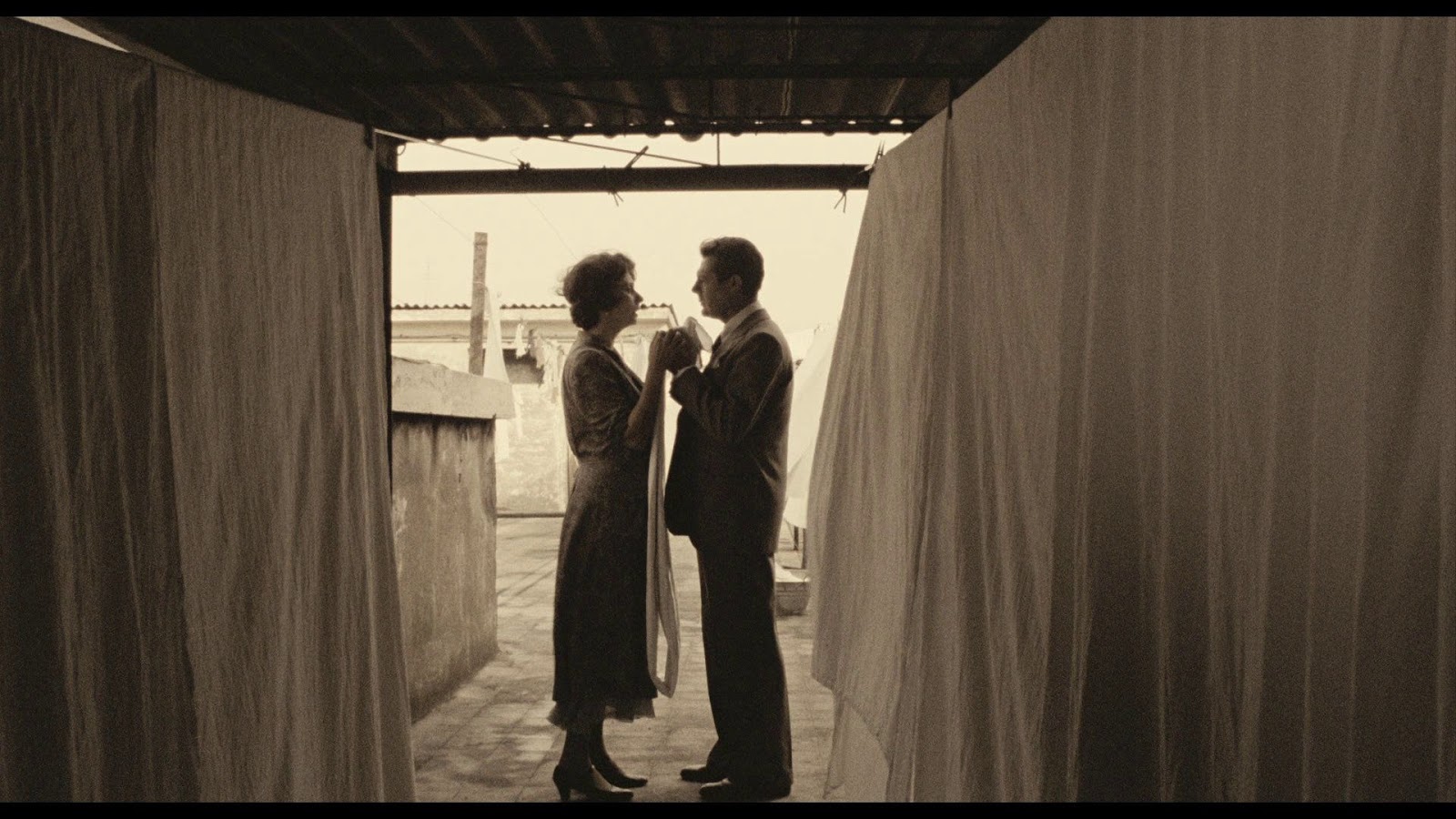
Scola’s direction opens with real-life newsreel footage of Hitler’s arrival to Rome in May of 1938 as he is greeted by Mussolini as if they’re old friends. Then it shifts to the main story as Scola would use some intricate and sprawling crane shots to get a scope of the apartment building inside the exterior of the main lobby as it’s shot in a largely sepia-like photography style where the only glimpses of colors are in a few objects including the flags for Fascist Italy and Nazi Germany. Scola would also create some unique long from this wide crane shot into a close-up of Antonietta’s apartment as she is getting her children ready while her husband does some exercise to get ready for the day. The usage of close-ups and medium shots add to some of the theatricality and intimacy into the scenes with Antonietta and Gabriele as they’re talking throughout the film while the one sequence where they’re outside on top of the apartment rooftop to get the former’s laundry is presented in a wide shot.
Scola’s usage of long-takes in the conversations between Antoinetta and Gabriele has him establishing not just their immediate awkwardness early on but also how they would get on during the course of the day. The camera would often move at times to get a look into the space of their respective apartments as well as what it looked like in the hallways and staircases. There is also this air of sexual tension yet it is Gabriele that is resisting as he knows someone who is gay that has been taken away as it play into the concept of masculinity from the point of view of Fascism. There is also a sense of repression in Antoinetta’s role as a housewife as it all revolves around the lack of power women have in their place in Fascism other than just be supportive. Its ending is about the state of the world and what Antoinetta would have to face though there is a little bit of freedom she would have in this world of Fascism. Overall, Scola crafts a mesmerizing and haunting film about two neighbors staying home during a celebratory parade for Adolf Hitler and Benito Mussolini.
Cinematographer Pasqualino De Santis does incredible work with the film’s sepia-drenched cinematography as it gives the film a look and feel that breathes an element of nostalgia but also repression in the way it looks while the few colors that are shown are on objects including the flags. Editor Raimondo Crociani does excellent work with the editing as it is largely straightforward to play into the drama without devolving too much into style. Production designer Luciano Ricceri does brilliant work with the look of the interiors of the apartment from the rooms that Antoinetta and Gabriele live to the staircase and hallways. Costume designer Enrico Sabbatini does fantastic work with the costumes as it play into the Fascist uniforms that many of the people wear with the exception of Antoinetta’s ragged dress and the suit that Gabriele wears. Sound mixer Franco Bassi does terrific work with the sound to capture the sound of the parade from afar as well as the sound of planes flying over the building. The film’s music by Armando Trovajoli is amazing for its bombastic and triumphant film score that is played on location as source music for the parade while the soundtrack also features elements of rumba and somber music that play into the drama.
The film’s wonderful cast feature a couple of notable small roles from John Vernon as Antoinetta’s husband Emanuele who is a fierce loyalist to the Fascist party with Marcello Prando providing dubbing on Vernon and Francoise Berd as the apartment building’s caretaker who isn’t fond of Gabriele believing him to be subversive and full of trouble. The performances of Sophia Loren and Marcello Mastroianni are phenomenal in their respective roles as Antoinetta and Gabriele. Loren provides a repressed sensuality to her performance as a woman that is just trying to maintain the household as well as having to do all of the things expected as a housewife. Mastroianni is also restrained in his performance while displaying bits of charm when he tries to teach Antoinetta how to dance the rumba. Yet, Loren and Mastroianni display a chemistry that is just intoxicating in the way they get to know each other as well as deal with their own sense of anguish as it’s a master class in acting from two of Italy’s finest.
Una giornata particolare is a tremendous film from Ettore Scola that features spectacular performances from Sophia Loren and Marcello Mastroianni. Along with its gorgeous cinematography, intimate setting, and themes of repression and longing, it’s a film that explore two people dealing with what is happening outside of their apartment as well as being aware of a world that is in chaos with neither of them having a say in this oppressive world. In the end, Una giornata particolare is a sensational film from Ettore Scola.
© thevoid99 2018

Based on the play Filumena Marturano by Eduardo De Filippo, Matrimonio all’italiana (Marriage Italian Style) is the story of a man who meets a country woman in Naples during World War II as his frequent visits to this woman lead to some major revelations about his relationship and the fact that she gave birth to three sons as he might be the father of one of them. Directed by Vittorio de Sica and screenplay by Renato Castellani, Tonino Guerra, Leo Benvenuti, and Piero De Bernardi, the film is a romantic comedy of sorts that play into a man’s relationship with this woman who would become a prostitute as he deals with the situation he’s in. Starring Marcello Mastroianni, Sophia Loren, Aldo Puglisi, Tecla Scarano, and Marilu’ Tolo. Matrimonio all’italiana is a lively and evocative film from Vittorio de Sica.
The film follows a man who learns that his former flame is dying just as he’s about to get married to a younger woman as he reflects on how he met her and his relationship with her. The film explores this relationship that lasted for more than 20 years during from the final years of Fascist Italy in World War II to the 1960s where they run a bakery though the relationship has had its ups and downs. The film’s screenplay opens with Filumena Marturano passed out as she is being carried to her apartment where the possibility of her dying is looming forcing her maid Lucia (Enza Maggi) and the loyal servant Alfredo (Aldo Puglisi) to call on the apartment’s landlord and Filumena’s on-again, off-again lover Don Domenico Soriano (Marcello Mastroianni) to help out. Much of the first act is about how Don Soriano met Filumena at a brothel when she was just a seventeen-year old prostitute during a bombing raid in Naples and then meet her again two years later where they start a relationship.
It’s a relationship where Don Soriano would give Filumena a place to live as well as work and run his bakery while he’s often out of the country doing business and later having affairs with young cashiers. The second act is about Filumena and her life when Don Soriano is out of town as it’s told from her perspective as well as a major revelation in her life as she had given birth to three different sons in different periods of time. Don Soriano wouldn’t know about her three sons until the third act where Don Soriano is dealing with a scheme Filumena and her servants supposedly had concocted but it would also come with complications about her three sons.
Vittorio de Sica’s direction has elements of style but it maintains a tone that mixes light-hearted humor with elements of melodrama. Shot on location in Naples, the film does play into this world that mixes the idea of the working class and rural locations that Filumena is a part of to the more upper class world that Don Soriano is from as he wears expensive shoes and stylish suits. While de Sica would use some wide shots to capture some of the locations as well as some shots in the apartment for the big crowd scenes. Much of what de Sica would do is maintain a sense of intimacy in his approach to close-ups and medium shots in the way he would develop the relationship between Don Soriano and Filumena such as a scene during their relationship early in the film where Filumena thinks about a bright future but Don Soriano is too concerned with being successful. The approach to humor is offbeat as it help play into this supposed scheme that Filumena might be playing at in what she wants to do to Don Soriano but it also serves a purpose for the film’s melodrama.
The film’s melodrama is key into the second act as it relates to the introduction of Filumena’s three sons as children including a scene where two boys who don’t know each other come into the bakery where they eat pastries unaware that their mother is watching them with such fondness. It also play into moments where she really has no idea about the way the law works in what she is trying to do due to her rural background as it lead to Don Soriano trying to use his background and power to get what he wants. The film’s third act isn’t just about these revelations over what Don Soriano would discover but also forces him to deal with his actions where de Sica restrains the melodrama to mix both comedy and drama including these moments with Filumena’s sons where it has these subtle moments of humor. Overall, de Sica crafts a rapturous yet witty film about a turbulent relationship between a businessman and a prostitute in Naples.
Cinematographer Roberto Gerardi does brilliant work with the film’s cinematography with its natural and colorful approach to some of the daytime exteriors in some of the film’s gorgeous locations as well as the usage of stylish lighting for the scenes at night as well as some of the film’s interior scenes. Editor Adriana Novelli does excellent work with the editing as it has elements of rhythmic cuts to play into the drama as well as much of the film’s humor. Production designer Carlo Egidi and set decorator Dario Micheli do amazing work with the look of the apartment that Filumena lives in as well as the bakery that she works at which is run by Don Soriano.
Costume designer Piero Tosi does fantastic work with the costumes from the look of the suits that Don Soriano wear to the stylish dresses and lingerie that Filumena wears. The sound work of Ennio Sensi is superb for capturing some of the chaotic sounds in some of the location as it relate to large crowds as well as some of the film’s quieter moments. The film’s music by Armando Trovajoli is wonderful for its lush and somber orchestral score that play into the melodrama as well as parts of the film’s humor.
The film’s marvelous cast feature some notable small roles from Enza Maggi as Filumena’s loyal maid Lucia, Tecla Scarano as a prostitute/friend of Filumena in Rosalia, and Aldo Puglisi as the loyal servant Alfredo. In the roles of Filumena’s three sons, Vito Moricone as Riccardo, Generoso Cortini as Michele, and Gianni Ridolfi as Umberto are superb in their roles as three young men who each have something to offer as they all display traits that would confuse Don Soriano. Marilu’ Tolo is wonderful as Diana as Don Soriano’s fiancée who has no clue on what is going on as she also suspects about Don Soriano’s sudden odd behavior late in the film.
Finally, there’s the duo of Marcello Mastroianni and Sophia Loren in phenomenal performances in their respective roles as Don Domenico Soriano and Filumena Marturano. Mastroianni has this air of charm that he exudes throughout the film while his comedic timing is a joy to watch in the way he reacts to things where all of the cool factor that he’s known for is thrown out of the window. Loren has this air of grace that is prevalent throughout the film while also being playful in the way she displays her sex appeal as someone that wants to have a simple life but also what is best for her sons. Mastroianni and Loren do provide this great sense of rapport and comedic timing with each other as they are a major highlight of the film.
Matrimonio all’italiana is a sensational film from Vittorio De Sica that features incredible performances from Marcello Mastroianni and Sophia Loren. Along with its gorgeous visuals, sumptuous score, and the mixture of comedy and melodrama, it’s a film that is an offbeat film that offers so much but also has a lot of heart and characters that are a joy to watch. In the end, Matrimonio all’italiana is a spectacular film from Vittorio De Sica.
Vittorio De Sica Films: (Rose scarlatte) - (Maddalena, zero in condotta) - (Teresa Venerdi) - (Un garibaldino al convento) - (The Children Are Watching Us) - (La porta del cielo) - (Shoeshine) - (Heart and Soul (1948 film)) - Bicycle Thieves - Miracle in Milan – Umberto D. - (It Happened in the Park) - (Terminal Station) - (The Gold of Naples) - (The Roof) - (Anna of Brooklyn) - Two Women (1960 film) - (The Last Judgment) - (Boccaccio ‘70) - (The Condemned of Altona) - (Il Boom) - Yesterday, Today, and Tomorrow - (Un monde nouveau) - (After the Fox) - (Woman Times Seven) - The Witches (1967 film)- An Evening Like the Others - (A Place for Lovers) - (Sunflowers (1970 film)) - The Garden of the Finzi-Continis - (Lo chiameremo Andrea) - (A Brief Vacation) - (The Voyage)
© thevoid99 2018

Directed by Vittorio De Sica, Leri, oggi, domani (Yesterday, Today, & Tomorrow) is a trilogy of stories involving three couples in three different parts of Italy where a woman uses her sexuality to get her husband/beau to do whatever she wants. The three stories display different ideas of love in three different places of the country as it’s told in a humorous fashion as the three couples are played by Marcello Mastroianni and Sophia Loren. Leri, oggi, domani is an extraordinary film from Vittorio De Sica.
The film is about three different stories in three different locations that all revolve around a woman who would use her sexuality to get what she wants as it would often cause trouble for her husband/beau in these stories. The first of which is entitled Adelina de Naples which is written by Eduardo de Filippo and Isabella Quarantotti that has a woman who finds a loophole by getting pregnant so she can avoid going to jail for selling cigarettes in the black market which eventually takes its toll on her marriage. The second story entitled Anna of Milan from writers Cesare Zavattini and Billa Billa Zanuso plays into a day in Milan where a wealthy of wife of an industrialist drives around her Rolls Royce with her lover as they deal with what is important. The third and final story entitled Mara of Rome that is based on a story by Alberto Moravia and screenplay by Cesare Zavattini revolves around a prostitute’s relationship with one of her clients as she tries to help out an elderly neighbor’s grandson who is thinking about giving up his priesthood studies.
The scripts all play to themes of a woman trying to get her man to do what he wants where the first story has the husband Carmine trying to save his wife as he is unemployed yet having sex with Adelina eventually tires him. In the second story, it is a short but comical story that plays into a man trying to get this rich wife of an industrialist to have a relationship but she is a woman that is very vain and selfish. The third and final story plays around the life of a prostitute who has very high-priced clients including a son of an industrialist who is eager to marry this woman but she isn’t sure as she has other problems to deal with. All of which have similarities about the way women use their sexuality where it can be an advantage or a curse.
Vittorio De Sica’s direction is very intoxicating in the way he tells these three different stories where it does play into the different parts of Italy not just socially but also culturally. In Adelina, it is all set in Naples where it’s the longest section of the three stories as De Sica aims for some realism in its locations where it’s shot largely in these stair-like streets where it is quite cramped but also full of life. De Sica’s approach to the widescreen format to capture the location is among the highlights of the section while some of it is quite comical in the way Adelina deals with her plight and Carmine trying to help her as it would overwhelm him. The Anna segment is the shortest of the three where it begins with a long running shot of Anna driving her Rolls Royce from her perspective as she drives manically to reach her love Renzo.
It’s the funniest of the three shorts but also very compelling for the way it plays into Anna’s own vanity. The third and final segment in Mara has De Sica be more intimate in not just his compositions but also in the way he presents Rome by avoiding many of its landmarks. Instead, it’s a more somber piece where De Sica plays into a prostitute trying to help a family while dealing with a client who is in love with her as it culminates a striptease for the client. All of which plays into something is purely Italian in how men and women conduct their lives. Overall, De Sica crafts a very sensational yet captivating film about women who uses their sex appeal to get men to do whatever they want.
Cinematographer Giuseppe Rotunno does amazing work with the film‘s cinematography to capture not just the beauty of the different locations but also bring in some unique lighting for the Adelina and Mara segments in some of its nighttime scenes. Editor Adriana Novelli does excellent work with the editing by bringing in a very straightforward approach to the editing with some jump-cuts and dissolves in a few scenes for all three segments. Art director Ezio Frigerio and set decorator Ezio Altieri do fantastic work with the set pieces from the home that Adelina and Carmine live in with their children to the apartment that Mara lives in on top of the building where her next door neighbor is an elderly couple and their grandson.
The costumes of Piero Tosi is terrific for its sense of style from the ragged dresses of Adelina as well as the stylish clothes of Mara plus the Christian Dior dress that Anna wears. The sound work of Ennio Sensi is superb for some of the chaotic yet layered sound for some of the scenes involving the crowd in the Adelina segment with more intimate sound work in the other two segments. The film’s music by Armando Trovajoli is brilliant where it features different themes that are quite playful and somber as it features some orchestral pieces and ballads that are featured in the Adelina segment while the Anna segment features mostly jazz and the Mara segment consists of more somber orchestral pieces.
The film’s cast features some notable small roles from composer Armando Trovajoli as a man Anna and Renzo meet on the road, Agostino Salvietti as an attorney for Adeline and Carmine, Tecla Scarano as the attorney’s sister, Tina Pica and Gennaro Di Gregorio as Mara’s elderly neighbors, Aldo Giuffre as a friend of Carmine who tries to sleep with Adeline out of desperation, and Gianni Ridolfi as the neighbors grandson who falls for Mara as he wants to renounce his vows to be with her. Finally, there’s the duo of Sophia Loren and Marcello Mastroianni in incredible performances as the three couples in the film. Loren brings a smoldering sexuality to her trio of roles while making them very different as Adelina is a woman trying to not to go to jail which shows Loren at her most dramatic. In the role of Anna, Loren brings a very intoxicating yet vain approach to her character while she brings a great complexity as Mara as a woman with a big heart despite her profession.
Mastroianni brings a lot of humor and humility in his trio of roles where he displays an earnestness in the role of Carmine. In the role of Renzo, he plays someone who is confused but also troubled by Anna’s decisions while he showcases a more comical and neurotic approach in the role of Augusto in his attempt to sleep with Mara. There is a chemistry between Loren and Mastroianni that is just insatiable to watch where they know how to play off each other and have fun doing it.
Leri, oggi, domani is a phenomenal film from Vittorio De Sica that features great performances from Sophia Loren and Marcello Mastroianni. The film isn’t just a humorous look into the world of women making men do whatever they want but also as a compelling portrait of Italy. In the end, Leri, oggi, domani is a spectacular film from Vittorio De Sica.
Vittorio De Sica Films: (Rose scarlatte) - (Maddalena, zero in condotta) - (Teresa Venerdi) - (Un garibaldino al convento) - (The Children Are Watching Us) - (La porta del cielo) - (Shoeshine) - (Heart and Soul (1948 film)) - Bicycle Thieves - Miracle in Milan - Umberto D. - (It Happened in the Park) - (Terminal Station) - (The Gold of Naples) - (The Roof) - (Anna of Brooklyn) - Two Women (1960 film) - (The Last Judgment) - (Boccaccio ‘70) - (The Condemned of Altona) - (Il Boom) - Marriage Italian-Style - (Un monde nouveau) - (After the Fox) - (Woman Times Seven) - The Witches (1967 film)- An Evening Like the Others - (A Place for Lovers) - (Sunflowers (1970 film)) - The Garden of the Finzi-Continis - (Lo chiameremo Andrea) - (A Brief Vacation) - (The Voyage)
© thevoid99 2014
Directed by Michelangelo Antonioni and written by Antonioni, Tonino Guerra, and Ennio Flaiano, La Notte (The Night) is the story about the day in the life of a married couple whose marriage is disintegrating as they spend the night confronting the state of their marriage. The second part of Antonioni’s alienation trilogy that was preceded by L’Avventura and later followed by L’Eclisse. The film is an exploration into marriage and how people fall out of love in the course of one night. Starring Marcello Mastroianni, Jeanne Moreau, Monica Vitti, and Bernhard Wicki. La Notte is an entrancing yet eerie film from Michelangelo Antonioni.
Told in the span of 24 hours, the film explores the life of a married couple where their marriage is in a state of disintegration where they later attend a party one night as it becomes clear how far apart they’ve become. It is a film that plays into the idea of a couple falling out of love but it is set in modern Italy in the city of Milan where things are changing radically. Not just in the way where the places that Giovanni (Marcello Mastroianni) and Lidia Pontano (Jeanne Moreau) once used to frequent are disappearing but also other things in their life emotionally and socially. Giovanni is a renowned author who feels like he has reached the peak of his career as people ask him endless questions about how to be a great writer. Lidia is a woman who is just frustrated by the state of her marriage as she is unsure of where she is at in her life. All of which plays into this party where Giovanni and Lidia each frequent into their own adventures while dealing with their sense of alienation in themselves and in each other.
The film’s screenplay has this very unique structure where its first half is set in the day and the evening yet the second act is spent largely at night at this party. Notably as its first half showcase the growing division between Giovanni and Lidia where they spend the day together visiting their ailing friend Tomasso (Bernhard Wicki) at the hospital where Giovanni later has a strange encounter with nymphomaniac patient as they later attend a party for Giovanni’s new book where Lidia wanders around Milan. Lidia’s journey and Giovanni’s encounters with strange things including the adulation he receives both would have some serious repercussions for the two as they decide to have a night together going to a nightclub and later attend the party. It’s this party that drives the film’s second half where it’s clear that even though they attend the party as a couple. They’re both in very different worlds based on the way they behave at the party and the people they encounter.
Though Lidia is wracked with grief and sentimentality, she does meet a man named Roberto (Giorgio Negro) whom she dances with but it’s only she spends time with after Giovanni would meet the party host’s daughter Valentina (Monica Vitti). Lidia’s observation at the party only showcases how lost she is where despite the fact that she’s well-dressed and being treated graciously by the hosts. She doesn’t feel like she’s fitting in where she later becomes more depressed until she meets Roberto where she considers having a brief fling. Giovanni’s encounter with Valentina would be playful but also would have Giovanni face some revelations about himself as Valentina is this intriguing young woman who has ambitions but is also uncertain about herself. Yet, it just adds to Giovanni’s own sense of confusion as he’s often asked by many about his work and such where he doesn’t have the answers while Valentina’s father (Vincenzo Corbella) would offer him a job which surprises Giovanni who admits that he doesn’t need the money. The course of the night would lead to Giovanni and Lidia coming together where they are forced to face the realities about themselves and their marriage.
Michelangelo Antonioni’s direction is very exotic in the way he presents the film as this very intimate yet haunting portrait of alienation. Notably as he opens the film with images of Milan from an elevator as it’s going up and down to showcase a world that is definitely changing. It’s a world where Giovanni and Lidia don’t seem to recognize as it could be stated as a visual metaphor for their own disintegrating marriage. Notably as the long sequence of Lidia wandering around Milan from the city to its outskirts where she witness a fight and later witnesses young men shooting rockets off to the ground near the old home that she and Giovanni lived in when they first got married. Giovanni would be alone at the apartment he and Lidia lived in where the images that Antonioni creates showcase a man at a crossroads in his life as he’s looking out at the city and other buildings around him.
Antonioni’s direction is filled with these striking compositions and images that has some of the actors be placed into the edge of the frame or use something like the mirrors at the villa to express a sense of detachment that is happening around them. Notably the film’s second half where Giovanni and Lidia both go into their own adventures as Antonioni uses the wide and medium shots to showcase their growing alienation amidst this era of decadence where people are having a good time. Though Giovanni would have fun at first and later Lidia, both definitely feel lost as the film progresses where Giovanni’s time with Valentina would be playful but also filled with some dramatic moments as Valentina would have this monologue to state about the idea of being the other woman.
Even as she would also have a moment with Lidia where two women just talk as it would play to Giovanni’s own sense of isolation. It would all come to this final scene as it is told with such simplicity but also a moment that is quite intense dramatically about how far Giovanni and Lidia have come in the course of an entire day. Much of it has Antonioni gazing at the camera with these shots that are quite long where many of what he does won’t be for everyone yet it expresses the sense of loss that is prevalent throughout the film. Overall, Antonioni creates a very chilling yet ravishing portrait of a couple falling out of love.
Cinematographer Gianni De Venanzo does amazing work with the film‘s black-and-white photography with its use of shadows to convey that sense of loneliness as well as many of the interior and exterior lighting schemes to help set a mood that includes the scenes set at night. Editor Eraldo Da Roma does excellent work with the film‘s editing where it is quite straightforward in terms of its cutting while it spends most of its time not wanting to cut for some of the film‘s most entrancing moments. Production designer Pierro Zuffi does fantastic work with the set pieces from the look of the villa where the party is held to the apartment home where Giovanni and Lidia live in.
The sound work of Claudio Maielli is brilliant for its mixing and array of sounds to play into the sense of loneliness and growing modernism that is prevalent throughout the film. The film’s music by Giorgio Gaslini is superb for its jazz-based score that is played on location at the party scenes along with a very moody, ominous piece at the film’s opening credits scene.
The film’s incredible cast includes some notable small performances from Giorgio Nergo as the man Lidia meets in Roberto, Vincenzo Corbello and Gitt Magrini as Valentina’s parents, Roberta Speroni as an old friend of Lidia’s at the party, and Rosy Mazzacurati as a fan of Giovanni’s work who keeps asking him questions about writing. Bernhard Wicki is excellent as Giovanni and Lidia’s ailing friend Tomasso who is happy with their presence though he would cast a haunting presence on Lidia who is really close to him. Monica Vitti is amazing as Valentina as this very charming young woman who woos Giovanni yet is uncertain about becoming a married man’s mistress.
The performances of Marcello Mastroianni and Jeanne Moreau are remarkable in their respective roles as Giovanni and Lidia Pontano as a couple falling out of love. Mastroianni has this presence that is full of charm and wit but also a sense of humility and uncertainty as a writer who thinks his brains can’t really offer enough importance to the world as he is also troubled by his lust for other women. Moreau is far more entrancing in the way she conveys this woman as a frustrated wife who feels lost in her world as everything from her past is going away as she is also trying to see if there’s any future. Mastroianni and Moreau create this chemistry that is quite interesting to display this sense of detachment that is lurking around them as they just add that sense of emotional weight to bring this couple falling out of love.
The 2013 Region 1 DVD/Region A Blu-Ray from the Criterion Collection presents the film in 1:85:1 theatrical aspect ratio under a new digital restoration from a 4k film transfer and Dolby Digital Mono sound with English subtitles. The DVD includes a few special features that relate to the film and its filmmaker Michelangelo Antonioni. The 27-minute interview with film critic Adriano Apra and film historian Carlo di Carlo about the film and Antonioni. Apra dominates most of the interview as he talks about the film and its themes with di Carlo talking about Antonioni and his approach to the film. Both of them dwell into many of the visual traits of the film as well as its theme on alienation as it is truly an engaging little featurette about the film.
The 31-minute interview with Harvard professor Giuliana Bruno about the architecture of the film. Bruno plays into a lot of the visual style that Antonioni wanted with the buildings of Milan that was to present something that seemed abstract and metaphoric. Notably to convey the sense of something that is happening and Antonioni’s fascination with that world. Bruno also reveals the importance of the use of the mirrors and glasses in the film that helps adds to the visual style as it’s a very compelling piece that explores Antonioni’s visual style. The DVD also includes a 3-minute trailer that presents the film in an offbeat way.
The DVD/Blu Ray set also includes a booklet that features two pieces of text relating to the film. The first is an essay entitled Modern Love by film critic Richard Brody of the New Yorker. Brody’s essay talks about the film and its approach to abstract art as well as play into its theme of alienation in tune with the disintegrating marriage between Giovanni and Lidia. The second piece of text is from the late Michelangelo Antonioni which is an article he wrote for a French newspaper to coincide with the film’s release. Antonioni talks about the inspiration for the film and small tidbits about the development for the film as both text pieces are wonderful accompaniments to the film and its DVD extras.
La Notte is an enchanting yet exotic film from Michelangelo Antonioni. Thanks to its ravishing yet abstract visual style and the performances of Marcello Mastroianni, Jeanne Moreau, and Monica Vitti. It’s a film that explores alienation at its most haunting as well as the idea of love fading away. While it’s not an easy film to watch due its lack of strong plot and slow, methodical pacing. It is still a film that captures the idea of the end of a marriage. In the end, La Notte is a phenomenal film from Michelangelo Antonioni.
Michelangelo Antonioni Films: (Story of a Love Affair) - (I Vinti) - (The Lady Without Camelias) - Le Amiche - (Il Grido) - L'Avventura - L’Eclisse - Red Desert - Blow-Up - Zabriskie Point - (Chung Kuo, Cina) - The Passenger - (The Mystery of Oberwald) - Identification of a Woman - (Beyond the Clouds) - Eros-The Dangerous Thread of Things
© thevoid99 2013
Directed by Robert Altman and written by Altman and Barbara Shulgasser, Prêt-a-Porter is the story about a group of very different people who attend Fashion Week in Paris as some are reporting the events while some are just attending to see what is out there. The film is an exploration into the world of fashion that involves many people in the course of a week. Starring Marcello Mastroianni, Sophia Loren, Julia Roberts, Tim Robbins, Kim Basinger, Lili Taylor, Jean-Pierre Cassel, Chiara Mastroianni, Linda Hunt, Sally Kellerman, Stephen Rea, Anouk Aimee, Tracey Ullman, Rossy de Palma, Forest Whitaker, Rupert Everett, Lyle Lovett, and Lauren Bacall. Pret-a-Porter is a witty yet chaotic comedy from Robert Altman.
The film is about many different groups of people attending Fashion Week in Paris where a lot is happening while a prestigious fashion president had died believing that he had been murder. In the course of the film, a lot happens as a fashion TV reporter covers the events that is happening while lots of affairs between fashion designers are happening. Two American journalists are forced to share the same hotel room while covering what is happening and a fashion designer is dealing with possible bankruptcy. Fashion magazine editors spar with each other to go get a prestigious photographer while a woman goes on a shopping spree around the city. All in the course of an entire week as it leads to a climatic fashion show where a designer presents the ultimate show in grand style.
The screenplay by Robert Altman and Barbara Shulgasser doesn’t really have any kind of singular plot as it’s all about the chaos of Fashion Week. Notably as there’s journalists trying to cover the event and make sense of it as it involves a New York Times photographer (Lili Taylor) and a fashion TV reporter named Kitty Porter (Kim Basinger). Yet, there’s also this story about this French fashion president in Olivier de la Fontaine (Jean-Pierre Cassel) who meets a mysterious man named Sergei (Marcello Mastroianni) where something happens leading to de la Fontaine’s death as his wife Isabella (Sophia Loren) seems relieved though is lover in fashion designer Simone Lowenthal (Anouk Aimee) is saddened as she is dealing with losing her business where her son Jack (Rupert Everett) does something that will save her business but with some reservations. Things get crazier as two different American journalists in Anne Eisenhower (Julia Roberts) and Joe Flynn (Tim Robbins) are forced to share a hotel to cover what’s been happening.
Altman’s direction is definitely engaging for the way he explores the world of fashion and what goes on in Fashion Week. Taking on a style similar to cinema verite, Altman captures all of the craziness that occurs while going inside into what goes in the world of fashion as shows are being prepared and such. Notably as the film features cameos from celebrities, models, and fashion designers as they’re part of this crazy yet fascinating world. The direction is also intimate and straightforward for scenes inside the hotel rooms and offices where many people work out as well as some moments in the fashion runway. It is still about the show and the world that is happening which also includes Sergei trying to contact Isabella as they’re revealed to be former lovers. Their scenes together is essentially an ode to their appearance in Vittorio de Sica’s 1963 film Yesterday, Today, and Tomorrow. While it’s a film that can be described as a rambling mess due to the many storylines that happens. It is still a very enjoyable and very exhilarating film from Robert Altman.
Cinematographers Jean Lepine and Pierre Mignot do excellent work with the look of Paris during Fashion Week with its many landmarks as well as the scenes inside the fashion shows and some of the film‘s interior settings. Editors Geraldine Peroni and Suzy Elmiger do wonderful work with the editing to capture the sense of chaos that occurs in the world of fashion as well as more straightforward moments in the intimate scenes. Production Stephen Altman, with set decorator Francoise Dupertuis and art director William Abello, does nice work with the looks of the hotels and the runway shows that occur including the very street-based show one of the designers at a metro.
Costume designer Catherine Leterrier does terrific work with the non-designer clothes some of the characters wear to maintain their lack of style while most of the characters wear clothes that display their unique personalities. Sound editor Skip Lievsay does superb work with the sound to capture the atmosphere of the runway shows to the chaos in some of the parties. The film’s music by Michel Legrand is delightful for its playful piano pieces and other cuts to play out the humor. Music supervisor Allan F. Nichols creates a fantastic soundtrack that features music from Massive Attack, Bjork, U2, Ini Kamoze, Salt-N-Pepa, the Rolling Stones, M People, Janet Jackson, the Cranberries, Pizzicato Five, Robert Palmer, Grace Jones, and many others to capture the spirit of the fashion world.
Finally, there’s the film’s amazing ensemble cast as it features cameo appearances from Bjork, Harry Belafonte, Cher, and David Copperfield along with supermodels like Claudia Schiffer, Helena Christensen, Naomi Campbell, Linda Evangelista, Carla Bruni, and Christy Turlington, and fashion designers like Jean-Paul Gaultier, Sonia Rykiel, Issey Miyake, Christian Lacroix, and Gianfranco Ferre for Christian Dior as themselves. In small but notable roles, there’s Alexandra Vandernoot as a TV reporter, Jean Rochefort and Michel Blanc as police investigators, Teri Garr as an obsessed shopper, Danny Aiello as the shopper’s husband, Rossy de Palma as Simone’s assistant Pilar, Chiara Mastroianni as Kitty Porter’s aide Sophie Choiset, Ute Lemper as the pregnant model Albertine, Kasia Figura as the dim-witted assistant of magazine editor Sissy, and Jean-Pierre Cassel as the Fashion Week president Olivier de la Fontaine.
Sally Kellerman, Linda Hunt, and Tracey Ullman are great in their respective rules as the dueling magazine editors Sissy Wannamaker, Regina Krumm, and Nina Scant who all try to nab Stephen Rea’s very devious photographer Milo O’Brannigan who would provide a prank of his own all three where Rea is very funny. Lauren Bacall is wonderful as the colorblind fashionista Slim Chrysler while Lyle Lovett is terrific as the cowboy boots designer Clint Lammereaux. Julia Roberts and Tim Robbins are excellent as the dueling journalists Anne Eisenhower and Joe Flynn where they eventually fall for each other as they share a hotel room together. Lili Taylor is superb as the NY Times photojournalist Fiona Ulrich while Kim Basinger is hilarious as the somewhat dim fashion TV reporter Kitty Porter. Forest Whitaker and Richard E. Grant are fantastic in their respective roles as fashion designers in the street-wise Cy Bianco and the snobbish Cort Romney.
Rupert Everett is pretty good as the slimy Jack Lowenthal who does something without his mother’s consent while Anouk Aimee is phenomenal as the respected fashion designer Simone Lowenthal who deals with Olivier’s death as well as the prospect of losing her business. Finally, there’s Marcello Mastroianni and Sophia Loren in marvelous performances in their respective roles as Sergio/Sergei and Isabella where they play former lovers who finally meet after many years where Mastroianni brings a lot of humor with Loren bringing an element of class to her role as well as a sexiness that is still captivating.
Pret-a-Porter is an excellent film from Robert Altman. Featuring a wild ensemble cast full of actors, models, fashion designers, and all sorts of people. It’s a film that captures the craziness that is Fashion Week while taking time to inject humor into that world. While the film is a bit of a mess, it is still enjoyable for the way Altman explores a world that is fascinating. In the end, Pret-a-Porter is a remarkable film from Robert Altman.
Robert Altman Films: (The Delinquents) - (The James Dean Story) - Countdown (1968 film) - (That Cold Day in the Park) - M.A.S.H. - Brewster McCloud - McCabe & Mrs. Miller - (Images) - The Long Goodbye - Thieves Like Us - California Split - Nashville - Buffalo Bill and the Indians, or Sitting Bull’s History Lesson - 3 Women - (A Wedding) - (Quintet) - (A Perfect Couple (HealtH) - Popeye - (Come Back to the Five and Dime, Jimmy Dean, Jimmy Dean) - (Streamers) - (Secret Honor) - (O.C. and Stiggs) - Fool for Love - (Beyond Therapy) - (Aria-Les Boreades) - (Tanner ‘88) - (Vincent & Theo) - The Player - Short Cuts - (Kansas City) - (The Gingerbread Man) - Cookie’s Fortune - Dr. T & the Women - Gosford Park - The Company (2003 film) - (Tanner on Tanner) - A Prairie Home Companion
© thevoid99 2013