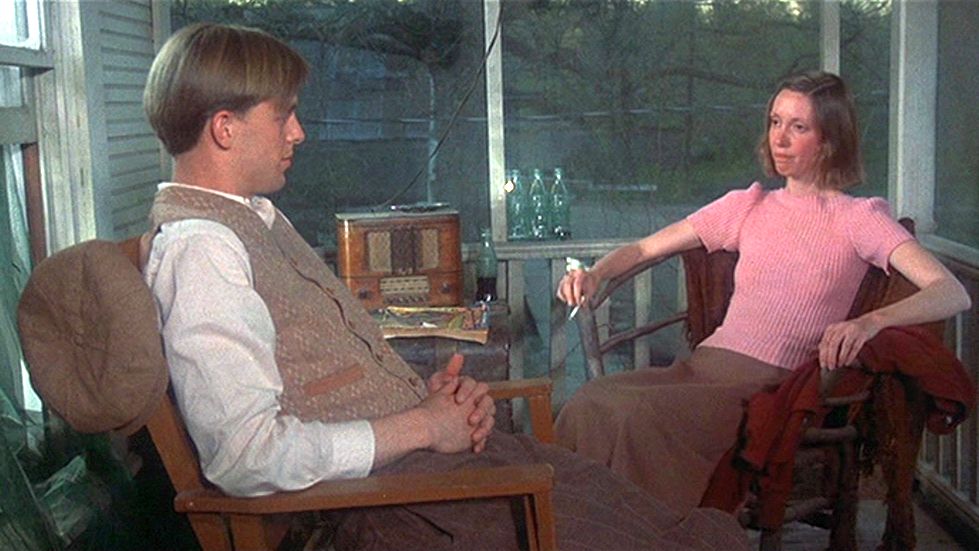
Based on the novel by Edward Anderson, Thieves Like Us is the story of three men who escaped prison as they go on a crime spree throughout the American South during the 1930s. Directed by Robert Altman and screenplay by Altman, Joan Tewkesbury, and Calder Willingham, the film is a loose remake of Nicholas Ray’s 1949 film They Live by Night which was also an adaptation of Anderson’s novel as it blends elements of humor and crime. Starring Keith Carradine, Shelley Duvall, John Schuck, Tom Skerritt, Bert Remsen, and Louise Fletcher. Thieves Like Us is a riveting and mesmerizing film from Robert Altman.
Set during the Great Depression in the American South, the film revolves around a trio of escaped convicts who become bank robbers as they would become successful and notorious only to go way over their head when they are later pursued by the authorities. It’s a film with a simple premise as it play into three men that want to live the good life during the Depression as well as endure some of the trappings of success in their work as bank robbers. The film’s screenplay by Robert Altman, Joan Tewkesbury, and Calder Willingham does follow a straightforward narrative but it’s really more about three guys trying to plan robberies and such as one of them is a young man named Bowie (Keith Carradine) is someone that is learning the ropes of robbing but is eager to wanting to have a good life with a young woman in Keechie (Shelley Duvall). Yet, Bowie is pressured to continue robbing by his partners T-Dub (Bert Remsen) and Chicamaw (John Schuck) as the latter becomes more violent and troubling to the point that he would cause a lot of trouble.
Altman’s direction has elements of style in terms of the compositions and scenes he creates but he also does things that doesn’t play into conventions such as the robberies where he never reveals what happens during the robbery. Instead, it’s about the action outside where Bowie is the getaway driver as he waits for T-Dub and Chicamaw leaving the bank and getting into the car. It’s among these moments in the film that has Altman deviate from what is expected in caper films as he’s more concerned about the characters and how they plan a robbery. Even if it means laying low between robberies where they can get a chance to enjoy themselves as T-Dub would live at a house with Chicamaw and a woman whose young adult daughter is someone he is in love with. Shot largely on location in the state of Mississippi, Altman does maintain that air of realism into the locations such as the swamps and dirt roads along with showing this period of the American South during the Depression that was grimy but also kind of exciting.
Altman’s direction also emphasizes on the usage of radio reports as well as diegetic music to capture the idea of the times where it is either used as a form of entertainment or to intensify the drama during the film’s second act where Bowie, T-Dub, and Chicamaw become fugitives. Altman’s usage of long takes in the drama add to an energetic tone as well as the events that would occur in the third act with Chicamaw becoming violent as Bowie finds himself being a reluctant participant in these violent acts. Even as Bowie wants to take part in a simple life with Keechie but is pulled into wanting to participate in more robberies as it would eventually get more troubling. All of which has Altman showcase these haunting moments of violence that would haunt Bowie whose life is in greater danger just as he’s trying to make changes for himself. Overall, Altman crafts a witty yet compelling film about three convicts making a name for themselves as bank robbers during the Great Depression.
Cinematographer Jean Boffety does brilliant work with the film’s cinematography as it has a low-key approach to the way many of the daytime exteriors look with ideas of grainy photography as well as the way some of the scenes at night are lit. Editor Lou Lombardo does amazing work with the editing as it has an air of style for its usage of jump-cuts as well as a key scene towards the end with its usage of slow-motion as it is a highlight of the film. Costume designer Polly Platt does excellent work with the costumes from the look of the dresses the women wear as well as the clothes the men wear during those times. Sound mixer Don Matthews does fantastic work with the sound in the way music and radio programs sound like inside a car or at a house as well as the atmosphere of the locations including the scenes involving overlapping dialogue.
The film’s superb cast include some notable small roles from Arch Hall Sr. as a young man who picks up Bowie, T-Dub, and Chicamaw early in the film, Al Scott as a prison warden, Ann Latham as T-Dub’s young lover Lula, and Tom Skerritt in a terrific small role as the general store owner Dee Mobley who also runs a small-time criminal operation that he eventually abandoned. Louise Fletcher is fantastic as Lula’s mother Mattie as a woman who lets T-Dub, Bowie, and Chicamaw stay at her home where it eventually becomes chaotic to the point that she would later play a part in their downfall. Bert Remsen is excellent as T-Dub as eldest of the three thieves who walks with a cane and is always trying to ensure that things go well while not wanting to be violent as he enjoys the fruit of success.
John Schuck is brilliant as Chicamaw as the most brutal of the three thieves as well as someone who isn’t satisfied with robbing banks where he becomes more violent and unruly where he would get everyone into trouble. Shelley Duvall is amazing as Keechie as Mobley’s younger sister who falls for Bowie as they embark on a relationship where she knows what he does but also keeps it a secret while dealing with the idea that Bowie would abandon the good life in favor of the thrill of danger. Finally, there’s Keith Carradine in an incredible performance as Bowie as a young thief who contemplates his role as someone who is a robber where he relishes in having money and wanting a good life but becomes disturbed by some of the violence he encounters as it’s a role that has Carradine display humor but also someone who comes to term with the trouble he’s created and the need to make things right.
Thieves Like Us is a sensational film from Robert Altman that features great performances from Keith Carradine and Shelley Duvall. Along with its ensemble cast, evocative cinematography, loose take on theft and notoriety, and an unconventional take on the caper genre. It’s a film that play into the idea of three men wanting to succeed through crime only to go way over their heads once they become notorious. In the end, Thieves Like Us is a phenomenal film from Robert Altman.
Robert Altman Films: (The Delinquents) – (The James Dean Story) – Countdown (1968 film) - (That Cold Day in the Park) – M.A.S.H. - Brewster McCloud - McCabe & Mrs. Miller - (Images) – The Long Goodbye - California Split - Nashville - Buffalo Bill and the Indians or, Sitting Bull's History Lesson - 3 Women - (A Wedding) – (Quintet) – (A Perfect Couple) – (HealtH) – Popeye - (Come Back to the Five and Dime, Jimmy Dean, Jimmy Dean) – (Streamers) – (Secret Honor) – (O.C. and Stiggs) – Fool for Love - (Beyond Therapy) – (Aria-Les Boreades) – (Tanner ’88) – (Vincent & Theo) – The Player - Short Cuts - Pret-a-Porter - (Kansas City) – (The Gingerbread Man) – Cookie's Fortune - Dr. T and the Women - Gosford Park - The Company - (Tanner on Tanner) – A Prairie Home Companion
© thevoid99 2018
Directed by Robert Altman and written by Doran William Cannon, Brewster McCloud is the story of a recluse who lives in a shelter at the Houston Astrodome as he dreams of wanting to fly where he would create a flying machine. The film is an offbeat comedy that plays into a young man wanting to do the impossible as it mixes fantasy and reality into this man’s desire to fly. Starring Bud Cort, Sally Kellerman, Michael Murphy, Rene Auberjonois, Stacy Keach, Margaret Hamilton, Jennifer Salt, and introducing Shelley Duvall. Brewster McCloud is a witty and whimsical film from Robert Altman.
The film is about a young recluse who yearns to fly as he creates a flying machine that would give him the chance to fly as he would deal with others who threaten him leading to a murder investigation led a detective from San Francisco. Set entirely in the city of Houston with the Astrodome in the center of the story, the film follows this titular character (Bud Cort) as he is trying to get an idea of how to fly with these wings he created. The film’s screenplay by Doran William Cannon sets up the main premise yet much of the film is improvised by director Robert Altman who would include small subplots into the film as it relates to Brewster McCloud.
Popping up every now and then is a lecturer (Rene Auberjonois) talking about birds and their wings while another subplot involves this detective in Frank Shaft (Michael Murphy) who arrives from San Francisco to investigate these mysterious murders as the one key evidence in these killings are bird shit. McCloud would try to mind his own business despite being aided by a mysterious woman in a trench coat named Louise (Sally Kellerman) and getting the attention of a tour guide in Suzanne (Shelley Duvall). Still, he is determined to prove that man can fly no matter what obstacles he faces.
Altman’s direction is offbeat as it opens with a band rehearsing the American national anthem until its singer (Margaret Williams) stops it because the band was off-key prompting to start all over again with the opening credits appearing once again. Shot on location in Houston, Texas and in and out of the Astrodome, the film does play into this strange mixture of fantasy and reality as it relates to what Brewster is trying to do in being able to fly. Yet, he also has to make a living as he would be first seen being a chauffeur to a miserly old man (Stacy Keach) while he also deals with an off-duty narcotics officer who tries to plant drugs on him at the zoo. Both men would meet their fate in bizarre ways as it adds to the film’s offbeat tone. Much of Altman’s direction is loose as he does use wide shots to get a look of the locations as well as shots inside the Astrodome. There are also some medium shots and close-ups that play into the characters and their interaction with a location including a scene of Brewster hiding from a security guard where he finds himself party of a touring group.
The film also play into these offbeat moments that happen as if something else is happening during a key scene which adds to Altman’s approach to the story as it play into so much that is happening including overlapping dialogue that would become a trademark of Altman’s style. Even as there is this car chase during the third act where it’s a riff of the car chase in some respects but also play into this confrontation with reality for some of the characters. The film’s climax is about Brewster’s flight and everything he thought about into his attempt to fly and what he would do to make this dream happen just as discoveries are made about these bizarre murders. Overall, Altman crafts an odd yet rapturous film about a young recluse wanting to fly inside the Astrodome.
Cinematographers Lamar Boden and Jordan Cronenweth do excellent work with the film’s cinematography to capture the sunny look of the daytime exterior scenes in Houston as well as the interiors for some scenes at night as well as the interiors of the Astrodome. Editor Lou Lombardo does brilliant work with the editing with some stylish jump-cuts to play into the humor and parts of the suspense as well as some playful montages that play into the bits of fantasy colliding with reality. Art directors E. Preston Ames and George W. Davis, with set decorators Robert R. Benton and Hugh Hunt, do fantastic work with the look of the shelter that Brewster lives in as well as the home of some of the victims along with the place that Suzanne lives in that she takes Brewster too.
Special makeup effects artist/wing designer Leon Ericksen does amazing work with the look of the old man that Brewster works for early in the film as well as the design of the wings. The sound work of William L. McCaughey and Harry W. Tetrick do superb work with the sound as it help capture the sound of the crowd as well as the atmosphere of the stadium when it isn’t full as well as some of the film’s natural elements. The film’s music by Gene Page is terrific for its playful orchestral score with elements of folk and country that include some original songs by John Phillips that play into the sense of adventure.
The casting by Gary Chason is wonderful that include some notable small roles from G. Wood as a skeptical police captain in Crandall who isn’t fond of Shaft, Bert Remsen as the corrupt narcotics officer Breen, John Schuck as the officer Johnson who helps out Shaft, William Baldwin as Suzanne’s boyfriend Bernard who works for the top police official Weeks, Stacy Keach as a stingy and cruel old man who collects money from old folks home in Abraham, Corey Fischer as an officer who helps Crandall, Margaret Hamilton as a singer in Daphne Heap that is cruel to the band playing for her, and Jennifer Salt as a young woman named Hope who helps out Brewster while also being sexually attracted to him. Rene Auberjonois is fantastic as the lecturer as this mad professor who talks about birds and their power in a comical way while William Windom is terrific as the top police official Haskell Weeks who hires Shaft to investigate while trying to smooth things over within the city.
In her film debut, Shelley Duvall is excellent as Suzanne as a tour guide for the Astrodome that meets Brewster when he’s trying to steal her car as they evade the police while learning about what Brewster is doing. Michael Murphy is brilliant as detective Frank Shaft as a man with piercing blue eyes who lead the investigation over these bizarre murders as he’s an offbeat man that is trying to investigate the case where he is the closest to anyone getting any answers of what is going on. Sally Kellerman is amazing as Louise as this mysterious woman who helps Brewster in his quest as she is this caretaker of sorts while also giving him advice on what to do to achieve his dream. Finally, there’s Bud Cort in a marvelous performance as the titular character as this young man that is wanting to fly as it’s an odd performance of a kid who is shy and reclusive yet is so determined to wanting to fly.
Brewster McCloud is an incredible film from Robert Altman. Featuring a great cast, an offbeat premise, dazzling visuals, and humorous moments that play into the film’s mix of reality and fantasy. It’s a film that definitely displays Altman’s unique vision in telling a story in an unconventional manner while playing up the ideas of fantasy and reality. In the end, Brewster McCloud is a sensational film from Robert Altman.
Robert Altman Films: (The Delinquents) – (The James Dean Story) – Countdown (1968 film) - (That Cold Day in the Park) – M.A.S.H. - McCabe & Mrs. Miller - (Images) – Thieves Like Us - The Long Goodbye - California Split - Nashville - Buffalo Bill and the Indians, or Sitting Bull's History Lesson - 3 Women - (A Wedding) – (Quintet) – (A Perfect Couple) – (HealtH) – Popeye - (Come Back to the Five and Dime, Jimmy Dean, Jimmy Dean) – (Streamers) – (Secret Honor) – (O.C. and Stiggs) – Fool for Love - (Beyond Therapy) – (Aria-Les Boreades) – (Tanner ’88) – (Vincent & Theo) – The Player - Short Cuts - Pret-a-Porter - (Kansas City) – (The Gingerbread Man) – Cookie's Fortune - Dr. T and the Women - Gosford Park - The Company (2003 film) - (Tanner on Tanner) – A Prairie Home Companion
© thevoid99 2018
Based on the play Indians by Arthur Kopit, Buffalo Bill and the Indians, or Sitting Bull’s History Lesson is the story of Buffalo Bill trying to stage a Wild West show where he gets the services of a deposed chief in hoping to present a show for the American president. Directed by Robert Altman and screenplay by Altman and Alan Rudolph, the film is an unconventional western that explores a man’s desire to uphold his own mythological persona while dealing with the realities around him including his own conflicts with Native Americans. Starring Paul Newman, Geraldine Chaplin, Joel Grey, Shelley Duvall, Harvey Keitel, Will Sampson, and Burt Lancaster. Buffalo Bill and the Indians, or Sitting Bull’s History Lesson is a whimsical yet engrossing film from Robert Altman.
Set in 1885 during the last years of a conflict involving Native Americans, the film revolves around a legend of the West who learns he’s gotten the services of the famed Chief Sitting Bull (Frank Kaquitts) for his show celebrating the West as it would prove to be more troubling as he would have to stage it in front of President Grover Cleveland (Pat McCormick). It’s a film that explores some of the behind-the-scenes moments of Buffalo Bill Cody (Paul Newman) trying to stage this show as he wants to present the ideas of the West as something wild and with its own sense of mythology. The film’s screenplay by Robert Altman and Alan Rudolph doesn’t just explore Cody trying to present his stage show as this façade of what the Wild West was but is forced to cope with the realities of what really happened. Especially when he meets Sitting Bull who he thought was this savage that enjoys killing people but it’s revealed to be this very calm, quiet, and morally pure which complicate everything that Cody wants to stage to the people.
The script also showcase Cody’s attempt to play up this persona he’s created as he becomes upset over not just Sitting Bull’s presence but also the fact that Sitting Bull doesn’t want to compromise very much as his interpreter Halsey (Will Sampson) has to speak up for him. Cody would also get into some tension with some of the players including Annie Oakley (Geraldine Chaplin) who is more sympathetic towards Sitting Bull. After a stage show with Sitting Bull where Cody expected him to be booed, it goes the other way around as it destroys everything Cody wanted to present in his idea of the American West. Adding to this turmoil is the fact that Cody isn’t just getting older but he’s having a hard time living up to the persona he’s created as his loyal nephew Ed Goodman (Harvey Keitel) is forced to realize this while his biographer Ned Buntline (Burt Lancaster) is trying to tell many about the many myths of Cody and romanticize to the people working at the show.
Altman’s direction is definitely stylish for not just creating a film that is quite chaotic and loose but also play up into this conflict of reality vs. myth with the West as its backdrop. Shot on location at the Stoney Indian Reservation in Alberta, Canada, the film does play into this idea of a man trying to recreate the Wild West in the middle of a forest near the Rocky Mountains as Altman would use some wide shots to establish the beauty of the location. Yet, he would go for more intimate shots in the usage of close-ups and medium shots as it play into the events happening behind the scenes as everyone is trying to stage the show. The presentation of the shows are quite lavish including the recreation of the Battle of Little Big Horn which shows Cody trying to show the battle from his view but the reality turns out to be more troubling.
The conflict of reality vs. myth is what is at stake in the film as Altman showcases these scenes where Cody is surrounded by things that aren’t real as he has opera singers as lovers, a biographer trying to embellish his legend, and people working with Cody trying to create the greatest show possible. Yet, there are things in the second half that showcase Cody’s struggle to create this myth in a moment where Sitting Bull and some of his people from his tribe have left as Cody and his men try to find them. What happens is that unveiling of the reality that Cody couldn’t face as he has to maintain his persona as this mythological figure of the West to President Grover. Though there are times the sense of looseness in the film does meander a bit for the film’s pacing, Altman does try to maintain a sense of liveliness to capture a moment in time with its protagonist being unaware of what is ahead. Overall, Altman creates a very intoxicating yet offbeat film about a legend of the Wild West trying to stage the ultimate show to present his vision of that world.
Cinematographer Paul Lohmann does brilliant work with the film’s cinematography in using some gorgeous natural lighting to capture the beauty of the locations in the day along with some lights for some of the scenes set at night. Editors Peter Appleton and Dennis M. Hill do terrific work with the editing as it’s mostly straightforward with a few jump-cuts to play into some of the humor and moments of the show. Production designer Anthony Masters, with set decorator Dennis J. Parrish and art director Jack Maxsted, does amazing work with the look of the sets for the stage show as well as the room where Cody sleeps in as well as the bar and a few other places at the circus area.
Costume designer Anthony Powell does excellent work with the costumes from the clothes that Cody wears as well as some of the actors to the simpler look of Sitting Bull and his tribe. Makeup artist Monty Westmore does nice work with the look of Cody as well as some of the makeup the characters wear during a performance. Sound editors Richard Oswald and William A. Sawyer do superb work with the sound as it play into the raucous sounds such as the overlapping dialogue and other things in and around the field for the stage show and circus. The film’s music by Richard Baskin is wonderful as it’s mainly an orchestral score filled with woodwinds and brass instruments that is often played on location to create this sense of pageantry into Cody’s own legend.
The film’s incredible ensemble cast include some Jerri and Joy Duce as cowboy trick riders, Bert Remsen as the bartender Crutch, Robert DoQui as an African-American actor who would often play the Indian chiefs in the stage performances, Bonnie Leaders and Evelyn Lear as a couple of opera singers who try to entertain Cody with the latter being the one who would sing in front of the president, Patrick Reynolds as the president’s aide, Patrick McCormick as President Grover Cleveland, and Shelley Duvall as the First Lady. Will Sampson is terrific as Sitting Bull’s right-hand man and interpreter Halsey as a man that is just trying to keep the peace and explain Sitting Bull’s view of things while Frank Kaquitts is superb as Sitting Bull as the revered Indian chief who rarely says anything as he maintains this presence of purity throughout the film.
John Considine is fantastic as Frank E. Butler as the husband of Annie Oakley who would often be the person holding her targets as well as deal with the chaos of the show. Kevin McCarthy is excellent as Major Burke as a military official who would be the one to get Sitting Bull to be involved as he’s this boisterous individual that likes to have fun and make sure everyone have fun. Joel Grey is brilliant as the producer Nate Salisbury as a man trying to keep everything in control while being announcer for the stage shows while Harvey Keitel is amazing as Cody’s nephew Ed Goodman as an assistant for Cody who is trying to keep him calm and deal with Halsey and Sitting Bull.
Burt Lancaster is marvelous as Ned Buntline as a journalist who is writing Cody’s biography as he tries to maintain that air of mystique for Cody though he is aware that the idea of myth won’t last. Geraldine Chaplin is remarkable as Annie Oakley as the famed sharpshooter who is seen with her right arm in a sling as she copes with not just her injury but the treatment of Sitting Bull as she becomes frustrated with Cody and his desire to present his idea of what the Wild West is. Finally, there’s Paul Newman in a phenomenal performance as Buffalo Bill Cody as a man that is trying to live up to the mythical persona he’s created as he copes with not just the reality of the West but also himself as it’s a performance with charm but also humility as it’s one of his finest performances of his career.
Buffalo Bill and the Indians, or Sitting Bull’s History Lesson is a vivacious film from Robert Altman that features an incredible leading performance from Paul Newman. Along with its great supporting cast, gorgeous visuals, and themes on mythology vs. reality, it’s a film that doesn’t play by the rules into the ideas of the Wild West though it does have a few flaws in its pacing. In the end, Buffalo Bill and the Indians, or Sitting Bull’s History Lesson is a sensational film from Robert Altman.
Robert Altman Films: (The Delinquents) – (The James Dean Story) – Countdown - (That Cold Day in the Park) – M.A.S.H. - Brewster McCloud – McCabe & Mrs. Miller - (Images) – Thieves Like Us - The Long Goodbye - California Split - Nashville - 3 Women - (A Wedding) – (Quintet) – (A Perfect Couple) – (HealtH) – Popeye - (Come Back to the Five and Dime, Jimmy Dean, Jimmy Dean) – (Streamers) – (Secret Honor) – (O.C. and Stiggs) – Fool for Love - (Beyond Therapy) – (Aria-Les Boreades) – (Tanner ’88) – (Vincent & Theo) – The Player - Short Cuts - Pret-a-Porter - (Kansas City) – (The Gingerbread Man) – Cookie's Fortune - Dr. T & the Women - Gosford Park - The Company (2003 film) - (Tanner on Tanner) – A Prairie Home Companion
© thevoid99 2017
Directed by Hal Ashby and written by Charles Eastman, Second-Hand Hearts is the story of a widow who marries a loner as they try to recover the former’s children for an unusual road trip to California. The film is a love story of sorts with a road movie where two very troubled individuals try to form a new family in an offbeat journey. Starring Barbara Harris, Robert Blake, and Bert Remsen. Second-Hand Hearts is a quirky but very messy film from Hal Ashby.
The film follows a couple who recently got married as they embark on a road trip from Texas and all the way to California where they stop to retrieve the woman’s three kids while her husband copes with the new role of being their stepfather. It’s a film with a simple story as this lonely drifter who has never had a lot of luck in his life marries this widow who is also down on her luck as her husband had died some time ago with her children living at her in-laws. Though the two got married during a drunken bender, they’re eager to make it work despite their own flaws and fears where they hope to go to California in a beaten-up station wagon and create a new life. Charles Eastman’s screenplay has a lot invested in the story but it has no center in what it wants to be. While it’s mainly a road movie, it tries to cram a lot where it’s a family film of sorts but also a romantic-comedy as it never has a center. Plus, the character of Loyal Muke (Robert Blake) is a total loser that is often afraid of things or reluctant to do something though his development is well-written. It’s just that he is played as a comedic figure rather than someone totally sympathetic.
Despite the beauty of the many locations in and around Texas and the American Southwest, Hal Ashby’s direction definitely suffers from the film’s screenplay due to its lack of a central identity. While Ashby’s wide shots for many of the scenes set on the road are very beautiful as it is expected in a road movie. Ashby is more concerned with the dynamic between Loyal and his new wife Dinette Dusty (Barbara Harris) where they had just gotten married and aren’t sure if this marriage will be successful. Ashby’s usage of close-ups and medium shots in and around some of the locations including the station wagon are unique but there are moments when the attempts at comedy feel very forced. Even in moments where it tries to be serious but ends up being very silly where Ashby’s attempt in offbeat humor also doesn’t work despite some of the earnest moments involving Loyal, Dinette, and Dinette’s children late in the film. Overall, Ashby creates a compelling but very uneven film about a newlywed couple taking their rag-tag family on a road trip to California for a new life.
Cinematographer Haskell Wexler does brilliant work with the film’s cinematography from the gorgeous scenery of the sprawling American Southwest locations to some of the shots at night including a scene where the car runs out of gas as well as the early scenes at a club where Dinette is singing at. Editor Amy Holden Jones does nice work with the editing as it is mostly straightforward with few jump cuts as it relies more on something simple and to the point. Production designer Peter Wooley, with set decorator Robert R. Benton and art director Rick Carter, does fantastic work with the look of the station wagon as well as the bar where Dinette sings at and the pool hall where her father-in-law manages.
Costume designer Ann Roth does terrific work with the costumes from the lavish and colorful clothing that Dinette wears to the more ragged look of Loyal. Sound mixer Art Rochester does superb work with the sound to play into the atmosphere of some of the locations as well as some of the funny sounds in the station wagon. The film’s music by Willis Alan Ramsey is alright as it mainly a country-based music soundtrack with some contributions from Willie Nelson, Freddy Fender, and other country artists.
The casting by Lyn Stalmaster is brilliant despite the substandard material the actors had to work with as it include some notable small roles from Joe Wilson as a one-armed snake rustler, James Steven Beverly as a young man who would help Dinette and her children when they’re stranded on the road, Woody Chambliss as a deaf gas attendant, Bert Remsen and Sondra Blake as Dinette’s in-laws, and Shirley Stoler in a wonderful small role as Maxy as a woman who would give Dinette and her children shelter while Loyal tries to find them. In the role of Dinette’s children, there’s the duo of Jessica and Erica Stansbury as the toddler Sandra Dee, Amber Rose Gold as the talkative middle child Iota, and Collin Boone as the eldest but mute kid Human.
Robert Blake is alright as Loyal Muke as a bum who is able to do a lot of things but doesn’t have a lot of confidence where Blake feels misdirected whenever he tries to be funny in his breakdowns or to try and con someone. Barbara Harris is amazing as Dinette Dusty as this woman that has endured a lot of bad luck but is eager to start a new life with Loyal despite his shortcomings as it’s a performance filled with charisma and humility where Harris does also bring in the best of Blake when he is restrained.
Second-Hand Hearts is an OK but very uneven film from Hal Ashby despite a winning performance from Barbara Harris and the great cinematography from Haskell Wexler. It’s a film that fans of Ashby would want to seek out although it doesn’t bear a lot of the elements that he is known for as it’s just a very lackluster film that is rarely shown on television and is considered to be very hard to find. In the end, Second-Hand Hearts is just a messy and disappointing film from Hal Ashby.
Hal Ashby Films: The Landlord - Harold and Maude - The Last Detail - Shampoo - Bound for Glory - Coming Home - Being There - (Lookin’ to Get Out) - (Let’s Spend the Night Together) - (Solo Trans) - (The Slugger’s Wife) - 8 Million Ways to Die
© thevoid99 2017