Showing posts with label burt lancaster. Show all posts
Sunday, September 02, 2018
From Here to Eternity
Based on the novel by James Jones, From Here to Eternity is the story of three U.S. Army soldiers stationed at Pearl Harbor months before the attack as they deal with tribulations of their environment as well as the women in their lives. Directed by Fred Zinneman and screenplay by Daniel Taradash, the film is a look into the lives of soldiers as they deal with some of the cruelty of their work as a couple of men find themselves wanting a life outside of war. Starring Burt Lancaster, Montgomery Clift, Deborah Kerr, Donna Reed, Ernest Borgnine, Philip Ober, Jack Warden, Mickey Shaughnessy, Claude Akins, George Reeves, and Frank Sinatra. From Here to Eternity is a ravishing yet compelling film from Fred Zinneman.
Set months before the attack on Pearl Harbor on December 7, 1941, the film revolves around a tough but fair sergeant who watches over a company that includes a new transfer and a fellow soldier who find themselves at odds with non-commissioned officers. It’s a film that play into the lives of three different men who are part of the same company as they deal with hazing and all sorts of things while two of them would find love during their time. Daniel Taradash’s screenplay does have a straightforward narrative that follows the lives of these three men as they deal with their duties at the Schofield Barracks on the island of Oahu in Hawaii. Leading the company is First Sergeant Milton Warden (Burt Lancaster) who is the second in command to a rifle company that is mainly run by Captain Dana “Dynamite” Holmes (Philip Ober).
New to the company is Private Robert E. Lee Prewitt (Montgomery Clift) who was a bugler but is transferred hoping to do something else though Captain Holmes is aware that Private Prewitt is a boxer and hopes he can box for the company so he would get a promotion. For Private Prewitt, he isn’t interested in boxing due to actions that he committed as he’s consumed with guilt where Captain Holmes want to get other non-commissioned officers to make things tough for him to get him to box. Private Prewitt does get sympathy from another rebel of sorts in Private Angelo Maggio (Frank Sinatra) who is urging Private Prewitt to stay out of trouble but knows that Prewitt is being pushed. During the days where they would get day-leaves from service where Maggio is a member of an exclusive club, Prewitt meets a paid dancer in Lorene (Donna Reed whom he falls for and would have a relationship with. For Warden, he would engage into an affair with Captain Holmes’ wife Karen (Deborah Kerr) as she is known for a having a seedy reputation as Warden discovers that it’s actually much more complicated.
Fred Zinneman’s direction is largely straightforward in terms of the compositions yet it does play into this moment in time just before war is to happen in America. Shot on location in Honolulu and other parts of Hawaii, the film does play into a world of military service where it is set in this lovely and vibrant island but it’s not exactly what it seems. While Zinneman would use some wide shots to establish bits of the location as well as a few places the characters go to. Much of his direction is more based on medium shots and close-ups to play into the drama and the interaction between characters. Particularly a scene between Warden and Karen during a night out as it would lead to one of the most iconic moments in film as it play into this emerging romance and passion these two have for each other despite the complications that both of them have to carry in their secret affair. Zinneman’s direction also play into soldiers and the tension they have with their non-commissioned superiors such as Maggio towards the brutal Staff Sgt. James R. Judson (Ernest Borgnine) who runs the stockade.
Even as Prewitt is being pushed to try and submit to Captain Holmes’ wishes to box for his company with others making him do things as Zinneman doesn’t shy away from the awful treatment Prewitt is given. The third act isn’t just about the mistreatment of Prewitt and Maggio but also Warden realizing it’s gone far enough though he would try to persuade the former to just give in and save face while knowing that Prewitt is stubborn. It also play into the decisions Warden and Prewitt have about their possible life outside of duty as it relates to their respective relationships with Karen and Lorene. Even as the two women have ideas of what they should do but also what they want for themselves as there is this conflict that Zinneman would convey into a world that is full of love and safety or the world of duty. Overall, Zinneman crafts a captivating and evocative film about three soldiers dealing with their world just before the attack on Pearl Harbor.
Cinematographer Burnett Guffey, with additional work from Floyd Crosby, does brilliant work with the film’s black-and-white cinematography as it play into the beauty of the daytime exteriors of Hawaii as well as the usage of low-key lights for the exterior scenes at night. Editor William A. Lyon does excellent work with the editing as it is feature some rhythmic cuts to play into some of the drama as well as these intense moments of confrontation between the protagonists and the non-commissioned officers. Art director Cary Odell and set decorator Frank Tuttle do fantastic work with the look of the nightclub that Maggio is a member of as well as the bars at the city and the interior of the barracks.
Costume designer Jean Louis does amazing work with the design of the dresses and gowns that Lorene and Karen wear as well as the casual clothes they would wear at home. The sound work of John P. Livadary is terrific for its sound in capturing the sound of soldiers marching as well as air sirens and bugles being heard from afar. The film’s music by George Duning is wonderful for its serene and sweeping orchestral score that play into some of the romantic elements of the film while providing some more rhythmic pieces for some of the suspense and scenes at the military station.
The casting by Maxwell Arnow is superb as it feature some notable small roles from Claude Akins as Warden’s friend Sgt. “Baldy” Dohm, Robert J. Wilke as Sgt. Henderson, George Reeves as Warden’s assistant Sgt. Maylon Stark, Jack Warden as Corporal Buckley who is trying to help Prewitt in not get anymore hazing, Harry Bellaver as Private 1st Class Mazzioli, Mickey Shaughnessy as Sgt. Leva who always carries a guitar, John Dennis as the brutish Sgt. Galovitch who tries to push Prewitt, and Ernest Borgnine in a terrific performance as the brutal Staff Sgt. James R. “Fatso” Judson who has issues with Maggio where he also runs the stockade as he is this sadistic figure that likes to push people around including Maggio in the worst way. Philip Ober is fantastic as Captain Dana “Dynamite” Holmes as an officer that wants to haze Prewitt so harshly so that Prewitt would give in and box for him as he’s a man that wants glory but is also flawed for being neglectful in his home life in favor of other activities.
Frank Sinatra is excellent as Private Angelo Maggio as a soldier who is in training for combat while doing other duties such as clean-ups and such as he’s also a man that likes to have fun but doesn’t like being pushed around as it is Sinatra in great form. Donna Reed is brilliant as Lorene as a woman at an exclusive club who is paid to dance with other men as she embarks on a relationship with Prewitt while admitting to having her own ideas of what she wants to do with her life as it’s a performance that is filled with layers and complexities on a role that could’ve been one-dimensional as Reed just manages to hit every note that is needed for that character. Deborah Kerr is amazing as Karen Holmes as the neglected wife of Captain Holmes as a woman that is aware of what others said about her as she has her reasons while is eager to leave her husband for something much better though she has a hard time understanding Warden’s reluctance in the idea of being an officer.
Montgomery Clift is incredible as Private Robert E. Lee Prewitt as a new transfer who endures a brutal hazing from non-commissioned officers so he can give and become Captain Holmes’ top boxer as he displays someone who is stubborn in refusing to give in while having valid reasons for not wanting to fight as it’s a riveting and complex performance from Clift. Finally, there’s Burt Lancaster in a phenomenal performance as 1st Sgt. Milton Warden as a man who runs the infantry company for Captain Holmes as he is tough but fair as he doesn’t like what others are doing to Prewitt and Maggio while he also copes with his love for Karen whom he wants to help but struggles with his devotion to his work as a soldier as it’s an iconic performance from Lancaster.
From Here to Eternity is a tremendous film from Fred Zinneman. Featuring a great ensemble cast, a compelling premise, gorgeous visuals, and a sublime music score, the film is definitely a riveting war drama that play into men dealing with the conflict of duty and love just before World War II was to come onto their turf. It’s also an unconventional war drama in some respects as it play into what men will not do to answer to those that want to break their spirit. In the end, From Here to Eternity is a spectacular film from Fred Zinneman.
Fred Zinneman Films: (Redes) - (That Mothers Might Live) - (Stuffie) - (Forbidden Passage) - (Kid Glove Killer) - (Eyes in the Night) - (The Seventh Cross) - (My Brother Talks to Horses) - (The Search) - (Act of Violence) - (The Men (1950 film)) - (Benjy) - (Teresa) – High Noon - (Oklahoma!) - (A Hatful of Rain) - (The Nun’s Story) - (The Sundowners) - (Behold a Pale Horse) - (A Man For All Seasons) - (The Day of the Jackal) - (Julia) - (Five Days One Summer)
© thevoid99 2018
Friday, July 28, 2017
Buffalo Bill and the Indians, or Sitting Bull's History Lesson
Based on the play Indians by Arthur Kopit, Buffalo Bill and the Indians, or Sitting Bull’s History Lesson is the story of Buffalo Bill trying to stage a Wild West show where he gets the services of a deposed chief in hoping to present a show for the American president. Directed by Robert Altman and screenplay by Altman and Alan Rudolph, the film is an unconventional western that explores a man’s desire to uphold his own mythological persona while dealing with the realities around him including his own conflicts with Native Americans. Starring Paul Newman, Geraldine Chaplin, Joel Grey, Shelley Duvall, Harvey Keitel, Will Sampson, and Burt Lancaster. Buffalo Bill and the Indians, or Sitting Bull’s History Lesson is a whimsical yet engrossing film from Robert Altman.
Set in 1885 during the last years of a conflict involving Native Americans, the film revolves around a legend of the West who learns he’s gotten the services of the famed Chief Sitting Bull (Frank Kaquitts) for his show celebrating the West as it would prove to be more troubling as he would have to stage it in front of President Grover Cleveland (Pat McCormick). It’s a film that explores some of the behind-the-scenes moments of Buffalo Bill Cody (Paul Newman) trying to stage this show as he wants to present the ideas of the West as something wild and with its own sense of mythology. The film’s screenplay by Robert Altman and Alan Rudolph doesn’t just explore Cody trying to present his stage show as this façade of what the Wild West was but is forced to cope with the realities of what really happened. Especially when he meets Sitting Bull who he thought was this savage that enjoys killing people but it’s revealed to be this very calm, quiet, and morally pure which complicate everything that Cody wants to stage to the people.
The script also showcase Cody’s attempt to play up this persona he’s created as he becomes upset over not just Sitting Bull’s presence but also the fact that Sitting Bull doesn’t want to compromise very much as his interpreter Halsey (Will Sampson) has to speak up for him. Cody would also get into some tension with some of the players including Annie Oakley (Geraldine Chaplin) who is more sympathetic towards Sitting Bull. After a stage show with Sitting Bull where Cody expected him to be booed, it goes the other way around as it destroys everything Cody wanted to present in his idea of the American West. Adding to this turmoil is the fact that Cody isn’t just getting older but he’s having a hard time living up to the persona he’s created as his loyal nephew Ed Goodman (Harvey Keitel) is forced to realize this while his biographer Ned Buntline (Burt Lancaster) is trying to tell many about the many myths of Cody and romanticize to the people working at the show.
Altman’s direction is definitely stylish for not just creating a film that is quite chaotic and loose but also play up into this conflict of reality vs. myth with the West as its backdrop. Shot on location at the Stoney Indian Reservation in Alberta, Canada, the film does play into this idea of a man trying to recreate the Wild West in the middle of a forest near the Rocky Mountains as Altman would use some wide shots to establish the beauty of the location. Yet, he would go for more intimate shots in the usage of close-ups and medium shots as it play into the events happening behind the scenes as everyone is trying to stage the show. The presentation of the shows are quite lavish including the recreation of the Battle of Little Big Horn which shows Cody trying to show the battle from his view but the reality turns out to be more troubling.
The conflict of reality vs. myth is what is at stake in the film as Altman showcases these scenes where Cody is surrounded by things that aren’t real as he has opera singers as lovers, a biographer trying to embellish his legend, and people working with Cody trying to create the greatest show possible. Yet, there are things in the second half that showcase Cody’s struggle to create this myth in a moment where Sitting Bull and some of his people from his tribe have left as Cody and his men try to find them. What happens is that unveiling of the reality that Cody couldn’t face as he has to maintain his persona as this mythological figure of the West to President Grover. Though there are times the sense of looseness in the film does meander a bit for the film’s pacing, Altman does try to maintain a sense of liveliness to capture a moment in time with its protagonist being unaware of what is ahead. Overall, Altman creates a very intoxicating yet offbeat film about a legend of the Wild West trying to stage the ultimate show to present his vision of that world.
Cinematographer Paul Lohmann does brilliant work with the film’s cinematography in using some gorgeous natural lighting to capture the beauty of the locations in the day along with some lights for some of the scenes set at night. Editors Peter Appleton and Dennis M. Hill do terrific work with the editing as it’s mostly straightforward with a few jump-cuts to play into some of the humor and moments of the show. Production designer Anthony Masters, with set decorator Dennis J. Parrish and art director Jack Maxsted, does amazing work with the look of the sets for the stage show as well as the room where Cody sleeps in as well as the bar and a few other places at the circus area.
Costume designer Anthony Powell does excellent work with the costumes from the clothes that Cody wears as well as some of the actors to the simpler look of Sitting Bull and his tribe. Makeup artist Monty Westmore does nice work with the look of Cody as well as some of the makeup the characters wear during a performance. Sound editors Richard Oswald and William A. Sawyer do superb work with the sound as it play into the raucous sounds such as the overlapping dialogue and other things in and around the field for the stage show and circus. The film’s music by Richard Baskin is wonderful as it’s mainly an orchestral score filled with woodwinds and brass instruments that is often played on location to create this sense of pageantry into Cody’s own legend.
The film’s incredible ensemble cast include some Jerri and Joy Duce as cowboy trick riders, Bert Remsen as the bartender Crutch, Robert DoQui as an African-American actor who would often play the Indian chiefs in the stage performances, Bonnie Leaders and Evelyn Lear as a couple of opera singers who try to entertain Cody with the latter being the one who would sing in front of the president, Patrick Reynolds as the president’s aide, Patrick McCormick as President Grover Cleveland, and Shelley Duvall as the First Lady. Will Sampson is terrific as Sitting Bull’s right-hand man and interpreter Halsey as a man that is just trying to keep the peace and explain Sitting Bull’s view of things while Frank Kaquitts is superb as Sitting Bull as the revered Indian chief who rarely says anything as he maintains this presence of purity throughout the film.
John Considine is fantastic as Frank E. Butler as the husband of Annie Oakley who would often be the person holding her targets as well as deal with the chaos of the show. Kevin McCarthy is excellent as Major Burke as a military official who would be the one to get Sitting Bull to be involved as he’s this boisterous individual that likes to have fun and make sure everyone have fun. Joel Grey is brilliant as the producer Nate Salisbury as a man trying to keep everything in control while being announcer for the stage shows while Harvey Keitel is amazing as Cody’s nephew Ed Goodman as an assistant for Cody who is trying to keep him calm and deal with Halsey and Sitting Bull.
Burt Lancaster is marvelous as Ned Buntline as a journalist who is writing Cody’s biography as he tries to maintain that air of mystique for Cody though he is aware that the idea of myth won’t last. Geraldine Chaplin is remarkable as Annie Oakley as the famed sharpshooter who is seen with her right arm in a sling as she copes with not just her injury but the treatment of Sitting Bull as she becomes frustrated with Cody and his desire to present his idea of what the Wild West is. Finally, there’s Paul Newman in a phenomenal performance as Buffalo Bill Cody as a man that is trying to live up to the mythical persona he’s created as he copes with not just the reality of the West but also himself as it’s a performance with charm but also humility as it’s one of his finest performances of his career.
Buffalo Bill and the Indians, or Sitting Bull’s History Lesson is a vivacious film from Robert Altman that features an incredible leading performance from Paul Newman. Along with its great supporting cast, gorgeous visuals, and themes on mythology vs. reality, it’s a film that doesn’t play by the rules into the ideas of the Wild West though it does have a few flaws in its pacing. In the end, Buffalo Bill and the Indians, or Sitting Bull’s History Lesson is a sensational film from Robert Altman.
Robert Altman Films: (The Delinquents) – (The James Dean Story) – Countdown - (That Cold Day in the Park) – M.A.S.H. - Brewster McCloud – McCabe & Mrs. Miller - (Images) – Thieves Like Us - The Long Goodbye - California Split - Nashville - 3 Women - (A Wedding) – (Quintet) – (A Perfect Couple) – (HealtH) – Popeye - (Come Back to the Five and Dime, Jimmy Dean, Jimmy Dean) – (Streamers) – (Secret Honor) – (O.C. and Stiggs) – Fool for Love - (Beyond Therapy) – (Aria-Les Boreades) – (Tanner ’88) – (Vincent & Theo) – The Player - Short Cuts - Pret-a-Porter - (Kansas City) – (The Gingerbread Man) – Cookie's Fortune - Dr. T & the Women - Gosford Park - The Company (2003 film) - (Tanner on Tanner) – A Prairie Home Companion
© thevoid99 2017
Tuesday, December 27, 2016
The Osterman Weekend
Based on the novel by Robert Ludlum, The Osterman Weekend is the story of a network news broadcaster who has been approached by the CIA to meet with friends during a weekend outing to see if they‘re really KGB spies who are threatening national security. Directed by Sam Peckinpah and screenplay by Alan Sharp from a screen story by Ian Masters, the film is a suspense thriller set during the Cold War as it play into a eerie weekend for a man. Starring Rutger Hauer, John Hurt, Craig T. Nelson, Dennis Hopper, Meg Foster, Helen Shaver, Chris Sarandon, and Burt Lancaster. The Osterman Weekend is a fascinating though flawed film from Sam Peckinpah.
The film revolves around a controversial network news broadcaster, whose TV show has often criticized the American government, that is met by officials from the CIA and the FBI who tell him that his three powerful friends are KGB spies. It’s a film that isn’t just about trust but also a world where everyone is watched as it’s part of this emergence of a new world order as this news broadcaster finds himself targeted for his critiques of the government. Still, he has to force himself to see that there are dark forces as he reluctantly agrees to help them on the condition that the CIA director appears on his show as it would all revolve on this weekend outing with friends that becomes unlike any other weekend. Alan Sharp’s screenplay does create a lot of intrigue about not just national security but also in who to trust as the protagonist John Tanner (Rutger Hauer) becomes a pawn in a game run by the CIA director Maxwell Danforth (Burt Lancaster).
Helping Danforth in assignment is an agent in Lawrence Fassett (John Hurt) who has his own motivations to do this as he believes the KGB killed his wife and wants revenge where he does whatever to help Tanner expose and hopefully get Tanner’s friends to defect. The second act would be set in Tanner’s home with his wife and son where their friends would appear for an annual weekend where no one, except for Tanner, knows they’re being watched by Fassett nearby through surveillance video. What was supposed to be a fun weekend ends up being very tense as the TV producer Bernie Osterman (Craig T. Nelson), plastic surgeon Richard Tremayne (Dennis Hopper), and the stock trader Joseph Cardone (Chris Sarandon) become uneasy by strange things happening. Though it does have a straightforward narrative, the script doesn’t flesh out the three men accused as spies fully as well as in what is revealed. Plus, the twists and turns become very messy as it does lose some insight into what is happening and which characters are good or evil.
Sam Peckinpah’s direction is definitely mesmerizing for the way it plays into the mystery and suspense as it starts off with a surveillance video of Fassett and his wife having sex until she is killed while he is in the shower. It play into this emergence of a world where everyone is watched as well as what kind of power the American government is willing to do during the age of the Cold War as well as target the media who have begun to question their tactics. Shot largely in Los Angeles, the film play into this emergence of an ever-increasing world of surveillance and media trying to manipulate what is truth and fiction. Much of Peckinpah’s approach to compositions are intimate as well as using a lot of intricate camera work to play into growing new world order in the Cold War. Especially with the usage of surveillance video as it adds to the suspense where Tanner would watch Fassett on a TV set talking to him and vice versa as there would be bits of humor that would emerge in the film.
There would be moments of violence such as a chase scene where Tanner goes after men attempting to kidnap his wife and son as well as a climatic confrontation involving Tanner where it has a lot of the stylistic touches that Peckinpah is known for. A lot of it is quite exciting and such yet the film does feel very muddled during the second act and its lead-up to the third where it loses some of its suspense. It’s not just the script that becomes messy but it is also the fact that there were some forces behind the scenes who wanted to create something with a lot of twists but it ends up becoming somewhat predictable and heavy-handed which is something Peckinpah isn’t about. Despite the flaws and the fact that he didn’t have final cut, Peckinpah does at least make a fascinating thriller about a TV broadcast reporter being used as a pawn to lure his friends who are believed to be KGB spies.
Cinematographer John Coquillon does excellent work with the film‘s cinematography as it largely focuses on low-key lighting and such for many of the film‘s interiors and nighttime exteriors through its low-grade film stock. Editors Edward M. Abroms and David Rawlings do some nice work with the editing as it feature some slow-motion cutting for some of the action including a great chase scene and in some of the action in the climax though it does feel muddled at times. Art director Robb Wilson King and set decorator Keith Hein do fantastic work with the look of the home that Tanner lives which is the setting for the weekend as well as the office that Danforth works at.
Sound designers Alan Howarth and Clancy T. Troutman do terrific work with the sound with the way some of the surveillance equipment is presented as well as in some of the action though the mixing is low in the way some of the dialogue is presented at times. The film’s music by Lalo Schifrin is pretty good for its jazz-like score with elements of keyboard and piano-based music as bits of orchestral music that play into the suspense though it feels like it doesn‘t do enough to make it intense.
The casting by Michael McLean is wonderful as it feature some notable small roles from Merete Van Kamp as Fassett’s wife, Christopher Starr as Tanner’s son Steve, Jan Triska as a KGB agent, Hansford Rowe as a general Tanner destroys on his TV show, and Sandy McPeak as Danforth’s right-hand man Stennings whom he aids in creating trouble with Danforth. Cassie Yates is good as Cardone’s wife Betty who becomes uncomfortable with the weekend due to the tension while Helen Shaver is fantastic as Tremayne’s wife Virginia as this wild and talkative woman with a cocaine addiction who just riles people up as she manages to piss off Tanner’s wife Ali. Meg Foster is excellent as Ali as Tanner’s wife who is wondering what is going on as she also suspicious of Fassett where she would have her moment as a full-on badass with a bow-and-arrow. Chris Sarandon is terrific as the stock trader Joseph Cardone as someone who becomes unhinged by what is happening on the weekend though it’s a very underwritten role. Dennis Hopper is superb as Richard Tremayne as a plastic surgeon who tries to maintain some control despite his wife’s drug addiction as he is the most sensible of the three men.
Craig T. Nelson is amazing as the TV producer Bernie Osterman as a man who is the most suspicious of the three that could be affiliated with the KGB as he is also a martial arts expert where Nelson manages to convey that ambiguity despite his ridiculous-looking mustache. Burt Lancaster is remarkable as the CIA director Maxwell Danforth as this man who is willing to do whatever it takes to win the Cold War while trying to get Tanner to see the bigger picture of what will happen as he also has some ambiguity to him. John Hurt is marvelous as Lawrence Fassett as a British agent working for the CIA who would aid Tanner in uncovering the truth to pursue his revenge over his wife’s death while there is also something about him that is ambiguous that is added with some offbeat humor. Finally, there’s Rutger Hauer in a stellar but flawed performance as John Tanner as this TV show host who finds himself being a pawn where Hauer doesn’t really do much to flesh out his character due to the faults of the script despite his determination to try and make sense of things and take action.
Despite the post-production tampering, faulty script, and muddled tone, The Osterman Weekend is still a terrific and fascinating film from Sam Peckinpah. Featuring a fantastic ensemble cast and a compelling look into the world of surveillance and national security. It’s a film that is definitely flawed but does say a lot about the dark aspects of the modern world in the age of the Cold War. In the end, The Osterman Weekend is a good yet messy film from Sam Peckinpah.
Sam Peckinpah Films: The Deadly Companions - Ride the High Country - Major Dundee - Noon Wine - The Wild Bunch - The Ballad of Cable Hogue - Straw Dogs - Junior Bonner - The Getaway - Pat Garrett and Billy the Kid - Bring Me the Head of Alfredo Garcia - The Killer Elite - Cross of Iron - Convoy - The Auteurs #62: Sam Peckinpah
© thevoid99 2016
Wednesday, April 29, 2015
Atlantic City (1980 film)
Directed by Louis Malle and written by John Guare, Atlantic City is the story of a former gangster who protects a young courier after her husband had stolen some money as they’re both on the run from the mob. The film is an unlikely love story where an old man falls for a younger woman as they deal with chaos over stolen money in the middle of Atlantic City. Starring Burt Lancaster, Susan Sarandon, Kate Reid, Robert Joy, Hollis McLaren, Al Waxman, and Michel Piccoli. Atlantic City is a thrilling yet enchanting film from Louis Malle.
The film revolves a former gangster who befriends and falls for a young woman whose estranged husband had stolen some drugs from mobsters as he does whatever it takes to protect her. It plays into a man trying to cope with aging as he is struggling to get by as he is caring for an old woman as well as make money for the poor as his neighbor is a casino waitress training to be a courier. The two come together when Lou Pascal (Burt Lancaster) tries to help out this young drug dealer named Dave Matthews (Robert Joy) try to score a deal in which Lou will get a cut but things go wrong when the drugs that Dave stole belonged to a mob.
The film’s screenplay explores this old man trying to find meaning again as he falls for this young woman named Sally (Susan Sarandon) who wants a new life as she copes with her husband’s bad deals and how it would affect her chance for a brighter future. Even as Sally has to endure her ex-husband and her pregnant sister Chrissie (Hollis McLaren) as they would stay at her apartment while Lou spends his time taking care of a mob-boss widow named Grace (Kate Reid) where he doesn’t feel appreciated. All of which play into Sally and Lou coming together and make a new life for themselves.
Louis Malle’s direction is quite simple as there aren’t a lot of very stylistic shots yet it does play into a period in time where Atlantic City is moving away from its roots into something more modern and less glamorous. While it is a largely intimate film, there are some wide shots as it plays the decline of the old Atlantic City where its hotels and buildings are either destroyed or in ruins in favor of cheaper and more modern-day casinos. Malle does make the city a character as it is mostly shot on the actual city while he goes for close-ups and medium shots to play into some of the drama and suspense that looms throughout the film. Especially as there’s moments where Lou and Sally are in the same room but the latter isn’t aware of the former’s presence until the film’s second half. Malle’s direction does keep thing engaging as it includes some intense moments into the suspense as well as bits of humor as it play into Lou’s desire to reclaim his sense of youth and his attraction towards Sally. Overall, Malle creates a very engaging yet fun film about an ex-gangster protecting a young woman from the mob.
Cinematographer Richard Ciupka does excellent work with the film‘s very soft yet lush cinematography to capture the sense of griminess and bleak colors of the locations along with some unique lighting schemes to play into some of the romantic textures of the film. Editor Suzanne Baron does terrific work with the editing as it‘s very straightforward to play into the drama and suspense. Production designer Ann Pritchard and set decorator Gretchen Rau do amazing work with the look of the apartments of the key characters as well as some of the places they go to including the casinos.
Costume designer Francois Barbeau does nice work with the costumes from the suits that Lou would wear to the waitress/casual clothes that Sally wears to play into the ideas of the old and new world. The sound work of Jean-Claude Laureux is superb for its sound effects from the way music is heard on locations to the atmosphere in the casinos. The film’s music by Michel Legrand is wonderful though it is very sparse as it is mostly an ambient soundtrack while much of the soundtrack consists of different array of music from soul, rock, pop, classical, jazz, and opera music.
The film’s brilliant cast includes an appearance from the singer Robert Goulet as himself as well as notable small roles from Al Waxman as a dealer Lou knows, Wallace Shawn as a restaurant waiter, Hollis McLaren as Sally’s spiritual yet pregnant sister Chrissie, and Robert Joy as Sally’s estranged husband Dave who would try to create deals only to get himself into serious trouble. Michel Piccoli is superb in a small role as a courier teacher who tries to teach Sally the ropes in dealing while Kate Reid is fantastic as the aging mob widow Grace who orders Lou around while lamenting over the loss of the old Atlantic City. Susan Sarandon is amazing as Sally Matthews as this woman eager to make it as a courier while working part time as a waitress as she copes with her husband’s troubles and the protection of Lou. Finally, there’s Burt Lancaster in a phenomenal performance as Lou Pascal as this former gangster who was a top numbers man back in the old days as he copes with aging and the thirst to feel young again as Lancaster brings a sense of charm and energy into his performance.
Atlantic City is a remarkable film from Louis Malle that features top-notch performances from Burt Lancaster and Susan Sarandon. It’s a film that manages to transcend all genres while being very exciting with characters that are engaging and lively as it’s also one of Malle’s most accessible films. In the end, Atlantic City is a sensational film from Louis Malle.
Louis Malle Films: (The Silent World) - Elevator to the Gallows - The Lovers (1958 film) - Zazie dans le metro - (A Very Private Affair) - (Vive Le Tour) - The Fire Within - (Bons baisers de Bangkok) - (Viva Maria!) - (The Thief of Paris) - Spirits of the Dead-William Wilson - (Phantom India) - (Calcutta) - Murmur of the Heart - (Humain, Trop Humain) - Place de la Republique - Lacombe, Lucien - Black Moon - (Close Up (1976 short) - (Dominique Sanda ou Le reve eveille) - Pretty Baby - (My Dinner with Andre) - Crackers - God’s Country (1985 film) - (Alamo Bay) - (And the Pursuit of Happiness) - Au Revoir Les Enfants - (May Fools) - (Damage (1992 film)) - (Vanya on 42nd Street)
© thevoid99 2015
Tuesday, February 03, 2015
Sweet Smell of Success
Based on the novelette by Ernest Lehman, Sweet Smell of Success is the story of a newspaper columnist who decides to ruin the love life of his own sister due to his opinion of her new boyfriend by getting a press agent to help him. Directed by Alexander Mackendrick and screenplay by Lehman and Clifford Odets, the film is a stylized noir-drama that plays into a man trying to impose his own ideas about what is best for his family as he decides to ruin the lives of his sister and her new boyfriend. Starring Burt Lancaster, Tony Curtis, Susan Harrison, and Martin Milner. Sweet Smell of Success is a chilling and captivating film from Alexander Mackendrick.
The film revolves around the work of a press agent who is asked by a powerful newspaper columnist to ruin the life of his sister and her jazz musician boyfriend. Much of it is told in the span of two days in New York City where Sidney Falco (Tony Curtis) has to use his connections and wit to do whatever to break-up a young couple’s relationship as he’s also eager to get in the good graces of the powerful columnist J.J. Hunsecker (Burt Lancaster). It’s a film where a man is at the bottom of his rope as he’s dealing with debt as well as losing clients as he works with Hunsecker to do this deed. Along the way, Falco confronts Hunsecker’s sister Susan (Susan Harrison) into breaking up with her boyfriend Steve Dallas (Martin Milner) as things get more troubling during the course of the film.
The film’s screenplay by Ernest Lehman and Clifford Odets definitely play into a sense of morality which comes much later in the film as it relates to everything Falco is doing for Hunsecker. Falco may not be a good man as he does very bad things to people in order to gain something as he is also very unsentimental. While he starts off being someone that is willing to help Hunsecker, Falco realizes that Dallas is someone that they underestimate as it leads to questions of morality where Falco has done his job without any sense of remorse. Part of the script’s success is the dialogue and how it has this sense of rhythm where characters like Falco and Hunsecker use words as weapons as well as a way to get what they want. Another aspect of the script is the usage of power where Hunsecker is a man who can do anything and be influential as he would drive Falco to do what he wants. It becomes something that is prevalent in the third act where it’s about everything these two men have done and the implications of their actions where one of them realizes the severity of what was done.
Alexander Mackendrick’s direction definitely has elements of style as much of the film is shot at night and around Time Square in New York City. It adds this sense of a world that feels very amoral where it’s about getting ahead and do whatever it takes to get ahead. Mackendrick uses a lot of medium shots to convey this new world where he captures something that feels lively and dangerous in the jazz clubs and bars where there’s also some unique camera angles to play into that world. Especially in the sense of chaos where Falco would meet Hunsecker and see if he can win him over. Mackendrick’s use of compositions definitely play into the drama as well as the exchanges between Hunsecker and Falco where there’s a lot of reverse shots and other stylistic moments to play into two men having a conversation.
Mackendrick also manages to display bits of melodrama as it relates to Susan and her relationship with Dallas as there’s very little close-ups in the film but it relates to people that Hunsecker and Falco both have done damage to. Most notably in the latter where Falco asks a lady friend to spend some time with a columnist whom she had been with a couple of years ago which she reluctantly does. Yet, it’s Hunsecker’s actions into breaking up his sister’s relationship with Dallas that is far more damaging where Falco is involved as the third act becomes a film about morality and power. The direction becomes slightly detached in terms of where the camera is placed and how the actors are framed as it adds to the dramatic tone of the film. Overall, Mackendrick creates a very unsettling and haunting film about a man being asked by another man to do damage to a young woman’s life.
Cinematographer James Wong Howe does brilliant work with the film‘s black-and-white photography to capture the eerie and mesmerizing look of the scenes set at night with its lights along with elements of smoke for the interior scenes. Editor Alan Crosland Jr. does fantastic work with the editing as it’s mostly straightforward with some stylish usage of rhythmic cuts and dissolves to play into the drama. Art director Edward Carrere and set decorator Edward Boyle do amazing work with the set pieces from the look of Hunsecker‘s lavish apartment to the jazz club where Dallas plays.
Costume designer Mary Grant does excellent work with the costumes from the suits that Falco and Hunsecker wears to the low-key dress that Susan wears. Sound recorder Jack Solomon does terrific work for the sound to capture the atmosphere of the clubs, bars, and restaurants the characters go to. The film’s music by Elmer Bernstein is superb for its mixture of eerie orchestral pieces as well as somber and more dramatic pieces while the rest of the music features songs by Chico Hamilton and Fred Katz that play into the world of jazz that Dallas is a part of where Hamilton and his band make an appearance in the film as the club house band.
The film’s marvelous cast include some notable small roles from Edith Atwater as Falco’s secretary Mary, Sam Levene as Dallas’ manager/friend Frank D’Angelo, Barbara Nichols as bar waitress in Rita, David White as a columnist that Falco works with to spread lies on Dallas, and Emile Meyer in a terrific role as the corrupt policeman Lt. Harry Kello. Martin Milner is excellent as Steve Dallas as a young jazz guitarist who just wants to have a good life with Susan as he despises Falco as he also meets with Hunsecker as he gives his real opinion on the man without any sense of fear. Susan Harrison is amazing as Susan Hunsecker as this young woman who is in love with Dallas as she is unaware of her brother’s immense disapproval as she also despises Falco despite his attempts to help her.
Finally, there’s the duo of Burt Lancaster and Tony Curtis in absolutely incredible performances. Lancaster is the more restrained of the two but maintains a very dark and menacing presence as he is a man of great power which he uses with such terror as he can get anyone to do anything. Curtis is the shower of the two as he manages to talk with such a fast pace as he displays a charm but one that is also very dark as he is a character that is a real son-of-a-bitch. Lancaster and Curtis both display great rapport in their scenes together where Lancaster does get moments to be the dominant while Curtis is content with doing what he’s told until his character begins to question things where both men become equals as they’re major highlights of the film.
Sweet Smell of Success is a remarkable film from Alexander Mackendrick that features two masterful performances from Burt Lancaster and Tony Curtis. The film is definitely a very powerful and chilling film about what a man is willing to do to get his way with the help of another as it is a very dark exploration into the world of power. In the end, Sweet Smell of Success is a sensational film from Alexander Mackendrick.
Alexander Mackendrick Films: (Whiskey Galore!) - (The Man in the White Suit) - (Mandy) - (The Maggie) - The Ladykillers - (Sammy Going South) - (A High Wind in Jamaica) - (Don’t Make Waves)
© thevoid99 2015
Wednesday, February 16, 2011
1900
Originally Written and Posted at Epinions.com on 12/28/06.
Following the success of the controversial but brilliant erotic drama Last Tango in Paris, Italian auteur Bernardo Bertolucci finally has the chance to create an epic film about Italy's history into the 20th Century. Telling the story of farmers and landowners and their parallel lives through the years of political turmoil from the perspective of two different men. The resulting would be an epic film that explored the innocence of men in their discovery of sex and politics through times of turmoil as Bertolucci called the film 1900.
Written by Bertolucci along with his brother Guiseppe and longtime editor/Last Tango co-writer Franco Arcalli, 1900 tells the story of two boys born on the same day in different parts and classes of Italy as they eventually formed a friendship that would eventually tear them apart through the political turmoil of the times. An epic tale told in four different parts through different seasons, Bertolucci reveals how two different men start out as friends only to see everything that their grandparents have taught from the environments they come from. With an all-star cast that includes Robert de Niro, Gerard Depardieu, Donald Sutherland, Burt Lancaster, Sterling Hayden, Laura Betti, plus previous Bertolucci sirens Dominique Sanda and Stefania Sandrelli. 1900 is a brilliant, epic film from the always amazing Bernardo Bertolucci.
April 25, 1945 in Italy which was known as Liberation Day. A group of peasants and workers suddenly revolt as the remaining numbers of Nazis and Fascists are dwindling. Leading a pack of female workers is a young woman named Anita (Anna Henkel) who runs after a couple leaving on bicycle as they're captured. Meanwhile, a young farm boy has taken an old man as his hostage where the old man is revealed to be the farmland's patron named Alfredo (Robert de Niro). Suddenly, Alfredo begins to recall the day and his friend Olmo (Gerard Depardieu) were born on the same day in the summer in 1901. Olmo was born illegitimately to a woman named Rosina (Maria Monti) where he would be raised by a large family of peasants including his grandfather Leo Dalco (Sterling Hayden). Minutes later, Alfredo was born with his patron grandfather Alfredo Sr. (Burt Lancaster) looking over as his grandson is born to wealth and dignified parents in Giovanni (Romolo Valli) and Eleonora (Anna-Maria Gherardi). Despite the differences of class and wealth the rich owners and peasants have, Leo and Alfredo Sr. have an understanding toward each other as they celebrate the birth of their grandsons.
Years later as the boys grew, a new age of progress has emerged where the young Alfredo (Paolo Pavesi) and young Olmo (Roberto Maccanti) are friends despite their class differences. Though Olmo doesn't have a lot, he works hard in capturing frogs and having pride instilled by him from his grandfather. He also watches over some silkworm nests and things for the patron in which, he's often been praised by him. Alfredo meanwhile, doesn't understand Olmo's vast knowledge on things, especially sex. Despite the differing lifestyles they live in, Olmo is often treated with much kindness and love. Alfredo on the other hand, with the exception of his grandfather, has often been treated with harsh discipline and the idea that he will run the farm soon. Alfredo's grandfather doesn't like the way his son has treated Alfredo yet Giovanni often feels that he's not as loved as his brother Ottavio (Werner Bruhns). After the sudden death of Alfredo's grandfather, things in the farm land are changed where though Alfredo's grandfather wasn't always fair, he knew how to ran things. With Giovanni now running things, the peasants feel uneasy as they strive for socialism and change.
After Leo dies, the young Olmo takes part in the strikes where he along with several young children leave. Several years later after World War I, Olmo returns to his home realizing that the farm he's known to live has changed. Machines have started to replace things while everything else is now ran by a vicious foreman named Attila (Donald Sutherland). Despite everything, Olmo was glad to see his old friend Alfredo, who prefers to play the part of a soldier as Olmo meets a young teacher named Anita (Stefania Sandrelli). With working conditions and things not going well, peasants begin to revolt as Anita teaches Olmo the ideology of communism that begins to strike things down. With the tension between peasants and landowners rising, Giovanni organizes a meeting with other owners including Aranzini (Jose Quaglio) about a plan to hurt the rise of communism.
Alfredo decides to take Olmo to the city where they encounter an epileptic hooker named Neve (Stefania Casini) where what happened doesn't work. Alfredo later goes to meet his uncle Ottavio where he was introduced to a worldly yet eccentric young woman named Ada (Dominique Sanda). Alfredo takes Ada to a dance where she pretends to be blind as her behavior makes Olmo and Anita uncomfortable. Suddenly, an incident involving the burning death of four men makes a rise in a socialist revolt as Attila leads the newly-found Fascist party to help rid of the rising communist order. Following the years of courtship just as Fascism has gone underway, Alfredo decides to marry Ada where upon telling Ottavio, he receives news that his father has died. Returning home to attend the funeral, Alfredo learns that Olmo, after years of disappearance was at his father's office. Olmo tells him the news that he's now officially the new patron as Olmo tells Alfredo that Anita has died from childbirth where she gave birth to a baby girl named after her.
On the day of the wedding for Alfredo and Ada, what was supposed to be a great day only darkens with the presence of Attila and his new love, Regina (Laura Betti), the cousin of Alfredo. Regina's hatred for Ada becomes clear while Attila's presence becomes uncomforting to Alfredo. After a warning from Olmo about Attila, Alfredo becomes unaware of what Olmo was trying to say after a violent murder of a boy happened in which Olmo was accused of but became cleared since he was with Ada as she was riding her new horse. Seeing that Alfredo is starting to become accustomed to the lifestyle that his father and grandfather lived on, Ottavio decides to leave and never return to Ada's dismay. Immediately, the cold winters of the coming years reflect on the dark mood as Olmo hopes to start another revolution but is overpowered by Attila's forces as he decides to give his attention more to his daughter. Alienated by the rich, lifestyle that Alfredo has been secured by, Ada hopes to break away from her lifestyle, especially from alcohol, to give Anita a fine education.
With Alfredo trying to deal other businesses including one with an old family friend Pioppi (Pierto Longari Ponzoni) and his wife Ida (Alida Valli) are seeking help to keep their house despite their lack of money. Alfredo does all he can while he tries to reconnect with Ada where one winter night at a tavern, the two make an attempt with the help of the old hooker her met years before in Neve. Unfortunately, the murder of Ida only emotionally troubles Ada as she begins to isolate herself. With the years passing by and Alfredo becoming conflicted over his powers to stop Attila, Olmo finally revolts against Attila as he and Anita banish themselves separately. Just as Alfredo was going to fire Attila, Ada has finally disappeared. With Alfredo now taken hostage in 1945 after the fall of Fascism, Olmo returns as Attila and Regina are punished severely by the peasants in which the political realism of Italy comes face to face where Olmo and Alfredo are forced to deal with their futures.
While the film is a drama set in the first forty-five years of Italy in the 20th Century, in some ways, it's a historical revisionist on Italy's poverty and the rise of Socialism and Communism and how Fascism started. Still, the core of the story is in the characters of Olmo and Alfredo and how their lives paralleled. Since it's a film told in forty-five years with the film's final scene set in 1976, it is told in an epic scale in four-parts and in two acts. A third act was supposed to be made of the years after 1945 but Bertolucci scrapped it since the film was already long enough. Still, what Bertolucci and his writers bring is a tale of friendship and betrayal through the years of Fascism and Socialism. The only real flaw in the script that Bertolucci was trying to tell was the film’s politics. While he did reveal of how Fascism got started, there was never a clear idea of the idealism of Socialism and Communism and how it paralleled with Fascism. The only thing he did made clear was that in the end, both didn't work out at all for Italy as the film ends with a bit of irony.
Still, what Bertolucci told was interesting tale where it starts out innocently as two boys explore their own sexuality and their penises. Yet, it also revealed in the first part of the summer of the early 1900s of the lives that Olmo and Alfredo lived. There, it's the difference of their lives and what they've been taught that would mark their own development in character. Olmo, despite being poor yet happy home life, became a revolutionary as he hopes to make things right for his own people. Alfredo, tries to understand the joys of life despite not having a lot to be joyful for where in the end, he becomes a colder person than his father and grandfather before him. While the two try to bring their own perspective on life together, they couldn't due to their upbringing. Especially through the political situations they live in where by the film's end, Alfredo's coldness and his inability to lead gets him in trouble while Olmo's idealism starts to get the best of him.
While the script is really a character study as well as an epic tale of politics, it's in Bertolucci's direction that really gives the film a sense of look and style. There's several scenes in the film that reveals his genius like in the film's first part of the summer, there's a scene of how the people walk up to the party filled with joy as Alfredo's grandfather looks on with sadness. Other scenes including a hilarious moment where the epileptic prostitute Neve performs a sexual act on both Olmo and Alfredo that reveals a bit of humor but something horrifying in its aftermath. While the film's sexual content is a bit explicit, it's nothing compared to the film's violence. Particularly in the way it's done by the character of Attila who reveals the evilness of Fascism. Bertolucci doesn't exaggerate or understate the violence of the times as it serves as a part of Italy's troubling history and how powerless Alfredo deals with it. For Olmo, he uses violence as a way of defense but towards the end of the film, the violence becomes almost as brutal as the way Fascist are in terms of what Olmo and his socialists are trying to do. In the end, it's a strong yet entrancing direction from Bernardo Bertolucci in the way he tells the story.
Helping Bertolucci in his visual presentation in terms of compositions and style is his longtime cinematographer Vittorio Storaro. Storaro's work is brilliant in every way as he gives the look of the film a variety of styles. From the natural look of Olmo’s childhood home, which was shot with no electric lights, to the artificiality of Alfredo's home in where the style of light is filled with more colors but to represent the blandness of Alfredo's lifestyle. Storaro's work is brilliant in every way to the grayness of the fall/winter parts of the film to convey the sense of doom to the colorful looks of green and yellow in the film’s spring/summer sequences where it's all done. The color of red is also prominent in all parts of the film where Storaro's photography captures the energy and horrors of the political revolution. If there's any technical achievement that should be praised and worth seeing, it's in the brilliant cinematography of Vittorio Storaro.
Editor Franco Arcalli does some amazing work in the shifting of scenes and structure as his job to edit a film as epic and long as this one. Still, Arcalli's editing is masterful to the perspective of characters but having it start out in 1945 and then going back in time to 1901. Arcalli's work is wonderful in giving the film a nice, leisurely pace despite its original five-hour, fifteen-minute running time. Production designers Maria Paola Maino and Gianni Quaranta along with art director Enzo Frigerio do wonderful work in the differences of the upper class world and the world of the peasants through the changing times with wonderful design of the villas and farms to the world of the Italian cities and taverns. Costume designer Gitt Magrini also does wonderful work in the film's costumes, notably the clothes of Dominique Sanda that reveals a European style of worldly clothing to the more militant clothing that Donald Sutherland wears. Sound editors Michael Billingsley and Alessandro Peticca do wonderful work in the atmosphere of the times through sound from the quietness early on to the world of machinery and revolution towards the film's end.
The film's music features a couple of compositions from Guiseppe Verdi but many of the film's score and themes come from the brilliant Ennio Morricone. From its wistfully opening theme to the wide range of Italian folk music, Morricone brings a diverse score filled with melodic romanticism and elegant arrangements. Through the film's suspense, Morricone brings a swift, intense piano score that gives the idea of suspense and horror. Aside from Storaro's photography and Bertolucci's direction, the score of Morricone is a real highlight as the famed composer brings another memorable score that goes up there with his work for the films he did with Sergio Leone as well his score work for The Mission and Terrence Malick's 1978 classic Days of Heaven.
The film's cast is very large and wonderfully performed with notable small, memorable performances from Bertolucci regulars Jose Quaglio and Anna-Marie Gherardi, plus Giacomo Rizzo as the hunchback Rigoletto, Francesca Bertini as Sister Desolata, Ellen Schwiers as Aunt Amelia, Clara Colosimo as a woman who accused Olmo, Patrizia De Clara as a woman friend of Olmo named Stella, Maria Monti, and Pierto Longari Ponzoni. The late Anna Henkel gives a wonderfully memorable, small performance as the adult Anita Foschi while Werner Bruhns is excellent as the worldly uncle Ottavio. Paolo Pavesi and Roberto Maccanti are wonderfully brilliant in their respective roles as the young Alfredo and Olmo. Stefania Casini gives a memorable, strange performance as the epileptic Neve while Romolo Valli is good as the greedy Giovanni. Though not up to other great performances, Burt Lancaster is excellent in his role as Alfredo's grandfather who begins to see the emptiness of his world that leads to tragedy while Sterling Hayden is even better as the opposite with such restraint and wisdom as Hayden shines.
Stefania Sandrelli is enchanting as the quiet yet intelligent Anita who shines in her scenes with Depardieu. The late Laura Betti is wonderfully over-the-top as the mean, greedy Regina who is definitely evil in the way she treats Ada. Alida Valli is also great in an over-the-top scene in which she tries to fight for her house from the evil Attila. Dominique Sanda is amazing in her role as the worldly yet troubled Ada with her enchanting beauty and wandering presence. Sanda's performance is wonderful in how she can manipulate people without meaning to while trying to find some kind of meaning to her life as her performance is a huge standout. Donald Sutherland is the film's most psychotic performance as Attila. Sutherland's performance can be described as over-the-top but given the psychotic nature of his character, it's one that is filled with a lot of horror and evilness that the scenes of him doing bad things are shocking. It should be noted that Sutherland himself couldn't watch the film for years after seeing his own performance.
Gerard Depardieu gives a brilliant, harrowing performance as Olmo. Depardieu brings the kind of determination and drive to his role as well as a realism to his character when dealing with small things. It's handled wonderfully as it's one of the most memorable roles from the iconic French actor. Robert de Niro gives another of one of his great performances of the 1970s as the playful yet powerless Alfredo. De Niro brings a realism and naivete to a man who starts out living in a fantasy and not wanting to be his father but once he becomes the patron, he betrays everything only to become a man comfortable with his social upbringing failing to realize the role of being a patron. It's de Niro's performance that's really notable as in the same year, he would give a far more troubling performance in Martin Scorsese's classic Taxi Driver.
The Region 1 2-disc Collector's Edition DVD from Paramount presents the film in its full, uncut, uncensored for the first time in the U.S. in the DVD format. Shown in widescreen for 16x9 aspect ratio for TV, the film looks brilliant thanks to a superb transfer. The film's sound in English 2.0 Surround Dolby Digital Sound plus Italian and French mono are optioned. The only flaw with that is given to the film's release and diverse cast, it becomes confusing on which language was the original. While Sanda and Depardieu are French, Lancaster, Hayden, and de Niro are American with Sutherland a Canadian, and the rest of the cast are Italian. The dubbing doesn't match the actor's speaking sometimes though the actors are mouthed in English. Still, it doesn't affect the performances the way The Conformist was released in its dubbed form. It's an option that's for those who want to hear the actors speak their language but with yellow, English subtitles available.
Due to the transfer of the DVD, the film is split into two discs yet, it's done right where after the first act ends, the first disc ends. Something that on the DVD to Sergio Leone's Once Upon a Time in America, another 2-disc DVD, it stops abruptly. On the second disc of the DVD comes two special feature segments featuring director Bernardo Bertolucci and cinematographer Vittorio Storaro. The first is the 14-minute 1900: The Story, the Cast where Bertolucci discussed about creating the story as an imaginary bridge between two imperialist countries, the democratic U.S. and the then-Communist Soviet Union. The reason he said there wasn't a third act was because the politics of Italy and his own politics had changed around the time he was making the film. Inspired by the likes of Jean Renoir, the early Soviet cinema, and American cinema, Bertolucci wanted to make a film reminding Italy of the world they once lived in the world of farms which Bertolucci was raised in.
He also talked about the casting where he got Gerard Depardieu since he couldn't get a Russian actor due to the Soviet politics at the time. He went to Los Angeles to find an American actor where he discovered Martin Scorsese's film Mean Streets and chose de Niro over Harvey Keitel, who he felt was a bit more working class. He met Donald Sutherland in Paris at a hotel with Elliot Gould and on a boat, they met Sterling Hayden. He got Burt Lancaster, who was working with Luchino Visconti, to do the film who decided to do it for not very much while the rest of the Italian cast were people he knew from movies from other famed Italian directors while calling Dominique Sanda and Stefania Sandrelli to be a part of film.
In the second segment, 1900: Creating an Epic, Bertolucci talked about the 45 week shoot where they went for the structure without a schedule where they started the film in seasons in relations to the world of farmers. Vittorio Storaro discusses the nature of light where the dinner scene of the peasants was shot just as sunset was starting. The next sequence of Alfredo's world was shot with artificial lights where Storaro talked about the shift of style and storytelling. Bertolucci talked about the sex where he wanted to present an innocent portrayal of the sexual discovery and the scene with Neve which confirms the last link of their childhood. On the violence, Bertolucci wanted to bring a sense of horror where he admitted into making the audience uncomfortable. The trial sequence Bertolucci said was inspired by the Chinese revolution between farmers and landowners.
Then Bertolucci talked about the film's finish and the different cuts. The final cut was at a staggering five-hour, fifteen-minutes which his producer Alberto Grimaldi disliked. Grimaldi made a three-hour cut that has been rarely seen. Though the film's long cut was a hit in Europe, the film did go through a lot of problems in getting a U.S. release as well as a release in the Soviet Union. Bertolucci made a compromised cut of four-hours and a few minutes in cutting several sequences a bit shorter. Some of the stuff cut involved some of the film's sexual scenes, especially the scene of the boys examining their own penises. If it had been released then in the U.S., it would've violated several laws concerning pornography and children. Though at the time, Bertolucci preferred that cut, he ended up going for his long, original cut that eventually was released in theaters in the early 1990s in the U.S. Bertolucci concludes that the experience of making 1900 was a glorious one where he described that being a director is like being a sculptor.
While it's not a perfect film, 1900 is still a superb, worldly epic from Bernardo Bertolucci and company. With a great cast led by Robert de Niro, Gerard Depardieu, Donald Sutherland, Dominique Sanda, Stefania Sandrelli, Alida Valli, Laura Betti, Sterling Hayden, and Burt Lancaster. Fans of European films will no doubt find this as essential, despite its flaws. Fans of Bertolucci should have this film, especially that now and The Conformist have just been released on DVD, in their intended formats. Though not up to par with the latter, Last Tango in Paris, and The Last Emperor, or as entertaining as his most recent film, The Dreamers. 1900 is still an amazing, huge achievement from Bernardo Bertolucci.
Bernardo Bertolucci Films: (La Commare Secca) - (Before the Revolution) - (Partners) - (The Spider's Stratagem) - The Conformist - Last Tango in Paris - (La Luna) - (Tragedy of a Ridiculous Man) - (The Last Emperor) - The Sheltering Sky - Little Buddha - Stealing Beauty - (Besieged) - The Dreamers - (Me & You)
© thevoid99 2011
Tuesday, November 02, 2010
The Leopard
Originally Written and Posted at Epinions.com on 5/25/08 w/ Additional & Re-Edited Content.
One of Italy's finest directors, Luchino Visconti helped take part in Italy's postwar cinema into the venture of neo-realism with other contemporaries like Vittorio de Sica and Roberto Rosselini. Visconti's contributions in the 1950s helped shaped Italian cinema as he also marked the arrival of other important directors like Federico Fellini and Michelangelo Antonioni. By the 1960s, Visconti remained revered for his take on realism while also dabbling into other themes of filmmaking. In 1963, Visconti made one of his most personal films based on a novel by Guiseppe Tomasi di Lampedusa about the decline of the Sicilian empire just as Italian unification was to happen in the mid to late 1800s. The film adaptation would become one of Visconti's finest films of his career simply entitled Il Gattopardo (The Leopard).
Directed by Luchino Visconti with an adapted script written by Visconti, Pasquale Festa Campanile, Enrico Medioli, Massimo Franciosa, and Suso Cecchi d'Amico. The film is the story of a Sicilian prince whose life of prestige and royalty is coming to an end during the period of Risorgimento for Italian unification. Forced to deal with change around him, he becomes aware that his time is up with a new world starting to emerge. With an all-star cast starring Burt Lancaster, Claudia Cardinale, Alain Delon, Serge Reggiani, Mario Girotti, and Pierre Clementi. Il Gattopardo is an epic, fascinating, and beautiful film from Luchino Visconti.
Prince Don Fabrizio Corbera of Salina (Burt Lancaster) is living a great life of nobility and prestige as he is praying with his family and Father Pirrone (Romolo Valli). Yet, when they hear noises about a dead soldier near their garden, he gets word of a new revolution taking place for the unification of Italy. With is wife Maria Stella Corera (Rina Morelli) distraught, Corbera is convinced that the revolution will be short-lived. Often turning to Pirrone for spiritual counsel, he receives a visit from his beloved nephew Tancredi Falconeri (Alain Delon), who is taking part of the revolution for the middle class led by Garibaldi. Corbera suddenly becomes aware that times might change after all with his old order of nobility, royalty, and everything else is fading away.
During a battle in Palermo where Tancredi received a wound in his right eye, he returns home as he accompanies his relatives to their holiday home. Father Pirrone is suddenly becoming aware of the changing times as he joins the family for a holiday in Sicilian countryside of Donnafugata while Tancredi chats with his older cousins Concetta (Lucilla Morlacchi) and Francesco Paolo (Pierre Clementi). With the family choosing to meet Don Ciccio Tumeo (Serge Reggiani) and Don Calogero Sedara (Paolo Stoppa) for church service, Father Pirrone later tells Fabrizio about Concetta falling for Tancredi. Yet, later at a dinner Tancredi meets Sedara's daughter Angelica (Claudia Cardinale) as the two become attracted to each other much to Concetta's dismay.
During a hunt wit Don Ciccio, Ciccio admits to having problems with Sedara's plans for an Italian unification convinced that it will do nothing for Fabrizio. Fabrizio is aware of Sedara's scheming yet when Tancredi has interest in Angelica. He realizes that Tancredi's marriage to Angelica might help him in power much to Ciccio's pleas to not have it happen. After negotiating with Sedara over land and such, Fabrizio realizes that it might not be an easy alliance after all. When Tancredi returns wearing a uniform for the King's army, he's accompanied by Count Cavriaghi (Mario Girotti) who hopes to court Concetta. Angelica is surprised by her engagement to Tancredi, Concetta is more dismayed as she ignores Cavriaghi. Then comes the arrival of Cavaliere Chevelley (Leslie French) who reveals what future role Fabrizio might play politically.
Realizing his role, stature, and prestige might no longer be of use after all, Fabrizio and his family arrives at the ball of Don Diego (Howard Nelson Rubien) which is also Angelica's society debut. Realizing that he no longer fits in with anything or anyone, Fabrizio is saddened by his newfound loneliness despite being asked to waltz with Angelica. With Tancredi set for his own future, Fabrizio ponders everything he's lost as the world around him is changing.
The film is essentially about the last days of a Sicilian prince's reign as he tries to deal with the changing world around him only to realize he's unable to adapt to the changes while everyone and everything around him is. While the script and story is less-plot driven and more about character and its historical surroundings. It definitely tells of how a man is trying to hold on to this world that he's been living in for all of his life and then when everything is changing. He couldn't really adapt to it and when he tries to, for his gain, he realizes that it's only for his nephew who is clueless about all of these revolutionaries and political revolts. The character of Tancredi is someone who wants to change but only to realize that he's blinded by his youth where in the beginning, he believes in one thing and by the end of the film. He's into something else as if he's following some political faction for his gain and role in society.
The script is wonderfully structured with the first act opening in a quaint, serne countryside to the chaos in Palermo before the family goes on holiday at Donnafugata. The second act is about the arrival of Angelica and Fabrizio trying to hold on to his role as Prince only to get himself into these negotiations with Don Sedara who wants a lot of things while attaining an important, political role. The third act is Fabrizio's revelation and the alienation he goes through as he tries to cope with the changes that is in front of him. Not just the new generation of people he couldn't relate to but his old order who are conforming to the times.
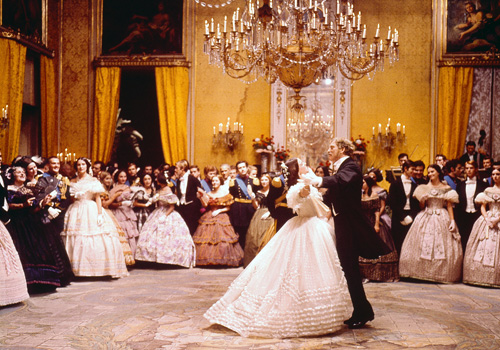
Luchino Visconti's direction is very fluid and mesmerizing in every scene he's shooting. From its wondrous, epic scope in the film's exterior settings in the country to the intimacy and atmosphere in the film’s interior sequences. Visconti's framing of the ball scene is wonderful in how he captures everything that goes on in the frame. The compositions later on are truly superb to capture the emotion of what is happening to the character of Fabrizio. The presentation and the way the dances are choreographed and capture show Visconti's talent in the directing front. The Don Diego ball sequence at forty-five minutes is truly mesmerizing with Visconti revealing everything that goes on. The result is truly a solid, engrossing, and certainly enchanting film that just doesn't stay true to the period but brings it to life in front of the audience.
Cinematographer Guiseppe Rotunno does amazing work with the film's look in its Technicolor, 35mm film stock with gorgeous coloring in every frame from the yellow, wheatfields in the countryside exteriors and hill tops on location in Sicily. Rotunno's camera work in the interiors with its use of day light for it sense of aura to the nighttime scenes in the interiors are filled with an array of color and richness that is exquisite in every frame shot. Rotunno's work is truly one of the film's highlights. Editor Mario Sarandrei does an excellent job in the transitional cuttings from scene to scene with the use of fade-outs and dissolves to help structure the story and most of all, maintain a meditative pacing style for the audience to get to know the characters and its surroundings.
Art director Mario Garbuglia along with set decorators Laudomia Hercolani and Giorgio Pes create exquisite interior set pieces for the homes that the character live in with authentic detailing of the furniture and silk for the look of the beds and such. The art direction in this film is truly divine for its attention to detail of the period of the mid-1800s in Italy. The costume design of Piero Tosi is just gorgeous to look at for its attention to detail and the sense of fluidity to the period. Notably in the ball scene where the dresses the women wear are jaw-droppingly beautiful for its coloring and stitching that is another highlight in its technical work. The music score of Nino Rota is truly mesmerizing from its sweeping arrangements, somber melodies, and orchestral power. The score is truly one of Rota's best work as he also arranged an old composition by Guiseppe Verdi in the waltz sequence as Rota's work is really one of the film's most memorable moments.
The casting of the film is superb with notable small performances from Howard Nelson Rubien as Don Diego, Ivo Garrani as Colonel Pallavicino, and Pierre Clementi as Fabrizio's son Francesco Paolo. Mario Girotti aka Terrence Hill is wonderfully dashing as the charming Count Cavriaghi who tries to woo Concetta with little success. Leslie French is great as Cavaliere Chevelley who tries to help out Fabrizio in his upcoming role while being clueless to his metaphorical line about his role and the world. Serge Reggiani is excellent as the loyal Don Ciccio who tries to warn Fabrizio about Sedara as he's forced to watch in horror the deal Fabrizio makes. Rina Morelli is good as Fabrizio's wife and princess who is trying to deal with the changes while being distraught towards Tancredi's rejection over her daughter Concetta. Paolo Stoppa is great as the scheming Don Sedara who hopes to gain everything from his deal despite his lack of manners and taste.
Romolo Valli is brilliant in his role as Father Pirrone, Fabrizio's spiritual guide who is one of the few trusted allies Fabrizio has while also wanting to speak matters of the heart when he wants some confessions from Fabrizio. Lucilla Morlacchi is excellent as Concetta, Fabrizio's eldest daughter who has fallen for her cousin Tancredi only to become cold by his rejection and his changing persona as she becomes bored by her own surroundings. Claudia Cardinale is superb in her role as Angelica, a beautiful woman who is touched by the kindness of Fabrizio while being aware of Concetta's feelings for Tancredi. Cardinale's sincere performance is lovely to watch, especially in her waltz with Burt Lancaster that shows how compassionate her character is to the man who is about to leave the world. Alain Delon is great as the charming Tancredi, a young man whose youthful ideals and enthusiasm is met with great love by his uncle despite his opinions. Yet, when he trades one faction for another, it becomes clear that he's merely a follower who is willing to try and maintain a position of power no matter where it comes from. It's a truly amazing performance from the French actor in his glory days in the early 1960s.
Finally, there's Burt Lancaster in what is truly one of his best performances in his legendary career. Lancaster's understated, world-weary performance is definitely one for the ages. Though in its full, uncut 185-minute Italian version, his performance is dubbed by another actor. Lancaster makes the most of it with his restraint and glorious presence as a prince who is trying to adapt to the changing time. Lancaster is most touching when he's not speaking or doing anything as he delves into all the emotions into what he's losing. It's a truly mesmerizing and powerful performance from the late yet legendary actor who even at the height of his fame is willing to take risks as an actor.
***The Following is DVD Content Relating to Il Gattopardo that was Written & Added on 11/2/10***
The 2004 3-disc Region 1 Criterion Collection DVD for Il Gattopardo presents the film in its two different versions in its two different discs. The first disc is the definitive 185-minute cut of the film with a new high-digital transfer that is supervised by the film’s cinematographer Giuseppe Rotunno. The film is also is presented with the its original Super Technirama letterboxed/widescreen aspect ratio of 2:21:1 along with restored sound and image. The first disc also includes a new English subtitle translation and a full-length commentary track by film scholar Peter Cowie.
Cowie’s commentary reflects on many of the film’s themes, its historical setting, and on the life of Luchino Visconti. Cowie also discusses what scenes were cut from the original film for the U.S. release which also included scenes where Don Fabrizio and Don Ciccio at the hunting scene is shortened in the America version along with a scene where Father Pirrone is talking about faith at an inn. Cowie reveals Visconti’s own background as he grew up in an aristocratic family where during his time in Paris, he met Coco Chanel. This would later him get some work for Jean Renoir where Renoir taught him the world of films. Cowie says that during the early 60s, the most important Italian directors at that time were Visconti, Michelangelo Antonioni, Vittorio de Sica, and Federico Fellini.
Cowie also revealed that despite the fact that Burt Lancaster was the bigger star, Alain Delon was the only actor who got his own private dressing room which seemed insulting. Though Lancaster remained professional throughout the film despite not speaking Italian with the rest of the cast. Cowie also dwells on Claudia Cardinale, who was becoming one of Italy’s premier actresses at that time as she was breaking out internationally thanks to this film along with Fellini’s 8 ½. The work of cinematographer Giuseppe Rotunno is widely discussed as he became a prominent cinematographer for the Italian industry, and a regular collaborator of Visconti.
For many of the historical aspects about the film, Cowie believes that the period of Italian reunification of the 1860s would spark the groundwork for the world of the Mafia in Sicily. Cowie also dwells on the music of Nino Rota during the ballroom scene. Even as he revealed that when worked with Francis Ford Coppola for a 2001 DVD release for The Godfather, they found audio tapes of Rota improvising various themes. Cowie also goes deep into the discussion of the characters in the film while revealing many of the film’s themes that involve Don Fabrizio. Cowie’s commentary is truly delightful and very informative with its relaxed and rhythmic tone.
The second disc of the DVD is filled with special features and documentaries relating to the film. The first is a one-hour making-of documentary called A Dying Breed: The Making of The Leopard. Featuring interviews with Claudia Cardinale, screenwriters Suso Cecchi D’Amico and Enrico Medioli, and cinematographer Giuseppe Rutunno, plus several others including the late American filmmaker Sydney Pollack. The six-part documentary recalls on everything that lead up to the making of the film and its release. The first part talks about the contrast of backgrounds between Luchino Visconti and Giuseppe Tomasi di Lampedusa. Even as some wondered if Visconti’s approach to the novel were too much since di Lampedusa died before the film ever came out. By the time it was in the adaptation stage, it was very difficult since Visconti’s take on the book was much different from di Lampedusa. Cut out of the story from the book were the last two chapters, the epilogues, where Visconti wanted to focus more on the Prince in his final moments for the third act of the film.
Even the characterization of Tancredi and Angelica were different from what they were in the book as Visconti wanted them to be a more joyful, loving couple unaware of what will happen to them. The casting of the film proved to be very difficult as they needed a big name to headline the film. After the idea of casting a Russian actor to play Don Fabrizio didn’t work, they went to Laurence Olivier to see if he could go for the part. The problem was that Olivier wasn’t available as producer Goffredo Lombardo made a real breakthrough in getting Burt Lancaster involved. Though Visconti didn’t initially liked the idea of Lancaster as Don Fabrizio, he reluctantly agreed to the casting as the relationship between Lancaster and Visconti didn’t start out well.
Yet, as the filming went on with Rutunno being the messenger for both men. Lancaster and Visconti became the best of friends until Visconti’s death as Pollack revealed that the film proved to be a real acting breakthrough for Lancaster. Even as Claudia Cardinale helped smooth out whatever issues Visconti and Lancaster had early on as she acted with Lancaster in English and with Alain Delon in French. Cardinale had worked with Visconti in other film as did Delon as they were able to help things move quite seamlessly. With the actors cast, production was set as costume designer Piero Tosi talked about the design of the costumes. Notably the look of the soldiers where they wore early versions of blue jeans as their uniform while Rutunno and art director Mario Garbuglia talk about the look of Sicily and locations which were difficult to find.
Once the locations were found, Garbuglia and Rutunno went to great detail to recreate the interior designs of the home from the way it should be lit to the look of the walls. For the ballroom sequence, it was a very difficult shoot due to the fact that there were several mirrors inside of the rooms. Yet, Rutunno and Visconti were able to find ways to get the camera angles without the mirror showing the camera. Tosi also talked about the costumes, notably the dress that Claudia Cardinale had to wear which was difficult to make. Cardinale recalled the one thing she didn’t like about wearing the dress was the corset because it was half her size.
The fifth part of the documentary discusses about Visconti’s personality and his approach to making films. Garbuglia and Tosi revealed that despite having a bad temper, Visconti was caring towards his collaborators and actors. Cardinale also recalled about guiding her during her first dinner scene and got her to laugh in such a way. The final part of the documentary recalls the American release where the people involved the film revealed how the Americans got it wrong. Even as they had trouble with Visconti, who didn’t speak English and wasn’t very kind with the American producers at 20th Century Fox. While Burt Lancaster was involved by dubbing his own voice with Sydney Pollack directing Lancaster during the syncing. Pollack confesses that the American version of the film was lousy. While he revealed that Lancaster ranked the film as his best role, the only qualm Lancaster had was that in the definitive version. It wasn’t his voice while Pollack contended that it was the silent moments and graceful movements that gives reasons into why it’s one of Lancaster’s greatest roles of his career.
The second big feature is a 20-minute interview with producer Goffredo Lombardo. Lombardo discusses about getting the film made because of the novel’s popularity as he went through early developments for the film until getting Luchino Visconti attached to the project. Lombardo was responsible for getting Burt Lancaster involved as he had a hard time trying to talk to American producers, who treated the Italian producers with indifference. Lancaster talked with Lombardo and decided to be involved after seeing a Visconti film called Rocco and His Brothers. Though he knew Visconti wasn’t a fan of Lancaster, a meeting in Rome with Lancaster changed things.
Lombardo also discussed the production of the film as well as its release. The reception for the film was good but in the way the film has been received many years later as a classic. Lombardo also revealed that the film came out during a troubled period for Italian cinema because of a financial crisis. Lombardo ends the interview talking about the idea of the DVD as he believes it’s a great thing so that it can be seen by people at their home.
The third and final big special feature is a fourteen-minute video interview with University of Pennsylvania professor Millicent Marcus about the Risorgimento period in Italy during the 19th Century. Marcus revealed that the fall of the Roman Empire led to a separation of Italy where various sections of the country were run by different countries. By the 1800s, there was a movement to reunify the country which finally happened in the mid-1800s. Marcus revealed that the character of Chevelley was based on Camillo Benso, one of the leading figures of the Risorgimento. Marcus talks about Giuseppe Garibaldi, a military figure who helped lead many battles that would lead to Italy’s reunification as Marcus reveals that he was seen as a romantic hero.
Marcus talks about the battle of Palermo, which was the big battle scene in the film as she talked about everything that was happening in that scene. Even as it relates to the character of Tancredi where the battle would have a major effect on his views. He starts out being a member of the revolution and then becomes part of the anti-revolution. The Risorgimento was viewed as a failure because of power plays involving politics though there was an eventual reunification of the country though the real winner was the middle class. Not the revolutionaries nor the aristocracy. Marcus also talks about the idea of revolution in its various meanings while her last statement revolves around Don Fabrizio’s love of astronomy about how things would often go back.
Additional special features include a stills gallery that features rare pictures of Visconti on set, film posters, and scenes that didn’t make it to the final film or were in the original 205-minute cut of the film. Also included in the promotional section of the special features are three trailers. The original Italian trailer and two American trailers, the first of which featured Burt Lancaster presenting the trailer. Finally, there’s two Italian newsreels that relates to the premieres of Il Gattopardo in Rome, where it was also an award ceremony for some of the finest in the Italian film industry including the film’s producer Goffredo Lombardo as well as Dino de Laurentiis and actress Gina Lollobrigida.
The third disc of the DVD is a remastered transfer of the 161-minute American release of the film from 20th Century Fox. The film is presented in the widescreen aspect ratio of 2:35:1 with a remastered sound as it features the voices of Burt Lancaster and Leslie French in their respective roles as Don Fabrizio and Chevelley. While the print of that version of the film does look great though doesn’t carry as much depth of field as the original did. It’s not a bad version of the film as the differences isn’t what was cut from the original film as the only thing added was a text that appears after the opening credits about the Risorgimento. The problem with the American version are in two factors. First is the dubbing which affects the performances as they don’t have the same sense of regality in the original.
Though there’s some moments where Lancaster is in great form as he dubs himself, the scenes where he displays some high emotions don’t seem right. The other issue in the film is that the pacing, in some parts of the film, is off where things move slower in some parts including the ballroom scene while other scenes, notably the sequence where Don Fabrizio and his family go to their summer home where the scene at the inn was cut along with another scene of Tancredi talking to some soldiers. It’s where some things become confusing because the audience has no idea what is happening. To compare it to the original version, it would be a decent, adequate film.
Accompanied with the Criterion DVD set is an essay by film historian Michael Wood about the film. Wood talks about the similarities between Visconti and novelist Giuseppe di Lampedusa. Even as they have a fascination with the history of Italy as they both came from different ideas of aristocracy. Wood also goes into the psychological aspects of the characters, notably Tancredi whose motivations are more to do with power as he’s unaware of the bleak future he and Angelica would have. Yet, Wood reveals that the film is about a man of the old order trying to find a place in a world that is rapidly changing as he would make his way towards death.
The 3-disc DVD for Il Gattopardo is definitely one of the Criterion Collection’s finest releases as audiences get a chance to see the film in its definitive version. Even as it includes the shorter, American version so audiences can see what 20th Century Fox did wrong though it’s not an entirely bad film. It’s truly a must-have DVD for film buffs and fans of great Italian cinema.
***End of DVD Tidbits***
When it first played in Italy in the spring of 1963 with a cut of 205-minutes, reviews were good though some complained about the length of the film. Visconti eventually trimmed twenty-minutes of the film for its premiere at the Cannes Film Festival which won the Palme D'or. Despite the success at Cannes, 20th Century Fox decided to release the film with a new cut of 161-minutes and dubbing that included Burt Lancaster's own voice for the American version. The American version received mixed reviews while the film by itself lost its stature with Lancaster often saying it's one of the best films he's done. For years, Il Gattopardo had been rarely seen in its full version as in 1980, four years after Luchino Visconti's death. The film's cinematographer Giuseppe Rotunno supervised a restored version of the 185-minute cut that Visconti preferred to cinemas all over the world. The film was immediately hailed as a lost classic while its uncut version was seen by Americans in California in the groundbreaking pay-cable channel known as Z Channel.
Luchino Visconti's Il Gattopardo in its 185-minute, Italian version is a magnificent film for the ages led by a masterful and sprawling performance by the legendary Burt Lancaster. Fans of Italian cinema no doubt consider this film as essential in its full glory while it's suggested to avoid the American version since it doesn't carry the same sense of prestige and beauty of its full Italian version. With great technical work from Guiseppe Rotunno, Piero Tosi, and Nino Rota along with super supporting performances from Alain Delon, Claudia Cardinale, Lucilla Morlacchi, and Romolo Valli. It's a must-see for fans of art-house cinema while traditional audiences should be patient for its pacing and epic scope. In the end, Luchino Visconti's Il Gattopardo is classic period-piece cinema at its finest.
© thevoid99 2017
Subscribe to:
Posts (Atom)