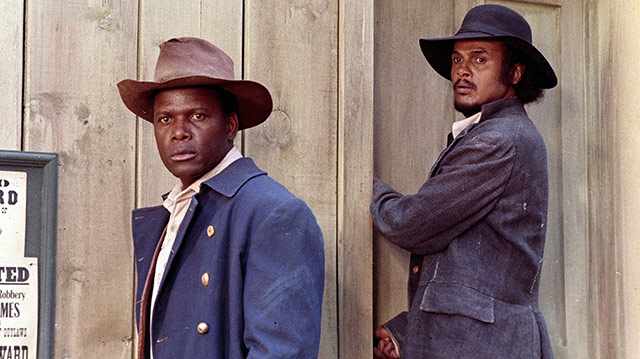
Set years following the events of the American Civil War, a wagon master who helps lead wagon trails to the West deals with white bounty hunters who are trying to get the former slaves back to the South where the wagon master in Buck teams up with a man known as the Preacher to deal with these evil forces. It is a film based on real-life events for African-Americans who decide to move west on a wagon trail of their own as they had to deal with white bounty hunters in an attempt to get things back the way they were. Ernest Kinoy’s screenplay play into these groups of African-American people on a wagon trail as they were former slaves who want to move to the West to find a new world yet they’re hired by former plantation owners to get them back to Louisiana in an attempt to restore the old ways. Many of these travelers turn to Buck, who is a former soldier, as he would help them in their travels yet has to deal with these men lead by Deshay (Cameron Mitchell) while a man in Reverend Willis Oaks Rutherford aka the Preacher is offered $500 to capture Buck yet he realizes what Buck is doing as he too would cause trouble for Deshay and others.
Even as African-American settlers would be ambushed with women and children being killed by Deshay and his men with money also stolen from them that they needed to buy seed, supplies, and other things they need for their journey with Buck being paid to help them reach their destination. The Preacher sees what is going on as he is reluctant to help Buck but is aware that the people are the ones in need of help as he and Buck would come up with ideas to not only get their money back but also ask the help of the Native Americans who have their own issues with the white men.
Sidney Poitier’s direction definitely has elements of style in the film while retaining many of the hallmarks expected in a western as it is shot on location in Durango, Mexico. Though it was initially helmed by Joseph Sargent who would then be replaced by Poitier a few days into production due to Sargent’s lack of understanding towards the African-American experience. Poitier would infuse not just a lot of the imagery of African-Americans trying to go into the West to find a new home where there’s an old man in Cudjo (Clarence Muse) who would perform old magic with bones to give him a message. It plays into this sense of danger that African-Americans had to deal with as a young woman in Sarah (Lynn Hamilton) had to hide dollar bills around her body from the white bounty hunters. Poitier doesn’t shy away from the severity of the violence though it isn’t graphic but rather the aftermath of wagons being burned and destroyed as well as tents and such where men are digging a hole to bury the bodies including a child. Poitier’s usage of close-ups and medium shots don’t just add to the suspense and drama but also the desire of two men trying to think in how to deal with Deshay and his men that includes his young nephew Floyd (Denny Miller) as they’re both lawless, racist individuals.
Poitier also creates some unique wide shots as the locations are key to the story including some of the mountains, rivers, and valleys that the wagon trail and other characters venture into as well as small towns where Buck and the Preacher would concoct a plan with the aid of Buck’s wife Ruth (Ruby Dee) as it relates to getting the money Buck is owed as well as the money that was stolen from the wagon trail. Poitier does create some moral ambiguity for Buck and the Preacher though they don’t intend to kill innocent people nor do they want to cause trouble while a local sheriff (John Kelly) who wants to capture Buck and the Preacher for what they did as it relates to Deshay is someone who does uphold the law as he doesn’t like what Deshay and Floyd do in harassing African-Americans. The film’s climax is a shootout yet it is all about location and what Buck and the Preacher do to get the posse away from the wagon trail where Poitier doesn’t just get these great wide shots to showcase the point of view of where Buck and the Preacher are against this posse but also the Natives who watch from afar. Overall, Poitier crafts a gripping yet captivating film about a wagon master and a gun-slinging preacher trying to help their people reach a new world away from evil white racist bounty hunters.
Cinematographer Alex Phillips Jr. does brilliant work with the film’s cinematography with the opening usage of sepia-drenched filters for the film’s first few minutes to the vibrant colors of the daytime exterior settings and low-key lighting for the scenes at night. Editor Pembroke J. Herring does excellent work with the editing as it is largely straightforward with some rhythmic cuts for the action and some of the film’s comedic moments. Production designer Sydney Z. Litwack, with set decorators Ernest Carrasco and Ray Moyer, does fantastic work with the look of the tents and shacks that the settlers live in as well as the town that the white people mainly stay in. Costume designer Guy C. Verhille does terrific work with the costumes from the black suit and hat the Preacher wears to the ragged look of Buck. Sound mixer Tom Overton does superb work in capturing the sounds of gunfire, horses running from afar, and other natural sounds to help maintain a tense atmosphere for the film’s suspenseful moments. The film’s music by Benny Carter, with additional music from Sonny Terry and Brownie McGhee, is incredible for its offbeat score with elements of traditional folk and blues that is filled with some offbeat string instruments and other tidbits to play into not just the suspense and drama but also in some of the film’s humorous moments.
The casting by Billy Gordon is wonderful as it feature some notable small roles from Lynn Hamilton as a young woman in Sarah who helps hide the money for the freed slaves that she would carry around her body, Nita Talbot as a brothel madam in Madame Esther who would invite Deshay and his men for a good time only to get into some trouble of her own, John Kelly as a local sheriff who would go on the hunt for Buck and the Preacher for breaking the law yet wants no part of Deshay’s posse in killing African-Americans, Clarence Muse as an elderly African-American in Cudjo who uses old magic to get answers, James McEachin as a young African-American who turns to Buck for answers on what to do, Enrique Lucero as a Native American tribal chief who wants no trouble yet is fair to Buck, Julie Robinson Belafonte as a Native American woman who interprets for her chief as she helps relay the message for Buck and the Preacher, and Denny Miller as Deshay’s nephew Floyd who wants to help his uncle in turning the African-Americans back to South as he has little regard for the law.
Cameron Mitchell is excellent as Deshay as a bounty hunter who is hired by plantation owners to get former slaves back to the South as he sees it as a way back to the old ways while he is also aware of Buck whom he isn’t fond of. Ruby Dee is brilliant as Buck’s wife Ruth as a woman who is eager to go to Canada as she later takes part in Buck and the Preacher’s plan to rob a stationary/bank while also lamenting over Buck’s weariness in helping out the people. Finally, there’s the duo of Sidney Poitier and Harry Belafonte in tremendous leading performances in their respective titular roles with Poitier being this former soldier who leads a wagon trail as he deals with the dangers of the Wild West as well as Deshay where he also admits to being weary but is willing to do what he can. Belafonte brings a lot of charm and energy to his character as he often preaches the gospel while also bringing some back story about the clothes he wears as he is also someone that becomes aware of what is at stake as he helps out Buck. Poitier and Belafonte together are a joy to watch as they’re two different personalities all with the same goal as they also prove to be a duo that can’t be messed with.
Buck and the Preacher is a phenomenal film from Sidney Poitier that is led by the great performances of Poitier and Harry Belafonte. Along with its supporting ensemble cast that includes Ruby Dee plus, gorgeous visuals, a playful music soundtrack, and its exploration of post-American Civil War racial tension. It is a western that doesn’t just bear the elements that are crucial to the genre but also infuse it with the African-American struggle as well as bringing voice to those people who just wanted a new home. In the end, Buck and the Preacher is a sensational film from Sidney Poitier.
Sidney Poitier Films: (A Warm December) – (Uptown Saturday Night) – (Let’s Do It Again) – (A Piece of the Action) – (Stir Crazy) – (Hanky Panky (1982 film)) – (Fast Forward) – (Ghost Dad)
© thevoid99 2023
Based on the autobiographical novel Black Klansman by Ron Stallworth, BlacKkKlansman is the real-life story about detective Ron Stallworth who manages to infiltrate a local chapter of the Ku Klux Klan with the help of a white detective as its face. Directed by Spike Lee and screenplay by Lee, David Rabinowitz, Charles Wachtel, and Kevin Willmott, the film is a look into how an African-American detective in Colorado somehow infiltrated a local chapter of the white supremacist group and eventually be a head of one of its chapters with John David Washington starring in the role of Stallworth Also starring Adam Driver, Laura Harrier, Topher Grace, Corey Hawkins, Robert John Burke, Harry Belafonte, and Alec Baldwin as Dr. Kennebrew Beaureguard. BlacKkKlansman is a rapturous and witty film from Spike Lee.
Set in 1972, the film is about the real-life story of rookie cop Ron Stallworth who becomes the first African-American officer to work for the local precinct at Colorado Springs, Colorado where he would move up to intelligence where he finds himself making contact with a local chapter of the Ku Klux Klan. It’s a film that play into this man who would find himself be part of the notorious white supremacist group as he and another undercover officer in Flip Zimmerman (Adam Driver) would both play this man wanting to join the KKK in Stallworth’s name. The film’s screenplay does take a few dramatic liberties as the real-life events took place in 1979 yet given the context of the times and the struggle for black identity in the early 1970s. The script does play into this tension that is looming with Stallworth in the middle as a man who just wants to be a good cop and protect all kinds of people.
While he would encounter some racism from a fellow cop who likes to bust other African-Americans in Colorado Springs, Stallworth knows when to not say anything as he is given an opportunity to make a difference in the local precinct. While he knows when to keep his mouth shut, Stallworth would eventually get some serious work as an undercover officer where he first attends a student rally where civil rights leader Kwame Ture (Corey Hawkins) was speaking to see if Ture is planning something that could cause trouble. Stallworth would get his first serious assignment when he answers an ad from the Ku Klux Klan where he talks in a Caucasian accent as he would fool several leaders but knows that he needs a white face to get in. Zimmerman does it despite the fact that he’s Jewish as he takes Stallworth’s name as he would meet the local chapter’s leader Walter Breachway (Ryan Eggold) as well as the psychotic Felix Kendrickson (Jasper Paakkonen). Through their frequent contacts, Stallworth would eventually get to chat on the phone with KKK’s grand wizard in David Duke (Topher Grace).
Much of the film’s second and third act has Stallworth and Zimmerman play as the former to the meetings with the latter having to attend meetings and at shooting ranges as well as the ceremony during the film’s third act. The film does have elements of humor in some of the dialogue as the script doesn’t just play into this idea of how idiotic some of the people in the KKK are but also how it parallels with events that are happening in the 21st Century including this rhetoric of making America great again. It would play into a moment in the film as its climax involves Duke’s appearance at this event but also plans to disrupt an event nearby held by Colorado College’s black student union president Patrice Dumas (Laura Harrier) whom Stallworth is embarking on a relationship with.
Spike Lee’s direction is gripping for the way he plays up this idea of white power as it opens with a scene of Dr. Kennebrew Beaureguard making a scientific explanation about the dangers of racial integration while using images from films like Gone with the Wind and Birth of a Nation as examples as it would inspire these ideas of white supremacy with African-Americans, Jews, and other racial/ethnic groups as inferior. Shot on location in Ossining, New York as Colorado Springs with some exteriors shot at Colorado Springs, Colorado, the film does play into this small town that is like any other town in America but with this undercurrent of rampant racism that is emerging. Lee would use some wide shots for the locations but also create something that is also intimate with the medium shots and close-ups. Even in some striking compositions and stylistic shots in the way he play into people meeting with one another as well as some of the humor that is created in scenes that has Stallworth talking the KKK on the phone as if he wants to join.
Lee’s direction also play up into the idea of Blaxploitation as an idea of African-American identity as well as the fascination of African-American culture from a few of Stallworth’s colleagues including Zimmerman who is a big fan of Willie Mays. While the character of Dumas is someone who has legit reasons for her disdain for cops, she is forced to listen to reason from Stallworth as well as be aware that not all white cops are bad. Especially as someone like Zimmerman has to listen to anti-Semitic rhetoric from Kendrickson and take it though Zimmerman admits to not acting Jewish or practicing Judaism yet does feel the need to stand up to this idea of hate. The film’s climax is unique in the way Lee presents these two different meetings where one involves the KKK and the other meeting involving black students as there’s a great contrast to how they conduct themselves and such.
The film does have an epilogue as it relates to the KKK and how it’s managed to transform into something bigger and more dangerous where despite Stallworth’s effort to make fools out of them and reveal what they’re about. Little has changed with more now trying to stop this idea of hate and bigotry from a group of people who have nothing good to offer to the world. Overall, Lee creates an entertaining yet gripping film about an African-American police officer who would find his way into the Ku Klux Klan and discover the inner-workings of the hateful organization.
Cinematographer Chayse Irvin does excellent work with the film’s cinematography as it emphasizes on low-key colors for many of the film’s interior and exterior settings with much of the former using some stylish lights to play into the look that is similar to 1970s cinema. Editor Barry Alexander Brown does brilliant work with the editing with its usage of jump-cuts, dissolves, and some split-screen cuts to play into Stallworth’s conversation with Duke on the phone as it help create some comic effects into their conversations. Production designer Curt Beech, with set decorator Cathy T. Marshall and art director Marci Mudd, does amazing work with the look of the police building interiors as well as some of the local places including the home of Kendrickson with his collection of guns and stuff including a lie detector machine as well as the look of the hall where Duke has his ceremony. Costume designer Marci Rodgers does fantastic work with the period costumes that is set in the 70s from the stylish look of Dumas and other students as well as the more ragged look that some of the KKK members wear aside from the KKK robes.
Hair stylist Shaun Perkins, along with makeup artists Janine JP Parrella and Yasmina Smith-Tyson, does wonderful work with the hairstyles and look of the characters as it play into the world of the 1970s including the look of David Duke in the 1970s with his mustache. Visual effects supervisor Randall Balsmeyer does terrific work with the visual effects as it is appears on a few set pieces including in the montage of close-ups during Ture’s speech. Sound editor Philip Stockton does superb work with the sound as it help play into the atmosphere of some of the meetings and rallies as well as some of the intense moments at Kendrickson’s home and in the film’s climax in how the meetings are presented. The film’s music by Terence Blanchard is incredible for its usage of jazz and funk with elements of soul as it help play into the times as it also includes an orchestral piece that play into the drama while music supervisor Rochelle Claerbaut provides a soundtrack that features an array of diverse music from Emerson, Lake, & Palmer, the Cornelius Brothers and Sister Rose, the Edwin Hawkins Singers, the Temptations, Looking Glass, and a traditional music piece performed by Prince.
The casting by Kim Coleman is great as it feature some notable small roles from Isiah Whitlock Jr. as an African-American official in Mr. Turrentine who works with the police to meet with Stallworth, Nicholas Turturro as a bomb maker named Walker, Frederick Weller as the racist cop Landers, Ashlie Atkinson as Kendrickson’s wife Connie who also hates African-Americans, Michael Buscemi as a cop in Jimmy Creek who helps out Stallworth and Zimmerman, Ken Garito as Sgt. Trapp whom Stallworth and Zimmerman report to as he gets a kick out of Stallworth’s conversations with Duke, and Robert John Burke as Chief Bridges as the Colorado Springs police chief who wants to ensure that Stallworth stays out of trouble as he wants to make sure things go well. The cameo appearances from Alec Baldwin and Harry Belafonte in their respective roles as Dr. Kennebrew Beaureguard and Jerome Turner are superb to play into some of the historical context in what is at stake as Baldwin’s performance is sort of played for laughs while Belafonte is more reserved in how he talks about what African-Americans endured after the Civil War with lynching being common in those days.
Ryan Eggold is terrific as Walter Breachway as the local chapter head of the KKK in Colorado Springs who would be the first to contact Stallworth unaware of his true identity as he’s a more level-headed person who wants nothing to go wrong. Paul Walter Hauser is fantastic as the dim-witted Ivanhoe as a KKK member who often says dumb things while always saying some unintentionally funny stuff. Jasper Paakkonen is excellent as Felix Kendrickson as a wildcard member of the KKK who is always suspicious of those who want to join the KKK as it’s a darkly comical performance that is full of energy and wit. Corey Hawkins is brilliant in his small role as civil rights activist Kwame Ture as a man who wants to help his community though he is aware of the police brutality that he and others are dealing with but also hoping to make some kind of change. Topher Grace is amazing as David Duke as the infamous Grand Wizard of the Ku Klux Klan who is trying to make the organization look friendlier but also has this dark idea of what he wants America to be like.
Laura Harrier is marvelous as Patrice Dumas as a student union president for Colorado College as she is trying to get people together to rally against some of the oppression other students face while starting to become less political upon meeting Stallworth as she shows a more human side. Adam Driver is incredible as Flip Zimmerman as a Jewish cop who becomes Stallworth’s face in his infiltration of the KKK where he gets a closer look to what he sees as well as be disturbed by its idea of hate. Finally, there’s John David Washington in a phenomenal breakthrough performance as Ron Stallworth as an African-American rookie cop who finds an ad from the KKK and ends up infiltrating the KKK via phone as it’s a charismatic and grounded performance where he provides some humor but also an idea of what is at stake for himself and everyone who just wants to bring good to the world.
BlacKkKlansman is a tremendous film from Spike Lee that features great performances from John David Washington, Adam Driver, Laura Harrier, and Topher Grace. Along with its ensemble cast, stylish visuals, compelling script, and an incredible music score and soundtrack. It’s a film that captures a moment in time when an African-American would find himself in an organization that provides hate and fear in the hope he can put a stop to them even if it’s something small despite the fact that it would escalate into something far worse. Notably as it’s a film that showcases what hate can bring and how a man is willing to put a stop to it for the good of the world. In the end, BlacKkKlansman is a magnificent film from Spike Lee.
Related: Birth of a Nation
Spike Lee Films: (She’s Gotta Have It) – (School Daze) – Doing the Right Thing - Mo' Better Blues - Jungle Fever - (Malcolm X) – Crooklyn - (Clockers) – (Girl 6) – (Get on the Bus) – 4 Little Girls - (He Got Game) – Freak - Summer of Sam - (The Original Kings of Comedy) – (Bamboozled) – (A Huey P. Newton Story) – 25th Hour - (Jim Brown: All-American) – (She Hate Me) – (Inside Man) – (When the Levees Broke: A Requiem in Four Acts) – (Miracle at St. Anna) – (Kobe Doin’ Work) – (Passing Strange) – (If God is Willing and Da Creek Don’t Rise) – (Red Hook Summer) – Bad 25 - Mike Tyson: The Undisputed Truth - (Oldboy (2013 film)) – (Da Blood of Jesus) – (Chiraq) – Michael Jackson's Journey from Motown to Off the Wall - Da 5 Bloods - (American Utopia)
© thevoid99 2018
Directed by Alex Gibney, Sinatra: All or Nothing at All is a two-part, four-plus hour documentary film about the life and career of Frank Sinatra through various archival footage and interviews from the man himself as well as those who knew him and biographers that wrote about Sinatra. Inter-cut with footage from Sinatra’s first retirement concert in 1971 in Los Angeles where he sings a selection of his iconic songs which serves as chapters to each part of his life. The film revels into the many highs and lows Sinatra endured as an entertainer and as a man. The result is a fascinating yet elegant film from Alex Gibney.
If there was one vocalist who was pretty much the standard bearer of the 20th Century, it was Frank Sinatra whose voice captured a generation where he was a heartthrob in late 1930s and 1940s into becoming the master crooner who would rule the charts from the 1950s and 1960s defying trends as well as cultivate a successful career in films where he would win an Oscar for Best Supporting Actor for the 1953 film From Here to Eternity. The documentary doesn’t just tell the story of Sinatra’s life but it is told through the songs that made him a legend as he performs them in his first retirement concert in 1971 that is shown through rare footage that hadn’t been seen for many years.
The film is split into two parts that intertwine with footage from the 1971 concert as the first half is about Sinatra’s early life as a child with Italian immigrant parents as well as his early triumphs as a singer where he was a teen heartthrob. The second half revolves around Sinatra in the 1950s after he won an Oscar and recovered from his late 1940s career decline where he would become very popular as well as having involvements with the Mafia and John F. Kennedy as well as his relationships with other women. Much of it isn’t just told through Sinatra’s own words but also from the view of friends and colleagues as it is collected through many archives and such that played into Sinatra’s life. Though there aren’t any real narrators in the film other than a few biographers, it does allow Sinatra’s life to be presented by many as well as display a man who was all sort of things yet remain a man that is from Hoboken, New Jersey.
Alex Gibney’s direction is quite simple where he and his editors Samuel D. Pollard, Ben Sozanski, and Anoosh Tertzakian, along with sound editor Alexa Zimmerman, Gibney compiles many archival interviews including a famous one in the 1960s with Walter Kronkite along with interviews from the late 70s and early 80s. With the aid of cinematographers Antonio Rossi and Samuel Painter along with visual effects supervisor Raul Ortega, they would recreate pictures and old stock footage to play into the impact Sinatra had not just in popular culture but also in American society. Even where he would have a reputation where it is flawed as it played into a man full of contradictions and such that makes him far more compelling.
Then there’s the music as the songs that are chosen to represent each part of his life play into who he is as a performer and why he’s never caught on into any trends where Mia Farrow reveal that singing something that is popular doesn’t mean anything to him if he can’t connect with it. It says a lot to the man as there’s clips of him performing with other acts including Elvis Presley where it represents the old guard passing the torch to the new generation where the two definitely show common ground when singing together. Even in moments that showcase that he is willing to sing at any place including a prison in Washington D.C. where it proves that despite the fact that he’s a womanizer and can be a dick sometimes. The man cares for the people and is willing to give them their times worth for a performance.
Sinatra: All or Nothing at All is a phenomenal documentary from Alex Gibney. The film is definitely not just a captivating portrait about one of the greatest entertainers that ever lived but also managed to show more of the man as just a man rather than the legend he’s known for. In the end, Sinatra: All or Nothing at All is a sensational film from Alex Gibney.
© thevoid99 2015