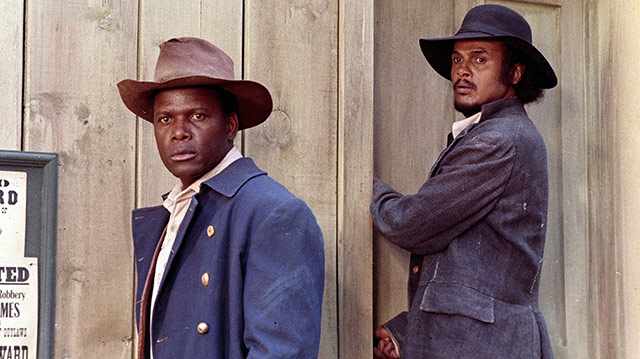
Set years following the events of the American Civil War, a wagon master who helps lead wagon trails to the West deals with white bounty hunters who are trying to get the former slaves back to the South where the wagon master in Buck teams up with a man known as the Preacher to deal with these evil forces. It is a film based on real-life events for African-Americans who decide to move west on a wagon trail of their own as they had to deal with white bounty hunters in an attempt to get things back the way they were. Ernest Kinoy’s screenplay play into these groups of African-American people on a wagon trail as they were former slaves who want to move to the West to find a new world yet they’re hired by former plantation owners to get them back to Louisiana in an attempt to restore the old ways. Many of these travelers turn to Buck, who is a former soldier, as he would help them in their travels yet has to deal with these men lead by Deshay (Cameron Mitchell) while a man in Reverend Willis Oaks Rutherford aka the Preacher is offered $500 to capture Buck yet he realizes what Buck is doing as he too would cause trouble for Deshay and others.
Even as African-American settlers would be ambushed with women and children being killed by Deshay and his men with money also stolen from them that they needed to buy seed, supplies, and other things they need for their journey with Buck being paid to help them reach their destination. The Preacher sees what is going on as he is reluctant to help Buck but is aware that the people are the ones in need of help as he and Buck would come up with ideas to not only get their money back but also ask the help of the Native Americans who have their own issues with the white men.
Sidney Poitier’s direction definitely has elements of style in the film while retaining many of the hallmarks expected in a western as it is shot on location in Durango, Mexico. Though it was initially helmed by Joseph Sargent who would then be replaced by Poitier a few days into production due to Sargent’s lack of understanding towards the African-American experience. Poitier would infuse not just a lot of the imagery of African-Americans trying to go into the West to find a new home where there’s an old man in Cudjo (Clarence Muse) who would perform old magic with bones to give him a message. It plays into this sense of danger that African-Americans had to deal with as a young woman in Sarah (Lynn Hamilton) had to hide dollar bills around her body from the white bounty hunters. Poitier doesn’t shy away from the severity of the violence though it isn’t graphic but rather the aftermath of wagons being burned and destroyed as well as tents and such where men are digging a hole to bury the bodies including a child. Poitier’s usage of close-ups and medium shots don’t just add to the suspense and drama but also the desire of two men trying to think in how to deal with Deshay and his men that includes his young nephew Floyd (Denny Miller) as they’re both lawless, racist individuals.
Poitier also creates some unique wide shots as the locations are key to the story including some of the mountains, rivers, and valleys that the wagon trail and other characters venture into as well as small towns where Buck and the Preacher would concoct a plan with the aid of Buck’s wife Ruth (Ruby Dee) as it relates to getting the money Buck is owed as well as the money that was stolen from the wagon trail. Poitier does create some moral ambiguity for Buck and the Preacher though they don’t intend to kill innocent people nor do they want to cause trouble while a local sheriff (John Kelly) who wants to capture Buck and the Preacher for what they did as it relates to Deshay is someone who does uphold the law as he doesn’t like what Deshay and Floyd do in harassing African-Americans. The film’s climax is a shootout yet it is all about location and what Buck and the Preacher do to get the posse away from the wagon trail where Poitier doesn’t just get these great wide shots to showcase the point of view of where Buck and the Preacher are against this posse but also the Natives who watch from afar. Overall, Poitier crafts a gripping yet captivating film about a wagon master and a gun-slinging preacher trying to help their people reach a new world away from evil white racist bounty hunters.
Cinematographer Alex Phillips Jr. does brilliant work with the film’s cinematography with the opening usage of sepia-drenched filters for the film’s first few minutes to the vibrant colors of the daytime exterior settings and low-key lighting for the scenes at night. Editor Pembroke J. Herring does excellent work with the editing as it is largely straightforward with some rhythmic cuts for the action and some of the film’s comedic moments. Production designer Sydney Z. Litwack, with set decorators Ernest Carrasco and Ray Moyer, does fantastic work with the look of the tents and shacks that the settlers live in as well as the town that the white people mainly stay in. Costume designer Guy C. Verhille does terrific work with the costumes from the black suit and hat the Preacher wears to the ragged look of Buck. Sound mixer Tom Overton does superb work in capturing the sounds of gunfire, horses running from afar, and other natural sounds to help maintain a tense atmosphere for the film’s suspenseful moments. The film’s music by Benny Carter, with additional music from Sonny Terry and Brownie McGhee, is incredible for its offbeat score with elements of traditional folk and blues that is filled with some offbeat string instruments and other tidbits to play into not just the suspense and drama but also in some of the film’s humorous moments.
The casting by Billy Gordon is wonderful as it feature some notable small roles from Lynn Hamilton as a young woman in Sarah who helps hide the money for the freed slaves that she would carry around her body, Nita Talbot as a brothel madam in Madame Esther who would invite Deshay and his men for a good time only to get into some trouble of her own, John Kelly as a local sheriff who would go on the hunt for Buck and the Preacher for breaking the law yet wants no part of Deshay’s posse in killing African-Americans, Clarence Muse as an elderly African-American in Cudjo who uses old magic to get answers, James McEachin as a young African-American who turns to Buck for answers on what to do, Enrique Lucero as a Native American tribal chief who wants no trouble yet is fair to Buck, Julie Robinson Belafonte as a Native American woman who interprets for her chief as she helps relay the message for Buck and the Preacher, and Denny Miller as Deshay’s nephew Floyd who wants to help his uncle in turning the African-Americans back to South as he has little regard for the law.
Cameron Mitchell is excellent as Deshay as a bounty hunter who is hired by plantation owners to get former slaves back to the South as he sees it as a way back to the old ways while he is also aware of Buck whom he isn’t fond of. Ruby Dee is brilliant as Buck’s wife Ruth as a woman who is eager to go to Canada as she later takes part in Buck and the Preacher’s plan to rob a stationary/bank while also lamenting over Buck’s weariness in helping out the people. Finally, there’s the duo of Sidney Poitier and Harry Belafonte in tremendous leading performances in their respective titular roles with Poitier being this former soldier who leads a wagon trail as he deals with the dangers of the Wild West as well as Deshay where he also admits to being weary but is willing to do what he can. Belafonte brings a lot of charm and energy to his character as he often preaches the gospel while also bringing some back story about the clothes he wears as he is also someone that becomes aware of what is at stake as he helps out Buck. Poitier and Belafonte together are a joy to watch as they’re two different personalities all with the same goal as they also prove to be a duo that can’t be messed with.
Buck and the Preacher is a phenomenal film from Sidney Poitier that is led by the great performances of Poitier and Harry Belafonte. Along with its supporting ensemble cast that includes Ruby Dee plus, gorgeous visuals, a playful music soundtrack, and its exploration of post-American Civil War racial tension. It is a western that doesn’t just bear the elements that are crucial to the genre but also infuse it with the African-American struggle as well as bringing voice to those people who just wanted a new home. In the end, Buck and the Preacher is a sensational film from Sidney Poitier.
Sidney Poitier Films: (A Warm December) – (Uptown Saturday Night) – (Let’s Do It Again) – (A Piece of the Action) – (Stir Crazy) – (Hanky Panky (1982 film)) – (Fast Forward) – (Ghost Dad)
© thevoid99 2023
Directed by Samuel Fuller and screenplay by Harry Kleiner with additional dialogue by Fuller, House of Bamboo is the story of an American military official who goes to Japan to learn about a former GI who has formed a gang with former soldiers and Japanese locals to steal weapons and such from the military. A loose remake of The Street with No Name that was co-written by Kleiner, the film is a noir-inspired film set in the world of American bases in Japan following the post-war years as it play into corruption from the military and a man trying to comprehend what is going on. Starring Robert Ryan, Robert Stack, Shirley Yamaguchi, and Cameron Mitchell. House of Bamboo is a riveting and compelling film from Samuel Fuller.
The film explores a series of incidents that involve the robbery of military weapons, ammunition, and smoke bombs that belonged to the U.S. army as well as the death of a few American soldiers prompting an undercover military official to go to Japan and infiltrate this gang led by a former GI. It’s a film that has a man hired by the U.S. army after a thief had been killed by one of the men in the gang as he is revealed to have married a Japanese woman who reluctantly agrees to help the undercover agent. Harry Kleiner’s screenplay that would feature additional dialogue by Samuel Fuller is an exploration of a man trying to figure out what this outfit led by this American GI and other Americans with Japanese locals wanting to make lots of money as much of the motives from its leader Sandy Dawson (Robert Ryan) who was dishonorably discharged from the U.S. military and wants to stick it to the U.S. army and Japanese authorities.
Dawson’s actions forced the Army to bring in Eddie Spanier (Robert Stack) who had just been released from prison to infiltrate Dawson’s gang since Spanier was a friend of a man who was killed by one of Dawson’s men during a botched heist. Spanier would get into contact with the Japanese wife of one of the thieves who was killed during the botched heist in Mariko (Shirley Yamaguchi) as she is reluctant to help but wants to know who killed her husband and why as they form a relationship of sorts despite the fact that interracial marriages/relationships remain taboo from both the Americans and Japanese. Even as Mariko makes some chilling discoveries that would have her help Spanier as well as uncover some dark truths into Dawson’s criminal empire.
Fuller’s direction is definitely wondrous in not just capturing post-war Japan life through the gorgeous usage of the Cinemascope as it captures the growing prosperity of the country as it is shot on locations in Tokyo, Yokohama, and various countryside areas. In wanting to get a sense of realism in the film and to capture post-war life, Fuller would use hidden cameras with wide and medium shots to get a glimpse of this life in Japan where people go into parks, temples, and anywhere else in the cities. Fuller would also showcase a world where there is still this post-war tension between the Americans and Japanese as it relates to how some the locals react towards Americans though American military officials and Japanese police officers try to maintain a sense of peace despite Dawson’s activities where it’s only the Japanese workers that are often injured in these heists unless guns are involved as they get killed. Fuller also maintains an intimacy in the medium shots and close-ups as it relates to Spanier and his growing friendship with Mariko that also include Mariko’s approach to creating poached eggs.
Fuller would also use crane and wide shots to get a scope of the locations as well as in some of the compositions that relate to the drama and suspense. Fuller also play into this air of taboo in how Japanese react to one of their own such as Mariko for her time with Spanier as if she had done something really offensive and dishonorable. Yet, Fuller show that Dawson is way crueler than the locals while he and a few of people in the gang will kill their own over something wrong as Spanier becomes concerned with Dawson’s increasing paranoia. The film’s third act has Fuller definitely take great usage of the locations in Tokyo as well as this attention to detail in the street corners as well as a rooftop theme park where Fuller creates some unique compositions and suspense to play into the intensity of the showdown. Overall, Fuller crafts a gripping and thrilling film about a U.S. military officer infiltrating a gang of former American soldiers engaging themselves in thievery and corruption.
Cinematographer Joseph MacDonald does brilliant work with the film’s colorful cinematography with its usage of DeLuxe Color to capture the beauty of the Japanese locations as well as creating some unique interior lighting for the scenes set at night as it is a highlight of the film. Editor James B. Clark does excellent work with the editing as it is largely straightforward with some rhythmic cuts to play into the suspense. Art directors Addison Hehr and Lyle R. Wheeler, along with set decorators Stuart A. Reiss and Walter M. Scott, do amazing work with the look of Dawson’s lavish yet traditional Japanese home as well as the look of the home that Spanier would live in. The sound work of Harry M. Leonard and John D. Stack do fantastic work with the sound as it play into the atmosphere of the locations as well as the sounds of gunfire and smoke bombs. The film’s music by Leigh Harline is wonderful for its mixture of lush and bombastic orchestral music and traditional Japanese string music as it help play into the suspense and drama.
The film’s superb ensemble cast feature some notable small roles from Elko Hanabusa as a screaming Japanese woman in the film’s opening sequence, Sandro Giglio as a corrupt cop in Ceram, Biff Elliot as the wounded thief Webber who is also Mariko’s husband, Brad Dexter as the American official Captain Hanson whom Spanier reports to, Sessue Hayakawa as the Japanese police investigator Kitz who works with Hanson, and DeForest Kelley as one of Dawson’s top goons in Charlie. Cameron Mitchell is terrific as Dawson’s right-hand man Griff who is suspicious about Spanier as he is also ruthless towards those who screw things up during a heist.
Shirley Yamaguchi is amazing as Mariko as a Japanese woman who had married an American soldier only to die due to his involvement with Dawson as she is reluctant to help out Spanier while also learning more about Dawson as she becomes close to Spanier. Robert Stack is excellent as Eddie Spanier as a U.S. army official who goes undercover as he copes with his job while dealing with the corruption that Dawson has created while becoming close with Mariko whom he wants to protect. Finally, there’s Robert Ryan in an incredible performance as Sandy Dawson as a disgraced American soldier who teams up with Japanese locals and other disgraced American soldiers as a way to stick it to the army as well as make money.
House of Bamboo is a phenomenal film from Samuel Fuller that features great performances from Robert Ryan, Robert Stack, and Shirley Yamaguchi. Along with its gorgeous cinematography, wondrous music score, and its mixture of noir, suspense, and drama set in post-war Japan. It is a film that explores post-war Japan as relations with Americans remain tense with some wanting to create chaos and mistrust prompting a few to do what is right for both countries. In the end, House of Bamboo is a sensational film from Samuel Fuller.
Samuel Fuller Films: I Shot Jesse James - The Baron of Arizona - The Steel Helmet - Fixed Bayonets! - Park Row - Pickup on South Street - (Hell and High Water) - (China Gate) - Run of the Arrow - Forty Guns - Verboten! - The Crimson Kimono - Underworld U.S.A. - Merrill's Marauders - Shock Corridor - The Naked Kiss - (Shark!) - (Dead Pigeon on Beethoven Street) – The Big Red One - White Dog - (Thieves After Dark) - (Street of No Return) - (The Madonna and the Dragon)
© thevoid99 2020
Directed and co-edited by Orson Welles and written by Welles and Oja Kodar, The Other Side of the Wind is the story of the last day in the life of a filmmaker who is trying to complete his comeback film at a screening party. Shot from 1970 to 1976 sporadically, the film that was meant to be Welles’ return to narrative-based filmmaking is a satire of European cinema and New Hollywood as well the Hollywood of old in this multi-layered film that play into the struggles of a man trying to get back in the game. Starring John Huston, Oja Kodar, Bob Random, Peter Bogdanovich, Susan Strasberg, Lilli Palmer, Norman Foster, Edmond O’Brien, Mercedes McCambridge, Cameron Mitchell, Paul Stewart, Gregory Sierra, Tonio Stelwart, and Dan Tobin. The Other Side of the Wind is a rapturous and evocative film from Orson Welles.
Set in what would be a man’s last day, the film revolves a filmmaker trying to finish his film entitled The Other Side of the Wind as he would screen at his home for his 70th birthday which would also be a screening party. Surrounded by an entourage that includes his collaborators, a protégé, a documentary film crew, and many others, the man discusses the film and ponders if it will ever be seen to a wide audience. The film’s screenplay by Orson Welles and Oja Kodar does follow a straightforward narrative as it relates to the life of filmmaker J.J. “Jake” Hannaford (John Huston) whose career had been in decline as he’s trying to create a comeback through this film that would be shown as it relates to a young man who meets a mysterious woman as they fall in love and later follow her through a desert. Throughout the course of the film, Hannaford is having a party with this barrage of guests including filmmakers, film buffs, a documentary film crew, Hannaford’s collaborators, colleagues, the mute starlet (Oja Kodar), and film critic/journalist Juliette Riche (Susan Strasberg).
Yet, the one person that is missing which had complicated the final days of production is its star John Dale (Bob Random) whom Hannaford discovered in Acapulco when he saw Dale attempted suicide. Many wondered where Dale is while Hannaford is also trying to get funding to do more work in finishing the film as he even turns to his protégé in filmmaker Brooks Otterlake (Peter Bogdanovich) for help only for things to fall apart. Especially as those who are part of Hannaford’s entourage including collaborators and close friends try to figure out the man who is starting to unravel through alcohol while contemplating the idea of making a film that he could be proud of.
Welles’ direction is definitely stylized in terms of its presentation where it dwell into many ideas that was prevalent in the 1960s/1970s as it is shot mainly at a house in Phoenix, Arizona as Reseda, California, Beverly Hills at Peter Bogdanovich’s home, Connecticut, France at Welles’ own home, and other locations in Europe and Southwest America. The scenes of Hannaford being documented and having his party is shot in a mixture of black-and-white film stock and color as it’s presented in a 1:37:1 full-frame aspect ratio in a cinema verite style with a documentary film crew often being shown. There’s a looseness to the direction with its usage of hand-held cameras where Welles would play into the raucous atmosphere of the party while including moments of Hannaford’s entourage talking to each other with appearances from filmmakers wanting to meet Hannaford. There are also these moments through the editing by Welles, along with additional work by Bob Murawski in the 2017 edits that was overseen by Bogdanovich and producer Frank Marshall who was a unit production manager during its filming, which play to the chaos where Welles would create these rapid cuts for the conversations or make a strange transition of a footage shot in black-and-white to a shot in color.
The scenes of Hannaford’s film The Other Side of the Wind is presented in an entirely different aspect ratio in a widescreen format and in full color reminiscent of some of the European art-house films of the 1960s/1970s with Michelangelo Antonioni’s Zabriskie Point being the obvious influence. The usage of the wide shots would play into the striking compositions that play into this air of mystery relating to these two characters played by Random and Kodar as they never say a word in the film. The film The Other Side of the Wind that Hannaford is making has no plot as it is about these two people who meet, meet again at a club, have sex in a car, and then go into the desert for more sex and intrigue. It’s Welles playing up the pretentious elements of European cinema with its methodical approach to long shots and editing as well as the idea that there isn’t much to explain.
Welles would move back and forth into Hannaford’s party and clips of his film as it would deviate more into chaos as the party winds down where Welles’ usage of close-ups and medium shots add to the discomfort that is looming. Even in a moment that involves Hannaford shooting dummies mixed in with these moments of partying from the guests have this bizarre quality that is to represent the sense of loss and uncertainty in Hannaford in his final day. The film’s climax at this empty drive in where Hannaford shows his guest the last portion of his film is to represent a man desperate to show his film but also deal with his own identity as an artist and as a man. Overall, Welles crafts an abstract yet exhilarating about a man’s final day as he tries to show his film to numerous partygoers at his home.
Cinematographer Gary Graver does brilliant work with the film’s cinematography from the usage of black-and-white film stock to play into some of the elements of the party as well as scenes of characters talking at Hannaford’s home and at the drive-in while the usage of color is vibrant that is most notable in Hannaford’s film with its approach to naturalistic photography. Art director Polly Platt does amazing work with the decayed sets at Hannaford’s film including the club as well as some of the interiors at Hannaford’s home. Costume designer Vincent Marich does nice work with the costumes from the look of the characters in Hannaford’s film including their lack of clothing as well as the array of casual and stylish look of the people at Hannaford’s parties.
Visual effects supervisors Joe Ceballos, John Knoll, and Brian Meanley do terrific work with some of the film’s minimal visual effects as it appear in only a couple of sequences as it relates to some dummies on rocks and a small moment in the film’s finale. Sound editors Scott Millan and Daniel Saxlid do superb work with the sound in capturing all of the spoken dialogue in the film as well as providing a balanced mix by Millan who would also do much of the work from its 2017 post-production period. The film’s music by Michel Legrand is excellent for its jazz-based piano score with elements of somber brass arrangements and a few string-based arrangements as it adds to the sense of melancholia in the film while music supervisor Carter B. Smith help cultivate a music soundtrack that features some rock music as well as jazz and classical that appears in Hannaford’s film and at Hannaford’s home.
The film’s wonderful cast features appearances from filmmakers such as Dennis Hopper, Claude Chabrol, Paul Mazursky, Curtis Harrington, and Henry Jaglom as themselves along with a young Cameron Crowe, Rich Little, Stephane Audran, Les Moonves, Richard Wilson, and George Jessel as party guests. Other noteworthy small roles include Gene Clark as a film projectionist, Howard Grossman as Hannaford’s biographer Charles Higgam, Cathy Lucas as a young admirer of Hannaford in Mavis Henscher, Pat McMahon as the film journalist Marvin P. Fassbender, Geoffrey Land as film studio boss Max David who isn’t fond of what Hannaford has done, Dan Tobin as Dr. Bradley Pease Burroughs whose pupil is Hannaford’s leading man, Robert Aitken as the driver in Hannaford’s film, Tonio Stelwart as Hannaford’s business partner/screenwriter in the Baron, Paul Stewart as Hannaford’s personal assistant Matt Costello, and Gregory Sierra as screenwriter Jack Simon who believes that Hannaford is gay.
Cameron Mitchell and Mercedes McCambridge are terrific in their respective roles as Hannaford’s collaborators in makeup artist Matt “Zimmie” Zimmer and film editor Maggie Noonan who both deal with the craziness of the production with the former being someone often fired and rehired while the latter is more concerned about the final version of the film. Edmond O’Brien is superb as one of Hannaford’s cronies in Pat Mullins who always drinks and say weird things on a megaphone while Lilli Palmer is fantastic as retired actress Zarah Valeska who hosts Hannaford’s party as she talks to the documentary crew about Hannaford. Bob Random is fantastic as Hannaford’s leading man Oscar “John” Dale as a young man Hannaford discovered and cast him for the film only to walk out during production and never return. Oja Kodar is excellent as Hannaford’s unnamed leading lady as this mysterious woman who, like Dale, never speaks throughout the film as she is an object of desire but also something far more intriguing when she appears at the party.
Norman Foster is brilliant as a friend/former child actor of Hannaford who is also an apologist and defender trying to protect his friend’s reputation to a fault while Peter Bogdanovich is amazing as Hannaford’s protégé in filmmaker Brooks Otterlake as a man who worships Hannaford but becomes frustrated by his drinking and lack of progress forcing him to confront the man’s many faults. Susan Strasberg is incredible as film journalist/critic Juliette Riche as a woman who is trying to get some answers from Hannaford about his films as well as try to figure out his newest film which she is seeing for the first time like everyone else. Finally, there’s John Huston in a phenomenal performance as J.J. “Jake” Hannaford as a filmmaker living his final day trying to finish his comeback film and show it to the world while dealing with the lack of funds and support of the film as it’s Huston in one of his finest performance with additional voice-dubbing by his son in actor Danny Huston.
The Other Side of the Wind is a sensational film from Orson Welles. Featuring a great cast, a dazzling mixture of cinematic styles, bizarre mediations of identity and desire, and Michel Legrand’s sumptuous score. It’s a film that is offbeat in its presentation while also challenging in its approach to narrative and ideas about cinema itself. In the end, The Other Side of the Wind is a spectacular film from Orson Welles.
Orson Welles Films: Citizen Kane - The Magnificent Ambersons - The Stranger (1946 film) - The Lady from Shanghai - Macbeth (1948 film) - Othello (1952 film) - Mr. Arkadin - Touch of Evil - The Trial (1962 film) - Chimes at Midnight - The Immortal Story - F for Fake - Filming Othello
Related: Zabriskie Point - Orson Welles: The One-Man Band – The Eyes of Orson Welles - They’ll Love Me When I’m Dead - The Auteurs #69: Orson Welles: Part 1 - Part 2
© thevoid99 2018