Showing posts with label mickey rourke. Show all posts

Wednesday, September 27, 2017

The Pope of Greenwich Village


Based on the novel by Vincent Patrick, The Pope of Greenwich Village is the story of two cousins who decide to go into crime to help fund their dreams of owning and running a restaurant. Directed by Stuart Rosenberg and screenplay by Vincent Patrick, the film is an unconventional crime-drama that follows two men trying to do whatever they can to get money as well as go head-on into the world of crime. Starring Mickey Rourke, Eric Roberts, Darryl Hannah, Geraldine Page, Kenneth McMillan, Frank Vincent, M. Emmet Walsh, and Burt Young. The Pope of Greenwich Village is a witty and exhilarating film from Stuart Rosenberg.

The film follows two Italian-American cousins working and living at the Greenwich Village area of New York City as they dream of being successful and run their own restaurant where they go into the world to crime to fund that dream. It’s a film that is about two guys trying to do what they can yet they deal with so much adversity as well as the fact that one of them is a total screw-up and the other is cautious with a lot to deal with. Vincent Patrick’s screenplay explores the unique dynamic between Charlie (Mickey Rourke) and Paulie (Eric Roberts) as these two cousins who both want to succeed yet Charlie is someone that is trying to work hard and do things the right way. Paulie is a guy that likes to scheme and often put Charlie in trouble as the film begins with Charlie working as a maître d’ at a restaurant where Paulie is the waiter who gets Charlie in trouble and they both lose their job.

Paulie gets a tip about money stashed in a safe as he coerces Charlie to be involved as they’re joined by a locksmith/clock repairman in Barney (Kenneth McMillan) as their safecracker. The job succeeds except for an encounter with an undercover policeman (Jack Kehoe) that went wrong as Charlie then learns who the money belongs to which causes even more trouble. Adding to Charlie’s problems is that he is paying alimony to his ex-wife as they have a son and his girlfriend Diane (Daryl Hannah) is pregnant with his child as he is trying to do good things for her. Still, Charlie has a loyalty to Paulie which irks Diane since she knows that Paulie is an idiot and always find a way to mess things up. Even as Paulie would be confronted by hoods who work for the mobster Bed Bug Eddie (Burt Young) including Paulie’s Uncle Pete (Tony Musante) forcing Charlie to settle the matter.

Stuart Rosenberg’s direction does have bits of style yet much of it is straightforward as it is shot on location in New York City and in the Greenwich Village area with some of it shot in New Jersey. While Rosenberg would use a lot of wide shots that would create some unique compositions of the characters on a roof with certain city landmarks in the background. Much of the compositions Rosenberg creates are intimate with its close-ups and medium shots that includes a key meeting between detectives and the mother of the dead undercover officer as it’s a very chilling moment due to what happened to the undercover officer and his mother’s reaction. There are scenes of humor in the film yet much of it is dramatic with some stylish dialogue as it play into the environment of the film. Rosenberg’s direction also play into this world of the streets where it has its own rules and idea of justice as it’s something Charlie is fully aware of while Paulie is sort of ignorant about it thinking he can charm or bullshit his way out of a situation. The third act revolves around Paulie dealing with the consequences of who he stole the money from and the fallout of those consequences in which Charlie realizes what he has to do. Yet, there is a sense of conflict in Charlie in whether to help out someone that is family or to save himself. Overall, Rosenberg crafts a lively and engaging film about two cousins going to crime to fund their dream.

Cinematographer John Bailey does brilliant work with the film’s cinematography with the richness of some of the daytime exterior scenes as well as the usage of low-key lights for Bed Bug’s hideout in its interiors and the usage of lights for some of the scenes set at night. Editor Robert Brown does excellent work with the editing as it is largely straightforward to play into the drama and the few moments of suspense such as Paulie being confronted by his uncle. Production designer Paul Sylbert and set decorator George DeTitta Sr. do fantastic work with the look of the restaurant Charlie and Paulie work at in the film’s opening sequence as well as the former’s apartment and the place where Bed Bug works at.

Costume designer Joseph G. Aulisi does nice work with the costumes from the stylish suits that Charlie wears to some of the stylish clothes that Paulie wears. Sound mixer James Sabat does terrific work with the sound as it play into the atmosphere of some of the locations. The film’s music by Dave Grusin does amazing work with the film’s soundtrack as it’s a mixture of jazz and pop to play into the energy of Greenwich Village while music supervisor Harry V. Lojewski provide a fun soundtrack that mixes pop and jazz that include music from Frank Sinatra.

The casting by Bonnie Timmerman is superb as it feature some notable small roles from Joe Grifasi as Jimmy the Cheese Man, Philip Bosco as Paulie’s father, Val Avery and M. Emmet Walsh as a couple of detectives, Tony Musante as Paulie’s Uncle Pete, Jack Kehoe as the undercover detective Bunky, and Frank Vincent as Bed Bug’s crew chief. Geraldine Page is incredible in her brief two-scene performance as Bunky’s mother Mrs. Ritter as a woman who is wondering what her son is doing and later cope with the aftermath as it’s just a very powerful performance. Burt Young is fantastic as Bed Bug Eddie as a local mob hood who is trying to maintain some power in his turf while wanting to find out who stole his money. Kenneth McMillan is excellent as Barney as locksmith/clock repairman who helps Charlie and Paulie as their safecracker where he understand what is going on as well as becoming uneasy about who the money belonged to where he knows something is about to go wrong.

Daryl Hannah is brilliant as Diane as Charlie’s girlfriend who is concerned about what Charlie is doing as well as seeing if he can provide a future for both of them and their child that is on the way. Finally, there’s the duo of Mickey Rourke and Eric Roberts in phenomenal performances in their respective roles as the cousins Charlie and Paulie. Rourke provides a performance that is grounded while also having moments of anger and frustration into the obstacles he is given relating to his dreams of running his own restaurant and his relationship with Diane. Roberts’ performance is filled with charm and an energy that is insatiable to watch as someone that is often upbeat but also naïve about the ways of the world as Roberts is always fun to watch. Rourke and Roberts together have this chemistry that is powerful as well as having this sense of brotherhood as two guys who depend on each other no matter how fucked up one of them is.

The Pope of Greenwich Village is a remarkable film from Stuart Rosenberg that feature top-notch performances from Mickey Rourke and Eric Roberts. Along with its great supporting cast, riveting story, dazzling visuals, and a fun soundtrack, it’s a film that explore the folly of ambition and crime as well as two cousins trying to do whatever they can to reach their dream. In the end, The Pope of Greenwich Village is a sensational film from Stuart Rosenberg.

Stuart Rosenberg Films: (Murder Inc.) – (Question 7) – Cool Hand Luke - (The April Fools) – (Move (1970 film)) – (WUSA) – (Pocket Money) – (The Laughing Policeman) – (The Drowning Pool) – (Voyage of the Damned) – (Love and Bullets) – (The Amityville Horror) – (Brubaker) – (Let’s Get Harry) – (My Heroes Have Always Been Cowboys)

© thevoid99 2017

Saturday, July 05, 2014

Desperate Hours (1990 film)


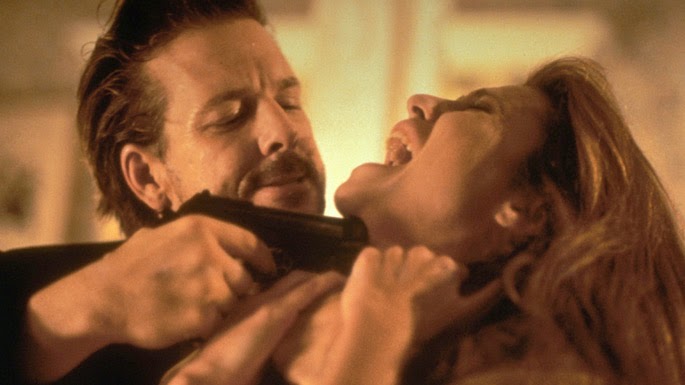
Based on the novel and play by Joseph Hayes, Desperate Hours is the story of an escaped criminal who breaks into a house and takes over while terrorizing a family with two of his friends. Directed by Michael Cimino with a screenplay by Hayes, Lawrence Konner, and Mark Rosenthal, the film is a remake of the 1955 film by William Wyler that starred Humphrey Bogart and Fredric March as it’s set in a more modern setting. Starring Mickey Rourke, Anthony Hopkins, Mimi Rogers, Kelly Lynch, Elias Koteas, David Morse, Shawnee Smith, Matt McGrath, Danny Gerard, and Lindsay Crouse. Desperate Hours is an eerie though somewhat uneven film from Michael Cimino.

The film is a home invasion story about an escaped criminal who hides out at the home of a man who has become estranged from his wife as they’re taken hostage at home. Yet, it’s a film about control and trust where the criminal Michael Bosworth (Mickey Rourke) is waiting for his lawyer/lover Nancy Breyers (Kelly Lynch) to be cleared from accusations that she was the one who broke him out of jail as he is being charged for all sorts of crimes. With the help of his brother Wally (Elias Koteas) and an unhinged, half-wit criminal Albert (David Morse), Bosworth would hide out at the home of Nora Cornell (Mimi Rogers) who is selling her home as she and her husband Tim (Anthony Hopkins) are estranged due to Tim’s infidelity with a young woman. Once Bosworth takes control of the Cornell home, he would instill elements of trust where Nora is more likely to trust Bosworth than Tim as it relates to her life and the life of their kids in the 15-year old May (Shawnee Smith) and the eight-year old Zack (Danny Gerard).

The film’s screenplay does take its time to explore a family being invaded by criminals where in control is this sociopath who is trying to make sure everything goes normal until he can flee with his girlfriend and associates with some money. Yet, the actions of Nancy Breyers only gets the attention of a very intelligent and no-nonsense FBI special agent in Brenda Chandler (Lindsay Crouse) who doesn’t buy Nancy’s act and knows where she’s going as she hopes to nab Bosworth. Though the script is pretty uneven as part of it is set at the Cornell home where Tim tries to reconcile with Nora only for things to go wrong with the Bosworth brothers and Albert taking over where Nora has trust issues with Tim. The other part of the script involves Chandler’s pursuit and watching over Nancy where it has this element of the road movie but it never really gels since Nancy is a very underwritten character who is just lovesick over Bosworth and is put into very tense situations. The scenes at the Cornell home is interesting where there is a sense of psychology as the family isn’t sure who to trust as Bosworth doesn’t try to hurt anyone while Tim tries to do something only to get himself into trouble.

Michael Cimino’s direction is pretty engaging for the way he conveys this element of suspense and dread inside a family’s home as it’s taken over by criminals. Especially as he maintains that sense of tense intimacy with some close-ups and unique medium shots where Cimino’s framing is always there to play into the drama as well as some of tension that goes on. The scenes outside of the Cornell home is shot in various locations in Utah where it plays into Cimino’s sensibilities in terms of the mountains, deserts, and such that does have this sense of beauty in the locations where Cimino is able to display them in a wide canvas. Yet, it adds to film’s uneven tone where it does feel like it’s two different films being made in some aspects though it would come together in a very intense third act. Especially as it becomes a battle of wits and trust where the FBI is also involved in Chandler who takes a more cautious but unconventional approach to let the fates play out. Overall despite a few inconsistencies in its tone, Cimino does craft a very captivating and solid thriller about a family’s home invaded by criminals.

Cinematographer Douglas Milsome does brilliant work with the film‘s cinematography with the gorgeous lighting for many of the daytime exteriors in the Utah desert/mountain locations to more ominous lighting schemes and such to play into the dramatic tension at the Cornell house. Editors Peter R. Hunt and Christopher Rouse do excellent work with the editing to create some methodical cuts to play into the film‘s suspense along with some rhythmic cuts for some of the car chase scenes involving Nancy and the FBI. Production designer Victoria Paul, with set decorator Crispian Sallis and art director Patricia Klawonn, does nice work with the look of the Cornell house to play into its sense of intimacy and the terror that Bosworth would bring.

Costume Charles DeCaro does terrific work with the costumes from the clothes of the Cornell family that is quite casual to the Armani suits that Bosworth wears. Sound editor James J. Klinger does superb work with the sound from the way the helicopters, planes, and cars sound in the exteriors to the intense atmosphere of the Cornell home as it has this air of terror in the film. The film’s music by David Mansfield is amazing for its soaring orchestral score to play into its suspense and drama along with some low-key pieces to showcase the estrangement between Tim and Nora.

The casting by Mary Colquhoun is wonderful as it features some notable small roles from James Rebhorn as a prosecutor, Matt McGrath as May’s boyfriend Kyle, Gerry Bamman as a real-estates agent, and Dean Norris as Chandler’s FBI associate Maddox. Shawnee Smith is alright as Tim and Nora’s teenage daughter May who tries to antagonize Bosworth and his gang while Danny Gerard is quite good as May’s younger brother Zack who deals with the terror of being taken hostage. Kelly Lynch is pretty terrible as Nancy Breyers where it’s not just the character that is terrible but Lynch never really does anything to make anyone care about her as she spends half the film topless and often be worried. Elias Koteas is terrific as Bosworth’s brother Wally who keeps things in control while trying to make sure that the family has nothing to worry about. David Morse is excellent as the more troubled criminal Albert who becomes anxious as he would later become a liability to the situation.

Lindsay Crouse is amazing as the no-nonsense FBI special agent Brenda Chandler who is this very offbeat character that talks in a Southern accent as she knows how to handle situations and can read people better than her fellow agents. Mimi Rogers is fantastic as Nora Cornell as this woman who becomes aware of the situation as she tries to keep things from not going wrong while being very unsure on who to trust. Anthony Hopkins is superb as the Tim Cornell as a man trying to regain his wife’s trust after cheating on her as he deals with Michael Bosworth’s presence and the situation that is happening as he is goaded to take action only to figure out what to do to not hurt his family. Finally, there’s Mickey Rouke in an incredible performance as Michael Bosworth as this very smart sociopath who takes control of an entire house as he tries to play a game of trust on Nora to turn against her own husband as it’s a very fiery and intense performance from Rourke.

While it is a film with some flaws and an inconsistent tone, Desperate Hours is still a solid film from Michael Cimino. Armed with great performances from Mickey Rourke, Anthony Hopkins, Mimi Rogers, and Lindsay Crouse. It’s a film that plays into the world of home invasion as well as a compelling look into the world of trust and guilt. In the end, Desperate Hours is a pretty good film from Michael Cimino.

Michael Cimino Films: Thunderbolt & Lightfoot - The Deer Hunter - Heaven’s Gate - Year of the Dragon - The Sicilian - The Sunchaser - To Each His Own Cinema: No Translation Needed - The Auteurs #35: Michael Cimino

© thevoid99 2014

Tuesday, June 10, 2014

Year of the Dragon


Based on the novel by Robert Daley, Year of the Dragon is the story of a troubled New York City police captain who goes on a personal war against the organized world of Chinese triad gangs. Directed by Michael Cimino and screenplay by Cimino and Oliver Stone, the film is a look into the world of gangs and culture clash as a former Vietnam War veteran turned police captain deals with his own prejudices and the rise of a Chinese crime lord. Starring Mickey Rourke, John Lone, Ariane Koizumi, and Raymond J. Barry. Year of the Dragon is a hard-hitting yet wild film from Michael Cimino.

Set in the Chinatown section in New York City, the film is about a police captain who goes to war with the Chinese triad gang in the hope he can end the chaos that is emerging in the section following the death of a revered triad leader. Yet, Captain Stanley White (Mickey Rourke) is a former Vietnam veteran with some very racist attitudes towards Asians as he wants to hit triads very hard as he also deals with the rising triad boss Joey Tai (John Lone). Tai wants to change things in the way the triads deal with other business ventures as he finds a formidable opponent in Captain White. Tai’s ambitions would eventually alienate the triad elders while Captain White’s determination would also drive away those he cared for such as his wife Connie (Caroline Kava) where he would engage into an affair with the Chinese-American news reporter Tracy Tzu (Ariane Koizumi). It’s not just a film about ambition as well as a new world order taking out the old rules but it’s also a film where a man’s obsession has him lose sight of the good things in the world.

The film’s screenplay by Michael Cimino and Oliver Stone isn’t afraid to be controversial as some of its dialogue includes some very racist words about Asians and other races. Particularly as it Captain White is a man who is a very flawed individual as he often neglects his wife in a marriage that becomes very rocky while he is also very arrogant and confrontational towards his superiors. In some ways, White is a guy that seems to have a death wish about stopping every bad Chinese triad member and everyone till there is no more only to drive away the people who care about him. Once he is confronted by people who work for him or those who care about him, there is a side of White that is very sensitive as he tries to come to terms with his flaws and wants to do what is right. It’s part of the script’s brilliance to showcase this conflict in White as he wants to hold on to those he cares but he also wants to fight the never-ending battle against corruption and evil.

Then there’s Joey Tai as he is a young man with ambition as he realizes that the old ways of the Chinese triads are becoming dated as he wants to expand and evolve much to the dismay of his uncles who have become overwhelmed with the emerging chaos in Chinatown as young gang members kill with no remorse. For Tai, it’s a chance to have the Chinese be the new leaders of the crime underworld and no longer take a backseat to the Italians who often treated the triads as second-class citizens. There is a bit of mutual respect between Tai and White as they’re two men who are very uncompromising in everything they do. They don’t care for rules or what it takes to get things done yet they both stand for different ideas as White is a man of the law and Tai is on the other side where a collision is going to happen. It’s a film that moves back-and-forth into these two men where neither would budge forcing those who had been at their side to watch from the sidelines. Even as those that White had often criticized would fight back with some strong words about not what the Chinese brought to the world but also how they’ve managed to survive no matter what troubles they’ve encountered including prejudice.

Cimino’s direction is truly mesmerizing not just for the use of the 2:35:1 widescreen aspect ratio to capture every attention to detail in the frame. It’s also a film that doesn’t pull punches in terms of its violence and action as it has elements of gangster films and crime dramas of the past. Particularly in the look of its main characters as White sort of models himself as a detective of the 1940s but with the ruggedness of the 1970s while Tai is a man that recalls a more classical look but with a more modern attitude. While it is set largely in New York City, much of the film is shot in Wilmington, North Carolina as it dresses the Chinatown section as a colorful yet troubled world that is teetering on the edge of collapse. Much of Cimino’s compositions includes a lot of medium shots yet he manages to fill in a lot of coverage with the aspect ratio to play into the action and drama.

Some of which include some gazing tracking shot and some dolly shots to play into the drama such as this hypnotic scene where Tracy looks at New York City from her window as she walking slowly to look at the morning view. Some of the scenes set in Thailand has Cimino employ some wide shots that recall some of the epic-scale filmmaking of the 1960s to display Tai’s ambition. The direction gets more intense in the third act when White and Tai go head on as it includes this very gripping climax where the two men finally go to war as it recalls bits of the western and the gangster film all rolled into one. Overall, Cimino crafts a very visceral yet unflinching film about a cop’s ruthless obsession to stop an ambitious man’s rise to the top of the world.

Cinematographer Alex Thomson does excellent work with the film‘s colorful cinematography from the lush look of red in some of the interior scenes set in Chinatown along with exotic lights for the scenes in Tracy‘s apartment while a lot of the exterior scenes set in New York are grimy as Thomson‘s work is among one of the film‘s highlights. Editor Francoise Bonnot, with additional work from Noelle Boisson, does brilliant work with the editing with its unpredictable rhythms to play into some of the film‘s action and violent scenes while keeping things more simple for its dramatic moments. Production designer Wolf Kroeger and art director Victoria Paul do amazing work with the set pieces from some of the look of Chinatown as well as Tracy’s apartment plus some of the places like a restaurant and other places in the film.

Costume designer Marietta Ciriello does fantastic work with the costumes from the clothes the men wear along with the stylish look of Tracy to showcase her somewhat-posh persona. Sound editor James J. Klinger does superb work with the sound from the way some of the crowd scenes are captured to the sound effects of gunplay and such that occurs in the film. The film’s music by David Mansfield is incredible for its eerie orchestral pieces along with some plaintive and somber themes that also include some intense, Asian-based score cuts while the music soundtrack includes a few classical pieces and some Chinese pop songs.

The casting by Joanna Merlin is phenomenal as it features some notable small roles from Eddie Jones as the police captain that White replaces, Leonard Termo as White’s associate during the investigation, Mark Hammer as the police commissioner, Paul Scaglione as an aging Mafia boss, Mei Sheng Fan as a Thai crime boss that Tai meets, Ming C. Lee as the triad boss that is assassinated early in the film, and Joey Chin as the wild assassin Ronnie Yung. Victor Wong is terrific as Tai’s uncle Harry who becomes the new leader only to step down out for Joey as he becomes overwhelmed with the chaos that is emerging. Dennis Dun is excellent as the Chinese rookie cop Herbert Kwong as this young man who reluctantly works for White while having this great monologue about the Chinese and their contributions to the world as a way to put White in his place. Caroline Kava is wonderful as White’s long-suffering wife Connie who becomes frustrated with being neglected as well as his obsession to fight as she ponders about the state of their marriage.

Raymond J. Barry is superb as White’s superior/friend Bukowski as he tries to maintain some peace between the police and the triad as well as to get White to see some sense over the chaos he’s created. Ariane Koizumi is pretty good as news reporter Tracy Tzu as this ambitious woman that covers the chaos of what is happening as she engages into an affair with White while being frustrated over his attitude. John Lone is brilliant as Joey Tai as this ambitious and ruthless young triad boss who wants to create a new world order for the Chinese triad while doing what it takes to survive. Finally, there’s Mickey Rourke in a tremendous performance as Captain Stanley White as this flawed yet determined man who wants to take down the crime underworld at any cost as it’s a performance that is full of charm, wit, and humor as well as be extremely intense and terrifying as Rourke’s scenes with Lone are just exciting to watch.

Year of the Dragon is a remarkable film from Michael Cimino. Thanks to the top-notch performances of Mickey Rourke and John Lone as well as Alex Thomson’s fluid camera work and the hypnotic score of David Mansfield. The film is definitely one of Cimino’s finest films in his otherwise troubled career as it includes a smart and unflinching script co-written with Oliver Stone. It’s also a film that explores the world of prejudices, ambition, and obsession as it isn’t afraid to get down and dirty. In the end, Year of the Dragon is an incredible film from Michael Cimino.

Michael Cimino Films: Thunderbolt and Lightfoot - The Deer Hunter - Heaven’s Gate - The Sicilian - Desperate Hours (1990 film) - The Sunchaser - To Each His Own Cinema-No Translation Needed - The Auteurs #35: Michael Cimino

© thevoid99 2014

Monday, November 12, 2012

Sin City


Originally Written and Posted at Epinions.com on 1/4/06 w/ Additional Edits


Based on Frank Miller's graphic novel series, Sin City is a collection of stories set in a dark seedy world featuring many of its players as they defy the law and do all sorts of dastardly deeds. Written for the screen, produced, and directed by Robert Rodriguez and Frank Miller with special guest director Quentin Tarantino, Sin City is a dark, violent, gritty film that pushes the limits of the film noir genre. Using the same, digital style of his Spy Kids films, Rodriguez goes a look that is similar to Miller's graphic novels. Starring Rodriguez/Tarantino regulars like Bruce Willis, Mickey Rourke, Josh Hartnett, Michael Madsen, Elijah Wood, and Carla Gugino plus Jessica Alba, Devon Aoki, Alexis Bledel, Rosario Dawson, Nick Stahl, Brittany Murphy, Jamie King, Marley Shelton, Rutger Hauer, Powers Boothe, Benicio del Toro, Clive Owen, and Michael Clarke Duncan. Sin City is a fast, powerful, in-your-face film that brings Frank Miller's vision to life.

It's a rainy night in Sin City as a mysterious man (Josh Hartnett) looks upon a woman (Marley Shelton) as she looks out on the rain. The mood sets for the night when a big, battered ex-convict named Marv (Mickey Rourke) is accused of killing a hooker he loved named Goldie (Jaime King). He escapes the cops as he flees into the home of his lesbian parole officer Lucille (Carla Gugino) for some pills. After stepping into the bar where dancing is a young stripper named Nancy (Jessica Alba) while a waitress named Shellie (Brittany Murphy) gives him a drink. Marv looks for answers on who killed Goldie as her twin Wendy is going after him. Marv goes to a farm where he finds a young, cannibalistic killer named Kevin (Elijah Wood) who works for the town's cardinal Roark (Rutger Hauer) whose brother (Powers Boothe) is a senator. After another escape from the cops, he turns to Wendy and her gang in the seedy section of Old Town as he gets help to seek vengeance on Goldie.

Meanwhile in that same bar, Shellie is trying to evade a violent madman named Jackie Boy (Benicio del Toro) who is trying to figure who is Shellie's new boyfriend who is a big man named Dwight (Clive Owen). Jackie Boy comes to her apartment where he meets Dwight and after a confrontation, Jackie Boy leaves as Dwight decides to go after him. Jackie Boy enters the world of Old Town which is run by venomous hookers led by the sexy Gail which includes the innocent Becky (Alexis Bledel) and the silent samurai Miho (Devon Aoki). After Jackie Boy and his gang try to sweet-talk Becky into coming with them, Miho kills the gang as Dwight and Gail watch. Then they learn a horrible secret about Jackie Boy that threatens a peace treaty between cops and the ladies of Old Town as Dwight tries to return Jackie Boy's body downtown which starts troubling since Jackie Boy is still alive. After encountering a group of Irish mercenaries, Dwight is delayed as Gail is suddenly being tortured by Manute (Michael Clarke Duncan) who is the leader of corrupt cops. With the help of Miho, Dwight evades the Irish mercenaries led by Brian (Tommy Flanagan) as he joins Gail for their war.

The last story involves a burnt-out cop named Hartigan (Bruce Willis) with a bad heart condition who is one-day away from retirement as he tries to rescue a young girl (Mackenzie Vega) from a troubled young man (Nick Stahl) who turned out to be the son of Senator Roark. Despite saving the young girl and wounding Roark's son, Hartigan is in the hospital but is forced to go to jail by the Senator unless he confesses to molesting the young girl. Though the girl who would become Nancy would write to him, trouble emerges eight years later when a creature in yellow appeared as Hartigan decides to bust out. With help from his former partner Bob (Michael Madsen), Hartigan goes to Sin City where he finds Nancy and the Yellow Bastard as Hartigan's promise to protect Nancy is underway.

Shot with digital cameras in Rodriguez's own studio in Austin with top visual effects equipment, this film is truly one of the most visually-inspiring movies to come out in many years. With its ode to the film-noir genre, the film is shot mostly in black-white with dabbles of color to appear. The directing by Rodriguez and Miller is definitely amazing in its ode to the film-noir genre while the violence and sex is very graphic which is true to Miller's vision. This film isn't for those with a bad ticker, it's a film where anything goes and the violence is very uncompromising. From its fast-paced camera angles to the visual effects that plays to the emotions of the films in its color. Many of those visual effects is credited to Rodriguez who not only serves as the cinematographer but editor as well. Rodriguez brings a unique black-and-white style of lighting that is a wonderful ode to film-noir while his editing is fast-paced and to the point while not being a distraction to the story.

If Rodriguez's ability as director, producer, editor, and cinematographer helps, so does his writing in his collaboration with Frank Miller. While the script starts off with an early segment featuring Josh Hartnett and Marley Shelton, the film really starts off with an early part of Hartigan's story with Roark. Then there is the dialogue where its approach is very stylized, it works to the genre. From the narration to the words that are spoken is a true ode to film noir. A lot of that credit goes to Frank Miller who uses the world of 1940s film noir to create an atmosphere that is true to the film while its tone adds excitement to the story. Each segment is filled with excitement where each of them on their own merits have fascinating moments but as a whole, it's brilliant. It's a testament to not just Frank Miller's talents but also Robert Rodriguez. Then there's Quentin Tarantino who does a great job in the Jackie Boy/Dwight car scene which shows a lot of Tarantino's humor as he returns a favor for Rodriguez as he directed that part for $1 which Rodriguez did in his score for Kill Bill Vol. 2 for $1.

Adding flair to the gritty look of Sin City is art director Jeanne Scott and set decorator David Hack along with visual effects supervisors Thierry Delattre and Richard Martin. The film's look shows a town in chaos where it's all authentic from its bar to the motels and everything in between. The visual effects are amazing in its mix of color and black-and-white backgrounds. Then we have the costumes by designer Nina Proctor who does a great job in not just the long trench coat jackets for the men as well as Dwight's Converse shoes but the clothing for the ladies which is filled with the punk-leather of the Old Town girls to the cowboy chaps that Nancy wears. Finally, there's the film score composed by Rodriguez, John Debney, and Graeme Revell that not only adds flair to the genre with its saxophone arrangements but the orchestral arrangements play to the film's wonderful action and dramatic scenes.

Finally, there's the film amazing cast that includes several fine small performances from Mackenzie Vega and Frank Miller as a priest in the Mickey Rourke segment. Josh Hartnett and Marley Shelton also do great work to the film' opening segment while veterans like Rutger Hauer and Powers Boothe do great job in their villainous roles. One of the strangest and memorable performances that deserves the term, "against type" is Elijah Wood as the silent, cannibal killer Kevin who delivers a performance that is clearly the anti-Frodo. Devon Aoki is also memorable as the silent but deadly Miho who brings an amazing presence to the film. Jaime King is excellent in her double duty as the slain hooker and her angry twin sister while Alexis Bledel is good as the innocent, charming young hooker Becky. Nick Stahl brings a creepy, venomous performance as Roark with his love for young girls and slithery demeanor. Michael Clarke Duncan is also good as the big man villain Manute. Michael Madsen is funny in his small role as Bruce Willis' partner while Tommy Flanagan is funny as an Irish mercenary.

Clive Owen delivers a great performance as the cool Dwight who shoots his guns and wears some cool Converse while Benicio del Toro is funny as the demented Jackie Boy. Rosario Dawson is hot, hot, hot as Gail with her fishnet, leather clothing and in-your-face attitude that gives the meaning of "girl power" to a new level. Brittany Murphy is also good as Shellie that is an ode to noir female characters while Jessica Alba is great as the stripper Nancy who knows how to move. Carla Gugino is great as the lesbian parole office who helps out Mickey Rourke while appearing in the film nude most of the time. Mickey Rourke delivers the film's best performance as Marv who is filled with confusion and doubts as he is battered and burnt out while delivering some of the coolest lines and moments throughout the entire film. Bruce Willis is also brilliant as the cop with a bad heart, Hartigan in a heroic performance that proves that Willis still have what it takes to be a hero.

The 2005 one-disc DVD that presents the film in its widescreen format ratio and 5.1 Dolby Digital and DTS sound is great but for fans of Rodriguez's films, it's disappointing. Only because it has a 10-minute TV feature on the making-of the film which includes interviews with cast members, Rodriguez, Miller, and Tarantino.

***Added on 6/21/06, the 2-Disc Version of Sin City***

While the one-disc DVD for Sin City may be for those who just want to see the movie. In December of 2005, a brand-new two-disc set for the film has something that not just fans of the film wanted but has all the elements that co-director Robert Rodriguez has done with his DVDs. For this special edition, two-disc deluxe edition of the film, Rodriguez presents the film in two different versions. One is the theatrical version in all of its glory and a second disc featuring the film separated in its four different segments all extended with over 20 minutes of additional footage. Both version shown on the widescreen theatrical format of 1:85:1 anamorphic format with a 16x9 ratio along with DTS and Dolby Digital 5.1 Surround Sound with Spanish subtitles.

The two-disc DVD also includes several special features and extras plus two different commentaries featuring Rodriguez with Frank Miller and Quentin Tarantino and an audio track of the film's premiere in Austin, Texas.

The first disc of the DVD which is the film in its theatrical version features the three different audio commentaries. First is Rodriguez's commentary with co-director and novelist Frank Miller where Rodriguez and Miller comment on the adaptation from book to film where it was very easy since they didn't change a lot of the dialogue. The two discussed the casting in how Bruce Willis and Mickey Rourke were perfect for their roles while Clive Owen auditioned to play Dwight. Of the commentaries, the one with Rodriguez and Miller is the most fun and insightful as they talk about a lot of the performances and the faithfulness to Miller's graphic novels.

The second commentary is mostly a technical commentary track from Rodriguez as he talks about the challenges of making the film, convincing Miller to do it and the casting. Popping up during the commentary, notably the Big Fat Kill segment is Quentin Tarantino who discusses the scene he shot with Clive Owen and Benicio del Toro as many people assumed it was a scene involving Miller's favorite character Miho killing guys with swords, Hatori Hanzo swords that they borrowed. Bruce Willis joins the commentary for the That Yellow Bastard segment as he talks about the acting challenges and his enjoyment of making the film. The third and final audio track is recorded from the film's premiere screening in Austin, Texas. For this particular track, Rodriguez wanted to give the viewer a chance to watch the film with an audience to bring the sense that the film is being seen with a big audience. The noise full of cheers, claps, and yells definitely brings the right tone since it makes the film more fun to watch.

In the special features of the first disc, there are several documentaries and featurettes about the making of the film. First is the six-minute How It Went Down: Convincing Frank Miller to Make the Film revealed Miller's reason for making Sin City as an anti-film after his horrible experience in Hollywood, notably the Robocop films. Featuring interviews with Miller, Rodriguez, Tarantino, props master Steve Joyner, and cast members Bruce Willis, Benicio del Toro, Carla Gugino, and Josh Hartnett. The small featurette revealed how Rodriguez wanted to make a completely faithful adaptation of the novels with the blessing of Miller. It started with the test shoot that Rodriguez did with Hartnett and Marley Shelton for The Customer is Always Right where Miller was immediately impressed. Rodriguez is considered the more technical director as Miller was the artistic director as Rodriguez felt that Miller should co-direct since its his baby.

Special Guest Director: Quentin Tarantino is a seven-minute featurette that opened with Tarantino and Rodriguez's longtime friendship/collaboration since they both released their debut features at the 1992 Sundance Film Festival. When Rodriguez was to score Kill Bill Vol. 2, he mentioned Sin City as Tarantino decided to return a favor by directing a scene for Sin City. Rodriguez's wife and producer Elizabeth Avellan thought it would be a great idea although Tarantino had some reluctance on shooting digital. In the end, Tarantino was amazed at the digital work that Rodriguez had done with the test short as he directed the car scene of del Toro and Clive Owen that owed to his French New Wave style. The scene showed some of Tarantino's exuberance and how Rodriguez played cinematographer/editor and Miller as the writer for Quentin's scene. It's really one of the enjoyable featurettes in the DVD.

A Hard Top with a Decent Engine: The Cars of Sin City is a seven-minute-and-a-half featurette which revealed the importance of cars in the movie. Cecil D. Evans who serves as the transportation coordinator reveals on finding the cars for the film which gives the movie a sense of style. The ones he found were in Austin like Wendy's '55 Porsche Spyder Convertible, Dwight's red '59 Cadillac Convertible, Hartigan's '55 Buick Convertible, '55 Chevy Police Car, Jackie Boy's '57 Chevy Imperial, Dallas' '41 Chevrolet, Roark Jr.'s '61 Jaguar XKE, the 57' Ford Thunderbird for the Body Transfer, the Priest's 1990 Mercedes 420 SEL, Marv's '68 Chevrolet Corvair, a '49 Chevrolet Taxi, and Mr. Shlubb's '89 Ferrari. Nancy's '57 Chevy Nomad was the only car found outside of Austin while the Yellow Bastard's 1937 Cadillac was the most expensive since it costs $100,000 to rent for a week. Many of the cars were chosen in ode to film noir and they were the kind of cars Frank Miller loved.

Booze, Broads, & Guns: The Props of Sin City is an eleven-minute segment that focuses on the contributions of props master Steve Joyner. Joyner plus property master Caylah Eddleblute reveal the weaponry they find and how they created them through a 3-D clay-like style. Using the books for storyboard and detail with help from graphic designer Troy Engel, they created the weaponry design and detail through computer before creating it into a 3-D machine. Eddleblute had to find the look of the weapons just to get a full idea on the designs for them since Miller draws them with great detail. Transportation captain Joe Llanes was responsible for teaching Jessica Alba how to lasso while props sculptor Brandon Campbell and head props fabricator Marcus Laporte reveal the making of the weapons through a 3-D clay-like machine. Devon Aoki reveals the martial arts props that were used and the swords she got are indeed, Hatori Hanzo swords from the Kill Bill movies that they got from Tarantino's garage as Miller, is so in love with Miho.

Making the Monsters: Special Effects Make-Up is a nine-minute featurette that focuses on the work of Greg Nicotero who is the special effects makeup supervisor. Nicotero reveals that with Miller's help and the books, the look of Marv, Hartigan, Jackie Boy, and Yellow Bastard come to life. While Hartigan's scar was only minor, the look for Marv took them three weeks to do but it worked. For Jackie Boy, Benicio del Toro wanted the look to be more like the book and they had more fun with the look, even when he's covered in paint for a scene. The toughest was the Yellow Bastard where on set, Nick Stahl is in full-make up and look where he's blue but on post-production, he's yellow. The last featurette for Trench Coats & Fishnets: The Costumes of Sin City focuses on the work of costume designer/supervisor Nina Proctor. Proctor reveals the work into the costumes with help from Miller's book as it became a very fun experience. Rosario Dawson and Brittany Murphy praise Proctor's work as they all had fun wearing the costumes while Murphy was totally into character once she wore some six-inch heels.

The last two special features on the first disc are a trailers sections that reveals both the teaser and theatrical trailer that brought anticipation for the films. The second is an interactive feature called the Sin-Chroni-City Interactive Game where you take a character, put him in a place, and connect him with another character and through Frank Miller's voice. You hear background stories, details, and everything about places and the characters in one of the best interactive features available.

The second disc of the DVD includes more special features and the Recut, Extended version of Sin City which are separated into four different segments. In his introduction, Rodriguez cut over 20-minutes of footage for the theatrical release for length reasons. For the Recut version, he chose to separate the four segments into their own individual stories with the option of viewers to watch a segment at any time. Whether its in chronological order for: That Yellow Bastard, The Customer is Right, The Hard Goodbye, and The Big Fat Kill or in the order that the film had. Still, each segment is given new treatment and new ideas that is faithful to Miller's novels.

The first one for The Customer is Right with Josh Hartnett and Marley Shelton isn't done with a lot of work since it's a prologue and the only touch Rodriguez adds is the film's epilogue that also involved Hartnett and a major character from one of the stories. In The Hard Goodbye, a few moments of dialogue, notably Marv's rant in the rain is extended while a scene of him going to his mother's house to retrieve his gun, Gladys has been added. The scene overall is great as it works for the entire segment which shows a more sentimental side of Marv as he goes into his childhood room and later, meeting his blind mother (Lucina Paquet) which shows more of the range that Mickey Rourke has as an actor.

The Big Fat Kill features some extended dialogue and narration from Dwight McCarthy along with an extended scene between Clive Owen's McCarthy and Brittany Murphy's Shellie. The best added scene comes right in the end in the big final battle between the mob and Dwight with the girls of Old Town. Most notably, the battle involves the sweet, little Miho who gets to show everyone what she can do with an ax, a big fucking ax!!!!!! I love Miho, I'll fight Frank Miller to the death for her heart.

That Yellow Bastard is the segment that adds more scenes to the film. First that are added is a bridging sequence that comes between Hartigan's shooting and his meeting with Senator Roark. It's when Michael Madsen's Bob is surrounded by police cars and an ambulance that leads a sequence where everyone including a nurse (Katherine Willis), a DA, Hartigan's superiors, and Hartigan's wife Eileen (Babs George) is asking Hartigan about what happened as he refuses to talk. The second added sequence involves Carla Gugino's Lucille who serves as Hartigan's attorney where she's called for the parole hearing who is disgusted in Hartigan's false intentions to leave the jail. There's also an extended sequence with Nick Offerman's Mr. Shlubb and Rick Gomez's Klump on their way to the motel Hartigan and Nancy were staying. Overall, the extended and added scenes that are filled with more violence reveals the true nature and style of Frank Miller.

Five special features are on the second disc which includes two regular segments of all of Rodriguez DVDs. The first special feature is the actual movie shown in high-speed on green screen. There, you see the entire film in 10 minutes through a fast speed time where you see how all of the performances are done and who's acting with who along with isn't in the frame. It's one of the best featurettes with a wonderful introduction from Rodriguez. The second featurette is The Long Take: 14 Uninterrupted Minutes of Tarantino's Segment which shows an uncensored, uncut outtake of Tarantino directing Clive Owen and Benicio del Toro in their scene with the car. It reveals the exuberant energy of Tarantino as well as the relaxed chemistry between Owen and del Toro.

The two regular Rodriguez DVD special features arrive with the 15-Minute Film School with Robert Rodriguez. The lesson Rodriguez gives is about the advantage of working with digital cameras and shooting a film like this with a cheap budget as opposed to shooting the film with a full studio backing. Since Rodriguez is one of few directors to have his own studio, effects team, and collaborators, he can do a film on green screen and not having to create scenes outside or create production scenes most of the time. Since he uses green screen for lighting purposes and production, Rodriguez was able to save more money and with own effects team, he didn't need to have a visual effects team from other studios where he saved more money.

For performance, actors had to move a little bit faster than usual where after a few days, they get really comfortable acting in a green-screen set. While the production part was easy, the entire film was made on post-production which took a long time but it allowed Rodriguez and his team to think of ideas, using computer dummies, and things to get the ideas of shots and visual photography. Rodriguez closes the featurette saying that if you have some film, visual effects computer software and a digital camera, you can make a film like Sin City while you can take your time in making effects and learning about the technology.

The 10-Minute Cooking School with Robert Rodriguez is easily one of the most enjoyable featurettes. The recipe Rodriguez makes are Sin City Breakfast Tacos. For these tacos, Rodriguez makes his own flour tortillas with flour, baking powder, a bit of salt, some lard, and butter to give the sense of Mexican authenticity. He makes the tacos in two variations both with scrambled eggs. One of them has peeled, diced, chopped potatoes which he fries as he refers to them as Mexican fries and he likes them crisp. The second variation includes diced, fried corn tortilla chips, tomatoes, onions, and jalapeno peppers. Mix them with the eggs and fry the flour tortillas and you got yourselves some damn good tacos. In the words of Marv from an outtake of the film, enjoy those tacos.

The final special feature is Sin City Live Night at Antones-Filmmakers, Cast & Crew Party which features a full performance from Bruce Willis and his own band the Accelerators doing Devil Woman along with clips of performances from Robert Rodriguez's band. Showing up in the clip are not just cast members Nick Stahl and Jessica Alba but director Richard Linklater and his cast including Woody Harrelson from Linklater's film A Scanner Darkly. While Willis may not have been a good recording artist like most Hollywood stars, he does bring in a good live show.

Added to the two-disc edition of Sin City which is a good starting point for people new to the novel is a complete graphic novel of the first Sin City novel for The Hard Goodbye, which reveals in complete detail, Frank Miller's drawing style, some added scenes, and how close the dialogue that Miller wrote is to the actual film. Overall, it's a great book and anyone who is new to the novels will definitely be interested in the entire series of Sin City. In the end, the 2-Disc DVD special edition of Sin City is a must-have for not just fans of the film or of the work of Frank Miller and Robert Rodriguez. It's also one of the best film collections ever assembled on DVD.

***End of 2-Disc DVD section***

In Conclusion, Sin City is a hands down, visual, noirish, violent, sexual, and stylized film from Robert Rodriguez & Frank Miller with a great cast, a great crew, and the contribution of Quentin Tarantino. For anyone interested in the novels will definitely get a new introduction as the vision of Frank Miller definitely comes to life. Anyone interested in film noir will see how closely Rodriguez pays tribute to the genre. So for anyone who wants a great film with lots of violence, sex, and cool dialogue, go see Sin City.

Robert Rodriguez Films: (El Mariachi) - (Roadracers) - (Desperado) - Four Rooms: The Misbehaviors - From Dusk Till Dawn - (The Faculty) - (Spy Kids) - (Spy Kids 2: The Island of Lost Dreams) - (Spy Kids 3D: Game Over) - (Once Upon a Time in Mexico) - (The Adventures of Sharkboy and Lavagirl in 3D) - Grindhouse: Planet Terror - (Shorts) - (Machete) - (Spy Kids: All the Time in the World) - (Machete Kills) - (Sin City: A Dame to Kill For)

(C) thevoid99 2012

Friday, January 07, 2011

Rumble Fish


Originally Written and Posted at Epinions.com on 10/21/05 w/ Additional Edits.


When Francis Ford Coppola broke through with The Godfather films in 1972 and its sequel in 1974. He was quickly becoming one of the finest American directors of the 1970s. 1974's The Conversation helped establish his role but after the chaotic production for 1979's Apocalypse Now, it was clearly becoming the beginning of the end for director. In 1982 with his dream studio Zoetrope now coming into fruition, Coppola fell into the big-budget flop trap with his 1982 musical feature One from the Heart which put his studio into a lot of financial trouble. The failure of the film with its $23 million budget and state-of-the-heart equipment forced Coppola to find new projects that would satisfy not just commercially but critically as well. He found himself interested in two books by writer S.E Hinton. One of them was The Outsiders which he chose after being petitioned by school kids to do the film and another Hinton novel he chose to adapt into a film was the coming-of-age street drama Rumble Fish.

Adapted by Hinton and Coppola, Rumble Fish is a tale of a young street punk who tries to take over leadership of his older brother's gang. When his older brother returns from California, the young man is forced to content with his older brother's advice to stop the gang thing and go in his own way. Shot on location in Tulsa, Oklahoma in black-and-white, Coppola aimed for an arty coming-of-age film that isn't just an ode to the European films Coppola loved but also the teen angst he identified with in the 1950s. Starring Coppola regulars Matt Dillon, Dennis Hopper, Diane Lane, Laurence Fishburne, Tom Waits, and family members Nicolas Cage and Sofia Coppola (as Domino) along with Diana Scarwid, Vincent Spano, Chris Penn, William Smith, and Mickey Rourke. Rumble Fish is a fascinating, arty drama that carries enough angst and power to an overlooked coming-of-age film.

For the young Rusty James (Matt Dillon), all his life was to lead the gang his older brother the Motorcycle Boy (Mickey Rourke) has led. After two months, the Motorcycle Boy has disappeared as Rusty James is doing nothing but hang around with his buddies Smokey (Nicolas Cage), B.J. (Chris Penn), and childhood friend/nerd Steve (Vincent Spano) at a pool bar owned by Benny (Tom Waits). When another friend named Midget (Laurence Fishburne) arrives with news that Biff Wilcox (Glenn Withrow) wants to fight him tonight, Rusty James decides he will despite his older brother's rules of no fighting when he's gone. Before he decides to fight Biff at 10:00, he decides to meet his girlfriend Patty (Diane Lane) at her home where she's staying with her younger sister Donna (Sofia Coppola) where Patty feels that his role as a street fighter has only made him stupid.

After his night with Patty, Rusty James gets ready to fight the pill-popping Biff that all goes well until the arrival of the Motorcycle Boy who has returned after two months. Biff cuts Rusty James as Motorcycle Boy beats up Biff. Steve and Motorcycle Boy take Rusty James back to their apartment home as Motorcycle Boy takes care of him. The Motorcycle Boy reveals that he had been to California for two months while Rusty James notices he's gotten older and looks more weary while dealing with his on-off deafness and the fact that he's color-blind. After returning to school and meeting Patty at her house for another date, Rusty James returns home where he meets an ex-girlfriend of the Motorcycle Boy in Cassandra (Diana Scarwid) who has become a heroin junkie. Rusty James has a loathing for junkies and doesn't understand in what his brother sees in her. Later, their father (Dennis Hopper) returns home in his usual, sad drunken stupor as he talks to his eldest son about California and the Greeks.

After a night of partying with Smokey and his cousin James (Gian-Carlo Coppola), Rusty James finds himself in trouble with Patty as they break up. After being suspended from school, Rusty James decide to go into another night of partying into town with the Motorcycle Boy and Steve. They stop at a zydeco concert where the Motorcycle Boy dances with Cassandra while they walk into the town's vibrant scene. For Rusty James, the town was filled with live instead of the place he lives in on the other side of the bridge. After talking with the Motorcycle Boy, Rusty James thought he was going to be just like him until the Motorcycle Boy reveals that while he was in California, he met their mother and decided to be with her for a while. Rusty finds himself upset while maintaining that he’s going to be like him.

After an assault by a couple of thugs, the Motorcycle Boy saves him again as Rusty James wants to continue the gang lifestyle while Steve and the Motorcycle Boy tell him there's no future in that world. Even as the town's officer Patterson (William Smith) is waiting for the Motorcycle Boy to slip up, Rusty James still wants to pursue his brother's role. Yet after learning of a scheme created by Smokey, he realizes that his main flaw is that he isn't smart enough to be a leader whereas Smokey has the intelligence.

The Motorcycle Boy meanwhile, has become obsessed with colorful Siamese fighting fishes that he coined as Rumble Fish. With Patterson lurking, the Motorcycle Boy and Rusty James have heart-to-heart with their father as it leads to a melancholic conversation about how Rusty James is falling into bad waters. With his brother not being the same and his friends moving on, Rusty James is forced to learn about finding his own identity.

If the film does have one major flaw, it's that at times it falls into some of the pretentiousness of any kind of art movie. Whether it's the references to time, moving clouds at fast speed or shots of the city. Still, for an art film, it looks great and it represents in what Coppola is trying to say about time. In the sense that the Motorcycle Boy's time is running out and Rusty James isn't aware that he's just getting started. It's really a young man who idolizes his brother only to realize that he has to be his own person.

It's something that Coppola and the film's novelist S.E. Hinton wanted to talk about. There's one person who wants to be his brother while his brother isn't the same person anymore. He's tired, he's had enough of an old lifestyle and he doesn't feel like he's got anything to prove except to teach his brother that there's something more. It was something that was very personal to Francis Ford Coppola in its story which is why in the final credits, he dedicates his film to his older brother August (Nicolas Cage’s father) for teaching him.

If the screenplay of the film conveys the themes in what the story is trying to tell. Coppola chose to tell the story in style. By going to old black-and-white style of photography that is throw-back to the old European films he was influenced by. Even the sequences of moving clouds, city backdrops, and having a clock in a frame of the film is shown in an arty way. Even if it seems pretentious, it's all for good reasons. There's a scene during where after Rusty James gets beat up by two thugs, there's a strange out-of-body sequence that happens in which it gives the film a stylish feel. Even in the stuff with the fishes, it's the fishes that are in color where everything else is in black-and-white. Only one moment in the film where it shifts from black-and-white to color and it's an emotional one. In a lot of ways, it's Coppola leaning towards a visual style of storytelling that works overall in his directing.

Helping Coppola in his visual style is cinematographer Stephen H. Burum whose black-and-white photography really gives the film a distinctive, authentic style where in color, it wouldn't retain the tone of the film. Burum's cinematography is amazing to watch from its lighting to its use of sunlight in many sequences. Editor Barry Malkin also gives the film a nice, leisurely style feel in its 94-minute running time with a lot of solid cuts that gives the film a nice movement. Helping in Coppola to capture the authenticity of the film and Tulsa is his longtime production designer Dean Tavoularis who helps captures the vibrancy of the city and the urban decay of the apartments where Rusty James and his brother lives. Even the costume design of Marjorie Bowers works, especially for Diane Lane who manages to steal a scene with the clothes she wears. Helping the film give its mood in sound is longtime Coppola collaborator Richard Beggs whose sound design helps the movie give a feeling with its use of clocks and winds to convey an impending doom that's going to happen.

With a bit of zydeco, rock, and soul that's played in the background of some scenes in the movie. Most of the music comes from Police drummer Stewart Copeland who brings all sorts of material for the film. Ranging from reggae, jazz, new wave, and everything else that's in the Police sound. The film has a nice percussive feel that is vibrant to where the film is, even in its dark moments where the layers of jazz melodies occurs. Stewart Copeland's score is really one of the film's most memorable moments in which his work as a composer gave him something to do aside from his work in the Police during the late 70s and early 80s.

Then there's the film cast and with a cast of old-school and then-new school iconic actors/filmmakers. How can you not watch this film? With some nice small performances from Herb Rice as a pool player in a bar scene with Rourke and Dillon along with a nice little role from the young Sofia Coppola, far better than the performance she gave in The Godfather, Part III, as Diane Lane's little sister Donna. There's also cameos in the film from the film's novelist S.E. Hinton and Sofia's late older brother Gian-Carlo Coppola as in real life, Nicolas Cage's cousin. Also noted is that Gian-Carlo and brother Roman both served as associate producers for the film. Also giving out some memorable small performances are Glenn Withrow as Biff Wilcox, the always-funny Chris Penn as B.J., Diana Scarwid as the beautiful, desperate junkie Cassandra, Laurence Fishburne as the cool, pimpin' Midget, and the always cool Tom Waits as the time-consuming pool bar owner Benny.

Now if anyone is going to get an ingenue for a film like this, who better than the extremely, smokin' hot Diane Lane. Lane steals every moment in the film with her graceful, old-school Hollywood beauty, especially in the scene when she walks into Benny's bar. Even in the fantasy sequences for Rusty James, she just oozes with sexuality while bringing a lot of toughness and frustration to her character. It's a great performance from the young Diane Lane but what is more astounding is that seeing her 20 years later and she is still fucking gorgeous. William Smith gives a wonderful performance as the intimidating, observant Patterson who just waits for the Motorcycle Boy to slip while reminding Rusty James that he doesn't know his brother very well. Dennis Hopper gives a brilliant performance as the melancholic drunk father of Rusty James and the Motorcycle Boy who has a lot of love to offer but reminds Rusty James to be an individual and go his own way.

Nicolas Cage also gives a great performance as the slick, laid-back partner of Rusty James who has a lot of intelligence while reminding his friend that he doesn't have the capabilities of being a leader. Vincent Spano plays against type as the moralistic childhood friend Steven who often reminds Rusty James of his flaws and telling him that his brother is making sense. Matt Dillon gives a strong, confrontational performance as the troubled protagonist Rusty James who thinks he knows things only in the end to know so little. Dillon gives his character a lot of depth and growth towards the end as he journeys into his own existence, living in his own world and acting like a child. Then when the film develops, Dillon brings a lot of emotion to his troubles and dealing with the fact that his brother might not be around very much. It's truly one of Matt Dillon's more overlooked and inspiring performances.

The film's best performance belongs to Mickey Rourke. Rourke in many of his films brings a lot of charm, charisma, and attitude that defines him as one of the coolest actors of his generation. There's a James Dean quality to him but in his role as the Motorcycle Boy, Rourke brings something that isn't seen very often in his work. He brings a lot more restraint and melancholia to his role as a man weary of his old lifestyle trying to get his brother into the right path. Rourke is mostly quiet through the film with a complexity of coolness and weariness into one singular approach. This is a man who doesn't want to be disturb and tries to do good, even when he comforts his father and brother. Still, if you mess with him, you're going to get in trouble as Rourke proves to be a real badass. This is by far one of his greatest performances and one of the more overlooked performances of the decade.

When Rumble Fish came out in late 1983, months after The Outsiders, like its predecessor, the film received mixed reviews. Most of the complaints was Coppola's approach into making an arty film that doesn't appeal to anyone. While The Outsiders was modestly successful in the box office, Rumble Fish struggled to find an audience and ended up getting overlooked as it gave Coppola a tougher time to continue as his output in the rest of the decade was merely work-for-hire. Since its release, Rumble Fish has grown into a cult film and most recently along with an extended cut DVD release of The Outsiders, Rumble Fish was given a special edition DVD release while rumors still persist that Coppola has made an eight-hour cut of the movie. Yet the film's influence can be traced in daughter Sofia Coppola's 1997 short film Lick the Stars in its style and angst.

Nearly 20 years after its release, Rumble Fish is a wonderfully stylish, coming-of-age drama from Francis Ford Coppola. With a great cast led by Mickey Rourke and Matt Dillon along with Diane Lane, Dennis Hopper, Chris Penn, Laurence Fishburne, Nicolas Cage, and William Smith. It's by far one of the most underrated films in recent years. While the film's flaws only hits in its art-house style, fans of art-house pretentiousness will love it. Fans of these actors will definitely enjoy this film while anyone who loves the work of the Coppola family will find this worthy in their filmography. For a cool movie shot in black-and-white with a lot of attitude and style, Rumble Fish is the film to see.

Francis Ford Coppola Reviews: Dementia 13 - (You're a Big Boy Now) - (Finian's Rainbow) - (The Rain People) - The Godfather - The Conversation - The Godfather Part II - Apocalypse Now/Apocalypse Now Redux - One from the Heart - The Outsiders - The Cotton Club - (Peggy Sue Got Married) - (Garden of Stone) - (Tucker: The Man & His Dream) - New York Stories - The Godfather Part III - Bram Stoker's Dracula - (Jack) - (The Rainmaker) - (Youth Without Youth) - Tetro - (Twixt)

© thevoid99 2011

Friday, December 10, 2010

The Wrestler


Originally Written and Posted at Epinions.com on 2/21/09 w/ Additional Edits.


Professional wresting is something near and dear to fans as they watch men battle out in the ring, entertain audiences, do high-flying stunts, and moves in front of thousands of people in an arena with millions watching at home. Yet, some will say that pro wresting is fake but its defenders will argue passionately about the validity of pro wrestling. While it's largely dominated by Vince McMahon and his World Wrestling Entertainment company, stars that once worked for the company would often find themselves working in the world of independent wrestling as they wrestle people in high school gyms and small venues. It's a harsh reality that happens to those once their star is faded. Now a story about the aftermath of superstardom and a man dealing with reality as he faces a life outside of the ring is told in a film simply entitled The Wrestler.

The Wrestler tells the story of Randy "The Ram" Robinson, a man who was a big star in the 1980s until in the next decade and the present. He's now wrestling in the independent circuits with little money while working in delis as he's getting a chance to wrestle to larger crowds again to have a rematch with one of his legendary opponents. Instead, health problems forces him to face life outside of wrestling where he befriends a stripper who convinces him to try to mend his relationship with his estranged daughter. Directed by Darren Aronofsky of Pi & Requiem for a Dream fame with a script written by Robert D. Siegel, the film reveals the harsh realities of pro wrestling and what happens to star wrestlers after their time in the limelight. Playing the title character is Mickey Rourke in his first major leading role in ages. Also starring Marisa Tomei, Evan Rachel Wood, Todd Barry, and several pro wrestling luminaries like Ernest "The Cat" Miller and Ron "The Truth" Killings. The Wrestler is a heartbreaking tale of redemption and realism from Darren Aronofsky.

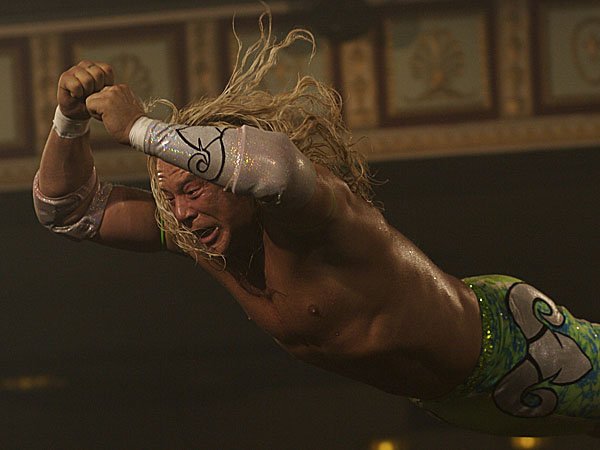
Randy "The Ram" Robinson was a top wrestler in the 1980s but his limelight has faded since. Now working at the New Jersey independent wrestling circuit, Randy can barely keep funds going to pay his rent where he lives in a trailer park and at times, his van. Money often goes to get his trademark blond hair dyed, skin tanned, and steroids when he needs them for his built physique. Wrestling in high school gyms and other halls to small crowds and even attend autograph sessions with few people going. Randy goes to a nearby strip club to meet a friend and stripper in Cassidy (Marisa Tomei) who is going through a hard time as patrons are favoring younger strippers over her. When his promoter (Todd Barry) announces that he plans to have a big rematch between Randy and his old rival the Ayatollah (Ernest "The Cat" Miller) that happened in Madison Square Garden 20 years ago. Everything seems up as it might be Randy's ticket back to the big time. Instead, Randy suffers a heart attack following a brutal and bloody hardcore style wrestling match.

When he hears that he can't wrestle again and that it might kill him if he does, he's forced to face a life without wrestling. Already working at a supermarket to scrape by, he asks the manager if he can get more work as all of his upcoming matches cancelled. After hanging out with Cassidy at the club, Randy decides to renew contact with his estranged daughter Stephanie (Evan Rachel Wood) who doesn't really want to do anything with him. With Cassidy's help, whose real name is Pam and has a 9-year old son, Randy goes for another attempt to reconnect with Stephanie that goes well as he reveals his regrets and flaws. While Cassidy's help managed to spark a possible relationship, Cassidy felt it crossed the line about work and real life. With Randy struggling to deal with reality and other things, he reluctantly decides to get back into the wrestling circuit in deciding to wrestle the Ayatollah. It's at this time he gets some unexpected support.

The idea of pro wrestling to an average viewer is pure spectacle with high drama, fast moves, big production values, and pure entertainment. Today's leading stars like John Cena, Chris Jericho, HHH, Randy Orton, Matt & Jeff Hardy, Edge, Christian, and dozen of others are living the high life in the world of wrestling in the WWE. Yet, what would happen to a wrestler after his time in the limelight. That's what the concept of this film is about. For many who had trained and lived to entertain audiences in arenas, small halls, or whatever, it's a moment that they love to do. Yet, what happens when they're unable to wrestle. It becomes very difficult for aging wrestlers in the real world as they're forced to take on jobs that can barely keep by while as wrestlers in the big time, they had lots of money.

Screenwriter Robert D. Siegel does a brilliant job in capturing the realism and craftsmanship that goes into the world of pro wrestling. How wrestlers talk about doing moves, who should win, what kind of instructions that they should go through. Yet, it's really a study about a man trying to find redemption for his mistakes and regrets about his relationship with his daughter while trying to accept the fact that he is who he is. Even as the real world proves to be troubling for him while wanting companionship with a stripper whose own days in the profession is waning. Siegel's script is wonderfully structured with the first act about the Ram wrestling and his eventual heart attack, the second act is him trying to renew his relationship with his daughter and try to find life outside of wrestling. The third and final act about his acceptance and lure of the ring which he can't seem to get away from because it's his environment as the real world is just too much for him. It's truly a fantastic script that explores a man dealing with the real world and all he wants from people is that he can bring them a smile.

Director Darren Aronofsky has been known for being a director that's all about grand visuals or techniques that are haunting to any story he's telling. With this film, Aronofsky strips away all of the stylish technique of his past films to go for something simpler and to the point. Inspired by the realist, documentary filmmaking style of Belgian directors the Dardenne Brothers. Aronofsky goes for a simpler, hand-held style to capture the action and drama that goes on in and out of the ring. While it's a looser style of filmmaking for Aronofsky to do. It works well for the story as he's letting the audience know what is going on in the wrestling world while following this man in his life. The hand-held work isn't as shaky as other films but it's truly engaging in how Aronofsky captures the drama and intensity of pro wrestling. To call pro wrestling fake is really an insult to an art form that takes a lot of hard work and dedication that these people do to entertain an audience. In the end, Darren Aronofsky crafted a brilliant film that is truly real but at the same time troubling in what goes on in the world of professional wrestling.

Cinematographer Maryse Alberti does a fantastic job with the film's stripped-down photography in its hand-held style. Without delving into any kind of stylish lighting schemes or flashy scenery. Alberti's work in its New Jersey location goes for gritty realism with bits of grain and action that goes on inside the ring. With its bright yet grimy look of the film in its daytime exterior scenes to the shady, colorful nighttime scenes at the strip club. Alberti's work is truly superb in its realism and atmosphere of the film itself. Editor Andrew Weisblum does an excellent job with the film's editing in its rhythmic cutting. Notably the intensity of the wrestling stuff that includes a scene that goes back in forth of Randy after a hardcore match and then going into that hardcore match. Weisblum's smooth transitions, jump-cut edits, and rhythmic pacing gives the film a leisurely pace while a faster one for the wrestling scenes.

Production designer Tim Grimes with set decorator Theo Sena and art director Matthew Munn do a very good job with the look of Randy's trailer and beat up Dodge Ram van on the inside. Plus the look of the ring from its shoddy, intimate look to the more sprawling feel of the match at the end that looks like most wrestling events. Costume designer Amy Westcott does a great job with the costumes from the tights and clothes that Randy wears in character to the more street clothes that he has. The clothes that Marisa Tomei wears from the t-shirts and jeans that she wears outside of the strip club to the more trashy clothing with a thong that she wears as a stripper. Sound designer Brian Emrich does an amazing job capturing the atmosphere of the strip club and New Jersey along with intense excitement and carnage that goes on in the ring with fans cheering. Emrich's work in capturing that energy and passion that fans have for wrestling is truly phenomenal.

Longtime Aronofsky collaborator Clint Mansell brings a plaintive, somber score to the film to complement the drama and emotion that plays throughout the film. Yet, it's the film's soundtrack that is filled with dance pieces from Madonna and Lil' Wayne along with hip-hop music providing some of the strip club music. Another portion of the film's soundtrack is the barrage of 80s metal music from hard rock legends like Guns N' Roses' Sweet Child O'Mine being the theme music for Randy in his big match, with a special thanks towards Axl Rose. Other 80s metal music comes from acts like Slaughter, Cinderella, Motley Crue, Accept, Scorpions, Quiet Riot, Firehouse, and Ratt provide some nostalgia and the soundtrack to Randy's life that Cassidy seems to share. For all of that cheesiness that hair metal brought, it was good time music and to have Mickey Rourke and Marisa Tomei sing along to Round and Round by Ratt provides an entertaining moment.

Yet, the most heartbreaking song of the soundtrack is its title track from Bruce Springsteen. The acoustic ballad featuring a somber piano and smooth orchestration is carried by Springsteen's gravelly voice filled with pain and heartache. It is the song that captures the sadness of the story as it is played in its final credits. It's truly one of Springsteen's best songs and a damn shame that the Academy Award chose not to nominate it and end up choosing 3 songs instead of five for its category.

The casting by Mary Vernieu and Suzanne Smith is excellent with appearances from Aronofsky cohorts like his parents as people at the market, Ajay Naidu as a medic, and Mark Margolis as Randy's landlord. From the wrestling world, there's Ron "R-Truth" Killings, the Blue Meanie, Johnny Valiant, Lex Lethal, and Necro Butcher as himself wrestling Rourke in the hardcore match. Another famed pro wrestler in former WCW star Ernest "The Cat" Miller is excellent as the Ayatollah by playing it straight out of the ring but brash inside the ring. Todd Barry is very good as the promoter who organizes the match between Randy and the Ayatollah. Evan Rachel Wood is great as Stephanie, Randy's estranged daughter who definitely wants to do nothing with her father after years of abandonment and neglect. Wood brings in the kind of anger that her character is carrying as well as the heartbreak over the fact that her father was never around as it's fantastic performance from the young actress.

Marisa Tomei is brilliant as Cassidy, an aging stripper whose days are being numbered in favor of younger strippers. Tomei truly has an amazing body for her age yet its her sincerity in her performance that really shines. Tomei also reveals the balance that she has that Randy doesn't have in terms of her identity as outside of the club, she's Pam. Tomei's performance is definitely great to watch along with the chemistry she has with Mickey Rourke as it's truly a superb supporting performance from the veteran actress.

Finally, there's Mickey Rourke in what is the ultimate comeback role and certainly his greatest performance to date. The actor who was considered one of the finest actors in the 1980s with performances in films like Barry Levinson's Diner, Francis Ford Coppola's Rumble Fish, Michael Cimino's Year of the Dragon, Stuart Rosenberg's The Pope of Greenwich Village, Adrian Lyne's 9 ½ Weeks, Alan Parker's Angel Heart, and Barfly only to crash with bad decisions in the early 90s before going into a brief boxing career. After recent films like Robert Rodriguez's Sin City and Tony Scott's Domino, Rourke is now officially back with a performance that is truly heartbreaking and nearly identical to his own life.

The performance Rourke gives as Randy "The Ram" Robinson is truly phenomenal where in the ring. He's a guy that likes to give people their money's worth for entertainment as Rourke does all of his own wrestling with help from Afa Anoai of the Wild Samoans tag team from the 1980s whose daughter appears as a pharmacist. Rourke sells his work in the ring as well as the grit and weariness that goes on. Outside of the ring, we see Rourke trying to please people and be a nice guy while dealing with the fact that he is a screw-up who is just trying to redeem himself in front of his daughter. There's a lot of sympathy he brings to his character as he is just trying to make people happy and find some kind of companionship as it's a remarkable and certainly a career-defining role for Mickey Rourke.

***Additional DVD Content Written on 12/4/10***

The 2009 Region 1 DVD for The Wrestler from 20th Century Fox presents the film in the widescreen format of 2:35:1 aspect theatrical ratio plus 5.1 Dolby Surround Sound in English plus Dolby Surround in Spanish plus English and Spanish subtitles. The DVD special features includes a music video of The Wrestler written and performed by Bruce Springsteen as he sings the song inside a ring and lifting weights. The other major special feature is a 42-minute behind-the-scenes featurette called Within the Ring.

The documentary features interviews with Aronofsky, various crew members, wrestlers, and actress Evan Rachel Wood as they talk about the making of the film. Though Mickey Rourke and Marisa Tomei weren’t interviewed, they were seen throughout during the film’s 35-day production which spanned from late January to early March of 2008 all over New Jersey along with a few scenes in Philadelphia. Aronofsky revealed that he had an idea for The Wrestler some time after making Requiem for a Dream as he intended to make it into a period piece set in the 1970s before Vince McMahon Jr. decided to combine all of those pro wrestling territories into what would become the World Wrestling Federation (later re-named World Wrestling Entertainment).

Yet after creating The Fountain and releasing it in 2006, Aronofsky decided to change his approach after seeing both King Kong Bundy and Tony Atlas wrestle for independent circuits as he decided to focus on a character. With the cinema verite style, Aronofsky wanted to go for realism while also wanting Mickey Rourke for the role. For many of the wrestling scenes, it was nearly improvised while a stunt double were used for some of Mickey’s wrestling scenes. Aronofsky revealed that he didn’t storyboard for the film in order to create something real. Even in the scenes at the supermarket where Darren’s father talked about the time he took Darren to see a wrestling show as a kid in a match between Tony Atlas and Hulk Hogan.

The overall featurette is quite sobering about the world of independent pro wrestling along with the veterans who are still doing it to make money. At the same time, there’s some funny moments involved including a credits sequence where Aronofsky and crew members fly over the top rope and land on safety floors. Yet, it ends with an outtake of Rourke trying to give Marisa Tomei a lap dance while complaining about the music.

Another featurette that only appears in the Region 1 Blu-Ray release is a 20-minute roundtable discussion from real-life wrestlers with moderator Damon Andrews. Discussing the film are Diamond Dallas Page, “Rowdy” Roddy Piper, Lex Luger, Greg “The Hammer” Valentine, and Brutus “The Barber” Beefcake. They all expressed their opinions on the film and Rourke’s performance, which they praised, while Piper talks about some the aspects of Rourke’s performance that surprised him. Luger and Page also talk about the fact that pro wrestling isn’t fake considering the injuries they suffered over the years. Even as Piper delve into the difference of acting and the real emotions that goes on inside the ring.

The discussion about life after the big time where both Piper and Luger reveal a need for a union and a pension plan for wrestlers once they reach a certain age and are forced to abuse their bodies by wrestling independently for little money. Though Valentine was able to put a humor about the need of health insurance. Beefcake also reveal the importance of fans while Page reveals that once the fans see you from the curtains, that feeling is more important than any kind of drug out there. The overall featurette is definitely a great companion piece to the film as it gives wrestling fans and non-wrestling fans a chance to respect pro wrestling as well as the wrestlers themselves.

***End of DVD Tidbits***

While this film might have something to offer for fans of pro wrestling. Its realism and story along with its study of what wrestlers have to go through to entertain people might be too much for some. In many ways, what happens to a character like Randy "The Ram" Robinson to go from being a top star in the 1980s to now working for so little in small independent circuits shows a much harsher reality of wrestling industry. The blame can be placed on a top corporate like the WWE for not taking care of their employees in the aftermath. It's clear that wrestlers who are retired and not really able to find something to do with their life outside of the industry should get a pension plan. It's a film that clearly could be too much for some longtime fans of wrestling to deal with as the stars that people seem to love struggle to get by as they either couldn't deal with reality or risk their bodies and health to entertain audiences for one last time.

To say pro wrestling is fake is once again, insulting to those who do this for a living. We cheer for the faces and boo the heals but what they're doing is art. They do high flying moves, risk their bodies, and compete against one another for the sake of entertainment. Having to cheer or boo those guys is what they wanted to hear and they deserve a bit more credit than that. It's clear that even top guys like John Cena, Jeff Hardy, Randy Orton, and Chris Jericho understand that while paying much respect to the guys that came in before them (though Jericho in his character on TV and in the ring isn't along with Orton). To shortchange this art that they do, how they set up what moves to do and what they must do to their bodies clearly shows the brilliance and sacrifice that is the art of pro wrestling or as some like to call it, sports entertainment.

The Wrestler is a heartbreaking yet engrossing film from Darren Aronofsky and screenwriter Robert D. Siegel featuring a masterful performance from Mickey Rourke. While the film isn't as good as Aronofsky's 2000 film Requiem for a Dream for some of his fans, The Wrestler is really his most accessible film to date in its simplicity. Along with excellent supporting work from Marisa Tomei and Evan Rachel Wood, it's a film that is hard to watch at times but overall satisfying in its storytelling. For Mickey Rourke, it's a real comeback role for an actor that had been written off for so many years as he's given a chance to redeem himself. Hopefully, he can get his career back on track and get better roles as he deserves all of the accolades he's receiving. In the end, The Wrestler is a brilliant, engaging, and powerful film from Darren Aronofsky.

Darren Aronofsky Films: Pi - Requiem for a Dream - The Fountain - Black Swan - Noah - mother!


© thevoid99 2010