Showing posts with label david morse. Show all posts

Monday, March 09, 2015

Down in the Valley


Originally Written and Posted at Epinions.com on 12/8/06 w/ Additional Edits & Revisions.


Written and directed by David Jacobsen, Down in the Valley is the story of a cowboy who meets a rebellious teenage girl as they begin a torrid relationship as he copes with the modern world. The film is an exploration into a man who finds himself in a world where he tries to play cowboy as he faces the darker realities of the modern world. Starring Edward Norton, Evan Rachel Wood, Rory Culkin, David Morse, and Bruce Dern. Down in the Valley is an enchanting yet uneven film from David Jacobsen.

Arriving onto the San Fernando Valley, a cowboy named Harlan (Edward Norton) enters into the strange, vast world filled with gas stations, shops, and cars. To Harlan, it's a mysterious world as he lives at a motel and takes a job at a gas station. Meanwhile, a rebellious, 17-year old girl named Tobe (Evan Rachel Wood) also feels lonely since she lives with her father Wade (David Morse) and her shy, 13-year old brother Lonnie (Rory Culkin). Since Tobe doesn't get along with her father, she often goes out with her friends including April (Kat Denning) where on the way to the beach, Tobe meets Harlan at the gas station. An attraction immediately happens as Harlan joins Tobe and her friends to the beach where they fall in love. After introducing Harlan to Lonnie, Wade becomes uncomfortable at Tobe's new relationship with Harlan.

After a night in the town driven by Ecstacy, Harlan and Tobe's relationship becomes passionate which makes Wade uneasy. Even when Harlan and Tobe decide to go horseback riding where the horse's owner named Charlie (Bruce Dern) accuses Harlan of theft. After Wade deals with Charlie, he forbids Tobe to see Harlan again. Still, Tobe's love for Harlan remains strong as she has to go San Diego for the weekend to be with her friends. Harlan however, tries to live without Tobe for the weekend often pretending to be in some Western or writing a letter to a man named Joe. Hoping for Tobe to return on the day she was supposed to, he finds Lonnie where he takes Lonnie shooting since Wade owns some authentic guns. Upon returning home, Wade finds Lonnie with Harlan and threatens to shoot him if he doesn’t leave his family alone.

Learning what Wade had done, Tobe meets Harlan where she asks him to leave the family alone till Wade cools down. With his cowboy fantasy starting to blur with reality, Harlan gets in trouble as he gets kicked out of his hotel while trying to steal things hoping to win Tobe back. Still, Harlan finds himself alienated by the modern world as he remains stuck in the Old West. After meeting Tobe after some time away from her, he plans to make an escape with her but Tobe isn't sure what's going on. After an accident, Harlan's vision of the Old West begins to collide with reality as he tries to kidnap Lonnie and have a confrontation with Wade, who finds out some troubling news about Harlan from an investigator (Geoffrey Lewis).

Films about reality against fantasy does often require strange fantasy sequences but for what writer/director David Jacobson goes for is an internal conflict in a man who has a love for the West but finds himself alienated by the modern world. While the film is largely inspired by the work of the legendary Terrence Malick, notably Badlands, the film does have the same poetic imagery and dialogue in terms of what Harlan is in and in his relationship with Tobe. Despite the Malick-esque imagery and imagery, the film's script is very flawed. While some can figure out the tense relationship between Wade and Tobe, there's no back story into their tension. Plus, the first half of the film is a love story while the second half becomes a modern-day Western where they're both interesting but makes the film to be uneven. Despite a lot of wonderful imagery, scenes, and everything else, Jacobson doesn't seem to know what kind of film he's making though the performances do remain consistent with its Badlands-like tone.

Helping Jacobson in his unique vision is cinematographer Enrique Chediak whose wonderful photography of many of the film's exterior settings, notably the hills of the San Fernando Valley is breathtaking as well some night sequences that shows the nightlife of Los Angeles in all of its glory. Production designer Franco Giacomo Carbone and set decorator Robert Greenfield do fantastic work in providing the idea of the West in a fantasy sequence for Harlan while showing the colorful and modern look of Los Angeles. Costume designer Jacqueline West does great work in creating the cowboy look for Norton while giving Evan Rachel Wood some wonderful dresses.

Editors Edward Harrison and Lynzee Klingman does wonderful work in providing a rhythmic, stylized editing that gives the film a nice flow and feel. Sound designer Scott Sanders does some great work in the film's sound, including a scene where Harlan goes to a synagogue that reveals his alienation. The film's haunting score is filled with wonderful guitar work from Peter Salett that brings a sense of suspense and atmosphere to its varied sequences. The soundtrack is largely filled with dreamy mixes of music ranging from mariachi to old-school Western songs as well as cuts from Patsy Cline, Hank Williams, Calexio, and two great tracks from Mazzy Star where the vocals of Hope Sandoval provide some of the film's most haunting moments.

The film’s cast includes some wonderful small performances and cameos from Ira David Wood IV, Kat Dennings, Ty Burrell, Elizabeth Pena, and Geoffrey Lewis as an investigator. In a small role, Bruce Dern is great as a haggard ranch owner who is suspicious of Harlan’s motives and understanding of Wade’s control issues. David Morse is excellent as the strict, caring Wade who is trying to talk to his children while dealing with Harlan as Morse does some outstanding work in the scenes he's in. Rory Culkin is amazing as the shy, scared Lonnie who tries to seek some kind of adventure and confidence as he often relies on his sister and Harlan since his dad isn't around much. Evan Rachel Wood is fantastic as Tobe as this young woman who copes with growing pains as she falls for Harlan while having a hard time dealing with Harlan's eccentricities. Finally, there's Edward Norton in a brilliant performance as Harlan as this troubled man who seems like someone that is out of step with the times as he wants to play cowboy in a world that is very complicated as it is this very fascinating mix between fantasy and reality.

The Lions Gate/ThinkFilm Region 1 DVD of Down in the Valley presents the film 5.1 Dolby Digital Surround & 2.0 Stereo sound in 16x9 widescreen presentation. The DVD also brings trailers to not just this film but The King w/ Gael Garcia Bernal and William Hurt, I Love Your Work by Adam Goldberg, and other films. Two big special features are on the DVD. The first is a 21-minute Q&A session with Edward Norton and director David Jacobson as they're interviewed by Rolling Stone film critic Peter Travers. In the interview, Jacobson talks about the collision of fantasy and reality and how the San Fernando Valley has a mystique concerning the West. Edward Norton talked about getting the script in 2003 and wanting to work with Jacobson as the two developed the project and both wanted Evan Rachel Wood for the role of Tobe after seeing her in thirteen in which the two widely praised her as well as the other actors as Norton was laid-back in the interview.

The second big special feature is a nine-minutes worth of four deleted scenes. The first is an extended opening sequence involving Tobe and Lonnie on a bridge in which Lonnie causes an accident. The second is a deleted scene where Harlan looks for a new hat and buys the white dress that Tobe would wear. The third is touching scene involving Lonnie and Wade about an incident in where Lonnie professes his innocence. The final scene is an extended sequence of a supposed fantasy scene where Harlan talks to a cowboy played by Ty Burrell.

Down in the Valley is a superb yet flawed film from David Jacobsen that features top-notched performances from Edward Norton, Evan Rachel Wood, Rory Culkin, and David Morse. While it is uneven in its exploration of fantasy and reality, it does manage to bring in some compelling ideas about the complications of the modern world. In the end, Down in the Valley is a stellar film from David Jacobsen.

© thevoid99 2015

Saturday, July 05, 2014

Desperate Hours (1990 film)


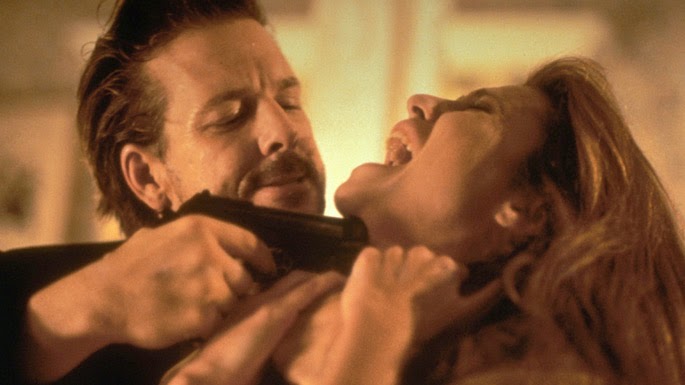
Based on the novel and play by Joseph Hayes, Desperate Hours is the story of an escaped criminal who breaks into a house and takes over while terrorizing a family with two of his friends. Directed by Michael Cimino with a screenplay by Hayes, Lawrence Konner, and Mark Rosenthal, the film is a remake of the 1955 film by William Wyler that starred Humphrey Bogart and Fredric March as it’s set in a more modern setting. Starring Mickey Rourke, Anthony Hopkins, Mimi Rogers, Kelly Lynch, Elias Koteas, David Morse, Shawnee Smith, Matt McGrath, Danny Gerard, and Lindsay Crouse. Desperate Hours is an eerie though somewhat uneven film from Michael Cimino.

The film is a home invasion story about an escaped criminal who hides out at the home of a man who has become estranged from his wife as they’re taken hostage at home. Yet, it’s a film about control and trust where the criminal Michael Bosworth (Mickey Rourke) is waiting for his lawyer/lover Nancy Breyers (Kelly Lynch) to be cleared from accusations that she was the one who broke him out of jail as he is being charged for all sorts of crimes. With the help of his brother Wally (Elias Koteas) and an unhinged, half-wit criminal Albert (David Morse), Bosworth would hide out at the home of Nora Cornell (Mimi Rogers) who is selling her home as she and her husband Tim (Anthony Hopkins) are estranged due to Tim’s infidelity with a young woman. Once Bosworth takes control of the Cornell home, he would instill elements of trust where Nora is more likely to trust Bosworth than Tim as it relates to her life and the life of their kids in the 15-year old May (Shawnee Smith) and the eight-year old Zack (Danny Gerard).

The film’s screenplay does take its time to explore a family being invaded by criminals where in control is this sociopath who is trying to make sure everything goes normal until he can flee with his girlfriend and associates with some money. Yet, the actions of Nancy Breyers only gets the attention of a very intelligent and no-nonsense FBI special agent in Brenda Chandler (Lindsay Crouse) who doesn’t buy Nancy’s act and knows where she’s going as she hopes to nab Bosworth. Though the script is pretty uneven as part of it is set at the Cornell home where Tim tries to reconcile with Nora only for things to go wrong with the Bosworth brothers and Albert taking over where Nora has trust issues with Tim. The other part of the script involves Chandler’s pursuit and watching over Nancy where it has this element of the road movie but it never really gels since Nancy is a very underwritten character who is just lovesick over Bosworth and is put into very tense situations. The scenes at the Cornell home is interesting where there is a sense of psychology as the family isn’t sure who to trust as Bosworth doesn’t try to hurt anyone while Tim tries to do something only to get himself into trouble.

Michael Cimino’s direction is pretty engaging for the way he conveys this element of suspense and dread inside a family’s home as it’s taken over by criminals. Especially as he maintains that sense of tense intimacy with some close-ups and unique medium shots where Cimino’s framing is always there to play into the drama as well as some of tension that goes on. The scenes outside of the Cornell home is shot in various locations in Utah where it plays into Cimino’s sensibilities in terms of the mountains, deserts, and such that does have this sense of beauty in the locations where Cimino is able to display them in a wide canvas. Yet, it adds to film’s uneven tone where it does feel like it’s two different films being made in some aspects though it would come together in a very intense third act. Especially as it becomes a battle of wits and trust where the FBI is also involved in Chandler who takes a more cautious but unconventional approach to let the fates play out. Overall despite a few inconsistencies in its tone, Cimino does craft a very captivating and solid thriller about a family’s home invaded by criminals.

Cinematographer Douglas Milsome does brilliant work with the film‘s cinematography with the gorgeous lighting for many of the daytime exteriors in the Utah desert/mountain locations to more ominous lighting schemes and such to play into the dramatic tension at the Cornell house. Editors Peter R. Hunt and Christopher Rouse do excellent work with the editing to create some methodical cuts to play into the film‘s suspense along with some rhythmic cuts for some of the car chase scenes involving Nancy and the FBI. Production designer Victoria Paul, with set decorator Crispian Sallis and art director Patricia Klawonn, does nice work with the look of the Cornell house to play into its sense of intimacy and the terror that Bosworth would bring.

Costume Charles DeCaro does terrific work with the costumes from the clothes of the Cornell family that is quite casual to the Armani suits that Bosworth wears. Sound editor James J. Klinger does superb work with the sound from the way the helicopters, planes, and cars sound in the exteriors to the intense atmosphere of the Cornell home as it has this air of terror in the film. The film’s music by David Mansfield is amazing for its soaring orchestral score to play into its suspense and drama along with some low-key pieces to showcase the estrangement between Tim and Nora.

The casting by Mary Colquhoun is wonderful as it features some notable small roles from James Rebhorn as a prosecutor, Matt McGrath as May’s boyfriend Kyle, Gerry Bamman as a real-estates agent, and Dean Norris as Chandler’s FBI associate Maddox. Shawnee Smith is alright as Tim and Nora’s teenage daughter May who tries to antagonize Bosworth and his gang while Danny Gerard is quite good as May’s younger brother Zack who deals with the terror of being taken hostage. Kelly Lynch is pretty terrible as Nancy Breyers where it’s not just the character that is terrible but Lynch never really does anything to make anyone care about her as she spends half the film topless and often be worried. Elias Koteas is terrific as Bosworth’s brother Wally who keeps things in control while trying to make sure that the family has nothing to worry about. David Morse is excellent as the more troubled criminal Albert who becomes anxious as he would later become a liability to the situation.

Lindsay Crouse is amazing as the no-nonsense FBI special agent Brenda Chandler who is this very offbeat character that talks in a Southern accent as she knows how to handle situations and can read people better than her fellow agents. Mimi Rogers is fantastic as Nora Cornell as this woman who becomes aware of the situation as she tries to keep things from not going wrong while being very unsure on who to trust. Anthony Hopkins is superb as the Tim Cornell as a man trying to regain his wife’s trust after cheating on her as he deals with Michael Bosworth’s presence and the situation that is happening as he is goaded to take action only to figure out what to do to not hurt his family. Finally, there’s Mickey Rouke in an incredible performance as Michael Bosworth as this very smart sociopath who takes control of an entire house as he tries to play a game of trust on Nora to turn against her own husband as it’s a very fiery and intense performance from Rourke.

While it is a film with some flaws and an inconsistent tone, Desperate Hours is still a solid film from Michael Cimino. Armed with great performances from Mickey Rourke, Anthony Hopkins, Mimi Rogers, and Lindsay Crouse. It’s a film that plays into the world of home invasion as well as a compelling look into the world of trust and guilt. In the end, Desperate Hours is a pretty good film from Michael Cimino.

Michael Cimino Films: Thunderbolt & Lightfoot - The Deer Hunter - Heaven’s Gate - Year of the Dragon - The Sicilian - The Sunchaser - To Each His Own Cinema: No Translation Needed - The Auteurs #35: Michael Cimino

© thevoid99 2014

Saturday, December 29, 2012

12 Monkeys


Based on the short film La jetee by Chris Marker, 12 Monkeys is the story about a convicted criminal living in a post-apocalyptic world as he’s sent back in time to find information about a virus that is already plaguing the world as he later deals with trouble. Directed by Terry Gilliam and screenplay by David and Janet Peoples, the film is an exploration into the world of time-travel and chaos as a man deals with his past while doing whatever he can to save the future. Starring Bruce Willis, Brad Pitt, Madeleine Stowe, David Morse, and Christopher Plummer. 12 Monkeys is a stylish yet mesmerizing sci-fi film from Terry Gilliam.

In a post-apocalyptic future where 1% of the world had survived a plague that had wiped out the human race, James Cole (Bruce Willis) is a convicted criminal who volunteers to take part in a time-travel experiment to retrieve information about the source of the virus that started the plague. In return, Cole would receive a pardon for his work as he is sent back to the period of 1996-1997 where the virus started. Yet, he finds himself in 1990 as he is sent to a psychiatric ward where he meets a crazed young man named Jeffrey Goines (Brad Pitt). At the hospital, he’s being examined where Cole learns that it’s 1990 while making claims to his doctors about a virus that is going to spread that is going to cause a plague. After an escape attempt with help from Goines, Cole returns back to the future where he reveals what went wrong.

The scientists send Cole back in time where he finally makes it to 1996 where he kidnaps a psychiatrist named Kathryn Railly (Madeleine Stowe) who was Cole’s doctor at the hospital six years earlier as they drive from Baltimore to Philadelphia. Cole has discovered that Goines is the founder of an underground army known as the Twelve Monkeys as he hopes to confront Cole as he tries to search for him. Cole finally learns where Goines is as he is the son of a revered scientist (Christopher Plummer) where Cole finally confronts Goines only for things to become more confusing. After returning back to the future to reveal what he learned, Cole begins to doubt about everything he’s been through.

Back in 1996, Railly begins to review her diagnosis about Cole where she makes some startling discoveries that has her realizing what’s really going on. After convincing the scientists to send him back to 1996, he returns to 1996 where Railly meets him trying to tell him that a plague is really going to happen. Upon realizing what will happen, the two make a discovery about what is going on as Cole does whatever it takes to stop the plague from happening.

The film is essentially the story of a man going back in time to try and find out who started a plague that would nearly wipe out civilization while he deals with all sorts of things that has him confused about his mission. A lot of which has him encountering all sorts of people including a crazed man who would eventually lead an underground army that might’ve started the plague and a psychiatrist who would eventually piece out all of the things that he’s saying. During these missions and encounters, he also deals with recurring dreams where he sees a young boy witnessing a murder. Since it is inspired by Chris Marker’s 1962 short film La jetee about a man living in a post-apocalyptic world where he goes back in time and has a recurring dream about a boy (Joseph Melito) witnessing a man die. The film expands Marker’s short film into something far grander.

The screenplay definitely uses the basic elements of Marker’s short while adding more stakes to the story as well as a lot of ambiguity. Notably in the character of Jeffrey Goines who is this very crazy young man that the film’s protagonist meets where their encounter would have Goines come up with something big that would later drive the plot. Yet, Goines ends up becoming more abstract in his ambitions whether no one really knows what he’s up to and maybe he doesn’t know what he’s doing as it’s up to James Cole to find out. Cole is a man who definitely has no idea what he’s doing as he seemed content to collect insects for samples to scientists while hoping to get a decent life. By taking part in this experiment, he becomes more confused about what is real as he eventually starts to realize what is going on.

Adding to Cole’s journey who would eventually play to his fate about whether it’s true or not is Kathryn Railly who doubts everything Cole says at first. Even as she would become some best-selling novelist who has a lot of theories about certain things only to realize that something could actually happen. Yet, she faces her own persecution from doctors and police when they believe that she has gone crazy. The screenplay not only succeeds in creating characters that are engaging as well as scenes that play out to the suspense of the film. It also features some small stories and dialogue relating to a missing boy that would play to what Cole knows and Railly’s realization about what is going on.

Terry Gilliam’s direction is definitely stylish for the way he presents the film as not just a sci-fi film but also something that feels modern where Gilliam was able to work around with his budget limitations. For the scenes in the future, Gilliam creates something that is filled with ruins as it’s set in Philadelphia and Baltimore where it seems like a world that is ravaged and animals are there to roam freely. While there is a bit of visual effects for a few scenes involving animals, it is set mostly in a world where it is grim and troubled as there’s a lot of strange things that play up to a future that is still trying to figure out its technology and its purpose.

For the scenes set in the 1990s, Gilliam keeps things simple in terms of the presentation though he goes for very stylistic slanted camera angles to help tell the story. A lot of which it to play up Cole’s view of the world where he has no idea where he is. Gilliam also employs lots of close-ups and medium shots to help tell the story while utilizing a few moments that pays homage to La jetee in the recurring dream sequences. Gilliam also uses wandering cameras to play up the suspense and drama that heightens things including the film’s climatic finale that captures the true spirit of Chris Marker’s famed short. Overall, Gilliam creates a truly marvelous and exhilarating film that does more in what is expected in a sci-fi film.

Cinematographer Roger Pratt does brilliant work with the film‘s vibrant yet stylish look from the somewhat grimy look of the futuristic scenes to more straightforward yet ethereal lighting schemes for the scenes set in the 1990s. Editor Mick Audsley does excellent work with the editing from the stylish montages of the dream scenes to the more rhythmic cuts for the film‘s suspenseful moments. Production designer Jeffrey Beecroft, along with set decorator Crispian Sallis and art director William Ladd Skinner, does spectacular work with the set pieces from some of the decayed places set in the 1990s that Cole and Railly encounter to the more grimy look of the futuristic scenes with its TV ball.

Costume designer Julie Weiss does nice work with the costumes by keeping things straightforward for the most part though the character of Railly gets to wear the more stylish clothes throughout the film. Hair and makeup designer Christine Beveridge does terrific work with the look of the characters such as Jeffrey Goines‘ mid-90s look as well as other looks that were inspired by the films of Alfred Hitchcock. Sound editor Peter Joly does superb work with the sound work from the haunting atmosphere of the futuristic set pieces to the more chaotic sounds of the scenes in the 1990s. The film’s music by Paul Buckmaster is wonderful for its low-key yet soaring orchestral score to play out the drama as well as some playful themes for the Jeffrey Goines character. The rest of the soundtrack features music from Louis Armstrong, Fats Domino, B.J. Cole, Tom Waits, and a score piece from Bernard Herrmann.

The casting by Margery Simkin is incredible for the ensemble that is created as it features appearances from Matt Ross and Lisa Gay Hamilton as a couple of activists, Carol Florence as a scientist who monitors Cole’s reports, Jon Seda as a fellow inmate of Cole, Christopher Meloni as a police lieutenant who interrogates Railly after her kidnapping, Joseph Melito as the boy in Cole’s dream, and David Morse as the assistant to Dr. Goines. Christopher Plummer is pretty good in a small role as Goines’ father who is bewildered by his son’s eccentric activities.

Brad Pitt is brilliant as Jeffrey Goines as a man who is extremely unpredictable and abstract as someone who is very outgoing as well as displaying a physicality that is just eerie to watch as it’s definitely one of Pitt’s great performances. Madeleine Stowe is wonderful as Kathryn Railly as a psychiatrist who tries to understand what Cole is doing only to piece up things that would raise lots of questions into what Cole is up to. Finally, there’s Bruce Willis in a remarkable performance as James Cole as a man seeking to find a way to a decent life only to take part in an experiment that has him confused as well as vulnerable as it’s definitely one of Willis’ finest performances.

12 Monkeys is a phenomenal film from Terry Gilliam that features top-notch performances from Bruce Willis, Madeleine Stowe, and Brad Pitt. The film is definitely not just a great tribute to Chris Marker’s La jetee but also one of Gilliam’s most fully-realized and engaging films. It’s also one of Gilliam’s more accessible films in terms of its imagery as well as injecting small bits of humor into a story that is very bleak. In the end, 12 Monkeys is a triumphant film from Terry Gilliam.

Terry Gilliam Films: Jabberwocky - Time Bandits - Brazil - The Adventures of Baron Munchausen - The Fisher King - Fear and Loathing in Las Vegas - The Brothers Grimm - Tideland - The Imaginarium of Dr. Parnassus - The Zero Theorem - The Auteurs #38: Terry Gilliam

Related: La Jetee

© thevoid99 2012

Monday, January 09, 2012

Dancer in the Dark


Originally Written and Posted at Epinions.com on 3/24/04 w/ Additional Edits & Revisions.


Written and directed by Lars von Trier, Dancer in the Dark is a film about a Czech immigrant raising her son in 1964 America trying to raise money to save her son's sight as her own vision diminishes. In the spirit of Dogme 95, von Trier goes for natural sounds and realism for storytelling as he also combines another film genre that he loves, the musicals. In Dancer in the Dark, von Trier uses the musical as an escapist backdrop to the character of Selma, played by Icelandic vocalist Bjork, as her world crumbles down as she tries to save the life of her own son in one of von Trier's most powerful achievements.

It's 1964 in Washington as Czech immigrant Selma is rehearsing to play Maria for a production of The Sound of Music. While working at a factory with her friends Kathy (Catherine Deneuve) and Jeff (Peter Stormare), Selma hopes get the role for the play as she dreams of being in a musical while hoping to raise money for her son Gene (Vladica Kostic) who might become blind as she is starting to suffer from blindness. While her landlord in local officer Bill (David Morse) and his wife Linda (Cara Seymour) help out, she has managed to save $2000 as Gene's doctor (Stellan Skarsgard) starts to worry about Selma's eyesight. While she tries to hide her blindness from everyone including the factory foreman (Jean-Marc Barr), it doesn't help out as her work suffers while the play director (Vincent Paterson) thinks she might not be up to doing the part.

Following a meeting with Bill over his own financial issues due to Linda's spending, Selma decides to keep a secret for Bill. Hoping to get more overtime for more money, she suddenly daydreams of being in a musical where she causes trouble and is fired. After telling Jeff about her blindness, she has another daydream moment as Jeff decides to meet her later that day. Upon returning home, Selma learns that the money she has saved was stolen as she asks Bill where something goes wrong leading to a horrifying incident. Meeting up with Jeff, he takes her to the hospital where they meet the operation doctor (Udo Kier) and gives him money for Gene's operation. After being arrested following a rehearsal, Selma is then put into trial where its district attorney (Zeljko Ivanek) interrogates her.

Claiming her father is Czech film star Oldrich Novy (Joel Grey), Novy attends the trial as she has a dream that they're dancing for a musical number. Sent to jail following the trial, Selma befriends a guard named Brenda (Siobhan Fallon) as Selma makes another move to save her son's life.

The film is clearly von Trier's most accessible effort to date despite his emphasis on handheld digital video cameras that he used since he is also credited as the camera operator. Emphasizing on the spirit of Dogme 95, von Trier brings a natural look to the film as opposed to the more cinematic, heightened look of most films today. With Breaking the Waves cinematographer Robby Muller, von Trier gives the film a look that is captivating from its grayish tone in many scenes to the more colorful tone in the musical interludes where Muller shines in his vast cinematography, especially since the musical numbers features nearly 100 cameras in use. For von Trier, it’s another experiment that succeeds as he just tries to bring a real look without any gloss that has been seen in Hollywood films.

The film's story is a wide mix of melodrama and musicals as Bjork's Selma says that in musicals, nothing dreadful happens. Well with von Trier, that isn't the case. Especially the ending that is just heartbreaking because of its sadistic nature as von Trier uses pain for a huge, emotional climax like he did in Breaking the Waves. Really, the story is about a woman saving the life of her child by sacrificing herself and it's a heartbreaking story. While the film's first act starts off a bit slow (if you don't count the colorful overture in the film's first few minutes), it picks up just as the musical numbers come in with amazing choreography from Vincent Paterson as well as original music from Bjork with additional compositions from longtime Bjork collaborator Sjon Sigurdsson and von Trier himself.

The music definitely plays up to the spirit of musicals that von Trier has loved with its mix of electronic beats and textures as well as Rodgers & Hammerstein arrangements all put in a lush, grand tone. Bjork is clearly the star of the music as the cast itself sings many of the great songs on the film (although Peter Stormare's vocals were replaced by Radiohead's Thom Yorke in the film's soundtrack entitled Selmasongs). The music really serves a purpose in the same way von Trier used the music as an emotional outlet in Breaking the Waves.

Another great aspect of the film, which received a lot of controversy when it premiered at the Cannes Film Festival in 2000, was von Trier's depiction of America. While the film was shot in Sweden, von Trier does give a nice idea in what America would look like although in Washington, it's usually rainy. In many respects, von Trier is looking at America in a dream in the same way Stanley Kubrick used London as New York City for Eyes Wide Shut. Really, it's America in a dreamier tone in reference to the Hollywood musicals that Selma loved. Really, von Trier isn't trying to knock America but he knows that he doesn't have to go there to know what's going on since he's pretty much afraid to go on a plane and doesn't like to travel very much.

The film's cast is amazing not just in their singing voices but in their roles as well. While von Trier veterans like Stellan Skarsgard, Udo Kier, and Jean-Marc Barr had small roles, their cameos were fun to watch in their respective roles while Vincent Paterson is excellent as the theater director and Zeljko Ivanek is excellent as the D.A. and doing a great job in an American accent. Joel Grey is amazing to watch in his small role as Oldrich Novy as he shows his graceful talent as a dancer and as an actor, especially since he hasn't been heard from since his Oscar-winning performance in Bob Fosse's Cabaret.

Cara Seymour is wonderful as the scornful wife Linda, especially playing a character that later on, is loathed for her actions and Seymour does an excellent job in that performance. Vladica Kostic is wonderful as Gene, especially since he just plays a kid in a restraint tone without going over the top or anything. Siobhan Fallon is lovely as Brenda as the scenes with Bjork are gripping to watch, especially in the film's final moments.

For the rest of the supporting cast, the film's best performance easily goes to French film legend Catherine Devenue. Devenue is amazing to watch as Selma's sympathetic best friend who shares her love of musicals. Devenue almost serves as a voice of reason for the anguished, naïve Selma as in the third act; her action nearly upsets Selma as in the end, comes a heartbreaking scene of friendship. Devenue is as enigmatic and masterful in her portrayal. Peter Stormare is superb as the wannabe-boyfriend Jeff by just underplaying the role sensitively and sympathetically and you want him to be her boyfriend. Stormare gives a subtle performance that is quiet and gripping at the same, especially in the film's final act. David Morse is amazing as the anguished Bill who does get sympathy despite his own actions but when Morse sings, he shines as does his character that gives more outlook into this versatile yet, underrated actor.

The film's best performance overall easily goes to Bjork in her first film in many years since she's done film work as a child in her native Iceland. In her first adult performance, Bjork brings a heartbreaking, sympathetic performance that is filled with lost innocence and anguish. The character of Selma is a complex yet flawed character as she brings the escapism in everyone through musicals. Bjork even comes livelier in the musical interludes with her thick Icelandic vocals while in the final act, she comes out with a gripping performance that is so powerful, it will leave you in tears.

Dancer in the Dark is a spectacular, genre-bending film from Lars von Trier. With a great cast led by Bjork and Catherine Devenue along with wonderful musical interludes, the film is among one of von Trier's more accessible film as well as one of his strangest. While it has a look that is strange despite the dated look of the digital photography, it is a film that is very abstract and dream-like. In the end, Dancer in the Dark is a superb film from Lars von Trier.


© thevoid99 2012

Monday, January 02, 2012

The Hurt Locker


Originally Written and Posted at Epinions.com on 8/9/09 w/ Additional Edits.


Directed by Kathryn Bigelow and written by Mark Boal, The Hurt Locker tells the story of a bomb squad working on the streets of Iraq defusing bombs during the war. Leading the team is a man who loves doing the job for the hell of it while trying to deal with the chaos surrounding him with members of his team watching him. A part war-drama, part-psychological film, it's a movie that delves into the mind of what a bomb squad goes through in defusing bombs and being a soldier at war. Starring Jeremy Renner, Anthony Mackie, Brian Geraghty, Guy Pearce, Ralph Fiennes, Evangeline Lilly, and David Morse. The Hurt Locker is a mesmerizing yet haunting war drama from Kathryn Bigelow and company.

It's 2004 in Baghdad as a new member of an elite Explosive Ordnance Disposal unit named Staff Sergeant William James (Jeremy Renner) is now part of a new group filled by Sergeant JT Sanborn (Anthony Mackie) and Specialist Owen Elridge (Brian Geraghty). With 40 days left in their tour of duty, James has already become an eccentric figure as he refuses to take orders in order to get the job done. Even as he comes across one bomb attached to another which he defuses quite well despite a bit of pressure. Though Sanborn is frustrated over James' no-frills, all thrills attitude and his willing to put himself on the line. Elridge is already going through his own problems following the death of a superior (Guy Pearce) as he is now having psychological sessions with Colonel Cambridge (Christian Camargo). James meanwhile, feels at home in the line of duty and at war as he befriends a 12-year old Iraqi kid named Beckham (Christopher Sayegh) while defusing bombs all for the hell of it.

Then when a bomb site is nearby a United Nations building, James diffuses it quite successfully except bringing lots of anxiety to his team in taking off his bomb suit and refusing to wear headphones to listen to Sanborn's orders. Impressed by James' ability to just diffuse bombs is Colonel Reed (David Morse) who is amazed over James' experience in diffusing bombs. Though James reveals to have a life at home with a wife (Evangeline Lilly) and a baby boy, he prefers to work as a bomb tech without robots and go with his gut. When he, Sanborn, and Elridge encounter a group of contractors led by its leader (Ralph Fiennes), they are ambushed by a group of Iraqi militia where things get tense as Sanborn and Elridge with James' help manages to diffuse the situation. While it was a great day for the three as they all got drunk and beat each other up for fun, it was like all three men has finally clicked. With the days winding down, some traumatic events occur for all three that would shape their minds. With James getting more personal and even putting his own team in danger, everything would crash down for the three men with James starting to unravel over his life as a soldier and at home.

Films about the Iraq war in recent years has been filled with a lot of overwrought melodrama despite its noble intentions to reveal the horrors of war and in the injustice soldiers have to face. What makes this film very different is that it's about three men just doing their job as they all face their own personal turmoil inside of themselves. Of those three, it's William James that is the most compelling as he's a man that loves to take risks in order to get the job done and diffuse situations. Yet, he's also reckless, refusing to take orders, and is always on an adrenaline rush. James is a loose cannon but does have a compassionate side when he befriends an Iraqi kid who sells him DVDs and plays soccer with him though he has a hard time being that person at home despite his noble efforts.

Screenwriter Mark Boal does a superb job in creating a unique structure to the story which begins with a scene involving a bomb about to be diffused by the previous bomb tech. The first act is about Staff Sgt. James arrival to the unit while proving to be a unique figure to his team like the by-the-book Sgt. Sanborn and the young, insecure Specialist Elridge. Both of whom each are given some development and insight into their own characters with Sanborn trying to be in control while Elridge is haunted by his own issues where in some intense moments, he's comforted by James. Boal's screenplay is well-structured in not just introducing the character but providing a strong second act for the characters to finally bond and click with each other while the third act would unveil some harsh truths and situations involving the main three characters.

While Boal's script does manage to delve into the psychological elements of what is going on in battle and in diffusing a bomb along with the soldier's experience. It's Kathryn Bigelow's direction that is really the highlight of the film. Bigelow's engaging approach to the film by getting inside the battlefield, inside the action, and all of the drama that goes on is really what sets this film apart from not just the Iraq war films that came before in the past few years is that it's not melodramatic. At the same time, it is not very stylized, not filled with lots of CGI creations, or anything that is sprawling in its action scenes. Instead, it goes deep into the action with gun battles, explosions, and the tension that goes in diffusing a bomb while the soldiers have to look out to see if the enemy is watching. Utilizing a hand-held approach to the camera work in capturing all of the action and intensity. Bigelow's direction is truly remarkable in just being real, to-the-point, and not overglazing it with fast action, bloated scenery, or lifeless spectacles.

Cinematographer Barry Ackroyd does amazing work with the film's gritty, hand-held photography with elements of grainy shots in some of the nighttime scenes with little light. The action scenes are filled with close-ups of the action with camera blurs to emphasize a point-of-view shot from a sniper. Ackroyd's cinematography is exhilarating in its realism and in not being over-stylized. Editors Chris Innis and Bob Murawski do excellent work in the film's editing in providing some nice jump-cuts for some rhythmic editing along with rhythms to play up to the tension that is going in scenes where bombs are diffused or in the action. While it has a running time of nearly two-hours and fifteen minutes, it does have the feeling or pacing approach of a film that long which is brilliant as Innis and Murawski do some masterful work in the editing.

Production designer Karl Juliusson, along with set decorator Amin Charif El Masri and art director David Bryan, does fine work in the creation of bases and camps that the soldiers live in along with the designs of the bombs and devices. Costume designer George L. Little does good work in the design of the bomb suit that Jeremy Renner wears in order to unveil all of the detail of what bomb technicians have to wear. Sound designer/editor Paul N.J. Ottosson does spectacular work with the film's sound work in its action sequences and moments of suspense to add tension to all that is going on. Music composers Marco Beltrami and Buck Sanders provide an excellent score with haunting arrangements from strings and drums to provide the tension and drama that is going on in the war scenes. For the film's soundtrack, three tracks are provided from the legendary industrial-metal band Ministry from their Rio Grande Blood album as it serves as amazing accompaniment for James' state of mind.

The casting by Mark Bennett is superb with appearances from Lost's Evangeline Lilly as Staff Sgt. James' wife, Hasan Darwish as a DVD vendor, Nabil Koni as a professor William visits, and Christopher Sayegh as Beckham, the boy Staff Sgt. James befriends. Christian Camargo is very good as Elridge's psychologist who may know what soldiers go through but has little experience in what goes on when they're on the battlefield. Making appearances in some very small roles include Guy Pearce as a bomb tech, David Morse as a lively colonel, and Ralph Fiennes as a British contractor carrying a sniper rifle. Brian Geraghty is excellent as Elridge, a young soldier who is dealing with the horrors of war as he tries to cope with it the best he can do. Anthony Mackie is superb as Sgt. Sanborn, the straight man of the story as he is the man who does things by the book while trying to deal with James' reckless persona as well as his own horrors about life after war.

Finally, there's Jeremy Renner in what is truly a remarkable performance. In the role of Staff Sgt. William James, Renner displays a swagger and nonchalant attitude to his character as a man who loves his job and is willing to take all the risks. While he has a compassionate side to him, Renner displays all of the conflict his character has to go through when he knows he has to go home. Yet, he couldn't help but be on an adrenaline rush when he knows that there's something wrong and he wants to go out there and fight. It's truly a star-making performance for the actor who has been famous for supporting roles and small parts as he's now an actor to watch out for.

The Hurt Locker is a sensational film from Kathryn Bigelow thanks to an amazing performance from Jeremy Renner. In an era of heavy-handed, melodramatic war films that does nothing but rally around a political message along with action films that are all spectacles and no sense of what is happening. This is the film that corrects all of those things in what is expected from their genres. Fans of smart action films and war films will no doubt enjoy this film for its sheer realism and ideas of what soldiers have to go through. For director Kathryn Bigelow, this film is truly her best work to date while it may not be as entertaining as Point Break or Strange Days. Yet, in a genre that's dominated by men helming action features. This film proves that not only can she do a great action film. It also proves that she's better than the guys in creating great explosions and action scenes. In the end, for a film that is smart, entertaining, and filled with great action sequences. The Hurt Locker is the film to go see.


© thevoid99 2012

Friday, August 19, 2011

LAMB Movie of the Month: The Long Kiss Goodnight


Directed by Renny Harlin and written by Shane Black, The Long Kiss Goodnight is the story of a small town schoolteacher whose life following a car accident changes when she starts to have memories of her old life as an assassin. With help from a private detective, the two evade people trying to kill her while they also try to save her kidnapped daughter. Starring Genna Davis, Samuel L. Jackson, David Morse, Yvonne Zima, Craig Bierko, and Brian Cox. The Long Kiss Goodnight is a thrilling yet exciting film from Renny Harlin.

Samantha Caine (Geena Davis) is a schoolteacher from a small Pennsylvanian town as lives a quaint, happy life with her daughter Caitlin (Yvonne Zima) and boyfriend Hal (Tom Amandes). Though she has no recollection of her life following Caitlin’s birth where she’s paid investigators to find any information, she seems content until driving an intoxicated man home where she has an accident. Despite her recovery, Caine starts to have awful dreams about another woman that looked like her as other things start to pop up. When a one-eyed convict named Jack (Joseph McKenna) escapes from jail to attack Samantha after seeing her on TV, an attempt on Samantha’s life failed due to Samantha’s sudden defense skills.

Mitch Hennessey (Samuel L. Jackson), a private investigator, arrives to help Samantha uncover her old identity as the two go on a road trip. Though Hennessey is a low-rent investigator with little accomplishments, he helps Samantha as they hope to meet a man named Dr. Nathan Waldman (Brian Cox) to help uncover Samantha’s true identity. Yet, an old suitcase that Hennessey found reveals to be a sniper rifle as Samantha wonders who she was as she and Mitch deal with people out to get her until Waldman arrives to help them. After refusing to believe Waldman about Caine’s true identity as Charlene “Charly” Baltimore, Samantha and Mitch decide to meet a named Luke (David Morse) for answers. Yet, the two realize it’s a trap as they learn that Luke was an intended target that Charly was supposed to kill.

After a horrific torture, Samantha escapes along with Hennessey where she regains her old identity and becomes Charly again. With Charly dismissing her life as Samantha, Mitch becomes worried where they learn that Charly’s old CIA boss Leland Perkins (Patrick Malahide) has teamed up with a terrorist named Timothy (Craig Bierko), who was Charly’s old lover. Realizing that they want to rid of her and plan a big terrorist attack near Niagara Falls, Charly/Samantha and Mitch decide to stop them while learning that Timothy has kidnapped Caitlin. With an ever bigger revelation that involves Timothy, Samantha has to embrace both herself and Charly to stop Timothy and his plans.

The film is about a woman who eventually regains her memory realizing that she used to be a trained assassin for the CIA. With the help of a wise-cracking investigator, they figure who is trying to kill her and why that leads to a climatic battle filled with gun battles, knife-fights, and explosions. Yet, it’s part of what Shane Black creates with his script about the idea that this quaint, lovely schoolteacher used to kill people for a living. The script has a lot of Black’s sense of humor and one-liners along with thrilling action sequences. Yet, it’s the first script Black wrote where the protagonist is a woman as he brings a wonderful complexity to Samantha Caine/Charly Baltimore. A woman who seems content until parts of her past including knife-play and being a bit tougher starts to appear.

Black’s portrayal to give characters like Caine and Mitch Hennessey some development and make them more than caricatures are one of the reasons why he is a cut above most Hollywood screenwriters. Hennessey may be a bit of a comic relief and reluctant partner but he’s also a man that is trying to redeem himself towards his ex-wife while finding the moment that would break him out of low-paying gigs. While some of the villains, with the exception of the Luke character, are caricatures. They do provide enough motivation for Caine and Hennessey to stop them as Black creates a very engaging yet fun script that does more with what its genre intends.

Renny Harlin’s direction is very stylish but also straightforward as he goes to basics for many of the film’s lighter moments such as the comedy and light-dramatic moments. He does manage to create some interesting compositions for some of those scenes including a scene late in the film where Mitch is lying down on the road having a smoke as Harlin shoots the scene from above with a crane shot. The action sequences has all of the touches that Harlin is known for that is bombastic and thrilling. Yet, he does restrain himself a bit to let audience see what is going on. While he creates a film where people know what’s going to happen that is typical of a lot of action films. Harlin does manage to create something that is solid and entertaining.

Cinematographer Guillermo Navarro does some excellent work with the cinematography from snowy exteriors of the scenes that were shot mainly in Ontario along with stylish camera work for some of the nighttime action scenes. Editor William Goldenberg does a fantastic job with the editing as he maintains a rhythmic yet stylish feel to the film with jump-cuts and fast-paced action while it doesn’t move too fast for the audience to see what is going on.

Production designer Howard Cummings, along with art directors Steve Arnold and Dennis Davenport plus set decorator Michael Taylor, does some very good work with the set pieces such as the homes the characters live in to the hotel lodge for the film‘s climatic showdown. Costume designer Michael Kaplan also does some good work with the costumes from the golf-like clothing that Mitch wears to the different array of clothes that Samantha/Charly would wear throughout the film. Visual effects supervisor Steven Robiner does some nice work with some of the visual effects provided such as Samantha‘s flashback scene though the final battle has a few that looks quite scratchy.

Sound editor Stephen Hunter Flick does some stellar work with the sound to capture the sounds of carolers to the chaos of the gunfights as it‘s some notable work that is expected in action films. Alan Silversti’s score is a worthwhile highlight of the film for the way it plays up the suspense and action with some bombastic moments though it does get over-used in parts of the film. Music supervisor Bonnie Greenberg does create a wonderful soundtrack that includes cuts by Santana, LaBelle, Elvis Presley, Dean Martin, Dan Seals and John Ford Coley, Marvin Gaye and Tammi Terrell, Muddy Waters, Neneh Cherry, and Tracy Bohnam to add some diversity and humor to the film.

The casting by Mary Vernieu and Ronnie Yeskel is brilliant as it features some notable appearances from Sharon Washington as Mitch’s ex-wife, Edwin Hodge as Mitch’s son, G.D. Spradlin as the President of the United States, Melina Kanakardes as Mitch’s assistant Trin, and Joseph McKenna as the one-eyed killer Jack. Other notable small roles include Tom Amandes as Samantha’s boyfriend Hal, Patrick Malahide as the corrupt government official Perkins, and David Morse as the cool but devious Luke. Brian Cox is very good in a small role as Dr. Nathan Waldman, a former mentor of Charly who tries to help her while Yvonne Zima is also good as Samantha’s daughter Caitlin. Craig Bierko is pretty decent as the smarmy villain Timothy as Bierko gets to ham it up despite the fact that it’s a typical caricature of all villains in action films like this.

Samuel L. Jackson is phenomenal as Mitch Hennessey, a humorous yet street-smart private investigator who helps out Samantha while dealing with her true identity and the danger they encounter. Jackson brings a lot of fiery humor too his character that often has him singing a Muddy Waters tune with different lyrics as Jackson gives one of his most entertaining performances of his career. Geena Davis is excellent in the dual roles of Samantha Caine and Charly Baltimore. For Caine, she plays her as a woman that is quaint and sweet only to be scared by the dark skills she has. When she becomes Charly, Davis lets herself be loose and cool as she brings a nice complexity to her role as it’s one of better performance that is complimented by her chemistry with Samuel L. Jackson.

The Long Kiss Goodnight is a stellar yet fun action film from Renny Harlin and screenwriter Shane Black. Featuring superb performances from Geena Davis and Samuel L. Jackson, this is one of Harlin’s better films along with Cliffhanger and Die Hard 2. For Black, it’s one of his better scripts following the somewhat-underrated 1993 action film Last Action Hero as it features a lot of the humor that Black puts into his film. In the end, The Long Kiss Goodnight is an entertaining yet captivating film from Renny Harlin and Shane Black.

© thevoid99 2011