Set in the mid-1990s, the film revolves around a former tobacco company executive who is fired as he sends documents to a producer for the CBS show 60 Minutes which leads to bigger things about what this man knows despite the confidentiality agreement, he had signed to not speak out against this corporation he worked for. It is a film that explores a man who knows something about what the tobacco industry is doing as he is aware of what he is risking but also feels like the public needs to know as this producer believes this is a story that the world needs to hear. The film’s screenplay by Michael Mann and Eric Roth is straightforward in its narrative while it is really a study of two men trying to get the truth out to the public amidst the many obstacles, they would endure including death threats, smear campaigns, legal maneuvering, and corporate pressure. Even as both men are pushed to extremes and their backs against the wall as the idea of truth and integrity becomes less valued in favor of greed.
The first act opens with producer Lowell Bergman (Al Pacino) in a Middle East country trying to convince the head of Hezbollah in Sheikh Falladah (Cliff Curtis) for an interview with Mike Wallace which he succeeds as it establishes the kind of reasoning and level of comfort Bergman has on those who want to talk to the press. Upon getting a box of documents at his home, Bergman learns who sent the box in former Brown & Williamson executive Dr. Jeffrey Wigand (Russell Crowe) as they meet in a hotel where Dr. Wigand only tells him some details about the documents and nothing else due to a confidentiality agreement he signed following his termination. Bergman realizes that Dr. Wigand knows more following threats from the people at Brown & Williamson forcing Dr. Wigand to reveal what he knows in an interview with Mike Wallace that doesn’t get aired as his family is forced to move from an upper-class home to something more modest as it would take a toll on his marriage to his wife Liane (Diane Venora) who doesn’t know what has been going on until the threats come in.
The second act plays into Bergman and Dr. Wigand dealing with Brown & Williamson’s attempt to block everything the latter is to say as they get help from Richard Scruggs (Colm Feore) who has been battling the tobacco industry as he would represent Dr. Wigand with his own team in the state of Mississippi. It would also be this moment where Dr. Wigand must settle for a new line of work in being a high school chemistry teacher while also teaching Japanese though he does feel like he would have influence through his testimony. However, the film’s third act plays into the world of corporate politics where CBS find themselves being bought as there are those who want to suppress the story leaving Bergman and Dr. Wigand in a bigger mess than they’re both in where the former does what he can to go public about what is happening as it would mark a major change in the way news is presented to the public.
Mann’s direction is intoxicating in its overall presentation where it is shot on various locations including New York City, Los Angeles, Lebanon, the Bahamas, Big Bear Valley in California, and Pascagoula, Mississippi to play into a moment in time when news brought a sense of awareness to the world. Mann’s direction is stylish as he shoots much of the film with hand-held cameras to get a sense of urgency into what is happening inside the offices, a news studio, and inside a house. While there are some wide shots in some of the locations including some gorgeous compositions where Mann places a character on a location whether it is on a beach or at a golf park. Much of Mann’s direction emphasizes medium shots and close-ups to create an intimacy as well as a sense of dramatic suspense for the characters in the situations they are in. Even in scenes during meetings where Mann would carefully create compositions where the actor is at the forefront and who is in the background.
Mann’s direction also has this element of realism such as the deposition scene as it takes place in the actual building where Dr. Wigand’s real deposition took place in Pascagoula, Mississippi. Mann does create this sense of tension where the Brown & Williamson legal team keep interrupting one of Dr. Wigand’s lawyers who mouths off at one of them over the gag order towards Dr. Wigand in his native Kentucky. The film’s third act takes a major tonal shift though the air of dramatic suspense is still in tact as it play into corporate politics and how they can suppress a story. Even to the point that a few of Bergman’s allies, including Wallace reluctantly give in except for Bergman as he believes that he must do what he can to get Dr. Wigand’s story out as he feels it is a threat to the free press. The film’s ending is about what needs to be done but it comes at a price where everyone loses something but something much bigger is lost as it relates to what the news is. Notably as it marked a major change where the truth becomes compromised by the ideals and interests of others who want to have things their way. Overall, Mann crafts an evocative and exhilarating film about a news producer trying to get a former tobacco corporate executive to tell the truth to the American public.
Cinematographer Dante Spinotti does phenomenal work with the film’s cinematography with its usage of low-key colors and lighting for some of the exterior scenes in the day and night including scenes in the rain as well as some stylish lighting for some of the interior scenes at CBS and at the different homes that Dr. Wigand would live in. Editors William Goldenberg, Paul Rubell, and David Rosenbloom do amazing work with the editing with its stylish usage of jump-cuts while also allowing shots to linger for a bit to play into the drama through some straightforward cutting as it is a highlight of the film. Production designer Brian Morris and art director Margie Stone McShirley do brilliant work with the look of the different homes that Dr. Wigand and his family live in as well as the interiors of the offices and studios for CBS in New York City and the other places that Bergman and his CBS crew go to. Costume designer Anna B. Sheppard does excellent work with the costumes as it is casual with the suits that Dr. Wigand wears as well as some of the clothing that Bergman wears.
Hair designer Vera Mitchell and makeup effects supervisor Keith VanderLaan do fantastic work with the look of Dr. Wigand in the grey hair that he has as well as the hairstyle of Mrs. Wigand. Visual effects supervisor Chris Watts does terrific work with some of the film’s visual effects in the usage of video as well as some set dressing for some scenes. Sound editors Gregg Baxter and Gregory King do superb work with the sound in the way cars sound up close and from afar in a suburb or in a city as well as the sparse textures in some of the sound mixes. The film’s music by Lisa Gerrard and Pieter Bourke is incredible for its world music-based score filled with vocals and dissonant instruments that play into the atmosphere of some of the drama as it is a highlight of the film. The film’s soundtrack features some additional score pieces by Graeme Ravell as well as pieces by Gustavo Santaolalla, Jan Garbarek, Massive Attack, Einstürzende Neubauten, Curt Sobel, Avro Part, the Casbah Orchestra, and David Darling.
The casting by Bonnie Timmerman is wonderful as it feature some notable small roles and appearances from Evan Podell as Bergman’s son, Breckin Meyer as Bergman’s stepson, Wings Hauser as a Brown & Williamson attorney at the deposition, Willie C. Carpenter as a newspaper editor friend of Bergman, Paul Perri and Wanda De Jesus as a couple of FBI agents posing as geologists meeting Bergman for a source of the whereabouts of an infamous American terrorist, Rip Torn as a CBS executive leader in John Scanlan, Roger Bart as a hotel manager who tries to relay a message to Dr. Wigand in a scene in the third act, real-life attorneys Jack Palladino and Mike Moore as themselves who help out Dr. Wigand, Gary Sandy as an attorney for Brown & Williamson CEO Thomas Sandefur, Cliff Curtis as Hezbollah leader Sheikh Falladah, Renee Olstead as Dr. Wigand’s eldest daughter Deborah who suffers from acute asthma, Hailee Kate Eisenberg as Dr. Wigand’s youngest daughter Barbara, Stephen Tobolowsky as CBS News president Eric Kluster, Gina Gershon as CBS attorney Helen Caperelli, Bruce McGill as the attorney Ron Motley who is anti-tobacco crusader, Lynn Thigpen as a high school principal who hires Dr. Wigand, Pete Hamill as a reporter for the New York Times, Nestor Serrano as an FBI agent who tries to help Bergman over a few things, Linda Hart as an ex-wife of Dr. Wigand used for a smear campaign, and Michael Gambon in a superb small performance as the Brown & Williamson CEO Thomas Sandefur who makes some serious threats towards Dr. Wigand.
Lindsay Crouse is fantastic in a small role as Bergman’s wife Sharon Tiller who is also a journalist that understands the chaos that Bergman is going through while is also someone who ensures that he does not lose himself. Debi Mazar is excellent as Debbie De Luca as a CBS News employee who helps Bergman in gathering sources and such while also having connections of her own regarding legal matters. Colm Feore is brilliant as Richard Scruggs as an attorney battling tobacco as he learns about Dr. Wigand’s situation as he realizes he help Dr. Wigand over his issues while also having him take part in this big battle against tobacco. Philip Baker Hall is amazing as 60 Minutes creator Don Hewitt who is aware of the importance of Dr. Wigand’s story while also finding himself dealing with corporate pressure as it relates to those wanting to buy CBS. Diane Venora is incredible as Liane Wigand as Dr. Wigand’s wife whose life changes because of the death threats and change of lifestyle while being shielded into what her husband is going through to the point that she becomes unsure if him being a whistleblower is a good idea.
Christopher Plummer is great as Mike Wallace as the famed journalist/reporter for 60 Minutes who would interview Dr. Wigand as he is aware of how the story is while later dealing with pressures from corporate in suppressing the story where he becomes unsure to give in or have the interview aired. Russell Crowe is phenomenal as Dr. Jeffrey Wigand as a former Brown & Williamson science executive who gets fired while he knows things that he feels could be harmful to the public about cigarettes where Crowe brings this sense of restraint and weariness of a man being pushed to the edge. Even where he sacrifices a lot where Crowe brings in one of his career-defining performances of a man just trying to do the right thing. Finally, there’s Al Pacino in a tremendous performance as Lowell Bergman as a producer for 60 Minutes who learns about this story and wants it out for the world to hear while also trying to help Dr. Wigand and his family over their death threats. It is a somber performance from Pacino, who does bring in some charm and wit while is also someone who believes in something only to see what is happening to the news media as it head towards the 21st Century with a weariness that is a lot to bear.
The Insider is an outstanding film by Michael Mann that features two top-notch leading performances from Al Pacino and Russell Crowe. Along with its great supporting cast, intoxicating visuals, stylish editing, study of truth and what those are willing to suppress it, and a mesmerizing score by Lisa Gerrard and Pieter Bourke. It is a film that explores two men trying to get something big known to the public while dealing with forces that does not want the people to know the truth about the dangers of tobacco. In the end, The Insider is a magnificent film by Michael Mann.
Michael Mann Films: The Jericho Mile - Thief - The Keep - Manhunter - L.A. Takedown - The Last of the Mohicans (1992 film) - Heat - Ali - Collateral - Miami Vice - Public Enemies - Blackhat - Ferrari – (Heat 2) - The Auteurs #73: Michael Mann Pt.1 – Pt. 2
© thevoid99 2024
Written and directed by Finn Taylor, Cherish is the story of an eccentric young woman who is a major suspect in a hit-and-run manslaughter case as she is on house arrest while wondering where her stalker is as he was the one that put her in the situation. The film is a genre-bending film as it mixes suspense, romance, and comedy as it revolves around a woman trying to find the real killer as she gets help from a parole officer. Starring Robin Tunney, Tim Blake Nelson, Lindsay Crouse, Liz Phair, Brad Hunt, Nora Dunn, and Jason Priestley. Cherish is a charming and delightful film from Finn Taylor.
The film revolves around this shy and quirky woman who goes out one night only to be held hostage by a mysterious stalker in which she kills a cop in a hit-and-run as she is put on house arrest. It’s a film with a simple premise yet the character of Zoe Adler (Robin Tunney) is an odd protagonist as she is this computer animator with a lack of confidence as she is unaware that she is being stalked by a mysterious man who would later put her in trouble. Even as she is someone that escapes through music of the 70s and 80s where it would help her cope with being in house arrest as she would befriend this deputy named Bill (Tim Blake Nelson) who comes in occasionally to check on her bracelet where he would eventually help her. Finn Taylor’s screenplay doesn’t just explore Zoe’s eccentric behavior but also having her be determined to find the stalker who ruined her life. Even as she also copes with loneliness where she is also able to befriend neighbors and other people in the apartment she is forced to stay in.
Taylor’s direction definitely has some elements of style such as an intricately-filmed opening credits sequence at the building that Zoe works at with its usage of crane shots. Still, Taylor opts for something more simplistic to play into Zoe’s quirky personality with playful shots as well as compositions to showcase her sense of isolation and the need to connect. There are some usages of close-ups and medium shots to play into Zoe’s sense of intimacy while there are also some creative wide shots to play into the scope of the apartment she’s living in as well as the locations as a lot of it shot in San Francisco and places in the Bay Area. The film’s third act would change in tone where it does become a suspense film but it adds to a sense of growth to Zoe in her quest to find the man who ruined her life. Yet, Taylor would create a climax that is quite engaging as it play into everything that Zoe had been through and her determination to prove her innocence. Overall, Taylor creates an exhilarating yet lively film about a woman coping with isolation as she tries to find the stalker that ruined her.
Cinematographer Barry Stone does excellent work with the film’s cinematography as it is largely straightforward with some grainy film stock for some of the fantasy scenes shown from the stalker’s perspective. Editor Rick LeCompte does brilliant work with the editing as it emphasizes a lot on style from jump-cuts, montages, and other moments that play into its humor and suspense. Production designer Don Day, with set decorator Lisa Clark and art director Guy Harrington, does fantastic work with the look of the condo Zoe had early in the film to the apartment she is forced to stay at. Costume designer Amy Brownson does nice work with the costumes from the quirky clothes that Zoe wears to the more straight-laced look of Bill.
The visual effects work of Adrian Dimond is terrific for some of the minimal moments such as a few time-lapse sequences and some of the fantasy scenes involving the stalker. Sound editor David Nelson does superb work with the sound in the way it’s mixed and how music is presented as well as other moments that play into the world that Zoe is in. The film’s music by Mark De Gil Antoni is wonderful for its mixture of jazz and electronic music that play into the suspense and humor while music supervisor Charles Raggio an incredible soundtrack that features an array of music from the late 1960s to the early 1980s from acts such as the Association, Hall & Oates, Terry Jacks, Human League, Modern English, Soft Cell, Tom Petty & the Heartbreakers, America, 10cc, Maze, the Turtles, Togetherness, the Style Council, the Flamingos, the Impressions, and the Climax Blues Band plus more contemporary music from Noe Venable.
The casting by Joseph Middleton is remarkable as it feature some notable small roles from Ricardo Gil as a paralyzed-dwarf neighbor named Max, Kenny Kwong as a teen Zoe befriends in Yung, Kelvin Han Yee as an officer who often accompanies Bill, Nina Pescheke-Koedt and Daniel DeShara as Eastern European neighbors living above Zoe, Phil LeMarr as a yoga instructor, and Lindsay Crouse as Zoe’s therapist early in the film who analyzes Zoe’s own loneliness. Nora Dunn is terrific as Zoe’s attorney who tries to get Zoe a reduced sentence while Liz Phair is superb as Zoe’s very bitchy boss who doesn’t really care about her. Jason Priestley is excellent as Andrew as a hunky co-worker of sorts that Zoe meets at a bar and dances with on the night her life would go to shit.
Brad Hunt is brilliant as the voice of a DJ that Zoe listens to in retro music that he plays. Tim Blake Nelson is amazing as Bill Daly as a deputy who puts bracelets on criminals as he sympathizes and befriends Zoe where he would help as well as put some joy into his very mundane life. Finally, there’s Robin Tunney in a phenomenal performance as Zoe Adler as a shy and eccentric woman whose life changes by a fatal hit-and-run she was unfortunately involved in as she copes with her loneliness by looking at the world around her and try to find her stalker as it’s a very charming performance from Tunney.
Cherish is an incredible film from Finn Taylor that features a mesmerizing performance from Robin Tunney. Along with a strong supporting cast, an intriguing premise, and a fun soundtrack, the film is definitely a fascinating portrait of loneliness as well a woman’s determination to reclaim her life. In the end, Cherish is a marvelous film from Finn Taylor.
© thevoid99 2017
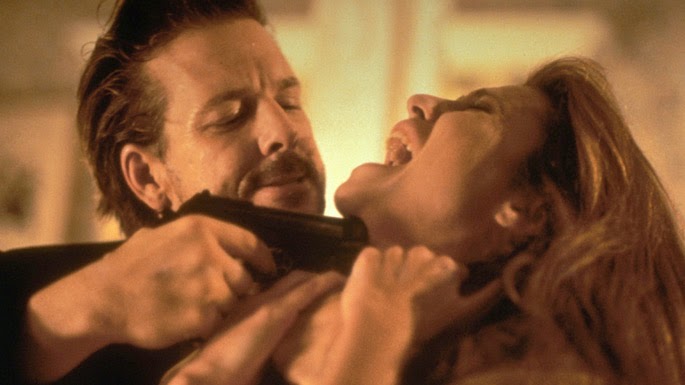
Based on the novel and play by Joseph Hayes, Desperate Hours is the story of an escaped criminal who breaks into a house and takes over while terrorizing a family with two of his friends. Directed by Michael Cimino with a screenplay by Hayes, Lawrence Konner, and Mark Rosenthal, the film is a remake of the 1955 film by William Wyler that starred Humphrey Bogart and Fredric March as it’s set in a more modern setting. Starring Mickey Rourke, Anthony Hopkins, Mimi Rogers, Kelly Lynch, Elias Koteas, David Morse, Shawnee Smith, Matt McGrath, Danny Gerard, and Lindsay Crouse. Desperate Hours is an eerie though somewhat uneven film from Michael Cimino.
The film is a home invasion story about an escaped criminal who hides out at the home of a man who has become estranged from his wife as they’re taken hostage at home. Yet, it’s a film about control and trust where the criminal Michael Bosworth (Mickey Rourke) is waiting for his lawyer/lover Nancy Breyers (Kelly Lynch) to be cleared from accusations that she was the one who broke him out of jail as he is being charged for all sorts of crimes. With the help of his brother Wally (Elias Koteas) and an unhinged, half-wit criminal Albert (David Morse), Bosworth would hide out at the home of Nora Cornell (Mimi Rogers) who is selling her home as she and her husband Tim (Anthony Hopkins) are estranged due to Tim’s infidelity with a young woman. Once Bosworth takes control of the Cornell home, he would instill elements of trust where Nora is more likely to trust Bosworth than Tim as it relates to her life and the life of their kids in the 15-year old May (Shawnee Smith) and the eight-year old Zack (Danny Gerard).
The film’s screenplay does take its time to explore a family being invaded by criminals where in control is this sociopath who is trying to make sure everything goes normal until he can flee with his girlfriend and associates with some money. Yet, the actions of Nancy Breyers only gets the attention of a very intelligent and no-nonsense FBI special agent in Brenda Chandler (Lindsay Crouse) who doesn’t buy Nancy’s act and knows where she’s going as she hopes to nab Bosworth. Though the script is pretty uneven as part of it is set at the Cornell home where Tim tries to reconcile with Nora only for things to go wrong with the Bosworth brothers and Albert taking over where Nora has trust issues with Tim. The other part of the script involves Chandler’s pursuit and watching over Nancy where it has this element of the road movie but it never really gels since Nancy is a very underwritten character who is just lovesick over Bosworth and is put into very tense situations. The scenes at the Cornell home is interesting where there is a sense of psychology as the family isn’t sure who to trust as Bosworth doesn’t try to hurt anyone while Tim tries to do something only to get himself into trouble.
Michael Cimino’s direction is pretty engaging for the way he conveys this element of suspense and dread inside a family’s home as it’s taken over by criminals. Especially as he maintains that sense of tense intimacy with some close-ups and unique medium shots where Cimino’s framing is always there to play into the drama as well as some of tension that goes on. The scenes outside of the Cornell home is shot in various locations in Utah where it plays into Cimino’s sensibilities in terms of the mountains, deserts, and such that does have this sense of beauty in the locations where Cimino is able to display them in a wide canvas. Yet, it adds to film’s uneven tone where it does feel like it’s two different films being made in some aspects though it would come together in a very intense third act. Especially as it becomes a battle of wits and trust where the FBI is also involved in Chandler who takes a more cautious but unconventional approach to let the fates play out. Overall despite a few inconsistencies in its tone, Cimino does craft a very captivating and solid thriller about a family’s home invaded by criminals.
Cinematographer Douglas Milsome does brilliant work with the film‘s cinematography with the gorgeous lighting for many of the daytime exteriors in the Utah desert/mountain locations to more ominous lighting schemes and such to play into the dramatic tension at the Cornell house. Editors Peter R. Hunt and Christopher Rouse do excellent work with the editing to create some methodical cuts to play into the film‘s suspense along with some rhythmic cuts for some of the car chase scenes involving Nancy and the FBI. Production designer Victoria Paul, with set decorator Crispian Sallis and art director Patricia Klawonn, does nice work with the look of the Cornell house to play into its sense of intimacy and the terror that Bosworth would bring.
Costume Charles DeCaro does terrific work with the costumes from the clothes of the Cornell family that is quite casual to the Armani suits that Bosworth wears. Sound editor James J. Klinger does superb work with the sound from the way the helicopters, planes, and cars sound in the exteriors to the intense atmosphere of the Cornell home as it has this air of terror in the film. The film’s music by David Mansfield is amazing for its soaring orchestral score to play into its suspense and drama along with some low-key pieces to showcase the estrangement between Tim and Nora.
The casting by Mary Colquhoun is wonderful as it features some notable small roles from James Rebhorn as a prosecutor, Matt McGrath as May’s boyfriend Kyle, Gerry Bamman as a real-estates agent, and Dean Norris as Chandler’s FBI associate Maddox. Shawnee Smith is alright as Tim and Nora’s teenage daughter May who tries to antagonize Bosworth and his gang while Danny Gerard is quite good as May’s younger brother Zack who deals with the terror of being taken hostage. Kelly Lynch is pretty terrible as Nancy Breyers where it’s not just the character that is terrible but Lynch never really does anything to make anyone care about her as she spends half the film topless and often be worried. Elias Koteas is terrific as Bosworth’s brother Wally who keeps things in control while trying to make sure that the family has nothing to worry about. David Morse is excellent as the more troubled criminal Albert who becomes anxious as he would later become a liability to the situation.
Lindsay Crouse is amazing as the no-nonsense FBI special agent Brenda Chandler who is this very offbeat character that talks in a Southern accent as she knows how to handle situations and can read people better than her fellow agents. Mimi Rogers is fantastic as Nora Cornell as this woman who becomes aware of the situation as she tries to keep things from not going wrong while being very unsure on who to trust. Anthony Hopkins is superb as the Tim Cornell as a man trying to regain his wife’s trust after cheating on her as he deals with Michael Bosworth’s presence and the situation that is happening as he is goaded to take action only to figure out what to do to not hurt his family. Finally, there’s Mickey Rouke in an incredible performance as Michael Bosworth as this very smart sociopath who takes control of an entire house as he tries to play a game of trust on Nora to turn against her own husband as it’s a very fiery and intense performance from Rourke.
While it is a film with some flaws and an inconsistent tone, Desperate Hours is still a solid film from Michael Cimino. Armed with great performances from Mickey Rourke, Anthony Hopkins, Mimi Rogers, and Lindsay Crouse. It’s a film that plays into the world of home invasion as well as a compelling look into the world of trust and guilt. In the end, Desperate Hours is a pretty good film from Michael Cimino.
Michael Cimino Films: Thunderbolt & Lightfoot - The Deer Hunter - Heaven’s Gate - Year of the Dragon - The Sicilian - The Sunchaser - To Each His Own Cinema: No Translation Needed - The Auteurs #35: Michael Cimino
© thevoid99 2014