Showing posts with label james rebhorn. Show all posts
Monday, November 14, 2016
The Game
Directed by David Fincher and written by John Brancato and Michael Ferris (w/ additional work by Andrew Kevin Walker and Larry Gross), The Game is the story of a wealthy investment banker who is invited to play a game that blurs reality and fiction as it becomes dangerous and thrilling. The film is about a man being forced to confront his own fears as well as his own life through a deadly game. Starring Michael Douglas, Sean Penn, James Rebhorn, Deborah Kara Unger, Carroll Baker, and Armin Mueller-Stahl. The Game is an exhilarating and sprawling film from David Fincher.
The film follows the life of a wealthy but cold investment banker who is given a mysterious birthday present from his estranged younger brother which is an invitation to play a game where reality and fiction blur. It’s a film where a man is forced to confront aspects of his own life as well as memories about his father’s death where he has no idea if the game he is playing is real or just some sick joke. The film’s screenplay by John Brancato and Michael Ferris doesn’t just establish the life of its protagonist Nicholas Van Horton (Michael Douglas) who is wealthy but very lonely as he lives in a mansion with a longtime family maid as he is more content with making money and being powerful. When he is invited to lunch by his younger brother Conrad (Sean Penn) who would give him this mysterious invitation. Nicholas doesn’t think about what his brother gave him until he takes a chance where he’s interviewed and examined and then the game starts in a mysterious way.
In the course of the film, Nicholas would wonder what is going on as aspects of his life begin to fall apart from a TV reporter that he watches who suddenly talks to him to other odd things. Along the way, he meets a waitress named Christine (Deborah Kara Unger) who has no idea what is going on as she becomes part of the game for some strange reason. Even as his house has been vandalized and other things start to make no sense as Conrad would claim that the company who handles the game has gone out of control. There is a structure to the script as much of the second act is about the game while the third is Nicholas trying to find out more about this company and expose them to see if he’s still playing or something else has happened.
David Fincher’s direction is definitely stylish in terms of the moods and compositions he creates as it play into a man taking part into the world of the unknown. Shot largely on location in San Francisco, the film plays into this world that mixes the corporate business side with a wild side as Nicholas is not familiar with the latter. Fincher’s meticulous compositions in the usage of the medium shots and close-up play into that sense of cold and unforgiving world that Nicholas lives in as Fincher presents Nicholas in a somewhat detached way. Once the game begins, the direction becomes more intimate and eerie as well as having some bits of dark humor. The lines of reality and fantasy would blur where Fincher doesn’t try to make anything distinctive only for the fact that a game is being played. At the same time, it is about the sense of the unknown where San Francisco is a character in the film where Fincher uses some wide shots to establish some of its landmarks.
The direction also has Fincher use some flashbacks shown in 8mm film as it play into the guilt and loss that Nicholas is carrying which adds to his loner persona. Yet, he realizes that he will have to depend on those who are willing to help him such as Christine. Still, there is that blur of who is playing what and are any of them in on the game or have no clue that they’re in a game. The film’s climax definitely ups the ante in terms of its intensity where Nicholas tries to decipher what is real and what is fantasy as well as face some of his own fears that had been looming into his life. Overall, Fincher creates a thrilling yet provocative film about a man playing a game of death where he is forced to confront his own fears and flaws about himself.
Cinematographer Harris Savides does brilliant work with the film‘s cinematography from the usage of filters and lights for some of the interior scenes as well as the scenes set at night while creating a cold look for some of the exteriors set at night. Editor James Haygood does excellent work with the editing as it has some nice rhythmic cutting to play into the suspense and action as well as some of the darkly comic moments in the film. Production designer James Beecroft, with art directors James J. Murakami and Steve Saklad and set decorator Jackie Carr, does fantastic work with the look of the interior at Nicholas‘ home as well as the look of the office where the people of the game work and the hotel rooms in San Francisco‘s finest hotels. Costume designer Michael Kaplan does nice work with the costumes from the expensive suits that Nicholas wears early in the film to the more casual look he would sport later on as well as the clothes of the other characters.
Visual effects supervisor Kevin Haug does terrific work with some of the minimal visual effects as it mostly relates to the film‘s climax it play into that blur of reality and fantasy. Sound designer Ren Klyce does amazing work with the sound work as it has many layers into the locations that Nicholas encounters as well as in the phone conversations he has. The film’s music by Howard Shore is superb for its haunting yet bombastic score as its orchestral flourishes swell into the drama and suspense while music supervisor Dawn Soler creates a fun soundtrack that features elements of jazz, classical, and contemporary music.
The casting by Don Phillips is marvelous as it feature some notable small roles and appearances from Spike Jonze as a EMT, Linda Manz as Christine’s roommate, Yuji Okumoto as the Nikko hotel manager, Tommy Flanagan as a solicitor/taxi driver, Mark Boone Junior as a shady private detective following Nicholas, and Charles Martinet as Nicholas and Conrad’s father in the flashback scenes. Anna Katarina is wonderful as Nicholas’ ex-wife Elizabeth who only appears briefly late in the film as someone who has moved on but is starting to see that Nicholas is having some revelations about himself. Carroll Baker is terrific as Nicholas’ maid Ilsa as a woman who has been taking of Nicholas’ home yet knows a lot about Nicholas’ father once he starts to ask her about him. Peter Donat is superb as Nicholas’ attorney Samuel Sutherland as someone who watches over and handles some of Nicholas’ business as he becomes evasive later in the film. Armin Mueller-Stahl is excellent as Anson Baer as a businessman that Nicholas tries to buy out only to be just as eccentric and mysterious as he is fun to watch.
James Rebhorn is fantastic as Jim Feingold as a man who is an analyst for the company that creates the game as he is this eccentric yet fun guy that brings so much joy into his performance. Deborah Kara Unger is amazing as Christine as a waitress whom Nicholas meets during his game as she becomes this unlikely player that becomes part of the game as she tries to figure out what is going on. Sean Penn is brilliant as Conrad as Nicholas’ estranged younger brother who would introduce his brother to the game saying it will change his life only to find himself owing money to the company that created the game. Finally, there’s Michael Douglas in an incredible performance as Nicholas Van Orton as a wealthy investment banker who is quite cold and distant where he is given the thrill of a lifetime where Douglas gives a performance that is exhilarating as a man who encounters fear and danger as it is one of his great performances.
The Game is a phenomenal film from David Fincher that features a sensational performance from Michael Douglas. Along with a great supporting cast, eerie visuals, a chilling music score, and a crafty screenplay that blur the lines between reality and fiction. It’s a film that isn’t just a smart and engaging thriller but also a study of fear and control. In the end, The Game is a spectacular film from David Fincher.
David Fincher Films: Alien 3 - Se7en - Fight Club - Panic Room - Zodiac - The Curious Case of Benjamin Button - The Social Network - The Girl with the Dragon Tattoo (2011 film) - Gone Girl
Related: 15 Essential Music Videos by David Fincher - The Auteurs #61: David Fincher
© thevoid99 2016
Wednesday, March 09, 2016
Carlito's Way
Based on the novels by Edwin Torres that includes After Hours, Carlito’s Way is the story of a former gangster who tries to go straight following a stint in prison as he finds himself being dragged into the world of crime thanks to his deceitful lawyer. Directed by Brian de Palma and screenplay by David Koepp, the film is a character study of sorts of a man trying to start all over and do right for himself and the woman he loves as Al Pacino plays the role of Carlito Brigante. Also starring Sean Penn, Penelope Ann Miller, Luis Guzman, John Leguizamo, Viggo Mortensen, and James Rebhorn. Carlito’s Way is a dazzling and riveting film from Brian de Palma.
Set in 1975 New York City, the film revolves around the life of former gangster Carlito Brigante who has just been released from prison in the hopes to start a new life without trouble but aspects of his criminal past come back to haunt him while he is torn in his love for a dancer and his loyalty to his deceitful lawyer. It’s a film that is essentially a character study of sorts where Brigante is eager do something new but he needs the money to get a head-start in going to the Bahamas where he hopes to live a quiet life and run a rental car service for tourists without any trouble. Yet, for all of Brigante’s dreams to come true where he would run a club and make the money that he needs. There are elements of his past that comes to haunt him as there are those that see him as this legendary figure who they want to learn from as well as those that want to see if he’s still in the game of dealing drugs and such. It adds to this conflict in the story where he wants to get out but he’s being pulled back into the dark world as some of it is actually his fault.
David Koepp’s screenplay doesn’t just create a unique structure to the story as well as the fact that it begins and ends with a wounded Brigante on a stretcher in Grand Central Station. He also brings in this noir-style narrative that is largely told from Brigante’s perspective with some voice-over narration that plays into a man struggling with his conscience as well as his attempts to go straight. The dialogue is quite stylish where it does have elements of the film noir language but updated for a more contemporary setting in the 1970s where the Brigante character would find himself in awful situations but tries to restrain himself from not going too far as he knows he might go back to prison. Even as he tries to disassociate himself with old friends in the world of crime as well as new gangsters trying to make a name for themselves like Benny Blanco from the Bronx (John Leguizamo) who is really a younger version of Brigante.
Koepp’s script also play into how seriously flawed Brigante is where his intentions go straight are valid but he is someone that unfortunately trusts the wrong people like Kleinfeld who has put himself into a dangerous world of crime. Kleinfeld’s increasing usage of cocaine and paranoid behavior would trouble Brigante but also has him wanting to help as if he feels like he owes him for getting him out of prison. To Brigante’s former flame Gail (Penelope Ann Miller), she is the first person to see Kleinfeld for who he really is as she is aware of the flaws in Brigante while questioning if everything he is saying about going straight is true as she had seen a lot which adds to her own struggle between cynicism and optimism. Even as there are smaller characters in the film that tell Brigante about the people he’s surrounding himself by as it adds to those flaws which do come to ahead in a key sequence where Brigante finally sees what Kleinfeld is up to all along. Notably as it involves Brigante being used as bait for the justice system which would lead to this thrilling climax over Brigante dealing with Kleinfeld’s actions.
Brian de Palma’s direction is quite stylish for the way he creates these intricate yet mesmerizing tracking shots but also use them to create a sense of atmosphere into the many locations and settings he is in. Shot on location in New York City and some of its landmarks including Grand Central Station for its climax, the film does play into a period where it was very vibrant and exciting but also a world that Brigante has a hard time understanding as well as the fact that the rules are very different as something like ethics are considered dead. The usage of wide and medium shots do help play into aspects of the location including an eerie moment early in the film where Brigante stops at a pool hall for a cousin of his which goes horribly wrong as it is this unsettling moment of the new world that Brigante had unfortunately created. It’s among these moments where de Palma maintains that air of suspense and the unknown where it adds to what Brigante is trying to run away from. The compositions that de Palma creates in the way he would frame his actors into a conversation or have some unique attention to detail in the background while there is someone else in the foreground is among the key visual elements that is used in the film.
Along with some stylish Dutch angles and these mesmerizing tracking shots that manages to capture the vibrancy of the clubs and places Brigante and Gail to go. The direction also has de Palma create moments that are lively with elements of humor but also these unsettling moments such as a sequence where Brigante and Kleinfeld are on a boat is where the former sees the latter for what he’s really done. It is followed by a scene afterwards where it is presented with such simplicity but it also shows exactly where Brigante is and the fact that he knows he is completely fucked by the man who got him out of jail. All of which would lead to these violent and intense moments in the film’s climax where it is quite operatic but also play into what is at stake. Overall, de Palma crafts an exhilarating and rapturous film about a gangster’s attempt to find redemption and a new life away from crime.
Cinematographer Stephen H. Burum does brilliant work with the film‘s cinematography with the usage of colored lights for many of the scenes at the dance clubs as well as some low-key lighting for some of the interiors including the pool hall sequence and natural exterior lighting for scenes in the day. Editors Kristina Boden and Bill Pankow do amazing work with the editing with its usage of jump-cuts, dissolves, and a few stylish cuts for some of the light-hearted and dramatic moments while knowing when not to cut in some of the intricate tracking shots to get a sense of the atmosphere in the film. Production designer Richard Sylbert, with set decorator Leslie A. Pope and art director Gregory Bolton, does fantastic work with the sets that are created from the pool hall, the dance club that Brigante would run, Kleinfeld‘s office, and some of the other places the characters would go to. Costume designer Aude Bronson-Howard does excellent work with the costumes that play into the world of the 1970s from the suits that Brigante wears to the stylish dresses that the women wear at the clubs. Key hair stylist Michael Kriston and key makeup artist Michael Laudati do terrific work with the look of some of the characters including Kleinfeld with his Jew-fro and the look of the hair in some of men in those times.
Sound editor Maurice Schell do superb work with the sound as it play into the atmosphere of the clubs and some of the wild moments in the film plus some of the tense moments in the film such as Brigante‘s meeting with the D.A. The film’s music by Patrick Doyle is phenomenal for its orchestral-based score that play into the drama and suspense with its lush string arrangements that manage to do so much to elevate a scene. Music supervisor Jellybean Benitez create an incredible soundtrack that largely features music from the mid-1970s from the disco music of George McCrae, KC & the Sunshine Band, the Bee Gees, the O’ Jays, Cheryl Lynn, and Hot Chocolate to the salsa music of Hector Lavoe, Willie Colon, Santana, and the Fania All-Stars as well as a poignant usage of Joe Cocker’s You Are So Beautiful.
The casting by Bonnie Timmerman is remarkable as it features a tremendous ensemble that include some notable small roles from filmmaker Paul Mazursky as Brigante’s appeal judge, Angel Salazar and Al Israel as a couple of old friends of Brigante from Spanish Harlem, John Augstin Ortiz as Brigante’s cousin Guarjio, Rick Aviles as a small-time hood Brigante meets early in the film, Ingrid Rogers as a club regular that Kleinfeld goes out with in Steffi, Joseph Siravo and Adrian Pasdar as the sons of a crime boss Kleinfeld is working for, Frank Minucci as the boss Tony T Taglialucci whom Kleinfeld is working for, and the legendary Argentine comedy host Jorge Porcel as a disco/salsa club owner named Saso aka Ron whom Brigante would help out with his debts. James Rebhorn is superb as the district attorney Bill Norwalk who is trying to see if Brigante is up to no good while having his own suspicions about Kleinfeld.
Viggo Mortensen is fantastic as an old friend of Brigante in Lalin as a once top-crime figure who has become down on his luck as he is now on a wheelchair as a person that is being forced to do something bad to Brigante. Luis Guzman is excellent as Pachanga as an old friend of Brigante who works for him as a bodyguard as he is a man that does a lot of things yet is taken aback a bit by Brigante’s own ideals and disdain for his criminal past. John Leguizamo is amazing as Benny Blanco from the Bronx as a young hood who reminds Brigante as a younger version of himself who is eager to earn from Brigante yet is forceful and cunning where Leguizamo manages to be a scene-stealer in the moments he’s in. Penelope Ann Miller is brilliant as Gail as a dancer who was once Brigante’s flame as she is reluctant to be around him yet is someone looking for a change in her own life where she struggles with wanting to chase a dream but contend with the harsh realities of the world.
Sean Penn is sensational as Dave Kleinfeld as a young attorney who gets Brigante out and helps him in finding a club to run yet is someone that is troubled and doing awful things behind the scenes where Penn brings a manic and dangerous approach to his role that has bits of dark humor as it is one of Penn’s finest roles. Finally, there’s Al Pacino in one of his iconic performances of his career as Carlito Brigante as a former criminal that is eager to turn straight and start a new life only for his past activities and flaws in trusting the wrong kind of people come back to haunt him. It’s a role that has Pacino bring in a mixture of accents that play true to the streets while displaying a vulnerability in his role where he realizes he puts himself into a bad situation where he makes the character someone to root for as someone that can still be saved.
Carlito’s Way is a magnificent film from Brian de Palma that features a tremendous performance from Al Pacino. Along with strong supporting work from Sean Penn, Penelope Ann Miller, Luis Guzman, and John Leguizamo as well as a strong script by David Koepp, dazzling visuals, and a killer soundtrack. The film isn’t just one of de Palma’s quintessential films in terms of its style and character study but it’s also a film that showcases a study of redemption as well as the struggle in letting go of a dark past. In the end, Carlito’s Way is a spectacular film from Brian de Palma.
Brian De Palma Films: (Murder a la Mod) - (Greetings) - (The Wedding Party) - (Dionysus in ‘69) - (Hi, Mom!) - (Get to Know Your Rabbit) - Sisters - Phantom of the Paradise - Obsession - Carrie - The Fury - (Home Movies) - Dressed to Kill - Blow Out - Scarface - Body Double - (Wise Guys) - The Untouchables - Casualties of War - The Bonfire of the Vanities - Raising Cain - Mission: Impossible - Snake Eyes - Mission to Mars - Femme Fatale - The Black Dahlia - (Redacted) - Passion (2012 film) - (Domino (2018 film))
© thevoid99 2016
Saturday, July 05, 2014
Desperate Hours (1990 film)
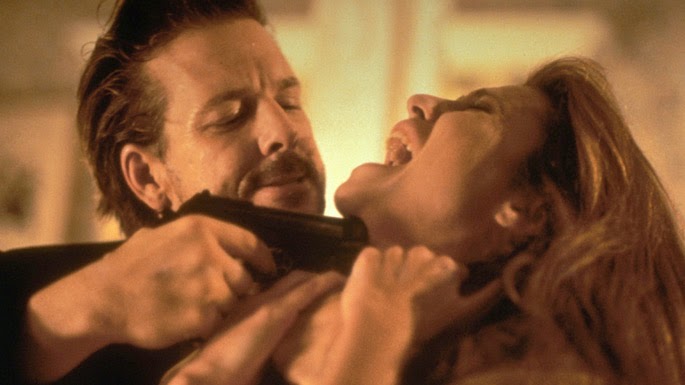
Based on the novel and play by Joseph Hayes, Desperate Hours is the story of an escaped criminal who breaks into a house and takes over while terrorizing a family with two of his friends. Directed by Michael Cimino with a screenplay by Hayes, Lawrence Konner, and Mark Rosenthal, the film is a remake of the 1955 film by William Wyler that starred Humphrey Bogart and Fredric March as it’s set in a more modern setting. Starring Mickey Rourke, Anthony Hopkins, Mimi Rogers, Kelly Lynch, Elias Koteas, David Morse, Shawnee Smith, Matt McGrath, Danny Gerard, and Lindsay Crouse. Desperate Hours is an eerie though somewhat uneven film from Michael Cimino.
The film is a home invasion story about an escaped criminal who hides out at the home of a man who has become estranged from his wife as they’re taken hostage at home. Yet, it’s a film about control and trust where the criminal Michael Bosworth (Mickey Rourke) is waiting for his lawyer/lover Nancy Breyers (Kelly Lynch) to be cleared from accusations that she was the one who broke him out of jail as he is being charged for all sorts of crimes. With the help of his brother Wally (Elias Koteas) and an unhinged, half-wit criminal Albert (David Morse), Bosworth would hide out at the home of Nora Cornell (Mimi Rogers) who is selling her home as she and her husband Tim (Anthony Hopkins) are estranged due to Tim’s infidelity with a young woman. Once Bosworth takes control of the Cornell home, he would instill elements of trust where Nora is more likely to trust Bosworth than Tim as it relates to her life and the life of their kids in the 15-year old May (Shawnee Smith) and the eight-year old Zack (Danny Gerard).
The film’s screenplay does take its time to explore a family being invaded by criminals where in control is this sociopath who is trying to make sure everything goes normal until he can flee with his girlfriend and associates with some money. Yet, the actions of Nancy Breyers only gets the attention of a very intelligent and no-nonsense FBI special agent in Brenda Chandler (Lindsay Crouse) who doesn’t buy Nancy’s act and knows where she’s going as she hopes to nab Bosworth. Though the script is pretty uneven as part of it is set at the Cornell home where Tim tries to reconcile with Nora only for things to go wrong with the Bosworth brothers and Albert taking over where Nora has trust issues with Tim. The other part of the script involves Chandler’s pursuit and watching over Nancy where it has this element of the road movie but it never really gels since Nancy is a very underwritten character who is just lovesick over Bosworth and is put into very tense situations. The scenes at the Cornell home is interesting where there is a sense of psychology as the family isn’t sure who to trust as Bosworth doesn’t try to hurt anyone while Tim tries to do something only to get himself into trouble.
Michael Cimino’s direction is pretty engaging for the way he conveys this element of suspense and dread inside a family’s home as it’s taken over by criminals. Especially as he maintains that sense of tense intimacy with some close-ups and unique medium shots where Cimino’s framing is always there to play into the drama as well as some of tension that goes on. The scenes outside of the Cornell home is shot in various locations in Utah where it plays into Cimino’s sensibilities in terms of the mountains, deserts, and such that does have this sense of beauty in the locations where Cimino is able to display them in a wide canvas. Yet, it adds to film’s uneven tone where it does feel like it’s two different films being made in some aspects though it would come together in a very intense third act. Especially as it becomes a battle of wits and trust where the FBI is also involved in Chandler who takes a more cautious but unconventional approach to let the fates play out. Overall despite a few inconsistencies in its tone, Cimino does craft a very captivating and solid thriller about a family’s home invaded by criminals.
Cinematographer Douglas Milsome does brilliant work with the film‘s cinematography with the gorgeous lighting for many of the daytime exteriors in the Utah desert/mountain locations to more ominous lighting schemes and such to play into the dramatic tension at the Cornell house. Editors Peter R. Hunt and Christopher Rouse do excellent work with the editing to create some methodical cuts to play into the film‘s suspense along with some rhythmic cuts for some of the car chase scenes involving Nancy and the FBI. Production designer Victoria Paul, with set decorator Crispian Sallis and art director Patricia Klawonn, does nice work with the look of the Cornell house to play into its sense of intimacy and the terror that Bosworth would bring.
Costume Charles DeCaro does terrific work with the costumes from the clothes of the Cornell family that is quite casual to the Armani suits that Bosworth wears. Sound editor James J. Klinger does superb work with the sound from the way the helicopters, planes, and cars sound in the exteriors to the intense atmosphere of the Cornell home as it has this air of terror in the film. The film’s music by David Mansfield is amazing for its soaring orchestral score to play into its suspense and drama along with some low-key pieces to showcase the estrangement between Tim and Nora.
The casting by Mary Colquhoun is wonderful as it features some notable small roles from James Rebhorn as a prosecutor, Matt McGrath as May’s boyfriend Kyle, Gerry Bamman as a real-estates agent, and Dean Norris as Chandler’s FBI associate Maddox. Shawnee Smith is alright as Tim and Nora’s teenage daughter May who tries to antagonize Bosworth and his gang while Danny Gerard is quite good as May’s younger brother Zack who deals with the terror of being taken hostage. Kelly Lynch is pretty terrible as Nancy Breyers where it’s not just the character that is terrible but Lynch never really does anything to make anyone care about her as she spends half the film topless and often be worried. Elias Koteas is terrific as Bosworth’s brother Wally who keeps things in control while trying to make sure that the family has nothing to worry about. David Morse is excellent as the more troubled criminal Albert who becomes anxious as he would later become a liability to the situation.
Lindsay Crouse is amazing as the no-nonsense FBI special agent Brenda Chandler who is this very offbeat character that talks in a Southern accent as she knows how to handle situations and can read people better than her fellow agents. Mimi Rogers is fantastic as Nora Cornell as this woman who becomes aware of the situation as she tries to keep things from not going wrong while being very unsure on who to trust. Anthony Hopkins is superb as the Tim Cornell as a man trying to regain his wife’s trust after cheating on her as he deals with Michael Bosworth’s presence and the situation that is happening as he is goaded to take action only to figure out what to do to not hurt his family. Finally, there’s Mickey Rouke in an incredible performance as Michael Bosworth as this very smart sociopath who takes control of an entire house as he tries to play a game of trust on Nora to turn against her own husband as it’s a very fiery and intense performance from Rourke.
While it is a film with some flaws and an inconsistent tone, Desperate Hours is still a solid film from Michael Cimino. Armed with great performances from Mickey Rourke, Anthony Hopkins, Mimi Rogers, and Lindsay Crouse. It’s a film that plays into the world of home invasion as well as a compelling look into the world of trust and guilt. In the end, Desperate Hours is a pretty good film from Michael Cimino.
Michael Cimino Films: Thunderbolt & Lightfoot - The Deer Hunter - Heaven’s Gate - Year of the Dragon - The Sicilian - The Sunchaser - To Each His Own Cinema: No Translation Needed - The Auteurs #35: Michael Cimino
© thevoid99 2014
Thursday, April 07, 2011
Far from Heaven
Originally Written and Posted at Epinions.com on 1/7/04 w/ Extensive Revisions & New Content.
Written and directed by Todd Haynes, Far from Heaven is the story of 1950s Connecticut housewife whose idyllic life and marriage shatters upon the discovery of her husband's homosexual tendencies. With her husband going to treatment, the wife begins to fall for her black gardener. The film recalls Haynes' themes of repression in the home life and in homosexuality, which was taboo in the 1950s. The film is also a tribute to the film of Douglas Sirk, famous for such melodramatic films such as All That Heaven Allows and Imitation of Life. Starring Julianne Moore, Dennis Quaid, Dennis Haybert, Viola Davis, and Patricia Clarkson. Far from Heaven is a lush and enchanting drama from Todd Haynes and company.
It's 1957 in Hartford, Connecticut as a beautiful housewife named Cathy Whitaker comes home and brings grocery to her lovely house with her perfect family including son David (Ryan Ward) and daughter Janice (Lindsay Andretta). Her husband Frank is at work in his corporate office while Cathy is at home with help from her black maid Sybil (Viola Davis). Cathy seems to have the perfect life much envy but she seems to think her life is just like everyone else’s as a local newspaper editor Mrs. Leacock (Bette Henritze) wants to do a profile on her. On that day, she sees a black man in her backyard that turns out to be her new gardener Raymond Deagan (Dennis Haysbert), who is replacing his late father, who was the family’s old gardener.
While Cathy’s life seems to be perfect, she still has to contend with the town’s gossip queen Mona Lauder (Celia Weston) while she often talks gossip about sex and home life with best friend Eleanor Fine (Patricia Clarkson). Cathy then seems to notice about her husband’s behavior as he often works late, doesn’t spend a lot of time at home, and most recently was arrested for drunken behavior. One night when she decides to bring his dinner to his work place, she finds Frank kissing another man in his office, as she is both shocked and confused. Frank doesn’t know why he behaves like this as he goes to see psychiatrist Dr. Bowman (James Rebhorn) to seek some sort of treatment. Cathy just wants to move on and please her husband as she begins to talk more with Raymond, who is a single parent that owns a plant shop outside of Hartford. She meets with and his daughter Sarah (Jordan Puryear) at an art gallery Eleanor was hosting, as Raymond says some very intelligent things about a Miro painting. Cathy is extremely impressed with his knowledge and sensitivity while the townspeople are lurking over what is going on.
Later at a dinner party hosted by Cathy, she finds herself uncomfortable by the talks of integration in Hartford while Frank is getting drunk at the party. When it ends, Frank tries to make love to her but couldn’t but she says it’s OK as he accidentally hits her. Eleanor comes to the house the next day to pick up some things as she sees the bruise on Cathy’s head as Cathy nearly breaks down in front of her and later, in front of Raymond. Raymond comforts her as he takes her to a park to buy flowers for the garden and a restaurant nearby a car shop where Mona sees the two. Raymond takes Cathy to the restaurant where the restaurant’s all black-patrons look on with ill ease as Raymond ignores their look as Cathy finds Raymond charming.
Rumors begin to swell over what Mona saw as Eleanor begins to ask Cathy what’s going on as Frank is suggesting that Cathy is having an affair where she insists, nothing happened. Cathy had no choice but to fire Raymond but Raymond doesn’t want her to ignore things but understands why they couldn’t be together. Around Christmas time, Frank and Cathy go on a vacation by themselves as Frank’s homosexual tendencies are tested again and he begins to fall apart. Cathy then learns that school kids attacked Raymond’s daughter, as she is saddened at where her life is and realizes that there’s no such thing as a perfect life.
What makes Far from Heaven such an exquisite, delicate little film isn’t just its colorful, ravishing look but its restrained melodrama from its actor and film’s script. Todd Haynes, who is known for such films as Safe, Velvet Goldmine, and the controversial Poison, makes a movie that isn’t just a lovely tribute to Douglas Sirk’s work but also makes them superior to some of today’s modern drama films. He brings in some trained, old school acting style back from the 1950s but with a modern humanistic tone that makes the characters entertaining and real at the same time. Haynes goes for elements of suspense and drama at its most heightened or just making it linear to the story. Especially in the film’s racial tension where it isn’t just the whites looking very discomforted but blacks as well as they too, don’t like the idea of this handsome, intelligent black man talking with this beautiful, charming white woman. It’s stories like that, that are so ahead of its time and Haynes takes it back in time and makes it look fresh.
The look of the film is just breathtaking thanks in large part to cinematographer Edward Lachman. Lachman’s use of color, lighting, and wide-angle shots are so divine, it leaves you breathless as if you’re back in the 1950s. His look is both rich and luscious in its tone and works in its dramatic setting, along with the production design from Mark Friedberg who places all sorts of details of 1957 Hartford from its cars and buildings, to the housings. The film’s art director Peter Rogness should be credited for the film’s colorful look, especially with its fall-like setting of colorful leaves and green grasses. Even the costumes by designer Sandy Powell is filled with life with the big dresses Julianne Moore wore to the more tightened, clothing Patricia Clarkson was wearing along with suits and tuxedos Dennis Quaid and Dennis Haysbert wore.
Another great element that brought suspense to the film was Elmer Bernstein’s orchestral score. From its subtle, heartfelt moments, Bernstein brings in a touch of light, smooth orchestral music that just worked while in the more intense dramatic moments, he just strikes with emotional power the way drama should work. At times, it makes your hair stand as if you’re watching a highly emotional scene with immense intensity.
The film’s performance is just top-notch from the smaller roles like the Whitaker’s children and townspeople including the cheery Mrs. Leacock and the lecherous gossip queen Mona Lauder. Even the more standout roles like James Rebhorn’s Dr. Bowman are played at a subdued, restrained tone which some aren’t used to seeing for those who know Rebhorn for playing asshole-like characters. Viola Davis’ role as the maid Sybil is noted just for its quiet tone as she strays away from the cliché of an African-American maid in the 1950s. Instead, Davis just plays the role from a more subdued, discipline role, as she knows what’s going on between Raymond and Cathy but isn’t saying anything although she isn’t pleased.
The film’s best supporting performance overall goes to Patricia Clarkson as Moore’s best-friend Eleanor. Clarkson gives a raspy, cool tone to her performance as she plays the best friend without descending to other type of clichés where she is the one trying to help her and knowing where she shouldn’t be at. Clarkson is just enigmatic in both her delivery and grace. Dennis Haysbert is by far the film’s most impressive male performance as again, he strays away from stereotypes. Haysbert brings in a relaxed, wise tone to Raymond by just being this African-American character that knows where his place is although isn’t afraid to cross the world he isn’t supposed to be in. It’s the fearlessness that’s impressive as Haysbert proves to be more versatile with each performance and is understandably one of the most underrated actors around.
Dennis Quaid brings in his best performance to date as the tortured mess known as Frank Whitaker. At times, Quaid brings in restraint to his character when it’s needed while being shady in places he’s trying to hide in while breaks down in front of his children in the more dramatic performances. Quaid is just amazing in the way he reveals his internal conflict. Julianne Moore is the film’s best performance as she brings in both beauty and intelligence to her performance while trying not to act phony. She does play that 50s housewife trying to please her husband but she develops into a stronger woman who realize that images aren’t what they seem. It is definitely her most radiant performance of her career.
***The Following Content was Written on 4/7/11***
The 2003 Region 1 DVD for Far from Heaven from Universal presents the film in its 1:85:1 theatrical aspect ratio for the widescreen format. Also presented in 5.1 Dolby Digital and DTS Surround Sound in English and Dolby Surround in French plus subtitles in English, French, and Spanish. The look of the film is gorgeous in displaying the lush photography of Edward Lachman as well as the sound work of Kelley Baker.
The special features of the DVD includes a feature-length commentary track from the film’s writer-director Todd Haynes. Haynes discusses the film’s production and inspiration including reading quotes about film theory from Douglas Sirk as well as Rainier Werner Fassbinder’s thoughts on Sirk’s films. Haynes also revealed that because of the small budget and limitations they had as they were shooting the film on New Jersey. The production was tense though they got through it quite easily. Haynes reveals that since he wanted to recreate the look of Sirk’s films for Far from Heaven, he worked closely with Edward Lachman, production designer Mark Friedberg, and costume designer Sandy Powell about how it should look.
Haynes revealed that during the shooting, Julianne Moore was early in her pregnancy as Sandy Powell did create clothes that would make her comfortable. Haynes praised the work of the actors while he revealed that Dennis Haysbert had a difficult time due to the fact that he had to fly back and forth from New York to Los Angeles for his work on the show 24. Haynes also discusses the story and how he wanted to give it a Sirk-like feel while adding a bit of Fassbinder to some of the characters and in tone of the film. Particularly with the editing as the transitions were partially inspired by Fassbinder’s films. The overall commentary is an enjoyable treat that allows Haynes to reflect on the film and such.
The 27-minute Anatomy of a Scene special from the Sundance Channel is about the making of the party scene at the Whitakers’ home. Haynes along with Julianne Moore, Dennis Quaid, cinematographer Edward Lachman, production designer Mark Friedberg, editor James Lyons, costume designer Sandy Powell, and music composer Elmer Bernstein the importance of the party scene in which Frank gets drunk as it leads to a breakdown between him and Cathy. Haynes, the actors, and crew members each discuss their approach to the scene while using the films of Douglas Sirk and the period of the 1950s as a guideline. It’s definitely a marvelous special that breaks down how a scene is created.
The 11-minute making-of featurette is a piece where Haynes, the main cast, and Elmer Bernstein talk about the film. Featuring clips of films by Douglas Sirk, notably All That Heaven Allows, Haynes talks about wanting to recreate the world of Sirk but with a contemporary feel of sorts. Even as the actors like Dennis Quaid revealed that it was challenging because it was a different style of acting. Haynes reveals that the biggest highlight of making the film is working with Elmer Bernstein as Bernstein revealed that the score for this film is one of his favorites. The five-minute Q&A session with Todd Haynes and Julianne Moore has the two talking about their collaboration while Moore talks about her process to the performance. Even as she reveals that she doesn’t like to rehearse and find the character through the acting.
Other minor special features on the DVD include the film’s theatrical trailer, recommendations from Focus Features on films like Francois Ozon’s 8 Women and Neil LaBute’s Possession, cast and director info, and production notes about the film and Haynes’ desire to bring back the 1950s melodrama films of Douglas Sirk. The overall DVD is truly marvelous as it features special features fans of Haynes would love.
Far from Heaven is a gorgeous yet heartbreaking masterpiece from Todd Haynes featuring a superb performance from Julianne Moore. Featuring phenomenal supporting work from Dennis Quaid, Dennis Haybert, Viola Davis, and Patricia Clarkson. It’s a film that will allow audiences to soak into the lush, melodramatic work that Haynes has created while paying tribute to the late Douglas Sirk. While it’s Haynes’ most accessible work to date, it is definitely a film that is definitely romantic with characters that audiences can root for. In the end, Far from Heaven is a magnificent triumph from Todd Haynes.
Todd Haynes Films: Superstar: The Karen Carpenter Story - Poison - Dottie Gets Spanked - Safe - Velvet Goldmine - I'm Not There - Mildred Pierce (TV miniseries) - Carol - Wonderstruck - Dark Waters (2019 film) - The Velvet Underground - The Auteurs #3: Todd Haynes
© thevoid99 2011
Subscribe to:
Posts (Atom)