Showing posts with label monica bellucci. Show all posts

Monday, September 09, 2024

Beetlejuice Beetlejuice


Based on the characters created by Michael McDowell and Larry Wilson, Beetlejuice Beetlejuice is the sequel to the 1988 film Beetlejuice in which a family returns to a small town following the death of their patriarch where a woman reunites with a demonic figure after her daughter is taken to the Afterlife leading to another misadventure. Directed by Tim Burton and screenplay by Alfred Gough and Miles Millar from a screen story by Gough, Millar, and Seth Grahame-Smith, the film explores a family whose previous encounter with the Afterlife has them dealing with loss and other strange things with Michael Keaton reprising his role as the titular character/Betelgeuse with Winona Ryder and Catherine O’Hara also returning to reprise their respective roles in Lydia and Delia Deetz. Also starring Jenna Ortega, Justin Theroux, Monica Bellucci, Arthur Conti, Santiago Cabrera, and Willem Dafoe. Beetlejuice Beetlejuice is a whimsical and witty film by Tim Burton.

More than 30 years after events in which a young woman meets a demonic figure named Betelgeuse, the film revolves around that woman, her stepmother, and daughter who return to the small town following the death of her father where strange events occurred in the Afterlife involving Betelgeuse and his ex-wife seeking revenge on him. It is a film that does not just explore loss but also a woman dealing with the traumatic events when she was a teenager as she is forced to confront her past as well as her own relationship with her daughter. The film’s screenplay by Alfred Gough and Miles Millar is straightforward in its narrative as it plays into a woman who remains haunted by Betelgeuse where she has spent her adult life hosting a TV show relating to ghosts whom she can see. Yet, the show has also been the reason Lydia Deetz has become estranged from her teenage daughter Astrid (Jenna Ortega) who does not believe her mother’s claims, nor does she believe in ghosts as she wonders why her mother could see ghosts but not her late father.

The death of Lydia’s father Charles Deetz forces Lydia, Astrid, and Lydia’s stepmother Delia to return to Winter River fin the funeral as well as cleaning out their old house where Astrid discovered a flyer at the attic that has Betelgeuse’s name. Astrid would meet a fellow teenager in Jeremy (Arthur Conti) as they share a love of Dostoyevsky while Lydia’s boyfriend/producer Rory publicly proposed to her during the wake adding to the growing tension between Lydia and Astrid while Delia also is not fond of Rory as she’s concerned with cleaning out the house and express her grief through art. The script does play into Lydia and Delia’s relationship with each other as the former feels lost as she turns to the latter despite the issues they have had in the past. Still, the presence of Betelgeuse still looms as he has problems of his own in the fact that his ex-wife Delores (Monica Bellucci) has returned following a strange accident involving a janitor. Delores and Betelgeuse met during the plague as the former was part of a soul-sucking cult that tried to kill the latter only for Betelgeuse to kill her in retaliation. While Lydia is reluctant to ask for Betelgeuse’s help when Astrid is sent to the Afterlife, Betelgeuse does help her though it does come with some risks as he is an opportunist who will always want something. Still, he does want to show Lydia that he does care despite his motives.

Tim Burton’s direction is stylish and full of whimsy in terms of re-establishing a few visual clues and some Easter eggs relating to the original 1988 film but also paying tribute to that film as its opening sequence mirrors the same one from that film. Shot on location in Vermont and Massachusetts with some interior shots created in London, Burton does play into these two different worlds that is the living and the dead where Lydia’s show is filled with these quirks that is expected in shows about the paranormal. Yet, Burton also infuses the film with different kinds of style ranging from European horror in a sequence where Betelgeuse tells his employees about how he met his ex-wife to stop-motion animation in discussing how Charles Deetz had died. Still, Burton knows when to break from the humor and horror to create scenes that are straightforward in his compositions where he uses close-ups and medium shots in the way characters interact with one another. There are some wide shots that Burton uses though he prefers to maintain some simplicity when it comes to the compositions and elaborate set pieces.

Burton also plays into this idea of death where there are some humorous moments as it relates to Delia’s over-the-top approach to grief as she expresses it through art as well as well as some of the antics that Betelgeuse does in the building he works at. Burton also maintains some suspense once Astrid is sent to the Afterlife as there are stakes not just for the Deetz but also for Betelgeuse himself as he is also being chased by the ghost detective Wolf Jackson (Willem Dafoe) who was once a B-movie actor. The film’s climax is a throwback of sorts to the climax of the original film, but Burton brings in a more elaborate setting that involves musical dance numbers and other silly things that is expected from Burton. Overall, Burton crafts a dazzling and offbeat film about a woman reaching out to her former tormentor to help her retrieve her daughter in the Afterlife.

Cinematographer Haris Zambarloukos does brilliant work with the film’s cinematography with the usage of natural lighting for the daytime exteriors in some scenes as well as the usage of colorful lighting for the interior scenes in the Afterlife. Editor Jay Prichidny does excellent work with the editing as it is straightforward in its approach to rhythmic cuts to play into the humor and suspense. Production designer Mark Scruton, along with supervising art directors Nick Gottschalk and Andrew Palmer plus set decorators Lori Mazuer and David Morison, does amazing work with the look of the Afterlife offices and hallways as well as the interiors of the old Deetz/Maitland home that also featured additional work from the first film’s production designer Bo Welch who serves as the film’s visual consultant. Costume designer Colleen Atwood does fantastic work with the costumes from the black clothing that Lydia wears as well as some of the clothes that Betelgeuse wears and the stylish clothing that Astrid and Delia wear.

Hair/makeup designer Christine Blundell does incredible work with the look of the characters from the look of the dead in the Afterlife as well as Delia’s red hair. Visual effects supervisor Angus Bickerton and special effects supervisor Stefano Pepin, along with creature effects designer Neal Scanlan, do phenomenal work with the visual effects in the mixture of practical and CGI effects to create a unique world . Sound designer Jimmy Boyle does superb work with the sound in some of the sound effects created as well as the atmosphere of a room during the wake scene as well as the raucous atmosphere of the scenes in the Afterlife.

The film’s music by Danny Elfman is wonderful for its bombastic orchestral score filled with grand string and brass arrangements that play into the sense of suspense and humor while music supervisors James Balmont and Matthew Lawrenson create a fun soundtrack that features two different versions of the song MacArthur Park sung by Richard Harris and a disco version by Donna Summer. The rest of the music soundtrack also features music from the Bee Gees, Mazzy Star, Scott Weiland, Pino Donaggio, Sigur Ros, and Richard Marx as it is a highlight of the film.

The casting by Sophie Holland is great as it feature some notable small roles and appearances from Georgiana Beedle as Jackson’s secretary who always brings him a cup of coffee, Filipe Cates as a mysterious figure Astrid would meet in Vlad, casting director Sophie Holland as a hot dog lady with a stick who runs the office when the dead arrive, Sami Silane as an artist in Le Tigre who is upset at Delia for cancelling her show, and Amy Nuttall as the real estate agent Jane Butterfield who took over the business from her mother as she reveals some crucial information to Lydia that would be a key plot-point to the film. Other notable small roles include Santiago Cabrera as Astrid’s late father Richard who had died in South America, Burn Gorman as Father Damien who performed the funeral for Charles Deetz as well as other events in the town, and Nick Kellington as Betelgeuse’s right-hand shrinker-zombie friend Bob who helps run things for Betelgeuse.

Arthur Conti is superb as Jeremy as a young man Astrid meets after crashing her bicycle into his fence where he offers a chance to help Astrid see her father though he has motives of his own. Willem Dafoe is excellent as Wolf Jackson as a former B-movie actor who leads a paranormal detective force as he tries to deal with Delores and the antics of Betelgeuse where Dafoe gets the chance to ham it up as someone who really loves playing the role of a detective. Monica Bellucci is fantastic as Delores as Betelgeuse’s ex-wife who is part of a soul-sucking cult that tried to kill Betelgeuse during the black plague only to be killed by him in retaliation as she is eager to get revenge on him. Justin Theroux is brilliant as Lydia’s producer/boyfriend Rory as a guy who is the embodiment of uncool as he tries everything to win over Astrid while also forcing Lydia into a wedding for publicity reasons where Theroux is fun to watch in the way he reacts to certain things as well as just being so dumb. Jenna Ortega is incredible as Astrid as Lydia’s teenage daughter who wants nothing to do with her mother as she doesn’t believe in ghosts while feeling resentful towards her mother for not seeing their late father as well as other issues where Ortega brings a lot of wit and angst to her character while also proving to funny as she has great rapport with her co-stars.

Catherine O’Hara is phenomenal as Delia Deetz as Lydia’s stepmother who becomes consumed with grief over the death of her husband as she expresses it through art in the most hilarious of ways. Notably as she does some things that are odd, yet O’Hara often keeps things lively while also proving to be understanding over Lydia’s relationship with Astrid. Winona Ryder is great as Lydia Deetz as a paranormal TV show host who is still dealing with trauma as well as loss where Ryder keeps a lot of her performance straightforward while retaining a few quirks in her choice of clothing. Even though she is determined to not deal with Betelgeuse but realizes that she needs him to help retrieve her daughter in the Afterlife. Finally, there’s Michael Keaton in a tremendous performance as Betelgeuse as the demon who still pines for Lydia while dealing with the return of his ex-wife as he is eager to be rid of Delores while also hoping to reunite with Lydia in the hopes of marrying her. Keaton adds a lot of energy and charisma to his performance as well as the complexity of someone who likes to create chaos while also wanting to show Lydia that he really does care in his own offbeat way.

Beetlejuice Beetlejuice is a marvelous film by Tim Burton that features great performances from Michael Keaton, Winona Ryder, Catherine O’Hara, and Jenna Ortega. Along with its supporting ensemble cast, amazing set pieces, dazzling visuals, a fun music soundtrack, and a story about loss and family. It is a film that does not try to be its predecessor while also acknowledging it in a loving way while also wanting to be entertaining and not taking itself too seriously. In the end, Beetlejuice Beetlejuice is a remarkable film by Tim Burton.

Tim Burton Films: (Pee-Wee’s Big Adventure) – Beetlejuice - Batman - (Edward Scissorhands) – Batman Returns - Ed Wood - (Mars Attacks!) – (Sleepy Hollow) – (Planet of the Apes (2001 film)) – (Big Fish) – (Charlie and the Chocolate Factory) – (Corpse Bride) – (Sweeney Todd: The Demon Barber of Fleet Street) – (Alice in Wonderland (2010 film)) – (Dark Shadows) – (Frankenweenie) – (Big Eyes) – (Miss Peregrine’s Home for Peculiar Children) – (Dumbo (2019 film))

© thevoid99 2024

Friday, September 29, 2017

The Whistleblower


Directed by Larysa Kondracki and screenplay by Kondracki and Eilis Kirwan, The Whistleblower is the story of a United Nations peacekeeper who makes a chilling discovery as it relates to sex trafficking forcing her to confront the United Nations and eventually tell her story publicly. The film is based on a true story about Nebraskan police officer Kathryn Bolkovac who went to Bosnia and Herzegovina in 1999 originally to work for the UN’s peacekeeping work as her discovery would raise concerns over what is happening in the war-torn country as Bolkovac is played by Rachel Weisz. Also starring Monica Bellucci, David Strathairn, Nikolaj Lie Kaas, Benedict Cumberbatch, Liam Cunningham, Anna Anissimova, and Vanessa Redgrave. The Whistleblower is a terrifying yet gripping film from Larysa Kondracki.

Set in 1999 in the aftermath of the war in the Balkans at Bosnia and Herzegovina, a Nebraskan police officer in Kathryn Bolkovac signs up to join the peacekeeping mission for the United Nations in the hope of making some serious money to be near her daughter who is living with her father and his new family. When she is given a new assignment relating to the department of gender affairs, she would make a chilling discovery as it relates to sex trafficking that include those working for the United Nations. The film’s screenplay by Larysa Kondracki and Eilis Kirwan opens in Kiev, Ukraine where two young women make plans to make money and travel the world unaware that they’ve been sold to Bosnia and Herzegovina for prostitution as it then cuts to Bolkovac working in Lincoln, Nebraska as a cop awaiting a transfer to be near her daughter.

In taking this job for the United Nations to help out in post-war Bosnia and Herzegovina for financial reasons, Bolkovac would get the attention of the revered Madeleine Rees (Vanessa Redgrave), who is the head of the Human Rights Commission for the United Nations, after Bolkovac aided a Muslim woman over domestic violence charges and have something done about it. Bolkovac would see the job as a major opportunity until she participates in a raid at some nightclub where she makes a discovery that has her questioning what is happening as she sees men who work as part of the UN’s police force participating in these lewd events as she takes pictures and passports as evidence. She would confront those who work in that force but also have a realization of how big things are when she talks to women who had been taken from their homes for sex trafficking as well as try to help a couple of young prostitutes including a young Ukrainian girl in Raya (Roxana Condurache).

Yet, there are complications when there are those including local Bosnian police forces that want to keep it quiet prompting Bolkovac to turn to Rees for help who brings in internal affairs specialist Peter Ward (David Strathairn) for help. Even a human rights organization executive in Laura Leviani (Monica Bellucci) tries to help by talking directly to Raya’s mother despite the corporate pressures to not discuss what had been found. Still, it urges Bolkovac to find out more as the few allies she has do whatever they can to help her but there is so many obstacles for Bolkovac that would she would have to face all the way to top official at the United Nations.

Kondracki’s direction is very straightforward in terms of the compositions that she creates while much of the film is shot mainly near Bucharest, Romania as Bosnia and Herzegovina with some interior scenes of the UN buildings shot in Toronto. While there are some wide shots of the locations, Kondracki’s direction is mainly intimate to play into the suspense and drama while displaying an air of realism into the subject matter. Most notably a scene in which Raya has been captured and raped in front of other girls to see what would happen to her if she told anyone what they’re doing. It’s among one of the most horrifying scenes in the film as much of Kondracki’s direction emphasize on hand-held cameras that include a chase scene involving Bolkovac running after a young prostitute who had been taken and was found near the Serbian border.

While there is a lot of moments of suspense with some action, much of Kondracki’s direction emphasizes on the dramatic stakes of what Bolkovac wants to do as the drama would intensify once she is dealing with various officials in the United Nations as well as private contractors working with the government for their own interest. Especially when she’s asked to take a leave which she knew would only cause more problems prompting her to take action and gather whatever evidence she has that could expose everything. Even if it means having to lose her job and never see her daughter again as she is aware of what is at stake and what to do to make sure that young women wouldn’t have to be taken for sex trafficking ever again. Overall, Kondracki creates a gritty yet evocative film about a United Nations peacekeeper who discovers the practice of sex trafficking in post-war Bosnia and Herzegovina.

Cinematographer Kieran McGuigan does excellent work with the film’s cinematography to capture some of the dark yet colorful look of some of the interior scenes set at night in the clubs and sanctuary for some of the women who are hiding from criminals. Editor Julian Clarke does brilliant work with the editing in creating some unique rhythmic cuts to play into the suspense and some of the action while maintaining something straightforward for the dramatic moments in the film. Production designer Caroline Foellmer, with set decorator Andreea Popa and art director Vlad Vieru, does fantastic work with the look of the interior of the UN offices as well as the look of the nightclub where the young women are forced to work at.

Costume designer Gersha Phillips does nice work with the costumes as it is mainly straightforward with the exception of the skimpy clothing the young girls are forced to wear. Sound editors Mark Gingras and John Laing does superb work with the sound with the way some of array of sounds in various locations are presented as well as some of the quieter moments in the film. The film’s music by Mychael Dyanna music is terrific for its usage of low-key orchestral music to play into the drama and suspense while music supervisor David Hayman provide a mixture of traditional Eastern European music with some contemporary music of the late 90s.

The casting by Sara Jay and Jenny Lewis is great as it feature some notable small roles from David Hewlett and William Hope as a couple of UN peacekeeping officers involved in the sex trafficking, Stuart Graham as a top UN official who tries to dismiss Bolkovac from her investigation, Benedict Cumberbatch as a UN security officer that befriends Bolkovac, Paula Schramm as a young Ukrainian woman in Luba who would convince Raya to travel outside of the Ukraine only to realize what she’s done, Rayisa Kondracki as a young prostitute in Ikra who wanted to testify only to be taken and later saved by Bolkovac, Rosabell Laurenti Sellers as Bolkovac’s daughter Erin, Alexandru Potocean as a corrupt Bosnian officer, and Liam Cunningham in a superb performance as the head of the private security company Bill Haynes who wants to cover up all of these reports on sex trafficking.

Monica Bellucci is terrific as Laura Leviani as a human rights organization executive trying to help Bolkovac as well as Raya’s mother despite the corporate pressures from her superiors to not be involved. Roxana Condurache is excellent as Raya as a young woman who is convinced by a friend to travel only to endure abuse of the worst kind as a prostitute which includes a scene of her being raped in the most gruesome of ways. Anna Anissimova is fantastic as Raya’s mother Zoe as a woman who wonders where her daughter is as she travels to Bosnia to meet with Leviani as she would learn some awful truths about what happened as well as the people who put her daughter in this mess. Nikolaj Lie Kaas is brilliant as Jan as a Bosnian UN official who is one of Bolkovac’s few allies as he tries to help Raya and other girls only to deal with Bosnian criminals.

Vanessa Redgrave is amazing as Madeleine Rees as the famed human rights commission head for the United Nations who hires Bolkovac to help her in gender affairs as she would learn what is going on as she also becomes disgusted over the fact that the United Nations is involved with sex trafficking. David Strathairn is incredible as Pete Ward as an internal affairs specialist who would help Bolkovac in finding more evidence about sex trafficking as he would make some discoveries that would get him in trouble as he does whatever he can to give it to Bolkovac and expose it to the world. Finally, there’s Rachel Weisz in a magnificent performance as Kathryn Bolkovac as this cop from Nebraska who takes a job for the United Nations peacekeeping force only to get a better job with more money but also revelations about what she would discover in post-war Bosnia and Herzegovina prompting her to do something where Weisz has this air of humility and determination to do the right thing as well as displaying that anguish over what is happening to these girls as it’s one of her best performances.

The Whistleblower is a phenomenal film from Larysa Kondracki that features a tremendous performance from Rachel Weisz. Along with its strong ensemble cast, eerie visuals, and gripping take on a universal subject matter that is uneasy to deal with. It is definitely a suspense-drama that showcases some of the troubling aftermaths of war and what some will do to not just protect their image but also make money out of it forcing a woman to stop all of that for the good of the world. In the end, The Whistleblower is a sensational film from Larysa Kondracki.

© thevoid99 2017

Saturday, November 21, 2015

007 James Bond: SPECTRE


Based on the novels of Ian Fleming, SPECTRE is the story of James Bond trying to uncover a criminal organization that is threatening the world just as the MI6 is under threat of shutting down. Directed by Sam Mendes and screenplay by John Logan, Neal Purvis, Robert Wade, and Jez Butterworth from a story by Logan, Purvis, and Wade, the film has Bond encounter the organization that puts the world into chaos as Daniel Craig plays Agent 007 for the fourth time. Also starring Christoph Waltz, Lea Seydoux, Monica Bellucci, Dave Bautista, Ben Whishaw, Naomie Harris, Jesper Christensen, Andrew Scott, and Ralph Fiennes as M. SPECTRE is a thrilling yet exciting film from Sam Mendes.

The film plays into not just the recent events James Bond had encountered with mysterious organization known as Quantum but it all finally ties together when he not only uncovers what Quantum is part of but who is running this secret organization. Even as it relates to not just Bond’s past but also the emergence of a new world order as MI6 is being shut down by a new organization that wants to put the entire world under total surveillance. For Bond, this new criminal threat as well as the possibility of MI6 being shut down not only prompts him to go at it alone against the advice of M but also lead him to clues as it relates to a man named Franz Oberhauser (Christoph Waltz) whom Bond had known as a child and thought had died.

The film’s script doesn’t just play with Bond coping with aspects of his past and the new threats he is dealing with. He also is forced to go alone as MI6 are unable to be directly involved as M, Q (Ben Whishaw), Moneypenny (Naomie Harris), and Bill Tanner (Rory Kinnear) are all under surveillance from this new organization that is to replace MI6 where M had to fight to keep MI6 going. While Bond would create things that would put MI6 under further scrutiny such as the film’s opening sequence in Mexico City which has him trying to go after an assassin that is related to this secret criminal organization under the orders of the previous M. He would also turn to an old nemesis in Mr. White (Jesper Christensen) who would reveal not just what Quantum had become but asked Bond to protect his daughter in Dr. Madeline Swann (Lea Seydoux) who knows some things about what her father did as she would help Bond.

The script would also play into the growing sense that the world is changing as it makes Bond and M uneasy where the latter has to deal with Max Denbigh aka C (Andrew Scott) who wants to get rid of MI6 for a joint security organization as he believes surveillance on everyone is good for the future. It plays into this conflict of the old ways vs. the new ways where Bond is a representation of the old ways as he is about trying to figure out what is going on and make the decision to pull the trigger if necessary. While M and Bond do agree that their old tactics do have faults, they at least produce results which does prompt the latter to go deeper into what he is trying to uncover and why Oberhauser is alive. Even as it becomes clear about what is trying to do and why he is targeting Bond of all people.

Sam Mendes’ direction is definitely thrilling from the film’s cold open which begins with this intricate and gripping tracking shot where Bond is at the Day of the Dead ceremony in Mexico City as he is watching out for an assassin. It definitely opens the film with a bang while it establishes what Bond is going after and what it will lead him to. Shot in several locations such as Mexico City, Rome, London, Tangiers, and the Austrian Alps, the film does play into the emergence of a new world order emerging where there are several things happening while Bond would travel by himself as he is aware that he’s being watched under the new rules forcing his associates to cover for him. While it is largely a suspense film with lots of action and extravagant set pieces, Mendes does know where to slow things down as well as play into the formula that is often expected with Bond films. There are elements of humor in the film which definitely gives a nice balance to the action as it often comes from Q and Moneypenny while infusing bits of drama and character development into the story.

Notably the relationship between Bond and Dr. Swann as the latter is hesitant to trust Bond but realizes what he is doing while being the one person that could bring some redemption for her father. Mendes’ approach to compositions with its usage of medium shots and close-ups do help build up the drama while the wide shots allow Bond to be wherever he’s at to cope with what he’s facing When the film’s third act takes place in Tangiers where Bond and Dr. Swann with Oberhauser, it is clear that something is up but also there is a lot more that is being revealed. Especially in what he is up to where some of it isn’t surprising but it does have this payoff that Bond is up for a challenge with so much at stake. Overall, Mendes crafts an enthralling and entertaining film about a spy saving the world from an evil criminal organization bent on creating a new world order.

Cinematographer Hoyte Van Hoytema does brilliant work with the film‘s cinematography from the usage of the exterior lights for scenes set in Rome and London as well as playing up to some of the cold atmosphere of the scenes in the Alps as well as some crafty interior lighting for scenes in Tangiers. Editor Lee Smith does excellent work with the editing as it is straightforward while knowing when not to cut while creating some unique rhythms and jump-cuts for some of the action sequences. Production designer Dennis Gassner, with set decorator Anna Pinnock and supervising art director Chris Lowe, does amazing work with the design of places where Oberhauser conducts his business and meetings as well as Bond‘s home apartment and other rooms such as Q‘s workshop.

Costume designer Jany Temime does nice work with the costumes from the dresses that Dr. Swann and the other women wear to the Tom Ford suits that Bond wears. Hair designer Zoe Tahir and makeup designer Naomi Donne, with prosthetics makeup designer Mark Coulier, do terrific work with look of the characters in terms of the hair and such as well as the look of a character late in the film. Special effects supervisor Chris Corbould, along with visual effects supervisors Steven Begg and Mark Curtis, does fantastic work with the special effects as it relates to some of the action sequences along with some of the hacking devices from Q.

Sound designers Christopher Assells, Ann Scibelli, and Peter Staubi, along with sound editors Karen Baker Landers and Per Hallberg, do superb work with the sound to play into the many sound effects that occur in the action sequences as well as in some of the film‘s quieter moments to build up its suspenseful moments. The film’s music by Thomas Newman is wonderful for its bombastic orchestral score that play into the action and suspense while knowing when to be low-key for its drama while creating some variations of the franchise’s theme music. The film’s song Writing’s on the Wall by Sam Smith is an OK song that has its moments but Smith’s singing is just terrible.

The casting by Debbie McWilliams and Nicole Schmied is great as it features some notable appearances from Stephanie Sigman as Bond’s date in Mexico and Alessandro Cremona as the assassin Bond goes after in Mexico. Monica Bellucci is wonderful as the assassin’s widow Lucia who would give Bond some crucial information about Oberhauser while Jesper Christensen is terrific in his role as former Quantum figure Mr. White who would also reveal Bond some information as well as urging Bond to protect his daughter. Andrew Scott is fantastic as Max Denbigh aka C as a government official who wants to get rid of MI6 for a new security organization as he brings a smugness that is just fun to hate. Dave Bautista is superb as Oberhauser’s henchman Mr. Jinx as a henchman that doesn’t say anything but uses his actions and power to do the talking as he’s a fun henchman to watch.

Rory Kinnear is excellent as MI6 chief of staff member Bill Tanner who aids M in trying to keep MI6 from being shutdown while Naomie Harris is brilliant as Moneypenny as M’s secretary who helps Bond uncover some information that would relate to the secret organization. Ben Whishaw is amazing as Q as Bond’s quartermaster who provides him with some inventions and stuff while providing some witty banter that is essential to the series. Ralph Fiennes is incredible as M as Bond’s boss who copes with not just Bond’s tactics but also MI6 being shut down where he tries to deal with C and maintain his idea of the old ways.

Lea Seydoux is remarkable as Dr. Madeline Swann as Mr. White’s daughter who joins Bond in uncovering the secrets of this organization while being someone who is very smart and not afraid to throw down where Seydoux brings some depth to the character. Christoph Waltz is phenomenal as Franz Oberhauser as this mysterious man who knows Bond very well as he is the mastermind of this organization where Waltz brings a lot of charm and personality to a villain that could be Bond’s greatest opponent yet while bearing many attributes that is typical of the old ways but reinvent for a new world order. Finally, there’s Daniel Craig in a sensational performance as Agent 007 James Bond as this spy who is trying to save the world from evil where he copes with not just elements of his past but also in maintaining the role that only he knows as it’s changing for an uncertain future. It’s a performance that his Craig not only be the badass and be serious but also display some humor which shows he’s having fun as it’s definitely Craig at his best.

SPECTRE is a marvelous film from Sam Mendes that features Daniel Craig in another winning performance as Agent 007. Along with a great supporting cast that include standout performances from Christoph Waltz, Lea Seydoux, and Ralph Fiennes as well as thrilling action sequences and sprawling technical work from its crew. The film definitely stands as one of the finest films of the James Bond franchise in terms of its entertainment value as well as provide enough intrigue for audiences to be captivated by. In the end, SPECTRE is a riveting and exciting film from Sam Mendes.

James Bond Files: The EON Films: Dr. No - From Russia With Love - Goldfinger - Thunderball - You Only Live Twice - On Her Majesty's Secret Service - Diamonds are Forever - Live and Let Die - The Man with the Golden Gun - The Spy Who Loved Me - Moonraker - For Your Eyes Only - Octopussy - A View to a Kill - The Living Daylights - Licence to Kill - GoldenEye - Tomorrow Never Dies - The World is Not Enough - Die Another Day - Casino Royale - Quantum of Solace - Skyfall - No Time to Die

Non-EON Films: Casino Royale (Climax! TV Episode) - Casino Royale (1967 film) - Never Say Never Again

Bond Documentaries: Bond Girls are Forever - True Bond - Everything or Nothing: The Untold Story of 007

Sam Mendes Films: (American Beauty) - (Road to Perdition) - (Jarhead) - (Revolutionary Road) - (Away We Go) - (1917)

© thevoid99 2015

Wednesday, February 19, 2014

The Brothers Grimm


Directed by Terry Gilliam and written by Ehren Kruger with rewrites by Gilliam and Tony Grisoni, The Brothers Grimm is the story of how the two men who would create fairy tales when their work as con-artists have them encountering with a real-life fairy tale curse. The film is a fictional portrait of Wilhelm and Jakob Grimm with some exaggerations as they’re played respectively by Matt Damon and Heath Ledger. Also starring Lena Headey, Jonathan Pryce, Peter Stormare, and Monica Bellucci. The Brothers Grimm is an enjoyable yet messy film from Terry Gilliam.

Set in the early 19th Century in French-occupied Germany, the film is about the Brothers Grimm who are tasked to take on an ancient curse that has captured young girls in a small German town despite the fact that they’re really con-artists doing tricks for money. It’s a film that is largely fictional and exaggerated in how Wilhem and Jakob Grimm came up with the many stories that would be told for ages. Especially as it showcases these two different personalities with Wilhem being the more selfish and realistic of the brothers and Jakob as the more imaginative and helpful. Due to their antics, they reluctantly team up with the Italian torturer Mercurio Cavaldi (Peter Stormare) to deal with this curse as they also get help from the huntress Angelika (Lena Headey) whose sisters had also disappeared. Yet, what they deal with is something much more troubling as it relates to an ancient story about a queen (Monica Bellucci) whose beauty was ravaged by the plague as she seeks the blood of 12 girls to reclaim her beauty.

The film’s screenplay does have an interesting concept, along with references to the stories of the Brothers Grimm, but it’s often bogged down by lots of exposition about the ancient curse and all sorts of things that makes the story very messy. Especially in tone where it wants to be a fantasy film with humor and action but never finds a way to really mesh itself. Though it’s clear that Terry Gilliam and Tony Grisoni try to improve Ehren Kruger’s script by meshing these genres. The emphasis on exposition is a major flaw in the script though the characterization of the Brothers Grimm, Angelika, and Cavaldi do manage to make things work. Even as Cavaldi is an antagonist working for the French yet becomes fully aware that the forces that he, the Brothers Grimm, and Angelika are facing is much more troubling.

Gilliam’s direction is definitely lavish in terms of the set pieces that he creates as well as the sense of style in the compositions he creates. Notably as he manages to create some unique shots to play into the world of the Brothers Grimm as much of the production is set in the Czech Republic as 19th Century Germany. Many of the scenes that Gilliam creates is definitely playful and offbeat such as the torture room and castle that Cavaldi’s superior in General Vavarin Delatombe (Jonathan Pryce) lives in to the tower where the aging queen lives. Gilliam does infuse a lot of humor into the action along with some sequences that require some visual effects to play into that world of fantasy though not every moment with visual effects work. Still, there’s a messiness that occurs in the film as it plays to its climax where the Brothers Grimm face off against the queen which has some good moments but also some not-so-good moments. Overall, Gilliam creates a pretty enjoyable film despite some of the issues with its script and its emphasis on exposition.

Cinematographer Newton Thomas Sigel, with additional work from Nicola Percorini, does excellent work with the film‘s cinematography with its use of yellowish lighting for some of the film‘s exteriors with some blue for some scenes at night while putting on some displays of lighting for many of the film‘s interior scenes. Editor Lesley Walker does nice work with the editing where it does emphasize a lot on style with some rhythmic cutting for the film‘s action and humor as well as in its suspenseful moments. Production designer Guy Hendrix Dyas, with set decorator Judy Farr and supervising art director Keith Pain, does fantastic work with the set pieces from the look of the tower and castles as well as the village the Brothers Grimm go to. Costume designers Gabriella Pescucci and Carlo Poggioli do brilliant work with the costumes from the uniforms that Cavaldi and General Delatombe wears to the lavish dress the queen wears.

Makeup designer Christine Beveridge and hair designer Vera Mitchell do superb work with the makeup and hair design in the look of the queen as an aging crone to what she would look like in her prime. Visual effects supervisor Kent Houston does some good work with the visual effects from the look of the moving trees and other strange creatures though some of it is a bit wobbly at times. Sound editor Ian Wilson does terrific work with the sound to create some sound effects and such to play into the world of fantasy the characters encounter. The film’s music by Dario Marianelli is wonderful as it is largely orchestral in its playful arrangements with some moments of suspense as well as being more brass-based to play into the period of the times.

The casting by Irene Lamb is amazing as it features some notable small performances from Roger Ashton-Griffiths as a town mayor duped by the brothers, Mackenzie Crook and Richard Ridings as sidekicks of the brothers who aid them in their schemes, Tomas Hanak as Angelika’s father who told her the story about the queen, and Monica Bellucci in a terrific performance as the mysterious mirror queen. Jonathan Pryce is excellent as the very cruel General Delatombe who forces the Brothers Grimm to deal with the incident over disappearing girls or else he will have them executed. Peter Stormare is superb as Mercurio Cavaldi as a torturer who watches over the Brothers Grimm in their activities while realizing that something isn’t right as he also deals with General Delatombe’s cruelty towards him.

Lena Headey is brilliant as Angelika as a huntress who is considered a pariah in her village as she reluctantly helps out the Brothers Grimm as she wants to find her sisters who had disappeared while realizing that the story her father told is actually real. Finally, there’s Matt Damon and Heath Ledger in delightful performances in their respective roles as Wilhelm and Jakob Grimm where the two bring a lot of energy and determination to their role. Damon is the funnier of the two as he’s always got some funny things to say while being very bossy while Ledger is more reserved while yearning for some moment of fantasy as he’s constantly writing ideas that would become basis for the stories he and his brother would create. Damon and Ledger have great rapport together which does liven things up in the film as they’re major highlights of the film.

While it is a flawed film, The Brothers Grimm is still a pretty good film from Terry Gilliam. Thanks to its cast led by Matt Damon, the late Heath Ledger, Lena Headey, and Peter Stormare as well as wonderful references to the stories of the Brothers Grimm. It’s a film that is entertaining though very messy considering what Terry Gilliam had to deal with due to the constant interference from the Weinstein brothers. In the end, The Brothers Grimm is a terrific film from Terry Gilliam.

Terry Gilliam Films: Jabberwocky - Time Bandits - Brazil - The Adventures of Baron Munchausen - The Fisher King - 12 Monkeys - Fear & Loathing in Las Vegas - Tideland - The Imaginarium of Dr. Parnassus - The Zero Theorem - The Auteurs #38: Terry Gilliam

© thevoid99 2014

Friday, April 06, 2012

The Private Lives of Pippa Lee


Written and directed by Rebecca Miller, The Private Lives of Pippa Lee is the story of a housewife whose perfect life starts to unravel by her memories of the past as she would befriend a man dealing with his own issues. The film explores the life of a woman as she tries to come to terms with her past as her seemingly perfect marriage and life starts to wind down. Starring Robin Wright, Alan Arkin, Maria Bello, Keanu Reeves, Monica Bellucci, Blake Lively, Julianne Moore, Zoe Kazan, Ryan McDonald, and Winona Ryder. The Private Lives of Pippa Lee is an engaging although messy film from Rebecca Miller.

Pippa Lee (Robin Wright) is the housewife of publisher Herb Lee (Alan Arkin) as they had just moved to a small town in Connecticut as they celebrate with friend Sam Shapiro (Mike Binder) and his wife Sandra (Winona Ryder). Just as Pippa seems to enjoy her role as a housewife taking care of Herb, things start to unravel by the messes she sees in her home thinking Herb caused all of it. Instead, Pippa traces back to her life as a child where her mother Suky (Maria Bello) was a crazed woman with a troubled amphetamine addiction that eventually took its toll by the time the teenaged Pippa (Blake Lively) decided to leave home. Living with her lesbian aunt Trish (Robin Weigter), she briefly becomes a model for Trish’s photographer girlfriend Kat (Julianne Moore) that featured Pippa in racy positions.

After being kicked out by Trish, Pippa would wander around New York City for a few years until she attends a party with some friends where she would meet Herb. Though Herb is married to a beautiful Italian woman named Gigi (Monica Bellucci), the two hit it off as Pippa finds someone in Herb she can be loyal to as they would later have two kids. Years later as the two live a comfortable life, Pippa’s persona starts to unravel after discovering who has been making a mess in her home. Meanwhile, her neighbor’s son Chris (Keanu Reeves) has just move in as the two become friends as he wonders about her behavior. Realizing she’s starting to have a nervous breakdown, Pippa decides to take control only to discover that not everything around her is going well at all.

The film is an exploration of a woman recalling her past just as her life as a helpful housewife starts to come undone through secrets and the fear that she might become her mother. Throughout her journey, this woman would endure the troubled chaos of her neurotic mother as well as trying to find a place where she can feel like she’s at home. Though things seem fine once she meets this much older gentleman, a breakdown gives in as she finds a friend in a man that has his own problems with the world. It’s a story that is engrossing in the exploration of a woman who would later unravel by the events of her past. It’s just that Rebecca Miller draws it out too much to the point that the story becomes a total mess.

Miller’s approach to the screenplay, that is based on her own book, is creating a narrative that moves back and forth that features a reflective narration told through Pippa’s perspective. While the narrative device is effective, it tends to linger too long on the segments of Pippa’s past where Pippa is trying to figure out what happens. While there’s a lot of interesting moments, the moments where Miller tries to infuse humor in these stories feels forced and out-of-place with the story. The segment of Pippa in the present time is a bit more interesting in the way Miller tries to figure out how she’s breaking down while making some discoveries about herself and her life as a friend of hers is also starting to unravel. It’s an intriguing story but doesn’t do enough to create a narrative that isn’t all over the place.

Miller’s direction is pretty stylish in the way she presents a lot of the film’s different period settings. Notably the scenes in the 1960s and 1970s to explore the young Pippa’s life as there’s a sense of style where things feel a bit exaggerated and quirky. By the time the story moves into the 1980s, style is still evident but becomes more restrained once Pippa’s life starts to become less crazy as she would become an adult. The compositions become more straightforward and also claustrophobic as it’s Miller wanting to emphasize the world where Pippa starts to lose control. A lot of it works though there’s scenes of fantasy where it doesn’t fit in with that portion of the film. Despite some wonderful moments in underplaying the drama and framing the actors to play out what’s happening. Miller’s film unfortunately falls short due to its emphasis to its uneven story and its attempts to draw out this woman’s trouble life into something grander.

Cinematographer Declan Quinn does excellent work with the film‘s very vibrant and colorful cinematography for the scenes in the 1960s and 1970s while utilizing more straightforward palettes for the scenes of the 1980s and present scenes despite the exaggerated fantasy scenes in the present segment. Editor Sabine Hoffman does superb work with the editing to play with the film‘s structure and create unique montages for Kat‘s photo material that the young Pippa takes part of. Production designer Michael Shaw and set decorator Cherish Magennis do great work with the set pieces created to emphasize the different places and periods that Pippa would encounter to play up her evolution.

Costume designer Jennifer von Mayrhauser does a wonderful job with the costumes that also plays up the different periods for Pippa in her evolution from more stylish clothes of the 70s and 80s to more casual clothes in the present. Sound editor Sarah Gaines does nice work with the sound to play up the party scenes that Pippa explores early to the more sparse intimacy of her time with Chris. The film’s music score by Michael Rohatyn is a pretty good for its low-key string orchestra and somber pieces to play up the drama in the film. Music supervisor Linda Cohen creates a soundtrack that is a mixture of music from pop and folk along with cuts by Dusty Springfield, Lucinda Williams, and a couple of ambient pieces from Brian Eno.

The casting by Cindy Tolan is terrific for the ensemble that is created as it would include small roles from Ryan McDonald and Zoe Kazan as Herb and Pippa’s adult children in Ben and Grace, respectively, along with Shirley Knight as Chris’ mother Dot, Robin Weigert as Pippa’s aunt Trish, Julianne Moore as Trish’s photographer girlfriend Kat, and Madeline McNulty as the 7-year old Pippa. Other notable small roles include Mike Binder as Herb’s writer friend Sam who has feelings for Pippa as well as Monica Bellucci as Herb’s vibrant Italian wife Gigi. Maria Bello is alright as Pippa’s mother Suky in the way she expresses a woman who is at the grips of addiction though Bello tends to overact some of the film’s emotional moments by going over the top. Winona Ryder is very good as Sam’s wife Sandra who is trying to deal with her failing marriage as she starts to break down and go to Pippa for help.

Blake Lively is really good as the young Pippa as a young woman trying to deal with her troubled life while finding solace in Herb. Keanu Reeves is superb as the very quiet Chris who becomes Pippa’s friend by helping her deal with her impending breakdown. Alan Arkin is excellent as Pippa’s husband Herb who tries to deal with her unraveling while is shown to be a very tender man who cares for Pippa in her evolution. Finally, there’s Robin Wright as the adult Pippa Lee as Wright gives an entrancing performance as a woman seemingly lost in her troubled state. Notably as Wright starts off as this calm and kind woman who slowly starts to lose herself as she tries to come to terms with everything around her.

The Private Lives of Pippa Lee is a decent but very uneven film from Rebecca Miller despite a great lead performance from Robin Wright. Despite an interesting premise and a superb supporting cast, it’s a film that falls flat due to a script that tries to do a lot and leave very little. Particularly as its exploration of a woman unraveling could’ve been very interesting but gets lost due to its over-stylized approach to the story. In the end, The Private Lives of Pippa Lee is a disappointing film from Rebecca Miller.


© thevoid99 2012

Friday, May 20, 2011

2011 Cannes Marathon: Irreversible


(Premiered at the 2002 Cannes Film Festival, in Competition for the Palme D’or)


Written, shot, edited, and directed by Gaspar Noe, Irreversible tells the story of a man and his best friend seeking revenge against the man who raped his girlfriend. Told in reverse chronology, it is considered to be one of the most controversial films ever made as it features explicit sexual and violent content. Starring Vincent Cassel, Monica Bellucci, Albert Dupontel, and Jo Prestia. Irreversible is a shocking yet captivating film from Gaspar Noe.

It’s a night of celebration as a couple named Marcus (Vincent Cassel) and Alex (Monica Bellucci) are to meet with their friend Pierre (Albert Dupontel) for a party. Things go well at the party as Pierre likes to watch Alex dance while Marcus is acting very wild. Alex leaves the party to go home as she walks to an underpass as she encounters a man (Jo Prestia) beating a woman (Jara-Millo) as he turns his attention towards Alex. Alex is raped and beaten as Marcus and Pierre later find her as Marcus seeks revenge.

The film’s plot is about a couple and a friend going out to a party, the lady leaves only to be beaten and rape by a man as her boyfriend seeks revenge. In a traditional narrative, that makes the story not very engaging as there is an idea of what is going to happen. When it’s told in reverse chronology, that’s when that premise becomes not just very interesting but also tragic. Yet, the film doesn’t start out with this main storyline as it opens with a man from Gaspar Noe’s previous film I Stand Alone known as the butcher (Philippe Nahon) talking with another man about his own crimes as well as a philosophical discussion about time.

This would lead to scenes where the aftermath of all of the revenge happens as it leads to transitions of scenes that follow Marcus’ yearning for revenge to the brutal rape/beating of Alex, and the party they were just in. Yet, the film’s penultimate scene is Marcus and Alex getting ready that includes something that makes Alex’s incident more heartbreaking. Noe’s script is filled with lots of dialogue that recalls Alex and Marcus’ relationship along with warnings and such that would play up to everything that happens as if there’s a sense of foreboding.

Yet, the script really serves as a guide to Noe’s direction as he and co-cinematographer Benoit Debie create something that is dizzying and hypnotic. Shot in 16mm with colorful lights throughout the entirety of the film, Noe creates a film where the camera is always moving as if he’s shooting a lot of it in one take. Yet, the transitions between the many scenes are shot on walls or ceilings where there’s a lot of invisible cutting throughout the film. Some of it through digital imagery with some visual effects to make it seem like the entire film is shot in one take. The camera angles and long tracking and crane shots make the film much more surreal and entrancing in its imagery.

Then there’s the film’s rape scene which is shot in a single take with no edits that is truly the most confrontational and shocking moment on the film. Through that moment when the rape is happening, the camera remains still while during that entire sequence as it rarely moves. It’s Noe being confrontational where the aftermath of that rape is even more disturbing as the beating as the combination of sound and performance makes it feel so real. The overall presentation of the film itself in its dizzying yet chilling presentation with colorful photography and a non-linear storyline that is told in reverse chronology is truly a great piece of art.

Production designer Alain Juteau does an excellent job with the look of Marcus and Alex‘s apartment along with the party they‘re at and the infamous tunnel passageway for the brutal rape scene. Costume designer Laure Culkovic does a great job with the look of Alex‘s party dress along with the casual clothes that the men wear. Visual effects supervisor Rodolphe Chabrier does a very good job with the minimal visual effects used in the film such as the swirling transitions between scenes and digital imaging to make the film look as if it‘s shot on one entire take.

Sound designers Jean-Luc Audy, Marc Boucrot, and Cyril Holtz do a fantastic job with the sound from the atmosphere of the parties and cities to the intimate but horrifying sound of the rape scene that include mixes to create something very disturbing. The film’s score by Daft Punk’s Thomas Banglater is brilliant for its hypnotic presentation along with mood pieces that play up the intensity of what is happening. Banglater’s score is a highlight of the film where at one moment, it can be cool and soothing but other times very dark. The soundtrack also includes a couple of classical pieces by Gustav Mahler and Ludwig Van Beethoven and a couple of pop pieces by Etienne Daho and Andre Bezu.

The casting by Jacques Grant is superb as it features appearances from Philippe Nahon as a man from Noe’s previous film I Stand Alone along with Mourad Khimaand and Hellal as a couple of men who offer to help Marcus in his revenge, and Jara-Millo as a hooker that is being harassed in the tunnel. Jo Prestia is very good as the man who rapes Alex in the way he makes himself brutal and someone that audiences want to see get beaten up. Albert Dupontel is excellent as Pierre, the friend who also serves as the conscious in the film of sorts as he tries to make Marcus be reasonable while being the great friend to Alex.

Vincent Cassell is great as Marcus, a man who is fun and excited while being immature only to become vengeful. It’s mesmerizing role from Cassell who plays up a man who had been manipulated and troubled by what happened to his girlfriend while also providing that he might be at fault for what happened. Monica Bellucci is amazing as Alex, a sensual woman who is very fun and exciting only to become a victim of a brutal beating and rape. Bellucci, who is truly one of the most beautiful women out there, brings something that we all know but the idea of her being in a situation like that is horrifying. Yet, there is something fearless in that performance as it’s one of her finest work to date.

The 2003 Region 1 DVD from Lions Gate Entertainment presents the film in 16x9 widescreen for its 2:35:1 aspect ratio with French 5.1 Dolby Digital Surround Sound with English and Spanish subtitles. Among the special features on the DVD include the film’s theatrical trailer, three minutes worth of teaser trailers from France that include six 30-second clips and one one-minute clip along with a twenty-five second trailer clip for the film’s soundtrack. Other trailers from Lions Gate include James Foley’s Confidence, Mondays in the Sun starring Javier Bardem, and Ken Loach’s Sweet Sixteen.

Two deleted scenes appear in the DVD that includes a four-and-a-half minute scene of the camera moving around the dark tunnel to the frenetic music of Thomas Banglater that’s called “Stress”. The second called “Outrage” which is a four-minute, twenty second scene of a camera moving around during the apartment party scene as it swirls around to the drone-pulsating film score.

The last big special feature is a making of the film’s special effects. The seven-minute featurette has visual effects supervisor Rodolphe Chabrier discuss how many of the transitions were made including a couple of key violent scenes where they had to do various takes to match the same shots. Some of which featured props that were later added digitally while they also used rotoscoping for one of the film’s violent moments as the visual effects took a lot of work with the small budget that was given. While it’s an excellent DVD, it’s one that needed more in what is expected with a lot of films in recent years as far as DVD releases are concerned.

Irreversible is a provocative yet disturbing film from Gaspar Noe featuring eerie performances from Vincent Cassel, Monica Bellucci, and Albert Dupontel. Mainstream audiences who are used to conventional narrative and more traditional ideas of sex and violence should not see this film as it is very challenging and confrontational. Audiences interested in the work of Gaspar Noe as well as the New French Extremity movement will see this as essential viewing. It is a disgusting film yet one that challenges its audience about the way human nature is pushed in shocking events. Irreversible is a film that represents all of ideas of what cinema is and should be as far as challenging ideas is concerned.


© thevoid99 2011

Sunday, January 09, 2011

Bram Stoker's Dracula


Originally Written and Posted at Epinions.com on 3/8/05 w/ Additional Edits.


The story of Count Dracula by Bram Stoker has been a very popular story among horror fans. Cinematic versions were done since 1922's Nosferatu by F.W. Murnau and since then, there have been many versions. Some were good and some were bad. In 1992, another film adaptation of Bram Stoker's Dracula came to the silver screen as the vampire was introduced to a new generation of fans simply entitled Bram Stoker's Dracula. Taking the adaptation for the new Dracula film at that time was Francis Ford Coppola, who was reeling from the disappointment of The Godfather Part III. Taking on this project to help score some box office points, Coppola and screenwriter James V. Hart not only wanted to make a faithful adaptation to Stoker's vision but also bring new ideas to the story.

Coppola's version of the Dracula story is a return to the old-school horror film days when Coppola worked with Roger Corman. Using dabbles of gore and blood, Coppola's approach to Dracula isn't simply just a horror story but a love story that is the centerpiece of the film. Taking a sexuality that is complex, Coppola gives Dracula vulnerability and depth that some directors have missed. With a cast that includes Gary Oldman in the title role along with Winona Ryder, Anthony Hopkins, Keanu Reeves, Richard E. Grant, Sadie Frost, Cary Elwes, Bill Campbell, Monica Bellucci, and Coppola associate Tom Waits. Francis Ford Coppola's version of Bram Stoker's Dracula is a brilliant, sexy, and mystifying film that has all the works of a great vampire film.

It's 1897 as a young British real estates dealer named Jonathan Harker (Keanu Reeves) is sent to Transylvania to conduct with a mysterious man named Dracula. Harker takes over the business dealings after one of his former co-workers named Renfield (Tom Waits) was sent to a mental hospital after a mental breakdown. Before he leaves for Transylvania, Harker bids farewell to his fiancee Mina Murray (Winona Ryder) as he vows to marry her once he returns. With Mina staying at the home of best friend Lucy (Sadie Frost), Harker sets aboard from England to the mountains of Transylvania in Romania. Harker arrives through a mysterious transport as he meets Count Dracula (Gary Oldman) who has aged and seeks interest in buying land in England. Intrigued by his interest in the property, Harker asks about the painting of Vlad Dracul who was an ancestor of Dracula. Then during the payment, Dracula finds a picture of Mina who eerily resembles an old bride of Dracul named Elisabeta.

Dracula asks Harker to stay for a month by sending three letters to his superiors, families, and Mina as Harker does as Dracula wishes only to be seduced by his brides (Monica Bellucci, Michela Bercu, and Florina Kendrick). Harker is trapped as Dracula leaves for England through boxes of earth and onboard a ship. Meanwhile in England, Mina receives eerie letters from Jonathan  while she watches Lucy being courted by several suitors including a Texan named Quincy P. Morris (Bill Campbell), Lord Arthur Holmwood (Cary Elwes), and Dr. Jack Seward (Richard E. Grant). The last of which has been studying the case of Renfield's odd behavior. On the night of Dracula's arrival, Dracula becomes a wolf as he lets animals on the loose. Lucy begins to sleepwalk as she is seduced by Dracula's power as Mina runs after her to find Lucy bitten by a wolf. The wolf sees Mina as Dracula becomes tormented by his memories of his bride's death that led him to renounce God back in the 15th Century.

Fully developed as a normal man who can walk around sunlight, Dracula quietly encounters Mina asking her about the town. Mina at first tries to sway him but only to realize that Dracula is just a foreigner trying to discover the town. With a white wolf loose from the zoo, Dracula saves Mina from the wolf. Mina finds comfort in Dracula as Lucy becomes ill from the bite she suffered.  Dr. Seward tries to find out what's wrong as he seeks counsel from his former mentor Dr. Abraham Van Helsing (Anthony Hopkins). With Dracula using Lucy for feeding, Van Helsing arrives as he and Dr. Seward try to save Lucy. Mina meets Dracula again for dinner as she learned about the bride Elisabeta and Dracula’s pain as the two begin to fall in love. Then when news that Jonathan has escaped, Mina plans to keep her affair with Dracula secret as Dracula becomes anguished of Jonathan's escape. Mina sees Lucy one final time as she gave Mina her ring as a wedding present while trying to deal with her growing, erratic behavior. 

After the bites on Lucy's neck were from Dracula, Van Helsing learns about Dracula's history as Count Vlad Dracul who slaughtered an army of Muslim Turks for a Christian church in Romania. After a group of Turks sent false news to Elisabeta about Dracul’s death, she kills herself where Dracul learns of her death as he renounces god and becomes a vampire. Angered by Jonathan and Mina's wedding, Dracula vents his anger by wreaking havoc on his foes as Van Helsing defends himself against Dracula.  With an ill Jonathan returning home, Van Helsing makes plans to attack Dracula while Mina meets Renfield where she learns she has a chance to be given eternal life from Dracula.  Dracula then meets Mina only to be saved by Van Helsing despite Mina's sudden connection with the monster.  With Jonathan, Van Helsing, and other men going to Transylvania to battle Dracula, Mina is suddenly caught in the middle.

While some horror fans might be put off by the approach of Coppola's version to the Dracula story, they will at least be happy that Coppola did fully utilize enough gore and blood for any fan of vampire films. While the film isn't scary, Coppola's approach to the story is more faithful to the novel by Bram Stoker though some did felt he didn't go far enough to the taboo of Dracula's behavior. Instead, Dracula is served as an anti-hero driven by his love and anguish. That approach works in giving the title character an emotional depth that hadn't been seen in many Dracula movies. In many ways, both the script and Coppola's fast-paced, eye-wielding directing works on many levels.

Helping Coppola with the fast, jerky camera shots and movements is cinematographer Michael Ballhaus who truly captures the late-19th Century Gothic tone with flashes of black, grayish colors and blueish filters that is enigmatic and chilling. Ballhaus also uses great shots in its sunlight sequences including a monochrome graininess to the cinematograph camera shots used on Dracula's arrival as a full-fledged human. Helping Ballhaus with the visuals is the Oscar-award winning team of production designer Thomas Sander, art director Andrew Precht, and set designer Garry Lewis for their great, detailing look of the late 19th Century period of houses and props. Also helping out in the visuals is Francis' son Roman Coppola who serves as a visual effects director and second unit director who brings in great, blueish visual effects that are chilling in its look while giving a great effect that isn't fake or superficial.

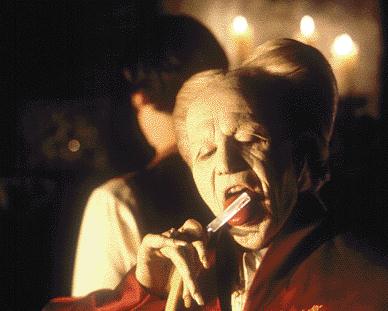
While the film runs at over two hours, editors Anne Goursaud, Glen Scantlebury, and Nicholas C. Smith do a great job in giving the film a kinetic, nicely-paced energy that gives viewpoints to many of the film's central characters and their struggles in their sequences along with the sound work of Tom C. McCarthy and David E. Stone. McCarthy along with a team of makeup people bring in great look to the vampire characters in the film especially with Oldman’s aged look of Dracula with great, reddish colors from costume designer Eiko Ishioka who uses brilliant detail on the costumes, notably the long red cloak of the aged Dracula. The music by Wojciech Kilar brings suspense to the film as well as a romantic quality in scenes involving Oldman and Ryder while some tracks includes vocals by Diamanda Galas and a vocal track from Annie Lennox in the final credits. Overall, this film is a technical achievement thanks to Francis Ford Coppola's masterful direction.

While the film has a nice cast with nice, small performances from Monica Bellucci as one of the brides and nice in-fringe characters performances from the eloquent Cary Elwes as the snobbish Lord Holmwood and Bill Campbell as the funny Texan Quincey P. Morris. The rest of the supporting cast really shine with the exception of Keanu Reeves. While Reeves is not a bad actor, he's just mediocre as he struggled to maintain a straightforward British accent though he does do well when he doesn’t speak or whenever he’s playing a foil for Oldman. Sadie Frost's character of Lucy doesn't have much development or depth in her character but Frost makes up for it with her playful, sexy charm while as she becomes a vampire, she shines through her madness and does a great job in puking out blood. Richard E. Grant is amazing as the morphine-addicted Dr. Seward with his calm but crazed performance while he has great moments with Anthony Hopkins and Tom Waits. Tom Waits is a huge standout as the insane Dr. Renfield and the man should be commended for giving a crazed performance, especially eating real-live bugs.

Sir Anthony Hopkins delivers a maddening, over-the-top performance as Dr. Van Helsing with his psychotic state of mind and a sense of humor that clearly isn't for everyone. Hopkins really steals the show among those in his supporting cast by bringing both madness and humor into his complex turn as Van Helsing, especially since Hopkins does dual parts as a priest in the film's opening sequence. Winona Ryder is wonderful as the ingenue of Mina with her restrained innocence and class that develops into something that is more grandeur where she goes into a state of craziness and obsessed love. Ryder delivers not just one of her best performances but she carries the film with grace and class while having some great scenes with Gary Oldman.

Gary Oldman is the best performance of the entire cast and he clearly is truly one of cinema's most gifted and versatile actors. From playing a punk rocker to a classical composer, a corrupt cop to most recently, a loveable convict. Oldman gives a tortured, demented approach to Dracula that makes more than just an anti-hero tortured by love but a protagonist who is very complex despite his motivations. Oldman doesn't just carry great scenes with Ryder that shows his depth but also a humanity in Dracula, even as an old man with white makeup, a Victorian wig, and a cool red cape. Oldman even steals the show from veteran Anthony Hopkins in their brief confrontation scenes as he plays a vampire in a way that is both terrifying and with a sense of love.

While Bram Stoker's Dracula isn't a great horror film or anywhere near the brilliance of Francis Ford Coppola's film work of the 1970s. It is still a very entertaining vampire films thanks to Coppola's eye-wielding direction and the anguished performance of Gary Oldman. For Coppola, Bram Stoker's Dracula is his most accomplished and watchable film since 1986's Peggy Sue Got Married. While Coppola deserves credit, equal credit should go to screenwriter James V. Hart for faithfully capturing Bram Stoker's book but also Coppola's film crew and the film’s cast that includes great performances from Anthony Hopkins, Winona Ryder, Richard E. Grant, Sadie Frost, and Tom Waits. For a vampire film that has a nice dose of sex and gore, Bram Stoker's Dracula fulfills that for any fan of vampire films.

Francis Ford Coppola Films: Dementia 13 - (You're A Big Boy Now) - (Finian's Rainbow) - (The Rain People) - The Godfather - The Conversation - The Godfather Part II - Apocalypse Now/Apocalypse Now Redux - One from the Heart - The Outsiders - Rumble Fish - The Cotton Club - (Peggy Sue Got Married) - (Garden of Stone) - (Tucker: The Man & His Dream) - New York Stories - The Godfather Part III - (Jack) - (The Rainmaker) - (Youth Without Youth) - Tetro - (Twixt)

© thevoid99 2011