Showing posts with label richard gere. Show all posts

Tuesday, April 17, 2018

The Cotton Club


Based on the historical picture book by James Haskins, The Cotton Club is the story of a musician who finds himself falling for a mobster’s girlfriend where he gets himself into trouble during the era of Prohibition. Directed by Francis Ford Coppola and screenplay by Coppola and William Kennedy from a story by Coppola, Kennedy, and Mario Puzo, the film is a stylish gangster-musical film of sorts as it is set largely in this nightclub. Starring Richard Gere, Gregory Hines, Diane Lane, Lonette McKee, Bob Hoskins, James Remar, Nicolas Cage, Allen Garfield, Laurence Fishburne, Gwen Verdon, and Fred Gwynne. The Cotton Club is a lavish yet incoherent film from Francis Ford Coppola.

Told in the span of the final years of the famed gangster Dutch Schultz (James Remar), the film follows a coronet player who falls for Schultz’s teenaged girlfriend as he’s given a job to protect her after saving him from an assassination attempt where things eventually become complicated. The film doesn’t just explore the life of this cornet player who is love with this young woman but also a tap dancer who is trying to pursue a singer who sings at the titular club that feature a lot of African-American singers, musicians, and dancers yet they can’t be at the club as audience members. The film’s screenplay by Francis Ford Coppola and William Kennedy want to showcase this world that is the center of the gangster world in New York City. Yet, there’s so many characters in the story including real-life gangsters as it eventually becomes messy to understand what is going on and what it wants to be.

There’s this love story where the cornet player Dixie Dwyer (Richard Gere) pursuing Schultz’s girlfriend Vera (Diane Lane) as well as the story of his tap-dancing friend Sandman (Gregory Hines) trying to woo the mixed-race singer Lila Rose Oliver (Lonette McKee). The narrative would move back-and-forth into these storylines as well as Schultz’s activity in the world of crime as he would find himself becoming a rival of Owney Madden (Bob Hoskins) and his right-hand man Frenchy (Fred Gwynne). Madden owns the Cotton Club which would have Schultz later form a rival club yet they would use Harlem as the place of conflict with some of Schultz’s men including Dixie’s brother Vincent (Nicolas Cage) getting into trouble with some of the locals including Bumpy Rhodes (Laurence Fishburne) who decides to fight back. It all takes place in the span of a few years as the script wouldn’t just try to be this romantic-gangster drama with elements of musical performances. Its major drawback is that blend of genres as well as dialogue that isn’t strong and characters that aren’t engaging enough.

Coppola’s direction is definitely stylish in terms of its presentation of the film as it has elements of old Hollywood and these lavish musical numbers with intricate choreography by Henry LeTang. Shot largely in New York City with its interiors shot at the Astoria studio in the city, the film does play into this high-octane world of New York City gangster life during the days of Prohibition. Coppola would use wide shots to get a scope of the locations in its exteriors as well as the performances that include tap dance numbers, choirgirl dances, and all sorts of things that was prevalent during the days of Prohibition. Much of the direction that Coppola aims for is style in its usage of slanted camera angles, close-ups, and medium shots to capture the atmosphere of the clubs. Even as the moments of violence are intense such as this dramatic re-creation of Vincent leading an assassination on one of Schultz’s men where some children are killed. It’s among some of the key moments in the film where it manages to overcome many of the script’s shortcomings including an argument scene involving Madden and Frenchy as it’s presented in a very simple yet direct medium shot.

For all of the lavishness, stylish musical numbers, and homage to the gangster films of the time, Coppola unfortunately doesn’t find a center into the film as much of its centerpiece takes place in the titular club. Rarely, the characters of Dixie and Sandman would interact as the script never establishes more of their friendship in favor of their respective romantic pursuits. The direction is all over the place where it messes up much of the film’s tone as it would be one genre and then go into something else. Even the film’s ending which mixes fantasy and reality of what happens to the characters wants to be this traditional Hollywood ending but the result is extremely messy as Coppola tried to end it with a sense of style. Overall, Coppola creates an extravagantly rich but inconsistently tonal film about life at a club during the days of Prohibition.

Cinematographer Stephen Goldblatt does brilliant work with the film’s cinematography with its stylish approach to lighting for some of the musical performances as well as the look of the exteriors set at night. Editors Barry Malkin and Robert Q. Lovett do excellent work with the editing as it is stylish with its usage of dissolves and transition wipes to play into the film’s frenetic style. Production designer Richard Sylbert, with set decorators Leslie Bloom and George Gaines plus art director Gregory Bolton and David Chapman, does amazing work with the look of the nightclubs in all of its lavish form as well as the backstage areas and the places the characters would go to.

Costume designer Milena Canonero does incredible work with the costumes as it is a highlight of the film in the lavish dresses and costumes the women wear including the colored suits of the male performances in the musical numbers. Sound editor Edward Beyer does superb work with the sound with the way music sounds on location as well as the sounds of gunfire and other violent moments in the film. The film’s music by John Barry is fantastic for its orchestral-jazz based score that play into the period of the time with elements of blues music while music consultant Jerry Wexler would provide a soundtrack that feature many of the standards of the time that are performed by the actors in the film including Richard Gere playing his own cornet solos.

The casting by Lois Blanco and Gretchen Rennell is wonderful as it feature some notable small roles and appearances from Mario Van Peebles as a dancer at the Cotton Club, Mark Margolis as an assassin late in the film, Sofia Coppola as a young girl trying to sell Vince an apple, Giancarlo Esposito as one of Bumby’s hoods, Bill Cobbs as a veteran gangster in Big Joe Ison, Woody Strode as a Harlem veteran who advises Bumpy, Larry Marshall as the famed performer Cab Calloway, Rosalind Harris as the famed actress Fanny Brice, Jennifer Grey as Vince’s girlfriend Patsy, Tom Waits as the Cotton Club manager Irving Starck, Diane Venora as the actress Gloria Swanson who sees Dixie as a future film star, Lisa Jane Persky as Schultz’s girlfriend Frances Flegenheimer, Maurice Hines as Sandman’s brother Clay who would perform with Sandman as part of a tap duo, Julian Beck as Schultz’s advisor Sol Weinstein, Allen Garfield as Schultz’s accountant Otto Biederman, Joe Dalessandro as Lucky Luciano, and Gwen Verdon as Dixie and Vince’s mother Tish Dwyer who knew Madden who always liked her.

Fred Gwynne is terrific as Frenchy as Madden’s right-hand man who looks menacing yet is also calm unless he gets really angry while Bob Hoskins is superb as Owney Madden as the revered gangster that knows what to do and get things done but is also a man that has some morals where he tries to help out whoever he can. Nicolas Cage is fantastic as Vince Dwyer as Dixie’s brother who is trying to be a gangster working for Schultz only to get carried away to the point that he becomes trouble for everyone. Laurence Fishburne is brilliant as Bumpy Rhodes as a Harlem gangster who has had it with Vince and Schultz’s antics as he decides to fight back and get some rights for his people. James Remar’s performance as Dutch Schultz definitely has the ferocity and anger of Schultz but it also borders into parody at times where it’s a mixed bag overall as Remar isn’t given more to do but be angry and jealous for most of the film and rarely display any kind of sensitivity.

Lonette McKee is good as Lila Rose Oliver as a singer who is fascinated by Sandman but is keen on wanting to do other things as she is able to get opportunities that other women couldn’t get as she’s half-black, half-white as McKee’s performance is wonderful but very underwritten. Gregory Hines is excellent as Sandman as a tap dancer that is eager to perform at the Cotton Club and win over Lila as it’s definitely the best performance of the film where Hines is someone that is just trying to make it as he later copes with the chaos that is happening in Harlem as well as the prejudice he endures. Diane Lane is alright as Vera as Schultz’s teenaged mistress who wants to run a club as it’s a performance that has charm but not a lot of substance as her character doesn’t really do much but be pretty and be the object of affection. Finally, there’s Richard Gere in a decent performance as Dixie Dwyer as he does display a sense of charm while being a capable musician. It’s just that his character is also messy where he can be the nice and smooth talker one minute and then be an asshole the next minute as it’s just a messy performance from Gere.

The Cotton Club is an entertaining but extremely messy film from Francis Ford Coppola. Despite its gorgeous visuals, lavish production values, terrific supporting performances, and an enjoyable music score/soundtrack, it’s a film that had all of the right ideas on paper but doesn’t mesh well in terms of its execution. Notably as it tried to be so many things in one entire film only to have a lot of tonal issues as well as being more style over substance. In the end, The Cotton Club is a worthwhile but incoherent film from Francis Ford Coppola.

Francis Ford Coppola Films: (Tonight for Sure) – (The Bellboy and the Playgirls) – Dementia 13 - (You’re a Big Boy Now) – (Finian’s Rainbow) – (The Rain People) – The Godfather - The Conversation - The Godfather Pt. II - Apocalypse Now/Apocalyse Now Redux - One from the Heart - The OutsidersRumble Fish - (Peggy Sue Got Married) – (Garden of Stone) – (Tucker: The Man & His Dreams) – New York Stories-Life Without Zoe - The Godfather Pt. III - Bram Stoker's Dracula - (Jack) – (The Rainmaker) – (Youth Without Youth) – Tetro - (Twixt)

© thevoid99 2018

Thursday, April 02, 2015

An Officer and A Gentleman


Directed by Taylor Hackford and written by Douglas Day Stewart, An Officer and a Gentleman is the story of a troubled man who joins the naval academy as he contends with an uncompromising drill sergeant as well as his own demons while falling for a local woman. The film is an exploration into a young man who is trying to find himself through the Naval academy as he tries to escape the life he is destined to be from his own father. Starring Richard Gere, Debra Winger, David Keith, Lisa Eilbacher, Harold Sylvester, Lisa Blount, Grace Zabriskie, David Caruso, Robert Loggia, Tony Plana, and Louis Gossett Jr. An Officer and a Gentleman is a riveting film from Taylor Hackford.

Set in the American Pacific Northwest, the film revolves a Naval officer candidate who arrives at the naval academy to make something of himself as he deals with a no-holds-barred drill sergeant while he falls for a local woman who is eager to get out of her small town life. It’s really a film that is about two people trying to make changes in their lives as they both have to contend with themselves and their own environments. Especially as they’re eager to have a chance to get a better life in a world where there’s many expectations and such. For Zachary Mayonnaise (Richard Gere), he hopes to succeed as a naval aviator officer in the hopes that he doesn’t become like his father (Robert Loggia) who has a reputation for being a drunk and chasing whores overseas where the young Zachary was forced to live him following his mother’s suicide.

Douglas Day Stewart’s screenplay explores Mayonnaise’s desire to better himself as he is also known for being a loner that feels guilty for his mother’s death. Upon arriving at this naval academy, he contends with Gunnery Sgt. Foley (Louis Gossett Jr.) who is uncompromising in his tactics but knows what to do in ensuring that his recruits would have to succeed as he sees Mayonnaise as a troublemaker. Even when he discovers that Mayonnaise does do a side business of selling pre-shined shoes and belt buckles for money where Sgt. Foley would haze him to wonder why Mayonnaise wants to be a pilot and why he’s at the academy. While Mayonnaise would befriend other candidates including Sid (David Keith), Seeger (Lisa Eilbacher), and Perryman (Harold Sylvester), he would also do whatever it takes to prove that he can be an officer.

During breaks at the academy, he would meet and fall for Paula Pokrifi (Debra Winger) as she is among the group of women who hopes to bag an officer so they can get out of their life of working in the factory and staying in a small town with little hope. Her friend Lynette (Lisa Blount) would bag Sid as Paula deals with Mayonnaise’s moody behavior and unwillingness to be close to someone as she copes with not having a good life. Especially as she is a naval officer’s daughter who abandoned her mother (Grace Zabriskie) when Paula wasn’t even born as it plays into the roles women have and uneasy one where Lynette would make an announcement for Sid that would compromise his chances to become a naval pilot. Especially as Mayonnaise becomes more reliable in helping others succeed instead of himself as he is unsure if he can be a gentleman for Paula because of his own demons.

Taylor Hackford’s direction is quite simple as he shoots the film largely in the state of Washington for its Pacific Northwest setting along with a few shots set in the Philippines for Mayonnaise’s flashback scene as a kid. Much of it is presented with simple compositions where Hackford use a few wide shots for the setting while maintaining an intimacy into the training sequences and other moments involving Mayonnaise and the hazing he would get from Foley. The usage of close-ups and medium shots are quite prevalent while Hackford does bring in moments of humor along with some intense moments to play into Mayonnaise’s loner persona as he doesn’t make him afraid of being selfish. Even as the moments where Mayonnaise would be hazed with such brutality as it would have this key emotional moment for Mayonnaise about why he refuses to quit.

Hackford also amps up the drama for the film’s third act as it relates to Sid’s own situation with Lynette that would prompt Mayonnaise to do something while coping with the people in his life that he lost. Even as he wonders if is destined to become his own father as it plays into this desire of wanting to not just an officer but also a gentleman in order to give Paula the sense of hope that she needs. Overall, Hackford creates a very engaging and compelling film about a man trying to start a new life in a naval academy and help a woman to escape her own dreary environment.

Cinematographer Donald E. Thorin does excellent work with the cinematography as it‘s quite straightforward to play into the look of its location where the colors are a bit dark and gray while going for more low-key lighting for the scenes at night. Editor Peter Zinner does brilliant work with the editing to capture the intensity of the training along with some straightforward cutting to play into some of dramatic events as well as some montage-style cutting for Mayonnaise‘s flashback scenes. Production designer Philip M. Jeffries, with set decorator James L. Berkey and art director John V. Cartwright, does terrific work with the dorm rooms the naval candidates live in as well as some of the locations such as the training bases and the motel where Mayonnaise and Paula would go to.

Sound editor Clive Smith does nice work with the sound as it‘s very low-key as it plays into the training the candidates go through. The film’s music by Jack Nitzsche is superb for its low-key yet somber score as it features elements of triumphant pieces with its usage of guitars and keyboards while being low-key at times. The film’s music soundtrack features contributions from Pat Benatar, ZZ Top, Dire Straits, Van Morrison, Morris Albert, and the ballad Up Where We Belong that is sung by Joe Cocker and Jennifer Warren that is written by Nitzsche, Buffy Sainte-Marie, and Will Jennings as it’s one of the finest love songs of the 1980s.

The casting by Lynn Stalmaster and Nancy Klopper is fantastic as it features notable small roles from Robert Loggia as Mayonnaise’s alcoholic naval seaman father, Tommy Petersen as a young Mayonnaise, Victor French as Paula’s stepfather who doesn’t like naval officers, John Laughlin as an unfortunate townie who got beat up by Mayonnaise, Grace Zabriskie as Paula’s mother, Ed Begley Jr. as the voice of an altitude chamber instructor, Tony Plana as officer candidate Serra, and David Caruso as the naïve officer candidate Daniels. Harold Sylvester is terrific as officer candidate Perryman as a family man trying to make it so he can provide for his family while Lisa Eilbacher is brilliant as officer candidate Seeger as one of the few women who is trying to make it as despite her lack of physical prowess in its obstacle course.

Lisa Blount is excellent as Lynette as a local woman who wants the same thing that Paula wants but a series of misunderstandings would put her into trouble with Sid. David Keith is superb as Sid as another officer candidate who is also trying to succeed until he learns that Lynette might be pregnant as he wonders about what to do. Louis Gossett Jr. is phenomenal as Sgt. Foley as a drill sergeant who is quite tough with his candidates yet is also preparing them for what is to come in combat as he’s also a man that is quite fair as he tries to push Mayonnaise to be a better man and see if he’s worthy of being an officer. Debra Winger is amazing as Paula as a factory worker who is eager to get out of her small town existence as she falls for Mayonnaise as well as try to understand his loner persona. Finally, there’s Richard Gere in an incredible performance as Zack Mayonnaise as a naval officer candidate eager to succeed as he copes with his own guilt and selfishness while finding ways to become a better man for himself and for Paula.

An Officer and a Gentleman is a remarkable film from Taylor Hackford that features great performances from Richard Gere, Debra Winger, and Louis Gossett Jr. It’s a film that isn’t just a compelling romantic drama but also a character study that explores a young man trying to make it in a naval academy to attain a better future for himself. In the end, An Officer and a Gentleman is a tremendous film from Taylor Hackford.

Taylor Hackford Films: (Bukowski) - (Teenage Father) - (The Idolmaker) - (Against All Odds) - (White Nights) - (Hail! Hail! Rock ‘n’ Roll) - (Everybody’s All-American) - (Blood In Blood Out) - (Dolores Claiborne) - (The Devil’s Advocate) - (Proof of Life) - (Ray) - (Love Ranch) - (Parker 2013 film))

© thevoid99 2015

Thursday, July 04, 2013

American Gigolo


Written and directed by Paul Schrader, American Gigolo is the story of a male escort who finds himself in danger after the death of a client just as his life becomes more complicated when he falls for a politician’s wife. The film is an exploration into the world of a man who lives to give women pleasure while he deals with some of the drawbacks of his world. Starring Richard Gere, Lauren Hutton, Hector Elizondo, Nina van Pallandt, and Bill Duke. American Gigolo is an entrancing yet provocative film from Paul Schrader.

The film explores the life of Julian Kaye (Richard Gere) who is an escort that sleeps with many women all over the posh areas of Southern California as he works alone with the exception of a madam named Anne (Nina van Pallandt) who offers him assignments. Kaye’s life becomes complicated following a trick where he is paid by a man named Rheiman (Tom Stewart) to have sex with his wife (Patricia Carr) while he watches as she is later killed that night with Kaye being the suspect. Though he was somewhere else that night, Kaye is unable to find help just as he is starting a relationship with Michelle Stratton (Lauren Hutton) whose husband is a powerful senator. Michelle knows that he’s telling the truth as his life starts to unravel as he seeks to find answers about why he’s being targeted.

Paul Schrader’s script is full of complexities into the life of this man who loves to have sex with various rich women in Southern California as some of them are married. Kaye is good at what he does but some believe he’s becoming too good at his job where pimps like Anne and Leon (Bill Duke) want him to work for them full-time. Still, Kaye just wants to live a life where he can drive his Mercedes SL, listen to music with his expensive stereo equipment, and wear the finest clothes that is available. It’s a life that is flawed as Kaye is also somewhat full of himself as he wants no complications as he demands to have control. After a trick involving a rich man and his wife that led to the death of the latter, Kaye’s life starts to lose control as he becomes a suspect.

Kaye is known as a professional but his life becomes more complicated by the appearance of Michelle Stratton who is intrigued by what he does as she wants the same things that other women want from him. Yet, they eventually get close as she knows that he didn’t kill Mrs. Ryman but their affair is complicated when Senator Stratton (Brian Davies) becomes aware of what is happening. Schrader’s script is filled with some very rhythmic and stylish dialogue to play out the world that Kaye is in as well as the kind of language he and Michelle talk into as it would also play into the third act when Kaye is targeted by the police led by Detective Sunday (Hector Elizondo). Particularly as paranoia would emerge in Kaye as he is dealing with the mystery over the murder and why is he being framed for it.

Schrader’s direction is very stylized in the way he presents this film as this sort of slick yet gritty film that plays to that sense of excitement and decadence in the life of an escort. Notably as it plays off with a sense of look where Kaye wears Giorgio Armani clothes and lives in a posh apartment complex where Schrader goes for a lot of wide and medium shots to showcase this world that is enthralling but also sort of cold. Schrader also uses a lot of tracking shots to play out some of the suspense as well as close-ups to play into the emotions involving Kaye and Michelle. Largely as Schrader wants to keep many of the scenes low-key and simple while having this air of style that is happening including some chilling moments such as Kaye meeting Leon at a gay disco.

Schrader also manages for the film’s sexual content to be presented in a sense of style that includes a wide full-frontal shot of Kaye as he’s standing in his room while talking to Michelle who is lying in bed. Still, Schrader doesn’t make the sexual content to be overwhelming to the story where he is more focused on the life of this man who is sort of a loner as he starts to unravel by something he didn’t do. Schrader invests a lot of chilling moments into the third act where Kaye becomes more concerned with who is framing him as he no longer cares about how he looks or what car he’s driving. There is still that chill that occurs in the way Schrader presents the mystery and its eventual outcome where it plays to Kaye’s development and the fate that is set for him. Overall, Schrader creates a very harrowing yet mesmerizing film about the life of an escort gone wrong by accusations of murder.

Cinematographer John Bailey does brilliant work with the film‘s very colorful and stylized photography where it has this sense of vibrancy for many of its daytime exterior scenes while using lots of low-key lighting schemes and shades for some of its nighttime interior and exterior scenes. Editor Richard Halsey does fantastic work with the editing to create some unique montages for a sex scene between Kaye and Michelle along with some methodical cuts for the film‘s suspense. Art director Edward Richardson and set decorator George Gaines do amazing work with the look of some of the film’s set pieces from the gay disco club to some of the restaurants that Kaye goes to as well as his apartment that features additional contributions from production designer Ferdinando Scarfiotti.

Sound mixer Barry Thomas does terrific work with the sound to play up the atmosphere of some of the film‘s suspense including some of the intimate moments in Kaye‘s apartment and at the restaurants he goes to. The film’s music by Giorgio Moroder is wonderful for its synthesizer-based score to play up the world that Kaye lives in with its eerie notes as the soundtrack also includes contributions from John Hiatt, Smokey Robinson & the Miracles, and Blondie whose song Call Me appears in the opening credits as it’s written by Moroder and Blondie vocalist Debbie Harry.

The casting by Vic Ramos is excellent as it features appearances from K Callan as a woman who is a friend of Kaye as she doesn’t want to help him because of her reputation, Tom Stewart and Patricia Carr as the Rheimans who would put Kaye into trouble, Brian Davies as Michelle’s husband, Jessica Potter as Kaye’s neighbor Jill, and Gordon Haight as a mysterious blond boy that hangs around with Leon. Bill Duke is terrific as the more street-wise pimp Leon who was the one that put Kaye into the Rheiman assignment that would get him in trouble while Nina van Pallandt is wonderful as the more refined madam Anne who respects Kaye but feels unappreciated for the things she’s done for him. Hector Elizondo is superb as Detective Sunday as a man who believes that Kaye knows a lot more about what happened to Mrs. Rheiman while trying to see if Kaye is really innocent.

Lauren Hutton is amazing as Michelle Stratton as a woman who is intrigued by Kaye and what he does as she finds someone who she can talk to and have sex with while becoming the one person that might be able to help him with his troubles. Finally, there’s Richard Gere in an incredible performance as Julian Kaye as a male escort who loves his job and what he gets out of it where Gere can be charming but also kind of smug at times. Once Kaye gets in trouble, Gere puts in a lot of humility and intensity as a man who is trying to found out the truth and why he’s being framed as it’s definitely one of Gere’s most iconic performances.

American Gigolo is a remarkable film from Paul Schrader that features a riveting performance from Richard Gere. Along with a great supporting cast and eerie soundtrack by Giorgio Moroder, the film is definitely one of the most provocative and haunting films about sex and murder. Notably as it plays into the life of an escort and some of the flaws in his life as he is also a very lonely man. In the end, American Gigolo is a phenomenal film from Paul Schrader.

Paul Schrader Films: Blue Collar - Hardcore - Cat People (1982 film) - Mishima: A Life in Four Chapters - (Light of Day) - (Patty Hearst) - (The Comfort of Strangers) - (Light Sleeper) - (Witch Hunt) - (Touch) - Affliction - (Forever Mine) - (Auto Focus) - (Dominion: Prequel to the Exorcist) - (The Walker) - (Adam Resurrected) - (The Canyons) - Dying of the Light - (Dog Eat Dog) - First Reformed - (The Card Counter)

© thevoid99 2013

Monday, February 11, 2013

Dr. T and the Women


Directed by Robert Altman and written by Anne Rapp, Dr. T and the Women is the story about the life of a Texan gynecologist whose life begins to fall apart after his wife’s mental breakdown as he finds himself seeking companionship in the form of a golf instructor in the wake of his daughter’s upcoming wedding. The film is an exploration into the life of a man and the women he’s surrounded by as he tries to deal with the changes in his life. Starring Richard Gere, Helen Hunt, Farrah Fawcett, Laura Dern, Shelley Long, Kate Hudson, Tara Reid, Liv Tyler, and Andy Richter. Dr. T and the Women is a witty yet sensational comedy from Robert Altman.

The film is about the tumultuous life of a renowned Texan gynecologist who is beloved by the rich women of the state as things around him starts to fall apart. His wife has a mental breakdown that has her regressing to a childlike state while his sister-in-law has moved in to his house as they’re all getting ready for the wedding of his eldest daughter who is carrying a secret of her own. Meanwhile, a former golf pro has arrived into his golf club as he forges a relationship with her to escape from his chaotic life until some big news about his daughter and his wife come ahead as well as an overloaded schedule that finally culminates into his daughter’s wedding. For this man known as Dr. Sullivan Travis aka Dr. T (Richard Gere), it’s a world that he lives in surrounded by all of these women where he does find time to hang out with the guys. Yet, he remains devoted to the women in his life no matter how crazy they are.

Anne Rapp’s screenplay is quite loose in its premise though it does take time to explore the other characters such as the eldest daughter Dee Dee (Kate Hudson) and her younger sister Connie (Tara Reid) where the latter is a conspiracy theorist. Along with his loopy sister-in-law Peggy (Laura Dern) and his wife Kate (Farrah Fawcett), the film explores this unique family life that Dr. T has where he does love them no matter how screwed up they are. Yet, Kate’s mental breakdown and regression into a childlike state has the family, with the exception of Connie, going into all sorts of trouble where Peggy drinks and stumbles into situations while Dee Dee is being secretive underneath her posh exterior as it concerns her maid of honor Marilyn (Liv Tyler). For Dr. T, all of these revelations and troubles has him going to this former golf pro in Bree (Helen Hunt) who offers him an escape from his troubles while she becomes aware of the crazy world he live in.

Robert Altman’s direction is fascinating for the way he explores the life of this gynecologist who lives in Dallas, Texas. Particularly in a posh setting where many of Dr. T’s clients are these rich women who adore him and some try to flirt with him. Still, there is that element of chaos in Altman’s direction in the way he presents the waiting room where there’s a lot of women chattering or talking to the reception for an appointment or scenes in the mall where Kate would have her breakdown. While a lot of the framing is straightforward as Altman shoots on location in Dallas and other nearby locations. The film’s climax near the end that involves something that Connie feared but it would be in a bigger context that relates to the chaos that Dr. T had been through. While the presentation of that scene is imperfect, it does make sense of what Altman was trying to say. Overall, Altman creates a delightful yet whirlwind film that explores the world of a doctor and the women in his life.

Cinematographer Jan Kiesser does excellent work with the film‘s very colorful cinematography to capture the beauty of Dallas in its exteriors as well as some of the scenes in the film‘s interior settings. Editor Geraldine Peroni does wonderful work with the editing to capture the chaos in the waiting room as well as some of the film‘s comical moments like Kate‘s breakdown in the mall. Production designer Stephen Altman, with set decorator Chris L. Spellman and art director John Bucklin, does nice work with the look of Dr. T‘s office and his waiting room as well as Bree‘s apartment and the home that Dr. T lives in.

Costume designer Dona Granata does terrific work with the costumes to display the world of posh Texas without any cowboy gear as well as the camouflage clothes that Dr. T and his male friends wear on their hunting trips. Visual effects supervisor Charles Gibson does some good work with the film‘s lone visual effects sequence although it doesn‘t look realistic. Sound editor Frederick Howard does some fine work with the sound to capture the chaos of the waiting room with its overlapping dialogue as well as the scenes involving the rain. The film’s music by Lyle Lovett is amazing as it is mostly a playful take on country with bits of jazz and blues to complement the world that is Texas.

The casting by Pam Dixon is phenomenal for the ensemble that is created as it features some notable small roles from Robert Hays, Matt Malloy, and Andy Richter as Dr. T’s hunting buddies, Lee Grant as Kate’s examiner Dr. Harper, and Janine Turner as a flirtatious patient who keeps insisting that there’s something wrong with her. Tara Reid is pretty good as the conspiracy-obsessed Connie who is suspicious about her sister’s possible secret while Kate Hudson is OK in a somewhat underwritten role as the older sister Dee Dee who aspires to be a Dallas Cowboys cheerleader while carrying a secret as she’s set to get married. Liv Tyler is terrific as Dee Dee’s friend Marilyn who also knows about Dee Dee’s secret as her meeting with Dr. T ends up being very awkward. Laura Dern is very funny as Dr. T’s sister-in-law Peggy who always stumble around certain things as she definitely has a drinking problem.

Shelley Long is wonderful as Dr. T’s loyal assistant Carolyn who helps him deal with the chaos while keeping a secret of her own towards that revolves around Dr. T. Farrah Fawcett is superb as the troubled Kate who regresses into a childlike state where Fawcett brings a lovely sense of humor to her role. Helen Hunt is excellent as Bree Davis who befriends Dr. T as she represents the one woman whose life isn’t filled with lots of complications as she sympathizes with Dr. T. Finally, there’s Richard Gere in a marvelous performance as Dr. T as he is this very kind man that finds his life falling apart as he is desperate to hold on to whatever he has left only to nearly fall prey to the chaos of his life.

Dr. T and the Women is a remarkable film from Robert Altman that features a superb leading performance from Richard Gere. The film is an interesting view into the life of a man who surrounds himself with the women in his life while dealing with all of the turmoil that occurs as things start to fall apart around him. It’s also a film that showcases the world of women and they seek the help from a man in order to help them find themselves. In the end, Dr. T and the Women is an extraordinary film from Robert Altman.

Robert Altman Films: (The Delinquents) - (The James Dean Story) - Countdown (1968 film) - (That Cold Day in the Park) - M.A.S.H. - Brewster McCloud - McCabe & Mrs. Miller - (Images) - The Long Goodbye - Thieves Like Us - California Split - Nashville - Buffalo Bill and the Indians, or Sitting Bull’s History Lesson - 3 Women - (A Wedding) - (Quintet) - (A Perfect Couple (HealtH) - Popeye - (Come Back to the Five and Dime, Jimmy Dean, Jimmy Dean) - (Streamers) - (Secret Honor) - (O.C. and Stiggs) - Fool for Love - (Beyond Therapy) - (Aria-Les Boreades) - (Tanner ‘88) - (Vincent & Theo) - The Player - Short Cuts - Pret-a-Porter - (Kansas City) - (The Gingerbread Man) - Cookie‘s Fortune - Gosford Park - The Company (2003 film) - (Tanner on Tanner) - A Prairie Home Companion

© thevoid99 2013

Monday, April 04, 2011

I'm Not There


Originally Written and Posted at Epinions.com on 12/5/07 w/ Additional Edits.


Bob Dylan is known to the world as a poet, a folk singer, a voice for a generation, a rebel, an innovator, an icon, and everything else he's been called. Since his debut in the early 1960s, Dylan wrote and sang anthems about changing the world early in his career only to evolve by going electric, singing about whatever is on his mind and putting on a different persona. By 2007, he remains an icon revered by the world as his last album in 2006, Modern Times debuted at #1 in the Billboard 200 album charts proving his staying power through changing musical trends and the harsh world of the music industry. The story of Dylan is a journey that is sprawling and if it was made into a film, how would it be told? Iconic indie-auteur Todd Haynes has that answer in his new film about Bob Dylan named after one of his most bootlegged songs entitled I'm Not There.

Directed by Todd Haynes based on his screen story with a script he co-wrote with Oren Moverman, I'm Not There tells the story of the life of Bob Dylan through exaggerations, truths, legends, and other tales through seven periods of his life. In the role of Bob Dylan, Haynes devised a plan to hire not one but six individuals to play Robert Zimmerman aka Bob Dylan through the different periods of his life. In those six include his Velvet Goldmine star Christian Bale along with Cate Blanchett, Richard Gere, Heath Ledger, Ben Whishaw, and Marcus Carl Franklin. Also starring Haynes' regular Julianne Moore, Michelle Williams, Charlotte Gainsbourg, David Cross, and Bruce Greenwood. I'm Not There is a whimsical, original, and inspiring masterpiece from Todd Haynes and company.

A young boy calling himself Woody Guthrie (Marcus Carl Franklin) arrives on a train singing songs he claimed were his own as he talks about protests and such. Yet, as he jams with other musicians and hangs out with poor people, a woman tells him that he's singing songs from a different time as it is 1959. After getting kicked out of a train and being found by a rich couple, he is revealed to be a runaway juvenile as Woody is in search of his identity. A few years later at the Greenwich folk music scene, a new singer-songwriter named Jack Rollins (Christian Bale) became the wunderkind of the scene. With help of a folk singer named Alice (Julianne Moore), Rollins became a reluctant folk star.

With Rollins' fame rising, an actor named Robbie Clark (Heath Ledger) plays the folk singer as he falls for a Frenchwoman named Claire (Charlotte Gainsbourg) as they have a blissful relationship. Yet, as Clark's fame rise, he struggles with it as it would eventually take a toll on his marriage to Claire. With Rollins disappearing, a singer named Jude Quinn (Cate Blanchett) shocks an audience at a New England music festival by playing electric instruments and angering the crowd. During a tour in England, Jude gets the Beatles high on dope, evades the attention of movie star Coco Rivington (Michelle Williams) and talks to a journalist (Bruce Greenwood) during a huge interview for the BBC. With Jude changing gears on his music, he is facing a lot of heat from fans who claimed that he's betrayed the folk music scene while a man named Arthur (Ben Whishaw) is interviewed about why he isn’t singing protest music. Arthur instead, rambles on about what is going on while not giving a straight answer.

While Robbie's marriage to Claire is disintegrating and Jack Rollins disappears, a reclusive man named Billy (Richard Gere) is hiding in the woods unaware that a man named Pat Garrett (Bruce Greenwood) is hunting for him. While Billy is looking at the Western town in the middle of the woods, he wonder why he left the world and what happened to this gift he once had. Meanwhile, Jack Rollins returns as Pastor John who then sings nothing but Christian music.

Whenever a film biography of a musician or an artist is made. There's a traditional structure. Musician comes from humble beginnings, struggles to make it. Gets discovered, sign to a record deal. Becomes a huge success, gets involved with all the trappings of stardom. Then comes the decline and eventual resurrection and comeback. Yet, with someone as unique as Bob Dylan, that's a structure that is too easy to tell and at the same, the idea of one person playing Bob Dylan couldn't work. Why? It's because Bob Dylan was an individual who evolved through whatever moment he's in. In many ways, Dylan is just trying to be himself through whatever phase he's in his peculiar, unique life.

This is something Todd Haynes understood since a film about the life of Bob Dylan isn't going to work through conventional means because it's too predictable and it's been told so many times through the traditional medium of what music bio-pics are going through. It's a genre that at the moment is becoming not just stale but also parody, which is the case of the upcoming film Walk Hard: The Dewey Cox Story. So, what is there to do? If a movie is going to be made about Bob Dylan, certain periods of his life has to be shown which includes his early folk years in the early 60s, his controversial move going to electric, his personal life, his own rambling interviews, his reclusive period in the early 70s, and his Christianity phase in the late 70s. One actor couldn't do all of those periods as well as play up to the different personas of Dylan. That's why Todd Haynes has chosen to employ six different actors for the film. Two British actors, one Welsh and the other English. Two Australian actors, man and woman. Two American actors, a 50-year old white man and a 13-year old African-American child.

While the idea of using multiple actors for one role isn't an entirely original idea. The approach Haynes and co-writer Oren Moverman chose works to show each persona and period of Dylan's life. While the entire film is told in non-linear fashion in tradition to Dylan's narrative style of writing. Each period and persona is very different not just look but in performance. While the stories move back and forth, it unveils each period to where the character is at and how they're reacting at the moment. The story of Woody is based on Dylan's exaggerations from Dylan to journalists and people during folk scene in Greenwich as the look of the boy with his hat is a reference to hat Dylan wore on his first album. Jack Rollins' story is about Dylan in his early rise to fame from the folk scene and his moment of controversy during a Civil Rights Award.

The story of Jude is partially based on the D.A. Pennebaker film Dont Look Back but mostly insprired by the rarely seen documentary Eat The Document about Dylan's tour of the U.K. while making references to his friendship with Allen Ginsberg (David Cross) and his rumored affair with Edie Sedgwick. Robbie's story is about Dylan's personal life in his relationship with Claire who is a fictional character based on his 1960s girlfriend Suze Rotolo and wife Sara Lownds with a subtle reference to his 1975 album Blood on the Tracks. The character of Arthur has only one scene which is about Dylan interrogated about his evolution as the character rambles about his life and view of things. The story of Billy is a reference to Dylan's country music exploration as well as the film Dylan starred in Sam Peckinpah's Pat Garrett & Billy the Kid.

Haynes and Moverman understood what those periods and phases in Dylan's life meant and they certainly couldn't move on after Dylan's period when became a Christian. Dylan in the 80s would be boring and too predictable while the story of Dylan now doesn't seem that interesting and it's best for only Dylan himself to tell that part of the story. Haynes understands that while the film's plot is Dylan through the periods of his own life. The plot couldn't be very simple as it's presented on screen. Haynes' direction is superb and extremely unconventional. With the black-and-white footage on the characters of Arthur, Jude, and parts of Jack and the rest of the story on color. While mainstream audiences might feel baffled and confused by the approach, it's only because this is how Dylan lived his life.

Haynes' look for the Woody/Billy worlds really gets the film in full circle as Woody is a boy finding his identity with Billy running away from that world only to rediscover it. Billy's world is essentially a fantasy world in the way he sees things as if he is Billy the Kid. With everyone wearing clown makeup and a giraffe appears, it's all because it's part of Billy's fantasy only to be aware that Pat Garrett is coming to get him. The Jude sequence which is based on the Pennebaker documentary includes a moment of fantasy as if Jude is living a dream world while the world of Robbie shows a scene of the man dealing with his fame.

The result of the whole film is extremely avant-garde and whimsical yet it works to convey the sense of evolution in Dylan's life. Through the wide lenses, super 8 films, grainy footage, and everything else. It's an understanding of where Bob Dylan was and is in his life as he goes from one world to another. Haynes' direction through each different look is distinctive and imaginative as like the in the script and in what Dylan has said in the film's trailer. All I Can Do Is Be Me. Whoever That Is. That is what the film is about and its shows that before David Bowie, before Cher, before Elvis Costello, and before Madonna. Bob Dylan was the godfather of reinvention and with Todd Haynes' direction, it reveals on who this legendary man is.

Cinematographer Edward Lachman creates a look that is unique to each period of the film with Arthur's segment shot in grainy, 16mm black-and-white footage as if he's part of an interrogation, Jude shot in gorgeous black-and-white to emphasis the documentary style of Dont Look Back, and the TV, black-and-white footage of Jack Rollins that is shot in grainy color as if the whole segment is a documentary. For the rest of the film, the Robbie story is mostly shot with tinted blue palettes and sepia-toned colors to convey the world he was in as well as his troubled mood. Lachman's photography is given higher palettes of sepia for the dream-like look of both the Billy and Woody segments while the Pastor Jack sequence is more in the look of 70s style TV. Lachman's photography is extremely superb and truly one of the year's best.

Editor Jay Rabinowitz, who took over for the late James Lyon (whom the film was dedicated to), plays to the similar style of the film with use of jump-cuts for the Jude sequence, more traditional cuts in other parts while playing to the film's non-linear tone as his editing overall is amazing. Production designer Judy Becker does amazing work in creating the different look and times of the film from the delapitated world of Billy to the 70s like world of paintings and furniture in Robbie's world and the whimsical, stylish world of swinging 60s in Jude's world. Becker's production design is extraordinarily brilliant. Costume designer John A. Dunn does great work with the different looks of the film that mimic all the album covers, clothes, and shoes that Dylan was wearing those different periods. Jean-Jacques Dion does great work with the film's hair with some of the actors sporting Dylan-like hairdo while Christian Bale gets to sport a Jew-fro as Pastor John that looks hilarious.

Sound editor Robert Jackson does amazing work in capturing the atmosphere of each period through the waves of boos and music through the scene of Jude playing electric at a folk music show. Special effects supervisor Louis Craig and visual effects supervisor Louis Morin does great work in creating the weird, whimsical world for both Jude and Billy's own fantasies. The film's soundtrack supervised by Jim Dunbar and Randall Poster features an amazing soundtrack featuring original cuts by Dylan including the unreleased title track plus various covers performed by Sonic Youth, Cat Power, John Doe, Stephen Malkmus, Mason Jennings, Karen O of the Yeah Yeah Yeahs, Calexio, Willie Nelson, and many more. Each song is used to convey the period and world of Dylan's life as it emphasizes his evolution with Doe, Malkmus, and Jennings singing the songs during the period of Jude and Jack Rollins with Marcus Carl Franklin doing his own singing while jamming with Richie Havens.

Finally, we have the film's cast that is wonderfully assembled by Laura Rosenthal. Featuring appearances from Kim Gordon of Sonic Youth as a folk singer discussing Jack Rollins, Craig Thomas as Hewey Newton and Benz Antoine as Bobby Seale of the Black Panther party who listen to Dylan's song while being massaged, Jane Wheeler as a TV host doing a profile on Rollins, Allison Folland as a journalist interviewing Robbie, Don Francks and Roc LaFortune as Hobos Woody meets, Richie Havens as a musician Woody jams with, Kim Roberts as the woman who gives Woody advice on what he should sing, Gabrielle Marcoux and Jessey LaFlamme as Robbie & Claire's daughters, Mark Camacho as Jude's manager Norman, and Kris Kristofferson as the narrator for film's opening sequence.

Yolonda Ross gives a brief but fine performance as Angela, based on Mary Alice Artes, who introduced Jack to Christianity and made him Pastor John while Julianne Moore plays a Joan Baez-like persona as a woman nurtured Jack's talents only to feel betrayed by him. David Cross is funny as Allen Ginsberg who has a great scene about Jude's possible selling out claiming he sold out to God in a reference to a Dylan concert in Berkeley 1965. Bruce Greenwood is great in a dual role as a British journalist who is the supposed inspiration to the song Ballad of The Thin Man while also playing the aging Pat Garrett in the Billy sequence. Michelle Williams is wonderfully sexy as Coco Rivington, an Edie Sedgwick-like actress who teases Jude while acting like a diva. The film's best non-Dylan performance is truly Charlotte Gainsbourg as Claire, the mix of Suze Rotolo and Sarah Lownds who loved Robbie but couldn't face with him not at home or his attraction to other women as she would become the muse for Dylan's Blood on the Tracks. Gainsbourg's performance is just amazing showing her evolution as the woman who was Robbie's soulmate to the unhappy housewife dealing with his fame.

Marcus Carl Franklin gives a superb, upbeat performance as Woody, a young Dylan who is trying to find his own identity, tell false stories and such while jamming along with other musicians and for other people. Franklin's performance is a real breakthrough as he proves he can sing and play while grabbing the attention early in the film. Ben Whishaw is excellent as Arthur, the Dylan who is interviewed as he rambles on incoherently while not giving any straight answers. Though Whishaw is only in one entire segment, he does the most to make himself memorable. Christian Bale is brilliant as the shy, evasive Jack Rollins as he performs while trying to be controversial at the same time. Bale's performance is the one that mimics Dylan the most in voice while he shows great humor in sporting a Jew-fro as Pastor John while his performance in inspirational proving that Dylan's Christianity phase isn’t something to make fun of.

Richard Gere gives a very laconic, subtle performance as Billy as he wanders around riding a horse, looking for his dog, and trying to see what is going on. Gere doesn't do any traditional, Hollywood style of acting as he is a man who does his best work when he's quiet while pondering his own existence as the veteran actor gives a masterful performance. Heath Ledger is great as the conflicted Robbie, an actor who is tempted by women and fame as he struggles with being a family man. Ledger's performance is extremely memorable while mimicking Dylan's voice in a unique way that proves his performance in Brokeback Mountain by Ang Lee was no fluke.

The film's best performance and certainly the most entertaining of all is Cate Blanchett as Jude Quinn. Wearing a sock that she put in her pants to walk and act like a man, Blanchett brings a lot of humor, angst, and attitude to the character as tries to evade Coco, hang out with Allen Ginsberg, and do all sorts of stuff. Blanchett's performance is truly a marvel to watch as she brings Dylan to life whether he's playing electric or watching news reels saying "I can't take anymore of this man" and saying some nasty things including comments about Coco's... you know. Blanchett is just fun to watch from start to finish and it's truly one of the best performances ever shown on cinema.

***Updated 6/6/08 for DVD Info & Special Features***

The Region 1 2-disc Collector's Edition DVD of I'm Not There presents the film in its original aspect theatrical ratio and in the widescreen format. With the film sound in 5.1 Dolby Surround Sound in English for the film and the second disc in Stereo Surround Sound. The DVD also include English and Spanish subtitle for the film as well as English for the hearing impaired in both discs. The first disc is the actual feature film itself along with a slew of special features. First is a series of text introductions to the film. The first entitled Who's Not There: Six Faces of Dylan from Rolling Stone magazine reveals the six actors who play the personalities of Bob Dylan. The second entitled Tangled Up In Clues by Los Angeles Times music writer Ann Powers who explores the film through its various sources on its characters, look, costumes, and such. The first two text came from a CD-booklet of sorts that accompanied the film from its theatrical release. The third text entitled Encoding An Entertaining Enigma is pretty much a summary of the film and its characters.

The fourth and final piece of text introduction comes from famed music critic Greil Marcus. The writer who is also an avid fan of Dylan and wrote a book about The Basement Tapes recordings in a book entitled Invisible Republic writes down notes on this film. Entitled A Dream That Doesn't Demand Explanation is essentially Marcus explaining what Haynes wanted to do for the film as well as the mystery of Dylan itself through the various persona and characters being played on film. Marcus also touches on the film's title, which is an unreleased bootleg made during The Basement Tapes recordings. Now officially available in the film’s soundtrack, Marcus reveals the song's sense of mystery while though it's incomplete with Dylan just singing what he can come up with in his head. Marcus' notes are truly extraordinary for what the audience needed for the film.

The feature-length audio commentary by Todd Haynes is truly one of the most informative and enjoyable commentaries ever heard. Haynes discusses about the many mysteries and references of Dylan that's shown throughout the film. He also discusses Dylan's cultural impact in the 1960s and what he think that Dylan's motorcycle crash in 1966 really represented in relation to what was going on at the time. He also reveals why he didn't cover Dylan in the 1980s, 1990s, and so forth. What he revealed is that because of Dylan's 1966 crash, Dylan retreated away from the public and the media to live a private life and when the character of Billy hops on that train at the end of the film just as it began with Woody on the train. It shows that Dylan from 1962-1966 was definitely a high-water mark in pop culture and by the time he crashed, he stopped being this phenomenon and lived in his own terms as he's doing now in his Never-Ending Tour.

Haynes also reveals some of the film's technical tidbits while complementing the talents of his collaborators like producer Christine Vachon, cinematographer Edward Lachman, production designer Judy Becker, and editor Jay Rabinowitz among others. He also revealed the various influences he had for the film that included Federico Fellini and Jean-Luc Godard for its different look. He also talks about the actors he got for the film. Of the most professional, Christian Bale was the most serious about playing Dylan where during his scenes with Julianne Moore for the pictures, Moore ended up laughing through most of it as Haynes jokingly said she was very unprofessional.

Haynes also talked about Marcus Carl Franklin and Ben Whishaw, whom he both auditioned and enjoyed working with while with Richard Gere, he hired him not just because of his talent but of his filmography, notably Terrence Malick's Days of Heaven. With Gere, Haynes told Gere to think of those early years while Gere helped him in finding a look for the town of Riddle in those segments. Haynes' discussion on Cate Blanchett were fun to hear as he talked about Blanchett's performance with such delight while revealing that she's the closest thing to looking like Dylan. Some of her performance, Haynes, revealed was improvised including her dance with David Cross as Allen Ginsberg.

Haynes complemented the work of Charlotte Gainsbourg for her performance of Claire who he felt did everything that a great actor, actress does in the tradition of Meryl Streep. Someone who doesn't know what to do when they're about to play a character as if they don't know how to act to begin with. Then there's Heath Ledger in whom, Haynes sadly spoke about since his untimely, tragic death back in January of 2008. Haynes talked about Ledger's plan to create a bio-pic on Nick Drake that he wanted to direct but didn't want to delve into the same type of structure that often hinders most bio-pics. Ledger, originally was supposed to take a break from acting to do the Drake project but once he worked with Haynes on this film. Ledger felt it would help him create the idea on his Drake project. Haynes talked about the close friendship he had with Ledger while watching those scenes as he admits to being very sad about his death.

The second disc includes a huge amounts of special features separated into four different sections. The first one is an entire collection of trailers featuring the two theatrical trailers for the film as well as unreleased trailers. The unreleased trailers involve all the six actors playing Dylan carrying large flash cards to the classic song Subterranean Homesick Blues in the same presentation that its seminal video did for D.A. Pennebaker's Dont Look Back. There's eight versions of that trailer, six of them showing each individual actor carrying and throwing cardboard signs and two versions, short and long, with all the actors involved from their footage. It's a great trailer to emphasize the spirit of Dylan.

The second section entitled From the Edit Room features a slew of deleted scenes, alternate takes, extended sequences, and many more. The first segment is two audition tapes for Ben Whishaw and Marcus Carl Franklin. Franklin's audition with one of the casting people showed Franklin's charismatic, charming performance as he clearly plays the role of Woody with such ease as if he was a total natural. Whishaw's audition, taped at a restaurant, showed the British actor doing a passable American accent while giving the presence that was needed for his character. Two deleted scenes emerge in the film totally less than five minutes. First is a scene from Jude Quinn's segment as Jude, burned out and sick from pills is surrounded by two men arguing as they seem to recognize the singer. The second deleted scene from Billy the Kid's segment involves Billy running into a family with a dead pony and talking to a woman asking if she'a seen his dog, who ran from him.

Next is the extended/alternate scenes that are essentially the full-length performances of the songs performed in the film like Tombstone Blues with Ritchie Haven and Marcus Carl Franklin, The Lonesome Death Of Hattie Carroll by Christian Bale miming the voice of Mason Jennings, Bale as Pastor John for Pressing On as he's miming the voice of John Doe, and Goin' To Acapulco in the Billy the Kid segment sung by Jim James of My Morning Jacket backed by Calexico.

These extended scenes and performances each do serve as great music videos as the songs themselves prove to be just as powerful as the scenes themselves. The four-minute outtakes segment is essentially a gag reel that shows all the mistakes and such that happens on the film through most of the production that included director Todd Haynes in the shot they were supposed to be shooting, a horse relieving and defecating, and other funny hijinks.

The fifth and final part of the post-production section is a touching tribute to Heath Ledger in tune to Bob Dylan's Tomorrow Is A Long Time. It opens with a deleted scene of Ledger playing the Robbie Clark character in a museum taking shots at the place with Charlotte Gainsbourg and then loads of footage and outtakes involving Ledger that proves to be extremely touching and a fitting tribute to the recently departed actor.

The third section entitled Look Back consists of three segments including the film's red carpet premiere in New York City, the making of the soundtrack, and a conversation with Todd Haynes. First is the three-minute red carpet premiere in NYC on November 13, 2007 that features brief interviews with Todd Haynes, actors Richard Gere, Julianne Moore, and Heath Ledger, and musician John Doe of X as they all talk about the film and Dylan. The twenty-one minute making-of soundtrack segment featuring Haynes, actor Marcus Carl Franklin, and the soundtrack’s producers Joe Henry, Sonic Youth's Lee Ranaldo, and Calexico's Joey Burns. Haynes discusses the plan to create a soundtrack for the film where Joe Henry said that the soundtrack was in the works at the time the film was in production. With Henry focusing on the Woody segment, Ranaldo on the Jude segment, and Burns on the Billy the Kid segment. Each producer were given the task of reinventing or reinterpreting the songs they’re given as they also try to capture each period.

Henry worked closely with Marcus Carl Franklin on the music they were making as Franklin, who is a musician himself, wanted to be faithful to Dylan's music and found himself more influenced by Dylan than ever. During filming, they contacted Richie Havens for Tombstone Blues with Franklin that ended up being an improvised jam with Havens later recording his own version for the film's soundtrack. Ranaldo wanted to update the songs he was given as he called on Eddie Vedder to sing All Along the Watchtowers and brought in Tom Verlaine for Cold Irons Bound while he along with several musicians including Verlaine and Sonic Youth drummer Steve Shelley formed the Million Dollar Bashers. For the singing voice of Jude, they called in Stephen Malkamus of Pavement to sing just so he can capture that style of Dylan's vocals at the time.

Joey Burns of Calexico aimed for an Old World feel for the music that is more in the tradition of Americana as he called in Jim James of My Morning Jacket to cover Goin' To Acapulco, a song that isn't considered to be a major Dylan song among fans. Yet, its reinterpretation made it a surprise as did another obscure Dylan song, Pressing On from his Christian period. Ranaldo, who is an admitted super-Dylan freak, admits to not being grabbed on by that song in its original form but when heard John Doe's version, he was blown away and rediscovered the original song. Haynes said that the reinterpretation of these songs is great for even the hardcore Dylan fan to rediscover proving that they can be done in so many different ways.

The forty-three minute conversation with Todd Haynes segment is a collection of interviews with the director talking about Bob Dylan, the film, and how he made it. He revealed that in 2000, after living in New York City for 15 years. He decided to move to Portland, Oregon and went on a cross-country road trip where he brought a bunch of Bob Dylan music on the road. It was at that time, he was about to work on Far from Heaven as he began to re-discover Bob Dylan and also went through various bootlegs including the complete Basement Tapes recordings. After getting a collection of American folk music and early Americana, Haynes got the idea to create a Dylan film.

Yet, he and producer Christine Vachon were very careful about approaching an idea on making a film about Dylan. After going through troubling experiences with getting the music rights since Haynes' 1987 cult-short Superstar: The Karen Carpenter Story is no longer being seen in public because of Richard Carpenter's refusal to let the music be used in the short and such. Haynes also went through similar trouble with Velvet Goldmine back in 1998 when David Bowie refused to give him rights for the music. Haynes contacted Dylan's eldest son Jesse, who is also a film director, and Dylan's manager Jeff Rosen about the idea. He gave them a description and then he had to write an idea about the project with some specific instructions as Rosen and Jesse Dylan gave the idea to Bob Dylan, who approved.

The film, shot in Montreal, was not easy to make because of a limited budget and shooting schedule while Haynes revealed that the actors knew they were in for a challenge in playing the Dylan parts. Haynes revealed that writing the script with Oren Moverman wasn't easy to do because Haynes wanted to tell so much of Dylan's story from the 1960s while not leaning towards the traditional bio-pic. He also revealed that Moverman, who is Israeli, really got into Dylan's Christian period and had some understanding into why Dylan became a Christian for a brief period. The only actor Haynes wrote in mind for one of the characters was Charlotte Gainsbourg in the role of Claire, as Haynes admits, she almost wanted to turn him straight. With everyone else, it was through the casting process as it proved to be a challenge but also fruitful in terms of its collaboration. It's a wonderful interview that doesn't get boring as Haynes is talking through film festival conferences, promotional interviews, and such.

The fourth section of the special features is Dylanography, a collection of text and articles exploring Dylan and notes of the film. The first is a sixty-six page article from New York Times magazine writer Robert Sullivan entitled This is Not a Bob Dylan Movie about the process Todd Haynes had to go through in making the film as well as his own filmography. It's an informative article that explored how much Haynes took into making this film about Bob Dylan while trying not to make into a conventional bio-pic. The next article is Haynes' one-page proposal to Bob Dylan on his project that was original titled I'm Not There: Suppositions on a Film Concerning Dylan that shows the plans that he was going to do along with the text that he used where originally, there was seven characters. The character that never made it to the final cut was Charlie, a Greenwich kid that was supposed to be a link between the Woody Guthrie and Jack Rollins character. Next is a chronology on Bob Dylan that explores the time line and events of his life from his birth in 1943 to the release of his last studio album Modern Times in 2006.

The next three sections on Dylan are a collection of his work in music, film, and literature. The discography of Dylan explores every album he did up till 2006 including live albums, box sets, and the bootleg series. The filmography section explores the different section of Dylan on film including the documentaries like D.A. Pennebaker's Dont Look Back, the rarely-seen Eat the Document, and Martin Scorsese's 2005 documentary No Direction Home, concert films like The Last Waltz by Scorsese and two Dylan concert videos like Bob Dylan in Concert from 1986 and the 30th Anniversary concert in 1992. Plus listed are the film's he's acted like Sam Peckinpah's Pat Garrett & Billy the Kid, 1978's Renaldo & Clara that he directed, Hearts of Fire from 1987, 1990's Catchfire, 1999's Paradise Cove, and 2003's Masked & Anonymous by comedian Larry David.

The bibliography section includes the five books Dylan wrote like Tarantula, Writings & Drawings, Lyrics, 1962-2001, Chronicles Vol. 1, and Drawn Blank plus thirty books about Bob Dylan himself and it's a big collection. The filmmaker's notes is a collection of drawings and story boards about the compositions and shot set-ups about the film. Finally, there's a stills gallery in six separate segments to represent each of the six personalities that play Bob Dylan. Shown in black and white and a bit in color, it's a wonderful collection of the photos of the actors and on-set production that goes on. The overall special features content of the DVD is truly amazing for not just people who enjoy the film. It's also a must-have for Dylan fans while paying tribute to the late Heath Ledger.

***End of DVD Tidbits***

With the music bio-pic genre starting to run out of ideas, I'm Not There is an amazing, superb, and truly original film from Todd Haynes and company. With a great cast led by Cate Blanchett, Heath Ledger, Christian Bale, Richard Gere, Ben Whishaw, and Marcus Carl Franklin as Bob Dylan, it's a film experience that has to be seen on the big screen. While mainstream audiences might be baffled by the film's unconventional tone, anyone who understands Bob Dylan and his music will get it very easily while seeing things like Pete Seeger attempting to cut the wires with an ax (which wasn't true but a great legend) happen. While it's a film that subverts expectations, the result overall is truly amazing. For a film that defies conventions and tradition in the same way Bob Dylan lived his life in those times, I'm Not There is the film to go see.


© thevoid99 2011

Monday, August 16, 2010

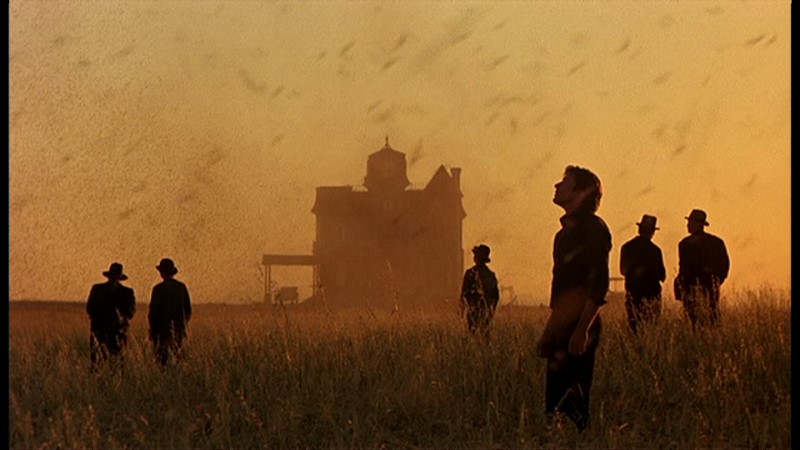
Days of Heaven


Originally Written on 10/28/05 at Epinions.com with re-edited content from 12/10/07


After helming his 1973 debut feature, the road crime drama Badlands, Terrence Malick was on his way into becoming one of the most promising directors of his generation. While Badlands wasn't a huge commercial success, the film's elliptical approach to storytelling along with Malick's visual scope was noticed by many. Still, a follow-up was awaited but Malick instead chose to co-write a film The Gravy Train under a pseudonym named David Whitney. Then in 1978, Malick finally re-emerged with his second film called Days of Heaven about young migrant workers fleeing to Texas where a woman falls in love with a dying farmer leaving her boyfriend jealous with his young sister looking on.

Written and directed by Terrence Malick, Days of Heaven is set in the early 1900s just before the U.S. goes to World War I. With the basic plot commented through the thoughts and eyes of a young girl, the film revolves as a young trio arrive to Texas from Chicago for work as they seek a gold mine in a dying farmer. Yet with the plan coming into fruition, jealousy, greed, and tragedy comes ahead as the young girl looks on to her own destiny and the people around her. Starring Richard Gere, Brooke Adams, Sam Shepard, Linda Manz, and Robert J. Wilke. Days of Heaven is a visually stunning, enchanting masterpiece from one of American cinema's most poetic and enigmatic film directors.

It's 1916 in Chicago as a young migrant worker named Bill (Richard Gere) has just gotten into words with a factory foreman (Stuart Margolin) where a fight ensues and accidents happen as Bill flees. Taking his younger sister Linda (Linda Manz) and his girlfriend Abby (Brooke Adams) away from Chicago, the trio flee on a train with a bunch of migrant workers as they head to Texas. Landing onto a nearby farmed own by a reclusive young farmer (Sam Shepard), Bill, Abby, and Linda take jobs working on the farm while not getting near his house. Working under the young farmer's longtime foreman (Robert J. Wilke), Bill would be working for $3 a day with the women while getting into fights with workers of his relationship with Abby where they claim to be siblings.

While trying to steal some medicine for his sister, Bill overhears a conversation between the young farmer and his doctor where the farmer is ill and has a year to live at best. With his harvest of wheat surrounding him that makes him rich, Bill notices the farmer looking at Abby with great interest. Bill has an idea for Abby to hook up with the farmer so they can nab his riches yet Abby doesn't think it's a good idea but goes along.

With the harvest and crop gathering finishing up, the farmer and Abby begin to have a relationship while Linda befriends a young girl (Jackie Shultis) who is upset that her boyfriend has left while she is still working. With the migrant workers leaving after finishing the crop, the farmer asks Abby to stay so she can do some work with him and she does only if Bill and Linda join him.

With the four people living in the farmer's house, it was a joyous time as Abby begins to fall for the farmer as they get married leaving Bill to be jealous. Still, Bill became a good friend to the farmer while Linda loves the atmosphere living in the farm area with the three adults. The farmer's foreman becomes suspicious as he is dismissed until the next spring harvest as he tells Bill he knows something. Yet with Bill waiting for the farmer to die, his patience becomes troubling as the farmer's condition stayed the same. His feelings for Abby are still the same as does her feelings for him while she is also in love with the farmer. Then when a two little planes arrive on the farmer's home, it belong to a trio of Italian circus performers.

Their arrival only brought a brief sense of joy when the farmer finally becomes suspicious of Abby and Bill's affection for each other. Abby fears his behavior as Bill decides to leave for work in Chicago as he leaves with the circus performers. Bill's departure only left the farmer, Abby, and Linda to live a blissful life for a year. Then when the spring harvest crop starts to arrive, Bill makes a return. Plagued with guilt over things, his arrival brings a bad omen filled with insects on the crop, a fire, and tragedy followed upon by tragedy leaving a young Linda to observe the world around her.

For a story as enchanting as Days of Heaven goes, there could've been so many ways for it to be presented. Whether as an epic kind of film about love or a coming-of-age story. Since this came from mind of Terrence Malick, the approach comes off in not just in a very original way but also in its simplicity. Particularly in his narrative style and approach to structure in his screenplay. The first act being the young trio's arrival to the farm crop and the farmer's interest in Abby.

The second act is Abby living with the farmer and Bill's departure. Then there is the third act where everything comes together in a very tragic way that has a bit of irony along with a full development of the characters. Particularly Bill and the farmer where Bill starts off as very hot-headed and the farmer being very quiet and shy. Even during the arrival of locusts and fire, it's somewhat biblical in the way the behaviors of the main characters begin to shift. Then as the film progresses, their behaviors change as Bill feels guilty and is coming to terms with everything while the farmer becomes enraged in his return.

Yet in its narrative style, it's really through the perspective of Linda since her voice-over narration is what drives the film. She is seeing and hearing things about where the characters are as she feels for Abby, Bill, and the farmer in every way. She sees the good in them as well as the bad in them in a line that really sums up everything. The words and dialogue Malick puts into the film isn't just very simple but realistic in its authenticity to the way the characters speak to each other or what they are thinking.

It's one of the key strengths into Malick's creativity as a writer while as a director, he brings an authentic style to the film. Since it's set in the early 1900s, he goes for a distinctive look that almost looks like an old painting from that era while he brings an epic scope to the film with an observant eye to the environment the characters are in with wonderful close-ups on some scenes or moving the camera feet away for the character.

If there's another way to describe Malick's style of directing, it can be summed up as dreamy. Not in a visual scale but in its tone where the film's title sums up the joy and heavenly feel that the characters feel for each other only to have it shattered by horrible secrets and its aftermath. Malick could've gone and created a situation that would've made the story more conventional but he keeps it real, especially in the tension between the farmer and Bill. It's only conventional when it leads to its tragic consequences while the film's ending is really more about one part of a story ending and another person's story just beginning but that couldn't be told.

What is more surprising that since the film has an epic-like feel to its in terms of visual approach and narrative style. It is done in a very simple way where the movie's running time is 95 minutes. It's really the genius of Malick who used a story that could've been longer but only chose to keep the simple moments.

Helping Malick in the visual department of the film is the late but renowned Cuban cinematographer Nestor Almendros. With some additional work from another great cinematographer, Haskell Wexler, the film's stunning cinematography is lush in its setting. Notably for using sunlight but not showing the sun, particularly during what is called magic hour where it's that time to shoot just before sunset. The shots in the film, notably in its exterior settings is epic and magical in the way the sky is shown along with the atmosphere of the wheat fields. There's an authenticity to every moment and every scene shot, even in the interior settings where it feels like a film in the early 1900s. It's all wonderfully done by Almendros and Wexler.

Helping Malick in the film's presentation is editor Billy Weber who gives a nicely paced, along with nice fading, dissolving cuts that shifts from a scene to scene and helps out in Malick's perspective directing style. Even the sound design of Barry K. Thomas of the film feels very realistic to the times as it helps give the film a sense of authenticity. Longtime art director Jack Fisk with set decorator Robert Gould does a great job in capturing the landscape of the farming, which was done in Alberta, Canada, where he uses the realistic models of cars, gas tanks, and housing designs for the home of the farmer. Even costume designer Patricia Norris does a great job in capturing the look of the costumes that doesn't reveal a lot of colors but colors that matches the atmosphere of the environment as well as the times.

Then there's the film's music that features a wonderful, bouncy early 1900s acoustic guitar style from Leo Kottke that gives the film a bit of a playful feel. Part of the film's soundtrack includes Camille Saint-Saens' Carnival Of The Animals. Yet the main film score of the film is done by one of the greatest film composers of all-time, Ennio Morricone. Sergio Leone's longtime composer brings an elegant, sweeping feel to the film's soundtrack that doesn't just touch its dreamy landscapes but also the sense of drama that isn't overdone. Morricone goes for a simplistic feel while using his talents to create memorable, rich score pieces that gives the film a lot more in terms of its presentation and style.

Finally, there's the film's cast is filled with memorable, small characters like the circus trio performers played by Sahbra Markus, Frenchie Lemond, and Richard Libertini as well as Stuart Margolin as the factory foreman and Jackie Shultis as Linda's friend who appears early in the film and much later towards the end. The most memorable small supporting character is the farm foreman played Robert J. Wilke who is like a father figure to the young farmer while suspecting trouble immediately. Still in terms of casting and performances, the film truly belongs to the four principle actors that not only drive the film but bring the kind of performances that are majestic enough to remember.

Brooke Adams gives an excellent performance as the anguished yet mesmerizing Abby with her natural beauty and her warmth towards the people around her. Adams combined a maternal instinct as well as a loyalty and torment into the scheme that she and Gere planned. When the film and story progresses, she is forced to realize the role that she is playing as in the end amidst the tragedies that occur, she comes to a realization. It's truly Adams' most memorable work to date while she was also good in Alison Anders' Gas, Food, & Lodging, and David Cronenberg's The Dead Zone.

The film's most impressive performance is the young Linda Manz, who was only 16 when she made the film. Manz brings an angelic quality to her presence while it's her narration and observant eye that really drives the story. Manz brings a lot of realism and innocence to her role while having great scenes with her counterparts. While she's only done a few movies since including her most recent work in Harmony Korine's Gummo in 1997, it's truly a remarkable performance.

In his acting debut in a film, noted film/play writer Sam Shepard gives an amazing performance as the shy, quiet farmer. Shepard hits all the right emotions and tones for his performance as a man ailing while dealing with loneliness. When his character is forced to go into rage, Shepard doesn't go over the top but knows that he shouldn't be too restrained. The way Shepard shifts his character from one person to another is amazing as he would prove to be great in not just his work as an actor but as a writer including Paris, Texas for Wim Wenders.

Now Richard Gere may be known now as a Hollywood A-list actor with such films as Pretty Woman, American Gigolo, An Officer & a Gentleman, and more recently, Unfaithful, Chicago, and Shall We Dance. Yet, it was this film that is one of the reasons in why Richard Gere is one of the better actors working in Hollywood today. Gere brings a persona that completely isn't the person in real life, a violent, bratty, charismatic kind of man who does everything he can to get a life that he can't have. Then when the film goes into the third act with his return, we see the guilt and caution that he brings as Gere brings in a spectacular performance in how he handles things and deals with mistakes.

***The Following Content is DVD Tidbits written from 10/07-12/10/07 specifically for the Criterion DVD***

The Region 1 DVD of Days of Heaven by Paramount that was released in 1999 and then re-issued with a different cover in 2006. The DVD shown on widescreen that is enhanced for 16x9 TVs was considered a disappointment. Notably for the fact that the film was originally released in 70mm film and the film transfer to DVD wasn't very good on some parts to complement the brilliant cinematography of the late Nestor Almendros and Haskell Wexler. Another problem with the original DVD is the sound. Mixed in Dolby Digital in English for 5.1 and 2.0 Surround sound. Neither are well-mixed as when compared to the French Mono, the French Mono is much louder. The only extra feature in that DVD is a theatrical trailer that is grainy in some parts since it's a very old trailer. It's also misleading to believe that it's a love-triangle when in reality, that's not what the film is about.

For several years as the legend of Terrence Malick has grown through his other films like Badlands, The Thin Red Line, and The New World. The cult of Malick for a longtime have been waiting through definitive DVDs of his work while they continue to await possible longer cuts of The Thin Red Line and The New World, the latter which has still been delayed in a rumored three-hour cut. Malick also was part of a list of the 25 films that had to be re-issued into a Criterion-like form on DVD with Days of Heaven as the only film in that list. Well, after years of waiting. Days of Heaven is finally given a DVD treatment it deserves and best of all, it is approved by its creator, Terrence Malick.

The 2007 Criterion Collection DVD version is vastly superior in both image and sound in comparison to the original Paramount DVD. With a new, high-definition transfer supervised by Terrence Malick along with the film's editor Billy Webber and the film's original camera operator John Bailey. The look of the film is richer, fuller, and lively without any moments of grainy footage, scratches, and such to not only complement the gorgeous cinematography of Nestor Almendros and Haskell Wexler. The film is also remixed in a new 5.1 Dolby Digital Surround Sound that blows away the sound work in the original DVD. Presented in the 1:78:1 aspect ratio in the widescreen format for 16x9 TVs, the film is even grander in its presentation and scope as it shows the film in its intended form by Malick and his collaborators.

Three section of special features appear in the Criterion DVD. First is a feature-length audio commentary track from the crew members of the film including two of Malick's frequent collaborators, art director Jack Fisk and editor Billy Weber. Along with costume designer Patricia Norris and casting director Dianne Crittendon, the commentary recorded in 2007 exclusively for the DVD. The discussion is mostly about the making of the film and their memories where Fisk and Weber talk about Malick's work method. Crittendon talked about the early casting sessions that had John Travolta as Richard Gere's character and Tommy Lee Jones as the farmer. What happened was Travolta couldn't do the film due to scheduling conflict with his show Welcome Back Kotter while Malick wanted someone younger than Jones and opted for Sam Shepard.

Patricia Norris discussed the making of the costumes while showing the Canadians attitude towards American, particularly in the way Malick and cinematographer Nestor Almendros worked. Fisk and Weber went further revealing that Almendros, who is known for his work with Francois Truffaut and Eric Rohmer, had a very different style of creating images that infuriated a lot of the film’s camera crew and such who were used to working in a Hollywood style.

Ennio Morricone is briefly discussed as he was the composer Malick wanted due to his work in Bernardo Bertolucci's 1900 that they used and asked Morricone to create some music in Italy where the only cue he wrote for a scene specifically was the fire scene while the rest was just pieces he created. Weber revealed that the reason it took two years to edit the film was because Malick wanted to cut out a lot of dialogue to aim for something that was close to silent movies in the early 20th Century. The result of the two-years of editing would make Malick exhausted and then move to France in 1979 where he then, disappeared.

Fisk discusses the production scale where the houses and such made by Hutterrites, a religious group who owned the land but gave permission to use the location for filming in Southern Alberta, Canada. Fisk and Weber also reveal what material did Haskell Wexler shot which were a lot of the film’s interior scenes, the steel mill scene, and a large portion of the film's ending. The reason Wexler was hired because Nestor Almendros only worked for nine weeks and had to leave due to a commitment in shooting a film for Francois Truffaut.

Fisk and Weber did reveal that the film wasn't a commercial hit when it came out while receiving mixed reviews from critics despite praise for the cinematography. What was really surprising was that because it was a $3 million film and it was taking a long time to edit, Paramount didn't pay any attention to what was going on due to other films at the time like Saturday Night Fever and Grease that helped the company while were going over the problems with William Friedkin's The Sorcerer.

The surprising support from Paramount the crew admits was surprising since they liked Malick's films and for the fact that he could make them cheap. The overall commentary is informative and enjoyable with some great humor while the big question they talked about is, where is Terry? Probably watching Zoolander again, this time with Sean Penn and Heath Ledger while reciting many quotes from that film.

The second section of special features is devoted to the actors of the film. While actresses Brooke Adams and Linda Manz don't contribute to the DVD, the more well-known and revered actors Richard Gere and Sam Shepard do make contributions. Richard Gere's 21-minute audio interview recorded exclusively for the DVD is set against many of the film's images, stills, and such. Gere discusses Malick's methods of filmmaking while talking about his own experience since this film was the first he ever made. Gere wanted to do the project because of Badlands and wanting to work with producers Bert and Harold Schneider who had produced landmark films like Easy Rider and Five Easy Pieces. Gere admits that Malick isn't very good at making decisions during the casting while with actors, he wasn't good at that either because he was still new to filmmaking at the time.

Gere talks about his fellow cast where in Brooke Adams, she was someone he knew and was hired at the last minute when another actress dropped out. Sam Shepard was someone Gere knew as well since he had done a couple of plays by Shepard while the two had a rivalry of sorts for Adams' affection whom they both had a crush on. Linda Manz was brought in as Gere talks about her performance and how Terry worked with her that Gere compared to the way Robert Altman worked with kids. He said the secret is to not tell them what to do. Gere also recalls on the film's cinematography and the work of both Almendros and Wexler and how the traditional Hollywood crew had grumbling on Almendros' unconventional style and Wexler making them feel at ease for a bit. Gere also lets in on a secret about the famous locusts flying scene that he reveals exclusively for the interview.

While Gere admits to his own frustrations at the time, notably in the post-production when a lot of the scenes of dialogue was cut, he understood what Terry aimed for and was very proud of the final film which he considers to be one of his favorite films he’s ever been in.

The 12-minute interview with Sam Shepard recorded in 2002 shows the actor/playwright discussing Malick's methods while giving some of his own analyzation of his own character. He says that Terry's films aren’t meant to be overanalyzed and such while he goes on further on the film's historical setting which he says was in some ways was about the changing times of man and machine. Shepard's discussion is very informative while he shares Gere's frustrations over Malick's approach with acting. Shepard also reveals some of Malick's methods with acting where if a spoiled actor worked with him, it would be terrible. An actor, when it comes to working with Terry, has to be independent and make his own decisions while trying to give Terry what he wants.

The third and final section in the DVD special features is about the film's award-winning cinematography. Featuring two video interviews with the film's camera operator John Bailey and cinematographer Haskell Wexler, the two men muse on the film's unconventional cinematography and the late Nestor Almendros. Bailey's 20-minute interview, as he is seen working on the DVD transfer on the film, discusses a lot of the film’s technical moments while revealing that the film was made in the American New Wave style of the early 70s but without its urban look.

Bailey's job as a camera operator was to work under Almendros' instructions since it was the first time Almendros worked with a camera operator. Bailey also reveals the lack of artificial light and grips that were used to convey Almendros' style of photography and Terry's vision. The crew who worked on grips and such were not happy in the style. Bailey's interview is extremely informative and a must-hear for cinematography film buffs.

The 13-minute interview with Haskell Wexler, who filled in when both Almendros and Bailey had to leave due to other commitments. The legendary yet eccentric cinematographer chose the job after seeing some of the footage in the editing room and went to Canada to meet with Malick and Almendros where they were behind schedule and Wexler was used to get things going. Almendros told Wexler to not use any diffusion gauzes, natural light only. Wexler, whose background had been in both documentary and feature-films, had similar visual presentations that Almendros wanted while giving his insight on how he shot and such.

He also channels his frustration over not getting credit by the Academy for Best Cinematography. Though it wasn't anything against Almendros, who he was happy to see won, but wanted to have an Oscar to for his work on that film. It's understandable since he deserves full credit while producer Bert Schneider thought so as well when he told him at a Lakers game.

Accompanying the DVD that includes wonderful packaging for the cover and sleeve is a booklet featuring two essays about the film. The first essay entitled On Earth As It Is In Heaven by Australian senior researcher and Rogue magazine co-editor Adrian Martin of Monash University in Melbourne. Martin's five-page essay discusses the film and Malick's unique perspective on films and philosophy since the man was a Harvard graduate who briefly went to Oxford. Martin tells about his own experience in watching Days of Heaven in its original, 70mm presentation in theaters that was unlike any film at the time in the late 70s. Martin exclaims that part of Malick's philosophy came from Martin Heidegger while his film influences came from Europe, notably Francois Truffaut. He said the actual film in its plot might seen like a typical love triangle between the characters of Richard Gere, Brooke Adams, and Sam Shepard but what was added is the narration of Linda Manz as Gere's sister.

Martin says it was this film that would reveal Malick's idealism of his filmmaking, while his debut Badlands was more of a genre film of sorts that had an elliptical pacing style and voice-over narration. It was Days of Heaven that would define his filmmaking style that would come later on for The Thin Red Line and The New World. It would be a style Martin claims would influence many directors including Wong Kar-Wai. The film's original script had loads of dialogue but by post-production, Malick got tired of the dialogue and ended up cutting a lot of it into a completely different film though the script provided the basic story. The themes of Malick, notably nature which is something Malick seems to love more than anything. While Martin's essay is informative and insightful, it never gives reason into his 20-year departure that followed. Instead, it chooses to focus on the brilliance and influence of Days of Heaven.

The second essay is an excerpt from Nestor Almendros' 1984 autobiography A Man with a Camera. The chapter entitled Shooting Days of Heaven, Almendros discusses his experience making the film and how he and Malick wanted to push the film stock they had for a look that was unlike anything on film. With Almendros, he turned to the paintings of Vermeer for inspiration where he, like Malick, opted for a natural look with very few artificial lighting equipment. This caused conflict between Almendros and most of the film crew who were used to shooting in a glossy, Hollywood style where Almendros didn't give them much to do. Malick doesn't like blue sky and neither did Truffaut which suited Almendros as he usually did his own camera operating but in this film, he had John Bailey as his operator.

Almendros also talked about the technical pointers on the film, notably the use of the Panaflex camera, which was an early version of the Steadicam since Malick opted for use of hand-held cameras and other types of shots. Almendros worked for 53 days on the film and Haskell Wexler worked for 19 days and Almendros' departure was due to the fact that he was committed to shoot The Man Who Loved Women for Truffaut and Wexler took over after some discussion in which he told Haskell to not use any diffusion gauzes. Almendros talked about the difference between American and European film equipment that reveals more source of the conflict between him and the American crew. The excerpt overall is extremely informative for aspiring cinematographers with technical pointers and such from the late yet renowned cinematographer.

Nearly 30 years since its release that was followed by two feature films, both acclaimed and beloved by Malick's devoted following that included fellow film directors. While it received a mixed reception in 1978 despite praise by some critics and loads of awards including the Best Cinematography Oscar to Nestor Almendros and a Best Director prize to Malick at 1979 Cannes Film Festival. After a 20-year disappearance, Malick released his film adaptation of James Jones' The Thin Red Line that drew rave reviews and in 2005, he released The New World to similar acclaim.

In 2007, Malick announced his upcoming project entitled Tree of Life is set for production in 2008 that will star Sean Penn and Heath Ledger (later replaced by Brad Pitt). Though it's unclear when the film will be released, it will be met with lots of anticipation. Even as Malick’s influence has been noted on many directors including Sofia Coppola, Andrew Dominik, and most of all, protegee David Gordon Green whose 2000 debut film George Washington was inspired by both Days of Heaven and The Thin Red Line.

***End of DVD Tidbits***

Nearly 30 years since its release, Days of Heaven is a beautiful, heartbreaking drama from Terrence Malick featuring a superb cast, stunning cinematography, a rich film score, and everything wanted in a beautiful film. While Badlands is a more accessible, this film is the best introduction in terms of Malick's approach to storytelling and narrative. Fans of Sam Shepard and Richard Gere will no doubt find this film to be essential to their work. With the Criterion DVD release, the film is now a must-have for any film buff as well as any diehard fan of Terrence Malick. For a film with great scenery, wonderful plot elements, exquisite narration, and a rich score, Days of Heaven is the film to see.

Terrence Malick Reviews: Badlands - The Thin Red Line - The New World - The Tree of Life - To the Wonder - Knight of Cups - Voyage of Time: The IMAX Experience - (Voyage of Time: Life's Journey) - Song to Song - A Hidden Life - (The Way of the Wind)

© thevoid99 2010