Showing posts with label stephane audran. Show all posts
Wednesday, February 21, 2018
Babette's Feast
Based on the short story by Karen Blixen under the Isak Dinesen pseudonym, Babette’s Feast is the story of a housekeeper who decides to create a feast for religious villagers in late 19th Century Denmark. Written for the screen and directed by Gabriel Axel, the film is a look into a woman with a mysterious past that decides to take action in the hopes of bringing people together to celebrate the 100th birthday of their late yet beloved pastor. Starring Stephane Audran, Birgitte Federspiel, Bodil Kjer, and narration by Ghita Norby. Babette’s Feast is an evocative and enchanting film from Gabriel Axel.
The film follows the life of two sisters and their French housekeeper who lived together for fourteen years when the latter had been taken in despite the fact that the sisters had no money. During their time as the sisters are running their father’s congregation with the remaining villagers left in their small village, their housekeeper plans to create a feast to celebrate what would’ve been the 100th birthday of the congregation leader. Gabriel Axel’s screenplay opens with the story of these two sisters in their youth where they are both pursued by different suitors who visit their small village but both women would stay with their father and later run his congregation. The story then shifts to thirty-five years later where the Frenchwoman Babette (Stephane Audran) has arrived based on the recommendation by a former suitor of one of the sisters who has left France due to a conflict in the country. The story would move fourteen years where Babette receives a letter from home as it would be a brief trip where she would return with ideas for a grand feast for the sisters and the villagers.
Axel’s direction is understated in terms of its setting as well as not going for any kind of stylistic shots to go for something simple and to the point. Shot on location in the small town of Lonstrup in Denmark, Axel would use wide shots to get a scope of the locations as well as some of its surroundings including its seaside cliffs and the oceans. Yet, much of what Axel would do is maintain an intimacy with its close-ups and medium shots where the film opens with Philippa (Bodil Kjer) and Martine (Birgitte Federspiel) is holding a congregation meeting with its small villagers while Babette would serve them food. The flashbacks of the sisters when they were younger as it’s told by Ghita Norby’s narration to play into the world they could’ve been in with Philippa being courted by an officer and Martine by an opera singer due to her voice. Axel would show why the sisters chose to stay as it relates to their father and the congregation that he is leading in this small yet fruitful community.
The tone of the film would change upon Babette’s arrival as she would eventually learn how to speak Danish as well as things do lighten up until Babette has to return to France briefly where a soup that she’s known to make that is recreated by the sisters isn’t as good. It would lead to the third act where Babette returns from France with a bevy of things as it relates to the film’s climatic feast. The attention to detail into what Babette would create in her feast is engaging where Axel is fixated on all of the ingredients she’s bringing in as well as the preparation for the entrees she’s making. The dinner which would include a couple of major guests as there’s a sense of apprehension from Philippa due to a surreal dream she had about what she and the guests will eat. Once the guests would get as their feast, something magical happens as it play into the unexpected as well as the familiar. Overall, Axel crafts a ravishing and sumptuous film about a French housekeeper and the feast she makes for her mistresses and their guests.
Cinematographer Henning Kristiansen does brilliant work with the cinematography with its usage of natural lights for many of the interior/exterior scenes in the village with a few artificial lighting for a few scenes in the places outside of the village. Editor Finn Henriksen does excellent work with the editing as it has some unique rhythmic cuts to play into a few scenes of Babette cooking or in moments that play into the lives of the two sisters. Production designer Sven Wichmann does amazing work with the look of the home that the sisters live in as well as the houses in the village and the interiors of the rich places that the suitors of the sisters lived in.
Costume designer Annelise Hauberg does fantastic work with the costumes from the plain and colorless dresses of the villagers to the colorful look of the officer’s uniform. Sound mixer Hans-Eric Ahrn does superb work for the sound in creating a natural mix of sounds to play into the atmosphere of the village and its surroundings as well as the climatic dinner scene. The film’s music by Per Norgaard is wonderful for its low-key orchestral score that has elements of opera and traditional religious music that play into the world that the characters live in.
The film’s incredible cast include some notable small performances from Gert Bastian as a poor villager who loves Babette’s soup, Pouel Kern as Philippa and Martine’s father, Hanna Stensgaard and Vibeke Hastrup in their respective roles as the younger versions of Philippa and Martine, Thomas Antoni as a Swedish lieutenant, and Bibi Andersson as a Swedish courtier that would introduce General Lowenheilm to his wife. Jean-Philippe Lafont is superb as the opera singer Achille Papin as the man who courts Philippa as he hears her voice and later send Babette to her and Martine.
Jarl Kulle is fantastic as General Lorens Lowenheilm as a man who falls for Martine as he would see her years later in attending the feast. Bodil Kjer and Birgitte Federspiel are amazing in their respective roles as Philippa and Martine as two sisters who run their father’s congregation as well as dealing with its dwindling followers and reluctantly give Babette the chance to create her feast. Finally, there’s Stephane Audran in a phenomenal performance as Babette as a woman who becomes the housekeeper for two sisters where she would create food that would be extraordinary and wanting to return the favor to the sisters by creating a feast that would become an once-in-a-lifetime experience.
Babette’s Feast is a sensational film from Gabriel Axel. Along with its incredible cast, gorgeous visuals, sumptuous music, and images of delicious food, it’s a film that explore what an ordinary woman could to help two old ladies and a village in giving them something that is extraordinary. In the end, Babette’s Feast is a spectacular film from Gabriel Axel.
© thevoid99 2018
Tuesday, May 30, 2017
2017 Blind Spot Series: The Big Red One
Written and directed by Samuel Fuller, The Big Red One is the story of a platoon dealing with war during their campaign in Europe and North Africa during World War II. Based on aspects of Fuller’s own experiences as a soldier, the film is an in-depth look of what goes on in the battlefield where a young platoon follows its leader to survival as they deal with the horrors of war. Starring Lee Marvin, Mark Hamill, Robert Carradine, Bobby Di Cicco, Kelly Ward, Siegfried Rauch, Marthe Villalonga, and Stephane Audran. The Big Red One is an intense and gripping film from Samuel Fuller.
The film follows the 1st Infantry Division during World War II from their campaign in North Africa in November of 1942 to the liberation of the Falkenau concentration camp in May of 1945 led by its sergeant (Lee Marvin). The film follows a sergeant and four men from his platoon as they deal with their many campaigns in the span of nearly three years as it’s largely told by a wannabe-novelist in Private Zab (Robert Carradine) who is the film’s narrator as he is joined by the sharpshooter Private Griff (Mark Hamill), the Italian-American Private Vinci (Bobby Di Cicco), and the medic Private Johnson (Kelly Ward). Samuel Fuller’s screenplay begins with the sergeant fighting in World War I as he would learn the war just ended after killing someone at a place in France which he would revisit years later.
Fuller’s screenplay doesn’t really have much of a plot as it would delve into an episodic narrative of sorts as it follows the sergeant and his platoon into different adventures in the course of their time in Europe and North Africa. Yet, Fuller is more interested in the comradery between the sergeant and his four privates where the sergeant doesn’t really act like some leader who barks orders but rather a soldier who knows what to do and make sure his men aren’t killed. At the same time, he’s kind of a father to them as he would let them get away with a few things but always keep them in check. Especially Pvt. Griff who has a hard time coping with the idea of killing someone as the sergeant reveal some of the dark and cynical aspects of war that is quite true. The script also has a subplot relating to a German officer named Schroeder (Siegfried Rauch) who is a counterpart of sorts for the sergeant as they would encounter each other from time to time during battles yet never meet each other directly. Schroeder is an interesting antagonist who has an undying sense of loyalty to Hitler and the Nazis but has a hard time accepting criticism of their ideals.
Fuller’s direction is definitely intense in terms of some of the battle scenes and action though Fuller doesn’t make it gratuitous nor overblown as it’s often the case with a lot of war films. Shot largely in Ireland with the North African locations shot in Israel as well as some of it shot in California, Fuller explores the different kind of obstacles the sergeant and his men would endure throughout the course of the film. While Fuller would use a lot of wide shots, along with some medium shots, to capture the scope of the locations. It’s in the close-ups and extreme close-ups is where Fuller captures the human aspects of war whether it’s a soldier looking at some of the horror or scenes of them observing their surroundings. Even if it’s moment of fun such as a scene late in the film where Pvt. Zab has a party for the platoon at a house in Belgium as it’s a moment of joy and fun. Fuller would create scenes that are odd as it help give the film a different tone that is often synonymous with war films.
The sequence at an insane asylum where the sergeant and his men meet a woman who is part of the French Resistance would be this mixture of dark humor and suspense that show what the 1st Infantry Division had to do. It’s among some of the offbeat moments in the film as well as what some soldiers have to use to protect their rifles in the water. Yet, Fuller does maintain some realism as it relates to the horrors of war as well as some of the humanity as it relates to the people the sergeant and his platoon encounter. Though some of it is dark, Fuller does show moments of compassion such as a little moment where a young girl puts flowers on the sergeant’s helmet or the film’s climax at the concentration camp in Czechoslovakia. Overall, Fuller crafts a chilling yet captivating film about the 1st Infantry Division’s adventure during World War II.
Cinematographer Adam Greenberg does excellent work with the film’s cinematography as its usage of soft-lights and naturalistic photography for some of the daytime exteriors help give the film a beautiful look including some chilling moments involving some of the violence in the film. Editor Morton Tubor, with Bryan McKenzie for the 2004 reconstruction, does brilliant work with the editing as it is largely straightforward without emphasizing too much on style. Art director Peter Jamison does fantastic work with the look of some of the sets including a big cross that the sergeant would see reminding him of his time in World War I as well as the interiors at the asylum.
Sound editor Jack A. Finlay, with sound designers Mark Linden, Tara A. Paul, and Harry E. Snodgrass for the 2004 reconstruction, does superb work with the sound in capturing some of the horrors of war including the sounds of bombs and gunfire. The film’s music by Dana Kaproff is wonderful for its orchestral-based score as it play into some of the dramatic moments of suspense as well as some offbeat moments in the film in some light-hearted pieces.
The film’s marvelous cast include some notable small roles from Christa Lang as a German countess Schroeder sleeps with, Pascal Bruer as a Hitler Youth member, Galit Rotman as a pregnant Frenchwoman, Matteo Zoffoli as a Sicilian boy who helps the platoon in exchange for them to help bury his mother, Perry Lang as a young private named Kaiser, Doug Werner as a Polish-American soldier, and Marthe Villalonga as a madam at a Belgium house where the platoon briefly stay at. Stephane Audran is terrific as a French spy pretending to be a patient at an insane asylum as she helps the sergeant and his platoon while befriending Pvt. Griff. Siegfried Rauch is superb as Schroeder as a German officer who is kind of the counterpart for the sergeant as they share similar views on war yet he is someone that is truly devoted to Hitler as he will kill those who says something bad about him.
Kelly Ward is excellent as Pvt. Johnson as a farm boy who has experience in being a doctor as he tries to cope with the chaos of war as well as be someone who is very loyal to his platoon. Bobby Di Cicco is fantastic as Private Vinci as an Italian-American who says some of the film’s funniest things while being quite tough in dealing with the enemy. Robert Carradine is brilliant as Private Zab as the film’s narrator as someone who provides some humor as well as witty commentary on things as he’s using his experiences for a book. Mark Hamill is amazing as Private Griff as a sharpshooter who has a hard time with the idea of killing someone as he would display some humility and weariness as someone who would see a lot as he copes with some of the darkest aspects of war. Finally, there’s Lee Marvin in an incredible performance as the sergeant as a man who has been through a lot of wars as he tries to maintain some sense of morale as well as be someone who knows what not to do as it is really one of Marvin’s career-defining performances.
The Big Red One is a phenomenal film from Samuel Fuller. Featuring a great cast, an engaging story about what men go through in war, dazzling technical work, and a fantastic music score. It’s a war film that doesn’t exactly play by the rules while displaying elements of humanity and comradery that is often missed in war films. In the end, The Big Red One is a spectacular film from Samuel Fuller.
Samuel Fuller Films: I Shot Jesse James - The Baron of Arizona - Steel Helmet - Fixed Bayonets! - Park Row - Pickup on South Street - (Hell and High Water) - House of Bamboo - (China Gate) - Run of the Arrow - Forty Guns - Verboten! - The Crimson Kimono - Underworld U.S.A. - Merrill's Marauders - Shock Corridor - The Naked Kiss - (Shark!) - (Dead Pigeon on Beethoven Street) - White Dog - (Thieves After Dark) - (Street of No Return) - (The Madonna and the Dragon)
© thevoid99 2017
Sunday, June 19, 2011
The Discreet Charm of the Bourgeoisie
Directed by Luis Bunuel with a script co-written with Jean-Claude Carriere, Le charme discret de la bourgeoisie (The Discreet Charm of the Bourgeoisie) is the story about a group of upper class friends trying to have a dinner as they’re interrupted by surreal events. During these events, personalities begin to unfold during the course of the day. Starring Fernando Rey, Paul Frankeur, Delphine Seyrig, Stephane Audran, Bulle Ogier, Jean-Pierre Cassel, and Michel Piccoli. Le charme discret de la bourgeoisie is a whimsical yet mysterious film from Luis Bunuel.
A dinner party at the home of the Senechals as a foreign ambassador named Rafael Acosta (Fernando Rey) arrives with his friend Francois Thevenot (Paul Frankeur), Thevenot’s wife Simone (Delphine Seyrig), and her sister Florence (Bulle Ogier). Only Alice Senechal (Stephane Audran) is at the house unaware that there’s a party as her husband Henri (Jean-Pierre Cassel) isn’t home. They all decide to go to eat somewhere else unaware that the restaurant is closed only to discover why. Henri later apologizes for his absence as he invites Acosta and Thevenot for lunch only to be interested in having sex with his wife as the guests later leave as they meet Bishop Dufur (Julien Bertheau) who asks to be their gardener.
Attempts to eat and get together become troubling as they deal with interruptions from soldiers, associates, and other things. Even as they encounter men talking about weird dreams or memories and such. Rafael is dealing with political issues including a female terrorist (Maria Gabriella Maione) while Dufur becomes part of the party realizing something weird is happening.
The film is essentially about a group of bourgeoisie friends trying to have dinner together and have fun. Yet, they are continually interrupted by strange events or happenings that is going on around them. Even as the ladies try to have a simple tea party where there’s a lot of things going wrong. At the same time, there’s various people such as a lieutenant and a sergeant both recalling strange dreams or memories. At the same time, realities become blurred as the dinners seem more confusing and abstract. Luis Bunuel and co-screenwriter Jean-Claude Carriere create a story that is a very loose story that relies on not just repetition but also humor.
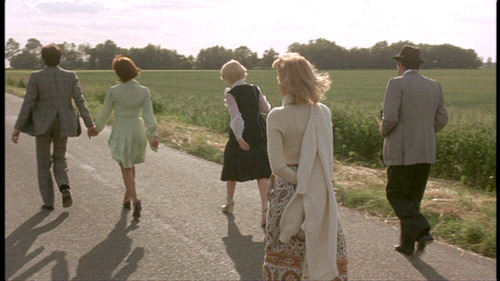
Bunuel’s direction is very entrancing from the repeated images of the people walking on a road in the middle of the French countryside to the intimacy he captures in the dinner scenes. Yet, he also plays up the surrealistic tone of the film by creating scenes where dreams are shot in a world that is artificial with fake backdrops intentionally shown. At the same time, Bunuel allows the camera to be engaging with some close-ups and wide shots to capture the world of the Senechal house as well as the places they go into such as the home of a colonel (Claude Pieplu). In scenes where there’s some expositions about the situations, Bunuel chooses to have strange sounds to cover all of that dialogue as if he doesn’t want to hear what they’re saying. Overall, Bunuel crafts an imaginative yet exhilarating film that is very funny and intriguing in its surrealism.
Cinematographer Edmond Richard does a wonderful job with the film‘s colorful cinematography from the gorgeous, naturalistic look of the daytime exterior scenes to the posh look of the interior scenes at night. Editor Helene Plemiannikov does a great job with the editing in creating a film with a leisured pace and straightforward cuts while playing along with its surrealist tone by utilizing stylistic cuts.
Art director Pierre Guffoy does an amazing job with the art direction from the home of the Senechals to the places they encounter. Notably the surrealistic sets that appears in dreams that play up the film’s idea of reality. Costume designer Jacqueline Guyot does a fantastic job with the closes, notably the dresses for two of the women in the film along with gowns for Simone that was created by Jean Patou. Sound mixer Jacques Carrere does an excellent job with the sound work from the intimacy of the dinner scenes to the chaos for some of the conversation as it blares over the dialogue.
The cast is definitely phenomenal as it features appearances from such Bunuel regulars as Marguerite Muni as a peasant woman and Michel Piccoli as a minister. Other notable small roles include George Douking as a dying gardener, Maria Gabriella Maione as the terrorist, Milena Vukotic as the Senechal’s maid, Claude Peiplu as a colonel, and Francois Maistre as an inspector. Another notable small but brilliant role is Julien Bertheau as a bishop who wants to be a gardener while revealing a story about his parents’ death. Bulle Ogier is excellent as the youthful yet intelligent Florence, the younger sister of Alice Thevenot who often feels like she’s not equal with everyone else because of her youth. Paul Frankeur is really good as Francois Thevenot, a man who is trying to get everyone to have dinners while trying to convince people to go to his place to eat his caviar.
Jean-Pierre Cassel is great as Henri Senechal, a man who also tries to get the dinners going while he is often more interested by having sex with his wife than having a gathering with his friends. Stephane Audran is wonderful as Henri’s wife Alice who often not ready for the party or trying to organize things while she befriends the bishop. Delphine Seyrig is brilliant as Simone Thevenot, Francois’s wife who is often trying to get the ladies to have some their own time together while having flirtatious moments with Rafael. Finally, there’s Fernando Rey in a fantastic performance as the ambassador Rafael Acosta who has a lot in his mind while wanting to have dinner and eat as he often engages in conversations with his friends.
Le charme discret de la bourgeoisie is a superb yet captivating film from Luis Bunuel. Featuring a great ensemble cast led by Fernando Rey and Delphine Seyrig, it is a film that plays with the idea of reality along with Bunuel’s fascination with surrealism. Among the films that Bunuel has done in his long yet glorious career, this film is truly among as one of his best. In the end, Le charme discret de la bourgeoisie is a mesmerizing yet intoxicating film from the late, great Luis Bunuel.
Luis Bunuel Films: Un Chien Andalou - L'Age d'Or - Land Without Bread - (Gran Casino) - (The Great Madcap) - Los Olvidados - (Susana) - (La hija de engano) - (Mexican Bus Ride) - (A Woman Without Love) - (El Bruto) - (El) - (Illusion Travels by Streetcar) - (Wuthering Heights (1954)) - Robinson Crusoe (1954) - (The Criminal Live of Archibaldo de la Cruz) - (El rio y la muerte) - (Cela S'apelle l'Aurore) - (Death in the Garden) - (Nazarin) - (La Fievre a El Pasao) - (The Young One) - Viridiana - The Exterminating Angel - Diary of a Chambermaid - Simon of the Desert - Belle de Jour - (The Milky Way) - Tristana - (The Phantom of Liberty) - (That Obscure Object of Desire)
© thevoid99 2011
Subscribe to:
Posts (Atom)