Showing posts with label michel piccoli. Show all posts
Tuesday, June 13, 2017
Une chambre en ville
Written and directed by Jacques Demy, Une chambre en ville is the story of a young woman who wants to leave her brutish husband for a steel worker amidst a worker’s strike as she’s unaware that the worker is living with her mother. The film is a musical in which many of the dialogue is sung as it explore people dealing with their feelings for one another during a tumultuous event in a small town in France. Starring Dominique Sanda, Michel Piccoli, Richard Berry, Fabienne Guyon, Jean-Francois Stevenin, Jean-Louis Rolland, and Danielle Darrieux. Une chambre en ville is an extraordinarily rich and majestic film from Jacques Demy.
Set in 1955 at the small port town of Nantes during a worker’s strike, the film follows a worker who meets a woman, who is wearing only high heels and a fur coat, as they would have an affair while he deals with his own girlfriend and uncertain future for his job. Adding to the complications is that the woman he met is married and her mother is his landlord as she frets over the chaos of this strike and the appearance of her daughter whom she hadn’t seen in years. Jacques Demy’s screenplay features a lot of the dialogue as it’s sung yet it does help tell the story where the songs would reveal some key plot-points as well as establishing the characters and the situations they’re in. Even as characters such as the protagonists Edith Leroyer (Dominique Sanda) and Francois Guilbaud (Richard Berry) are coping with their own issues as they would get together. Edith’s husband in the TV shop owner Edmond (Michel Piccoli) and her mother Margot Langlois (Danielle Darrieux) would be integral to the story as the former is a man that is very jealous and possessive while the latter is Guilbaud’s landlord that was once a former baroness until she married a colonel as she would sympathize with the workers.
Demy’s direction is definitely entrancing from the way he opens the film with a showdown between striking workers and the police in black-and-white which then turns into color as well as some of the camera movements he creates throughout the film. Shot on location in Nantes, much of Demy’s compositions are straightforward such as the opening wide shots of the showdown at the film’s beginning while he would go for more intimate moments in the scenes at Langlois’ home with the usage of medium shots and close-ups. One notable scene where Edmond confronts his wife late in the film has Demy use hand-held cameras to showcase Edmond’s perspective in this showdown of sorts as it is quite violent at times. Since the film is a musical, there is no dancing or any kind of choreography as it is mostly dramatic but in a restrained tone as Demy wanted to emphasize on this struggle that Guilbaud is having as someone who is part of the working class. Especially as the songs that the characters sing throughout the entirety of the film showcase their own personal desires and struggles in a world that is quite chaotic. Overall, Demy creates a dazzling yet heartfelt film about a wife who has an affair with striking worker.
Cinematographer Jean Penzer does brilliant work with the film’s very colorful cinematography from the way the interiors are presented as well as some of the daytime and nighttime exteriors as it doesn’t go too much into style but maintain a sense of beauty. Editor Sabine Mamou does excellent work with the editing as it is largely straightforward with some rhythmic cuts to play into the music as well as some of the transitions. Production designer Bernard Evein does amazing work with the look of the home of Madame Langlois as well as the TV shop that Edmond runs and the café that the workers would hold their meetings at.
Costume designer Rosalie Varda does nice work with the costumes from the fur coat that Edith wears to violet dress of Violette and the posh clothes of Madame Langlois. The sound work of Andre Hervee is terrific for its low-key and naturalistic sound as it help play into the drama. The film’s music by Michel Colombier is incredible as its usage of jazz, orchestral music, and bits of contemporary pop arrangements as it help carry the film and put accompaniment to the dialogue that is sung throughout the film as it is one of its major highlights.
The film’s superb cast include some notable small roles from Marie-France Roussel as a gypsy fortune teller, Jean-Louis Rolland as a leader for the striking workers, Anna Gaylor as Violette’s mother, and Jean-Francois Stevenin in a terrific role as the striking worker Dambiel who is a friend of Guilbaud as he is also a fraternal figure of sorts for Violette. Fabienne Guyon is fantastic as Violette as Guilbaud’s girlfriend that is eager to start her venture into adulthood while dealing with his sudden distance knowing that there is a future despite the atmosphere involving the worker’s strike. Michel Piccoli is excellent as Edmond Leroyer as a TV salesman that is consumed with jealousy thinking his wife is having an affair while dealing with his own faults as it would make him more troubling.
Danielle Darrieux is brilliant as Margot Langlois as Edith’s mother as a woman who lets Guilbaud stay at her house as a lodger as she deals with the things she lost in her life as well as her growing disdain towards the bourgeoisie lifestyle she was once a part of. Richard Berry is amazing as Francois Guilbaud as a metal sheet worker who is on strike as he copes with the expectations of his relationship with Violette as he falls in love with Edith while turning to Margot for advice and conversation. Finally, there’s Dominique Sanda in a radiant performance as Edith as Margot’s estranged daughter who realizes the bad decision she’s made in marriage as she tries to make amends with her mother while falling for Guilbaud as she spends much of the film wearing only a fur coat to express the sense of ruin that her life has become.
Une chambre en ville is a phenomenal film from Jacques Demy. Featuring a great cast, gorgeous visuals, a compelling story, and an exquisite music soundtrack with many of the actors singing their own dialogue. It’s a musical that doesn’t play by the rules while venturing into the anguish of love and the hope of a better life. In the end, Une chambre en ville is a spectacular film from Jacques Demy.
Jacques Demy Films: (Lola (1961 film)) - Bay of Angels - The Umbrellas of Cherbourg - The Young Girls of Rochefort - Model Shop - Donkey Skin - (The Pied Piper (1972 film)) - A Slightly Pregnant Man - (Lady Oscar) - (La Naissance du Jour) - (Parking (1985 film)) - (Three Places for the 26th) - (Turning Table)
© thevoid99 2017
Wednesday, March 22, 2017
The Young Girls of Rochefort
Written and directed by Jacques Demy, Les Demoiselles de Rochefort (The Young Girls of Rochefort) is the story of two sisters who hope to go to the big city when a fair arrives in their port town as they hope to find men and a chance to succeed. The film is a musical set in a small port town in France where it plays into two sisters trying to make it and escape their dreary world. Starring Catherine Deneuve, Francoise Dorleac, Jacques Perrin, Michel Piccoli, Danielle Darrieux, George Chakaris, Grover Dale, and Gene Kelly. Les Demoiselles de Rochefort is a splendid and enchanting film from Jacques Demy.
Set in the actual port town of Rochefort during the course of an entire weekend, the film is about a fair that is happening in the town where twin sisters hope to find their ideal men during the fair while hoping to go to Paris to pursue their own dreams. It’s a film that is about trying to find love but also deal with lost love and other complications with everyone getting ready for this fair that was to showcase a lot of things to the locals in Rochefort. Jacques Demy’s screenplay follows a lot of characters and their own pursuit for love with the twin sisters Delphine (Catherine Deneuve) and Solange (Francoise Dorleac) as the leads in the story as they’re two women who can sing and dance as they both want to go to Paris. Upon meeting the carnies Etienne (George Chakaris) and Bill (Grover Dale), they find a chance to get out of Rochefort even though their ideal figures of who their soul mates are just happen to be in the city. At the same time, there’s other characters who cope with love such as Delphine and Solange’s mother Yvonne (Danielle Darrieux) over a fiancée she left behind while a music shop owner in Simon Dame (Michel Piccoli) has just arrived to the town lamenting over someone he had lost as he befriends Solange.
Simon’s friendship with Solange would prompt him to call upon an old friend who could help her with her dreams of writing music in an American named Andrew Miller (Gene Kelly) as the two would meet but are unaware of who they really are. Another storyline involves a sailor named Maxence (Jacques Perrin) who is also a poet and painter as he is looking for his own ideal form of love through a painting he made as the woman in the painting looks a lot like Delphine though he’s never met her. There’s a lot that goes on yet Demy always find a way for these multiple stories with multiple characters to not overwhelm the narrative as he would write the lyrics and dialogue that would reveal a lot for all of these other storylines to make sense.
Demy’s direction is just intoxicating to watch in every sense of the word as it is shot on location in Rochefort where it is made to look like a real small town that has a lot more to offer. Shot on a 2:35:1 aspect ratio, Demy uses the widescreen format to his advantage not just in the wide shot where he captures so much coverage in the town but also in the scope of the dancing. Aided by choreographer Norman Meen, the dancing in the film definitely has a sense of movement that Demy would follow not just in wide and medium shots but also know when to cut and get it from another angle or for a close-up. Demy would use some tracking shots to follow some of the dancing while setting up moments from one part of a street to another to follow one character’s narrative into another where it all connects. Demy would also create simple moments for the non-musical scenes as it is more about the characters and what they would do where it would either set up a musical moment or something that would become a plot-point for a character. Even as its climax is at the fair where it is about these twin sisters finally reaching their dream to go to Paris and make something of themselves but also leave behind the idea that they might’ve never found their ideal figures of love. Overall, Demy creates a wondrous and majestic film about twin sisters trying to find love in their small port hometown.
Cinematographer Ghislain Cloquet does amazing work with the film’s colorful and gorgeous cinematography as much of the film is shot in the daytime where it captures the fullness and beauty of the colors as well as the locations with very few scenes shot at night that includes a dinner at Yvonne’s café. Editor Jean Hamon does excellent work with the editing as it does have elements of style but knows how to play with the rhythm of the music and in the dancing as it’s one of the film’s highlights. Production designer Bernard Evein and set decorator Louis Seuret do brilliant work with the set design from the look of Yvonne’s café as well as some of the staging in the fair and the music shop owned by Simon.
Costume designers Jacqueline Moreau and Marie-Claude Fouquet do fantastic work with the costumes as it adds to the film’s gorgeous visuals with its vibrant colors and how it play into the personality of the characters in the film. The sound work of Jacques Maumont is superb as it is very straightforward while capturing the atmosphere of the fair and some of the other local events. The film’s music by Michel Legrand is incredible as it is a highlight of the film with its playful score and the songs written with Demy as it says so much about the characters and helping to drive the story.
The film’s phenomenal cast include some notable small roles from Genevieve Thenier as Yvonne’s café waitress Josette, Pamela Hart and Leslie North as a couple of performers that dump Etienne and Bill for sailors, Patrick Jeantet as Yvonne’s youngest son Booboo, Rene Bazart as Yvonne’s father, Henri Cremieux as an old friend of Yvonne’s father who visits the café, and Jacques Riberolles as Delphine’s art gallery boyfriend Guillaume who is quite full of himself as the two break-up early in the film. Michel Piccoli is superb as Simon as a music shop owner who is an old friend of Andy as well as a mentor of sorts for Solange with her music as he also laments over love that he’s lost many years ago. Danielle Darrieux is fantastic as Yvonne as a café owner who also laments over a lover she left behind while coping with the fact that her daughters are leaving home to pursue their dreams as she’s the only person in the film that actually sings while everyone lip-syncs other people’s voices. Jacques Perrin is excellent as the sailor Maxence as a man who is trying to finish his service in the military while pursuing his own dreams as an artist where he hopes to find the woman he painted but never met.
George Chakaris and Grover Dale are brilliant in their respective roles as Etienne and Bill as two smooth-talking but kind carnies who try to woo Delphine and Solange while helping out Yvonne and other locals in the world of love. Gene Kelly is marvelous as Andrew Miller as an American friend of Simon who visits the small town as he gets a glimpse and falls for Solange while discovering a piece she wrote that she dropped upon their first meeting. Finally, there’s the duo of Catherine Deneuve and Francoise Dorleac in remarkable performances in their respective roles as Delphine and Solange. Deneuve and Dorleac, who are sisters in real-life, both provide a great sense of comic timing and charm as well as displaying their own vulnerabilities as women trying to find their ideal mates and their pursuit to follow their dreams in the big city despite leaving the one place they call home.
Les Demoiselles de Rochefort is a spectacular film from Jacques Demy. Featuring a great cast, gorgeous visuals, top-notch choreography, and sumptuous music. It’s a film that doesn’t just bear many elements into what makes the musical a joy to watch but it’s also backed by a universal and engaging story about finding love in a small portside town in France. In the end, Les Demoiselles de Rochefort is a tremendous film from Jacques Demy.
Jacques Demy Films: (Lola (1961 film)) - Bay of Angels - The Umbrellas of Cherbourg - Model Shop - Donkey Skin - (The Pied Piper (1972 film)) - A Slightly Pregnant Man - (Lady Oscar) - (La Naissance du Jour) – Une chambre en ville - (Parking (1985 film)) - (Three Places for the 26th) - (Turning Table)
© thevoid99 2017
Thursday, September 17, 2015
The World of Jacques Demy
Written and directed by Agnes Varda, L’univers de Jacques Demy (The World of Jacques Demy) is a documentary in which Varda pays tribute to her late husband through the films he made as well as his life. Featuring interviews with those that worked with him, the film is a look into one French cinema’s finest filmmakers. The result is a lively and touching portrait of one of the great filmmakers that ever lived.
Among the filmmakers who emerged during the era of the French New Wave, Jacques Demy was someone who didn’t fit in with that movement due to his love for American musicals and fantasy as he would cultivate a career that is considered one of the finest in cinema. Created in the span of two years, Agnes Varda creates not just a solemn tribute to her husband but would also interview some of his collaborators, fans of his work, and the actors that worked with him. Even as Varda goes into detail about his own life with the aid of their children, her sister-in-law, and old friends as well as the places he grew up in as the town would also pay tribute to the filmmaker.
Through various film clips and rare behind-the-scenes footage which would feature those anyone wouldn’t expect in a Demy film set like Jim Morrison at the set of Donkey Skin who would give Delphine Seyrig’s son his autograph. The actors such as Michel Piccoli, Jeanne Moreau, Catherine Deneuve, Dominique Sanda, Anouk Aimee, Jacques Perrin, Nino Castelnuovo talk about their experiences working with Demy and his films. Much of it show that they all have pleasant experiences with him where Deneuve recalled doing The Umbrellas of Cherbourg as the first time she felt she was working with a real filmmaker. Many of his films are covered including the ones that weren’t successful like Lady Oscar and Parking where clips of interviews by Demy talk about the way things are in the industry where not all of his films are successful.
The film also showcases Demy’s brief flirtation in Hollywood when he was making Model Shop as a sequel to Lola with Anouk Aimee where the original male lead was supposed to be an up-and-coming actor named Harrison Ford who is also interviewed where he talks about how much Demy and one of the film’s producer wanted him to be in the film. Instead, studios chose Gary Lockwood of 2001: A Space Odyssey for the role which Demy wasn’t happy with though the resulting film was something Demy thought was good but not great. With the aid of cinematographers Stephane Krausz, Peter Pilafian, and Georges Strouve, along with editor Marie-Josee Audiard and the sound work of Thierry Ferreux and Jean-Luc Rault-Cheynet, Varda chose a different approach to narrative where she goes for a more non-linear look into Demy’s life and work.
Adding to the film’s whimsical tone are the music pieces by Michel Colombier and Michel Legrand who are both featured in the film as they talk about Demy’s approach to music. Much of the music that appears in the film is from Demy’s films as it adds to his love for music and what it means to him. Even as some fans of his films including some ordinary people know some of the songs by heart as the actors in those films would sing bits of these songs. It adds to the power of Demy’s influence and the impact he made in the world of films.
L’univers de Jacques Demy is a phenomenal film from Agnes Varda. It’s not just one of Varda’s finest documentaries but also a touching and exhilarating tribute to her late husband in Jacques Demy. Notably as it’s a film that displays some unique surprises about Demy and his work and how much he means to audiences all over the world. In the end, L’univers de Jacques Demy is a sensational film from Agnes Varda.
Agnes Varda Films: Diary of a Pregnant Woman - Du cote de la cote - La Pointe Courte - Cleo from 5 to 7 - Le Bonheur - (Les Creatures) – (Far from Vietnam) – (Lions Love) – (Daguerreotypes) – One Sings, the Other Doesn’t – (Murals Murals) – (Documenteur) - Vagabond - (Jane B. by Agnes V.) – ((Le Petit Amour) – (Jacquot de Nantes) – (The Young Girls Turn 25) – (One Hundred and One Nights) – The Gleaners & I - (The Gleaners & I: Two Years Later) – (Cinevardaphoto) – (Some Windows of Noirmoutier) - (The Beaches of Agnes) – (Faces Places) – (Varda by Agnes)
© thevoid99 2015
Wednesday, April 29, 2015
Atlantic City (1980 film)
Directed by Louis Malle and written by John Guare, Atlantic City is the story of a former gangster who protects a young courier after her husband had stolen some money as they’re both on the run from the mob. The film is an unlikely love story where an old man falls for a younger woman as they deal with chaos over stolen money in the middle of Atlantic City. Starring Burt Lancaster, Susan Sarandon, Kate Reid, Robert Joy, Hollis McLaren, Al Waxman, and Michel Piccoli. Atlantic City is a thrilling yet enchanting film from Louis Malle.
The film revolves a former gangster who befriends and falls for a young woman whose estranged husband had stolen some drugs from mobsters as he does whatever it takes to protect her. It plays into a man trying to cope with aging as he is struggling to get by as he is caring for an old woman as well as make money for the poor as his neighbor is a casino waitress training to be a courier. The two come together when Lou Pascal (Burt Lancaster) tries to help out this young drug dealer named Dave Matthews (Robert Joy) try to score a deal in which Lou will get a cut but things go wrong when the drugs that Dave stole belonged to a mob.
The film’s screenplay explores this old man trying to find meaning again as he falls for this young woman named Sally (Susan Sarandon) who wants a new life as she copes with her husband’s bad deals and how it would affect her chance for a brighter future. Even as Sally has to endure her ex-husband and her pregnant sister Chrissie (Hollis McLaren) as they would stay at her apartment while Lou spends his time taking care of a mob-boss widow named Grace (Kate Reid) where he doesn’t feel appreciated. All of which play into Sally and Lou coming together and make a new life for themselves.
Louis Malle’s direction is quite simple as there aren’t a lot of very stylistic shots yet it does play into a period in time where Atlantic City is moving away from its roots into something more modern and less glamorous. While it is a largely intimate film, there are some wide shots as it plays the decline of the old Atlantic City where its hotels and buildings are either destroyed or in ruins in favor of cheaper and more modern-day casinos. Malle does make the city a character as it is mostly shot on the actual city while he goes for close-ups and medium shots to play into some of the drama and suspense that looms throughout the film. Especially as there’s moments where Lou and Sally are in the same room but the latter isn’t aware of the former’s presence until the film’s second half. Malle’s direction does keep thing engaging as it includes some intense moments into the suspense as well as bits of humor as it play into Lou’s desire to reclaim his sense of youth and his attraction towards Sally. Overall, Malle creates a very engaging yet fun film about an ex-gangster protecting a young woman from the mob.
Cinematographer Richard Ciupka does excellent work with the film‘s very soft yet lush cinematography to capture the sense of griminess and bleak colors of the locations along with some unique lighting schemes to play into some of the romantic textures of the film. Editor Suzanne Baron does terrific work with the editing as it‘s very straightforward to play into the drama and suspense. Production designer Ann Pritchard and set decorator Gretchen Rau do amazing work with the look of the apartments of the key characters as well as some of the places they go to including the casinos.
Costume designer Francois Barbeau does nice work with the costumes from the suits that Lou would wear to the waitress/casual clothes that Sally wears to play into the ideas of the old and new world. The sound work of Jean-Claude Laureux is superb for its sound effects from the way music is heard on locations to the atmosphere in the casinos. The film’s music by Michel Legrand is wonderful though it is very sparse as it is mostly an ambient soundtrack while much of the soundtrack consists of different array of music from soul, rock, pop, classical, jazz, and opera music.
The film’s brilliant cast includes an appearance from the singer Robert Goulet as himself as well as notable small roles from Al Waxman as a dealer Lou knows, Wallace Shawn as a restaurant waiter, Hollis McLaren as Sally’s spiritual yet pregnant sister Chrissie, and Robert Joy as Sally’s estranged husband Dave who would try to create deals only to get himself into serious trouble. Michel Piccoli is superb in a small role as a courier teacher who tries to teach Sally the ropes in dealing while Kate Reid is fantastic as the aging mob widow Grace who orders Lou around while lamenting over the loss of the old Atlantic City. Susan Sarandon is amazing as Sally Matthews as this woman eager to make it as a courier while working part time as a waitress as she copes with her husband’s troubles and the protection of Lou. Finally, there’s Burt Lancaster in a phenomenal performance as Lou Pascal as this former gangster who was a top numbers man back in the old days as he copes with aging and the thirst to feel young again as Lancaster brings a sense of charm and energy into his performance.
Atlantic City is a remarkable film from Louis Malle that features top-notch performances from Burt Lancaster and Susan Sarandon. It’s a film that manages to transcend all genres while being very exciting with characters that are engaging and lively as it’s also one of Malle’s most accessible films. In the end, Atlantic City is a sensational film from Louis Malle.
Louis Malle Films: (The Silent World) - Elevator to the Gallows - The Lovers (1958 film) - Zazie dans le metro - (A Very Private Affair) - (Vive Le Tour) - The Fire Within - (Bons baisers de Bangkok) - (Viva Maria!) - (The Thief of Paris) - Spirits of the Dead-William Wilson - (Phantom India) - (Calcutta) - Murmur of the Heart - (Humain, Trop Humain) - Place de la Republique - Lacombe, Lucien - Black Moon - (Close Up (1976 short) - (Dominique Sanda ou Le reve eveille) - Pretty Baby - (My Dinner with Andre) - Crackers - God’s Country (1985 film) - (Alamo Bay) - (And the Pursuit of Happiness) - Au Revoir Les Enfants - (May Fools) - (Damage (1992 film)) - (Vanya on 42nd Street)
© thevoid99 2015
Thursday, October 02, 2014
Contempt
Based on the novel Il disprezzo by Albert Moravia, Les Mepris (Contempt) is the story of a playwright who is asked by an American producer to help in doing re-writes for an adaptation of Homer‘s The Odyssey that is being directed by Fritz Lang while his personal life starts to unravel. Directed by Jean-Luc Godard and screenplay by Godard and Moravia, the film is an exploration of a man dealing with his situation as his attempts to be involved in a film has him noticing that his own marriage is starting to mirror aspects of the story he is trying to tell. Starring Michel Piccoli, Brigitte Bardot, Jack Palance, Giorgia Moll, and Fritz Lang as himself. Les Mepris is a rich yet provocative film from Jean-Luc Godard.
The film explores a playwright’s life falling apart when he accepts a job to do re-writes for an adaptation of The Odyssey for director Fritz Lang. In need of the money so he can buy a new flat for himself and his wife Camille (Brigitte Bardot), Paul Javal (Michel Piccoli) notices that his marriage is unraveling due to the presence of American producer Jeremy Prokosch (Jack Palance) who is battling Lang over artistic differences as Prokosch wants something that is more commercial. While Paul deals with trying to create a script that can satisfy both men, his marriage to Camille starts to break down as the film explores how art can play into someone’s personal life where Paul’s struggle starts to mirror some of the aspects of The Odyssey. The film’s screenplay doesn’t really have much of a plot as its first act is about Paul arriving to Italy to meet with Prokosch and Lang where he wonders how to tell the story. The film’s second half explores this slow breakdown between Paul and Camille as it leads to a third act where resentments and desperations start to unfold as all of the converge at the island of Capri.
Jean-Luc Godard’s direction is very mesmerizing as he presents the film on Cinemascope to create something that has the look and feel of a Hollywood film but with aesthetics that are more keen to Godard’s own sensibilities. Notably as Godard creates a film that plays into some of the trouble of what goes on in film productions. Even as Godard would infuse elements of styles such as long and elaborate tracking and dolly shots to play into the Paul meeting with Prokosch about making the film as well as his disintegrating marriage unfolding inside their apartment. Some of it involves these gazing long shots that showcases a marriage disintegrating slowly in this long sequence that is the film’s second act where Camille questions about their marriage as there’s attempts to reconcile which heightens the drama. The film’s third act set in Rome and the island of Capri showcase Lang’s vision of how he wants to tell The Odyssey which starts to mirror Paul’s own disintegrating marriage.
One aspect of Godard’s direction that is very notable is the way he showcases Camille as she’s occasionally presented nude where she is this object of affection for Paul as well Proskosch who is smitten by her as he plays a part into the marriage’s disintegration. It would come ahead in this third act where cinema and realism collide as it showcases Paul’s frustrations with everything in his life including his own marriage. Even as he questions the decisions he has made as an artist and how it has affected his own relationship where Paul would ask Camille what to do as she revealed that any decision he would make would have consequences. Overall, Godard crafts a very engaging and intoxicating film about a writer being compromised in his life as an artist and as a man.
Cinematographer Raoul Coutard does brilliant work with the film‘s very colorful cinematography to capture some of the film‘s naturalistic look of some of the locations as well as some of the interiors and its use of filters for some of its stylistic moments. Editor Agnes Guillemot does amazing work in creating a style that is mostly straightforward with the exception of some of montages that plays into Paul‘s own reflection of his disintegrating marriage. The sound work of William Sivel is terrific for some of the sound effects that occur in the film within a film as well as a scene where the characters watch a theater performance. The film’s music by Georges Delerue is fantastic as it features a somber orchestral piece that plays into Paul and Camille’s own breakdown of their marriage.
The film’s cast includes cameos from Godard and cinematographer Raoul Coutard as Lang’s crew members plus Linda Veras as a siren for the film that is being made and Giorgia Moll in a superb role as Prokosch’s assistant/lover Francesca who deals with Prokosch’s cruelty as well as befriending Paul and Fritz Lang. Fritz Lang is excellent as himself as he plays a director wanting to create something that is arty but also true to Homer’s story as he befriends Paul where they discuss the story and interpret their own ideas about the story. Jack Palance is amazing as Jeremy Prokosch as this American producer who is also a playboy as he tries to take control of the production and woo Camille.
Brigitte Bardot is fantastic as Camille as this beautiful woman who finds herself in the presence of Prokosch as she begins to question her husband’s love for her. Finally, there’s Michele Piccoli in a brilliant performance as Paul as this playwright who tries to do what is right as he finds himself compromised as he wonders how it has affected his marriage and wondered if he can do anything to save it and himself.
Les Mepris is a remarkable film from Jean-Luc Godard. Armed with a great cast and dazzling visuals, the film is a compelling story about a man losing his grasp on his personal life and what he wants as an artist. It’s also a film that explores the world of Hollywood productions and how it can trouble European filmmakers wanting to instill their own vision. In the end, Les Mepris is a phenomenal film from Jean-Luc Godard.
Jean-Luc Godard Films: All the Boys Are Called Patrick - Charlotte et son Jules - Breathless - The Little Soldier - A Woman is a Woman - My Life to Live - The Carabineers - Band of Outsiders - A Married Woman - Alphaville - Pierrot Le Fou - Masculin Feminin - Made in U.S.A. - Two or Three Things I Know About Her - La Chinoise - Weekend - One Plus One (Sympathy for the Devil) - (Joy of Learning) - (British Sounds) - Tout va Bien - (Letter to Jane) - (One A.M.) - (Number Two) - (Here and Elsewhere) - (Every Man for Himself) - (Passion) - (First Name: Carmen) - Hail, Mary - (Soft and Hard) - (Detective) - (King Lear (1987 film)) - (Keep Your Right Up) - (Nouvelle Vague) - (Allemagne 90 neuf zero) - (JLG/JLG - Self-Portrait in December) - For Ever Mozart - (Historie(s) de Cinema) - (In Praise of Love) - (Notre musique) - (Film Socialisme) - (Adieu au Language) - (The Image Book)
© thevoid99 2014
Saturday, June 07, 2014
Mauvais Sang
Written and directed by Leos Carax, Mauvais Sang (The Night is Young) is the story of a young man who is asked by two aging thieves to steal a serum for an American crime boss as the young man falls one of the thieves‘ young lover. Set in a futuristic world where young people who make love without any emotions are being killed in a strange epidemic forcing a young man to do something to survive only to fall in love. Starring Denis Lavant, Juliette Binoche, Hans Meyer, Julie Delpy, Carroll Brooks, Hugo Pratt, Mireille Perrier, and Michel Piccoli. Mauvais Sang is a tremendously stylish yet whimsical film from Leos Carax.
In a world that is troubled by an epidemic where young people start to die due sex without emotions, two criminals ask a young man to help steal a serum that will stop this epidemic in order to pay off a debt to an American woman who asks for their help. Yet, things become complicated with the young criminal Alex (Denis Lavant) falls for one of the thieves’ young lover in Anna (Juliette Binoche) who is also part of the caper as she dealing with depression. It’s a film that bends all sorts of genre where writer/director Leos Carax throws away the rule book about what can be told in a crime film as he infuses a lot of elements of sci-fi, romance, and silent comedy into the mix. Notably as it’s about a young man wanting to start a life of his own after the death of his estranged father as he is offered that opportunity. Yet, he is forced to make sacrifices as he leaves his young girlfriend Lise (Julie Delpy) while waiting for the job to happen.
The film’s screenplay has a very loose structure with a lot of stylish dialogue that plays into Alex’s desire for a new life while he helps out Marc (Michel Piccoli) and Hans (Hans Meyer) in retrieving the serum though there are complications as the two men are old and one of them is ill. This forces Alex to spend much of his time with Anna as she is often very melancholic and cries for no reason as Alex would try to cheer her up. Yet, there is confusion as Anna likes Alex but remains devoted to Marc while Alex still thinks about Lise despite the fact that he let a friend of his be with her. That would eventually complicate things when the date of the heist emerges as emotions start to run high as does the stakes.
Carax’s direction is definitely stylish not just in the world that he creates where it’s set in a not-too-distant futuristic world of Paris. Especially as the epidemic that is used for the film serves as an allegory of sorts for the AIDS virus at the time as Carax goes for something that is a bit of a social commentary but also infuses it with ideas that could be set in the future as it relates to sex without emotions. Carax does create some shots that are quite simple and to the point as far as the drama plays out yet there’s also moments where he does aim for a sense of style in the way he places the camera for some of the compositions as well as aim for something that harkens back to all sorts of styles in cinema. Some of which involves silent film scenes where Alex would often do things as if he was a character in a silent movie while the romantic moments between Alex and Anna recall aspects of the French New Wave.
The direction also includes some stylish shots that play into the film’s unconventional presentation such as Alex running around the streets of Paris to David Bowie’s Modern Love as Carax would use a tracking dolly shot to capture Alex’s run through the streets of Paris. There’s also scenes where it is very playful and full of style where it adds to this world that feels very offbeat and almost surreal at times. Especially in the scene where Alex would steal the serum as it has elements of sci-fi but also suspense while its climax would be another ode to the French New Wave films of the 1960s. Overall, Carax crafts a very odd yet exhilarating film about a young man trying to start a new life for himself by becoming a criminal.
Cinematographer Jean-Yves Escoffier does fantastic work with the film‘s cinematography where even though it doesn‘t have a lot of color in its scenery, there are moments where he allows some of the costumes and such to shine while also using some black-and-white footage to be used for stylistic reasons. Editor Nelly Quettier does brilliant work with the editing by emphasizing largely on style with jump-cuts and unconventional frame-speeds to play with its action and drama. Production designers Jacques Dubus, Thomas Peckre, and Michel Vandestien, with set decorator Bernard Leonard, do amazing work with the set pieces from the base that Marc and Hans stay at to plan the heist to some of the exteriors of the buildings where it adds a dream-like feel to the film.
Costume designers Dominique Gregogna, Martine Metert, and Robert Nardone do excellent work with the costumes from the red sweater and blue robe that Anna wears to the yellow leather jacket that Alex wears as it adds to the film‘s unique look. The sound work of Claude Hivernon, Harrik Maury, Henri Morelle, and Joel Riant is superb for some of the sound effects that is created from the way Alex‘s motorcycle sounds to the way some of the objects sound to play into the action and suspense. The film’s wonderful music soundtrack consists of classical pieces by Sergei Prokofiev and Benjamin Britten as well as a score piece from Charles Chaplin and songs by Serge Raggiani and David Bowie as the classical pieces serves as dramatic cues while the Chaplin piece from Limelight is played in a very dazzling sequence where Alex encounters a young mother and her child.
The casting by Helene Bernardin is great for the ensemble that is created as it features some notable small performances from Mireille Perrier as the young mother Alex encounters, Serge Reggiani as Marc and Hans’ friend Charlie, Jerome Zucca as Alex’s friend Thomas, Leos Carax as a peeping tom, Hugo Pratt as the American boss’ muscle Boris, and Carroll Brooks as the American boss who orders Marc and Hans to steal the serum so they can clear their debt. Hans Meyer is excellent as Hans as a criminal who is also a doctor and a man of style as he teaches Alex how to present himself as a criminal. Julie Delpy is amazing as Lise as Alex’s young girlfriend who is in love with him despite her naiveté as she tries to communicate with him while becoming a crucial part of the heist.
Michel Piccoli is brilliant as Marc as an old friend of Alex’s dad who asks Alex for help while dealing with his own issues as an old man as well as the debt that looms over his head. Juliette Binoche is fantastic as Anna as Marc’s young yet melancholic lover who only takes up the job to support Marc while being charmed by Alex as it’s a role that has Binoche be funny as well as maternal. Finally, there’s Denis Lavant in a remarkable performance as Alex as this young criminal who is known for his quick hands as he joins the heist in order to start a new life while dealing with what is at stake as he is also torn for his love for both Anna and Lise as it’s Lavant in one of his best roles to date.
Mauvais Sang is an incredible film from Leos Carax that features outstanding performances from Denis Lavant, Juliette Binoche, Michel Piccoli, and Julie Delpy. The film is definitely one of Carax’s finest films in terms of blending all sorts of genre and make it something unique while also being a tribute to cinema itself. In the end, Mauvais Sang is a phenomenal film from Leos Carax.
Leos Carax Films: Boy Meets Girl - Lovers on the Bridge - Pola X - Tokyo!-Merde - Holy Motors - Annette - The Auteurs #36: Leos Carax
© thevoid99 2014
Thursday, November 21, 2013
Belle de Jour
Based on the novel by Joseph Kessel, Belle de Jour is the story of a housewife who spends her afternoons as a prostitute while her husband is at work as she deals with her sexual desires. Directed by Luis Bunuel and screenplay by Bunuel and Jean-Claude Carriere, the film is an exploration into a woman trying to find sexual fulfillment as she’s not finding that in her marriage prompting her to take drastic actions. Starring Catherine Deneuve, Jean Sorel, Francisco Rabal, and Michel Piccoli. Belle de Jour is a provocative yet entrancing film from Luis Bunuel.
The film explores the world of a bored housewife of a surgeon who decides to become a prostitute in the afternoons to fulfill her sexual desires. There, she encounters men who give her the sexual fulfillment she craves which would have an ironic effect in her relationship with her husband until she meets a troubled criminal who wants her. It’s a film that is largely told from the perspective of the protagonist Severine (Catherine Deneuve) who has these fantasies of being beaten and insulted yet has a hard time living that out in the real world as she is bored and aloof which confuses her husband Pierre (Jean Sorel) who often works. Yet, she is also quite cold to his friend Henri Husson (Michel Piccoli) who would mention about the brothel that one of Severine’s old friends used to work at which prompts the curious Severine to see what is there where she would find this strange balance of fantasy and reality.
The film’s screenplay by Luis Bunuel and Jean-Claude Carriere creates a unique story that is largely told from a woman’s perspective where it’s opening scene is where Severine and Pierre are riding in a carriage where Pierre demands the carriage drivers to beat her. It’s a very strange moment to open the film but the fact that it’s Severine’s fantasy makes it even stranger into why would this woman want to feel pleasure from being whipped by men and such? Pierre has no clue about Severine’s fantasies as he is also baffled by her reluctance to have sex with him but he respects her too much to not do anything against her will. Still, there is that question of maybe Severine wants Pierre to take action but it doesn’t happen where she also is also attracted to Husson in some respects though she also despises him greatly because of how flirtatious he can be.
The script is also intriguing in how Severine manages to be part of this world of sex where she works for this very stern brothel madam known as Madame Anais (Genevieve Page) who shows her the ropes of what to do. Under the name Belle de Jour, Severine would become one of class and intrigue to the clients she meets. Yet, it becomes more troubling in its third act with the arrival of a criminal named Hyppolite (Francisco Rabal) who is an old friend of Madame Anais as he is joined by his young protégé Marcel (Pierre Clementi) whose attraction to Severine is very unstable. Notably as it clashes with everything she wanted but also the stability that she craves for at home.
The direction of Luis Bunuel is very entrancing in the way he blurs the idea of fantasy and reality. Most notably with its opening sequence that seems real but it has an air of surrealism that is common with a lot of Bunuel’s work as there would be these scenes that are presented in some of the beautiful ways. Even as it has this degradation that makes it so strange where Husson throws mud at Severine in one scene while she’s tied up on a tree in another scene to showcase how extreme these fantasies of sadomasochism can be. Even where Severine finally gets to act in these fantasies where there is a sense of happiness that occurs where even the fantasies become more playful in some respects.
The compositions that Bunuel creates are mesmerizing in the way he puts his actors into a frame or how he maintains the idea of reality and fantasy colliding. Notably as some of the moments of reality where Severine interacts with the other prostitutes showcase an intimacy in some of these scenes as well as scenes between Severine and Pierre where it’s quite calm. Still, Bunuel does create some great scenes in these moments where he would also include moments of symbolism to suggest the fate that Severine might face. Most notably a sequence where Severine is hired to play the dead wife of a man in this elaborate yet strange funeral scene. Things get darker in the third act where her encounter with Marcel is one that is just chaotic as it also begins to blur the idea of reality and fantasy where Severine must make a choice. Overall, Bunuel creates a very fascinating and captivating film about a woman trying to find fulfillment in her sexual desires.
Cinematographer Sascha Vierny does amazing work with the film‘s very colorful cinematography from the way the scenes in the forests look with its vibrant colors to some of the lighting schemes that is created in some of the film‘s interiors. Editor Louisette Hautecoeur does brilliant work with the editing where it is stylized with its jump-cuts and dissolves as it plays to some of the film‘s humor and strange moments. Production designer Robert Clavel does fantastic work with the look of the brothel that Severine works at as well as her lavish home that she and Pierre live in. The costumes of Helene Nourry is superb for its sense of style in the clothes that Severine wears that ranges from quaint and innocent to some of the sensual clothing she has to wear for work. The sound work of Rene Longuet is excellent for some of the effects that is created to play up that blur of fantasy and reality as well as in creating an atmosphere in some big scenes in the film.
The film’s incredible cast includes some notable small roles from Marguerite Muni as Madame Anais’ maid, Georges Marchal as a duke who hires Severine to come to his home, Macha Merill as Severine’s friend Renee, Francoise Fabian and Maria Latour as a couple of women who work for Madame Anais, and Francisco Rabal as the notorious yet cautious criminal Hyppolite. Pierre Clementi is excellent as the unpredictable and fierce Marcel who falls for Severine as she has everything he wants yet has a hard time not being with her. Genevieve Page is superb as Madame Anais as a woman who is stern but also very kind as she helps Severine figure out how to play her part while dealing with the fact that Severine is only working in afternoons. Michel Piccoli is great as Henri Husson as a man who is attracted to Severine no matter how much she despises him as he’s one full of charm and wit while he would be the one that would play a key role into ending Severine’s time as a prostitute.
Jean Sorel is terrific as Severine’s husband Pierre as he’s sort of this aloof yet kind surgeon who loves his wife but doesn’t know what she wants as he’s quite oblivious to her activities while being a much more brutal person in her fantasies. Finally, there’s Catherine Deneuve in a remarkable performance as Severine as this woman who sort of has this cold yet lost personality early in the film to someone who seems to enjoy being beaten and humiliated in her fantasies as it’s definitely one of Deneuve’s finest performances in her career where she shows a bit of skin but also shows something much more in this film.
Belle de Jour is a phenomenal film from Luis Bunuel that features a radiant performance from Catherine Deneuve. The film is certainly one of the most interesting takes on the world of sexual fantasies and sadomasochism as well as what a woman wants in her life as she is just simply trying to find herself. Most notably as it would also play into the idea of reality and fantasy in what a woman wants. In the end, Belle de Jour is a sensational film from Luis Bunuel.
Luis Bunuel Films: Un Chien Andalou - L’Age d’Or - Land Without Bread - (Gran Casino) - (The Great Madcap) - Los Olvidados - (Susana) - (La hija de engano) - (Mexican Bus Ride) - (A Woman Without Love) - (El Bruto) - (El) - (Illusion Travels by Streetcar) - (Wuthering Heights (1954 film)) - Robinson Crusoe (1954 film) - (The Criminal Lives of Archibaldo de la Cruz) - (El rio y la muerte) - (Cela S’apelle l’Aurore) - (Death in the Garden) - (Nazarin) - (La Fievre a El Pasao) - (The Young One) - Viridiana - The Exterminating Angel - Diary of a Chambermaid - Simon of the Desert - (The Milky Way) - Tristana - Discreet Charm of the Bourgeoisie - (The Phantom of Liberty) - (That Obscure Object of Desire)
© thevoid99 2013
Sunday, November 25, 2012
Holy Motors
Written and directed by Leos Carax, Holy Motors is the story about a man who travels throughout Paris inhabiting many personalities in the course of a day. The film is an unconventional story that revolves around cinema and a man changing from one personality to another in order to play a role in what is needed in life. Starring Denis Lavant, Eva Mendes, Edith Scob, Michel Piccoli, Elise L’Homeau, and Kylie Minogue. Holy Motors is a strange yet intoxicating film from Leos Carax.
The film is essentially the story about a man named Mr. Oscar (Denis Lavant) who spends his entire day inhabiting many personalities as part of his job. In this day, he spends his time in many different stories in very different genres as if he’s recreating moments or doing something as part of his job. In these different assignments, he meets various people in the course of a day as he’s often accompanied by his driver Celine (Edith Scob). It’s all part of a world that Leos Carax is creating where it blends fiction and reality where nothing is as it seems. Particularly as he transcends many different genres from comedy, romance, musical, film noir, the gangster film, and everything else in between for what is certainly an unconventional story.
Part of Carax’s approach to the screenplay is the fact that it doesn’t have a structure nor does it reveal anything into whether or not this story about a man inhabiting many personalities is real. Especially as the film opens with a different man (Leos Carax) opening a door in his apartment to enter a cinema where the audience is watching King Vidor’s The Crowd. It adds to the ambiguity that is part of this story where it asks many questions into what is happening. Is Mr. Oscar playing these personalities to fill something that is lost in the world? Are these personalities that the people encounter all part of an act or to create something shocking? Are the people part of the act that is happening?
These are the many questions that is happening in the course of the film as its narrative is approach in an episodic manner. Yet, it works as each personality that Mr. Oscar plays does manage to get people up in the air as the moments start to become more overwhelming and much crazier. Notably as there’s brief breaks where Mr. Oscar has to do something where it adds more question to the job that he’s doing. It’s all part of the schematics that Carax is creating where he raises the stakes for each adventure that Mr. Oscar is encountering. What become more intriguing as the story progresses is the people he’s meeting where they could be part of this strange agency.
Carax’s direction is definitely stylish in terms of the presentation that he’s creating for the film. Shot largely on location in Paris and nearby towns, it’s a world where things aren’t very real where it’s all about the world these personalities inhabit such as a gravesite, a film studio, an abandoned hotel, a suburb, and all sorts of places. Part of which takes place inside a big limousine where Oscar does all of his makeup work and prepares for each assignment he takes part on during the day. Carax has a stylish intimacy for these scenes where it feels large but also small at times while Mr. Oscar is always looking at a TV screen where he talks to Celine. Celine’s role is really that of a companion who ensures that he does his job and returns to his limo as she often shows maternal concern for him.
Since this is a film where reality doesn’t really exist, it’s also a film that features a lot of references to films as it is in some ways a tribute to cinema. In the middle of the film, there’s a break where Mr. Oscar plays the accordion with a bunch of musicians as a camera follows them in a tracking shot where they’re playing inside a church. It’s part of that idea of what cinema once was where there is a lot of fantasy and everyone is playing something. There’s also an element of the musical where it is clear that Carax is aiming for something that harkens back to times when cinema was about a whole lot more. Largely as Carax employs a lot of stylistic shots to create something big as Paris itself is a character in the film. Overall, Carax creates a very exhilarating yet strange spectacle that is a real love letter to cinema.
Cinematographers Caroline Champetier and Yves Cape do excellent work with the film‘s very stylish photography from the colorful look of the locations in Paris in day and night to some of the more weirder shots to explore Mr. Oscar‘s troubled mind. Editor Nelly Quetier does brilliant work with the editing by utilizing lots of stylish cuts to play with the film‘s rhythm as well as creating unique transitions for the film to move from one story to another. Production designer Florian Sanson and art director Emmanuelle Cuillery do amazing work with the set pieces in the film such as the limousine that Mr. Oscar lives in to some of the places like the abandoned hotel, the studio set, and the cave that his personalities inhabit.
Costume designer Anais Romand does wonderful work with the different costumes that Mr. Oscar wears along with some of the clothes of the people he encounters in his journey. Hair and makeup designer Bernard Floch does terrific work with the hair and makeup work that Mr. Oscar puts into all of the personalities he creates. Visual effects supervisors Yoann Berger and Alexandre Bon do nice work with some of the film‘s minimal visual effects which is most notable in the motion-capture scene that Mr. Oscar participates in. The sound work of Emmanuel Croset and Erwan Kerzanet is superb for the atmosphere it creates in the different locations that occur as well as the intimacy in the limousine.
The film’s soundtrack features an array of different music ranging from classical pieces by Dmitri Shostakovich, a score piece from the movie Godzilla by Akira Ifukube, and other music pieces by R.L. Burnside, Manset, Sparks, and Kylie Minogue. Minogue also sings an original song written by Leos Carax and Neil Hannon that is for the film’s lone musical number as it serves as a great tribute to cinema.
The casting by Elsa Pharaon is phenomenal for the small ensemble that is created as it features noteworthy performances from Jeanne Disson as a troubled teenager, Elisse L’Homeau as a nurse caring for her uncle, Geoffrey Carey as an obsessed photographer, Annabelle Dexter-Jones as the photographer’s assistant, and Leos Carax as the mysterious man in the film’s opening scene. Michel Piccoli is excellent in a small but memorable performance as a man who is probably Mr. Oscar’s boss as he questions about the status of his appointments. Eva Mendes is wonderful as a model that one of Mr. Oscar’s characters is infatuated by where Mendes is mesmerizing. Kylie Minogue is terrific as the mysterious Jean who joins Mr. Oscar in a very memorable scene where she sings a song.
Edith Scob is amazing as Mr. Oscar’s limo driver Celine as she makes sure he comes back from his appointments while worrying about his well-being after each assignment. Finally, there’s Denis Lavant in an incredible performance as Mr. Oscar and the many personalities he inhabits. It’s a truly riveting performance that has Lavant take on so many things including the Mr. Merde character that he played in the Merde segment in the anthology film Tokyo! It’s also a performance that allows Lavant to showcase his range from comedy, drama, and all sorts of things as it’s definitely one for the ages.
Holy Motors is an outstanding film from Leos Carax that features triumphant performances from Denis Lavant and Edith Scob. Along with top-notch supporting work from Kylie Minogue, Eva Mendes, and Michel Piccoli, it’s a film that is truly a true love-letter to the art of cinema as well as a film that dares to be unconventional and uncompromising without giving any kind of answers or meaning. In the end, Holy Motors is an extraordinary yet out-of-this-world film from Leos Carax.
Leos Carax Films: Boy Meets Girl - Mauvais Sang - Les Amants du Pont-Neuf - Pola X - Tokyo!: Merde - Annette - The Auteurs #36: Leos Carax
© thevoid99 2012
Sunday, June 19, 2011
The Discreet Charm of the Bourgeoisie
Directed by Luis Bunuel with a script co-written with Jean-Claude Carriere, Le charme discret de la bourgeoisie (The Discreet Charm of the Bourgeoisie) is the story about a group of upper class friends trying to have a dinner as they’re interrupted by surreal events. During these events, personalities begin to unfold during the course of the day. Starring Fernando Rey, Paul Frankeur, Delphine Seyrig, Stephane Audran, Bulle Ogier, Jean-Pierre Cassel, and Michel Piccoli. Le charme discret de la bourgeoisie is a whimsical yet mysterious film from Luis Bunuel.
A dinner party at the home of the Senechals as a foreign ambassador named Rafael Acosta (Fernando Rey) arrives with his friend Francois Thevenot (Paul Frankeur), Thevenot’s wife Simone (Delphine Seyrig), and her sister Florence (Bulle Ogier). Only Alice Senechal (Stephane Audran) is at the house unaware that there’s a party as her husband Henri (Jean-Pierre Cassel) isn’t home. They all decide to go to eat somewhere else unaware that the restaurant is closed only to discover why. Henri later apologizes for his absence as he invites Acosta and Thevenot for lunch only to be interested in having sex with his wife as the guests later leave as they meet Bishop Dufur (Julien Bertheau) who asks to be their gardener.
Attempts to eat and get together become troubling as they deal with interruptions from soldiers, associates, and other things. Even as they encounter men talking about weird dreams or memories and such. Rafael is dealing with political issues including a female terrorist (Maria Gabriella Maione) while Dufur becomes part of the party realizing something weird is happening.
The film is essentially about a group of bourgeoisie friends trying to have dinner together and have fun. Yet, they are continually interrupted by strange events or happenings that is going on around them. Even as the ladies try to have a simple tea party where there’s a lot of things going wrong. At the same time, there’s various people such as a lieutenant and a sergeant both recalling strange dreams or memories. At the same time, realities become blurred as the dinners seem more confusing and abstract. Luis Bunuel and co-screenwriter Jean-Claude Carriere create a story that is a very loose story that relies on not just repetition but also humor.
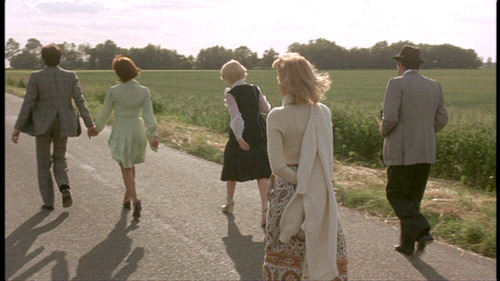
Bunuel’s direction is very entrancing from the repeated images of the people walking on a road in the middle of the French countryside to the intimacy he captures in the dinner scenes. Yet, he also plays up the surrealistic tone of the film by creating scenes where dreams are shot in a world that is artificial with fake backdrops intentionally shown. At the same time, Bunuel allows the camera to be engaging with some close-ups and wide shots to capture the world of the Senechal house as well as the places they go into such as the home of a colonel (Claude Pieplu). In scenes where there’s some expositions about the situations, Bunuel chooses to have strange sounds to cover all of that dialogue as if he doesn’t want to hear what they’re saying. Overall, Bunuel crafts an imaginative yet exhilarating film that is very funny and intriguing in its surrealism.
Cinematographer Edmond Richard does a wonderful job with the film‘s colorful cinematography from the gorgeous, naturalistic look of the daytime exterior scenes to the posh look of the interior scenes at night. Editor Helene Plemiannikov does a great job with the editing in creating a film with a leisured pace and straightforward cuts while playing along with its surrealist tone by utilizing stylistic cuts.
Art director Pierre Guffoy does an amazing job with the art direction from the home of the Senechals to the places they encounter. Notably the surrealistic sets that appears in dreams that play up the film’s idea of reality. Costume designer Jacqueline Guyot does a fantastic job with the closes, notably the dresses for two of the women in the film along with gowns for Simone that was created by Jean Patou. Sound mixer Jacques Carrere does an excellent job with the sound work from the intimacy of the dinner scenes to the chaos for some of the conversation as it blares over the dialogue.
The cast is definitely phenomenal as it features appearances from such Bunuel regulars as Marguerite Muni as a peasant woman and Michel Piccoli as a minister. Other notable small roles include George Douking as a dying gardener, Maria Gabriella Maione as the terrorist, Milena Vukotic as the Senechal’s maid, Claude Peiplu as a colonel, and Francois Maistre as an inspector. Another notable small but brilliant role is Julien Bertheau as a bishop who wants to be a gardener while revealing a story about his parents’ death. Bulle Ogier is excellent as the youthful yet intelligent Florence, the younger sister of Alice Thevenot who often feels like she’s not equal with everyone else because of her youth. Paul Frankeur is really good as Francois Thevenot, a man who is trying to get everyone to have dinners while trying to convince people to go to his place to eat his caviar.
Jean-Pierre Cassel is great as Henri Senechal, a man who also tries to get the dinners going while he is often more interested by having sex with his wife than having a gathering with his friends. Stephane Audran is wonderful as Henri’s wife Alice who often not ready for the party or trying to organize things while she befriends the bishop. Delphine Seyrig is brilliant as Simone Thevenot, Francois’s wife who is often trying to get the ladies to have some their own time together while having flirtatious moments with Rafael. Finally, there’s Fernando Rey in a fantastic performance as the ambassador Rafael Acosta who has a lot in his mind while wanting to have dinner and eat as he often engages in conversations with his friends.
Le charme discret de la bourgeoisie is a superb yet captivating film from Luis Bunuel. Featuring a great ensemble cast led by Fernando Rey and Delphine Seyrig, it is a film that plays with the idea of reality along with Bunuel’s fascination with surrealism. Among the films that Bunuel has done in his long yet glorious career, this film is truly among as one of his best. In the end, Le charme discret de la bourgeoisie is a mesmerizing yet intoxicating film from the late, great Luis Bunuel.
Luis Bunuel Films: Un Chien Andalou - L'Age d'Or - Land Without Bread - (Gran Casino) - (The Great Madcap) - Los Olvidados - (Susana) - (La hija de engano) - (Mexican Bus Ride) - (A Woman Without Love) - (El Bruto) - (El) - (Illusion Travels by Streetcar) - (Wuthering Heights (1954)) - Robinson Crusoe (1954) - (The Criminal Live of Archibaldo de la Cruz) - (El rio y la muerte) - (Cela S'apelle l'Aurore) - (Death in the Garden) - (Nazarin) - (La Fievre a El Pasao) - (The Young One) - Viridiana - The Exterminating Angel - Diary of a Chambermaid - Simon of the Desert - Belle de Jour - (The Milky Way) - Tristana - (The Phantom of Liberty) - (That Obscure Object of Desire)
© thevoid99 2011
Diary of a Chambermaid (1964 film)
Based on Octave Mirbeau’s 1900 novel, Le journal d’une femme de chambre (Diary of a Chambermaid) is the story of a chambermaid who becomes a servant for a family in rural France as she sees things that prompt her to use her sexuality for gain. For the 1964 adaptation directed by Luis Bunuel with an adapted script by Bunuel and his then-new collaborator Jean-Claude Carriere. Bunuel sets the story in 1939 France during a period of political unrest in France. Starring Jeanne Moreau, Georges Geret, Daniel Ivernel, and Michel Piccoli. Le journal d’une femme de chambre is an intriguing yet exhilarating drama from Luis Bunuel.
Celestine (Jeanne Moreau) is a Parisian woman in her 30s arriving in a rural town in France to work as a chambermaid for a rich family headed by the aging Monsieur Rabour (Jean Ozenne). His daughter (Francoise Lugagne) gives Celestine strict orders about what to do as Celestine learns about the family. Monsieur Monteil (Michel Piccoli) has an eye for Celestine as does Rabour who asks her to read to her and wear shoes for his enjoyment. Yet, Celestine still has to deal with Monteil, his wife, Rabour, and the gruff yet political groundskeeper Joseph (Georges Geret). Celestine chooses to continue with her work as she befriends the neighbor in the retired Captain Mauger (Daniel Ivernel) who despises Monteil.
With Celestine getting used to the tense world of the Monteil as she befriends a young girl named Claire (Dominique Sauvage) while having a hard time with Joseph. When she spends time with Rabour, she tries on some shoes for him to his excitement only for a couple of events to end this excitement. A murder has happened as Celestine has suspicions as she uses her sexuality to get a few answers. While she has also decided to stay to help out Monsieur and Madame Monteil, she also gets close with Mauger who gets involved with a lawsuit against Monteil. With Celestine finding out who possibly committed the murder, she finds a way out of being a servant to the rich.
The film is about a maid working for a rich family where things are very tense as she has to deal with a strict madam, a philandering man who likes to hunt, an aging master who has a fetish for women in leather shoes, and a groundskeeper who spouts political rhetoric. Yet, Celestine is a woman who is very beautiful and wears fine clothing as some wonder why a Parisian maid would work for a rich family in rural France? Well, she hopes to find someone who can help her give her a life without having to serve someone or be ridiculed. While she has to contend with Monsieur Monteil and Rabour along with Joseph. She does find some comfort in the elderly but honorable Mauger despite his suggestions to deal with Monteil.
The screenplay that Bunuel and Jean-Claude Carriere create is a wonderful character study that also a bit of sexual play into the film. At the same time, there’s some political elements in both Mauger and Joseph. The latter of which is very anti-Semitic, nationalist, and right-wing man who hates priests but loves religion as he hopes to have a café nearby this ongoing revolution against immigrants. Joseph is also a man who is very violent that makes him a likely suspect over what happened though he is not an easy person to peg since he can read people and often speaks the truth. Bunuel and Carriere play up this game of sexual politics between Celestine and Joseph while giving the idea of the home that Celestine works in as an idea of Fascist that some viewers might not understand.
Bunuel’s direction is truly mesmerizing in its imagery and composition. From the look of the town that he shoots in to the way he captures intimacy in the house that Celestine works in. Bunuel creates something that is very intoxicating along with shots to present something that is sexual but not too graphic. Notably a shot of Celestine showing Rabour a bit of leg in the leather shoes he wanted her to wear. There is also some wonderful shots such as close-ups and dollies that Bunuel brings into understand the behaviors and things that is happening throughout the film. While it has a few flaws, Bunuel does create something that is enriching and chilling in this provocative yet brilliant film.
Cinematographer Roger Fellous doe a wonderful job with the film‘s black-and-white cinematography to create a look that is a mix of the old-school cinema of the early 20th Century along with the more vibrant look of the French New Wave. Fellous also creates some wonderful lighting schemes with shades and nighttime shots to set an eerie mood for these particular scenes. Editor Louisette Hautecoeur does a great job with the editing while creating something that is very straightforward with a bit of style with some jump-cuts and transitional dissolves to keep the story moving.
Production and costume designer Georges Wakhevitch does an excellent job with the look of the film in creating a posh yet early 20th Century look to the home as well as the clothes the people wear. Notably the maid dress and stockings that Celestine wears to woo some of the men in the film. The sound work by Antoine Petitjean is very good for its intimate locations as well as the broad atmosphere of the town Celestine comes across in.
The cast is truly brilliant for the large ensemble that is assembled. Making small yet memorable appearances include co-screenwriter Jean-Claude Carriere as a priest, Claude Jaeger as a judge, Gilberte Geniat as Mauger’s maid, Marguerite Muni as the other maid that Celestine works with, and Dominique Sauvage as the little girl Claire. Francoise Lugagne is excellent as the strict yet icy Madame Monteil who likes to have things in her way while not giving her husband any kind of satisfaction. Jean Ozenne is really good as Rabour, Madame Monteil’s father who likes to keep things to himself while finding pleasure in Celestine wearing leather heels. Michel Piccoli is great as the skirt-chasing Monteil who wants Celestine while trying to deal with his wife and his neighbor.
Daniel Ivernel is brilliant as Captain Mauger, a former army officer who is a man of honor as he treats Celestine with kindness while having his own issues with Monteil whom he really dislikes. Georges Geret is superb as the brutish yet ambitious groundskeeper Joseph who engages into a battle of wit and sexual politics against Celestine while being a very political individual with some strong views. Finally, there’s Jeanne Moreau in a fantastic performance as the film’s protagonist Celestine. Moreau brings a very understated sexuality to her performance while being quite tough and not going overboard when she’s being harassed. It’s definitely one of her finest performances in a glorious career.
Le journal d’une femme de chambre is a phenomenal yet hypnotic film from Luis Bunuel featuring a radiant performance from the legendary Jeanne Moreau. While it is one of Bunuel’s finest films, some viewers might be lost in the satire that Bunuel is trying to say about Fascism while the sexual politics of the film makes it very engaging to watch. In the end, Le journal d’une femme de chambre is a fascinating character study from the revered Luis Bunuel.
Luis Bunuel Films: Un Chien Andalou - L'Age d'Or - Land Without Bread - (Gran Casino) - (The Great Madcap) - Los Olvidados - (Susana) - (La hija de engano) - (Mexican Bus Ride) - (A Woman Without Love) - (El Bruto) - (El) - (Illusion Travels by Streetcar) - (Wuthering Heights (1954)) - Robinson Crusoe (1954) - (The Criminal Live of Archibaldo de la Cruz) - (El rio y la muerte) - (Cela S'apelle l'Aurore) - (Death in the Garden) - (Nazarin) - (La Fievre a El Pasao) - (The Young One) - Viridiana - The Exterminating Angel - Simon of the Desert - (Belle de Jour) - (The Milky Way) - Tristana - The Discreet Charm of the Bourgeoisie - (The Phantom of Liberty) - (That Obscure Object of Desire)
© thevoid99 2011
Subscribe to:
Posts (Atom)


_arc.jpg)