Showing posts with label yves montand. Show all posts

Sunday, November 20, 2022

Tout va bien


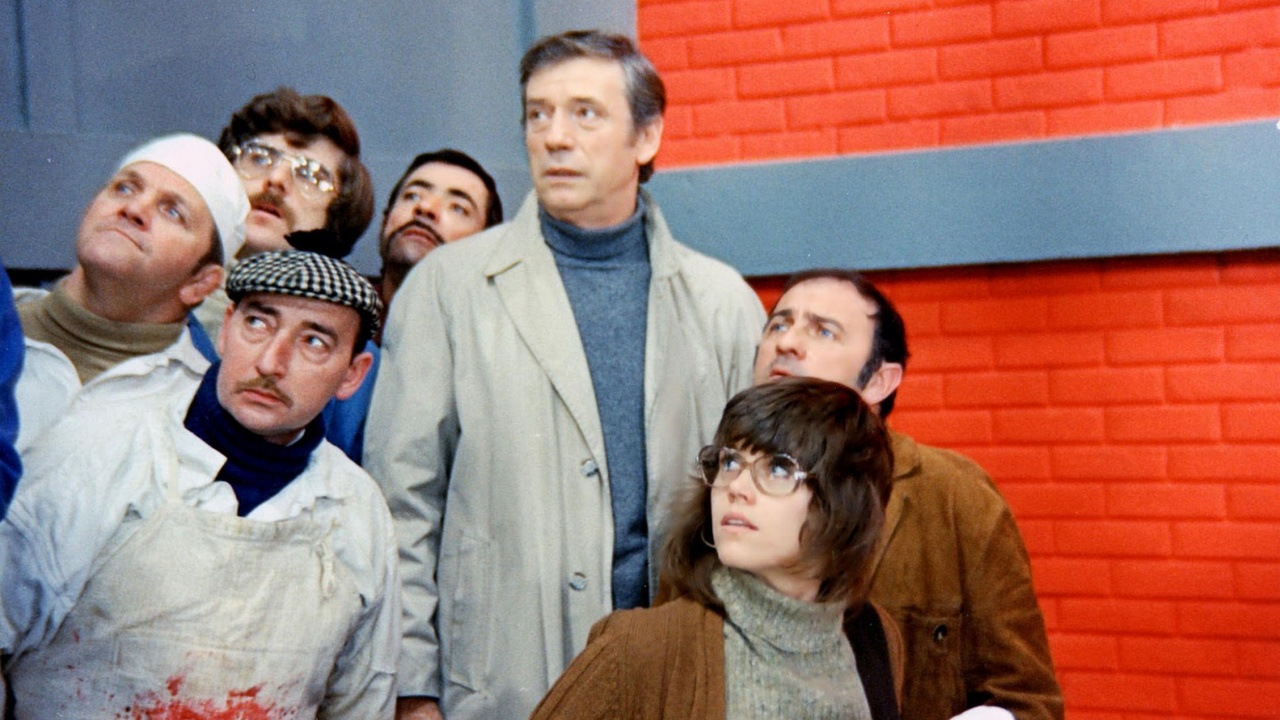
Written and directed by Jean-Luc Godard and Jean-Pierre Gorin, Tout va bien (Everything’s All Right) is the story of an American reporter and her has-been French New Wave filmmaker husband who go to a sausage factory to report on a strike that is happening. The film is an exploration of two people capturing a strike that is happening as it play into the events of May of ’68 in France as well as the many fallacies of revolutions in the aftermath of that event. Starring Jane Fonda, Yves Montand, and Vittorio Caprioli. Tout va bien is an intriguing though messy film from Jean-Luc Godard and Jean-Pierre Gorin.

Set four years after the chaotic events of May of ’68 in France, the film revolves around a has-been filmmaker and his American reporter wife who go to a sausage factory where it has been taken over by the workers as they’re locked inside the manager’s office with the manager. It is a film that explore this air of social and political chaos that is emerging in a factory with leftist workers trying to get better wages and such as they would humiliate the factory manager to show the shit they had to endure from him. The film’s screenplay doesn’t really have a straightforward narrative as much of its first two acts is set largely in the factory with glimpses of life outside of the factory for the filmmaker Jacques (Yves Montand) and his American wife Suzanne (Jane Fonda) in their occupations and married life. Even as they are locked in an office with the factory manager (Vittorio Caprioli) as there are scenes where there is narration as it play into what is going on with characters talking about their political and social situations.

The film’s direction from Jean-Luc Godard and Jean-Pierre Gorin is stylish in not just mixing documentary filmmaking style with a narrative style as there are scenes in the factory where it is shot inside a studio set. Notably as there’s this wide tracking dolly-shot where Godard and Gorin shoot the entire factory set from room to room as it plays into the sense of chaos but also people trying to figure out what to do next. There are also close-ups and medium shots that occur including a close-up in which a young woman (Anne Wiazemsky) talks about the demands of the workers but also a lot of fallacies into Leftist views as they would want more and more in a largely-capitalist society.

The direction also has these elements that play into these moments of chaos as it relates to the struggles of the working class and their disdain for the bourgeoisie through these brief breaks from the narrative yet the third act when Jacques and Suzanne are released from the factory is where things become really uneven. Notably as it play into what Jacques and Suzanne are doing and the compromises they make as it feels like it is part of something else with a scene late in the film in which Suzanne is in a market where it is this commentary on capitalism but there’s a man spouting communist rhetoric in the middle of the market while a bunch of young people are running around and announcing that everything in the market is free with police coming in to stop the chaos. It is a moment that is entrancing visually but its message into these clashing ideals ends up being all about nothing as it showcases the many fallacies of political ideals while it’s ending is really a non-ending in which the narrator speaks with a woman about how to end the film. Overall, Godard and Gorin craft a fascinating but uneven film about a filmmaker and his reporter wife trying to understand the social and political chaos inside a sausage factory.

Cinematographer Armand Marco does brilliant work with the film’s editing as it is largely straightforward to play into the film’s documentary-like tone but also with some vibrant colors for the interior scenes inside the factory. Editors Claudine Merlin and Kenout Peltier do terrific work with the editing as it has some jump-cuts to play into some the action and chaos while much of it is straightforward for some of the long shots in the film. Production designer Jacques Dugied does amazing work with the look of the interiors of the factory with great attention to detail in its stage-like setting. The special effects by Jean-Claude Dolbert and Paul Trielli do wonderful work with some of the film’s minimal effects as it play into the sets but also in the work that Jacques does. The sound work of Antoine Bonfanti and Bernard Ortion is superb as it is largely straightforward in the atmosphere of the factory and in the occupations that Jacques and Suzanne have in their lives.

The film’s excellent ensemble cast feature small roles from Eric Chartier, Castel Casti, Elizabeth Chauvin, and Hughette Mieville as factory employees rebelling against their boss, Louis Bugette as an old employee who talks about the conditions in the factory, Pierre Oudrey as a man working for the workers in getting their demands, Anne Wiazemsky as a Leftist woman talking in a monologue about the fallacies of the workers’ demands, and Vittorio Caprioli as the factory owner who is annoyed by the negotiation tactics as well as the humiliation of enduring the troubling working conditions his employees had to endure.

Yves Montand is brilliant as Jacques as a once-revered filmmaker who does commercials for a living who goes to the factory to help his wife’s report where he is later troubled by his experience as well as his disillusionment with politics. Finally, there’s Jane Fonda in an incredible performance as Suzanne as an American reporter working for an American company in France who goes to this factory as she finds herself siding with the workers but feels compromised by the people she works for while also dealing with her own marital issues as she copes with the chaos around her but also in her own life.

Tout va bien is a superb film from Jean-Luc Godard and Jean-Pierre Gorin. While it does a messy and uneven narrative with political commentary that is all over the place. It is still a fascinating film that explore the lessons learned and unlearned following the events of May ’68 as well as being a film that explore a certain period in Godard’s career that had him stray away from narrative-based films. In the end, Tout va bien is a terrific yet flawed film from Jean-Luc Godard and Jean-Pierre Gorin.

Jean-Luc Godard Films: All the Boys are Called Patrick - Charlotte et son Jules - A Bout de Souffle - The Little Soldier - A Woman is a Woman - Vivre sa Vie - Les Carabiniers - Contempt - Bande a Part - A Married Woman - Alphaville - Pierrot le fou - Masculin Feminin - Made in U.S.A. - Two or Three Things I Know About Her - La ChinoiseWeekend (1967 film) - Sympathy for the Devil (One Plus One) - (Joy of Learning) - (British Sounds) - (Letter to Jane) - (One A.M.) - (Number Two) - (Here and Elsewhere) - (Every Man for Himself) - (Passion) - (First Name: Carmen) - Hail, Mary - (Soft and Hard) - (Detective) - (King Lear (1987 film)) - (Keep Your Right Up) - (Nouvelle Vague) - (Allemagne 90 neuf zero) - (JLG/JLG - Self-Portrait in December) - For Ever Mozart - (Historie(s) de Cinema) - (In Praise of Love) - (Notre musique) - (Film Socialisme) - (Adieu au Language) – (The Image Book)

© thevoid99 2022

Monday, November 13, 2017

Le Cercle Rouge


Written and directed by Jean-Pierre Melville, Le cercle rouge (The Red Circle) is the story of a master thief who meets a prison escapee and a former cop where they team up for a heist as they deal with an inspector. The film is a study of three men planning a heist to ensure that everything goes exactly as planned while they’re being pursued by a police investigator. Starring Alain Delon, Gian Maria Volonte, Yves Montand, and Andre Bourvil. Le cercle rouge is a ravishing and intoxicating film from Jean-Pierre Melville.

The film follows two different criminals who meet as they team up for a heist with a former cop while one of the criminals is being pursued by a police investigator who was accompanying him to prison. It’s a film that play into men who are trying to pursue one another or flee from someone as its title refers to that place where everyone comes together through some form of destiny. Jean-Pierre Melville’s screenplay opens with these two paralleling narratives into these two criminals in the thief Corey (Alain Delon) and a prisoner named Vogel (Gian Maria Volonte) as the former is being released from prison while the latter makes an escape on a train as a manhunt would follow led by Inspector Mattei (Andre Bourvil) who was accompanying Vogel. Corey would go on the run after robbing a former associate and be involved in a scuffle with that associate’s goons as he discovers that Vogel had hidden himself in the trunk of his new car.

The two would learn about their respective situations as Corey has some vital information about a robbery he wants to do as Vogel knows a former cop named Jansen (Yves Montand) who is an expert marksman that is dealing with alcoholism. While Corey and Vogel plan the robbery with Jansen scoping out everything in this posh jewelry store, Inspector Mattei is in pursuit of Vogel as he tries to figure out how to capture him alive as he would encounter a series of mysteries that Vogel is involved in. Even as he would delve into the crime underworld to get what he wants while straying away from being corrupted as he had seen a lot of people in the force succumb to vices.

Melville’s direction definitely has some stylistic scenery in the way he captures the idea of a heist film though much of his compositions are straightforward. Shot on various locations in France including parts of Paris, the film does play into this idea of characters meeting as if it was destiny as much of the first act is about Inspector Mattei’s pursuit of Vogel and Corey on the run from people in the criminal underworld. Melville’s approach to compositions has him focusing on the scope of the locations with the wide shots in Vogel running from the authorities and how he would meet Corey through accidental means with Corey unaware that Vogel hid in the trunk of his car. The usage of close-ups and medium shots that play into the suspense as well as Vogel and Corey’s first meeting as Melville would create shots that are simple to establish who they are as well as the need to make a big score. The introduction of Jansen is surreal as it plays into his alcoholism where he would see all of these animals coming into his home as it is a key moment in the second act.

One notable sequence during the second act is where Jansen goes to the jewelry shop as it’s about the room where all of the jewels are on display and what is in the room. The attention to detail as well as the geography of where the cameras might be as well as a lock for what might be a vault is shown through wide and medium shots as Melville gives the audience an idea of what has to be done. The heist sequence itself is definitely the highlight of the film as it’s this long sequence that goes on for nearly 30 minutes as it about what these three men would do and the role they would play. It is paced slowly but it’s crucial to show how meticulous these three men are in making sure everything goes right as there is barely a word said throughout. The aftermath is filled with thrills as it play into Inspector Mattei trying to find Vogel as well as the men who robbed the jewelry store as its climax is about Mattei trying to set a trap. Overall, Melville crafts a riveting and evocative film about three men planning a jewelry heist as they’re being pursued by the criminal underworld and a determined police investigator.

Cinematographer Henri Decae does brilliant work with the film’s cinematography with its natural yet grey exteriors to play into the cold weather for the rural locations as well as the usage of lights for some of the scenes at night including the bright and extravagant look at the nightclub scenes. Editor Marie-Sophie Dubus does amazing work with the editing as it is stylized with usage of jump-cuts, transition wipes, and other rhythmic cuts to play into the suspense and the drama. Production designer Theo Meurisse and set decorator Pierre Charron do excellent work with the look of the dusted apartment where Corey and Vogel hide out as well as the rooms in the police station and at the nightclub where one of Vogel’s old friends run.

The costumes of Colette Bardot are fantastic as it is mainly straightforward with many of the men wearing suits while there’s some stylish clothing for the dancers at the nightclub. The sound work of Jean Neny is superb for the atmosphere of the nightclub as well as the sparse usage of low-key sounds for the heist sequence. The film’s music by Eric Demarsan is terrific as it’s a mixture of jazz and orchestral music that is used sparingly during the course of the film with bits appearing during the heist.

The film’s incredible cast feature some notable small roles from Francois Perier as Vogel’s old contact Santi who runs a nightclub, Pierre Collet as a prison guard that Corey befriends early in the film, Andre Eykan as Corey’s old associate Rico whom he robs, and Paul Amiot as the police chief who is suspicious towards Inspector Mattei over his methods. Yves Montand is brilliant as Jansen as a former cop who is struggling with his alcoholism as he is asked by Corey to work with him and Vogel where he would unveil his true sense of professionalism when being sober as well as someone who is always looking out at anything he see that could go wrong. Gian Maria Volonte is amazing as Vogel as an escape convict who is trying to evade Inspector Mattei where he teams up with Corey while maintaining a low profile in his role for the heist.

Andre Bourvil is phenomenal as Inspector Mattei as a man who is trying to pursue Vogel and investigate other crimes as he’s an unconventional inspector that has methods where he can get the job done but he’s also a man of justice. Finally, there’s Alain Delon in a sensational performance as Corey as a master thief who has been released from prison who gets a tip about a place that is for a job where he tries to ensure that nothing goes wrong while befriending Vogel and Jansen as it’s an understated performance from Delon.

Le cercle rouge is a magnificent film from Jean-Pierre Melville. Featuring a great cast, gorgeous visuals, an engaging story, and inventive sequences that play into the meticulous nature of a heist. It’s a film that explores men trying to create the ultimate heist without incident unaware of the meeting they will have with the man trying to pursue them in this unlikely form of destiny. In the end, Le cercle rouge is a tremendous film from Jean-Pierre Melville.

Jean-Pierre Melville: 24 Hours in the Life of a ClownLe silence de la mer - Les enfants terribles - (Quand tu liras cette letter) - Bob le flambeur - (Two Men in Manhattan) – (Leon Morin, Priest) – (Le Doulos) – Magnet of DoomLe deuxieme soufflĂ©Le samourai - Army of Shadows - (Un flic)

© thevoid99 2017

Tuesday, September 05, 2017

The Confession (1970 film)


Based on the book by Artur London and Lise London, L’aveu (The Confession) is the real-life story of Artur London who had been abducted, interrogated, and imprisoned during a series of trials by the Soviet Union. Directed by Costa-Gavras and screenplay by Jean Semprun, the film is a political thriller that explore the Soviet Eastern bloc show trials and the troubled journey that London took as he is played by Yves Montand. Also starring Simone Signoret, Gabriele Ferzetti, Michel Vitold, and Jean Bouise. L’aveu is an eerie yet gripping film from Costa-Gavras.

Set from 1951 Czechoslovakia to the day the Soviet Union invaded Prague on August 21, 1968, the film is about Artur London’s arrest for claims that he had betrayed the communist party in his country where he would be abused and interrogated forcing him to confess his actions. Told largely as a flashback where London is telling his story to a couple of journalists in France in 1965, the film’s screenplay by Jean Semprun doesn’t reveal this twist until the beginning of the second act as it’s more about the events that lead to London’s arrest and his time in prison where he is given unconventional methods of torture to confess as he would reveal things where some of it featured some truth as well as time with a man who is revealed to be an American spy. It’s a script that is presented in a very unconventional manner as there’s flashbacks and voice-over dialogue present throughout London’s interrogations and torture as he would tell them to journalists.

The film’s second half would also introduce to the man who would be London’s interrogator in Kohoutek (Gabriele Ferzetti) as he would get answers as it is all part of big public trial for London and several others accused of betrayal. Even as London’s wife Lise (Simone Signoret) is trying to get him out of prison but is conflicted due to wanting to not get in trouble with the communist party as she ends up making a decision that would impact her greatly. The film’s third act is about the trial and its aftermath as well as the 11 who would be executed including the man that gave London and 12 other colleagues in trouble with the Soviet Union.

Costa-Gavras’ direction is definitely engaging for the way he opens the film with London noticing he’s being followed and watch as he does his usual day-to-day activities as it builds up the suspense very slowly. Shot mainly in France as Czechoslovakia for some of the exteriors, the film spends much of its time inside the prisons where London has no clue where he’s at or what time it is as he’s often blindfolded or wearing glasses that block his vision. While there’s a few wide shots in the film, much of Costa-Gavras’ direction involve more intimate shots with the usage of medium shots to capture the space of the jail cells, the interrogation rooms, and other rooms in the prison where it can be claustrophobic at times. Still, Costa-Gavras maintains an air of intrigue throughout the course of the film during these interrogations where the methods are torturous as it’s not just physical but also mental. By the time Kohoutek enters the film, it definitely become a game of wits with Kohoutek trying to gather everything he can from London as there is a sense of repetition in what London has to say for the public trials.

There are some wide shots in the trial sequence as it include a moment of humor to play into the grandness of what is happening. The scenes set in 1965 at the South of France are much simpler as well as the scenes in the aftermath as it’s more about what London had been through and what he would see happen to his home country. Especially when he’s forced to see the fallacy of what the communist movement was all about and the accusations he had been given over his loyalty to the party. Overall, Costa-Gavras creates a very captivating and unsettling film about a man being forced to confess for crimes and such he probably didn’t commit.

Cinematographer Raoul Coutard does brilliant work with the film’s cinematography as its usage of low-key lights for the scenes in the prisons as well as the lack of sunlight for some of the exteriors, with the exception of the scenes at the south of France, to play into the grimy world of Czechoslovakia. Editor Francoise Bonnot does excellent work with the editing as it’s very stylized with its jump-cuts, slow-motion cuts, and some montages to play into the drama and suspense. Production designer Bernard Evein does amazing work with the look of the prison cells, the courtroom, and other places that play into this cold world of Communist Czechoslovakia. The sound work of William Robert Sivel is superb for capturing the atmosphere of the prisons as well as the way some of the sounds of the torture devices are presented. The film’s music by Giovanni Fusco is fantastic for its sparse yet eerie score filled with dissonant strings and keyboards to play into the melancholic elements of the film.

The film’s terrific cast features a large ensemble that include Jean Bouise as a factory boss and Michel Vitold as a communist party official. Gabriele Ferzetti is incredible as Kohoutek as an interrogator for the Soviets who would use unconventional methods to get London to sign documents and reveal things as it is a very restrained performance from Ferzetti who doesn’t get mad but knows what to do when he’s pushed. Simone Signoret is amazing as Lise London as London’s French wife who is concerned about her husband but is also aware of what she has to do to avoid prison time as she is forced to make some serious sacrifices. Finally, there’s Yves Montand in a tremendous performance as Artur London as a vice-minister of foreign affairs for Czechoslovakia who is accused of treason as he wonders what he’s done as it’s a very demanding performance that require a lot of physicality as it’s one of Montand’s finest performances.

L’aveu is a phenomenal film from Costa-Gavras that features top-notch performances from Yves Montand, Simone Signoret, and Gabriele Ferzetti. Along with its eerie visuals and intense look into the Soviet show trials, it’s a political thriller that showcases what a man would endure to answer questions he has no answers for as well as a look into a dark period of time in Eastern Europe where the Soviets would question its most die-hard loyalists. In the end, L’aveu is a sensational film from Costa-Gavras.

Costa-Gavras Films: (The Sleeping Car Murders) – (Shock Troops) – Z - (State of Siege) – (Special Section) – (Womanlight) – Missing (1982 film) - (Hanna K.) – (Family Business) – (Betrayed (1988 film)) – (Music Box) – (The Little Apocalypse) – (Mad City) – (Amen.) – (Le Couperet) – (Eden is West)

© thevoid99 2017

Friday, May 17, 2013

2013 Cannes Marathon: Z


(Winner of the Jury Prize & Best Actor Prize to Jean-Louis Trintignant at the 1969 Cannes Film Festival)


Based on the novel by Vassilis Vassilikos, Z is a loosely-based story on the assassination of Greek left-wing activist Gregoris Lambrakis as a murder is covered up by the government prompting a magistrate to finally uncover the truth. Directed by Costa-Gavras and screenplay by Costa-Gavras and Jorge Semprun, the film is a political thriller set during a tense period of civil unrest as well as exploring a world that is in absolute chaos. Starring Jean-Louis Trintignant, Yves Montand, Irene Papas, and Jacques Perrin. Z is a provocative yet intriguing film from Costa-Garvas.

The film is a look into the assassination of a left-wing activist (Yves Montand) who is assassinated during a troubling period in Greece as many around him question about the murder. A government magistrate (Jean-Louis Trintignant) leads the investigation where he uncovers a lot of unsettling things including secret government extremist groups and other things as witnesses to the incident are being targeted as well. It’s all part of a world in which a government is trying to protect themselves from scandal that would ruin the reputation of this country yet a magistrate begins to learn that not only is he working for the bad guys but that the people he’s working for are committing atrocities that forces him to try and do the right thing.

The screenplay has a very unique structure that is traditional but is more about the element of suspense that occurs. The first is about this left-wing activist who arrives to find a place to hold a meeting and on that night of the meeting, he is attacked by mysterious men and eventually given a fatal hit in the head with a club as his personnel try to help him. The second act is about the government covering up while a photojournalist (Jacques Perrin) is trying to conduct his own investigation as he meets up with the activist’s wife (Irene Papas) who ravaged with grief and confusion over what happened. The third act relates to the magistrate’s investigation as well as his own discoveries with the help of the photojournalist about this secret group of right-wing extremists and the people they’re targeting.

It’s not just the structure and the dialogue that makes the screenplay interesting but also the characters as the activist is a man who wants to ensure a world that can be peaceful as he is a major threat to this right-wing, military-driven government. The activist is also a flawed man who is going through his own personal issues relating to his wife as once she arrives following the assassination, she is upset by what happened but also display mixed feelings over what happened. The magistrate is a man who lurks in the shadow for most of the film’s first two acts as he finally comes to his own in the third act as he talks to a few witnesses and doctors where he eventually comes to the conclusion that what happened was a murder as he starts to look towards the people he’s working for.

Costa-Gavras’ direction is very engaging for the way he captures a world of civil unrest in one of the most crucial periods in Greek history. Though it was shot in France and parts of Algeria while the language is spoken in French. The direction still has this element that an incident like this could happen anywhere in Europe where a lot of social changes are happening. There is an element of cinema verite in the way the direction is played out for the protest scenes as well as the assassination scene.

There is also some very entrancing compositions and stylistic shots for some of the film’s drama and suspenseful moments where Costa-Gavras aims for something that adds an air of mystery. The film also features some very intriguing ideas about the world at large as well as an epilogue that is really more in tune with how hard it is to change the world. Overall, Costa-Garvas creates a very intense yet chilling film about government conspiracy and one man’s attempt to do things right in a troubling world.

Cinematographer Raoul Coutard does amazing work with the film‘s photography from the sunny exteriors of the locations to more stylish lights for the scenes in night in its interior and exterior settings to create some dark moods for the film. Editor Francoise Bonnot does brilliant work with the editing as it‘s very stylized with jump-cuts and some flashback montages as it is truly a highlight of the film. Production designer Jacques D’Ovidio does excellent work with the set pieces such as the film‘s hospital operating room as well as the scenes in the hotel and halls where some of the protestors meet.

Costume designer Piet Bolscher does nice work with the costumes as it is a mixture of casual clothing along with military uniforms to present the military men. Sound editor Michele Boehm does terrific work with the sound to capture the atmosphere of the protests and meetings as well as some eerie moments in some of the film‘s intimate moments. The film’s music by Mikis Theodorakis is fantastic for its mixture of intense Greek folk music with its string instruments to some bits of rock music as it helps create a chilling mood for the film as it’s another highlight of the film.

The film’s cast is superb as it features some notable small performances from Georges Geret as a witness got attacked, Magali Noel as that witness’ right-wing sister, Marcel Bozzuffi and Renato Salvatori as two assassins, Francois Perier as the public prosecutor, Clotilde Janno as a personnel of the activist, Charles Denner as the activist’s lawyer Manuel, and Pierre Dux as the general whom the magistrate suspects. Jacques Perrin is excellent as a determined photojournalist seeking to show the truth in any way or form as he hopes to do things right. Irene Papas is wonderful as the activist’s wife Helene who is trying to come to terms with her loss as well as all of her feelings towards her husband. Yves Montand is great in a small yet memorable performance as the activist trying to create peace in a period of civil unrest while eager to do things right for everyone including his family. Finally, there’s Jean-Louis Trintignant in an incredible performance as the magistrate as a man who starts off as an observer and then becoming someone trying to do what is right as he is aware of the consequences that he might face.

Z is a phenomenal film from Costa-Gavras that features brilliant performances from Jean-Louis Tringtignant and Yves Montand. The film is a masterfully-crafted thriller that explores the world of government cover-ups and conspiracies as well as a look into one of the most chaotic periods in the history of the world. In the end, Z is a remarkable film from Costa-Gavras.

Costa-Gavras Films: (The Sleeping Car Murders) - (Shock Troops) - The Confession (1970 film) - (State of Siege) - (Special Section) - (Womanlight) - Missing (1982 film) - (Hanna K.) - (Family Business (1986 film)) - (Betrayed) - (Music Box) - (The Little Apocalypse) - (Mad City) - (Amen.) - (Le Couperet) - (Eden is West) - (Le Capital)

© thevoid99 2013

Monday, October 01, 2012

Manon des Sources


Based on Marcel Pagnol’s novel, Manon des Sources (Manon of the Spring) is the sequel to Jean de Florette in which the daughter of Jean de Florette seeks revenge for what happened to her father many years earlier as the Soubeyran land starts to become more valuable. Directed by Claude Berri and screenplay by Berri and Gerard Brach, the film explores the world of greed but also consequences in the fates of the Soubeyran as both Yves Montand and Daniel Autieul reprise their respective roles as Cesar and Ugolin Soubeyran. Also starring Emmanuelle Beart and Hippolyte Girardot. Manon des Sources is a complex yet compelling drama from Claude Berri.

More than a decade after buying the Florette land, Cesar and Ugolin Soubeyran are basking in their success over Ugolin’s carnation farm that has made them rich. With Cesar already growing old, he asks Ugolin to find a wife to that the Soubeyran empire can continue. While trekking around the hills, Ugolin catches a glimpse of Jean Cadoret’s daughter Manon (Emmanuelle Beart) who has become a goat herder as she lives with her Italian guardian Baptistine (Margarita Lozano). Ugolin tries to pursue yet Manon has become interested in the young schoolteacher Bernard Oliver (Hippolyte Girardot) who was in the hills collecting rocks. Ugolin makes an attempt to pursue Manon by professing his love to her but she refuses to respond.

On one day while herding the goats, Manon overhears a couple of villagers who reveal about their own guilt over knowing about the spring that could’ve helped Jean Cadoret years ago. Devastated by what she learned, Manon decides to seek revenge as one of her goats while herding has found the underground source for the village spring. In her act against the Soubeyran, Manon decides to dam the spring leading a water shortage as the town panics. After a church gathering where the whole town and Manon attends, the villagers admit their guilt over their treatment to Jean Cadoret as Manon publicly accuses the Soubeyrans over what they did to her father. Even worse is when a poacher finally reveals what he had seen years ago as it leads to an outcry of shame and guilt over all that had happened as the village learns some harsh truths.

In the aftermath of these revelations, Cesar deals with the shame he faces from the village as they hold a procession to get the water back. When an old friend of his in Delphine (Yvonne Gamy) returns to the village, she reveals to Cesar some news that would consume him with guilt as he tries to find redemption for his actions.

The film is an exploration on not just greed and deception but also guilt and redemption where it is all driven by an act of revenge over what happened in Jean de Florette. What the Soubeyrans did was cruel as they are hoping to become rich and be lauded by the village in hopes to make sure their name remains powerful and respected by the community. Even the villagers know about what really happened yet couldn’t admit to facing their guilt in front of Manon. When Manon learns about what really happened to her father, she is driven by revenge over her the loss of her father as she hopes to make the village and the Soubeyrans suffer for their actions. This would eventually cause some locals to finally confess their actions including a mysterious poacher who knew what really happened. Guilt finally emerges in the Soubeyrans as it would lead to not just tragedy but also revelations that goes beyond everything that Cesar Soubeyran had wanted.

The screenplay is more structured than its predecessor as well as being more engrossed in its themes. Notably as it revolves around guilt in the film’s second half where Ugolin finally admits to Manon about his actions and begs for forgiveness. There are no flashbacks in the story as it’s really isn’t needed in order to let the audience reflect on the events that had happened in the previous film. It’s through dialogue and character motivations that let the audience reflect on those past events. While the first half is more loose in its structure in order to establish the characters and what they’re doing, the second half is more dramatic where it reveals a lot about the past and Manon’s motivations. The third act doesn’t just contain elements of tragedy but also shocking revelations that would send Cesar Soubeyran to the edge as he becomes consumed with guilt and regret as he would make an attempt to redeem himself.

Claude Berri’s direction is entrancing for the compositions he creates as he definitely takes on some more stylish compositions to capture the beautiful locations in the hills and mountains. There’s also more intimate shots in scenes at the town and in some of the close-ups that Berri creates. Notably in moments such as the town meeting where there’s a lot of chaos goes on while the events after the meeting show a town just in a state of absolute panic. By the time the film reaches the third act, Berri goes into less stylish camera work to establish the sense of loss that is happening around Cesar as he deals with not just guilt but also the shocking news that he receives. Even with the film’s ending that is very poignant for all of the troubles and tribulations that happen as Cesar seeks redemption. Overall, Berri creates a fascinating yet mesmerizing portrait of guilt and redemption.

Cinematographer Bruno Nuytten does fantastic work with the colorful cinematography from the naturalistic look of the sunny locations to the array of lush lighting schemes for many of the film‘s nighttime interiors including the cave where Manon finds the underground spring source. Editors Herve de Luze and Genevieve Louveau do wonderful work with the editing by creating some nice rhythm for some of the film‘s suspenseful moments while using fade-outs to help flesh out the film‘s structure. Production designer Bernard Vezat does nice work with the set pieces such as the carnations garden that Ugolin has as well as the look of the underground spring source that Manon finds.

Costume designer Sylvie Gautrelet does amazing work with the costumes from the more posh clothing the Soubeyran men wear to the more mountain dresses that Manon wears early in the film. Sound editors Dominique Hennequin and Maryline Monthieux do terrific work with the sound to capture the intimacy of the church scenes to the chaos in the town meeting. The film’s music by Jean-Claude Petit is lovely for its playful orchestral score that ranges from fun to more serious and darker arrangements along with the use of Giuseppe Verdi’s La forza del destino to help play to the sense of loss that Manon deals with.

The casting by Marie-Christine Lafosse is brilliant for the ensemble that is created as it features some notable small appearances from Elisabeth Depardieu in a cameo as Manon’s mother Aimee, Yvonne Gamy as Delphine, and Margarita Lozano as Manon’s Italian guardian Baptistine. Hippolyte Girardot is very good as the kind teacher Bernard who befriends Manon as he becomes the one true friend that she has in town. Emmanuelle Beart is tremendous as Manon as she displays a great sense of enthusiasm and heartbreak into her role as well as a great sense of physicality since she doesn’t have a lot of lines to say.

Daniel Autieul is superb as Ugolin as he displays a wonderful sense of humor to his performance in the film’s first half as well as a sense of humility in the second half. Finally, there’s Yves Montand in an incredible performance as Cesar Soubeyran as he displays a man trying to defend himself against the crimes he had done only to realize that he committed a much bigger crime that forces him to seek redemption where Montand displays something unforgettable in the film’s final moments.

Manon des Sources is a remarkable film from Claude Berri that features marvelous performances from Yves Montand, Daniel Autieul, and Emmanuelle Beart. The film definitely stands as an intriguing piece on revenge, guilt, and redemption while it makes for a great double-feature with its predecessor in Jean de Florette. In the end, Manon des Sources is a ravishing yet endearing film from Claude Berri.

Claude Berri Films: (The Chicken) - (The Two of Us) - (So Long, Stooge) - Jean de Florette - (Uranus) - (Germinal) - (Lucie Aubrac) - (Hunting and Gathering)

© thevoid99 2012

Jean de Florette


Based on Marcel Pagnol’s novel, Jean de Florette is the story about two men who try to trick a man over the land he had just inherited. Directed by Claude Berri and screenplay by Berri and Gerard Brach, the film explores the world of rural France after World War I as it explores the cruelty of men in their greedy desire for land. Starring Gerard Depardieu, Yves Montand, and Daniel Auteuil. Jean de Florette is a captivating film from Claude Berri.

Returning from military service to the small village of Provence, Ugolin Soubeyran (Daniel Auteuil) arrives at the farmland that is owned by his uncle Cesar (Yves Montand) as he presents his uncle with a profitable idea. Bringing in some carnation roots to grow where he manages to sell them for a good price, the two realize that the only way to make more money is to get the land nearby that is owned by a man named Pique-Bouffigue (Marcel Champel). When he refuses as he insults the Soubeyran family name, Cesar fights Pique-Bouffigue that leaves him dead. For Cesar, he hopes that relatives will sell the land so he can buy it off only to learn that Pique-Bouffigue’s nephew Jean (Gerard Depardieu) has inherited the land as he brings his wife Aimee (Elisabeth Depardieu) and their daughter Manon (Ernestine Mazurowna) to the land.

Having already blocked the water spring near the land, Cesar devises for Ugolin to befriend Jean and his family as Ugolin learn of Jean’s plans for the land. With plans to breed rabbits and grow vegetables in the land, Jean hopes to make a profit for the next few years. The only problem is that they don’t have lot of water in the land as they trek down a place owned by an Italian couple who have access to the water spring. Though things start off well at first despite the lack of water in their well, things eventually go bad due to a heat wave as Jean and his family force to trek downhill very often to get water which is bad for Jean’s humpback. After some trials and tribulations which makes Cesar excited, Ugolin goes to Jean’s land where he learns about another plan for Jean to get water for his land. What would happen would have some repercussions for all involved.

What happens when a couple of men conspire to gain a plot of land for their own reasons when they contend with a man from the city who has more honorable plans of his own? That is the idea of this story as it involves a man and his uncle hoping to use this land for their own ideas as they know about a secret water spring that they hope to use to help grow their carnations. After accidentally killing the land’s original owner where they hope to buy it from relatives, all of that changes when it is inherited by that man’s nephew who is this city tax collector hoping to start a new life as a farmer. This would force a man and his uncle to do things to make sure this man fails in his endeavors and get the land any way they can.

The screenplay explores the world of greed and cruelty in the hands of these two men though the character of Ugolin is the one who later becomes conflicted in his role to befriend Jean. In fact, he realizes that Jean isn’t a bad man yet Ugolin couldn’t be too friendly as he often makes excuses to not lend Jean his mule so that Jean can carry lots of water for his well. Then there’s Jean as he’s just a man wanting to start a new life where he can live comfortably as a farmer with his family. Yet, he’s an outsider to this small village who are suspicious of his intentions when he really just wants to be part of their community. He’s also a spiritual man as he prays to God for small things including rain for his crops. What would happen would push Jean to the edge as he becomes more desperate to cling on to the land that his mother was born in.

Claude Berri’s direction is definitely mesmerizing for the way he presents the film as this intimate period piece with gorgeous wide shots of the locations. He also set up shots that would later establish key moments that would become more important as the story progresses. Berri also maintains an intimacy with some close-ups and unique camera angles to help say something in these images as he’s always wanting to see how Jean would succeed as well as create tense moments where Jean is failing. Berri also maintains an air of suspense to see what will happen as the film’s third act explores Jean’s failures but also his desire to not quit. What would happen would lead to an ending that would set the course for the next part of the story in Manon des Sources. Overall, Berri creates an exhilarating yet poignant story of greed and humanity.

Cinematographer Bruno Nuytten does brilliant work with the cinematography from the gorgeous, naturalistic camera work of the exterior locations to the intimate lighting in the film‘s interiors along with a lovely sepia-awash look for the dust-wind scene. Editors Noelle Boisson, Sophie Coussein, Herve de Luze, Jeanne Kef, Arlette Langmann, Corinne Lazare, and Catherine Serris do terrific work with the editing by creating some wonderful montages and using other stylish cuts to help move the film‘s structure and transitions. Production designer Bernard Vezat does excellent work with the set pieces such as the farms of the Soubeyran land as well as the wonderful farm land that Jean had set up.

Costume designer Sylvie Gautrelet does nice work with the period costumes from the rich clothes that Jean wears to the more rural clothes that everyone else wears. Sound editor Eric Mauer does superb work with the sound from the atmosphere of the exterior locations to some of the chaos in the bars that Cesar hangs out at. The music by Jean-Claude Petit is wonderful for its soaring orchestral score that plays out all of the drama and light-hearted moments of the film while the music also features excerpts from Giuseppe Verdi’s La forza del destino for more dramatic moments of the film.

The film’s cast is amazing for the ensemble that is created as it features some notable small roles from Margarita Lozano as the old Italian lady who lives near the water spring, Marcel Champel as Pique-Bouffigue, and Ernestine Mazurowna as the young Manon who doesn’t seem to trust Ugolin. Elisabeth Depardieu is wonderful as Jean’s wife Aimee who deals with Jean’s obsession to maintain the land as well as the sacrifices that she makes. Daniel Autieul is great as Ugolin Soubeyran as he befriends Jean in order to see what he’s doing as he later gets into his own conflict over the real reasons why he’s doing it. Yves Montand is incredible as the conniving Cesar Soubeyran who tries to ensure that Jean will fail for his own means while instructing his nephew on what to do. Finally, there’s Gerard Depardieu in a brilliant performance as Jean Cadoret as Depardieu brings a lot of enthusiasm to a man intent on creating a new life for himself while dealing with the struggle that he faces as it’s one of Depardieu’s great roles.

Jean de Florette is a marvelous film from Claude Berri that features top-notch performances from Gerard Depardieu, Yves Montand, and Daniel Autieul. The film is definitely a very intriguing piece about the world of greed and deceit as well as an engaging period film that features a character everyone wants to root for. In the end, Jean de Florette is a radiant yet mesmerizing film from Claude Berri.

Claude Berri Films: (The Chicken) - (The Two of Us) - (So Long, Stooge) - Manon des Sources - (Uranus) - (Germinal) - (Lucie Aubrac) - (Hunting and Gathering)

© thevoid99 2012

Sunday, October 30, 2011

The Wages of Fear


Directed by Henri-Georges Clouzot and written by Clouzot and Jerome Geronimi that is based on a novel by Georges Arnaud, Le Salaire de la peur (The Wages of Fear) is the story about four European men carrying nitroglycerine to extinguish a fire at a South American oil well through treacherous terrains. Starring Yves Montand, Charles Vanel, Peter van Eyck, and Folco Lulli. Le Salaire de la peur is a gripping yet mesmerizing suspense film from Henri-Georges Clouzot.

A group of foreign men are in a South American town taking odd jobs to get by as they’re seeking for some bigger job at a nearby American oil company. Arriving into town is an ex-gangster named Jo (Charles Vanel) where he meets a young Frenchman named Mario (Yves Montand) as Mario shows him around town. While Jo tries to make some deals with the company foreman Bill O’Brien (William Tubbs), Mario tries to flirt around with the bar’s waitress Linda (Vera Clouzot). Though Jo is seen as the big shot, he’s not favored by everyone including the hardworking Luigi (Folco Lulli). When news of an explosion at an oil well that has killed four men, O’Brien needs four men to drive two big trucks filled with nitroglycerine to stop the fire. Mario and Luigi are hired along with a Dutchman named Bimba (Peter van Eyck) and a German named Smerloff (Jo Dest).

When Jo manages to smooth his way to take the job, he joins Mario on the first truck while Bimba and Luigi drive the second as they go through the treacherous terrain to the oil well. The four men take turns to drive though it’s clear that despite Mario’s admission to being scared and his need for Jo to help him. Jo becomes ill and starts to become fearful while the four men go through many dangers including and old mine and a huge rock blocking the road. The ordeal would be tough on all four as Mario is forced to deal with Jo’s sudden behavior as it becomes erratic. With a bigger challenge emerging, Mario ponders about the journey he’s been through.

The film is about four guys trying to find some big payoff by taking on this big job. Yet, the job means having to go into a suicide mission carrying an entire truckload of nitroglycerine through these horrific terrains and roads that leads to the big oil well so that a fire can be stopped. Still, there’s the journey where it becomes more than just dangerous on a physical level but also from an emotional and mental perspective. The four men would deal with their own fears and how to handle situations where one would fall apart as his partner is forced to try and get him to calm down.

The screenplay that Henri-Georges Clouzot and Jerome Geronimi create is about these men in the world they live in as the film has a structure that is very different. The first half is about the men themselves and their own lives as they each try to deal with trying to find work and live in this very poor South American town. One of the men is a kind laborer hoping to return to Italy while the other is an intense yet quiet Dutchman who spent his years working in the salt mines. Then, there’s these two different Frenchmen as one is a young playboy while the other is an aging ex-gangster. The first half of the film spends a lot of time with the two men along with various others all trying to find some work and make some money in this poor town that is run by an American oil company. While the company are seen as villains, Clouzot nor Geronimi aren’t making some kind of political or social statement towards American corporations other than the fact that they are known for exploiting poor regions in the world.

By the time it gets to the second half, the film changes into this suspenseful yet thrilling adventure where it’s all about what to do on the road. That half is definitely a more engaging portion of the film because of what happens in the journey. Through these challenges such as a series of very dangerous roadways, a very narrow turn near a cliff, a rock, and later a big crater as they‘re all carrying an entire truckload of nitroglycerine, which makes the journey more dangerous. While two of them end up working together very well and manage to maintain some control, there’s two more that are dealing with other issues such as their own fears and to try and to get to their destination. The stakes become more intense as the journey progresses where there is something that’s going to happen. The script’s success is due to the structure of the film where the first half is about these four men and the second half is the journey and what they hope to gain from it.

Clouzot’s direction is very entrancing in the way he presents the film in its different ideas towards the narrative and story. The first half is a more lighthearted yet intriguing drama where there’s elements of melodrama and character study with dabbles of humor. The direction for the most part is quite straightforward but also dwells into the lives of these men and the people that surround them. There’s also some tension throughout that includes a showdown between the working-class Luigi and the more experienced yet successful Jo. The latter of which is a man that can slime his way into anything in hopes that there’s a big payday.

For its second half, the tone of the film changes as it becomes this more harrowing film where the journey is very dangerous. There’s a claustrophobia to the roads and locations they’re driving in as they’re either quite narrow or unsafe because it’s bumpy or has lots of potholes. The camera is always showing the tires and from a point-of-view of the driver. Clouzot’s direction becomes more direct towards what is happening as the action sequences are slow but captivating over what these four men could do in the situations they’re facing. The ending of the film revolves around what was accomplished but also what was lost as it moves back and forth into two different scenes leading to a climatic moment about all that had happened. The overall result in Clouzot’s direction is a film that is chilling but magnificent for its approach to suspense.

Cinematographer Armand Thirard does a great job with the film‘s black-and-white photography to exemplify the broad yet sunny look of the small town the characters live in to more haunting yet stylish look for some of the nighttime scenes. Notably the scenes in the road where the camera work is more engaging for the action as Thirard’s photography is a major highlight of the film. Editors Henri Rust and Madeleine Gug do an amazing job with the editing in giving a lot of the film’s first half some stylish transitional wipes to maintain a steady yet methodical pace for that section. For the second half, the pacing is a bit slower to maintain that element of suspense and chills as it’s definitely engrossing as it’s another of the films technical highlights.

Art director Rene Renoux does a very good job with the set pieces created such as the bar that many of the men hang out to the decayed mine that the four men had to encounter in their journey. The sound work of William Robert Sivel is brilliant for the raucous atmosphere of the city including the bar where there‘s music and dancing played. The sound for the film‘s second half is mostly sparse with only the noise of the truck and locations present in that section to emphasize on its suspense. The music of Georges Auric is superb for its haunting yet acoustic guitar-driven introduction in the opening credits while a lot of the music in the film ranges from Latin American folk and dance music of the time to classical pieces that’s played on location.

The casting for the film is excellent as it features some notable small performances from Luis de Lima as a young Italian man named Bernardo, Jo Dest as the German Smerloff, Dario Moreno as the bar owner Hernandez, William Tubbs as the American foreman O’Brien, and Vera Clouzet as the flirtatious yet dramatic Linda who is in love with Mario. Peter van Eyck is wonderful as Bimba, a Dutch miner who likes to keep things straight as he becomes the biggest risk taker when dealing with a huge roadblock that threatens the job. Folco Lulli is brilliant as the upbeat yet no-nonsense Luigi, a laborer that just wants to get paid and return home for a good life as he’s the most upbeat of the four men.

Charles Vanel is great as Jo, a former gangster who tricks his way into getting the job unaware of the dangers that he’s facing as he becomes a coward due to his illness and old age. Finally, there’s Yves Montand in a phenomenal performance as Mario. Montand brings a nice complexity to a man who is charming but mysterious man who likes to flirt with Linda while also being sort of cruel to her at times. Montand also shows a real everyman quality to a man who is determined to get the job done as it’s definitely a very captivating performance.

Le Salaire de la peur is a spectacular yet powerful suspense film from Henri-Georges Clouzet. Featuring a towering lead performances from Yves Montand, the film is truly one of the most engaging and compelling films ever made for its suspenseful action sequence as well as its devotion to get to know its characters. For anyone that is into suspense films should see this as an essential piece of how it should be done. In the end, Le Salaire de la peur is a haunting yet exhilarating film from Henri-Georges Clouzet.

Henri-Georges Clouzot Films: (Caprice de Princesse) - (Tout pour l’amour) - (The Murderer Lives at Number 21) - (Le Corbeau) - (Quai des orfevres) - (Manon) - (Miquette et sa mere) - Les Diaboliques - (Les Espions) - (La Verite) - (Grand chefs d’orchestre) - (La Prisonniere)

Related: Sorcerer - Henri-Georges Clouzot's Inferno

© thevoid99 2011