Showing posts with label anne wiazemsky. Show all posts

Friday, January 27, 2023

2023 Blind Spot Series: La Chinoise


Based on the novel Demons by Fyodor Dostoyevsky, La Chinoise, ou plutot a la Chinoise: un film en train de se faire (The Chinese, or rather, in the Chinese manner: a film in the making) is the story of five Maoist activists in Paris as they try to figure out their place in the world as well as hoping to change things through forms of terrorism. Written for the screen and directed by Jean-Luc Godard, the film is a political drama that explores a group of young people in their study of Maoism as a way to deal with the chaos of the world as the film marks a crucial trajectory for Godard in the films he would do later in the 1960s and in the 1970s. Starring Jean-Pierre Leaud, Anne Wiazemsky, Juliet Berto, and Michel Semeniako. La Chinoise is a provocative and riveting film from Jean-Luc Godard.

Set largely in a Parisian apartment during the course of the summer, the film revolves around five students from Parisian suburbs who have become Maoist activists as they try to figure out how to carry their ideals to the world with terrorism being a key suggestion. It is a film that explores a group of young people who are troubled by the state of their surroundings as they’ve been inspired by the actions of Communist China under the rule of Mao Zedong. It is a film with a straightforward narrative where Jean-Luc Godard uses the Dostoyevsky novel and set it in modern-day France during a tumultuous time of social disorder that would set the stage for the events of May of 1968. For these five people, they listen to Radio Peking and other Maoist propaganda in the hope they can achieve something in France but also deal with other factions relating to communism as they have different views. Even as the continuous studies and such would also create discord within the group about what to do.

Godard’s direction is stylish as it is set almost entirely in this apartment in Paris where there are five people who live there as they’re all idealists lead by the couple Guillaume (Jean-Pierre Leaud) and Veronique (Anne Wiazemsky) as they’re joined by the country girl Yvonne (Juliet Berto) and the student Henri (Michel Semeniako) as well as another figure known as Kirilov (Lex de Brujin) who would play a bigger role. Aside from a visitor in an African student in Omar (Omar Blondin Diop), the group remains isolated as Godard maintains an intimacy in the direction while also breaking the fourth wall at times to show a few crew members filming the actors. There are a lot of close-ups and medium shots that play into the intimacy such as the characters in a room that is filled with a lot of copies of the Little Red Book in the background as all of the characters carry a copy of that book with them. Godard does use some wide shots as there are shots of areas in France as well as parts of Paris that portrays a society that is being overtaken by ideas of the bourgeoisie which these students are opposed to.

The direction also has Godard create these moments where characters are carrying objects that transform into machine guns as well as make some commentary on the Vietnam War as well as their own opposition towards American foreign policy. Even as there are moments of Yvonne playing a Vietnamese woman being attacked by toy American jets to explain the chaos of the war as it also allude to their own disdain towards the Soviet Union’s idea of communism. By the time the film reaches its third act where members of the group diverge in ideals as the four principle characters do get a segment where they talk with Henri talking about what happened to him while a scene set in a train where Veronique talks about terrorism with political activist Francis Jeanson over his role in the Algerian war as he is troubled by Veronique’s views as it does play into the fallacies on revolutions. Overall, Godard crafts a compelling and gripping film about a group of political activists turning to terrorism to get their message through during a tumultuous time in France during the 1960s.

Cinematographer Raoul Coutard does brilliant work with the film’s cinematography in capturing the vibrancy of the color red throughout the film with many of its interior shots being straightforward yet colorful along with its exteriors in some of its greyer settings. Editors Delphine Desfons and Agnes Guillemot do excellent work with the editing with its stylish usage of jump-cuts and other stylish cuts to play into the film’s unconventional presentation but also for dramatic effect. Costume designer Gitt Magrini does fantastic work with the costumes from the sweaters that Guillaume wears to the war cap that Veronique would sometimes wear. The sound work of Rene Levert does superb work with the sound in capturing the natural elements of the sound on some locations but also in creating sound effects for some of the playful gunfire. The film’s music consist of original music by Michel Legrand and Karlheinz Stockhausen as well as classical pieces by Pierre Degeyter, Franz Schubert, and Antonio Vivaldi as the original is a mixture of pop and orchestral music to play into the events of the time including a song celebrating Mao while much of the classical music is played for dramatic effect.

The film’s incredible ensemble cast feature some notable small roles and appearances from Jean-Claude Sussfeld as a getaway driver for a key scene late in the film, Omar Blondin Diop as a black-French student who appears to do a speech about his views on the world, Lex De Brujin as Kirilov as a student who doesn’t engage much in the discussions though he does have views of his own that supports the idea of terrorism, and Francis Jeanson as himself as the controversial political philosopher who is against Veronique’s views as well as wanting to use terrorism as he is someone who goes into the fallacies of his own actions in the Algerian war as well as the flaws of revolutions. Michel Semeniako is fantastic as Henri as a student who is a follower of the Maoist ideals but then starts to question things as he would later comment on his own future but also the faults of Maoism.

Juliet Berto is excellent as Yvonne as a young student from the country who is hoping to use Maoist to help with plight of workers as she also the lack of progress that occurs in revolutions. Jean-Pierre Leaud is amazing as Guillaume as a student who is eager to play a role in the revolution as he then starts to disagree with Veronique later on as he also copes with the lack of progress in revolutions. Finally, there’s Anne Wiazemsky in a phenomenal performance as Veronique as a young student who is a fervent follower of Mao and his ideals as she realizes what is necessary despite the many faults of her views as she also copes with the fallacies of revolutions.

La Chinoise is a tremendous film from Jean-Luc Godard. Featuring a great ensemble cast, vibrant visuals, a riveting music soundtrack, and its focus on political ideals and the chaos that it would predict. It is a film that isn’t just one of Godard’s finest films during the French New Wave period but also a film that says a lot about young people’s fascination with terrorism and other acts of violence for the sake of change with its many fallacies. In the end, La Chinoise is a spectacular film from Jean-Luc Godard.

Jean-Luc Godard Films: All the Boys are Called Patrick - Charlotte et son Jules - A Bout de Souffle - The Little Soldier - A Woman is a Woman - Vivre sa Vie - Les Carabiniers - Contempt - Bande a Part - A Married Woman - Alphaville - Pierrot Le Fou - Masculin Feminin - Made in U.S.A. - Two or Three Things I Know About Her - Weekend (1967 film) - Sympathy for the Devil (One Plus One) - (Joy of Learning) – (British Sounds) – Tout va Bien - (Letter to Jane) - (One A.M.) - (Number Two) - (Here and Elsewhere) - (Every Man for Himself) - (Passion) - (First Name: Carmen) - Hail, Mary - (Soft and Hard) - (Detective) - (King Lear (1987 film)) - (Keep Your Right Up) - (Nouvelle Vague) - (Allemagne 90 neuf zero) - (JLG/JLG - Self-Portrait in December) – For Ever Mozart - (Historie(s) de Cinema) - (In Praise of Love) - (Notre musique) - (Film Socialisme) - (Adieu au Language) – (The Image Book)

© thevoid99 2023

Sunday, November 20, 2022

Tout va bien


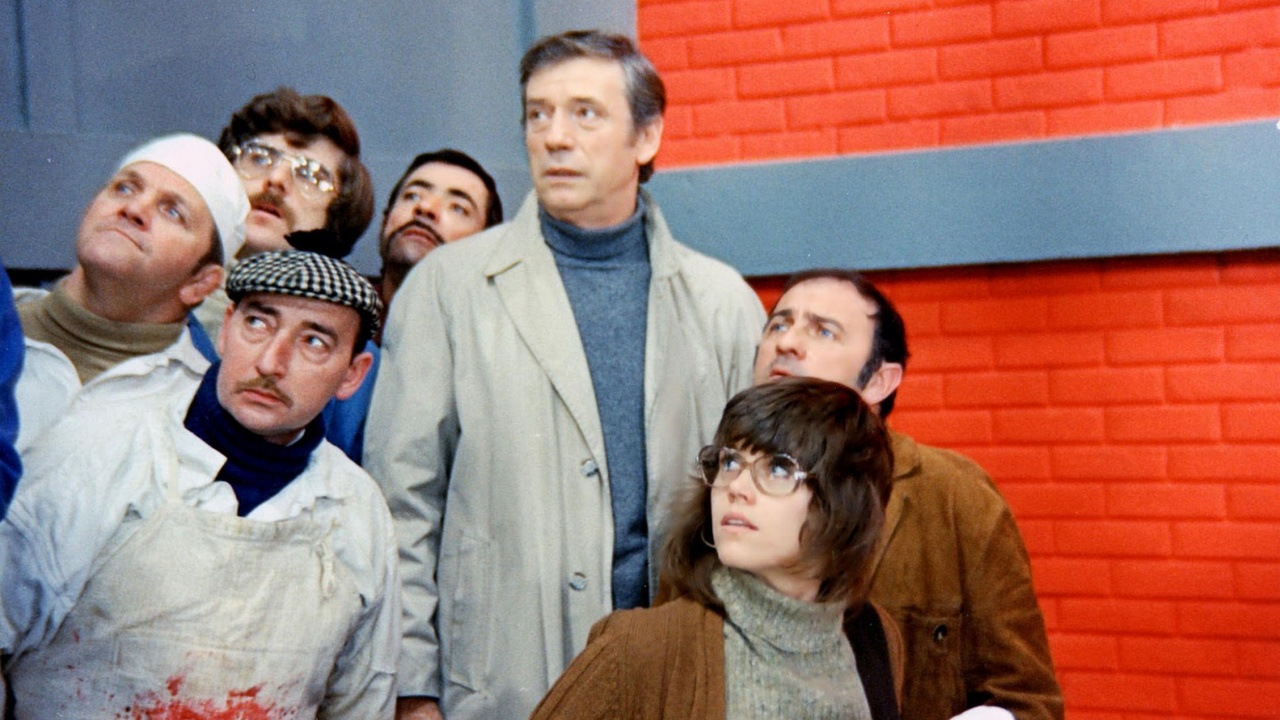
Written and directed by Jean-Luc Godard and Jean-Pierre Gorin, Tout va bien (Everything’s All Right) is the story of an American reporter and her has-been French New Wave filmmaker husband who go to a sausage factory to report on a strike that is happening. The film is an exploration of two people capturing a strike that is happening as it play into the events of May of ’68 in France as well as the many fallacies of revolutions in the aftermath of that event. Starring Jane Fonda, Yves Montand, and Vittorio Caprioli. Tout va bien is an intriguing though messy film from Jean-Luc Godard and Jean-Pierre Gorin.

Set four years after the chaotic events of May of ’68 in France, the film revolves around a has-been filmmaker and his American reporter wife who go to a sausage factory where it has been taken over by the workers as they’re locked inside the manager’s office with the manager. It is a film that explore this air of social and political chaos that is emerging in a factory with leftist workers trying to get better wages and such as they would humiliate the factory manager to show the shit they had to endure from him. The film’s screenplay doesn’t really have a straightforward narrative as much of its first two acts is set largely in the factory with glimpses of life outside of the factory for the filmmaker Jacques (Yves Montand) and his American wife Suzanne (Jane Fonda) in their occupations and married life. Even as they are locked in an office with the factory manager (Vittorio Caprioli) as there are scenes where there is narration as it play into what is going on with characters talking about their political and social situations.

The film’s direction from Jean-Luc Godard and Jean-Pierre Gorin is stylish in not just mixing documentary filmmaking style with a narrative style as there are scenes in the factory where it is shot inside a studio set. Notably as there’s this wide tracking dolly-shot where Godard and Gorin shoot the entire factory set from room to room as it plays into the sense of chaos but also people trying to figure out what to do next. There are also close-ups and medium shots that occur including a close-up in which a young woman (Anne Wiazemsky) talks about the demands of the workers but also a lot of fallacies into Leftist views as they would want more and more in a largely-capitalist society.

The direction also has these elements that play into these moments of chaos as it relates to the struggles of the working class and their disdain for the bourgeoisie through these brief breaks from the narrative yet the third act when Jacques and Suzanne are released from the factory is where things become really uneven. Notably as it play into what Jacques and Suzanne are doing and the compromises they make as it feels like it is part of something else with a scene late in the film in which Suzanne is in a market where it is this commentary on capitalism but there’s a man spouting communist rhetoric in the middle of the market while a bunch of young people are running around and announcing that everything in the market is free with police coming in to stop the chaos. It is a moment that is entrancing visually but its message into these clashing ideals ends up being all about nothing as it showcases the many fallacies of political ideals while it’s ending is really a non-ending in which the narrator speaks with a woman about how to end the film. Overall, Godard and Gorin craft a fascinating but uneven film about a filmmaker and his reporter wife trying to understand the social and political chaos inside a sausage factory.

Cinematographer Armand Marco does brilliant work with the film’s editing as it is largely straightforward to play into the film’s documentary-like tone but also with some vibrant colors for the interior scenes inside the factory. Editors Claudine Merlin and Kenout Peltier do terrific work with the editing as it has some jump-cuts to play into some the action and chaos while much of it is straightforward for some of the long shots in the film. Production designer Jacques Dugied does amazing work with the look of the interiors of the factory with great attention to detail in its stage-like setting. The special effects by Jean-Claude Dolbert and Paul Trielli do wonderful work with some of the film’s minimal effects as it play into the sets but also in the work that Jacques does. The sound work of Antoine Bonfanti and Bernard Ortion is superb as it is largely straightforward in the atmosphere of the factory and in the occupations that Jacques and Suzanne have in their lives.

The film’s excellent ensemble cast feature small roles from Eric Chartier, Castel Casti, Elizabeth Chauvin, and Hughette Mieville as factory employees rebelling against their boss, Louis Bugette as an old employee who talks about the conditions in the factory, Pierre Oudrey as a man working for the workers in getting their demands, Anne Wiazemsky as a Leftist woman talking in a monologue about the fallacies of the workers’ demands, and Vittorio Caprioli as the factory owner who is annoyed by the negotiation tactics as well as the humiliation of enduring the troubling working conditions his employees had to endure.

Yves Montand is brilliant as Jacques as a once-revered filmmaker who does commercials for a living who goes to the factory to help his wife’s report where he is later troubled by his experience as well as his disillusionment with politics. Finally, there’s Jane Fonda in an incredible performance as Suzanne as an American reporter working for an American company in France who goes to this factory as she finds herself siding with the workers but feels compromised by the people she works for while also dealing with her own marital issues as she copes with the chaos around her but also in her own life.

Tout va bien is a superb film from Jean-Luc Godard and Jean-Pierre Gorin. While it does a messy and uneven narrative with political commentary that is all over the place. It is still a fascinating film that explore the lessons learned and unlearned following the events of May ’68 as well as being a film that explore a certain period in Godard’s career that had him stray away from narrative-based films. In the end, Tout va bien is a terrific yet flawed film from Jean-Luc Godard and Jean-Pierre Gorin.

Jean-Luc Godard Films: All the Boys are Called Patrick - Charlotte et son Jules - A Bout de Souffle - The Little Soldier - A Woman is a Woman - Vivre sa Vie - Les Carabiniers - Contempt - Bande a Part - A Married Woman - Alphaville - Pierrot le fou - Masculin Feminin - Made in U.S.A. - Two or Three Things I Know About Her - La Chinoise – Weekend (1967 film) - Sympathy for the Devil (One Plus One) - (Joy of Learning) - (British Sounds) - (Letter to Jane) - (One A.M.) - (Number Two) - (Here and Elsewhere) - (Every Man for Himself) - (Passion) - (First Name: Carmen) - Hail, Mary - (Soft and Hard) - (Detective) - (King Lear (1987 film)) - (Keep Your Right Up) - (Nouvelle Vague) - (Allemagne 90 neuf zero) - (JLG/JLG - Self-Portrait in December) - For Ever Mozart - (Historie(s) de Cinema) - (In Praise of Love) - (Notre musique) - (Film Socialisme) - (Adieu au Language) – (The Image Book)

© thevoid99 2022

Monday, September 14, 2020

Teorema


Written and directed by Pier Paolo Pasolini, Teorema is the story of a wealthy family whose upper-class lifestyle is turned upside down when they invite a stranger into their home. The film is a study of a family from Milan who endure some serious revelations upon inviting this man into their home as they cope with their identities and their environment. Starring Terence Stamp, Laura Betti, Silvana Mangano, Massimo Girotti, Anne Wiazemsky, and Ninetto Davoli. Teorema is a majestic and surreal film from Pier Paolo Pasolini.

Set in the bourgeoisie world of Milan, the film revolves around a wealthy family who invite a mysterious visitor to their home for a brief stay as his presence would turn their world upside down. It is a film with a simple premise as it play into a family who spent much of their lives living in the bourgeoisie society as they’re not fully aware of what the world around them. Pier Paolo Pasolini’s script doesn’t feature a conventional plot, despite featuring a straightforward narrative, nor does it feature a lot of dialogue in favor of characters reacting to this mysterious and unnamed visitor (Terence Stamp). The visitor’s presence would create a reaction to this family including its maid Emilia (Laura Betti) who is suffering from depression as her encounter with the visitor has her facing many things. The visitor’s time at this home is only for the film’s first half but his impact would play a major key role in the film’s second half as it relates to the family.

Pasolini’s direction is largely straightforward in its compositions yet it does contain an element of surrealism as it relates to the world of this bourgeoisie family as it is also shot on location in and around Milan. There are some wide and medium shots of the locations as well as the home of this family yet Pasolini also uses it to convey the sense of isolation this family lives in as it is clear that their lack of interaction outside of their environment has made them too comfortable. Here in this strange visitor, the bubble that this family is living in proves to full of faults and fallacies as the visitor is someone who would inspire each member of the family in some way. The usage of the close-ups and medium shots add an intimacy to what Pasolini is conveying in how each of the family members and the maid deal with this visitor.

While much of the film’s first half is straightforward, there are elements that are surreal that would include recurring images of gray and dusty landscapes. The second half of the film is where Pasolini brings in a lot of these surreal moments as they’re more about these revelations of this family and their own individual needs and wants. Pasolini also play into the idea of spirituality as well as some of the harsh realism of the modern world since the family patriarch Paolo (Massimo Girotti) runs a factory as he is already troubled by some of the growing tension between factory workers and those in charge. By the film’s third act where Paolo and his film start to unravel in different ways, it all play into these ideas of existentialism as well as identity. Notably as it features Paolo and the recurring images of the gray landscape that he’s been thinking about as well as the lack of depth in the bubble he had lived in for many years with his family. Overall, Pasolini crafts an entrancing and eerie film about a mysterious visitor’s time at the home of a Milanese bourgeoisie family and its aftermath.

Cinematographer Giuseppe Ruzzolini does brilliant work with the film’s cinematography to capture the lush colors of the locations within the family home that is a direct contrast to the more realistic look of the locations in and outside of Milan with the opening shots of the film presented in a sepia-like filter. Editor Nino Baragli does amazing work with the editing with its stylish usage of jump-cuts for the recurring images of gray landscape that appear every now and then as well as rhythmic cuts to play into the drama. Art director Luciano Puccini does excellent work with the look of the family home with its stylish rooms that play into the personality of the characters.

Costume designers Roberto Capucci and Marcella De Marchis do fantastic work with the costumes with Capucci creating lavish and stylish clothes for the family matriarch to wear with De Marchis creating clothes for the other characters that are posh but casual. The sound work of Bernardino Fronzetti is superb for its atmosphere of the locations at the home where it’s tranquil in comparison to the noisier world of industrial-driven Milan. The film’s music by Ennio Morricone is tremendous for its mixture of lush orchestral music mixed in with elements of jazz that is driven by horns as well as a bit of rock n roll while its soundtrack features a classical piece from Wolfgang Amadeus Mozart.

The film’s incredible cast feature some notable small roles from Ninetto Davoli as the postman Angelino, Adele Cambria as a maid also named Emilia, Alfonso Gatto as a doctor, Susanna Pasolini as an old peasant, and Laura Betti as the family maid in Emilia whose encounter with the visitor has her dealing with ideas of spirituality. Andres Jose Cruz Soublette is superb as the young man Pietro who rooms with the visitor as he would later cope with his identity as well as the world he lives in. Anne Wiazemsky is fantastic as the family daughter Odetta who is a young woman of innocence as someone who cares for her father as her meeting with the visitor has her thinking about men in a sexual way as it becomes an emotional revelation for her.

Massimo Girotti is excellent as the family patriarch Paolo as a man who owns and runs a factory who becomes ill as he also copes with the world of industrialization and social turmoil as well as dreams of a land where his encounters with the visitor forces him to see things differently. Silvana Mangano is amazing as Lucia as the family matriarch whose encounter with the visitor awakens her own sexual desires as she deals with the trappings of her own surroundings where she would go into an existential journey of her own. Finally, there’s Terence Stamp in a sensational performance as the visitor as this mysterious young man who is a guest at this home where he doesn’t do much other than just read books, play with a dog, and other casual activities as he is also someone that doesn’t reveal exactly who he is as Stamp just plays it straight in an understated yet ravishing performance.

Teorema is a spectacular film from Pier Paolo Pasolini. Featuring a great cast, lush visuals, a riveting music score by Ennio Morricone, and a study of identity and lifestyle. The film is a provocative and rapturous film that explores the life of a bourgeoisie family as their world goes upside down following a strange visit from a mysterious young man as it play into the many faults of the upper-class and their disconnection with the rest of the world. In the end, Teorema is a phenomenal film from Pier Paolo Pasolini.

Pier Paolo Pasolini Films: (Accattone) – (La Rabbia) - Mamma Roma - (Location Hunting in Palestine) – (The Gospel According to Matthew) – (Love Meetings) – (The Hawks and the Sparrows) – The Witches (1967 film)- The Earth Seen from the Moon - (Oedipus Rex) – (Porcile) – (Medea (1969 film)) – (Appunti per un film sull’India) – (Notes Towards an African Orestes) – The Decameron - The Canterbury Tales - Arabian Nights - Salo, or the 120 Days of Sodom

© thevoid99 2020

Monday, March 25, 2019

2019 Blind Spot Series: Weekend (1967 film)


Based on the short story Le autopista del Sur by Julio Cortazar, Weekend is the story of a bourgeoisie couple who travel to France to collect an inheritance as they encounter a world where everything is falling apart. Written for the screen and directed by Jean-Luc Godard, the film is an exploration of two people with secrets from each other as they’re forced to see a world that is in total chaos as it would mark the end of a style of storytelling for Godard for more than a decade as it plays into his interest towards political and social matters. Starring Mireille Darc, Jean Yanne, Georges Staquet, Juliet Berto, Jean Eustache, Jean-Pierre Leaud, and Yves Afonso. Weekend is a chilling yet abstract film from Jean-Luc Godard.

A trip through the French countryside for a bourgeoisie couple becomes a nightmare due to a world that has gone to shit. That is the film’s overall premise as it explores the idea of what happens when society and morality have all fallen by the wayside just as a couple go on a trip to collect an inheritance with each having their own intentions for themselves. Jean-Luc Godard’s screenplay does have a traditional narrative structure yet it is told in an abstract style as it breaks down the fourth wall at times but also would blur the idea of fantasy and reality along with elements of surrealism as the couple would meet real-life figures in literature, history, or in politics. It all play into a world that is coming apart as this couple in Corrine (Mireille Darc) and Roland (Jean Yanne) are trying to understand what is happening yet are desperate to reach their destination that becomes more troublesome as they have to endure the chaos around them including traffic jams, deaths, and people angry at the world.

Godard’s direction is definitely stylish in its offbeat approach yet it is filled with some haunting visuals that play into this idea of a world coming undone. Shot on various locations in France, Godard captures a world that is outside of Paris that is full of wonders where he shoots a Corrine and Roland both at their apartment as Roland is driving his car recklessly with no regards for anyone. There are some long shots that occur throughout the film whether it’s in a wide and medium shot or in a close-up where Godard would have characters talk about what is going on around them or a historical figure pop up and say something that has some relevance to the chaos that is happening in France during the 1960s that would have these dire premonitions of what was to come in May of 1968. Even as Corrine and Roland find themselves unable to get a ride to town after their car had crashed at the beginning of its second act due to political affiliations.

Godard’s direction would include these long and gazing dolly-tracking shots for the film’s traffic jam scene in the film’s first act as it shows Roland Corrine trying to get through this road of death, destruction, absurdity, and confusion. The tracking shots definitely capture a lot of coverage while they would be briefly interrupted by jump-cuts of title cards that would also include a scene of a camera going slowly in circle for a music break. It is Godard breaking away from the confines of traditional narrative while following this bourgeoisie couple who are traveling to receive an inheritance as the third act is about them reaching their destination and an aftermath that is more troubling as it relates to their secrets from one another but also this inhumanity they had endured throughout their journey where they end up encountering a guerilla task force. It would play into the conflict involving social classes as well as this growing civil disobedience over what the world has become. Overall, Godard crafts a provocative and unsettling film about a bourgeois couple’s trek through France where they encounter a world that has completely lost its purpose.

Cinematographer Raoul Coutard does brilliant work with the film’s gorgeous cinematography that captures the vibrancy of the colors in the clothes that Corinne and other characters wear as well as the look of the locations that showcase a world that is coming undone. Editor Agnes Guillemot does amazing work with the editing as it is playful with its usage of jump-cuts but also its usage of repetition and montages to play into this sense of remorse or lack of it. The sound work of Rene Levert and Antoine Bonfanti is excellent for its approach to sound in the way car horns, trucks, guns, and everything would sound from afar or up close as it help add to the film tense atmosphere of the film. The film’s music by Antoine Duhamel is fantastic for its offbeat musical score that ranges from somber orchestral pieces as well as a disconcerting drum-based piece that is actually played on location while the film also feature elements of classical music.

The film’s superb cast feature some notable small roles and appearances from filmmaker Jean Eustache as a hitchhiker, Omar Blondin Diop and Laszlo Szabo as a couple of garbage men who both have something to say about the state of the world for Africa and Algeria, Ernest Menzer as a FLSO cook, Michelle Breton as the assistant cook, Jean-Pierre Kaflon as the leader of a guerilla faction known as the FLSO, Valerie Lagrange as the leader’s lover, Paul Gegauff as a pianist performing classical music for the music break sequence, Anne Wiazemsky and Michel Cournot as a couple of barnyard passerby with Wiazemsky also playing a guide, Georges Staquet as a tractor operator who argues with Roland, and Jean-Claude Guilbert as a vagabond who fights with Roland. Jean-Pierre Leaud is terrific in a dual role as the French Revolution leader Louis Antoine Leon de Saint-Just and as a man on a telephone who tries to stop Roland and Corrine from stealing his car.

Yves Afonso is fantastic as the literary character Tom Thumb who comments about the state of the world while Blandine Jensen is excellent in a dual role as the author Emily Bronte who never gives any straight answers and as a piano accompanist for the pianist. Juliet Berto is brilliant in a dual role as a fellow bourgeoisie that Roland and Corrine encounter and as a FLSO fighter. Finally, there’s the duo of Mireille Darc and Jean Yanne in great performances in their respective roles as Corinne and Roland Durand as this bourgeois couple traveling through France to collect an inheritance for Corinne as she is someone eager to get money for her own reasons while dealing with the chaos around her. Yanne’s performance as Roland is a man who is manic and impulsive with little regard for anyone due to his reckless driving and nonchalant attitude towards others where he and Darc both display this air of inhumanity as two people with ulterior motives for each other as well as become lost in a world that is far crueler than they are.

Weekend is a spectacular film from Jean-Luc Godard. Featuring a great cast, gorgeous visuals, an abstract narrative, and themes of a world becoming undone by class conflicts, social issues, popular culture, and the sins of the Western Civilization. It’s a film that is definitely confrontational but also unafraid in being absurd and offbeat as it is definitely one of Godard’s quintessential films as well as a fitting end to his widely-revered French New Wave period. In the end, Weekend is a phenomenal film from Jean-Luc Godard.

Jean-Luc Godard Films: All the Boys are Called Patrick - Charlotte et son Jules - A Bout de Souffle - The Little Soldier - A Woman is a Woman - Vivre Sa Vie - Les Carabiniers - Contempt - Bande a Part - A Married Woman - Alphaville - Pierrot Le Fou - Masculin Feminin - Made in U.S.A. - Two or Three Things I Know About Her - La Chinoise - Sympathy for the Devil (One Plus One) - (Joy of Learning) - (British Sounds) - Tout va Bien - (Letter to Jane) - (One A.M.) - (Number Two) - (Here and Elsewhere) - (Every Man for Himself) - (Passion) - (First Name: Carmen) - Hail, Mary - (Soft and Hard) - (Detective) - (King Lear (1987 film)) - (Keep Your Right Up) - (Nouvelle Vague) - (Allemagne 90 neuf zero) - (JLG/JLG - Self-Portrait in December) - For Ever Mozart - (Historie(s) de Cinema) - (In Praise of Love) - (Notre musique) - (Film Socialisme) - (Adieu au Language) – (The Image Book)

© thevoid99 2019

Sunday, March 19, 2017

Sympathy for the Devil (One Plus One)


Written and directed by Jean-Luc Godard, Sympathy for the Devil (One Plus One) is a documentary film about the recording of the titular song by the Rolling Stones that is inter-cut with segments relating to the political and social events of the late 1960s. The film marks the beginning of a period of experimental features for Godard in his movement away from traditional narrative while he chronicles one of the most popular bands at that time during a crucial period in their career. The result is a fascinating though uneven film from Jean-Luc Godard.

The film follows a series of recording sessions in June of 1968 by the Rolling Stones for a song that is to reflect into the chaos of that year entitled Sympathy for the Devil. During the course of the film as the Stones would try and create this song, the film would be inter-cut with dramatic segments featuring actors reading or giving their views on many social and political ideologies of the time. Yet, both narratives would often feature a brief jump-cut of someone spray painting political slogans all over London during the course of the film. It’s a film that has two very different things happening yet both segments would also feature commentaries by a narrator (the voice of Sean Lynch) reading stories on Marxism where it would often drown out some of the things that is happening or be drowned out by comments from those talking politics or the Stones playing music as well as sounds of jets flying in the air courtesy of sound mixers Derek Ball and Arthur Bradburn.

Both the segments involving the Stones and the political content are shot in long takes by Jean-Luc Godard with the aid of cinematographer Anthony B. Richmond as it follows not just what is going on but also in the environment. Whereas the Stones are seen recording at Olympic Studios in London, the political segments largely take place in different areas. There’s two different segments involving black militants talking about their own ideas while executing white women in one segment as it takes place in a junkyard near a river. A segment with actress Anne Wiazemsky as a character talking to people in the forest about what she thinks the state of the world and the different ideas of politics. There’s one segment taking place inside a bookstore where a Fascist reads a book on Fascism with two customers beaten and bloodied by other Fascist customers as the store is surrounded by comics, pulp novels, and nudie magazines.

The scenes involving the Stones recording Sympathy for the Devil shows the band hard at work trying to develop the song that would become one of their defining songs as vocalist Mick Jagger tries to find the right vocal tone for the song while guitarist Keith Richards would play bass on the song trying to find its groove. Drummer Charlie Watts and bassist Bill Wyman would provide their own contributions to the song as would session keyboardist Nicky Hopkins and producer Jimmy Miller. The scenes also showcase guitarist Brian Jones becoming less involved as there’s a major scene during the recording where the band plus Hopkins and percussionist Rocky Dijon are all playing in the circle while Jones is playing acoustic guitar in a booth behind Jagger. It is a moment that shows his diminishing role in the band as he would die more than a year after the recording of the song.

While the film does contain some rich cinematography by Richmond as well as some straightforward editing by Ken Rowes including the jump-cuts to showcase the young woman spray-painting slogans on walls around London. The film is definitely uneven largely due to the fact that Godard wants to create something that is a response to the events of 1968 as it’s really 2 different films. Yet, the film’s original intentions had Godard wanting to make something that is more political but clashes with one of the film’s producers in Iain Quarrier, who plays the role of a Fascist book seller, would complicate things as the resulting film that is shown is quite uneven. It’s uneven to audiences that thought they would see a film about the Stones in their prime only to see something else while Godard-enthusiasts would wonder why the Stones in a film that definitely has a lot of commentaries on the politics of the times.

Sympathy for the Devil (One Plus One) is a stellar film from Jean-Luc Godard. Though it’s a very uneven film due to its different subject matter. It is still an interesting film that chronicles a tumultuous time period inspired by the events of 1968 as well as a look into the Rolling Stones creating one of their defining songs. In the end, Sympathy for the Devil (One Plus One) is a terrific film from Jean-Luc Godard.

Related: Gimme Shelter - The Rolling Stones Rock and Roll Circus - Shine a Light - Crossfire Hurricane

Jean-Luc Godard Films: All the Boys are Called Patrick - Charlotte et son Jules - A Bout de Souffle - The Little Soldier - A Woman is a Woman - Vivre sa Vie - Les Carabiniers - Contempt - Bande a Part - A Married Woman - Alphaville - Pierrot Le Fou - Masculin Feminin - Made in U.S.A. - Two or Three Things I Know About Her - La Chinoise - Weekend - (Joy of Learning) - (British Sounds) - Tout va Bien - (Letter to Jane) - (One A.M.) - (Number Two) - (Here and Elsewhere) - (Every Man for Himself) - (Passion) - (First Name: Carmen) - Hail, Mary - (Soft and Hard) - (Detective) - (King Lear (1987 film)) - (Keep Your Right Up) - (Nouvelle Vague) - (Allemagne 90 neuf zero) - (JLG/JLG - Self-Portrait in December) - For Ever Mozart - (Historie(s) de Cinema) - (In Praise of Love) - (Notre musique) - (Film Socialisme) - (Adieu au Language) - (The Image Book)

© thevoid99 2017

Thursday, December 26, 2013

Au Hasard Balthazar


Written and directed by Robert Bresson, Au Hasard Balthazar (Balthazar, at Random) is the story about the paralleling lives of a young girl and her donkey following their heartbreaking separation where they both suffer cruelty. The film explores the relationship between this shy girl and her donkey and the separation that would destroy them both. Starring Anne Wiazemsky and Francois Lafarge. Au Hasard Balthazar is a heart wrenching film from Robert Bresson.

The film is about the life of a donkey named Balthazar who would be in the hands of many owners where most of them would treat the donkey with great cruelty with the exception of a young girl named Marie (Anne Wiazemsky) who would also endure the same kind of abuse from the people in her small town. The film doesn’t have much of a plot only that it takes place in the span of many years from Balthazar’s early days with Marie whose father (Philippe Asselin) has been taking care of the farm for a rich family only to sue them for money. When that goes wrong, Balthazar is later handed to a series of owners where some treat the donkey cruelly that includes a young thug named Gerard (Francois Lafarge) who would harass Marie into an abusive relationship. All of it would play into the way humanity deals with animals and young women where it would be Balthazar who would maintain some kind of dignity through the ordeal he goes through.

The direction of Robert Bresson is simple and to the point in the way he explores the life of a donkey and the connection he has with this shy young woman who loved the donkey since she was a girl. Bresson’s approach to naturalism has him going for something that is astonishing in the way a donkey is being treated as he is treated with care at times but also in the worst ways that includes a scene where Gerard lights a paper on Balthazar’s tale to get him to move. Much of the compositions has Bresson use wide and medium shots to play into the world that Balthazar is in as he is walking in towns where it he has to deal with cars and motorbikes as he wanders on the road. There’s also moments where Balthazar is being treated like an animal where he wanders around to a circus where there’s these amazing close-ups of circus animals in cages looking at Balthazar.

The close-ups on Balthazar are some of the most gorgeous yet somber images captured on film where it’s clear that this is more than just some donkey but a character with a soul as the donkey that plays Balthazar deserves high commendation for its work. Even in his interaction with the actors in the film including the character of Marie whose story is also just as heartbreaking as Bresson brings a very low-key approach to the melodrama to showcase her own journey. Notably as she longs to return to her childhood friend Jacques (Walter Green) despite all of the abuse she’s been through with Gerard and others as she also has to deal with her father whose pride had been his undoing as he is also responsible for what Balthazar endures. Overall, Bresson crafts a very touching yet powerful drama about the cruelty of humanity towards a saintly donkey.

Cinematographer Ghislain Cloquet does excellent work with the film‘s black-and-white photography where it‘s very understated for much of its daytime scenes while go for a bits of style in the nighttime scenes. Editor Raymond Lamy does brilliant work with the editing as it‘s quite straightforward with some jump-cuts and some stylistic cutting to play into the film‘s drama. Production designer Philippe Dussart does terrific with the set pieces from the home that Marie and her family lives in to the bakery that Gerard works at. The sound work of Antoine Archimbaud and Jacques Carrere is amazing for the intimacy and naturalism that is presented for the film including the braying of Balthazar. The film’s music largely consists of piano pieces by Franz Schubert that is performed by Jean-Joel Barbier as it plays to much of the film’s melodrama while the rest of the music soundtrack includes jazz pieces by Jean Weiner and some pop songs that are played from Gerard‘s radio.

The film’s cast includes some incredible small performances from Jean Remignard as the notary who deals with Marie’s father’s case, Philippe Asselin as Marie’s stubborn father, Nathalie Joyaut as Marie’s kindly mother, Francois Sullerot and Marie-Claire Fremont in their respective roles as the baker and his wife where the latter is suspicious towards Gerard, and Walter Green as Marie’s childhood friend Jacques who tries to settle the matter between his family and Marie’s father. Pierre Klossowski is terrific as a merchant Marie meets late in the film as he would become one of Balthazar’s final owners. Jean-Claude Guilbert is excellent as the drunken farmer Arnold who would gain Balthazar as he treats the donkey with some contempt while also being caring at times as he’s this melancholic man lost in the modern world.

Francois Lafarge is superb as the cruel Gerard as this youthful thug who uses Balthazar for his own schemes while treating him and Marie with such disdain. Finally, there’s Anne Wiazemsky as Marie as a shy young woman who is heartbroken by her separation from Balthazar as she becomes lost in her despair where she is abused and mistreated while seeking to find some good in the world.

Au Hasard Balthazar is a tremendous yet harrowing film from Robert Bresson. Featuring a mesmerizing performance from a donkey as well as a somber tale about a donkey’s life where he endures cruelty. It’s a film that is definitely powerful while proving that animals do have a soul when it’s treated with love and care. In the end, Au Hasard Balthazar is a magnificent film from Robert Bresson.

Robert Bresson Films: (Les affairs publique) - (Les Anges du peche) - Les Dames du Bois de Boulogne - Diary of a Country Priest - A Man Escaped - Pickpocket - The Trial of Joan of Arc - Mouchette - (A Gentle Woman) - (Four Nights of a Dreamer) - (Lancelot du Lac) - (The Devil Probably) - L’Argent

© thevoid99 2013