Showing posts with label jane fonda. Show all posts

Sunday, November 20, 2022

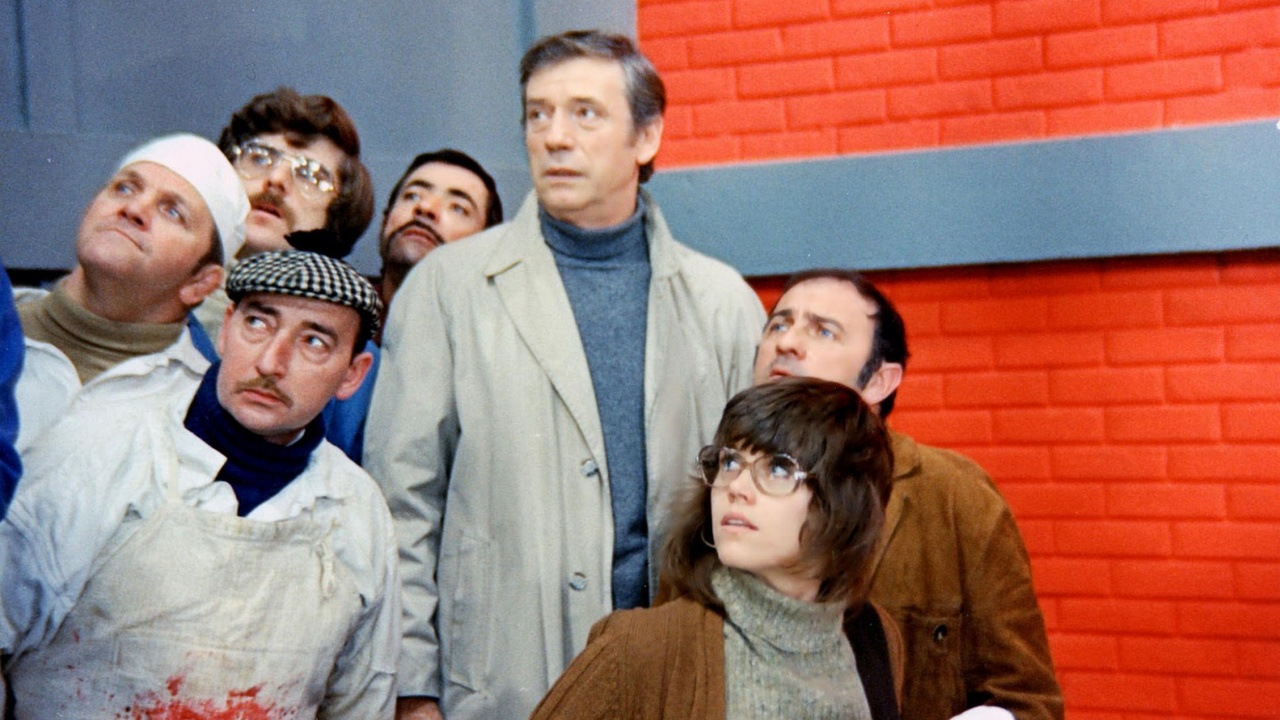
Tout va bien


Written and directed by Jean-Luc Godard and Jean-Pierre Gorin, Tout va bien (Everything’s All Right) is the story of an American reporter and her has-been French New Wave filmmaker husband who go to a sausage factory to report on a strike that is happening. The film is an exploration of two people capturing a strike that is happening as it play into the events of May of ’68 in France as well as the many fallacies of revolutions in the aftermath of that event. Starring Jane Fonda, Yves Montand, and Vittorio Caprioli. Tout va bien is an intriguing though messy film from Jean-Luc Godard and Jean-Pierre Gorin.

Set four years after the chaotic events of May of ’68 in France, the film revolves around a has-been filmmaker and his American reporter wife who go to a sausage factory where it has been taken over by the workers as they’re locked inside the manager’s office with the manager. It is a film that explore this air of social and political chaos that is emerging in a factory with leftist workers trying to get better wages and such as they would humiliate the factory manager to show the shit they had to endure from him. The film’s screenplay doesn’t really have a straightforward narrative as much of its first two acts is set largely in the factory with glimpses of life outside of the factory for the filmmaker Jacques (Yves Montand) and his American wife Suzanne (Jane Fonda) in their occupations and married life. Even as they are locked in an office with the factory manager (Vittorio Caprioli) as there are scenes where there is narration as it play into what is going on with characters talking about their political and social situations.

The film’s direction from Jean-Luc Godard and Jean-Pierre Gorin is stylish in not just mixing documentary filmmaking style with a narrative style as there are scenes in the factory where it is shot inside a studio set. Notably as there’s this wide tracking dolly-shot where Godard and Gorin shoot the entire factory set from room to room as it plays into the sense of chaos but also people trying to figure out what to do next. There are also close-ups and medium shots that occur including a close-up in which a young woman (Anne Wiazemsky) talks about the demands of the workers but also a lot of fallacies into Leftist views as they would want more and more in a largely-capitalist society.

The direction also has these elements that play into these moments of chaos as it relates to the struggles of the working class and their disdain for the bourgeoisie through these brief breaks from the narrative yet the third act when Jacques and Suzanne are released from the factory is where things become really uneven. Notably as it play into what Jacques and Suzanne are doing and the compromises they make as it feels like it is part of something else with a scene late in the film in which Suzanne is in a market where it is this commentary on capitalism but there’s a man spouting communist rhetoric in the middle of the market while a bunch of young people are running around and announcing that everything in the market is free with police coming in to stop the chaos. It is a moment that is entrancing visually but its message into these clashing ideals ends up being all about nothing as it showcases the many fallacies of political ideals while it’s ending is really a non-ending in which the narrator speaks with a woman about how to end the film. Overall, Godard and Gorin craft a fascinating but uneven film about a filmmaker and his reporter wife trying to understand the social and political chaos inside a sausage factory.

Cinematographer Armand Marco does brilliant work with the film’s editing as it is largely straightforward to play into the film’s documentary-like tone but also with some vibrant colors for the interior scenes inside the factory. Editors Claudine Merlin and Kenout Peltier do terrific work with the editing as it has some jump-cuts to play into some the action and chaos while much of it is straightforward for some of the long shots in the film. Production designer Jacques Dugied does amazing work with the look of the interiors of the factory with great attention to detail in its stage-like setting. The special effects by Jean-Claude Dolbert and Paul Trielli do wonderful work with some of the film’s minimal effects as it play into the sets but also in the work that Jacques does. The sound work of Antoine Bonfanti and Bernard Ortion is superb as it is largely straightforward in the atmosphere of the factory and in the occupations that Jacques and Suzanne have in their lives.

The film’s excellent ensemble cast feature small roles from Eric Chartier, Castel Casti, Elizabeth Chauvin, and Hughette Mieville as factory employees rebelling against their boss, Louis Bugette as an old employee who talks about the conditions in the factory, Pierre Oudrey as a man working for the workers in getting their demands, Anne Wiazemsky as a Leftist woman talking in a monologue about the fallacies of the workers’ demands, and Vittorio Caprioli as the factory owner who is annoyed by the negotiation tactics as well as the humiliation of enduring the troubling working conditions his employees had to endure.

Yves Montand is brilliant as Jacques as a once-revered filmmaker who does commercials for a living who goes to the factory to help his wife’s report where he is later troubled by his experience as well as his disillusionment with politics. Finally, there’s Jane Fonda in an incredible performance as Suzanne as an American reporter working for an American company in France who goes to this factory as she finds herself siding with the workers but feels compromised by the people she works for while also dealing with her own marital issues as she copes with the chaos around her but also in her own life.

Tout va bien is a superb film from Jean-Luc Godard and Jean-Pierre Gorin. While it does a messy and uneven narrative with political commentary that is all over the place. It is still a fascinating film that explore the lessons learned and unlearned following the events of May ’68 as well as being a film that explore a certain period in Godard’s career that had him stray away from narrative-based films. In the end, Tout va bien is a terrific yet flawed film from Jean-Luc Godard and Jean-Pierre Gorin.

Jean-Luc Godard Films: All the Boys are Called Patrick - Charlotte et son Jules - A Bout de Souffle - The Little Soldier - A Woman is a Woman - Vivre sa Vie - Les Carabiniers - Contempt - Bande a Part - A Married Woman - Alphaville - Pierrot le fou - Masculin Feminin - Made in U.S.A. - Two or Three Things I Know About Her - La ChinoiseWeekend (1967 film) - Sympathy for the Devil (One Plus One) - (Joy of Learning) - (British Sounds) - (Letter to Jane) - (One A.M.) - (Number Two) - (Here and Elsewhere) - (Every Man for Himself) - (Passion) - (First Name: Carmen) - Hail, Mary - (Soft and Hard) - (Detective) - (King Lear (1987 film)) - (Keep Your Right Up) - (Nouvelle Vague) - (Allemagne 90 neuf zero) - (JLG/JLG - Self-Portrait in December) - For Ever Mozart - (Historie(s) de Cinema) - (In Praise of Love) - (Notre musique) - (Film Socialisme) - (Adieu au Language) – (The Image Book)

© thevoid99 2022

Friday, October 02, 2020

2020 Blind Spot Series: They Shoot Horses, Don't They?


Based on the novel by Horace McCoy, They Shoot Horses, Don’t They? is the story of a people trying to win a dance marathon during the Great Depression with a power-hungry emcee urging them to continue. Directed by Sydney Pollock and screenplay by Robert E. Thompson and James Poe, the film is a study of people who are desperate to win this dance marathon in the hope of winning $1,500 during a troubled time where people are clinging to hope. Starring Jane Fonda, Michael Sarrazin, Susannah York, Bruce Dern, Bonnie Bedelia, Red Buttons, and Gig Young. They Shoot Horses, Don’t They? is a harrowing and evocative film from Sydney Pollock.

The film revolves around a dance marathon during the Great Depression where a group of people attend the marathon in the hopes of winning $1,500 and a better life as they also hope to win the audience. Yet, it’s a marathon that goes on for days and days where it becomes a troubling image of exploitation where people try to stay away and move just to win money. The film’s screenplay by Robert E. Thompson and James Poe has this narrative that features what could be flashbacks or something as it relates to the character Robert Syverton (Michael Sarrazin) who walks into the La Monica Ballroom on the Santa Monica Pier accidentally where this marathon is to begin. Syverton is chosen to partner up with the cynical Gloria Beatty (Jane Fonda) whose original partner is unable to participate due to bronchitis. Other participants including an elderly sailor named Harry Kline (Red Buttons) who is joined by his partner Shirl (Allyn Ann McLerie), the aspiring actress from London in Alice (Susannah York) with her partner in another struggling actor in Joel (Robert Fields), and a farming couple in James (Bruce Dern) and his pregnant wife Ruby (Bonnie Bedelia).

The first act is about the marathon and everything that happens as it is overseen by its emcee Rocky Gravo (Gig Young) who is hoping to make money out of this marathon as the dancers would get sponsorship to keep on dancing hoping they would win. Yet, Gravo has something sinister in making people attend everything and to see who drops out and who stays on that would also include breaks but also the terrifying race around the dancefloor for a period of time where the last three couples are eliminated. It adds to the drama with Beatty wondering why some of these people are there including the pregnant Ruby as she would often question herself. Syverton, who is a reluctant participant, observes everything that is happening as he would also have flashbacks on his childhood while getting some unwanted attention from Alice.

Sydney Pollock’s direction does bear a lot of style as it is shot largely in a soundstage with a few of the exteriors shot at the Santa Monica Pier as much of the film is set in this ballroom. Pollock’s usage of wide and medium shots to get a scope of the entire ballroom is immense yet it is his usage in the latter and close-ups that add to the drama that occur. Notably as much of the action occur is in the ballroom with a few breaks in these rooms where the contestants rest for a where some of the drama occur with Beatty looking around the other women with an air of disdain. Pollock maintains something straightforward in those scenes while including a few strange recurring images of fields as it relates to Syverton as he is seen being interrogated. The behind-the-scenes moments involving Gravo showcase a man who is doing whatever he can to make money and to make the show more interesting so that the people attending this marathon can watch people suffer.

The two scenes involving the race around the dancefloor is definitely the most intense where Pollock doesn’t show the craziness of this moment but also this growing idea of inhumanity as these people are trying to walk around an entire lap and make sure they’re not eliminated. The ones who drop on the floor showcase the horror of these races while the moment they’re dancing and could barely move also add to this inhumanity. Most notably in the third act where Beatty and Syverton briefly break-up and be with other partners as it adds to the growing chaos where they both learn that there’s a lot more at stake. Even as Gravo continues to stir the pot and hope that there’s a winner yet it adds to this growing cynicism that Beatty has as well as revelations for Syverton about the world in general. Overall, Pollock crafts a riveting yet chilling film about a group of people trying to win a dance marathon during the Great Depression.

Cinematographer Philip H. Lathrop does brilliant work with the film’s cinematography with the usage of sepia-like color for a few stylish shots in the flashbacks as well as gorgeous approach to lighting for many of the interiors including low-key natural light for the scenes where the contestants rest. Editor Fredric Steinkamp does amazing work with the editing where it knows when to be straightforward in the dramatic moments while the racing scenes has this air of chaos in its fast cuts as well as bits of slow-motion for dramatic effect. Production designer Harry Horner and set decorator Frank R. McKelvy do excellent work with the look of the dancehall and its many interiors as well as the way the floor is re-painted for the racing scenes. Costume designer Donfeld does fantastic work with the costumes as it play into the period of the times as it includes the gorgeous gown that Alice wears that later goes into ruins to the sweats some of the people wear during the racing scene.

Makeup artist Frank McCoy, along with hair stylists Sydney Guilaroff and Ina Claire, does terrific work with the look of the characters as they sweat and become sleep-deprived while Guilaroff does the look of Beatty and Claire doing the look of Alice. The sound work of Tom Overton is superb for the atmosphere it maintains in the way the crowd sounds as well as how music is presented from afar as well as the sounds of the sea heard from the outside of the building. The film’s music is a wonderful mixture of standards of those times as it adds to the atmosphere while being a major highlight of the film.

The casting by Lyn Stalmaster, James Martell, and Jack Roberts is incredible as it feature some notable small roles from Art Metrano as a dancer who collapses during the first race, Madge Kennedy as an old lady who sponsors Beatty and Syverton, Allyn Ann McLerie as Harry’s partner Shirl, Robert Fields as Alice’s partner in aspiring actor Joel, Al Lewis as Gravo’s right-hand man Turkey, and Michael Conrad as one of the event’s organizers in Rollo. Bruce Dern and Bonnie Bedelia are fantastic in their respective roles as the traveling couple James and Ruby Bates who have done dance marathons before but they’re facing a bigger challenge with the latter being pregnant as the former tries to be supportive but also defensive towards Beatty’s cynical remarks. Red Buttons is excellent as the sailor Harry Kline as an old war veteran eager to win some money as he befriends some of the dancers while dealing with the intense challenges of staying up as well as the race itself.

Susannah York is brilliant as Alice LeBlanc as an actress from London eager to get some attention from talent scouts to appear at the marathon only to deal with stolen items, envy, and other issues as she starts to become fragile. Gig Young is amazing as Rocky Gravo as the organizer and emcee of the marathon who does whatever he can to sell tickets and make money while also playing a devious game of torturing people in the hope he can make some money as it’s a charming yet devilish performance. Michael Sarrazin is incredible as Robert Syverton as a man who accidentally walks into the ballroom where he reluctantly becomes Beatty’s partner as he deals with the chaos around him while in some strange images recounts some things in his life as it’s an understated performance from Sarrazin. Finally, there’s Jane Fonda in a phenomenal performances as Gloria Beatty as a woman eager to win by any means necessary while dealing with the physical, emotional, and mental torment of her desire to win hoping it’s one last chance at doing something where Fonda brings that biting cynicism to play a woman that has lost a lot of hope and is clinging to that last semblance of hope as it is one of Fonda’s quintessential performances.

They Shoot Horses, Don’t They? is a tremendous film from Sydney Pollock that features a great performance from Jane Fonda. Along with its supporting cast, eerie setting, study of human nature and exploitation, and gorgeous visuals. The film is definitely an engaging period drama set during the Great Depression that explore what people are willing to do win money during a dark time in history as well as the lows they have to endure with some trying to milk it for all of its worth. In the end, They Shoot Horses, Don’t They? is a spectacular film from Sydney Pollock.

Sydney Pollock Films: (The Slender Thread) – (This Property is Condemned) – (The Scalphunters) – (Castle Keep) – (Jeremiah Johnson) – (The Way We Were) – (The Yakuza) – (Three Days of the Condor) – (Bobby Deerfield) – (The Electric Horseman) – (Absence of Malice) – Tootsie - (Out of Africa) – (Havana) – (The Firm) – (Sabrina (1995 film)) – (Random Hearts) – (The Interpreter) – (Sketches of Frank Gehry) – (Amazing Grace (2018 film))

© thevoid99 2020

Wednesday, September 26, 2018

Jane Fonda in Five Acts


Directed by Susan Lacy, Jane Fonda in Five Acts is a documentary film about the life and career of Jane Fonda as she talks about her life being the daughter of actor Henry Fonda as well as the many identities she took in being an actress, an activist, a workout enthusiast, and many other roles on screen and off screen. The film has Fonda also discuss many things that she encountered as well as aging as fellow actors and other personalities including family members and two of her three ex-husbands talk about the woman who has done a lot and is embarking on a new chapter in her life. The result is a fascinating and touching film from Susan Lacy.

The eldest daughter of Henry Fonda, Jane Fonda would make a mark of her own as an actress in film, TV, and theatre but also would take part in other ventures including activism. The film is told through five different parts with Fonda discussing many aspects of her life as the four preceding acts all represent the men who were important in Fonda’s life with the first being her father. Fonda revealed that for the image that her father had represented to the public was different from what he was in private as all Fonda wanted from him was to be proud of her. Plus, she admitted to struggle with her early image once she became an actress as well as be the public face of Henry Fonda’s daughter.

The preceding acts each represent the three men that Fonda would marry in filmmaker Roger Vadim, activist/politician Tom Hayden, and billionaire/media mogul Ted Turner. All of which would have Fonda discuss their importance in her life as well as giving her a sense of direction and identity but also revealed why the marriage fell apart. When it came to her activism, Fonda knew she was going to get a lot of heat but wanted to contribute something to the world and help people. When it came to the issues in the Vietnam War and her visit to North Vietnam during the war, Fonda does have regrets over the way she put herself into a position as the film opens with an audio recording of Richard Nixon talking about how bad Fonda has fallen and felt for her father.

Fonda also reveal a lot of her own faults as a person and as a mother where despite the glowing commentary she would receive from her son in actor Troy Garity and adopted daughter Mary Luana Williams as well as former stepdaughter Nathalie Vadim. Fonda’s eldest child in Vanessa Vadim doesn’t appear in the film as Fonda admits to not being a better mother to her due to her activism and selfishness even though her grandchildren do appear in the film looking at old family photos with Fonda. Then there’s Fonda’s mother in actress in Frances Ford Seymour who had some mental health issues including manic depression that only worsened during her marriage to Henry who would later have an affair with socialite Susan Blanchard who was nine years older than Jane. In April of 1950, Frances committed suicide when Fonda was 12 and Peter was only 10 as there is a scene of Fonda visiting her mother’s grave as it’s a somber moment that shows a sense of loss and overwhelming emotion of a woman who really loved her mother.

With the help of cinematographer Samuel Painter, Susan Lacy’s direction is straightforward in not just getting Fonda to speak openly along with members of her family but also friends and fellow actors such as producer Paula Weinstein, Robert Redford, and Lily Tomlin. Tom Hayden also appears as he talks about his marriage with Fonda and why it fell apart yet it is the rare appearance of Ted Turner at his ranch where he gets a visit from Fonda that is the most fascinating. Especially as it reveals there’s still a love between the two but it’s more of a friendship that has them riding horses on fields and watch buffalos.

Editors Benjamin Gray and Kris Liem would help Lacy in cultivating many archival interview footage that Fonda did in the past with Fonda commentating on where her head was at the time as well as the films she did as she admitted that some of her performances in her early films sucked. Sound editor Steve Borne would also cover through archives of audio including some of the famous recordings of Richard Nixon who was disgusted by Fonda’s activism. The film’s music by Paul Cantelon would provide a wonderful score that play into the highs and lows that Fonda endured as it is largely a low-key orchestral score.

Jane Fonda in Five Acts is a sensational film from Susan Lacy. It’s a film that explores the life of one of the finest entertainment and social figures who is still going to strong while still having things to say. Even as the woman herself dismisses the many myths about herself and her family as well as provide insight into a woman who is complex but also endearing. In the end, Jane Fonda in Five Acts is a phenomenal film from Susan Lacy.

© thevoid99 2018

Sunday, August 28, 2016

Youth (2015 film)


Written and directed by Paolo Sorrentino, Youth is the story of two old men who travel to a holiday spa in Switzerland as they reflect on their life as they also cope with aging and their longing to be youthful as they meet other people young and old. The film is a study on the ideas of youth, aging, and the struggle about what to do with the time that is left in one’s life. Starring Michael Caine, Harvey Keitel, Rachel Weisz, Paul Dano, and Jane Fonda. Youth is a ravishing yet evocative film from Paolo Sorrentino.

Set in Swiss Alps in a holiday spa, the film follows two men who are vacationing there as they cope with what is ahead as one of them is a famed composer trying to enjoy retirement while his friend is a filmmaker eager to make one more film and get a big-time actress to star in it. During their time, the two discuss things they can and can’t remember as well as the fact that they’re in their final years unsure of when death will arrive. Especially as the two also have children who are married to each other where something unexpected happens as they would also meet various characters in the course of their vacation. Paolo Sorrentino’s screenplay doesn’t just explore the ideas of youth, aging, life, and death but also the struggle for identity and meaning in the world. Even as these two men try to see if they still matter or have already contributed to the world and be forced to realize they have nothing to prove anymore.

The composer Fred Ballinger (Michael Caine) and the filmmaker Mick Boyle (Harvey Keitel) both try to deal with their roles in life as the former copes with the task of performing a concert for Queen Elizabeth II and her husband for the latter’s birthday while the latter is trying to make a film which he believes will be his greatest work. During the course of their stay, they befriend an actor named Jimmy (Paul Dano) who is doing research for a role while Fred is accompanied by his daughter Lena (Rachel Weisz) who just went through a life-changing event making her stay at the spa much longer. Around the same time, Fred and Mick also encounter many eccentrics during their stay as they also comment on their past as well as their own faults as men where Fred admits to not being a good father to Lena as well as the fact that he wasn’t faithful to his wife where he copes with the fact that he couldn’t do his greatest piece without her.

Sorrentino’s direction is gorgeous for the way he presents this world of tranquility and peace that is like paradise. Shot largely on location in Flims, Switzerland at the Waldhaus Flims hotel with some shots at the Hotel Schatzalp in Davos and additional scenes set in Rome and Venice. Sorrentino creates some unique compositions to play into something that is idyllic in terms of where the elderly would go to relax as well as the fact that it’s a place for those in their prime as well as the young. Sorrentino’s usage of wide shots play into the look as well as some of the intimate moments that involve many of the residents at the spa where they’re shot in groups. The intimacy would also be used in the close-ups and medium shots as Sorrentino knows where to frame the actors or create something that is adds a lot to this air of tranquility and calm as these residents are given the chance to relax but also do some activities and listen to music.

The direction also has moments that are quite surreal as it play into this air of fantasy that some of the characters embark on. These sequences not only are dream-like but also play into some of the fear some of the characters endure but also moments that play into their sense of desire. Even as they are these odd moments that do make sense as well as showcase that feeling of existence where it would be overshadowed by the harshness of reality. Notably in a sequence in the third act which relates to the lives of Fred and Mick as the former is still carrying some form of grief and regret while the latter would face heartbreak of the worst kind. All of which these two men would be forced to carry for the remainder of their lives. Overall, Sorrentino creates an enchanting yet rapturous film about two old friends going on a holiday in the Swiss Alps coping with the remaining moments of their lives.

Cinematographer Luca Bigazzi does brilliant work with the film‘s cinematography from the usage of its natural and colorful look for many of its daytime exteriors the usage of lights and moods for many of the scenes set at night. Editor Cristiano Travaglioli does nice work with the editing as it has some stylish rhythmic cuts to play into the offbeat moments while much of it is straightforward. Production designer Ludovica Ferrario, with set decorator Noel Godfrey and art directors Daniel Newton and Marion Schramm, does amazing work with the look of the rooms the residents live in as well as some of the design of the rooms and places they would go to. Costume designer Carlo Poggioli does excellent work with the different array of clothes of the many residents who are at the spa as well as the look of the actress that Mick wants to work with.

Hair/wig designer Aldo Signoretti and makeup designer Maurizio Silvi do fantastic work with the look of the actress that Mick wants to work with in her diva-esque persona as well as the look for Mick‘s own surreal moment. Visual effects supervisor Andrew Morley does terrific work with some of the visual effects as it play into the elements of surrealism that the characters would encounter or dream about. Sound editor Dario Calvari does superb work with the sound in playing up that sense of tranquility as well as the layer of sounds that Fred would hear in a surrealistic moment. The film’s music by David Lang is wonderful for its mixture of somber folk with elements of orchestral flourishes that play into the serenity of the locations as it would also feature additional contributions by Mark Kozelek who appears in the film as himself in creating some songs that are performed including Fred‘s famed composition that is sung in the final credits by the soprano singer Sumi Jo.

The casting by Shaheen Baig, Laura Rosenthal, and Anna Maria Sambucco is great as it feature some notable small roles from the British pop vocalist Paloma Faith as herself, Ed Stoppard as Lena‘s husband/Mick‘s son, Alex MacQueen as an emissary for Queen Elizabeth II, Ian Keir Attard as the emissary‘s assistant, Madalina Diana Ghena as Miss Universe, and Roly Serrano as an overweight and ailing version of the famed futbol icon Diego Maradona. In the roles of the screenwriters who work with Mick on his story, there’s Tom Lipinski, Chloe Pirrie, Alex Beckett, Nate Dern, and Mark Gessner as these different writers who provide Mick different ideas as well as try to come up with the ending as they‘re all fun to watch. Luna Mijovic is wonderful as a young masseuse that Fred befriends while Robert Seethaler is superb as a mountain climbing instruction that Lena takes interest in. In a small but crucial role as the diva-esque actress Brenda Morel, Jane Fonda is incredible as this longtime collaborator of Mick who makes this appearance as she represents some of the harshness of reality that Mick faces where she just owns that scene.

Paul Dano is excellent as Jimmy Tree as a young actor who befriends Fred and Mick where he shares their frustration with their work as he’s famously known for playing a robot where he hopes to find a role that could give him more. Rachel Weisz is amazing as Lena as Fred’s daughter who is also his assistant as she makes an unexpected return to the retreat where she copes with some of the bitter aspects of her relationship with her father. Harvey Keitel is phenomenal as Mick Boyle as a filmmaker eager to try and create one final film that would define his legacy while dealing with aspects of his life along with his friendship with Fred. Finally, there’s Michael Caine in a remarkable performance as Fred Ballinger as this music composer trying to retire as he is dealing with the demands of his former career in doing a concert for Queen Elizabeth II and write a memoir while dealing with his own faults as a man, a father, and as a husband where he also recalls things he can and can’t remember.

Youth is a spectacular film from Paolo Sorrentino that features brilliant performances from Michael Caine, Harvey Keitel, Rachel Weisz, Paul Dano, and Jane Fonda. Along with memorable performances from the rest of its ensemble cast, gorgeous visuals, strong themes on life and death, and superb music. It’s a film that explores many of the ideas about getting old as well as the idea of capturing some element of youth in an old age. In the end, Youth is a tremendous film from Paolo Sorrentino.

Paolo Sorrentino Films: (One Man Up) - (The Consequences of Love) - (The Family Friend) - (Il Divo) - (This Must Be the Place) - (The Great Beauty)

© thevoid99 2016

Saturday, October 05, 2013

Spirits of the Dead


Histoires extraordinaire (Spirits of the Dead) is an omnibus film from Federico Fellini, Louis Malle, and Roger Vadim that takes three different stories based on the works of Edgar Allen Poe. The three segments each explores the world of horror in many different ways as well as individuals who deal with their sins. The result is a truly fascinating and entertaining omnibus film from Federico Fellini, Louis Malle, and Roger Vadim on the works of Edgar Allen Poe.

Metzengerstein

Directed by Roger Vadim. Screenplay by Roger Vadim, Pascal Cousin, and Daniel Boulanger. Starring Jane Fonda and Peter Fonda. Cinematographer Claude Renoir. Editor Helene Plemiannikov. Production designer Jean Andre. Costume designer Jacques Fonteray. Music by Jean Prodromides.

The segment is about a countess who has inherited a renowned estate as she lives a life of debauchery and excess with no consequences. When she is rejected by her baron cousin who lives nearby, she seeks vengeance only to get a mysterious horse that she becomes attached to. It’s a piece that is filled with an array of beautiful imagery through Roger Vadim’s direction as well as sense of style in the way the clothes display that sense of decadence as well as the sense of guilt and melancholia that Countess Frederique Metzengerstein (Jane Fonda) would deal with over what she did to Baron Wilhem Berliftizing (Peter Fonda). Even as the mysterious horse in a tapestry the countess has might play into the fate that she would encounter with the horse she had just received where both Fonda siblings give fantastic performances where Jane speaks perfect French while Peter is more quiet as his lines are dubbed in French.

William Wilson

Directed by Louis Malle. Screenplay by Louis Malle, Clement Biddle Wood, and Daniel Boulanger. Starring Alain Delon and Brigitte Bardot. Cinematographer Tonino Delli Colli. Editors Franco Arcalli and Suzanne Baron. Production/costume designer Ghislain Uhry. Art director/costume designer Carlo Leva. Music by Diego Masson.

Louis Malle’s segment explores the life of a cruel young man (Alain Delon) who shares the same name of a doppelganger who would set the rights of what his counterpart has done. Yet, it has a narrative that is told in a reflective manner as Wilson confesses to a priest (Salvo Radone) about the rivalry he has with his doppelganger dating back to childhood where it would culminate in a game where Wilson tries to cheat a socialite named Giuseppina (Brigitte Bardot). It’s a very complex and eerie film about identity and such that features a brilliant Alain Delon that is complemented by Malle’s very intense and mesmerizing direction as well Bardot’s very charming and cool performance.

Toby Dammit

Directed by Federico Fellini. Screenplay by Federico Fellini and Bernardino Zapponi. Starring Terence Stamp. Cinematographer Giuseppe Rutunno. Editor Ruggero Mastroianni. Production/costume designer Piero Tosi. Art director Fabrizio Clerici. Visual effects by Joseph Nathanson. Music by Nino Rota.

The segment is about a washed-up Shakespearean actor who goes to Rome to accept an award and to star in a Catholic western as he starts to lose his mind following an encounter with a little girl who lost her ball. It’s a film that is filled with many of the visual traits of Federico Fellini as it’s all style where it’s playful but also gorgeous to look at thanks to Giuseppe Rutunno’s cinematography. The film also features a truly delightful score by Nino Rota that also features a truly magnificent sequence of the titular character driving all over Italy on a Ferrari as he’s played with such complexity by Terence Stamp who adds a melancholia and craziness to the character.

The film is about the sins and such of various individuals all told in very different places as the segments by Roger Vadim and Louis Malle are all period pieces that do play with Edgar Allen Poe’s story. In Metzengerstein, Vadim decided to make Poe’s story about a long-standing family feud be more complex as its protagonist would become a woman as she falls for her rival only to be upset by his rejection. In William Wilson, Malle sets his story in the 19th Century Austria where it plays into a man’s identity and the idea of a double where his double is man that is the exact opposite of the other man.

Both Vadim and Malle bring a sense of faithfulness to their respective stories yet it is Federico Fellini who does a whole lot more in his loose-adaptation of Never Bet the Devil Your Head where he sets in modern-day Italy as it’s all full of style to play up the troubled mind of an alcoholic actor as he’s doing interviews and attend a lavish party that has him realize how undeserving he is as he’s being paid a Ferrari to do a film. It’s Fellini’s segment that is the best of the three as well as one of his most outstanding works of his career.

Histoires extraordinaire is a marvelous omnibus film that chronicles the work of Edgar Allen Poe. Featuring some fantastic segments by Roger Vadim and Louis Malle that features excellent performances from Jane and Peter Fonda, Brigitte Bardot, and Alain Delon. The film also features a magnificent segment by Federico Fellini that is one of his great masterworks that includes an incredible performance by Terence Stamp. In the end, Histoires extraordinaire is a remarkable omnibus film from the trio of Federico Fellini, Louis Malle, and Roger Vadim.

Federico Fellini Films: (Variety Lights) - The White Sheik - (L’amore in Citta-Un’agenzia matrimoniale) - I Vitelloni - La Strada - Il bidone - Nights of Cabiria - La Dolce Vita - (Boccaccio ‘70-Le tentazoni del Dottor Antonio) - 8 1/2 - Juliet of the Spirits - (Fellini: A Director’s Notebook) - Fellini Satyricon - (I Clowns) - Roma - Amarcord - Casanova - Orchestra Rehearsal - City of Women - And the Ship Sails On - Ginger and Fred - (Intervista) - (The Voice of the Moon)

Louis Malle Films: (The Silent World) - (Elevator to the Gallows) - (The Lovers) - (Zazie dans la Metro) - (Vive le Tour) - (A Very Private Affair) - (The Fire Within) - (Viva Maria!) - (The Thief of Paris) - (Calcutta (1969 film)) - (Murmur of the Heart) - (Humain, trop humain) - (Lacombe, Lucien) - (Black Moon) - (Pretty Baby) - (Atlantic City (1980 film)) - (My Dinner with Andre) - (Crackers) - (Alamo Bay) - (God’s Country) - (And the Pursuit of Happiness) - (Au Revoir Le Enfants) - (May Fools) - (Damage) - (Vanya on 42nd Street)

Roger Vadim Films: (And God Created Woman) - (No Sun in Venice) - (The Night Heaven Fell) - (Les laisons dangereuses) - (Blood and Roses) - (Please, Not Now!) - (The Seven Deadly Sins) - (Love on a Pillow) - (Castle in Sweden) - (Vice and Virtue) - (Circle of Love) - (La Curee) - (Barbarella, Queen of the Galaxy) - (Pretty Maids All in a Row) - (Helle) - (Ciao! Manhattan) - (Don Juan, or If Don Juan Were a Woman) - (The Murdered Young Girl) - (Game of Seduction) - (Night Games) - (Hot Touch) - (Surprise Party) - (And God Created Woman (1988 film))

© thevoid99 2013

Wednesday, December 19, 2012

Coming Home


Based on the novel by George Davis, Coming Home is the story about a the wife of a Marine captain who falls for a paralyzed soldier while her husband away fighting at the Vietnam War. Directed by Hal Ashby and screenplay by Robert C. Jones and Waldo Salt, with additional work by Rudy Wurlitzer, from a screen story by Nancy Dowd, the film explores the world of life at home as a woman deals with the Vietnam War as she meets a paraplegic soldier who is still scarred by the events of the war itself. Starring Jane Fonda, Jon Voight, Bruce Dern, Penelope Milford, and Robert Carradine. Coming Home is a powerful yet captivating drama from Hal Ashby.

Sally Hyde (Jane Fonda) is the wife of Marine Captain Bob Hyde (Bruce Dern) as he is set to leave for service in Vietnam which he believes will help things despite some of the events that happened including the Tet Offensive. After Bob’s departure, Sally deals with her loneliness as she befriends the bohemian Vi Hudson (Penelope Milford) who helps her get an apartment off the base and near the beach. Sally decides to volunteer at a nearby military hospital where she meets various soldiers who have been injured or paralyzed by the war including a man named Luke Martin (Jon Voight) who had been an old classmate of hers years ago. Luke has become paraplegic as he’s angry over what happened to him as Sally tries to figure out what to do with him.

The two become friends where they slowly open up to each other just as the events of 1968 were happening. With Luke finally in a wheelchair and starting to leave the hospital to be on his own, their friendship blossoms as Luke also tries to help out Vi’s troubled younger brother Billy (Robert Carradine) who is suffering from the traumas of the war. Sally’s life starts to change as she gets a letter from Bob to visit her in Hong Kong for a week as she arrives to find Bob becoming detached. Upon returning home, Sally learns some devastating news that has Luke chaining himself to a Marines recruiting building in order to not have young men being sent to war. Sally bails him out as the two begin to fall in love though the two try to figure out how to tell Bob about their relationship once he returns home. Bob eventually returns home with a wounded leg as he starts to become more unhinged as he learn about Sally’s affair with Luke.

Films about the Vietnam War is often about the horror that happens in combat as well as a lot of the political issues that occur. With this film, it is about war from the perspective of three different people as it’s set outside of the battlefield in 1968 where a lot is happening. Yet, it’s more about a woman dealing with her husband going out in war while meeting a paraplegic soldier who had been to war. She starts out as an officer’s wife that has only known that kind of life. When she’s alone, she figures out what to do as she only knows that military life and the only way to be close to that world is to volunteer at a military hospital. Once she volunteers and meets this paraplegic man, her outlook in life changes as does her lifestyle.

The screenplay by Robert C. Jones and Waldo Salt definitely does a lot of work into exploring the dynamics of its three central protagonists without trying to involve any kind of political rhetoric about the Vietnam War. Instead, it is about these three people caught up in the chaos of war as they deal with war and its aftermath. For Sally, she starts to learn a lot of what Luke went through in the war as well as other veterans as she eventually asks for other officer wives to help out but they’re more concerned about doing other things. She eventually does things herself with help from Vi as she becomes someone the veterans at the hospital love to have around including Luke.

Luke starts out as this very disillusioned man who felt angry over what happened to him as he isn’t treated well at the hospital and upset at what is happening in the war. Once he meets Sally and the two get reacquainted after not seeing each other for years, Luke becomes a much friendlier person as he starts to rebuild his own life and find meaning again. The two eventually have a romance where Sally would experience things she didn’t have with her husband yet becomes conflicted about her loyalty to Bob. Luke understands this as he doesn’t want to cause anymore trouble yet they would be unveiled by something outside of them. Bob is a man that starts out as someone with a sense of idealism about his role as an officer but he starts to slowly unravel due to his experience of the war and comes home a wounded man not just in a literal sense but also emotional.

What Luke and Sally do to Bob isn’t the worst thing as they both wanted to be honest but it is what has already happened to Bob that just adds to what he is going through. Whereas Luke had started off as a man paralyzed by war and ends up regaining the will to live as he doesn’t let his paralysis affect him. Bob becomes a man that is paralyzed where he doesn’t know what or who to believe as he ends up being lost. For Sally, she is caught in the middle as she is in love with Luke but also loves Bob as she doesn’t want to cause more trouble though she is not the same woman that she was in the beginning of the film.

Hal Ashby’s direction is very engaging for the way he explores the after effects of war and how people try to change themselves in the wake of these events. Particularly as he opens the film with men playing pool as they talk about the war where it is established that this won’t be a typical film about war but rather the aftermath as everyone in that room is outspoken. Then it cuts to an opening credits scene where it shows Bob running around a military base to establish who this man is. Ashby’s direction is filled with a lot of imagery that revolves around war that is prevalent on the televisions and radio that also tells a world that is coming undone. Yet, he is more interested in the human drama that occurs where Ashby uses the camera to capture the chaos of the hospital that slowly becomes more peaceful.

The direction becomes more playful and much more open as it’s shot largely nearby San Diego and some bits in Hong Kong where it shows a lot of contrast to the world that Sally encounters with the two different men in her life. In Hong Kong, things are tense and chaotic where it’s also very crowded. In California, things are much freer as Ashby’s direction does contain an element of intense drama but also looseness in the scenes between Sally and Luke. Ashby also creates some compositions and moments where it is about the drama as it the film intensifies to some huge climaxes. Particularly when it involves the three protagonists as it’s followed by an ending that reveals how far these three individuals have gone to in the beginning. The ending does have a message but it’s not a heavy-handed one as Ashby tells it with a lot of simplicity and that is it. Overall, Ashby creates a truly mesmerizing and heartfelt drama about the after effects of war.

Cinematographer Haskell Wexler does brilliant work with the film‘s photography from the colorful yet lush look of the daytime exteriors to the more stylish approach to lighting for some of the interiors including the clubs that Sally go to. Editor Don Zimmerman does amazing work with the editing to play out the drama as well as some parallel montages to contrast the lives of the characters. Production designer Michael D. Haller and set decorator George Gaines do wonderful work with the sets from the look of Sally‘s home to the more chaotic look of the military hospital.

Costume designer Ann Roth does nice work with the costumes to play up the period from the more ragged look of Luke to the stylish clothes that Sally and Vi wear. Makeup artist Bernadine M. Anderson and hair stylist Lola “Skip” McNalley do terrific work for the look of Sally from her hairdo and makeup to showcase her transformation. Sound editor Frank E. Warner does superb work with the sound from the atmosphere of the clubs to the more quieter moments in the scenes between Luke and Sally. The film’s soundtrack is truly a delight to hear as it features effective use of music from the Beatles, the Rolling Stones, Buffalo Springfield, Simon & Garfunkel, Aretha Franklin, Tim Buckley, Bob Dylan, the Chambers Brothers, Steppenwolf, Richie Havens, Big Brother Holding Company with Janis Joplin, Jefferson Airplane, and the Jimi Hendrix Experience.

The casting by Lynn Stalmaster is definitely a major highlight of the film as it features some notable small roles from Robert Ginty as Vi’s sometimes lover Sgt. Mobley and Robert Carradine as Vi’s troubled Vietnam veteran brother Billy. Penelope Milford is great as Vi who helps Sally deal with her loneliness while dealing with her own issues as she becomes a friend for Sally and Luke. Bruce Dern is brilliant as Captain Bob Hyde who is a man that has this idea of war is only to face the realities of what he’s facing as he becomes undone by these realities as he finds himself out of sorts with the world including his wife.

Finally, there’s the duo of Jane Fonda and Jon Voight as the two give very incredible performances in their respective roles as Sally and Luke. Voight displays a complexity to his character as a man wracked with the horror of war and feeling mistreated as he later finds a reason to live where he starts to take control of his own life and finally give his own perspective on war in a great finale. Fonda is radiant as this woman lost in her role as an officer’s wife as she tries to find a way to fill her time only to go through changes by what she encounters and deal with the harsh reality of war. Fonda and Voight have amazing chemistry together in the way they deal with each as well as the fact that neither character wants to cause more pain to Bob in the film’s third act.

Coming Home is an extraordinary film from Hal Ashby that features outstanding performances from Jane Fonda, Jon Voight, and Bruce Dern. The film is definitely one of the best films about the Vietnam War in terms of the troubling aftermath soldiers faces as well as what wives deal with as they’re at home wondering what will happen to their husbands. It’s also an engrossing drama that explores the world of loneliness as well as trying to find an identity in the wake of loneliness. In the end, Coming Home is a remarkable film from Hal Ashby.

Hal Ashby Films: The Landlord - Harold and Maude - The Last Detail - Shampoo - Bound for Glory - Being There - Second-Hand Hearts - (Lookin’ to Get Out) - (Let’s Spend the Night Together) - (Solo Trans) - (The Slugger’s Wife) - 8 Million Ways to Die

© thevoid99 2012