Saturday, August 21, 2010

Lick the Star


Prior to the landmark films she’s made in her career, Sofia Coppola was simply known to many as the daughter of Francis Ford Coppola as well as gaining notoriety for her Razzie-winning performance in The Godfather Pt. III.  Shortly after appearing in that film, Coppola was struggling to get projects going as she appeared in music videos for the Black Crowes, Madonna, and later the Chemical Brothers’ Elektrobank that was directed by her then-boyfriend Spike Jonze. Coppola’s aspirations to become a director did come with a project that was co-directed with Ione Skye called Bed, Bath, & Beyond that featured another director that was rarely seen.  At the same time, she had already directed videos for Walt Mink and the Flaming Lips.  Yet, it would be another film that would pave the way for Coppola’s arrival as a prominent director with a unique voice in the 16mm, black-and-white short film called Lick the Star.

Directed by Sofia Coppola with a script co-written with Stephanie Hayman, Lick the Star tells the story of a group of girls planning a scheme on some boys.  When one of the girls becomes alienated by one of her friends in the clique, it would lead to some dire consequences.  The 13-minute short recalls the future themes Coppola would explore in later films including alienation and the troubles of being a young woman.  With a cast of mostly unknowns that would include Coppola’s cousin Robert Schwartzman and a cameo appearance from legendary director Peter Bogdanovich.  Lick the Star is a promising, intriguing short from Sofia Coppola.

After getting her left foot injured, Kate (Christina Turley) returns to middle school after a few days of being in a hospital.  Things have changed in the few days she missed school though one thing is still the same as Chloe (Audrey Heaven) is still the queen of the 7th grade.  Along with Rebecca (Julia Vanderham) and Sara (Lindsy Drummer), they rule the seventh grade as they pull pranks and lord over the rest of their classmates.  Kate is befuddled by their quote “lick the star” as it’s a code for “kill the rats” as Chloe and the gang plan to poison Greg (Robert Schwartzman) with arsenic from an idea they got from the book Flowers in the Attic.

After Kate got caught with a cigarette, the principal (Peter Bogdanovich) lists her as a non-student so she couldn’t attend proms or other school-related activities.  With Kate out of the plan due to her hesitation, Chloe along with Rebecca and Sara go along.  Yet, Rebecca and Sara starts to have second thoughts where Chloe treats them with contempt.  Then when a minor conversation about history class is overheard, Chloe is suddenly the target of the entire 7th grade as she is suddenly made an outcast.

The film is about a girl trying to take revenge on the boys only to make herself become an outcast.  Yet, there’s also the story of another girl who is unaware of her friends now becoming this clique as she finds herself isolated about the plan they do.  Yet, it’s the theme of alienation that would become prevalent in the work that Sofia Coppola would have in her later films along with the theme of womanhood.  Coppola definitely understands what teenage girls go through in dealing with isolation as well as not being able to understand the consequences when one believes she is the queen.  Along with co-writer Stephanie Hayman, Coppola adds a sense of realism to the story along with stylistic dialogue that rings very true to what kids would say about anything.

The direction Coppola has is very stylish as Chloe’s entrance is presented in slow-motion with jump-cuts to play along to music by the Amps.  Even as she creates haunting yet entrancing compositions with the four girls lying on the grass during gym class just acting cool.  There’s a looseness to the presentation as well as the fact that it’s shot on location with real students of the school as extras.  Yet, the realness of how kids act and behave during those time seem true instead of presented in such a melodramatic or overly-stylized fashion.  Coppola’s striking compositions along with the way she frames scenes from the perspective of a student.  The result is a truly fascinating yet engrossing short from Sofia Coppola.

Helping Coppola with her look is cinematographer Lance Acord, the photographer who would later work with her in films like Lost in Translation and Marie Antoinette.  Acord’s grainy black-and-white 16mm look is truly fascinating from the bright sunny lights and white background where there is something that is fun to look at.  When it’s night, the look is dark but with a tone that is truly foreboding.  Acord’s work is phenomenal as he creates beauty to the film.  Editor Eric Zumbrunnen does excellent work with the film’s stylized editing with its sense of rhythm and straightforward transitions.  Even in Chloe’s opening arrival where the use of jump-cuts and slow-motion definitely lets the audience in on the fact that it’s not going to be some kind of Hollywood-standard kind of film.

Art director Kira Cunningham does very good work with the look of the lockers inside that’s plastered with photos and such with contributions from Leslie Hayman of The Virgin Suicides as a set dresser.  Longtime associate of the Coppola family in sound designer Richard Beggs brings some fantastic work in capturing the sound locations and atmosphere of the school.  The film’s soundtrack includes some noisy but catchy driven girl rock from acts like the Amps, the Go-Go’s, Kim Gordon’s Free Kitten project, and Land of the Loops.

The cast includes mostly unknowns with appearances from renowned director Peter Bogdanovich as the school’s principal and Sofia Coppola’s friend Zoe Cassavetes as the P.E. teacher.  Sofia’s cousin Robert Schwartzman is very good as the girls’ enemy Greg while Julia Vanderham and Lindsy Drummer are excellent in their respective roles as Rebecca and Sara, two of Chloe’s friends who try to deal with Chloe’s attitude.  Christina Turley is wonderful as Kate, Chloe’s injured friend who tries to deal with everything that is happening while being the only one who later sympathize what would happen to Chloe.  Finally, there’s Audrey Heaven who is great as Chloe.  Heaven delivers a cool yet stylized performance as a queen bee who is full of herself only to become isolated by her antics as Heaven is the real standout of the cast.

Lick the Star is a remarkable short film from Sofia Coppola that captures the world of alienation and girlhood with such captivating style and harsh realism.  Fans of Coppola’s work will no doubt see this as a fascinating short that would set the stage for what would come from the famed director of films like The Virgin Suicides, Lost in Translation, and Marie Antoinette.  In the end, Lick the Star is a wonderful short from Sofia Coppola.

Sofia Coppola Films: The Virgin Suicides - Lost in Translation - Marie Antoinette - Somewhere - The Bling Ring - A Very Murray Christmas - The Beguiled (2017 film) - On the Rocks - Priscilla (2023 film)

Sofia Coppola Soundtracks: Air-The Virgin Suicides - The Virgin Suicides OST - Lost in Translation OST - Marie Antoinette OST - (The Bling Ring OST) - (Priscilla OST)

Sofia Coppola Essays: LIT 5th Anniversary Essay - Sofia Coppola: The Videos and Ads 1993-2008 - The Auteurs #1: Sofia Coppola

© thevoid99 2010


Thursday, August 19, 2010

The New World

Originally Written & Posted at Epinions.com on 1/21/06 of the 135-minute cut with some minor edits.


The story of Pocahontas has been told in many forms including a Disney animated version in 1995 about the young Indian heroine who befriended colonists in 1608 in Virginia including John Smith whose life she saved. The story is often told in a simple way and would often ignore Pocahontas' life after saving and befriending Smith as she later married aristocrat John Rolfe in 1614 as she settles into a simpler life while bringing peace between Indians and the English. Now, there's a new story that is much broader and more observant about the life of Pocahontas but it's more about the arrival of English colonists arriving to the area of Jamestown, Virginia and the aftermath. This time however, this story of Pocahontas is from the viewpoint from one of American cinema's most poetic and enigmatic visionaries in Terrence Malick for The New World.

Written and directed by Terrence Malick with a script he wrote in the mid-70s, The New World is a story about John Smith and English settlers arriving into Jamestown where Smith meets Pocahontas as the two explore each others culture that would lead to tension as Pocahontas would later meet John Rolfe. Shot on location in Jamestown, Malick goes for the same, poetic narrative approach to his earlier films for an observant and more enchanting tale of how the world changed through the eyes of a young girl. Starring Colin Farrell, Christian Bale, Christopher Plummer, Wes Studi, August Schellenberg, Irene Bedard, Raoul Trujillo, Jesse Borrego, Jonathan Pryce, David Thewlis, Noah Taylor, Ben Chaplin, John Savage, Brian F. O'Byrne, and introducing Q'Orianka Kilcher as Pocahontas.  The New World is a haunting yet lush film from Terrence Malick and company.

It's 1608 Virginia as three ships arrive onto the unknown land led by Captain Newport (Christopher Plummer) where joining him is another captain, Wingfield (David Thewlis). Imprisoned inside the ship for mutinous remarks is John Smith (Colin Farrell) as Newport sets him free so he can join the exhibition of the land. During their reconnaissance, Newport and his crew meet up with a group of natives led by Tomococo (Raoul Trujillo) as their first meetings is slow. Then when Newport leaves for England, Wingfield takes over while Smith becomes second-in-command to take on the exhibition. Immediately, mis-communication and misunderstandings lead to trouble as Smith along with two captured natives and crew members including Jehu Robinson (Ben Chaplin) are to explore the regions and rivers of Virginia to find the tribe's chief. After a native escapes, Smith takes on his exploration where he is captured by a band of natives led by Opechancanough (Wes Studi).

Opechancanough takes Smith to his tribe where he awaits answers from his brother and tribe chief Powhatan (August Schellenberg) as the punishment is death. Just as Smith is about to die, Powhatan's daughter Pocahontas steps him and asks her father to spare his life. Smith becomes a prisoner but immediately during his period of captivity, he becomes enamored and absorbed with the culture of the natives. He also begins to befriend the worldly spirit of Pocahontas as the two learn about each others' languages while having this relationship that transcends all barriers. This period of captivity made Smith aware of the peace they live in as Powhatan decides that he should return home. Smith is taken back to the settlement his colleagues had been building where they've been struck by poverty. With Smith chosen to take over, it doesn't become easy as he is often in conflict with Argall (Yorick van Wageningen) while dealing with the starvation of other men including crazed men like Savage (John Savage), Murray (Eddie Marsan), Lewes (Brian F. O'Byrne) Thomas Emery (Jamie Harris), and Selway (Noah Taylor).

After a horrifying winter, Pocahontas comes to help the troubled settlers to give them food but Smith knows that her generosity might spell trouble. Despite their love for each other, Smith tries to give the natives things in return but more misunderstandings including the settlers refusing to leave their land lead to a horrific conflict in battle. Pocahontas is immediately banished by her father for her involvement with the settlers while Smith is also punished for his refusal to trade with another tribe for Pocahontas. Pocahontas is sent to the village that was becoming Jamestown as she becomes accepted immediately thanks to her generosity as she no longer is called Pocahontas and adopts new ideas from a woman named Mary (Janine Duvitski). Pocahontas finally sees Smith as he blames himself for her banishment and feels that if they get together, it only spells trouble. Newport returns where he wants Smith to take part on an exhibition around North America. Smith takes the job as he tells someone to tell Pocahontas that he died two months after his expedition.

Smith's departure breaks Pocahontas as she becomes an alien of sorts to the town until she captures the gaze of a widowed aristocrat named John Rolfe (Christian Bale). Rolfe begins a relationship with Pocahontas as he teaches her about the English culture while he like Smith, is enamored with her spirit. During their time, they marry and have a son while she adopts the name Rebecca. The marriage is seen as a treaty between natives and settlers after a period of conflict as Rebecca learns that Smith is still alive. Rolfe is aware of her feelings for Smith as the two go to England where she becomes an honored guest in front of King James I (Jonathan Pryce) and Queen Anne (Alexandra Malick). Rebecca along with Opechancanough and a few natives are taken to England as they are amazed at the world they're in now. With Rolfe aware of Rebecca's feelings for Smith, he arranges a final meeting between the two in his posh home as Smith is forced to deal with his own troubles and feelings for his lost love.

Now most historical moments that features a romantic subplot in films like Heaven's Gate, Titanic, or Pearl Harbor can either work or becomes a distraction. What none of those films have is the genius, narrative approach that Terrence Malick does with a romantic subplot. Since he's basing some of these ideas from fact and legend, the love story of Pocahontas and John Smith doesn't feel contrived at all and it's the heart of the story since it's about these two different cultures coming together and trying to understand one another. While the romance does lead to trouble of what was to come in terms of the tension between the settlers and natives, it helps conveys the story and what Malick is trying to say in his revisionist approach to history. Another thing that Malick does that works in this film that didn't work with other films about moments of American history is that he gets right to the point about these events and what had happened without over-dramatizing things that happened.

Plus, Malick's writing on characters reveals not just the arrogant ignorance that the English came on feeling that they own this land. Malick also reveals the natives’ reluctance into giving land to settlers since it disrupts the peace they had been living in. Malick doesn't take shots on the English because of their feelings, he knows why they try to find a new world since their land is filled with problems yet they take those problems into the new world. While the story moves slow for Malick's message to come across, the momentum he builds up does pay off emotionally and spiritually right to the end. Then there is Malick's unique narrative style that is a trademark of all of his films. The voice-over narration Malick does goes from different perspectives, mostly the perspective of John Smith and Pocahontas as they search for their own ideas on themselves and the lands. Also given some narration is John Rolfe in the film's second half in his description of Pocahontas and how he tries to help lift her spirits.

It's not just Malick's unique script that brings light to his interpretation of what happened in those times but its his direction that really is amazing. Particularly on how he slowly builds up the momentum of the story and observe the behaviors and nature of what is going on around Jamestown. Then when the film reaches its final moments in England, the feeling and mood change but not the spirit since Pocahontas and her natives are seeing the world of their neighbors and how it differs. Whereas the world that the natives live is wide open with this scenery of rivers, trees, plants, fields, and amazing sunlight. The world of England is a bit more claustrophobic upon their arrival since its more crowded and more divine in its religious imagery and richness. While Rolfe's English home does have the space that Pocahontas seem to love, it doesn't have the same worldliness that her home had.

Known for his visual poetry, Malick does something that not many filmmakers would do in capturing an epic, visual scope. Whereas most films would use 35mm for a full-film print in terms of widescreen presentation, Malick goes for 65mm where that print of film is often used for visual effects. In this film, the first since Kenneth Branagh's 1996 adaptation of Hamlet, Malick uses the 65mm for a visual scale that is undeniably powerful in each of its absorbing image. From shots underwater to the ariel shots of the world where Malick would spin around to observe every moment and every piece of grass and mud. From the steadicam, dolly shots of more dramatic sequences to the shaky, handheld camera work of the more intense scenes. More importantly, to convey the sense of realism and poetry that he wants in his vision, no artificial or light equipment was used. All the light from the sun, fires, and moons were the source. The overall result is Malick creating a film that is entrancing in its imagery while recreating an old story that is still compelling after all of these years.

Helping Malick in his visual scope is renowned Mexican cinematographer Emmanuel Lubezki. Known for his pallette visual style of greenish colors, Lubezki takes that color to even greater use as for anyone who have seen his work including the films of Alfonso Cuaron will know that he shot this. Lubezki's lush coloring and camera work with the use of sunlight and fire brings not just the realism Malick wanted but an exquisite visual scale that is unparalleled with many of today's period films. In many of the exterior Jamestown scenes, Lubezki uses whatever source of light he can find and brings a true vision of what it could've looked like. Even in interior settings, Lubezki uses the light for shadows and to convey the emotions of the characters. Since he used no filters or special equipment, Lubezki's work in this film is truly not just some of the best cinematography of the year but its by far his most absorbing piece of camera work to date.

Longtime Malick collaborator Jack Fisk does wonderful detail in the production design of capturing the look and features that goes on into the homes of the natives and settlers. Since the Jamestown scenes are shot right in Jamestown itself, the location is truly inspiring for Fisk, along with set decorator David Erickson and art director David Crank, to convey the true atmosphere of the differing worlds of the natives and settlers. Whereas the natives' world is more grounded and natural as opposed to the poverty-stricken of the settlers' home early on and later to the more bleaker world of England and its claustrophobic setting. Along with the costume design of Jacqueline West and the make-up work of Chris Varosky, the film truly captures an authenticity and spirituality to the clothing and makeup of the natives as it brings an atmosphere that is just amazing. Even the clothing that Pocahontas wears in her meeting with King James I is exactly true to the pictures that are shown in various history books.

Whether in its 150-minute long, NYC/LA theatrical version or the 135-minute wide-release version, the editing style of Saar Klein, Hank Corwin, Richard Chew, and Mark Yoshikawa is wonderful with its use of jump-cuts, black fades, and straight cuts shows the film in its unique form in its perspective to perspective. Even as they move the film quite seamlessly from sequence to sequence without disrupting its elliptical flow. Even the sound work of sound editor Skip Livesay and sound designer Craig Berkey rings true to the way sound works in those times where everything from the hitting of clubs, cannons, and animal calls are so true where even to the point that it can make the audience jump at the mix of all these different sounds. It's truly some of the best sound work done in a film.

Then we come to the music that features elements of Richard Wagner's Das Rheingold where it's used to convey a sweeping, operatic feel to help build the momentum of the film. Also included is Mozart's Piano Concerto No. 23 for more subtle, tender scenes involving John Smith and Pocahontas. Composer James Horner does bring in a bit of bombast to his score but goes for more sweeping and subtle pieces to convey the drama and romance of each scene as he creates probably his best score work to date.

Then, we have the film's superlative, enormous cast filled with great actors from the Native American community to an array of English actors. Playing small yet memorable roles as the natives are Jesse Borrego, Alex Rice, Michael Greyeyes, Kalani Queypo, Rulan Tangen, Myrton Running Wolf, and Irene Bedard as Pocahontas' mother who brings a great presence to her worldly spirit. In small roles as the settlers, Ben Chaplin, Brian F. O'Byrne, Noah Taylor, John Savage, Jamie Harris, and Eddie Marsan are excellent while Jonathan Pryce makes a wonderful cameo as King James I with Alexandra Malick as Queen Anne.

Raoul Trujillo is excellent as the natives' interpreter Tomococo while Wes Studi is brilliant as the war-like chief Opechancanough. August Schellenberg does great supporting work as the calm, observant Chief Powhatan who knows that intruders coming to his land will bring trouble as Schellenberg does great work. David Thewlis is excellent as the ignorant, wary Wingfield while Yorick van Wageningen is wonderful as the violent but disciplined Argall. Janine Duvitski is also wonderful in a small, supporting role as Pocahontas' maternal mentor. Of the supporting cast, none is as great as the brilliant Christopher Plummer as Captain Newport whose intelligence and willing to do good in making peace with the natives bring depth to a historical character. Plummer's wariness and wisdom brings light to the man's flaw as he feels that his arrival is an importance for his own country while he doesn't want to bring trouble. It's a great performance from the veteran actor.

Christian Bale, fresh off from his role as Batman, is wonderful in his role as John Rolfe. While not much is known about the aristocrat, Bale brings a wonderful emotion to a man who is willing to form a relationship with Pocahontas as he is seduced by her spirit. Bale brings a lot of humor and heart to his role while having great chemistry with Kilcher as his character reveals that he is aware that his love is in love with someone else. Bale does great work in playing a second fiddle for a woman whose spirit only brings him a lot of warmth. Colin Farrell delivers his best performance to date as the troubled, anguished John Smith who gains a peace of mind when he meets Pocahontas while being a man who is trying to find his place in the world. While Farrell had nearly embarrassed himself as Alexander the Great in Oliver Stone's awful 2004 film Alexander, Farrell more than improves as the rugged, adventurous Smith by playing a man who is confused while finding a sense of happiness. Where in Alexander, Farrell had to be more dramatic but in this film, Farrell displayed a rare sensitivity and warmth to his character as Farrell has proven to be a really, fine actor.

The film's breakthrough and most spiritual performance easily goes to Q'Orianka Kilcher as Pocahontas. While her previous work was a choir extra in Ron Howard's film version of How the Grinch Stole Christmas, this is truly one of the best debut performances ever captured on film. Every moment in the film, Kilcher creates a vibrancy and spirit that is indescribable. In her dramatic moments, Kilcher sells the heartbreak of her character while her scenes with Farrell, including their final meeting is filled with real chemistry that is true to their legend. There is never a dull moment from Kilcher and she is truly a young actress that should be watched.

***The Following is Additional Content Relating to the 135-minute DVD & 172-minute Extended Edition of the Film Written on 8/19/10 along with a new conclusion***

When The New World was slated for a late 2005 release. The film eventually came out in two different running times due to Terrence Malick’s notoriety for editing his films right up to the last minute. In New York City and Los Angeles in late 2005, Malick released a 150-minute cut of the film for Oscar consideration where it received a nomination for Emmanuel Lubezki’s cinematography. Malick would end up trimming 15 minutes of the first cut of the film for a 135-minute theatrical cut that was officially released in January of 2006. When news arose that Malick was in preparation of a much longer cut of the film, it only added to excitement among Malick’s devoted fans.

Yet, fans would end up having to wait for that extended cut of the film with a running time of 172-minutes that was eventually released on DVD in October of 2008. The New World is released in two different running time for its DVD released back in 2006 and later 2008 for North American region. The 2006 Region 1 DVD presents the film in a widescreen format of 2:35:1 aspect ratio with 5.1 English Surround and Stereo Surround Sound. Along with Spanish subtitles and closed captioning for the hearing impaired. The DVD includes only one special feature in the form of a 50-minute making-of featurette.

The making-of featurette explores the long process of making the film when production began in July 2004 and ended in November of 2004. It starts with Malick’s longtime production designer Jack Fisk recreating the entire Jamestown colony with a crew on a location nearby where the actual colony was. Taking the same amount of time the original settlers used to build the colony but with modern equipment, it was an attempt to recreate something close to what it was at the time. Even as an archeology professor gets a chance to look at the set to see how close it is as he is amazed by its look and authenticity.

The making of is set into ten parts where the second has Raoul Trujillo, who plays a Native American, also serves as a choreographer for the people cast as the Algonquian tribe. Scholars were brought in to see a language be revived as Trujillo and the rest of the Native American actors were brought into create their own personas for the film. Once Q’Orianka Kilcher was finally cast a month into pre-production, she came in to the rehearsals as everyone agreed she is Pocahontas. With the third part about the casting of Kilcher as Pocahontas, the fourth is about the recreation of the tribe with actors putting on makeup and such.

Part five is the use of the ships that was used as they’re all filmed on the rivers where the ships did arrive back in 1607. Even as cast and crew members talk where everyone is taking instructions from Malick via cell phone. Notably the film’s cinematographer Emmanuel Lubezki. Colin Farrell is shown the swords he will use for his battle scenes and his arrival into the Algonquian village set. Christian Bale for the eighth part along with actors and crew talk about Malick’s directing style. August Schellenberg discusses Malick’s approach which is to shoot at the moment with no rehearsals and no planning as if he’s doing a documentary. Even as there’s no cables or lighting projects as Lubezki and other camera operators have to use natural, available light. Yet, throughout the fifty-minute, 10-part documentary, Malick is not seen as it is an overall, fascinating piece on the making of the film.

The 2008 extended edition of the film is presented in the same theatrical aspect ration as in the 135-minute cut along with the same sound formats. Yet, the 172-minute version is not very different from the other versions. It’s mostly an extension of the film with subtle additions and such. The film begins with a quote from John Smith about Virginia prior to the opening credits. The film also has an extended scene of Pocahontas and fellow natives swimming underwater along with a scene of Wingfield pleading to Captain Newport about not sending John Smith to confer with the natives.

A lot of the film features not just extended scenes of Smith with the natives, going upriver with other settlers, and struggling to build the Jamestown colony. There’s other scenes where there’s more emphasis on the Smith/Pocahontas relationship including a scene that follows just after Smith makes a trade with another tribe. In the theatrical version, it’s inter-cut with him playing around with Pocahontas with audiences believing it could be a flashback. In the extended version, it has Smith returning from the trade where he meets and spends some time with her. When he returns to the ship, it’s clear he’s been gone for a few days.

The extended cut also makes note of Pocahontas’ own internal conflict on her love for Smith as well as her devotion to her tribe. Particularly a small scene with her uncle Opechancanough at the Rolfe estate in England where she reveals her guilt while he offers her a brief sense of wisdom about the many worlds around her. It’s not just added scenes that includes a small scene with Roger Rees as a governor discussing John Rolfe’s decision to marry Pocahontas. There’s a bit more of Newport in those scenes as well as one scene in England at the Rolfe estate. There’s a lot of material that is small scenes including one of Lewes meeting Pocahontas when getting some fish where he would tell Argall about a trade.

It’s not just what Malick adds to the film in terms of scenery, it’s also in the voice-over dialogue from Pocahontas, John Smith, and John Rolfe. Malick adds more voice over work from Pocahontas and Smith in terms of their own feelings about the environment and the conflicts they’re dealing with. For Rolfe, there isn’t much added though one piece of dialogue about his dead wife and child is cut as it’s later revealed through a dialogue between him and Pocahontas. Another addition to the film in its extended version is more of James Horner’s score pieces as it’s only used to underplay certain sequences.

To compare the 135-minute theatrical cut and the 172-minute extended cut seems hard to grasp on. Even as they’re both the same story but with small differences. It’s not easy to say which version is better but Malick is a director that has absolute control of what he can do. He prefers to let his audience figure out which is better. Then again, there is probably no version that is better other than the fact that The New World is truly one of most mesmerizing films of the past decade.

While it may not be as good as films like Days of Heaven or The Thin Red Line, The New World is truly an astounding and intoxicating masterpiece from Terrence Malick. No matter what cut of the film is presented, it is a film that truly enraptures an old world that is resurrected into the legendary story of John Smith and Pocahontas. With a superb cast that includes Colin Farrell, Christian Bale, Christopher Plummer, and Q’orianka Kilcher, it’s a film that recalls the beauty of the 17th Century as well as the discovery of something new. In the end, The New World is one of the most compelling films ever made and from one of the greatest directors out there in Terrence Malick.

Terrence Malick Reviews: Badlands - Days of Heaven - The Thin Red Line - The Tree of Life - To the Wonder - Knight of Cups - Voyage of Time: The IMAX Experience - (Voyage of Time: Life's Journey) - Song to Song - A Hidden Life - (The Way of the Wind)

© thevoid99 2010

Monday, August 16, 2010

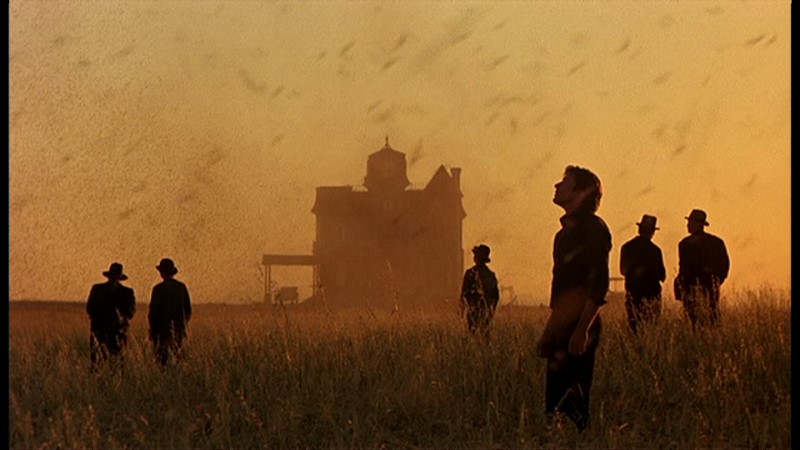
Days of Heaven


Originally Written on 10/28/05 at Epinions.com with re-edited content from 12/10/07


After helming his 1973 debut feature, the road crime drama Badlands, Terrence Malick was on his way into becoming one of the most promising directors of his generation. While Badlands wasn't a huge commercial success, the film's elliptical approach to storytelling along with Malick's visual scope was noticed by many. Still, a follow-up was awaited but Malick instead chose to co-write a film The Gravy Train under a pseudonym named David Whitney. Then in 1978, Malick finally re-emerged with his second film called Days of Heaven about young migrant workers fleeing to Texas where a woman falls in love with a dying farmer leaving her boyfriend jealous with his young sister looking on.

Written and directed by Terrence Malick, Days of Heaven is set in the early 1900s just before the U.S. goes to World War I. With the basic plot commented through the thoughts and eyes of a young girl, the film revolves as a young trio arrive to Texas from Chicago for work as they seek a gold mine in a dying farmer. Yet with the plan coming into fruition, jealousy, greed, and tragedy comes ahead as the young girl looks on to her own destiny and the people around her. Starring Richard Gere, Brooke Adams, Sam Shepard, Linda Manz, and Robert J. Wilke. Days of Heaven is a visually stunning, enchanting masterpiece from one of American cinema's most poetic and enigmatic film directors.

It's 1916 in Chicago as a young migrant worker named Bill (Richard Gere) has just gotten into words with a factory foreman (Stuart Margolin) where a fight ensues and accidents happen as Bill flees. Taking his younger sister Linda (Linda Manz) and his girlfriend Abby (Brooke Adams) away from Chicago, the trio flee on a train with a bunch of migrant workers as they head to Texas. Landing onto a nearby farmed own by a reclusive young farmer (Sam Shepard), Bill, Abby, and Linda take jobs working on the farm while not getting near his house. Working under the young farmer's longtime foreman (Robert J. Wilke), Bill would be working for $3 a day with the women while getting into fights with workers of his relationship with Abby where they claim to be siblings.

While trying to steal some medicine for his sister, Bill overhears a conversation between the young farmer and his doctor where the farmer is ill and has a year to live at best. With his harvest of wheat surrounding him that makes him rich, Bill notices the farmer looking at Abby with great interest. Bill has an idea for Abby to hook up with the farmer so they can nab his riches yet Abby doesn't think it's a good idea but goes along.

With the harvest and crop gathering finishing up, the farmer and Abby begin to have a relationship while Linda befriends a young girl (Jackie Shultis) who is upset that her boyfriend has left while she is still working. With the migrant workers leaving after finishing the crop, the farmer asks Abby to stay so she can do some work with him and she does only if Bill and Linda join him.

With the four people living in the farmer's house, it was a joyous time as Abby begins to fall for the farmer as they get married leaving Bill to be jealous. Still, Bill became a good friend to the farmer while Linda loves the atmosphere living in the farm area with the three adults. The farmer's foreman becomes suspicious as he is dismissed until the next spring harvest as he tells Bill he knows something. Yet with Bill waiting for the farmer to die, his patience becomes troubling as the farmer's condition stayed the same. His feelings for Abby are still the same as does her feelings for him while she is also in love with the farmer. Then when a two little planes arrive on the farmer's home, it belong to a trio of Italian circus performers.

Their arrival only brought a brief sense of joy when the farmer finally becomes suspicious of Abby and Bill's affection for each other. Abby fears his behavior as Bill decides to leave for work in Chicago as he leaves with the circus performers. Bill's departure only left the farmer, Abby, and Linda to live a blissful life for a year. Then when the spring harvest crop starts to arrive, Bill makes a return. Plagued with guilt over things, his arrival brings a bad omen filled with insects on the crop, a fire, and tragedy followed upon by tragedy leaving a young Linda to observe the world around her.

For a story as enchanting as Days of Heaven goes, there could've been so many ways for it to be presented. Whether as an epic kind of film about love or a coming-of-age story. Since this came from mind of Terrence Malick, the approach comes off in not just in a very original way but also in its simplicity. Particularly in his narrative style and approach to structure in his screenplay. The first act being the young trio's arrival to the farm crop and the farmer's interest in Abby.

The second act is Abby living with the farmer and Bill's departure. Then there is the third act where everything comes together in a very tragic way that has a bit of irony along with a full development of the characters. Particularly Bill and the farmer where Bill starts off as very hot-headed and the farmer being very quiet and shy. Even during the arrival of locusts and fire, it's somewhat biblical in the way the behaviors of the main characters begin to shift. Then as the film progresses, their behaviors change as Bill feels guilty and is coming to terms with everything while the farmer becomes enraged in his return.

Yet in its narrative style, it's really through the perspective of Linda since her voice-over narration is what drives the film. She is seeing and hearing things about where the characters are as she feels for Abby, Bill, and the farmer in every way. She sees the good in them as well as the bad in them in a line that really sums up everything. The words and dialogue Malick puts into the film isn't just very simple but realistic in its authenticity to the way the characters speak to each other or what they are thinking.

It's one of the key strengths into Malick's creativity as a writer while as a director, he brings an authentic style to the film. Since it's set in the early 1900s, he goes for a distinctive look that almost looks like an old painting from that era while he brings an epic scope to the film with an observant eye to the environment the characters are in with wonderful close-ups on some scenes or moving the camera feet away for the character.

If there's another way to describe Malick's style of directing, it can be summed up as dreamy. Not in a visual scale but in its tone where the film's title sums up the joy and heavenly feel that the characters feel for each other only to have it shattered by horrible secrets and its aftermath. Malick could've gone and created a situation that would've made the story more conventional but he keeps it real, especially in the tension between the farmer and Bill. It's only conventional when it leads to its tragic consequences while the film's ending is really more about one part of a story ending and another person's story just beginning but that couldn't be told.

What is more surprising that since the film has an epic-like feel to its in terms of visual approach and narrative style. It is done in a very simple way where the movie's running time is 95 minutes. It's really the genius of Malick who used a story that could've been longer but only chose to keep the simple moments.

Helping Malick in the visual department of the film is the late but renowned Cuban cinematographer Nestor Almendros. With some additional work from another great cinematographer, Haskell Wexler, the film's stunning cinematography is lush in its setting. Notably for using sunlight but not showing the sun, particularly during what is called magic hour where it's that time to shoot just before sunset. The shots in the film, notably in its exterior settings is epic and magical in the way the sky is shown along with the atmosphere of the wheat fields. There's an authenticity to every moment and every scene shot, even in the interior settings where it feels like a film in the early 1900s. It's all wonderfully done by Almendros and Wexler.

Helping Malick in the film's presentation is editor Billy Weber who gives a nicely paced, along with nice fading, dissolving cuts that shifts from a scene to scene and helps out in Malick's perspective directing style. Even the sound design of Barry K. Thomas of the film feels very realistic to the times as it helps give the film a sense of authenticity. Longtime art director Jack Fisk with set decorator Robert Gould does a great job in capturing the landscape of the farming, which was done in Alberta, Canada, where he uses the realistic models of cars, gas tanks, and housing designs for the home of the farmer. Even costume designer Patricia Norris does a great job in capturing the look of the costumes that doesn't reveal a lot of colors but colors that matches the atmosphere of the environment as well as the times.

Then there's the film's music that features a wonderful, bouncy early 1900s acoustic guitar style from Leo Kottke that gives the film a bit of a playful feel. Part of the film's soundtrack includes Camille Saint-Saens' Carnival Of The Animals. Yet the main film score of the film is done by one of the greatest film composers of all-time, Ennio Morricone. Sergio Leone's longtime composer brings an elegant, sweeping feel to the film's soundtrack that doesn't just touch its dreamy landscapes but also the sense of drama that isn't overdone. Morricone goes for a simplistic feel while using his talents to create memorable, rich score pieces that gives the film a lot more in terms of its presentation and style.

Finally, there's the film's cast is filled with memorable, small characters like the circus trio performers played by Sahbra Markus, Frenchie Lemond, and Richard Libertini as well as Stuart Margolin as the factory foreman and Jackie Shultis as Linda's friend who appears early in the film and much later towards the end. The most memorable small supporting character is the farm foreman played Robert J. Wilke who is like a father figure to the young farmer while suspecting trouble immediately. Still in terms of casting and performances, the film truly belongs to the four principle actors that not only drive the film but bring the kind of performances that are majestic enough to remember.

Brooke Adams gives an excellent performance as the anguished yet mesmerizing Abby with her natural beauty and her warmth towards the people around her. Adams combined a maternal instinct as well as a loyalty and torment into the scheme that she and Gere planned. When the film and story progresses, she is forced to realize the role that she is playing as in the end amidst the tragedies that occur, she comes to a realization. It's truly Adams' most memorable work to date while she was also good in Alison Anders' Gas, Food, & Lodging, and David Cronenberg's The Dead Zone.

The film's most impressive performance is the young Linda Manz, who was only 16 when she made the film. Manz brings an angelic quality to her presence while it's her narration and observant eye that really drives the story. Manz brings a lot of realism and innocence to her role while having great scenes with her counterparts. While she's only done a few movies since including her most recent work in Harmony Korine's Gummo in 1997, it's truly a remarkable performance.

In his acting debut in a film, noted film/play writer Sam Shepard gives an amazing performance as the shy, quiet farmer. Shepard hits all the right emotions and tones for his performance as a man ailing while dealing with loneliness. When his character is forced to go into rage, Shepard doesn't go over the top but knows that he shouldn't be too restrained. The way Shepard shifts his character from one person to another is amazing as he would prove to be great in not just his work as an actor but as a writer including Paris, Texas for Wim Wenders.

Now Richard Gere may be known now as a Hollywood A-list actor with such films as Pretty Woman, American Gigolo, An Officer & a Gentleman, and more recently, Unfaithful, Chicago, and Shall We Dance. Yet, it was this film that is one of the reasons in why Richard Gere is one of the better actors working in Hollywood today. Gere brings a persona that completely isn't the person in real life, a violent, bratty, charismatic kind of man who does everything he can to get a life that he can't have. Then when the film goes into the third act with his return, we see the guilt and caution that he brings as Gere brings in a spectacular performance in how he handles things and deals with mistakes.

***The Following Content is DVD Tidbits written from 10/07-12/10/07 specifically for the Criterion DVD***

The Region 1 DVD of Days of Heaven by Paramount that was released in 1999 and then re-issued with a different cover in 2006. The DVD shown on widescreen that is enhanced for 16x9 TVs was considered a disappointment. Notably for the fact that the film was originally released in 70mm film and the film transfer to DVD wasn't very good on some parts to complement the brilliant cinematography of the late Nestor Almendros and Haskell Wexler. Another problem with the original DVD is the sound. Mixed in Dolby Digital in English for 5.1 and 2.0 Surround sound. Neither are well-mixed as when compared to the French Mono, the French Mono is much louder. The only extra feature in that DVD is a theatrical trailer that is grainy in some parts since it's a very old trailer. It's also misleading to believe that it's a love-triangle when in reality, that's not what the film is about.

For several years as the legend of Terrence Malick has grown through his other films like Badlands, The Thin Red Line, and The New World. The cult of Malick for a longtime have been waiting through definitive DVDs of his work while they continue to await possible longer cuts of The Thin Red Line and The New World, the latter which has still been delayed in a rumored three-hour cut. Malick also was part of a list of the 25 films that had to be re-issued into a Criterion-like form on DVD with Days of Heaven as the only film in that list. Well, after years of waiting. Days of Heaven is finally given a DVD treatment it deserves and best of all, it is approved by its creator, Terrence Malick.

The 2007 Criterion Collection DVD version is vastly superior in both image and sound in comparison to the original Paramount DVD. With a new, high-definition transfer supervised by Terrence Malick along with the film's editor Billy Webber and the film's original camera operator John Bailey. The look of the film is richer, fuller, and lively without any moments of grainy footage, scratches, and such to not only complement the gorgeous cinematography of Nestor Almendros and Haskell Wexler. The film is also remixed in a new 5.1 Dolby Digital Surround Sound that blows away the sound work in the original DVD. Presented in the 1:78:1 aspect ratio in the widescreen format for 16x9 TVs, the film is even grander in its presentation and scope as it shows the film in its intended form by Malick and his collaborators.

Three section of special features appear in the Criterion DVD. First is a feature-length audio commentary track from the crew members of the film including two of Malick's frequent collaborators, art director Jack Fisk and editor Billy Weber. Along with costume designer Patricia Norris and casting director Dianne Crittendon, the commentary recorded in 2007 exclusively for the DVD. The discussion is mostly about the making of the film and their memories where Fisk and Weber talk about Malick's work method. Crittendon talked about the early casting sessions that had John Travolta as Richard Gere's character and Tommy Lee Jones as the farmer. What happened was Travolta couldn't do the film due to scheduling conflict with his show Welcome Back Kotter while Malick wanted someone younger than Jones and opted for Sam Shepard.

Patricia Norris discussed the making of the costumes while showing the Canadians attitude towards American, particularly in the way Malick and cinematographer Nestor Almendros worked. Fisk and Weber went further revealing that Almendros, who is known for his work with Francois Truffaut and Eric Rohmer, had a very different style of creating images that infuriated a lot of the film’s camera crew and such who were used to working in a Hollywood style.

Ennio Morricone is briefly discussed as he was the composer Malick wanted due to his work in Bernardo Bertolucci's 1900 that they used and asked Morricone to create some music in Italy where the only cue he wrote for a scene specifically was the fire scene while the rest was just pieces he created. Weber revealed that the reason it took two years to edit the film was because Malick wanted to cut out a lot of dialogue to aim for something that was close to silent movies in the early 20th Century. The result of the two-years of editing would make Malick exhausted and then move to France in 1979 where he then, disappeared.

Fisk discusses the production scale where the houses and such made by Hutterrites, a religious group who owned the land but gave permission to use the location for filming in Southern Alberta, Canada. Fisk and Weber also reveal what material did Haskell Wexler shot which were a lot of the film’s interior scenes, the steel mill scene, and a large portion of the film's ending. The reason Wexler was hired because Nestor Almendros only worked for nine weeks and had to leave due to a commitment in shooting a film for Francois Truffaut.

Fisk and Weber did reveal that the film wasn't a commercial hit when it came out while receiving mixed reviews from critics despite praise for the cinematography. What was really surprising was that because it was a $3 million film and it was taking a long time to edit, Paramount didn't pay any attention to what was going on due to other films at the time like Saturday Night Fever and Grease that helped the company while were going over the problems with William Friedkin's The Sorcerer.

The surprising support from Paramount the crew admits was surprising since they liked Malick's films and for the fact that he could make them cheap. The overall commentary is informative and enjoyable with some great humor while the big question they talked about is, where is Terry? Probably watching Zoolander again, this time with Sean Penn and Heath Ledger while reciting many quotes from that film.

The second section of special features is devoted to the actors of the film. While actresses Brooke Adams and Linda Manz don't contribute to the DVD, the more well-known and revered actors Richard Gere and Sam Shepard do make contributions. Richard Gere's 21-minute audio interview recorded exclusively for the DVD is set against many of the film's images, stills, and such. Gere discusses Malick's methods of filmmaking while talking about his own experience since this film was the first he ever made. Gere wanted to do the project because of Badlands and wanting to work with producers Bert and Harold Schneider who had produced landmark films like Easy Rider and Five Easy Pieces. Gere admits that Malick isn't very good at making decisions during the casting while with actors, he wasn't good at that either because he was still new to filmmaking at the time.

Gere talks about his fellow cast where in Brooke Adams, she was someone he knew and was hired at the last minute when another actress dropped out. Sam Shepard was someone Gere knew as well since he had done a couple of plays by Shepard while the two had a rivalry of sorts for Adams' affection whom they both had a crush on. Linda Manz was brought in as Gere talks about her performance and how Terry worked with her that Gere compared to the way Robert Altman worked with kids. He said the secret is to not tell them what to do. Gere also recalls on the film's cinematography and the work of both Almendros and Wexler and how the traditional Hollywood crew had grumbling on Almendros' unconventional style and Wexler making them feel at ease for a bit. Gere also lets in on a secret about the famous locusts flying scene that he reveals exclusively for the interview.

While Gere admits to his own frustrations at the time, notably in the post-production when a lot of the scenes of dialogue was cut, he understood what Terry aimed for and was very proud of the final film which he considers to be one of his favorite films he’s ever been in.

The 12-minute interview with Sam Shepard recorded in 2002 shows the actor/playwright discussing Malick's methods while giving some of his own analyzation of his own character. He says that Terry's films aren’t meant to be overanalyzed and such while he goes on further on the film's historical setting which he says was in some ways was about the changing times of man and machine. Shepard's discussion is very informative while he shares Gere's frustrations over Malick's approach with acting. Shepard also reveals some of Malick's methods with acting where if a spoiled actor worked with him, it would be terrible. An actor, when it comes to working with Terry, has to be independent and make his own decisions while trying to give Terry what he wants.

The third and final section in the DVD special features is about the film's award-winning cinematography. Featuring two video interviews with the film's camera operator John Bailey and cinematographer Haskell Wexler, the two men muse on the film's unconventional cinematography and the late Nestor Almendros. Bailey's 20-minute interview, as he is seen working on the DVD transfer on the film, discusses a lot of the film’s technical moments while revealing that the film was made in the American New Wave style of the early 70s but without its urban look.

Bailey's job as a camera operator was to work under Almendros' instructions since it was the first time Almendros worked with a camera operator. Bailey also reveals the lack of artificial light and grips that were used to convey Almendros' style of photography and Terry's vision. The crew who worked on grips and such were not happy in the style. Bailey's interview is extremely informative and a must-hear for cinematography film buffs.

The 13-minute interview with Haskell Wexler, who filled in when both Almendros and Bailey had to leave due to other commitments. The legendary yet eccentric cinematographer chose the job after seeing some of the footage in the editing room and went to Canada to meet with Malick and Almendros where they were behind schedule and Wexler was used to get things going. Almendros told Wexler to not use any diffusion gauzes, natural light only. Wexler, whose background had been in both documentary and feature-films, had similar visual presentations that Almendros wanted while giving his insight on how he shot and such.

He also channels his frustration over not getting credit by the Academy for Best Cinematography. Though it wasn't anything against Almendros, who he was happy to see won, but wanted to have an Oscar to for his work on that film. It's understandable since he deserves full credit while producer Bert Schneider thought so as well when he told him at a Lakers game.

Accompanying the DVD that includes wonderful packaging for the cover and sleeve is a booklet featuring two essays about the film. The first essay entitled On Earth As It Is In Heaven by Australian senior researcher and Rogue magazine co-editor Adrian Martin of Monash University in Melbourne. Martin's five-page essay discusses the film and Malick's unique perspective on films and philosophy since the man was a Harvard graduate who briefly went to Oxford. Martin tells about his own experience in watching Days of Heaven in its original, 70mm presentation in theaters that was unlike any film at the time in the late 70s. Martin exclaims that part of Malick's philosophy came from Martin Heidegger while his film influences came from Europe, notably Francois Truffaut. He said the actual film in its plot might seen like a typical love triangle between the characters of Richard Gere, Brooke Adams, and Sam Shepard but what was added is the narration of Linda Manz as Gere's sister.

Martin says it was this film that would reveal Malick's idealism of his filmmaking, while his debut Badlands was more of a genre film of sorts that had an elliptical pacing style and voice-over narration. It was Days of Heaven that would define his filmmaking style that would come later on for The Thin Red Line and The New World. It would be a style Martin claims would influence many directors including Wong Kar-Wai. The film's original script had loads of dialogue but by post-production, Malick got tired of the dialogue and ended up cutting a lot of it into a completely different film though the script provided the basic story. The themes of Malick, notably nature which is something Malick seems to love more than anything. While Martin's essay is informative and insightful, it never gives reason into his 20-year departure that followed. Instead, it chooses to focus on the brilliance and influence of Days of Heaven.

The second essay is an excerpt from Nestor Almendros' 1984 autobiography A Man with a Camera. The chapter entitled Shooting Days of Heaven, Almendros discusses his experience making the film and how he and Malick wanted to push the film stock they had for a look that was unlike anything on film. With Almendros, he turned to the paintings of Vermeer for inspiration where he, like Malick, opted for a natural look with very few artificial lighting equipment. This caused conflict between Almendros and most of the film crew who were used to shooting in a glossy, Hollywood style where Almendros didn't give them much to do. Malick doesn't like blue sky and neither did Truffaut which suited Almendros as he usually did his own camera operating but in this film, he had John Bailey as his operator.

Almendros also talked about the technical pointers on the film, notably the use of the Panaflex camera, which was an early version of the Steadicam since Malick opted for use of hand-held cameras and other types of shots. Almendros worked for 53 days on the film and Haskell Wexler worked for 19 days and Almendros' departure was due to the fact that he was committed to shoot The Man Who Loved Women for Truffaut and Wexler took over after some discussion in which he told Haskell to not use any diffusion gauzes. Almendros talked about the difference between American and European film equipment that reveals more source of the conflict between him and the American crew. The excerpt overall is extremely informative for aspiring cinematographers with technical pointers and such from the late yet renowned cinematographer.

Nearly 30 years since its release that was followed by two feature films, both acclaimed and beloved by Malick's devoted following that included fellow film directors. While it received a mixed reception in 1978 despite praise by some critics and loads of awards including the Best Cinematography Oscar to Nestor Almendros and a Best Director prize to Malick at 1979 Cannes Film Festival. After a 20-year disappearance, Malick released his film adaptation of James Jones' The Thin Red Line that drew rave reviews and in 2005, he released The New World to similar acclaim.

In 2007, Malick announced his upcoming project entitled Tree of Life is set for production in 2008 that will star Sean Penn and Heath Ledger (later replaced by Brad Pitt). Though it's unclear when the film will be released, it will be met with lots of anticipation. Even as Malick’s influence has been noted on many directors including Sofia Coppola, Andrew Dominik, and most of all, protegee David Gordon Green whose 2000 debut film George Washington was inspired by both Days of Heaven and The Thin Red Line.

***End of DVD Tidbits***

Nearly 30 years since its release, Days of Heaven is a beautiful, heartbreaking drama from Terrence Malick featuring a superb cast, stunning cinematography, a rich film score, and everything wanted in a beautiful film. While Badlands is a more accessible, this film is the best introduction in terms of Malick's approach to storytelling and narrative. Fans of Sam Shepard and Richard Gere will no doubt find this film to be essential to their work. With the Criterion DVD release, the film is now a must-have for any film buff as well as any diehard fan of Terrence Malick. For a film with great scenery, wonderful plot elements, exquisite narration, and a rich score, Days of Heaven is the film to see.

Terrence Malick Reviews: Badlands - The Thin Red Line - The New World - The Tree of Life - To the Wonder - Knight of Cups - Voyage of Time: The IMAX Experience - (Voyage of Time: Life's Journey) - Song to Song - A Hidden Life - (The Way of the Wind)

© thevoid99 2010

Sunday, August 15, 2010

Blog News

Since I've been posting old and new reviews through my blog.  I've feel like a sense of relief has come in since my departure from Epinions.com.  Though I'm not sure if I'm being read.  At least, I've gained a certain freedom.

There will be some new music reviews coming soon though it's unlikely that I will have a huge list of 2010 releases to be reviewed due to the fact that I've been busy rebuilding my music catalog into my external hard drive.  Once I feel like reviewing albums again, it will become frequent soon.


In the film front, some have noticed I've been re-posting old reviews from Epinions which are now copyrighted by me.  Some have been re-edited or expanded depending on the film.  Even with DVD reviews which has been fulfilling lately because there's not much to work on them and there's not much pressure as well.

Coming soon will be some director profiles for upcoming releases by Terrence Malick and Sofia Coppola.  With Malick, there will be the expanded Criterion DVD review of Days of Heaven that will be posted for the blog that I wrote for Epinions a few years ago.  There will also be some new, expanded DVD reviews for The New World and the upcoming Criterion DVD of The Thin Red Line.  With Badlands, I'm not sure about posting a review unless there is news of a superior DVD release coming soon.  Then I plan on doing a profile of Malick in anticipation for the release of Tree of Life.

With Coppola, all of my old reviews of films, soundtracks, and essays will be posted in this blog along with my own take on Coppola's work in anticipation for Somewhere.  This blog is now alive and well again and I will be posting old and new reviews in the coming days.  Even as I will have expanded DVD reviews of films like Che, The Double Life of Veronique, Brazil, Solaris, and My Own Private Idaho.

Saturday, August 14, 2010

Scott Pilgrim vs. the World


With the popularity over comics and graphic novels becoming films, it’s no surprise that audiences are seeing a new culture of geeks who are influenced by comics and video games. One such story is in the form of Bryan Lee O’Malley’s Scott Pilgrim series. The graphic novel series tells the story of a young slacker from Toronto who falls in love with an American girl only to learn that in order to go out with her. He must defeat her seven evil-exes. With the sixth and final book Scott Pilgrim’s Finest Hour finally released on July 20, 2010, O’Malley has also allowed for his series to be adapted by British director Edgar Wright for a film named after the second book called Scott Pilgrim vs. the World.

Directed by Edgar Wright with a screenplay written by Wright and Michael Bacall, Scott Pilgrim vs. the World tells the story of a young Toronto slacker who plays in a band has his love life changed by an American girl. Wanting to go out with her, he must defeat her seven evil exes in a video-game style of conflict. Along the way, Pilgrim has to deal with the fact that he’s growing up and how took some of his ex girlfriends for granted as one of them is going after the woman he loves.

With an all-star cast led by Michael Cera as Scott Pilgrim. The film also includes Mary Elizabeth Winstead, Kieran Culkin, Ellen Wong, Anna Kendrick, Alison Pill, Mark Webber, Aubrey Plaza, Johnny Simmons, Brandon Routh, Mae Whitman, Brie Larson, Chris Evans, and Jason Schwartzman. Scott Pilgrim vs. the World is an enjoyable, off-the-wall film that is truly fantastic.

After meeting a 17-year old Chinese girl named Knives Chau (Ellen Wong), Toronto-based slacker Scott Pilgrim is in a new relationship. While he lives with a gay roommate named Wallace Wells (Kieran Culkin) and plays bass in a band called Sex Bob-omb with former high school girlfriend Kim Pine (Alison Pill) and Stephen Stills (Mark Webber). Scott is still an immature 22-year old with no job as he starts to have weird dreams with this mysterious young woman. After seeing her at the library and later at party, he learns that she is Ramona Flowers (Mary Elizabeth Winstead). Ramona is an American girl who works for Amazon as Scott asks her out during a delivery as sparks flew.

After inviting Ramona to a gig where Knives also attends, Scott finds himself in trouble during a performance where Ramona’s first evil-ex boyfriend Matthew Patel (Satya Bhabha) appears to challenge Scott. After Ramona tells him that he must defeat her seven evil-exes so he can date her, Scott realizes he is up for a challenge as he also makes some bad decisions. After breaking up with Knives, Scott has to deal with Ramona’s other exes including actor Lucas Lee (Chris Evans), musician Todd Ingram (Brandon Routh), a ninja-like girl named Roxy (Mae Whitman), and a couple of Japanese pop twins named Ken and Kyle Katayanagi (Keita and Shota Saito).  Scott also to deal with another ex-girlfriend in Envy Adams (Brie Larson), who is now a pop star playing in a band that Todd is in.

Dealing with exes overwhelm Scott as he also has to deal with how its affecting his relationship with Ramona. When Sex Bob-omb is finally getting noticed, the person taking the band is none other than Ramona’s last ex-boyfriend in Gideon Gordon Graves (Jason Schwartzman). Scott realizes that what he must do to defeat Gideon which includes facing himself as well.

Bryan Lee O’Malley’s graphic novel series about Scott Pilgrim tells the story about this young slacker who falls for his dream girl but has to deal with her exes as well as gaining some self-respect. What writers Michael Bacall and Edgar Wright do in adapting the series into a feature film is take that premise of a guy defeating seven exes and bring it to life. Exposing a pop culture world filled with indie music, video games, and all sorts of worlds. The film plays like a video game of sorts starting with the Universal film logo designed like an old 8-bit video game with 8-bit music.

While it’s known that adapting a book or a series of books into films aren’t easy, Bacall and Wright do a great job in not just getting the characterization and the world of Scott Pilgrim. They also bring enough that is told for a feature film, though it was made when the sixth and final book was in the works. While various subplots about Scott Pilgrim’s relationship with Kim Pine as well as more stories about various characters including Julie (Aubrey Plaza) and Scott’s younger sister Stacy (Anna Kendrick) aren’t featured as much. They’re given enough exposure of what is needed to be told for the story of Scott Pilgrim’s journey.

The development of Scott Pilgrim as this young, slacker kid who doesn’t have much clue about love nor has a clue about how his own decisions towards the people he hurt has affected them. When he’s with Ramona, he starts to grow up a bit but still acts as an immature kid though he steps up when he gets into fights. Ramona Flowers is just as complex as this young woman desperate to escape from her past and finds something different in Scott Pilgrim. Yet, she admits to being a bitch while feels bad for putting Scott into this situation. Another major character that gets exposure is Knives Chau, a 17-year old Chinese girl who is introduced to a new world. Yet, when Scott breaks up with her. She takes up stalking to the point that she pretends to date Young Neil (Johnny Simmons) while plotting to destroy Ramona Flowers.

The screenplay succeeds in not just using what is needed to tell the story but also in giving many of the film’s supporting characters to play their role to the story. Particularly in setting up each confrontation that goes on. Within each opponent that Scott faces, the stakes become higher and more intense where there’s a great structure to the story within each confrontation. Even as it plays like a video game where the levels become much tougher and more overwhelming. The script overall is truly amazing as it’s captured with such energy and style from its director Edgar Wright.

Using some of illustration of O’Malley for several scenes as well the use of split screens for comic-book style framing. Wright’s direction is truly stunning in terms of recreating the comic book to life with lively visual effects and video-game style. Wright definitely goes for a pop-art element for film he uses visual effects to display heightened emotions. Even if he’s capturing the energy of the concerts and fight sequences. The staging of scenes has Wright framing things as if they look the same book presented them. Even if it’s an awkward scene where Scott and his friends meet The Clash at Demonhead, the band featuring Envy and Todd.

Wright definitely displays a sense of confidence in his directing where he allows the actors to do their stunt work as well as show their funny sides in the most natural way. The humor isn’t forced or gimmicky as it flows well in the way O’Malley’s books have as it doesn’t take itself too seriously or go for silly gags. The action scenes show Wright taking on different angles for the fights as each one has its own sense of energy. Notably the Scott vs. Todd scene where the two battle each other with their ability to play bass. Another noted factor that works for the film are the title displays for the characters to figure out their personalities or how smart they are. Wright’s direction overall, shows a director finally given the chance to create something that is spectacular and fun without going overboard or make things look cheap.

Cinematographer Bill Pope does excellent with the film’s colorful photography as it’s shot on location in Toronto. Pope’s photography is full of color where the white snow in daytime scenes work with the colors clashing for whatever moment if it’s a funny or a dramatic moment. Pope also succeeds in creating dazzling lights and colors for several scenes including the concert and fight scenes without a lot of flashy, polished photography. There’s a bit of grit to the look as Pope’s work is phenomenal.

Editors Jonathan Amos and Paul Machliss do amazing work with the film’s stylized yet energetic editing. From the use of split-screens and other formats, the editing moves the film in a fast but rhythmic tone for many of the film’s fight and concert scenes. Yet, Amos and Machliss know when to slow down when it’s for something more dramatic while using comedic sequences with great timing.  The editing of the film is definitely masterful for its array of rhythms and stylization. Production designer Marcus Rowland, along with set decorator Odetta Stoddard and art director Nigel Churcher, do fantastic work with the set designs for the clubs and places the characters are in. Even as they recreate places just like the novel did in its illustration as the art direction is truly spellbinding.

Costume designer Laura Jean Shannon does some nice work with the costumes from the casual clothing that most of the characters wear to the indie-like clothes that Knives Chau were later in the film. Even the look of Envy Adams with her big heels are great as the costumes reflect the personalities of the characters along with the hair and make-up work that bring more of a unique look to the characters Visual effects Frazer Churchill does amazing work with the visual effects of the film that has a comic-book like feel to play to exaggerated emotions and other sound effects sequence. Even for the fight and concert sequences that plays to a heightened level of intensity as it’s truly spectacular. Even as the Shynola visual arts team do some crazy work for the film’s opening credits sequence.

Sound editor Julian Slater and sound designer James Boyle do brilliant work with the film’s sound work. Bringing the use of 8-bit video game sounds for effects reason, the sound has a video game-like feel while there’s texture to the layering of the sound effects during the fight and concert scenes. The mixing is truly astonishing in its presentation while the design for the 8-bit effects adds humor. If there’s a real technical highlight of the film, it’s the sound department.

The film’s music is truly amazing with a dream-like yet frenetic score by renowned producer Nigel Godrich. Godrich, along with contributions by Beck, Dan the Automator, and Osymyso, creates a wide mixture of music from 8-bit style electronic music to frenetic garage rock and other strange pieces. Dan the Automator provides the cheesy electro-pop song for Matthew Patel while Cornelius brings a high-octane electronic piece for Katayanagi twins. The rest of the soundtrack has Beck providing music for the band Sex Bob-omb with his fast-paced, rocking sound.

Other artists in the soundtrack include Beachwood Sparks providing a cover of Sade’s By Your Side for a wonderful love scene between Scott and Ramona. Metric contributes a song as they provide the music for Envy’s band The Clash at Demonhead while others like the Broken Social Scene, Frank Black, the Rolling Stones, Black Lips, Plumtree, and the Broken Social Scene also contribute cuts to what is certainly an amazing array of music.

The casting by Robin D. Cook, Jennifer Euston, and Allison Jones is truly amazing for the people that are cast as the characters all look like the people from the novels. Small roles include Christine Watson as Matthew Patel’s demon hipster chick, Chantelle Chung as Knives’ friend Tamara, Ingrid Haas as a partygoer named Monique, Kerr Hewitt as Stacy’s date Jimmy, Nelson Franklin as Comeau, and Ben Lewis as the Other Scott whom Wallace sleeps with. The film also has some great cameo appearances but none is as exciting or as funny as the two men who play the Vegan Police.

For the roles of the seven evil exes, the casting on that side is truly inspiring as each individual definitely get to stand out on their own. Though they don’t have any dialogue, Keita and Shota Saito as the Katayanagi twins are excellent for the presence they have as they battle Sex Bob-omb in an epic battle that is truly fun to watch. Mae Whitman is very funny as Roxy, another ex with a real grudge for Scott and Ramona as she sports makeup and acts like a ninja as she definitely stands out. Though he was known for playing Superman in the very underrated Superman Returns, Brandon Routh is truly a marvel as the vegan-powered Todd Ingram. Delivering his dialogue with a stylized, deadpan style, Routh adds a lot of humor by doing so little with his role as it is definitely a great performance. Satya Bhabha is excellent as Matthew Patel, the first evil ex who does a bit of dancing while providing some comical moments to his role.

Chris Evans is hilarious as Lucas Lee, an actor with a raspy voice who hires his own stunt doubles to do the fighting while acting all cool. Then there’s Jason Schwartzman as Gideon Graves, the final ex who is the ultimate king of cool while proving to be a slimy son-of-a-bitch as Schwartzman really gets to ham it up a bit. Another notable ex that is superb is Brie Larson as Scott’s ex-girlfriend Envy Adams as a pop star who is trying to make Scott miserable while trying to intimidate Ramona as Larson is truly cool for that role. Other notable small but memorable characters that gets a lot to do is Aubrey Plaza as the bitchy Julie who despises Scott for being a dork while Johnny Simmons is great as Young Neil, the kid who is one of the few fans of Sex Bob-omb as he often spouts some funny words.

Alison Pill is excellent as Kim Pine who often delivers a dead-pan, monotone dialogue for some of her scenes to show her bitterness towards Scott though she heightens it up whenever she screams “We are Sex Bob-omb, 1-2-3-4”. Mark Webber is very good as Stephen Stills, the talent in the band who is often anxious before each gig while hoping to get signed. Anna Kendrick is really good as Scott’s younger but mature sister Stacy who is shocked over what Scott is doing while providing him with some wisdom. Kieran Culkin is a hoot as Wallace Wells, Scott’s cool gay roommate who offers advice while freaking Scott out with his own sexual escapades.

The film’s real discovery goes to Ellen Wong as Knives Chau, the 17-year old Chinese girl who falls for Scott only to get dumped where she unleashes her crazy side. Wong definitely brings a sense of innocence and naivety to the role early in the film as she is introduced to a new world. When she loses Scott, she becomes a stalker while getting ready to go head-to-head with Ramona as Wong hits all the right notes in terms of comedic timing and being a supremely bad ass chick. If Wong is the discovery, Mary Elizabeth Winstead is the film’s breakout performance as Ramona Flowers. Winstead brings a sense of wit and charm to her character while admitting to be flawed as she is also quite secretive. Winstead truly brings Ramona to life with different hair colors and a sexiness that isn’t overt. This is really Winstead’s moment as she and Wong are the highlight of the cast.

Finally, there’s Michael Cera in what is definitely his best work to date. While he’s known as a one-note actor with a very limited range. Cera, definitely steps up a bit in playing a character that’s not entirely likeable but not a total asshole as well. Cera definitely shows the character’s sense of immaturity as well as someone who is willing to fight for what he wants. It’s really a marvelous performance from the young actor, even as he has great rapport with the cast. Though some might feel it’s a variation of the roles he’s played, it’s one that broadens his work as an actor while showing there’s more to him that just being the kid from Arrested Development and Superbad.

Scott Pilgrim vs. the World is an extraordinary film from Edgar Wright that truly lives up to Bryan Lee O’Malley’s graphic novels as well as bringing it to life in such a grand way. Featuring an amazing cast, a superb soundtrack, amazing visual effects, great humor, and brilliant fight scenes that keeps the film exciting. It’s a film that bends all sorts of genres and puts into one exciting film where the fun doesn’t stop. Fans of the books will be amazed by Wright’s vision while it will also bring in new readers interested in the world of Scott Pilgrim. In the end, Scott Pilgrim vs. the World is a magnificent film that definitely brings out the fun for a dreary summer year.

Edgar Wright Reviews: (A Fistful of Fingers) - Shaun of the Dead - Hot Fuzz - The World’s End - Baby Driver - The Sparks Brothers - Last Night in Soho

© thevoid99 2010