Tuesday, April 12, 2011

The Soloist


After two back-to-back successful films, British filmmaker Joe Wright was already one of the hot rising directors emerging into the mainstream. His 2005 adaptation of Jane Austen’s Pride & Prejudice and 2007’s Atonement had helped established Wright as a director who can create lush imagery. For his third film, Wright went to Los Angeles to direct a true story about a journalist who befriends a homeless musician suffering from schizophrenia called The Soloist.

Based on the book and articles of Steve Lopez, The Soloist is the story of how the troubled Lopez meets Nathaniel Ayers. Ayers was once a cello prodigy who became troubled by schizophrenia by the time attends Julliard and eventually becomes homeless. Directed by Joe Wright and screenplay by Susannah Grant, the film is a dramatic tale of how a troubled journalist’s life is changed by the meeting of a gifted musician as Robert Downey Jr. plays Lopez and Jamie Foxx as Ayers. Also starring Catherine Keener, Stephen Root, Lisa Gay Hamilton, Nelsan Ellis, Rachael Harris, and appearances from Wright’s Pride & Prejudice co-stars Jena Malone and Tom Hollander. The Soloist is an interesting but lackluster drama from Joe Wright.

Despite being an acclaimed journalist for the Los Angeles Times, Steve Lopez is a man whose life isn’t going very well. Divorced from his wife/L.A. Times Mary (Catherine Keener), Lopez is trying to find some way to get himself back on good terms following a bike accident. During treatment for his accident, he hears a violin playing in a yard as he comes across a homeless man named Nathaniel Anthony Ayers. Learning that he was in Julliard, he tries to find information as he was a student in the early 1970s only to drop out after a two year stint. After calling Nathaniel’s sister Jennifer (Lisa Gay Hamilton), he learns about Nathaniel’s life as a child as his mother (Lorraine Toussaint) believes he will do great.

After writing an article about Ayers, an old woman suffering from arthritis gives Lopez her cello for Ayers to play. After seeing Ayers at a tunnel, he gives him the cello as Lopez hears Ayers play as he realizes that he and the cello need to be in a safe place. Convincing Ayers to stay at a homeless shelter, it turns out to be a good idea as a doctor (Nelsan Ellis) helps out while suggesting that Ayers should get an apartment later on. The friendship slowly builds as Lopez also works on other assignments as he also takes Ayers to a rehearsal though it wasn’t easy due to Nathaniel’s attachment to his shopping cart. With things moving slowly, Lopez gets an apartment for Ayers despite some reluctance.

After bringing in a renowned cello player named Graham Claydon (Tom Hollander) to see Ayers, Claydon agrees hoping to help Ayers through music. Though the lesson goes well, he realizes that Ayers is becoming attached to Lopez as Ayers has a chance to play a recital. Instead, it becomes a disaster due to Ayers’ mental illness as Steve blames himself for what happens. Even as he felt that Ayers is helping him with his own issues.

The film is about a journalist’s unexpected friendship with a mentally-ill musician that ends up helping both of them. While it’s an interesting yet captivating story, the problem is that the screenplay tends to over-dramatize the relationship between Lopez and Ayers while there’s additional elements in the screenplay that doesn’t really belong in the film. There’s also an underdeveloped storyline about Lopez’s own relationship with ex-wife Mary though the truth is that Steve Lopez never got divorced. Some of the dramatic liberties that screenwriter Susannah Grant take with the story to makes the film lose focus on what it’s supposed to be about. Even as Grant adds a bit of heavy-handed ideas about the issue with the homeless, though its intentions are thoughtful, as well as a character that spouses religious ideals.

Joe Wright’s direction definitely has a lot of flourishes that he’s known in tracking shots, wonderful zooms, and lots of amazing ideas. The problem is that he is given an uneven script that doesn’t play to his strengths. While he creates some wonderful sequences where Lopez just plays the music, some of it becomes quite unnecessary as there’s a scene where birds (ala CGI) fly around Los Angeles that really overdoes the dramatic tone of the music.

At the same time, he also has to shoot scenes involving the homeless where while it’s interesting and does provide insight into that world. It becomes a distraction as if he wants to make something about the homeless situation in Los Angeles when really, the film should be about these two men. Despite some interesting sequences and some chances to not over-dramatize events, Wright stumbles with his approach for this film.

Cinematographer Seamus Garvey does some excellent work with the photography in bringing some wonderful yet gorgeous shots of the nighttime exterior scenes of Skid Row Los Angeles. While there’s some great shots of Los Angeles in other places. Garvey’s work is definitely a highlight though it’s nothing really new in comparison to other films shot in L.A. Editor Paul Tothill does a good job with the editing that includes some wonderful rhythmic cuts that plays to the music despite some pacing issues that slows the film down at times.

Production designer Sarah Greenwood, with set decorator Julie Smith and art director Greg Berry do a nice job with the look of the L.A. Times office as well as Lopez‘s home and the apartment that Ayers eventually lives in. Costume designer Jacqueline Durran does a fine job with the costumes in creating casual clothing for most of the cast including the look for Ayers with his cap and such that is pretty unusual but fun to look at.

Visual effects supervisor John Moffatt does some exceptional work for a sequence where it‘s just lights and swirling visuals that play along to the music though the sequences of the birds flying around Los Angeles isn‘t one of those great moments. Sound designers Craig Berkey and Christopher Scarabosio do some wonderful work with the sound to create a chaotic atmosphere for Los Angeles though some scenes where Ayers hears voices in his head gets a little repetitive and overdone at times.

Music composer Dario Marianelli creates an amazing film score that plays up to not just the dramatic elements of the film but also something that infuses Ayers’ gift as a musician. Along with pieces by Johann Sebastian Bach and Ludwig Van Beethoven that helps drive the soundtrack as Beethoven is the most dominant piece of music in the film. Along with cuts by Stevie Wonder, Neil Diamond, the Temptations, the Carter Family, and Beenie Man that all appear in the background. The film’s music and soundtrack is definitely the real highlight of the film.

The casting by Francine Maisler is pretty good for some notable appearances that include Stephen Root and Rachael Harris as fellow journalists of the L.A. Times, Justin Martin as the young Nathaniel Ayers in the flashback scenes about his early life, Lorraine Toussaint as Nathaniel’s mother, and in a cameo appearance, Jena Malone as a Goth-like lab technician. Nelsan Ellis is very good as the homeless shelter doctor who offers Steve Lopez guidance about dealing with Ayers’ illness. Lisa Gay Hamilton is also good as Nathaniel’s sister who is desperate to want to contact him a wonderfully understated scene with Jamie Foxx. Tom Hollander is excellent as Gary Claydon, a musician who tries to help Ayers though approaches it the wrong way.

Catherine Keener is pretty good as Mary Weston, Lopez’s ex-wife and editor, who is a bit baffled by her ex-husband’s fascination with Ayers though her character seems underdeveloped due to the fact that there’s not much more about her life with Lopez. Even as Keener has a very embarrassing scene where she gets drunk at a gathering with Lopez. Jamie Foxx is wonderful as Nathaniel Ayers as Foxx doesn’t go into a sense of vanity into playing a troubled man who refuses to believe he’s schizophrenic. Even as Foxx proves to be a wonderful musician while making some fascinating ramblings and such as he has great rapport with Robert Downey Jr.

Robert Downey Jr. is superb as Steve Lopez, a brilliant but complicated journalist seeking some sort of idea to get his hazy life back on track. While Downey brings some humor to his character, he also adds a lot of dramatic weight to a man who is fascinated by this individual he encounters. It’s a remarkable performance from Downey in the way he brings sympathy to a guy like Lopez.

Despite an amazing cast and a stellar soundtrack, The Soloist is a middle-of-the-road drama that got some great ideas but poor execution in its screenplay and in Joe Wright’s direction. While it wants to be an inspirational story of sorts, it’s coddled up with lots of bad decisions about Ayers’ illness along with some dramatic liberties about Lopez’s own life. Though Joe Wright does display some nice sequences that keep the film from being a total disaster, he’s hampered by the shortcomings of Susannah Grant’s screenplay. In the end despite the superb performances of Robert Downey Jr. and Jamie Foxx, The Soloist is a disappointing film from Joe Wright.


© thevoid99 2011

Monday, April 11, 2011

Mildred Pierce (2011 TV Miniseries)


Based on James M. Cain’s 1941 novel, Mildred Pierce tells the story of a middle-class housewife’s struggle to give her children a better life during the Great Depression. Though she finds works as a waitress and begins to work her way up, she also begins to deal with the ambitions of her eldest Veda as their lives turn tragic. The story would eventually become a feature film in 1945 by Michael Curtiz that starred Joan Crawford in the title role, which would win her an Oscar for Best Actress. In 2011, the melodramatic story is told once again into a new medium for a five-part TV miniseries. This time, under the helm of one of American cinema’s great talents in Todd Haynes.

Directed by Todd Haynes with a teleplay by Haynes and Jon Raymond. Haynes’ adaptation of Mildred Pierce is a re-telling of the novel by expanding on the melodrama with the realism of the 1930s. While some might consider the project to be a companion piece of sorts to his 2002 film Far from Heaven. The miniseries is a different take on the world of housewives that Haynes had previously explored in Far from Heaven and Safe. Even as he goes for a grittier yet stylistic approach to the story with Kate Winslet in the title role. Also starring Evan Rachel Wood, Guy Pearce, Mare Winningham, Melissa Leo, Brian F. O’Byrne, James LeGros, and Hope Davis. Mildred Pierce is a sprawling yet evocative drama from Todd Haynes and company.

Part 1

It’s 1931 during the Great Depression in Glendale, California when Bert Pierce (Brian F. O’Byrne) leaves his home and his wife Mildred after accusations of infidelity. With her two young daughters in the glamorous Veda (Morgan Turner) and the playful Ray (Quinn McColgan), Mildred realizes that she needs work. While her neighbor Lucy Gessler (Melissa Leo) helps out along with Bert’s business partner Wally Burgan (James LeGros). Still in 1931, as Mildred struggles to find work in any kind of field. While an employment agent helps her find work, she gets a job offer to work for a maid by a rich woman named Mrs. Forrester (Hope Davis).

Mildred turns her down as she continues to try and find work where during a lunch break, she sees an argument between waitresses as the manager (Mark Margolis) fires one of them. Realizing they’re short, Mildred volunteers for the day as she accepts the job of being a waitress. While she only tells Lucy about the job, she hopes that no including Veda would know about this.

Part 2

With help from Ida Corwin (Mare Winningham), Mildred succeeds as a waitress as she brings in some money. While things are fine at the restaurant, the only thing the customers complain about is the pie as Mildred brings in pies of her own to help boost things. Realizing that she can make money on her own with her cooking skills, she also learns the ropes of the restaurant business with Wally’s help to start a restaurant. Though Wally reveals that in order for Mildred to have her own business, she needs to divorce Bert. Bert reluctantly does so though he still gets the chance to see his daughters.

Mildred’s secret comes out when her new assistant Letty wear Mildred’s waitress dress. Mildred has a confrontation with the snobbish Veda while revealing the plans she’s having for the restaurant. On the last day of her job as a waitress, a man named Monty Beragon (Guy Pearce) arrives as he asks Mildred for a day at the beach in Santa Barbara. Mildred accepts where romance happens between Mildred and the fruit company heir. On the way home, Mildred would encounter tragedy that would change her life as well as her relationship with Veda.

Part 3

After the family tragedy Mildred faced, she decides to move forward to open her restaurant called Mildred’s. With her maid Letty (Marin Ireland) helping out for the first day, it starts off slow until it grew in that first night. With Ida and Lucy helping out, the first night becomes successful as Monty makes an appearance much to the delight of Veda. With Monty in Mildred’s life and making an indelible impression on Veda, everything seems to be going well. Even as Monty gets a chance for Veda to audition for a prestigious music teacher. Though the audition is a success, Mildred knows that she has to get a top piano for Veda so she can continue to practice.

With Prohibition on its way out and Monty having money troubles, Mildred takes Lucy’s advice to have a little bar in her restaurant. Yet, it’s not enough to deal with Monty’s financial issues while Veda’s time with Monty makes Mildred uneasy. Even as Veda is unimpressed by Mildred’s present while saying things that upset Mildred about Veda’s conversations with Monty. At a rainy night on New Year’s Eve, Mildred confronts Monty about his conversations with Veda along with the fact that she works and he doesn’t.

Part 4

With Mildred’s becoming a success as Mildred hopes to expand her business, Lucy finds a location at Laguna that would become a place where Mildred would exceed her finances. With help from Wally and Ida, Mildred’s third restaurant at the Laguna becomes another success as she also expands her entrees. After the news of her teacher‘s death, Veda (Evan Rachel Wood) tries to get an audition with a famed music impresario named Treviso. Instead, the audition becomes a disaster leading Veda to party with a group of young people.

Mildred is worried about Veda’s partying ways as she gets an unexpected visit from Mrs. Forrester. What Mildred learns from Mrs. Forrester has her worried while she asks Veda what happened. Veda revealed she turned to Wally for help as Mildred learns the realization of what Veda is trying to do. Yet, what is more shocking is Veda’s motivation to do so as Mildred kicks her out. With Veda gone, Mildred focuses on her business yet she longs for information about Veda. Then, she hears the news from Bert that Veda has succeeded as an opera singer.

Part 5

After learning about Veda’s success and hearing her sing through the radio, Mildred is desperate to contact her. She realizes that Veda’s music instructor is Treviso who is happy about working with Veda though suggests to Mildred to not make any contact with her for her own sake. With ideas of finding a new home in Pasadena, Mildred runs into Monty as they reconnect. Selling her his estate, the two get married as Veda makes a surprise appearance. Though everything seems fine as Veda becomes a big success. Mildred learns about some holes in her finances as it becomes clear what’s been happening. Even Bert reveals what’s been happening as people from her business have tried to warn her about something. It is there that Mildred faces not only betrayal but also heartbreak.

While the original 1945 film was a noir-like melodrama set in the 1940s, it was a very stylized approach to what James M. Cain had originally intended with the book. Under the direction of Todd Haynes, Cain’s story about a woman trying to win the heart of her ungrateful daughter expands into something much bigger and more realistic. Even as Haynes uses Mildred’s struggle early in the miniseries as an allegory to what was going in the late 2000s during the troubled economy. Yet, Haynes and co-writer Jon Raymond delve into the story about this woman’s desperate to succeed in her own times and win her daughter’s heart. Even by going to Cain’s novel and bring in characters that weren’t present or under-utilized in Michael Curtiz’s 1945 film.

The relationship between Mildred and Veda is the heart of the miniseries while characters such as Bert Pierce, Ida Corwin, Wally Burgan, and Monty Beragon are more prominent in the book. Even the character Lucy Gessler, who wasn’t in the 1945 film, is presented in the miniseries. With these supporting characters, they bring in their own perspective about the Mildred and Veda relationship though it’s told through Mildred’s perspective.

Since it’s told in nearly six-hours and in five parts, it’s all about Mildred’s progression from a wife whose husband has left her for another woman to struggle on her own. When she eventually takes a job as a waitress so she can raise her daughters. During this time as a waitress, she learns about the restaurant business and with the help of a few people. She starts her own restaurant and eventually succeeds by turning it into an empire. Yet, part of the motivation isn’t to give her daughters the chance to feel secure but also for them to have a very good life. Unfortunately, one of them wants more than that.

The character of Veda is someone that wants ambition and wants to succeed at any cost. When family tragedy occurs in the Pierce family, it does bring Veda and Mildred closer which also serves as Mildred’s reason to want to have Veda around her. Instead, Veda becomes more ambitious and falls for Monty’s lifestyle. The chance to play music and later, become a singer is Veda’s chance to not only leave Glendale but also leave the mother who she feels is holding her back.

With the relationship of the two progressing throughout the duration of the story, there comes various people involved that would look at this relationship. The one person that would help create the divide in the two is Monty. Monty is a rich playboy who likes to live a lifestyle that he can afford, at first. By the time his own finances dry up, he goes to Mildred for money as she takes care of him. Instead, his own time with Veda would be the breaking point as they won’t see each other for a few years. When he does reappear, he would be responsible for the reunion between Mildred and Veda. Yet, that wouldn’t last as he would create the problems Mildred would face the near-ruin of everything she’s worked for. What’s even worse isn’t just betrayal but also an indication of how foolish she can be.

Part of Mildred’s fault is her ability to try and please others such as Monty and Veda. Yet, they take advantage of her hospitality making Mildred into a tragic figure of sorts. Even by the miniseries’ climatic moment is where she finally reaches her breaking point following everything that has just happened to her. The ending of the miniseries isn’t as stylish as Curtiz’s film but it’s an indication of what Mildred has learned and realizes in the end.

The teleplay by Haynes and Jon Raymond succeeds in not only the character study of Mildred Pierce as well as other characters. They succeed in also creating the environment of what was it like during the Great Depression. Through Haynes’ sprawling yet stylish direction, he creates something that is not just reminiscent of 1970s cinema. He also brings a contemporary approach to the story while retaining the language of the 1930s. Yet, Haynes is always having his camera interested in what is going on with Mildred’s world and through the people around her.

There are scenes throughout the miniseries where Mildred is looking around whether she’s inside a car or at a restaurant looking around. It’s as if she’s is feeling detached by the world around her. Even as Haynes understands what Mildred is going through with her life. Even as the story progresses, she becomes more refined while is awaiting to be reunited with Veda. The scenes where Veda performs an opera is truly captivating as it’s shown not just from Mildred’s perspective but also in how Veda is displaying those emotions through her singing. It’s not just Veda singing to her mother where it seems like she’s being grateful underneath all of that performance is a young woman becoming more detached from the woman who tried to give her everything.

Haynes’ direction truly succeeds in creating a feeling of detachment while bringing new life to the world of the Depression in California though it’s mostly shot in the state of New York. The look of the 1930s during the Depression might not seem as decayed or in ruins but rather a period where people are struggling while trying to get things moving. Even as he creates wonderful shots and camera movements to get into the emotion of the story. Even as he ends each part with some sort of cliffhanger as the end of the first part really shows a great example of what is happening. The result is truly a magnificent miniseries helmed by one of American cinema’s great filmmakers working today.

Cinematographer Edward Lachman does a superb job with the miniseries’ gorgeous photography. Lachman plays up the sunny yet dreamy quality of many of the miniseries’ exteriors that gives it a Californian feel. For many of the interiors, Lachman brings in an amazing array of lighting schemes whether its to reflect sunlight against the glass in some scenes or creating a mood for what is happening. Lachman’s photography is truly exquisite as it is definitely the highlight of the miniseries’ technical work.

Editors Alfonso Goncalves and Camilla Toniolo do a phenomenal job with the editing of the entire series. With Goncalves on the first two parts, Toniolo on the third, and both doing the last two parts. The editing works in playing up to the drama and uncertainty about Mildred early in the story. Even as presents the story in a leisured yet methodical pacing while not making it too slow. While it’s length works as a miniseries which allows each part to be separated at over an hour each. The editing also works to convey the intense melodrama that occurs throughout the miniseries as it is definitely some fine work.

Production designer Mark Friedberg, along with set decorator Ellen Christiansen and art director Peter Rogness, does a great job with the recreation of 1930s California from the look of the restaurants and homes that characters lived in. Even with the cars as Freidberg and his team do something that is truly spectacular with the period setting including the grand scenes for the opera. Costume designer Ann Roth does a spectacular job with the costumes for the miniseries. Roth’s costumes plays up to the evolution of Mildred’s character from a middle-class woman struggling to find work to a woman with lavish clothes running a business. Even with Veda’s clothes early as child with someone wanting top-class to a much more grander style of clothing to represent her narcissistic personality.

Visual effects supervisor Lesley Robson-Foster does a very good job with the minimal sound effects to enhance the look of 1930s America along a few shots for some of the driving scenes. Sound designer Leslie Shatz does an amazing job with the sound work for the miniseries. From the way cars sounded back then to the surroundings Mildred would encounter throughout duration of the miniseries along with the homes she lives in. Shatz’s work is truly stellar in the way she allows the sound to intensify the dramatic elements of the miniseries.

The score by Carter Burwell is truly wonderful for the way Burwell plays up to the melodrama as well as the period of the music. Creating a score filled with lush arrangements and orchestral flourishes that is bombastic and also understated to play up the drama. Even with something as plaintive as a piano to help play to Mildred’s complex emotions. Music supervisor Randall Poster helps with the soundtrack by creating a mix of 1930s pop music at the time, notably I‘m Always Chasing Rainbows that serves as Mildred‘s sort of theme. Poster also selects varied classical opera pieces for Veda to play with vocals by Sumi Jo to serve as Veda’s voice. The music overall is fantastic as it’s another highlight of the miniseries.

The casting by Laura Rosenthal is definitely top-notch with the array of people that appears throughout the entire miniseries. In small but notable appearances include Paul Sparks as an agent trying to get Veda to New York City in the fifth part of the series, Mark Margolis as the diner boss, Miriam Shor as a diner waitress, Elvy Yost as Mildred’s secretary in the latter part of the miniseries, Halley Feiffer as one of Mildred’s waitresses, and Marin Ireland as Mildred’s maid/assistant Letty. Quinn McColgan is very good as Mildred’s youngest daughter Ray who provides all of the warmth and playfulness that anyone could ask for in a kid. Hope Davis is excellent in a small but pivotal role as Mrs. Forrester, a rich woman who snidely offers Mildred a job in the first part only to return in the fourth when she confronts Mildred about Veda.

Mare Winningham is great as Ida Corwin, a diner waitress who helps Mildred run the restaurant while being the person who tries to warn Mildred about the finances. James LeGros is wonderful as Wally Burgan, a businessman who occasionally sleeps with Mildred early in the series to help her start a business while being the man who would make decisions that baffles Mildred. Melissa Leo is phenomenal as Lucy Gessler, Mildred’s best friend and confidant who helps her run the restaurant business while trying to warn Mildred about Veda’s behavior. Brian F. O’Byrne is extremely impressive as Bert Pierce, Mildred’s first husband who leaves for another woman only to become a supporter of her and one of the few people she trusts. O’Byrne truly brings an everyman quality to Bert who is kind of a sap but a guy that is sympathetic as his own relationship with Mildred in the progression of the story becomes one of the most interesting as O’Byrne really shines.

Guy Pearce is amazing as Monty Beragon, the charming playboy who wows Mildred with his tastes as he helps her succeed. Yet, Pearce also brings a devilish quality to Beragon as he is someone who is more brutish and also lazy as a guy who just likes to live a lifestyle that he can’t really afford. It’s Pearce at his finest as he and Kate Winslet have some wonderful chemistry whether they’re in love or hating each other. For role of Veda Pierce, two actresses play the character in two different age groups. For the younger Veda, Morgan Turner is superb as this young, ambitious little girl who scoffs at the idea of the working class while being very spoiled. Turner adds a smugness to that character that makes her someone that anyone would love to hate. Yet, it’s a remarkable performance from the young Turner as it’s really a set-up for what will Veda become as a teenage girl/young woman played by Evan Rachel Wood.

Evan Rachel Wood gives, what is probably the best performance of her young career so far. Not only does she make Veda more unlikable, she makes Veda into a monster that anyone wishes would be dead. Wood truly brings a very dramatic flair to her character by being a bit over the top and also bringing the idea that she is a talented singer/musician in the way she mimics things. By the time the story progresses and she becomes larger than life, Wood definitely has moments she nearly steals the scenes from Kate Winslet including a nude scene that is one of the most infuriating moments of the miniseries. It is definitely a break-out performance for the young Evan Rachel Wood.

Finally, there’s Kate Winslet in what is definitely one of her greatest performances of her career. In playing the titular character, it is a very different performance than the one Joan Crawford gave in the 1945 performance. It’s stripped down and also very direct about a woman struggling to bring security to her young daughters and to succeed on her own terms. Winslet brings a real weariness to her character while her physicality in the way she reacts to things is just startling. Even as she has a great rapport with her fellow actors including Evan Rachel Wood where the two have great scenes together about their troubled relationship. While it may not be her best performance of her career, it is certainly among one of her best in an amazing career.

Mildred Pierce is a spectacular yet mesmerizing miniseries/melodrama from Todd Haynes featuring a towering performance from Kate Winslet in the title role. Along with some fantastic supporting work by Evan Rachel Wood, Morgan Turner, Guy Pearce, Melissa Leo, Mare Winningham, and Brian F. O’Byrne. It’s definitely a story that really plays to its sense of ambition and heartbreak. While it may not be as overly stylized as Michael Curtiz’s 1945 film, it is definitely a more realistic take on James M. Cain’s novel though both have the same idea. While it is a long story to watch, it is told in the right medium as a miniseries as Todd Haynes truly went all out for this story. In the end, the 2011 miniseries of Mildred Pierce is a dazzling yet intense project from Todd Haynes.


© thevoid99 2011
Sunday, April 10, 2011

Moon


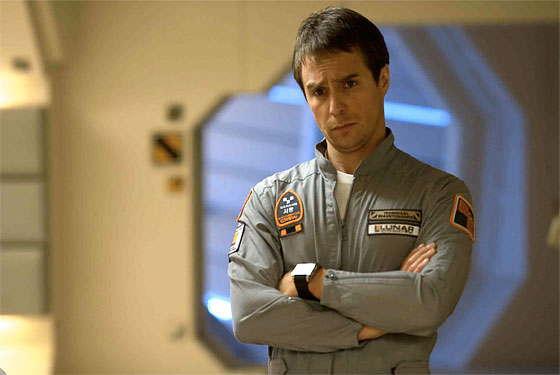
Directed by Duncan Jones and screenplay Nathan Parker based on Jones‘ original story, Moon tells the story of an astronaut who had been living in isolation for three years during a mining expedition on the moon. With his expedition about to end, he starts to become ill while dealing with strange occurrences at the moon. Starring Sam Rockwell and the voice of Kevin Spacey. Moon is a haunting yet exhilarating sci-fi drama from Duncan Jones and company.

Sam Bell (Sam Rockwell) is a miner who works on the far side of the moon. Alone with only a computer named Gerty (the voice of Kevin Spacey) to often confer to, Sam’s job is essential to look over the harvesting of helium extracts that provides energy to the Earth. With his three-year contract expiring and he’s to return home, Sam hopes to reunite with his wife Tess (Dominique McElligott) and their three-year old daughter Eve (Rosie Shaw). Though contact via life feed is limited, Sam is ready to go home until he starts to see strange visions including images of a mysterious woman (Kaya Scodelario) appearing. During a mining routine, he sees a strange figure standing where his rover crashed into a harvesting machine.

Sam later wakes up in an infirmary having little memory of what just happened as he hears Gerty talking to a couple of supervisors via satellite feed where he wants to go outside. Gerty refuses as Sam makes a plan to go outside claiming there’s something wrong as he finds a crashed rover with someone in there. Realizing it’s a guy that looks like Sam, he asks Gerty who he is. Gerty reveals it’s Sam Bell as the guy he’s talking to is also Sam Bell. With the injured Sam Bell from the rover feeling ill, the other Sam Bell looks younger but also more cynical as he believes something is going on.

The two Sams try to figure out what is going with Gerty reluctantly helping out and revealing some truths. With the younger Sam finding out about satellite feeds, the injured Sam finds a secret room. What the Sams discover isn’t just what’s in the room but also more secrets about what is going on as a rescue crew is coming to pick up one of them back to Earth as one of the Sams has an idea.

The film is a mystery set into a sci-fi atmosphere on the moon where a man discovers something about what is happening around him. Even as he sees a man who could be a younger version of him as they uncover the mystery of what is going on. What they find out is more to do with what the company Lunar Industries is trying to do with the computer named Gerty reluctantly helping out. That’s essentially the plot in a nutshell through Nathan Parker’s screenplay as it’s mostly a character study of how Sam Bell and his possible clone along with a computer named Gerty try to help him out.

The character of Sam Bell starts out as this normal guy who is excited to go home but is troubled by these weird visions he’s having. When he later meets his double, who is an angrier and cynical version of himself. He has a hard time trying to figure out who this guy is. Even worse is that is he wonders if this guy is actually the real person and he’s just the double. Yet, they would work together to find out what is happening. What they uncover isn’t just more startling but some answers that have them finding out who they are and what’s really going on.

The screenplay works in the mystery angle as well as the element of character study as director Duncan Jones plays up that element of suspense. Even as he sets into a sci-fi setting that is more reminiscent of the sci-fi films of the 1970s rather than what a mainstream audience now perceives about the genre. Setting it partially inside a space station on the moon, it plays as a set piece while many of the scenes outside of the station is a mixture of computer effects and handmade models to help create a futuristic look. Even as Jones is always capturing what is going on while making a robotic character like Gerty into a lively character who offers sympathy at times.

Jones’ direction is absolutely phenomenal in the way he slowly lets the mystery unfold that leads to a surprising third act that really changes the perspective of the film. Jones also uses tricks where he always have two-shots in which Sam Bell is talking to himself (the double is played by Robin Chalk). Jones’ framing of many of the scenes allows the audience to be invested in the journey of the two Sams trying to find out what is going on. The result is an outstanding debut for the young British filmmaker.

Cinematographer Gary Shaw does a phenomenal job with the film’s cinematography. While a lot of its shot inside the space station or in a rover with a few exterior shots. Shaw’s photography is very stylish to create a very sheer look while using different lights such as dark yellow and elements of dark lights to create moods for the film as the photography is a technical highlight of the film. Editor Nicolas Gaster does an excellent job with the editing in creating a methodical yet leisured pace to not only build up the suspense. Also in creating a mood where everything feels like time is slowing down while bringing some rhythmic cuts to some of the more action-driven scenes as Gaster’s editing is truly wonderful.

Production designer Tony Noble and art director Hideki Arichi do an amazing job with the set design for the film. Notably with the look of the space station along with the robot Gerty who has a screen where he display faces to conjure up his own emotions. Costume designer Jane Petrie does a very good job with the costumes from the creation of the space suit to the clothing that the Sams wear. Hair and makeup designer Karen Dawson does a great job with the look of Sam early in the film with his shaggy hair and beard along with the decayed look he would sport late in the film.

Visual effects supervisors Simon Kilroe, Gavin Rothery, and Simon Stanley-Clamp do a spectacular job with the visual effects for many of the film‘s exterior moon scenes. Notably in the look of the models that look very real to the flying space ships that come around throughout the film. Sound mixer Patrick Owen does some nice work with the sound in capturing the hollow, isolated world of the space station as it‘s also intimate and eerie in its presentation.

Music composer Clint Mansell does a wonderful job with the film’s soothing yet chilling score. Mansell brings a melancholia to his piano-laden score that plays to Sam’s own sense of isolation and longing. Even as Mansell also brings some broader pieces to play the suspenseful tone of the film as it’s another stellar score from Mansell. The rest of the film’s soundtrack includes pop songs from a cover of a Nik Kershaw song and a brief snippet of Katrina and the Waves 1980s hit Walking On Sunshine.

The casting by Manuel Puro and Jeremy Zimmerman do a great job with the casting as it’s mostly filled with a small ensemble in varied supporting roles. Among the small parts filled for the film include Benedict Wong and Matt Berry as corporate supervisors, Malcolm Stewart as a technician late in the film, Rosie Shaw as Sam’s daughter Eve, Kaya Scodelario as the mysterious woman who appears in Sam’s vision early in the film, and Dominique McElligott as Sam’s wife Tess who longs for his return.

In the voice of Gerty, Kevin Spacey does a superb job in bringing a humanistic quality to a machine as he reluctantly aids Sam in his quest to find secrets while providing sympathy to Sam’s own troubles. Sam Rockwell gives what is definitely his finest performance to date as Sam Bell. With help from Robin Chalk as his double, Rockwell brings layers to his role as a man who could be a double or an original as the two Sams try to uncover what is going on. Rockwell even allows himself to be funny and also angry for what his characters are going through. It’s a true tour-de-force performance from the always talented and exciting Sam Rockwell.

Moon is a dazzling yet intriguing sci-fi drama from Duncan Jones featuring a magnificent performance from Sam Rockwell. Fans of smart sci-fi films will no doubt enjoy this film for not just its technical presentation but also in its story and character study. Fans of Sam Rockwell will no doubt see this as one of his finest film performances of career while it is also an amazing debut film for Duncan Jones. In the end, Moon is a great film that makes audience realize what a sci-fi film should be and more.


© thevoid99 2011

Saturday, April 09, 2011

Blog News 4/9/11


With the upcoming final parts of Todd Haynes' TV miniseries adaptation of Mildred Pierce coming this Sunday, the third part of the Auteurs series about Haynes will finally arrive this coming week following the release my full review of Mildred Pierce.  The fourth director to be profiled for the Auteurs will be Gus Van Sant in anticipation for the release of Restless which is due in the fall.  Yet, I plan to profile Van Sant and his work this coming summer.  For my fifth profile on the Auteurs, I'm leaning towards Whit Stillman as he will coming out with a new film sometime in 2011.  Even as it will present a challenge as he's a director whose work I'm not entirely familiar with since the only film of his that I saw is The Last Days of Disco.

Other than that, I will be catching up on some films I've missed in the past few years and such due to personal issues.  I will be having my Cannes Film Festival Marathon from May 11-May 22 around the time the festival is going on.  For anyone not familiar with the marathon that I've done in the past.  It's essentially a marathon that celebrates the films that played at the prestigious festival.  I will profile various films including a few Palme D'or winners and such.  Even as I will also do some expanded reviews on two films that I've previously reviewed at Epinions.com and will be moved here which are Steven Soderberg's Che and Lars von Trier's Antichrist in newly re-edited forms with notes about the theatrical experience of both films that I saw back in 2009.

With the upcoming release of the much-anticipated The Tree of Life by Terrence Malick.  I will present an essay for viewers who are unfamiliar with Malick's work and what to sort of expect from not just this upcoming film but all of his work.  It's not going to be another Auteurs essay as I plan to do one on Malick once his sixth film comes out.  It's rather a guide for the Malick-newbie.

With the recent release of the new trailer for Lars von Trier's Melancholia, I have to say that I am totally anticipating this film.  Being a big von Trier fan, it's definitely got a lot of the visual cues he has from Antichrist.  Yet, knowing that he's a prankster.  I'm wondering if there's a big joke von Trier is playing though I don't exactly believe he's bringing an unhappy ending since from the work that I've seen.  I know that von Trier never had a happy ending no matter what his view is.  

Other than what is going on with upcoming releases, I will definitely have reviews of Duncan Jones' Source Code and Joe Wright's Hanna while I'm on the fence about seeing David Gordon Green's Your Highness considering the bad reviews it's gotten.  I just don't want to experience watching another bad film and paying for it.  Sucker Punch was disappointing enough for me and I can't go through another one.

Well, that's it for now as I'm currently on the third act of my upcoming script project which I've entitled Ugly.  If anyone is interested in reading the project which hasn't gotten into screenplay form for the time being.  Please contact me through my email.

Thursday, April 07, 2011

Far from Heaven

Originally Written and Posted at Epinions.com on 1/7/04 w/ Extensive Revisions & New Content.


Written and directed by Todd Haynes, Far from Heaven is the story of 1950s Connecticut housewife whose idyllic life and marriage shatters upon the discovery of her husband's homosexual tendencies.  With her husband going to treatment, the wife begins to fall for her black gardener.  The film recalls Haynes' themes of repression in the home life and in homosexuality, which was taboo in the 1950s.  The film is also a tribute to the film of Douglas Sirk, famous for such melodramatic films such as All That Heaven Allows and Imitation of Life.  Starring Julianne Moore, Dennis Quaid, Dennis Haybert, Viola Davis, and Patricia Clarkson.  Far from Heaven is a lush and enchanting drama from Todd Haynes and company.

It's 1957 in Hartford, Connecticut as a beautiful housewife named Cathy Whitaker comes home and brings grocery to her lovely house with her perfect family including son David (Ryan Ward) and daughter Janice (Lindsay Andretta). Her husband Frank is at work in his corporate office while Cathy is at home with help from her black maid Sybil (Viola Davis). Cathy seems to have the perfect life much envy but she seems to think her life is just like everyone else’s as a local newspaper editor Mrs. Leacock (Bette Henritze) wants to do a profile on her. On that day, she sees a black man in her backyard that turns out to be her new gardener Raymond Deagan (Dennis Haysbert), who is replacing his late father, who was the family’s old gardener.

While Cathy’s life seems to be perfect, she still has to contend with the town’s gossip queen Mona Lauder (Celia Weston) while she often talks gossip about sex and home life with best friend Eleanor Fine (Patricia Clarkson). Cathy then seems to notice about her husband’s behavior as he often works late, doesn’t spend a lot of time at home, and most recently was arrested for drunken behavior. One night when she decides to bring his dinner to his work place, she finds Frank kissing another man in his office, as she is both shocked and confused. Frank doesn’t know why he behaves like this as he goes to see psychiatrist Dr. Bowman (James Rebhorn) to seek some sort of treatment. Cathy just wants to move on and please her husband as she begins to talk more with Raymond, who is a single parent that owns a plant shop outside of Hartford. She meets with and his daughter Sarah (Jordan Puryear) at an art gallery Eleanor was hosting, as Raymond says some very intelligent things about a Miro painting. Cathy is extremely impressed with his knowledge and sensitivity while the townspeople are lurking over what is going on.

Later at a dinner party hosted by Cathy, she finds herself uncomfortable by the talks of integration in Hartford while Frank is getting drunk at the party. When it ends, Frank tries to make love to her but couldn’t but she says it’s OK as he accidentally hits her. Eleanor comes to the house the next day to pick up some things as she sees the bruise on Cathy’s head as Cathy nearly breaks down in front of her and later, in front of Raymond. Raymond comforts her as he takes her to a park to buy flowers for the garden and a restaurant nearby a car shop where Mona sees the two. Raymond takes Cathy to the restaurant where the restaurant’s all black-patrons look on with ill ease as Raymond ignores their look as Cathy finds Raymond charming.

Rumors begin to swell over what Mona saw as Eleanor begins to ask Cathy what’s going on as Frank is suggesting that Cathy is having an affair where she insists, nothing happened. Cathy had no choice but to fire Raymond but Raymond doesn’t want her to ignore things but understands why they couldn’t be together. Around Christmas time, Frank and Cathy go on a vacation by themselves as Frank’s homosexual tendencies are tested again and he begins to fall apart. Cathy then learns that school kids attacked Raymond’s daughter, as she is saddened at where her life is and realizes that there’s no such thing as a perfect life.

What makes Far from Heaven such an exquisite, delicate little film isn’t just its colorful, ravishing look but its restrained melodrama from its actor and film’s script. Todd Haynes, who is known for such films as Safe, Velvet Goldmine, and the controversial Poison, makes a movie that isn’t just a lovely tribute to Douglas Sirk’s work but also makes them superior to some of today’s modern drama films. He brings in some trained, old school acting style back from the 1950s but with a modern humanistic tone that makes the characters entertaining and real at the same time. Haynes goes for elements of suspense and drama at its most heightened or just making it linear to the story. Especially in the film’s racial tension where it isn’t just the whites looking very discomforted but blacks as well as they too, don’t like the idea of this handsome, intelligent black man talking with this beautiful, charming white woman. It’s stories like that, that are so ahead of its time and Haynes takes it back in time and makes it look fresh.

The look of the film is just breathtaking thanks in large part to cinematographer Edward Lachman. Lachman’s use of color, lighting, and wide-angle shots are so divine, it leaves you breathless as if you’re back in the 1950s. His look is both rich and luscious in its tone and works in its dramatic setting, along with the production design from Mark Friedberg who places all sorts of details of 1957 Hartford from its cars and buildings, to the housings. The film’s art director Peter Rogness should be credited for the film’s colorful look, especially with its fall-like setting of colorful leaves and green grasses. Even the costumes by designer Sandy Powell is filled with life with the big dresses Julianne Moore wore to the more tightened, clothing Patricia Clarkson was wearing along with suits and tuxedos Dennis Quaid and Dennis Haysbert wore.

Another great element that brought suspense to the film was Elmer Bernstein’s orchestral score. From its subtle, heartfelt moments, Bernstein brings in a touch of light, smooth orchestral music that just worked while in the more intense dramatic moments, he just strikes with emotional power the way drama should work. At times, it makes your hair stand as if you’re watching a highly emotional scene with immense intensity.

The film’s performance is just top-notch from the smaller roles like the Whitaker’s children and townspeople including the cheery Mrs. Leacock and the lecherous gossip queen Mona Lauder. Even the more standout roles like James Rebhorn’s Dr. Bowman are played at a subdued, restrained tone which some aren’t used to seeing for those who know Rebhorn for playing asshole-like characters. Viola Davis’ role as the maid Sybil is noted just for its quiet tone as she strays away from the cliché of an African-American maid in the 1950s. Instead, Davis just plays the role from a more subdued, discipline role, as she knows what’s going on between Raymond and Cathy but isn’t saying anything although she isn’t pleased.

The film’s best supporting performance overall goes to Patricia Clarkson as Moore’s best-friend Eleanor. Clarkson gives a raspy, cool tone to her performance as she plays the best friend without descending to other type of clichés where she is the one trying to help her and knowing where she shouldn’t be at. Clarkson is just enigmatic in both her delivery and grace. Dennis Haysbert is by far the film’s most impressive male performance as again, he strays away from stereotypes. Haysbert brings in a relaxed, wise tone to Raymond by just being this African-American character that knows where his place is although isn’t afraid to cross the world he isn’t supposed to be in. It’s the fearlessness that’s impressive as Haysbert proves to be more versatile with each performance and is understandably one of the most underrated actors around.

Dennis Quaid brings in his best performance to date as the tortured mess known as Frank Whitaker. At times, Quaid brings in restraint to his character when it’s needed while being shady in places he’s trying to hide in while breaks down in front of his children in the more dramatic performances. Quaid is just amazing in the way he reveals his internal conflict. Julianne Moore is the film’s best performance as she brings in both beauty and intelligence to her performance while trying not to act phony. She does play that 50s housewife trying to please her husband but she develops into a stronger woman who realize that images aren’t what they seem. It is definitely her most radiant performance of her career.

***The Following Content was Written on 4/7/11***

The 2003 Region 1 DVD for Far from Heaven from Universal presents the film in its 1:85:1 theatrical aspect ratio for the widescreen format. Also presented in 5.1 Dolby Digital and DTS Surround Sound in English and Dolby Surround in French plus subtitles in English, French, and Spanish. The look of the film is gorgeous in displaying the lush photography of Edward Lachman as well as the sound work of Kelley Baker.

The special features of the DVD includes a feature-length commentary track from the film’s writer-director Todd Haynes. Haynes discusses the film’s production and inspiration including reading quotes about film theory from Douglas Sirk as well as Rainier Werner Fassbinder’s thoughts on Sirk’s films. Haynes also revealed that because of the small budget and limitations they had as they were shooting the film on New Jersey. The production was tense though they got through it quite easily. Haynes reveals that since he wanted to recreate the look of Sirk’s films for Far from Heaven, he worked closely with Edward Lachman, production designer Mark Friedberg, and costume designer Sandy Powell about how it should look.

Haynes revealed that during the shooting, Julianne Moore was early in her pregnancy as Sandy Powell did create clothes that would make her comfortable. Haynes praised the work of the actors while he revealed that Dennis Haysbert had a difficult time due to the fact that he had to fly back and forth from New York to Los Angeles for his work on the show 24. Haynes also discusses the story and how he wanted to give it a Sirk-like feel while adding a bit of Fassbinder to some of the characters and in tone of the film. Particularly with the editing as the transitions were partially inspired by Fassbinder’s films. The overall commentary is an enjoyable treat that allows Haynes to reflect on the film and such.

The 27-minute Anatomy of a Scene special from the Sundance Channel is about the making of the party scene at the Whitakers’ home. Haynes along with Julianne Moore, Dennis Quaid, cinematographer Edward Lachman, production designer Mark Friedberg, editor James Lyons, costume designer Sandy Powell, and music composer Elmer Bernstein the importance of the party scene in which Frank gets drunk as it leads to a breakdown between him and Cathy. Haynes, the actors, and crew members each discuss their approach to the scene while using the films of Douglas Sirk and the period of the 1950s as a guideline. It’s definitely a marvelous special that breaks down how a scene is created.

The 11-minute making-of featurette is a piece where Haynes, the main cast, and Elmer Bernstein talk about the film. Featuring clips of films by Douglas Sirk, notably All That Heaven Allows, Haynes talks about wanting to recreate the world of Sirk but with a contemporary feel of sorts. Even as the actors like Dennis Quaid revealed that it was challenging because it was a different style of acting. Haynes reveals that the biggest highlight of making the film is working with Elmer Bernstein as Bernstein revealed that the score for this film is one of his favorites. The five-minute Q&A session with Todd Haynes and Julianne Moore has the two talking about their collaboration while Moore talks about her process to the performance. Even as she reveals that she doesn’t like to rehearse and find the character through the acting.

Other minor special features on the DVD include the film’s theatrical trailer, recommendations from Focus Features on films like Francois Ozon’s 8 Women and Neil LaBute’s Possession, cast and director info, and production notes about the film and Haynes’ desire to bring back the 1950s melodrama films of Douglas Sirk. The overall DVD is truly marvelous as it features special features fans of Haynes would love.

Far from Heaven is a gorgeous yet heartbreaking masterpiece from Todd Haynes featuring a superb performance from Julianne Moore. Featuring phenomenal supporting work from Dennis Quaid, Dennis Haybert, Viola Davis, and Patricia Clarkson. It’s a film that will allow audiences to soak into the lush, melodramatic work that Haynes has created while paying tribute to the late Douglas Sirk. While it’s Haynes’ most accessible work to date, it is definitely a film that is definitely romantic with characters that audiences can root for. In the end, Far from Heaven is a magnificent triumph from Todd Haynes.


© thevoid99 2011
Snow Angels


Originally Written and Posted at Epinions.com on 4/15/09.


With three acclaimed films to his credit by 2007, David Gordon Green is considered to be one of American cinema's most promising young directors. Since his 2000 landmark debut film George Washington, Green's dream-like yet harrowing portrait of life in the American South has earned him praised from critics, notably Roger Ebert. Compared in some respects to the legendary yet elusive Terrence Malick, Green followed up his debut with 2003's romantic-drama All the Real Girls and 2004's thriller Undertow in which the latter was co-produced by Malick. After an attempt to get an adaption of the legendary John Kennedy Toole classic novel A Confederacy of Dunces with help from Steven Soderbergh as one of the screenwriters failed to get off the ground. Green took a break to plan several projects before taking on an adaptation of Stewart O'Nan's small-town drama Snow Angels.

A multi-layered story about young teenager dealing with the disintegration of his parents marriage as well as a long-standing crush with a former babysitter who is currently having relationship problems with her ex-husband. When the woman and her ex-husband starts to boil over due to an affair, the young man suddenly finds himself falling for a quirky young high school girl as a small town begins to lose its innocence. Written for the screen and directed by David Gordon Green, Snow Angels marks as a huge departure for the director as he moves North to create an enchanting yet eerie tale of small town life that is close to his own small town world in the South. With an all-star cast that includes Sam Rockwell, Kate Beckinsale, Michael Angarano, Nicky Katt, Olivia Thirlby, Jeanetta Arnette, Amy Sedaris, Tom Noonan, and Griffin Dunne. Snow Angels is an enchanting yet harrowing drama from David Gordon Green.

Arthur Parkinson (Michael Angarano) is a high school teenager dealing with new changes in his life. His parents Don (Griffin Dunne) and Louise (Jeanetta Arnette) are splitting up as Arthur tries to cope with it with school work and marching band practice. Around the same time, Arthur works as a bus boy at a local Chinese restaurant with his former babysitter Annie (Kate Beckinsale) whom he's had a crush on. Annie is dealing with her own problems raising her four-year old daughter Tara (Gracie Hudson) by herself while her ex-husband Glenn (Sam Rockwell) has become a Born-again Christian and just landing a job selling carpets. Though Glenn does get to see Tara from time to time, he hopes to have Annie back in his life while maintaining his own sobriety. It's around the same time Arthur befriends a new student in the nerdy yet charismatic Lila (Olivia Thirlby).

With Glenn starting to get things in order, Annie has an affair with a cop named Nate (Nicky Katt) who is married to Annie's friend Barb (Amy Sedaris) who also works with her as a waitress at the Chinese restaurant. The affair becomes secretive for awhile until Glenn starts to suspect something as Barb also finds out. With Annie stressed out in her own life while trying to raise Tara, Glenn starts to confront Annie and Nate over this affair as trouble starts to brew. Arthur meanwhile, learns that his dad is seeing someone as he starts to get close with Lila whom he's becoming attracted to. Then one day, a sick Annie is at home with a cold when her daughter is suddenly gone. Turning to Barb for help, a whole town tries to find something. What happens would change things forcing Glenn to become insane while a distraught, angry Arthur leans closer towards Lila. Then comes a day when the lives of an entire town would change forever.

The film is about disconnection and connections into the lives of various individuals in a small, Northern town in America. While small-town life isn't new to what screenwriter/director David Gordon Green has explored. The location and setting is very different from his three previous films as he goes into the north during a winter season. While Green's script definitely delves into the lives of the three main individuals of Arthur, Glenn, and Annie. He does create a faithful version of Stewart O'Nan's novel though the story overall is uneven. While there's enough work that's put into the coming-of-age story of Arthur, it's overshadowed by the drama of Glenn and Annie which reaches tragic proportions. Yet, it's setting and study of characters is what definitely attracted Green to this story as he puts enough attention towards major characters and supporting ones as he delves into a small town setting.

Green's direction is truly majestic in its setting though the film is shot mostly in Canada. Green's rich compositions and dramatic staging is what keeps this film compelling as he goes deep into the drama but knows when to pull away. While there's not much humor, Green knows when to use it when it's necessary. The drama is more theatrical in its performance but Green knows when to have his actors not delve into melodrama or high theatrics. It's all restrained except in parts for high drama as he knows when to place his camera to capture all that is going on. Even in getting shots from a character's perspective or a scenery that is enchanting with shots of nature that is reminiscent of the work of his mentor Terrence Malick. Overall, Green's direction shows a maturity in the young director who takes some of his old tricks and refine them for better dramatic effect.

Green's longtime cinematographer Tim Orr does brilliant work with the usage of snow and sunlight for the film's exterior, daytime scenes. Orr's photography maintains the richness that Green wanted for the film as there's a beauty to the look of small town life. Even the nighttime exteriors are well shot with low-lights and an intimacy for the drama with a beautiful shot one of the film's final scenes involving falling snow and a football field. Orr's camera work in the interiors is intimate as in a couple of bar scenes, it's low-lit to emphasize the dark mood of one of its major characters. The overall work of Tim Orr is truly phenomenal as he's one of the best young cinematographers working in the field.

Editor William M. Anderson does excellent work with the film's stylish editing with the use of fade-outs, jump-cuts, and rhythmic cutting to create transitions that seems abrupt yet energetic for the story. Green's longtime production designer Richard A. Wright, along with set decorator Ian Greig and art director Terry Quennell, does some fine work with the look of the high schools, Annie's home, and other locations that has a nice, quaint small-town feel. Costume designer Kate Rose does good work with the costumes in creating casual clothing for the actors with Olivia Thirlby's Lila character standing out the most with a yellow coat and hat along with cat-like glasses to create a unique look for her. Sound editor Larry Blake does brilliant work with the sound in capturing the quaint feel of the small town with layering of noises as well as the sounds of instruments and such for the film. Notably its opening sequence with the thundering sounds that would set the film's dramatic tone in place.

Green's longtime music composer David Wingo along with Jeff McIlwain brings a quiet yet plaintive score with acoustic guitars and ambient textures to play to the film's somber, small-town feel. The soundtrack consists of material ranging from blues to country with songs by Gene Autry, Shane Hartman, Tony Berg, Josh Crocker, Benji Hughes, indie-rock stalwarts Explosions in the Sky, and a soft-rock song from Bread. Another song that is used for humor and dramatic effect is Peter Gabriel's Sledgehammer which is performed by a marching band.

The casting by Kerry Barden, Billy Hopkins, Paul Schnee, and Suzanne Smith is wonderfully assembled for its usage of big and small characters. Memorable small roles include Connor Paolo as Arthur's friend Warren, Deborah Allen as Annie's mom, Brian Downey and Carroll Godsman as Glenn's parents, Leah Ostry as Lila's sister, Daniel Lillford as Glenn's boss, Lita Llewellyn as a cop, Hugh Thompson as a police investigator, Angela Vemeir as Don's new girlfriend, and Tom Noonan in a funny role as the band leader. Gracie Hudson is good as Glenn and Annie's wild, energetic 4-year old girl Tara while Jeanetta Arnette is excellent as Arthur's mother Louise who is trying to deal with the split from her husband. Griffin Dunne is very good as Arthur's dad Don, a man confused about his role while trying to communicate with Arthur about the flaws of being a man.

Amy Sedaris is great as Barb, Annie's friend and co-worker who feels betrayed when she learns that her husband Nate is having an affair with Annie only to realize something more troubling. Nicky Katt is very good as Nate, a womanizer who is bored by his own marriage while his affair with Annie is also running out of steam. Olivia Thirlby is wonderful as Lila, the girl who would be a shining light to Arthur. Thirlby, known to audiences for her role as the best friend in Juno, is full of charm and wit while displaying an innocence to her that is insatiable to watch. Michael Angarano is excellent as Arthur, the young teen dealing with all that's going on around him as he comes of age in finding his first girlfriend and coping with the stuff that goes on his own. Angarano's performance is very realistic in the hang-ups of being a teenager while he has great chemistry with both Olivia Thirlby and Kate Beckinsale.

Kate Beckinsale, whose acting career in recent years has been spotty with action films and light drama, gives a performance that is describe as a return to form of sorts following her mid-90s breakout period. Stripping away the glamour for something more realistic and homegrown, Beckinsale's role as a stressed-out mother dealing with her child while juggling an affair and the presence of her ex-husband shows Beckinsale in playing a character that is realistic but also flawed. Along with a legitimate American accent, the British beauty displays grace and despair into her role as it's a phenomenal role for the actress. Finally, there's Sam Rockwell in a tour-de-force performance as Glenn. A man who is trying to improve himself though is often forgetful and pushy. Rockwell has some great scenes with Beckinsale as he displays a man who loses control while convinced he's doing what God asks him to do. It's a brilliant role for the actor who always gives a lot into his roles whether it's doing humor or drama as he's one of the best actors of his generation.

While it doesn't have the dreamy quality of George Washington, the romanticism of All the Real Girls, or the flat-out humor and entertainment factor of 2008's Pineapple Express. Snow Angels is still a harrowing yet intriguing drama from David Gordon Green featuring a superb ensemble led by Sam Rockwell, Kate Beckinsale, Michael Angarano, and Olivia Thirlby. Fans of Green's films will enjoy the richness and intimate small-town setting he creates while seeing that the Southern director is becoming more mature in his work. In the end, Snow Angels is an entrancing, dark, yet touching drama from David Gordon Green.

David Gordon Green Films: George Washington - All the Real Girls - Undertow - Pineapple Express - (Your Highness) - (The Sitter) - (Prince Avalanche) - Joe (2013 film) - (Manglehorn) - (Our Brand is Crisis) - (Stronger (2017 film)) - Halloween (2018 film) - (Halloween Kills) - (Halloween Ends)

© thevoid99 2011

Wednesday, April 06, 2011

Poison


In the late 1980s and early 1990s, a new wave of gay cinema was emerging that was funded independently and made by gay filmmakers. Coined as New Queer Cinema, it allowed audiences to see a new world unexplored by Hollywood. While it also allowed filmmakers to tackle subjects whether its personal or political, New Queer Cinema did broaden the spectrum for what was needed to be said about gay culture in the era of conservative America. One of the figures to come out of that scene is Todd Haynes. After gaining notoriety for his 1987 short film Superstar: The Karen Carpenter Story about the late Carpenters singer. Haynes was definitely a director on the rise as he had also directed a music video for Sonic Youth in 1990. In 1991, he would unleash a film that would shock everyone that was considered to be one of the definitive films of New Queer Cinema called Poison.

Based on the writings of Jean Genet, Poison is a film set into three different sections as they’re each presented in three different styles. The first of which is a documentary about a boy who kills his father. The second is a 1950s style drive-in movie about scientist who turns into a monster. The third is a prisoner who falls for another prisoner at a juvenile prison. Written for the screen and directed by Todd Haynes, the film is a myriad of styles told in an unconventional form where all three segments are meshed into one whole film. The result is a surreal yet provocative film from Todd Haynes.

Hero

A seven-year old boy named Richie Beacons kills his father and flies away. Policemen and neighbors wondered what happened as his mother Felicia (Edith Meeks) is interviewed. She claims that Richie was a gift from God while others such as classmates and a teacher (Millie White) believe him to be a weird child. Even as he’s been someone that’s been in the nurse’s office and principal’s office in school several times. Often due to fights where he gets beat up as a nurse (Marina Lutz) recalls the moment he called her “fatso”. Even when a boy (Buck Smith) talks about why he beat up Richie at school during gym as the principal and a neighbor reveal that Richie was a strange kid. Dr. MacArthur (Evan Dunsky) even believes there is something strange about Richie from the abuses he has taken from his father and kids. Yet, Felicia Beacons would reveal more into the events that led to him murdering his father.

Horror

Dr. Thomas Graves (Larry Maxwell) is trying to create an elixir that would isolate human sexuality. Though he is vilified by some in his field, a woman named Nancy Olsen (Susan Gayle Norman) helps him as he falls for her. Yet, his infatuation with Olsen has him accidentally drinking the elixir he created. Suddenly, he becomes a monster where he kills through leprosy as Olsen realizes what went wrong. With Olsen attempting to help Graves, she tries to take him to the outside world as it fails. Even as the attempt fails despite their love for each other, reports about the deaths and infections relating to leprosy troubles Nancy. Even as Graves becomes a target where tragedy has him confronting the people he felt ostracized by.

Homo

A thief named John Broom (Scott Renderer) is about to go prison again where he meets Jack Bolton (James Lyons) whom he knew years ago at a French prison. They become friends as Broom recalls his days at another prison where Bolton was a prisoner whom he taunted. Even as Bolton shows Broom his scars where Bolton hopes to make it into the big gang at the prison led by a man named Rass (John R. Lombardi). Broom’s attraction to Bolton increases although Bolton’s attachment to Rass has Broom becoming jealous. Even as Broom recalls an incident when he as a young man (Tony Pemberton) saw Bolton (Andrew Harpending) be abused and taunted by other inmates at the French prison many years ago.

The film is a collection of stories by Jean Genet that recalls various themes of heroism, horror, and homosexuality. In the mind of Todd Haynes, he takes those three themes and inter-cut them into a style that is very unorthodox and engaging. In the Hero section, it is told in a documentary story about a strange boy who kills his abusive father and then flies away. While it’s an interesting story, it’s the one section that isn’t as developed as it ends up bringing more questions while the mother of the film seems to be a woman in denial.

The Horror section is definitely the most entertaining as it’s a mixture of campy horror and thriller in the style of the 1950s while playing allusions to the AIDS crisis of sorts with the use of leprosy as the main disease. Homo is definitely the most provocative and also the most confrontational as it’s about a thief meeting an old inmate from another prison as he becomes infatuated with while dealing with memories about his time at the French prison. Even as it features a scene that will definitely get people disgusted over what Broom sees what happens to Bolton at the French prison. Horror and Homo are definitely the most interesting as they have stories that are engaging and says something. Hero sorts of works but doesn’t engage the viewer into a lot of answers about why this kid killed his dad and why he was so strange.

Haynes’ direction is definitely phenomenal in the way he presents each section. Yet, he creates a film that definitely plays with the idea of conventional narrative. Instead of presenting each story as one whole section to another section and then to another. He creates a narrative where all three stories are inter-cut and meshed into an entire film. For an audience that’s accustomed to traditional film narratives, this different approach will definitely take them aback and be challenging to follow the story. In some respects, it works as it’s a different form of storytelling in its three different styles.

With Hero being a cheesy TV-documentary style with lots of dramatization and a few surreal moments while Horror is a B-movie style horror film and Homo as a homosexual prison story. It creates a film that is very engaging but with two very strong sections and a decent section, it does create a film that is uneven at times while the pacing lags in various spots. While it is largely based on the stories of Jean Genet, Haynes does put in text to reveal what Genet is saying in these stories. Despite the flaws the film has, it is a remarkable yet mesmerizing film by Todd Haynes.

The film’s cinematography is superb for being shot in two different styles. For color, it’s by Maryse Alberti and in black-and-white, it’s by Barry Ellsworth. Alberti’s photography for the Hero scene is very good for its grainy, documentary look while her work in the Homo section for the French prison scenes are exquisite. Barry Ellsworth’s photography for Horror is wonderful for its 1950s style of B-movie cinema that plays up to the suspenseful tone of the story. Editors James Lyons and Todd Haynes do a very good job with the film’s editing in creating numerous styles of cutting for the various sections while the transitions from one section to another does create some fine moments. Even though, there’s moments where it feels jerky and not as smooth.

Production designer Sarah Stollman and art director Chas Plummer do a wonderful job with the look of the French prison for the Homo section with its period feel while the Hero and Horror sections are also noteworthy for its respective scenes. Costume designer Jessica Haston does a great job with the 50s period costume for the Horror section as well as the bland, casual look for the Hero section. Hairstylist/makeup artist Angela Johnson and effects makeup artist Scott Sliger do an amazing job with the leprosy looks for the Horror section of the film.

Sound editor Mary Ellen Porto does an excellent job with the film‘s sound from the suspense of the Horror to the eerie tone of the prison scenes in Homo. The film’s music by James Bennett is definitely the film’s technical highlight from the suspenseful jazz of Horror to the serene, dreamy quality of Homo. Bennett’s somber score for Hero is the least memorable but also cheesy in the way it plays up to the documentary style of the section.

The casting by Karim Anouz, Laura Barnett, Andrew Harpending, and John Michael Kelsey is excellent with its array of performances that includes John Leguizamo as an inmate in the French prison at the Homo section. Other notable small roles from the Hero section include Millie White as the principal, Buck Smith as a bully, Marina Lutz as a nurse, Richard Anthony as a custodian, and Evan Dunsky as the doctor. In Horror, there’s a small but memorable performance from Michelle Sullivan as a hooker. In Homo, there’s some memorable turns from Andrew Harpending and Tony Pemberton as the young Bolton and Broom, respectively, and John R. Lombardi as the brutish Rass.

From Hero, Edith Meeks is very good as the mother who seems to be in denial over Richie’s weird behavior while revealing some ideas into why Richie killed his father. In Horror, Larry Maxwell is excellent as the tortured Dr. Graves who accidentally drinks an elixir that made him a monster while Susan Gayle Norman is superb as the woman who loves and tries to help him. In Homo, Scott Renderer is wonderful as the tough but laid-back Broom who is in love with the tough-talking Bolton. The late James Lyon is stellar as the tough-talking Bolton who hopes to get out of jail while being a guy no one wants to mess with.

When the film premiered at the 1991 Sundance Film Festival, the film was considered to be a landmark film for New Queer Cinema as it won the festival’s top prize. The $250,000 budgeted film proved to be a modest art-house hit while gaining a large degree of controversy when it was revealed to be partially funded from a grant from the National Endowment for the Arts. When news came that the film was funded by the NEA, the American Family Association attacked the film as it ended up helping draw more attention for film and for Todd Haynes. Even as it helped the film’s reputation and furthered the new wave of gay cinema that was to emerge in the 1990s.

Poison is a good and interesting film from Todd Haynes that features an interesting array of styles and stories based on the works of Jean Genet. While it might be considered an essential film of Todd Haynes’ work as well as gay cinema. It’s a film that is flawed in its inter-cut style though it would be more refined with Haynes’ 2007 Bob Dylan bio-pic I’m Not There. While it’s a film that certainly won’t be for everyone for its frank, provocative sexual content and disturbing stories. It’s a film that is also very challenging of what is expected in the form of storytelling. In the end, Poison is an entertaining yet intriguing film from Todd Haynes.


© thevoid99 2011