Written and directed by Samuel Fuller, The Big Red One is the story of a platoon dealing with war during their campaign in Europe and North Africa during World War II. Based on aspects of Fuller’s own experiences as a soldier, the film is an in-depth look of what goes on in the battlefield where a young platoon follows its leader to survival as they deal with the horrors of war. Starring Lee Marvin, Mark Hamill, Robert Carradine, Bobby Di Cicco, Kelly Ward, Siegfried Rauch, Marthe Villalonga, and Stephane Audran. The Big Red One is an intense and gripping film from Samuel Fuller.
The film follows the 1st Infantry Division during World War II from their campaign in North Africa in November of 1942 to the liberation of the Falkenau concentration camp in May of 1945 led by its sergeant (Lee Marvin). The film follows a sergeant and four men from his platoon as they deal with their many campaigns in the span of nearly three years as it’s largely told by a wannabe-novelist in Private Zab (Robert Carradine) who is the film’s narrator as he is joined by the sharpshooter Private Griff (Mark Hamill), the Italian-American Private Vinci (Bobby Di Cicco), and the medic Private Johnson (Kelly Ward). Samuel Fuller’s screenplay begins with the sergeant fighting in World War I as he would learn the war just ended after killing someone at a place in France which he would revisit years later.
Fuller’s screenplay doesn’t really have much of a plot as it would delve into an episodic narrative of sorts as it follows the sergeant and his platoon into different adventures in the course of their time in Europe and North Africa. Yet, Fuller is more interested in the comradery between the sergeant and his four privates where the sergeant doesn’t really act like some leader who barks orders but rather a soldier who knows what to do and make sure his men aren’t killed. At the same time, he’s kind of a father to them as he would let them get away with a few things but always keep them in check. Especially Pvt. Griff who has a hard time coping with the idea of killing someone as the sergeant reveal some of the dark and cynical aspects of war that is quite true. The script also has a subplot relating to a German officer named Schroeder (Siegfried Rauch) who is a counterpart of sorts for the sergeant as they would encounter each other from time to time during battles yet never meet each other directly. Schroeder is an interesting antagonist who has an undying sense of loyalty to Hitler and the Nazis but has a hard time accepting criticism of their ideals.
Fuller’s direction is definitely intense in terms of some of the battle scenes and action though Fuller doesn’t make it gratuitous nor overblown as it’s often the case with a lot of war films. Shot largely in Ireland with the North African locations shot in Israel as well as some of it shot in California, Fuller explores the different kind of obstacles the sergeant and his men would endure throughout the course of the film. While Fuller would use a lot of wide shots, along with some medium shots, to capture the scope of the locations. It’s in the close-ups and extreme close-ups is where Fuller captures the human aspects of war whether it’s a soldier looking at some of the horror or scenes of them observing their surroundings. Even if it’s moment of fun such as a scene late in the film where Pvt. Zab has a party for the platoon at a house in Belgium as it’s a moment of joy and fun. Fuller would create scenes that are odd as it help give the film a different tone that is often synonymous with war films.
The sequence at an insane asylum where the sergeant and his men meet a woman who is part of the French Resistance would be this mixture of dark humor and suspense that show what the 1st Infantry Division had to do. It’s among some of the offbeat moments in the film as well as what some soldiers have to use to protect their rifles in the water. Yet, Fuller does maintain some realism as it relates to the horrors of war as well as some of the humanity as it relates to the people the sergeant and his platoon encounter. Though some of it is dark, Fuller does show moments of compassion such as a little moment where a young girl puts flowers on the sergeant’s helmet or the film’s climax at the concentration camp in Czechoslovakia. Overall, Fuller crafts a chilling yet captivating film about the 1st Infantry Division’s adventure during World War II.
Cinematographer Adam Greenberg does excellent work with the film’s cinematography as its usage of soft-lights and naturalistic photography for some of the daytime exteriors help give the film a beautiful look including some chilling moments involving some of the violence in the film. Editor Morton Tubor, with Bryan McKenzie for the 2004 reconstruction, does brilliant work with the editing as it is largely straightforward without emphasizing too much on style. Art director Peter Jamison does fantastic work with the look of some of the sets including a big cross that the sergeant would see reminding him of his time in World War I as well as the interiors at the asylum.
Sound editor Jack A. Finlay, with sound designers Mark Linden, Tara A. Paul, and Harry E. Snodgrass for the 2004 reconstruction, does superb work with the sound in capturing some of the horrors of war including the sounds of bombs and gunfire. The film’s music by Dana Kaproff is wonderful for its orchestral-based score as it play into some of the dramatic moments of suspense as well as some offbeat moments in the film in some light-hearted pieces.
The film’s marvelous cast include some notable small roles from Christa Lang as a German countess Schroeder sleeps with, Pascal Bruer as a Hitler Youth member, Galit Rotman as a pregnant Frenchwoman, Matteo Zoffoli as a Sicilian boy who helps the platoon in exchange for them to help bury his mother, Perry Lang as a young private named Kaiser, Doug Werner as a Polish-American soldier, and Marthe Villalonga as a madam at a Belgium house where the platoon briefly stay at. Stephane Audran is terrific as a French spy pretending to be a patient at an insane asylum as she helps the sergeant and his platoon while befriending Pvt. Griff. Siegfried Rauch is superb as Schroeder as a German officer who is kind of the counterpart for the sergeant as they share similar views on war yet he is someone that is truly devoted to Hitler as he will kill those who says something bad about him.
Kelly Ward is excellent as Pvt. Johnson as a farm boy who has experience in being a doctor as he tries to cope with the chaos of war as well as be someone who is very loyal to his platoon. Bobby Di Cicco is fantastic as Private Vinci as an Italian-American who says some of the film’s funniest things while being quite tough in dealing with the enemy. Robert Carradine is brilliant as Private Zab as the film’s narrator as someone who provides some humor as well as witty commentary on things as he’s using his experiences for a book. Mark Hamill is amazing as Private Griff as a sharpshooter who has a hard time with the idea of killing someone as he would display some humility and weariness as someone who would see a lot as he copes with some of the darkest aspects of war. Finally, there’s Lee Marvin in an incredible performance as the sergeant as a man who has been through a lot of wars as he tries to maintain some sense of morale as well as be someone who knows what not to do as it is really one of Marvin’s career-defining performances.
The Big Red One is a phenomenal film from Samuel Fuller. Featuring a great cast, an engaging story about what men go through in war, dazzling technical work, and a fantastic music score. It’s a war film that doesn’t exactly play by the rules while displaying elements of humanity and comradery that is often missed in war films. In the end, The Big Red One is a spectacular film from Samuel Fuller.
Samuel Fuller Films: I Shot Jesse James - The Baron of Arizona - Steel Helmet - Fixed Bayonets! - Park Row - Pickup on South Street - (Hell and High Water) - House of Bamboo - (China Gate) - Run of the Arrow - Forty Guns - Verboten! - The Crimson Kimono - Underworld U.S.A. - Merrill's Marauders - Shock Corridor - The Naked Kiss - (Shark!) - (Dead Pigeon on Beethoven Street) - White Dog - (Thieves After Dark) - (Street of No Return) - (The Madonna and the Dragon)
© thevoid99 2017

Another end to a great festival and certainly one of the most interesting as it began with some controversy over the role of Netflix. It has to do with the fact that two of the films playing in competition for the Palme d’Or such as Bong Joon-Ho’s Okja and Noah Baumbach’s The Meyerowitz Stories are being released exclusively through Netflix but won’t be playing in theaters in France which has caused a stir. This led to a debate between the jury’s president Pedro Almodovar and one of the jurors in Will Smith over this issue as Almodovar believes that films should be seen in the theaters as I definitely agree with him as I’m not fond of this exclusivity. I can understand Smith’s point of view of being able to see a film in your living room but the fact that not everyone in the world has nor are willing to subscribe to Netflix or any kind of streaming platform seem to be left out. There’s a lot out there that has raised some very interesting discussions about streaming platforms and how to get films available to the public as it’s something that will continue.

As for the festival itself, there were a lot of damn good films that managed to create some buzz and intrigue as I’m interested in seeing Okja and The Meyerowitz Stories but I would like to see them in the theaters as I’m still a traditionalist. I’m glad there were some good films that played in competition for the Palme d’Or such as Wonderstruck by Todd Haynes, Francois Ozon’s L’Amant Double, and Michael Hanake’s Happy End got some good reception though Hanake’s film did also get some mixed reviews which is actually interesting. There were also some films that played out of competition or at the Un Certain Regarde section that were also interesting such as Sean Baker’s The Florida Project and Taylor Sheridan’s Wind Rider which won Sheridan its Best Director prize while John Cameron Mitchell’s How to Talk to Girls at Parties definitely raised some interest.

Then there’s some of the big films that were competing that created some buzz though I was kind of disappointed that Robin Campillo’s 120 Beats Per Minute didn’t win the Palme d’Or but was able to walk away with some prizes such as the Queer Palm, the 2nd place Grand Jury prize, and the FIPRESCI prize. Winning the Palme d’Or this year is The Square by Ruben Ostlund of Force Majeure as that is a surprise as I’m intrigued to see that film. I’m happy that films such as Sofia Coppola’s The Beguiled, Lynne Ramsay’s You Were Never Really Here, Yorgos Lanthimos’ The Killing of a Sacred Deer, and Andrey Zvyagintsev’s Loveless received honors as Loveless receives the third place Jury Prize while Coppola would become the second woman to win the festival’s Best Director prize.

In the acting front, Joaquin Phoenix wins best actor for You Were Never Really Here while Ramsay and Lanthimos shared the Best Screenplay prize for their films. Diane Kruger was a surprise in receiving the festival’s Best Actress prize for Fatih Akin’s In the Fade as it’s deserving since she is a great actress while Nicole Kidman received the festival’s 70th Anniversary prize which is very deserving as she’s definitely been the ball of the festival. The coverage for the festival has been amazing as I would like to thank the AV Club, IndieWire, and The Film Experience for their work in covering the festival. I also thank social media as I was able to follow along amidst some of the chaos relating to politics and other events which includes the tragedy in Manchester where the festival was able to hold a minute of silence for those that had fallen.
Now that the festival is over, so has been this year’s marathon which has been a lot of fun this year. I ended up adding one more film to the marathon for the competition which did push aside my Blind Spot choice as I’m watching it at this moment. I had hoped to scale it down like I said I was going to do last year as it’s near impossible to watch 14 films in 11 days though I managed to do it in just 10. I’m kind of tired at the moment but I had some fun as this year’s selection was certainly a joy to watch. Now it’s time to give out the fictional version of the prizes for this marathon.
The fictional Palme d’Or of the marathon goes to…. The Handmaiden
Chan-wook Park’s 2016 film is definitely everything a film should be and more. It’s unsettling, it’s intriguing, it’s odd, it’s intense, it’s erotic, and it is fucking balls to the wall and more. Taking Sarah Waters’ novel Fingersmith and setting into Japan-occupied Korea during the early years of the 20th Century, Park’s film is an exploration of identity, ambition, and longing as it features not just phenomenal performances from Kim Min-hee, Kim Tae-ri, and Ha Jung-woo. It’s got some of the finest technical work presented on film as Park’s collaborators manage to raise the bar of what could be done in such lavish period productions and make it feel very dangerous as well as intoxicating.
The 2nd place Grand Jury prize goes to…. Our Little Sister
Sometimes, films don’t need to be big and grand in order to tell a story which is why Hirokazu Koreeda could be described as this generation’s Yasujiro Ozu. The simple story of three sisters in their 20s who take in their newly-discovered teenage half-sister shows that even a story with just the simplest plot can be very extraordinary. Set in the seaside city of Kamamura, Koreeda just goes for something that that is very engaging and universal in its stories about sisters. It has a lot of things people would expect in terms of what life is like as it also creates a lot of questions of these women and their late father. Even as some of them go through growing pains and other issues but all do it together in a film that didn’t need to be overly-dramatized or laced with heavy-handed sentimentality.
The third place Jury Prize goes to…. Harakiri
Masaki Kobayashi is often overlooked when it comes to the great Japanese filmmakers as he’s often not in the conversation with the likes of Akira Kurosawa, Yasujiro Ozu, and Kenji Mizoguchi. Yet, he should be in that list of men who defined Japanese cinema as his film about the subject of seppuku isn’t just one of his best but also one of his darkest films of his career. Especially as it features an intense performance from Tatsuya Nakadai in this idea of what the samurai has to deal with at a time when they have no master to serve nor have the means to make a living. Even as the film with its eerie cinematography and Toru Takemitsu’s eerie score as it would play into this climax that is just monstrous and visceral.
The Best Director Prize goes to…. Denis Villeneuve for Sicario
Denis Villeneuve has definitely been a big name lately as his 2015 film about the drug war is definitely one of his finest. Especially as it play into the darkest aspects of the drug war told from the perspective of an idealistic FBI agent who is there along for the ride. Villeneuve’s direction has these gorgeous visuals, aided by cinematographer Roger Deakin, in the way it play into this chaotic conflict between the American drug task force and these Mexican drug runners where it is very violent and gripping.
The Best Screenplay Prize goes to…. Vittorio de Sica and Cesare Zavattini for Umberto D.
Vittorio de Sica’s neorealist film about a man dealing with alienation of postwar Italy in its economic boom and being forced out of his apartment is definitely a heartbreaking story. Based on Cesare Zavattini’s own story which definitely had a lot of the things de Sica was looking for. It is a film that explore some of the drawbacks of this postwar economic miracle that some were left out on as it features a heartbreaking performance from Carlo Battisti as well as the dog Napoleone as the titular character’s companion Flike. It is a very human story that says a lot about the ways of the world and how a generation shouldn’t ignore the work the previous generation did as it is one of de Sica’s crowning achievements.
The Best Actor Prize goes to…. Tatsuya Nakadai for Harakiri
Tatsuya Nakadai is one of the premier actors in world cinema as he’s often never talked about when it comes to great actors. Not just in his collaboration with Akira Kurosawa for films such as Yojimbo, Sanjuro, Kagemusha, Ran, and several others but also with Masaki Kobayashi where he really became a star. His performance in one of 11 collaborations with Kobayashi is his most intense in terms of what his character has to go through as well as the humility he displays that later turns into rage and one-upmanship.
The Best Actress Prize goes to…. Emily Blunt for Sicario
Emily Blunt is a big name considering the fact that she is a star in the world of Hollywood but there is a lot more to her for those who have seen her work outside of Hollywood. There were performances in the marathon that were great but Blunt’s performance as this idealistic FBI agent who reluctantly joins a task force sticks out due to the fact that it has her doing something very different. There’s a humility to her performance but also a sense of grit without the need to act tough.
Technical Jury Prize goes to…. Toru Takemitsu for Harakiri
The score that Toru Takemitsu creates for Kobayashi’s film is definitely unusual as much of the scores in the film are either electronic or orchestral-based with very few standing out. Takemitsu’s score has this air of terror in the way it approaches suspense through music as it uses its string instruments in a very imperfect and discordant way that isn’t heard of very often in film scores. Especially in its usage of traditional Japanese percussions as it help adds this unsettling atmosphere in some of the action and drama.
The Special Jury Prize goes to…. Haruka Ayase, Masami Nagasawa, Kaho, and Suzu Hirose for Our Little Sister
Ensemble casts often help make a film what it is yet it is these four women playing the role of sisters in Hirokazu Koreeda’s film that really add something special to it. Notably as they have this natural chemistry that is insatiable as it makes it feel like you’re watching real sisters instead of actresses. It helps add to the ravishing quality of the film as well as bring all sorts of emotions into the film as the actresses are just incredible.
And now for the ranking of the 11 other films from this marathon:
4. Sicario
Denis Villeneuve’s 2015 film about the drug war is certainly one of the most chilling and intense films that explore this world of corruption and greed. Featuring great performances from Emily Blunt, Josh Brolin, and Benicio del Toro, the film is a look of what some will do in the war on drugs but also what the other side is willing to do to help drug lords and such. Armed with great photography from Roger Deakins and a chilling score by Johan Johannson, the film is definitely a suspense-thriller that doesn’t play by the rules nor is it willing to offer any easy answers to big questions.
5. Umberto D.
Vittorio de Sica’s neo-realist film about an old man dealing with the neglect and indifference of the post-war economic boom that many of Italy’s younger residents are reaping with as it’s an exploration of a man driven to the edge. Despite the fact that the titular character does get a few moments of sympathy including a young and pregnant maid, it is really about his journey into trying to keep his home and maintain some dignity with his dog Flike as it is a film that really goes for big emotions but without anything that is heavy-handed.
6. Fantastic Planet
Rene Laloux’s surreal adaptation of Stefan Wul’s novel is definitely one of the weirdest films of the entry as well as one of the few animation films to play at the festival. It plays into the idea of humans being treated as pets for gigantic blue aliens until one of them gains the intelligence of the aliens and uses it against them. It’s a very fascinating film that anyone who loves animation should see.
7. Ballad of a Soldier
From Grigori Chukhari comes one of the most tender and humanistic portraits of war told by a young soldier who is given a two-day leave to see his mother as he goes on a journey through the Soviet Union on life during wartime. Featuring sensational performances from Vladimir Ivashov and Zhanna Prokhorenko as the young woman who joins Ivashov’s character on the journey. It’s a film that can’t be described as an anti-war film though it doesn’t fit in with any kind of genre as it is really something special with a powerful ending.
8. The Nice Guys
Definitely the most entertaining film of the marathon, Shane Black’s neo-noir suspense-comedy set in the late 1970s in Los Angeles is really fucking bonkers. Featuring fantastic performances from Russell Crowe and Ryan Gosling as a mismatched duo trying to find a missing young woman. It is a film that bears a lot of Black’s hallmarks in terms of its over-the-top violence and witty dialogue as well as characters that are engaging which include Angourie Rice as Gosling’s daughter.
9. The Passionate Friends
David Lean’s adaptation of H.G. Wells’ novel about affairs and longing is definitely one of his finest and often overlooked films in comparison to the epics he would make later in his career. Yet, this film is really fascinating as it play into Ann Todd’s own reflection of her affair with Trevor Howard while being married to Claude Rains. Then everything becomes complicated when Todd’s character sees Howard’s character for the very first time in years as she wonders if she still has feelings for him as it leads to trouble as it is filled with some of Lean’s most gorgeous visuals.
10. The Holy Girl
Lucrecia Martel is a filmmaker more people should know about as her second feature-length film is a fascinating study of faith and a woman coming of age through her sexuality. It’s a very unconventional film in terms of what is expected in these films as it’s got a lot happening as it is set almost entirely in a hotel. Martel’s filmmaking is key to what makes it interesting as she doesn’t really go for anything conventional in terms of expressing sexuality and drama while leaving things very open right towards the end.
11. Tale of Tales
Matteo Garrone’s surrealistic take on classic fairytales written by Giambattista Basile is definitely one of the oddest films I’ve seen as it owe a lot to the works of Federico Fellini. Yet, its ensemble cast that include Salma Hayek, Vincent Cassel, Toby Jones, John C. Reilly, and Shirley Henderson does make it a very fascinating and entertaining film. Even as it does so many different things for the different stories where you couldn’t help but either be in awe or repulsed.
12. Coming Home
Zhang Yimou’s 2014 drama is definitely a return of sorts of something more intimate after a period of lavish films where it features a phenomenal performance from Yimou regular Gong Li as a woman who loses her memory in an incident as she tried to reunite with her husband. Set during the final years of the Cultural Revolution and three years after its end, the film is just this simple yet tender drama that explores what a man will do to be with his wife despite the fact that she has no idea who he is while thinking he will return to her.
13. Dream of Light
Victor Erice is a filmmaker who really needs to make more films as his third and most recent feature-length film is certainly the most challenging film of the marathon. Notably as it’s a very unconventional documentary on painter Antonio Lopez Garcia and his attempt to paint a quince sun tree. It shows Garcia’s meticulous approach to his painting as well as what he does to try and capture something in the most realistic manner as it is a daunting film that requires a lot of patience but it is very rewarding in the end.
14. The Crucified Lovers
From Kenji Mizoguchi is a film that explores not just some of the fallacies of 17th Century Japan in its morality but also what a man does when he accuses his wife of adultery with his apprentice. It is a compelling film that doesn’t show a man’s greed and selfishness that would ultimately be his undoing but also the trouble he causes for his wife and apprentice where they would eventually fall in love despite the high morality that was happening in Japanese society during that time.
Well, that is all for this year’s marathon. I’m not sure what I will do with next year as I want to do another focusing, once again, on the Palme d’Or winners. I’m thinking about making the marathon into a blog-a-thon with other bloggers so that we can all see some of these great films and figure out whether or not they deserved the Palme d’Or. Until then, au revoir.
© thevoid99 2017
(Co-Winner of the Special Jury Prize w/ The Cassandra Cat at the 1963 Cannes Film Festival)
Based on a story by Yasuhiko Takiguchi, Harakiri is the story of a ronin samurai who wants to commit seppuku at the home of a warlord where he is confronted by members of the lord’s clan. Directed by Masaki Kobayashi and screenplay by Shinobu Hashimoto, the film is an exploration of a man trying to maintain his sense of honor and beliefs during a time of change in 17th Century Japan during the Edo era. Starring Tatsuya Nakadai, Rentaro Mikuni, Shima Iwashita, Akira Ishihama, and Yoshio Inaba. Harakiri is a gripping yet eerie film from Masaki Kobayashi.
Set in 1630 Edo, the film follows a ronin warrior who goes to the home of a revered warlord and asks the house if he can commit hara-kiri in their home as he recounts his story. It’s a film with a simple premise as it relates to the subject of suicide and honor yet it is told in a complex manner as it challenges these ideas during a time of peace in 17th Century Japan after years of feuding warlords. Especially as it is about dying with a sense of honor at a time where ronin samurai warriors are dealing with not having work and poverty as they have no one to work for as they can either get work for a lord or nothing all but death. Much of Shinobu Hashimoto’s screenplay is told in a reflective manner as the ronin samurai warrior Tsugumo Hanshiro (Tatsuya Nakadai) would arrive at the house of the Ii clan where he would meet with its head counselor Saito Kageyu (Rentaro Mikuni) about doing hara-kiri at the estate of this warlord.
Yet, Kageyu has some reservations as it relates to men claiming to be ronin samurais who come in hoping for money as he tells Hanshiro about a young man named Chijiiwa Motome (Akira Ishihama) who is suspected of being part of an extortion scheme. The film’s screenplay has a unique structure that would play into the flashback as the first act is about Motome’s story while the second act is about Hanshiro’s own story that would lead to his reason for wanting to commit seppuku. It would lead to this very intense third act as it would play into the idea of honor and the samurai code as it is revealed to be flawed as it goes into the present story as Hanshiro is eager to perform seppuku but he has ideas of how he wants it done.
Masaki Kobayashi’s direction is definitely entrancing in the way he captures the world of 17th Century Japan at a time of peace where everything seems to go well but it is just an illusion as Kobayashi would slowly peel the layers to reveal something that isn’t everything as it seems. Much of the direction has Kobayashi use a lot of wide shots to capture the scope of the house as well as some of the exteriors in the rural locations in Japan. The scenes inside the house including the courtyard where the seppuku ritual is performed has Kobayashi use not just some wide shots but also low angles, slanted camera angles, medium shots, and close-ups to play into some of the tension and suspense that looms throughout. Even in the way Kobayashi puts his actors into a frame for the compositions as it showcases how much a seppuku ceremony means something where there’s a man in the corner that is to be a samurai’s second with many others watching over him.
The direction of Kobayashi also display some intimacy in the flashbacks as it relates to Hanshiro’s story as well as the things that led to the third act. Notably the three men that Hanshiro asks for to be his second during the seppuku ceremony as his choices where Kobayashi goes inside the house where Kageyu and some of his senior members of the clan try to find the three men Hanshiro has requested. Much of the film throughout is very restrained until the third act where it’s not just about the seppuku ritual but also the code of the samurai and its flaws. Especially as Hanshiro would divulge some information that would create a sense of chaos in the Ii clan as its climax isn’t just violent but also unsettling considering the façade that these warlords wanted to present in peace time Japan during the 17th Century. Overall, Kobayashi creates a visceral and intense film about a man wanting to commit hara-kiri at the home of a warlord.
Cinematographer Yoshio Miyajima does amazing work with the film’s black-and-white cinematography as it help play into some of the tension in the film as well as its usage of lights for some of the scenes at night and in some of the interior settings. Editor Hisashi Sagara does excellent work with the editing as it straightforward with the exception of some jump-cuts that help play into some of the dramatic tension and action. Art directors Junichi Ozumi and Shigemasa Toda, with set decorator Zenichi Taijiri, do brilliant work with the look of the estate in its interiors and exteriors as well as the home of Hanshiro in the flashbacks.
Costume designer Mitsuzo Ueda does nice work with the costumes where it showcases the look of the robes as well as what one has to wear for a seppuku ceremony. The sound work of Hideo Nishizaki is fantastic for some of the sound effects that is created and captured to help play into the dramatic suspense as well as some of the action. The film’s music by Toru Takemitsu is incredible for its unsettling and eerie score filled with disconcerting string music and some hollow percussions as it help set a dark mood for a scene as it is a highlight of the film.
The film’s marvelous ensemble cast feature some notable small roles from Yoshio Inaba as an old friend of Hanshiro in Jinai in the flashbacks, the trio of Tetsuo Tamba, Ichiro Nakatani, and Yoshiro Aoki as the three senior members of the clan whom Hanshiro asks for to be his second, and Shima Iwashita as Hanshiro’s daughter Miho whom Hanshiro loved and cared for in the film’s flashbacks. Akira Ishihama is excellent as Chijiiwa Motome as a young man claiming to be a samurai as he would be part of a story that would raise suspicions for Hanshiro’s own claims. Rentaro Mikuni is brilliant as Saito Kageyu as a clan counselor who is watching over everything and see if Hanshiro is worthy to commit seppuku as well as be someone who is very intent on maintaining some kind of code of what samurais should do. Finally, there’s Tatsuya Nakadai in a phenomenal performance as Tsugumo Hanshiro as a ronin samurai warrior who wants to end his life at the home of a warlord as he would state his own reasons and his own story as it is a performance filled with some humility and gravitas that is later more complex as it adds to the film’s chilling climax.
Harakiri is a tremendous film from Masaki Kobayashi that features a sensational performance from Tatsuya Nakadai. Featuring a great cast, gorgeous visuals, and an eerie film score, it’s that explores some of the fallacies of the samurai code as well an exploration of 17th Century Japanese culture and some of its drawbacks. In the end, Harakiri is a spectacular film from Masaki Kobayashi.
Masaki Kobayashi Films: (Black River) - The Human Condition Trilogy - Kwaidan - Samurai Rebellion - (Hymn to a Tired Man) - (The Fossil) - (Tokyo Trial)
© thevoid99 2017
(Winner of the Vulcan Award for Production designer Ryu Seong-hee at the 2016 Cannes Film Festival)

Based on the novel Fingersmith by Sarah Waters, The Handmaiden is the story of a young Korean woman who is hired to serve a reclusive Japanese heiress during Japan’s occupation of Korea as she is used by a conman to swindle the heiress out of her inheritance. Directed by Chan-wook Park and screenplay by Park and Chung Seo-kyung, the film is an exploration of lust and deception where a young woman is torn in doing a job for a devious conman and her infatuation with this Japanese woman. Starring Kim Min-hee, Kim Tae-ri, Ha Jung-woo, and Cho Jin-woong. The Handmaiden is a ravishing yet unsettling film from Chan-wook Park.
Set in the early 20th Century during Japan’s occupation of Korea, the film revolves around a young Korean woman who is part of a scheme to defraud a Japanese heiress with the aid of a conman pretending to be a count. It’s a film that explores not just a young woman torn into the work she’s doing as she falls for this heiress. It’s also a film that is about a world that is quite intense where women are used as some form of object whether it’s for desire or to serve men in the sickest of ways. The film’s screenplay by Chan-wook Park and Chung Seo-kyung would have this unique three-act structure as it would play into the perspective of its three central characters in the heiress in Lady Izumi Hideko (Kim Min-hee), the titular character whose name is Sook-hee (Kim Tae-ri), and the conman who pretends to be a count named Fujiwara (Ha Jung-woo). All of which are dealing with Hideko’s uncle Kouzuki (Cho Jin-woong) who is this eccentric yet perverse collector of rare erotic novels.
The first act is about Sook-hee being the handmaiden for Hideko as she is aware of what she has to do but she is also very naïve about the world that Hideko lives in as she’s introduced to fine dresses and jewelry. Plus, she would befriend Hideko to the point that they would fall for each other until Count Fujiwara arrives claiming he can create perfect forgeries which intrigues Kouzuki. The second act is about Hideko and why she’s known for being reclusive as well as dealing with the death of her beloved aunt (Moon So-ri) who had raised her and had previously been her uncle’s book reader of these racy and explicit erotic novels that she would read to these aristocratic guests who would buy these books at an auction with Kouzuki making lots of money. It’s a role that Hideko would later play as there’s elements in the first act that would return which would lead to this very intriguing third act which is more about Fujiwara’s own ambition and what he wants from this scheme.
Park’s direction is just rapturous in every image he creates as he would take Sarah Waters’ story which was originally set in Victorian Britain and transport it into Japan-occupied Korea during the early years of the 20th Century. Shot largely in South Korea with some locations in Japan, the film does play into this mixture of traditional Japanese interior design with some British Victorian-era architecture in the home of Kouzuki with some of it set in a world that is ever-changing from traditional Japan/Korea to the modern world of that time. Park’s usage of the wide shots and zoom lenses to capture the scope of the rooms and exteriors at the Kouzuki estate has an air of exquisiteness in the way the camera moves as well as play into something that is beautiful but also quite off. Especially the library filled with Kouzuki’s collection of erotic novels and objects that are quite lavish as it play into the desire of these aristocratic men.
The scenes of Hideko reading these salacious and explicit novels with these men, including her uncle and Fujiwara, watching are quite erotic in the way she reads every word as the sensuality is very potent yet also quite restrained compared to the sex scenes involving Hideko and Sook-hee which are intense. Even in how Park would slowly build up the sexual tension as well as creating different perspectives of a scene to showcase what is going on between the two women. The usage of close-ups and medium shots help play into the attraction while Park would also use some tracking shots and other stylized compositions to help play into the drama. It would be very restrained in the third act as it would include bits of humor into the film as it showcases a lot of the ways of the world at that time and how women were perceived in those times. Overall, Park creates an intoxicating yet eerie film about a young woman being used for a scheme to defraud a reclusive heiress.
Cinematographer Chung Chung-hoon does incredible work with the film’s gorgeous cinematography with its usage of dark colors and stylish yet low-key lighting for some of the film’s nighttime interior/exterior scenes as well as going for something natural yet dream-like in some of the film’s daytime exterior scenes. Editors Kim Jae-bum and Kim Sang-bum do brilliant work with the editing as its usage of jump-cuts as well as other rhythmic cuts to play into the heightened drama and suspense. Production designer Ryu Segong-hee does amazing work with the look of the look of Kouzuki’s home as well as the many interiors and rooms in the house including the lavish library as it’s a highlight of the film. Costume designer Jo Sang-keyong does excellent work with the design of the suits the men wear as well as the beautiful robes and clothes the women wear.
Hair/makeup designer Jong-hee Song does fantastic work with the look of the hairstyles that Hideko would sport throughout the film as well as the look of Kouzuki. Visual effects supervisor Jeon Hyoung Lee does some nice work with the film’s visual effects which is mainly bits of set dressing for a few scenes including parts of the third act. Sound editor Chul-woo Moon does superb work with the sound in capturing some of the sound effects for some of the dramatic suspense as well as some of the intensely dark moments in the film. The film’s music by Jo Yeong-wook is phenomenal as its usage of heavy string arrangements with elements of piano and orchestration really adds a lot of dramatic weight and intensity in some of the romantic and erotic elements of the film as it is another of the film’s highlights.
The film’s tremendous ensemble cast feature some notable small roles from Kim Hae-sook as the Kouzuki estate’s main butler madam, Lee Yong-nyeo as Sook-hee’s mentor in thievery, Jo Eun-hyung as the young Hideko, and Moon So-ri as Hideko’s late aunt in the flashbacks. Cho Jin-woong is brilliant as Kouzuki as a rich collector of rare erotic novels who is quite perverse and very abusive towards Hideko in the way he would want her to read these novels as well as be very possessive towards his books. Ha Jung-woo is excellent as Fujiwara as a con man who is pretending to be a count to swindle Hideko out of her inheritance where Jung-woo brings a complexity into someone that wants money for his own reasons while doing things to fool someone as if he’s an idiot or ambitious.
Finally, there’s the duo of Kim Hin-jee and Kim Tae-ri in spectacular performances in their respective roles as Hideko and Sook-hee. Tae-ri’s performance as Sook-hee is a joy to watch as someone who is quite innocent into the role she’s in yet knows she is part of a big scheme. There is something about Tae-ri in the way she sees things as there is something that is quite naïve but engrossing as she would develop into a cunning woman that is much smarter than people realize. Hin-jee’s performance as Hideko is also very complex in how she copes with the trauma over her aunt’s death and restrained approach to seduction. There is also something about her that is even more intriguing as the story progresses as there’s so much more to her than this oppressed yet odd heiress. Hin-jee and Tae-ri together have a chemistry that is just insatiable to watch as they have something offbeat in the way they interact with each other as it would grow into something intense as they are the highlights of the film.
The Handmaiden is a magnificent film from Chan-wook Park that features phenomenal performances from Kim Hin-jee, Kim Tae-ri, and Ha Jung-woo. Featuring some incredible technical work as well as a gripping story, gorgeous visuals, and a hypnotic music score. The film is definitely an uneasy yet rapturous film that doesn’t like to play safe while pushing the limits into the world of seduction, deceit, and ambition. In the end, The Handmaiden is an outstanding film from Chan-wook Park.
Chan-wook Park Films: (The Moon Is… the Sun’s Dream) – (Trio (1997 film)) – Judgement (1999 short film) – JSA-Joint Security Area - Sympathy for Mr. Vengeance - (If You Were Me-Never Ending Peace and Love) – Oldboy - Three... Extremes-Cut - Lady Vengeance - I'm a Cyborg but That's OK - Thirst - (Night Fishing) – (60 Seconds of Solitude in Year Zero) – (Day Trip) – Stoker - (The Little Drummer Girl (2018 TV series)) - Decision to Leave
© thevoid99 2017
(Played in Competition for the Palme d’Or at the 2015 Cannes Film Festival)
Based on the manga series Umimachi Diaries by Akimi Yoshida, Our Little Sister is the story of three women who learn about the death of their father as well as the realization that they have a fourteen-year old half-sister who has no one to take care of her. Written for the screen, edited, and directed by Hirokazu Koreeda, the film is an exploration of sisterhood and family where three women deal with the estrangement and loss of their father as well as the new person in their life. Starring Haruka Ayase, Masami Nagasawa, Suzu Hirose, and Kaho. Our Little Sister is a ravishing and evocative film from Hirokazu Koreeda.
Set mainly in the seaside city of Kamamura, the film revolves around three women who take in their fourteen-year old half-sister following the death of their estranged father as they all deal with his loss but also the things that led to the estrangement and other issues revolving around them. It’s a film with a simple premise that explores four women who share the same father but one of them has a different mother as they all deal with living together in their grandmother’s home as well as other things in their lives. Hirokazu Koreeda’s screenplay doesn’t really go for any kind of traditional narrative structure as it’s more about the building of a relationship between these three women and their newly-discovered half-sister whom they invite to live with them. The eldest in Sachi Koda (Haruka Ayase) is a woman works at a hospital as a nurse as she is the most maternal of the three as she had helped raise her two younger sisters since their father left them for another woman and their mother would suddenly abandon them after the fallout of the affair.
The other two sisters in the banker Yoshino (Masami Nagasawa) and the 21-year old shoe store clerk Chika (Kaho) are also trying to live their lives and go through some form of growing pains as they would take in their 14-year old half-sister Suzu Asano (Suzu Hirose) as they knew about her for a while but never really got to know her. Much of the film is about these four women living together in this small town as they introduce Suzu to this very warm and lively community of people that includes a diner owner they’ve known since they were kids as well as a regular customer of that diner and their great aunt who is a little hesitant about meeting Suzu. Yet, Suzu would eventually fit in with her new surroundings as she also becomes close to her older sisters as it would play into the development of all four women. Especially as Sachi is having an affair with a married colleague while Yoshino’s life of being with men who aren’t good would finally take its toll.
Koreeda’s direction also takes a very simple approach to the story as it is largely shot on location in Kamamura as the town itself is a character in the film. While Koreeda would use some wide shots to establish much of the film’s locations as well as some scenes around the house of the four sisters. He would favor something that is more intimate as it is the right tone of the film where Koreeda doesn’t really go for anything stylistic other than in the compositions which definitely captures a lot of depth in the image. Especially with the medium and some of the wide shots in capturing the four sisters in a single frame as there aren’t many close-ups in the film so that Koreeda can focus on the four sisters together or individually. There are moments of humor but it’s mostly subtle as is some of the drama where it is very restrained as Koreeda is more about building up the relationship between Suzu and her three older sisters. Notably in these little moments where there’s a reveal about Suzu’s relationship with her father as it raises question about what her sisters missed out on.
Koreeda would also create little subplots in the film that help add to the development whether it’s Chika watching over Suzu with a friend or Yoshino trying to help the diner owner with her finances. It all has something that does feel natural as it’s also Koreeda would create these scenes and dramatic moments very patiently which includes a key meeting between the three sisters and their mother during a memorial service for their late grandmother. There is a sense of tension that is looming but Koreeda chooses not to go overboard as he knows where to hit the right notes. Also serving as the film’s editor, Koreeda would maintain that simplicity as he only uses a few fade-outs for transitional reasons where it is about these sisters bonding as it would include moments that are very touching without the need to be overly sentimental as Koreeda knows where to hit the right notes. Overall, Koreeda creates an intoxicating and rapturous film about three women bonding with their newly-discovered half-sister.
Cinematographer Mikiya Takimoto does excellent work with the film’s very naturalistic yet colorful cinematography as it doesn’t aim for any kind of particular style but rather something very straightforward including some of the scenes set at night. Production designer Keiko Mitsumatsu, with set decorator Ayako Matsuo and art director Mami Kagamoto, does brilliant work with the design of the home the sisters live in as well as the interiors of the local diner they go to as well as some places in the city. Costume designer Sachiko Ito does nice work with the costumes as it is very straightforward as the clothes play to the personality of the characters along with the robes they wear for a local ceremony in the summer. Sound mixer Yukata Tsurumaki does wonderful work with the sound as it also presented in a very simple manner to play into the atmosphere at the house and areas in the city. The film’s music by Yoko Kanno is incredible for its usage of sumptuous string arrangements that is very low-key but very effective as it help sets a tone for the drama without overdoing the scene or the moment.
The casting by Toshie Tabata is fantastic as it feature some notable small roles from Kirin Kiki as great-aunt Fumiyo, Lily Franky as the diner owner Sen-ichi, Jun Fubuki as the estranged mother, Shinichi Tsutsumi as a diner regular who knew their father, and Ryo Kase as a colleague of Yoshino who would help her settle financial matters for Sen-ichi. The performances of Suzu Hirose, Kaho, Masami Nagasawa, and Haruka Ayase are phenomenal in their respective roles as Suzu, Chika, Yoshino, and Sachi. Hirose’s performance as Suzu is a joy to watch as a 14-year old coming of age as she exudes an air of innocence into her performance while Kaho’s role as Chika is full of energy and wit as someone who is young but also responsible as she is very excited about being an older sister for Suzu.
Nagasawa’s performance as Yoshino is fun to watch as someone who goes from being a typical mid-20s woman who likes to have fun and sleep around to being responsible as she does whatever she can to help out a family friend. Ayase’s performance of Sachi is definitely the most reserved as the eldest of the four sisters as she is also the most maternal as she acts as a mother figure to Suzu while also be very flawed in her own situations. The four women together have this potent chemistry that is just incredible to watch as it feels like they are sisters as they fight, laugh, and cry together as they are a major highlight of the film.
Our Little Sister is a tremendous film from Hirokazu Koreeda. Featuring a remarkable ensemble cast as well as a very simplistic yet engrossing story that is carried with gorgeous images and its location. It’s a film that manages to provide so much by doing so little as it prove that even something ordinary like a story about sisters can be extraordinary and more. In the end, Our Little Sister is a magnificent film from Hirokazu Koreeda.
Hirokazu Koreeda Films: (Lessons from a Calf) - (However) - (August Without Him) - (This World) - (Without Memory) - Maborosi - (After Life) - (Distance) - Nobody Knows - (Hana) - Still Walking - (Air Doll) - (I Wish) - (Life Father, Like Son (2013 film)) - After the Storm - (The Third Murder) - (The Shoplifters)
© thevoid99 2017
(Played in Competition for the Palme d’Or at the 1955 Cannes Film Festival)
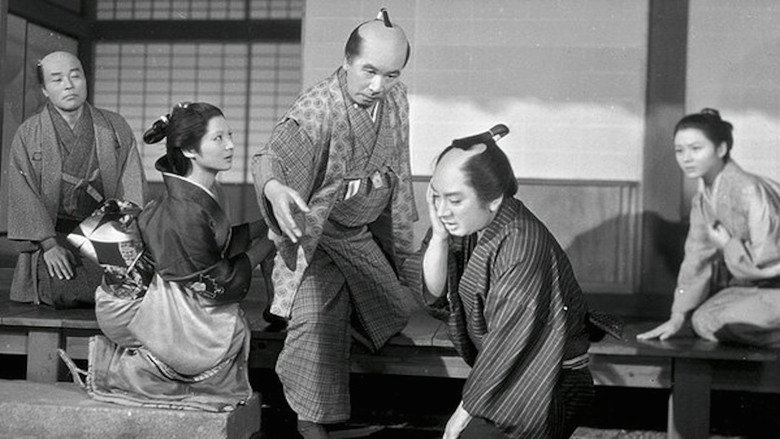
Based on the musical play by Chikamatsu Monzaemon, The Crucified Lovers is the story of a wealthy man who accuses his wife and an employee of having an affair as the two run away together. Directed by Kenji Mizoguchi and screenplay by Matsutaro Kawaguchi and Yoshikata Yoda, the film is an exploration of jealousy and neglect set in 17th Century Kyoto. Starring Kazuo Hasegawa, Kyoko Kagawa, Yoko Minamida, and Eitaro Shindo. The Crucified Lovers is a compelling and gripping film from Kenji Mizoguchi.
The film revolves around a wealthy but selfish scroll maker who would accuse his wife and his top employee of having an affair when the reality is that the wife needed money to pay her brother’s debts which the husband refuses to do as she turns to his top apprentice for help. It’s a film that is about a man who drives away his wife and his top man into chaos all because he doesn’t want to spend the money he makes and have it wasted on things he thinks are mindless. The film’s screenplay is quite simple as it explores a man’s greed and his unwillingness to help people as he would treat his wife cruelly as well as those who work for him as he would often try to engage into an affair with a young maid who has feelings for the top apprentice. The first half is about the trouble the wife in Osan (Kyoko Kagawa) would unfortunately create while the second half is about her and the apprentice Mohei (Kazuo Hasegawa) running away as they deal with what to do next as they’re being pursued by people working for Osan’s husband Ishun (Eitaro Shindo) who wants to deal with them himself rather than report them to the authorities.
Kenji Mizoguchi’s direction is definitely engaging for the way he captures life in 17th Century feudal-Japan where it’s run by warlords and such as there’s people willing to profit from these conflicts. Much of the film is shot in countryside locations in Japan as it plays into a world that is thriving yet there are rules that are quite cruel. Mizoguchi’s usage of the wide shots would capture this sense of oppression where there is a scene of a couple that is being shamed publicly and later crucified because they committed adultery which adds a sense of dramatic weight into the film. Yet, Mizoguchi would favor more intimate shots such as close-ups and medium shots to play into the drama which include these scenes at these lavish yet traditional Japanese homes as well in the forest where he would create a sense of theatricality into the acting as well as raise the stakes into what Osan and Mohei would endure. Especially in the third act as it play into not just the selfishness of Ishun finally catching up with him but the effects it would play into Osan and Mohei’s lives. Overall, Mizoguchi creates a riveting and haunting film about a wealthy man’s selfishness as he drives his wife and top apprentice into an affair.
Cinematographer Kazuo Miyagawa does brilliant work with the film’s black-and-white photography for its usage of lights for many of the interior/exterior scenes set at night while going for something more natural in the daytime scenes. Editor Kanji Sugawara does excellent work with the editing as it is straightforward to play into the build of the dramatic intensity as well as in some of the moments of dramatic suspense. Production designer Hisakazu Tsuji, with set decorator Yaichi Ebise and art director Hiroshi Mizutani, does fantastic work with the look of the home of Ishun as well as his shop where he runs his scroll making business as well as some of the interior gardens. Costume designer Natsu Ito does wonderful work with the costumes from the design of the robes and clothes that the men and women wore in those times. The sound work of Iwao Otani is terrific for its natural approach to the sound as it help create some tension in the drama. The film’s music by Fumio Hayasaka and Tamezo Mochizuki is amazing for its unsettling yet enchanting score as its usage of percussions and string instruments help add weight to the drama as it is a major highlight of the film.
The film’s superb cast feature a few notable small roles from Haruo Tanaka as Osan’s brother, Yoko Minamida as the maid Otama who is in love with Mohei, and Eitaro Ozawa as the scroll maker manager Sukeemon as a man who would try to defuse the situation only to cause more trouble. Eitaro Shindo is excellent as Ishun as a wealthy owner of a scroll making business who is a man that is very selfish as he neglects his wife and is indifferent about the feeling of his workers as he would plot a way to deal with his wife and Mohei. Kazuo Hasegawa is brilliant as Mohei as a scroll-making apprentice who is good at his job until he is asked to help Osan into giving her money where everything goes wrong as he deals with his growing disdain towards Ishun and his feelings for Osan. Finally, there’s Kyoko Kagawa in an amazing performance as Osan as Ishun’s wife who is trying to help her family as she puts herself and Mohei into a terrible situation as she becomes angry over her husband’s insensitivity as she would try and make a life of her own only to realize how difficult it is.
The Crucified Lovers is a marvelous film from Kenji Mizoguchi. Featuring a great cast, gorgeous visuals, a captivating script, and an eerie music score. It’s a film that explores Japanese society where everything is unruly during its feudal times as well as a woman dealing with the selfishness of her husband and the help of another man. In the end, The Crucified Lovers is a remarkable film from Kenji Mizoguchi.
Kenji Mizoguchi Films: (Tokyo March) - (The Water Magician) - (Aizo Toge) - (The Downfall of Ozen) - Osaka Elegy - (Sisters of the Gion) - (The Story of the Last Chrysanthemums) - The 47 Ronin (1941 film) - (Utamaro and his Five Women) - (The Love of the Actress Sumako) - (Portrait of Madame Yuki) - (Miss Oyu) - (The Lady of Musashino) - The Life of Oharu - Ugetsu - (A Geisha) - Sansho the Bailiff - (The Woman in the Rumor) - (Princess Yang Kwei-Fei) - (Tales of Taira Clan) - (Street of Shame)
© thevoid99 2017