***The Following is a Review of the 252-minute Extended Version of the Film***

The film revolves around a fellowship who take their final steps to finish a quest to destroy a dark lord’s ring that is in the possession of a hobbit who is tasked to take the ring to its homeland and destroy it. It is a film that serves as a culmination of everything that had been told in previous stories where four hobbits, two men, a wizard, an elf, and a dwarf all choose to take part in a quest to destroy the ring of Sauron where there is a lot at stake. In this third film, the stakes are even bigger with Gondor being in danger from Sauron’s forces in both orcs and humans ready to attack while two hobbits are continuing their journey to Mordor with Gollum guiding them unaware that Gollum is going to betray them over what happened at Gondor. Meanwhile, the rest of the fellowship would split with two of them going to Gondor while the rest remain at Rohan planning the next battle against Sauron.
The film’s screenplay by Peter Jackson, Fran Walsh, and Philippa Boyens does continue a cross-cutting narrative though it opens with how Smeagol became Gollum after he kills his cousin Deagol (Thomas Robins) over the ring that Deagol found. It then cuts to the main narrative where Frodo Baggins (Elijah Wood) and Samwise Gamgee (Sean Astin) continue their trek to Mordor with Gollum as they are unaware of his intentions. The narrative also plays into the brief reunion between members of the fellowship in Aragorn (Viggo Mortensen), Legolas (Orlando Bloom), Gimli (John Rhys-Davies), Gandalf (Ian McKellan), Merry (Dominic Monaghan), and Pippin (Billy Boyd) at Isengard in the aftermath of Rohan’s battle against the Uruk-hai where Gandalf finds the Palantir previously owned by Saruman (Christopher Lee) where Pippin makes a discovery into what Sauron is doing next. It would force Gandalf to go to Gondor with Pippin to warn its steward in Lord Denethor (John Noble) about Sauron’s upcoming attack. Instead, the grief-stricken Denethor refuses to listen to Gandalf aware of Aragorn’s claim to Gondor’s throne leaving the land and its city of Minas Tirith vulnerable despite its defense led by Denethor’s son Faramir (David Wenham).
The script does help complete some unique character arcs for the fellowship but also in the stakes were Aragorn’s lover in elvish Arwen (Liv Tyler) has chosen to stay in Middle Earth after seeing a vision of the future but her fate becomes tied to the fate of the Ring. Her father Elrond (Hugo Weaving) realizes that he must help Aragorn in going into a dark land as it relates to an army of the dead who had been cursed in their refusal to help Isildur (Harry Sinclair). The second act relates to the siege of Gondor where Gandalf leads its army to defend the city of Minas Tirith while Lord Denethor succumbs to madness believing Rohan has abandoned him. The third act does relate to not Frodo and Sam’s continued journey towards Mordor despite major obstacles with Aragorn finally accepting his role as Gondor’s king where he challenges Sauron.
Jackson’s direction is immense in terms of the large set pieces, settings, and myriads of tones that he would create throughout the film as it is shot on location in New Zealand including studios in the country for some scenes. The film’s opening prologue relates to how Smeagol became Gollum displays the horror of what the ring did to him as it would then cut to many years later where Frodo and Sam get ready for another day of walking with Gollum towards Mordor. The usage of wide and medium shots play into the world that is Middle Earth with its mountains, forests, rivers, valleys, lakes, and fields as they do function as characters in the film. One notable sequence where Jackson takes advantage of the locations is a sequence where Pippin lights a beacon at Minas Tirith leading to a series of beacons on the mountains lighting up. It shows that ordinary people in the mountains all have a role to play as Aragorn would see a beacon lit as it would play into Rohan answering the call.
Jackson also maintains some intimacy and calmer moments such as scenes of Gandalf and Pippin at Minas Tirith where they watch over the storm at Mordor where a beam shot from a castle at Mordor shots up. Jackson’s close-ups show the sense of fear and dread in Gondor with Sauron’s forces including the Nazgul led by the Witch-King of Angmar (Lawrence Makoare). Jackson’s direction knows when to create a sense of calm before the storm as it includes these tense moments where Gollum would try to create discord between Sam and Frodo with the former realizing what Gollum is up to. The tension also occurs involving Faramir and Denethor with the former taking on a suicide charge to reclaim Osgiliath only to return as its unconscious sole survivor leading Denethor into a state of madness just as the orcs have arrived at Pelennor Fields. The Siege of Minas Tirith is among one of the finest sequences ever created where Jackson highlights a lot of depth of field into how massive the orc army is that would later include the Haradrim and a group of pirates whom Aragorn, Legolas, and Gimli would confront on their way to Gondor.
The extended version of the film, in its 252-minute running time, adds a lot more depth to the story where Jackson allow characters and moments to breathe more. Even in some of the smaller moments such as a brief conversation between Merry and Eowyn as the former reveals why he wants to fight. One major sequence in the extended version that was not in the theatrical version involves a confrontation at Isengard where Saruman (Christopher Lee) is bitter about his loss as he tries to attack Gandalf. It is also a scene that includes Grima Wormtongue (Brad Dourif) who had assisted Saruman but is at a sense of loss where Theoden offers his forgiveness. The extended version also does more with what happened in the Battle of Pelennor Fields that would involve so many things including a confrontation between Gandalf and the Witch-King of Angmar. The third act is where Jackson slows things down as it relates to Frodo and Sam walking towards Mount Doom as it include some dark humorous moments as well as a sense of loss in which Frodo starts to lose his own identity and cannot remember the life he once had.
The film’s post-climax does involve a lot of endings, yet it is more about the aftermath of everything that happened. Jackson approaches these loose ends where it plays into characters returning home yet nothing is the same for one character. Even so it would involve a brief return from Bilbo (Ian Holm) who has aged since having parted with the ring as he would ask about it. It is followed by the idea of death as the next big adventure while a character would return home with a task to finish the story that everyone had experienced. Overall, Jackson crafts a film that is epic in every sense of the word as it plays into a group of creatures trying to save Middle Earth from a dark lord.
Cinematographer Andrew Lesnie does phenomenal work with the film’s cinematography with its usage of colorful lighting for some of the daytime scenes as well as the color grading and lighting textures that help maintain an atmosphere for some of the battle scenes as well as some scenes set at night. Editors Jamie Selkirk and Annie Collins do brilliant work with the editing in the usage of slow-motion cuts for some of the action and suspense along with fast-cutting for some of the battle scenes and dramatic moments such as Lord Denethor’s mad state as it relates to Faramir. Production designer Grant Major, with set decorator/supervising art director Dan Hennah, set decorator Alan Lee, and co-conceptual designer John Howe, does incredible work with the sets that include the look of Minas Tirith, the hall of the king, and some of the places in Mordor including Mount Doom. Costume designers Ngila Dickson and Richard Taylor do excellent work with the costumes that include the armor that Merry and Pippin would wear to respectfully represent Rohan and Gondor as well as the look of the armor of the orcs and the final armor that Aragorn wears for its climax.
Hair and makeup designers Peter Swords King and Peter Owen do amazing work with the look of the orcs including the orc commander Gothmog (Lawrence Makoare) and the look of the elderly Bilbo. Visual effects supervisor Jim Rygiel does tremendous work with the visual effects for some of the set dressing of the locations including Minas Tirith as well as some of the creatures including the Ents for the brief scene at Isengard, the Nazgul, the oliphaunt, and the eagles would play a key role in the final battle. Sound designers David Farmer, Michael Semanick, and Ethan van der Ryn, along with sound editor Mike Hopkins, do superb work with the sound in terms of the atmosphere of the sounds in the battle scenes as well as other sparse sounds in some of the locations. The film’s music by Howard Shore is incredible for its soaring orchestral score that play into the bombast of some of the action, suspense, and drama with the usage of string arrangements, percussions, vocals, brass, and woodwinds to help add to the stakes and drama. The film also features a great original song written by Shore, Fran Walsh, and Annie Lennox in Into the West as it serves as a fitting finale for the trilogy.
The casting by Victoria Burrows, Amy Hubbard, John Hubbard, Liz Mullane, and Ann Robinson is marvelous as it feature some notable small roles and appearances from Marton Csokas as the elf leader Celebron, Bret McKenzie as the elf guide Figwit, Sarah McLeod as the hobbit barmaid Rosie Cotton, Lawrence Makoare in a dual role as the Witch-king of Angmar and the orc commander Gothmog with Craig Parker as the voice of the latter, Alan Howard as the voices of Sauron and the ring, Thomas Robin as Smeagol’s cousin Deagol who found the ring, Ian Hughes as the Minas Tirith officer Irolas, John Bach as Faramir’s second-in-command Madril, Bruce Hopkins as a Rohirrim officer in Gamling, Paul Norell as the ghostly King of the Dead, Bruce Spence as the Mouth of Sauron in the extended version of the film, Sean Bean as Boromir as a ghostly figure in the extended version, and Ian Holm as Frodo’s uncle Bilbo as the old hobbit who had once had the ring where he later asks Frodo if he still has it. Christopher Lee and Brad Dourif are excellent in their respective brief roles as the wizard Saruman and Grima Wormtongue with the former being an ally to Sauron that has lost everything as he tries to battle Gandalf while the latter is a spy of Saruman who feels remorse for his actions despite the abuse he receives from Saruman.
John Noble and David Wenham are brilliant in their respective roles as Lord Denethor and his son Faramir with the former succumbing to madness and grief as he continues to berate Faramir for not living up to expectations. Wenham’s performance as Faramir highlights a man who realized what happened to his older brother Boromir where he deals with his father’s criticism as he goes on a futile quest to win his father’s approval. Karl Urban is superb as King Theoden’s nephew Eomer who is the leader of the Rohirrim as he proves to be one of Aragorn’s most loyal figures as he also proves to be a warrior on the battlefield. Bernard Hill is fantastic as King Theoden of Rohan as a king who is reluctant to help Gondor but realizes what is at stake where he knows that he and Rohirrim are outnumbered but remains this great leader who can inspire many to fight. Miranda Otto is amazing as Eomer’s sister Eowyn as a woman who is in love with Aragorn but also wants to prove herself as a warrior where she would disguise herself as a man at the Battle of Pelennor Fields where she really kicks some ass.
The trio of Cate Blanchett, Liv Tyler, and Hugo Weaving are incredible in their respective roles as the elvish queen Galadriel, Arwen, and Lord Elrond with Blanchett appearing in a few moments such as guiding Frodo as well as appearing in the penultimate scene of the film. Tyler brings gracefulness to the role of Arwen, who has her own vision of the future as the decision she makes is linked with her fate of the ring. Weaving’s performance is doubtful of men until he decides to help Aragorn by reforging Isildur’s sword so that Aragorn can claim his throne. Dominic Monaghan and Billy Boyd are great in their respective roles as the hobbits Merry and Pippin who both go on separate journeys with Merry staying at Rohan where he becomes a squire for King Theoden while Pippin becomes the guard of the Citadel at Gondor where both hobbits prove their worth. Orlando Bloom and John Rhys-Davies are phenomenal in their respective roles as the elf warrior Legolas and the dwarf Gimli as two members of the fellowship who help Aragorn in convincing the Army of the Dead while becoming the best of friends while Rhys-Davies also does additional voice work for the Ent character Treebeard.
Ian McKellan and Viggo Mortensen are tremendous in their respective roles as the wizard Gandalf and the heir to Gondor’s throne in Aragorn with the former as a resurrected wizard who goes to Gondor with Pippin where he expresses his own doubts while he does what he can to lead Gondor into battle. Mortensen’s performance as Aragorn shows a former ranger who realizes the role he must accept where he would also take on a leadership role that includes a great speech in the final battle that shows that he is worthy to be king. Sean Astin is remarkable as Samwise Gamgee as Frodo’s friend who accompanies him to Mordor where he becomes aware of Gollum’s deceit where he deals with Frodo banishing him only to later return where he is the film’s conscious in doing what is right and to remind Frodo about the good of the world.
Andy Serkis is magnificent as Smeagol/Gollum as a hobbit who had become a creature that once possessed the ring for hundreds of years as he hopes to reclaim where he would do what he can to deceive all and reclaim the ring. Serkis’ performance also shows the descent of someone who used to be good only to succumb to greed as it is a performance for the ages. Finally, there is Elijah Wood in a spectacular performance as Frodo Baggins as a hobbit who carries the ring to Mordor where he starts to lose parts of his own identity as he would also descent to the ring’s power. Wood also has the most physically-demanding performance of someone that is just becoming tired as he has the weight of everything to be the one to destroy the ring followed by an aftermath that has him coping with everything he had dealt with as it is an iconic performance from Wood.
The Lord of the Rings: The Return of the King is an outstanding film by Peter Jackson. Featuring a great ensemble cast, top-notch visual effects, gorgeous photography, a riveting story of good vs. evil, and Howard Shore’s ravishing music score. It is a film that goes beyond the description of an epic as it is also the culmination of a grand story that shows four little hobbits making a big impact on a magical land with elves, dwarves, and human beings. In the end, The Lord of the Rings: The Return of the King is a magnificent film by Peter Jackson.
Peter Jackson Films: (Bad Taste) – (Meet the Feebles) – (Braindead) – (Heavenly Creatures) – (Forgotten Silver) – (The Frighteners) – The Lord of the Rings: The Fellowship of the Ring - The Lord of the Rings: The Two Towers - (King Kong (2005 film)) – (The Lovely Bones) – (The Hobbit: An Unexpected Journey) – (The Hobbit: The Desolation of Smaug) – (The Hobbit: The Battle of the Five Armies) – (They Shall Grow Old Together) – The Beatles: Get Back
© thevoid99 2026
***The Following is a Review of the 223-minute Extended Version of the Film***

The film revolves around a fellowship that had been splintered by events and challenges where they all go on a quest to destroy Sauron’s ring at Mount Doom in Mordor. It is a film with three different storylines where Frodo Baggins (Elijah Wood) and Samwise Gamgee (Sean Astin) travel to Mordor by themselves where they meet the creature Gollum who agrees to take them to Mordor after Frodo takes pity on him. The other storyline has the ranger Aragorn (Viggo Mortensen), the elf Legolas (Orlando Bloom), and the dwarf Gimli (John Rhys-Davies) travel to Rohan where they help King Theoden of Rohan (Bernard Hill) deal with Saruman (Christopher Lee) and his army who want to destroy Rohan. The other two hobbits in Merry (Dominic Monaghan) and Pippin (Billy Boyd) escape the clutches of the Uruk-hai and go into Fangorn forest where they meet the Ent Treebeard (voice of John Rhys-Davies) to convince him and other Ents to wage war on Saruman for destroying parts of Fangorn forest.
The film’s screenplay by Peter Jackson, Fran Walsh, Philippa Boyens, and Stephen Sinclair has a cross-cutting narrative that play into the different journeys the fellowship would go through. Especially after events forced the group to be splintered following tragedy and uncertainty that led to their separation where Aragorn, Legolas, and Gimli decide to follow the Uruk-hai who had captured Merry and Pippin only to learn that the Uruk-hai had been killed by Eomer (Karl Urban), who is the leader of Rohan’s calvary in the Rohirrim, and his horsemen as they had been exiled by Theoden’s advisor in Grima Wormtongue (Brad Dourif). Going through Fangorn forest, they learn that the wizard Gandalf (Ian McKellan) has been resurrected as Gandalf the White who had left Merry and Pippin to the Ents for safety while he joins the rest to Rohan to free Theoden from Saruman’s powers. The narrative involving Frodo and Sam as they struggle to find their way to Mordor until they meet the creature Gollum, who had once possessed the ring, who had been following them hoping to recapture the ring where he reluctantly to accompany them to Mordor. During their journey where Frodo learns that Gollum was once a hobbit named Smeagol, they also run into Gondor rangers led by Faramir (David Wenham) who is Boromir’s younger brother.
The script also play into character arcs where Merry and Pippin are forced to grow up as they deal with their own situations as they realize that the Shire would be in danger if they cannot convince the Ents to wage war on Saruman. Aragorn would go through his own arc as he becomes aware that he is a symbol of hope to Rohan including Theoden’s niece Eowyn (Miranda Otto) who becomes smitten by him even though he is in love with the elvish princess Arwen (Liv Tyler). The script also play into Arwen having to make the decision to leave with the elves who are all leaving Middle Earth as her father Elrond (Hugo Weaving) reveal her fate if she chooses to stay. Yet, Elrond would have his own conversation with the elvish queen Galadriel who is aware that Aragorn and Rohan are in danger of losing to both Sauron and Saruman.
Jackson’s direction is grand in terms of how big the visual presentation is at it is shot on various locations in New Zealand as well as studios in New Zealand. The film opens with events from the previous film where the fellowship run from Balrog where Gandalf would take a stand at the monster. What Jackson does is show what happened to Gandalf as the fellowship see him fall to his death only for Gandalf to fall while fighting Balrog. It then cuts to Frodo and Sam continuing to walk towards Mordor as they find themselves lost where Jackson’s approach to close-ups and medium shots play into the sense of the unknown in the locations they are in where they later meet Gollum who had been following them. Jackson would maintain this tense and eerie atmosphere for the scenes involving Frodo, Sam, and Gollum as they travel towards Mordor. Even as there are a bit of light-hearted moments in the tension between Sam and Gollum where the former comments about creating a stew with the need for some potatoes.
In the extended version of the film in its 223-minute running time, as opposed to the 179-minute running time in its theatrical release, where Jackson can do more with the story and flesh out the characters. One notable sequence involves a flashback scene with Boromir (Sean Bean) who had recaptured the port city of Osgiliath for Gondor as he would share his victory with Faramir. It plays into why Boromir was keen on having the ring as the scene also featured his father Denethor (John Noble) who believes that the meeting is about the ring as Boromir is reluctant to go. The sequence adds depth for Faramir’s own reasons in wanting the ring as it relates to his troubled relationship with his father. Jackson’s usage of the wide shots for the locations would add greater depth for the film’s climatic battle at Helm’s Deep. In its mixture of practical effects, miniatures, and computerized-visual effects, the battle of Helm’s Deep is truly a marvel in terms of how to create a battle with lots of extras and detail into every moment that is shown.
So much is happening during the battle as it would cross-cut on the narrative of Merry and Pippin convincing Treebeard and the Ents to go to war on Saruman as the extended version in the film reveal a lot of detail about Fangorn forest and its own magical powers. There is also more into what Frodo, Sam, and Gollum go through after being captured by Faramir where they encounter the Nazgul and orcs at Osgiliath as its aftermath would play into a key decision Faramir makes about the ring. The ending of the second film sets up what is to come ahead between the forces of Rohan and the fellowship while Frodo and Sam continue their trek towards Mordor with Gollum in tow. Overall, Jackson crafts a grand and gripping film about a group of individuals continuing their quest to destroy evil for good.
Cinematographer Andrew Lesnie does phenomenal work with the film’s cinematography with its approach to color grading for some of the interior/exterior settings at night as well as the look of the daytime exteriors for some shots in the valleys as well as scenes in the forests as it is a highlight of the film. Editor Michael Horton does brilliant work with the editing in the usage of jump-cuts for some montages as well as other stylish cuts to play into the action and suspense as it is another highlight of the film. Production designer Grant Major, with set decorator/supervising art director Dan Hennah, and set decorator Alan Lee, does incredible work with the look of Saruman’s tower at Isengard as well as the look of fortress of Helm’s Deep in its interiors and exteriors with additional work from conceptual designer John Howe. Costume designers Ngila Dickson and Richard Taylor do excellent work with the costumes in the look of King Theoden’s armor as well as the look of the Rohirrim and the soldiers of Gondor.
Hair and makeup designers Peter Swords King and Peter Owen do fantastic work with the look of the Uruk-hai orcs, the elvish army, and King Theoden in his decayed state under Saruman’s spell. Visual effects supervisor Jim Rygiel does amazing work with the look of the Nazgul creatures as well as the look of the Ents and the motion-capture design of Gollum as it is a major highlight of the film. Sound designers David Farmer and Michael Semanick, along with sound editors Mike Hopkins and Ethan Van der Ryn, do superb work with the sound in the way the Nazgul sound and other sound effects that help play into the action and suspense. The film’s music by Howard Shore is great as its usage of heavy brass sections, soaring strings, heavy percussions, and somber woodwinds for some unique themes along with a few songs including a funeral song sung by Eowyn.
The casting by Victoria Burrows, Amy Hubbard, John Hubbard, Liz Mullane, and Ann Robinson is marvelous as it feature some notable small roles from Sam Comery and Olivia Tennet as a couple of young Rohan children who escape the Uruk-hai, Robyn Malcolm as their mother, Paris Howe Strewe as Theoden’s son Theodred who gets seriously wounded following an ambush by the Uruk-hai, Bruce Hopkins as one of Theoden’s military leaders in Gamling, the quartet of Robbie Magasiva, Jed Brophy, Nathaniel Lee, and Stephen Ure as Uruk-hai orcs, and Craig Parker as the elvish general Haldir. Christopher Lee and Brad Dourif are superb in their respective roles as the evil wizard Saruman and the spy Grima Wormtongue with the former being a once-respected wizard who has aligned himself with Sauron as he wants to destroy Rohan while the latter is a slimy figure who works for Saruman in poisoning King Theoden’s mind as he would also play a role in wounding Rohan.
In the extended version of the film, John Noble and Sean Bean are fantastic in their respective roles as Lord Denethor and Boromir with the former as Gondor’s steward who learns about the ring as he wants Boromir to Rivendell. Bean’s performance as Boromir is given more complexity as a man that is devoted to Gondor as well as trying to give his younger brother Faramir more credit. David Wenham’s performance as Faramir is excellent as a captain of Gondor who captures Frodo and Sam while he hopes to get the ring to win the approval of his father. Karl Urban is brilliant as Theoden’s nephew Eomer, who gets exiled by Wormtongue as he and the Rohirrim go on their own war against the Uruk-hai as he laments over his home and his uncle’s state of mind. Miranda Otto and Bernard Hill are amazing in their respective roles as Eomer’s sister Eowyn and King Theoden of Rohan with the former as a woman who wants to fight as she becomes smitten towards Aragorn as she also does what she can for the people of Rohan. Hill’s performance starts off as a man poisoned and disconnected from reality under Saruman’s spell and Wormtongue’s activities only to come out of it in trying to help his people as he laments over the power of the Uruk-hai in their hatred of everything and everyone.
The trio of Cate Blanchett, Liv Tyler, and Hugo Weaving are incredible in their respective roles as the elvish queen Galadriel, Arwen, and Lord Elrond with Blanchett’s brief appearance in her telekinetic conversation with Elrond about what is at stake with Weaving being someone unsure as he laments over the life his daughter Arwen would have if she chooses not to leave Middle Earth where Tyler brings a gracefulness of a woman who is aware of what she will lose. Dominic Monaghan and Billy Boyd are remarkable as the hobbits Merry and Pippin as the two hobbits who were briefly captured by the Uruk-hai until they are saved by the Ents where they deal with Saruman’s growing power and the need to convince the Ents to go to war against Saruman. John Rhys-Davies is marvelous in a dual role as the voice of the Ent Treebeard, who often talks in an unconventional fashion, and as the dwarf Gimli who does provide humor in some of the action as well as be someone who remains loyal to the fellowship where he does what he can to fight the Uruk-hai.
Orlando Bloom and Ian McKellan are great in their respective roles as the elvish warrior Legolas and the wizard Gandalf with the former being this skilled elvish warrior who deals with the severity of what Rohan is facing while doing what he can to fight off the Uruk-hai. McKellan’s performance as Gandalf is only on a few scenes as a wizard who gets resurrected where he also realizes that Rohan is in danger where he would go to find Eomer for help. Sean Astin and Viggo Mortensen are phenomenal in their respective roles as Sam and Aragorn with the former dealing with Gollum and Frodo’s declining emotional/mental state while the latter as a ranger who realizes that he must become a leader where he deals with many obstacles as well as a near-death experience during an ambush.
Elijah Wood is tremendous as Frodo Baggins as the hobbit carrying the ring where he deals with the severity of the quest as well as the ring’s power where he would start to lose himself. Finally, there is Andy Serkis in an outstanding supporting performance as the creature Gollum/Smeagol as a former hobbit who once held the ring where he guides Frodo and Sam to Mordor in the hope, he can reclaim the ring as there is a lot of complexity to his performance where he can the kind and light-hearted Smeagol or the meaner and manipulative Gollum.
The Lord of the Rings: The Two Towers is a spectacular film by Peter Jackson. Featuring a great ensemble cast, vast set pieces including the Helm’s Deep battle sequence, intoxicating visuals, an exhilarating music score, and a story of good versus evil. It is a fantasy film that does a lot more in its exploration of what creatures face in the darkest of times as well as the need to find light in that darkness. In the end, The Lord of the Rings: The Two Towers is a tremendous film by Peter Jackson.
Peter Jackson Films: (Bad Taste) – (Meet the Feebles) – (Braindead) – (Heavenly Creatures) – (Forgotten Silver) – (The Frighteners) – The Lord of the Rings: The Fellowship of the Ring - The Lord of the Rings: The Return of the King – (King Kong (2005 film)) – (The Lovely Bones) – (The Hobbit: An Unexpected Journey) – (The Hobbit: The Desolation of Smaug) – (The Hobbit: The Battle of the Five Armies) – (They Shall Grow Old Together) – The Beatles: Get Back
© thevoid99 2026
***The Following is a Review of the 208-minute Extended Version of the Film***

Set in a fictional ancient world known as Middle Earth, the film revolves around a young hobbit who inherits a ring from his uncle where a wizard realizes it is the ring created by the dark demon known as Sauron. There, the wizard, a hobbit along with three other hobbits, a dwarf, an elf, and two men go on a journey to Sauron’s homeland of Mordor to bring the ring to its land and destroy it. It is a story that is part of an immense epic that follows different creatures who venture on a quest to vanquish evil finally just as Sauron is set to return and destroy everything that is good. The first story is about a hobbit who is given this ring as he would accidentally wear the ring as he realizes its power and why so many want it. Yet, there are those who would become part of the fellowship who have their own reasons for not wanting to carry this ring as well as his own reasons for why he has abandoned his role in becoming king for one of the last free countries of Middle Earth.
The film’s screenplay by Peter Jackson, Fran Walsh, and Philippa Boyens opens with a prologue about life in Middle Earth where rings of power were given to the races of men, elves, and dwarves only to realize that the dark lord Sauron (Sala Baker) has created one ring to rule over everyone in Middle Earth. It would lead into a war where men and elves formed an alliance to fight Sauron and his forces where a prince in Isildur (Harry Sinclair) severs Sauron’s hand but chooses to keep Sauron’s ring until it would be lost following an ambush years after the battle. Then it would be in the hands of a creature known as Gollum (Andy Serkis) who would keep it for centuries until it abandoned him where it would be in the hands of a hobbit in Bilbo Baggins (Ian Holm). The prologue sets up the stakes as well as what Bilbo’s nephew Frodo (Elijah Wood) must destroy by going to Mordor and its volcano in Mount Doom where the ring was created. The first act is set 60 years after the events in which Bilbo found the ring as there is a birthday celebration for him where the wizard Gandalf the Grey (Ian McKellan) visits him. The celebration would be notable for Bilbo disappearing where Gandalf discovered that Bilbo has a ring that Bilbo found many years ago where Bilbo reluctantly gives the ring to Frodo. Gandalf would then discover that the ring is the one ring created by Sauron after Frodo reads the inscriptions after it was on fire.
Part of the first act has Frodo being accompanied by his best friend Samwise Gamgee (Sean Astin) and later joined by hobbits Merry (Dominic Monaghan) and Pippin (Billy Boyd) as they to evade Sauron’s rangers in the Nazgul. After meeting a ranger named Strider (Viggo Mortensen) who takes them to Rivendell where the fellowship is formed that would include Gandalf, the elf Legolas (Orlando Bloom), the dwarf Gimli (John Rhys-Davies), and Boromir (Sean Bean) of Gondor to go to Mordor and destroy the ring. The fellowship would be challenged by many forces including a new army of orcs in the Uruk-hai created by the wizard Saruman who had turned on Gandalf and aligned himself with Sauron. Even as Frodo becomes tempted by the power of the ring as is Boromir who wants the ring for his home of Gondor that is threatened by Mordor. Yet, the fellowship would go through obstacles with Strider revealed to be Aragorn who is a descendant of Isildur and the rightful heir to Gondor’s throne.
Jackson’s direction is grand as it is shot on location in New Zealand along with some scenes shot in studios in New Zealand. Jackson goes for a varying degree of styles in the direction through some wide and medium shots for a scope of the locations. Notably in scenes involving the mountains, rivers, and valleys as they function as characters into the film where it plays into the richness of Middle Earth with the Shire as this peaceful and isolated world of hobbits that very few outsiders visit. It is a direct contrast to other parts of Middle Earth such as the world of the elves in the forest where the elf-queen Galadriel (Cate Blanchett) lives in a Mordor where orcs and other dark creatures settle in as they get ready for war. The usage of aerial shots of the locations along with some intimate moments where Gandalf interacts with hobbits are unique as the usage of trick photography and visual effects do add a sense of wonderment into the film. Jackson also puts in some humor as it relates to the adventure that balances the suspense and drama throughout the film.
Jackson’s approach to some of the intimate moments such as a sequence where the fellowship of the ring are in the Mines of Moria as Frodo copes with being the one to carry the ring as the dialogue plays into Tolkien’s words about the choices everyone must make. Even choices that are the most difficult to endure as it would lead to some intense fight and action scenes. The usage of wide and crane shots are immense in its scale that includes the fellowship running from a demonic monster in Balrog. The third act in which the fellowship go to the elvish land of Lothlorien as they deal with their own struggles and encounters with the orcs. In the extended version of the film, in its 208-minute running time that expands 30 additional minutes from the theatrical release, where characters are fleshed out more such as Boromir who struggles with wanting to fulfill the wishes of his father as well as the need for something better where he sees Aragorn as the leader Gondor needs. Overall, Jackson crafts an astonishing and riveting film about a group of different creatures going on a quest to destroy a ring of evil to its land of darkness.
Cinematographer Andrew Lesnie does incredible work with the film’s cinematography with its unique color grading and look for some of the exterior scenes at the Shire and Lothlorien as well as some of the usage of light for the scenes in the mines and caves as well as the usage of blue light for scenes set at night. Editor John Gilbert does excellent work with the editing in the usage of slow-motion cuts as well as fast-cuts for some of the action along with moments in the drama and suspense where shots are allowed to last more than a minute. Production designer Grant Major, with set decorator/supervising art director Dan Hennah and set decorator/conceptual designer Alan Lee, does amazing work with the look of the sets, with additional help from co-conceptual designer John Howe, in how the homes at the Shire are presented as well as the world of the elves and Mordor including Saurman’s tower at Isengard. Costume designers Ngila Dickson and Richard Taylor do brilliant work with the costumes in the clothes the elves wear as well as the armor that Aragorn, Boromir, and Gimli wear, and the look of the armor that the orcs wear.
Hair and makeup designers Peter Swords King and Peter Owen do fantastic work with the look of the characters, with additional help from John Howe and Alan Lee, as well as the design and look of the orcs including the Uruk-hai. Visual effects supervisor Jim Rygiel does great work with the visual effects in the mixture of practical effects in the look of the orcs as well as the look of the demonic figure Balrog and the motion-capture look of Gollum. Sound designers David Farmer, Michael Semanick, and Ethan Van der Ryn, along with sound editor Michael Hopkins, do superb work in the sound as the way swords and flying arrows sound as well as the way monsters sound as it is a highlight of the film. The film’s music by Howard Shore is phenomenal for its orchestral score that is filled with unique themes through woodwinds as well as bombastic orchestral themes for some of the action and suspense as it is an absolute highlight of the film.
The casting by Victoria Burrows, Amy Hubbard, John Hubbard, Liz Mullane, and Ann Robinson is marvelous as it feature some notable small roles from Sarah McLeod as a hobbit barmaid in Rosie Cotton whom Sam has a crush on, Bret McKenzie as an elf escort in Figwit, Marton Csokas as an elvish elder in Celebron, Craig Parker as an elvish military leader in Haldir, Sala Baker as the dark lord Sauron, Alan Howard as the voice of the ring and Sauron, Bret McIntyre as the head Nazgul leader in the Witch King of Angmar, Harry Sinclair as Isildur, Lawrence Makoare as the Uruk-hai leader Lurtz, and Andy Serkis in a brief appearance as the creature Gollum and the voice of the Witch King of Angmar. Ian Holm is terrific as Frodo’s uncle Bilbo Baggins who had possession of the ring as he dealt with wanting a chance to leave the Shire for an adventure and complete his book while expressing regret about what Frodo must endure in destroying the ring. Liv Tyler is fantastic as Elrond’s daughter Arwen, who is Aragorn’s lover, as she would help Frodo go to Rivendell following his encounter with the Nazgul as she also gives Aragorn a gift for the journey he will take.
Hugo Weaving and Cate Blanchett are excellent in their respective roles as the elvish leaders Elrond and Galadriel as the former is an elf leader who saw what Isildur did in keeping the ring while he laments over Aragorn and Arwen’s relationship. Blanchett’s performance as Galadriel is graceful as a woman who admits to be tempted by the ring during her conversation with Frodo as she is aware of its powers and would give Frodo a gift for the journey. Christopher Lee is brilliant as the wizard Saruman who has turned evil and aligned himself with Sauron where he would create a new race of orcs that are more powerful than the orcs at Mordor. Dominic Monaghan and Billy Boyd are amazing in their respective roles as Merry and Pippin as two mischievous hobbits who join Frodo and Sam in the quest as they deal with the danger of the quest while learning how to fight with swords. John Rhys-Davies and Orlando Bloom are incredible in their respective roles as the dwarf Gimli and the elf Legolas as two mismatched members of the fellowship with Rhys-Davies providing a lot of wit as a dwarf who is strong and cunning while Bloom brings a level of finesse and expert marksmanship as an elf who is the straight man of the two.
Sean Bean is marvelous as Boromir as the son of Gondor’s steward who joins the fellowship where he is tempted by the ring where he struggles to do what is right while becoming protective of Merry and Pippin whom he would befriend as well as Aragorn whom he hopes would take on the role as King of Gondor. Sean Astin is remarkable as Samwise Gamgee, who is Frodo’s best friend and the film’s conscience, where Gandalf asks him not to leave Frodo where he helps Frodo on the journey while providing some witty comments during the film. Ian McKellan is great as the wizard Gandalf the Grey who learns about the ring Bilbo had been carrying for years as he also joins the fellowship as a magical figure who can deal with Saruman from afar. Viggo Mortensen is phenomenal as Strider/Aragorn as a ranger, who is also Isildur’s heir, who helps the hobbits in dealing with the Nazgul as he would join the fellowship where he also deals with the temptation of the ring that plays into his own reluctance to be King of Gondor. Finally, there’s Elijah Wood in a sensational performance as Frodo Baggins as a hobbit who is given the ring where he would accidentally wear the ring as he struggles with its powers and the task he must play.
The Lord of the Rings: The Fellowship of the Ring is a spectacular film by Peter Jackson. Featuring a great ensemble cast, rich visuals, a gripping story of temptation and the need to bring good into the world, Howard Shore’s majestic music score, and top-notch technical work. It is a film that is not just this exhilarating fantasy-adventure film but also a film that explores different people going on a quest to vanquish evil and bring good to the world. In the end, The Lord of the Rings: The Fellowship of the Ring is a tremendous film by Peter Jackson.
Peter Jackson Films: (Bad Taste) – (Meet the Feebles) – (Braindead) – (Heavenly Creatures) – (Forgotten Silver) – (The Frighteners) – The Lord of the Rings: The Two Towers – The Lord of the Rings: The Return of the King – (King Kong (2005 film)) – (The Lovely Bones) – (The Hobbit: An Unexpected Journey) – (The Hobbit: The Desolation of Smaug) – (The Hobbit: The Battle of the Five Armies) – (They Shall Grow Old Together) – The Beatles: Get Back
© thevoid99 2026

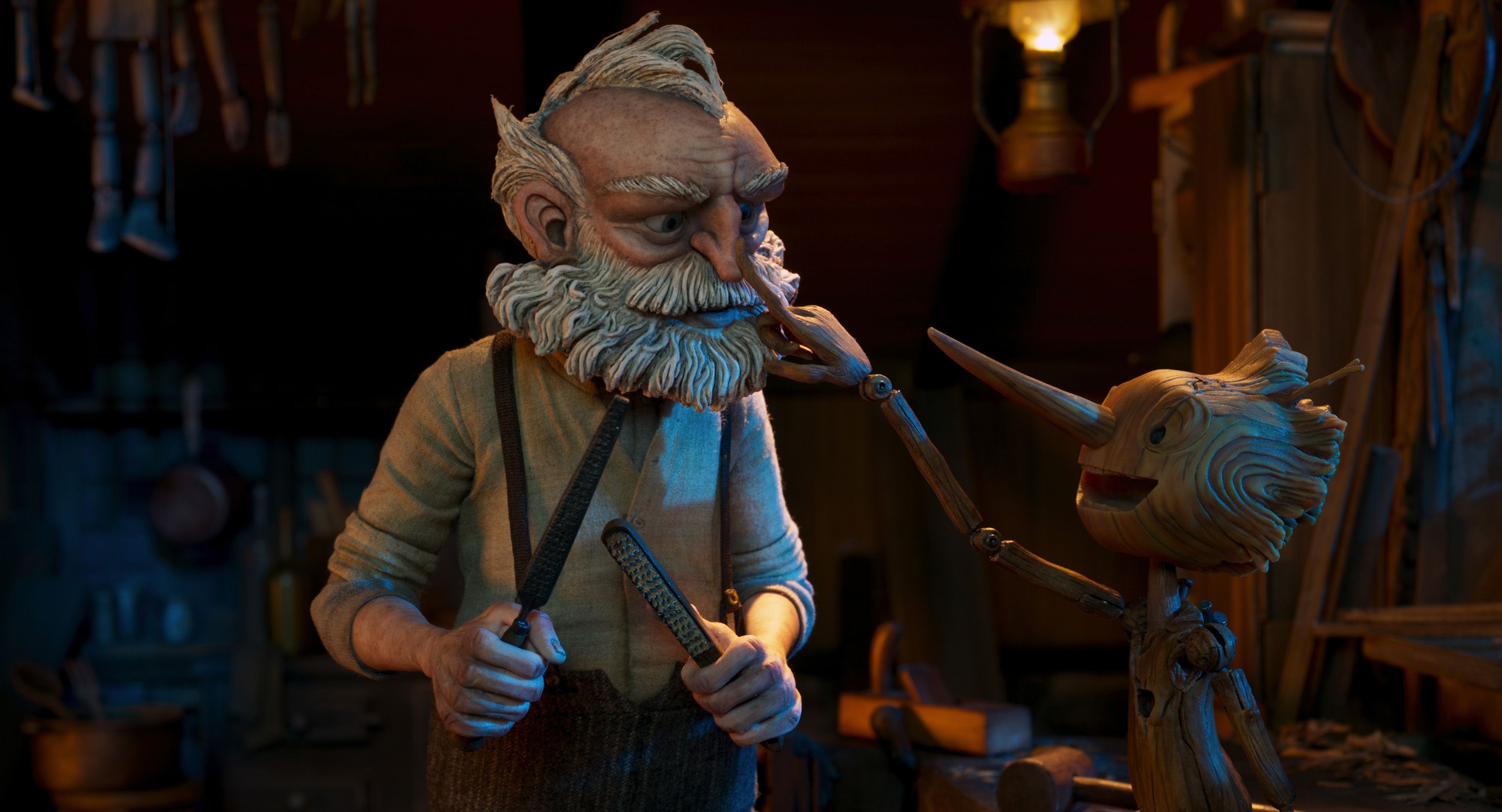
Two decades after the death of son during World War I, the film follows a man who drunkenly creates a wooden boy to cope with his loss as it comes to life where the boy struggles with not just winning his father’s approval but also what it means to live. It is a film that takes the premise of the story of a man who creates a puppet who turns into a boy as it is set in Fascist Italy at a time when conformity and playing to certain rules are in tow which is something that a puppet with no strings is trying to deal with as well as the idea of love and what it means to exist. The film’s screenplay by Guillermo del Toro and Patrick McHale is told largely by a cricket in Sebastian J. Cricket (Ewan McGregor) about the titular character (Gregory Mann) and how he had been created by this lonely carpenter in Geppetto (David Bradley) after having lost his son Carlo (Gregory Mann) during an aerial bombing in World War I as he had been ravaged by grief until he cuts down a tree where Cricket was living and turned it into a puppet. It is then where a fairy in the Wood Sprite (Tilda Swinton) would cast a spell for the puppet to come to life while asking Cricket to watch over and guide him.
While Geppetto’s initial encounter with Pinocchio has him confused and frightened as does Pinocchio’s appearance at the town’s local church. Geppetto does what he can to steer Pinocchio the right way but also him wanting to be like Carlo yet there is also pressure from the Podesta (Ron Perlman) who wants Geppetto to ensure that Pinocchio becomes part of the Italian Royal Army upon a major discovery they would have much to Geppetto’s horror. Even as Pinocchio would encounter the failing circus ringmaster Volpe (Christoph Waltz) who would get Pinocchio to sign a contract that would keep him out of the eye of the Podesta but also keep Pinocchio performing in order to keep Geppetto out of debt. It all plays into Pinocchio’s development and his conversations with Cricket as it has him thinking about not just wanting to live but also to find his own voice as he watches the abuse that Volpe has on his longtime assistant monkey Spazzatura (Cate Blanchett) as well as a closer look into the world of Fascist Italy upon being watched by the Podesta at youth training camp.
The direction of del Toro and Mark Gustafson is astonishing in its overall presentation due to the attention to detail that both men put into its look as it is created on studio locations in Portland, Oregon and Guadalajara, Mexico. With Gustafson and his team of animators doing much of the stop-motion work with production designers Guy Davis and Curt Enderle, with set decorators Jesse Gregg, Gillian Hunt, Samantha Levy, Molly Light, Laura Savage, and Zach Sheehan plus art directors Andy Berry, Karla Castaneda, Robert DeSue, and Juan J. Medina, helping to create much of the backdrops in the look of the forests and woods in such grand detail. Even with Davis also creating some of the creatures including Cricket, Spazzatura, and the sea monster for the film’s climax, there is a look that is del Toro in terms of its approach to death as well as horror with the former involving a sequence in which Pinocchio meets a death fairy (Tilda Swinton) in a surrealistic presentation of the afterlife. Since the film is also based on the illustrations of Gris Grimly, del Toro and Gustafson maintain this look that quite wobbly in its presentation as there is a realism to the animation as well as a physicality in how they take this story and set it into a world where there are elements of politics and existentialism in the mix.
Even in a scene where Pinocchio asks his father why people don’t like him but love this model of the crucifixion as it is among these things that Pinocchio would go into. The compositions that del Toro and Gustafson create add to the drama that Pinocchio goes through in the wide and medium shots in a location or in one of Pinocchio’s stage performances as well as close-ups that play into the characters as they cope with whatever situation they’re in. Notably in the climax as it plays into Pinocchio and Geppetto dealing with a sea monster as all of the lessons that Pinocchio would learn allows him to deal with the situations as well as an understanding of both life and death. Overall, del Toro and Gustafson craft an exquisitely moving and ravishing film about a wooden boy who comes to life and learns about existence and identity during the era of Fascist Italy.
Cinematographer Frank Passingham does incredible work with the cinematography as it helps the look of the film give it a sense of physicality in the lighting while helping to set mood to help bring more texture to the production design. Editors Ken Schretzmann and Holly Klein do amazing work with the editing as it is largely straightforward to play into some of the musical numbers but also in some of the dramatic and terrifying moments with its rhythmic cuts. Visual effects supervisors Cameron Carson and Aaron Weintraub do excellent work with the visual effects as it is mainly set dressing for some scenes involving war and fire as it help broaden the visuals. Sound designer Scott Martin Gershin does brilliant work with the sound in the way certain objects sound as well as the way an instrument sounds on a location or how bombs sound from afar. The film’s music by Alexandre Desplat is phenomenal with its rich orchestral score that has elements of lush strings and orchestral pianos themes along with some offbeat percussive-based themes while the soundtrack also feature original songs written by Desplat along with lyrics by del Toro, McHale, and Roeben Katz that add to the drama and humorous moments in the film that are sung by its cast.
The casting by Mary Hidalgo is great as it feature some notable small voice roles from Tom Kenny in a trio of voice performances as a sea captain, a right-hand for Mussolini, and the Italian Fascist leader Benito Mussolini as well as Tim Blake Nelson as a quartet of black rabbits, John Turturro as a doctor in the small town Geppetto lives in, Burn Gorman as the local priest, Finn Wolfhard as the son of the Podesta in Candlewick who at first bullies Pinocchio only to befriend him late in the film, and Cate Blanchett in a superb voice cameo as Volpe’s monkey assistant Spazzatura who talks through puppets where Blanchett brings unique voices as a monkey who is jealous of Pinocchio only to realize the good in Pinocchio. Tilda Swinton is fantastic in a dual voice role as the magical fairy known as the Wood Sprite and her sister known as Death where Swinton brings different tones to the two characters as they lament on the ideas of both life and death. Ron Perlman is excellent as the Podesta as a Fascist government official who sees Pinocchio at first as a freak only to see that he could become a symbol for the government in their rise while trying to raise his son as a perfect soldier for Fascist Italy.
Christoph Waltz is brilliant as Volpe as a former aristocrat-turned circus ringmaster who sees Pinocchio as a way to get him back into aristocracy as well as a chance to get in the good graces of Mussolini as he brings a charm to this evil character. Ewan McGregor is amazing as Sebastian J. Cricket as the film’s narrator and conscience-of-sorts who tries to steer Pinocchio onto the right path while dealing with being squished and such as well as trying to do what he can where he laments over his role. David Bradley is incredible as Geppetto as a woodcarver/carpenter who laments over the loss of his son as well as dealing with Pinocchio as he is someone ravaged by grief while trying to understand the many flaws of Pinocchio while trying to go on a search for him when Pinocchio joins the circus. Finally, there’s Gregory Mann in a sensational voice performance in the dual role of Carlo and the titular character as he brings an exuberance and innocence to the former as well as an energy into the latter as well as this vulnerability of someone who is just trying to understand the ideas of life and death where Mann brings a lot of life into both of these roles.
Pinocchio is a tremendous film from Guillermo del Toro and Mark Gustafson. Featuring a great ensemble cast, gorgeous visuals, ravishing art direction, its story of existentialism and identity, amazing character/creature designs, and Alexandre Desplat’s enchanting music score. It is a film that takes a tale told many times but bring something new to it and set it during a tumultuous time in world history as it help play into a wooden boy trying to find himself as well as a physicality that gives the film an edge in its stop-motion animation presentation. In the end, Pinocchio is a magnificent film from Guillermo del Toro and Mark Gustafson.
Guillermo del Toro Films: Cronos - Mimic - The Devil's Backbone - Blade II - Hellboy - Pan's Labyrinth - Hellboy II: The Golden Army - Pacific Rim - Crimson Peak - The Shape of Water - Nightmare Alley (2021 film)
Related: (Pinocchio (1940 film)) - The Auteurs #10: Guillermo del Toro
© thevoid99 2023

Set in the late 1930s/early 1940s, the film follows a man who starts off as a carny for a low-level circus where he learns the art of mind-reading that he uses to become a top mind-reader in big cities only to attract the attention of a devious psychiatrist who helps him take part on a big scheme. It is a film that explore this man who is ambitious as he believes he has something that can make him a lot of money but ends up meeting someone who is more ambitious but also far more sinister. The film’s screenplay by Guillermo del Toro and Kim Morgan is straightforward as it is more based on Gresham’s novel with elements of the 1947 film by Edmund Goulding that featured Jules Furthman’s screenplay as it relates to these ideas that the film’s protagonist in Stanton Carlisle (Bradley Cooper) as he finds himself in a circus after burning down a house with the body of his late father where he sees what it has and takes a job as a carney.
The first act is about Carlisle’s time as a carny where he meets the clairvoyant Zeena Krumbein (Toni Collette) and her alcoholic husband Pete (David Strathairn) where Carlisle learns from the latter about their act while he proves to be loyal to the group when he helps out its owner Clem Hoatley (Willem Dafoe) who would give Carlisle a job after helping to handle a troubled circus geek. Carlisle also befriends another performer in Molly (Rooney Mara) who would later join Carlisle in his own version of the clairvoyant act though Zeena and Pete warned him about going too far as the film’s second act takes place in late 1941 where Carlisle becomes successful in his act with Molly. The second act would also introduce the character of Dr. Lilith Ritter (Cate Blanchett) who is intrigued by his act after fooling an acquaintance of hers where she decides to collaborate with him on a scheme on the reclusive millionaire Ezra Grindle (Richard Jenkins) that makes Molly uneasy.
Guillermo del Toro’s direction definitely does pay homage to Goulding’s film in some bits but much of it is entrancing in his presentation of the late 1930s/early 1940s as it was shot on location in and around Toronto as well as additional locations in Buffalo, New York including its city hall. The direction has del Toro definitely emphasize a lot on tracking shots to get a look into the carnival while having Carlisle early in the film not say much as he just stumbles into the circus out of curiosity where he just looks at an act and then walks out to check what else is out there. The usage of wide and medium shots allows del Toro to showcase the scope of the carnival that Carlisle is in as well as a scene where Carlisle and Clem go after a geek inside a monster house as it is one of these great set pieces in the film. The scenes during the second act in these posh restaurants where Carlisle and Molly are doing their act also has a lot of space in the visuals while del Toro also knows when to use close-ups to play into the suspense and drama. The film also has del Toro play into the dangers of what Carlisle is doing as both Zeena and Pete had warned about going too far into people’s grief as it would be a key factor for the film’s third act.
Notably in a scene where Zeena, the strongman Bruno (Ron Perlman), and diminutive Major Mosquito (Mark Povinelli) visit Carlisle and Molly with prompting from the latter where Zeena uses her tarot cards and warned Carlisle of what he’s doing. The third act that is about Carlisle’s scheme with Dr. Ritter on Grindle as it involves Grindle’s own sense of loss and guilt as the scheme would involve Molly who realizes what is going on. It all plays into not just the downside of greed and manipulation but also how far people are willing to go get closure on their grief as it relates to news on someone Carlisle did a séance for. Its aftermath is dark into not just the fact that Carlisle went too far but also the fact that there’s people who are much worse than Carlisle who will do whatever to exploit people’s grief. Its ending is about the fate of those who are lost as it relates to the troubled geek that Carlisle tried to subdue early in the film as it relates to people and monsters. Overall, del Toro crafts a haunting yet evocative film about an ambitious carny whose ambition as false clairvoyant leads him into a path of darkness.
Cinematographer Dan Laustsen does incredible work with the film’s cinematography as its usage of lush colors and low-key natural lighting to emphasize on its dark tone but also in some of the beauty in the desolate locations they’re in that is a direct contrast to the more stylish look in the city and at Grindle’s home. Editor Cam McLauchlin does excellent work with the editing as its usage of jump-cuts, transition wipes, and other stylish cuts to play into the suspense and drama. Production designer Tamara Deverell, with set decorator Shane Vieau and supervising art director Brandt Gordon, does phenomenal work with the look of the carnival as well as Clem’s massive collection of fetuses in mason jars, some of the carnival attractions, and Dr. Ritter’s office as the attention to detail in the rooms is a major highlight of the film. Costume designer Luis Sequeira does amazing work with the costumes from the red coat and beret that Molly wears in the second/third act as well as some of her casual clothing to the more refined gowns that Dr. Ritter wears along with the ragged to refined suits the men wear.
Hair designer Cliona Furey and makeup designer Jo-Ann MacNeill, with special makeup effects supervisor Mike Hill, do excellent work with the look of the characters from the different hairstyles from the women to a few of the gory elements in some of the violence that Hill would create. Special effects supervisors Michael Innanen, Shane Mahan, Philippe Maurais, and Shane Million, with visual effects supervisor Dennis Berardi, do terrific work with the visual effects as it relates to a few bits involving fire as well as Molly’s act as a woman who works with electricity as it is largely minimal except in some of the film’s violent moments. Sound editors Jill Purdy and Nathan Robitaille do superb work with the sound as it play into the way certain machines sound as well as how police sirens sound from afar as well as Dr. Ritter’s own recording equipment as it add a lot of drama and suspense into the film. The film’s music by Nathan Johnson is brilliant for its low-key orchestral score with elements of big-band jazz in some bits as it play into the music of the times with its soundtrack also featuring a lot of the standards that were popular in that period.
The casting by Robin D. Cook is marvelous as it feature some notable small roles that includes a cameo appearance from Tyrone Powell’s daughter Romina as a viewer of one of Carlisle’s show at the posh dining hall as well as notable small roles from Dian Bachar as a carnival performer, Paul Anderson as the geek that Carlisle tries to subdue early in the film, Lara Jean Chorostecki as Clem’s wife Louise, Stephen McHattie as a hobo late in the film, Troy James as a carnival performer known as the Snake Man, Clifton Collins Jr. as the carnival barker/musician Funhouse Jack, Bill MacDonald as Carlisle’s ailing father who is seen in flashbacks, Jim Beaver as a local sheriff who is trying to stop the carnival because of the skimpy clothing Molly is wearing, Mark Povinelli as a dwarf-carny who helps out in various performances including Molly’s act, Tim Blake Nelson as a carnival owner that appears late in the film, Peter MacNeill as Judge Kimball who is intrigued by Carlisle’s gift as he seeks help in relation to his late son, Holt McCallany as Grindle’s bodyguard Anderson who is suspicious towards Carlisle as he is protective of Grindle, and Mary Steenburgen in a small yet superb role as Judge Kimball’s wife as a woman who is still reeling with loss over her son.
Ron Perlman is fantastic as the strongman Bruno who is like a father figure to Molly as he knew her father as he is unsure of Carlisle’s intention towards her. David Strathairn is excellent as Pete Krumbein as an alcoholic performer who was once a great clairvoyant with a system of his own as he teaches Carlisle what to do but also warns him on what not to do. Richard Jenkins is brilliant as Ezra Grindle as a reclusive millionaire who is fascinated by Carlisle’s gift as it relates to a former lover he mourns dearly as he was once a patient of Dr. Ritter as he is the target of a scheme they’ve created as he is also a man with a very dark past. Willem Dafoe is amazing as Clem as a carnival owner who hires Carlisle as he shows him the ropes of what goes on as he also sees potential in Carlisle while being the owner of a bunch of dead fetuses in mason jars. Toni Collette is incredible as the clairvoyant performer Zeena Krumbein who takes has Carlisle working for her in helping her act while is also intrigued by him while later warning him about what he’s doing as well as reveal that he is headed for serious trouble.
Rooney Mara is remarkable as Molly Cahill as a carnival performer who works with electrical currents as part of her act as she falls for Carlisle where she joins him as his assistant while becoming troubled by his ambitions as she reluctantly takes part of his scheme only to become homesick towards the carnival family who cared for her. Cate Blanchett is tremendous as Dr. Lilith Ritter as a devious yet charismatic psychiatrist who is fascinated by Carlisle’s gift as she would seduce him to team up but also know that she is able to outsmart him. Finally, there’s Bradley Cooper in a phenomenal performance as Stanton Carlisle as this man who starts off as a low-level carny to becoming this in-demand clairvoyant who eventually becomes greedy in his ambitions where Cooper does display a lot of quiet observation early in the film but also a man that is filled guilt in his climb only to try and do something big that would eventually be his downfall as it is a career-defining performance from Cooper.
Nightmare Alley is a sensational film from Guillermo del Toro that features great performances from Bradley Cooper, Cate Blanchett, and Rooney Mara. Along with its ensemble cast, ravishing visuals, evocative art direction, its exploration on the ideas of loss and greed, and its luscious music score. The film is definitely a fascinating suspense-drama that is a tribute of sorts to the 1947 Edmund Goulding film but also its own beast as it play into del Toro’s fascination with humanity and their monstrous elements. In the end, Nightmare Alley is a phenomenal film from Guillermo del Toro.
Guillermo del Toro Films: Cronos - Mimic - The Devil's Backbone - Blade II - Hellboy - Pan's Labyrinth - Hellboy II: The Golden Army - Pacific Rim - Crimson Peak - The Shape of Water - Pinocchio (2022 film)
Related: Nightmare Alley (1947 film) - The Auteurs #10: Guillermo del Toro
© thevoid99 2022

Set mainly in Austin, Texas in its respective music and arts scene, the film revolves around two songwriters/musicians, a music mogul, and a waitress as they all take part in whirlwind of a love affair that would each play into their ambitions and desires. It’s a film that doesn’t have much plot nor does it feature a traditional narrative due to the fact that its writer/director Terrence Malick didn’t write a script and created everything through notes and what he can capture on film. Yet, the film plays more into the themes of these four people who all meet as they fall in love but deal with temptation, doubt, and the search for meaning. Especially as Faye (Rooney Mara) is trying to make it into the music industry as she falls for the slightly-successful BV (Ryan Gosling) as she gets him to meet music mogul/lover Cook (Michael Fassbender). Yet, Faye continues her tumultuous affair with Cook who would marry the waitress Rhonda (Natalie Portman) but things go into strange turns due to Cook wanting to engage more into his decadent lifestyle with Faye and BV both trying to find something.
Malick’s direction definitely plays into the loose nature of the film’s unconventional narrative as it has this sense of freewheeling approach in the way he films everything around him. Shot largely on location near and in Austin, Texas with some shots in Mexico for a scene where BV, Faye, and Cook take a trip to Mexico. The usage of wide and medium shots not only allow Malick to get a look into the surroundings that these characters encounter but also in its connection with the world itself. Even as Malick would have characters also encounter elements of nature as it play into their search for love and identity while also encountering the chaos in the Austin music scene. The camera would often be in the middle of the action whether it’s in a mosh pit or people dancing in a rave. Malick’s close-ups add to the film’s unconventional tone as he always play into these characters and all of the highs and lows they endure as the four principle characters of Faye, BV, Cook, and Rhonda also express their feelings through voice-over narration.
Though the film centers on this music and arts scene in Austin, there are also these spiritual elements in the film though a lot of is subtle as it relates to journeys of these four characters. Notably as Faye is filled with doubt over her relationship with BV who has some issues with Cook over business reasons. Even as she learned that BV has been in a past relationship with Swedish singer Lykke Li and another former flame in Amanda (Cate Blanchett) whom he would briefly reconnect despite the fact that Faye would also continue her tumultuous affair with Cook to the point that he would have her and Rhonda in a brief three-way affair. Cook is this metaphoric figure of temptation and decadence who would often lure Faye into his world to the point that Rhonda feels neglected, lost, and yearning for answers leading her to go to the world of faith. The usage of music plays into this idea of people bringing together yet it is also used for decadence in Cook who continuously tries to find some sort of meaning through drugs and partying.
The film’s third act is about the journeys that these four characters endure where Malick showcases this air of loss through the trappings of temptation and decadence with some trying to find a bigger meaning in their lives with others forced to accept reality as well as cope with some of their poor decisions. Still, there are people who do give them some guidance as a way to cope with loss but also on love as Malick brings that sense of reality and gracefulness to show that as hard as the world can hit someone. It is all about getting hit and taking it to move forward as it play into the story that these four characters endure. While there’s a lot that is happening and can meander at times due to the film’s lack of a conventional narrative, Malick is able to maintain something that is more of a thematic study set against this culture of music and art with the four people at the center of it. Overall, Malick crafts an intoxicating and compelling about four people going through their own desires, doubts, and identity issues in Austin, Texas.
Cinematographer Emmanuel Lubezki does incredible work with the film’s cinematography as its usage of natural lighting, available light, different film stocks, and digital photography adds to the look of the film with its vibrant colors as it is a major highlight of the film. Editors Rehman Nizar Ali, Hank Corwin, and Keith Fraase do amazing work with the editing with its stylish approach to jump-cuts and rhythmic cuts as it play into the film’s dream-like and gliding tone. Production designer Jack Fisk, with set decorator David Hack and art director Ruth De Jong, does brilliant work with the look of the homes of the characters including the hotel that Cook often parties at or the look of the stages at the South by Southwest music festival.
Costume designer Jacqueline West does excellent work with the costumes with its mixture of casual and stylish clothing including some of the designer clothes that some of the richer characters wear as well as the look of the music performers in the film. Sound designers Joel Dougherty and Will Patterson do superb work with the sound as it play into the atmosphere of the locations as well as how music sounds live and on stage as well as the way the voiceover narrations are mixed. Music supervisor Lauren Mikus does fantastic work with the film’s music soundtrack with its mixture of classical, rock, indie, electronic music, and other kinds ranging from classical cuts from Zbigniew Preisner, Gustav Mahler, Camile Saint-Saens, Maurice Ravel, Nicholas Britell, Avro Part, and Claude Debussy along with music from Iggy Pop, Public Image Ltd., the Black Lips, Florence + the Machines, Lykke Li, Patti Smith, the Red Hot Chili Peppers, Bob Dylan, Elmore James, Del Shannon, Neon Indian, and many others.
The casting by Francine Maisler and Lauren Grey is wonderful as it feature cameos from the Red Hot Chili Peppers, John Lydon, Florence Welch, Iggy Pop, Tegan & Sara, Die Antwoord, and the Black Lips as themselves as well as Swedish artist Lykke Li as a fictional version of herself as a former flame of BV and American punk rock legend Patti Smith as a woman who is helping Faye with a lot of advice about art and life. Other notable small roles include Linda Edmond as BV’s mother, Tom Sturridge and Austin Amelio as BV’s younger brothers, Val Kilmer as one of Cook’s clients in a performer named Duane, Dana Falconberry as Faye’s sister, Brady Coleman as Faye’s father, Neely Bingham as BV’s ailing father, and Holly Hunter in a fantastic performance as Rhonda’s mother Miranda who is eager to have a life without trouble but becomes concerned for her daughter’s well-being. Berenice Marlohe is excellent as the French artist Zoey whom Faye meets and has a brief affair with as a woman who would give Faye some attention. Cate Blanchett is brilliant in her small role as Amanda who is a former flame of BV as she rekindles her relationship with him but realizes there’s some cracks in the relationship.
Natalie Portman is incredible as Rhonda as a waitress/former kindergarten teacher who falls for Cook as she is tempted by what he offers but finds herself lost in his decadent lifestyle as she seeks to find something with more meaning. Michael Fassbender is amazing as Cook as a music mogul who is a man that offers a lot and wants to be part of the fun but gets upset whenever he doesn’t get what he wants as he is this charming figure of corruption and temptation. Ryan Gosling is remarkable as BV as a successful musician trying to figure out what to do next as he falls for Faye while dealing with some business and personal issues with Cook as it is a somber performance from Gosling as someone who has seen a lot and is searching for answers. Finally, there's Rooney Mara in a phenomenal performance as Faye as a musician trying to get her break despite her attachment with Cook and her growing feelings for BV as it has this air of radiance and anguish as it is one of Mara’s finest performances to date.
Song to Song is a sensational film from Terrence Malick. Featuring a great ensemble cast, rapturous visuals, a rich music soundtrack, and themes of identity, doubt, and temptation against the backdrop of a vibrant music and arts scene in Austin, Texas. It is a film that explore four people trying to find their way in the world in the music scene as well as endure many ideas despite the film’s unconventional narrative and lack of a strong plot which won’t appeal to a lot of people. In the end, Song to Song is a phenomenal film from Terrence Malick.
Terrence Malick Films: Badlands - Days of Heaven - The Thin Red Line - The New World - The Tree of Life - To the Wonder - Knight of Cups - Voyage of Time: The IMAX Experience - (Voyage of Time: Life's Journey) – A Hidden Life – (The Way of the Wind)
© thevoid99 2020
Based on the characters by George Clayton Johnson and Jack Golden Russell, Ocean’s 8 is a spin-off film of the Ocean’s trilogy from the 2000s in which Danny Ocean’s sister Debbie leads a group of women to take part in a big heist at the Met Gala at the Metropolitan Museum of Art in New York City. Directed by Gary Ross and screenplay by Ross and Olivia Milch from a story by Ross, the film is a heist film in which eight different women take part in a heist as it play an event that is attended by celebrities where lots of riches are at. Starring Sandra Bullock, Cate Blanchett, Anne Hathaway, Mindy Kaling, Sarah Paulson, Rihanna, Awkwafina, Helena Bonham Carter, James Corden, and Richard Armitage. Ocean’s 8 is an exhilarating and enjoyable film from Gary Ross.
After being released on parole from serving five years in prison over a con game gone wrong, Debbie Ocean (Sandra Bullock) teams up with her former partner-in-crime Lou (Cate Blanchett) with five other women to take part in a heist at the Met Gala that is hosted by actress Daphne Kluger (Anne Hathaway). It’s a film that is sort of a revenge film but it’s really a heist film that play into a group of women wanting to get rich and steal a diamond necklace that is worth more than $150 million. The film’s screenplay by Gary Ross and Olivia Milch follows Ocean’s plan to rob the Met Gala to get this ultra-expensive necklace from Cartier that is to be worn by Kluger yet knows she can’t pull this off by herself as she had a plan for this heist for years. Especially after what happened to her the night she got arrested and her then-lover in arts dealer Claude Becker (Richard Armitage) put her in jail.
The film does have a unique structure as the first act is about the planning of the heist where Ocean and Lou gather a group of people for the heist including the jewelry maker Amita (Mindy Kaling), the street hustler/pickpocket Constance (Awkwafina), the hacker Nine Ball (Rihanna), the disgraced fashion designer Rose Weil (Helena Bonham Carter), and an old friend of Ocean in Tammy (Sarah Paulson) who is a suburban mom that still fences good at her home. The second act is about the actual heist that takes place at the Met Gala where there is a lot that is happening but also things that do play into what isn’t being shown and where the players are at in the roles they’re in for the heist. The film’s third act is about the aftermath as well as a twist into the heist that revolves around other people who might know what happened.
Gary Ross’ direction is stylish as it play into the idea of the heist as he focuses more on the planning and the players involved as well as their contributions to this heist at the Met Gala. Shot on location in New York City, the film does use the locations as well as being able to shoot at the Metropolitan Museum of Art where the Met Gala is held annually as there is this element of realism that Ross would create in the direction that has characters be at the actual event with real celebrities. There are some wide shots in some of the locations in the city yet Ross would take great advantage of the interiors at the museum including scenes during the Met Gala where it is this lavish and enchanting world where the elite eat the finest foods and look at the rare pieces of art and jewelry. There are also some medium shots and close-ups that play into the characters interacting with one another as well as the attention to detail as it add to some of the intrigue as well as this need for repetition of certain scenes where there is something else that is happening that integral to the story.
Ross’ direction also play into some of the low-key events as it relates to Ocean’s own thirst for revenge towards Becker as well as her history with Lou and Tammy who also knew about Ocean’s affiliation with her brother Danny who is presumed to be dead. The status of Danny remains ambiguous as there’s a couple of cameos from members of his gang who appear yet the film does remain a women’s gang as it relates to the heist as well as an aftermath that raises question into how this necklace got stolen. Even as it also reveal more about Kluger’s role in the heist as someone who was a target but also seems to know more about what was going on. Overall, Ross crafts a witty yet adventurous film about a group of women stealing a diamond necklace at the lavish Met Gala.
Cinematographer Eigil Bryld does excellent work with the film’s cinematography as much of the exterior lighting in the daytime is straightforward with some low-key interior lighting for the scenes at the main base for the gang to the interiors of the Met Gala inside the Museum of Modern Art. Editor Juliette Welfling does brilliant work with the editing as it is stylized with its montages, jump-cuts, split-screens, and rhythmic cuts that help play into the film’s energetic and comedic tone. Production designer Alex DiGerlando, with set decorator Rena DeAngelo and supervising art director Chris Shriver, does amazing work with the look of the home base that Ocean, Lou, and the gang work at as well as the design of the presentation of the Met Gala in the middle of the museum. Costume designer Sarah Edwards does incredible work with the costumes as it is largely stylized to play into the personality of the characters including the gowns that they would wear at the Met Gala
Makeup artists Joanna and Louise McCarthy, along with hairstylist Liliana Meyrick, do fantastic work with the look of the gang with the disguise that Ocean would have as well as the hairstyle that Nine Ball and Weil would sport. Visual effects supervisors Jiwoong Kim, Vico Sharabani, and Asaf Yeger do terrific work with some of the set dressing for scenes at the Met Gala along with the 3D printing design of the jewels. Sound editor Paul Hsu does superb work with the sound as it is straightforward along with the mixes of the atmosphere of the Met Gala with its crowds. The film’s music by Daniel Pemberton does wonderful work with the film’s music with its mixture of electronic music along with playful organ backgrounds that add to the film’s energetic tone while music supervisors Gabe Hilfer and Devoe Yates provide a soundtrack of a wide array of music from Sammy Davis Jr., Eamon, the Notorious B.I.G., Kelis featuring Too $hort, Dorothy Ashby, Sofi Tukker with Nervo, Alisa Ueno, the Knocks, Patti Page, Amy Winehouse, and Nancy Sinatra.
The casting by Shayna Markowitz and Debra Zane is great as it feature cameo appearances from Elliott Gould and Qin Shaobo reprising their respective roles in Reuben Tishkoff and “The Amazing” Yen who were part of Danny’s gang. Other notable small roles include the quartet of Elizabeth Ashley, Dana Ivey, Marlo Thomas, and Mary Louise Wilson as four old ladies who were hired by Ocean for a crucial role in the heist, Nathanya Alexander as Nine Ball’s younger sister Veronica, and Dakota Fanning as a young starlet that Weil would be pictured with to rouse jealousy in Kluger. James Corden is terrific as the insurance fraud investigator John Frazier who plays a key role in the third act as someone trying to find out who stole the necklace as he suspects Ocean. Richard Armitage is superb as the arts dealer Claude Becker as a former lover of Ocean who betrayed her and put her in prison as he becomes a target for revenge as he would attend the Met Gala as Kluger’s date.
Awkwafina and Rihanna are fantastic in their respective roles as the street hustler/pickpocket Constance and the hacker Nine Ball with Awkwafina providing a comical and lively performance as Constance and Rihanna being low-key yet cool as Nine Ball. Mindy Kaling and Sarah Paulson are excellent in their respective roles as the jewelry maker Amita and the suburban mom/fence Tammy with Kaling providing some humor and determination as a woman desperate to leave the shadow of her family while Paulson is more straightforward as a woman secretly doing criminal stuff to fund her lifestyle as she would take a job working at the Met Gala to help with the heist. Helena Bonham Carter is brilliant as Rose Weil as a disgraced fashion designer whose is in serious debt as she is looking for a break as she joins the gang to pay off her debts but also revive her name as it’s a mixture of comedy and drama.
Anne Hathaway is amazing as actress Daphne Kluger as the host of the Met Gala who is full of herself and bitchy towards people as she is someone that is an obvious target but there’s a lot more to her as it play into a woman that is just dealing with the world she’s in. Cate Blanchett is incredible as Lou Miller as Debbie’s girlfriend/partner-in-crime who works at restaurants and such as she is eager to renew her relationship with Ocean as well as be someone is also a mastermind in the world of crime knowing that it can help her financially. Finally, there’s Sandra Bullock in a remarkable performance as Debbie Ocean as the sister of the famed thief Danny Ocean who had just been released in prison on parole as she is seeking revenge for the man that put her in prison but also hoping to get a major payday through the one thing she and her family are good at as it’s a performance full of charm and wit.
Ocean’s 8 is a marvelous film from Gary Ross. Featuring a great ensemble cast, fantastic locations, a cool music soundtrack, and lots of fun and exciting moments. It’s a film that never takes itself seriously while taking the time to create a heist as well as focus on the players who are involved. In the end, Ocean’s 8 is a remarkable film from Gary Ross.
Gary Ross Films: (Pleasantville) – (Seabiscuit) – The Hunger Games - (Free State of Jones)
Related: Ocean's Eleven - Ocean's Twelve - Ocean's Thirteen
© thevoid99 2019

Based on the comic series by Stan Lee, Jack Kirby, and Larry Lieber, Thor: Ragnarok is the story of the godly figure who finds himself in danger when a mysterious figure has returned to Asgard to wreak havoc forcing Thor to seek help from an ally and other figures. Directed by Taika Waititi and screenplay by Eric Pearson Craig Kyle, and Christopher Yost, the film is an exploration of a man trying to fulfill his role but also rectify the mistakes of the past as Chris Hemsworth reprises the role of Thor. Also starring Cate Blanchett, Tom Hiddleston, Mark Ruffalo, Tessa Thompson, Idris Elba, Karl Urban, Jeff Goldblum, and Anthony Hopkins as Odin. Thor: Ragnarok is a sprawling yet witty film from Taika Waititi.
Two years after the events in Sokovia where Thor helped the Avengers saved its people, the film follows the godly figure trying to get answers about the Infinity Stones where he learns that a mysterious figure named Hela (Cate Blanchett) is returning to Asgard to make her claim to its throne and its people. It’s a film that has Thor not only try to find out the whereabouts of his father but also deal with the sins that Odin had been carrying as it include Hela who is revealed to be Thor’s older sister that was cast out of Asgard due to her dark ambitions. With the help of his adopted brother Loki (Tom Hiddleston), Thor tries to stop Hela only for things to go wrong as she takes control of Asgard while Thor finds himself in the planet of Sakaar. The film’s screenplay doesn’t just explore the sins that Odin has laid upon for his sons who are forced to work together and deal with themselves but also realize the role that Thor is destined to carry as he is Asgard’s true heir.
The script also has this unique structure that doesn’t just play into the development of the story but also the characters as Thor is first seen imprisoned by the fire demon Surtur (voice of Clancy Brown) in his search for the Infinity Stones where he also learns of the prophecy known as Ragnarok that will deal with the end of Asgard which had been in Thor’s mind for some time. Upon his return to Asgard where he learns that his father had been away, he turns to Dr. Stephen Strange (Benedict Cumberbatch) for help where he and Loki find Odin’s whereabouts who reveal his own sins and the return of Hela. The second act isn’t just about Hela taking over Asgard as well as deal with a resistance led by Heimdall (Idris Elba) who had taken the sword that controls the Bridge to all nine realms. It’s also about Thor in the planet of Sakaar where he’s captured by a woman named Valkyrie (Tessa Thompson) where he’s forced to become a gladiator for amusement of the planet’s leader in the Grandmaster (Jeff Goldblum) where its champion is none other than the Hulk/Bruce Banner (Mark Ruffalo). Thor has to convince the Hulk to join him in saving Asgard as well as Valkyrie who was once part of an army of warriors that tried to stop Hela years ago.
Taika Waititi’s direction is very offbeat not just for the fact that it’s a film with grand visuals and set in a large universe but it’s also approached with a sense of humor mixed in with bits of tragedy. Though shot mainly on soundstages at Pinewood Studios in Atlanta, the film also shoots on location in New York City and parts of Australia with the latter as the forest and mountains in Asgard. Waititi does create something that is grounded but also maintain the importance of the different lands and galaxies where it is very diverse as well as filled with all sorts of ideas of the world that Thor is encountering. Waititi would use some wide shots for those locations but also in some of the battle scenes and in the gladiator showdown between Thor and Hulk as the latter is this mixture of humor and drama. He would also use some close-ups and medium shots as it play into the situations that Thor is in whether it’s being imprisoned at Sakaar where he would befriend other gladiators including a rock-like creature named Korg (Taika Waititi) or coping with the sins of his father.
The direction doesn’t showcase the motivations of Hela in the need to claim her place in the throne as Asgard’s sole ruler but also infuse with some dark humor where Hela is someone that is just hell-bent on wreaking havoc. Waititi would also showcase Asgard when Odin isn’t available as it include this play of Thor and Loki’s adventures where Thor is watching with befuddlement. It’s among these offbeat moments in the film that add a lighter touch to the action and drama as well as the scenes in Sakaar where the Grandmaster is this oddball man that is ruling a planet yet he’s so weird. The film’s climax in which Thor, Loki, the Hulk, and Valkyrie battle Hela and her army as it does play into Thor’s own insecurities into not living up to his own claim for Asgard’s throne. All of which forces him to unveil his true powers and bring some redemption for his father to save the people of Asgard. Overall, Waititi crafts an exhilarating and evocative film about a god trying to save his people from his evil sister with the help of a few allies.
Cinematographer Javier Aguirresarobe does brilliant work with the film’s cinematography from the colorful exteriors of the scenes in Sakaar and Asgard as well as some of the interiors for the scenes at Dr. Strange’s home and at the palace of Asgard. Editors Joel Negron and Zene Baker do excellent work with the editing as it is stylized with conventional fast-cutting in the action but also use some straightforward cuts for the non-action scenes to establish what is going on. Production designers Dan Hennah and Ra Vincent, with set decorator Beverley Dunn plus art directors Bill Booth, Brendan Heffernan, Richard Hobbs, Alex McCarroll, and Laura Ng, do amazing work with the look of the different worlds from Dr. Strange’s New York home, the places in Asgard, and the coliseum at Sakaar. Costume designer Mayes C. Rubeo does fantastic work with the costumes from the design of the gladiator gear to the clothes that Hela, Valkyrie, and the Grandmaster wear to play into their offbeat personalities.
Hair designer Lucy Vannella and makeup designer Vincenzo Mastrantonio do terrific work with the look of Hela in her hairstyle as well as Thor’s haircut before the gladiator battle and the makeup some of the people at Sakaar wear. Special effects supervisors Brian Cox and R. Bruce Steinheimer, with visual effects supervisors Megan Flood, Jake Morrison, and Stuart White, do incredible work with the visual effects from the look of the Hulk and some of the creatures Thor encounters to the look of the planet that Sutur lives in. Sound designers David Farmer and Shannon Mills, with co-sound editor Daniel Laurie, do superb work with the sound in creating sound effects for some of the action as well as the way the Hulk sounds and some of the objects in the different planets such as the guns at Sakaar.
The film’s music by Mark Motherbaugh is wonderful for its mixture of electronic synth-pop with elements of orchestral bombast as the latter play into some of the adventure and action while the electronic pieces play into the world of Sakaar while music supervisor Dave Jordan provide a soundtrack that is just as offbeat from the usage of Pure Imagination from Willy Wonka & the Chocolate Factory to Led Zeppelin’s Immigrant Song which makes perfect sense for the film’s action scenes as its lyrics features a lot of Norse mythology that relates to Thor.
The casting by Sarah Finn and Kirsty McGregor is marvelous as it feature some notable small roles and appearances from Clancy Brown as the voice of the fire demon Sutur, the trio of the Warrior Three in Tadanobu Asano as Hogun, Ray Stevenson as Volstagg, and Zachary Levi as Fandral who are among the first to confront Hela at Asgard, Rachel House as the Grandmaster’s bodyguard Topaz, director Taika Waititi as the rock-like gladiator Korg who provides some funny commentary about Thor’s situation, the obligatory Stan Lee cameo as Thor’s barber, and Benedict Cumberbatch in a brief but terrific appearance as Doctor Stephen Strange who helps Thor find the whereabouts of Odin through his own powers. Karl Urban is superb as the Asgardian warrior Skurge who watches over the Biofrost as he becomes a reluctant aide to Hela where he copes with the choices he makes. Anthony Hopkins is fantastic as Odin as Thor and Hela’s father and king of Asgard who deals with his own exile as well as the regrets he made in his life where he ponders what will happen to Thor and Loki upon Hela’s return.
Idris Elba is excellent as Heimdall as the former watcher of the Biofrost who has become a fugitive due to events from the last film as he leads a resistance against Hela where he does whatever he can to help the people of Asgard. Jeff Goldblum is brilliant as the Grandmaster as the odd leader of Sakaar who rules the planet with a mighty fist but also with some eccentric ideas as he cares more about having gladiator shows than cleaning up his dirty planet. Tom Hiddleston is amazing as Loki as Thor’s adopted brother who has been trying to create mischief at Asgard due to Odin’s absence as he deals with the presence of Hela while being very conflicted into helping Thor and Asgard or himself as he also struggles with his own shortcomings. Tessa Thompson is remarkable as Valkyrie as a former Asgardian warrior who had fought with Hela a long time ago as she is reeling from bad memories while unsure if she wants to help Thor in order to find her own redemption. Mark Ruffalo is incredible as the Hulk/Bruce Banner where he appears briefly as Banner as the man who had been lost in the role of the Hulk as he tries to comprehend what has happened to him whereas the Hulk has become a figure that feels loved and appreciated at Sakaar instead of being seen as a monster on Earth.
Cate Blanchett is phenomenal as Hela as Odin’s first-born child who had been his executioner and right-hand woman until her ambitions overwhelm him as this woman that is just pissed off in being exiled as Blanchett provides a bit of camp but also has this air of charisma that makes her so interesting in being one of the best villains in the MCU. Finally, there’s Chris Hemsworth in a sensational performance as Thor as the Norse god who is trying to find answers about the Infinity Stones only to learn about the revelation that he has an evil older sister where he deals with his own shortcomings as Hemsworth displays some humility as well as some great comedic timing that adds to his sense of humility.
Thor: Ragnarok is a spectacular film from Taika Waititi that features great performances from Chris Hemsworth, Cate Blanchett, Mark Ruffalo, Tessa Thompson, Jeff Goldblum, Tom Hiddleston, and Anthony Hopkins. Along with its supporting cast, dazzling visuals, killer music soundtrack, and themes on sins and duty. It’s a film that manages to be compelling in its themes while providing moments that are exciting as well as being very funny. In the end, Thor: Ragnarok is a tremendous film from Taika Waititi.
Taika Waititi Films: Two Cars, One Night - Eagle vs. Shark - Boy (2010 film) - What We Do in the Shadows - Hunt for the Wilderpeople - Jojo Rabbit - Next Goal Wins (2023 film) - (Klara and the Sun) - Auteurs #64: Taika Waititi
Marvel Cinematic Universe: Infinity Saga: Phase One: Iron Man - The Incredible Hulk - Iron Man 2 - Thor - Captain America: The First Avenger - The Avengers (2012 film)
Phase Two: Iron Man 3 - Thor: The Dark World - Captain America: The Winter Soldier - Guardians of the Galaxy - The Avengers: Age of Ultron - Ant-Man
Phase Three: Captain America: Civil War - Doctor Strange - Guardians of the Galaxy Vol. 2 - Spider-Man: Homecoming - Black Panther - Avengers: Infinity War - Ant-Man & the Wasp - Captain Marvel - Avengers: Endgame - Captain Marvel - Spider-Man: Far from Home
Post-Infinity Saga: Phase Four: Black Widow (2021 film) - Shang-Chi and the Legend of the Ten Rings – Eternals – Spider-Man: No Way Home – Doctor Strange in the Multiverse of Madness – Thor: Love and Thunder – Werewolf by Night - Black Panther: Wakanda Forever - The Guardians of the Galaxy Holiday Special
Phase Five: Ant-Man & the Wasp: Quantumania - Guardians of the Galaxy Vol. 3 – The Marvels – (Deadpool & Wolverine) - (Captain America: Brave New World) - (Thunderbolts*)
Phase 6: The Fantastic Four: First Steps - (Avengers: Doomsday) - (Avengers: Secret Wars)
Related: MCU is Cinema: Pt. 1 - Pt. 2 - Pt. 3 – Pt. 4 – (Part 5) – (Part 6) – (Part 7) - The MCU: 10 Reasons Why It Rules the World
© thevoid99 2017