Showing posts with label john turturro. Show all posts

Sunday, January 15, 2023

Pinocchio (2022 Animated Film)


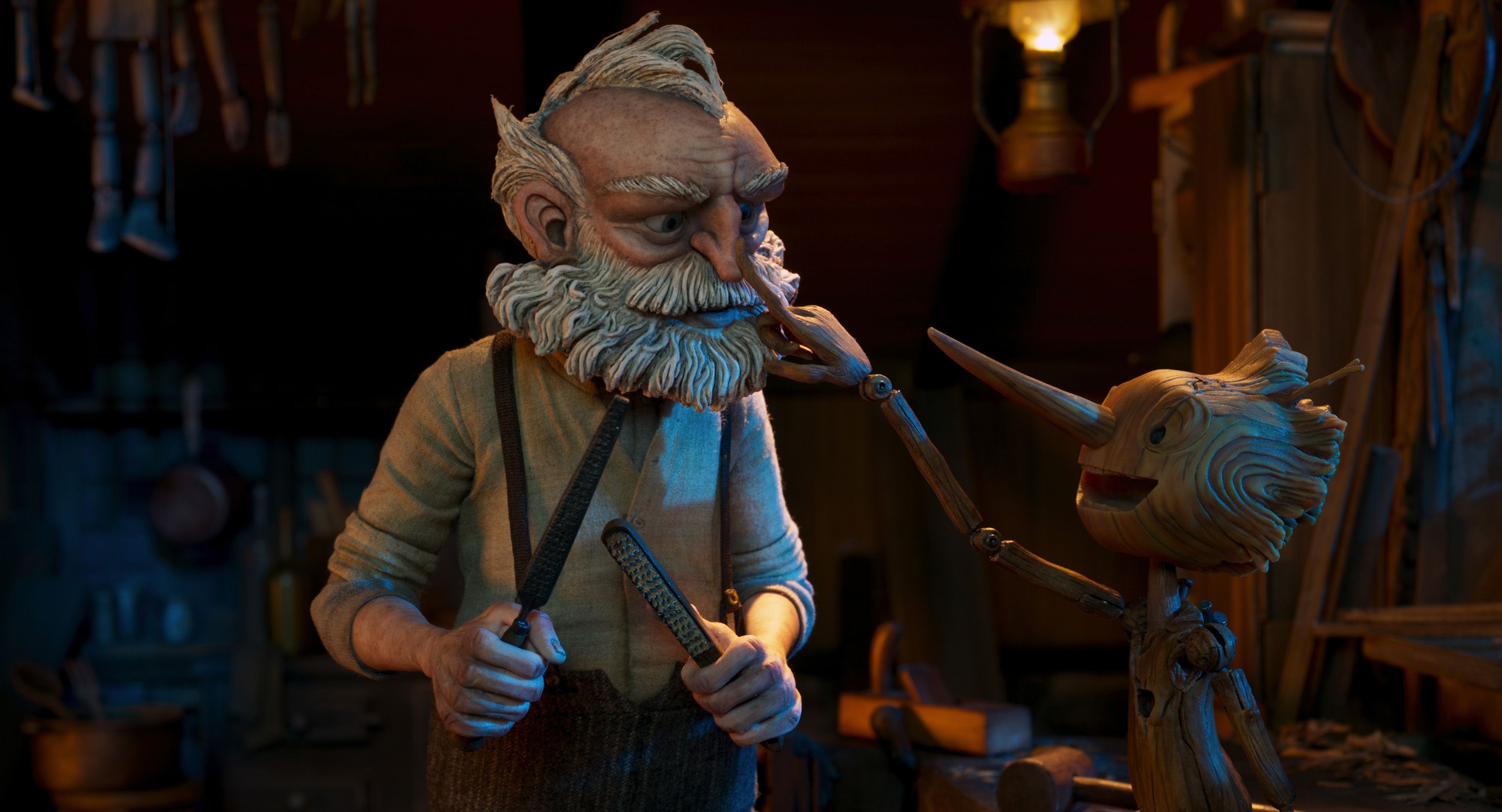
Based on the novel The Adventures of Pinocchio by Carlo Collodi with illustrations by Gris Grimly, Pinocchio is the story of a wooden puppet who comes to life as he struggles with his well-being and winning the approval of his father. Directed by Guillermo del Toro and Mark Gustafson with a screenplay by del Toro and Patrick McHale from a story by del Toro and Matthew Robbins, the stop-motion animation film is set during the period of Fascist Italy as it plays into a man dealing with loss and a puppet trying to discover life during a period of chaos. Featuring the voices of Gregory Mann, David Bradley, Ewan McGregor, Burn Gorman, Ron Perlman, John Turturro, Finn Wolfhard, Cate Blanchett, Tim Blake Nelson, Christoph Waltz, and Tilda Swinton. Pinocchio is a rich and intoxicating film from Guillermo del Toro and Mark Gustafson.

Two decades after the death of son during World War I, the film follows a man who drunkenly creates a wooden boy to cope with his loss as it comes to life where the boy struggles with not just winning his father’s approval but also what it means to live. It is a film that takes the premise of the story of a man who creates a puppet who turns into a boy as it is set in Fascist Italy at a time when conformity and playing to certain rules are in tow which is something that a puppet with no strings is trying to deal with as well as the idea of love and what it means to exist. The film’s screenplay by Guillermo del Toro and Patrick McHale is told largely by a cricket in Sebastian J. Cricket (Ewan McGregor) about the titular character (Gregory Mann) and how he had been created by this lonely carpenter in Geppetto (David Bradley) after having lost his son Carlo (Gregory Mann) during an aerial bombing in World War I as he had been ravaged by grief until he cuts down a tree where Cricket was living and turned it into a puppet. It is then where a fairy in the Wood Sprite (Tilda Swinton) would cast a spell for the puppet to come to life while asking Cricket to watch over and guide him.

While Geppetto’s initial encounter with Pinocchio has him confused and frightened as does Pinocchio’s appearance at the town’s local church. Geppetto does what he can to steer Pinocchio the right way but also him wanting to be like Carlo yet there is also pressure from the Podesta (Ron Perlman) who wants Geppetto to ensure that Pinocchio becomes part of the Italian Royal Army upon a major discovery they would have much to Geppetto’s horror. Even as Pinocchio would encounter the failing circus ringmaster Volpe (Christoph Waltz) who would get Pinocchio to sign a contract that would keep him out of the eye of the Podesta but also keep Pinocchio performing in order to keep Geppetto out of debt. It all plays into Pinocchio’s development and his conversations with Cricket as it has him thinking about not just wanting to live but also to find his own voice as he watches the abuse that Volpe has on his longtime assistant monkey Spazzatura (Cate Blanchett) as well as a closer look into the world of Fascist Italy upon being watched by the Podesta at youth training camp.

The direction of del Toro and Mark Gustafson is astonishing in its overall presentation due to the attention to detail that both men put into its look as it is created on studio locations in Portland, Oregon and Guadalajara, Mexico. With Gustafson and his team of animators doing much of the stop-motion work with production designers Guy Davis and Curt Enderle, with set decorators Jesse Gregg, Gillian Hunt, Samantha Levy, Molly Light, Laura Savage, and Zach Sheehan plus art directors Andy Berry, Karla Castaneda, Robert DeSue, and Juan J. Medina, helping to create much of the backdrops in the look of the forests and woods in such grand detail. Even with Davis also creating some of the creatures including Cricket, Spazzatura, and the sea monster for the film’s climax, there is a look that is del Toro in terms of its approach to death as well as horror with the former involving a sequence in which Pinocchio meets a death fairy (Tilda Swinton) in a surrealistic presentation of the afterlife. Since the film is also based on the illustrations of Gris Grimly, del Toro and Gustafson maintain this look that quite wobbly in its presentation as there is a realism to the animation as well as a physicality in how they take this story and set it into a world where there are elements of politics and existentialism in the mix.

Even in a scene where Pinocchio asks his father why people don’t like him but love this model of the crucifixion as it is among these things that Pinocchio would go into. The compositions that del Toro and Gustafson create add to the drama that Pinocchio goes through in the wide and medium shots in a location or in one of Pinocchio’s stage performances as well as close-ups that play into the characters as they cope with whatever situation they’re in. Notably in the climax as it plays into Pinocchio and Geppetto dealing with a sea monster as all of the lessons that Pinocchio would learn allows him to deal with the situations as well as an understanding of both life and death. Overall, del Toro and Gustafson craft an exquisitely moving and ravishing film about a wooden boy who comes to life and learns about existence and identity during the era of Fascist Italy.

Cinematographer Frank Passingham does incredible work with the cinematography as it helps the look of the film give it a sense of physicality in the lighting while helping to set mood to help bring more texture to the production design. Editors Ken Schretzmann and Holly Klein do amazing work with the editing as it is largely straightforward to play into some of the musical numbers but also in some of the dramatic and terrifying moments with its rhythmic cuts. Visual effects supervisors Cameron Carson and Aaron Weintraub do excellent work with the visual effects as it is mainly set dressing for some scenes involving war and fire as it help broaden the visuals. Sound designer Scott Martin Gershin does brilliant work with the sound in the way certain objects sound as well as the way an instrument sounds on a location or how bombs sound from afar. The film’s music by Alexandre Desplat is phenomenal with its rich orchestral score that has elements of lush strings and orchestral pianos themes along with some offbeat percussive-based themes while the soundtrack also feature original songs written by Desplat along with lyrics by del Toro, McHale, and Roeben Katz that add to the drama and humorous moments in the film that are sung by its cast.

The casting by Mary Hidalgo is great as it feature some notable small voice roles from Tom Kenny in a trio of voice performances as a sea captain, a right-hand for Mussolini, and the Italian Fascist leader Benito Mussolini as well as Tim Blake Nelson as a quartet of black rabbits, John Turturro as a doctor in the small town Geppetto lives in, Burn Gorman as the local priest, Finn Wolfhard as the son of the Podesta in Candlewick who at first bullies Pinocchio only to befriend him late in the film, and Cate Blanchett in a superb voice cameo as Volpe’s monkey assistant Spazzatura who talks through puppets where Blanchett brings unique voices as a monkey who is jealous of Pinocchio only to realize the good in Pinocchio. Tilda Swinton is fantastic in a dual voice role as the magical fairy known as the Wood Sprite and her sister known as Death where Swinton brings different tones to the two characters as they lament on the ideas of both life and death. Ron Perlman is excellent as the Podesta as a Fascist government official who sees Pinocchio at first as a freak only to see that he could become a symbol for the government in their rise while trying to raise his son as a perfect soldier for Fascist Italy.

Christoph Waltz is brilliant as Volpe as a former aristocrat-turned circus ringmaster who sees Pinocchio as a way to get him back into aristocracy as well as a chance to get in the good graces of Mussolini as he brings a charm to this evil character. Ewan McGregor is amazing as Sebastian J. Cricket as the film’s narrator and conscience-of-sorts who tries to steer Pinocchio onto the right path while dealing with being squished and such as well as trying to do what he can where he laments over his role. David Bradley is incredible as Geppetto as a woodcarver/carpenter who laments over the loss of his son as well as dealing with Pinocchio as he is someone ravaged by grief while trying to understand the many flaws of Pinocchio while trying to go on a search for him when Pinocchio joins the circus. Finally, there’s Gregory Mann in a sensational voice performance in the dual role of Carlo and the titular character as he brings an exuberance and innocence to the former as well as an energy into the latter as well as this vulnerability of someone who is just trying to understand the ideas of life and death where Mann brings a lot of life into both of these roles.

Pinocchio is a tremendous film from Guillermo del Toro and Mark Gustafson. Featuring a great ensemble cast, gorgeous visuals, ravishing art direction, its story of existentialism and identity, amazing character/creature designs, and Alexandre Desplat’s enchanting music score. It is a film that takes a tale told many times but bring something new to it and set it during a tumultuous time in world history as it help play into a wooden boy trying to find himself as well as a physicality that gives the film an edge in its stop-motion animation presentation. In the end, Pinocchio is a magnificent film from Guillermo del Toro and Mark Gustafson.

Guillermo del Toro Films: Cronos - Mimic - The Devil's Backbone - Blade II - Hellboy - Pan's Labyrinth - Hellboy II: The Golden Army - Pacific Rim - Crimson Peak - The Shape of Water - Nightmare Alley (2021 film)

Related: (Pinocchio (1940 film)) - The Auteurs #10: Guillermo del Toro

© thevoid99 2023

Monday, March 07, 2022

The Batman (2022 film)


Based on the DC comic series, The Batman is the story about the titular caped crusader in his second year as a vigilante where he deals with corruption within Gotham as it relates to his own family as well as a series of murders by a serial killer known as the Riddler. Directed by Matt Reeves and screenplay by Matt Reeves and Peter Craig, the film is a different take on the Batman/Bruce Wayne story as the character deals with not just trauma in his past but also pondering questions on whether his role as the Batman has made a difference with Robert Pattinson playing the role of Wayne and the Batman. Also starring Zoe Kravitz, Paul Dano, Jeffrey Wright, John Turturro, Peter Sarsgaard, Andy Serkis, and Colin Farrell as Oswald “Oz” Cobblepot/Penguin. The Batman is a riveting and evocative film from Matt Reeves.

Two years into his life as a masked vigilante, Bruce Wayne/the Batman investigates a series of murders involving corrupt police and political officials in Gotham City as it play into so much more including involvement from his own family. It’s a film that follows this young man who is hoping to clean up Gotham from the shadows but the recent murder of a mayor during an election year and other revelations over corruption as it relates to events some decades ago forces Wayne to deal with this mysterious figure who is killing all of these people. The film’s screenplay by Matt Reeves and Peter Craig is straightforward in its narrative yet it does follow a lot of tropes relating to film noir as well as crime films as it acts more of a police investigation mystery-suspense film rather than a conventional superhero film.

Bruce Wayne isn’t this superhero who can use gadgets and such to deal with the chaos within Gotham but rather a young man still haunted by the death of his parents and feels like he owes his family something to ensure that their name can bring hope. Unfortunately in this mayoral election year in Gotham, things are still bad where a crime family still operates and pay off many top officials in the police and government to ensure their place in Gotham. The murder of Mayor Don Mitchell Jr. (Rupert Penry-Jones) raises an awareness into what is happening as many are not fond of the Batman with the exception of Lt. James Gordon (Jeffrey Wright) who is one of the few police officials that is incorruptible. Wayne and Gordon would watch the elite become targets of this mysterious serial killer known as the Riddler (Paul Dano) who often leaves clues for the Batman to decipher as Wayne would get help from his longtime butler/mentor Alfred Pennyworth (Andy Serkis) whom they have a testy relationship as Pennyworth wants Wayne to be more involved in his family’s legacy of philanthropy.

Upon some discovery into Mitchell’s involvement with the crime boss Carmine Falcone (John Turturro) and his lieutenant Oswald Cobblepot/the Penguin, Wayne befriends a young waitress at Falcone’s club in Selina Kyle (Zoe Kravitz) who had a friend that was pictured with Mitchell as she had gone missing where a lot of things get leaked leading to more chaos in Gotham. It would force Wayne, Kyle, and Gordon to be among the few who would have to take charge though Kyle’s motivations would lead to vengeance as well as revelations about herself that add to her thirst for vengeance. The antagonists in Falcone and Penguin are interesting in their dealings with the latter being someone who is smarter than people give him credit for as he does reveal some key information as it relates to what happened years ago as he knows the Riddler is going to ruin everything. Even as Wayne is forced to confront some things about his own family where he realizes that people make mistakes but it’s about how fix those mistakes.

Matt Reeves’ direction is definitely sprawling in terms of the way Gotham is presented as it is shot on various locations in London and Liverpool with additional shots in Chicago, Glasgow, and Hertfordshire including studios sets at Leavesden. Reeves’ approach to the film definitely has a sense of physicality in not just some of the action scenes in which Batman combats criminals but also in a world that is grimy as it rains quite often as there are also many areas to Gotham. The usage of wide and medium shots add to the major scale from the look of the club and the underground club within that Falcone is seen at as well as the way some of the shots at the buildings are presented with all of those gorgeous skylines. Still, Reeves grounds the film with its emphasis on physicality in these locations but also maintain this slow-burn of the Batman uncovering each clue with Alfred and Gordon helping him out in solving these riddles that the Riddler is leaving. Some of which are deadly including one clue attached to a corrupt district attorney in Gil Colson (Peter Sarsgaard) who has a bomb wrapped around his neck as it all play into the Riddler’s game.

Reeves maintains this tense atmosphere in the film as it play into a world that is starting to unravel with the second act being about Wayne not just being a target for the Riddler but also playing to the revelations about why his parents got killed. Even as Kyle reveals that the people that the Riddler are targeting all have took advantage of the ideas that Wayne’s father was trying to do for the city and felt that Thomas Wayne ended up being no different than those the Riddler is targeting. The third act is about the Batman confronting Falcone in the hope he can stop the Riddler yet there are more complications forcing the Batman to meet the Riddler as there is a horror element to this meeting that is followed by something much bigger where it is all about Gotham. The climax involves a massive set piece where there is a lot happening yet it is all about the Batman just trying to save the people of Gotham and give them hope. Overall, Reeves crafts a visceral and gripping film about a masked vigilante dealing with a mysterious serial killer who hopes to expose and destroy Gotham.

Cinematographer Greig Fraser is incredible as its usage of low-level lights for much of the interiors and the exterior scenes at night as it adds to the film’s grimy visuals as well as some of the daytime scenes with its emphasis on natural lighting for a few of its interior scenes. Editors William Hoy and Tyler Nelson do amazing work with the editing as it has some stylish cuts to play into the action while allowing shots to linger for more than 10-15 seconds including a car chase scene and in some of the other action sequences including its climax. Production designer James Chinlund, with set decorator Laura Ng and supervising art director Grant Armstrong, does brilliant work with the look of the nightclub that Falcone and Penguin run as well as the Wayne tower where Wayne lives and some of the interiors in some of the places at Gotham. Costume designers Jacqueline Durran, David Crossman, and Glyn Dillon do excellent work with the costumes with Durran doing much of the design for all of the characters including Kyle’s leather clothing while Crossman and Dillon do the design of the Batsuit that Wayne wears as the Batman.

Makeup designer Naomi Donne and prosthetics makeup supervisor Tristan Verslius do fantastic work with the look of the Penguin as someone does look a bit rough but not in what is expected from the character while also adding some unique look to the wigs that Kyle wears to work. Special effects supervisor Dominic Tuohy and visual effects supervisor Dan Lemmon do phenomenal work with the special and visual effects from the way some of the action set pieces are created including the chase scene and the film’s climax as well as a few set-dressing bits in some scenes including a scene of the Batman flying off a building. Sound designers Lee Gilmore, Craig Henighan, and Chris Terhune, along with sound editor Douglas Murray, do superb work with the sound in the way some of the gadgets sound as well as the way music sound inside a nightclub and the atmosphere some of the action and suspense are presented.

The film’s music by Michael Giacchino is sensational for its orchestral score that include some incredible themes and other pieces of music that play into the drama, action, and suspense as it is a major highlight of the film while music supervisor George Drakoulias cultivates a soundtrack that feature elements of electronic music at the club scene including some classical music for some bits in the film and an effective usage of Nirvana’s Something in the Way to play into the sense of loss and confusion that Wayne goes through.

The casting by Lucy Bevan and Cindy Tolan is marvelous as it feature some notable small roles from Luke Roberts and Stella Stocker in their respective roles as Bruce’s parents in Thomas and Martha Wayne, Charlie and Max Carver as twin bouncers at Falcone’s club, Hana Hrzic as Kyle’s European roommate Annika who is also Mayor Mitchell’s mistress, Con O’Neill as Gotham’s police chief, Alex Ferns as the police commissioner who is one of the Riddler’s targets, Oscar Novak as a young Bruce Wayne, Peter McDonald as a corrupt police officer in Kenzie who is seen often at Falcone’s club, Gil-Perez Abraham as the Gotham police officer Martinez who at first is distrustful of the Batman until he says something to him in the third act leading a major discovery for both of them, Rupert Penry-Jones as Gotham’s mayor in Don Mitchell Jr., Kosha Engler as Mitchell’s wife, Archie Barnes as Mitchell’s son, Sandra Dickinson as Wayne’s maid Dory, and Jayme Lawson as the mayoral candidate Bella Real who is hoping to clean Gotham as she wants Wayne to be involved more in helping Gotham.

Peter Sarsgaard is superb in his small role as Gotham’s district attorney Gil Colson as a sleazy man whom Kyle sees at a club as he knows something that would get many in trouble as he becomes a major target for the Riddler. Andy Serkis is fantastic as Wayne’s butler Alfred Pennyworth as someone who aids Wayne at the Wayne Tower though he feels that Wayne needs to focus more on the family’s businesses and charities while also providing Wayne some insight about the family and mistakes they made. John Turturro is excellent as Carmine Falcone as a crime boss who runs a mob family as he is a devious man who also brings a sense of unease to Kyle as he is also someone that seems to know a lot more than what everyone knows. Colin Farrell is brilliant as Oswald Cobblepot/the Penguin as Falcone’s lieutenant who helps run the business as he is also eager to do his own thing where he is confronted by the Batman believing that he’s an informant only to reveal things that are far more complicated. Jeffrey Wright is amazing as Lt. James Gordon as a police official who is one of the few that the Batman trusts as he is aware that something isn’t right while also deciphering some of the Riddler’s clues.

Zoe Kravitz is incredible as Selina Kyle as a waitress at a club who knows Falcone but is also a cat burglar with her own set of skills where she helps out the Batman while also having her own motives for vengeance as it relates to Falcone as it is definitely a mesmerizing performance from Kravitz. Paul Dano is phenomenal as the Riddler where is largely seen in a mask and some body suit as he does a lot of his riddles through videos via social media as it is a chilling and terrifying performance that really adds some unexpected layers to the famed villain as Dano brought something new as well as make him a formidable foe for the Batman. Finally, there’s Robert Pattinson in a tremendous performance as Bruce Wayne and the titular role as this brooding and troubled man who is among the elite of the Gotham upper class yet is more concerned with trying to save Gotham as a vigilante where he deals with not just the Riddler but also himself and his family’s past where Pattinson brings some restraint but also a physicality that makes him a joy to watch as it is a career-defining performance from Pattinson.

The Batman is a spectacular film from Matt Reeves that features a great leading performance from Robert Pattinson as well as top-notch supporting performances from Zoe Kravitz and Paul Dano. Along with its ensemble cast, stylish visuals, intense action set pieces, emphasis on suspense and character study, eerie sound work, and a sensational music soundtrack. The film isn’t just a superhero film but so much more as it is an exploration of a man dealing with his own grief but also the need to save his city from corruption and terror. In the end, The Batman is a phenomenal film from Matt Reeves.

Matt Reeves Films: (The Pallbearer) – (Cloverfield) – (Let Me In) – Dawn of the Planet of the Apes - War for the Planet of the Apes

Batman Films: (Batman (1966 film)) – Batman (1989 film) - Batman Returns - Batman Forever - Batman & Robin - Batman Begins - The Dark Knight - The Dark Knight Rises - Batman v Superman: Dawn of Justice - The Lego Batman Movie

© thevoid99 2022

Friday, March 24, 2017

Rio, Eu Te Amo


Rio, Eu Te Amo (Rio, I Love You) is an anthology film collecting a series of short films by several of the world’s finest filmmakers about stories of love in the city of Rio de Janeiro. With four segments directed by Brazilian filmmakers Carlos Saldanha, Fernando Meirelles, Jose Padilha, and Andrucha Waddington plus six segments helmed by Guillermo Arriaga, Stephan Elliott, Im Sang-soo, Nadine Labaki, Paolo Sorrentino, and John Turturro as well as transitions directed by Vicente Amorim. The film follows the idea of love through many different people in the city of Rio de Janeiro. The result is a lively and enchanting film all set in the wondrous city of Rio de Janeiro.

In Dona Fulana (directed by Andrucha Waddington and written by Waddington and Mauricio Zacharias), an old homeless woman (Fernanda Montenegro) is roaming around the streets of Rio living her life as she is followed by a young man (Eduardo Sterblitch) as he tries to help her. La Fortuna (written and directed by Paolo Sorrentino) follows a couple (Basil Hoffman and Emily Mortimer) vacationing in Rio where the husband is paralyzed with a stroke while dealing with his spoiled wife who refuses to give him the vices in life that could kill him. In A Musa (directed by Fernando Meirelles and written by Antonio Prata and Chico Mattoso), an artist (Vincent Cassel) makes a sand sculpture as he notices a woman (Debora Nascimento) where he tries to win her love by making a sculpture.

Acho que Estou Apaixonado (written and directed by Stephan Elliott), a popular movie star (Ryan Kwanten) is struck by the wonders of the Sugarloaf Mountain where he and his Brazilian assistant (Marcelo Serrado) climb the mountain as the latter tells him about the legend of the mountain where they meet a beautiful spirit (Bebel Gilberto). In Quando nao ha Mais Amor (written and directed by John Turturro), a couple (John Turturro and Vanessa Paradis) breaks up as they cope with what they had and what got lost. Texas (written and directed by Guillermo Arriaga) is about a one-armed boxer (Land Viera) who is given a chance to help his model wife (Laura Neiva) walk again following an accident where he is offered a proposal by a man (Jason Isaacs) that comes with dire consequences.

In O Vampiro do Rio (written and directed by Im Sang-soo), an old vampire (Tonico Pereira meets a prostitute (Roberta Rodrigues) as he hopes to make her part of a small group of people who live in the city as vampires. Pas de Deux (directed by Carlos Saldanha and written by Elena Soarez) revolves around a ballet couple (Rodrigo Santoro and Bruna Linzmeyer) who perform behind a silhouette curtain for a performance as they quietly bicker about some life-changing decisions. Inutil Paisagem (directed by Jose Paldiha and written by Octavio Leonido) follows a man (Wagner Moura) who flies on a glider over Rio as curses the statue of Christ the Redeemer over his own failed relationship with his ex-wife (Cleo Pires). The final segment in O Milagre (directed by Nadine Labaki and written by Labaki, Rodney El Haddad, and Khaled Mouzanar) has an actor (Harvey Keitel) and an actress (Nadine Labaki) meet a boy (Caua Antunes) at a train station who is waiting from a phone call from Jesus Christ where the actor and actress do something to make that call happen.

The film follows a series of stories about love through ten different segments plus transitional scenes involving characters from those stories as well as a cab driver (Michel Melamed) and his former flame (Claudia Abreu) which is written by Fellipe Barbosa and directed by Vicente Amorim. It all plays into the ideas of love in many ways as it’s all set in the city of Rio de Janeiro where it is a character in the film and many of its landmarks add to its beauty. Though the filmmakers in the film don’t really do anything new to explore more of the city including its slums. It’s more about the city and how it inspires love in many different ways through the eyes of its filmmakers and their own takes on love. Filmmakers such as Stephan Elliott, Andrucha Waddington, Fernando Meirelles, and Nadine Labaki tell stories that are very unconventional as it doesn’t exactly follow the formula of love. Instead, they go for something different in their own definition of love as their segments are the ones that really standout as it also uses the locations and situations to really do something wondrous.

Another segment that is very unconventional is from Im Sang-soo whose idea of vampires living around Rio as they wear sunglasses to protect themselves from the sun is actually a very crafty and fun idea. Especially as they would spend the night dancing around as if it was Carnival where it has something a bit dark but also fun. Jose Paldiha’s segment is the most simple of them all but it’s also kind of controversial considering that its protagonist would make a very obscene gesture towards Christ the Redeemer but it does have a beauty for the fact that it’s shot largely from a glider’s perspective. The rest of the film does kind of play by the rules as far as the conventional ideas of love yet all manage to create stories that are at least engaging. Paolo Sorrentino’s segment is mainly comical while the segments by Guillermo Arriaga and John Turturro are the most dramatic. The segment by Carlos Saldanha is definitely the most beautiful in terms of its presentation as it’s more focused on ballet and music with some rumblings of what is happening behind the scenes between the two dancers.

Visually, the film does follow similar visual palettes in its cinematography though they’re able to give each segment something of its own with Saldanha’s shot largely at night and Meirelles’ segment starting off at night and then into the day where he would have the most technically inventive with its editing both visually and in its sound. Much of the film’s music soundtrack features an array of music from Brazil including the samba and bossa nova with much of its contribution from Gilberto Gil providing the film’s theme music. The film’s phenomenal cast all do some fantastic work with Fernanda Montenegro being the big standout in the titular role of Dona Fulana while Harvey Keitel provides a very kind and sensitive performance as an actor who would help a kid in getting a message from Jesus Christ in the O Milagre segment where Keitel would speak Portuguese for part of the film.

Rio, Eu Te Amo is a marvelous anthology film that features some incredible segments from Fernando Meirelles, Im Sang-soo, Carlos Saldanha, and several others. Along with a great cast, amazing music, and gorgeous images, it’s a film that portrays Rio not just as a place of paradise but also something that is wild and intoxicating from the perspective of its locals to the tourists visiting the city. In the end, Rio, Eu Te Amo is a sensational film that explores all the joys and frustrations of love in Rio de Janeiro.

Related: Paris, Je T'aime - New York, I Love You - (Tbilisi, I Love You)

© thevoid99 2017

Monday, July 27, 2015

The Color of Money


Based on the novel by Walter Tevis, The Color of Money is the sequel to another Tevis novel in The Hustler in which “Fast” Eddie Felson has retired from the world of pool-hustling as he catches the eye of a young hustler in whom he wants to support only to be coaxed back into the game. Directed by Martin Scorsese and screenplay by Richard Price, the film plays into a man who tries to disconnect himself from the world that made him famous only to come back after seeing a young man with talent as Paul Newman reprises his role as “Fast” Eddie Felson. Also starring Tom Cruise, Mary Elizabeth Mastrantonio, Helen Shaver, John Turturro, Forest Whitaker, and Bill Cobbs. The Color of Money is a compelling and rapturous film from Martin Scorsese.

Set more than twenty years after “Fast” Eddie Felson had become the greatest pool hustler in the streets, the film revolves around a retired Felson who has now become a successful liquor salesman while making money on other hustlers. Yet, he catches the eye of a young hustler whom he sees as someone with the potential to be great as he takes the young man and his girlfriend on the road to teach him the trade of hustling. Along the way, Felson teaches Vincent Lauria (Tom Cruise) about how to make money and how to lose below his abilities in order to win big. By traveling to famous pool halls around the country before taking part of a big 9-ball tournament in Atlantic City, Felson finds himself getting the urge to return but has to contend with aging as well as the fact that there are those who are younger and know the trade of hustling just as good as he did.

Richard Price’s screenplay explores the world of hustling as Felson is someone who is a master at it but hasn’t played in more than 20 years while his eyesight has sort of deteriorated. Though he tries to live a normal life while watching pool hustling from afar, he finds something in Vincent that makes him want to come back. While Vincent is talented, he is immature as Felson would take him under his wing along with Vincent’s girlfriend Carmen (Mary Elizabeth Mastrantonio) who has managed Vincent’s dealings as she would pay close attention to Felson’s methods. Even as she would help Felson in playing the role of hustler as it would cause some issues with the very immature Vincent who realizes that part of the art of hustling is to act the part of being someone who isn’t good and then hustle that player. Through Vincent, Felson would live through him but would eventually become selfish once Vincent improves as its third act would have both men attend the tournament against each other.

Martin Scorsese’s direction is very stylish not just in his presentation of the world of 9-ball pool and hustling but also in a world where it’s about survival and making money anyway a person can. Shot largely in parts of Chicago as well as bits of Atlantic City, the film plays like a world that is changing where the valor and classiness of the pool halls is now nothing more than an urban decay of sorts. While Scorsese does bring in some stylish usage of close-ups and medium shots along with some simpler moments, it is all about the sense of atmosphere in these pool halls as well as the need to play and hustle someone. Scorsese’s approach to the games are presented with a sense of rhythm as well as a bit of psychology into what will take for that person to win and win big but also how to lose and then make that person feel like shit.

Scorsese would also go into extreme close-ups to showcase a pool ball being hit by a pool cue as well as other elements that definitely play into a sense of style. Notably in his approach to tracking shots where he would go from a medium to wide or vice-versa as it plays into Felson’s love-hate relationship with hustling. There’s also some unique crane shots that Scorsese would use as it would be prominent in the film’s third act in the 9-ball tournament in Atlantic City. Many of the images that Scorsese would create are very unconventional as it strays from what is expected in films like this but it also plays into how intense these games are where it is about strategy and see how one can lose. Overall, Scorsese creates a very engaging and riveting film about a former pool hustler teaching a young hustler the trick of the trade.

Cinematographer Michael Ballhaus does excellent work with the film‘s cinematography from its usage of natural lights for some of the exteriors and daytime interiors to the lighting in some of the pool halls as well as the lightings for the tournament. Editor Thelma Schoonmaker does incredible work with the editing with her stylish approach to montages, jump-cuts, and dissolves to play into the world of pool and hustling. Production designer Boris Leven and set decorator Karen O’Hara do fantastic work with the design of the pool halls from the richness of the one in Atlantic City to the more decayed, street look of the ones Vincent and Felson go to.

Costume designer Richard Bruno does nice work with the costumes to play into the youthful look of Vince as well as the suits that Felson wears to represent his sense of the old school. Sound editor Skip Lievsay does superb work with the sound as it plays into the atmosphere of the bars and pool halls the characters go to as it has a sense of atmosphere that is very street and has its own sense of rules. The film’s music by Robbie Robertson is great as it is largely blues-based music to play into the world of the pool halls while compiling a soundtrack that features music from Phil Collins, Warren Zevon, Robert Palmer, Mark Knopfler, B.B. King, Willie Dixon, Don Henley, and Eric Clapton.

The casting by Gretchen Rennell is brilliant as it features some notable appearances and small roles from punk rock legend Iggy Pop as an opponent Vince hustles on the road, professional pool players Grady Mathews, Steve Mizerak, Keith McCready, and Jimmy Mataya as themselves, and Bill Cobbs as an old friend of Felson who runs a pool hall. John Turturro is terrific as a friend of Felson who gets beaten by Vince as he thinks he can take him. Forest Whitaker as a young hustler Felson faces off with where the result would have serious consequences for Felson. Helen Shaver is wonderful as Felson’s girlfriend Janelle who tries to keep Felson grounded while being aware of his past as a hustler as she wonders if he’ll lose it all over again.

Mary Elizabeth Mastrantonio is amazing as Carmen as Vince’s girlfriend who joins Vince and Felson on the road while learning about Felson’s methods very closely as she realizes there is more than what is going on as she tries to make sure that Vince is well-paid and succeeds. Tom Cruise is excellent as Vincent Lauria as a young pool hustler who is great at pool but lacks the knowledge to make serious money as he copes with his immaturity and what Felson wants from him. Finally, there’s Paul Newman in a remarkable performance as “Fast” Eddie Felson as a former pool hustler who is fascinated by the young Vince as he wants to mentor him only to find himself back in the world that he’s been detached from for so many years as it’s a performance full of energy but also one of humility as Newman brings a lot of gravitas to the role as it’s one of his best performances.

The Color of Money is a phenomenal film from Martin Scorsese that features a great performance from Paul Newman as “Fast” Eddie Nelson. Along with amazing performances from Tom Cruise and Mary Elizabeth Mastrantonio and a killer soundtrack. The film isn’t just one of Scorsese’s most entertaining films but also a key study into the world of hustling and an old veteran trying to teach a young hustler the trades of making big money in a cruel world. In the end, The Color of Money is a sensational film from Martin Scorsese.

Related: The Hustler

Martin Scorsese Films: (Who’s That Knocking on My Door?) - (Street Scenes) - Boxcar Bertha - (Mean Streets) - Italianamerican - Alice Doesn't Live Here Anymore - Taxi Driver - New York, New York - American Boy: A Profile of Steven Prince - (The Last Waltz) - Raging Bull - The King of Comedy - After Hours - The Last Temptation of Christ - New York Stories-Life Lessons - Goodfellas - Cape Fear (1991 film) - The Age of Innocence - (A Personal Journey with Martin Scorsese Through American Movies) - (Casino) - (Kundun) - (My Voyage to Italy) - Bringing Out the Dead - (The Blues-Feel Like Going Home) - Gangs of New York - (The Aviator) - No Direction Home - The Departed - Shine a Light - Shutter Island - (A Letter to Elia) - (Public Speaking) - George Harrison: Living in the Material World - Hugo - The Wolf of Wall Street - (The 50 Year Argument) - Silence (2016 film) - (The Irishman) - Killers of the Flower Moon - (An Afternoon with SCTV)

© thevoid99 2015

Friday, July 11, 2014

The Sicilian


Based on the novel by Mario Puzo, The Sicilian is the story of a notorious bandit named Salvatore Giuliano who tried to liberate Sicily from Italy in the late 1940s as he would also defy the Mafia and other forces who would have him killed. Directed by Michael Cimino and screenplay by Steve Shagan with contributions from Gore Vidal, the film is an unconventional bio-pic that plays into the rise and fall of Giuliano as he is played by Christopher Lambert. Also starring John Turturro, Joss Ackland, Barbara Sukowa, Richard Bauer, Ray McNally, and Terence Stamp. The Sicilian is a rich yet gripping film from Michael Cimino.

The film is about the life of Salvatore Giuliano who was considered to be modern-day Robin Hood for the people of Sicily in the 1950s who defied the rich, the Mafia, and others in power. In the course of his journey from being this simple bandit to being the ultimate enemy for Italy, there is this story of a man who had survived death and tragedies but would eventually become his worst enemy as he thinks he is a savior to the people of Sicily. Instead, he ends up angering those with power including a Mafia leader in Don Masino (Joss Ackland), who wants to become an ally, as it would lead to his death in 1950. Yet, Giuliano’s death wouldn’t just happen because of himself but also in how the world works where Giuliano thinks that the people of Sicily wants land but things become more complicated as the people eventually lose faith in him.

The film’s screenplay that is largely re-written by Gore Vidal plays into that world of a man falling for his own myth yet it begins and ends with Giuliano’s mentor in Professor Hector Adonis (Richard Bauer) who would meet the man that killed Giuliano. The first act is about Giuliano’s rise and how he believes he is immortal as he is joined by his cousin Gaspare “Aspanu” Pisciotta (John Turturro) in stealing bread for the poor. Giuliano’s action in being a bandit forces him to realize he has to do more for the people in Sicily as he would take on the Mafia, the rich, and the corrupt world of politics and religion. Giuliano’s actions would get Don Masino’s attention as he wants to meet him through Adonis but Guiliano would often refuse in an act of defiance. The film’s second act is about Giuliano becoming this mythic figure as he would gain some allies as well as detractors in Italian minister Trezza (Ray McNally) as well as the intrigue of Sicily’s Prince Borsa (Terence Stamp) whose wife Camilla, Duchess of Cortone (Barbara Sukowa) would be seduced by Giuliano.

One aspect of the script that is unique is Vidal’s dialogue which is very stylized and direct where it does play into some of the film’s campy tone in some respects though it’s not overly camp. One aspect of the script that doesn’t work involves some of the character development where much of the women characters like Camilla and Giuliano’s girlfriend Giovanna (Giulia Boschi) are underwritten while some of Giuliano’s motivations definitely become one-note as his development isn’t as smooth or as intricately-written as it could’ve been. Fortunately, characters like Adonis, Pisciotta, and Don Masino manage to be fleshed out more as Don Masino is an unconventional antagonist since he admires Giuliano’s determination while wanting to ensure that he doesn’t get harmed where there is this very strange father-son relationship between the two. Yet, it’s a relationship that Giuliano doesn’t want and it would eventually regret it once it becomes clear that Giuliano doesn’t have the power he once had as politicians and religious organizers come together to stop him.

Michael Cimino’s direction is very sprawling in the way he presents the film as an epic of sorts set in Sicily. Shooting on location in the island, much of Cimino’s approach is to go for something that plays to not just his love for epics with his use of the wide shots and shooting on vast locations with a lot of coverage. Some of it is a homage to some of the Italian epics in terms of the compositions and settings that Cimino wanted to create. There’s also some unique close-ups and medium shots that Cimino would use to play into the drama and suspense as some of the violence is quite brutal including some very terrifying execution scenes where Giuliano kills those who betray him. There is a fluidity to not just the tracking shots and hand-held camera shots that Cimino creates throughout the film but also in how it plays into some of these scenes where it is about the situations and the characters involved.

The element of camp isn’t told in a comical manner but rather in a style that is a bit over-the-top in terms of the delivery of some of the film’s dialogue along with a few scenes where there’s some dancing. It’s one of the few aspects of the film that doesn’t work where Cimino wanted to inject something more light-hearted in a film that is often quite grim and operatic. Notably as the tone of the film gets much darker in the third act when Giuliano is tasked to stop Communist party members from voting where his intention was to scare them. Instead, something tragic happens where it plays into Giuliano’s fall as well as the reality of what he’s facing as it becomes clear over who is really in charge and how out of touch he has become with the people he wants to help. All of which would lead to the inevitable as its aftermath would only play into Giuliano’s legend. Overall, Cimino crafts a very engaging and mesmerizing film about a bandit’s rise and fall.

Cinematographer Alex Thomson does brilliant work with the film‘s cinematography from the gorgeous yet naturalistic look of the locations around the Sicilian mountains as well as some stylish usage of lights for some of the nighttime interior/exterior scenes including some of the shots in Palermo. Editor Francoise Bonnot does excellent work with the editing in creating some unique rhythmic cuts to play into its action and suspense as well as some of the drama. Production designer Wolf Kroeger and art director Stefano Maria Ortolani do amazing work with the set pieces from the lavish home of Prince Borsa to the many places in Palermo where many of the characters go to.

Costume designer Wayne A. Finkelman does terrific work with the costumes with most of the rugged look of Giuliano and his men to the more lavish dresses that Camilla wears. Sound editor Fred J. Brown does superb work with the sound from the gunfire sounds from afar as well as some of the chaos that goes on with crowds and also in some of gunfights that occur. The film’s music by David Mansfield is fantastic for its orchestral-driven score that is operatic at times but also somber with some themes that play into Giuliano and Giovanna’s relationship while the soundtrack includes a lot of music of the late 1940s.

The casting by Deborah Brown is great as the cast features some notable small performances from Ramon Bieri as the town mayor Quintana, Andreas Katsulas and Derrick Branche as a couple of Giuliano’s men who were former mob enforcers, Joe Regalbuto as a priest who warns Giuliano of what he is doing, Michael Wincott as an army corporal who joins Giuliano, Barry Miller as a professor who arrogantly defies Don Masino, Stanko Molnar as Giovanna’s Communist brother, Trevor Ray as a barber Giuliano knew as a boy, Justin Clark as a young boy who would become part of Giuliano’s band of brothers, and Ray McNally as a scheming minister who tries to stop Giuliano only to push buttons and eventually take some drastic matters into his own hands. Giulia Boschi is pretty good as Giuliano’s girlfriend Giovanna who tries to cope with his actions while having her own views about the way things work.

Barbara Sukowa is terrific as the Duchess Camilla who is wowed by Giuliano’s determination as she becomes a supporter of sorts for his cause. Richard Bauer is excellent as Giuliano’s mentor Professor Hector Adonis as someone who tries to guide Giuliano into taking a path while dealing with Don Masino as they both realize how crazed Giuliano has become. Terence Stamp is wonderful in a small yet noteworthy role as Prince Borsa as this rich figure in Sicily who often sees everything from afar while getting to know Giuliano where the two strike a deal of their own. Joss Ackland is brilliant as Don Masino as this revered and intimidating Mafia head who has a strange admiration for Giuliano as he tries to protect him from the rich and powerful in Italy only to realize how troubled he’s become. John Turturro is fantastic as Aspanu who is very loyal to his cousin Giuliano while doing all sorts of things only to realize how crazy it’s becoming.

Finally, there’s Christopher Lambert in a superb performance as Salvatore Giuliano as this bandit who wants to rebel against the rich and powerful in Italy to help the people of Sicily only to lose sight of his original intentions. Though it’s a performance that is flawed as Lambert would often be seen as stone-faced for much of the film, he does manage to convey some charisma and determination into the character.

The Sicilian is an excellent film from Michael Cimino. Thanks to a great cast and some amazing visuals, the film is one of Cimino’s finer films though it is quite flawed. Yet, it is a film that captures a world that is quite fascinating in a time period where old Italy is to meet a new world. Especially one that is much more violent and unforgiving as it is shown through Cimino’s eyes in its uncut 146-minute version. In the end, The Sicilian is a superb film from Michael Cimino.

Michael Cimino Films: Thunderbolt and Lightfoot - The Deer Hunter - Heaven’s Gate - Year of the Dragon - Desperate Hours (1990 film) - The Sunchaser - To Each His Own Cinema-No Translation Needed - The Auteurs #35: Michael Cimino

© thevoid99 2014

Thursday, January 03, 2013

To Live and Die in L.A.


Based on the novel by Gerald Petievich, To Live and Die in L.A. is about two Secret Service agents trying to find a counterfeiter at any cost. Directed by William Friedkin and screenplay by Friedkin and Petievich, the film is a thriller that explores the complexities of two men doing whatever it takes to nab a criminal where they would question their own tactics. Starring William Petersen, John Pankow, Darlanne Fluegel, John Turturro, Dean Stockwell, Debra Feuer, and Willem Dafoe. To Live and Die in L.A. is an entrancing yet thrilling film from William Friedkin.

After the death of his partner Jimmy Hart (Michael Greene) who was a few days from retiring just as he was trying to uncover a counterfeit scheme. Secret Service agent Richard Chance (William Petersen) is determined to avenge Hart’s death by going after the notorious counterfeiter/artist in Rick Masters (Willem Dafoe) whose methods are considered legendary. With Chance given a new partner in John Vukovich (John Pankow), the two stake out across from the home of an attorney in Max Waxman (Christopher Allport) where they didn’t see Masters kill Waxman as Chance manages to take a small pocketbook of Waxman to find who he’s connected to. With the help of his informant Ruth (Darlanne Fluegel), Chance goes into deep into what kind of work Masters is doing as he had tried to get a hit put on his friend Carl Cody (John Turturro) whom Chance had just put in prison.

Vukovich secretly meets with Masters’ attorney Bob Grimes (Dean Stockwell) who organizes a deal for Vukovich and Chance to see Masters about deal as they pretend to be different men. A deal is made but Masters wants $30,000 for his work as it would prove to be difficult as Chance and Vukovich try to figure out how to get the money. Through Ruth’s information, Chance decides to rob from a Chinese man named Ling (Michael Chong) who is interested in buying $50,000 worth of diamonds. During the robbery, things go wrong when Chance and Vukovich realizes that something didn’t go right even though they got the money. Chance’s tactics hope it will make a deal with Masters in the hopes to bust him yet Vukovich becomes uneasy about everything that has transpired.

The film is about a Secret Service agent and his new partner trying to go after a counterfeiter by any means necessary where their tactics become questionable as they take on major risks for themselves and those going after this counterfeiter. The film is also a revenge story of sorts since it is about this agent trying to get revenge for the death of his old partner who is definitely intent on wanting to kill the man who did this and put him down. Yet, it would cause a lot of conflict to those around this man including his superiors and new partner who wants to do things by the book and not get into any kind of trouble.

The screenplay by William Friedkin and novelist Gerald Petievich is very complex in the way it explores the tactics of one man and how he is obsessed with trying to capture this criminal who definitely operates in his own way. Richard Chance is this very unconventional Secret Service agent who is willing to do anything to capture someone where will also break rules in the process. This would often get the ire of his superiors yet he gets the job done. When it comes to this assignment to capture this counterfeiter who killed his partner, Chance becomes more unhinged as the story progresses where he does things that are unconventional like the fact that he sleeps with his informant and often blackmails her to do things or else she breaks her parole. Yet, he is also quite reckless where he will do stupid things such as believe a criminal’s words as he will admit that it was his own fault as he would do whatever to make up for that mistake.

Rick Masters is definitely a criminal who is very unique in his own way. He is an artists who likes to paint and then burn his paintings while he goes into great care into forging $20 bills in order to use it for his own criminal means. He knows that he couldn’t use $50 or $100 bills to do things as it would be too suspicious as he often lurks around in the underworld. He also goes into clubs where he has a girlfriend (Debra Feuer) around to aid him in a few of his things while he’s also ensuring that if there’s a problem. He’ll take care of it or let someone else do it. Then there’s John Vukovich who is a more straight-laced officer that is forced to see the kind of things that Chance does where he becomes anguished over what to do as he would turn to a lawyer who is also working for Masters. Things eventually become complicated as it would involve a showdown.

Friedkin’s direction is definitely engaging for the way he presents the film as it is shot on location in Los Angeles and nearby areas where it has this degree of style to its look and setting. It’s flashy but also very gritty in some of its locations where Friedkin does make Los Angeles a character in the film. Notably as Friedkin shoots a lot of scenes at night, in the evening, or at dawn where it adds to this element of style where it’s a place that is unsettling but also exciting. Friedkin creates a lot of unique compositions to help play out the suspense with some slow, methodical movements with the camera along with more intense-driven moments such as a chase inside the airport or a frenetic car-chase scene through the L.A. river.

The direction also have Friedkin explore the two different worlds between an agent and a criminal as it does have similarities to his 1971 film The French Connection. This time around, it’s not a battle of wits but rather a cat-and-mouse game of sorts with a revenge angle into the mix. Friedkin takes great time to reveal the two different lifestyles of Chance and Masters where the latter definitely surrounds himself in a very private world where he goes all over the place while Chance is more grounded in the streets. The eventual showdown is quite unexpected as Friedkin also takes more of a grimy approach towards the violence. Overall, Friedkin creates a mesmerizing and eerie crime film that explores the complexities of vengeance and power.

Cinematographer Robby Muller does brilliant work with the film‘s stylish photography from some wonderful shots of daytime exterior and interior settings to more stylish looks at night including the use of colored lights to set the mood for those scenes while second-unit photographer Robert D. Yeomen shot the scenes in the chase scene. Editor M. Scott Smith does excellent work with the editing from the intensity of the chase scenes to the more methodical cutting style in its suspenseful moments. Production designer Lilly Kilvert, along with set decorator Cricket Rowland and art director Buddy Cone, does nice work with the set pieces from the studio where Masters works at to the look of some of the locations in Los Angeles.

Costume designer Linda M. Bass does wonderful work with the costumes from the more rugged look of Chance to the more stylish clothes of Masters who always wear dark colors. Sound recorders Jean-Louis Ducarme and Rodger Pardee do superb work with the sound to capture the chaos of the locations as well as the intimate moments in the conversations. The film’s music by Wang Chung is a major highlight of the film for its chilling synthesizer-driven music from some eerie ambient-like pieces to more upbeat new wave music that plays up to the energy as it proves that there’s a lot more to Wang Chung than Everybody Have Fun Tonight.

The casting by Robert Weiner is amazing for the ensemble that is created as it features some notable small roles from Robert Downey Sr. as Chance’s superior Thomas Bateman, Michael Greene as Chance’s partner Jimmy Hart, Steve James as Masters’ street organizer Jeff Rice, Christopher Allport as the attorney Max Waxman, Michael Chong as the Asian man Chance and Vukovic kidnap, and Debra Feuer as Master’s girlfriend Bianca who would aid him in a few things. Dean Stockwell is terrific as Masters’ attorney Bob Grimes who secretly meets Vukovic about setting up a meeting while John Turturro is wonderful as Masters’ friend Carl Cody who gets himself in trouble while being aware that Masters might eliminate him. Darlanne Fluegel is excellent as Chance’s informer Ruth who reluctantly gives him information while feeling pushed about the power that he has.

John Pankow is great as the straight-laced John Vukovic who sees all of the things that Chance does in his line of work while becoming troubled by some of the things he encounters as he tries to maintain a grip between what should be done at any cost or to play by the rules. Willem Dafoe is fantastic as the very devious and secretive Rick Masters who is a man with a great sense of wit but also can be very cunning in his pursuits as it’s definitely one of Dafoe’s great performances. Finally, there’s William Petersen in a marvelous performance as Richard Chance where Petersen displays a sense of recklessness as well as unpredictability to a man who is determined to seek vengeance while doing things that would prove to be troubling.

To Live and Die in L.A. is an incredible film from William Friedkin featuring top-notch performances from William Petersen, John Pankow, and Willem Dafoe. The film is definitely one of the great crime thrillers of the genre as well as a very underrated film to come out of the 1980s. Featuring Robby Muller’s entrancing cinematography and superb music of Wang Chung, it’s a film that is definitely full of style and provides the audience something that is different from what is expected in the crime genre. In the end, To Live and Die in L.A. is a remarkable film from William Friedkin.

William Friedkin Films: (Good Time) - (The Birthday Party) - (The Night They Raided Minsky’s) - (The Boys in the Band) - The French Connection - The Exorcist - Sorcerer - (Brink’s Job) - Cruising - (Deal of the Century) - (Rampage (1987 film)) - (The Guardian (1990 film)) - (Blue Chips) - (Jailbreakers) - (Jade) - (12 Angry Men (1997 TV film)) - (Rules of Engagement) - (The Hunted (2003 film)) - Bug (2006 film) - Killer Joe

© thevoid99 2013

Tuesday, June 12, 2012

Fear X


Directed by Nicolas Winding Refn and written by Refn and Hubert Selby Jr. from an original story by Selby, Fear X is the story of a man who deals with strange visions that he believes has something to do with his wife’s murder. The film marks Refn’s first English-language feature following two features in his native Denmark. Starring John Turturro, Deborah Kara Unger, Stephen McIntyre, William Allen Young, and James Remar. Fear X is a very intriguing suspense film from Nicolas Winding Refn that loses its focus in its second half.

After the death of his wife in a shopping mall that he works at as a security cop, Harry Caine (John Turturro) is obsessed with finding out who killed her and why as he continuously searches through various security footage and pictures to find answers. After a friend in Phil (Stephen McIntyre) gives a video tape where Caine witnesses how his wife was killed as authorities ask him if his wife knew anyone. Caine suspects that the home that is across from his might know something due to surreal images he breaks in to find a strip of film on the floor. After uncovering the pictures that features a woman (Deborah Kara Unger) and a child, he learns that the pictures are from Montana as he travels to a small town to find answers.

Meanwhile, a lieutenant police officer named Peter Northrup (James Remar) has just been given a special award for his duties as his wife Kate watches in awe. Yet, Peter just learned that Harry is looking for Kate based on the photo he has where he reveals to his superiors about why Harry is here. With Harry getting closer to finding answers while dealing with the strange images in his head. He and Peter finally meet to discuss what happened to Harry’s wife.

The film is about a security mall cop who tries to figure out who killed his wife and why where he goes into this strange obsession to finding out who her killer is while a small town cop from Montana might have the answers. The film is about simply about fear, the fear of finding some awful truths and the fear of the guilt that is sweeping into a character. While it’s a premise that is interesting, screenwriters Nicolas Winding Refn and Hubert Selby Jr. don’t exactly create a payoff that is satisfying. While the first half of the story has this amazing narrative that follows Harry Caine weaving his way to find answers. The narrative then shifts a bit where Caine arrives in Montana as the focus is on this other man where things become messy and their eventual confrontation ends up being followed by moments that don’t make any sense.

Refn’s direction of the film is quite entrancing for the compositions he makes in the snowy locations of Winnipeg. Notably in how he sets a mood for Harry’s obsession in uncovering the mystery where there’s a great element of suspense as well a study into this man’s mind. One of the drawbacks of the film are these strange surreal montages that displays whether Harry is imagining things where it blurs the idea of reality and fiction. Some of which are seen as flashbacks but other times, it becomes confusing in the film’s second half to the point that it adds to the messiness of the narrative. When the film arrives in the second where Harry arrives in Montana, the focus on Peter starts forces the narrative to lose some momentum as if shifts back and forth for this eventual meeting.

While the compositions and the way Refn frames the meeting is interesting. It is followed by a very strange montage of visual images that really just hampers all of the tension. This would be followed by an ending that is very disappointing because it leaves more question than answers as it begs the question of whether Harry Caine’s obsession was imaginary or real. Overall, Refn creates a film that starts off very strong and then ends up into a huge mess where its payoff is a frustrating one.

Cinematographer Larry Smith does amazing work with the film‘s evocative cinematography from the lush interior settings he creates in the hotel hallway scenes to the gorgeous exteriors of the Winnipeg locations to play out the open-ended world of Montana. Editor Anne Osterud does nice work with the editing to play up the suspense of Caine‘s attempt to uncover the mystery along with some straightforward cuts to help intensify the drama. Production designer Peter De Neergaard, along with art directors Morten Isbrand and Rejean Labrie and set decorator Stephen Arndt, does terrific work with the set pieces created such as the hotel room that Caine stays at as well as the lovely hotel hallway that plays to the dark mood of the film.

Costume designer Darena Snowe does good work with the costumes as a lot of it is quite casual including the uniform that Harry wears when he works at the mall. Visual effects supervisor Morten Balling does some fine work with some of the visual effects montage that is quite surreal to look although they weren‘t really necessary. Sound designers Jens Bonding and Peter Schultz do superb work with the sound design from the calm atmosphere of Caine‘s home to the raucous world of the mall that Caine works at. The film’s score by Brian Eno and J. Peter Schwalm is wonderful for the way it plays out the tense atmosphere of the film with its chilling yet ethereal ambient score as it’s definitely some fantastic work from Eno who is the godfather of ambient music.

The casting by Carrie Hilton and Penny Perry is terrific for the ensemble that is created as it includes an appearance from Refn’s wife and Bleeder co-star Liv Corfixen as a hotel waitress as well as small roles from Amanda Ooms as a hooker, Mark Houghton as a diner cop, William Allen Young as an investigator who talks to Harry, Jacqueline Ramel as Harry’s late wife, and Stephen McIntyre as fellow security cop who helps Harry in providing security tapes. Deborah Kara Unger is practically wasted in her role as Peter’s wife Kate as she only appears in a couple of key scenes as she doesn’t get much to do but feel upset about what Peter could be hiding. James Remar is excellent as Lt. Peter Northrup who tries to deal with the news of Harry’s visit as Remar displays a great sense of anguish over what he could be hiding as well as the guilt he’s dealing with.

Finally, there’s John Turturro in an incredible performance as Harry Caine. It’s a performance where Turturro really gives a very understated approach to his character who is lost in his grief and determined to find answers for what happened. It’s truly mesmerizing in the way Turturro makes Caine into a character that audiences can sympathize with as he’s a man that isn’t about action but rather just someone seeking out some truth.

Despite some amazing images and John Turturro’s great performance, Fear X is a very underwhelming suspense film from Nicolas Winding Refn. While the film will feature compositions and a visual style that would be part of Refn’s later films. It’s a film that will disappoint fans of suspense films due to its incomprehensive second act and an ending that will leave everyone disgusted and confused. In the end, Fear X is a worthwhile but very frustrating film from Nicolas Winding Refn.


© thevoid99 2012

Wednesday, May 16, 2012

2012 Cannes Marathon: Do the Right Thing


(Played in Competition for the Palme D’or at the 1989 Cannes Film Festival)


Written, directed, and starring Spike Lee, Do the Right Thing is the story about one hot summer day in a Brooklyn neighborhood as racial tension starts to boil. The film explores an entire day where an Italian pizza owner has to deal with numerous characters including a highly-vocal young man, a big man carrying a boom box, and his new pizza delivery boy who just wants to get paid. Also starring Danny Aiello, John Turturro, Rosie Perez, Giancarlo Esposito, Bill Nunn, Steve Park, Ruby Dee, Ossie Davis, Joie Lee, Roger Guenveur Smith, and Samuel L. Jackson. Do the Right Thing is a provocative yet harrowing drama from Spike Lee.

It’s a hot summer day in Bedford-Stuyvesant in Brooklyn as Mookie (Spike Lee) has to go to work at a pizzeria owned by Sal (Danny Aiello). Working with Sal’s two adult sons in Pino (John Turturro) and Vito (Richard Edson), Mookie’s only concern is to get paid and see his girlfriend Tina (Rosie Perez) and son Hector whom he hasn’t seen in a week. Things get tense as the day goes on where Mookie’s friend Buggin’ Out (Giancarlo Esposito) is eating pizza at Sal’s as he is upset over why Sal’s Wall of Fame features Italians and wants to know if Sal will put some African-Americans on the wall. Instead, Buggin’ Out gets kicked out as he tries to start a boycott on Sal’s Pizza as the day continues to heat up where an old drunk named Da Mayor (Ossie Davis) tries to win the affections of an old woman named Mother Sister (Ruby Dee) who keeps looking out at the neighborhood.

Things continue to intensify as a trio of men (Robin Harris, Frankie Faison, and Paul Benjamin) watch the neighborhood deal with the heat while making complaints about Korean grocery store owner named Sonny (Steve Park) who had taken over the corner across from Sal’s for more than a year. Though Mookie is doing his job, he still has to deal with the prejudiced Pino who is not happy about working at his father’s place and is sick of being in an environment that he feels is filled with animals. Though Sal wants to maintain that his place is here to stay, he has an uneasy encounter with Radio Raheem (Bill Nunn) who likes to blast Public Enemy’s Fight the Power at a loud volume as he later joins Buggin’ Out in the boycott against Sal that would include a mentally-challenged man named Smiley (Roger Guenveur Smith) who meanders around the neighborhood trying to sell a picture of Martin Luther King Jr. and Malcolm X.

With the day turning into night and closing time starts to emerge, the tension between Buggin’ Out and Radio Raheem towards Sal about wanting some African-Americans on the wall leads to a huge fight that culminates in an incident the neighborhood would never forget.

What happens on one hot summer day in a small section of Brooklyn where things become uneasy between an Italian-America pizzeria owner, his two sons, a young pizza delivery man, his friends, some teenagers, a trio of middle-aged men, two elderly people, a Korean grocery store owner, two cops, and a radio DJ that watches everything in his booth? Well, there’s a lot that happens in this film where it all centers around a pizzeria that has been around for 25 years and one guy is upset over the fact that there’s no brothers on Sal’s Wall of Fame filled with famous Italian-Americans. A lot of is from the perspective of a young man named Mookie who is just trying to get through this hot day while he delivers pizza by foot and deal with Sal and Pino for being late or just delivering the pizzas not on time. For Mookie, he could care less except for just getting paid and do what is right for his girlfriend and their young son.

There’s also subplots that is prevalent in the film’s screenplay as it includes this old drunk who wanders around the neighborhood trying to impress this old lady as both of them watch what is going on. Notably as the old man is trying to bring wisdom to a young group of teenagers who dismiss his wisdom while he would end up doing something noble. There’s also brief glimpses of a group of Puerto Ricans trying to get through the hot day where they would have an encounter with Radio Raheem along with a scene where Buggin’ Out gets upset at a guy (John Savage) for accidentally messing up his Air Jordans. It’s all part of what is happening in the course of a very hot day as things are starting to boil where a couple of cops (Rick Aiello and Miguel Sandoval) are looking around.

One of Spike Lee’s gifts as a storyteller is the way he creates characters who are truly interesting but also flawed. Notably individuals like Pino and Buggin’ Out who are both quite extreme in their views of the world. Pino can be called a racist since he often spouts racial slurs and is not enthused about working in a predominantly African-American area. In a conversation with Mookie, it is revealed that is favorite basketball star is Magic Johnson, his favorite movie star is Eddie Murphy, and his favorite musician is Prince. That revelation is quite strange as Pino tries to explain to Mookie that these guys he loves aren’t black or whatever. They’re just men as he tries to explain but it adds to the complications of who he is though Mookie doesn’t think he’s a total jerk.

Buggin’ Out is another character that is quite extreme though his intentions about having brothers on the Wall of Fame is noble. It’s just that his approach rubs people the wrong way as he’s often dismissed or has to get some lesson from people about what he should do. Still, Buggin’ Out is on a mission to boycott Sal where he ends up gaining the very intimidating Radio Raheem in the boycott and things eventually goes out of control. Especially when it finally makes this very old-school yet kind man like Sal get even more angrier where his own hatred is unveiled in an intense scene that is followed by violence and chaos. All of this is in the eyes of a DJ named Mister Senor Daddy Love (Samuel L. Jackson) who, along with the three men in the corner, would comment everything that is going on in his neighborhood.

Lee’s direction is definitely stylish in terms of the compositions he creates as well as the mood he sets for these very simple yet tense dramatic scenes. Shot on location in Bedford-Stuyvesant in Brooklyn, Lee wanted to show a world that is vibrant and quite diverse but also a bit uneasy due to the heat wave that is happening. Scenes such as Mookie and Tina’s love scene with an ice cube along with some interior shots show the sweat and weariness of these characters. It would add to the boiling tension that occurs as Lee would always frame the actors a certain way to play up the drama.

Notably as there’s some montages such as a scene where characters spew out racial insults at someone to the camera only for Mister Senor Daddy Love to stop the montage so that everyone should just chill out. There’s a lot of intimate yet more simpler moments where Sal is flirting with Mookie’s sister Jade (Joie Lee) where there’s a camera panning to express the different feelings of both Mookie and Pino who feel uneasy about this relationship. There’s also some striking close-ups that add to the dramatic tension including shots where Lee takes advantage of using the crane to capture the neighborhood and the characters in this neighborhood.

For the film’s climatic moment where the tension boils in this pizzeria between Sal and Radio Raheem, Lee’s camera is always presented in a slanted composition where he’s waiting for the moment for things to finally just go out of control. There’s people in this crowd that is saying names of those who had died in these awful situations where its aftermath is one that will be frustrating because it ends up raising more questions than answers over what had happened. Did anyone in that film do the right thing? It’s not that easy to answer. Yet, Lee chooses to end the film with two very different quotes from Martin Luther King Jr. and Malcolm X that each has different viewpoints about using violence as it is followed by the picture of the two that Smiley had been holding throughout the entirety of the film. Overall, Lee creates a truly mesmerizing yet very confrontational film that doesn’t take the easy road into exploring race relations nor does he want to imply something with an overbearing message.

Cinematographer Ernest Dickerson does an extraordinary job with the film‘s vibrant and colorful cinematography from the daytime exteriors to play up the heat to the interiors where the heat intensify where Dickerson creates some gorgeous lighting schemes to play up the tension. Editor Barry Alexander Brown does a brilliant job with the editing to play up the rhythm of the conversations to the racial-spewing montage that is wonderfully cut along with other stylish elements to help keep the film at a leisured pace. Production designer Wynn Thomas and set decorator Steve Rosse do excellent work with the set pieces such as Sal‘s pizzeria with its old-school Italian setting and its Wall of Fame along with the red wall that the old men in the corner sit at including other parts of the Bedford-Stuyvesant location.

Costume designer Ruth Carter does wonderful work with the costumes from the Brooklyn Dodgers shirt that Mookie wears in the film‘s first half to the more colorful clothing many of the characters wear. Sound designer Skip Lievsay does fantastic work with the film‘s sound from the way Radio Raheem‘s boom box blares Public Enemy‘s Fight the Power to varying degrees of volume to the chaos that occurs in the film‘s climatic moment. The film’s score by Bill Lee is superb for its mix of orchestral flourishes that features a soothing saxophone by Branford Marsalis and a trumpet from Terence Blanchard to play out the chaos and drama that occurs in the film. The film’s soundtrack a wonderful mix of music ranging from Ruben Blades’ salsa to the reggae of Steel Pulse. Yet, a lot of the film’s music is dominated by R&B and hip-hop from acts like Teddy Riley, Take 6, E.U., and Public Enemy.

The casting by Robi Reed-Humes is outstanding for the ensemble that is created as it includes notable appearances from John Savages as a man who accidentally runs over Buggin’ Out’s Air Jordans, Frank Vincent as a man with a vintage car, Richard Parnell Habersham as a kid named Eddie, Ginny Yang as the Korean store owner’s wife, Joie Lee as Mookie’s younger yet more responsible sister Jade, Steve Parks as the Korean grocery owner Sonny, and Luis Antonio Ramos as a Puerto Rican who battles Radio Raheem over who has the louder boom box. Other noteworthy small yet memorable performances include Frankie Faison, Robin Harris, and Paul Benjamin as the three men in the corner commenting about everything while Martin Lawrence, Steve White, Leonard L. Thomas, and Christa Rivers are very good as the four young people who play around at the neighborhood. Miguel Sandoval and Rick Aiello are also good as the two cops who try to maintain order despite the treatment they receive from the neighborhood.

In her film debut, Rosie Perez is superb as Mookie’s profanity-spouting girlfriend Tina who bitches about Mookie not being there while Perez has a great moment dancing to Public Enemy in the film’s opening title sequence. Roger Guenveur Smith is terrific as the mentally-challenged Smiley while Bill Nunn is excellent as the intimidating Radio Raheem who sports two different rings that says “love” on the right and “hate” on the left. Richard Edson is pretty good as Sal’s much friendlier son Vito who is good friends with Mookie while John Turturro is amazing as the very prejudiced Pino who often spouts racial slurs while feeling embarrassed about where he’s working at. Giancarlo Esposito is incredible as the very outspoken Buggin’ Out who is trying to boycott Sal’s pizzeria in order to just to have some brothers on the wall.

Ossie Davis and Ruby Dee are wonderful in their respective roles of Da Mayor and Mother Sister as the two elderly individuals each provide insight into the surroundings around them with Davis trying to be the man of good despite wanting a beer. Samuel L. Jackson is great in a small role as Mister Senor Daddy Love who comments about everything that is happening as he even breaks the fourth wall by letting everyone chill. Spike Lee is great as the immature but determined Mookie who is keen on wanting to get paid while having to deal with some of the things in his life as he becomes more concerned for his family whom he hadn’t seen lately. Finally, there’s Danny Aiello in a phenomenal performance as Sal who is just trying to run his pizzeria in a hot day while dealing with Mookie’s attitude, Pino’s prejudice, and the tension that is happening as he finally loses it.

Do the Right Thing is a remarkable yet powerful film from Spike Lee. Featuring an ensemble cast that includes Lee, Danny Aiello, John Turturro, Giancarlo Esposito, Ruby Dee, the late Ossie Davis, Samuel L. Jackson, Rosie Perez, and Bill Nunn. It’s a film that is truly engrossing to watch for the way it plays out a lot of racial tension on one hot summer day. For those new to Spike Lee, this film is pretty much the best thing he did as well as a true landmark film for the way African-American life is depicted without playing down to stereotypes or with a message. In the end, Do the Right Thing is a magnificent film from Spike Lee.

Spike Lee Films: (She’s Gotta Have It) - (School Daze) - Mo' Better Blues - Jungle Fever - (Malcolm X) - Crooklyn - (Clockers) - (Girl 6) - (Get on the Bus) - 4 Little Girls - (He Got Game) - Freak - Summer of Sam - (The Original Kings of Comedy) - (Bamboozled) - (A Huey P. Newton Story) - (Jim Brown: All-American) - 25th Hour - (She Hate Me) - (Inside Man) - (When the Levees Broke: A Requiem in Four Acts) - (Miracle at St. Anna) - (Kobe Doin’ Work) - (Passing Strange) - (If God is Willing and the Creek Don’t Rise) - (Red Hook Summer) - Bad 25 - Mike Tyson: Undisputed Truth - (Oldboy (2013 film)) - (Da Blood of Jesus) - (Chi Raq) - Michael Jackson's Journey from Motown to Off the Wall - BlacKkKlansman - Da 5 Bloods - (American Utopia)

© thevoid99 2012