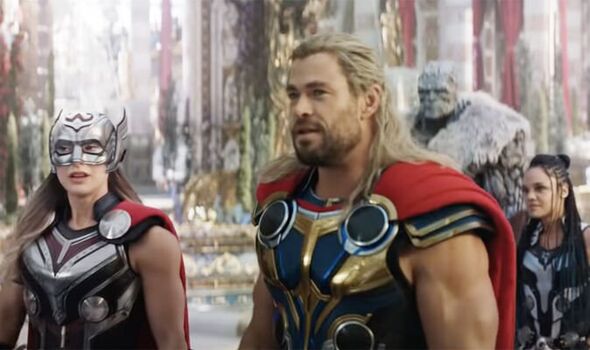
In the years after defeating Thanos and saving the universe, the film follows Thor Odinson going on a journey for inner peace as he learns that gods are being killed by a madman where he returns to New Asgard and learns this new foe’s intentions prompting Thor to seek help including his ex-girlfriend Jane Foster who has become the Mighty Thor. It is a film that explore a man who is still dealing with the loss of loved ones as he spends some time trying to help others until he learns about the death of a god where he found one of his old friends in Lady Sif (Jaime Alexander) wounded from her fight as he brings her home to New Asgard where things are already problematic involving shadow creatures trying to destroy New Asgard where Thor and the rock-like creature Korg (Taika Waititi) helps King Valkyrie (Tessa Thompson) as they’re aided by a new ally in the Mighty Thor who is revealed to be Jane Foster.
The film’s screenplay by Taika Waititi and Jennifer Katyin Robinson is messy in terms of the many genres they try to put in as well as some backstory and exposition. Still, Waititi and Robinson do create a compelling narrative that do play into this element of comedy and tragedy as the opening scene play into the latter as it relates to the origin of Gorr the God Butcher (Christian Bale) who was an ordinary man with a daughter (India Rose Hemsworth) where he prayed to the Gods for water in a desolate desert only for his daughter to die. Seeing that the god Rapu (Jonathan Brugh) treats him with indifference, Gorr finds the god-killing weapon known as Necrosword where makes a vow to kill all gods as the script does succeed in justifying some of Gorr’s actions which also forces Thor to see that some of the gods he idolized including Zeus are living in a bubble who prefer to not be involved in war and just do nothing. By kidnapping the children of New Asgard that includes Heimdall’s son Axl (Keiron L. Dyer) whom Thor can communicate with through Axl’s powers. Thor, Valkyrie, Korg, and Jane go on a journey to find the kids while there’s also something else happening as it relates to Jane wielding the newly-fixed Mjolnir as she is also dying from stage 4 cancer which adds a lot more emotional weight for Thor.
Waititi’s direction does bear a lot of style in terms of the different worlds that Thor and all of the principle characters go to but it is also grounded in this idea of what a god should be as it play into Thor’s own personal journey. Shot largely on locations at Fox Studios Australia in Sydney as well as some locations in and around Sydney, Waititi definitely creates different worlds that Thor, Jane, Korg, and Valkyrie go into with New Asgard being a character in the film as a world that isn’t just a tourist destination but also a home that allow Asgardians and other alien refugees a place where they can belong. While Waititi does create some unique wide and medium shots to capture a scope of these locations as well as a few scenes inside the Guardians of the Galaxy ship known as The Milano where Thor gains a couple of goats as they would accompany him and his team to an adventure. Still, Waititi does ground things as the first act does reveal what Jane was up to before as she is trying to find a way to stop her illness while some of Korg’s flashback montages do showcase how Mjolnir was in the hands of Jane.
The direction does also play into the stakes where Waititi do play into why Gorr has a point in wanting to kill all gods as it does relate to Thor pleading to Zeus and other gods to join him to stop Gorr. It is a commentary on why it is wrong to worship false idols with Thor being an idol that not only wants to help people and keep the universe safe but is also someone trying to understand who and what he needs to fight for based on advice from Peter Quill (Chris Pratt) early in the film. Though the presentation of the script is uneven in its attempt to balance comedy and tragedy that is part of Waititi’s own exploration of existential meaning in these two subjects. It does have stakes where it would play into this confrontation between Thor and Gorr with the latter wanting to reach this mysterious being with Thor knowing what he will do with Jane taking a major step of her own knowing that it might cost her own life as she and Thor both have to realize what it means to fight for love at all cost. Overall, Waititi crafts an adventurous and heartfelt film about a god trying to find peace of mind while having to fight a man that wants to kill all gods.
Cinematographer Barry Idoine does excellent work with the film’s cinematography with its emphasis on natural lighting for some of the daytime exterior scenes set in New Asgard as well as some stylish lighting including some black-and-white lighting for a scene set in Gorr’s home that is the Shadow Realm. Editors Matthew Schmidt, Peter S. Elliot, Tom Roche, and Jennifer Vecchiarello do terrific work with the editing as it is stylish in terms of some of the fast-cuts for the action and humor while also keeping things straightforward in some of the dramatic and suspenseful moments. Production designer Nigel Phelps, with set decorator Katie Sharrock and supervising art director Charlie Revai, does incredible work with the set design from the look of New Asgard in its houses and such as well as the look of Omnipotence City where all of the gods including Zeus live in. Costume designer Mayes C. Rubeo does fantastic work with the costumes that includes new armor for Thor as well as a new leather jacket as well as the armor for Jane and Valkyrie plus the ridiculous clothing that Zeus wears.
Makeup designer Matteo Silvi and creature/prosthetics designer Adam Johansen do brilliant work with the look of Gorr as well as some of the looks for the Olympians including Zeus. Special effects supervisor Dan Oliver, with visual effects supervisors Mathieu Assemat and Dominic Drane, does nice work with the look of some of the planets and space scenery as well as the look of the goats Thor gained in saving a planet as they would become his pets. Sound designers David C. Hughes, Samson Neslund, and Steve Orlando, with sound editor Quianbaihui Yang, do superb work with the sound as it play into some of the sound effects including the comical sounds from the goats as well as other sounds that play into the action and suspense. The film’s music by Michael Giacchino and Nami Melumad is phenomenal for its rock-based orchestral score that feature metal-inspired guitars and bombastic string arrangements to play into the scope of the film while music supervisor Dave Jordan creates a fun music soundtrack that features an original song by Waititi as Korg plus music from ABBA, Ciara with Petey Pablo, Enya, Michael Raphael, Mary J. Blige, Dio, and four songs by Guns N’ Roses.
The casting by Sarah Halley Finn is marvelous as it feature some notable small roles and cameos from Stephen Curry as a God in King Yakan whom Thor and the Guardians help early in the film, Carly Rees in a motion-capture performance as Valkyrie’s assistant Miek, Jonathan Brugh as the god Gorr worshipped in Rapu, Zia Kelly as a former girlfriend of Thor in a pirate girl, Elsa Pataky as another former flame of Thor in the Wolf Woman, Tristan Hemsworth as a young Thor, Samson Alston as the teenage Thor, Eliza Matengu as Axl’s mother Grace, Ava Caryofyllis as a young Jane, Simon Russell Beale as the god Dionysus, Akosia Sabet as the Wakandan goddess Bast, Jenny Morris as an New Asgardian resident, India Rose Hemsworth as Gorr’s daughter, and in the various roles of the Asgardian children kidnapped include Aleph and Amalia Millipied, Te Kainga O’Te Hinekahu Waititi, Sasha Hemsworth, and Rex Bale. Other notable cameos in the role of the Asgardian theatre troupe include Matt Damon as the actor playing Loki, Luke Hemsworth as the actor playing Thor, Sam Neill as the actor playing Odin, Melissa McCarthy as the actress playing Hela, and Ben Falcone as the stage manager.
Other noteworthy small roles include Kieron L. Dyer as Heimdall’s son Axl who is among one of the Asgardian children kidnapped as he has inherited his father’s powers while Daley Pearson is funny in his small role as Thor’s former roommate Darryl who is now a tour guide. Kat Dennings and Stellan Skarsgard are terrific in their brief appearances as Dr. Darcy Lewis and Dr. Erik Selvig as two of Jane’s longtime colleagues who are there for her early in the film as they’re concerned with her ailing health. Jaime Alexander is superb in her own brief appearance as Thor’s childhood friend Lady Sif who is severely wounded from her own fight with Gorr as Thor would get her home to safety. In the roles of the Guardians of the Galaxy, the performances of Sean Gunn as Kraglin, Pom Klementieff as Mantis, the voice of Bradley Cooper as Rocket, the voice of Vin Diesel as Groot, Karen Gillan as Nebula, Dave Bautista as Drax, and Chris Pratt as Peter Quill/Star-Lord are fun to watch as they get to kill bad guys while dealing with Thor’s own issues with Pratt being the person to give Thor some needed advice on fulfillment and love.
Taika Waititi is excellent in his motion-capture performance as the rock-monster Korg who is a fun comic relief that is always helpful and provide some comical insight into Thor’s own existential issues. Russell Crowe is hilarious in his performance as the god Zeus where he has this larger-than-life persona while doing one of the worst accents ever presented on film that just adds to how ridiculous the character is. Tessa Thompson is amazing as King Valkyrie as a former warrior turned King of Asgard who is hoping to have another adventure as a distraction from bureaucratic duties while finding a sense of sisterhood with Jane that she never thought she would have again. Christian Bale is incredible as Gorr the God Butcher as a man who is dismissed by a god only to take up the Necrosword that would make him into a man that has justified reasons to kill gods while is also a character filled with some unique humor as well as be an imposing and intimidating foe.
Natalie Portman is phenomenal as Jane Foster/the Mighty Thor as the astrophysicist who is dying from cancer until she learns that the damaged Mjolnir calls to her where she becomes the Mighty Thor as she adjust to her newfound powers where Portman brings a lot of complexity but also humor in trying to find a catchphrase that is suited to her character. Finally, there’s Chris Hemsworth in a sensational performance as Thor Odinson as the God of Thunder who is embarking on a journey for peace of mind following loss and grief where he deals with not just Gorr but also Jane becoming worthy of the Mjolnir where he does what he can to save the children of New Asgard. Hemsworth brings a lot of humor to his performance but also a lot of humility as his scenes with Portman definitely showcase a lot of chemistry in which both characters grow with Hemsworth learning what he needs to do and why he needs to be the God that people can count on.
Thor: Love and Thunder is a remarkable film from Taika Waititi that features great performances from Chris Hemsworth, Natalie Portman, Christian Bale, Tessa Thompson, Waititi, and Russell Crowe. Along with the rest of its ensemble cast, dazzling visuals, study on idol worship, and a killer music soundtrack with the rocking music of Guns N’ Roses. It is a film that doesn’t just deliver in high-stake action and suspense but is also filled with humor but also some commentary on fulfillment through love despite some tonal issues with the film’s script. In the end, Thor: Love and Thunder is a marvelous film from Taika Waititi.
Taika Waititi Films: Two Cars, One Night - Eagle vs. Shark - Boy (2010 film) - What We Do in the Shadows - Hunt for the Wilderpeople - Jojo Rabbit - Next Goal Wins (2023 film) - (Klara and the Sun) – The Auteurs #64: Taika Waititi
Marvel Cinematic Universe: Infinity Saga: Phase One: Iron Man - The Incredible Hulk - Iron Man 2 - Thor - Captain America: The First Avenger - The Avengers
Phase Two: Iron Man 3 - Thor: The Dark World - Captain America: The Winter Soldier - Guardians of the Galaxy - The Avengers: Age of Ultron - Ant-Man
Phase Three: Captain America: Civil War - Doctor Strange - Guardians of the Galaxy Vol. 2 - Spider-Man: Homecoming - Thor: Ragnarok - Black Panther - Avengers: Infinity War - Ant-Man and the Wasp - Captain Marvel - Avengers: Endgame - Spider-Man: Far from Home
Multiverse Saga: Phase Four: Black Widow - Shang-Chi and the Legend of the Ten Rings - Eternals - Spider-Man: No Way Home - Doctor Strange in the Multiverse of Madness - Werewolf by Night - Black Panther: Wakanda Forever - The Guardians of the Galaxy Holiday Special
Phase Five: Ant-Man & the Wasp: Quantumania - Guardians of the Galaxy Vol. 3 – The Marvels – (Deadpool & Wolverine) - (Captain America: Brave New World) - (Thunderbolts*)
Phase 6: The Fantastic Four: First Steps - (Avengers: Doomsday) - (Avengers: Secret Wars)
© thevoid99 2022

The film is about a cat-and-mouse chase between a LAPD police detective and a career thief with a loyal heist crew who take part in a major heist following another theft that involved bonds belonging to a money-laundering insurance owner. It is a film that explore two men who only know what to do as they’re set to collide but there is a mutual respect in the fact that they’re men who both have a code and know what to do if they meet face-to-face. Michael Mann’s screenplay is largely straightforward in its narrative yet it is more about the men involved in this cat-and-mouse game where the LAPD detective in Lieutenant Vincent Hanna (Al Pacino) and the criminal Neil McCauley (Robert de Niro) are trying to outwit one another but they’re also dealing with issues outside of their line of work with Hanna’s third marriage to Justine (Diane Venora) is crumbling as her daughter Lauren (Natalie Portman) is becoming emotionally-unstable. McCauley is just trying to do more work as it is all he knows while he meets and falls for a graphic designer in Eady (Amy Brenneman).
The film isn’t just about Hannah and McCauley dealing with each other and their own lives but the film also showcase that McCauley’s right-hand man in Chris Shiherlis (Val Kilmer) is going through issues with his wife Charlene (Ashley Judd) who is having an affair with a businessman in Alan Marciano (Hank Azaria). The script also play into the fact that McCauley, Shiherlis, Michael Cheritto (Tom Sizemore), and Trejo (Danny Trejo) are a crew who pride themselves in being professional and not kill anyone unless they have to as they bring in a wildcard in Waingro (Kevin Gage) who ends up becoming problematic as McCauley tries to kill him only for him to escape as he would end up being a problem for everyone including Hanna as it relates to the murders and raping of young women. Waingro would also play a role in the film’s second act as it relates to the bonds that McCauley and his crew stole as it belonged to the rich insurance salesman Roger Van Zant (William Fichtner). Mann doesn’t really create any heroes and villains but rather people are complicated with Van Zant and Waingro being the real villains in the film as they’re immoral and don’t care for anyone but themselves.
Mann’s direction definitely has an air of style in the presentation as it is shot on location in and around Los Angeles as the city itself is a character in the film. Mann uses these locations to not just play into the world that McCauley wants despite its lack of fulfillment but also a world that is simple as McCauley’s crew are diverse as it would later include a former prison-mate of his in Don Breedan (Dennis Haysbert) as they also have a simple life. There are wide and medium shots to play into the scope of the locations as well as banks, hotel rooms, and other places as there is a lot of attention to detail in these rooms and places that Mann is filming as it adds to the large scope of the film. Notably in a scene where Hanna and his team are at a docking area where McCauley and his team are having a conversation as Hanna and his team go to that location where Hanna realizes what is going on. It adds to this air of intrigue and suspense that occurs throughout the film that includes this meeting between McCauley and Hanna at a diner.
It’s a scene in the middle of the film in this meeting of the two men where it serves as a meeting of the minds before these two men go to war as it is clear through its close-ups and simple reverse shots as these are just two complicated men who could be friends in another world and have a lot of similarities but are on opposite sides of the law. The heist sequence that comes in late in the second act is an intense moment where there is a lot of quick shots that play into the frenetic energy as there is a lot at stake including lives where McCauley and his crew don’t want to kill anyone but they’re pinned down. The third act isn’t just about who ratted McCauley out but also Hanna wanting to find out who snitched to them as well yet both men and Shiherlis would deal their own personal issues. There is also a lot of drama that Mann explore where it is clear that McCauley and Hanna are men of certain extremes but at least are honest to admit with the latter having to realize what he means to his family despite not being there as much. The climatic showdown of the two is one that is filled with an immense visual style in its scope but it also owes a lot to the western. Overall, Mann crafts a ravishing yet gripping film about a LAPD detective and a career-criminal going head-to-head in an upcoming heist.
Cinematographer Dante Spinotti does incredible work with the film’s cinematography with its usage of low-key lights and bluish colors for some of scenes in the day and night as well as using available light in some scenes to enhance some of the drama. Editors Don Hoenig, Pasquale Buba, William Goldenberg, and Tom Rolf do amazing work with the editing with its usage of jump-cuts, fast-cuts, and other stylish cuts to play into the suspense and drama including the heist sequence. Production designer Neil Spisak, with set decorator Anne H. Ahrens and art director Margie Stone McShirley, does excellent work with the look of the homes that some of the characters live in as well as the offices that Hanna and his team work at and some of the diners that the characters go to. Costume designer Deborah Lynn Scott does fantastic work with the costumes from some of the stylish and posh clothing that both Charlene and Justine wear to the more casual and looser look of Eady with a lot of the suits that the men wear.
Makeup artist John Caglione Jr. and hair stylist Vera Mitchell, with tattoo designer Ken Diaz, do terrific work with the look of a few characters from the long-haired look of Shiherlis as well as the tattoos of Trejo. Visual effects supervisor Neil Krepela does nice work with some of the film’s minimal visual effects such as a scene of McCauley and Eady looking at the L.A. skyline at night. Sound editors Per Hallberg and Larry Kemp, along with sound designer Peter Michael Sullivan, do superb work with the sound as it play into the atmosphere of the locations as well as how guns sound when they fire as it is a highlight of the film. The film’s music by Elliot Goldenthal is wonderful for its somber yet moody score that mixes orchestral bits with some ambient electronic pieces while music supervisor Budd Carr creates a hypnotic soundtrack that features pieces by Moby, Einsturzende Neubauten, Terje Rypal & the Chasers, the Kronos Quartet, the Passengers (U2 & Brian Eno), B.B. King, and Lisa Gerrard.
The casting by Bonnie Timmerman is marvelous as it feature some notable small roles and appearances from Bud Cort as a diner owner that Breedan works for, Farrah Forke as a news reporter, Hazelle Goodman as a dead prostitute’s mother, Paul Herman as a police sergeant, Jeremy Piven as a surgeon, the trio of Rick Avery, Bill McIntosh, and Thomas Rosales Jr. as armored truck guards, Patricia Healy as Bosko’s date, Cindy Katz as a forensics investigator, Xander Berkeley as a friend of Justine named Ralph, Tom Noonan as a former criminal/guide in Kelso, Tone Loc and Ricky Harris as a couple of informant brothers who talk to Hanna about the word on the street, Jerry Trimble as one of Hanna’s detectives in Danny Schwartz, Henry Rollins as Van Zant’s assistant, Kim Statton as Breedan’s wife, Susan Traylor as Cherrito’s wife, Yvonne Zima as a young girl Cherrito reluctantly takes hostage, and Hank Azaria as Charlene’s lover Alan Marciano who is also involved in his own criminal activities until Hanna uses him as bait.
The performances of Ted Levine, Wes Studi, and Mykelti T. Williamson in their respective roles as Detective Mike Bosko, Lieutenant Sammy Casals, and Sergeant Bobby Drucker are terrific as members of Hanna’s team who all provide some insight into their mission with Sgt. Drucker being the one who deals with Charlene while not taking shit from Marciano. Natalie Portman is wonderful in her small role as Justine’s troubled teenage daughter Lauren who is dealing with an absentee father and other mental issues that raises concern from Hanna. Dennis Haysbert is superb as Don Breedan as a former prison mate of McCauley who is not happy with his parole assignment until he meets McCauley and agrees to help him while Danny Trejo is fantastic as McCauley’s friend Trejo who often serves as the driver in the heists until he is tailed by the police. Kevin Gage and William Fichtner are excellent in their respective villainous roles as Waingro and Roger Van Zant with the former being this deviant wildcard who has no remorse in who he kills while the latter is just a greedy insurance salesman who only cares about money and control.
The trio of Amy Brenneman, Ashley Judd, and Diane Venora are brilliant in their respective roles as Eady, Charlene Shiherlis, and Justine Hanna as the women in the lives of these three men with Brenneman providing a sense of warmth and hope to McCauley while Judd serves as a frustrated wife who is upset over her husband’s gambling issues and Venora as Hanna’s wife who is often upset by his frequent absences and her troubled daughter. Tom Sizemore and Jon Voight are amazing in their respective roles as the thief Michael Cherrito and the fence Nate with the former being someone who is eager for one more score while the latter helps McCauley in finding new jobs but is aware that something about Van Zant isn’t right. Val Kilmer is incredible as Chris Shiherlis as McCauley’s right-hand man who is a great marksman but also has gambling issues and feels like he’s not good enough for his wife and kid where he deals with the dangers of his work and being caught.
Finally, there’s Al Pacino and Robert de Niro in tremendous performances in their respective roles as Lieutenant Vincent Hanna and Neil McCauley. Pacino’s performance is a bit reserved while he also has some wild moments in a scene where he confronts Marciano as there are also moments where he is sensitive and does what he can to be helpful. The performance from de Niro is also low-key as someone who is meticulous in what he wants to do as he is also a man with a code while is eager to have a life outside of crime. Pacino and de Niro’s few scenes together are a joy to watch where it is two men displaying a mastery in their craft as these two extremes who have a lot of similarity but also know they have a code to live by.
Heat is a magnificent film from Michael Mann. Featuring a phenomenal ensemble cast, rapturous visuals, gripping action sequences, fascinating studies of characters and ideals, and an intoxicating music score. The film is definitely a crime drama that diverts the idea of heroes and villains in favor of studying morals as well as what two men would to maintain their own ideals. In the end, Heat is an outstanding film from Michael Mann.
Michael Mann Films: The Jericho Mile – Thief (1981 film) - The Keep – Manhunter - L.A. Takedown – The Last of the Mohicans - The Insider – Ali - Collateral - Miami Vice - Public Enemies - Blackhat - Blackhat - Ferrari – (Heat 2) - The Auteurs #73: Michael Mann Pt.1 - Pt. 2
© thevoid99 2021

The film follows a young novelist/actor who is interviewed by a journalist over a book he wrote about his corresponding letters with an American TV star more than a decade ago who died mysteriously following a scandal relating to both of them. It’s a film that is an exploration of fame and celebrity as well as how his stardom won the affections of a young boy who would write corresponding letters with him that eventually would cause trouble. It’s an idea that is interesting yet Xavier Dolan and co-writer Jacob Tierney create a script that is overwhelmed with ideas but with not much to say as the result is something extremely messy and overblown. Notably as its narrative moved back and forth into the story of its titular character (Kit Harrington) and his young fan in Rupert Turner (Jacob Tremblay) while the older Rupert (Ben Schnetzer) talks about everything to the journalist Audrey Newhouse (Thandiwe Newton).
The script opens with the news of John F. Donovan’s death and Rupert’s reaction as he is watching it on TV at a coffee house with his mother Sam (Natalie Portman) as it would be the start of a non-linear reflective narrative where the older Rupert talks to Newhouse about the book he wrote. Yet, Dolan and Tierney chooses to create a parallel narrative about Donovan’s rise and his need to keep his homosexuality a secret while the young Rupert is striving to become a young actor inspired by Donovan despite the homophobic abuse he receives from classmates. It’s a narrative that showcases both Donovan and Rupert’s own issues with their mothers but also their own struggles with who they are yet it is a narrative that tends to overwhelm itself with the older Rupert coming across as someone who has become an asshole. Especially as it features various characters in their lives with the exception of a few who are either underwritten or played as clichés.
Dolan’s direction definitely has ambition and a look that plays into this world of celebrity though it is largely set in three different cities such as New York City, London, and Prague as much of the film is shot on location in Montreal. While many of Dolan’s compositions are straightforward, there are elements of style in some of the scenes he shoots as it play into some of the film’s melodrama. There are some wide and medium shots in not just scopes of the locations but also in some intimate moments with the latter as it play into conversations including scenes that play into the lives of Donovan and the young Rupert as they struggle with their own issues as well as their own parallel relationships with their mother. Yet, there are these moments in the film where Dolan’s approach to melodrama does create scenes that are either cheesy or just overwrought such as a scene where Donovan visits his mother Grace (Susan Sarandon) for Thanksgiving as Donovan is accompanied by his wife Amy (Emily Hampshire) and his brother James (Jared Keeso) as it becomes this overblown moment of Grace feeling unappreciated while she’s drunk as Donovan gets angry over his uncle being an asshole.
It’s not just that sequence that feels overwritten as well as a scene where Rupert’s corresponding letters were discovered after a homophobic classmate stole them where Rupert had to break into the boy’s house to get it back. It’s also scenes where the older Rupert talks to Newhouse about ethics where he comes off as entitled as it’s another scene that doesn’t work. Dolan also puts in an odd scene where an old man (Michael Gambon) gives Donovan some advice late in the film where it is a strange moment that never feels earned as it would be followed by a scene of Donovan at his mother’s house where he and his brother are singing Lifehouse’s Hanging By a Moment that feels tacked on and never adds anything to the story. For a film that is meant to be this exploration of scandal, misunderstanding, and celebrity, Dolan not only doesn’t say anything new but he also dwells into clichés that doesn’t feel earned nor does it help the story in general. Overall, Dolan crafts an overwritten and baffling film about a young man reflecting on his time as a kid corresponding letters to a troubled TV star.
Cinematographer Andre Turpin does excellent work with the film’s cinematography as its emphasis on low-key lighting and lack of vibrant colors do add to the film’s dramatic tone despite its messy narrative. Editors Xavier Dolan and Mathieu Denis do fine work with the editing where it does have elements of style though some of it do go overboard to play into some major dramatic moments. Production designers Anne Pritchard and Colombe Raby do fantastic work with the look of the home that Donovan’s mother live in as well as the school and home that the young Rupert goes to in London. Costume designers Michele Clapton and Pierre-Yves Gayraud do nice work with the costumes as it has some style in the clothes that Donovan wears while much of it is just casual.
Hair/makeup designer Jan Archibald does terrific work with the look of Sam with her hairstyle as well as the look of a few other characters to play into the world that Rupert and Donovan are in. Special effects supervisor Guillaume Murray and visual effects supervisor Jean-Francois Ferland do some OK with the film’s visual effects for scenes relating to the TV show Donovan is in as well as some set-dressing for some of the film’s locations. Sound designer Sylvain Brassard does superb work with the sound in the way music is played on a car radio to the atmosphere of a few party scenes as well as some sparse moments in the dramatic aspects of the film. The film’s music by Gabriel Yared is good for some of the lush orchestral score pieces that does play into the drama though it does have moments where it does feel overdone while the music soundtrack that features music from Cat Power, Adele, P!nk, Lifehouse, and the Verve do have their moments as it play into the period of the mid-2000s yet some feel used in the most clichéd ways.
The casting by Carmen Cuba is wonderful despite the fact that the cast wasn’t given strong material to work with as small roles from Jane Wheeler and Susan Almgren as two of Donovan’s aunts, Craig Eldridge as Donovan’s asshole uncle Patrick, Lukas Rolfe as the young Rupert’s homophobic classmate Cedric, Sarah Gadon as one of Donovan’s co-stars in Liz Jones, Jared Keeso as Donovan’s older brother James, and Chris Zylka in a somewhat-bland performance as an actor in Will Jefford Jr. who would have a thing with Donovan as he’s never given anything to do. Michael Gambon’s one-scene performance as a man who gives Donovan advice is amazing despite the fact that the scene made no sense while Emily Hampshire’s performance as Donovan’s wife Amy is severely underwritten as someone who never really says a lot in the film.
Kathy Bates and Amara Karan are excellent in their respective roles as Donovan’s manager Barbara Haggermaker and Rupert’s schoolteacher Miss Kureshi with the former being a no-nonsense manager who does what she can for Donovan but not put up with his bullshit while the latter is a kind-hearted teacher who believes that Rupert is gifted. Ben Schnetzer’s performance as the 21-year old Rupert is terrible as he switches between a British and American accent every now and then where he comes off as a real douche bag in how he talks about his past and observations while Thandiwe Newton manages to be solid as the journalist Audrey Newhouse as she just plays it straight and not putting up with some of the bullshit. Susan Sarandon has her moments as Donovan’s mother Grace in quieter moments though the scenes where she is melodramatic is her over-acting a bit.
Natalie Portman is superb as Rupert’s mother Sam as a woman who is baffled by her son’s relationship with Donovan through the letters where Portman does show some realism in the mother world despite some of the clichéd dramatic tropes she had to endure. Kit Harrington’s performance in the titular role is a mess as it does have moments of someone that is struggling with his identity but Harrington is unfortunately hindered by clichés that never allows his character to be fully engaging. Finally, there’s Jacob Tremblay in an incredible performance as the young Rupert Turner where Tremblay displays this air of energy and enthusiasm to the role but also someone who is just trying to understand the ways of the world as he is the only real highlight of the film.
The Death and Life of John F. Donovan is a horrendous film from Xavier Dolan. Despite the performances of Jacob Tremblay, Natalie Portman, Kathy Bates, and Amara Karan, the film is unfortunately bogged down by too many ideas in its study of celebrity and identity by favoring melodrama and tacked on moments that never says anything. It is a film that had a unique idea but fails in its execution where it dwells too much into convention while never going into places that could’ve done more with its subject matter. In the end, The Death and Life of John F. Donovan is an absolute failure from Xavier Dolan.
Xavier Dolan Films: I Killed My Mother - Heartbeats (2010 film) - Laurence Anyways - Tom at the Farm - Mommy (2014 film) - (It’s Only the End of the World) – Matthias & Maxime - (The Night Logan Woke Up) – The Auteurs #46: Xavier Dolan
© thevoid99 2021

The film follows an astronaut who is eager to return to space but becomes disconnected with reality just as she begins an affair with another astronaut that eventually becomes troublesome. It’s a film that plays into a woman’s emotional and mental descent as she embarks on a tumultuous affair with a colleague as well as trying to go back to outer space despite the presence of a younger candidate who wants her spot. The film’s screenplay play into the descent that its protagonist Lucy Cola (Natalie Portman) endures as well as her desire to relive the experience of being in outer space yet it also goes into places where the narrative isn’t sure where it wants to go and what it wants to be. Notably as it doesn’t do enough to explore Lucy’s mental issues following her return from space as she believes she is alright despite the concerns of Dr. Will Plimpton (Nick Offerman). The man Lucy has an affair with in a fellow astronaut in Mark (Jon Hamm) is someone who says a lot of things but he also has kids and not much is known whether he’s married or divorced as he also has interest in Lucy’s new rival in Erin (Zazie Beetz).
If the script’s problems in establishing characters and its lack of exploration of Lucy’s disconnect with reality, Noah Hawley’s direction for the film is what makes everything fall apart. Shot on location in Southern California with some of it as part of Texas and Florida, the film has no clue on what it wanted to be where Hawley wanted to make this drama of a woman’s mental struggles but also this romantic drama with no sense of cohesive direction. Even in some of Hawley’s approach to wide and medium shots have him using different aspect ratios where some of the scenes on Earth including Lucy’s home with her husband Drew (Dan Stevens) and their niece Blue Iris (Pearl Amanda Dickson) are shot in a 1:33:1 aspect full-frame ratio where there’s some scenes shot in 1:85:1 and 2:35:1 aspect ratios as it gets confusing. Even where Hawley is trying to use the framing devices as a form of style but it ends up being a total distraction to the story as it would change every time until Hawley until sticks with one for its third act.
Hawley does use some close-ups that includes a scene where Lucy is training underwater as water went inside her helmet during the training scenario as she was able to finish it but raises concern about her mental state. It’s a rare good scene in a film that just gets crazier as the third act includes scenes that needed humor. Especially in light of the real-life stories that the film is based on yet it never goes there as Hawley just makes it dramatic leading up to this insane confrontation between Lucy and Mark as the aftermath of it is just a hollow and underwhelming resolution into what happened to her in the end. Even as it feels like it has been rushed and without explanation of how she got to the end as it’s just lazy storytelling. Overall, Hawley crafts an idiotic and humorless film about an astronaut who loses grip with reality as she engages into an affair with another astronaut that leads to chaos and stupidity.
Cinematographer Polly Morgan does excellent work with the film’s cinematography in its emphasis on low-key lights for many of the interiors in the day and night as well as some vibrant lighting for the scenes at the training stations. Editor Regis Kimble does a fine job in the editing despite the over-usage of jump-cuts to play into Lucy’s paranoia and troubled state of mind as it really does make the film jarring for much of it. Production designer Stefania Cella, with set decorator Jon J. Bush and art director Samantha Avila, does fantastic work with the look of the home that Lucy and her husband live in as well as Mark’s office. Costume designer Louise Frogley does nice work with the costumes as it is largely casual including the clean-cut look of Drew.
Special effects supervisor Mark R. Byers and visual effects supervisors Matthew Bramante do terrific work with the visual effects for the scenes in space though one sequence that involves Lucy moving through walls and into another location is one of the dumbest effects moments in the film. Sound designers Ai-Ling Lee and Tobias Poppe do superb work with the sound as it play into some of the natural locations though it does go overboard as it play into Lucy’s paranoia. The film’s music by Jeff Russo is good with its mixture of orchestral flourishes and ambient music while music supervisor Maggie Phillips provides a decent soundtrack that includes the B-52s, Riders in the Storm, Mel Tillis, and Norah Jones but it also features a horrendous cover of the Beatles’ Lucy in the Sky with Diamonds by Jeff Russo and vocalist Lisa Hannigan.
The casting by Ronna Kress is alright despite the fact that a lot of the actors don’t get much to do while being hampered by a terrible script and poor direction. Performances from Nick Offerman as the psychiatrist Dr. Will Plimpton, Tig Notaro as the astronaut Kate Mounier, Jeffrey Donovan as the astronaut trainer Jim Hunt, and Colman Domingo as the mission director Frank Paxton aren’t just severely underused but never really do anything to be involved with the narrative with the exception of Domingo’s character who plays a key role in the third act as it relates to Lucy’s mental state. Pearl Amanda Dickson is wonderful as Drew and Lucy’s niece Blue Iris as a young girl who is concerned about her aunt’s mental state as she reluctantly joins her for the road trip in the film’s third act. Zazie Beetz’s performance as Lucy’s rival Erin Eccles is severely underwritten as she’s just there to be this romantic/competitive rival with not much to do while Ellen Burstyn’s performance as Lucy’s grandmother Nana Holbrook has a few funny lines and such but never gets the chance to be used more as her one appearance in the film’s third act is just dumb.
Dan Stevens is alright in his performance as Lucy’s husband Drew as someone who is religious and kind-hearted yet becomes concerned about Lucy’s activities as he is hampered by the fact that he is underwritten and is just there to be a cuckold. Jon Hamm’s performance as the astronaut Mark Goodwin where it has its charm but is hampered by the film’s script as someone who is a manipulator and a womanizer as he ends up being one-dimensional. Finally, there’s Natalie Portman in a stellar though flawed performance as Lucy Cola as this astronaut whose experience in space has made her lose touch with reality as Portman does what she can to play into that disconnect but she is held back by the film’s awful script while her Texan accent is spotty at times and having to sport one of the worst haircuts ever on film.
Lucy in the Sky is a lousy and horrendous film from Noah Hawley. Despite Natalie Portman’s attempt to give a fiery performance, the film’s terrible script, messy presentation, and lack of humor as it relates to the real-life story the film is inspired by. It is a film that wants to be a lot of things yet its lack of cohesion and idiotic presentation makes it a total chore to watch. In the end, Lucy in the Sky is a fucking awful film from Noah Hawley.
© thevoid99 2021

Set mainly in Austin, Texas in its respective music and arts scene, the film revolves around two songwriters/musicians, a music mogul, and a waitress as they all take part in whirlwind of a love affair that would each play into their ambitions and desires. It’s a film that doesn’t have much plot nor does it feature a traditional narrative due to the fact that its writer/director Terrence Malick didn’t write a script and created everything through notes and what he can capture on film. Yet, the film plays more into the themes of these four people who all meet as they fall in love but deal with temptation, doubt, and the search for meaning. Especially as Faye (Rooney Mara) is trying to make it into the music industry as she falls for the slightly-successful BV (Ryan Gosling) as she gets him to meet music mogul/lover Cook (Michael Fassbender). Yet, Faye continues her tumultuous affair with Cook who would marry the waitress Rhonda (Natalie Portman) but things go into strange turns due to Cook wanting to engage more into his decadent lifestyle with Faye and BV both trying to find something.
Malick’s direction definitely plays into the loose nature of the film’s unconventional narrative as it has this sense of freewheeling approach in the way he films everything around him. Shot largely on location near and in Austin, Texas with some shots in Mexico for a scene where BV, Faye, and Cook take a trip to Mexico. The usage of wide and medium shots not only allow Malick to get a look into the surroundings that these characters encounter but also in its connection with the world itself. Even as Malick would have characters also encounter elements of nature as it play into their search for love and identity while also encountering the chaos in the Austin music scene. The camera would often be in the middle of the action whether it’s in a mosh pit or people dancing in a rave. Malick’s close-ups add to the film’s unconventional tone as he always play into these characters and all of the highs and lows they endure as the four principle characters of Faye, BV, Cook, and Rhonda also express their feelings through voice-over narration.
Though the film centers on this music and arts scene in Austin, there are also these spiritual elements in the film though a lot of is subtle as it relates to journeys of these four characters. Notably as Faye is filled with doubt over her relationship with BV who has some issues with Cook over business reasons. Even as she learned that BV has been in a past relationship with Swedish singer Lykke Li and another former flame in Amanda (Cate Blanchett) whom he would briefly reconnect despite the fact that Faye would also continue her tumultuous affair with Cook to the point that he would have her and Rhonda in a brief three-way affair. Cook is this metaphoric figure of temptation and decadence who would often lure Faye into his world to the point that Rhonda feels neglected, lost, and yearning for answers leading her to go to the world of faith. The usage of music plays into this idea of people bringing together yet it is also used for decadence in Cook who continuously tries to find some sort of meaning through drugs and partying.
The film’s third act is about the journeys that these four characters endure where Malick showcases this air of loss through the trappings of temptation and decadence with some trying to find a bigger meaning in their lives with others forced to accept reality as well as cope with some of their poor decisions. Still, there are people who do give them some guidance as a way to cope with loss but also on love as Malick brings that sense of reality and gracefulness to show that as hard as the world can hit someone. It is all about getting hit and taking it to move forward as it play into the story that these four characters endure. While there’s a lot that is happening and can meander at times due to the film’s lack of a conventional narrative, Malick is able to maintain something that is more of a thematic study set against this culture of music and art with the four people at the center of it. Overall, Malick crafts an intoxicating and compelling about four people going through their own desires, doubts, and identity issues in Austin, Texas.
Cinematographer Emmanuel Lubezki does incredible work with the film’s cinematography as its usage of natural lighting, available light, different film stocks, and digital photography adds to the look of the film with its vibrant colors as it is a major highlight of the film. Editors Rehman Nizar Ali, Hank Corwin, and Keith Fraase do amazing work with the editing with its stylish approach to jump-cuts and rhythmic cuts as it play into the film’s dream-like and gliding tone. Production designer Jack Fisk, with set decorator David Hack and art director Ruth De Jong, does brilliant work with the look of the homes of the characters including the hotel that Cook often parties at or the look of the stages at the South by Southwest music festival.
Costume designer Jacqueline West does excellent work with the costumes with its mixture of casual and stylish clothing including some of the designer clothes that some of the richer characters wear as well as the look of the music performers in the film. Sound designers Joel Dougherty and Will Patterson do superb work with the sound as it play into the atmosphere of the locations as well as how music sounds live and on stage as well as the way the voiceover narrations are mixed. Music supervisor Lauren Mikus does fantastic work with the film’s music soundtrack with its mixture of classical, rock, indie, electronic music, and other kinds ranging from classical cuts from Zbigniew Preisner, Gustav Mahler, Camile Saint-Saens, Maurice Ravel, Nicholas Britell, Avro Part, and Claude Debussy along with music from Iggy Pop, Public Image Ltd., the Black Lips, Florence + the Machines, Lykke Li, Patti Smith, the Red Hot Chili Peppers, Bob Dylan, Elmore James, Del Shannon, Neon Indian, and many others.
The casting by Francine Maisler and Lauren Grey is wonderful as it feature cameos from the Red Hot Chili Peppers, John Lydon, Florence Welch, Iggy Pop, Tegan & Sara, Die Antwoord, and the Black Lips as themselves as well as Swedish artist Lykke Li as a fictional version of herself as a former flame of BV and American punk rock legend Patti Smith as a woman who is helping Faye with a lot of advice about art and life. Other notable small roles include Linda Edmond as BV’s mother, Tom Sturridge and Austin Amelio as BV’s younger brothers, Val Kilmer as one of Cook’s clients in a performer named Duane, Dana Falconberry as Faye’s sister, Brady Coleman as Faye’s father, Neely Bingham as BV’s ailing father, and Holly Hunter in a fantastic performance as Rhonda’s mother Miranda who is eager to have a life without trouble but becomes concerned for her daughter’s well-being. Berenice Marlohe is excellent as the French artist Zoey whom Faye meets and has a brief affair with as a woman who would give Faye some attention. Cate Blanchett is brilliant in her small role as Amanda who is a former flame of BV as she rekindles her relationship with him but realizes there’s some cracks in the relationship.
Natalie Portman is incredible as Rhonda as a waitress/former kindergarten teacher who falls for Cook as she is tempted by what he offers but finds herself lost in his decadent lifestyle as she seeks to find something with more meaning. Michael Fassbender is amazing as Cook as a music mogul who is a man that offers a lot and wants to be part of the fun but gets upset whenever he doesn’t get what he wants as he is this charming figure of corruption and temptation. Ryan Gosling is remarkable as BV as a successful musician trying to figure out what to do next as he falls for Faye while dealing with some business and personal issues with Cook as it is a somber performance from Gosling as someone who has seen a lot and is searching for answers. Finally, there's Rooney Mara in a phenomenal performance as Faye as a musician trying to get her break despite her attachment with Cook and her growing feelings for BV as it has this air of radiance and anguish as it is one of Mara’s finest performances to date.
Song to Song is a sensational film from Terrence Malick. Featuring a great ensemble cast, rapturous visuals, a rich music soundtrack, and themes of identity, doubt, and temptation against the backdrop of a vibrant music and arts scene in Austin, Texas. It is a film that explore four people trying to find their way in the world in the music scene as well as endure many ideas despite the film’s unconventional narrative and lack of a strong plot which won’t appeal to a lot of people. In the end, Song to Song is a phenomenal film from Terrence Malick.
Terrence Malick Films: Badlands - Days of Heaven - The Thin Red Line - The New World - The Tree of Life - To the Wonder - Knight of Cups - Voyage of Time: The IMAX Experience - (Voyage of Time: Life's Journey) – A Hidden Life – (The Way of the Wind)
© thevoid99 2020
Written and directed by Brady Corbet from a story by Corbet and Mona Fastvold, Vox Lux is the story of a pop singer trying to get her career back on track while dealing her past that included her response to a school shooting that prompted her and her sister to write a song. The film is a study of a woman dealing with stardom and the craziness of it while trying to be a mother to a teenage daughter. Starring Natalie Portman, Jude Law, Stacy Martin, Raffey Cassidy, Jennifer Ehle, Christopher Abbott, and narration by Willem Dafoe. Vox Lux is a riveting yet haunting film from Brady Corbet.
After surviving a school shooting that left her nearly paralyzed and force her to wear a neck brace for the rest of her life, a young girl writes a song with her sister in response to what happened as it would later make her into a pop star where she later struggles with the demands of stardom and motherhood as an adult. It’s a film that is essentially a character study of sorts that showcases this young woman who has been affected by tragedy as she tries to comprehend what had happened. Brady Corbet’s screenplay has an unusual structure in its study of Celeste Montgomery (Natalie Portman) from the time she was a teenage girl (Raffey Cassidy) who created a song with her older sister Eleanor (Stacy Martin) and then becoming a young pop star to being a major pop star who has become full of herself.
The film’s narration by Willem Dafoe provide some context into what Celeste would deal with but also events that would cause trouble in making Celeste lose touch with aspects of reality. Even in the film’s second act where she’s an adult with a teenage daughter in Albertine (Raffey Cassidy) just as she’s about to release a new album and launch a new tour. Yet, there’s still a lot of issues that Celeste is dealing with while is becoming more problematic while being estranged towards her older sister who has been taking care of Albertine. All of the drama as well as chaos that surrounds Celeste forces her to say things through her music although scandals and her own actions are starting to overshadow the music at a time when branding and image becomes more important.
Corbet’s direction is entrancing for his approach into telling the story of a young pop star’s life and her emergence into adulthood as it is shot on various locations with much of the film’s second half shot in New York City and nearby areas. While there are some wide shots of the locations and the film’s climatic concert sequence, much of Corbet’s direction emphasizes on medium shots and close-ups along with home movie video footage. The home movie footage that include Dafoe’s narration play into the innocence that the young Celeste and Eleanor endured where the former is to be signed with Eleanor on board as not just as a songwriter but also someone who is watching over the young Celeste. There’s a looseness to those moments in the home movie footage where the sisters travel to New York City and later Stockholm and London to make Celeste’s debut album with their manager (Jude Law) as it would later devolve into craziness. There are a lot of tracking shots and long-takes such as an early scene of the school shooting where it’s sudden and visceral in its execution.
When the film shifts towards the second half as it is set more than 15 years after the events where the young Celeste is making her first album. The film does have a different tone where does feel more polished in its camera movements and compositions. Most notably a diner scene between Celeste and Albertine as they talk where the former goes off on the diner’s manager all because he politely asked for a picture. The climatic concert scene that includes choreography by Benjamin Millipied is definitely extravagant yet it also play into this persona that Celeste has created as a way to escape from the horrors of the world despite the fact that she is indirectly connected to a recent event of violence. Still, it does reinforce the role of the pop singer and how they use music to heal despite their own flaws and artificial world they live in. Overall, Corbet crafts an evocative yet harrowing film about the tumultuous life of a pop singer.
Cinematographer Lol Crawley does excellent work with the film’s cinematography as it is largely straightforward in terms of the visuals with some unique lighting for some of the interiors as well as the film’s climatic concert scene. Editor Matthew Hannam does fantastic work with the editing as it utilizes a few jump-cuts and montages with the latter for the home movie footage. Production designer Sam Lisenco, with set decorators Kendall Anderson and Olivia Peebles plus art director Julia Heymans, does brilliant work with the look of Celeste’s stage set as well as the scenes in the school and at Stockholm such as the recording studio and hotel rooms. Costume designer Keri Langerman does amazing work with the look of the clothes that the adult Celeste would wear that would play into this larger-than-life persona as well as be this idea of cool while everyone else looks a bit casual with Albertine sort of dressed up as a Goth.
Visual effects supervisor Asaf Yeger does nice work with some of the visual effects as it’s mainly set-dressing for some parts of the film including exteriors of 2000-2001 NYC. Sound designer Leslie Shatz does superb work with the sound in creating some effective sound mixes such as the sounds of gunshots as well as how music sounds in a venue or the atmosphere of a hotel room. The film’s music by Scott Walker is wonderful for its usage of ambient and classical-based pieces that help play into the drama while the original songs by Sia are effective and catchy as its approach to electro-pop have something that is engaging with the rest of the music soundtrack by music supervisor Margaret Yen include a couple of tracks by Sunrise in the Desert.
The casting by Cassandra Kulukundis is incredible as it feature some notable small roles from Matt Servitto and Meg Gibson as Celeste and Eleanor’s parents, Maria Dizzia as Celeste’s music teacher early in the film, Daniel London as a preacher early in the film, Leslie Silva as Celeste’s stylist, Micheal Richardson as a musician the young Celeste meets in Europe, and Christopher Abbott as a journalist who interviews the older Celeste and eventually piss her off. Jennifer Ehle is fantastic as Celeste’s publicist Josie who is trying to ensure Celeste’s career is going well as well as being realistic to the point that she is also protective of her during the latter parts of Celeste’s career. Jude Law is excellent as Celeste’s manager as a man who would handle the business aspects of Celeste’s career but also try and get her to be reasonable later on while he would unknowingly help cause the rift between Celeste and Eleanor.
Stacy Martin is brilliant as Eleanor as Celeste’s older sister who would be her collaborator in writing the songs they create as well as introduce her to all sorts of things that would later play into their rift with Martin displaying a restraint as someone who feels mistreated by the person she’s caring for. Raffey Cassidy is great in a dual role as the young Celeste and Celeste’s daughter Albertine where Cassidy displays an innocence and charm as the younger Celeste who is also aware of what happened to her and the need to connect which would be something Cassidy would delve into as Albertine as a young girl trying to understand her mother’s state of mind. Finally, there’s Natalie Portman in a spectacular performance as the older Celeste Montgomery as a pop star that is trying to make a comeback with a new album and tour where Portman is unleashed in displaying someone who can really bitchy and mean but also someone who is quite fragile as she needs to escape from the realities of celebrity by just singing as it’s a tour-de-force performance from Portman.
Vox Lux is a sensational film from Brady Corbet that features tremendous performances from Natalie Portman and Raffey Cassidy. Along with its supporting cast, study of trauma and escape, and an incredible music soundtrack from Scott Walker and Sia. It’s a film that explore the mind-set of a pop star who has been affected by tragedy forcing her to create a bubble that disconnects itself with reality with music being her saving grace. In the end, Vox Lux is a phenomenal film from Brady Corbet.
Brady Corbet Films: (The Childhood of a Leader) - The Brutalist
© thevoid99 2018
Based on the novel by Jeff VanderMeer, Annihilation is the story of a group of military scientists who enter a mysterious zone where landscapes change as they also encounter creatures that transform. Written for the screen and directed by Alex Garland, the film is a sci-fi horror film that follow a group of women who travel to this quarantined zone as one of them tries to understand what her husband had encountered. Starring Natalie Portman, Tessa Thompson, Gina Rodriguez, Tuva Novotny, Oscar Isaac, and Jennifer Jason Leigh. Annihilation is an eerie yet evocative film from Alex Garland.
The film revolves a biologist who volunteers to join a group of military scientists into a mysterious zone where its surroundings change as it include mysterious creatures and things that are indescribable with the biologist wondering why her husband was the only one to return from that area. It’s a film that has a compelling premise yet it is largely told in a reflective manner by its protagonist Lena (Natalie Portman) to a scientist in quarantine as Alex Garland’s script uses Lena to explain what she and her team saw in the zone with questions about what happened to her husband Kane (Oscar Isaac) who had returned from the zone but isn’t the same person. Even as the army has taken him and Lena believing that there is something wrong with them yet it is Kane that is ill with Lena wondering what really did happen to him.
The screenplay has Lena tell her story to this scientist as she also thinks about her life with Kane but also the anguish she faced when he wasn’t around. While she was approached by army psychologist Dr. Ventress (Jennifer Jason Leigh) who revealed what Kane and his team were at the zone known as the Shimmer. Lena eventually decides to volunteer with Dr. Ventress and a team that includes two military scientists in Josie (Tessa Thompson), Cassie (Tuva Novotny), and the paramedic Anya (Gina Rodriguez). Much of the film’s second and third act occur in the Shimmer as it is a world that is unlike anything where mutation is common while there’s a lot of complexities into the environment that these women are all trying to understand as they all try to reach the lighthouse where the source of everything that happened is.
Garland’s direction is definitely intoxicating for the way he creates a world that is strange and surreal but also filled with wonders that play into the complexities of humanity and nature. Shot largely on location at Windsor Great Park as well as Holkham Pines in North Norfolk in Britain, the film does play into this strange mix of sci-fi and horror as Garland does maintain this air of suspense. While the film does have conventional elements relating to horror in what these women encounter, there is this conflict about what these women want to do with their mission as it intensifies during its second half. The scenes set at the Shimmer definitely echoes a lot of the visual compositions of Russian filmmaker Andrei Tarkovsky in terms of the attention to detail in the images as well as in some of the surreal elements. The usage of wide and medium shots play into that sense of wonderment that include some of the creatures that Lena and her team would encounter throughout the course of the film.
Garland would also use surrealism to play into the landscape and things that the characters would find at the Shimmer. Even as it play into idea of science where Lena, Dr. Ventress, Cassie, Josie, and Anya each give their own take of what they find. The third act isn’t just about going into the lighthouse which is where the source of the Shimmer comes from but also what happened to those who went to the Shimmer and never came back. The land surrounding the lighthouse is just as unique where there is something that is beautiful and enchanting but also filled with a sense of terror into what is the source of all of these things. Even as Lena has to deal with what she discovered and cope with what happened to her husband and how he was able to return home. Overall, Garland crafts a ravishing yet haunting film about a group of scientists entering into a mysterious world where the laws of nature is different and ever-changing.
Cinematographer Rob Hardy does brilliant work with the cinematography to play into the low-key yet stylish lighting for the scenes at the lab and military compound as well as a more natural look at Lena’s home with something dream-like in the scenes set at the Shimmer. Editor Barney Pilling does excellent work with the editing as it does have some style in a few flashback montages of Lena thinking about her life with Kane as well as some rhythmic cuts that play into the suspense. Production designer Mark Digby, with set decorator Michelle Day and supervising art director Denis Schnegg, does amazing work with the look of the military bases as well as some of the places inside the Shimmer including the lighthouse. Costume designer Sammy Sheldon does nice work with the costumes as it is largely casual including the army uniforms that almost everyone wears in the film.
Hair/makeup designer Sian Grigg does terrific work with the look of the characters to play into their personalities including how Kane looked before his mission and what he looked like afterwards. Visual effects supervisor Andrew Whitehurst does incredible work with the visual effects in the design of the creatures as well as the landscapes and such inside the Shimmer. Sound designer Glenn Freemantle does fantastic work with the sound as it is a highlight of the film as it play into the atmosphere of the Shimmer as well as sound textures into what the creatures sound like. The film’s music by Ben Salisbury and Geoff Barrow is superb for its mixture of ambient and folk in the music as it help play into the drama and suspense while the soundtrack mainly features a song from Crosby, Stills, and Nash.
The casting by Francine Maisler is wonderful as it include a few notable small roles from Sonoya Mizuno in a dual role as a student of Lena in Katie and a mysterious being at the Shimmer, David Gyasi as a colleague of Lena in Daniel who also works at the university where she’s a professor, and Benedict Wong as the scientist Lomax who interrogates Lena following the events of what she encountered at the Shimmer. Oscar Isaac is terrific in his role as Kane as Lena’s husband who returns from the Shimmer a different man where he is restrained and uncertain of where he is in comparison to who he is in the flashbacks as someone lively and animated. Tuva Novotny is fantastic as Cass as a military scientist who takes part in the mission as she is tough but also friendly as she befriends Lena as they both share stories of loss. Gina Rodriguez is excellent as Anya as a military paramedic who is a tough woman that is baffled by what she discovers as well as coping with the harsh environment of the Shimmer that allows her to act out.
Tessa Thompson is brilliant as Josie as a scientist who would make some discoveries about the landscapes and organisms at the Shimmer as well as provide some ideas of what is happening. Jennifer Jason Leigh is amazing as Dr. Ventress as military psychiatrist who leads the team as she wants to know what is out there while knowing why Lena chose to volunteer as she is also dealing with a secret of her own. Finally, there’s Natalie Portman in an incredible performance as Lena as a biologist who is trying to understand what happened to her husband while carrying elements of guilt as a way to redeem herself for him where she would make some unsettling discoveries but also make sense of the world that she is in as it’s one of Portman’s finest performances.
Annihilation is a phenomenal film from Alex Garland that features great performances from Natalie Portman, Jennifer Jason Leigh, and Tessa Thompson. Along with its ensemble cast, gorgeous visuals, compelling story of nature, and an eerie music score. It’s a film that blends all sorts of genres while exploring the ideas of people dealing with surroundings that are complex and breaking the laws of nature. In the end, Annihilation is a sensational film from Alex Garland.
Related: Ex-Machina
© thevoid99 2018
Directed by Pablo Larrain and written by Noah Oppenheim, Jackie is the story about Jacqueline Kennedy-Onassis who deals with the death of her husband John F. Kennedy and the plans for his funeral while looking back at her time when she was the First Lady of the United States. The film is an unconventional bio-pic of sorts as it follows Onassis’ time as the First Lady and dealing with the shocking death of her husband as Natalie Portman plays Jacqueline Kennedy. Also starring Peter Sarsgaard, Greta Gerwig, Billy Crudup, John Carroll Lynch, Richard E. Grant, Beth Grant, and John Hurt. Jackie is an evocative and rapturous film from Pablo Larrain.
The film revolves around Jacqueline Kennedy’s days following the assassination of President John Fitzgerald Kennedy on November 22, 1963 as she plans for the funeral and such while talking to a journalist (Billy Crudup) less than a month later after the funeral. Told in a non-linear narrative, Noah Oppenheim’s script follows Jackie as she talks about her time in the White House with brief glimpses of life as the First Lady as well as the events of the assassination and its aftermath. The interview with the un-named journalist, which is based partially on Theodore H. White’s article for Life magazine, has Kennedy talking about her work as First Lady that included restoring rooms at the White House that was filmed for a TV program. Yet, the bulk of the narrative has Jackie talking about the funeral procession and planning for her husband as she looks to historical events of the past for inspiration while dealing with the loss she’s carrying.
Pablo Larrain’s direction is stylish for the way it captures a period in time as it has a looseness in its approach to compositions and how it captures history. With many of the interiors shot in a studio in Paris, France with the funeral procession shot on location in Washington D.C., Larrain would aim for something simpler as he doesn’t go for a lot of wide shots with the exception of the funeral scenes. Much of his compositions aim for close-ups and medium shots while the film is shot largely on a 1:66:1 aspect ratio with the exception of Jackie’s TV special where she gives a tour of the White House which is shot in the 1:33:1 aspect ratio and in grainy black-and-white. Larrain’s approach to those scenes have him recreate the idea of what 1960s TV looked like with shots of Jackie being filmed by a crew as there is a tracking shot following her every move until it cuts to her in black-and-white. It’s among some of the stylistic choices in the film while there is also the scenes of the day of the assassination where Larrain shoots a medium shot of Jackie getting ready for the motorcade while there is a lot happening in the background.
Larrain’s direction also captures the events of the assassination and the bloody aftermath that is inter-cut with Jackie talking to the journalist about what she remembers and telling him what not to print. Even as Larrain would film scenes of Jackie’s meeting with a priest (John Hurt) where she deals with mortality and wonders why her husband had to die as it is among one of the finest sequences on film. There are also these intimate moments involving Jackie’s relationship with her brother-in-law Bobby (Peter Sarsgaard) and her personal secretary Nancy Tuckerman (Great Gerwig) that helps humanize Jackie who is coping with her grief as well as wanting to honor her husband in a way that leaders with big ideas would be honored. The film would culminate the funeral procession as it is a moment where all of the grief and trauma that Jackie faced. She maintains the sense of dignity that is needed in the role of First Lady. Overall, Larrain creates an intoxicating and riveting film about Jacqueline Kennedy’s time following the assassination of her husband.
Cinematographer Stephane Fontaine does incredible work with the film’s cinematography with its usage of naturalistic colors and lighting to play into many of the exteriors in the day along with some low-key lighting for some of the interiors as well as scenes set at night. Editor Sebastian Sepulveda does brilliant work with the editing with its usage of jump-cuts and other stylized cuts to play into the film’s non-linear narrative and Jackie’s own reflection of the events. Production designer Jean Rabasse, with set decorator Veronique Melery plus art directors Halina Gebarowicz, Mathieu Junot, and Emmanuel Prevot, does amazing work with recreation of the interiors of the White House including some of the famous bedrooms and the exterior sets of where Kennedy was to be buried. Costume designer Madeline Fontaine does amazing work with the costumes from the famed pink coat and hat Jackie wore on the day of the assassination to some of the gowns and such she would wear at various events of the past.
Makeup designers Sarai Fiszel and Odile Fourquin, with key hairstylists Janice Kinigopoulos and Catherine Leblanc, do fantastic work with the look of the hairstyles that the women had including Jackie’s hairstyle. Visual effects supervisors Thomas Duval, Sebastian Rame, and Tomas Roca do terrific work with some of the visual effects as it is mainly set-dressing with some recreation of the funeral procession and the way Jackie’s TV special is presented in its grainy footage. Sound designer David Miranda does superb work with the sound in the way some of the quieter moments at the White House are presented to scenes at Arlington and Jackie’s meeting with the priest where it has a natural atmosphere in the sound. The film’s music by Mica Levi is phenomenal for its orchestral score with its eerie usage of string arrangements and low-key textures to play into the drama while music supervisor Bridget Samuels provides a soundtrack that consists of a few classical pieces and a cut from the musical Camelot which Jackie plays on a record player.
The casting by Lindsay Graham, Jessica Kelly, Mathilde Snodgrass, and Mary Vernieu is remarkable as it feature some notable small roles and appearances from Sunnie Pelant as Caroline Kennedy, Brody and Aiden Weinberg as John F. Kennedy Jr., Julie Judd as Bobby’s wife Ethel, and Caspar Phillipson as President John F. Kennedy. John Carroll Lynch is terrific as Lyndon Johnson who would become the new President of the United States of America as he tries to give Jackie advice about the funeral while Beth Grant is wonderful as Claudia “Lady Bird” Johnson who also wants to help as she also prepares for her new role as First Lady. Max Casella is superb as Jack Valienti who was Johnson’s assistant at the time where he also tries to organize the funeral service while Richard E. Grant is fantastic as William Walton who is Jackie’s collaborator in the White House restoration project as he helps her in the historical research for what she wanted for her husband’s funeral procession.
In one of his final film performances, John Hurt is excellent as the priest who meets Jackie to discuss faith as well as giving his views of what happened where it is this very restrained yet calm performance as it is one of Hurt’s finest performances. Billy Crudup is brilliant as the journalist who interviews Jackie at her home in Massachusetts as he tries to understand some of the answers Jackie is giving him as well as what he should tell the press. Greta Gerwig is amazing as Nancy Tuckerman as Jackie’s personal secretary who is Jackie’s director during the TV special for the White House restoration while also being a close confidant in being someone to talk to as it’s an understated yet touching performance from Gerwig. Peter Sarsgaard is marvelous as Bobby Kennedy as the then-Attorney General and Jackie’s brother-in-law who is trying to help Jackie with the funeral arrangements as well as doing his job and shielding her from any news that could upset her.
Finally, there’s Natalie Portman in what is definitely a performance for the ages as Jacqueline Kennedy. It’s a performance that is this fine mixture of radiance, restraint, anguish, and grace where Portman definitely disappears into the character where she captures many of the nuances and attributes of Jackie without deviating into an impersonation. Instead, Portman provides that air of dignity in Jackie in the way she copes with grief and the trauma of seeing her husband killed in front of her as well as the way she tries to maintain this role of regality that is needed in being a First Lady where it is definitely Portman in a career-defining performance.
Jackie is a tremendous film from Pablo Larrain that features an outstanding leading performance from Natalie Portman in the titular role. Along with its great supporting cast, inventive script by Noah Oppenheim, gorgeous visuals, top-notch technical work, and Mica Levi’s ravishing score. It’s a film that doesn’t play by the rules of a bio-pic by focusing on a specific time in the life of one of the great First Ladies in American history as she is aware of role in American history and how she tries to maintain that sense of dignity for herself and her husband. In the end, Jackie is a magnificent film from Pablo Larrain.
Pablo Larrain Films: (Fuga) – (Tony Manero) – (Post Mortem) – No (2012 film) - (The Club (2015 film)) – (Neruda)
© thevoid99 2017