Directed by Alfred Hitchcock and screenplay by John Michael Hayes from a story by Charles Bennett and D.B. Wyndham-Lewis, The Man Who Knew Too Much is the story of a vacationing couple in Morocco whose son witnesses an assassination plot as he is kidnapped prompting the couple to get their son back. A remake of the 1934 film of the same name, the film is a suspense thriller that explores a couple who deals with what their son discovered as they also realize what is at stake in not just for their son but for so much more. Starring James Stewart, Doris Day, Brenda de Banzie, Bernard Miles, Christopher Olsen, Daniel Gelin, and Reggie Nalder. The Man Who Knew Too Much is a riveting and exhilarating film from Alfred Hitchcock.
The film revolves around a couple who go to Marrakesh during a vacation in Morocco as they meet a Frenchman whom they would later see killed in an assassination plot as their son is later kidnapped as they wonder what is going on. It’s a film that play into a doctor and his wife whose meeting with a Frenchman and then see him killed the next day who gives the doctor a message as he becomes unsure whether to tell the authorities after getting a call that his son had been kidnapped. John Michael Hayes’ screenplay, with un-credited contributions from Angus McPhall, opens the film with an orchestral performance that would be crucial to its climax in relation to what is at stake in this assassination plot. Dr. Benjamin McKenna (James Stewart) and his pop singer wife Josephine “Jo” Conway McKenna (Doris Day) were with their son Hank (Christopher Olsen) when they meet Louis Bernard (Daniel Gelin) on a bus as they would later have a dinner with him only to be cancelled as the McKennas later dine with a British couple in Edward and Lucy Drayton (Bernard Miles and Brenda de Banzie respectively).
The Draytons aren’t what they seem when they suddenly disappear as Hank was with Lucy shortly after the assassination plot they witnessed where Bernard told Dr. McKenna crucial information. The first act takes place in Marrakesh while its second act is in London where the McKennas arrive to find a person named Ambrose Chappell based on a note that Dr. McKenna wrote from what Bernard told him. Their arrival in London is met with fanfare for Jo as she still had some air of popularity during her time as a singer where some old friends of her come and visit her at the hotel she and her husband stay in. It is in London that leads to this climatic event at the Royal Albert Hall as well as who is the target of this major assassination plot as the script manages to maintain this slow build but keep investing in its approach to suspense.
Alfred Hitchcock’s direction does bear style as it just opens with this orchestral performance of Arthur Benjamin’s Storm Clouds Cantata as it would be a piece re-played for its climax. Shot in locations in Morocco and London, the film does play into a world where this couple and their young son are just pawns of as they would witness a man being killed and later be involved about a secret assassination plot. While there are some wide shots that Hitchcock would create, much of his direction is emphasized more on attention to detail in the close-ups and medium shots as it play into the drama but also certain clues that play into the mystery. Hitchcock would also infuse some stylish shots as it play into the suspense and drama as well as the air of misdirection where Hitchcock would take a character somewhere and then put that person in the wrong place.
Hitchcock’s direction also play into this world where one couldn’t trust anyone as Dr. McKenna’s believes that there are authorities who are corrupt following a meeting he and Jo had with an immigration official where Dr. McKenna gets a call that Hank had been kidnapped. One of the few figures that the McKennas do trust but never tell them what they know is Inspector Buchanan (Ralph Truman) who understands the severity of their situation but is aware of what is at stake for the McKennas. The film’s climax is set at the Royal Albert Hall during this performance as it is about where the target is at and where the assassin is at the importance of the music piece. Hitchcock’s usage of geography and timing is key to that event as it would be followed by an aftermath where music is once again key to the dramatic suspense but it is presented in a more intimate setting. Overall, Hitchcock crafts a thrilling and captivating film about a couple whose son is kidnapped after they had witnessed a murder that involves a major assassination plot.
Cinematographer Robert Burks does brilliant work with the film’s colorful cinematography as it captures the exquisite beauty of some of the locations in Morocco and in London in its daytime exteriors as well as the usage of low-key lights for some of the nighttime interior scenes. Editor George Tomasini does excellent work with the editing as it help play into the suspense and drama with some structural fade-outs and rhythmic cuts that include the film’s climax at the Royal Albert Hall. Art directors Henry Bumstead and Hal Pereira, with set decorators Sam Comer and Arthur Krams, do fantastic work with the look of the hotel rooms and dining room in Marrakesh as well as the hotel suite they stay at in London as well as the mysterious home of Ambrose Chappell.
Costume designer Edith Head does amazing work with the costumes from the dresses that Jo wears as well as the glamorous clothes that some of the attendees at the Royal Albert Hall wear. Sound recordists Paul Franz and Gene Garvin, with sound editor Bill Wistrom, do superb work with the sound as it play into the atmosphere of the locations as well as in creating sound effects to help play into the suspense. The film’s music by Bernard Herrmann is incredible for its orchestral score with some lush string arrangements for the somber moments and some bombastic textures to play into the suspense while Herrmann appears in the film’s climax as the conductor for a performance of Arthur Benjamin’s Storm Clouds Cantata while the music soundtrack also features an original piece in Que Sera, Sera (Whatever Will Be) that is written by Jay Livingston and Ray Evans as it is a crucial song that is used for its final showdown.
The casting by William Cowitt, Gary Fifield, Bill Greenwald, Edward R. Morse, and Tony Regan is wonderful as it feature some notable small roles from George Howe and Richard Wordsworth as two men named Ambrose Chappell, Alexis Bobrinskoy as Britain’s prime minister, Alan Mowbray and Hillary Brooke as a couple of Jo’s old friends visiting her in London, Reggie Nalder as a mysterious man that the McKennas meet early in the film, Mogens Weith as a foreign ambassador who might have some involvement with the assassination plot, and Christopher Olsen as the McKennas’ young son Hank. Daniel Gelin is terrific in his brief yet crucial performance as Louis Bernard as a French-Moroccan man whom the McKennas meet early in the film as he is an ambiguous figure yet would be killed because of some information he discovered that he would pass to Dr. McKenna.
Ralph Truman is superb as Inspector Buchanan as a police inspector in London who wants to help the McKennas but is aware of what is at stake as he stays close to them while attending to other matters that would relate to the film’s climax. Bernard Miles and Brenda de Banzie are fantastic in their respective roles as Edward and Lucy Drayton as a British couple the McKennas meet as they look at various sites in Marrakesh with the former knowing how to speak French but they’re also a couple who provide intrigue in the way they present themselves and the way they look at the McKennas the first time they’re shown. Finally, there’s the duo of James Stewart and Doris Day in incredible performances in their respective roles as Dr. Ben McKenna and Jo McKenna as this American couple who witness a murder and later deal with their son being kidnapped with Stewart being a rational man trying to understand what is going on and is aware that he can’t trust anyone while Jo is a woman that is just troubled as she would also embark on her own investigation as she makes a major discovery and play a key role in the film’s climax.
The Man Who Knew Too Much is a spectacular film from Alfred Hitchcock that features sensational performances from James Stewart and Doris Day. Along with its supporting ensemble cast, usage of geography and location, riveting screenplay, and Bernard Herrmann’s sumptuous music score. It is a film that does a lot that is expected in the world of suspense and drama while it’s also one of Hitchcock’s quintessential film in terms of emphasis on attention to detail and maintaining an atmosphere to play up the suspense. In the end, The Man Who Knew Too Much is a tremendous film from Alfred Hitchcock.
Alfred Hitchcock Films: (Number 13) - (The Pleasure Garden) - (The Blackguard) - (The Mountain Eagle) - (The Lodger) - (A Story of the London Fog) - (The Ring) - (Downhill) - (The Farmer’s Wife) - (Easy Virtue) - (Champagne) - (The Manxman) - (Blackmail) - (Juno and the Paycock) - (Murder!) - (The Skin Game) - (Mary) - (Lord Camber’s Ladies) - (Rich and Strange) - (Number Seventeen) - (Waltzes from Vienna) - (The Man Who Knew Too Much (1934 film)) – The 39 Steps - (Secret Agent) - (Sabotage) - (Young and Innocent) – The Lady Vanishes - (Jamaica Inn) – Rebecca – (Foreign Correspondent) – (Mr. & Mrs. Smith) – Suspicion - (Saboteur) – (Shadow of a Doubt) – Lifeboat - Bon Voyage (1944 film) - (Spellbound) – Notorious – (The Paradine Cage) – Rope - (Under Capricorn) – (Stage Fright) – Strangers on a Train - I Confess - Dial M for Murder - Rear Window - To Catch a Thief - (The Trouble with Harry) – (The Wrong Man) – Vertigo - North by Northwest - Psycho - The Birds - Marnie - (Torn Curtain) – (Topaz) – (Frenzy) – (Family Plot)
© thevoid99 2019
Based on the novel The Last Frontier by Howard Fast, Cheyenne Autumn is the story of a cavalry captain who reluctantly takes part on a mission to track down a tribe of migrating Cheyenne. Directed by John Ford and screenplay by James R. Webb with contributions from Mari Sandoz, the film is Ford’s final western as it play into a man being forced to take down a Native American tribe as it play as an elegy for the West and for Native Americans who had been mistreated by the American government. Starring Richard Widmark, Carroll Baker, Ricardo Montalban, Gilbert Roland, Sal Mineo, Dolores del Rio, Edward G. Robinson, Karl Malden, Arthur Kennedy, and James Stewart as Wyatt Earp. Cheyenne Autumn is a majestic and sprawling film from John Ford.
Set in the late 19th Century, the film is based on the real-life Northern Cheyenne Exodus of 1878-1879 where a group of Cheyenne decide to leave their reservation in the Oklahoma Territory to return to their homeland in Wyoming due to a promise that wasn’t fulfilled by the U.S. government. It plays into this cavalry officer who is order to pursue a tribe of migrating Cheyenne and take them back to the reservation as he doesn’t want to harm them but knows the mission is futile. Adding to this in this pursuit is then Secretary of the Interior in Carl Schurz (Edward G. Robinson) who trying to prevent violence happening while some in the press are spreading lies into what the Cheyenne has done when the reality is that the death toll of soldiers were actually small. James R. Webb’s screenplay is largely told from the perspective of Captain Thomas Archer (Richard Widmark) who talks about his pursuit as well as wanting to keep the peace knowing that he’s tried to help the Cheyenne anyway he can and was angry that a meeting between a major government official and the Cheyenne didn’t take place because the former didn’t keep his promise.
Captain Archer tries to ensure two of its chiefs in Little Wolf (Ricardo Montalban) and Dull Knife (Gilbert Roland) to stay in the reservation despite its poor condition so he can reach out and give the Cheyenne what they want. With their head chief in poor health, Little Wolf and Dull Knife make the decision to return to Wyoming as they’re aided by the schoolteacher Deborah Wright (Carroll Baker) who is concerned for the children as the Cheyenne allow her to travel with them. Wright is Captain Archer’s lover as he would learn that she had fled with the Cheyenne making his reluctant pursuit personal as well as wanting to ensure that no harm comes to her. The film also showcase others encountering the Cheyenne including Wyatt Earp and Doc Holliday (Arthur Kennedy) in a comedic moment in the film as it play into this exaggeration of the press. Much of the film’s second half is about this divergence between Little Wolf and Dull Knife over their journey with the latter seeking shelter where things don’t go according to plan which angers Captain Archer and Wright forcing the former to turn to Schurz for help.
John Ford’s direction is definitely grand for the way he captures the world of the American West as it is shot largely on Monument Valley at the Arizona-Utah Border to play into not just some of the desolation of the location but also into a world that is ever-changing. Ford’s usage of the locations has him use a lot of wide shots with some precise compositions such as the scene of the Cheyenne waiting for the government official as they remain still with Captain Archer and his superior waiting as they would learn that the man won’t show up prompting the Cheyenne to leave. Ford’s usage of the wide shots doesn’t just play into the beauty of these locations but also in how vast the number of the Cheyenne as well as Captain Archer’s troops who are trying to pursue the Cheyenne but don’t want to create any conflict that could get both parties killed. The attention to detail in the compositions says a lot of what Ford wanted to say about the West and its mistreatment towards Natives including the Cheyenne.
While there are some intimate moments in the close-ups and medium shots that include a brief detour in a scene at a small town where Earp and Holliday are first seen playing cards and then get involved in a scuffle with the Cheyenne that is a comical moment in the film. It’s a scene that does seem out of place but it does play into this air of exaggeration the press will make in order to stir trouble and sell newspapers though there is a scene of one newspaper that wants to tell the truth. It all play into Ford’s need to have the Natives tell their side of the story as well as their mistrust towards whites with the latter wanting to make amends for their past sins. Though the eventual meeting between Schurz and the Cheyenne chiefs is presented in an awkward backdrop, it is a key moment that would create a step forward into a peaceful settlement between the Cheyenne and the American government. Overall, Ford crafts an evocative and mesmerizing film about the real life Northern Cheyenne Exodus.
Cinematographer William H. Clothier does brilliant work with the film’s Technicolor cinematography as it captures the beauty of the locations as well as the great attention to detail for many of the colors including some of the interior lighting for scenes set at night. Editor Otho Lovering, with additional work by David Hawkins, does excellent work with the editing as it is straightforward to play into the action and suspense. Art director Richard Day and set decorator Darrell Silvera do amazing work with the look of the town where Wyatt Earp and Doc Holliday were playing poker as well as the look of some of the cavalry forts. Costume designers Frank Beetson Jr. and Ann Peck do fantastic work with the costumes for the look of the cavalry uniforms and the lavish clothes for the people at the small town as well as clothes of the Cheyenne. The sound work of Francis E. Stahl is terrific for its natural approach to sound as well as the way it captures gunfire and war drums from afar. The film’s music by Alex North is wonderful for its sweeping orchestral score that play into the sense of adventure and suspense along with the usage of percussions for some of the bombast as well as low-key moments for the drama.
The film’s superb ensemble cast include some notable small roles and appearances from Judson Pratt as a mayor, George O’Brien as Captain Archer’s superior Major Braden, Sean McClory as the fort doctor O’Carberry who tends to a young Cheyenne girl, Mike Mazurki as 1st Sergeant Stanislus Wichowsky who helps out Captain Archer later in the film, John Carradine as Major Jeff Blair who plays poker with Earp and Holliday, Elizabeth Allen as a woman trying to flirt with Earp, and Patrick Wayne as 2nd Lieutenant Scott as a young cavalry officer eager to kill some Cheyenne yet has to endure some humility.
James Stewart and Arthur Kennedy are terrific in their brief appearances in their respective roles as Wyatt Earp and Doc Holliday with the two legends who provide some humor in their roles but also prove to be capable badasses that no one should mess with. Dolores del Rio is terrific in a small role as Spanish Woman as a Cheyenne who is a liaison for the Cheyenne and Wright as she sees good intentions in Wright but also know there is trouble going on. Sal Mineo is wonderful as Red Shirt as the son of a chief who has immense disdain towards the white people as he would often get the Cheyenne into danger while he pines for a chief’s wife. Karl Malden is fantastic as Captain Oscar Wessels as a cavalry fort captain who takes in a portion of the Cheyenne for shelter until he is given the order to take them back to their reservation as tries to instill his idea of order.
Ricardo Montalban and Gilbert Roland are excellent in their respective roles as Little Wolf and Dull Knife as two Cheyenne chiefs who both share the same views about White people only to diverge over ideas of survival as they would both struggle to maintain their friendship. Edward G. Robinson is brilliant as Carl Schurz as the then-Secretary of the Interior who is trying to maintain some order as well as securing a peaceful resolution with the Cheyenne as well as discredit any kind of news that puts them in a bad light. Carroll Baker is amazing as Deborah Wright as a Quaker schoolteacher who joins the exodus to watch over the children and help them as she deals with the troubles of the journey. Finally, there’s Richard Widmark in an incredible performance as Captain Thomas Archer as a cavalry officer who is trying to ensure a peaceful resolution with the Cheyenne as he reluctantly pursues them where he becomes aware of Wright with them as he tries to ensure that he and his troops don’t kill anyone.
Cheyenne Autumn is a remarkable film from John Ford. Featuring a great cast, gorgeous visuals, an exhilarating film score, amazing action, and a compelling story. The film is definitely one of Ford’s finest westerns as well as a touching elegy to Native Americans who were often depicted in an unkind light in the genre. In the end, Cheyenne Autumn is a marvelous film from John Ford.
© thevoid99 2018
Based on the short story It Had to Be Murder by Cornell Woolrich, Rear Window is the story of a man with a broken leg who sits in his apartment watching his neighbors from the building across from him where he sees a murder happening. Directed by Alfred Hitchcock and screenplay by John Michael Hayes, the film is a look into a man who observes everything around him while he is forced to watch from afar where something sinister is happening. Starring James Stewart, Grace Kelly, Thelma Ritter, Wendell Corey, and Raymond Burr. Rear Window is an intoxicating and eerie film from Alfred Hitchcock.
Set in a New York City at an apartment complex in Greenwich Village, the film revolves around a photographer with a broken leg who observes the occupants at the apartment building from his rear window as he believes a murder has occurred. It’s a film that is about voyeurism but not in a creepy way as it’s more about a man’s curiosity of the world around him as he is stuck in a wheelchair with a broken leg that’s about to be fully healed in a week. Yet, he notices something is off as it relates to a neighbor living across the building from him as he turns to his girlfriend and a nurse for help as they realize that something isn’t right. John Michael Hayes’ screenplay is set mainly in this apartment area where the photographer L.B. “Jeff” Jeffries (James Stewart) is staying at where he would look out at his apartment window during a hot summer. There would be various individuals he would observe including a ballerina, a songwriter, a newlywed couple, a lonely woman, a couple with a dog, and a mysterious man with an ailing wife.
Jeffries would get frequent visits from his nurse Stella who works for an insurance company that pays for Jeffries’ work as a photographer as he had been injured on the job as she knows there’s trouble around. Also visiting Jeffries is his socialite girlfriend Lisa Fremont (Grace Kelly) who wants to marry him but he’s reluctant feeling she’s too perfect for him as she often arrives wearing fashionable and posh clothes as well as bring food that is expensive. The two women would eventually realize something isn’t right as well as notice a few things that are off including a flower bed as Jeffries even turn to his friend in the NYPD detective Tom Doyle (Wendell Corey) for help who isn’t sure that this man has done anything. Yet, a key event that other people from the building saw would force Jeffries to take matters into his own hands with help from Stella and Lisa.
Alfred Hitchcock’s direction is very stylish for the fact that it’s set entirely in this apartment complex in the middle of Greenwich Village where it never leaves that setting though it’s all mainly shot in a soundstage at Paramount Studios in Hollywood. Hitchcock’s usage of the wide shots have him capture what Jeffries is seeing from his window as there are some unique crane shots to capture ever occupant in the building and their activities. While Hitchcock would use some close-ups and medium shots in scenes at Jeffries’ apartment to play into his own life and the time he spends with Lisa. Hitchcock is more concerned with what Jeffries is seeing from his binoculars or his camera with a wide angle lens to get the scope of what is happening. Much of the film is shown from Jeffries’ point of view as there is never a close-up of the other residents except for the suspect in Lars Thorwald (Raymond Burr) who is unaware that he’s being seen until the third act. The element of suspense of whether Thorwald is really a killer or doing something else just adds to the intrigue where Stella and Lisa would make plans to see what Thorwald is hiding as the latter would go into his apartment. It would then lead to the unveiling of what is happening with Jeffries being confronted for his voyeuristic tendencies. Overall, Hitchcock creates a thrilling and evocative film about a man possibly witnessing a murder from his window.
Cinematographer Robert Burks does brilliant work with the film’s gorgeous Technicolor cinematography from its approach to lighting some of the scenes at Jeffries’ home at night as well as the way the exteriors would look in day at night at the apartment courtyard. Editor George Tomasini does excellent work with the editing as it help play into the suspense with its approach to rhythmic cuts as well as other stylized cuts to help create that sense of intrigue and heightened drama. Art directors J. McMillan Johnson and Hal Pereira, along with set decorators Sam Comer and Ray Moyer, do incredible work with the design of the apartment buildings and backdrops behind the buildings as well as the room where Jeffries sees everything.
Costume designer Edith Head does fantastic work with the costumes from the gorgeous dresses that Lisa wears as well as the skimpy clothing of the ballerina. Sound recordists John Cope and Harry Lindgren do terrific work with the sound in creating that raucous atmosphere in the building as well as the screams and small noises that help play into the suspense. The film’s music by Franz Waxman is superb for its orchestral score that has moments that are serene as well as low-key moments to play into the suspense while the film also feature music that is played on location include a piece by Ross Bagdasarian who appears in the film as the lonely composer.
The film’s marvelous cast include some notable small roles from Ross Bagdasarian as the lonely composer, Judith Evelyn as a lonely middle-aged woman seeking companionship, Rand Harper and Havis Davenport as the newlywed couple who had moved in to the building, Frank Cady and Sara Berner as the couple with the dog, Irene Winston as Thorwald’s wife, and Georgine Darcy as the ballerina who is called Miss Torso. Wendell Corey is superb as Jeffries’ detective friend Tom Doyle as a man who would check on Jeffries' suspicions though he doesn’t think Thorwald has done anything without any real evidence. Raymond Burr is fantastic as Lars Thorwald as this mysterious man who is believed to be hiding something as he is also very secretive where he eventually realizes that Jeffries is watching him leading to a confrontation in the film’s climax.
Thelma Ritter is excellent as Stella as a nurse who watches over Jeffries in his recovery as she would notice little things from the window as she provides some of the best lines and commentary as well as be a comic relief of sorts for the film. Grace Kelly is amazing as Lisa Fremont as the socialite girlfriend of Jeffries who is trying to help him as well as deal with the fact that her life is too perfect for Jeffries as she would later prove to be a helpful ally for Jeffries when she also suspects Thorwald. Finally, there’s James Stewart in a brilliant performance as L.B. “Jeff” Jeffries as an injured photographer who looks out his apartment window to see his surroundings as he notices something is off as he believes a murdered has occurred where Stewart provides that sense of restraint and curiosity into his performance as it is one of finest performances of his career.
Rear Window is an outstanding film from Alfred Hitchcock that features great performances from James Stewart, Grace Kelly, and Thelma Ritter. Along with its dazzling production design, beautiful cinematography, and provocative ideas of voyeurism. It’s a film that explores the idea of a man seeing something he probably shouldn’t have seen and wonder if there’s something bad happening. In the end, Rear Window is a magnificent film from Alfred Hitchcock.
Alfred Hitchcock Films: (Number 13) - (The Pleasure Garden) - (The Blackguard) - (The Mountain Eagle) - (The Lodger) - (A Story of the London Fog) - (The Ring) - (Downhill) - (The Farmer’s Wife) - (Easy Virtue) - (Champagne) - (The Manxman) - (Blackmail) - (Juno and the Paycock) - (Murder!) - (The Skin Game) - (Mary) - (Lord Camber’s Ladies) - (Rich and Strange) - (Number Seventeen) - (Waltzes from Vienna) - (The Man Who Knew Too Much (1934 film)) - The 39 Steps - (Secret Agent) - (Sabotage) - (Young and Innocent) – The Lady Vanishes - (Jamaica Inn) – Rebecca – (Foreign Correspondent) – (Mr. & Mrs. Smith) – Suspicion - (Saboteur) – (Shadow of a Doubt) – Lifeboat - Bon Voyage - (Spellbound) – Notorious – (The Paradine Cage) – Rope - (Under Capricorn) – (Stage Fright) – Strangers on a Train - I Confess - Dial M for Murder - To Catch a Thief - (The Trouble with Harry) – The Man Who Knew Too Much (1956 film) – (The Wrong Man) – Vertigo - North by Northwest - Psycho - The Birds - Marnie - (Torn Curtain) – (Topaz) – (Frenzy) – (Family Plot)
© thevoid99 2017
Based on the play by Patrick Hamilton, Rope is the story of two college friends who kill a friend inspired by their philosophy professor in the idea of committing the perfect murder. Directed by Alfred Hitchcock and screenplay by Arthur Laurents from a story by Hume Cronyn, the film is the first film of Hitchcock to be shot in color as it is set entirely inside an apartment. Starring James Stewart, John Dall, Farley Granger, Joan Chandler, Sir Cedric Hardwicke, Constance Collier, Douglas Dick, and Edith Evanson. Rope is a thrilling and evocative film from Alfred Hitchcock.
Set entirely in a New York City penthouse apartment, two college friends kill their roommate and hide him inside a chest where they hold a dinner party for guests who are unaware that there’s a body inside the chest. Among the guest that is invited to this party is a philosophy professor whom they admire as he becomes very suspicious of what is happening as one of the hosts acts erratically during the course of the party. Arthur Laurents’ screenplay, with un-credited work from Ben Hecht, never steps out of the setting with the exception of the opening credits sequence outside of the penthouse.
It begins with two young men in Brandon Shaw (John Dall) and Phillip Morgan (Farley Granger) strangling David Kentley (Dick Hogan) to death as they put him in this chest in their belief that they have committed the perfect crime. It’s all part of their plan to prove that their intellectually superior to the people they invited including the man that gave them this idea in Rupert Cadell (James Stewart). During the course of the party, everyone is wondering where Kent is including his father (Sir Cedric Hardwicke) and his aunt Mrs. Atwater (Constance Collier) as Cadell notices something is off as he is also wondering about Morgan who starts to drink heavily.
Alfred Hitchcock’s direction is definitely entrancing for the fact that it’s got a lot of long takes and takes place almost entirely inside this penthouse as the only scene not in the penthouse in the opening credit sequence. In using the penthouse as the setting for the entirety of the film, Hitchcock’s usage of tracking camera shots and long takes would allow him to capture what these two men are doing as well as this dinner party. All of which is taking place in real time where there is a lot of coverage into what Hitchcock is capturing with the camera. There are close-ups that would zoom out to go into a medium or a wide shot while there are also these unique compositions of what is happening as it’s all about the attention to detail of what is happening while a character is talking to someone. Even where Hitchcock is focused on a certain object or whatever thing the character is talking about as that person is off-screen. It would eventually lead to Cadell trying to see what is really going on as well as confront his own theories about superiority and inferiority. Overall, Hitchcock crafts an inventive yet intoxicating film about two men who hold a dinner party while hiding a dead body in the middle of the living room.
Cinematographers Joseph A. Valentine and William V. Skall do brilliant work with the film’s gorgeous Technicolor cinematography in creating a look that is colorful while providing some unique lighting early in the film as well as creating different mood for the exterior background. Editor William H. Ziegler does excellent work with the editing as it is very straightforward for a film that only contains ten shots in total with invisible cuts coming during close-ups of a character’s attire. Art director Perry Ferguson, with set decorators Howard Bristol and Emile Kuri, does fantastic work with the look of the penthouse apartment in all of its interiors including many of the objects in the living room as it help play into what is really inside the chest that the guests don’t know about.
Dress designer Adrian does wonderful work with the look of the dress of one of the guests who is baffled by the lack of her appearance of her fiancée. The sound work of Al Riggs is terrific for its naturalistic sound in the way many of the events in the room are presented as well as a few sound effects played outside of the apartment. The film’s music by David Buttolph is superb as it is mainly an orchestral score that appears in the opening and closing credits of the film with additional work from Francis Poulnec that is played on piano by the characters as well as other piano pieces provided by music director Leo F. Forbstein.
The film’s incredible cast feature notable small roles and performances from David Hogan as the unfortunate victim in David Kentley, Edith Evanson as the part-time housekeeper Mrs. Wilson who is also suspicious over what is going on, Douglas Dick as a friend of David in Kenneth Lawrence who is wondering where David is as he also has feelings for David’s fiancée Janet, and Constance Collier as David’s jovial aunt Anita Antwater. Sir Cedric Hardwicke is fantastic as David’s father Henry Kentley as a man who is aghast into Shaw’s view of things while wondering where his son is while Joan Chandler is brilliant as David’s fiancée Janet Walker as a columnist who is eager to meet David as she is concerned about his absence as she also deals with her former boyfriend Kenneth.
Farley Granger is excellent as Phillip Morgan as a co-conspirator of the murder who becomes consumed with guilt as he tries to keep it together throughout the party. John Dall is amazing as Brandon Shaw as another co-conspirator of the murder who is convinced nothing go wrong as he is a man of arrogance that thinks he had committed the perfect crime and has succeeded in being smarter than everyone. Finally, there’s James Stewart in a remarkable performance as Rupert Cadell as a former professor who had been the one who gave Shaw and Morgan the ideas of superiority and inferiority as he becomes very suspicious about what is going on at the party as well as being baffled by the way Morgan and Shaw have conducted themselves.
Rope is a tremendous film from Alfred Hitchcock. Featuring a great ensemble cast, a unique premise, and an unconventional yet rapturous presentation. The film is definitely one of Hitchcock’s quintessential films in terms of laying out the suspense as well as keeping it inside an apartment where many aren’t aware there’s a dead body inside a chest. In the end Rope is a spectacular film from Alfred Hitchcock.
Alfred Hitchcock Films: (Number 13) - (The Pleasure Garden) - (The Blackguard) - (The Mountain Eagle) - (The Lodger) - (A Story of the London Fog) - (The Ring) - (Downhill) - (The Farmer’s Wife) - (Easy Virtue) - (Champagne) - (The Manxman) - (Blackmail) - (Juno and the Paycock) - (Murder!) - (The Skin Game) - (Mary) - (Lord Camber’s Ladies) - (Rich and Strange) - (Number Seventeen) - (Waltzes from Vienna) - (The Man Who Knew Too Much (1934 film)) - The 39 Steps - (Secret Agent) - (Sabotage) - (Young and Innocent) – The Lady Vanishes - (Jamaica Inn) – Rebecca – (Foreign Correspondent) – (Mr. & Mrs. Smith) – Suspicion - (Saboteur) – (Shadow of a Doubt) – Lifeboat - Bon Voyage - (Spellbound) – Notorious – (The Paradine Cage) – (Under Capricorn) – (Stage Fright) – Strangers on a Train - I Confess - Dial M for Murder - Rear Window – To Catch a Thief - (The Trouble with Harry) – The Man Who Knew Too Much (1956 film) – (The Wrong Man) – Vertigo - North by Northwest - Psycho - The Birds - Marnie - (Torn Curtain) – (Topaz) – (Frenzy) – (Family Plot)
© thevoid99 2017
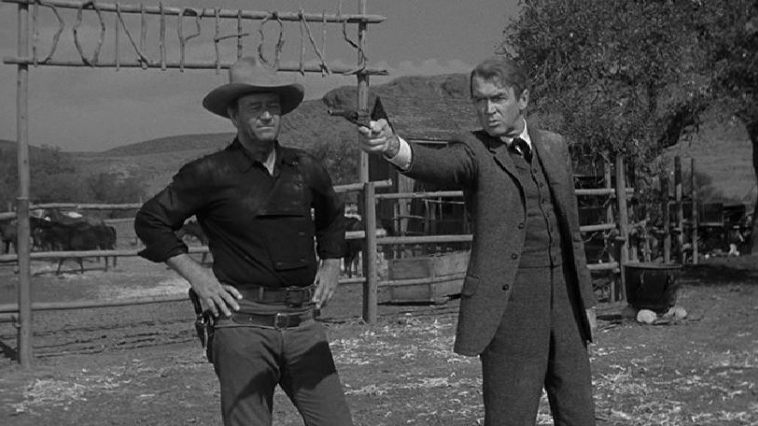
Based on the short story by Dorothy M. Johnson, The Man Who Shot Liberty Valance is the story of an attorney whose encounters with a notorious outlaw has him teaming up with a gunslinger to deal with him in order to protect the people at a small town in the West. Directed by John Ford and screenplay by James Warner Bellah and Willis Goldbeck, the film is an exploration of two men with different ideas of the world who team up to face off against someone who just wants to bring chaos into the world. Starring John Wayne, James Stewart, Vera Miles, Lee Marvin, Edmond O’Brien, Andy Devine, John Carradine, Jeanette Nolan, Woody Strode, Strother Martin, and Lee Van Cleef. The Man Who Shot Liberty Valance is a grand yet evocative film from John Ford.
The film is essentially a reflective story in which a senator recalls a time in his life when he was just an attorney arriving into a small town in the West where he tries to stand up against a notorious outlaw where he later teams up with a gunslinger and a few others in making a stand against him. Especially as he would later become a pillar of hope in a town that is still ravaged with fear prompting this attorney from the East to make a difference. The film’s screenplay begins with Ranse Stoddard (James Stewart) and his wife Hallie (Vera Miles) arriving to the small town of Shinbone as the local press wonder why he’s there. He then tells them the story of how he first came to the town 25 years earlier where he would meet Hallie and stand up to the outlaw known as Liberty Valance (Lee Marvin) after trying to stop him from robbing a widow during a stagecoach robbery. After being healed by Hallie and a local rancher in Tom Doniphon (John Wayne), Stoddard would do whatever he can to help the town.
Stoddard is a man that is educated and isn’t willing to be violent as he is trying to make sure there’s some law and order in this small town he’s arrived in as he also wants to be there for the people whether it’s to defend them in a court of law or teach them how to read and write. He would live at the restaurant that Hallie works at while doing his law practice at the local newspaper run by its publisher Dutton Peabody (Edmond O’Brien) who would befriend Stoddard as they would team up for an election on statehood. While Doniphon appreciates what Stoddard is doing, he feels that Stoddard is also just making things troubling because of Valance who wants to maintain his own power by beating up anyone or kill someone. Doniphon is a no-nonsense man who can read and write but knows how lawless the West can be as he is the only man that can out-gun Valance.
John Ford’s direction is definitely rapturous in terms of some of the visuals he creates as well as the fact that much of the story is told in a reflective manner by Stoddard to a journalist. Shot on the studio backlots at Paramount Studios in Hollywood, the film is more intimate in terms of its location even though there are a few scenes set in the desert as much of it is shot at a soundstage as the fictional town of Shinbone. While there are some wide shots of some of those locations, Ford would emphasize more on close-ups and medium shots for much of the film as it relate to the intimacy in the story as well as capturing some of the conversations and moments with the characters. Notably in the scenes that show Stoddard doing all sorts of things whether in educating some of the locals, cleaning the dishes at the restaurant where he’s staying at, or looking at Peacock’s articles. While much of the film is dramatic with some suspense, Ford would infuse the film with bits of humor such as a scene where Doniphon would show Stoddard how to shoot a gun as it would reveal how tough Stoddard really is.
As for some of the action, there are moments where the violence is quite brutal such as the Stoddard’s first encounter with Valance where Valance would whip him such a visceral way. The scenes where Valance is around is always filled with dread as the man is quite unpredictable as he would just scare people with his presence or through his violent actions. There is a showdown that would occur between Stoddard and Valance but it’s a very unusual showdown early in its third act. Notably as it would be followed by its aftermath as it relates to not just what happened to Valance but also who shot him as it would create this myth that is very unsettling. Overall, Ford creates a mesmerizing yet intense film about a lawyer and a gunslinger standing up against a notorious outlaw.
Cinematographer William H. Clothier does brilliant work with the film’s black-and-white photography from the sunny look of the daytime exteriors to some of the stylish usage of shadows and shades for some of the interior/exterior scenes at night. Editor Otho Lovering does excellent work with the film’s editing as it has some stylish rhythmic cuts to play into the action and suspense as well as some straightforward cuts for the drama. Art directors Eddie Imazu and Hal Pereira, with set decorators Sam Comer and Darrell Silvera, do fantastic work with the look of the saloons, restaurants, and Doniphon’s ranch as well as the interiors of some of the buildings in the film.
Costume designer Edith Head does nice work with the costumes from the look of the hats and clothes the men wear to some of the dresses that Hallie wears. Sound recordists Charles Grenzbach and Philip Mitchell do terrific work with the sound as it play into raucous sound of the meetings as well as in some of the moments of suspense as it relates to the showdown between Stoddard and Valance. The film’s music by Cyril J. Mockridge and Alfred Newman is wonderful for its mixture of bombastic orchestra music with its large brass arrangements and string flourishes for some of the dramatic moments as the score also include some folk-based music of the times.
The film’s superb cast include some notable small roles from Denver Pyle and O.Z. Whitehead as the father-son duo of Amos and Herbert Carruthers, Willis Bouchey as a train conductor, Joseph Hoover as a journalist interviewing Stoddard in the film’s beginning, Jeanette Nolan and John Qualen as the Swedish immigrant couple in the Ericsons who work with Hallie at the restaurant, John Carradine as a speaker for a convention representing those in favor of territory rights, Ken Murray as the local doctor Doc Willoughby, Strother Martin and Lee Van Cleef as two of Valance’s henchman in their respective roles as Floyd and Reese, and Woody Strode as Doniphon’s ranch hand Pompey as an African-American that is very helpful as well as wanting to be educated by Stoddard. Andy Devine is terrific as the local marshal Link Appleyard as a man that has a hard time upholding the law as he’s afraid of Valance as he is kind of the film’s comic relief. Edmond O’Brien is excellent as Dutton Peabody as the local newspaper publisher who is full of gusto in the things he says while admittedly being a drunk but a man that can rile up Valance through his words.
Vera Miles is amazing as Hallie as a local woman who runs a restaurant as she is courted by Doniphon as she would fall for Stoddard whom she sees as a man that can help her as well as make her into something more. Lee Marvin is brilliant as Liberty Valance as a brutish outlaw who likes to wreak havoc on the people as he tries to assert his own power and whatever he can to play into his role in the West. James Stewart is incredible as Ranse Stoddard as an attorney who is trying to help the locals in the small town as he also stands up to Valance where he is forced to see what he has to do to deal with him. Finally, there’s John Wayne in a phenomenal performance as Tom Doniphon as it is a performance where Wayne display some charm as well as humility as a gunslinger that is the one person that can deal with Valance but also is aware of what Stoddard is trying to do for the town as he would take action that would prove to be catastrophic for both men.
The Man Who Shot Liberty Valance is a sensational film from John Ford that features great performances from John Wayne, James Stewart, Vera Miles, and Lee Marvin. Along with its dazzling visuals and a compelling take on heroism, it’s a film that explore what some will do to help people not be afraid from the presence of an outlaw but also into the myths of the West. In the end, The Man Who Shot Liberty Valance is a tremendous film from John Ford.
© thevoid99 2017
Based on the novel D’entre les morts by Boileau-Narcejec, Vertigo is the story of a retired yet acrophobic police detective who is asked by a man to tail his wife who is dealing with mood swings. Directed by Alfred Hitchcock and screenplay by Alec Coppel and Samuel A. Taylor, the film is an exploration into a man dealing with his fear of heights as well as the case that he’s investigating where he falls for the woman he’s tailing. Starring James Stewart, Kim Novak, and Barbara Bel Geddes. Vertigo is a magnificent film from Alfred Hitchcock.
The film is a simple story about a retired police detective who is asked by an old friend to tail his troubled wife. Yet, John Ferguson (James Stewart) is still dealing with the guilt over losing his partner during a chase as he also suffers from acrophobia and gets dizzy due to that fear. By taking this assignment for an old friend, he hopes to get some form of redemption yet he would end up falling for this woman in Madeleine Elster (Kim Novak) while trying to deal with her fascination towards this woman who had died nearly a century ago. Even as he helps her try to deal with the nightmares she has where things get more stranger as it goes on. It’s a film that is largely about fear where one man has a fear of heights while this woman is someone who fears that she might be the reincarnation of someone else as she is becoming suicidal.
The film’s screenplay by Alec Coppel and Samuel A. Taylor does take its time to explore the aspects of fear where Ferguson is a man just wracked with guilt over the loss of his partner during a roof chase. Though he finds comfort in his former fiancée Midge Wood (Barbara Bel Geddes), he reluctantly takes the assignment for Gavin Elster (Tom Helmore) as a favor to an old friend as the first act is about Ferguson coping with his fear and seeing Madeleine for the very first time where he would follow her around San Francisco. The second act is about Ferguson trying to figure out Madeleine’s fear and her mental state while he also deals with some jealousy from Midge who managed to see Madeleine walk out of his apartment one night after she had jumped on the San Francisco Bay. The film’s third act is definitely the most intriguing where it just doesn’t explore the idea of guilt and fear but also identity and obsession where Ferguson delves into the latter towards another woman where a lot of the mystery gets unveiled.
The direction of Alfred Hitchcock is truly mesmerizing in the way he creates these gorgeous images while making San Francisco and places nearby the city as characters in the film. Hitchcock makes great use in his framing devices in not just the way he presents the film with these lovely compositions but also create something that has this air of mystery and melancholia that is prevalent throughout the film. Notably as Hitchcock would take a simple shot and do something with it to add to the sense of drama and suspense in the film. The way he uses a two-shot on characters as well as close-ups are very entrancing with some soft lenses and the use of locations just adds to this romance that builds between John and Madeleine.
Hitchcock also creates some very dazzling sequences that plays into John’s fear such as the shots of him looking down from above where the zoom lenses play a key part into his fear along with some special photographic effects. There’s also this very strange yet surreal sequence that also plays into John’s fear as well as the ideas of what Madeleine was so afraid of. Most notably as it would play into this very strange third act that explores John’s obsession as he tries to deal with his fear of heights as well as see if he can find some redemption. Overall, Hitchcock creates a very spectacular and intoxicating film about fear, obsession, and identity.
Cinematographer Robert Burks does exquisite work with the film‘s very colorful and lush photography to play into the beauty of the locations in San Francisco as well as using the lights to play into that element of suspense and intrigue as it is definitely a major highlight of the film. Editor George Tomasini does brilliant work with the editing to play into the suspense with some rhythmic cuts and other stylish cuts to help maintain that air of intrigue as well as some slow yet methodical cuts in the film‘s drama. Art directors Henry Bumstead and Hal Pereira, along with set decorators Sam Comer and Frank R. McKelvy, do fantastic work with the set pieces from the look of John‘s apartment as well as some of the places he goes to like the museum and the other places Madeleine goes to.
Costume designer Edith Head does amazing work with the costumes from the suits that John wears to the dresses that Madeleine and Midge wears as it has that great sense of style. Hairstyle supervisor Nellie Manley and makeup artist Benny Lane do excellent work with the look of Madeleine in her blond hair to display this unique look that John would be obsessed about later in the film. Sound recorders Winston H. Leverett, Harold Lewis, and Jim Miller do superb work with the sound to create an atmosphere in some of the locations as well as play into the film‘s suspense and drama. The film’s music by Bernard Herrmann is truly phenomenal with its orchestral-based score that features heavy and broad themes to more somber, lush pieces driven by the strings to play into the romance and drama.
The casting by Bert McKay is incredible as the ensemble that includes some noteworthy small roles like Fred Graham as John’s partner in the film’s opening sequence, Konstantin Shayne as a historian John and Midge meet, and Ellen Corby as a hotel owner John asks about. Tom Helmore is excellent as John’s old friend Gavin Elster who asks John to follow his wife to see what she’s up to. Barbara Bel Geddes is wonderful as John’s former fiancée Midge who helps John with his case while dealing with her jealousy towards Madeleine. Kim Novak is radiant as Madeleine as this mysterious yet troubled woman who has a strange connection to a woman from the past as Novak also has this beauty that is just entrancing making her performance iconic. Finally, there’s James Stewart in a marvelous performance as John “Scottie” Ferguson as a man wracked with guilt and fear as he takes an assignment that would prove to be troubling. Stewart and Novak have amazing chemistry together in the way they play into each other’s fears as well as the romance they have for each other.
Vertigo is an outstanding film from Alfred Hitchcock that features remarkable performances from James Stewart and Kim Novak. Not only is the film one of Hitchcock’s most quintessential works but also a stylish yet engaging thriller that explores the world of fear, obsession, and identity. Particularly as it’s told with great style through its colorful cinematography and the enchanting score of Bernard Herrmann. In the end, Vertigo is a triumphant film from Alfred Hitchcock.
Alfred Hitchcock Films: (Number 13) - (The Pleasure Garden) - (The Blackguard) - (The Mountain Eagle) - (The Lodger) - (A Story of the London Fog) - (The Ring) - (Downhill) - (The Farmer’s Wife) - (Easy Virtue) - (Champagne) - (The Manxman) - (Blackmail) - (Juno and the Paycock) - (Murder!) - (The Skin Game) - (Mary) - (Lord Camber’s Ladies) - (Rich and Strange) - (Number Seventeen) - (Waltzes from Vienna) - (The Man Who Knew Too Much (1934 film)) - The 39 Steps - (Secret Agent) - (Sabotage) - (Young and Innocent) - The Lady Vanishes - (Jamaica Inn) - Rebecca - (Foreign Correspondent) - (Mr. & Mrs. Smith) - Suspicion - (Saboteur) - (Shadow of a Doubt) - Bon Voyage - Lifeboat - (Spellbound) - Notorious - (The Paradine Cage) - Rope - (Under Capricorn) - (Stage Fright) - Strangers on a Train - I Confess - Dial M for Murder - Rear Window - To Catch a Thief - (The Trouble with Harry) - The Man Who Knew Too Much (1956 film) - (The Wrong Man) - North by Northwest - Psycho - The Birds - Marnie - (Torn Curtain) - (Topaz) - (Frenzy) - (Family Plot)
© thevoid99 2013
Directed by John Ford, Henry Hathaway, and George Marshall and written by James R. Webb, How the West Was Won is a five-part story about the life of a family told through four generations in the development and migration of the American west. Narrated by Spencer Tracy, the film is a mixture of the epic films of mid-20th Century mixed in with the broad canvas of the western. Starring Carroll Baker, Walter Brennan, Lee J. Cobb, Andy Devine, Henry Fonda, Carolyn Jones, Karl Malden, Harry Morgan, Gregory Peck, George Peppard, Robert Preston, Debbie Reynolds, James Stewart, Eli Wallach, John Wayne, and Richard Widmark. How the West Was Won is a majestic yet sprawling film from John Ford, Henry Hathaway, and George Marshall.
The film is a five-part series that tells the story about one family in the course of fifty years that would shape the American west through various periods in American history. All of which plays into the lives of a few people in the family known as the Prescotts where they travel on the Erie Canal to find a new home where two sisters would later take different paths in the second act. One goes to California to claim a piece of land she’s inherited with a gambler while the other settles into farm life with a trapper she fell for during her family’s journey in the river. The story then moves into the 1860s where the son of these women becomes part of the Civil War and later a cavalryman dealing with the changing times and the arrival of the railroad until he would meet his aunt for the very first time in the final part of the story.
It’s all part of James R. Webb’s extraordinary story about a family living in a period where the American west is discovered as they also endure the many changes in those fifty years as it’s told by Spencer Tracy as his narration only fill in moments about what has happening in America instead of the story about the Prescotts. All of which is separated in five parts with the first part being about the Prescotts at the Erie Canal and the treacherous journey they take where one of the daughters in Eve (Carroll Baker) falls for a trapper named Linus (James Stewart). The second part is about Eve’s sister Lilith (Debbie Reynolds) and her journey through the prairies where she and a gambler named Cleve (Gregory Peck) go to the west to get some land she’s inherited. The third part is about Eve’s son Zeb (George Peppard) and his encounter with the Civil War as he becomes a key player in the fourth and fifth part where he deals with the railroad where he meets an old friend of his father in Jethro Stuart (Henry Fonda).
It would play into this family’s encounter with history and how times are often changing in the West as they deal with the chaos of the Civil War, conflict with the Native Americans over the railroad, and also criminals and bandits over cattle and such. Notably as Zeb in the film’s third act realizes the horrors of war and the greed that comes into play involving the railroad as he definitely carries a sense of pride and honor that his father and uncle would carry in their lives. Even in the fifth and final part where he meets his aunt Lilith for the very first time while having to deal with a criminal named Charlie Gant (Eli Wallach) who has a grudge with Zeb.
The film’s direction is definitely vast in not just its composition but also in the way it wanted to tell a story about the development of the American west. Shot in the curved-three screen projector that was known as Cinerama, the film has this truly grand scale to capture not just the landscape of the American west but also the moments that shaped that world in the span of five decades. Under the vision of three filmmakers, with transitional scenes helmed by Richard Thorpe, the film does have this sense of unification in the filmmaking while each director does bring in their own ideas to the story to add that sense of epic storytelling. The Civil War segment is helmed by John Ford as it features not just some extravagant battle scenes but also some intimate moments where Zeb encounters the horror of war while meeting a Confederate drifter (Russ Tamblyn) as it’s a very telling piece to display Zeb’s sense of loss and his desire to find himself in an ever-changing world.
The railroad segment is helmed by George Marshall as it displays a lot of dramatic tension and some very intense scenes involving a buffalo stampede which would play to Zeb’s resolve over the conflict between the railroad company and a tribe of Native Americans. The rest of the film is helmed by Henry Hathaway who maintains the same sweeping vision like his other filmmakers as he also creates his own ideas that includes some intense moments involving the Prescotts in the rapids as well as other suspenseful moments such as Gant’s attempted train robbery. All of which plays to the grand spectacle of the west as the overall results is a very sensational yet engaging film about a family living in the changing times of the American west.
Cinematographers William H. Daniels, Milton Krasner, Charles Lang Jr., and Joseph LaSelle do fantastic work with the film‘s very colorful and vast cinematography to capture the vast beauty of the different landscapes in the American west along with some amazing shots set at night and the interiors to display some of the film‘s vibrant look. Editor Harold F. Kress does brilliant work with the editing in not just bringing some energy to some of the shootouts and battle scenes but also going for a methodical approach to some of the film‘s dramatic moments. Art directors George W. Davis, William Ferrari, and Addison Hehr, along with set decorators Henry Grace, Don Greenwood Jr., and Jack Mills, do excellent work with the set pieces from the look of the rafts in the first segment to the farms and buildings made during the film‘s duration and how it would evolve over time.
Costume designers Walter Plunkett and Ron Talsky do terrific work with the costumes from the showgirl costumes that Lilith wear in the second segment along with her dresses to some of the more low-key costumes most of the characters wear in their journey. The special visual effects work of A. Arnold Gillespe and Robert R. Hoag do nice work with the visual effects for the scenes set in the river rapids despite the fact that it sort of looks fake given the primitive technology that was used at the time. Sound editor Van Allen James does superb work with the sound to capture the extravagance of some of the gunfights and battles along with more intimate moments in some of the film‘s locations. The film’s music by Alec Newman is wonderful for its array of themes from broad and sweeping to more serene yet somber in their orchestral arrangements while the soundtrack also includes lots of traditional folk and country songs some of which are actually sung by Debbie Reynolds.
The film’s cast is phenomenal as it features some small but notable appearances from Lee Van Cleef as a river pirate, Harry Dean Stanton as a member of Gant’s gang, Raymond Massey in a brief scene as Abraham Lincoln, Harry Morgan as General Ulysses S. Grant, Russ Tamblyn as a Confederate deserter that Zeb meets, Carolyn Jones as Zeb’s wife Julie in the fifth segment, Thelma Ritter as Lilith’s traveling companion Agatha Clegg, and John Wayne in a small yet amazing performance as General William Tecumseh Sherman who gives a great monologue about not giving up the Civil War. Other noteworthy and memorable performances include Karl Malden and Agnes Moorehead as Lilith and Eve’s parents in the first segment, Walter Brennan and Brigid Balzen as a couple of river pirates, Robert Preston as a wagon master who tries to win Lilith’s heart, and Lee J. Cobb as a marshal who reluctantly helps Zeb to battle Gant.
Eli Wallach is excellent as the smarmy criminal Charlie Gant who is eager to cause trouble for Zeb Prescott while Richard Widmark is terrific as an immoral railroad baron who is more concerned with making money with the railroad no matter what the cost is. Henry Fonda is great in a small but memorable role as Linus’ old friend Jethro Stuart as a man who helps Zeb out over the conflict between the railroad and a Native American tribe as he would also help Zeb find his way in life. Gregory Peck is superb as the gambler Cleve Van Valen who is smitten by Lilith as he hopes to do whatever it takes to make her a proud woman. James Stewart is brilliant as the trapper Linus Rawlings who helps out the Prescotts in navigating the river while dealing with river pirates as he falls for Eve.
George Peppard is wonderful as Zeb as a man who has the same sense of pride and honor like his father Linus while dealing with the chaos in the changing times he encounters. Carroll Baker is amazing as Eve Prescott as a woman who falls for Linus as she deals with the dangers of the river. Finally, there’s Debbie Reynolds in a remarkable performance as Lilith Prescott as a woman who is very tough as well as talented as she is someone trying to define herself as a woman while finding a good man in Cleve as she later helps Zeb’s wife in the way Zeb is when it comes to action.
How the West Was Won is a sensational film from John Ford, Henry Hathaway, and George Marshall. Thanks to its sprawling vision, engaging story about a family encountering historical moments in the course of five decades, and a brilliant ensemble cast. The film is definitely an epic-western that has to be seen in a big screen or a big TV to display its vast images. It’s also a film that explores the life of a family and how they manage to define themselves in the American west no matter how troubling it is. In the end, How the West Was Won is an incredible film from the trio of John Ford, Henry Hathaway, and George Marshall.
© thevoid99 2013