Showing posts with label vera miles. Show all posts

Wednesday, July 26, 2017

The Man Who Shot Liberty Valance


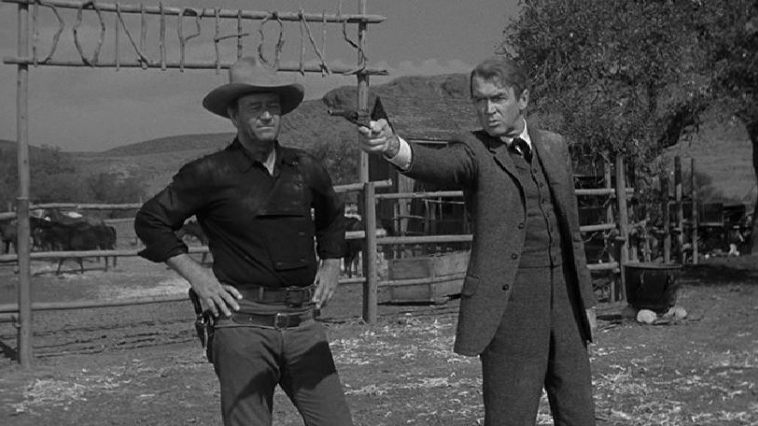
Based on the short story by Dorothy M. Johnson, The Man Who Shot Liberty Valance is the story of an attorney whose encounters with a notorious outlaw has him teaming up with a gunslinger to deal with him in order to protect the people at a small town in the West. Directed by John Ford and screenplay by James Warner Bellah and Willis Goldbeck, the film is an exploration of two men with different ideas of the world who team up to face off against someone who just wants to bring chaos into the world. Starring John Wayne, James Stewart, Vera Miles, Lee Marvin, Edmond O’Brien, Andy Devine, John Carradine, Jeanette Nolan, Woody Strode, Strother Martin, and Lee Van Cleef. The Man Who Shot Liberty Valance is a grand yet evocative film from John Ford.

The film is essentially a reflective story in which a senator recalls a time in his life when he was just an attorney arriving into a small town in the West where he tries to stand up against a notorious outlaw where he later teams up with a gunslinger and a few others in making a stand against him. Especially as he would later become a pillar of hope in a town that is still ravaged with fear prompting this attorney from the East to make a difference. The film’s screenplay begins with Ranse Stoddard (James Stewart) and his wife Hallie (Vera Miles) arriving to the small town of Shinbone as the local press wonder why he’s there. He then tells them the story of how he first came to the town 25 years earlier where he would meet Hallie and stand up to the outlaw known as Liberty Valance (Lee Marvin) after trying to stop him from robbing a widow during a stagecoach robbery. After being healed by Hallie and a local rancher in Tom Doniphon (John Wayne), Stoddard would do whatever he can to help the town.

Stoddard is a man that is educated and isn’t willing to be violent as he is trying to make sure there’s some law and order in this small town he’s arrived in as he also wants to be there for the people whether it’s to defend them in a court of law or teach them how to read and write. He would live at the restaurant that Hallie works at while doing his law practice at the local newspaper run by its publisher Dutton Peabody (Edmond O’Brien) who would befriend Stoddard as they would team up for an election on statehood. While Doniphon appreciates what Stoddard is doing, he feels that Stoddard is also just making things troubling because of Valance who wants to maintain his own power by beating up anyone or kill someone. Doniphon is a no-nonsense man who can read and write but knows how lawless the West can be as he is the only man that can out-gun Valance.

John Ford’s direction is definitely rapturous in terms of some of the visuals he creates as well as the fact that much of the story is told in a reflective manner by Stoddard to a journalist. Shot on the studio backlots at Paramount Studios in Hollywood, the film is more intimate in terms of its location even though there are a few scenes set in the desert as much of it is shot at a soundstage as the fictional town of Shinbone. While there are some wide shots of some of those locations, Ford would emphasize more on close-ups and medium shots for much of the film as it relate to the intimacy in the story as well as capturing some of the conversations and moments with the characters. Notably in the scenes that show Stoddard doing all sorts of things whether in educating some of the locals, cleaning the dishes at the restaurant where he’s staying at, or looking at Peacock’s articles. While much of the film is dramatic with some suspense, Ford would infuse the film with bits of humor such as a scene where Doniphon would show Stoddard how to shoot a gun as it would reveal how tough Stoddard really is.

As for some of the action, there are moments where the violence is quite brutal such as the Stoddard’s first encounter with Valance where Valance would whip him such a visceral way. The scenes where Valance is around is always filled with dread as the man is quite unpredictable as he would just scare people with his presence or through his violent actions. There is a showdown that would occur between Stoddard and Valance but it’s a very unusual showdown early in its third act. Notably as it would be followed by its aftermath as it relates to not just what happened to Valance but also who shot him as it would create this myth that is very unsettling. Overall, Ford creates a mesmerizing yet intense film about a lawyer and a gunslinger standing up against a notorious outlaw.

Cinematographer William H. Clothier does brilliant work with the film’s black-and-white photography from the sunny look of the daytime exteriors to some of the stylish usage of shadows and shades for some of the interior/exterior scenes at night. Editor Otho Lovering does excellent work with the film’s editing as it has some stylish rhythmic cuts to play into the action and suspense as well as some straightforward cuts for the drama. Art directors Eddie Imazu and Hal Pereira, with set decorators Sam Comer and Darrell Silvera, do fantastic work with the look of the saloons, restaurants, and Doniphon’s ranch as well as the interiors of some of the buildings in the film.

Costume designer Edith Head does nice work with the costumes from the look of the hats and clothes the men wear to some of the dresses that Hallie wears. Sound recordists Charles Grenzbach and Philip Mitchell do terrific work with the sound as it play into raucous sound of the meetings as well as in some of the moments of suspense as it relates to the showdown between Stoddard and Valance. The film’s music by Cyril J. Mockridge and Alfred Newman is wonderful for its mixture of bombastic orchestra music with its large brass arrangements and string flourishes for some of the dramatic moments as the score also include some folk-based music of the times.

The film’s superb cast include some notable small roles from Denver Pyle and O.Z. Whitehead as the father-son duo of Amos and Herbert Carruthers, Willis Bouchey as a train conductor, Joseph Hoover as a journalist interviewing Stoddard in the film’s beginning, Jeanette Nolan and John Qualen as the Swedish immigrant couple in the Ericsons who work with Hallie at the restaurant, John Carradine as a speaker for a convention representing those in favor of territory rights, Ken Murray as the local doctor Doc Willoughby, Strother Martin and Lee Van Cleef as two of Valance’s henchman in their respective roles as Floyd and Reese, and Woody Strode as Doniphon’s ranch hand Pompey as an African-American that is very helpful as well as wanting to be educated by Stoddard. Andy Devine is terrific as the local marshal Link Appleyard as a man that has a hard time upholding the law as he’s afraid of Valance as he is kind of the film’s comic relief. Edmond O’Brien is excellent as Dutton Peabody as the local newspaper publisher who is full of gusto in the things he says while admittedly being a drunk but a man that can rile up Valance through his words.

Vera Miles is amazing as Hallie as a local woman who runs a restaurant as she is courted by Doniphon as she would fall for Stoddard whom she sees as a man that can help her as well as make her into something more. Lee Marvin is brilliant as Liberty Valance as a brutish outlaw who likes to wreak havoc on the people as he tries to assert his own power and whatever he can to play into his role in the West. James Stewart is incredible as Ranse Stoddard as an attorney who is trying to help the locals in the small town as he also stands up to Valance where he is forced to see what he has to do to deal with him. Finally, there’s John Wayne in a phenomenal performance as Tom Doniphon as it is a performance where Wayne display some charm as well as humility as a gunslinger that is the one person that can deal with Valance but also is aware of what Stoddard is trying to do for the town as he would take action that would prove to be catastrophic for both men.

The Man Who Shot Liberty Valance is a sensational film from John Ford that features great performances from John Wayne, James Stewart, Vera Miles, and Lee Marvin. Along with its dazzling visuals and a compelling take on heroism, it’s a film that explore what some will do to help people not be afraid from the presence of an outlaw but also into the myths of the West. In the end, The Man Who Shot Liberty Valance is a tremendous film from John Ford.

© thevoid99 2017

Thursday, November 01, 2012

The Searchers


Originally Written and Posted at Epinions.com on 7/5/10 w/ Additional Edits & Revisions.


Based on the Alan Le May novel, The Searchers tells the story of a Civil War veteran returning home only to encounter tragedy concerning his family. With his nephew, the two go on a journey that spans a few years to find his niece who had been abducted by the Comanche Indian tribe. Directed by John Ford and screenplay by Frank S. Nugent. The film explores a man’s search for his niece where it gives its star John Wayne a role that is complex and dark. Also starring Jeffrey Hunter, Vera Miles, Lana Wood, Ward Bond, and Natalie Wood. The Searchers is an evocative and thrilling film from John Ford and his star John Wayne.

Returning home to Texas a few years after the Civil War, Ethan Edwards (John Wayne) arrives to meet his brother Aaron (Walter Coy), Aaron’s wife Martha (Dorothy Jordon), and their children Lucy (Pippa Scott), Ben (Robert Lyden), and the youngest named Debbie (Lana Woods). Arriving to the family dinner is Aaron’s adopted son Martin Pawley (Jeffrey Hunter) whom Ethan is uncomfortable with since Martin is half-Cherokee while the Reverend Captain Samuel Johnson Clayton (Ward Bond) arrives the next day to meet the family where he asks Martin and Ethan to join the Texas Rangers. Ethan and Martin aids Clayton to find out who has been stealing cattle from the nearby Jorgensen family where Ethan makes a chilling discovery as he realizes it’s a trap. Ethan and Martin return home to find their home burned with the family dead prompting Ethan, Martin, and Lucy’s fiancee Brad Jorgensen (Harry Carey Jr.) to go search for the Comanche tribe that had probably captured Lucy and Debbie.

The search proves to be troubling after Ethan, Martin, Brad, and the rangers were almost trapped by the encounter with the Comanche forcing Clayton to call off the search. Ethan, Martin, and Brad decide to continue the search where Martin goes on the search for a trail where Ethan makes another discovery that leaves Brad devastated. With the trail lost and winter approaching, Ethan and Martin seek shelter at the Jorgensen family as Martin is greeted by old childhood friend Laurie (Vera Miles). Lars Jorgensen (John Qualen) and his wife (Olive Carey) give Martin a letter about someone who knows Debbie’s whereabouts while Ethan meets a trader named John Futterman (Peter Mamakos) who also reveals clues about a dress Debbie wore a few years ago. Ethan and Martin continue their search where Martin writes his recollections to Laurie where the search goes on for a year. After meeting with some cavalry men at a fort, Ethan and Martin learn about the women who had been captured by the Comanche.

After meeting a Mexican man named Emilio Figueroa (Antonio Moreno) who reveals the whereabouts of the tribe and their leader named Scar (Henry Brandon). Ethan and Martin arrive to the tribe camp where they find another shocking discovery about Debbie (now played by Natalie Wood) as it troubles Ethan prompting he and Martin to return to the Jorgensen home where some incidents occur when Clayton makes a plan. Even as Martin is worried about what Ethan might do to Debbie as he has a plan of his own.

The film’s story about a man and his adopted nephew taking a five-year search to find a young girl who had been captured by Indians is a simple story. Yet, it’s the journey and the study of its characters that makes the film far more compelling in its presentation. It’s really about a man trying to find his lost niece while his adopted nephew is learning about his uncle’s dark side. Despite Ethan Edwards’ sense of hatred towards the Comanche, he is a man devoted to his family and his hate over their slaughter is the drive for the search of Debbie. For Martin, he too is devoted to family and wants vengeance. His character serves as a conscience of sorts though he is immature and inexperienced into how to find the Comanche while he would later have an encounter with an Indian tribe where he would end up marrying one for a brief period.

Screenwriter Frank S. Nugent succeeds in creating a story that is truly complex in its tone. At times, there’s some humor to balance out the drama and suspense of the film while there’s also characters that do more than what is expected in the archetype of the western genre. Particularly Laurie Jorgensen who is a frustrated yet loyal woman who loves Martin but has a hard time waiting for him to come home. Another female character that is a main drive to the plot, though is only seen briefly is Martha, Ethan’s sister-in-law. It is suggested that Ethan is in love with her but there’s no dialogue nor any story that alludes to that relationship but rather in subtle body language. The film’s antagonist in Scar is also complex since he’s a man who has the same kind of hate that Ethan has but towards white men over tragedies made by white men. Nugent’s study of character, surroundings, and the exploration of racism is truly mesmerizing as well as provocative in its approach. The result is a story that is engaging and thrilling in its journey.

Capturing all of this on screen is the legendary John Ford whose direction is truly hypnotic and at times, breathtaking. Shooting on location in parts of Monument Valley along with other locations in Utah, Los Angeles, & Canada. Ford creates a world where there are rules but they can limit to what is possible. Those rules was something for Ethan and Martin as they care about searching for Debbie. Ford’s direction is stunning from the way he framed the opening and closing shots to how captures close-ups with zoom lenses. Even for wide shots to capture the world of Monument Valley with an amazing depth of field is truly jaw-dropping. Even as he captures the action with tracking camera shots to get the momentum and drama of what is happening.

Some of the dramatic moments in the film has Ford doing some great things about what not to show in order to intensify the dramatic elements of the film. Even as Ford manages to play around with the rules that were restricted at the time as he, like other filmmakers at the time, were starting to push boundaries. While it may not have the grit of the westerns to come from Sergio Leone and Sam Peckinpah. Ford does add a classical element that is truly sweeping as he creates what is definitely an archetype of what the western should be.

Cinematographer Winton C. Hoch does a spectacular job with the film’s photography from the wide, epic canvas look of the exteriors in the day time with some more intimate, darker shots for the nighttime scenes. The interior shots are done with little lighting while some scenes that have a mixture of interior/exterior is filled with shades or evening shots on the outside to exemplify the beauty of the West. Even if it has a sense of darkness that is happening as Hoch’s work is superb. Editor Jack Murray does excellent work with the film’s editing where it moves fast during the film’s climatic battle scene while creating wonderful transitions from scene to scene. Notably the sequence where Laurie narrates Martin’s letter about his journey as it moves back and forth quite seamlessly as Murray’s editing is a highlight.

The art direction of James Basevi and Frank Hotaling, along with set decoration by Victor A. Gangelin, is brilliant for the set designs on the cabin homes of the Edwards’ home along with the ranch of the Jorgensen family. Even as it maintains a sense of authenticity of what it looked like in post-Civil War era of the American West. Costume designer Charles Arrico is very good for its look and how it reflects on that world of the old west while the dresses that Vera Miles and the other actresses wear are beautiful. The sound work of Hugh McDowell Jr. & Howard Wilson is superb for its layering in capturing the action that goes on from the shootouts and locations that the characters are surrounded by.

The music score by Max Steiner is wonderful for its excitement for many of the film’s action and suspense scenes to more somber pieces in the dramatic moments. Mostly an orchestral score, the music also has more humorous scenes involving Martin and his Indian bride. The title song that’s played in the opening and closing credits is a slow yet old-school western ballad by Stan Jones that is sung by Sons of the Pioneers.

The casting for the film is phenomenal as it includes some noteworthy appearances from John Wayne’s young son Patrick as a young cavalry lieutenant, Antonio Moreno as a Mexican man who leads Ethan & Martin to the Comanche, Robert Lyden as Ethan’s young nephew Ben, Pippa Scott as Lucy, Harry Carey Jr. as Brad Jorgensen, Beulah Archuletta as Martin’s Indian Bride, and Hank Worden in a hilarious role as Mose Harper. Other noteworthy small but memorable roles come from John Qualen and Olive Carey as Laurie Jorgensen’s parents, Ken Curtis as the simple-minded Charlie McCorry whom Martin doesn’t like, Lana Wood as the young Debbie, Walter Coy as Ethan’s brother Aaron, and Dorothy Jordan as Martha Edwards, whom Ethan adores.

Henry Brandon is excellent in a small but eerie performance as Chief Cicatrice aka Scar who has a deep hatred for the white man while explaining his own actions as Brandon brings a complexity to his role as the villain. In one of her early film roles, Natalie Wood is very good as the 15-year old Debbie. A young woman changed by the Comanche while pleading to be left alone only to become a target of her uncle. Ward Bond is great as Rev. Col. Samuel Johnston Clayton, an authority figure who means well but doesn’t understand Ethan while getting into things he isn’t fully prepared for. Vera Miles is amazing as Laurie Jorgensen, a hard-headed woman who loves Martin but is put-off by his immaturity and unwillingness to get married while being the one person to ground him. Jeffrey Hunter is superb as Martin Pawley, Ethan’s adopted nephew who goes along the journey to find Debbie only to discover more about his uncle. Hunter’s performance is remarkable in a man who starts off immature only to grow up to realize what is needed to be done.

Finally, there’s John Wayne in what is definitely one of his most iconic roles of his career. In the role of Ethan Edwards, Wayne displays a sense of wisdom but also a character who seems troubled. When he loses his family, Edwards intent for revenge and to find Debbie shows a man knowing what it takes to survive and to bide his time. Yet when he finds Debbie and what she’s become, the dark side of Edwards is revealed as Wayne’s complex, layered, and brooding performance shows all of that but in subtle tones. Even in the more humanistic, compassionate side of Edwards is rarely seen but it is done with light moments of body language. It is definitely a brilliant performance from John Wayne who doesn’t get a lot of credit for his acting.

The Searchers is a thrilling western by the late John Ford and that features a mesmerizing performance from the late John Wayne. Anyone who is new to the western genre must see the film for its visual language, themes, and character study as it lives up to all of benchmarks expected in the genre. Anyone new to the work of John Ford will see this as truly, worthy introduction to one of the greatest directors in cinema. Filled with amazing action, chilling suspense, some fine humor, and subtle drama, The Searchers is truly one of the most defining films of the western genre that can only come from the vision of John Ford.

© thevoid99 2012

Wednesday, August 03, 2011

Psycho


Based on the novel by Robert Bloch, Psycho is the story of a woman hiding out at a motel after stealing some money from her boss. There, she meets the motel’s disturbed owner while her sister tries to find out what happened the night the woman disappeared. Directed by Alfred Hitchcock with an adapted script by Joseph Stefano, the film is considered to be one of Hitchcock’s finest films of his celebrated career. Starring Anthony Perkins, Vera Miles, John Gavin, Martin Balsam, John McIntire, and Janet Leigh. Psycho is a chilling yet engaging film from Alfred Hitchcock.

Marion Crane (Janet Leigh) wants to marry Sam Loomis (John Gavin) but he’s unable to due to debt and to pay for his ex-wife’s alimony. When Marion is suddenly given $40,000 in cash by a customer she works at to deposit at the local bank, she decides to steal it instead. Though she has to deal with a highway patrolman (Mort Mills) and trade her car for another, she stops at a motel run by a young man named Norman Bates (Anthony Perkins). Marion has dinner Norman who talks a lot about his mother as she asks him if he wants to leave her but he couldn’t. Later that night, Norman finds something shocking as he realize something has gone wrong.

Meanwhile at Loomis’ hardware store, Marion’s sister Lila (Vera Miles) visits asking Sam about Marion’s whereabouts. Sam admits, he has no idea where she is as a private detective named Milton Arbogast (Martin Balsam) is also searching for her over the $40,000 she stole. Lila asks Arbogast to investigate where he searches for Marion where he stops at the Bates Motel where he talks to Norman. Arbogast becomes suspicious as he calls Lila about going further as he wants to meets Bates’ mother. When Lila doesn’t hear from Arbogast hours later, she asks a local sheriff in Al Chambers (John McIntire) who reveals some startling things about the Bates family. Sam and Lila try to figure out what is going on as they uncover a shocking secret.

The film has two narratives that eventually collides together into a shocking climax that is eventually tied together by a psychiatrist (Simon Oakland) who explains everything. In the first half of the film, there’s this secretary for a real estates firm that wants to get money so she and her lover can live a great life despite his debut. Therefore, she steals the money and tries to evade people until meeting this strange yet seemingly innocent man. Then there’s the second half where the woman’s sister tries to find her sister with a private detective who becomes suspicious about this strange man and the mother that he always talking about.

Joseph Stefano’s script is filled with a lot of intrigue and motives as characters such as Marion, Lila, and Sam all have motives in what they want to do throughout the film. Marion and Sam want to have better lives while Lila is concerned with finding Marion along with Sam. Then, there’s Norman Bates who is probably the most compelling character of the film. Here’s this young yet very sheltered young man who likes to do things calmly as he is someone clearly devoted to his mother. Yet, when he is also someone who doesn’t like confrontations as he stutters and becomes evasive. Still, he does do things to people that makes them re-think their motives or make them suspicious. Bates is truly a mystifying character that really drives the story for a large portion of the second half as he becomes more provocative in the third as Stefano’s script is truly mesmerizing in its suspense and character study.

Alfred Hitchcock’s direction is truly one of his finest in the way he opens the film with its wipe-driven opening credits to the first shots of the film overlooking Phoenix with mentions of what time it is and what day it is. Hitchcock’s camera is always engaged into what is going with the conversations and things as he always points his camera at something. The framing is very transfixing in the way Hitchcock allows the film to be shown whether it’s a simple of shot of people driving or the way he has two or three people at a frame. Then comes the way he builds suspense as he knows what to do with timing and once something horrifying happens. He just goes for it in the way he lets the camera move and to create something that is truly terrifying in tone. The overall work that Hitchcock does in his direction is amazing as he creates what is definitely one of his key films of his career.

Cinematographer John L. Russell does some excellent work with the film‘s black-and-white photography from the bright daytime scenes to create a much friendlier feel to the film. For many of the nighttime scenes, there is something much darker as the shading and eerie camera work presents a tone that is truly chilling. Editor George Tomasini does amazing work with the editing in creating stylish, rhythmic cuts to keep the film moving along with some wonderful transitions in the use of dissolves and fade-outs to keep the momentum going.

Art directors Robert Clatworthy and Joseph Hurley, along with set decorator George Milo, do some fantastic work with the art direction from the look of the Bates motel parlor to the interior of the Bates home as it‘s filled with an array of objects including stuffed birds. Costume designer Rita Riggs does very good work with the costumes from the dresses the women wear to the suits the mean along with the casual clothes that Bates wear throughout the film.. Sound recorders William Russell, Waldon O. Watson, and Harold Tucker do some superb work with the sound to capture the intimacy of the conversation and locations along with some amazing sound editing for the voice-overs that is prevalent in the film.

The film’s score by Bernard Herrmann is definitely a major highlight of the film with its sweeping orchestral opening theme that is filled with striking arrangements and chilling strings. Herrmann also creates some amazing pieces such as the famed violin screeches for a harrowing moment on the film along with some low-key cuts. Herrmann’s score is truly one of his best work of his celebrated career as he adds a lot of suspense and flair to the film.

The casting by Jere Henshaw is brilliant as it includes some notable performances from John Anderson as a used car salesman, Pat Hitchcock as Marion’s fellow secretary, Mort Mills as a highway patrolman, Frank Albertson as the client Marion steals from, Vaughn Taylor as Marion’s boss, Lurene Tuttle as Mrs. Chambers, Simon Oakland as the psychiatrist at the end of the film, and in the voices of Norman Bates’ mother, Virginia Gregg, Jeanette Nolan, and Paul Jasmin. John McIntire is excellent as the sheriff Al Chambers while Martin Balsam is great as detective Arbogast as they both bring some wit to their characters.

John Gavin is very good as Sam Loomis, a man who loves Marion but has a hard time dealing with debt until she goes missing as Gavin maintains a low-key but a strong presence throughout the film. Vera Miles is superb as Lila, Marion’s sister who is trying to find her as she ponders about the strange things happening about her sister’s disappearance as Miles brings a real sense of desperation to her performance. Janet Leigh is amazing as Marion Crane, a woman who steals money for a better life only to have an uncomfortable meeting with Norman Bates as it’s one of Leigh’s key performances.

Finally, there’s Anthony Perkins in his iconic performance as Norman Bates. Perkins brings a charming yet boyish performance as the disturbed Bates that makes him seem harmless although whenever he stutters and evasive, there’s a complexity to that character as it’s something only Anthony Perkins could bring.

Psycho is a smart yet hypnotic suspense film from the great Alfred Hitchcock that is a true standard bearer of what suspense films is and should be. Featuring a great cast led by Anthony Perkins, it’s a film that revels in style and intrigue over how it builds up its chills and its aftermath. This is a film that if anyone new to Hitchcock wants to see should find this as a great place to start. In the end, Psycho is a phenomenal film from one of cinema’s great masters in Alfred Hitchcock.

Alfred Hitchcock Films: (Number 13) - (The Pleasure Garden) - (The Blackguard) - (The Mountain Eagle) - (The Lodger) - (A Story of the London Fog) - (The Ring) - (Downhill) - (The Farmer’s Wife) - (Easy Virtue) - (Champagne) - (The Manxman) - (Blackmail) - (Juno and the Paycock) - (Murder!) - (The Skin Game) - (Mary) - (Lord Camber’s Ladies) - (Rich and Strange) - (Number Seventeen) - (Waltzes from Vienna) - (The Man Who Knew Too Much (1934 film)) - The 39 Steps - (Secret Agent) - (Sabotage) - (Young and Innocent) - The Lady Vanishes - (Jamaica Inn) - Rebecca - (Foreign Correspondent) - (Mr. & Mrs. Smith) - Suspicion - (Saboteur) - (Shadow of a Doubt) - Bon Voyage - Lifeboat - (Spellbound) - Notorious - (The Paradine Cage) - Rope - (Under Capricorn) - (Stage Fright) - Strangers on a Train - I Confess - Dial M for Murder - Rear Window - To Catch a Thief - (The Trouble with Harry) - The Man Who Knew Too Much (1956 film) - (The Wrong Man) - Vertigo - North by Northwest - The Birds - Marnie - (Torn Curtain) - (Topaz) - (Frenzy) - (Family Plot)


© thevoid99 2011