Showing posts with label lee marvin. Show all posts

Wednesday, July 26, 2017

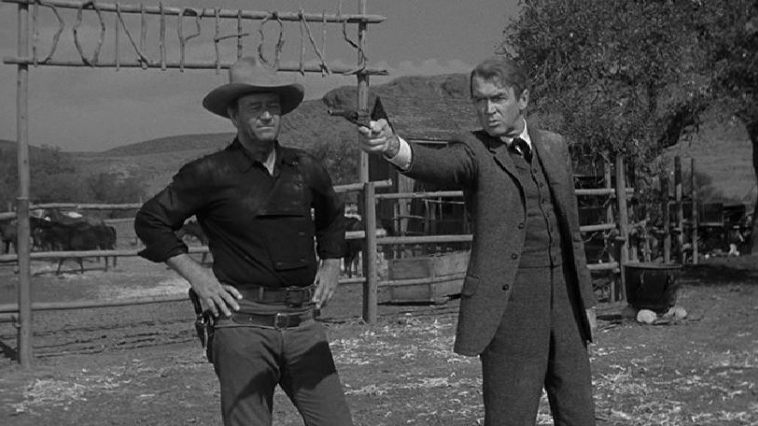
The Man Who Shot Liberty Valance


Based on the short story by Dorothy M. Johnson, The Man Who Shot Liberty Valance is the story of an attorney whose encounters with a notorious outlaw has him teaming up with a gunslinger to deal with him in order to protect the people at a small town in the West. Directed by John Ford and screenplay by James Warner Bellah and Willis Goldbeck, the film is an exploration of two men with different ideas of the world who team up to face off against someone who just wants to bring chaos into the world. Starring John Wayne, James Stewart, Vera Miles, Lee Marvin, Edmond O’Brien, Andy Devine, John Carradine, Jeanette Nolan, Woody Strode, Strother Martin, and Lee Van Cleef. The Man Who Shot Liberty Valance is a grand yet evocative film from John Ford.

The film is essentially a reflective story in which a senator recalls a time in his life when he was just an attorney arriving into a small town in the West where he tries to stand up against a notorious outlaw where he later teams up with a gunslinger and a few others in making a stand against him. Especially as he would later become a pillar of hope in a town that is still ravaged with fear prompting this attorney from the East to make a difference. The film’s screenplay begins with Ranse Stoddard (James Stewart) and his wife Hallie (Vera Miles) arriving to the small town of Shinbone as the local press wonder why he’s there. He then tells them the story of how he first came to the town 25 years earlier where he would meet Hallie and stand up to the outlaw known as Liberty Valance (Lee Marvin) after trying to stop him from robbing a widow during a stagecoach robbery. After being healed by Hallie and a local rancher in Tom Doniphon (John Wayne), Stoddard would do whatever he can to help the town.

Stoddard is a man that is educated and isn’t willing to be violent as he is trying to make sure there’s some law and order in this small town he’s arrived in as he also wants to be there for the people whether it’s to defend them in a court of law or teach them how to read and write. He would live at the restaurant that Hallie works at while doing his law practice at the local newspaper run by its publisher Dutton Peabody (Edmond O’Brien) who would befriend Stoddard as they would team up for an election on statehood. While Doniphon appreciates what Stoddard is doing, he feels that Stoddard is also just making things troubling because of Valance who wants to maintain his own power by beating up anyone or kill someone. Doniphon is a no-nonsense man who can read and write but knows how lawless the West can be as he is the only man that can out-gun Valance.

John Ford’s direction is definitely rapturous in terms of some of the visuals he creates as well as the fact that much of the story is told in a reflective manner by Stoddard to a journalist. Shot on the studio backlots at Paramount Studios in Hollywood, the film is more intimate in terms of its location even though there are a few scenes set in the desert as much of it is shot at a soundstage as the fictional town of Shinbone. While there are some wide shots of some of those locations, Ford would emphasize more on close-ups and medium shots for much of the film as it relate to the intimacy in the story as well as capturing some of the conversations and moments with the characters. Notably in the scenes that show Stoddard doing all sorts of things whether in educating some of the locals, cleaning the dishes at the restaurant where he’s staying at, or looking at Peacock’s articles. While much of the film is dramatic with some suspense, Ford would infuse the film with bits of humor such as a scene where Doniphon would show Stoddard how to shoot a gun as it would reveal how tough Stoddard really is.

As for some of the action, there are moments where the violence is quite brutal such as the Stoddard’s first encounter with Valance where Valance would whip him such a visceral way. The scenes where Valance is around is always filled with dread as the man is quite unpredictable as he would just scare people with his presence or through his violent actions. There is a showdown that would occur between Stoddard and Valance but it’s a very unusual showdown early in its third act. Notably as it would be followed by its aftermath as it relates to not just what happened to Valance but also who shot him as it would create this myth that is very unsettling. Overall, Ford creates a mesmerizing yet intense film about a lawyer and a gunslinger standing up against a notorious outlaw.

Cinematographer William H. Clothier does brilliant work with the film’s black-and-white photography from the sunny look of the daytime exteriors to some of the stylish usage of shadows and shades for some of the interior/exterior scenes at night. Editor Otho Lovering does excellent work with the film’s editing as it has some stylish rhythmic cuts to play into the action and suspense as well as some straightforward cuts for the drama. Art directors Eddie Imazu and Hal Pereira, with set decorators Sam Comer and Darrell Silvera, do fantastic work with the look of the saloons, restaurants, and Doniphon’s ranch as well as the interiors of some of the buildings in the film.

Costume designer Edith Head does nice work with the costumes from the look of the hats and clothes the men wear to some of the dresses that Hallie wears. Sound recordists Charles Grenzbach and Philip Mitchell do terrific work with the sound as it play into raucous sound of the meetings as well as in some of the moments of suspense as it relates to the showdown between Stoddard and Valance. The film’s music by Cyril J. Mockridge and Alfred Newman is wonderful for its mixture of bombastic orchestra music with its large brass arrangements and string flourishes for some of the dramatic moments as the score also include some folk-based music of the times.

The film’s superb cast include some notable small roles from Denver Pyle and O.Z. Whitehead as the father-son duo of Amos and Herbert Carruthers, Willis Bouchey as a train conductor, Joseph Hoover as a journalist interviewing Stoddard in the film’s beginning, Jeanette Nolan and John Qualen as the Swedish immigrant couple in the Ericsons who work with Hallie at the restaurant, John Carradine as a speaker for a convention representing those in favor of territory rights, Ken Murray as the local doctor Doc Willoughby, Strother Martin and Lee Van Cleef as two of Valance’s henchman in their respective roles as Floyd and Reese, and Woody Strode as Doniphon’s ranch hand Pompey as an African-American that is very helpful as well as wanting to be educated by Stoddard. Andy Devine is terrific as the local marshal Link Appleyard as a man that has a hard time upholding the law as he’s afraid of Valance as he is kind of the film’s comic relief. Edmond O’Brien is excellent as Dutton Peabody as the local newspaper publisher who is full of gusto in the things he says while admittedly being a drunk but a man that can rile up Valance through his words.

Vera Miles is amazing as Hallie as a local woman who runs a restaurant as she is courted by Doniphon as she would fall for Stoddard whom she sees as a man that can help her as well as make her into something more. Lee Marvin is brilliant as Liberty Valance as a brutish outlaw who likes to wreak havoc on the people as he tries to assert his own power and whatever he can to play into his role in the West. James Stewart is incredible as Ranse Stoddard as an attorney who is trying to help the locals in the small town as he also stands up to Valance where he is forced to see what he has to do to deal with him. Finally, there’s John Wayne in a phenomenal performance as Tom Doniphon as it is a performance where Wayne display some charm as well as humility as a gunslinger that is the one person that can deal with Valance but also is aware of what Stoddard is trying to do for the town as he would take action that would prove to be catastrophic for both men.

The Man Who Shot Liberty Valance is a sensational film from John Ford that features great performances from John Wayne, James Stewart, Vera Miles, and Lee Marvin. Along with its dazzling visuals and a compelling take on heroism, it’s a film that explore what some will do to help people not be afraid from the presence of an outlaw but also into the myths of the West. In the end, The Man Who Shot Liberty Valance is a tremendous film from John Ford.

© thevoid99 2017

Tuesday, May 30, 2017

2017 Blind Spot Series: The Big Red One


Written and directed by Samuel Fuller, The Big Red One is the story of a platoon dealing with war during their campaign in Europe and North Africa during World War II. Based on aspects of Fuller’s own experiences as a soldier, the film is an in-depth look of what goes on in the battlefield where a young platoon follows its leader to survival as they deal with the horrors of war. Starring Lee Marvin, Mark Hamill, Robert Carradine, Bobby Di Cicco, Kelly Ward, Siegfried Rauch, Marthe Villalonga, and Stephane Audran. The Big Red One is an intense and gripping film from Samuel Fuller.

The film follows the 1st Infantry Division during World War II from their campaign in North Africa in November of 1942 to the liberation of the Falkenau concentration camp in May of 1945 led by its sergeant (Lee Marvin). The film follows a sergeant and four men from his platoon as they deal with their many campaigns in the span of nearly three years as it’s largely told by a wannabe-novelist in Private Zab (Robert Carradine) who is the film’s narrator as he is joined by the sharpshooter Private Griff (Mark Hamill), the Italian-American Private Vinci (Bobby Di Cicco), and the medic Private Johnson (Kelly Ward). Samuel Fuller’s screenplay begins with the sergeant fighting in World War I as he would learn the war just ended after killing someone at a place in France which he would revisit years later.

Fuller’s screenplay doesn’t really have much of a plot as it would delve into an episodic narrative of sorts as it follows the sergeant and his platoon into different adventures in the course of their time in Europe and North Africa. Yet, Fuller is more interested in the comradery between the sergeant and his four privates where the sergeant doesn’t really act like some leader who barks orders but rather a soldier who knows what to do and make sure his men aren’t killed. At the same time, he’s kind of a father to them as he would let them get away with a few things but always keep them in check. Especially Pvt. Griff who has a hard time coping with the idea of killing someone as the sergeant reveal some of the dark and cynical aspects of war that is quite true. The script also has a subplot relating to a German officer named Schroeder (Siegfried Rauch) who is a counterpart of sorts for the sergeant as they would encounter each other from time to time during battles yet never meet each other directly. Schroeder is an interesting antagonist who has an undying sense of loyalty to Hitler and the Nazis but has a hard time accepting criticism of their ideals.

Fuller’s direction is definitely intense in terms of some of the battle scenes and action though Fuller doesn’t make it gratuitous nor overblown as it’s often the case with a lot of war films. Shot largely in Ireland with the North African locations shot in Israel as well as some of it shot in California, Fuller explores the different kind of obstacles the sergeant and his men would endure throughout the course of the film. While Fuller would use a lot of wide shots, along with some medium shots, to capture the scope of the locations. It’s in the close-ups and extreme close-ups is where Fuller captures the human aspects of war whether it’s a soldier looking at some of the horror or scenes of them observing their surroundings. Even if it’s moment of fun such as a scene late in the film where Pvt. Zab has a party for the platoon at a house in Belgium as it’s a moment of joy and fun. Fuller would create scenes that are odd as it help give the film a different tone that is often synonymous with war films.

The sequence at an insane asylum where the sergeant and his men meet a woman who is part of the French Resistance would be this mixture of dark humor and suspense that show what the 1st Infantry Division had to do. It’s among some of the offbeat moments in the film as well as what some soldiers have to use to protect their rifles in the water. Yet, Fuller does maintain some realism as it relates to the horrors of war as well as some of the humanity as it relates to the people the sergeant and his platoon encounter. Though some of it is dark, Fuller does show moments of compassion such as a little moment where a young girl puts flowers on the sergeant’s helmet or the film’s climax at the concentration camp in Czechoslovakia. Overall, Fuller crafts a chilling yet captivating film about the 1st Infantry Division’s adventure during World War II.

Cinematographer Adam Greenberg does excellent work with the film’s cinematography as its usage of soft-lights and naturalistic photography for some of the daytime exteriors help give the film a beautiful look including some chilling moments involving some of the violence in the film. Editor Morton Tubor, with Bryan McKenzie for the 2004 reconstruction, does brilliant work with the editing as it is largely straightforward without emphasizing too much on style. Art director Peter Jamison does fantastic work with the look of some of the sets including a big cross that the sergeant would see reminding him of his time in World War I as well as the interiors at the asylum.

Sound editor Jack A. Finlay, with sound designers Mark Linden, Tara A. Paul, and Harry E. Snodgrass for the 2004 reconstruction, does superb work with the sound in capturing some of the horrors of war including the sounds of bombs and gunfire. The film’s music by Dana Kaproff is wonderful for its orchestral-based score as it play into some of the dramatic moments of suspense as well as some offbeat moments in the film in some light-hearted pieces.

The film’s marvelous cast include some notable small roles from Christa Lang as a German countess Schroeder sleeps with, Pascal Bruer as a Hitler Youth member, Galit Rotman as a pregnant Frenchwoman, Matteo Zoffoli as a Sicilian boy who helps the platoon in exchange for them to help bury his mother, Perry Lang as a young private named Kaiser, Doug Werner as a Polish-American soldier, and Marthe Villalonga as a madam at a Belgium house where the platoon briefly stay at. Stephane Audran is terrific as a French spy pretending to be a patient at an insane asylum as she helps the sergeant and his platoon while befriending Pvt. Griff. Siegfried Rauch is superb as Schroeder as a German officer who is kind of the counterpart for the sergeant as they share similar views on war yet he is someone that is truly devoted to Hitler as he will kill those who says something bad about him.

Kelly Ward is excellent as Pvt. Johnson as a farm boy who has experience in being a doctor as he tries to cope with the chaos of war as well as be someone who is very loyal to his platoon. Bobby Di Cicco is fantastic as Private Vinci as an Italian-American who says some of the film’s funniest things while being quite tough in dealing with the enemy. Robert Carradine is brilliant as Private Zab as the film’s narrator as someone who provides some humor as well as witty commentary on things as he’s using his experiences for a book. Mark Hamill is amazing as Private Griff as a sharpshooter who has a hard time with the idea of killing someone as he would display some humility and weariness as someone who would see a lot as he copes with some of the darkest aspects of war. Finally, there’s Lee Marvin in an incredible performance as the sergeant as a man who has been through a lot of wars as he tries to maintain some sense of morale as well as be someone who knows what not to do as it is really one of Marvin’s career-defining performances.

The Big Red One is a phenomenal film from Samuel Fuller. Featuring a great cast, an engaging story about what men go through in war, dazzling technical work, and a fantastic music score. It’s a war film that doesn’t exactly play by the rules while displaying elements of humanity and comradery that is often missed in war films. In the end, The Big Red One is a spectacular film from Samuel Fuller.

Samuel Fuller Films: I Shot Jesse James - The Baron of Arizona - Steel Helmet - Fixed Bayonets! - Park Row - Pickup on South Street - (Hell and High Water) - House of Bamboo - (China Gate) - Run of the Arrow - Forty Guns - Verboten! - The Crimson Kimono - Underworld U.S.A. - Merrill's Marauders - Shock Corridor - The Naked Kiss - (Shark!) - (Dead Pigeon on Beethoven Street) - White Dog - (Thieves After Dark) - (Street of No Return) - (The Madonna and the Dragon)

© thevoid99 2017