Showing posts with label lee van cleef. Show all posts

Wednesday, July 26, 2017

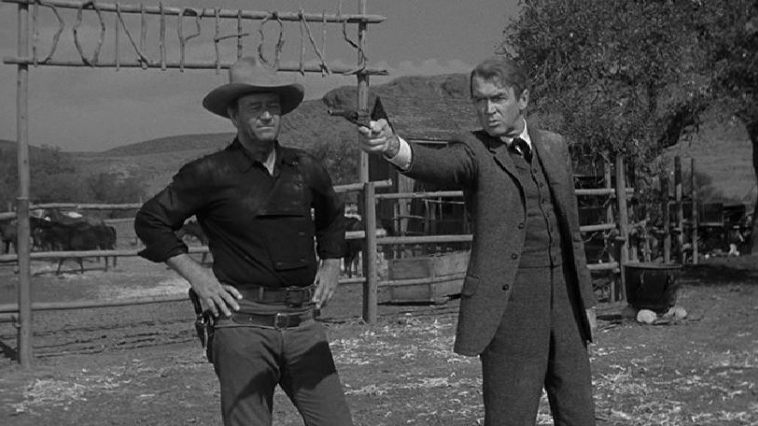
The Man Who Shot Liberty Valance


Based on the short story by Dorothy M. Johnson, The Man Who Shot Liberty Valance is the story of an attorney whose encounters with a notorious outlaw has him teaming up with a gunslinger to deal with him in order to protect the people at a small town in the West. Directed by John Ford and screenplay by James Warner Bellah and Willis Goldbeck, the film is an exploration of two men with different ideas of the world who team up to face off against someone who just wants to bring chaos into the world. Starring John Wayne, James Stewart, Vera Miles, Lee Marvin, Edmond O’Brien, Andy Devine, John Carradine, Jeanette Nolan, Woody Strode, Strother Martin, and Lee Van Cleef. The Man Who Shot Liberty Valance is a grand yet evocative film from John Ford.

The film is essentially a reflective story in which a senator recalls a time in his life when he was just an attorney arriving into a small town in the West where he tries to stand up against a notorious outlaw where he later teams up with a gunslinger and a few others in making a stand against him. Especially as he would later become a pillar of hope in a town that is still ravaged with fear prompting this attorney from the East to make a difference. The film’s screenplay begins with Ranse Stoddard (James Stewart) and his wife Hallie (Vera Miles) arriving to the small town of Shinbone as the local press wonder why he’s there. He then tells them the story of how he first came to the town 25 years earlier where he would meet Hallie and stand up to the outlaw known as Liberty Valance (Lee Marvin) after trying to stop him from robbing a widow during a stagecoach robbery. After being healed by Hallie and a local rancher in Tom Doniphon (John Wayne), Stoddard would do whatever he can to help the town.

Stoddard is a man that is educated and isn’t willing to be violent as he is trying to make sure there’s some law and order in this small town he’s arrived in as he also wants to be there for the people whether it’s to defend them in a court of law or teach them how to read and write. He would live at the restaurant that Hallie works at while doing his law practice at the local newspaper run by its publisher Dutton Peabody (Edmond O’Brien) who would befriend Stoddard as they would team up for an election on statehood. While Doniphon appreciates what Stoddard is doing, he feels that Stoddard is also just making things troubling because of Valance who wants to maintain his own power by beating up anyone or kill someone. Doniphon is a no-nonsense man who can read and write but knows how lawless the West can be as he is the only man that can out-gun Valance.

John Ford’s direction is definitely rapturous in terms of some of the visuals he creates as well as the fact that much of the story is told in a reflective manner by Stoddard to a journalist. Shot on the studio backlots at Paramount Studios in Hollywood, the film is more intimate in terms of its location even though there are a few scenes set in the desert as much of it is shot at a soundstage as the fictional town of Shinbone. While there are some wide shots of some of those locations, Ford would emphasize more on close-ups and medium shots for much of the film as it relate to the intimacy in the story as well as capturing some of the conversations and moments with the characters. Notably in the scenes that show Stoddard doing all sorts of things whether in educating some of the locals, cleaning the dishes at the restaurant where he’s staying at, or looking at Peacock’s articles. While much of the film is dramatic with some suspense, Ford would infuse the film with bits of humor such as a scene where Doniphon would show Stoddard how to shoot a gun as it would reveal how tough Stoddard really is.

As for some of the action, there are moments where the violence is quite brutal such as the Stoddard’s first encounter with Valance where Valance would whip him such a visceral way. The scenes where Valance is around is always filled with dread as the man is quite unpredictable as he would just scare people with his presence or through his violent actions. There is a showdown that would occur between Stoddard and Valance but it’s a very unusual showdown early in its third act. Notably as it would be followed by its aftermath as it relates to not just what happened to Valance but also who shot him as it would create this myth that is very unsettling. Overall, Ford creates a mesmerizing yet intense film about a lawyer and a gunslinger standing up against a notorious outlaw.

Cinematographer William H. Clothier does brilliant work with the film’s black-and-white photography from the sunny look of the daytime exteriors to some of the stylish usage of shadows and shades for some of the interior/exterior scenes at night. Editor Otho Lovering does excellent work with the film’s editing as it has some stylish rhythmic cuts to play into the action and suspense as well as some straightforward cuts for the drama. Art directors Eddie Imazu and Hal Pereira, with set decorators Sam Comer and Darrell Silvera, do fantastic work with the look of the saloons, restaurants, and Doniphon’s ranch as well as the interiors of some of the buildings in the film.

Costume designer Edith Head does nice work with the costumes from the look of the hats and clothes the men wear to some of the dresses that Hallie wears. Sound recordists Charles Grenzbach and Philip Mitchell do terrific work with the sound as it play into raucous sound of the meetings as well as in some of the moments of suspense as it relates to the showdown between Stoddard and Valance. The film’s music by Cyril J. Mockridge and Alfred Newman is wonderful for its mixture of bombastic orchestra music with its large brass arrangements and string flourishes for some of the dramatic moments as the score also include some folk-based music of the times.

The film’s superb cast include some notable small roles from Denver Pyle and O.Z. Whitehead as the father-son duo of Amos and Herbert Carruthers, Willis Bouchey as a train conductor, Joseph Hoover as a journalist interviewing Stoddard in the film’s beginning, Jeanette Nolan and John Qualen as the Swedish immigrant couple in the Ericsons who work with Hallie at the restaurant, John Carradine as a speaker for a convention representing those in favor of territory rights, Ken Murray as the local doctor Doc Willoughby, Strother Martin and Lee Van Cleef as two of Valance’s henchman in their respective roles as Floyd and Reese, and Woody Strode as Doniphon’s ranch hand Pompey as an African-American that is very helpful as well as wanting to be educated by Stoddard. Andy Devine is terrific as the local marshal Link Appleyard as a man that has a hard time upholding the law as he’s afraid of Valance as he is kind of the film’s comic relief. Edmond O’Brien is excellent as Dutton Peabody as the local newspaper publisher who is full of gusto in the things he says while admittedly being a drunk but a man that can rile up Valance through his words.

Vera Miles is amazing as Hallie as a local woman who runs a restaurant as she is courted by Doniphon as she would fall for Stoddard whom she sees as a man that can help her as well as make her into something more. Lee Marvin is brilliant as Liberty Valance as a brutish outlaw who likes to wreak havoc on the people as he tries to assert his own power and whatever he can to play into his role in the West. James Stewart is incredible as Ranse Stoddard as an attorney who is trying to help the locals in the small town as he also stands up to Valance where he is forced to see what he has to do to deal with him. Finally, there’s John Wayne in a phenomenal performance as Tom Doniphon as it is a performance where Wayne display some charm as well as humility as a gunslinger that is the one person that can deal with Valance but also is aware of what Stoddard is trying to do for the town as he would take action that would prove to be catastrophic for both men.

The Man Who Shot Liberty Valance is a sensational film from John Ford that features great performances from John Wayne, James Stewart, Vera Miles, and Lee Marvin. Along with its dazzling visuals and a compelling take on heroism, it’s a film that explore what some will do to help people not be afraid from the presence of an outlaw but also into the myths of the West. In the end, The Man Who Shot Liberty Valance is a tremendous film from John Ford.

© thevoid99 2017

Monday, October 05, 2015

Escape from New York


Directed by John Carpenter and written by Carpenter and Nick Castle, Escape from New York is the story of a former soldier who is tasked to rescue the President of the United States of America in a crime-ridden world in 22 hours. Set in a futuristic and dystopian New York City, the film is an exploration into the world of terror and chaos where a man named Snake Plissken has to save the day as he’s played by Kurt Russell. Also starring Lee Van Cleef, Ernest Borgnine, Isaac Hayes, Adrienne Barbeau, Harry Dean Stanton, and Donald Pleasance as the President. Escape from New York is a riveting and exciting film from John Carpenter.

After a massive rise in crime in America which led a mass evacuation of Manhattan Island in New York City where the island has become a prison. The film revolves around a former soldier who is asked to rescue the President of the United States of America whose plan has crashed in Manhattan Island after it was hijacked by a terrorist group. It’s a film that isn’t just a rescue movie but also a dystopian film of sorts as it plays into this renegade named Snake Plissken who has 22 hours to save the President who is supposed to give a speech in the hopes of ending a conflict with China and the Soviet Union. Upon arriving to Manhattan where he is also carrying a virus that would kill him if he doesn’t bring the President in time, Plissken also has to endure the many things that goes on in Manhattan including a prison leader known as the Duke (Isaac Hayes).

The film’s screenplay by John Carpenter and Nick Castle play into the stakes of what is going on as it is clear how troubled the United States is where everything outside of Manhattan Island is surrounded by a wall. Attempts to escape the island means certain death as anyone who is in the island is stuck no matter who that person is. This would add a lot to what is happening in the film as retrieving the President in an island full of criminals as he’s not the only one that isn’t safe but anyone else who tries to help him is safe. This prompts the country’s top police chief in Hauk (Lee Van Cleef) to bring in Plissken who was a former soldier that was just convicted for a robbery attempt on a Federal Reserves building. Plissken however is reluctant to do the job which plays into the complexity of his character as he is essentially a loner that is very distrustful of government and authority.

Once the second act is set in the island, it is clear that Plissken is in a world that is very different but is able to deal with the situation. It’s just that he’s dealing with people who are essentially nutcases as well as someone like the Duke who runs the city though there are a few such as a cab driver (Ernest Borgnine), an old friend of his named Brain (Harry Dean Stanton) who is the Duke’s advisor, and Brain’s girlfriend Maggie (Adrienne Barbeau). There, Plissken would have to survive with their help to save the President but it’s not just the life of the President that is at stake but also what he is carrying his briefcase which would play to the fate of the world.

Carpenter’s direction is very entrancing from the way he opens the film to the moment he reveals what goes on when a couple of men try to escape the island. It sets the tone for what is to come as there is this element of suspense once it becomes clear that the President is in the island and being held hostage. While much of the film is actually shot on locations in St. Louis and Los Angeles plus a few moments in New York City and Atlanta with additional scenes set in soundstages. It would play into the sense of despair that is in Manhattan where it looks like a city in complete ruins and being out on the street at night is very dangerous where no one is safe. Carpenter’s usage of wide and medium shots help play into that sense of danger while he also knows how to build suspense into what Plissken is saying.

While the film may be a futuristic sci-fi dystopian film, it has elements of the western since it involves some showdowns and a man’s instinct to survive. At the same time, Carpenter creates these moments where the violence is disconcerting but not really graphic as it’s more about what could happen and how far some are willing to go. The film’s climax where Plissken and the President are escaping is quite thrilling as it plays to not just the sense of danger of the island itself but what will happen there are those who will try to find a way to try and reach the wall. It does lead into an aftermath that plays into not what Plissken was doing but also into the fact that he realizes that there is a bigger picture which doesn’t really involve him. Instead, it plays into his own cynicism and how he would contend with that. Overall, Carpenter creates a gripping yet adventurous film about a renegade who goes to Manhattan to save the President from a bunch of crazed thugs.

Cinematographer Dean Cundey does excellent work with the film‘s very dark yet eerie cinematography which plays into many of the interior/exterior scenes where a lot of it is set at night with some more vibrant colors for some of the daytime sequences. Editor Todd Ramsay does amazing work with the editing as much of it is straightforward to help build up the film‘s suspense along with some fast-paced rhythmic cuts for the action sequences. Production designer Joe Alves and set decorator Cloudia Rebar do fantastic work with the look of New York City as well as the scenes set in the prison base.

Costume designer Stephen Loomis does nice work with the costumes as it‘s quite stylish in the ragged looks of Plissken and the characters at the island. Special effects supervisor Roy Arbogast and the visual effects work of William L. Arcane do terrific work with some of the effects for some of the film‘s action scenes as well as some computer-based images that includes some contributions by James Cameron on the special effects. Sound editor Warren Hamilton Jr does superb work with the sound to play into some of the sound effects and eerie tone for the scenes set in the island to play up its suspense. The film’s music by John Carpenter and Alan Howarth is brilliant as it is largely an electronic-based score with low-key yet brooding synthesizers to play into the mood of the film while the soundtrack features the swing classic Bandstand Boogie which the cab driver likes to play.

The film’s cast is incredible as it features some notable small roles from wrestler Ox Baker as a man Plissken must fight in the island, Frank Doubleday as the Duke’s assistant Romero, Tom Atkins as Hauk’s assistant Rehme, Charles Cypher as the Secretary of State, Season Hubley as young woman Plissken meets at the island, and voice appearances from producer Debra Hill as a computer and Jamie Lee Curtis as the film’s opening narrator. Adrienne Barbeau is fantastic as Maggie as Brain’s girlfriend who aids Plissken in getting the President while Harry Dean Stanton is superb as Plissken’s old friend Brain who also helps as he realize what is at stake while being one of the few that knows how to get out of the island. Ernest Borgnine is excellent as an old cab driver Plissken encounters as he knows where to go and such as he would also provide some key things in the rescue.

Lee Van Cleef is brilliant as Bob Hauk as the prison supervisor who asks for Plissken’s help knowing that he’s the only one that can do the job right as he also deals with the situation that is at hand. Isaac Hayes is amazing as the Duke of New York as a gang leader who holds the President hostage as he uses him as bait so he can get amnesty for himself and the other prisoners. Donald Pleasance is marvelous as the President as the leader who becomes a hostage as he tries to hold on to the contents of the briefcase which plays into what he really wants to do to end a worldwide conflict. Finally, there’s Kurt Russell in a phenomenal performance as Snake Plissken as this former soldier turned criminal who reluctantly takes the job to save the President for a pardon as he deals with his situation as well as what is at stake as he also carries a virus that will kill him. It’s a performance from Russell that is full of restraint but also a sense of cool as it is one of his most iconic performances of his career.

Escape from New York is a spectacular film from John Carpenter that features a tremendous performance from Kurt Russell. The film isn’t just one of the most intriguing rescue/dystopian films ever made but also one of the most exciting in terms of its action and suspense. Even as it features one of the greatest anti-heroes to be presented in cinema in the character of Snake Plissken. In the end, Escape from New York is a rapturous film from John Carpenter.

John Carpenter Films: Dark Star - Assault on Precinct 13 - Halloween - Someone’s Watching Me! - Elvis - The Fog - The Thing - Christine - Starman - Big Trouble in Little China - Prince of Darkness - They Live - Memoirs of an Invisible Man - Body Bags - In the Mouth of Madness - Village of the Damned - Escape from L.A. - Vampires - Ghosts of Mars - The Ward

The Auteurs #60: John Carpenter Pt. 1 - Pt. 2


© thevoid99 2015

Wednesday, July 17, 2013

High Noon


Directed by Fred Zinneman and screenplay by Carl Foreman from a story by John W. Cunnigham, High Noon is the story about a retired marshal who finds himself having to take a stand against a group of vengeful criminals in order to save his town. The film plays into a man reluctantly taking part in a stand against a villain and his gang as it’s told in real time. Starring Gary Cooper, Grace Kelly, Ian MacDonald, Lloyd Bridges, Katy Jurado, Lee Van Cleef, and Robert J. Wilke. High Noon is a gripping yet mesmerizing film from Fred Zinneman.

The revolves around the release of a criminal named Frank Miller (Ian MacDonald) who is about to arrive at the town of Hadleyville in order to get revenge on the man that put him to prison in a marshal named William Kane (Gary Cooper). Once Kane hears the news on his wedding day and that Miller will arrive town at noon, trouble brews as Kane is about to retire and live the quiet life with his bride Amy (Grace Kelly). Kane reluctantly decides to stay to face Miller and his gang as he suddenly realizes he’s all alone with no one willing to take a stand with him. Even Amy reluctantly decides to leave Kane to take the train out of town along with a former lover of Kane and Miller named Helen Ramirez (Katy Jurado) who is currently with Kane’s deputy Harvey Pell (Lloyd Bridges) who also decides not to help out Kane. Once noon comes in, it all comes down to this showdown between Kane and Miller with his gang.

What makes this film so engrossing isn’t just the fact that it’s told in real time but the way time is used to create this sense of tension and dread about the return of a notorious criminal who had brought chaos to this small town until a man named Kane brought law and order back to the town. Miller’s return causes worry as they’re all afraid of him and his gang forcing Kane to do everything by himself. Carl Foreman’s screenplay definitely plays to that sense of tension and dread as time is a real drive to the story. A lot of it features Kane having to go back to town and gather whatever posse he can get only to be turned down as many of the locals have no faith in the aging Kane despite what he’s done for the town. Still, there’s those who feel like Miller’s return will help things as Kane finds his back against the wall.

The script also plays into the people around Kane such as Amy and Helen as both of them each offer weight to the story. Amy is a Quaker who is worried about being a widow and doesn’t want to see Kane killed but also doesn’t want to deal with the sense of violence as she had horrific encounters with violence in the past. Helen is a woman was once a lover of Kane and Miller in the past as she had just made a new life for herself but Miller’s return forces her to flee in order to not just see Kane killed but also avoid Miller. Frank Miller doesn’t appear in the story until the moment the train arrives exactly at noon but still carries a presence that is disconcerting as he brings fear to this small town as the locals are unsure whether to take a stand against him or just let him and his posse take over.

Fred Zinneman’s direction is truly engrossing for the way he presents the film. Notably in the way he maintains this sense of tension in the film as time slows down where the pacing has this unsettling tone over what is coming. Zinneman uses a lot of close-ups and medium shots to play out the tension while always finding a way to put the clock in the frame to emphasize that time is a key proponent in the story. Zinneman also creates the sense of drama to help drive Kane’s decision of whether to face off against Miller or to run with Amy and hide from him. Yet, Kane is not a coward but he is aware of how dangerous Miller and his gang is.

Zinneman also employs an intimacy in some of the drama as well as scenes of the locals talking about Kane and Miller to help play into that sense of time as they all await for the showdown. It does add to that sense of dread where everyone is waiting for the train arrive including Miller’s gang as they wait at the station. Once the climatic showdown is coming, the suspense definitely amps to see what will happen and how will Kane go face to face against Miller and his gang. Overall, Zinneman creates a very intense and riveting film about a man taking a stand against a chaotic criminal.

Cinematographer Floyd Crosby does brilliant work with the film‘s gorgeous black-and-white photography in the use of shadows against the sun while creating low-key lights for some of the film‘s interiors. Editors Elmo Williams and Harry W. Gerstad do fantastic work with the editing as it plays to the sense of suspense and dread along with a few rhythmic cuts to play out some of the dramatic reactions and fights. Production designer Rudolph Sternad, along with set decorator Murray Waite and art director Ben Hayne, does excellent work with the set pieces from the look of the town to the hotel that Helen stays in.

The sound work of John Speak is superb for the atmosphere is created in the saloons as well as playing up to the suspense with the sound of clocks and train horns. The film’s music by Dimitri Tiomkin is amazing for its low-key yet somber score that is a mixture of country-western and orchestral music while using some orchestral music to play up the suspense and drama while the film’s title song co-written with lyricist Ned Washington and sung by Tex Ritter is a wonderful piece that helps tell the story.

The casting by Jack Murton is phenomenal for the ensemble that is created as it features some notable appearances from Harry Morgan as a friend of Kane who refuses to help out, Eve McVeagh as that friend’s wife who reluctantly lies to Kane, Otto Kruger as the judge who tells Kane to leave town, Lon Chaney as Kane’s old mentor who also tells Kane to leave, Morgan Farley as the town’s local minister and as Miller’s gang, there’s Robert J. Wilke, Sheb Wooley, and Lee Van Cleef as they bring a unique presence to the film. Ian MacDonald is terrific as the film’s antagonist Frank Miller as he appears late in the film but brings a great presence in the way he arrives to the film.

Lloyd Bridges is excellent as Kane’s successor who feels slighted by Kane as he abandons his post while trying to get him to flee. Katy Jurado is amazing as Helen Ramirez as a former lover of Kane and Miller as she is aware of the danger that is coming as she tries to get Kane to flee town as well. Grace Kelly is radiant as Kane’s new bride Amy as a woman who urges her husband to flee while dealing with the possibilities of what would happen as she would play a key role in the showdown. Finally, there’s Gary Cooper in an outstanding performance as William Kane as an aging marshal who is forced to face the man he put in prison while realizing how alone he is as it’s a performance that is truly engaging in the way Cooper maintains a sense of humility and determination to a man wanting to do what is right for himself and his town.

High Noon is a tremendous film from Fred Zinneman that features a brilliant performance from Gary Cooper. Along with noteworthy supporting performances from Grace Kelly, Katy Jurado, and Lloyd Bridges, it’s a film that is truly one of the defining films of the western genre. Particularly in the way it builds tension and suspense in real time as it doesn’t falter in its pacing while maintaining a sense of excitement. In the end, High Noon is a magnificent film from Fred Zinneman.

Fred Zinneman Films: (Redes) - (That Mothers Might Live) - (Stuffie) - (Forbidden Passage) - (Kid Glove Killer) - (Eyes in the Night) - (The Seventh Cross) - (My Brother Talks to Horses) - (The Search) - (Act of Violence) - (The Men (1950 film)) - (Benjy) - (Teresa) - From Here to Eternity - (Oklahoma!) - (A Hatful of Rain) - (The Nun’s Story) - (The Sundowners) - (Behold a Pale Horse) - (A Man For All Seasons) - (The Day of the Jackal) - (Julia) - (Five Days One Summer)

© thevoid99 2013

Friday, August 17, 2012

The Good, the Bad, & the Ugly


Originally Written and Posted at Epinions.com on 4/17/06 w/ Additional Edits & Revisions.


Directed by Sergio Leone with a screenplay by Furio Scarpelli and Agenore Incrocci, from a screen story by Leone and Luciano Vincenzoni and additional English translation by Mickey Knox, The Good, the Bad, & the Ugly is the story of three different gunslingers searching for gold in the middle of the American Civil War. The film takes all of Leone's previous westerns and ups the ante in terms of storytelling and violence as Clint Eastwood reprises his role as the Man with No Name in the final part of the Dollars trilogy. Also starring Lee Van Cleef, Mario Brega, Aldo Guiffre, and Eli Wallach. The Good, the Bad, & the Ugly is an outstanding yet visually-astonishing film from Sergio Leone.

A man named Tuco (Eli Wallach) is on the hunt as there's a bounty on him for $2000 as he's chased by three gunslingers and later another trio until he's saved by a mysterious no-named man called Blondie (Clint Eastwood). Yet, it's part of a scam they do to raise the reward as Tuco's bounty was raised to $3000 as the two eventually go their separate ways after Blondie leaves Tuco with his hands tied. Meanwhile, a man named Angel Eyes (Lee Van Cleef) is on a different mission where he gets information from a man named Stevens (Antonio Casas) about the whereabouts of a man who renamed himself as Bill Carson (Antonio Casales) as he kills another man (Livio Lorenzon) who is also searching for Carson. After getting information from a woman named Maria (Rada Rassimov), Angel Eyes continues his journey to find Bill Carson.

After taking revenge on Blondie by pulling a hit on him, Tuco finally gets his revenge after Blondie tries to pull the same scam on another person as he makes Blondie walk through the desert without water and a hat. The two then come across a running carriage full of dead Confederate soldiers where one of them is revealed to be Bill Carson who tells them about $200,000 worth of Confederate gold hidden in a graveyard. With Blondie getting the name of the grave, Tuco is forced to re-team with Blondie as they disguise themselves as soldiers where they seek refuge at a missionary run by Tuco's brother Pablo (Luigi Pistilli). With Blondie healed, he and Tuco make their way to the graveyard only to be captured by Union soldiers where Tuco claims to be Bill Carson as he's interrogated by Angel Eyes. After a beating from Corporal Wallace (Mario Brega), Tuco reveals the information to Angel Eyes yet reveals the other half is from Blondie who joins Angel Eyes to go to the graveyard.

After escaping the prison, Tuco meets up with a one-armed bounty hunter (Al Mulock) where he encounters Blondie and Angel Eyes at a small abandoned town with a group of Angel Eyes' men. After leaving Angel Eyes and re-teaming with Tuco, the two make their way as they encounter a drunk Union captain (Aldo Guiffre) claiming to enlist as they find themselves in the middle of a battle. Finally reaching the graveyard where the gold is, Angel Eyes catches up with them leading to a three-way duel for the gold.

Before the Westerns that Leone made, the genre had its formula of good guys battling the bad guys with a final shootout in the end. While Leone appreciated the formulas that were made from directors like Howard Hawks, Anthony Mann, and notably John Ford. He had an intense dislike for some of ideology and its Hollywood-like fashion where someone like John Wayne would save the day and come out with some unrealistic moral. From Leone's mind, there are no good guys or bad guys where in the end. It's every man for himself when it comes to certain things including money. This point of view was very interesting and it made more sense it feels more realistic. Yet, while Leone did appreciate the filmmaking techniques of Hawks, Mann, and Ford, he was also influenced by the work of Akira Kurosawa. The result of what Leone did with his westerns, notably The Good, the Bad, & the Ugly and 1968's Once Upon a Time in the West was giving the Western an operatic feel.

Three hours (even for its restored 180-minute version as opposed to the 161-minute U.S. version in 1967) is a lot to bring for a Western where in today's film world. Everything moves pretty fast and just cuts to the action without trying to understand things. Leone though, just lets a moment flow where its his directing that really shines. Thanks to a script that he wrote with his writers, Leone allows the audience to get to know the protagonists first in the film's first thirty minutes. Then, he lets the story follow through where it involves scams, distrusts, and greed. It's not that someone like Blondie, who is known as the Good, is trying to do the right thing but he's only doing it for himself just to make a living without any morals or compromises. The same goes for Angel Eyes aka the Bad and Tuco aka the Ugly. These are just three guys who are willing to do anything to get the prize, even if they have to scam one another.

Leone's genius in the writing not brings enough time to savor the idea of the Western but also take a view of America (though he hadn't been there at the time) where the Old West had its code. Notably using the film's time frame to cover something like the American Civil War where a battle occurs between Union and Confederates where it actually happened. A battle in the West over territory where Blondie and Tuco witness it without any sympathy for the fact that soldiers are wasting their lives over land. The comment that Blondie makes is ironic to the point on what he's doing. It's one of the few moments of humor that Leone likes to bring out while also making it very intelligent about their own position.

While Leone lets moments of shootouts, battles, and moments of deception be shown on screen, he doesn't glorify it nor does he downplay it. Yes, we see a despicable man like Angel Eyes kill people and brutalize people including a woman. Here, his viewpoint of the West is gritty, disgusting, and with no morals. If Leone's accomplishment as a storyteller is potent, so does his achievement as a director. When it comes to creating shots or compositions, no one does with great movement and rhythm better than he does, especially to the Western genre. The way he moves the camera and go for long takes of a certain scene, he manages to create a moment where its awestruck.

There are some scenes where he will take a close-up of someone and then slowly pans across the area where it becomes a wide shot of a landscape. Using the same locations for the previous films in Almeria, Spain, Leone captures breathtaking scenery for his films. Even when he's presenting something like a shoot-out, there's a great moment where he takes a shot of a gun or a man's face and then cut to something like another man's face or gun and another. There, he creates a momentum and tension that builds up the excitement for the audience. In many respects, Leone's work for this is pure genius. Not just for the entirety of the Western genre but for cinema itself.

Helping Leone in his amazing, visual epic scope is cinematographer Tonino Delli Colli who does great use of using the sun to capture the heat of the West in many of the film's exterior scenes. The look of the film is crisp and true to the epic scope of the West. Art director/costume designer Carlo Simi does amazing work in not just capturing the decaying look of the abandoned towns but also the staging of the battlefield. The costumes from the Civil War uniforms to the cowboy clothing looks very real while Eastwood provided his own costumes by using the clothes he wore on the TV show Rawhide. Sound designer Gonzalo Gavira also does great work in capturing the sound of the winds and cannon whistles that brings a lot of the intense danger for the film. Finally, there's the iconic editing of Eugene Alabiso and Nino Baragli where they create a wonderful style of cutting that moves from perspective to perspective. Most notably, in the film's final shootout scene where the cutting is rhythmic to convey the intensity of the film.

Amidst a lot of the film's technical achievements, another iconic moment in the film that is so memorable is the music provided by longtime Leone composer Ennio Morricone. Film scores before Morricone, especially in a Western genre has always been orchestral driven to serve as an accompaniment or to convey a sense of action. Morricone went beyond that with the film's memorable opening theme with a riff that goes, woo woo-woo, waa, waa-waa. Using stuff like guitar melodies, trotting rhythms, and whistles, the score takes the audience to a ride where they know what's coming in the sense of action. Even in the film's non-action moments, the music is done with great sensitivity to convey the times as it features amazing, orchestral arrangements. Even on a scene like Tuco's torture, he uses the most subtle, melancholic piece of music filled with simple instruments that brings a sense of idiosyncracy and horror. The idea of a piece of music that is so beautiful to listen to with a scene of graphic violence is purely unconventional.

Another thing that is so special in Morricone's work is that it has an operatic feel. Playing up to the epic scope of Leone, the music has this sense of something is about to happen. There's a sense of climax to the music. Notably the famous cut called Ecstacy of Gold where Tuco runs into the graveyard to go find the gravestone where the gold is. The cut opens with this fast-paced piano track that is later accompanied by intense, arrangements of strings and then comes this operatic vocal from a woman. The music just sweeps up the moment that is beautiful in the way its builds this climatic momentum. What is more amazing is that Morricone made the music just before Leone was making the film. There, the use of Morricone's music to Leone's epic film is purely magical.

Finally, there's the film's big cast that includes such memorable small performances from Antonio Casas and Livio Lorenzon as the two men Angel Eyes kill to get information. There's also memorable roles from Al Mulock as a one-armed bounty hunter, Antonio Casale as the ill-fated Jackson/Bill Carson, Rada Rassimov as Jackson's girlfriend Maria, and Luigi Pistilli as Tuco's brother Pablo. With the exception of Al Mulock and the three main actors, most of the actors were Italian where their dialogue is dubbed yet they don't affect the performances since they're all well done. Mario Braga is excellent as the torturous Corporal Wallace who brings a great presence to his character, especially in Tuco's torture scene. Aldo Guiffre is also great as the drunken Union captain who has seen enough of war while drinking his way to glory.

In two of the three main protagonists, we have two great actors of the Western genre. In the role of Tuco aka the Ugly, Eli Wallach gives a fantastic performance as a distrustful, talkative bandido who is willing to scheme his way to do anything. Even passing off successfully as a Mexican, Wallach brings an amazing presence of a man who isn't good but isn't bad either. Wallach brings a character who is likeable enough for an audience to enjoy despite his bad things. The late Lee Van Cleef is brilliant as Angel Eyes aka the Bad, with a presence that is eerie. Van Cleef has a look that is scary where you'll know, he's going to do something bad. Van Cleef is a veteran of the Western as he just brings all the ideas of a villain but brings a lot more to the table as he gives one of the best performances ever.

Finally, there's Clint Eastwood in the role of the Man with No Name aka Blondie aka the Good. Bringing that unshaven look to his face with not much dialogue to speak, Eastwood commands the film with great ease and a presence where it says one thing. He's the Man! Eastwood comes in with his stoic presence and one-liners where in comparison to the two other protagonists, his character is a faster and smarter gunslinger. While he has great scenes with Wallach and Van Cleef, Eastwood is a man with honor but only for himself as he has to remind Tuco that it's every man for himself. It's a very iconic role complete with a poncho, a brown hat, and a cigar, there's no one else who could play that as Clint Eastwood helped create the ultimate anti-hero as opposed to the traditional feel of John Wayne in the days before. There become a blueprint of what a gunslinger should be as Eastwood change the ideas of a Western protagonist.

The 2004 Special Edition Region 1 2-Disc DVD from MGM is by far one of the best DVD releases since its existence. To present this special edition of the film in its restored, near-three hour cut, MGM packages the film in a set that fans of the films and collectors can enjoy. Along with a booklet and four cards featuring different international posters of the film, this is truly one of the best DVD packaging to own since it offers so much to the film's fans. The first disc reveals the entire restored three-hour version of The Good, the Bad, & the Ugly in its fullest form with 5.1 Dolby Digital English audio plus remastered Italian audio and in the 16x9, 2:35:1 anamorphic ratio of the widescreen format that is truly intended for the film. Coming with subtitles in English, Spanish, French, Cantonese, and Mandarin, the only big special feature for the first disc of the film is audio commentary from critic and film historian Richard Schickel.

Schickel's informative documentary is filled with tidbits about the film including Eastwood's disaffection at the time when he was making this film as his relationship with Sergio Leone was starting to falter. It was mostly because Eastwood was tired of being in the Spaghetti Western genre and wanted to move on as did Leone where he would end up making one more Western, 1968's Once Upon a Time in the West. Schickel talked about some of the restored scenes like Angel Eyes arrival at the Confederate camp, Tuco and Blondie's desert walk, a cave scene with Tuco, and an extended scene at the Union battle trenches.

Schickel said the cutting was due to length that would be the case for most of Leone's films in the U.S. where they would be cut without his full consent. That was also the case in an awful butchered cut for his 1984 gangster epic Once Upon a Time in America. While Schickel's commentary can be boring at times yet it's informative and wonderful to hear since he is heard having a good time watching the film while talking about its reaction in the U.S. when it first came out.

The second disc of the special edition DVD is filled with loads of extras including five documentary shorts about the film, a deleted scenes section, a posters gallery, the original theatrical trailer along with trailers for films on MGM, and extra Easter egg interviews with Eastwood and Eli Wallach. Eastwood and Wallach are among those who are interviewed along with legendary Italian producer Alberto Grimaldi who was the producer for the film in its 1966 release. The first documentary is a 20-minute making-of retrospective on the movie called Leone's West with interviews from Eastwood, Wallach, Grimaldi, the film's English translator Mickey Knox, and film critic Richard Schickel. The doc features comments from Eastwood and Wallach about the way Leone would do the film while Grimaldi talked about how upped the budget a bit for an international breakthrough. The discussion on the doc is about the genre of the Spaghetti Western and how Leone turned it into a change for the Western by breaking rules with comments from Knox on the translation and Schickel on the historical impact.

The second documentary called The Leone Style is a 24-minute documentary featuring the same men from the previous documentary on Leone's film style. They discuss his work ethics and his ability to create a violent moment in a quick way or to show the brutality. Wallach discusses that since they didn't have stuntmen or anything in Italian productions, everyone had to do their own stunts. Eastwood talks about how Leone would create long shots that would last less than a minute just to savor a moment or build momentum. The third documentary is a 14-minute documentary called The Man Who Lost the Civil War about Confederate leader Henry Sibley and the battle he took that was actually documented in The Good, the Bad, & the Ugly. The Peter Spier doc featuring narration by Morgan Sheppard chronicles Sibley's failed campaign to take control of the west against the Union's Edward Canby that ran all the way to parts of Colorado and New Mexico.

The 11-minute documentary on the film's reconstruction talks about the film's December 1966 premiere in Rome which ran nearly 178-minutes. Due to American time constraints, the film was cut to 161-minutes for the U.S. release which didn't please Leone very much despite its success. In 2002, MGM hired Paul Rutan and John Kirk to do restoration work for the film to match the original Italian film version from its premiere. Rutan and Kirk discussed several scenes that got restored but an extended Tuco torture scene didn't make it into the restoration due to its print where it suffers from negative film damage. They also talked about cleaning the film, remixing the sound, and getting Eastwood and Wallach to re-do their voices for the scenes that got restored while hiring voice actors for other scenes as well. Alberto Grimaldi comments on the restoration and is pleased that it's the version that he enjoys and that Leone would’ve loved it.

The fifth documentary is an eight-minute feature on composer Ennio Morricone and his contribution to film scores, notably with Leone. Film music historian Jon Burlingame discusses Morricone's contributions to film scores and his collaboration with Leone. Morricone prior to working with Leone had only done a handful of film scores but when he was hired to do score work for A Fistful of Dollars, the two enjoyed their work. Straying away from the symphonic context of traditional film scores, the two wanted original ideas. In The Good, the Bad, & the Ugly, Morricone created concepts and pieces just before the film was made after reading the script. For Leone, the demos would give him musical inspiration as Burlingame says that the collaboration was magical. A 12-minute audio featurette on Morricone's score work is discussed by Burlingame who talks about Morricone's concept with film scores and arrangements. His relationship with Leone that spans longer than people seem since they went to the same children's school.

The discussion talks about how Morricone's score back in the 60s weren't considered true artistic triumphs in comparison to the Hollywood composers at the time. Yet, now that they're recognized and his score work for Leone along with films like Bernardo Bertolucci's 1900, Terrence Malick's Days of Heaven, and Roland Joffe's The Mission are considered some of the best in cinema history. The celebrated and beloved composer still has not won an Academy Award which some says, gives the Oscars less relevance.

The deleted scenes section features three little clips of the material that didn't make it to the restoration or its final cut. One is an extended Tuco torture scene where despite its brilliance, due to the look of the film print, the clip doesn't look great though its explanation because of the film’s negatives were damage. It's still a great scene to look at it despite its appearance. Another is a reconstructed idea of a sequences known as the Sorocco Sequence where it was a scene after Angel Eyes' arrival at a Confederate camp and before Tuco's search for Blondie. The scene reveals Tuco's search for Blondie as he extorts money and fights a bartender while Blondie is scoring with a Mexican woman. Some of those scenes in that sequence appear in the French trailer of the film along with alternate angles of other famous scenes. Aside from the American film trailer that appears in its fullest form, there's a poster gallery of all the different posters from the world like Japan, Germany, French, Italy, and the U.S. The Japanese, French, German, and Italian posters do appear little special cards in full-color.

With some additional trailers for the other parts of the Man-with-No-Name trilogy along with some MGM releases. The second disc also includes Easter Eggs of interview outtakes with Eastwood and Wallach talking about small stories about the making of the film. The special edition DVD comes with an eight-page booklet of what's in the DVD along with the titles for the 32 chapters in the film. The booklet is led by an essay from famed Chicago Sun-Times critic Roger Ebert. With many of the excerpts of his essay taken from his Great Movies column, Ebert talks about the film's brilliance and its impact since its release. Adding to the essay is the discussion of the restoration of the film and for its DVD where he thinks the film is considered a full-on classic.

The Good, the Bad, & the Ugly is a phenomenal film from Sergio Leone that features an iconic performance from Clint Eastwood. Along with additional supporting performances from Lee Van Cleef and Eli Wallach, it is definitely one of the great films of the western genres as it includes a brilliant score by Ennio Morricone. The film is also a great introduction for anyone who is interested in the works of Sergio Leone. In the end, The Good, the Bad, & the Ugly is a tremendous achievement from Sergio Leone.


(C) thevoid99 2012
Saturday, August 04, 2012

For a Few Dollars More


Originally Written and Posted at Epinions.com on 12/17/07 w/ Additional Edits.


Directed by Sergio Leone with a script by Leone, Fulvio Montella, and Luciano Vincenzoni, For a Few Dollars More is about two men on the hunt for a ruthless bandit who has been killing many with his gang. With Clint Eastwood returning as the Man with No Name, he is teamed up with character actor Lee Van Cleef as a fellow bounty hunter named Colonel Douglas Mortimer. The film is a more epic, stylistic that took Leone's visual style from his previous film to new heights with its iconic use of close-ups, editing, visual scope, and the duels that would define his westerns. Also starring Leone regulars Gian Maria Volonte, Joseph Egger, Aldo Sambrell, Mario Brega, and Benito Stefanelli along with Mara Krupp and legendary German actor Klaus Kinski. For a Few Dollars More is a solid, action-packed film from Sergio Leone and company.

Arriving into Tucumcari for a bounty, a man in black named Colonel Douglas Mortimer finds his target Guy Callaway (Jose Terron) and kills the man for $1000. While picking up his money, he asks about another killer targeted for a bounty in another part of town. Yet, a no-named man called Manco (Clint Eastwood) arrives into White Rocks where he finds and kills his bounty target Baby Cavanaugh (Jose Marco) along with his gang. Meanwhile, a ruthless killer named Indio (Gian Maria Volonte) has been freed by his gang while killing his cell mate (Dante Maggio), who turns out to be a carpenter who gave Indio information about the bank in El Paso, Texas. Indio's escape caught the attention of Mortimer and Manco as the two go to El Paso to find him and his gang. The two arrive at different times as Manco finds information through a young boy named Fernando (Antonio Ruiz) about the arrival of Mortimer as he charms a landlady named Mary (Mara Krupp) and gets a room.

After killing a man (Lorenzo Robledo) over his betrayal along with his family, Indio sends his group of men including Nino (Mario Brega) and the hunchback Wild (Klaus Kinski) to scout the bank. With Manco and Mortimer watching the men arrive, they also start to notice each other after Manco makes a confrontation with Wild. Both Manco and Mortimer watch what is going on as they realize they're after the same bounty. With Mortimer finding his information on Manco from the papers, Manco finds out about Mortimer through a prophet (Joseph Eggers). Realizing that they're both skilled and want the same thing, they decide to form a partnership as they plan for Manco to join up Indio's gang by freeing one of his notorious men named Sancho Perez (Panos Papadopulos). After freeing Sancho, Manco becomes part of Indio's gang as he and four other men are set to rob a bank for Santa Cruz as a diversion for Indio’s gang to rob the El Paso bank.

After killing a few of Indio's men, Manco makes diversions of his own while wanting to see what Indio and his men are doing. Realizing that they made a change of plans and not going for the expected safe, Manco and Mortimer try to figure out what is going on. Manco returns to Indio's hideout as they realize, they couldn't open the safe where Mortimer arrives wanting his own take. With the two men joining Indio, they ride into a town for a hideout as they finally got access to the money. Yet, Indio's intelligence that is supported by Groggy (Luigi Pistilli) reveals the identities of Manco and Mortimer as the two men are beaten up. Yet, Indio's wild plans to let them go while killing one of Indio's own men (Aldo Sambrell) for the blame. Groggy learns what Indio is up to as Manco and Mortimer have their own agendas with Mortimer revealing a far bigger motive to capture Indio that is worth more than any bounty.

Whereas Leone's previous film A Fistful of Dollars was a film that was reinventing the western genre with the story basis of Akira Kurosawa's Yojimbo. For a Few Dollars More is a more ambitious picture in terms of visual scope, staging, locations, look, and violence. In many ways, this film is really a transitional film for Leone as he uses a lot of the elements he is known for. Extreme close-ups, wide compositions, duels, huge locations, set designs, rhythmic editing, opera musical cues, and flashbacks are key to Leone's style of cinema. It's in this film where Leone is starting to incorporate these styles into his direction that would be perfected in his upcoming westerns The Good, the Bad, & the Ugly and Once Upon a Time in the West. Still, despite all of these stylistic choices, Leone remains a storyteller.

While taking the same theme of playing double that was in his previous film, the film is really more about two men going after the same man for one thing, money. Yet, for Douglas Mortimer, it's about a lot more than that when it comes to Indio. Particularly in a flashback scene that involved the death of a man and the raping of a woman with a chiming stopwatch reveals not just Mortimer's motives but also Indio's hazy, paranoid behavior that is driven more by his use of drugs. This is in some ways, the first Western to feature the use of narcotics in a film, which was taboo at the time. It's only to convey Indio's state of mind where despite the fact that he's intelligent and ruthless, he is his own worst enemy as he is sometimes, more vicious than his own men than anyone else he kills including women and children.

The character of Indio is a very complex character as the role of the villain is given more depth as he isn't some caricature but a man with wits, intelligence and skill as he is a villain that people could fear yet his men seem to revere for the most part. Yet, he only has a few of his men that often questions his motives including Nino and Groggy, the latter is the one who knows what could go wrong. Then, you got the two men in the Man with No Name and Col. Mortimer. There's an uneasy relationship where you have the young, quick-witted Manco and the older, experienced, and inventive Mortimer who are both equals in skill and such. While Manco is the kind of guy who just wants to do things in a simple way, Mortimer is more of a strategist who plans his way and tries to see how he can outwit Indio.

Leone's take on characters and their development is heightened more through his fluid, eye-wielding direction. Taking a more epic approach for its scope and story, Leone decides to slow things a bit for a sense of tension and momentum. Notably the third and final act that involves a big shootout and most of all, a duel. Leone's use of the widescreen lenses and his knowledge for depth of field, definitely captures the sense of aura and location in that final duel where the two men are at the edge of the screen. There, Leone uses those compositions for a sense of excitement of what is to come. Leone's knowledge of the western with all of its momentum while bringing a sense of attitude with explosions, gunfights, and such as this film he was just getting better at his craft.

Cinematographer Massimo Dallamano does a wonderful job with many of the film's exterior look where the film has a gritty look yet looks gorgeous at the same due to its locations of Almeria, Spain while the interiors are also shot with style, notably the interiors of Indio's hideouts. Editors Eugenio Alabiso, Adriana Novelli, and Giorgio Serrallonga do great work in maintaining the film's epic feel while using fast-cuts to convey the film's sense of action and tension, notably the extreme close-up faces cut to another that would become iconic and later, perfected by Nino Baragli in the upcoming film, The Good, the Bad, & the Ugly.

Longtime art director Carlos Simi does exquisite work with the film's set design from the look of the towns to the decayed church hideout of Indio where it has an old-school Western feel but with a European look with its stoned villages, churches, and the bank itself as Simi's set design is brilliant in every way. Simi's work on the costumes is also great, whether it's the green shirt that Wild wears to the black suit of Col. Mortimer as the film's look is stylized yet cool. Sound designers Oscar De Arcangelis and Guido Ortenzi do amazing work with the film's sound whether it's the gunshots, the horses, or any moments of violence to emphasize the style of the West. Special effects supervisor Giovanni Corridori does some fantastic work with some of the film's action, notably the explosion of the bank that gives the film more bombast to complement Leone's ambitions.

Then there's the film's amazing music by the Maestro, Ennio Morricone. Morricone's intense, operatic score that features a galloping theme with Fender guitars to serve as the theme for Manco with uses of whistles and doomy music to convey the other themes of characters. Some of the intensity of Morricone's music features the use of piano and striking arrangements to convey the suspense while the chiming music in the clocks is used for Indio's hazy state of mind in the flashback sequences. Then, there's the music of the final duel that is purely in Morricone's operatic style with huge arrangements, lots of momentum, and a sweeping voice that is just jaw-dropping. It's another sign that when it comes to Leone’s music, it doesn't feel right without the contributions of Ennio Morricone.

The film's cast is wonderfully assembled to emphasize Leone's quirky yet unique visual style with performances from Rosemary Dexter as the woman Indio raped and Peter Lee Lawrence as her husband, Kurt Zips as Mary's husband at the hotel, and Carlos Simi as the El Paso bank manager. Other small roles like Antonio Ruiz as the boy informant, Jose Terron and Jose Marco as the opening targets early in the film, Diana Rabito as a girl in a tub, Dante Maggio as Indio's cell mate, Joseph Egger as a train-complaining prophet, and Leone's baby daughter Francesca as a crying baby. In the various roles of Indio's gang, Aldo Sambrell, Benito Stefanelli, are Panos Papadopulos excellent while Mario Brega is a notable standout as the big Nino and Luigi Pistilli as the intelligent Groggy.

Another notable standout as a member of Indio's gang is the late yet legendary Klaus Kinski as the blue-eyed hunchback Wild. Kinski brings an eerie presence to the film where if you mess with him, there is surely bound to be a whole lot of trouble. Though it's a small role, Kinski's performance is still memorable as it's a great early role before his landmark work with Werner Herzog. Gian Maria Volonte is brilliant as the crazed, ruthless Indio, a pot-smoking, intelligent killer who has huge ambitions but is also flawed when it comes to his drug use. Volonte's performance is intense as it is eerie as he gives the villain an edge that hadn't seen before. It's a great performance from the late, Italian actor.

Lee Van Cleef, who was known prior to this film as a character actor, is magnificent in his role as Colonel Douglas Mortimer. Van Cleef's performance is brilliant for his subtle, witty, and cool presence where his eyes is the most distinctive feature of his performance. A role, originally supposed to go to Henry Fonda, Van Cleef definitely brings that sense of experience and inventiveness that is a joy to watch as the late actor makes a mark into the genre. Finally, there's Clint Eastwood in another kick-ass performance as the Man with No Name. Eastwood's laconic, deadpan performance filled with witty one-liners is great to watch as the actor seems more comfortable with the iconic character he plays. Eastwood is a total badass as he throws punches and shoots without hesitation while being a stoic, charming man who can woo the ladies and such. It's a great performance from the iconic legend.

The Region 1 2-Disc DVD Collector's Edition that's also part of the Sergio Leone Anthology Box Set that included the Special Editions of A Fistful of Dollars, The Good, the Bad, & the Ugly, and Duck, You Sucker! features the film as it is presented in the 2:35:1 aspect ratio for the widescreen format. Restored and remastered in 5.1 Dolby Surround Sound for English as well as Mono sound for English and Spanish with the French in Stereo. Included in the first disc of the DVD along with English and Spanish subtitles is a feature-length commentary track from film historian Sir Christopher Frayling.

Frayling's feature-length commentary is very informative about the film's history as well as what went on during production. The film, made for $600,000, gave Leone more confidence as he and his crew worked with a bigger budget, had more time, and for the most part was fun except for the later part of filming that involved problems with Gian Maria Volonte who had enough of Leone's multiple takes. Leone originally wanted Lee Marvin or Henry Fonda to play the role of Col. Mortimer but couldn't do it at the time because of budget concerns. Instead, he chose Lee Van Cleef based on the Westerns he had seen and loved where Frayling revealed that after this film and The Good, the Bad, & the Ugly, Van Cleef became a superstar in Europe making loads of Westerns. Frayling said it was For a Few Dollars More that really broke the door down for European-produced Westerns that became big in Europe for years to come.

Frayling's commentary is extremely informative and insightful to hear while he does reveal a brief tidbit on Klaus Kinski who was hired by David Lean to be in Doctor Zhivago based on his appearance in this film. Frayling also does extensive profile on two of Leone's long-standing collaborators in production designer Carlos Simi and Ennio Morricone who would eventually become big names after this film.

The second disc of the DVD features similar special feature contents that appeared in the special edition DVD for A Fistful of Dollars. The first featurette entitled A New Standard is a 20-minute segment featuring an interview with Sir Christopher Frayling on the film. Discussing a lot of the similar details he mentioned in the audio commentary, Frayling emphasized more on what Leone wanted. With help from producer Alberto Grimaldi, Leone wanted to create film that was very different from his previous film and making it into a fairytale of sorts for grownups. Frayling also goes into the relationship of the Manco and Col. Mortimer characters that was different in some respects to previous westerns though there were a few references about a possible gay thing from a viewpoint of the gay community. The violence is also discussed because Leone didn't like the way Hollywood films approached violence by deciding to have men shot and then fall off dead in the same short or see a bullet hole of sorts to add a new edge. The interview is very brilliant overall.

The 13-minute featurette Back for More is an interview with Clint Eastwood recorded in August 2003 originally for the special edition DVD for The Good, the Bad, & the Ugly. Eastwood discusses Leone's approach to casting minor characters as well as his directing style that has been an influence in Eastwood's own directing style. He decided to do For a Few Dollars More immediately thanks to the success of the previous film and he also talked briefly about Lee Van Cleef whom he knew as a character actor and had a lot of fun with him on set. Eastwood's interview is enjoyable to watch as the actor-director talks in a very laid-back style. Tre Voci is a 10-minute interview with producer Alberto Grimaldi, screenwriter Sergio Donati, and translator Mickey Knox about Leone and the film. Grimaldi talked about backing Leone after the rough experience in making Fistful that often had numerous producers fighting. Donati reveals his contributions to the film's script while Knox talked about Lee Van Cleef. They each talk about Leone's ambitions for the film and his emphasis to maintain a vision for the film.

The six-minute featurette about the film's original release and the American version reveals the subtle cuts made by American producers for the release of For a Few Dollars More. Three notable scenes in the film were trimmed for the American release, first is the introduction of Manco where in the American version, he's known as Mano to emphasize the promotional ad for the Man with No Name character. The second scene edited is the laugh of Indio with the poster following his escape from prison. The third scene is a shorter version of a beating scene with Eastwood and Van Cleef that is followed by longer dialogue from Indio and his gang. The fifth and final featurette is location comparisons scene to the exterior settings in Almeria, Spain then and now, notably the El Paso set which is now a tourist attraction. Looking at the locations then and some of the now, a few of those buildings are either in ruins or no longer exist with the exception of the El Paso set and the interior of Indio's church which is now a real church.

Also in the DVD are 12 radio spots promoting the film and trailers for this film plus a double-bill trailer with A Fistful of Dollars, the special edition of The Good, the Bad, & the Ugly, The Great Escape, and the special edition DVDs of Hoosiers, Raging Bull, and the anthology box set for Rocky. Accompanying the DVD is a booklet discussing the film's influence and impact for the Spaghetti Western genre that would follow for years to come. The booklet also revealed its influence on other film directors, notably Robert Rodriguez and Quentin Tarantino who are both big fans. More recently, the third Pirates of the Caribbean film had a reference to the film in relation to stopwatches.

For a Few Dollars More is an overall thrilling, exciting, and epic film from Sergio Leone and company helmed by the brilliant performances of Clint Eastwood & Lee Van Cleef. Leone fans will no doubt consider this one of his essential films while fans of the westerns will also enjoy Leone's take on the genre as well as its humor. With Leone fans now getting a chance to own the special edition DVD, it's a good time for Leone completists as the late yet legendary director is still gaining some respect. In the end, for a film that is epic, stylish, and loads of fun, For a Few Dollars More is the film to see.


(C) thevoid99 2012