Based on the novella Tra donne sole by Cesare Pavese, Le Amiche is the story of a woman who goes to Turin to start a new shop as she meets with a group of wealthy women as they all cope with the troubles of a friend amidst the turmoil in their own lives and in the world around them. Directed by Michelangelo Antonioni and written by Antonioni and Susu Cecchi D’Amico with contributions from Alba De Cespedes, the film is an exploration of five women dealing with their own identities in Turin as they deal with their own world and growing changing times around them. Starring Eleonora Rossi Drago, Gabriele Ferzetti, Franco Fabrizi, Valentina Cortese, Yvonne Furneaux, Madeleine Fischer, Anna Maria Pancani, Luciano Volpato, Maria Gambarelli, and Ettore Manni. Le Amiche is a riveting and somber film from Michelangelo Antonioni.
The film revolves a group of upper class women in the city of Turin as they deal with the suicide attempt of one of their friends just as a woman who is part of the social circle returns to the city from Rome to open a fashion salon. It’s a film that is more of a study of a group of women who live in the posh world of fashion and posh surroundings as one of them becomes despondent over her existence while another returns to her hometown as she ponders if she really fits in with this social circle. The film’s screenplay by Michelangelo Antonioni and Susu Cecchi D’Amico features a straightforward narrative that does focus on these five women that are part of this social circle of upper-class women living in Turin wearing expensive clothing and such. For Clelia (Eleonora Rossi Drago), returning to her hometown to open and manage a fashion salon from Rome allows her to look back at the town but also see the chaos in the social circle that she’s in as it relates to Rosetta (Madeleine Fischer) whose suicide attempt has disrupted a lot of the social activities in these women.
The script does feature a lot of dialogue that play into Rosetta’s despair and her need to find meaning in her life as it play into the faults of the upper-class world. Even as she find herself attracted to the artist Lorenzo (Gabriele Ferzetti) who is married to another artist in Nene (Valentine Cortese) who is also part the social circle of women with Momina De Stefani (Yvonne Furneaux) and the shallow and flaky Mariella (Anna Maria Pancani). Clelia is aware of Rosetta’s troubled emotional state as she finds herself at odds with Momina and Mariella with Nene becoming suspicious of Rosetta’s attraction towards Lorenzo. The film also showcases Clelia beginning a relationship with the architect’s assistant Carlo (Ettore Manni) who is an outsider due to his working class background yet Clelia is still fascinated by him since she doesn’t care about his social standing while Momina gets involved with Carlo’s boss Cesare Pedoni (Franco Fabrizi) who is building Clelia’s salon for this major event to occur that would attract Turin’s upper-class.
Antonioni’s direction is filled with striking and evocative compositions and settings that would play into the visual style that he would hone in later films as it play into the theme of alienation and loneliness that revolves around these characters. Shot on location in and around Turin, Antonioni uses the city as a character as a place that is changing where there a lot of these posh places emerging and such while there are places that the middle and working class go to but also the lower class as it play into Clelia’s return as she looks back at this place that was once her home. A scene where she and Carlo walk to find furniture where they walk to a street that she used to live is key to who she is as it was a place she knew she had to leave but has a fondness to it while knowing it’s different now and can’t fully return. Especially as she’s already in a world that has a lot to offer and has so many things but she does maintain a sense of reality in comparison to the likes of Momina and Mariella.
Antonioni’s usage of wide and medium shots not only play to the locations but also in the air of disconnect as it relates to these women and reality though Nene is someone who is given an immense opportunity that only a fool would turn down. Yet, she is troubled by Lorenzo’s failings as an artist as well as his attraction to Rosetta where there is a scene where she confronts Rosetta but not in a heavy dramatic way since Nene is aware of Rosetta’s mood swings. The confrontation takes place in its third act where it is about Clelia’s presentation that is followed by a troubling aftermath where all five women and a few of their dates go to eat dinner and things unravel. Especially at it all relates to Rosetta who is yearning to be fulfilled as its ending revolves more around Clelia and her own pursuits as she is aware of the faults of the posh world she lives in. Antonioni maintains that air of conflict in Clelia as well as her own feelings about Rosetta’s despair in a world that has so much but offer little salvation. Overall, Antonioni crafts a compelling yet heart-wrenching film about a group of posh women in Turin who deal with their world and the suicide attempt of one of their own.
Cinematographer Gianni Di Venanzo does brilliant work with the film’s black-and-white cinematography in the way many of the daytime exteriors are presented from the natural look of the scene on the beach to the greyer look of the city while the exterior scenes at night feature some unique lighting to maintain its atmosphere. Editor Eraldo Da Roma does excellent work with the editing as it is largely straightforward to play into the drama as well as the conversation between characters with some rhythmic cuts for dramatic effect. Production designer Gianni Polidori does amazing work with the look of the salon that Clelia is overseeing as well as a few of the homes of the women to play into their posh environment.
Costume designer Enzo Bulgarelli does fantastic work with the costumes in the design of the many dressed the women wear as it represents their unique personalities as it has a lot of life as well as the world that they represent. The sound work of Giulio Canavero, Emilio Rosa, and Ennio Sensi is terrific for its natural approach to the sound in many of the film’s locations as well as capturing the atmosphere of some of the gatherings including the fashion salon presentation. The film’s music by Giovanni Fusco is wonderful for its mixture of somber guitar-based pieces as well as heavy piano themes that play into the drama.
The film’s superb cast feature a couple of notable small roles from Maria Gambarelli as Clelia’s boss who appears late in the film and Luciano Volpato as Mariella’s boyfriend in the film’s third act. Franco Fabrizi is terrific as the architect Cesare as a man whom Momina becomes attracted to as she tries to start a relationship with him while Gabriele Ferzetti is fantastic as Lorenzo as Nene’s husband who is trying to make it as an artist while is becoming attracted towards Rosetta leading to some major trouble for everyone. Ettore Manni is excellent as Carlo as Cesare’s assistant who is a working class man that befriends Clelia as he would fall for her but is aware of their social class differences despite their fondness for one another. Anna Maria Pancani is amazing as Mariella who is this shallow woman that seems to care more about herself and whatever man she can get with little regard for people’s feelings as well as just getting everyone to join her in some gathering.
Yvonne Furneaux is brilliant as the pessimistic Momina as a woman who often says the wrong things and prefers to be the one to run things as if she maintains this air of importance unaware of the things she says about Rosetta. Madeleine Fischer is incredible as Rosetta as a young woman who is recovering from a suicide attempt as she questions about her own existence in the upper class world as well as her feelings for Lorenzo along with all sorts of things as it is a dramatic-heavy performance from Fischer. Valentina Cortese is phenomenal as Nene as Lorenzo’s artist wife who is given an opportunity to have a show in New York City where she also watches from afar in what is going on with Rosetta as she delivers a low-key yet effective performance as a woman who knows what is going on but prefers to not cause trouble nor create a scene. Finally, there’s Eleonora Rossi Drago in a sensational performance as Clelia as a woman who returns to Turin from Rome to open a fashion salon who finds herself in a posh circle of friends where she copes with trying to get a business started as well as Rosetta’s own issues where she tries to help her as it is a tender and engaging performance from Drago.
The 2016 Region 1/Region A DVD/Blu-Ray release from the Criterion Collection presents the film in a new 2K digital restoration in its original 1:33:1 aspect ratio and a remastered Italian mono soundtrack (uncompressed in its Blu-Ray release) as well as improved English subtitles. The DVD/Blu-Ray set also feature two featurettes that relates to the film as the first of which is a 27-minute conversation piece from scholars David Forgacs and Karen Pinkus on the film and its themes. Especially in what Antonioni changed from the novella, which had a more post-war environment, as well as what he wanted to say about the women in those times. Even in a place like Turin which was this city that was modern and attracted people from the south of Italy going north because there’s job opportunities there. Forgacs and Pinkus also talk about the importance of women in the film and all of those characters with the latter revealing that the film in some respects was ahead of its time in its exploration on a group of women being friends as it relates to shows like Sex & the City and Girls yet it’s a more cynical film set in a crueler environment.
The twenty-two and a half-minute interview with film scholar Eugenia Paulicelli on the film’s usage of fashion where Paulicelli discusses the importance of fashion in post-war Italy. Even as it helped create a new identity for the country following the aftermath of World War II where a new group of costume and fashion designers emerged as Antonioni was aware of this growing wave as he would use it in his films. Especially where Paulicelli talks about how the clothes play up the personality of the women in the film as well as analyze the women in who they are.
The DVD/Blu-Ray set also features an essay from film scholar Tony Pipolo entitled Friends-Italian Style that discusses the film and how it would serve as a preview of the films Antonioni would do in the 1960s that would garner him a lot of fame. Pipolo talks about how the film version differs from Cesare Pavese’s novella which was set a few years after the war where Turin was rebuilding itself whereas Antonioni chooses to set the film on Turin as it was becoming a thriving city that attracted the upper class. Pipolo also talks about Clelia’s return to the city that she used to live in and how much it changed but also what hasn’t changed as well as how fashion is used as a façade to the world that Clelia’s friends are in. Particularly a world that is disconnected from the real world that has the middle and working class wanting to be part of this new Italy whereas the rich begins to see this façade in this amazingly-written essay.
Le Amiche is a sensational film from Michelangelo Antonioni. Featuring a great ensemble cast, ravishing visuals, themes of alienation and identity in an upper class world, and a rich music score. The film is definitely an enthralling and evocative film that doesn’t just showcase a woman returning to her home city where she becomes part of a troubled social circle of friends but also watch as a young woman in that circle falling apart in a world that demands so much. In the end, Le Amiche is a phenomenal film from Michelangelo Antonioni.
Michelangelo Antonioni Films: (Story of a Love Affair) – (I Vinti) – (The Lady Without Camelia) – (Il Grido) – L'Avventura - La Notte - L'Eclisse - Red Desert - Blow-Up - Zabriskie Point - (Chung Kuo, Cina) – The Passenger - (The Mystery of the Oberwald) – Identification of a Woman - (Beyond the Clouds) – Eros-The Dangerous Thread of Things
© thevoid99 2020
Showing posts with label valentina cortese. Show all posts
Tuesday, September 22, 2020
Le Amiche
Saturday, August 02, 2014
The Adventures of Baron Munchausen
Directed by Terry Gilliam and written by Gilliam and Charles McKeown, The Adventures of Baron Munchausen is the story of a 18th Century German nobleman and his many adventures as it is told in a whimsical fashion where many wonder if they’re true. The third part of a trilogy based on the ideas of imagination, the film is a sprawling tale where a man tries to fight against forces while coming to terms with his own drawbacks as a hero as he is played by John Neville. Also starring Eric Idle, Sarah Polley, Uma Thurman, Oliver Reed, and Jonathan Pryce. The Adventures of Baron Munchausen is a spectacular and absolutely adventurous film from Terry Gilliam.
The film explores the world of a famous German nobleman during the Ottoman Wars of the late 18th Century where he is a man known for his great adventures where he returns to save a town ravaged by war as he felt responsible for being the one that caused all of it. With the help of a young girl named Sally (Sarah Polley), Baron Munchausen would travel through different worlds to retrieve the men who had helped him in his many adventures yet is battling age and the new realities of his quest as it plays into the idea of fantasy vs. reality. Especially as Munchausen is trying to tell this story of his adventures while a young girl wants to know if anything he is saying is true. All of which plays into a man wanting to die as he deals with a world that is becoming more complicated as there are forces who have other ideas about conflict and such.
The film’s screenplay by Terry Gilliam and Charles McKeown definitely play into this idea of a man wanting to live a life that no longer exist as the men who had been with him in his adventures now live very different lives without the powers they once had. The film begins with theater actors led by Sally’s father (Bill Paterson) who tell Munchausen’s story until the real Munchausen appears to reveal that the reason this small town is at war is all because of a wager that Munchausen won which upset the Turkish sultan Mahmud I (Peter Jeffrey) who wanted to cut Munchausen’s head off. Once Sally realizes that the man who claims to be Munchausen is real, she would stowaway in his hot-air balloon to help him retrieve his old friends for the film’s second act.
Yet, the fast-running Berthold (Eric Idle), the strongman Albrecht (Winston Dennis), the midget with strong ears and wind-power in Gustavus (Jack Purvis), and the sharpshooter Adolphus (Charles McKeown) aren’t the same as they share a sense of resentment towards Munchausen as they reluctantly join him. Throughout the course of the film, Munchausen would face many challenges that plays into mythical figures of the universe such as a delusional moon-king (Robin Williams), Vulcan (Oliver Reed), and all other things that would tempt Munchausen into believing he’s young and still part of the world until he would anger the wrong people and put himself and Sally into situations that would test their will. Especially as it comes to the climatic confrontation with the Turkish army where Munchausen is still caught up in his idea of defeating the Turkish in such a way that it almost seems unreal and more of a fantasy.
Gilliam’s direction is quite lavish in the way he tells the story as it opens up with scenes of an 18th Century town being destroyed where people are watching a performance of Munchausen’s story in this theater that is on the verge of collapse. It is part of this world that Gilliam sets up where he definitely infuses a lot of dark humor into the film where it’s very offbeat as well as fanatical considering how troubled Munchausen is as he wishes for death due to his old age. Adding to that feeling of death is the presence of the Angel of Death who would appear to reveal that it’s Munchausen’s time to go only to be evaded by many circumstances. Much of Gilliam’s compositions include a lot of wide shots and medium shots plus some stylish usage of some crane shots and visual effects that play into this world that is extremely off-the-wall in terms of what the universe is like.
Gilliam’s approach to set pieces definitely showcase that sense of a world that is quite strange where he plays with the idea of mythological figures like Vulcan and Venus (Uma Thurman) as Munchausen would charm the latter much to the dismay of the former. There is a sense of a world where it does have this idea of nostalgia and fantasy that Munchausen seems to try and hold on to where he becomes oblivious to what is happening in the real world thinking it will be okay for a while. The film’s third act would definitely play into that idea of reality vs. fantasy as it is this constant struggle that Munchausen would face as he would deal with the realities of war and death in a manner that only Munchausen would do no matter how fanatical he can be. Overall, Gilliam crafts a very sensational and whimsical film about a heroic man dealing with aging and living up to the idea of fantasy.
Cinematographer Giuseppe Rotunno does brilliant work with the film‘s very colorful cinematography with its usage of lights for some of the war sequences set at night as well as some of the interior settings and a chilling scene inside the body of a sea monster. Editor Peter Hollywood does excellent work with the editing with its usage of jump-cuts and other rhythmic cuts to play into the film‘s humor and action sequences. Production designer Dante Feretti, with set decorator Francesca Lo Schiavo and supervising art director Massimo Razzi, does phenomenal work with the set designs from the lavish staging of the moon city as well as the European town that Munchausen needs to protect as well as the stage play and other sets as it‘s one of the film‘s major highlights.
Costume designer Gabriella Pescucci does fantastic work with the film‘s lavish costumes from the ragged period clothing of the people of the town as well as the costumes made for the stage shows as well as Munchausen‘s uniform. Hair/makeup designer Maggie Weston does superb work with the different aging makeup that Munchausen would endure in his journey as well as the look of the younger versions of his gang. Special effects supervisor Richard Conway does terrific work with some of the film‘s visual effects with the movement of the moon-king‘s floating head as well as some of the shots set in outer space. Sound editor Peter Pennell does superb work with the sound effects as well as the layering of sounds in the battle scenes and other lavish sequences. The film’s music by Michael Kamen is amazing for its bombastic score that is quite triumphant at times in its orchestral setting as well as comical to play into the film’s humor.
The casting by Francesco Cinieri, Irene Lamb, and Margery Simkin is just incredible as the film features some cameo appearances from Sting as a soldier, Terry Gilliam as an irritating singer, Ray Cooper as a functionary for the city official, Alison Steadman as an actress with a baby, and Robin Williams in an un-credited appearance as the delusional yet funny the King of the Moon. Bill Paterson is terrific as the theater company leader who is also Sarah’s father as he struggles to get his play on Munchausen going. Charles McKeown, Jack Purvis, and Winston Dennis are excellent in their respective roles as Adolphus, Gustavus, and Albrecht as well the actors who would play these characters to add to that sense of fantasy vs. reality. Valentina Cortese is wonderful in a dual role as Queen Ariadne who is a former lover of Munchausen as well as a stage actress that is in love with Munchausen. Peter Jeffrey is superb as the Sultan Mahmud I who starts a war only because of a wager he lost to Munchausen.
Uma Thurman is amazing in a dual role as the young actress Violet who is trying get some attention as well as the role of Venus whose beauty is indescribable as she is charmed by Munchausen. Oliver Reed is fantastic as the eccentric yet hot-tempered fire god Vulcan who welcomes Munchausen only to be upset when Munchausen gets to dance with Venus. Jonathan Pryce is great as the very smarmy city official the Right Ordinary Horatio Jackson who wants to maintain order in the city as he is also someone that represents the dark realities of the world. Eric Idle is brilliant in a dual role as Berthold and the actor who played him as a man who can run with great speed as he loses him memory for a short time only to feel resentful towards Munchausen for abandoning him.
Sarah Polley is phenomenal as Sally as this young girl who would join Munchausen in his adventure as she would be this person who would try to ground him into reality and also make him not give up. Finally, there’s John Neville in a remarkable performance as the titular character as an aging hero who is caught up in living in a world that no longer exists while wishing for death due to the harsh realities that he’s dealing with as it is a truly astonishing performance from Neville.
The Adventures of Baron Munchausen is a tremendously extravagant and incredible film from Terry Gilliam. Armed with a great ensemble cast as well as amazing technical work from its crew, the film is truly a visual feast filled with dazzling set pieces and images. Especially as it’s backed by this compelling story revolving around the ideas of reality vs. fantasy as a man deals with age and death. In the end, The Adventures of Baron Munchausen is a dazzling and exhilarating film from Terry Gilliam.
Terry Gilliam Films: Jabberwocky - Time Bandits - Brazil - The Fisher King - 12 Monkeys - Fear & Loathing in Las Vegas - The Brothers Grimm - Tideland - The Imaginarium of Dr. Parnassus - The Zero Theorem - The Auteurs #38: Terry Gilliam
© thevoid99 2014
Friday, April 18, 2014
Day for Night
Directed by Francois Truffaut and written by Truffaut, Suzanne Schiffman, and Jean-Louis Richard, La nuit americaine (Day for Night) is the story about a filmmaker trying to make a film where a lot of things go wrong. With Truffaut playing the director, it’s a film that chronicles the turbulent world of filmmaking and what goes on during a film production. Also starring Jean-Pierre Leaud, Jacqueline Bissett, Valentina Cortese, Jean-Pierre Aumont, Dani, Nathalie Baye, Jean Champion, and Alexandra Stewart. La nuit americaine is a whimsical and engaging film about the world of filmmaking.
The film is about a filmmaker, his actors, and his crew trying to make a film called Meet Pamela where the director Ferrand learns he only has seven-weeks to shoot the film while his leading English actress has not arrived on set due to her melancholic state. Adding to the chaos is an aging diva who boozes up as she can’t remember her lines while her co-star is a former lover while one of her younger co-stars is dealing with his girlfriend’s infatuation with other crew members. It’s a film that explores a filmmaker trying to make this romantic love-triangle with all of the pressures that goes on as it relates to funding and all sorts of things. All of which is told in a very whimsical manner where Francois Truffaut pokes fun at the world of the studio system but also pays homage to it as the film is also a tribute to cinema itself.
The film’s screenplay has a lot of jokes that relates to cinema where Truffaut even pokes fun at himself as some of the characters he creates are composites of some of his collaborators and actors he worked with. Yet, Truffaut treats them as real people as the aging actor Alexander (Jean-Pierre Aumont) tries to keep things calm and be professional as he often takes trips to the airport. The aging diva Severine (Valentina Cortese) deals with aging as she has a hard time remembering her lines while reflecting on the days when she and Alexander made films in Hollywood. The young actor Alphonse (Jean-Pierre Leaud) is a variation of the many characters that Leaud had played in Truffaut’s films as he’s hung up on his girlfriend Liliane (Dani) who gets hired as a script girl as she is more interested in other men. Then there’s the young English leading lady Julie Baker (Jacqueline Bissett) who has just got married to an older man (David Markham) yet is still reeling from depression.
It all plays to the craziness that goes on as Ferrand and his producer Bertrand (Jean Champion) try to make sure that things don’t go wrong as crew members start to sleep around and do crazy things. It plays into the sense of pressure that goes on as Julie is uninsured in case things go wrong as Ferrand just tries to film while he would have recurring dreams featuring a kid. The script also has a lot of commentaries about film itself and what it means to people as it adds to the sense of reality and fiction blurring.
Truffaut’s direction is quite stylish for not just the way he presents the film-within-a-film in Meet Pamela but also in the realness that he creates when he’s trying to make a film as if there is a bit of a cinema verite feel to it. Much of the direction about Ferrand making the film has a lot of style from wide shots to display a crew shooting where there’s some elaborate crane shots to some close-ups that are on display for the film. The scenes for Meet Pamela is presented as a typical melodrama with a lot of cinematic references to some of films that Truffaut has made in some of the visuals. There is a lot of humor that goes on but it’s very subtle as it doesn’t go too far into whimsy.
There’s also moments where there’s an idea where the fourth wall might be broken as there’s a famous scene where a woman who is shown often in the background as she finally states her opinion about cinema. Even as the film’s American title relates to what filmmakers do to shoot scenes in the day for nighttime scenes as it plays to some of the absurdity of cinema as there’s a famous scene of two crew members watching a game show where the questions relates to films that starred Jeanne Moreau. Overall, Truffaut creates a very exciting and funny film about cinema and a man trying to make something cinematic.
Cinematographer Pierre-William Glenn does excellent work with the film‘s cinematography with its unique approach to lighting as well as displaying some tricks into how some of the film‘s interiors are lit for the film-within-a-film sequences. Editors Martine Barraque and Yann Dedet do fantastic work with the editing as it includes some montages and jump-cuts as it plays to the film‘s humor and some of its melancholia. Production designer Damien LanFranchi does brilliant work with the set pieces as well as the way sets are displayed as well some of the offices and hotel rooms the crew and actors stay in.
Costume designer Monique Dury does wonderful work with the costumes from the stylish clothes that Julie and Severine wear to the some of the costumes the actors wear for the film-within-a-film. The sound work of Rene Levert and Harrik Maury is terrific for its sound from the way sound is created on set to the recording of the characters in the film-within-a-film. The film’s music by Georges Delerue is amazing for its very soaring and upbeat score that plays into the humor along with some somber pieces that includes a cut that he did in Two English Girls.
The film’s superb cast includes some notable appearances from author Graham Greene as an English insurer, Christophe Vesque as the boy in Ferrand’s dream, Xavier Saint-Macary as Alexander’s companion, David Markham as Julie’s much-older husband, Zenaide Rossi as crewmember’s wife who is always on set, Nike Arrighi as the makeup girl Odile, and Bernard Menez as the prop man who is frustrated by some of the film’s troubles. Nathalie Baye is wonderful as Ferrand’s assistant director Joelle who tries to keep things organized while Jean Champion is terrific as the film’s producer who tries to get everything intact while being the one to accompany Julie when she arrives. Dani is terrific as Alphonse’s girlfriend Liliane who enjoys being on set while flirting with other men. Alexandra Stewart is excellent as the secondary actress Stacey who arrives to the set where Ferrand and his crew make a major discovery that would cause more trouble for the production.
Francois Truffaut is amazing in playing Ferrand where he’s sort of playing himself as a filmmaker trying to get the production going while dealing with all of the troubles that happens. Jean-Pierre Aumont is great as the aging actor Alexander who tries to ensure that things go well while being the most professional despite his frequent trips to the airport. Jacqueline Bissett is radiant as the troubled English actress Julie Baker who tries to cope with her depression while doing her job in playing the ingenue. Jean-Pierre Leaud is fantastic as the young actor Alphonse as he deals with his relationship issues while asking numerous questions about women as it relates to his own aloofness. Finally, there’s Valentina Cortese in a remarkable performance as the diva Severine as this woman trying to cope with aging as well as a fading career as Cortese brings a lot of life and exuberance to her performance that hides the sense of insecurities that she carries in her character.
La nuit americaine is an incredible film from Francois Truffaut. Armed with a great cast and many tributes and allusions to the world of cinema, the film is definitely one of Truffaut’s most accessible and compelling films of his career. Particularly as Truffaut makes fun of himself as well as show some realism into the world of filmmaking. In the end, La nuit americaine is a sensational film from Francois Truffaut.
Francois Truffaut Films: The 400 Blows - Shoot the Piano Player - Jules & Jim - Antoine & Colette - The Soft Skin - Fahrenheit 451 - The Bride Wore Black - Stolen Kisses - Mississippi Mermaid - The Wild Child - Bed and Board - Two English Girls - Such a Gorgeous Kid Like Me - The Story of Adele H. - Small Change - The Man Who Loved Women - The Green Room - Love on the Run - The Last Metro - The Woman Next Door - Confidentially Yours
The Auteur #40: Francois Truffaut (Pt. 1) - (Pt. 2)
© thevoid99 2014
Saturday, October 29, 2011
Juliet of the Spirits
Originally Written and Posted at Epinions.com on 7/12/09 w/ Additional Edits.
After two back-to-back feature films that were considered landmark films for cinema, Federico Fellini was clearly the top director of Italian cinema. While Fellini was known for his unique ambitions, his art films were clearly not for everyone as some Italian filmgoers were finding themselves being drawn to the rising world of Spaghetti Westerns led by Sergio Leone and Sergio Corbucci. Yet, Fellini decided to press on with his ambitions in a film that relates to his view of surrealism entitled Giulietta degli Spiriti (Juliet of the Spirits).
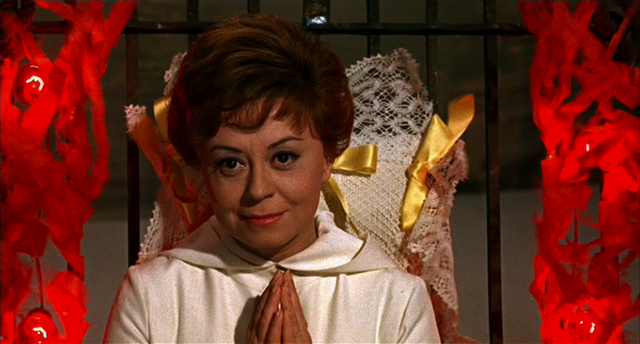
Directed by Fedrico Fellini which he co-wrote with collaborators Ennio Flaiano and Tullio Pinelli along with Brunello Rondi. Giulietta degli Spiriti tells the story of a woman who explores her subconscious as she delves into the world of her sexy neighbor. Oppressed by her mundane life and her cheating husband, the woman goes into a surreal world where she faces many dreams and nightmares. A film that revels into Fellini's fascination with surrealism, it's also the first feature-length film he made in color as it would be considered as one of his finest films of his career. Starring Fellini regulars Giulietta Masina and Sandra Milo plus Mario Pisu, Valentina Cortese, Valeska Gert, Jose Luis de Villalonga, and Caterina Boratto. Giulietta degli Spiriti is an eerie yet spellbinding film from Federico Fellini.
It's an anniversary party for Giulietta Boldrini (Giulietta Masina) and her husband Giorgio (Mario Pisu). Attending the party is Giulietta's friend Valentina (Valentina Cortese), Dolores (Silvana Jachino), and a clairvoyant named Genius (Genius). The clairvoyant decided to contact spirits for the party with several people while Giorgio and his friend are outside. During the party, Giulietta faints though she quickly recovers. The next day during the beach with her friends and sisters Adele (Luisa Della Noce) and Sylva (Sylva Koscina), surreal images start to appear that features an old man while her neighbor Suzy (Sandra Milo) makes an appearance at the beach. Later that day, Giulietta and her sisters meet their mother (Caterina Boratto) who wonders why Giulietta always put on an understated appearance.
When Giorgio returns home from work, they watch a TV program where later that night, he utters the name Gabriella in his sleep. Giulietta later asks him as he claims he has no idea what he said as Val visits to invite her to a seance with their friend Elena (Elena Fondra). During that seance, Giulietta talks to a spiritual guru (Valeska Gert) who speaks of Giulietta's problems with her marriage and what she should do. Giulietta becomes troubled by the images where she suddenly recalls a fascinating memory involving her grandfather (Lou Gilbert) and a circus ingenue (Sandra Milo). Returning home, she is encountered by a friend of Giorgio named Jose (Jose Luis de Villalonga) who makes sangria for her as he reveals about his world of bullfighting. Giulietta finds herself amazed by Jose though her suspicions of Giorgio's philandering is raised. Turning to Adele for help, they go to a private detective and a psychiatrist for help in order to confirm Giulietta's suspicions.
When a cat appears in Giulietta's backyard, she realizes it belongs to her neighbor Suzy as she goes to Suzy's lavish home filled with a variety of people as they quickly befriend one another. Even as Suzy tries to get Giulietta to open up sexually while taking her to her secret tree house. After getting a call from the private investigator to reveal what is going on with Giorgio, Giulietta suddenly faces the dark truth as her world crumbles. After a party held by Suzy where she encounters strange people and a beautiful young man, Giulietta suddenly has horrifying images that recalls images of the time she was to be martyred for a school play that her late friend Laura was involved in. The images start to be around her where at a party that involves a psycho-dramatist (Anne Francine) finds Giulietta desperate to rid of these images while forced to confront her troubled marriage. After going to the home of Giorgio's mistress in hopes to confront her, she returns home as she is haunted by her troubled marriage and demons surrounding her.
The film is about a woman's life that begins to unravel after an encounter with spirits where she begins to discover her troubled marriage as well as her free-spirited neighbor. Really, it's a film about demons and a woman's inability to find a life outside of her troubled marriage. With her sisters and friends telling her that she should leave Giorgio, the big question is what's next for Giulietta? Making things worse are memories and surreal images that begin to haunt her. Including the ghost of her departed friend Laura, who died at age 15 of drowning, and her eccentric grandfather who refused to have her take part in a ceremony that had him expelled from a prestigious school.
While the script is mostly a character study of a woman's troubled state of mind along with her troubled marriage due to her husband's philandering. The film recalls a lot of Fellini's own personal life which involves his real-life marriage to the film's star Giulietta Masina. A marriage that featured rumors that Fellini himself, had been having affairs with other women at the time he was becoming this internationally-renowned director a few years back. A lot of the film's spiritual, ghostly storylines revel in Fellini's fascination with surrealism as well as his early experiments with the drug known as LSD. With his collaborators like screenwriters Tullio Pinelli and Ennio Flaiano along with Brunello Rondi working on this story. The result is truly a film that delves into the world of death, spirituality, and marriage all surrounding a woman's state of mind.
Fellini's direction, being that it is his first film in color, reveal a new maturity in the director. Though the film at times lags in certain spots, it does show that Fellini is still as engaging in his camera work and presentation. With lavish scenes involving the circus and parties that are colorful yet surreal. It has images and scenes that are truly striking while his camera has great compositions on how he shoots the characters. There's times that the faces are darkened only to be shown fully for dramatic effect. At the same time, the camera rarely has a close-up on Sandra Milo throughout the entire film. Still, the images Fellini creates through some amazing visual effects to the lavish art direction shows that he can still create unforgettable images that dazzles the mind of the audience.
Cinematographer Gianni Di Venanzo does some fabulous with the film's rich, colorful cinematography from the exquisite, sunny exteriors on the daytime scenes, notably the look of the scenes in the woods to the dream-like nighttime exteriors of the house that Giulietta and Giorgio live in. The interior scenes, notably the home of Suzy and the scenes with the circus all awash with bright colors to give it a lavish look. Di Venanzo's work that includes some great zoom shots are entrancing to watch in every scene and image shown on the film. Editor Ruggero Mastroianni does some excellent work with the film's transitional cuts, dissolves, and other quick fade-to-black styles. While the editing is mostly conventional yet stylized, it has moments where it lags in the pacing though does work in its dramatic effect in several scenes.
Production designers Giantito Burchiellaro, Luciano Ricceri, and E. Benazzi Taglietti along with set decorator Vito Anzalone, and art director/costume designer Piero Gherardi is marvelous in the look of the home of Giulietta with its trees and gardens along with the look of Suzy's home. The production design on the circus scenes are extravagant yet wonderful in the presentation as it's one of the film's technical highlights. Gherardi's costume design lives up to the film's lavish production with hats, dresses, and costumes that really plays up to the posh lifestyle of its characters. With its large hats, colorful dresses, and the clothes that Sandra Milo wears, it's another of the film's highlights in its technical work.
The sound work of Mario Faraoni and Mario Morigi is excellent in creating moments of suspense as well as bringing a ghostly sound to the film's dramatic scenes. The film's best technical highlight is the vibrant, flourishing score of Nino Rota. Rota's pieces from 1930s-1940s style jazz, electric organ-style pieces that plays to the film's dreamy, comical tone. The arrangements and melodic-driven score that Rota creates is overall fascinating and powerful. It is truly one of the most majestic and memorable film scores in the history of film.
The cast is truly amazing with memorable appearances from Alba Cancellieri as the young Giulietta, Sujata Rubener as the assistant of the spiritual guru, Elisabetta Gray & Milena Vukotic as Giuletta's maids, Alessandra Mannoukine as Suzy's mother, and Mario Connocchia as Giulietta's old headmaster. Other notable small roles like Elena Fondra as Elena, the famed clairvoyant Genius as himself, Anne Francine as the psycho-dramatist, Sylva Koscina as Giulietta's TV star sister Sylva, Silvana Jachino as Dolores, Lou Gilbert as Giulietta's grandfather, Luisa Della Noce as Adele, and as the grotesque, strange spiritual guru, Valeska Gert. Caterina Boratto is excellent as Giulietta's rich, snobbish mother while Jose Luis de Villalonga is very good as Giorgio's friend Jose.
Valentina Cortese is wonderful as Giulietta's best friend Valentina who introduces Giulietta to the world of the spirits as she becomes more intrigued by what it has done for Giulietta while being concerned for her well-being. Mario Pisu is good as Giorgio, the philandering husband who constantly lies while being unaware that his wife knows exactly what she knows he's doing. Sandra Milo is great in the role of three women where she plays the circus ingenue known as Fanny as well as a spirit named Iris. Yet, it's the role of Suzy that Milo really gets to be loose and free while providing some great scenes with Giulietta Masina as it's definitely an excellent supporting performance from the sexy yet vivacious Milo.
Finally, there's Giulietta Masina in an amazing performance as the title character of Giulietta. While it may not have the comical approach and liveliness of her famed, previous performances in La Strada and Nights of Cabiria, it's definitely of Masina's best roles. Especially for how understated she is in her reactions to situations. There's something angelic in her facial expressions that plays well to her quiet, restrained role. Even as she doesn't do a lot of over-the-top performance as she is Masina is really the heart of the film.
Released in the fall of 1965, the film drew rave reviews with critics marking another achievement for Federico Fellini. Despite winning a Golden Globe and several critics awards, the film marked the last time Fellini worked with longtime screenwriter Ennio Flaiano who had a falling out with the director of creative credits. The film also marked a new phase for Fellini as he became more interested in surreal imagery due to the work of Carl Jung that would have a huge impact on his next film, Fellini Satyricon.
While it may not reach the brilliance of films like La Strada, Nights of Cabiria, or his two previous films, Giulietta degli Spiriti is still a brilliant, colorful, and haunting film from Federico Fellini. Thanks in part to the radiant performance of Giulietta Masina, it's a film that is definitely quintessential Fellini in all of its extravagance, humor, and look. Along with a great score by Nino Rota, it's a film that revels in the world of spirits and into a woman's state of mind as she deals with her troubled marriage. Despite a few flaws, Giulietta degli Spiriti is a mesmerizing, enchanting film from Federico Fellini.
Federico Fellini Films: (Variety Lights) - The White Shiek - I, Vitelloni - (L'amore in Citta-Un'agenzia matrimoniale) - La Strada - Il bidone - Nights of Cabiria - La Dolce Vita - (Boccaccio '70-Le tentazioni del Dottor Antonio) - 8 1/2 - Histoires extraordinaires-Toby Dammit - (Fellini: A Director's Notebook) - Fellini Satyricon - (I Clowns) - Roma - Amarcord - Casanova - Orchestra Rehearsal - City of Women - And the Ship Sails On - Ginger and Fred - (Intervista) - (The Voice of the Moon)
© thevoid99 2011
Subscribe to:
Posts (Atom)