Showing posts with label mario pisu. Show all posts

Wednesday, February 08, 2012

8 1/2


Originally Written and Posted at Epinions.com on 1/2/06 w/ Additional Edits & Revisions.


Directed by Federico Fellini and written by Fellini Ennio Flaiano, Tullio Pinelli, and Brunello Rondi, 8 1/2 is the story about a director who is trying to find meaning in his life as he prepares to create a sci-fi film. Surrounded by friends, mistresses, and his frustrated wife, the director finds his own life becoming part of surreal episodes that blurs the world between fantasy and reality. Playing the director Guido Anselmi is Marcello Mastroianni, who also played lead in Fellini's previous feature film La Dolce Vita. Also starring Anouk Aimee, Claudia Cardinale, Barbara Steele, Rosella Falk, Sandra Milo, Madeleine Le Beau, Mario Pisu, Guido Alberti, and Eddra Gale. 8 1/2 is a brilliant, surreal masterpiece from the always ambitious Federico Fellini.

After a strange dream involving traffic jams and floated like a kite, the life of Guido Anselmi is a mess due to pressures of creating a new project as he joins film critic Carini Daumier (Jean Rougeul) for a day in the park. There, he is transfixed by the appearance of a young actress named Claudia (Claudia Cardinale) though Carini doesn't see her. Unsure if what he saw is true, Carini wants to know about Guido's next project as Guido admits he has no idea what it's about as he's dealing with writer's block as he sees his friend Mario Mezzabotta (Mario Pisu) and his new girlfriend Gloria Morin (Barbara Steele). Leaving at a train station, Guido awaits the arrival of his immature mistress Carla (Sandra Milo) who is asking for an available part for her friend. Guido dreams about his parents (Giuditta Rissone and Annibale Ninchi) where his producer Pace (Guido Alberti) and Guido's wife Luisa (Anouk Aimee) appear in the dream.

Arriving to his hotel as he is dealing with Pace, more journalists and a French actress named Madeleine (Madeleine Le Beau) he's hired for the film. Guido is overwhelmed as a party with journalists, a mind reader (Ian Dallas), Pace and his girlfriend (Annie Gorassini) gets crazier where mind reader reveals a message in Guido's head. Guido has a flashback of his childhood with the mysterious message as he is dealing with more insanity while receiving a call from Luisa who is coming with her friend Rosella (Rosella Falk). Another strange meeting with his embittered production assistant (Mario Conocchia) involve Guido having another fantasy with Claudia whom he believes is his ideal lead. More surreal events would involve a meeting with the Cardinal (Tito Massini) over religious themes of the film leading to Guido recalling his life as a kid (Marco Gemini) during an encounter with a strange prostitute named Saraghina (Eddra Gale).

Luisa arrives with Rosella and Luisa's sister (Elisabetta Catalano) at a car show with their friend Enrico (Mark Herron) as Guido takes them to the spaceship he's building for his film. Still, Guido admits his doubts to Rosella about his failures as an artist and as a husband to Luisa. During a lunch with Luisa and Rosella, Carla appears much to Guido's horror as he has a dream involving all of the women in his life which starts out fun and later devolves into a messy haze. Back in the real world, Guido is dealing with screen tests for parts as Luisa gives him some horrifying news. Devastated by the news, Guido is sparked by Claudia's arrival as he reveals his fantasies that as he faces more harsh truths leading up to a press conference to announce what he is going to do about his new film project.

While Federico Fellini has known to use extravagance to enhance his story, in this film he uses the extravagance for a battle between reality and fantasy. While the story and feel of the film is different than his previous feature La Dolce Vita, this and 8 1/2 do share the similarities in the internal conflicts both played by Marcello Mastroianni. In La Dolce Vita, the character of Marcello is trapped in his own world of decadence only coming to the conclusion that there could be hope. In 8 1/2, there is a similar ending where Guido is trapped in his own world as a filmmaker where he is forced to his own compromises leaving him doubtful. The escape that Guido has is in his flashbacks and fantasy yet once they collide with reality, it becomes more troubling to him. Then there's the film's ending where his co-writer tells him something that he has to think about where Guido is forced to accept things and ends things only in a way that Fellini can make endings.

The film's script is brilliant in not just the struggles of dealing with making of a picture but the collision of fantasy and reality. Fellini's direction plays to the film's struggle in his extravagant presentation from the opening scene of Guido hanging in the air like a kite to the circus-like ending. Fortunately, the extravagance doesn't distract what Fellini aimed for since many of the fantasy sequences only come out in the simplest presentation where the only thing Fellini needed was a large location and lots of people. The screenplay does a great job in moving back and forth into fiction and reality while mixing the two in a few sequences. It's really in one way, a film about escapism through a man desperate to find answers in his own reality.

Helping Fellini in his visual presentation is Gianni Di Venanzo whose black-and-white photography and lighting schemes are wonderful to convey Fellini's harsh reality of the film world and the sunlight exteriors that shows Italy at its most beautiful. Art director Piero Gherardi does an amazing job in the lavish production of the exterior scene with the rocket while capturing the realness of the Italian, upper-class lifestyle. Gherardi also does work on the film's wonderful costumes with Leonor Fini whether it's the rich clothes of Carla, the black artiness of Gloria, the most sophisticated look of Luisa, or the innocent white of Claudia. Editor Leo Cattozzo does a wonderful job in tightening the film while helping it move easily in its back-and-forth world of fiction and reality. Longtime composer Nino Rota does a great job in the film's score that is filled with exuberant, circus-like arrangements and comedic textures while the rest of classical pieces from the likes of Richard Wagner, Gioacchino Rossini, Leo Ferre, and Pyotr Ilyich Tchaikovsky.

Finally, there's the film huge cast that is filled with an array of characters. Filled with such small performances from the likes of Olimpia Cavalli, Maria Antonietta Beluzzi, Hazel Rogers, Edy Vessel, Nadine Sanders, Elisabetta Catalano, Giuditta Rissone, Annibale Ninchi, Annie Gorassini, Mark Herron, Mario Conocchia, Tito Massini, and Marco Gemini as the young Guido. Another minor actress who gives a memorable performance as the Saraghina is Eddra Gale whose presence is amazing while Ian Dallas is also wonderful as the mind reader. Yvonne Casadei is also memorable for the role as one of Marcello's mistresses in a strange, fantasy sequence. Madeline Le Beau is also good as the French actress who feels like she's untalented while Guido Alberti is great as Guido's producer.

Mario Pisu is great as Guido's old friend Mezzabotta who seeks a new life with a new girlfriend while Barbara Steele is also great as Mezzabotta's girlfriend Gloria who brings an exciting presence. Jean Rougeul gives an excellent performance as Guido's co-writer who tries to figure him out while helping deal with his own doubts. Rosella Falk is excellent as Rosella who seems to be the only female aside from Claudia who can understand Guido's anxieties as she treats him like a sibling. Anouk Aimee is great as the intelligent but frustrated Luisa who loves Guido but is frustrated in his inability to be around her. Sandra Milo is amazing as Guido's sweet but selfish Carla who is engrossed in her own lifestyle and how she often frustrates Marcello with her own lifestyle. Claudia Cardinale is lovely as Claudia with her enchanting presence and eye-wielding innocence as she represents an angel of sorts for Guido only to realize that he disappoints her.

Finally, there's Marcello Mastroianni in another iconic performance as Guido. Bringing the same coolness and anguish that he did as Marcello in La Dolce Vita, Mastroianni goes more into that anguish to bring a character that artists can relate to. While the character is flawed, Mastroianni makes sure that Guido isn't too sympathetic since he does do selfish things around him like adultery while as an artist, he is somewhat irresponsible. It's a masterful performance from the late Mastroianni who brings a bit of humor and a lot of drama while making his character entirely memorable and likeable in the end.

While not as extravagant as La Dolce Vita, 8 1/2 is a wonderfully surreal and amazing film from Federico Fellini led by another iconic performance from Marcello Mastroianni. Of the films Fellini has made in his career, this film isn't just essential but a must-see for anyone interested in Fellini. Whether you're into the decadent La Dolce Vita or the extravagance of his later films, 8 1/2 is a film that everyone must see for anyone having trouble dealing with reality and fantasy.

Federico Fellini Films: (Variety Lights) - The White Sheik - I, Vitelloni - (L'amore in Citta-unagenzia matrimoniale) - La Strada - Il bidone - Nights of Cabiria - La Dolce Vita - (Boccaccio '70-Le tentazoni del Dottor Antonio) - Juliet of the Spirits - Histoires extraordinaires-Toby Dammit - (Fellini: A Director's Notebook) - Fellini Satyricon - (I Clowns) - Roma - Amarcord - Casanova - Orchestra Rehearsal - City of Women - And the Ship Sails On - Ginger and Fred - (Intervista) - (The Voice of the Moon)

© thevoid99 2012

Saturday, October 29, 2011

Juliet of the Spirits


Originally Written and Posted at Epinions.com on 7/12/09 w/ Additional Edits.


After two back-to-back feature films that were considered landmark films for cinema, Federico Fellini was clearly the top director of Italian cinema. While Fellini was known for his unique ambitions, his art films were clearly not for everyone as some Italian filmgoers were finding themselves being drawn to the rising world of Spaghetti Westerns led by Sergio Leone and Sergio Corbucci. Yet, Fellini decided to press on with his ambitions in a film that relates to his view of surrealism entitled Giulietta degli Spiriti (Juliet of the Spirits).

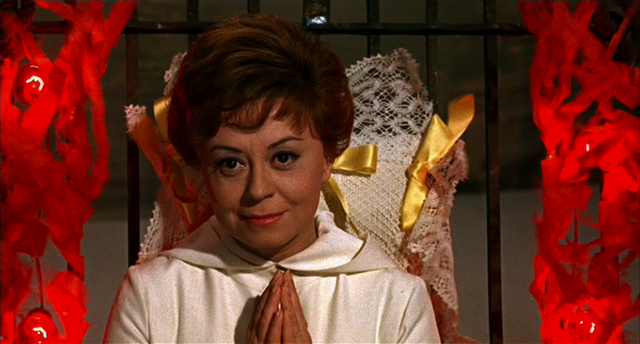
Directed by Fedrico Fellini which he co-wrote with collaborators Ennio Flaiano and Tullio Pinelli along with Brunello Rondi. Giulietta degli Spiriti tells the story of a woman who explores her subconscious as she delves into the world of her sexy neighbor. Oppressed by her mundane life and her cheating husband, the woman goes into a surreal world where she faces many dreams and nightmares. A film that revels into Fellini's fascination with surrealism, it's also the first feature-length film he made in color as it would be considered as one of his finest films of his career. Starring Fellini regulars Giulietta Masina and Sandra Milo plus Mario Pisu, Valentina Cortese, Valeska Gert, Jose Luis de Villalonga, and Caterina Boratto. Giulietta degli Spiriti is an eerie yet spellbinding film from Federico Fellini.

It's an anniversary party for Giulietta Boldrini (Giulietta Masina) and her husband Giorgio (Mario Pisu). Attending the party is Giulietta's friend Valentina (Valentina Cortese), Dolores (Silvana Jachino), and a clairvoyant named Genius (Genius). The clairvoyant decided to contact spirits for the party with several people while Giorgio and his friend are outside. During the party, Giulietta faints though she quickly recovers. The next day during the beach with her friends and sisters Adele (Luisa Della Noce) and Sylva (Sylva Koscina), surreal images start to appear that features an old man while her neighbor Suzy (Sandra Milo) makes an appearance at the beach. Later that day, Giulietta and her sisters meet their mother (Caterina Boratto) who wonders why Giulietta always put on an understated appearance.

When Giorgio returns home from work, they watch a TV program where later that night, he utters the name Gabriella in his sleep. Giulietta later asks him as he claims he has no idea what he said as Val visits to invite her to a seance with their friend Elena (Elena Fondra). During that seance, Giulietta talks to a spiritual guru (Valeska Gert) who speaks of Giulietta's problems with her marriage and what she should do. Giulietta becomes troubled by the images where she suddenly recalls a fascinating memory involving her grandfather (Lou Gilbert) and a circus ingenue (Sandra Milo). Returning home, she is encountered by a friend of Giorgio named Jose (Jose Luis de Villalonga) who makes sangria for her as he reveals about his world of bullfighting. Giulietta finds herself amazed by Jose though her suspicions of Giorgio's philandering is raised. Turning to Adele for help, they go to a private detective and a psychiatrist for help in order to confirm Giulietta's suspicions.

When a cat appears in Giulietta's backyard, she realizes it belongs to her neighbor Suzy as she goes to Suzy's lavish home filled with a variety of people as they quickly befriend one another. Even as Suzy tries to get Giulietta to open up sexually while taking her to her secret tree house. After getting a call from the private investigator to reveal what is going on with Giorgio, Giulietta suddenly faces the dark truth as her world crumbles. After a party held by Suzy where she encounters strange people and a beautiful young man, Giulietta suddenly has horrifying images that recalls images of the time she was to be martyred for a school play that her late friend Laura was involved in. The images start to be around her where at a party that involves a psycho-dramatist (Anne Francine) finds Giulietta desperate to rid of these images while forced to confront her troubled marriage. After going to the home of Giorgio's mistress in hopes to confront her, she returns home as she is haunted by her troubled marriage and demons surrounding her.

The film is about a woman's life that begins to unravel after an encounter with spirits where she begins to discover her troubled marriage as well as her free-spirited neighbor. Really, it's a film about demons and a woman's inability to find a life outside of her troubled marriage. With her sisters and friends telling her that she should leave Giorgio, the big question is what's next for Giulietta? Making things worse are memories and surreal images that begin to haunt her. Including the ghost of her departed friend Laura, who died at age 15 of drowning, and her eccentric grandfather who refused to have her take part in a ceremony that had him expelled from a prestigious school.

While the script is mostly a character study of a woman's troubled state of mind along with her troubled marriage due to her husband's philandering. The film recalls a lot of Fellini's own personal life which involves his real-life marriage to the film's star Giulietta Masina. A marriage that featured rumors that Fellini himself, had been having affairs with other women at the time he was becoming this internationally-renowned director a few years back. A lot of the film's spiritual, ghostly storylines revel in Fellini's fascination with surrealism as well as his early experiments with the drug known as LSD. With his collaborators like screenwriters Tullio Pinelli and Ennio Flaiano along with Brunello Rondi working on this story. The result is truly a film that delves into the world of death, spirituality, and marriage all surrounding a woman's state of mind.

Fellini's direction, being that it is his first film in color, reveal a new maturity in the director. Though the film at times lags in certain spots, it does show that Fellini is still as engaging in his camera work and presentation. With lavish scenes involving the circus and parties that are colorful yet surreal. It has images and scenes that are truly striking while his camera has great compositions on how he shoots the characters. There's times that the faces are darkened only to be shown fully for dramatic effect. At the same time, the camera rarely has a close-up on Sandra Milo throughout the entire film. Still, the images Fellini creates through some amazing visual effects to the lavish art direction shows that he can still create unforgettable images that dazzles the mind of the audience.

Cinematographer Gianni Di Venanzo does some fabulous with the film's rich, colorful cinematography from the exquisite, sunny exteriors on the daytime scenes, notably the look of the scenes in the woods to the dream-like nighttime exteriors of the house that Giulietta and Giorgio live in. The interior scenes, notably the home of Suzy and the scenes with the circus all awash with bright colors to give it a lavish look. Di Venanzo's work that includes some great zoom shots are entrancing to watch in every scene and image shown on the film. Editor Ruggero Mastroianni does some excellent work with the film's transitional cuts, dissolves, and other quick fade-to-black styles. While the editing is mostly conventional yet stylized, it has moments where it lags in the pacing though does work in its dramatic effect in several scenes.

Production designers Giantito Burchiellaro, Luciano Ricceri, and E. Benazzi Taglietti along with set decorator Vito Anzalone, and art director/costume designer Piero Gherardi is marvelous in the look of the home of Giulietta with its trees and gardens along with the look of Suzy's home. The production design on the circus scenes are extravagant yet wonderful in the presentation as it's one of the film's technical highlights. Gherardi's costume design lives up to the film's lavish production with hats, dresses, and costumes that really plays up to the posh lifestyle of its characters. With its large hats, colorful dresses, and the clothes that Sandra Milo wears, it's another of the film's highlights in its technical work.

The sound work of Mario Faraoni and Mario Morigi is excellent in creating moments of suspense as well as bringing a ghostly sound to the film's dramatic scenes. The film's best technical highlight is the vibrant, flourishing score of Nino Rota. Rota's pieces from 1930s-1940s style jazz, electric organ-style pieces that plays to the film's dreamy, comical tone. The arrangements and melodic-driven score that Rota creates is overall fascinating and powerful. It is truly one of the most majestic and memorable film scores in the history of film.

The cast is truly amazing with memorable appearances from Alba Cancellieri as the young Giulietta, Sujata Rubener as the assistant of the spiritual guru, Elisabetta Gray & Milena Vukotic as Giuletta's maids, Alessandra Mannoukine as Suzy's mother, and Mario Connocchia as Giulietta's old headmaster. Other notable small roles like Elena Fondra as Elena, the famed clairvoyant Genius as himself, Anne Francine as the psycho-dramatist, Sylva Koscina as Giulietta's TV star sister Sylva, Silvana Jachino as Dolores, Lou Gilbert as Giulietta's grandfather, Luisa Della Noce as Adele, and as the grotesque, strange spiritual guru, Valeska Gert. Caterina Boratto is excellent as Giulietta's rich, snobbish mother while Jose Luis de Villalonga is very good as Giorgio's friend Jose.

Valentina Cortese is wonderful as Giulietta's best friend Valentina who introduces Giulietta to the world of the spirits as she becomes more intrigued by what it has done for Giulietta while being concerned for her well-being. Mario Pisu is good as Giorgio, the philandering husband who constantly lies while being unaware that his wife knows exactly what she knows he's doing. Sandra Milo is great in the role of three women where she plays the circus ingenue known as Fanny as well as a spirit named Iris. Yet, it's the role of Suzy that Milo really gets to be loose and free while providing some great scenes with Giulietta Masina as it's definitely an excellent supporting performance from the sexy yet vivacious Milo.

Finally, there's Giulietta Masina in an amazing performance as the title character of Giulietta. While it may not have the comical approach and liveliness of her famed, previous performances in La Strada and Nights of Cabiria, it's definitely of Masina's best roles. Especially for how understated she is in her reactions to situations. There's something angelic in her facial expressions that plays well to her quiet, restrained role. Even as she doesn't do a lot of over-the-top performance as she is Masina is really the heart of the film.

Released in the fall of 1965, the film drew rave reviews with critics marking another achievement for Federico Fellini. Despite winning a Golden Globe and several critics awards, the film marked the last time Fellini worked with longtime screenwriter Ennio Flaiano who had a falling out with the director of creative credits. The film also marked a new phase for Fellini as he became more interested in surreal imagery due to the work of Carl Jung that would have a huge impact on his next film, Fellini Satyricon.

While it may not reach the brilliance of films like La Strada, Nights of Cabiria, or his two previous films, Giulietta degli Spiriti is still a brilliant, colorful, and haunting film from Federico Fellini. Thanks in part to the radiant performance of Giulietta Masina, it's a film that is definitely quintessential Fellini in all of its extravagance, humor, and look. Along with a great score by Nino Rota, it's a film that revels in the world of spirits and into a woman's state of mind as she deals with her troubled marriage. Despite a few flaws, Giulietta degli Spiriti is a mesmerizing, enchanting film from Federico Fellini.

Federico Fellini Films: (Variety Lights) - The White Shiek - I, Vitelloni - (L'amore in Citta-Un'agenzia matrimoniale) - La Strada - Il bidone - Nights of Cabiria - La Dolce Vita - (Boccaccio '70-Le tentazioni del Dottor Antonio) - 8 1/2 - Histoires extraordinaires-Toby Dammit - (Fellini: A Director's Notebook) - Fellini Satyricon - (I Clowns) - Roma - Amarcord - Casanova - Orchestra Rehearsal - City of Women - And the Ship Sails On - Ginger and Fred - (Intervista) - (The Voice of the Moon)

© thevoid99 2011