Showing posts with label anouk aimee. Show all posts
Monday, June 12, 2017
Model Shop
Written and directed by Jacques Demy, Model Shop is the story of an unemployed architect who falls for a Frenchwoman in Los Angeles as he copes with his mortality and the direction of his life. The film is a sequel of sorts to Demy’s 1961 film Lola as it’s more about a man dealing with drawbacks in his life. Starring Gary Lockwood, Anouk Aimee, and Alexandra Hay. Model Shop is a fascinating though flawed film from Jacques Demy.
The film follows a day in the life of an architect who owes money over his car as he deals with being unemployed and becoming estranged with his girlfriend as he would follow a Frenchwoman around Los Angeles where she works at a model shop. It’s a film that doesn’t have much of a plot as it explores a man coping with his own existence as well as the direction in his life where he would get news that he’s being drafted for the army. The film’s script, which would feature English dialogue by Carol Eastman, doesn’t just follow the sense of ennui that the film’s protagonist George Matthews (Gary Lockwood) is dealing with but also the fact that he is going through a lot and the recent news that’s being drafted just makes things worse. It’s when he goes to a friend asking for money, despite the fact that he already owes the guy $50, is where he first encounters this Frenchwoman named Lola (Anouk Aimee).
In Lola, she’s someone who is living in Los Angeles trying to make ends meet as she befriends George and confides in him about wanting to return to France. Yet, she also talks about aspects of her own life which would reference a few of the films that Jacques Demy did including the 1961 film named after Lola as well as characters from another Demy film in Bay of Angels. She would appear in brief instances for the first two acts yet would really come into play for its third act where she meets George again after he had photographed her at the model shop. Especially as she, like George, is going through a phase of her life unsure of what to do next as well as the fact that they’re also struggling financially.
Demy’s direction is definitely ravishing in the way he shoots and frames everything around in the city of Los Angeles as it’s a major character in the film. Avoiding many of the known landmarks of the city, Demy’s direction focuses on some of the more urban areas as well as parts of the hippie communities at the time as well as bits of the posh side during the sequence in which George follows Lola as they’re driving to a posh resident. There’s a shot during that sequence in which George gets a look of Los Angeles in this beautiful view as it displays the world that George wants to be in but couldn’t conform to the expectations of the corporate world as his friends are from the hippie community. Demy’s compositions have this sense of precise framing in the way he views Los Angeles as well as the intimacy in the scenes at the model shop and at the homes of George and Lola. Demy doesn’t emphasize too much on style as he’s more concerned with George’ sense of ennui and lack of direction where it does meander the film at times in its pacing. Still, Demy does manage to focus on the story as well as create a wonderment of two people lost in Los Angeles. Overall, Demy creates an evocative film about a directionless man who meets and falls for a visiting Frenchwoman.
Cinematographer Michel Hugo does excellent work with the film’s cinematography as it play into the gorgeous look of the locations in Los Angeles for the scenes in the day and nighttime exteriors. Editor Walter Thompson does nice work with the editing as it is largely straightforward with some jump-cuts in some parts of the film. Production designer Kenneth A. Reid and set decorator Antony Mondello do fantastic work with the look of the homes that the characters live in as well as the interiors of the model shop. Costume designers Gene Ashman and Rita Riggs do terrific work with the costumes from the casual look of George to the stylish white dress of Lola. The sound work of Les Fresholtz, Arthur Piantadosi, and Charles J. Rice is superb as it captures the way airplanes sound flying by as well as the raucous world of the hippie community and the locations in Los Angeles. The film’s music by the band Spirit is amazing for its mixture of low-key folk rock music with bits of psychedelia that play into George’s journey as the soundtrack also include some classical music pieces.
The film’s wonderful cast feature some notable small roles from Carol Cole as Lola’s roommate Barbara, Tom Holland (as Tom Fielding) as Gloria’s friend Gerry, Severn Darden as a camera shop owner, the band Spirit as themselves, and Alexandra Hay as George’s model girlfriend Gloria who is frustrated with his lack of progress in life. Gary Lockwood is alright as George as this man who copes with his impending draft notice as well as lack of direction where it’s not a bad performance but not a very engaging one as it’s a major flaw of the film. Especially as he wasn’t the original choice for the role as Demy wanted a then-unknown actor by the name of Harrison Ford for the role which would’ve made it more interesting. Finally, there’s Anouk Aimee in an incredible performance as Lola as a Frenchwoman who is trying to make ends meet working at a model shop as she tries to return home to be with her son as she is intrigued by George while lamenting her own situation in life.
Model Shop is a stellar though somewhat lackluster film from Jacques Demy. Despite Gary Lockwood’s somewhat bland performance, the film still offers something intriguing in terms of its visuals, music soundtrack, and Anouk Aimee’s radiant performance. In the end, Model Shop is a fine film from Jacques Demy.
Jacques Demy Films: (Lola (1961 film)) - Bay of Angels - The Umbrellas of Cherbourg - The Young Girls of Rochefort - Donkey Skin - (The Pied Piper (1972 film)) - A Slightly Pregnant Man - (Lady Oscar) - (La Naissance du Jour) – Une chambre en ville - (Parking (1985 film)) - (Three Places for the 26th) - (Turning Table)
© thevoid99 2017
Thursday, September 17, 2015
The World of Jacques Demy
Written and directed by Agnes Varda, L’univers de Jacques Demy (The World of Jacques Demy) is a documentary in which Varda pays tribute to her late husband through the films he made as well as his life. Featuring interviews with those that worked with him, the film is a look into one French cinema’s finest filmmakers. The result is a lively and touching portrait of one of the great filmmakers that ever lived.
Among the filmmakers who emerged during the era of the French New Wave, Jacques Demy was someone who didn’t fit in with that movement due to his love for American musicals and fantasy as he would cultivate a career that is considered one of the finest in cinema. Created in the span of two years, Agnes Varda creates not just a solemn tribute to her husband but would also interview some of his collaborators, fans of his work, and the actors that worked with him. Even as Varda goes into detail about his own life with the aid of their children, her sister-in-law, and old friends as well as the places he grew up in as the town would also pay tribute to the filmmaker.
Through various film clips and rare behind-the-scenes footage which would feature those anyone wouldn’t expect in a Demy film set like Jim Morrison at the set of Donkey Skin who would give Delphine Seyrig’s son his autograph. The actors such as Michel Piccoli, Jeanne Moreau, Catherine Deneuve, Dominique Sanda, Anouk Aimee, Jacques Perrin, Nino Castelnuovo talk about their experiences working with Demy and his films. Much of it show that they all have pleasant experiences with him where Deneuve recalled doing The Umbrellas of Cherbourg as the first time she felt she was working with a real filmmaker. Many of his films are covered including the ones that weren’t successful like Lady Oscar and Parking where clips of interviews by Demy talk about the way things are in the industry where not all of his films are successful.
The film also showcases Demy’s brief flirtation in Hollywood when he was making Model Shop as a sequel to Lola with Anouk Aimee where the original male lead was supposed to be an up-and-coming actor named Harrison Ford who is also interviewed where he talks about how much Demy and one of the film’s producer wanted him to be in the film. Instead, studios chose Gary Lockwood of 2001: A Space Odyssey for the role which Demy wasn’t happy with though the resulting film was something Demy thought was good but not great. With the aid of cinematographers Stephane Krausz, Peter Pilafian, and Georges Strouve, along with editor Marie-Josee Audiard and the sound work of Thierry Ferreux and Jean-Luc Rault-Cheynet, Varda chose a different approach to narrative where she goes for a more non-linear look into Demy’s life and work.
Adding to the film’s whimsical tone are the music pieces by Michel Colombier and Michel Legrand who are both featured in the film as they talk about Demy’s approach to music. Much of the music that appears in the film is from Demy’s films as it adds to his love for music and what it means to him. Even as some fans of his films including some ordinary people know some of the songs by heart as the actors in those films would sing bits of these songs. It adds to the power of Demy’s influence and the impact he made in the world of films.
L’univers de Jacques Demy is a phenomenal film from Agnes Varda. It’s not just one of Varda’s finest documentaries but also a touching and exhilarating tribute to her late husband in Jacques Demy. Notably as it’s a film that displays some unique surprises about Demy and his work and how much he means to audiences all over the world. In the end, L’univers de Jacques Demy is a sensational film from Agnes Varda.
Agnes Varda Films: Diary of a Pregnant Woman - Du cote de la cote - La Pointe Courte - Cleo from 5 to 7 - Le Bonheur - (Les Creatures) – (Far from Vietnam) – (Lions Love) – (Daguerreotypes) – One Sings, the Other Doesn’t – (Murals Murals) – (Documenteur) - Vagabond - (Jane B. by Agnes V.) – ((Le Petit Amour) – (Jacquot de Nantes) – (The Young Girls Turn 25) – (One Hundred and One Nights) – The Gleaners & I - (The Gleaners & I: Two Years Later) – (Cinevardaphoto) – (Some Windows of Noirmoutier) - (The Beaches of Agnes) – (Faces Places) – (Varda by Agnes)
© thevoid99 2015
Wednesday, May 21, 2014
2014 Cannes Marathon: A Man and A Woman
(Co-Winner of the Palme d’Or at the 1966 Cannes Film Festival)
Directed shot, and co-edited by Claude Lelouch and written by Lelouch and Pierre Uyterrhoeven, Un homme et une femme (A Man and a Woman) is the story about a widow and a widower who both meet at their respective children’s boarding school as they both forge a relationship based on loss as well as memories of the past. The film is an exploration into how a man and a woman meet and fall in love as well as explore the world of grief. Starring Anouk Aimee and Jean-Louis Trintignant. Un homme et une femme is a ravishing and enchanting film from Claude Lelouch.
There’s usually a scenario when it comes to love stories about how a man and a woman meet as it’s often typical of most romantic-based films. Yet, this is a film that is very different since it is about a widow and a widower who are still mourning the loss of their spouses as they meet one day when dropping their respective child at a boarding school as Jean-Louis (Jean-Louis Trintignant) drives Anne (Anouk Aimee) to her home where the two become friends as they would spend weekends together with their kids. It’s a film that doesn’t just explore two people coming together but also in the way they deal with grief as their past with their deceased spouses are shown in flashbacks.
The film’s screenplay doesn’t have much of a plot yet it does take its time to explore this growing relationship between Jean-Louis and Anne as they talk about what they do as the former is a race car driver while the latter is a script supervisor. The flashbacks reveal not just Anne’s life where her husband Pierre (Pierre Barouh) was a stuntman as they worked together on film sets but also Jean-Louis’ life as a driver that often cause worry for his wife Valerie (Valerie Lagrange). While both of them have busy jobs as it’s the major reason why their children are at a boarding school in Deauville, they do make time to see their kids as it becomes clear how much the kids like each other as it would also play to the loneliness they’re dealing with when they’re not with the children. It would lead to the two to come together but there’s a lot of emotional baggage the two would have to deal with.
Claude Lelouch’s direction is very simple not just in terms of the compositions he creates but also in the way he deviates from convention in his approach to two-shots, close-ups, and medium shots. Notably as he often goes for something that plays into Jean-Louis and Anne dealing with their loneliness as they don’t have a lot of conversations while most of the flashbacks don’t have a lot of dialogue. Also serving as the cinematographer and co-editing the film with Claude Barrois, Lelouch aims for a very offbeat style as he shoots the film in color as well as black-and-white and sepia-based tones either to act as a flashback or scenes just involving Jean-Louis and Anne. The editing is also offbeat with its approach to jump-cuts as it plays to some of the film’s emotional tone as it can range from being upbeat to being melancholic. Overall, Lelouch crafts a very engaging and touching film about two people coming together through grief and loneliness.
Production designer Robert Luchaire does nice work with the minimal set pieces from the homes Jean-Louis and Anne live in to the restaurant they eat with their children. Costume designer Richard Marvil does terrific work with the costumes with the stylized clothes that Anne wears to the more straight-laced look of Jean-Louis. The sound work of Jean Barronet and Michel Fano is superb for the simplicity of the sound in many of the film‘s locations such as the beach the characters spend with their children along with the way the engines sound when Jean-Louis is driving. The film’s music by Francis Lai is amazing as it‘s this mix of serene orchestral music with some light-hearted jazz often accompanied by an organ as it includes some songs with lyrics by Pierre Barouh that plays into the emotional aspect of the film.
The film’s incredible cast includes some notable small roles from Simone Paris as the school headmistress, Souad Amidou as Anne’s daughter Francoise, Antoine Sire as Jean-Louis’s son Antoine, Valerie Lagrange as Jean-Louis’s late wife, and Pierre Barouh as Anne’s late husband. Finally, there’s the performances of Jean-Louis Trintignant and Anouk Aimee in their respective roles as Jean-Louis and Anne. Trintignant is brilliant as this man who is a bit of a child yet ponders what he’s lost and the guilt he carries as he starts to fall for Anne. Aimee is radiant as this woman who misses her husband as she also deals with her loneliness as she finds company in Jean-Louis. Trintignant and Aimee have great chemistry in the way they react to each other as they both display sensitivity and charm to their roles as they really are the film’s highlights.
Un homme et une femme is a remarkable film from Claude Lelouch that features outstanding performances from Jean-Louis Trintignant and Anouk Aimee. The film is a very low-key yet mesmerizing film that explores two people coming together through chance and grief while pondering the idea of moving forward. In the end, Un homme et une femme is a sensational film from Claude Lelouch.
© thevoid99 2014
Wednesday, February 08, 2012
8 1/2
Originally Written and Posted at Epinions.com on 1/2/06 w/ Additional Edits & Revisions.
Directed by Federico Fellini and written by Fellini Ennio Flaiano, Tullio Pinelli, and Brunello Rondi, 8 1/2 is the story about a director who is trying to find meaning in his life as he prepares to create a sci-fi film. Surrounded by friends, mistresses, and his frustrated wife, the director finds his own life becoming part of surreal episodes that blurs the world between fantasy and reality. Playing the director Guido Anselmi is Marcello Mastroianni, who also played lead in Fellini's previous feature film La Dolce Vita. Also starring Anouk Aimee, Claudia Cardinale, Barbara Steele, Rosella Falk, Sandra Milo, Madeleine Le Beau, Mario Pisu, Guido Alberti, and Eddra Gale. 8 1/2 is a brilliant, surreal masterpiece from the always ambitious Federico Fellini.
After a strange dream involving traffic jams and floated like a kite, the life of Guido Anselmi is a mess due to pressures of creating a new project as he joins film critic Carini Daumier (Jean Rougeul) for a day in the park. There, he is transfixed by the appearance of a young actress named Claudia (Claudia Cardinale) though Carini doesn't see her. Unsure if what he saw is true, Carini wants to know about Guido's next project as Guido admits he has no idea what it's about as he's dealing with writer's block as he sees his friend Mario Mezzabotta (Mario Pisu) and his new girlfriend Gloria Morin (Barbara Steele). Leaving at a train station, Guido awaits the arrival of his immature mistress Carla (Sandra Milo) who is asking for an available part for her friend. Guido dreams about his parents (Giuditta Rissone and Annibale Ninchi) where his producer Pace (Guido Alberti) and Guido's wife Luisa (Anouk Aimee) appear in the dream.
Arriving to his hotel as he is dealing with Pace, more journalists and a French actress named Madeleine (Madeleine Le Beau) he's hired for the film. Guido is overwhelmed as a party with journalists, a mind reader (Ian Dallas), Pace and his girlfriend (Annie Gorassini) gets crazier where mind reader reveals a message in Guido's head. Guido has a flashback of his childhood with the mysterious message as he is dealing with more insanity while receiving a call from Luisa who is coming with her friend Rosella (Rosella Falk). Another strange meeting with his embittered production assistant (Mario Conocchia) involve Guido having another fantasy with Claudia whom he believes is his ideal lead. More surreal events would involve a meeting with the Cardinal (Tito Massini) over religious themes of the film leading to Guido recalling his life as a kid (Marco Gemini) during an encounter with a strange prostitute named Saraghina (Eddra Gale).
Luisa arrives with Rosella and Luisa's sister (Elisabetta Catalano) at a car show with their friend Enrico (Mark Herron) as Guido takes them to the spaceship he's building for his film. Still, Guido admits his doubts to Rosella about his failures as an artist and as a husband to Luisa. During a lunch with Luisa and Rosella, Carla appears much to Guido's horror as he has a dream involving all of the women in his life which starts out fun and later devolves into a messy haze. Back in the real world, Guido is dealing with screen tests for parts as Luisa gives him some horrifying news. Devastated by the news, Guido is sparked by Claudia's arrival as he reveals his fantasies that as he faces more harsh truths leading up to a press conference to announce what he is going to do about his new film project.
While Federico Fellini has known to use extravagance to enhance his story, in this film he uses the extravagance for a battle between reality and fantasy. While the story and feel of the film is different than his previous feature La Dolce Vita, this and 8 1/2 do share the similarities in the internal conflicts both played by Marcello Mastroianni. In La Dolce Vita, the character of Marcello is trapped in his own world of decadence only coming to the conclusion that there could be hope. In 8 1/2, there is a similar ending where Guido is trapped in his own world as a filmmaker where he is forced to his own compromises leaving him doubtful. The escape that Guido has is in his flashbacks and fantasy yet once they collide with reality, it becomes more troubling to him. Then there's the film's ending where his co-writer tells him something that he has to think about where Guido is forced to accept things and ends things only in a way that Fellini can make endings.
The film's script is brilliant in not just the struggles of dealing with making of a picture but the collision of fantasy and reality. Fellini's direction plays to the film's struggle in his extravagant presentation from the opening scene of Guido hanging in the air like a kite to the circus-like ending. Fortunately, the extravagance doesn't distract what Fellini aimed for since many of the fantasy sequences only come out in the simplest presentation where the only thing Fellini needed was a large location and lots of people. The screenplay does a great job in moving back and forth into fiction and reality while mixing the two in a few sequences. It's really in one way, a film about escapism through a man desperate to find answers in his own reality.
Helping Fellini in his visual presentation is Gianni Di Venanzo whose black-and-white photography and lighting schemes are wonderful to convey Fellini's harsh reality of the film world and the sunlight exteriors that shows Italy at its most beautiful. Art director Piero Gherardi does an amazing job in the lavish production of the exterior scene with the rocket while capturing the realness of the Italian, upper-class lifestyle. Gherardi also does work on the film's wonderful costumes with Leonor Fini whether it's the rich clothes of Carla, the black artiness of Gloria, the most sophisticated look of Luisa, or the innocent white of Claudia. Editor Leo Cattozzo does a wonderful job in tightening the film while helping it move easily in its back-and-forth world of fiction and reality. Longtime composer Nino Rota does a great job in the film's score that is filled with exuberant, circus-like arrangements and comedic textures while the rest of classical pieces from the likes of Richard Wagner, Gioacchino Rossini, Leo Ferre, and Pyotr Ilyich Tchaikovsky.
Finally, there's the film huge cast that is filled with an array of characters. Filled with such small performances from the likes of Olimpia Cavalli, Maria Antonietta Beluzzi, Hazel Rogers, Edy Vessel, Nadine Sanders, Elisabetta Catalano, Giuditta Rissone, Annibale Ninchi, Annie Gorassini, Mark Herron, Mario Conocchia, Tito Massini, and Marco Gemini as the young Guido. Another minor actress who gives a memorable performance as the Saraghina is Eddra Gale whose presence is amazing while Ian Dallas is also wonderful as the mind reader. Yvonne Casadei is also memorable for the role as one of Marcello's mistresses in a strange, fantasy sequence. Madeline Le Beau is also good as the French actress who feels like she's untalented while Guido Alberti is great as Guido's producer.
Mario Pisu is great as Guido's old friend Mezzabotta who seeks a new life with a new girlfriend while Barbara Steele is also great as Mezzabotta's girlfriend Gloria who brings an exciting presence. Jean Rougeul gives an excellent performance as Guido's co-writer who tries to figure him out while helping deal with his own doubts. Rosella Falk is excellent as Rosella who seems to be the only female aside from Claudia who can understand Guido's anxieties as she treats him like a sibling. Anouk Aimee is great as the intelligent but frustrated Luisa who loves Guido but is frustrated in his inability to be around her. Sandra Milo is amazing as Guido's sweet but selfish Carla who is engrossed in her own lifestyle and how she often frustrates Marcello with her own lifestyle. Claudia Cardinale is lovely as Claudia with her enchanting presence and eye-wielding innocence as she represents an angel of sorts for Guido only to realize that he disappoints her.
Finally, there's Marcello Mastroianni in another iconic performance as Guido. Bringing the same coolness and anguish that he did as Marcello in La Dolce Vita, Mastroianni goes more into that anguish to bring a character that artists can relate to. While the character is flawed, Mastroianni makes sure that Guido isn't too sympathetic since he does do selfish things around him like adultery while as an artist, he is somewhat irresponsible. It's a masterful performance from the late Mastroianni who brings a bit of humor and a lot of drama while making his character entirely memorable and likeable in the end.
While not as extravagant as La Dolce Vita, 8 1/2 is a wonderfully surreal and amazing film from Federico Fellini led by another iconic performance from Marcello Mastroianni. Of the films Fellini has made in his career, this film isn't just essential but a must-see for anyone interested in Fellini. Whether you're into the decadent La Dolce Vita or the extravagance of his later films, 8 1/2 is a film that everyone must see for anyone having trouble dealing with reality and fantasy.
Federico Fellini Films: (Variety Lights) - The White Sheik - I, Vitelloni - (L'amore in Citta-unagenzia matrimoniale) - La Strada - Il bidone - Nights of Cabiria - La Dolce Vita - (Boccaccio '70-Le tentazoni del Dottor Antonio) - Juliet of the Spirits - Histoires extraordinaires-Toby Dammit - (Fellini: A Director's Notebook) - Fellini Satyricon - (I Clowns) - Roma - Amarcord - Casanova - Orchestra Rehearsal - City of Women - And the Ship Sails On - Ginger and Fred - (Intervista) - (The Voice of the Moon)
© thevoid99 2012
Monday, January 30, 2012
La Dolce Vita
Originally Written and Posted at Epinions.com on 9/22/04 w/ Additional Edits & Revisions.
Directed by Federico Fellini and written with Ennio Flaiano, Tullio Pinelli, and Brunello Rondi, La Dolce Vita (The Sweet Life) is the story of an Italian reporter whose life of decadence leads to tragic consequences and realization after encounters with an actress, a socialite, a religious commune, and his suicidal girlfriend. While the film conveys realism, Fellini also brings mayhem to the screen where there are moments that questions morality, sexuality, socialism, and humanity itself. Shot in black-and-white with cinematographer Otello Martelli, the movie plays like a circus with surreal images that seem to bend the world of reality and fantasy. Starring Marcello Mastroianni, Yvonne Furneaux, Anouk Aimee, Anita Ekberg, and Alain Cuny. La Dolce Vita is a brilliant, sensational masterpiece from one of the greatest filmmakers ever put in the face of the earth.
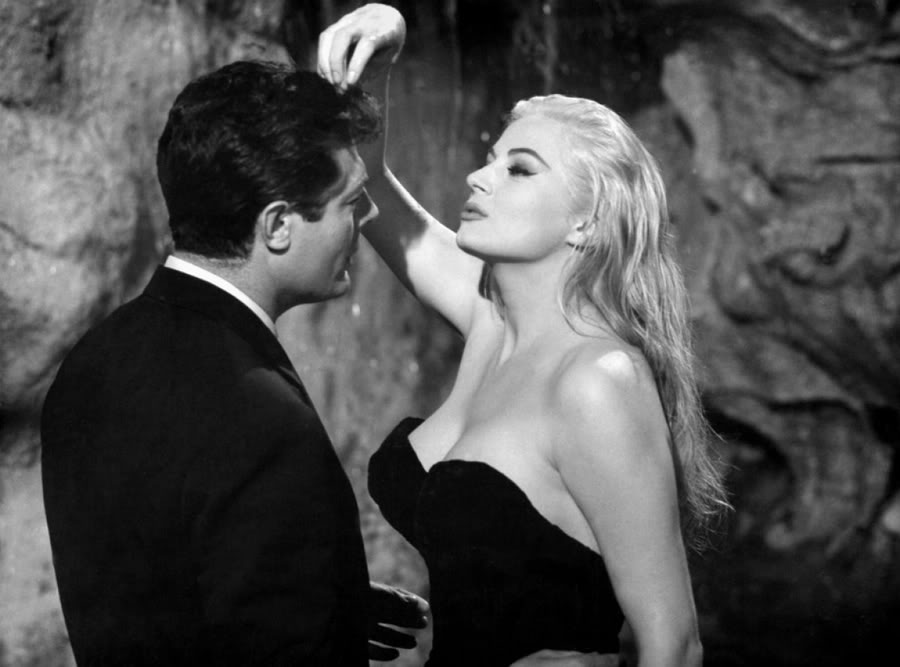
Marcello Rubini (Marcello Mastroianni) is a reporter riding on a helicopter that is carrying the statue of Jesus Christ above Rome as he later joins his photographer friend Paparazzo (Walter Santesso) at a nightclub. After meeting with a bored socialite in Maddalena (Anouk Aimee), Marcello takes for a ride and sleeps with her only to return home to deal with his self-destructive love Emma (Yvonne Furneaux). To report on the arrival of an American actress named Sylvia (Anita Ekberg), Marcello attends a press interview with the charming but not-so-bright actress who brought her boyfriend Robert (Lex Barker). Marcello takes Sylvia on a tour of Rome where they later go to a party with her friend Frankie Stout (Alan Dijon) and the alcoholic Robert. Leaving the party with Marcello, Sylvia frolics onto the Trevi Fountain as Marcello is in awe of her.
Despite having a life with all of its glamor, Marcello seeks to become a serious writer as he seeks the advice of his friend Steiner (Alain Cuny) who invites him to a party. Taking Paparazzo and Emma on an assignment on a sighting of the Virgin Mary claimed by two children. The event becomes an emotional turning point for both Marcello and Emma as they later attend Steiner's party as they meet his wife (Renee Longanni) and various friends. Envious of the life that Steiner has, he takes a job offer from Steiner only to realize that not everything is as it seems. In his attempt to write a novel and be away from Rome, Marcello meets a young waitress named Paola (Valeria Ciangotti) who gives him an idea of a life outside of the world he's lived in.
Reluctantly returning to Rome, Marcello takes his father (Annibale Ninchi) for a night on the town where they meet another of Marcello's friend in Fanny (Magili Noel). The night seems to be fun until his father had a brief heart attack prompting Marcello to question his own lifestyle. Attending another party with Maddalena and some friends to a strange party at a ruined home, Marcello starts to deal with his own faults as his relationship with Emma crumble. After another party and some tragic news, Marcello begins to question about the world he's lived in.
What makes La Dolce Vita such a rapturous film is Fellini's whimsical approach into taking a man's simple odyssey of life through a world of decadence. The film both plays itself to the point where things are way off and doesn't seem right yet at the same time, its lavish tone makes the film seem to make everything go crazy where it almost falls apart, but in a grand, Fellini way. The film truly belongs to Fellini since he's a man who likes everything to be a spectacle with the opening scene and all the cabaret things going in the night club to the decadence of the parties, including the final one where Marcello forces a woman named Nadia (Nadia Gray) to strip down. Every image, every frame, every thing that goes on in that movie clicks where it might seem too much for a three-hour movie but there was never a dull moment going on.
Fellini, the director, is a man who seems to love an image. With cinematographer Otello Martelli, the film has this evocative, wondrous black-and-white look where everything is huge, especially if you're watching it in the theater. Martelli brings a lush, romantic look to the film, notably the Anita Ekberg scene at the Trevi Fountain with Marcello. Still, the film is Fellini where he seems to fall in love with every image and there's always a great shot in that film where everything is going on. The film's screenplay doesn't lose itself to its excess since it plays to a simple story but is expanded by its excess. The film also has many questionable themes with characters of homosexuality and heterosexuality and also questions of spirituality, morals, and humanity itself.
Really, it's a story of a man trying to find answers to move forward and seeking love while wondering if he can move away from his playboy lifestyle. It's also an existential film of sorts while this man commits sins around him as he is helpless in his own faults as a man. The film is also a satire-of-sorts that would later foreshadow the world of fame with paparazzi and celebrities so this movie is isn't just a satire but it's also a romantic, comedic, dramatic film that really has no defining genre.
With Martelli bringing in a masterful photography to the film, credit also goes to the film's crew like production designer and costume designer Piero Gheradi for bringing in a detailed perspective of upper class Italian family homes. Even with its costumes ranging from the rich, lavish clothing of the socialites to the artier clothing that the character Nicollna (Nico) wears. With the a nice, stylized editing from Leo Cattozzo that helps brings the film a nice rhythm while playing true to its story. The film's music is also diverse ranging from rock n' roll, pop, and classical musical along with a comical and romantic film score from composer Nino Rota.
Then you have the film's huge cast of actors with small and memorable performances from Nadia Grey, Lex Barker, Alain Dijon, and Polidor as the clown in the nightclub scenes. Even future Velvet Underground vocalist Nico makes a memorable appearance as a model along with Ida Galli as the American debutante in the ghost search scene. Valeria Ciangottini brings a small, charming performance as Paola in her brief moment in the film while Renee Longanni and Magali Noel brought wonderful performances in their respective supporting roles. Annibale Ninchi is a standout as Marcello's father who seems to be the kind of man who is loved despite the fact that he wasn't around for Marcello very much. Walter Santesso is memorable as Paparazzo as a man who is just seeking for the right photographs while he has to forget the morality of his job since his job is to simply, take the pictures and don't ask questions.
Alain Cury gives a haunting performance as Steiner as a man who has everything but doesn't seem to have enough as he brings darkness to Marcello's mind. Anouk Aimee is lovely as the bored socialite Maddalena with her sexiness and manipulation, notably the ghost party scene where she asks for Marcello to marry her in a strange scene where's in one room and she's in another. Anita Ekberg is probably the most memorable performance of the entire group of actresses since she frolics around in the Trevi fountain as this actress who isn't very bright. While it's not a really a great character, Ekberg gives a defining performance that would be the inspiration for starlets consumed by their fame and wonderfulness. The film's best female performance is Yvonne Furneaux as the suicidal Emma who is a woman often neglected while believing she can save Marcello from his droll lifestyle. Furneaux brings a desperation to her performance as she seeks spiritual guidance while in the film's final act, she confronts Marcello as we also get the feeling that she may not save him because she barely save herself. It's a performance that doesn't get a lot of credit in the film.
The film's greatest and most iconic performance clearly goes to the late Marcello Mastroianni as Marcello Rubini. Mastroianni delivers a performance full of charisma and cool with his big-shade sunglasses and cocky swagger. Even after this movie, Mastroianni hasn't aged even when you see him in later fares. Mastroianni also brings emotional depth to a character that may look superficial but in his search for fulfillment, we see how much Marcello struggles. It's a performance that is defiant and by the end of the film, you love him and hate him at the same time as he accepts his own destiny where at the end, you wonder what will really happen to him. It's truly one of the greatest performances in cinema.
***Updated DVD Tidbits for 9/21/06***
Ever since the 1960 release of Federico Fellini's classic film La Dolce Vita, the film for the past 35-years has been a staple on not just an essential list of great films but also one of the greatest international films of all-time. In 2004, to coincide with a DVD release from Koch Lorber, the film was re-released for a brief period of time in the theaters as the 2-disc DVD presented the film in a new, digital remastered and restored edition for a new audience. A year later, Koch Lorber released a new box set of La Dolce Vita taking everything from the 2-disc set and added a lot more for this 3-disc Deluxe Collector's Edition which includes several collectible materials and new material of special features that runs at more than two-and-a-half hours.
The first disc of DVD includes a five-minute introduction from Sideways director Alexander Payne. Payne discusses on the film's influence and how he saw the film in the early 80s when he was just a film student in Spain. Notably talking about the influence of Fellini and how it would inspire him as a screenwriter and director where the film would show its influence for his 2004 classic film Sideways, notably the protagonist of Miles portrayed by Paul Giamatti. The film is shown in its 16x9 widescreen format along with original mono and 5.1 Stereo Surround Sound. Featuring English and Spanish subtitles in yellow and white letters, the film is presented both in English and Italian.
The feature-length audio commentary by noted film critic Richard Schickel reveals on the film's themes as Schickel gives his own interpretation on scenes, characters and such. Schickel takes break at times to watch a scene while giving his interpretation of the scene while giving insight into Fellini's background and the uproar he caused upon its release. Schickel's expertise in films really is educational on how he talks about the way Fellini shoots to the relationships Marcello has with all of the major characters. It's overall some of the best commentary of the film.
The second disc is filled with an hour's worth of material that starts off with a 35-minute collection of shorts and vingettes known as Fellini TV. Anyone aware of Fellini's work will get the idea. Everything from a puppet playing Dante selling watches, women in decadent, medieval clothing selling shoes, facial aerobics, a rock band going nuts, a singer executed, an Islamic heading mixed in with a debate on feminism to a funeral where it's a wine commercial. All of these little shorts and mock-commercials that are produced by the legendary Alberto Grimaldi are sometimes enjoyable and sometimes, purely self-indulgent. Still, they're very fun to watch right to the end about a joke involving a cow taking a dump. The four-minute Cinecetta-The House of Fellini is a musical montage that takes a tour of the offices and possessions of Fellini that reveals everything from statues, drawings, photographs, and chairs that is like a museum of sorts but shows his contribution to the famed studio.
The 12-minute Remembering the Sweet Life-Interviews with Marcello Mastroianni and Anita Ekberg includes a 1987 interview with Ekberg, a 1990 interview with Mastroianni at the 1990 Venice Film Festival, and an old footage of the two actors watching La Dolce Vita in the film Intervista. Ekberg recalls Fellini's sweetness along with the making of the film which she enjoyed. She admits that it didn't help her career since she got badly typecasted though she still enjoys being around Fellini and Mastroianni who at the time of making the film spoke little English and she spoke little Italian by then. Mastrioianni recalls how he worked with Fellini in the film and where originally, he wanted Paul Newman for the role but couldn't get him. The interview also showed a rare clip at the Venice Film Festival where Mastroianni is awarded a lifetime achievement Golden Lion presented by Fellini himself.
The six-and-a-half minute Fellini, Roma, and Cinecetta is a rare TV interview with Fellini in the 1980s as he discusses his love for Rome and his contributions to Cinecetta where he shot all of his films there. He recalls that Cinecetta is a part of Rome while shots of the city itself including the famed Trevi Fountain are shown as it reveals Fellini's love for Rome and his roots where his mother's family lived there for several generations.
The 8-minute Restoration Demo shows three important scenes on the film its old, 1960 film to its restored, remastered form. The first scene is the famous helicopter scene with the statue carrying where the original footage is light in black-and-white but with some spots on the film while on the other side of the same footage shows the restored version. The restored version is clearer yet a bit darker in its grey to show how the film looks now where it looks even better. Two other sequences for the second party scene with Anita Ekberg and the famed Trevi Fountain sequence reveals the difference in audio. The original footage shows the audio in full splendor where its loud yet some of the dubbing is off-track. In the restored version, the audio is fuller yet is aware of everything else that goes on while the dubbing is more on track while the force of the fountain in the Trevi Fountain scene is felt more.
The last major feature of the second disc is a large photo gallery feature that features stills from the film and the making of the film to present the richness and joy into the making of this masterpiece. The biographies section features the bios of Fellini along with composer Nino Rota and actors Mastroianni, Ekberg, and Anouk Aimee. The filmography section reveals the extensive work of Fellini, Mastroianni, Ekberg, Aimee, and Yvonne Ferneaux. The second disc also includes a link to the Koch Lorber label along with several trailers of films from the company including Jacques Demy's The Umbrellas of Cherbourg and The Five Obstructions from Lars von Trier and Jorgen Leth.
The third disc begins with one-hour documentary on film composer Nino Rota. Entitled A Musical Friend-The Maestro Nino Rota, the documentary explores his background as a child prodigy who made orchestras and operas by age 11 while considered to be one of the most gifted composers of his young age. Born in 1911, Rota came into films by the late 30s at a time when Italy was under the rule of Fascism and was only doing it to keep working. After World War II, Rota took his time away from his operas, film scores, and orchestral pieces to be a teacher at a conservatory where two of his pupils are interviewed about his work method and how he can create melodies through a theme he often uses. Directors Lina Wertmuller and Franco Zeferelli discuss his collaboration with directors, notably Fellini, Luchino Visconti, and Zeferelli himself who is aware that when he was making Romeo & Juliet, Rota took his time into making a score that was in tune with the time of the story. Wertmuller talks about his collaboration with Fellini where despite their different approach to creativity, it was magical as the two loved each other's company as Rota worked on nearly every film of Fellini since 1952 when they first met. The doc also discusses briefly on his work in other films including his most famous work for The Godfather movies.
Another interview with Anita Ekberg arrives in a new 2004 interview. The 19-minute interview reveals Ekberg talking about her film career and how she became an actress working in a production company for John Wayne. She also talked about her role in La Dolce Vita where she admits, wasn't much of a stretch as she played a bit of herself and other movie stars at the time. She also talked about how she often liked to go barefoot where she cut her foot on the night they were going to prepare the famous Trevi Fountain scene. When they went to prepare that scene before production in the winter, it was very cold and she felt very sorry for Marcello Mastroianni who was scared to go into the water and actually fell into the fountain flat on his face. She nearly got sick in that fountain while was more worried for Mastroianni. She also discussed her friendship with Fellini where his wife had suspected that they had an affair which she claims was untrue that she and Fellini were great friends. She also talked about the film's release where it nearly got banned by the Vatican in its release and for 20 years in Spain, the film was banned.
The next interview is an old 1960, four-and-a-half minute interview with Fellini about the film's controversy where he talked about an irate couple who tried to kill each other after watching the movie. He also talked about why his film shouldn't be taken seriously since it's a work of fiction while responding to the criticism he's received including from directors like Luchino Visconti and Roberto Rossellini. The 1960 Cannes Film Festival interview with Marcello Mastroianni is a two-and-a-half minute spot where Mastroianni tries to talk about the film's reaction at the Cannes Film Festival. Mastroianni is aware that the film has divided audiences while he does his best to respond to what people think and stuff.
Two more interviews arrive from colleagues of Fellini. First is an 8-minute discussion with one of Fellini's close friends in Rinaldo Gelend. Gelend discusses the themes of the film while doing a lot of the casting and talking about Fellini's own relationship with his often absent father. Geland also had claims that Fellini did have an affair with Ekberg along with other actresses because he loved women too much. The second interview is rare footage from Tullio Pinelli, one of the last surviving screenwriters behind the film. The six-minute interview revealed how Pinelli met Fellini and their collaboration on a script that eventually became La Dolce Vita. Pinelli discusses themes, notably about two characters he created, the girl Paola and the character of Steiner. A bonus interview comes from a recent documentary about Fellini from actor Donald Sutherland where he briefly talks about Fellini and La Dolce Vita and how Mastroianni almost didn't do the film. Sutherland also talked about when he was making Casanova, Fellini received a telegram from Universal who were honored to work with him and wanted to please him where Fellini gave a response.
Added to the box set which is presented in a large, leather-like packaging with a gold drawing of Anita Ekberg walking around are two different essays on the film. The first is a 40-page collector's booklet featuring an essay from Peter Bondanella, an expert in the works of Fellini. Bondanella discusses Fellini's career and the uproar of La Dolce Vita when it was released since it challenged a lot of moral behaviors and images that angered the Catholic church. The essay talked about the filming details which began in March of 1959 and finished shooting in August of that year before its official release in Italy on February 1960. Bondanella discusses the themes and character development that is in the film and its importance to cinema.
The second essay from Dennis Bartok discusses the film's impact on culture and media along with its success in giving Fellini international prestige. Though much shorter than Bondanella's essay, Bartok does revel in its impact along with its testament that when Marcello Mastroianni died in 1996, the famed Trevi Fountain was shut down and draped in black to mourn the famed superstar. Bartok also briefly discusses on the film's impact on fashion where the film has reveled in its decadence and such. Finally, there's two collectibles that fans of the film would enjoy. First is a large, 11"x17" poster of the film itself. The second collectible are five 5"x7" photographs in black-and-white that reveals the iconic images of the film. In the end, this 3-disc Deluxe Collector's Edition is a must-have for anyone who is a big fan of the film.
***End of DVD Tidbits***
La Dolce Vita is an extraordinary yet exciting film from Federico Fellini featuring an outstanding performance by Marcello Mastroianni. With dazzling yet surreal images, Nino Rota's sumptuous score, and an amazing ensemble cast. It's a film that remains very lively and hypnotic more than 50 years since its release. For anyone wanting to figure out who Fellini is, this is the best place to start. In the end, La Dolce Vita is a timeless yet magnificent film from Federico Fellini.
Federico Fellini Films: (Variety Lights) - The White Sheik - I, Vitelloni - (L'amore in Citta-unagenzia matrimoniale) - La Strada - Il bidone - Nights of Cabiria - (Boccaccio '70-Le tentazoni del Dottor Antonio) - 8 1/2 - Juliet of the Spirits - Histoires extraordinaire-Toby Dammit - (Fellini: A Director's Notebook) - Fellini Satyricon - (I Clowns) - Roma - Amarcord - Casanova - Orchestra Rehearsal - City of Women - And the Ship Sails On - Ginger and Fred - (Intervista) - (The Voice of the Moon)
© thevoid99 2012
Subscribe to:
Posts (Atom)