Showing posts with label elias koteas. Show all posts
Tuesday, July 17, 2018
Two Lovers (2008 film)
Inspired by Fyodor Dostoyevsky’s short story White Nights, Two Lovers is the story of a man who returns home to New York City as he finds himself engaged to a woman when he falls for a neighbor. Directed by James Gray and screenplay by Gray and Richard Menello, the film is an unusual romantic triangle where a man finds himself falling for a beautiful woman but also wants to be a good man to his fiancé. Starring Joaquin Phoenix, Gwyneth Paltrow, Vinessa Shaw, Elias Koteas, Moni Moshonov, and Isabella Rossellini. Two Lovers is a rapturous and intoxicating film from James Gray.
The film revolves around a troubled man who finds himself in a love triangle with a beautiful neighbor he’s fallen for and a woman whose father wants to buy his parents’ laundromat business. It’s a film that plays into a man dealing with not just in love with two different women but also the fact that he’s still reeling from heartbreak as he is unsure of what to do. The film’s screenplay by James Gray and Richard Menello opens with Leonard Kraditor (Joaquin Phoenix) walking near a creek on his way home as he thinks about his former fiancée who broke up with him as he jumps off a bridge in a suicide attempt. He is saved but still has to return home unaware that his parents are having a meeting with the people who are going to buy their laundromat as they’re bringing in their daughter Sandra Cohen (Vinessa Shaw) who is fascinated by Leonard. During this time he’s dealing with his family’s business being bought, he meets a neighbor in Michelle Rausch (Gwyneth Paltrow) as they hang out and such as he’s unaware of how troubled she is.
Throughout the course of the script, Leonard is being pulled into two spectrums as he is often leaning towards Michelle because they both share emotional and mental troubles as Leonard is still coping with a break-up as it forced him to move back to his parents. Yet, his time with Michelle would often lead to a lot of questions than answers as she is having an affair with a married law partner in Ronald Blatt (Elias Koteas) that is becoming tumultuous. It’s a relationship that is problematic yet Leonard does find himself courting Sandra who is a more grounded person and very kind but also doesn’t want to make him uncomfortable as it relates to his previous break-up. Plus, her parents like him and his parents like her a lot where they attend family events and such as he feels more relaxed around her. Still, he is enamored with Michelle who wants his help as it relates to her relationship with Ronald with Leonard’s mother Ruth (Isabella Rossellini) watching from afar.
Gray’s direction is low-key as it doesn’t emphasize too much on style in favor of aiming for an intimate story of a man torn between two women. Shot mainly on the Brighton Beach area in Brooklyn in New York City with some of the films shot on New York City, the film does play into this environment that is largely working-class but also a world that is also vibrant. Gray would use some wide shots for some of the locations including some scenes on the apartment rooftop in a few conversation scenes between Leonard and Michelle that is presented on an entire take in one shot with a few more to follow in medium shots and close-ups. Yet, much of Grey’s approach of the film is to shoot it in many rooms and apartments as well as real locations around Brooklyn to play into this world these characters live in but also one that is prospering as far as Leonard’s father Reuben (Moni Moshonov) is concerned knowing that his family laundromat is going to be a part of something big with Leonard having something to fall back on since his aspirations as a photographer hasn’t gone anywhere.
Gray’s direction also play into the idea of longing since Leonard and Michelle live in the same build but across from each other’s window as it adds intrigue to their relationship whenever they talk on the phone as Ruth is supposedly hearing the conversation though she isn’t seen. Gray’s direction also play into this temptation where Leonard is attending a Bar Mitzvah for Sandra’s brother as he spends all of his time there but gets a call from Michelle whom he sees later as Gray would make the choice of having Michelle and Sandra never meet each other though the latter does know about the former due to conversations with Leonard. The film’s climax relates to Leonard’s decision about his future and his love life as it would play into the idea of safety in Sandra or to risk it all with Michelle. Overall, Gray crafts a tender yet intoxicating film about a man torn between two women he is in love with.
Cinematographer Joaquin Baca-Asay does brilliant work with the film’s cinematography as it emphasizes on mood for its usage of sepia-based lighting for many of its interiors and scenes set at night along with more blue-grey colors for a few daytime exteriors including a scene at a restaurant with Leonard and Sandra. Editor John Axelrad does excellent work with the editing as it is straightforward to play into the drama with a few rhythmic cuts to play into some of the film’s emotional moments. Production designer Happy Masse, with art directors Marc Benacerraf and Pete Zumba plus set decorator Carol Silverman, does fantastic work with the look of the apartment that Leonard’s family lives including his messy room as well as the apartment that Michelle lives in.
Costume designer Michael Clancy does nice work with the costumes as it is largely straightforward for its Christmas holiday setting with the exception of a few stylish clothes that Michelle wears as well as a New Year’s Eve dress that Ruth wears. Sound designer Douglas Murray does superb work with the sound as it play into the atmosphere of a few party scenes as well as the sparse and quiet sounds for some of the scenes at the apartment rooftop. Music supervisor Dana Sano does terrific work in assembling the film’s soundtrack as it include some classical pieces for the film’s score as well as a mixture of hip-hop, opera, and jazz music to play into the world that the characters are in.
The casting by Douglas Aibel is wonderful as it feature some notable small roles and appearances from Anne Joyce as Leonard’s former fiancée in a dream sequence and in picture, Iain J. Bopp as Sandra’s little brother David, Samantha Ivers and Jeannie Serrales as a couple of Michelle’s friends, Julie Budd as Sandra’s mother Carol, and Bob Ari as Sandra’s father Michael who would make an offer to Leonard about his future at his company. Elias Koteas is terrific as Ronald as Michelle’s married lover who is concerned about her well-being as he asks Leonard to keep an eye on her. Moni Moshonov is superb as Leonard’s father Reuben as a man that is trying to uphold his deal in this merger as well as ensure that his son would not have to worry about his future.
Isabella Rossellini is fantastic as Leonard’s mother Ruth who is concerned about her son’s well-being as she is also wondering what is going on as she seems to know about his affair with Michelle as it’s a very low-key yet mesmerizing performance. Vinessa Shaw is amazing as Sandra Cohen as a woman whose father is buying Leonard’s family business as they start off as friends and eventually lovers as she is a woman that is kind and understanding but also someone who is willing to help him. Gwyneth Paltrow is brilliant as Michelle Rausch as a woman who lives in the same apartment as Leonard as she is someone who is charming and fascinating but also troubled due to her love of drugs and alcohol to cope with her own emotional troubles. Finally, there’s Joaquin Phoenix in an incredible performance as Leonard Kraditor as a man still reeling from heartbreak as he finds himself falling for two women as he deals with the decision he’s in but also the prospect of his own future as it’s a restrained and charismatic performance Phoenix.
Two Lovers is a phenomenal film from James Gray that features great performances from Joaquin Phoenix, Gwyneth Paltrow, Vinessa Shaw, and Isabella Rossellini. Along with its supporting cast, gorgeous locations, riveting story, and beautiful visuals, it is a romantic film that doesn’t play by the rules as well explore the idea of security and heartbreak in a romance. In the end, Two Lovers is a sensational film from James Gray.
James Gray Films: Little Odessa - The Yards - We Own the Night - The Immigrant (2013 film) - The Lost City of Z – Ad Astra – The Auteurs #67: James Gray
© thevoid99 2018
Wednesday, April 15, 2015
Gattaca
Written and directed by Andrew Niccol, Gattaca is the story of a young man who hopes to travel to outer space despite dealing with prejudice as he hides his genetic imperfections in a futuristic world where science determines who can succeed or not. The film is a mixture of sci-fi with elements of drama and mystery as it also relates to this young man who pretends to be another as he becomes a murder suspect. Starring Ethan Hawke, Uma Thurman, Jude Law, Loren Dean, Alan Arkin, Ernest Borgnine, Blair Underwood, Xander Berkley, Tony Shalhoub, Elias Koteas, and Gore Vidal. Gattaca is a riveting and evocative film from Andrew Niccol.
Set in a futuristic world where science determines one’s fate and when will that person die, the film revolves a young man who was conceived with genetic imperfections as he pretends to be another man in the hopes that he can travel to outer space. At the same time, he becomes a suspect over the death of mission control director as he learns that his younger brother is the detective leading the case. It’s a film that plays into this man who tries to prove that anything is possible in a world where one’s blood-type, urine sample, and such don’t determine one’s outcome. Yet, it is told from this man whose real name is Vincent Freeman (Ethan Hawke) who would take the guise of another man in Jerome Morrow (Jude Law) who would aid Vincent in achieving his dream.
Andrew Niccol’s screenplay is told largely from Vincent’s perspective as it begins with him learning that is one week away from actually achieving his dream to go into outer space. Yet, a simple eyelash found during the murder of the mission control director would be the one thing that might stop him as its first act reveals not just Vincent’s conception but also how he was already determined by science into when he will die and what ailments he will have. Once his younger brother Anton (Loren Dean) is born and is promised all of the things that Vincent will never have because Anton was conceived through genetic selection instead of the natural conception that brought Vincent into the world. Yet, it would be a simple swimming game of chicken where Vincent realizes that anything is possible as he would meet the paralyzed Jerome who was once a swimming star and take on Jerome’s identity while the real Jerome would provide the urine and blood samples Vincent would need.
Once Vincent’s story into how he became Jerome takes up much of the film’s first act, the second act does have a shift in tone where it becomes a mystery as Vincent not only deals with being a suspect but also falls in love with a co-worker in Irene Cassini (Uma Thurman) who is a valid but is unable to travel due to her own heart issues. Yet, she would learn firsthand about who Vincent really is just as Anton suspects that his own brother is the killer due to the loose eyelash from Vincent though Anton isn’t sure since he believes his brother had already died. Especially as his partner Hugo (Alan Arkin) looks into other possibilities as it relates to the prejudices that is hinged upon society where even Jerome was affected by it as he had all of the potential in the world to succeed but failure only made him bitter and depressed. Even as he copes with the pressure that was put upon him making him and Vincent equal of sorts.
Niccol’s direction is truly mesmerizing in terms of not just the compositions but also in presenting a futuristic sci-fi film without the need to make it totally futuristic. Much of it has Niccol shooting on various locations in California through some amazing architectural designs that does give the film a somewhat futuristic look. Niccol’s rich compositions and the way he places some of the wide shots definitely add something that a look that sort of makes it futuristic while he also goes for these kind of intricate crowd shots of exactly what Vincent does when he’s at work as it sort of plays into something that feels bureaucratic in some respects. Especially as Vincent would get a glimpse of how those with perfect genes would live and how he as an invalid would have to live and work where he would start off cleaning windows and then find his way to be part of this space program.
Niccol’s approach to close-up and medium shots are also entrancing as it also includes a few handheld moments such as a chase scene involving Vincent, Irene, and Anton. It plays into not just some of the mystery but also the drama and romance as well as Niccol’s approach to framing the actors where the flashback scenes involving a young Vincent and Anton where Vincent is in the foreground while Anton and their parents are in the background. It establishes how disconnected Vincent is with his own family as well as the world he lives in as the third act showcases him not only trying to reveal some truth to those close to him. Especially as it revealed exactly how he managed to defy the odds in a world that prevents him from achieving his dreams. Overall, Niccol creates a compelling and ravishing film about a young man prejudiced in a futuristic world where science determines one’s fate.
Cinematographer Slawomir Idziak does phenomenal work with the film’s very colorful cinematography with its usage of filters and lighting schemes for some of the film’s interiors while maintaining something that is quite ethereal in its images as it’s among one of the film’s major highlights. Editor Lisa Zeno Churgin does excellent work with the editing as it is quite stylish with some of its rhythmic cuts and usage of dissolves to play into the drama and suspense. Production designer Jan Roefls, with set decorator Nancy Nye and art director Sarah Knowles, does amazing work with the set design from the look of Jerome‘s home as well as the building where Vincent would work as Jerome along with the nightclubs and such the two would go to. Costume designer Colleen Atwood does fantastic work with the costumes from the suits that Vincent and Jerome would wear as well as the trench coat/fedora look of Anton‘s partner Hugo and the dresses that Irene would wear.
Makeup supervisor Ve Neill and key hair stylist Bette Iverson do terrific work with the look of Vincent prior to meeting Jerome and how they would have the same haircut. Visual effects supervisor Jerry Pooler does nice work with some of the minimal visual effects as it relates to spaceship that Vincent wants to board into. Sound editor Richard King does superb work with the sound to play into some of the chaotic elements of the film along with some of the textures that Vincent would endure in his training. The film’s music by Michael Nyman is incredible for its lush orchestral score with elements of minimalist and soft piano textures as it plays into the drama
The casting by Francine Maisler is marvelous as it features notable small roles from Dean Norris as a beat cop, Ken Marino as a sequencing technician, Maya Rudolph as a delivery nurse, Gabrielle Reece as a trainer where Vincent works at, Vincent Nielson and William Lee Scott in respective versions of the adolescent and teenage Anton, Mason Gamble and Chad Christ in the respective version of the adolescent and teenage Vincent, Blair Underwood as a geneticist, Jayne Brook as Vincent and Anton’s mother who loves both sons as she ponders what Vincent will do, and Elias Koteas as Vincent and Anton’s father who seems to favor Anton more than Vincent as he wants his eldest to be more realistic in his dreams. Tony Shalhoub is terrific in a small role as a mysterious man who would help Vincent attain the look and genetics to be Vincent.
Ernest Borgnine is superb as an invalid named Caesar who leads the clean-up crew as he tells Vincent not to clean too well as he would later provide evidence into who might be the killer not knowing that Jerome is really Vincent. Gore Vidal is excellent as the mission flight director Josef who tries to deal with the murder in his building while aiding the detectives. Xander Berkley is amazing as Dr. Lamar who would interview Vincent for the job as he looks into many background checks as it’s a very low-key yet mesmerizing performance. Alan Arkin is fantastic as Detective Hugo as an old-school detective who aids Anton into finding the killer as he initially suspects the invalid Vincent while he goes into looking for other clues. Loren Dean is brilliant as Anton as Vincent’s younger brother who has become a detective as he realizes Vincent is a suspect while wondering if his brother is really alive when he was supposed to.
Jude Law is incredible as Jerome as a former swimming star who has become paralyzed as he aids Vincent in achieving his dream while revealing what happened when he became paralyzed as it showcased how much he and Vincent have in common. Uma Thurman is remarkable as Irene as a woman who works with Vincent as she falls for him unaware of who he really is as she would also make some major discoveries of her own while revealing her own flaws in her genes despite being valid. Finally, there’s Ethan Hawke in a phenomenal performance as Vincent Freeman as a man who was conceived naturally with genetic flaws as he is determined to buck an unjust system while coping with his own ailments as well as what he had to do to overcome them.
Gattaca is a spectacular from Andrew Niccol that features great performances from Ethan Hawke, Uma Thurman, and Jude Law. It’s a film that isn’t just a compelling and provocative sci-fi drama but also a film that explores the ideas of what happens if science determines one’s fate. In the end, Gattaca is an enchantingly rich and tremendous film from Andrew Niccol.
© thevoid99 2015
Saturday, July 05, 2014
Desperate Hours (1990 film)
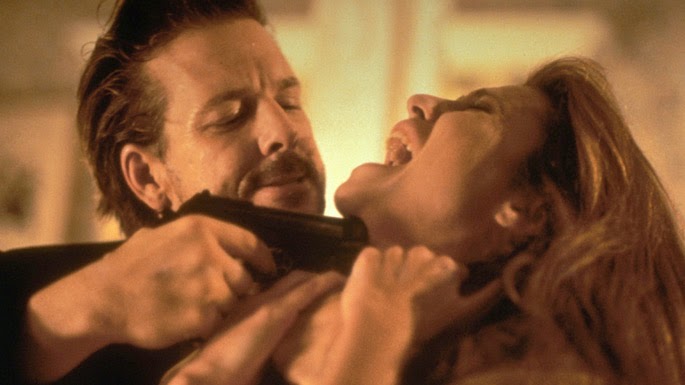
Based on the novel and play by Joseph Hayes, Desperate Hours is the story of an escaped criminal who breaks into a house and takes over while terrorizing a family with two of his friends. Directed by Michael Cimino with a screenplay by Hayes, Lawrence Konner, and Mark Rosenthal, the film is a remake of the 1955 film by William Wyler that starred Humphrey Bogart and Fredric March as it’s set in a more modern setting. Starring Mickey Rourke, Anthony Hopkins, Mimi Rogers, Kelly Lynch, Elias Koteas, David Morse, Shawnee Smith, Matt McGrath, Danny Gerard, and Lindsay Crouse. Desperate Hours is an eerie though somewhat uneven film from Michael Cimino.
The film is a home invasion story about an escaped criminal who hides out at the home of a man who has become estranged from his wife as they’re taken hostage at home. Yet, it’s a film about control and trust where the criminal Michael Bosworth (Mickey Rourke) is waiting for his lawyer/lover Nancy Breyers (Kelly Lynch) to be cleared from accusations that she was the one who broke him out of jail as he is being charged for all sorts of crimes. With the help of his brother Wally (Elias Koteas) and an unhinged, half-wit criminal Albert (David Morse), Bosworth would hide out at the home of Nora Cornell (Mimi Rogers) who is selling her home as she and her husband Tim (Anthony Hopkins) are estranged due to Tim’s infidelity with a young woman. Once Bosworth takes control of the Cornell home, he would instill elements of trust where Nora is more likely to trust Bosworth than Tim as it relates to her life and the life of their kids in the 15-year old May (Shawnee Smith) and the eight-year old Zack (Danny Gerard).
The film’s screenplay does take its time to explore a family being invaded by criminals where in control is this sociopath who is trying to make sure everything goes normal until he can flee with his girlfriend and associates with some money. Yet, the actions of Nancy Breyers only gets the attention of a very intelligent and no-nonsense FBI special agent in Brenda Chandler (Lindsay Crouse) who doesn’t buy Nancy’s act and knows where she’s going as she hopes to nab Bosworth. Though the script is pretty uneven as part of it is set at the Cornell home where Tim tries to reconcile with Nora only for things to go wrong with the Bosworth brothers and Albert taking over where Nora has trust issues with Tim. The other part of the script involves Chandler’s pursuit and watching over Nancy where it has this element of the road movie but it never really gels since Nancy is a very underwritten character who is just lovesick over Bosworth and is put into very tense situations. The scenes at the Cornell home is interesting where there is a sense of psychology as the family isn’t sure who to trust as Bosworth doesn’t try to hurt anyone while Tim tries to do something only to get himself into trouble.
Michael Cimino’s direction is pretty engaging for the way he conveys this element of suspense and dread inside a family’s home as it’s taken over by criminals. Especially as he maintains that sense of tense intimacy with some close-ups and unique medium shots where Cimino’s framing is always there to play into the drama as well as some of tension that goes on. The scenes outside of the Cornell home is shot in various locations in Utah where it plays into Cimino’s sensibilities in terms of the mountains, deserts, and such that does have this sense of beauty in the locations where Cimino is able to display them in a wide canvas. Yet, it adds to film’s uneven tone where it does feel like it’s two different films being made in some aspects though it would come together in a very intense third act. Especially as it becomes a battle of wits and trust where the FBI is also involved in Chandler who takes a more cautious but unconventional approach to let the fates play out. Overall despite a few inconsistencies in its tone, Cimino does craft a very captivating and solid thriller about a family’s home invaded by criminals.
Cinematographer Douglas Milsome does brilliant work with the film‘s cinematography with the gorgeous lighting for many of the daytime exteriors in the Utah desert/mountain locations to more ominous lighting schemes and such to play into the dramatic tension at the Cornell house. Editors Peter R. Hunt and Christopher Rouse do excellent work with the editing to create some methodical cuts to play into the film‘s suspense along with some rhythmic cuts for some of the car chase scenes involving Nancy and the FBI. Production designer Victoria Paul, with set decorator Crispian Sallis and art director Patricia Klawonn, does nice work with the look of the Cornell house to play into its sense of intimacy and the terror that Bosworth would bring.
Costume Charles DeCaro does terrific work with the costumes from the clothes of the Cornell family that is quite casual to the Armani suits that Bosworth wears. Sound editor James J. Klinger does superb work with the sound from the way the helicopters, planes, and cars sound in the exteriors to the intense atmosphere of the Cornell home as it has this air of terror in the film. The film’s music by David Mansfield is amazing for its soaring orchestral score to play into its suspense and drama along with some low-key pieces to showcase the estrangement between Tim and Nora.
The casting by Mary Colquhoun is wonderful as it features some notable small roles from James Rebhorn as a prosecutor, Matt McGrath as May’s boyfriend Kyle, Gerry Bamman as a real-estates agent, and Dean Norris as Chandler’s FBI associate Maddox. Shawnee Smith is alright as Tim and Nora’s teenage daughter May who tries to antagonize Bosworth and his gang while Danny Gerard is quite good as May’s younger brother Zack who deals with the terror of being taken hostage. Kelly Lynch is pretty terrible as Nancy Breyers where it’s not just the character that is terrible but Lynch never really does anything to make anyone care about her as she spends half the film topless and often be worried. Elias Koteas is terrific as Bosworth’s brother Wally who keeps things in control while trying to make sure that the family has nothing to worry about. David Morse is excellent as the more troubled criminal Albert who becomes anxious as he would later become a liability to the situation.
Lindsay Crouse is amazing as the no-nonsense FBI special agent Brenda Chandler who is this very offbeat character that talks in a Southern accent as she knows how to handle situations and can read people better than her fellow agents. Mimi Rogers is fantastic as Nora Cornell as this woman who becomes aware of the situation as she tries to keep things from not going wrong while being very unsure on who to trust. Anthony Hopkins is superb as the Tim Cornell as a man trying to regain his wife’s trust after cheating on her as he deals with Michael Bosworth’s presence and the situation that is happening as he is goaded to take action only to figure out what to do to not hurt his family. Finally, there’s Mickey Rouke in an incredible performance as Michael Bosworth as this very smart sociopath who takes control of an entire house as he tries to play a game of trust on Nora to turn against her own husband as it’s a very fiery and intense performance from Rourke.
While it is a film with some flaws and an inconsistent tone, Desperate Hours is still a solid film from Michael Cimino. Armed with great performances from Mickey Rourke, Anthony Hopkins, Mimi Rogers, and Lindsay Crouse. It’s a film that plays into the world of home invasion as well as a compelling look into the world of trust and guilt. In the end, Desperate Hours is a pretty good film from Michael Cimino.
Michael Cimino Films: Thunderbolt & Lightfoot - The Deer Hunter - Heaven’s Gate - Year of the Dragon - The Sicilian - The Sunchaser - To Each His Own Cinema: No Translation Needed - The Auteurs #35: Michael Cimino
© thevoid99 2014
Saturday, March 31, 2012
The Killer Inside Me
Based on the novel by Jim Thompson, The Killer Inside Me is the story of a sociopath deputy sheriff whose good-natured persona is a cover for a sinister one as he has a very troubled affair with a hooker that would lead to all sorts of trouble. Directed by Michael Winterbottom and screenplay by John Curran, the film is an exploration into the mind of a man carrying a very dark, troubled mind. Starring Casey Affleck, Jessica Alba, Kate Hudson, Ned Beatty, Tom Bower, Simon Baker, Elias Koteas, and Bill Pullman. The Killer Inside Me for all of its entrancing approach to suspense falls flat due to some very convoluted ideas.
After being asked by superior in Sheriff Bob Maples (Tom Bower) and a construction tycoon named Chester Conway (Ned Beatty), deputy sheriff Lou Ford (Casey Affleck) deals with a prostitute named Joyce Lakeland (Jessica Alba) who is having an affair with Conway’s son Elmer (Jay R. Ferguson). Yet, Lou would have a sadomasochistic affair with Joyce while having a relationship with local schoolteacher Amy Stanton (Kate Hudson). With Conway wanting Joyce out of town, she and Lou devise a plan to extort Conway as Conway and Maples agree to the payoff. Yet, Lou would do something that would change everything that would have him risk his reputation as a law-abiding officer.
While District Attorney Howard Hendricks and a local journalist named Joe Rothman (Elias Koteas) suspect Lou. There isn’t a lot of evidence about Lou though Joe knows a lot about Lou’s troubled childhood where he suggests to Lou that he should leave town. After a suspect in a young local teen named Johnnie Papas (Liam Aiken) was arrested, Lou would help the kid although things start to get more grim. When Amy wants to marry him, Lou tries to aim for a normal life until a local bum (Brent Briscoe) reveal what he knows as Lou’s life starts to unravel. Even as more suspicion would arise leading to complications where Lou would face some dark truths.
The film is about a small-town deputy sheriff whose dark mind that involves an affair with a sadomasochistic-loving prostitute leads to trouble where murder, blackmail, and all sorts of mysteries would be involved. A story like this set in the 1950s and told from the perspective of its troubled protagonist would’ve a very interesting story told. However, drawn-out story lines, underwritten characters, and lots of flashback scenes about Lou’s life end up creating a story that loses its suspense as well as its impact. Screenwriter John Curran does a good job with the film’s narration and see how Lou would execute things but some of the narration goes a little overboard at times. Curran succeeds in exploring Lou’s mind and motivation but he doesn’t do enough to make the suspense be more surprising.
Director Michael Winterbottom does a superb job in re-creating the look of 1950s Texas, though it’s shot in New Mexico, while utilizing some very entrancing compositions of the locations as well creating wonderful shots for some of the film’s dramatic moments. The problem is that he is unable to do more with the film’s script in setting up the suspense as its score would often for-tell that something is about to happen. It’s an idea that is quite clichéd with suspense as one would expect a director as unconventional with Winterbottom to do something different. Instead, Winterbottom chooses to play things straight while utilizing offbeat music to play up some of the darker moments. Then there’s Winterbottom’s approach to the film’s violence where it is one of the most unsettling moments of the film. It’s definitely one of the more unforgettable moments of the film but it is certainly not for everyone. Still, there’s a reason for its graphic depiction to dwell into Lou Ford’s sick mind. Despite that approach as well as other moments in the film, Winterbottom unfortunately doesn’t do more to make the film more visceral and entrancing as it could’ve been.
Cinematographer Marcel Zyskind does an excellent job with the film‘s very colorful cinematography from the sunny yet lush look of many of the film‘s daytime interior and exterior settings to more entrancing looks for some of its nighttime scenes. Editor Mags Arnold does a nice job with the editing in utilizing rhythmic cuts to play up Ford‘s troubled state of mind though there‘s parts where the pacing lags a bit due to its conventional approach to suspense. Production designers Rob Simons and Mark Tildesley, along with set decorator Jeanne Scott, do great work with the look of Ford‘s lavish home as well as the look of the cars and appliances of that period.
Costume designer Lynette Meyer does a wonderful job with the costumes in the design of 1950s clothing that the women wear from the more conservative dresses of Amy to the more stylish look of Joyce. The visual effects by Mark Knapton and Gus Martinez do some work in the film‘s lone visual effects scene towards the end of the film where the results aren‘t very good. Sound editor Joakim Sundstrom does terrific work with the sound to create tension in some of the film’s chilling moments as well as quieter ones such as Ford’s conversation with Johnnie Papas.
The film’s score by Melissa Parmenter and Joel Cadbury is pretty good for its low-key orchestral score though at times, it is used to help set up the suspense which only makes things seem more predictable. Music supervisor Chadwick Brown provides a nice soundtrack of country, blues, and ragtime music of the 1950s though some of the way is used was very misguided.
The casting by J.C. Cantu and Mary Vernieu is terrific for the ensemble that is created as it includes notable small roles from Liam Aiken as the young accused teen Johnnie Papas, Jay R. Ferguson as Chester’s playful son Elmer, Brent Briscoe as the mysterious bum who tries to blackmail Lou, Elias Koteas as a sympathetic journalist who tries to help Lou get out of town, and Bill Pullman as an attorney who shows up late in the film despite a very bad and over-the-top performance when he first appears in the film. Tom Bower is very good as Lou’s chief Bob Maples whose love for Lou starts to fall apart once Lou becomes a suspect as he tries to cope with it. Simon Baker is excellent as the cunning D.A. Howard Hendricks who tries to push Tom’s button’s any way he can. Ned Beatty is superb as the smarmy Chester Conway who tries to get Lou to buy out Joyce.
Jessica Alba gives a pretty decent performance as the submissive hooker Joyce who falls for Lou where Alba has a nice screen presence although she gives a very awkward performance in the film’s heavier moments. Kate Hudson is horrible as Lou’s girlfriend Amy where it’s not just that the character is underwritten but Hudson’s performance is at times over-the-top or underperformed where she seems to be sleepwalking through the role. Finally, there’s Casey Affleck in a tremendous performance as the chilling Lou Ford where Affleck brings a wonderful charm to his character that is balanced by a very dark demeanor. It’s definitely a very entrancing performance by Affleck who definitely has the right touches to play this character.
For all of its ambition and emphasis to explore the dark mind of a troubled man, The Killer Inside Me is a truly lackluster film from Michael Winterbottom. Despite Casey Affleck’s performance and some fantastic moments in the direction, the film falls short in terms of building up its suspense as well as trying to draw-up too many things about the Lou Ford character. For fans of Michael Winterbottom, the film will serve as a letdown considering the fact that he chooses to create something more straightforward while not doing enough to make the suspense genre more intriguing. In the end, The Killer Inside Me is a very disappointing film from Michael Winterbottom.
Michael Winterbottom Films: (Rosie the Great) - (Forget About Me) - (Under the Sun) - (Love Lies Bleeding) - (Family (1993 TV film)) - (Butterfly Kiss) - (Go Now) - (Jude) - Welcome to Sarajevo - I Want You - (With or Without You (1998 film)) - Wonderland (1999 film) - The Claim - 24 Hour Party People - In This World - Code 46 - 9 Songs - Tristram Shandy: A Cock & Bull Story - The Road to Guantanamo - A Mighty Heart - Genova - The Shock Doctrine (2009 film) - The Trip (2010 film) - (Trishna) - (Everyday) - The Look of Love - (The Trip to Italy) - (The Face of An Angel)
© thevoid99 2012
Saturday, August 13, 2011
Crash (1996 film)
Originally an Alternate Review Written and Posted at Epinions.com on 10/13/03 w/ Extensive Revisions.
Based on the J.G. Ballard novel, Crash is a film where a married couple seeks out new sexual thrills by watching and participating in car crashes. Written for the screen and directed by David Cronenberg, Crash is a film that pushes sex to new levels as its premise is to shock and provoke. Dealing with elements of destruction, sadomasochism, homosexuality, infidelity, and all sorts of stuff, Cronenberg takes everything to the extreme for this intense film. Starring James Spader, Holly Hunter, Deborah Kara Unger, Elias Koteas, and Rosanna Arquette. Crash is a mesmerizing yet confrontational film from David Cronenberg.
Film producer James Ballard (James Spader) and his wife Catherine (Deborah Kara Unger) are seeking some new thrills in their sex life as they even try to have sex with other people. During a ride into increasing traffic on a highway, James get himself in a car accident where he sees another injured driver who exposes her breast and masturbates following the intense crash. Suffering multiple injuries, James sees the woman named Dr. Helen Remington (Holly Hunter) who is at the same hospital where she is accompanied by man named Vaughn (Elias Koteas). Vaughn checks into James's injured leg as he's intrigued as James returns home to find his damaged car. Meeting up with Helen, the two begin an affair based on their love for traffic accidents.
When Helen takes James to a performance art show hosted by Vaughn, James watches Vaughn and a stuntman named Colin (Peter MacNeill) recreate James Dean's infamous car crash for their show as they both survived. Meeting up with a friend of Vaughn in Gabrielle (Rosanna Arquette) who is surrounded by leg and back braces, James takes part in Vaughn's cult as he brings Catherine along who finds thrills as she becomes interested in Vaughn who believes that car crashes and its destructive aftermath is a work of art. With Catherine becoming more attracted to Vaughn with James becoming uneasy, another horrific incident leaves James worried as he later has an affair with Gabrielle.
With Vaughn set to create his next big presentation with claims that it will be his masterpiece. James wonders if he and Catherine are going too far in their fetish for the chaos of car accidents.
What makes Crash intriguing is the way Cronenberg pushes things on sex and pain. With fast-paced camera work on the driving scenes by Peter Suschitzky, Cronenberg gives a look of everything that seems off and something might tick. The film as it goes by keeps on getting shocking and shocking by each scene with the ending being the icing on the cake. The real flaw of the film is in its extremities whether it’s the nature of violence or the graphic sex scenes, which features a lot of female genitalia from Unger, Arquette, and Holly as well as scenes involving Spader and Koteas with other women including themselves in a scene. Cronenberg makes sure, nothing gets off easy as he creates something that is truly confrontational and thrilling.
On the performance front, all the five main players in the film standout on their own or with the other actors where everyone seems to have some kind of chemistry whether its brilliant or discomforting. Holly Hunter brings a dark, masterful performance as Helen Remington where she proves she can be sexy and powerful as a broken soul trying to plan the next crash. Rosanna Arquette, who is always underrated, brings in a chilling, fragile performance as Gabrielle as she keeps walking on a cane and wanting more and more pain. Deborah Kara Unger is the film’s sexiest performance as she starts out as this bored woman who becomes more aroused into her own, dangerous personality. Elias Koteas is brilliant as the manipulative, psychotic Vaughn who is played with great indulgence that makes Koteas the most interesting actor in the film. James Spader is the film’s more moralistic character as he is trying to figure out if everything he’s doing is wrong while this film, would slow his career down a bit.
Crash is a chilling yet harrowing film from David Cronenberg that features a superb cast and a phenomenal premise. While it may not live up to earlier great films like Dead Ringers and Videodrome, it is a very interesting yet chaotic film that only Cronenberg can pull off. While it's definitely not a film for everyone, particularly those with extremely-conservative films. It's a film that works because it challenges the idea of what is normal as Crash is a powerful from David Cronenberg.
David Cronenberg Films: Stereo - Crimes of the Future - Shivers - Rabid - Fast Company - The Brood - Scanners - Videodrome - The Dead Zone - The Fly (1986 film) - Dead Ringers - Naked Lunch - M. Butterfly - eXistenZ - Spider - A History of Violence - Eastern Promises - A Dangerous Method - Cosmopolis - Maps to the Stars - Crimes of the Future (2022 film)
The Auteurs #26: David Cronenberg Pt 1 - Pt. 2
© thevoid99 2011
Wednesday, March 23, 2011
Shutter Island
After finally nabbing an Oscar for Best Director for his 2006 remake of the Hong Kong film Infernal Affairs entitled The Departed. Martin Scorsese was now part of a group of great directors who won the Oscar after trying to get the award several times. Scorsese took a break from feature films to direct a concert film for the Rolling Stones entitled Shine a Light in 2008 while producing various other projects including a restoration of the 1949 Powell-Pressburger classic The Red Shoes. In 2010, Scorsese returned to the big screen for a psychological thriller entitled Shutter Island.
Based on Dennis Lehane’s novel, Shutter Island tells the story of two U.S. marshals investigating a mental hospital where a patient has vanished. Upon the investigation, one of the marshals is haunted by the images of his dead wife as he believes her killer is in the island. Directed by Martin Scorsese with a script by Laeta Kalogridis along with additional work by Steven Knight. The film marks Scorsese’s fourth collaboration with actor Leonardo DiCaprio as they create a thriller that is both visually fascinating and intriguing in its story. Also starring Mark Ruffalo, Michelle Williams, Ben Kingsley, Patricia Clarkson, Emily Mortimer, Elias Koteas, Jackie Earle Haley, Ted Levine, John Carroll Lynch, and Max von Sydow. Shutter Island is an intriguing yet haunting film from Martin Scorsese and company.
It’s 1954 as two U.S. marshals named Teddy Daniels (Leonardo DiCaprio) and his new partner Chuck Aule (Mark Ruffalo) are going to Shutter Island to investigate the disappearance of a patient at a mental hospital known as Ashecliffe. Accompanied by deputy warden McPherson (John Carroll Lynch), the duo meets Dr. John Cawley (Ben Kingsley) who explains about the patient named Rachel Solando (Emily Mortimer) who had disappeared. Solando was brought in after drowning her three kids as Daniels and Aule try to interview staff members along with some patients. When Daniels want to know more by going to Cawley’s colleague Dr. Jeremiah Naehring (Max von Sydow) for more information. Daniels is rebuffed as he is troubled by headaches that feature flashbacks of his period in war along with the images of his dead wife Dolores (Michelle Williams).
With Daniels and Aule continuing their investigation during a stormy day at the island, Daniels reveals his motive to why he’s really at the island believing that a man named Andrew Laeddis (Elias Koteas) is at the island. Daniels believes that Laeddis was responsible for his wife’s death through arson as Daniels is also convinced of some experiments going on. With the two continuing their investigation, Rachel Solando has been found and is safe though the interrogation with Solando proves to be strange. With Daniels more troubled by his migraines and appearances of his wife along with Laeddis, Daniels goes on the search for more about Ashecliffe. In the aftermath of a bad storm where patients are out of the hospital, Daniels goes into the fortress where the most dangerous prisoners are held.
Daniels suddenly meets a man named George Noyce (Jackie Earle Haley) whom Daniels had tried to help. Realizing that Noyce had given him clues about the mysterious lighthouse, Daniels along with Aule try to find a path to the lighthouse where the two got separated. Aule disappears while Daniels meets a mysterious woman (Patricia Clarkson) at a cave who reveals more about the secrets of the island. With Daniels being picked up by the hospital’s warden (Ted Levine), Daniels confronts Dr. Cawley about what is going on as he decides to go to the lighthouse where he finds a shocking discovery.
The film is about a man trying to uncover mysteries about his wife’s death as well as the island where they’re keeping her killer who is possibly being part of a strange experiment. Yet, that’s the film’s plot in a nutshell but in the mind of Martin Scorsese. It’s anything but simple as it’s a film that is really a puzzle of sorts of what is really going on in the island and the people in the island. No character is who they say they are with a few exceptions. It’s all because there is something at the island that no one wants to explain right until the third act where there’s a twist involved.
Screenwriter Laeta Kalogridis creates a wonderful script that builds on the suspense of the story along with the back-and-forth movements of the story where Teddy Daniels is having flashbacks or strange dreams. The flashbacks and dreams play up to the film’s surreal style as it would unveil clues to what’s going on. The characters are also very interesting as Daniels’ partner Chuck acts as a foil of sorts but also a conscience who wants to be at Daniels’ side with everything that is happening. Dr. Cawley might seem like an antagonist since he’s always evading questions along with Dr. Naehring. All of the minor characters Daniels would interact along with the visions of Dolores would eventually lead to the twist.
The twist would definitely change all perspectives of what everyone just saw the first time around. When it is seen again for the second time, more clues are unveiled along with pieces of dialogue and how they’re presented. Overall, it’s a wonderful screenplay by Laeta Kalogridis.
Then, there’s the direction of Martin Scorsese which is truly powerful and engaging in its imagery. Taking an old-school approach to the directing, Scorsese goes for eerie zoom shots along with dolly tracks to create a mood for the film. Even as he creates wide shots for an idea of the island and its dark feel where something doesn’t seem right. Scorsese also goes for an intimate setting for some of the film’s interrogation and conversation pieces where he goes for simplicity in the presentation.
For some of the film’s broader scenes at the island, Scorsese uses some visual effects which are rich in its look. For the most part, they all look great except for one scene where Daniels is talking with the warden on the jeep as the background looks very fake. For many of the film’s fantasy sequences, Scorsese creates a look that is artificial and dream-like while playing up to the surrealism of the film. When it comes time for the twist, Scorsese makes sure that the dialogue that people heard early along with objects including the bandage in Teddy’s head early in the film mean something. Plus, Scorsese also allows a chance to put in a few references in objects such as the red shoes worn by the little girl (Ruby Jerins) as a reference to the Michael Powell/Emeric Pressburger film The Red Shoes. Despite a few flaws, it is a wonderfully stunning yet eerie film from Martin Scorsese.
Cinematographer Robert Richardson does a fantastic job with the film’s eerie yet colorful cinematography. Richardson’s work definitely plays to the film’s chilling mood with lots of dark colors to match the rainy scenes in the exteriors. Even in the prison where the lights are very stylish and moody to build up to the film’s suspense. Richardson’s photography is truly one of the film’s technical highlights for the way it brings atmosphere to the film.
Longtime Scorsese collaborator Thelma Schoonmaker does an excellent job with the film’s editing. Schoonmaker creates dazzling cuts to play with the film’s rhythm and build on its suspense. Even as she utilizes a few jump-cuts for rhythm while playing to the conversation scenes in cutting from one actor to another. Even in the transitions as Schoonmaker’s cutting is truly some of her best work in her career as an editor.
Production designer Dante Ferretti, along with set decorator Francesca Lo Schiavo and supervising art director Robert Guerra, does a fabulous job with the look of Ashecliffe hospital from its old-school wall filled with bricks including the decayed lighthouse. The look of the prison inside the hospital is eerie as it looks old and almost in ruins to help play up the film’s eerie tone. Costume designer Sandy Powell does a phenomenal job with the costumes from the clothes that Daniels and Aule wear early in the film to the suits that Dr. Cawley wears. Even in the colorful dresses that Dolores wears that plays true to the style of the 1950s.
Visual effects supervisor Rob Legato does a very good job with the visual effects from the lush look of the island in exteriors during the rainy season to the look of the flashback sequences where the effects play up to the Daniels‘ own troubled mind. Sound editors Philip Stockton and Eugene Gearty do some brilliant work in the sound from the feel of the storm along with the stark yet near-silent tone of the prison that Daniels investigate.
Music supervisor Robbie Robertson creates an amazing soundtrack that is filled with an array of eerie classical pieces that plays to the film’s suspense. Featuring classical pieces from Gustav Mahler, John Cage, Krzysztof Penderecki, Ingram Marshall, and Gyorgy Ligeti. The soundtrack also includes pieces from 1950s music like Kay Starr, Dinah Washington, Max Richter along with an ambient track from Brian Eno. The soundtrack is an excellent collection that plays well with what the film needed for its tone.
The casting by Ellen Lewis is superb as every actor in the film really hits the right notes. Notable small roles include Robin Bartlett as a patient Daniels and Aule interrogate, Ruby Jerrins as a mysterious little girl in Teddy’s dreams, Elias Koteas as the crazed Andrew Laeddis, and Ted Levine as sly warden who talks to Teddy about the island. Other small but memorable roles include Emily Mortimer as the troubled Rachel Solando, John Carroll Lynch as deputy warden McPherson, Jackie Earle Haley as the crazed George Noyce, and Max von Sydow as the calm but mysterious Dr. Naehring. Patricia Clarkson is excellent in a small role as mysterious woman in a cave who warns Daniels about Shutter Island and its lighthouse.
Michelle Williams is radiant as Dolores, Teddy’s deceased wife who appears in Teddy’s dreams and other visions as she guides him to unlock the mysteries of the island. Williams brings a sense of grace but also darkness of a character that isn’t even alive as she and DiCaprio have wonderful chemistry. Ben Kingsley is superb as Dr. Crawley, a mysterious doctor who reluctantly helps Teddy with the investigation while holding something back about what is going on. Mark Ruffalo is phenomenal as Chuck Aule, Teddy’s partner who helps in the investigation as Ruffalo plays the sidekick as well as conscience of sorts for Teddy. Even as help brings in some clues to the mysteries while being the guy to calm everyone down.
Leonardo DiCaprio is in top form as Teddy Daniels. DiCaprio brings a eerie quality to his performance as a troubled man trying to investigate a disappearance while hoping to expose the hospital for its experiments. There is a grittiness to DiCaprio’s performance as he’s someone worn down and disturbed by his own nightmares along with images of his wife appearing. While it may not top some of his previous collaborations with Martin Scorsese, DiCaprio does create a compelling yet engaging performance as Teddy Daniels.
Shutter Island is an excellent yet entrancing film from Martin Scorsese. While it may not top his recent films like The Aviator or The Departed along with other classic Scorsese films. It is still a remarkable achievement from a master like Scorsese who can still pull off some amazing tricks. Even as fans will be able to enjoy in what he can do with a suspense thriller that is presented with a lot of style. Featuring a great cast led by Leonardo DiCaprio, it’s a film that is like a great puzzle that when seeing it for the second time. It becomes more intriguing as Shutter Island is another wonderful achievement from Martin Scorsese.
Martin Scorsese Films: (Who’s That Knocking on My Door?) - Boxcar Bertha - (Mean Streets) - Italianamerican - Alice Doesn’t Live Here Anymore - Taxi Driver - New York, New York - American Boy: A Profile of Steven Prince - (The Last Waltz) - Raging Bull - The King of Comedy - After Hours - (The Color of Money) - The Last Temptation of Christ - New York Stories-Life Lessons - Goodfellas - Cape Fear - The Age of Innocence - (Casino) - (Kundun) - Bringing Out the Dead - Gangs of New York - (The Aviator) - No Direction Home - The Departed - Shine a Light - George Harrison: Living in the Material World - Hugo - The Wolf of Wall Street - (The Fifty Year Argument) - Silence (2016 film) - (The Irishman) - Killers of the Flower Moon - (An Afternoon with SCTV)
© thevoid99 2011
Thursday, December 30, 2010
The Thin Red Line
Originally Written and Posted at Epinions.com 11/6/05 w/ Additional Edits/Revisions & New Content.
Since the dawn of cinema, war movies have been a wonderful medium to tell stories of courage and conflict. By World War II, war had a sense of honor yet there were those who disagreed with it. Especially by the time the Vietnam War hit. With war still in debate, it's ability to tell a story about soldiers trying to save lives and defend their country remains one that people loved. In 1998, two different films about World War II came out. The first was from blockbuster director Steven Spielberg entitled Saving Private Ryan which was about a captain and his platoon trying to save a captured young man. Spielberg's war film was hailed as a masterpiece for its gritty realism and depiction of war as it was set to take several awards. Then later that year, came another film set in World War II at the Battle of Guadalcanal based on James Jones' novel The Thin Red Line. What was more surprising about that film was that it marked the return of one of American cinema's most enigmatic and poetic directors of the 1970s in Terrence Malick.
Only had made two acclaimed films in the 1970s, 1973's Badlands and 1978's Days of Heaven, Malick had quickly disappeared from the film world. With many rumors claiming that he was living in various areas as a teacher or working on unfinished projects. No one knew what had happened to the widely, admired director until rumors surfaced in the 1990s that he was writing an adaptation for James Jones' follow-up to From Here to Eternity for The Thin Red Line. Set during the Battle of Guadalcanal in 1942, the story about the American army fighting against the Japanese while soldiers deal with other conflicts including each other.
Written for the screen and directed by Terrence Malick, the film has all of Malick's visual poetry and unconventional voice-over narratives along with themes about humanity and nature. With a huge ensemble cast of actors that included Sean Penn, Adrien Brody, Ben Chaplin, Jim Caviezel, Woody Harrelson, John Cusack, Elias Koteas, Nick Nolte, Tim Blake Nelson, Jared Leto, John C. Reilly, John Savage, John Travolta, Thomas Jane, and George Clooney. The Thin Red Line is an engaging, breathtaking anti-war drama from one of American cinema's most premier auteurs.
It's 1942 in the island of Guadalcanal as a deserter named Witt (Jim Caviezel) is living peacefully with natives in the island. Along with another deserter (Will Wallace), they later see a ship as Witt's superior, First Sergeant Edward Welsh (Sean Penn) of Charlie Company debriefs him about an upcoming battle against the Japanese over an airfield in the island. With Penn's superior Captain James "Bugger" Staros (Elias Koteas) joining along with company, leading the campaign will be Lieutenant Colonel Gordon Tall (Nick Nolte) who is hoping to retire with a general star. After being debriefed by Brigadier General Quintar (John Travolta), Tall recalls his weariness and desire to be promoted.
With Welsh and Staros' men that includes many young soldiers including fellow Sgt. Storm (John C. Reilly), Corporal Fife (Adrien Brody), Private 1st Class Jack Bell (Ben Chaplin), Private 1st Class Dolls (Dash Mihok), Private Mazzi (Larry Romano), Private Tills (Tim Blake Nelson), Private Coombs (Matt Doran), Sgt. Keck (Woody Harrelson), Sgt. McCron (John Savage), Private 1st Class Edward Bead (Nick Stahl) and Private Train (John Dee Smith) all anxious to get into the battlefield but on their way, their fears began to creep in. Once they arrive onto the island waiting for the enemy as they go for a walk to await the Japanese as many of them pass out due to exhaustion. Private Witt, who is now part of the medical team wants to be part of Staros' platoon company. Private Bell meanwhile, is hoping to go home to be with his wife Marty (Miranda Otto) as he reminisces their days before the war when he was just an engineer before getting drafted.
With the battle finally ready to go, Second Lieutenant Whyte (Jared Leto) tries to get men closer to the bunkers of the Japanese only to get in trouble as immediately, the battle begins. Through the hills and long grass, the battle becomes vicious as Witt finally joins the platoon and everyone tries to save themselves and their men while battling the Japanese who are hiding through the bunkers firing machine guns. Sgt. McCron completely loses his mind during battle while in another area, Sgt. Keck creates a mental error of his own. With the battle becoming brutal, many soldiers dying while others are scared as Staros plan to attack the bunkers at the front was becoming too risky. After calling with Tall, things go wrong as the two disagree on what to do. Tall brings in Captain John Gaff (John Cusack) to take over. The next day, the attempt to overtake the bunker succeeds with help from Doll, Witt, and Bell as Gaff leads the way.
After taking the hill with several Japanese prisoners, the American troops emerge victorious while Gaff and Staros are waiting for water to come as Tall wants to move forward to attack the base. Tall commends Gaff for his attack on the bunkers as he recommends him for honors while Gaff isn't sure about it. After the attack on the village base where the Japanese were staying, it's another huge victory while Witt wonders if they’re doing the right thing. Staros gets relieved of his command though Tall will give him recommendations for medals as Staros officially leaves while having a final talk with Doll and Storm. With the soldiers resting and waiting for battle, the Japanese airbase in the island was finally attacked by air troops while a new cynicism and numbness has crept in on Storm and Welsh. Bell finally receives a letter from home but not the kind of letter he wanted while Welsh wonders in why Witt has a love for the jungle and its lights.
With the next battle getting near, a wave of melancholia ensues on the troops that once the next battle begins. It becomes more troubling as the new superior 1st Lieutenant Band (Paul Gleeson) taking over along with Marl (Donal Logue). With Japanese troops ready to attack to the last man, Witt, Fife, and Coombs try to see how many are coming as it looks more troubling as the Americans have to pull back leaving one of the soldiers to make a sacrifice leaving many soldiers to be disturb as they would have to fight another battle soon.
War movies often have perspectives on what is going on, especially if its an anti-war film where it shows not just the negative side of fighting war but also the wave of fear and anxiety in its emotions. In Malick's point-of-view, he starts and ends thing very idyllic on the island of Guadalcanal (though it's shot in areas like Australia and Solomon Islands). Yet its ending is more grim than hopeful since the soldiers know they will have to fight another battle somewhere and at another time. Even in the battles, there's a struggle for what is the right thing to do and how not to get anyone killed. Especially from the view of Lieutenant Colonel Tall who is willing to do anything for victory for his record and how his other officers respond to it. Another thing that Malick does that makes the film more interesting is in its aftermath of battles of the Japanese prisoner living in fear and shame and how some of the soldiers treat them.
The trademark style of Malick's narrative writing style is definitely prominent during the entire film. Yet this time however, he chooses to take the viewpoints of several characters. One character though is minor on screen is Private Train yet he does a lot of the film's narration with his viewpoints on war, nature, life, spirituality, and what's in the mind of his fellow soldiers. Voicing a bit of that narration is Billy Bob Thornton who takes a viewpoint that is many years distant from the Train of 1942. The characters of Tall, Staros, Witt, Bell and his wife, and Welsh all have voiceover narrations throughout the film. There, Malick provides the fear, guilt, cynicism, joy, morals, and heartbreak of all the characters and their surroundings.
The structure in Malick's script is wonderful in how he places it. The first 45 minutes is the soldiers preparing for war and getting ready while living in fear. The second act which is about over an hour is many of the film's battle sequences where the violence is realistic as well as the conflict over other troops or themselves. The film's final 40 minutes reveals the joy and wave of melancholia about those dying and those leaving. Including one scene where Witt meets another soldier in Private Ash (Thomas Jane) who gets to go home after being injured. The morality of medals and honors come into question as for the troops, it's really just a job.
Now war is something that many debate upon. Yet World War II was something, whatever views people have, was something Americans had to fight. Malick brings a lot of that fear into his directing. He reveals the soldiers being scared and at one point, brings a perspective on the Japanese as a dead-soldier (Takamitsu Okubo) talks in a voice-over narrative (voiced by Elias Koteas) where he asks Private Witt about their own conscience. Malick brings the same poetic style of directing on many fronts to many of the battle sequences to extreme close-up shots of grass and woods. To capturing the surroundings in the island where there’s a beauty in many shots from inside to the chaos that's surrounding it. Even in Bell's dreamy, American sequences, there's a sense of melancholia in Malick's poignant directing. If there's a reason for such a grim but hopeful ending, it's only because it's leading to what's coming next for many of the young soldiers and what comes after only gives an interpretation of whether or not things go right.
Malick's direction is truly hypnotic for the way he captures many of the film's gorgeous nature scenes as it features amazing shots underwater, on the sea, and in the jungle. Yet, there's an ugliness to some of those nature scenes once the war happens. For many of the battle scenes, Malick goes for all kind of shooting styles. Whether its hand-held, steadicams, or crane shots. There is always something Malick is interested in during the battle as he would have a shot of blood on the grass or something. There's always a rush once the first shots are fired in the big battle scene. The direction of the film is truly spectacular and engrossing as Malick creates a war film that is like no other.
Helping Malick capture the idyllic, epic-scope of his film is cinematographer John Toll. Toll's exquisite use of sunlight and colors capture an atmosphere that is enchanting in many of the jungle sequences while in the darker, war sequences, Toll's camera work is amazing in bringing the brutality amidst the sun on top of the fighting, especially in the village scene. Often shooting under trees and leaves, it's the natural sunlight used by Toll that brings that poetic visual style that Malick is known for as it weaves it way into enchantment.
With locations of the film mostly in Australia and in the Solomon Islands with Bell's dream sequences in California. A lot of the film's visual department in terms of production is helmed by Malick's long time art director Jack Fisk. Fisk's work along with art director Ian Gracie on many of the villages brings an authenticity to the film while bringing a lot of detail to the ships used during the war as well as weapons and gear. Helping to capture the period in terms of its clothing and look of the soldiers is costume designer Margot Wilson who captures everything from the Americans clothing to the Japanese army uniforms. In its near 3-hour running time, longtime Malick editor Billy Weber along with Saar Klein and Leslie Jones brings a wonderful, multi-layered style of editing that moves from a character to character or one situation to another. Especially in the war sequences which are masterfully executed from the perspective of the characters. Even Paul Brincat's sound design captures a realistic feel to the battle scenes and the atmosphere of tranquility in many of the film's other sequences.
Helming the score for the film is Hans Zimmer who brings a nice, ambient atmosphere to many of the film's idyllic scenes as well as the dreamy sequences of Bell's memory of his wife. For many of the battles, Zimmer brings a frenetic, rhythmic tension that just plays well to the feeling of war and the fears of the young soldiers. With additional music from John Powell as well as ambient textures by Jeff Rona. Also giving the film its idyllic, authentic tone is music from the natives of the island that brings the sense of peace for Private Witt. It's one of the best film scores captured in a war film.
Finally, there's the film's large ensemble cast of actors. While small cameos from the likes of George Clooney as a captain in one of the film's final scenes, John Travolta as a general, Jared Leto as a lieutenant, and John Savage as a sergeant who loses his mind don't add any dramatic scales to the film. Still, those cameos are wonderful to watch since they bring some credibility to the scenes they're in for other actors. Smaller performances from Tim Blake Nelson, Donal Logue, Larry Romano, Matt Doran, Paul Gleeson, Nick Stahl, John C. Reilly Thomas Jane, and John Dee Smith as the young Train all standout in their brief moments. Miranda Otto meanwhile brings a nice presence to Ben Chaplin's character as his strength while doing a wonderful voiceover work in the letter that he receives.
While Adrien Brody barely has any lines to speak, he does bring a memorable performance as the young Corporal Fife who particularly has a great scene in one of the film's final moments where we see the fear in him. Brody's performance is truly amazing in his brief scenes as does Woody Harrelson as the doomed Sgt. Keck who has one great scene where he pulls a huge error that could've costed the lives of his platoon only to sacrifice himself in the end. Ben Chaplin is excellent as Bell with his longing to return home and his will to do anything to come home in one piece while fighting. John Cusack is also memorable as a captain whose leadership in leading an attack on a bunkers is wonderful for his morals while not wanting to accept any kind of commendation. Elias Koteas is also great in the role as sympathetic Staros who refuses to see any of his men die while being a father figure to the younger soldiers he's taken care of.
Dash Mihok is a true standout in the film as Doll, a young soldier who starts off being very scared only to realize what he has to do when he fights where he gains some confidence but knows that he's just a soldier. Mihok is amazing in every scene he's in while presenting the fear and anxiety in a scene when Harrelson's character is dying and makes a promise to write to his wife. It's truly one of the best performances of the film. Nick Nolte is also great as the angry, grizzled Lieutenant Colonel Tall whose pride gets the best of him as he is willing to do anything to retire with high marks. He represents the madness of war and the immorality of how far soldiers will go to which is why you see when he wants to commend a fellow soldiers, they become very reluctant. Sean Penn is also amazing as the burnt-out, cynical, wise Sgt. Welsh who has seen it all while trying to save the lives and take care of the young soldiers. Jim Caviezel is the film's big standout as a soldier gone AWOL who is forced to return only to realize that the peace he had is gone forever and is willing to do anything to get it back while he represents the ideal dreamer in many soldiers in a truly magnificent performance.
***Additional DVD Content & New Content Written from 12/24/10-12/29/10***
Since the release of The Thin Red Line in 1998 along with arrival of the DVD. The film was released through various editions but all with the same DTS sound format and slim special features. The only feature in earlier DVD editions was the trailer for the film. By 2010, with anticipation for The Tree of Life still looming as it await a 2011 release, the cult of Terrence Malick has grown among devoted film buffs. The 2007 Criterion DVD release of Days of Heaven proved to be a landmark release for fans of Malick. Two years later, the Blu-ray DVD for that film from Criterion also came out. A year earlier, the long-awaited expanded cut of Malick’s 2005 film The New World was also released. Finally, after years of rumors and waiting, the Criterion Collection is releasing a definitive DVD for The Thin Red Line.
The 2010 Region 1 Criterion 2-disc DVD (and 1-disc Blu-Ray) for The Thin Red Line is presented with a new, restored high-definition digital transfer that is supervised by Malick and the film’s cinematographer John Toll. Shown in 2:35:1 aspect theatrical ratio for a widescreen presentation plus new Surround sound for its release. The film also includes a pre-title card before the film where Malick suggests that the film should be played loud. With that suggestion, the film takes on a much deeper level in both image and sound. Toll’s cinematography is as entrancing as ever while the sound work is far more engaging and layered in its mixing. It is definitely a massive improvement over its original DVD release.
The first disc includes not just the film’s theatrical trailer. It also includes a full-length feature commentary track from cinematographer John Toll, production designer/longtime Malick collaborator Jack Fisk, and producer Grant Hill. The three men talk about Terrence Malick along with the production of the film. Toll revealed that there were very little artificial light used throughout the film while all electrical outlets and such weren’t used either. The only big equipment used in the film was a big crane that was need for some of the film’s battle sequences. Toll also revealed about a lot of the locations that was shot which was primarily on Queensland, Australia. Though Malick and the crew wanted to shoot on location in Guadalcanal. Some shooting happened but everyone got sick from malaria as they realized it wasn’t the right idea to shoot the film entirely on Guadalcanal.
More than a 100 days was shot on Queensland with help from a private landowner who more than allowed Malick, cast, and crew to make the film at while Jack Fisk revealed that he burned a lot of grass for some of the battle scenes which the landowner wanted. For scenes with large grass, Fisk and art director Ian Gracie were able to have it grown yet the only time that Grant Hill saw Malick upset was when a cow was eating the grass. With an additional twenty-four days of shooting in the Solomon Islands and some days of shooting in the U.S. Many of the scenes with Miranda Otto was shot in a few days while a lot of the scenes on the boat were shot near Catalina in California. Hill revealed that John Travolta did two days work for his part as he was able to free up his schedule so he can work with Malick. George Clooney also was able to free up his own schedule to work with Malick since both he and Travolta were already working on various projects.
Fisk revealed that many of the interior scenes in the ship were shot in a tennis court in Australia with sets built while everything else in Queensland at the jungle were pretty good though there was a lot of improvisation. Toll revealed a lot about the film’s cinematography including the transfer of the Criterion DVD which he and Malick did some color correcting for the release. Toll also revealed that while he was shooting this film, his wife Lois Burwell was doing make-up for Steven Spielberg’s Saving Private Ryan. The two corresponded through emails as Malick gave Spielberg a Japanese war flag while Spielberg in return gave Malick a crew jacket with his film’s title.
Toll, Fisk, and Hill also dwell into the idea of how Malick approaches post-production. With more than a million of feet of film shot, it was very uneasy where Hill visited the editing room a few times. Fisk recalled the moment Malick asked editor Billy Weber about some frames or a sequence which took Weber ten days to find. The commentary overall is superb with elements of humor and lots of information as Fisk says whenever he does a film for Malick, he’s always exhausted. Even as he briefly mentions Malick’s upcoming film The Tree of Life that’s finally coming out in 2011.
The second disc of the DVD are filled with loads of special features. Among them are interviews, outtakes, and lots of tidbits about the making of the film. For the interview with the actors, the 33-minute featurette entitled The Actor’s Perspective include interviews with Sean Penn, Dash Mihok, Jim Caviezel, Kirk Acevedo, Thomas Jane, and Elias Koteas. While Penn’s interview are from excerpts of a 2002 documentary called Rosy-Fingered Dawn. The rest are new as Dash Mihok and Kirk Acevedo discuss the casting process and how they already knew each other through acting companies while Acevedo knew Adrien Brody from high school. Acevedo revealed he got the part through Sam Shepard, who had been in Days of Heaven, since Acevedo was doing a play for Shepard. Elias Koteas revealed that when he was given the part of Captain Staros, he initially didn’t want to do it because he felt it was a thankless role. Yet, when he did decided to do it. He realized he was part of something much bigger.
Penn revealed a lot about Malick’s style and how his name was able to bring funding to the project that led to other big time actors to be interested. Penn also talked about boot camp that nearly every actor did two weeks for while George Clooney only attended a day due to his limited schedule. Thomas Jane met Malick in Texas where he along with actors discussed what would happen as did Jim Caviezel who took the part of Witt despite getting offers to do five TV pilots. Mihok, Penn, and Acevedo got a chance to imitate Malick and his directing style as they revealed that Malick is trying to give them guidelines on how to act. Even as Mihok revealed that and Brody formed a hip-hop duo in a battle of the bands contest for the Melanesian tribe. The overall featurette is a wonderful piece about what actors had to do when working with Malick.
The 18-minute interview with casting director Dianne Crittenden features rare audition footage that included actors like Elias Koteas, Dash Mihok, Thomas Jane, Ben Chaplin, Nick Stahl, Tim Blake Nelson, and John Savage along with a group of actors who didn’t make it to the film. Crittenden, who had worked with Malick on Days of Heaven, was asked to help Malick with the audition. With help from pictures of soldiers from World War II, they knew they needed a certain look and style for the actors. Plus, they didn’t want stars or anyone with egos for the auditions. Still, they were young actors that did want to audition that included Stephen Dorff (though his audition isn’t shown) who took a late audition.
Among those whose audition tapes are shown and didn’t get in the film were Josh Hartnett, Phillip Seymour Hoffman, Crispin Glover, Ethan Embry, Brendan Sexton, Brett Harrelson, Luke Perry, and Neil Patrick Harris. Crittenden revealed that the reasons Mihok, Stahl, and Chaplin were successful because they had what Crittenden and Malick was looking for. Notably Mihok and Stahl to convey the innocence they needed while she mentioned that Adrien Brody and Jim Caviezel were cast because of their look. With Chaplin, it was his subtle approach to the performance that got him a successful audition. Crittenden’s piece is definitely a wonderful featurette about the process of casting and why auditioning for Terrence Malick is a big deal to young up-and-coming actors.
The 27-minute editing featurette includes interviews with Malick’s longtime editor Billy Weber plus Leslie Jones and Saar Klein. Billy Weber reveals that when anyone is working on a film for Malick. Editing everyone else’s film is easy compared to working with Malick. Weber also reveals that 6000 feet of film equals to an hour of footage. Since there was more than a million feet of film to edit with Weber and Leslie Jones already trying to figure out what to put in. Saar Klein came in during the middle of post-production which about a year and a half.
Jones revealed that Malick had a hard time creating action films and suggested getting a director like Renny Harlin to help with directing action sequences. Klein reveals about the mystery of Malick’s editing process which he reveals is hard to explain. He talks about creating sequences where it’s more about image and music rather than dialogue. Jones revealed that Malick wanted less dialogue and more silent moments. Weber and Jones also talk about the legendary five-hour cut of the film which was really a rough version. Malick only saw that version once and knew that more work was needed to be done.
Jones said the reason Adrien Brody’s character was cut largely because of Malick being more interested in Jim Caviezel’s character while he also wanted more voice-overs for the film. The voice-overs were added later on with a multitude of actors as an experiment over what was needed to be said and what should be used. It’s a really interesting featurette that brings some idea about what its like to edit a Malick film and why it takes so long to get it to the final version.
A sixteen-and-a-half interview with music composer Hans Zimmer reveals a lot about Zimmer’s collaboration with Malick. Zimmer talks about Malick’s love for music and how he likes to have it used for the film. Zimmer admits, he found it challenging to work with someone like Malick while the two would have silly arguments over certain musical notes used in the film. Zimmer revealed that Malick’s descriptions and idea of what he wants in the music that Zimmer found to be exciting as he came up with some great ideas. Including the sounds of ticking clock percussions which were Zimmer’s idea while he brought in a Japanese-American musician to play these large Japanese drums.
Zimmer also talks about the other pieces of music used in the film that he didn’t write like Avro Part’s Annum Per Annum in the film’s opening scene and Charles Ives’ The Unanswered Question in a scene of a Japanese soldier talking to Arie Vereen’s Dale character. Notably because he believed they were the right idea and from his view as a composer, it relieves him of what he had to try to do for those scenes musically. Zimmer also talked about those last moments when the film was near in completion where he says it’s the most tense moment. Notably because no one knows if the project will be finished as Zimmer was banned from the post-production area as he realized that it’s all part of a bigger picture. While he admits that he had to put his own ego aside, he was very glad in working on a film like The Thin Red Line.
The next big special feature are 14-minutes worth of eight outtakes presented in rough form. Many of these scenes were material that didn’t make it to the final cut while it reveals more scenes from the many actors who did make it into the film including one notable actor who didn’t make it to the final cut. The first outtake is a scene of Witt and Storm getting drunk where Storm calls out on Witt’s insubordination in a comical manner which gives John C. Reilly a chance to be funny. The second outtake is where Sgt. Becker (Don Harvey) volunteers his squad to Lt. Band. The third is Private Mazzi getting drunk as he and some other soldiers confront their new superior in Lt. Band. The fourth is where Bead kills a Japanese soldier in a brutal manner only to realize what he’s done where Nick Stahl gives an amazing performance.
The fifth deleted scene is an exchange between Witt and a burnt-out sniper (Mickey Rourke) as Witt is asked about his family while the sniper reveals his own mental wounds. It’s definitely the best outtake as it gives a chance for Mickey Rourke to give a fantastic performance. The sixth outtake involves Japanese POWs being dragged down a hill as they‘re tormented by various soldiers including Private Tills who suggests they should do the same to what the Japanese did to the Americans in Bataan. The seventh is a meeting Bell and Captain Bosche about the letter Bell received where Bosche makes some suggestions along with some news for Bell about his own military status. It’s a scene that gives more for George Clooney to do as he only was seen in the last minutes of the film. The last outtake is about Cpl. Fife getting his foot examined as a doctor reveals that he needs to take a medical leave of absence as Adrien Brody finally gets to have some lines for his character. While there’s definitely logical reasons why these were cut though it’s great to see these rough outtakes be shown.
The 19-minute interview with Kaylie Jones reveals a lot about her father James Jones, the novelist of The Thin Red Line. Jones talks about her father’s background and how he joined the Army in 1939 after the Great Depression. He was there at Pearl Harbor and was part of the first group of men to go fight in World War II. Jones also revealed an incident where her father was in Guadalcanal and killed a Japanese soldier in hand-to-hand combat when he was just alone and was using the bathroom. That moment would prove to be traumatic as it would become one of the things that would inspire The Thin Red Line. Jones also talked about her father’s hatred for government or anything that cleans up about the idea of war. Notably for the fact that James Jones, like many others, suffered post-traumatic stress disorder from the war as they all become wounded emotionally or mentally.
When James Jones moved to France following the release of From Here to Eternity in 1951 following some disputes with publishers over content including the use of the word “fuck”. Kaylie Jones recalls her father’s love for America, the Army, and people but hatred for government and censorship in that country while he also disliked the Euro-trash idealism with the way some kids are raised. The interview includes rare photos of James Jones as a young man and in his days with the Army along with old family photos in France. It’s a wonderful interview about James Jones and why he wrote The Thin Red Line as a way to reveal the true horrifying nature of war.
The Guadalcanal/Solomon Islands newsreels includes five news clips about the war and how it didn’t reveal the horrors about what happened. The black-and-white are all shown together in a fifteen-minute featurette where the first one is about the campaign in the Solomon Islands and the second about the victory in the Pacific. The other three are about Guadalcanal where all of the clips reveal something upbeat about the war with this idea of patriotism. While it has some excellent moments and clips about soldiers looking happy and getting medals. Yet, it is a propaganda piece that really ignores the idea of what war really is.
The last special feature is a seven-minute Melanesian chants featurette which includes three-four numbers all performed by the Melanesian Brotherhood. The tracks are played to images on set which includes rare black-and-white photographs of filming and the actors working (including Lukas Haas who was cut from the final version of the film). Also included in the DVD is a booklet featuring an essay from film critic David Sterritt and a 1963 reprint from James Jones.
David Sterritt’s essay entitled This Side of Paradise is about the film and Malick’s return to the world of film. Sterritt reveals about why James Jones’ novel was something of great interest to him which was quite a surprise considering that the story didn’t seem like the type of film Malick would make. Yet, the reason Malick was interested because it was about ordinary people in extraordinary situations. Even as he created a film where he was able to put his own ideas and thoughts in relation to Jones’ psychological take on war. That way, he was able to put thoughts into the soldiers as they’re dealing with war and the atmosphere they’re surrounded by.
Sterritt also focuses on characters such as Pvt. Witt and Lt. Col. Tall, the latter of which he describes as a shallow human being who claims to be philosophical but is more concerned with getting a promotion. Sterritt also talks about the play Malick worked on in the early 90s which was an adaptation of Kenji Mizoguchi’s Sansho the Bailiff which was to be directed by Andrzej Wajda. Though the play never went anywhere, the ideas of the story as well as the images of Mizoguchi’s film were an inspiration for Malick for The Thin Red Line. Sterritt closes the essay about the questions Malick asked in the film. Though there weren’t any clear answers, it’s the questions that are actually more interesting since its asking something that every person wants to ask about the world and nature.
The second text that is in the booklet is Phony War Films by James Jones for a March 1963 article for the Saturday Evening Post. Jones’ article is mainly a critique on Hollywood and how it portrays its war movies. He starts off with the complaint about a movie called Bataan about the way a grenade is thrown when he has experienced the real thing. He also talks about how war films were used to be something to cheer about when there is really something horrifying about it. He even talks about a film like Stanley Kubrick’s Paths of Glory where he felt the reasons audiences couldn’t relate to it is because it’s not a traditional kind of war film.
Jones also talks about the clichés that are used in various characters where the minor characters would be the first to go in a war movie. He even dwells on the way Hollywood tries to claim that these war films are meant to be realistic which is the opposite. Even as he revealed he was hired to write dialogue for a war film that didn’t work because he couldn’t use profane language. It’s definitely a great piece from the late Jones that is not just a wonderful critique about the war films made in the 1940s through the 1960s. It’s also a critique that holds true with some of war films of recent years falling to those clichés.
The overall content and presentation of the Criterion DVD to The Thin Red Line is definitely one of the must-have DVDs for any film buff or fan of war films. Thanks to Malick’s involvement with the film for its new transfer for both DVD and Blu-Ray, it’s definitely one of the DVDs to own. Even as it’s something that hardcore Malick fans must have in their collection.
When the film was finally released in late 1998, it was met with some positive reviews as well as mixed reviews. Though the box office was modest with a worldwide gross of nearly $100 million. It was a film that did divide audiences as some compared it to Steven Spielberg’s Saving Private Ryan which came out in the summer of 1998. Yet, the release for The Thin Red Line was not an easy task due to Malick’s notorious last-minute editing changes.
When the film was screened in an unfinished presentation for the New York film press, Malick wasn’t pleased nor was Adrien Brody. Brody’s complaint was over the fact that a lot of his work was cut from the film. Other actors had performances cut while a slew of others didn’t make it to the final cut. Among those were Mickey Rourke, Martin Sheen, Jason Patric, Gary Oldman, Viggo Mortensen, Bill Pullman, and Lukas Haas. Even Billy Bob Thornton didn’t make it to the final cut as he had contributed more than three hours worth of narration that didn’t make it except for a few minutes. Upset over the unfinished presentation, Malick along with Sean Penn and the film’s editors were finally able to finish the film before its Christmas release in the U.S.
In February of 1999, the film premiered at the International Berlin Film Festival where the film won the prestigious Golden Bear award for Best film. The film also received seven Oscar nominations including a Best Director nomination for Terrence Malick. While the film went home empty-handed, the film’s legend started to grow as Martin Scorsese named it his second favorite film of the 1990s. With the critical acclaim for the film growing along with Malick’s cult following, rumors about a longer cut had been talked about as it was recently shot down. Even as Malick remained silent as he worked on various projects including a project that would become Steven Soderbergh’s Che and The New World which was released in 2005.
The Thin Red Line is truly without a doubt, one of the greatest war movies ever made and certainly an unconventional one from someone as revered as Terrence Malick. While it’s not the kind of war film that all audiences will be into at first. It’s definitely a film that really goes deep into the soul of soldiers as they face horrors other than themselves. With a great cast and amazing technical work, it’s without a doubt a film that will mesmerize the audience with lush visuals and a story that is filled with themes of nature, humanity, and spirituality in all of its poetic glory. In the end, The Thin Red Line is a haunting yet enchanting masterpiece from Terrence Malick.
Terrence Malick Reviews: Badlands - Days of Heaven - The New World - The Tree of Life - To the Wonder - Knight of Cups - Voyage of Time: The IMAX Experience - (Voyage of Time: Life's Journey) - Song to Song - A Hidden Life - (The Way of the Wind)
Subscribe to:
Posts (Atom)