(Winner of the Un Certain Regard Prize for Best Director to Matt Ross at the 2016 Cannes Film Festival)
Written and directed by Matt Ross, Captain Fantastic is the story of a family whose patriarch is forced to return to society with his six children as they’ve been living in the forest as they deal with other family members and the modern world. It’s a film that explores a man trying to deal with returning to the world as well as loss and what people want for his children. Starring Viggo Mortensen, Frank Langella, George Mackay, Missi Pyle, Kathryn Hahn, and Steve Zahn. Captain Fantastic is a riveting and witty film from Matt Ross.
The film revolves around a man who lives in the forests in the Pacific Northwest in Washington with his six children as he receives the news that his wife had died and her father is barring him from the funeral that is held in New Mexico only for the man and his children deciding to go in defiance against their grandfather. It’s a film with a simple premise that play into a man who lives in an unconventional world in the forests where he and his children hunt for food and do all sorts of activities including mountain climbing and read various philosophical things about the world. Matt Ross’ screenplay follows the lifestyle that Ben Cash (Viggo Mortensen) has created with his wife Leslie (Trin Miller) who have six children that live with them as they all share views about their disdain for capitalism and the conformities of society. Yet, Leslie would briefly leave to go to the hospital for treatment for her illness until Ben’s sister Harper (Kathryn Hahn) gives him the news that Leslie died.
The first half of the film largely is set on the road where Ben is taking his kids on their bus as they drive from Washington to New Mexico to go to Leslie’s funeral despite the threat that her father Jack Bertrang (Frank Langella) about having Ben arrested if he shows up. On the road, Ben’s children deal with the world they’re encountering as they have very little clue about the outside world other than the ideas of capitalism and such as well as celebrate Noam Chomsky’s birthday months earlier as they see him as a great philosopher. Yet, there are also these elements of curiosity in the film as it relates to the eldest son Bodevan (George Mackay) who encounters the opposite sex as he is trying to figure out how to woo them while concealing the fact that he’s been accepted to various top universities in America. There’s also tension within the family as the middle son Rellian (Nicholas Hamilton) believes that his mother really died because of his father. The film’s second half is set in New Mexico as it doesn’t just play into family tension but also why Jack has a grudge towards Ben as he is also concerned for the well-being of his grandchildren.
Ross’ direction does have element of style yet much of his approach to the compositions are straightforward to play into the world of a family who don’t live in conventional society. Shot largely in the state of Washington with additional shooting in Portland, Oregon, the film does play into this world where the forest is a place where Ben feels right at home with his children as they spend much of the day learning about philosophies and ideas as well as train to survive for any kind of situation. The first thing that is shown in the film is Bodevan in camouflage as he kills a deer as it is a moment establishes what Ben and his family does to get meat as well as the fact that they have their own garden and the only time Ben and Bodevan leave the forest is to certain things in a nearby town as their source of transportation is in a bus called Steve. Once the film goes on the road, Ross would use wide shots for the many locations they venture into while using close-ups and medium shots to play into the way they interact with other people and things including a stop at Harper’s home with her husband Dave (Steve Zahn) and their two sons.
Ross’ direction also include some humor where Ben asks his nephews about the Bill of Rights as his youngest daughter Zaja (Shree Crooks) brings her own interpretation of the document as it shocks her aunt. The funeral scene is comical but also unsettling for the fact that Ben and his kids are seen wearing strange clothes in comparison to what everyone else in the church is wearing as it play into two different worlds and ideals clashing together. Yet, there is something about the world that Jack offers to his grandchildren that is still compelling as he’s willing to give them a sense of security as well as a chance to discover the real world. Still, much of the film’s motivations is driven by loss as well as the air of uncertainty as it play into what Ben has to do for his children and the possibilities they can bring to the world. Overall, Ross crafts a mesmerizing and witty film about a family who enter the world of society to attend the funeral of their mother.
Cinematographer Stephane Fontaine does brilliant work with the film’s colorful cinematography with the natural look of the scenes of the forests as well as the usage of low-key lighting for some of the scenes at night including at the homes of Harper and Jack. Editor Joseph Krings does excellent work with the editing as it is largely straightforward with a few rhythmic cuts to play into the comedy and drama. Production designer Russell Barnes, with set decorators Tania Kupczak and Susan Magestro plus art director Erick Donaldson, does fantastic work with the look of the bus known as Steve as well as the forest home that Ben and his family live as well as the more lavish home that Jack has.
Costume designer Courtney Hoffman does amazing work with the costumes from the ragged hippie clothes the kids and Ben wear as well as the wild clothes they would wear to their mother’s funeral. Sound designer Frank Gaeta does superb work with the film’s sound as it play into the atmosphere of the locations as well as the way nature sounds in its natural environment. The film’s music by Alex Sommers is wonderful for its mixture of folk and ambient music textures with some original music played on location while music supervisor Chris Douridas provides a nice mix of genres ranging from classical pieces by Johann Sebastian Bach and Glen Gould as well as music from Alex & Jonsi, Sigur Ros, Bikini Kill, and covers of songs by Guns N’ Roses and Bob Dylan.
The casting by Jeanne McCarthy is incredible as it feature some notable small roles and appearances from Erin Moriarty as a teenage girl that Bodeven meets and falls for at a trailer park camp, Missi Pyle as the girl’s mother, Elijah Stevenson and Teddy Van Ee in their respective roles as Harper and Dave’s sons Justin and Jackson, Trin Miller as Ben’s wife Leslie, and Ann Dowd in a terrific small role as Leslie’s mother who would give Ben a letter she received from Leslie as she wants to get to know her grandchildren. Frank Langella is excellent as Leslie’s father Jack Bertrang as a man who has a grudge towards Ben for taking his daughter away from the world and blames him for her death as he wants to give his grandchildren a chance in live where Langella does show a sensitive and loving side when his character is around the grandchildren.
Steve Zahn and Kathryn Hahn are fantastic in their respective roles as Dave and Harper with the latter being Ben’s sister who are both concerned about their nieces and nephews and their interaction with the real world as well was what will happen to them when they’re adults. Shree Crooks and Charlie Shotwell are brilliant in their respective roles as the youngest children in Zaja and Nai with the former knowing a lot about body parts and government amendments while the latter is known for not wearing clothes when it’s time to eat dinner. Samantha Isler and Annalise Baso are amazing in their respective roles as the eldest sisters Kielyr and Vespyr as two teenage girls who are both dealing with growing pains with the former becoming interested in literature and the latter interested in adventure.
Nicholas Hamilton and George McKay are incredible in their respective roles as the middle child Rellian and the eldest child in Bodevan with the former becoming concerned and angry about some truths about what happened to his mother while the latter is trying to conceal secrets about being accepted to prestigious universities just as he’s becoming fascinated by girls. Finally, there’s Viggo Mortensen in a phenomenal performance as Ben Cash as a man of great intelligence who decides to shelter his children away from conventional society in the hope they can think for themselves as he also deals with the death of his wife as he’s also forced to realize his own faults in his methods as it all relates to loss and his unwillingness to deal with reality as it’s one of Mortensen’s finest performances.
Captain Fantastic is a tremendous film from Matt Ross that features an incredible performance from Viggo Mortensen. Along with its ensemble cast, engaging premise, and offbeat tone, it’s a film that explores a man trying to hold his family together to mourn the loss of their mother as they also encounter a world that is foreign to them. In the end, Captain Fantastic is a spectacular film from Matt Ross.
Related: 28 Hotel Rooms
© thevoid99 2018
(Played as Part of the International Critics’ Week at the 2014 Cannes Film Festival)

Based on the novel by Anne-Sophie Brasme, Respire (Breathe) is the story of a 17-year old girl who begins a friendship with a transfer student that eventually spiral into chaos as the young girl also copes with her parents growing separation. Directed by Melanie Laurent and screenplay by Laurent and Julie Lambroschini, the film is a coming-of-age story that play into two teenage girls who become friends only for things to go wrong. Starring Josephine Japy, Lou de Laage, Isabelle Carre, and Claire Keim. Respire is an entrancing and eerie film from Melanie Laurent.
The film follows a 17-year old girl whose family life is in shatters until she meets a new transfer student who is lively and wild as they become friends only for things to get troubling as time goes on. It’s a coming-of-age film of sorts that play into a young woman’s growing pains as she is dealing with her parents splitting up and being bored with life in the suburbs and in high school. Upon meeting this new student whom she would get close to, things eventually get complicated following a holiday trip before the end of the year as thing begin to change. The film’s screenplay by Melanie Laurent and Julie Lambroschini follows the world that Charlie (Josephine Japy) is dealing with as it relates to her parents as she would be loyal to her mother Vanessa (Isabelle Carre). Upon meeting the transfer student Sarah (Lou de Laage) who claims to arrive from Nigeria as her mother works with refugees for four years and has to stay due to a border dispute. Charlie is intrigued by Sarah for her free-spirited persona as well as living a life that feature so much in comparison to how ordinary Charlie’s life is.
Yet, there is something about Sarah that becomes more fascinating as the story develops where Charlie invites her to a holiday with her mother and her mother’s friend Laura (Claire Keim) as things become complicated. Notably in a moment where they meet a fellow camper as Charlie introduces Sarah to the man where she said a simple mistake. Upon returning to the suburbs, Charlie learns more about Sarah in secrecy as she tries to maintain their friendship but Sarah becomes cold and distant leading Charlie to do the same towards her other friends who become concerned. It all play into this friendship that is eventually one-sided as well as troubling with many becoming increasingly aware that something isn’t right about Sarah.
Laurent’s direction is simple yet low-key in her approach to compositions as well as setting it in an environment that is quaint but ordinary as it is shot on location in the town of Beziers in the South of France. While there are some wide shots in a few of Laurent’s compositions, much of Laurent’s direction involve her using close-ups and medium shots as it play into how Charlie and Sarah interact with one another as well as the sense of isolation from the former towards her parents and friends. There’s a looseness for the scenes at the camp where everything is a little disorganized but also freeing as it play into the world that Sarah wants and how it makes Charlie feel even lonelier. Even in the second half where Laurent would create moments that are intense with some unique tracking-crane shots as it relates to Charlie wanting to know about Sarah and her life. Notably in a New Year’s Eve party where Charlie arrives in costume unaware of the theme as it would add to this growing tension between her and Sarah as the former knows a lot about the latter but doesn’t want to cause trouble.
The film’s third act that relates to Charlie’s own sense of loneliness and Sarah’s own rise in her social status in high school despite the fact that the latter is really using a façade to hide what is really going on in her own home. While Charlie wants to help Sarah, the latter would agree to but not in public in order to be accepted as Laurent’s direction continues to showcase Charlie’s growing isolation by having her show in a single frame whether it’s in a wide shot or a close-up. All of which play to this climax that is shocking but it builds up into all of the drama these two girls deal with towards each other in this friendship that ends up becoming toxic. Overall, Laurent crafts an evocative yet chilling film about a 17-year old befriending a lively yet mysterious transfer student.
Cinematographer Arnaud Potier does excellent work with the film’s cinematography from the usage of natural colors for the scenes in the day to some stylish lighting for some of the scenes including the New Year’s Eve party scene at night. Editor Guerric Catala does terrific work with the editing as it is largely straightforward in terms of capturing the drama with some rhythmic cuts in parts of the film. Production designer Stanislas Reydellet, with set decorator Cecilia Blom and art director Arnaud Denis, does fantastic work with the look of the house that Charlie and her mother live as well as the camp site where Charlie takes Sarah too for a holiday. Costume designer Maira Ramedhan Levi does nice work with the costumes as it is largely straightforward with the flowy dresses and jean-shorts look that Sarah likes to wear to flaunt her sexuality.
Makeup artist Pascale Bouquiere and hairstylist Jimmy Springard do superb work with the look of the characters from the straight-haired look of Charlie to the wavier look of Sarah. Sound editor Alexis Place does brilliant work with the sound in capturing the sound of the beaches and parties that the characters go to as well as some of the film’s quieter moments. The film’s music by Marc Chouarain does wonderful work with the film’s music which is largely an ambient-based score that appears in a few scenes to play into Charlie’s sense of isolation while much of the music soundtrack is a mixture of pop, hip-hop, and electronic music that Charlie and her friends listen to.
The casting by Coralie Subert is remarkable as it feature some notable small roles from Radivoje Bukvic as Charlie’s father, Carole Franck as Sarah’s aunt, Fanny Sidney as a popular girl named Isa, Louka Meliava as a classmate that Charlie is fond of in Lucas, Roxane Duran as Charlie’s best friend Victoire who becomes concerned about Charlie, and Claire Keim as Vanessa’s friend Laura who helps her deal with Vanessa’s split from her husband. Isabelle Carre is brilliant as Charlie’s mother Vanessa who is dealing with not just divorce but also the need to be with someone as she would bond with Sarah unaware of what Sarah is doing to Charlie.
Lou de Laage is amazing as Sarah as a new student transferring from Nigeria who arrives as this young girl who is lively and vibrant but also mysterious in the stories she tells as it’s a charismatic and wild performance from de Laage. Finally, there’s Josephine Japy in an incredible performance as Charlie as this 17-year old girl who is dealing with uncertainty in her own life as a high school student until meeting Sarah would make her feel more lively only to retreat further into loneliness as it play into this sense of loss as well as not knowing how abusive Sarah really is towards her.
Respire is a sensational film from Melanie Laurent that features phenomenal performances from Josephine Japy and Lou de Laage. Along with its supporting cast, simplistic approach to storytelling, and themes of friendship that ends up being toxic and abusive. It’s a film that explores a young girl coming of age as she meets someone who she thought was cool but only to create more trouble. In the end, Respire is a rapturous film from Melanie Laurent.
Melanie Laurent Films: (The Adopted (2011 film)) – (Tomorrow (2015 film)) – (Plonger) – Galveston - (The Nightingale (2022 film)) - (The Mad Woman's Ball)
© thevoid99 2018
(Winner of the Palm Dog Jury Prize to Bob the Dog, Queer Palm Special Mention, and the Jury Prize at the 2015 Cannes Film Festival)
Directed by Yorgos Lanthimos and written by Lanthimos and Efthimis Filippou, The Lobster is the story of a man who arrives at a compound where he’s given forty-five days to find a new partner or else he turns into an animal. It’s a film that explores isolation and the need to find someone in a world that is almost dystopian where human beings are desperate to connect or else they get themselves into serious trouble. Starring Colin Farrell, Rachel Weisz, John C. Reilly, Ben Whishaw, Lea Seydoux, Jessica Barden, Olivia Colman, Ashley Jensen, Ariane Labed, Angeliki Papoulia, and Michael Smiley. The Lobster is a whimsical and rapturous film from Yorgos Lanthimos.
Set in a futuristic dystopian world where a person has to have a partner as loneliness is forbidden, the film revolves around a man whose wife has left him for another man where he goes to a compound to find a new partner in 45 days or else he’s turned into an animal where he gets another chance to find a companion as that animal. It’s a film that plays into this absurdist dystopian world about the need to not be lonely as everyone has to be with someone and with a family in order for society to thrive or else they become animals or outcasts at worst. The film’s screenplay by Yorgos Lanthimos and Efthimis Filippou is largely told from the perspective of an outsider who narrates the film as her identity isn’t revealed until the film’s second half as she tells the story of David (Colin Farrell) who would enter this idyllic compound that is like a resort of sorts for lonely people to get their chance to find a partner. In this hotel, he would befriend a man with a lisp named Robert (John C. Reilly) and a man with a limp named John (Ben Whishaw) who are also trying to seek partners in this offbeat hotel resort.
Among their activities in order to prolong their time search in finding a partner include hunting loners who refuse to play by society’s rules and if they manage to hunt these loners, they would be given additional days to find a partner. When one finds a partner, they’re moved into a different part of the hotel where they would get to know each other and would be given a child in case there’s an argument or something. Then they’re moved to a yacht to continue the courtship until they’re moved to the city to spend the rest of their lives. Yet, there is something off as masturbation is forbidden as sexual stimulation from a staff member is mandatory though clothes are kept on. For David, it’s something he has to accept as much of the action takes place in the first half until he tries to partner up with a cold-hearted woman (Angeliki Papoulia) that goes horribly wrong. The film’s second half is set in the forest where David becomes a loner and meets up with a loner faction that forbids romance from happening yet David ends up falling for a short-sighted woman (Rachel Weisz). Their relationship is kept secret yet it becomes harder when their leader (Lea Seydoux) becomes suspicious as David would realize that both the loner faction and those wanting to people to be partnered up have their flaws in their methods.
Lanthimos’ direction is intoxicating for not just capturing this element of dystopia as it is set in a modern world but also creating something that does feel offbeat and strange. Shot largely in Ireland with the city shot on location in Dublin, the film does play into this clash of ideals in two worlds where the city is where society thrives on couples being together to maintain this idyllic society. Lanthimos would use wide shots to capture the look of the city where it does look futuristic in some areas yet maintains something that does feel like it’s near the present while he would also shoot in these locations such as the fields, mountains, and lakes. The hotel/compound where David would stay nearby these natural surroundings do give the film this look that is like a paradise of sorts but there’s also something off in Lanthimos’ direction from the fact that those without partners live in modest though posh-like rooms while the couples would live in a more spacious room that has more perks.
Lanthimos’ approach to close-ups and medium shots play into how characters interact with one another in which there’s a sequence where John tries to win over the nosebleed woman (Jessica Barden) by claiming he also gets frequent nosebleeds. It’s among some of the film’s comical events along with the scene of the loners dancing to music on their headphones which goes to show both the world of the couples and the world of the loners are. Still, there is that element of how repressed this world can be in a scene where David, short-sighted woman, the loner leader, and an associate walk to the city as they pretend to be couples as everyone has to have papers to prove they’re a couple or else they get sent to the compound. Lanthimos showcase a world where both sides is cruel as David’s infatuation with the short-sighted women is out of pure love but that’s not what the loners want nor does the people at the hotel want as they care about survival of the fittest rather than living. Overall, Lanthimos crafts a riveting yet abstract film about an absurd dystopian world where humans must find a mate or else become an animal.
Cinematographer Thimios Bakatakis does brilliant work with the film’s cinematography with its usage of low-key lighting and slightly-yellow color for some of the interiors set at night to a somewhat greyish look for the daytime exterior scenes in the forest and at the city. Editor Yorgos Mavropsaridis does excellent work with the editing as it is straightforward in terms of its lack of style with some slow-motion sequences such as a few of the hunting scenes. Production designer Jacqueline Abrahams does amazing work with the look of the hotel in its rooms and various outside activities including its spa as well as the home of the loner leader’s parents. Costume designer Sarah Blenkinsop does fantastic work with the costumes from the clothes the people at the compound have to wear to the raincoats that the loners wear at the forests.
Hair designer Eileen Buggy and makeup designer Sharon Doyle do terrific work with the look of the characters as much of it is straightforward to play into the look of conformity to a more ragged look for the loners when they’re in the forest. Visual effects supervisors Pierre Buffin and Olivier Cauwet do wonderful work with some of the film’s minimal visual effects as it relates to some of the animals that lurk around the forest and lakes. Sound designer/music composer Johnnie Burn does incredible work with the sound work in capturing the atmosphere of the locations and what goes on inside the hotels and cities while much of the music he creates is largely a low-key ambient score for a few scenes in the forest while music supervisor Amy Ashworth provides a music soundtrack that is a mixture of classical and contemporary music with contributions from Ludwig Van Beethoven, Igor Stravinsky, Richard Strauss, Benjamin Britten, Danai, and Nick Cave and the Bad Seeds with Kylie Minogue.
The casting by Jina Jay is tremendous as it features some notable small roles from Roger Ashton-Griffiths as an eye doctor for the short-sighted woman, Anthony Dougall as the 70-year old waiter at the hotel, Roland Ferrandi and Imelda Nagle Ryan as the loner leader’s parents, EmmaEdel O’Shea as the nosebleed woman’s best friend, Michael Smiley as the loner leader’s associate, Ashley Jensen as a woman who often carry biscuits at the compound, Ewen MacIntosh as a hotel guard, and Olivia Colman in a terrific performance as the hotel manager who spouts propaganda ideas of partnership yet forbids any idea of true happiness. Jessica Barden is fantastic as a young woman who has frequent nosebleeds as she tries to find a partner who would be her equal as well as handle her nosebleeds. Angeliki Papoulia is excellent as the heartless woman as someone who is a real cold-hearted bitch that doesn’t care if anyone gets hurt as well as being an able hunter who likes to hunt loners so she can extend her search for her equal.
Ariane Labed is brilliant as the hotel maid whose job is to dry-hump David as well as be someone to cater to everyone at the hotel yet also carries a secret about her role as it’s a great mixture of humor and restraint. Lea Seydoux is amazing as the loner leader as a woman who leads a faction of loners who believes that love only leads to trouble and that loneliness is the only way people can live despite her attachments to her parents whom she visits occasionally. John C. Reilly and Ben Whishaw are great in their respective roles as Robert and John with the former suffering from a lisp as he has trouble connecting with the women and the latter having a limp as he would find a way to get the woman with the nosebleeds. Rachel Weisz is incredible as the short-sighted woman who is part of the loner faction as she falls for David as she realizes that everything that the loners stand for is false as she and David try to keep their relationship a secret. Finally, there’s Colin Farrell in a sensational performance as David as a man whose wife has left him as he joins the hotel compound to find a new partner as he’s accompanied by his dog Bob as he copes with the need to find a partner only for things to go wrong as it’s an offbeat performance from Farrell who provides a sense of restraint but also an sweet awkwardness to his performance.
The Lobster is a phenomenal film from Yorgos Lanthimos. Featuring a great ensemble cast, an offbeat premise, gorgeous visuals, and a hypnotic soundtrack. It’s a film that plays into the absurdity of people needing to connect without the chance to find themselves or someone that they can spend their life with as it is filled with humor and drama as it’s told in a very abstract and hilarious style. In the end, The Lobster is a tremendous film from Yorgos Lanthimos.
Yorgos Lanthimos Films: (My Best Friend (2001 film)) – (Kinetta) – Dogtooth - (Alps (2011 film)) – (The Killing of a Sacred Deer) – The Favourite - Poor Things - Kinds of Kindness - (Bugonia)
© thevoid99 2018
(Winner of the Palme d’Or at the 1971 Cannes Film Festival)
Based on the novel by L.P. Hartley, The Go-Between is the story of a young boy who is invited to his rich friend’s home where he becomes a go-between for his friend’s sister and a tenant farmer neighbor who are having an affair. Directed by Joseph Losey and screenplay by Harold Pinter, the film is a coming-of-age film in which a young boy discovers love and its many complications as well as the differences of social classes and environments. Starring Julie Christie, Alan Bates, Margaret Leighton, Edward Fox, Michael Gough, and Dominic Guard. The Go-Between is a ravishing and evocative film from Joseph Losey.
Set in the span of a summer in the Norfolk countryside in the year of 1900, the film revolves around a 12-year old boy who becomes a messenger for his best friend’s older sister and a farmer who lives nearby unaware that they’re having a secret affair. It’s a film that plays into a boy dealing with the world around him in the course of the summer as he lives in an estate with this rich family where he befriends a young woman and her family. Harold Pinter’s screenplay is largely straightforward yet it would have bits of flash-forwards as it relates to its protagonist Leo Colston (Dominic Guard) who is given the chance to live in this lavish countryside estate in Norfolk, England for the summer with his friend Marcus Maudsley (Richard Gibson) whose parents (Michael Gough and Margaret Leighton) welcome Colston as they show him around their world. Yet, Leo is interested in Marcus’ older sister Marion (Julie Christie) who is also fascinated with Leo as she helps him fit in with their world as Leo notices Marion talking to a tenant farmer named Ted Burgess (Alan Bates) who lives nearby the Maudsley estate.
Pinter’s script would play into this growing conflict within Colston as he is asked by Marion to run to Burgess’ farm and give him a message and vice versa where he becomes this messenger unaware of the contents of these notes. Yet, Colston would figure out what is going on as Marion is being pursued by an estate owner in Hugh, Viscount Trimingham (Edward Fox) whom Colston meets and actually likes but he relates to Burgess more as they both come from similar backgrounds. Once Colston is aware of this connection between Marion and Burgess, he struggles to keep it a secret as he’s also coping with news within the family that would become troubling as suspicion emerges among family members as well as the news of Marion’s engagement to Hugh.
Joseph Losey’s direction does have bits of style in some scenes yet much of it is very straightforward to capture this posh and lavish world that Colston is surrounded by. Shot on location in various parts of Norfolk including Norwich, the film does play into this idyllic world where everyone is living in this lavish home and relax in open landscapes near farms where harvest hasn’t arrived yet. Losey would use wide shots to capture the beauty of the farmland and gardens while he would maintain an intimacy through the close-ups and medium shots for much of the drama. Notably the scenes where Colston would engage Marion or Burgess in their present environment as Colston would walk or run through fields to be their messenger. Yet, things would intensify during the film’s second act with the presence of Hugh who isn’t a bad man but he’s more of a man that is suitable for Marion in terms of social status.
Since the film also would feature these offbeat flash-forwards as it relates to an old man (Michael Redgrave), it would play into Colston’s own role in this secret affair as he’s also in the world of magic where he would try to infuse his wisdom in magic to help them. Instead, things become complicated as Colston would endure not just disappointment but also ideas of adulthood as it would climax with his thirteenth birthday party hosted by Mrs. Maudsley who has been suspicious of her daughter’s frequent disappearances. The moment wouldn’t just be a loss of innocence for Colston but also a truth that many are forced to face as it relates to the idea of love and the taboos it has in high society. Overall, Losey crafts a majestic yet haunting film about a boy being a messenger for two lovers in a secretive affair in the summer of 1900 in Norfolk, England.
Cinematographer Gerry Fisher does excellent work with the film’s cinematography as it play into the natural beauty of the British countryside in the daytime exteriors with the usage of low-key lights for the scenes at night. Editor Reginald Beck does terrific work with the editing as it is largely straightforward with a few jump-cuts to play into the flash-forwards in the film. Art director Carmen Dillon does brilliant work with the art direction with the look of the estate as well as its interiors as well as Burgess’ farm. Costume designer John Furniss does amazing work with the costume with the look of the dresses the women wore in those times as well as the clothes the men wore in high society in the early days of the 20th Century.
The makeup work of Bob Lawrence and hairstyling of Stephanie Kaye is fantastic for the hairstyles that the women had as well as the scar that Hugh sports on his face. Sound recordists Bob Bremner and Mike Rutter do superb work with the sound as it play into the natural elements of the locations as well as carriages sounded in those times. The film’s music by Michel Legrand is incredible as it is a major highlight of the film with its piano-based orchestral score that play into the drama as well as the sense of longing between Marion and Burgess.
The film’s remarkable cast include some notable small roles such as an early appearance from Jim Broadbent as a cricket spectator, Roger Lloyd-Pack as a family friend in Charles, Amaryllis Garnett as Marion’s friend Kate, Richard Gibson as Colston’s friend Marcus who would invite Colston to live with him during the summer, Michael Gough as Mr. Maudsley who is kind to Colston as they collaborate on things relating to nature, and Michael Redgrave in a small yet terrific performance as an old man in the film’s flash-forwards. Edward Fox is superb as Hugh, Viscount Trimingham as a noble figure and family friend of the Maudsley who would show Colston the ways of the world but is also aware of the class divide as he’s pursuing Marion just to ensure that she’ll be fine. Margaret Leighton is fantastic as Mrs. Maudsley as the family matriarch who runs the estate as she becomes suspicious about Marion’s activities outside of the home as well as what Colston does outside the home.
Dominic Guard is brilliant as Leo Colston as a 12-year old boy who is invited to stay at the lavish estate of his schoolmate where he deals with his surroundings as well as being a messenger between two people as he copes with all of the emotional complications that would lead to this loss of innocence. Alan Bates is amazing as Ted Burgess as a tenant farmer who lives nearby as he’s a simple man that likes to run his farm as he gives Colston some advice on life and love as he’s cagey about his relationship with Marion knowing that it would hurt her socially if anyone knew about it. Finally, there’s Julie Christie in an incredible performance as Marion Maudsley as a woman who is from a posh and respected family that finds joy in Colston as she asks him to be a messenger as she tries not to reveal her own feelings for Burgess as it’s a performance with a sense of restraint but also anguish over what she’s being asked to do and what she wants putting Colston in the middle.
The Go-Between is a sensational film from Joseph Losey that features top-notch performances from Julie Christie, Alan Bates, Dominic Guard, and Margaret Leighton. Along with its gorgeous setting, haunting premise, and Michel Legrand’s sumptuous score, it’s a film that explores a boy being caught in the middle over a secretive affair between two people of different social classes. In the end, The Go-Between is a spectacular film from Joseph Losey.
© thevoid99 2018
For the 19th week of 2018 as part of Wandering Through the Shelves' Thursday Movie Picks series hosted by Wanderer. The subject, suggested by me in conjunction with the Cannes Film Festival, is favorite films that played at the prestigious festival held every May in the south of France. There’s so many to choose from as a lot of great films came at Cannes as well as some duds (Southland Tales, The Last Face, and The Brown Bunny). Here are my three picks for films that played at the Cannes Film Festival that I loved:
1. The Dreamlife of Angels
Winner of the Best Actress prize to both Elodie Bouchez and Natacha Regnier at the 1998 Cannes Film Festival comes a film by Erick Zonca about two women living on the fringes of society as they try to find work as they become friends despite their troubling circumstances. It's a film that doesn’t just explore loneliness and the need for companionship but also a look into women finding a place in a world that is resistant to progress. It is truly one of the finest European films to ever come out in the 20th Century as it needs to be seen by a wider audience.
2. A Prophet
Winner of the Grand Jury Prize at the 2009 Cannes Film Festival comes Jacque Audiard’s riveting character study of a 19-year old North African-French prisoner who goes to prison where he would later become a crime boss ruling his own empire. Featuring a tremendous breakthrough performance Tahar Rahim, the film follows a man who is serving a six-year sentence for assaulting a cop as he would learn how to survive as well as become his own man as it is an unusual coming-of-age film that is gritty but also intoxicating to watch.
3. Silent Light
Co-winner of the Jury Prize at the 2007 Cannes Film Festival is a film from Carlos Reygadas that explores the Mennonite community in Mexico where a farmer is having an affair with another woman that would eventually shake up his entire family life. It’s an unusual film that will definitely challenge viewers due to its slow pacing and lack of conventional narrative yet it has these elements in its cinematography and sound design that are engaging in the way it captures a world that not many people know of. Even as it’s willing to tackle the idea of faith and devotion in this small community that is often tempted by elements of the outside world.
© thevoid99 2018
(Winner of the Palme d’Or at the 1939 Cannes Film Festival Awarded Retrospectively at the 2002 Cannes Film Festival)
Based on the novel Trouble Shooter by Ernest Haycox, Union Pacific is the story of a conflict over the Union Pacific Railroad plan where a man schemes to make profits over the construction as a troubleshooter tries to stop it from happening as he’s also dealing with other foes. Directed by Cecil B. DeMille and screenplay by Walter DeLeon, Jesse Lasky Jr., and C. Gardner Sullivan from an adapted story by Jack Cunningham, the film is a western set during the final days of the Civil War to the emergence of the American West where men try to profit from what is to come with those wanting to ensure that progress emerges. Starring Barbara Stanwyck, Joel McCrea, Akim Tamiroff, Robert Preston, Lynne Overman, Anthony Quinn, and Brian Donlevy. Union Pacific is a thrilling and adventurous film from Cecil B. DeMille.
Set in the mid-1860s from the final days of the American Civil War to the moment the Central Pacific railway line and the Union Pacific railway line meet on May of 1869, the film revolves around this monumental event in American history where a group of gamblers and politicians try to scheme their way in the hope that one of the companies succeed in this venture. With the more-established Central Pacific railway wanting to get the glory of being the railroad service for the U.S., President Lincoln authorizes the Union Pacific to do the job from linking the railway from the Atlantic to the Pacific as there’s individuals that want to ensure that Union Pacific fail in their mission. The film’s screenplay largely follows the lives of three individuals in a troubleshooter named Captain Jeff Butler (Joel McCrea), an Irish mailwoman named Mollie Monahan (Barbara Stanwyck) whose father is an engineer for one of the Union Pacific trains, and Dick Allen (Robert Preston) who is a gambler that works with another gambler who is hired by a banker to ensure that trouble emerges for the Union Pacific. Captain Butler and Allen are friends who are both in love with Monahan yet are working in different camps that would eventually cause trouble.
Cecil B. DeMille’s direction is astonishing in terms of its visuals and setting as it does play into the world of the American West. Shot partially on location in Iron Springs, Utah with some of the film shot in studio sets in Hollywood, the film does play into the world of the American West and the sense of change that emerges. DeMille’s direction would include some wide shots of the locations but would maintain a sense of intimacy inside the train cars as well as the saloons through medium shots and close-ups. Yet, there are these intense action sequences that would include miniatures for a sequence late in the film relating to the building of train tracks near snowy landscape would prove to be a marvel to watch. Even in scenes involving shootouts and chases would provide a sense of immediacy into the action as well as in the moments of the suspense where Captain Butler beings to suspect what Allen could be doing. There are also some elements of romance which does give the film a break from the action as it play into the tension between the three protagonists as they also have to cope with the fact that there’s forces that want to ensure that the Union Pacific doesn’t succeed. All of which play into this event that would shape American history when the two railroad companies meet. Overall, DeMille crafts a riveting and exciting film about a troubleshooter dealing with forces trying to stop a monumental event from happening.
Cinematographer Victor Milner does excellent work with the film’s black-and-white cinematography in capturing the brightness of the scenes in the day as well as how the saloons are lit. Editor Anne Bauchens does brilliant work with the editing as it has some unique rhythmic cuts for the action as well as a few transition wipes to play into the sense of adventure. Art directors Roland Anderson and Hans Dreier do amazing work with the look of the saloons as well as the interiors of the train compartments and the places the characters go to. Costume designer Natalie Visart does fantastic work with the costumes from the look of the suits the men wore as well as some of the clothing that the women wore in those times with the exception of the ragged look that Monahan has.
The special effects work of Barney Wolff is terrific for the usage of miniatures for sequences involving trains including one notable sequence set in the snow as well as some of the gunfights in the film. Sound recordists John Cope and Harry Lindgren do superb work with the sound in the way gunfire sounds as well as the atmosphere of the saloons and train compartments. The film’s music by Sigmund Krumgold and John Liepold is wonderful for its sweeping orchestral score that play into the sense of adventure as well as in some of the drama while the rest of the music feature an array of traditional music pieces from the Civil War and its aftermath.
The film’s marvelous cast feature some notable small roles from Harold Goodwin as the telegrapher E.E. Calvin, Henry Kolker as the banker Asa M. Barrows who is the mastermind in scheming against Union Pacific, Francis McDonald as Captain Butler’s superior General Grenville M. Dodge, Robert Barrat and Anthony Quinn as a couple of Campeau’s henchmen, Lynne Overman as a friend of Captain Butler in Leach Overmile who is a comic relief in the film, and Akim Tamiroff in a terrific performance as another of Captain Butler’s friend in Fiesta as the Mexican who provides some funny commentary as well as deal with Campeau’s men. Brian Donlevy is excellent as the scheming gambler Sid Campeau as a man that works for Barrows as he is willing to do whatever he can to ensure that Union Pacific fails by any means necessary.
Robert Preston is brilliant as Dick Allen as a gambler who is a partner of Campeau as well as Captain Butler’s best friend as he’s torn over his loyalty towards the latter as well as the prospect of money from the former which he needs as he’s in love with Monahan. Joel McCrea is amazing as Captain Jeff Butler as a troubleshooter who is trying to ensure that things go well for the Union Pacific as he’s also in love with Monahan as he tries to keep his distance to do his job as he knows what is at stake. Finally, there’s Barbara Stanwyck in an incredible performance as Mollie Monahan as an Irish mailwoman whose father is an engineer for the Union Pacific that finds herself torn between two men as well as wanting to help the Union Pacific as it’s a fiery and charismatic performance from Stanwyck.
Union Pacific is a remarkable film from Cecil B. DeMille. Featuring a great cast, lovely visuals, top-notch special effects, and thrilling music. It’s a film that play into the progress of America in the west as well as what some will do to stop progress from happening for their own selfish reasons. In the end, Union Pacific is a marvelous film from Cecil B. DeMille.
© thevoid99 2018
(Played in Competition for the Palme d’Or at the 1977 Cannes Film Festival)
Directed by Ettore Scola and written by Scola and Ruggero Maccari with contributions by Maurizio Costanzo, Una giornata particolare (A Special Day) is the story of a woman and her neighbor who choose to stay home on the day Adolf Hitler arrives to Rome to meet Benito Mussolini during the era of Fascist-Italy in 1938. The film is an exploration of a period in time where a woman who is married to a Fascist-loyalist bonds with a neighbor who isn’t fond of Fascism nor Nazism as they would also see the persecution of both camps towards homosexuals and others during this period of Fascism. Starring Sophia Loren, Marcello Mastroianni, Francoise Berd, and John Vernon. Una giornata particolare is a majestic and rich film from Ettore Scola.
It’s May 8, 1938 as Germany’s leader Adolf Hitler has arrived to Rome to meet with Italy’s leader Benito Mussolini in a landmark meeting that would solidify their alliance as many Italians go to the parade in Rome to greet the two men. The few who don’t attend the parade is a housewife and a journalist who lives across the same apartment building as they meet by accident and cope with their lives. It’s a film that is about these two people as it’s set entirely in this apartment building where they hear everything about the parade from the radio and what’s going on outside. The film’s screenplay by Ettore Scola and Ruggero Maccari takes place in the course of an entire day from Antonietta (Sophia Loren) helping her husband Emanuele (John Vernon) preparing for this day as he and their children would attend the parade to celebrate their leader and Hitler to the end of the parade as she would stay home to clean up their apartment and make dinner.
When her pet myna bird escapes and lands on the window still of her neighbor from across the building, Antonietta would go to the neighbor in a journalist named Gabriele (Marcello Mastroianni) who would help Antonietta as he also stays in his apartment due to his lack of interest in attending the parade. Yet, there’s a bigger reason why he’s not attending the parade which he doesn’t divulge as it relates to his job and who he is where he and Antonietta befriend one another during the course of the day. Even as they have different views on Mussolini and Fascism as it’s something Gabriele admittedly isn’t fond of as it relates to his situation. He’s also vilified by the building’s caretaker (Francoise Berd) who thinks that Gabriele is a subversive figure who has gotten into a lot of trouble. While Gabriele opens up about his situation and repression, Antonietta would unveil revelations about herself and her life.
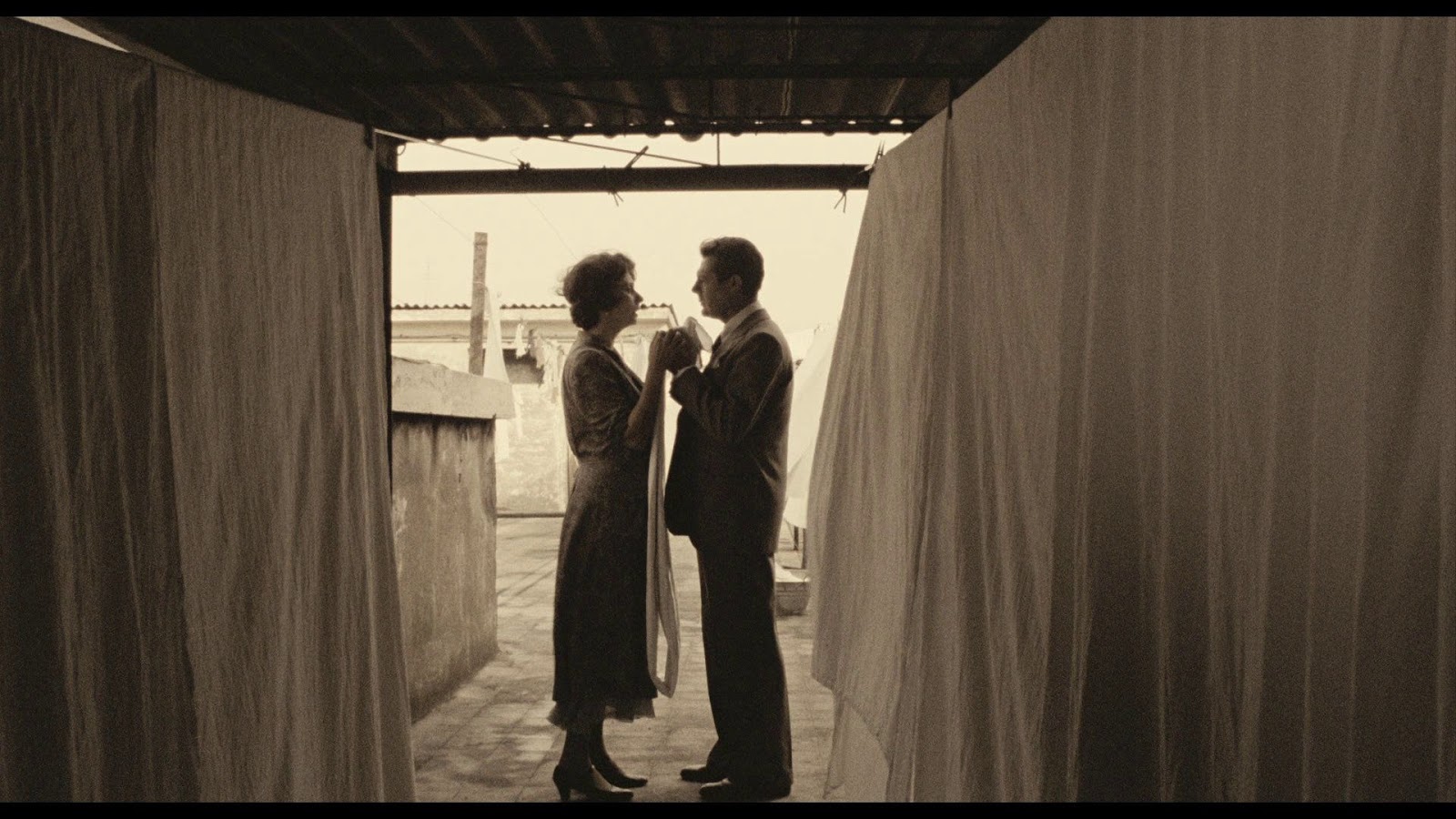
Scola’s direction opens with real-life newsreel footage of Hitler’s arrival to Rome in May of 1938 as he is greeted by Mussolini as if they’re old friends. Then it shifts to the main story as Scola would use some intricate and sprawling crane shots to get a scope of the apartment building inside the exterior of the main lobby as it’s shot in a largely sepia-like photography style where the only glimpses of colors are in a few objects including the flags for Fascist Italy and Nazi Germany. Scola would also create some unique long from this wide crane shot into a close-up of Antonietta’s apartment as she is getting her children ready while her husband does some exercise to get ready for the day. The usage of close-ups and medium shots add to some of the theatricality and intimacy into the scenes with Antonietta and Gabriele as they’re talking throughout the film while the one sequence where they’re outside on top of the apartment rooftop to get the former’s laundry is presented in a wide shot.
Scola’s usage of long-takes in the conversations between Antoinetta and Gabriele has him establishing not just their immediate awkwardness early on but also how they would get on during the course of the day. The camera would often move at times to get a look into the space of their respective apartments as well as what it looked like in the hallways and staircases. There is also this air of sexual tension yet it is Gabriele that is resisting as he knows someone who is gay that has been taken away as it play into the concept of masculinity from the point of view of Fascism. There is also a sense of repression in Antoinetta’s role as a housewife as it all revolves around the lack of power women have in their place in Fascism other than just be supportive. Its ending is about the state of the world and what Antoinetta would have to face though there is a little bit of freedom she would have in this world of Fascism. Overall, Scola crafts a mesmerizing and haunting film about two neighbors staying home during a celebratory parade for Adolf Hitler and Benito Mussolini.
Cinematographer Pasqualino De Santis does incredible work with the film’s sepia-drenched cinematography as it gives the film a look and feel that breathes an element of nostalgia but also repression in the way it looks while the few colors that are shown are on objects including the flags. Editor Raimondo Crociani does excellent work with the editing as it is largely straightforward to play into the drama without devolving too much into style. Production designer Luciano Ricceri does brilliant work with the look of the interiors of the apartment from the rooms that Antoinetta and Gabriele live to the staircase and hallways. Costume designer Enrico Sabbatini does fantastic work with the costumes as it play into the Fascist uniforms that many of the people wear with the exception of Antoinetta’s ragged dress and the suit that Gabriele wears. Sound mixer Franco Bassi does terrific work with the sound to capture the sound of the parade from afar as well as the sound of planes flying over the building. The film’s music by Armando Trovajoli is amazing for its bombastic and triumphant film score that is played on location as source music for the parade while the soundtrack also features elements of rumba and somber music that play into the drama.
The film’s wonderful cast feature a couple of notable small roles from John Vernon as Antoinetta’s husband Emanuele who is a fierce loyalist to the Fascist party with Marcello Prando providing dubbing on Vernon and Francoise Berd as the apartment building’s caretaker who isn’t fond of Gabriele believing him to be subversive and full of trouble. The performances of Sophia Loren and Marcello Mastroianni are phenomenal in their respective roles as Antoinetta and Gabriele. Loren provides a repressed sensuality to her performance as a woman that is just trying to maintain the household as well as having to do all of the things expected as a housewife. Mastroianni is also restrained in his performance while displaying bits of charm when he tries to teach Antoinetta how to dance the rumba. Yet, Loren and Mastroianni display a chemistry that is just intoxicating in the way they get to know each other as well as deal with their own sense of anguish as it’s a master class in acting from two of Italy’s finest.
Una giornata particolare is a tremendous film from Ettore Scola that features spectacular performances from Sophia Loren and Marcello Mastroianni. Along with its gorgeous cinematography, intimate setting, and themes of repression and longing, it’s a film that explore two people dealing with what is happening outside of their apartment as well as being aware of a world that is in chaos with neither of them having a say in this oppressive world. In the end, Una giornata particolare is a sensational film from Ettore Scola.
© thevoid99 2018
Based on the graphic novel The Coldest City by Antony Johnson and Sam Hart, Atomic Blonde is the story of a spy who travels to East Berlin to find a list of double agents before the collapse of the Berlin Wall during the final days of the Cold War. Directed by David Leitch and screenplay by Kurt Johnstad, the film is a spy thriller of sorts where a woman finds herself dealing with dark forces that want to stop during a crucial moment in world history. Starring Charlize Theron, James McAvoy, John Goodman, Til Schweiger, Eddie Marsan, Sofia Boutella, and Toby Jones. Atomic Blonde is a high-octane yet exhilarating film from David Leitch.
Set in November of 1989 during the final days of the Cold War and the collapse of the Berlin Wall, the film revolves around a British spy who travels to Berlin before the wall’s collapse to retrieve a list of double agents that was in the hands of another spy. It’s a film with a simple premise yet it’s told in a reflective flashback style by its protagonist Lorraine Broughton (Charlize Theron) who is interrogated by her superior in MI6 executive Eric Gray (Toby Jones) and CIA agent Emmett Kurzfield (John Goodman) over what happened in Berlin as much of the action takes place more than a week earlier where Broughton learns a fellow colleague had been killed as he had a list of double-agents in East Berlin that the Soviet Union wants. Kurt Johnstad’s screenplay plays into the back-and-forth narrative of Broughton telling her story of what had happened as she had been sent by Gray and MI6 boss C (James Faulkner) to travel to West Berlin before the wall is to collapse where she meets her contact in another MI6 agent in David Percival (James McAvoy) to help her retrieve the list.
Percival is an eccentric figure who spends time dealing in black markets in East Berlin as well as live in West Berlin as he is trying to get the list as well as a Stasi defector named Spyglass (Eddie Marsan) to West Berlin as he knows the names on the list that was hidden in a watch from the MI6 agent who had been killed. During the course of finding out what happened and to find this watch, Broughton is aware that she’s a target as there’s KGB spies in both East and West Berlin as she had also been warned about a double-agent named Satchel who might be causing trouble for all sides. At the same time, she meets a rookie French spy named Delphine Lasalle (Sofia Boutella) who also wants the list but also knows that there’s something not right in the scheme of things. Even as there’s also rogue KGB agents that want the list and sell it off for a lot of money no matter who gets it making Broughton’s mission much more difficult.
David Leitch’s direction is definitely stylish in terms of the setting as it play into a moment in time where the world is about to change as there are those who aren’t ready for this kind of change. Shot on location in Berlin with additional shooting set in Budapest, the film does play into a world that is changing yet there’s also something exciting over the element of rule breaking and chaos that is to emerge. While Leitch does include many of Berlin’s famous landmarks including a few shots of the re-created Berlin Wall with graffiti sprayed on the wall. Much of Leitch’s direction emphasize on the sense of intrigue as well as who is trying to con who and who can be the one to get the list first as Leitch would use close-ups and medium shots for these moments without emphasizing too much on style. There are some wide shots Leitch use in not just to establish the locations or what is happening in a moment in time but also in some intense set pieces that relate to the action including a scene where Broughton is in a car and fighting against a couple of KGB officers trying to kill her.
One key sequence in the film during the second act is an intricate fight scene set inside a building where Broughton is fighting against several KGB officers as it is presented in a long continuous shot with tracking and hand-held cameras. It’s a moment in the film that really showcases what Broughton has to do as the stakes of her mission becomes important yet there are also these twists and turns as it relates to the people she encounters as there are very few she can really trust. Notably as the scenes where she’s interrogated as she knows she’s being watched emphasize what she knows and what she doesn’t want to reveal as it does add to this blur of who is in the right and who is in the wrong. Overall, Leitch crafts a thrilling and gripping film about a British spy traveling to Berlin to retrieve a list of double agents before the collapse of the Berlin Wall.
Cinematographer Jonathan Sela does brilliant with the film’s colorful cinematography with its usage of bluish lights and moods for some of the interior scenes as well as the usage of neon lights in the clubs as well as other stylish looks for some of the daytime exterior scenes. Editor Elisabet Ronaldsdottir does excellent work with the editing with the usage of stylish fast-cuts without being too fast as well as some amazing invisible cuts for the film’s continuous fight sequence. Production designer David Scheunemann, with supervising art director Zsuzsa Kismarty-Lechner plus set decorators Zsuzsa Mihalek and Mark Rosinski, does fantastic work with the look of the clubs in Berlin as well as the apartments and places the characters go to or live at. Costume designer Cindy Evans does nice work with the costumes as it is stylish from the coats the characters wear to the Soviet and Stasi uniforms some of the officials wear.
Hair/makeup designer Paul Pattison does terrific work with the look of the characters from the different wigs and hairstyles that Broughton wears as well as the look of some of the people she meets. Special effects supervisor Gabor Kiszelly and visual effects supervisor Michael Wortmann do superb work with the visual effects as it is mainly set-dressing for some of the exteriors along with a few of the film’s action scenes. Sound designer Jonas Jansson, with sound editors Thomas Huhn and Nicklas Lindh, does amazing work with the sound in capturing the way music sounds in a club or on speakers as well as through the audio tapes that Broughton uses to spy on people and how she would cut the tapes to create what she discovered. The film’s music by Tyler Bates is wonderful for its electronic-based score that play into the action and suspense while music supervisor John Houlihan provides a kick-ass soundtrack of music that definitely play into the period of the 1980s from artists and acts like New Order, David Bowie, Queen, Depeche Mode, Information Society, the Reflex, After the Fire, Nena, Peter Schilling, Til’ Tuesday, A Flock of Seagulls, the Clash, George Michael, Siouxsie & the Banshees, and Public Enemy along with covers by Health, Marilyn Manson, and Kaleida plus a couple of Eastern European music of the times.
The casting by Zsolt Csutak, Marisol Roncali, and Mary Vernieu is marvelous as it feature some notable small roles and appearances from Barbara Sukowa as a coroner of the spy who is killed earlier in the film, Sam Hargrave as the MI6 agent James Gascoigne who is killed in the film’s beginning, Johannes Johannesson as the rogue KGB agent Yuri Bakhtin, Roland Moller as a high ranking Soviet official in Aleksander Bremovych, James Faulkner as the MI6 head C, Bill Skarsgard as Broughton’s East German contact in Gordon Merkel, and Til Schweiger in a terrific small role as a reclusive watchmaker who creates special watches with codes as he helps out Broughton. Toby Jones and John Goodman are superb in their respective roles as MI6 superior Eric Gray and CIA official Emmett Kurzfield who interrogate Broughton over what happened in Berlin with the latter also making a brief appearance in West Berlin to give Broughton a debriefing.
Eddie Marsan is excellent as Spyglass as Stasi officer who wants to defect to the West as he knows the names of the double-agents where he becomes someone that Broughton has to protect. Sofia Boutella is fantastic as Delphine Lasalle as a French agent who is also after the list but also has feelings for Broughton as well as be aware of what is going on as she also has an idea of who the mysterious Satchel is. James McAvoy is brilliant as David Percival as a MI6 agent who aids Broughton as he also runs a black markets scheme in East Berlin as it’s an exciting performance from McAvoy who provides a lot of humor and swagger into his performance. Finally, there’s Charlize Theron in a phenomenal performance as Lorraine Broughton as a MI6 spy who goes to Berlin to retrieve a list as it’s an intense performance from Theron who brings some charm as well as a grittiness to the role as a woman who is hell-bent on succeeding in her mission as well as deal with what is at stake as it’s Theron in one of her career-defining performances.
Atomic Blonde is a tremendous film from David Leitch that features an incredible leading performance from Charlize Theron. Along with its supporting ensemble cast, dazzling visuals, intense fight scenes, and a killer music soundtrack. The film is definitely a fun and thrilling action-suspense film set during the final days of the Cold War that is filled with intrigue and excitement. In the end, Atomic Blonde is a spectacular film from David Leitch.
David Leitch Films: John Wick - Deadpool 2 - (Fast & Furious Presents: Hobbs & Shaw)
© thevoid99 2018
For the 18th week of 2018 as part of Wandering Through the Shelves' Thursday Movie Picks series hosted by Wanderer. We venture in films in which characters start over in the hope they embark on a new start in life. Here are my three picks:
1. Alice Doesn't Live Here Anymore
From Martin Scorsese comes a film that might seem unusual for a filmmaker who is known mainly for making films about men and their environment and flaws but this gem from 1974 proves that he can also tell stories about women. Starring Ellen Burstyn as a woman whose husband just died as she moves to the American southwest with her son in the hopes they can start a new life. It’s a film that has Scorsese play into the struggle that a woman endures as she has a son who is bratty and talkative while dating men who aren’t so nice with the exception of a rancher. Add Jodie Foster in the role of a tomboy who would get Burstyn’s son into all sorts of shit and you have one of Scorsese’s finest films that is often overlooked.
2. Private Benjamin
A woman’s life is shattered following the death of her husband (Albert Brooks) on their wedding night and what does she do? She joins the army. It’s a hilarious premise in a film starring Goldie Hawn as a Jewish princess who gets everything she wants and then is forced to start over by joining the army in the belief that it’s a holiday spa by her army recruiter played by the late, great Harry Dean Stanton. Along the way, Hawn manages to find herself and eventually realizes that she doesn’t need a man to make her happy. Only she can do that herself as it’s one of the great comedies of the 1980s.
3. Mother
In another film that starred Albert Brooks is a film he also writes and directs about a sci-fi writer who endures another divorce and questions his own direction in life as he decides to start over by moving back home with his mother. Also starring Debbie Reynolds as Brooks’ mother, it’s a charming little comedy about a man trying to figure things out as well as re-establish his relationship with his mother who had been carrying secrets of her own. It’s one of Brooks’ finest films as a filmmaker as well as one of his most accessible films to date.
© thevoid99 2018
Written, directed, edited, and co-starring John Cassavetes, Husbands is the story of three men who hang out together as they deal with the death of a friend as they’re forced to deal with their own sense of mortality and next step in their lives. The film is a look into the lives of three friends who have all succeeded professionally and personally but deal with the specter of death as they wonder what will happen next when the unexpected happens. Also starring Ben Gazzara, Peter Falk, Jenny Runacre, Jenny-Lee Wright, and Noelle Kao. Husbands is a riveting and compelling film from John Cassavetes.
The film follows three men who all deal with the death of their friend as they ponder what to do next as they would try to reclaim elements of their youth amidst a mid-life crisis. It’s a film that play into these three men as they spend much of their time going out and just ask questions about life while they also deal with the state of their own lives professionally and personally. John Cassavetes’ screenplay is loose in terms of its structure as it doesn’t have much of a plot in favor of exploring these three men just doing whatever they can to pass the time whether it’s to go to a bar and drink or go to a gym and play basketball. Much of it has these three men figuring things out as Archie (Peter Falk) is talking about what he’s thinking while Gus (John Cassavetes) is dealing with what is next. Then there’s Harry (Ben Gazzara) who is a businessman with a marriage that is falling apart as he decides to go to London and takes Archie and Gus with him. The first half is largely set in New York City and areas nearby while the second half takes place in London where the three men get drunk, gamble, and meet other women as it would become this key moment of realization over their lost youth.
Cassavetes’ direction is very loose in terms of its presentation where there are no sets used in favor of shooting everything on location whether it’s in New York City and nearby areas as well as London for the film’s second half including a few scenes inside airplanes. While there aren’t anything stylized throughout the film, Cassavetes does maintain a sense of realism as he would shoot long monologues in one take while keeping the settings simple in the way he would frame a shot whether it’s in a close-up, a medium shot, or a wide shot. Though the film’s lack of plot and long takes would meander the film’s pacing where some of these moments go on for too long. Cassavetes would play into the sense of uncertainty these three men endure as well as the women they meet in London where the realization that they’re married and have kids come into play. Cassavetes’ editing is straightforward with a few jump cuts as it help play into the drama including the film’s climax as it relates to the decision of one of the characters and the reaction of the two. Overall, Cassavetes creates a captivating film about three men facing mid-life crises following the death of a longtime friend.
Cinematographer Victor Kemper does excellent work with the film’s cinematography as it is largely straightforward to play into the film’s realistic presentation. The sound work of James Perdue is terrific for its natural approach to sound to capture everything on location including the music as the only piece used that wasn’t recorded on location is a jazz piece during the film’s opening scenes.
The film’s incredible cast include some notable small roles from Nick and Xan Cassavetes as Gus’ kids, Eleanor Cody Gould as a singer at a bar, Claire Malis as the widow of the men’s dead friend, Meta Shaw Stevens as Harry’s wife, Lorraine MacMartin as Harry’s mother-in-law, Noelle Kao as an Asian woman Archie tries to flirt with in London, Jenny Runacre as Mary Tynan whom Gus tries to sleep with in London only for things to not work out, and Jenny Lee Wright as a Londoner named Pearl whom Harry meets and falls for during his time in London.
John Cassavetes is brilliant as Gus as a man that is lost in his grief as he tries to cope it with through sports and drink as his time in London would give him time to realize that he’s not a young man anymore. Peter Falk is fantastic as Archie as a man that is constantly talking about what he thinks in the wake of their friend’s death as he comes to term with himself and his own realization about his life. Finally, there’s Ben Gazzara in an amazing performance as Harry as a businessman that is dealing with a failing marriage as he is eager to reclaim his youth and lust for life as well as the fact that he is starting to lose sight of reality.
Husbands is a brilliant film from John Cassavetes. Despite its slow and meandering pacing in some parts of the film, it is still a fascinating film that explores three men dealing with loss as well as uncertainty as they reach middle age in their journey to reclaim their youth. In the end, Husbands is an excellent film from John Cassavetes.
John Cassavetes Films: (Shadows) – (Too Late Blues) – (A Child is Waiting) – (Faces) – (Minnie and Moskowitz) – A Woman Under the Influence - (The Killing of a Chinese Bookie) – (Opening Night) – Gloria (1980 film) - Love Streams – (Big Trouble (1986 film))
© thevoid99 2018